I recently read Matthew Parker’s superb Monte Cassino. It provides an evocative account of the battle in the mountains south of Rome, after the Allies took Sicily, landed in Salerno, took Naples, then were fought to a standstill by the massive fortifications of the German forces’ Winter Line (in particular the Gustav Line). A protracted stalemate took place around town of Cassino.
So evocative is the book, it got me wondering – why aren’t there more, better, or better-known war films set during the Italian campaign? And why, in particular, has the monumental conflict set in and around Cassino not been fictionalised?
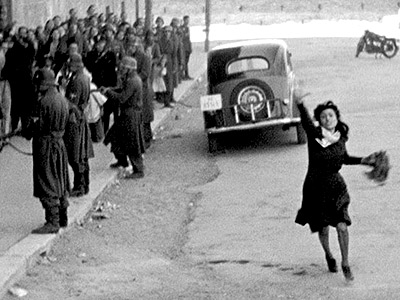
There are many films set in Italy during World War II, though perhaps the best are things like Roberto Rosselini’s Rome, Open City (Roma, Città Aperto, 1945), which maps the lives of ordinary civilians in Rome during the Nazi occupation in 1944. Rosselini shot the film mere months after the Nazis had left the city. I must admit here that I’ve not seen its companion piece, Paisà (Paisan, 1946), which might be something of a missing link for this essay, which is focussing more on the combat of the Italy campaign.
In terms of English language, international WWII Italian campaign films, which focus more on the experience of combatants, among the best from the early era – made during or just after the war – is Lewis Milestone’s A Walk in the Sun (1945). Milestone directed one of the best ever (anti-) war films, 1930’s WWI drama All Quiet on the Western Front, so in some ways his own bar is set too high. But A Walk in the Sun is still an interesting picture, presenting, philosophically, something of the uncertainty in ‘liberating’ a country that was not long before an Axis power. There’s a point in the film where Italian soldiers surrender to the protagonist US troops. For many of the Italian soldiery, the Allied landings in Salerno were a welcome end to their experiences, though the Italian situation is a complex one, and the soldiery will have of course represented the broad political spectrum of Italy itself.
Italy had been officially a Fascist state for longer than Germany. Benito Mussolini’s National Fascist Party (Partito Nazionale Fascista, PNF) was elected in 1922 – a full decade before the Nazi party achieved dominance in Germany, and 11 years before Hitler became Chancellor. So after the armistice of September 1943, Italian Fascists didn’t simply evaporate. And there was no possibility for a clear narrative of ‘liberation’. Many Italians were still Fascists, or at least sympathetic to the cause, which the Nazis were able to maintain via an Italian Fascist party power base in the north, with the PNF becoming the Republican Fascist Party (Partito Fascista Repubblicano, PFR).
Indeed, even after Mussolini’s killing in April 1945, and after the war, Fascism has remained a strong part of the Italian social and political landscape, albeit of a re-branded variety. It was not faced up to in the same way as it had to be in (occupied) Germany. Italy is a country without a vocal political centre, and through much of the 20th century extreme left-right tensions flared, notably in the years of terrorist attacks known as the Anni di Piombo, Years of Lead (1960s-1980s). Living in Rome today, I can tell you in no uncertain terms that extreme rightwing attitudes remain alive from the sheer amount of Fascist sloganeering and swastikas in graffiti and the tone of some posters, such as those with an anti-immigration message (“Immigrazione è invasione”).
 Anyway, the point I’m making is that Italy was a mess in 1943-45, its war narrative is hugely complex. There was no simple case of the Allies arriving, and being welcomed, as they were in, say, Holland or Belgium. Within any village an abiding tension between left and right could potentially be found. Read, for example, Eric Newby’s Love and War in the Apennines (1971), an account of his time hiding in the mountains in northern Italy’s Po Valley, after he left his POW camp in 1943 – the Italian guards simply walking away after the armistice. Newby is frequently on the move, sheltered by various peasants, who live in fear of being shopped by neighbours. (See Addendum 3, below.)

This matter of the Italian soldiers leaving their posts as POW camp guards is seen on screen in Von Ryan’s Express (1968), a big, glossy film that combines elements of the escape and the combat film. It begins with Frank Sinatra’s Air Force colonel Ryan shot down and taken to a camp, which is mainly populated by British soldiers under a stuffy Major, played by Trevor Howard – an actor whose posh, stiff upper lip (and arguably slightly neurotic) version of masculinity hasn’t dated well in such roles. Especially since the story emerged that he wasn’t actually a war hero, as had been claimed: he was kicked out of the army for having a “psychopathic personality”. (Though I’d like to know the source of that info included at the bottom of this newspaper article.) Anyway, after the armistice, the camp’s commander, a Blackshirt, begs for his life, takes off his cap, spits on its Fascist badge. Later he’s saved by the Nazis, and realigns himself. He’s something of a caricature, but it’s easy to believe that in his period loyalties were indeed fluid.

American combatants are the focus of another of the bigger Italian campaign war films, released the same year as Von Ryan’s Express: Anzio. This was legendary Italian producer Dino Di Laurentiis’ attempt to produce something loosely comparable to things like the D-Day epic The Longest Day (1962). The Anzio landings, like the Battle of Monte Cassino, are a historically notable element of WWII, but again, even more so than was the case with Monte Cassino, aren’t easy to apply a heroic narrative to. Anzio, a port city in Lazio region, and nearby Nettuno, were the landing points for the Allied troops taking part in Operation Shingle, which was designed to break the deadlock of Monte Cassino, through the creation of a bridgehead further north along the shin of Italy. The American generals in charge, John P Lucas and Mark Clark, were, however, so concerned to fortify their bridgehead, they moved slowly, allowing German forces – who had in fact been caught on the hop – to dig in and create more formidable defences.
There’s the potential for a fascinating film there. Anzio, unfortunately, isn’t that film. The film’s starting point was apparently a 1961 book of the same name by respected war correspondent Wynford Vaughn-Jones, who took part in Shingle reporting for the BBC. It’s hard to believe it though, as the film descends into cliché, with the usually reliable Robert Mitchum plodding through much of the film looking bored as a cynical war correspondent ultimately forced to take up arms. Co-star Peter Falk, meanwhile, didn’t like the script and wanted to flee, but Di Laurentiis gave him the option to write his own dialogue (according to a Wikipedia reference to his autobiography). It doesn’t exactly shine through. I do like, however, how the film at least acknowledges Falk’s glass eye – after a brawl near the beginning he complains that whatever hit him in the eye felt like a “lead pipe”.

A film that manages to actually address something of the complexity of the Italian campaign, and the Italian situation, is a more recent affair, Miracle of St Anna (2008). Spike Lee undertook this project in an effort to redress an abiding issue in American WWII films: their lack of representation for African-American troops. This is an enormous and thorny issue, but the grievances are understandable when African-American troops died for a country that was still grotesquely segregated, two decades before the Civil Rights movement began to break down some the USA’s version of apartheid.
Lee was particularly riled by the absence of black faces in Clint Eastwood’s Iwo Jima diptych Flags of Our Fathers and Letters from Iwo Jima (both 2006). I won’t go into their high-profile slagging match too much here either, but Eastwood accused Lee of not knowing his history, to which Lee replied “I know history. I’m a student of history. And I know the history of Hollywood and its omission of the one million African-American men and women who contributed to the second world war. Not everything was John Wayne, baby.”
His response was Miracle of St Anna, which tells the story of a group of soldiers from the 92nd Infantry Division, an African-American unit (though with white officers). The 92nd fought in the Italian campaign from 1944 to the end of the war, in the Apennines. I must admit when I first tried to watch the film, I struggled. I’m a fan of many of Lee’s films, but here I found the score too intrusive, and didn’t entirely buy the way the characters were written, they didn’t feel credibly of the 1940s. But on a second viewing, I got on with it much better – indeed, it’s safe to say it’s one of the best, most interesting Italian campaign films. Not only for how it puts black soldiers front and centre, but for how it engages with Italians, and the political complexities.
The heroes (played by Laz Alonso, Derek Luke, Omar Benson Miller and Michael Ealy) are stranded behind enemy lines in Tuscany, and hole up in a village. There, they meet partisans, whose leader (Pierfrancesco Favino) and best friend/right hand man (Matteo Sciabordi), have conflicting political backgrounds and agendas. The narrative is far from easy: the black heroes are fighting for white officers who (mostly) treat them with callous disregard, for a country that has cafés that will serve German POWs but not them, despite their nationality, their patriotism, their uniforms. The partisans they meet, meanwhile, should be allies, but one betrays their trust as he’s got insidious dealings with the Nazis.
There’s actually an interesting sub-sub-genre of WWII films that deal with the contributions to the conflict of non-white soldiers. You may know Windtalkers (2002), which featured Navajo soldiers deployed by the US Army for radio communications in the Pacific theatre: as the Axis forces couldn’t “break” their language. There’s also another film about Native Americans fighting in WWII called Thunderbirds (1952), though as far as I recall it never graced TV screens in my UK 1970s-80s childhood (where I first learned to love WWII movies), and it’s not surfaced on DVD, so I don’t know much about it, except that is does feature the soliders landing at Salerno for the Italian campaign.
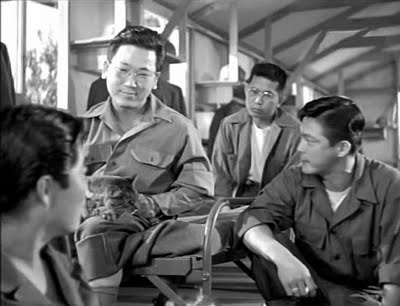
Go For Broke! (1951) is from a similar era to Thunderbirds – perhaps in the early 1950s there was a crisis of conscience in America about certain ethnic groups who fought for the nation in WWII. This one was presumably to in some part try and compensate for the mistreatment of Japanese-Americans who were interned. Its protagonists, from the 442nd Regimental Combat Team – made up of Nisei, Americans born to Japanese parents – are natural heroes for a movie, as they were one of the war’s most highly decorated outfits. It’s a remarkable story. Some of the troops in the film are Hawaiian Japanese-Americans (there’s plenty of ukulele action) who have suffered from the Japanese attack on Pearl Harbour attack. Others, mainlanders, get letters from home with news of mistreatment such as beatings and threats of lynching. “We’re good enough for German rifles, but not for picking sugar beet,” remarks Sam (Lane Nakano).
They’re not sent to the Pacific theatre unless they speak perfect Japanese (for intelligence work), as there’s a concern about friendly sniper fire, so instead they’re shipped to Italy. The film was shot in California, but uses stock footage of Naples and beyond, as the men – whose fellow Nisei in the 100th fought at Cassino – hike most of the way up Italy, their very white Texan lieutenant Grayson (Van Johnson) slowly overcoming his prejudices as they go, even to the point of slugging a fellow Texan who calls them “Japs”, rather than Japanese-Americans, Nisei or even “Buddha Heads”, their acceptable slang name.
It’s a pretty conventional film for the most part, with its various characters in the platoon, and uncomplicated portrayals of heroism, but the ethnic angle is fascinating. Even if the star is Johnson.

At one point in Go For Broke!, Grayson is fleetingly innamorato with an Italian signorina, who has a two-sided photograph, of her previous US lover on one side, and a prior German lover on the other. It’s a scene that recalls one of the very few Italian films I’ve seen that actually features Italian soldiers, where there are reversible portraits of Allies and Axis dignitaries. Il Due Colonnelli (The Two Colonels, 1962). This one isn’t actually set in Italy, it’s in Greece, where Italians and Brits vie for control of the same village, and the affections of its populace. It’s a broad, and distinctively Italian, comedy, which isn’t afraid to present the Italian soldiery as, by and large, foolish wastrels, though none is as bad as their commanding officer, a picolo Mussolini played by legendary Italian actor Totò, who apparently improvised most of his films.
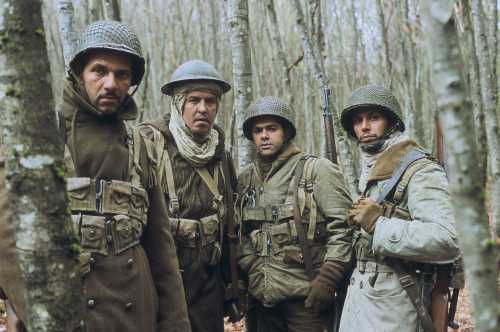
It’s not just the US that has produced films that highlight the sacrifices of non-white troops in WWII. Another fascinating film that features non-white soldiers and has sections set in Italy is Indigènes (aka Days of Glory, 2006). This Algerian-Belgian-French-Moroccan co-production directed and co-written by French-Algerian Rachid Bouchare, like Lee’s film, follows many of the hoary war-film conventions, notably by following a squad of bickering, bantering, diverse brothers-in-arms, living and dying together. Plus, again like Lee’s film, it’s one of the many WWII films that followed the revitalisation of the genre by Saving Private Ryan (1998). However, here the focus is on forces that may well have never been seen in a WWII previously: Algerian Tirailleurs and Tunisian or Moroccan Goumiers, the “indigenous people” of the title. It’s a fascinating film, but not necessarily a good war film, feeling flat in places, and I know it’s probably not politically correct to say it, but I struggled with the presence of Jamel Debbouze. He might be one of France’s biggest stars of North African origin (and is a good presence in things like Amélie and Asterix at the Olympic Games), but unlike the film itself, I found it hard to ignore his paralysed arm – something that in reality would have prevented someone from becoming a soldier, let alone actually firing a rifle.
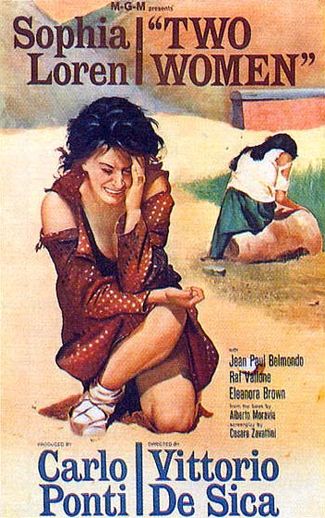
Tirailleurs and Goumiers played a major role in, for example, the worst of the fighting at Monte Cassino, and the efforts of Bouchare and Debbouze (star and co-producers) to use the film to address the issues of their rights are commendable. The film ends with a note that says the servicemen had their pensions frozen in 1959, three years after Tunisian and Moroccan independence and three years before Algerian independence. But there are stories about the Goumiers in Italy that didn’t find their way into the film. One very different portrait of the Goumiers can be found in Vittoria De Sica’s La ciociara (aka Two Women, 1960). This film dealt with the Marocchinate – an Italian word loosing meaning “the Moroccans’ acts” and used to refer to the mass rapes and even killings allegedly perpetrated by Goumiers on villagers in the Ciociaria region of central Italy, after the Allies broke through at Monte Cassino. Parker deals with this subject diplomatically in his book.
Suffice to say, there are open wounds for both the Goumiers mistreated bythe French military and government and the Italians who suffered at the hands of the Goumiers. There’s truth to be found, doubtless, in both Indigènes and La ciociara; between the two films, the complexities of the circumstances in Italy during WWII are hightlighted.

To get back on firmer ground, one of the greatest ever war films is Samuel Fuller’s The Big Red One (1980/reconstructed version 2004). It’s another film that utilises the classic squad format, and in other ways may be have been something of a template for Indigènes, notably in how it follows said squad through their experiences of various campaigns, a kind of bloody picaresque. Indeed, both films share the same trajectory: North Africa, Italy, France.
Although Fuller’s film looks and feels in some ways dated in an era when filmmakers like Spielberg can use CGI to fill the ocean off Normandy with ships, or give a gritty, graded realism to his footage of Omaha beach, replete with amputee actors ‘losing’ limbs to explosions, in other ways it’s a more authentic film than Saving Private Ryan will ever be. Why? Because Fuller himself was a highly decorated member of the Big Red One, the nickname for the US 1st Infantry Division, and did indeed see action in North Africa, Sicily, France and was at the liberation of Falkenau in Czechoslovakia in May 1945, setting for the film’s denouement. Furthermore, the film’s leading man, Lee Marvin, was also a veteran, who won a Purple Heart while fighting in the Battle of Saipan as a Marine.
The protagonists land in Sicily in July 1943, where one private loses a testicle to a mine. “You can live without it, that’s why they gave you two,” Marvin’s grizzled Sergeant tells him. It’s darkly humorous, at times farcical, such as when the squad captures a Hitler youth. When the Sergeant spanks him, his cries of “Heil Hitler! Heil Hitler!” turn into “Pappy! Pappy!”
The film is so episodic that much of it doesn’t take place in Italy at all, but its Sicily sequences capture something of the grimness and confusion of the Italian campaign. The squad in The Big Red One aren’t movie heroes per se, they just literally just solider on, from battle to battle. The only glory in war, according to Fuller’s stand-in character, Zab (Keith Carradine), is survival.

Survival, of course, being something that’s tantamount to impossible in Joseph Heller’s classic satire of war Catch-22, published in 1961 and adapted for the screen in 1970. The premise of the film is the ever-increasing number of missions its bomber crew protagonists must fly before they qualify to be sent home on leave. The number is so high that it exceeds the average life expectancy of missions. Which in itself is a catch, but the explicit catch of the book and film is that if a man applies for a psych evaluation to prove he’s insane, and can therefore be grounded, he’s clearly sane. The US airmen of the film are based on Pianosa, an island off the coast of Tuscany.
B-25s, the bombers featured in Catch-22, were among the aircraft involved with the bombing of Monte Cassino monastery and abbey on 15 February 1944. I can’t find out where the bombers that hit the monastery took off from, but it certainly wasn’t Pianosa, which, in reality, is too small for such a substantial airbase. The bombing of the monastery, remains, however, perhaps the most dubious episode in the Italian campaign, which as a whole was by no means straightforward – and as such, while it has produced a highly varied section of films, none of them are themselves straightforward combat films.
The Italian campaign is too hard to shape into the kind of neat black and white narrative; it’s harder to reiterate notions of a the “just war” or “good war” when one reads about Monte Cassino, which could be considered the focal point of the Italian campaign. It was a battle – or series of battles – that was mired in shame, folly, and terrible losses. Not only was the destruction of the monastery infamous, but the combat itself was as wasteful of human life as the most notorious battles of the World War I.

It’s not just an issue of how problematic the battles of the Italian campaign were, but also the very nature of Italy. By comparison, de Gaulle and co did an impressive job of creating an official version of WWII history for France, where the nation was occupied, brave French fought in the Resistance, and were extremely glad to be liberated by, well, not exactly the Allies, but by de Gaulle. The question of the French right wing and the infrastructure of collaboration was largely suppressed, and only articulated successfully after decades had passed, with such things are Marcel Ophul’s epic documentary The Sorrow and the Pity (Le chagrin et la pitié, 1969), which dared question the Resistance mythology, and reminded the nation of its anti-Semitism. Italy not only lacks any true classic WWII combat films, it has nothing comparable with Ophuls’ film (as far as I know). Instead, more recently, Italy itself has produced things like La vita è bella (Life is Beautiful, 1997) and Malèna (2000), which feature the experiences of civilians, and how they’re affected by the war.
Anyway, this was meant to be just a short-ish blog post responding to reading Parker’s book and considering a few war films, but it seem to expand somewhat. I’ve probably missed several films, and missed several points too, but hopefully it’s food for thought.
Addendum:
Managed to watch The Secret of Santa Vittoria finally.
It’s a somewhat laboured film, and I struggle with ‘accent movies’ generally. Here they have a Mexican star and various Italian co-stars and extras all speaking English. But it has some merit as a (somewhat fanciful) portrait of a village during the war. It’s not strictly in the purview of a piece about movie portrayals of combat during WW2’s Italy campaign – I don’t believe a single shot is fired – but here are a few comments.
It starts just after Mussolini has been deposed: it’s “the end of the Fascists!” Said Mexican star, Anthony Quinn, plays Bombolini, a fool and drunkard in the wine-producing village of S Vittoria. By a quirk of fate, he becomes mayor.
The film chronicles his transformation to a wily leader (of sorts), who’s cunning enough to take on a German army captain (Hardy Krüger), whose forces occupy the town, in a battle of wits. This involves the matter of S Vittoria’s wine. Bombolini is inspired by reading Machiavelli’s The Prince and a suggestion from a recuperating Italian solider (Sergio Franchi) to hide the majority of their million bottles in tunnels, and brick them up.
Director Stanley Kramer enjoys giving us portraits of the local extras, contorte contadini and no mistake, but there’s a strong sense of disjunction between the international stars and the local extras. Though Anthony Quinn and Anna Magnani (who plays the long-suffering signora Bombolini) have an interesting rapport. The couple’s on-screen feuding was apparently backed up by off-screen loathing, with her demonstrating her renowned fieriness by breaking a toe kicking him, and drawing blood while biting him filming a fight scene.
Addendum 2:
Red Tails is a modern (2012) WW2 film from Lucasfilm, produced by Rick McCallum and executive produced by George Lucas. Lucas, as any Star Wars fan or general observer of the seismic shifts in popular culture of the past 40 ish years will know, is a huge fan of WW2 films, and the world of Star Wars was profoundly influenced by the iconography of the WW2 aerial dogfight, such as that found in such films as Angels One Five (1952) and Battle of Britain (1969). There is a very clear, tangible line between the dogfighting in such films and the iconography of the space battles between X-Wings and TIE fighters in the original Star Wars films, created with sophisticated use of traditional special techniques involving models and matting, as well as innovative computer-controlled (motion control) cameras.
The CGI technologies deployed to grotesquely recreate this universe in the over-adorned Star Wars prequels has now been used to create the aircraft action in Red Tails. It’s gone full circle. So oddly, although the special effects sequences in Red Tails are impressive, they also suffer from that innate sense of airlessness and artificiality that can accompany excessive deployment of CGI. But perhaps more troubling, the aircraft in the film seem to behave like X-Wings. Were WW2 prop-fighters really quite so manoeuvrable?
Just to backtrack a moment, Red Tails concerns the Tuskagee Airmen, African-American who fought in WW2 as part of the US Army Air Corps. As such, the film arguably fits into the sub-sub-genre mentioned above concerning the contributions of non-white ethnic groups to a war where many of their comrades and allies disdained them.
It’s a fascinating story, though this film doens’t exactly do it justice – it’s both troubled by the heavy CGI aesthetic and a profoundly hoary storytelling mode, predicated on thinly written characters that conform to the war movie requirement to have a squad made up of bitching, bonding stereotypes (the maverick lothario, the captain with a drinking problem, the kid, the religious kid etc).
Still, Red Tails provides one of the few American WW2 films where the combat (almost) all plays out in Italy. Here, it starts with the Tuskagee Airmen’s 332nd Fighter Group in Italy in 1944, harrying German supply lines, strafing trains and trucks. It’s an important job but they aspire to more, feeling they’re kept away from the real action because of their ethnicity. Their colonel (played by Terrence Howard) argues their case in Washington, and the group is brought in to Operation Shingle, providing support for the landings at Nettuno and Anzio. This helps cement their reputation as skilled airmen, and they’re subsequently assigned to bomber escort. They even get their old P-40s upgraded to P-51s (Mustangs). It’s not exactly the glorious dogfighting opportunity some of them craved but a way to prove their skills and abilities once and for all. Oh, and they do get to do some fancy dogfighting, even contending with the German’s remarkable new Messerschmitt Me 262. The film credits them as being the first to shoot down one of these fast jets, one of its historically questionable inclusions.
Anyway, Red Tails is not a great film, but it’s an interesting addition to the catalogue of WW2 Italian compaign films.
Addendum 3:
There is a TV movie based on the book, 2001’s In Love and War, and while it’s largely inoffensive, it’s very cursory compared to the Newby’s account. It’s a shiny, amiable, superficial romance, which skims over so much of Newby’s actual experiences. It doesn’t even mention the fact that the girl he met, who would become his wife, Wanda, was Slovenian not Italian. It’s a bit of a Euro-pudding like that, with the Italian, and Italian-speaking characters, slipping in and out of speaking Italian and speaking English with Italian accents.




 Bread, Cakes And Ale