Category Archives: Rome

Non capisco

We’ve been in Italy for just over two months now. I’ve been studying Italian for about eight weeks, for about three hours each weekday. And I’m still utterly, utterly rubbish. In fact, I feel like I’m going backwards. Every encounter with an Italian speaker follows the same pattern – I manage to ask a question, just about, then they reply at a natural pace and I’m lost. Frustration and embarrassment ensue, to greater or lesser degrees depending on how low my generally meagre confidence is that day.

I’ve changed classes a few times already as teachers have left or been shuffled around. My first teacher was great, and made me feel very comfortable blundering through my first attempts at Italian. My second teacher was a blustering arse, who was uninterested in males and seemed to prefer a mode that involved a weird blend of bullying and brutish flirtation with the females. I changed classes. My third teacher was also good. But things were getting harder, and increasingly I’ve struggled to follow the flow. I always imagined language learning would be a gradual process of improvement, but currently I very much feel like I’m going backwards.

This week I’ve been with a fourth teacher – apparently an academic who’s written theses in Latin – who is also nice, but the class has been an enormous struggle. This is partly because it’s full of cocky, confident twenty-ish continental blokes, who all seem to already speak two or more languages (one guy rattled off a list of about five). In such circumstances, I’m utterly ashamed. Ashamed to be an inept monolinguist, grandson to a guy who spoke seven languages. And ashamed to be British. We really are crap with languages, especially now. The British empire of the 19th century, then the US empire of the 20th century may have made English a key international language, but while our empire is gone, the US empire is also on the decline, notably with the rise of China as the pre-eminent global power and trading nexus.

It’s a period when we really should be emphasising languages more at school, but instead they seem to be in decline. According to this article, the past decade and a half has seen GCSE and A-level French and German almost halving in the UK. Which may not really be a problem in an era when Mandarin and Spanish are surely becoming the most important global languages. But it also says uptake of “Chinese” has dropped, by, what, about 6%. It’s a real shame.

What’s also a shame is the very structure of language education in Britain, or at least my experience of it. I learned French at secondary school, for five years, between the ages of 11 and 16 ish (hey, it was a long time ago). You’d think after five years I’d be pretty fluent, but no, the teaching techniques were old-fashioned and of dubious efficacy, and we didn’t even have an exchange. Although my Italian is rubbish, oddly I am starting to feel it’s not a million miles away from my French, which does really highlight the failings of those five years.

The age range for those lessons was also utter nonsense. The human brain absorbs language readily pre-puberty, so if you’re going to teach languages, start at primary school, if not before, otherwise it’s verging on pointless. Unless after your GCSE or whatever you move to another country and get a local boy/girlfriend, for example – the other failsafe method of learning a language.

I fantasise about reaching that point where, after I’ve said something, I’ll actually be able to understand the reply. That point where you just understand conversation and ambient chat. That point where you even dream in another language. All things I have no concept of, and am starting to wonder if I ever will.

Being not of an outgoing disposition, middle-aged and married to a Brit (albeit one who bucks the shame by speaking very good French and pretty good Italian; the former consolidated by the aforementioned BF technique), I’m in a disappointing situation where I’m not really making Italian friends, whose companionship would be invaluable for learning the lingua. It’s said that the Italian social life revolves around family, so that excludes us sad childless types; and being an old fart, I’m not really out boozing with the ragazzi as that’d just be creepy. Perhaps worst of all though, I don’t like caffè and I’m not interested in calcio. The twin columns of Italian culture. Oh dear.

5 Comments

Filed under Main thread, Rome

Il tempo brutto

After having a bit of a rant about politics and economics yesterday, I thought it’d be good to get back on safer ground today, with that perennially popular topic for us Brits: the weather. And, specifically, horrendous weather – il tempo brutto.

Before arriving in Rome, we’d heard that the city occasionally experiences massive storms, but it’s been hard to conceive of even so much as a heavy rain shower here as most of the past 6 weeks have been clear and sunny, and only slowly dropping from utterly scorchio through much of September to temperate now, with many days featuring my favourite kind of weather – cool, verging on the crisp, in the morning, warm, verging on hot later on. (Weather that always reminds me of my favourite part of the world – Golden Bay and environs in New Zealand’s South Island.)

Anyway, today was different. We woke to the sound of the rain rattling on our exterior metal shutters, and frequent claps of thunder (tuono). It was just past dawn, but the sky was still dark as night, lit only by flashes of lightning (lampo or fulmine). My wife was freaked by the prospect of getting to work, but not because of a soaking during the 10-minute walk to the station, but because of the lampi, being one of those types who believe she is destined to be struck, every time there’s a storm.

Me, I was more worried about the soaking, and with good cause. Despite a raincoat, a brolly and Gore-Tex-lined shoes, my 25 minute walk to language class left me decidedly soggy. It was pretty exciting though. We live up on a hill, Monteverde, and there are a lot of stairways. Usually benign, sun-dappled steps transformed into raging cataracts were an impressive sight.

As Rome is generally dry, presumably it’s not a priority to keep the drains clear. They’re all doubtless rammed with spazzatura (rubbish), mozzicone di sigarette, merda di cane, polvere (dust; one of those great words with a built-in mnemonic – ie pulverised), e cose. Oh, and lots of leaves, as it’s autumn. Ergo, my normal walk involved dodging torrents and wading through various temporary lakes. A Gore-Tex shoe lining ain’t much good when the water comes over the top.

The Tiber, meanwhile, was threatening to flood the cycle track and path alongside it when I went over Ponte Sisto at 8.40am ish. When I came back after midday, lo and behold the tracks had disappeared in the brown swirling murk. It’s no surprise that after Rome became the capital of the new republic in 1870, the powers that be were keen to sort it out this soggy beast, then without embankments, properly. Apparently it used to flood so badly, via del Corso – the equivalent of say London’s Oxford Street – hosted a sailing race in 1878*.

The flood waters in the streets have subsided fairly quickly, but it’s interesting to experience this kind of weather. It rains a lot in Britain, certainly, but historically – at least in my lifetime – it was always more a case of lots of middlingly-heavy rain, endless days of grey and drizzle. So us Brits are arguably less used to this kind of tempesta. That said, the past few years in England we’ve been increasingly experiencing massive, tropical-style storms, where unusually large levels of rain fall in a short period (Thank you climate change.) So you’d think I’d have worked out the best way to handle such weather. Nope. I didn’t even bring my Wellies to Rome. They would have been perfect this morning.

* See Whispering City: Rome and its Histories, RJB Bosworth (Yale University Press, 2011), p114.

Leave a comment

Filed under Rome

“Merry Crisis”

Found myself in an interesting position the other day (ok, Saturday 15 October 2011), as I went from tour guide to demonstrator by way of the liminal act of slipping through a police cordon.

Some friends were visiting from England, and I plotted out a circular walk to show them Rome, including some of the tourist faves. The only thing they adamantly wanted to see was the Colosseum. I was keen to revisit the old brute too, having recently re-watched Gladiator, for a digital taste of ancient Rome in its prime. So after a grand giro that took in the Janiculum, St Peters, some quality pizza in a slightly ratty place in the Prati, Piazza del Popolo, Villa Borghese, Spanish Steps and the Trevi (is it ever not utter carnage there?), we headed for the Colosseum.

I was unaware of the global day of demonstrations. In my defence, we’ve not got real internet, my Italian is still too poor to read an Italian daily, and I generally only read the Guardian Weekly, a superb digest of quality news stories but not exact current. I took a backstreet route, keen to avoid the traffic on via dei Fori Imperiali, and suddenly found myself faced with a crowd and a line of cops, young guys looking all bad-ass with their belts and guns and sunglasses and hair product. Still oblivious, we waited our turn to squeeze through a between van and ancient ruins, and found the via dei Fori Imperiali not full of stinky vehicles, but instead full of people – demonstrators.

Italy, like the US but less like the UK, is a place of vocal political extremes. I’m sure there is centrism, but it doesn’t make its presence felt very clearly. This march seemed full of red flags with that strikingly anachronistic symbol, the hammer and sickle, amongst others.

The protest, like those in 81 other cities around the world (I found out later) was vocalising despair at the economic collapse, which some are now suggesting is worse than the 1930s Great Depression. I may be getting on a bit, but I’ve no memories of that particular crisis. Instead, I’m living through this one – and all too painfully aware that we, the ordinary people, are dealing with the fallout of things going wrong in that odious alliance between the finance industry and the super-haves. Pretty much everyone else is a have-not, but it’s the super-haves that run the place, via corporate power and the giant casino that seems to form the heart of the global economy.

That absurd casino is particular tangible in countries like Iceland – oops – and the UK, where we’ve abdicated and abnegated most of our other, real industry. Well, guess what, gambling is no replacement for heavy industry or manufacturing or viable agriculture – you know, processes that actually produce useful, tangible stuff. that, you know, could provide products to a local market. I think that’s what the widespread and somewhat amorphous protests are actually about – it’s not about right or left, political concepts that feel outmoded and profoundly unhelpful in the face of the economic and environmental crises of our era. It’s about, frankly, getting real. About controlling the gamblers and instead regenerating industry, particularly at a local level. Unfortunately, humanity largely tends to follow a pattern of the rich ruling for the rich (read rich old white men; cf this article), and the rest be damned. More idealistic notions such as Marxism led to the monstrosity of Stalinism and the epic failed experiment that was the USSR. What replaced that? More overt kleptocratic gangsterism, much like that in the US, or here in Italy, or even in the UK, where it’s obfuscated slightly by the arrogantly polite veneer of decency projected by our ruling class of old Etonians who have no concept that there’s a real world beyond the superannuated Oxbridge debating society atmosphere of Westminster.

Anyway, so although I feel many of the same complaints as many of these demonstrators, we weren’t quite prepared to fully participate, particularly not when the truck with the giant sound-system rolled down the road, pounding bassy hip-hop and followed by a horde of the kind of punching-the-air, black-clad, hooded youths that have accompanied so many newspaper headlines recently. We retreated, found the entire road blocked by police and carabinieri vehicles, and not a single official steward type to advise the many bewildered-looking tourists. Squeezing back through our entry point, a black column of smoke filled the sky above the Colosseum, and the water-cannon trucks screamed past us. It was certainly a very different vision of crowds at the Colosseum to those watching Maximus scrap, and justifiably slaw, nasty emperor Commodus. A means of changing society that’s nice and immediate, but not really a viable option.

(Oh, and Rome is already the most graffitied city I’ve visited, but the new slogans sprouted like fungus on this particular weekend. My favourite? “Merry Crisis”.

“Oh, #2”, it’s interesting to see the mask worn the terrorist/freedom fighter, hero/antihero of Alan Moore and David Lloyd’s ‘V For Vendetta’ [and its middling film adaptation] appearing at these events. That’s a tangled semiotic web if ever there was one.

“Oh #3” – I snapped the three posters today; I like that socialist realist aesthetic, and fair enough to encourage people to “buy Italian”. See the above link to the Guardian Blog for a comment on that state of affairs.)

Leave a comment

Filed under Rome

Dem bones

Exploring Rome, I’ve visited various marvellous churches, from the absurdly ornate Chiese Nuove, to the fascinating San Clemente, with its three tiers of history. The most unusual church visit so far was, however, to Santa Maria della Concezione dei Cappuccini.

This church – one of innumerable Santa Marias in the city –  dates from the 1620s, and was built on the orders of Pope Urban VIII. Mr Urban’s bro was a member of the Capuchin order (you know, the people who invented the cappuccino. Not really. It’s named after their garb). This brother, Antonio Marcello Barberini – a member of one of Italy’s major aristocratic families – had the perfectly sane notion to exhume the bones of thousands of dead Capuchins and arrange their bones in the church’s crypt.

I know the memento mori – “remember your mortality” – is historically a perennial piece of artistic iconography, but this really does seem extreme. Apparently, they order simply got into the habit (ahem) of putting their own dead there, along with the bones of various other Romans – including children. Fresh corpses were buried without a coffin for 30 years, then exhumed to be used in the decorations. The soil itself was – get this – imported from Jerusalem. This grand art project religious undertaking only ceased in the late 19th century.

The whole thing is deeply, deeply macabre, and totally at odds with the kind of largely wholesome New Testement Christianity I grew up with. Indeed, even I, an avid consumer of humanity’s more grim cultural output in the form of horror films and whatnot, felt somewhat queasy in the presence of all those bones artfully arranged into patterns and, in the final chapel, a diminutive, bony Grim Reaper, who hangs above you.

The lanterns of bones, mere millimetres above my head as I walked down the corridor, brought to mind Ed Gein’s human skin lampshades, while the skeletons of monks dressed in their habits resembled the antagonists of Amando de Ossorio’s “Blind Dead” cult series of zombie films.

The cheery message is “Quello che voi siete, noi eravamo; quello che noi siamo, voi sarete.” (“What you are now, we used to be; what we are now, you will be.”). Which is fair enough. But seriously, it’s the weirdest expression of Catholicism I’ve ever seen, topping even the demi-Mayan hybrid activities of San Juan Chamula in Mexico.

My wife Fran said the presence of so many bones reminded her of the bone-filled memorial stupa of the Choeung-Ek Killing Field in Cambodia. Most of us, in the course of a modern, Western lifetime, simply don’t come this close to so many human remains. I can understand the function and power of Choeung-Ek, but I’m baffled by the practises of Santa Maria della Concezione. At least catacomb ossuaries, generally, just stack up the bones, and don’t play with them so ardently. As momento mori go, it’s raw, over-to-top and frankly somewhat pagan.

1 Comment

Filed under Main thread, Rome

“Death on the highway”

72,000 people were killed on Italy’s roads during the 1990s. 72,000. More than were killed in the Vietnam war, according to Tobias Jones.

Yes, I’ve finally got round to reading The Dark Heart of Italy. It was recommended to me after it was first published in 2003, but without any tangible connection with Italy, I didn’t bother. Now I’m living here, it makes sense to read it. And a thoroughly engaging read it is too, though the user-critics on Amazon make some interesting , albeit arguably misguided, points about its credentials. Jones lived in Italy for four years, with an Italian girlfriend, and presumably wrote the book as he went along, as he learned Italian. The Amazon critics abuse him for getting things wrong. But it’s not written as the ultimate fact-based portrait of Italy (c2001-2002), but more like a series of observational opinion pieces, many published previously as magazine stories. Indeed, they’re not unlike blog entries, in many ways.

Writing a blog, or doing any kind of online publishing, there’s a strong sense that you should really be re-visiting each piece, and revising it as you learn more, as your ignorance or understanding shifts (something that’s harder to do with print media).

So for example, when I wrote this about Rome’s traffic, it was early September and I’d only been living in the city for a few weeks. I was naive and ignorant (I still am of course). In early September, a lot of Rome’s residents were still on holiday, avoiding the summer heat. When they came back, the number of SUV-type vehicles on the roads increased markedly. So that’s one comment from that earlier blog piece that’s inaccurate.

(As an aside – seriously, what the hell are these people thinking? Fossil fuels are a tangible and ongoing environmental catastrophe, oil itself is getting increasingly pricey, AND Rome is a city with a core of old neighbourhoods with tiny streets. Status symbolism really is so much more important than common sense to our moronic species.)

Another comment from that earlier blog that’s inaccurate is about cycling in Rome. I do see a certain amount of cyclists in Rome now. I even see people using the cycle track along the Tiber. Presumably, again, people who’ve come back from their holidays. I even sometimes see people wearing helmets, though not often. Though the cycling population is still tiny compared to that of London. In London, a dedicated riverside cycle track would be chocka.

Anyway, the point is that essays, blog entries, or even books like The Dark Heart of Italy aren’t about facts, they’re about opinions, and a certain amount of ignorance goes along with that.  Opinions are an essential part of writing, they’re dynamic, lively. There’s a clear difference between a news story and an opinion piece, but unfortunately in an era of immediate, easy reactions to anything that’s published, many people forget or ignore the distinction and are all too ready to troll.

That said, I wish Jones’ book that included a note giving the source for the “72,000” killed figure.

So anyway, I’m going to publish this now. In a week I might disagree with myself, but I doubt I’ll re-write this completely at any point.

(Oh, and quick quiz – name that tune.)


2 Comments

Filed under Rome

Blasé

Been noticing the last few days how my road-crossing technique is changing. When I first arrived in Rome, like many stranieri (foreigners – forgive the random Italian words, it helps me learn them), I perched on the pavement, terrified. Now however I’m learning the technique. Some people say you should catch the driver’s eye, but this is nonsense – it’s a sunny country, so the windscreen will be reflecting, and you’ll likely be wearing shades. So instead, just gaze intently at the driver’s location – itself a slightly tricky proposition when in your home country drivers sit on the other side of the vehicle. Make your presence felt, stride out meaningfully.

I’m becoming so used to this technique that I worry when I return to the UK, I’ll absent-mindedly try it with British drivers and get splatted.

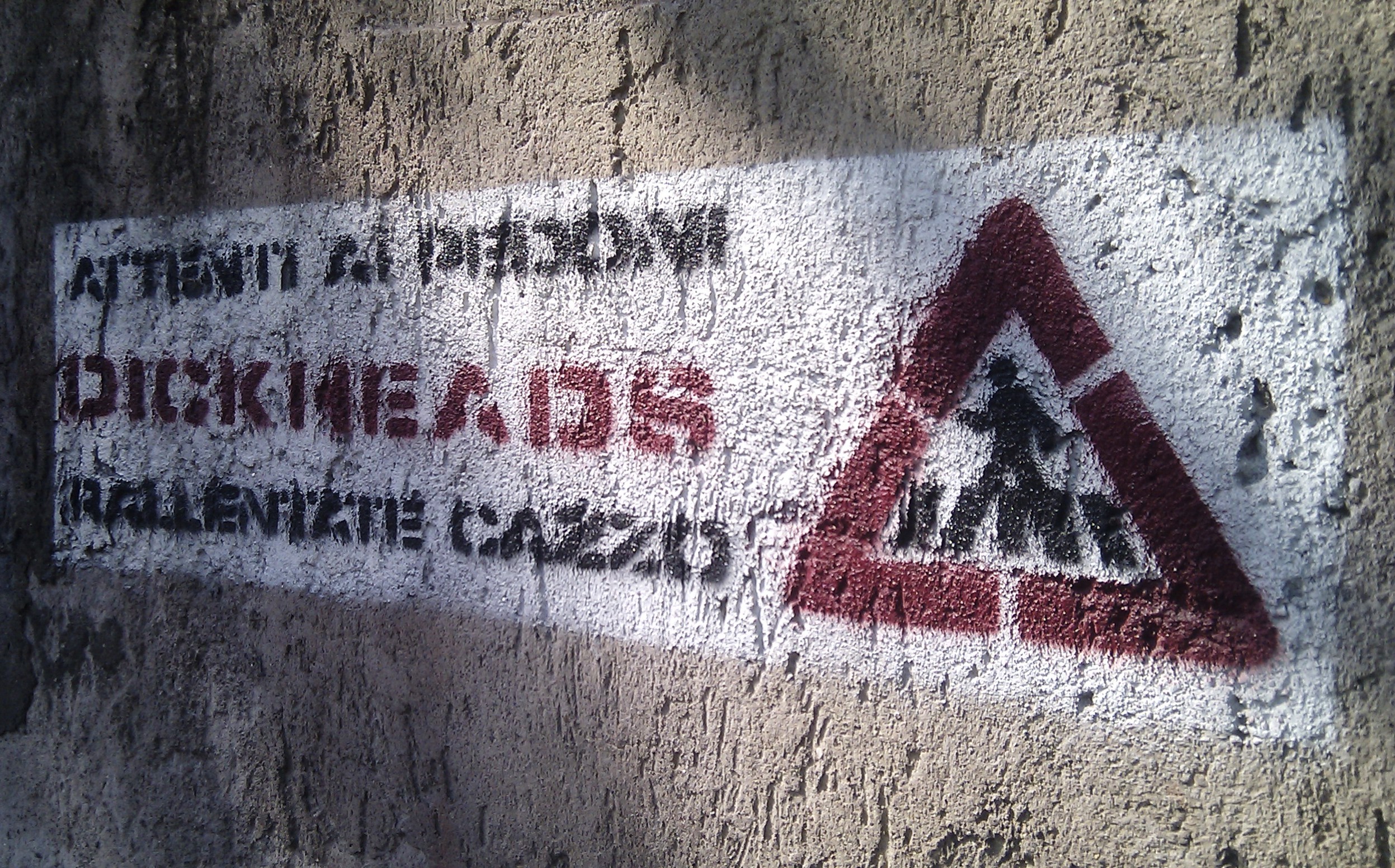
On a more serious note – people do of course get killed by traffic frequently, even with the seemingly casual way pedestrials face up to the insane traffic in Rome. Some people even do their bit to encourage more sensible driving. I walk past this graffito most days:

(Avert your eyes if you don’t like sweary swearwords, as it essentially says “Be aware of pedestrians / Dickheads / Slow the fuck down”. Just down the road is a banner that says “Caio Cesare” – I doubt it’s saying bye to a friend who was moving overseas.)

Anyway, the point is that, although my personality will never in a million years become even remotely Roman, I am adapting to the environment. I could say I’m becoming more blasé, but the use of a French word seems inappropriate. I can’t, however, use the equivalent Italian word as there doesn’t seem to be one. Our massive dictionary suggests indifferente or scettico, but they would seem to mean indifferent and sceptical. There’s sangue freddo – which our little dictionary translate as coolness – but that’s not quite right either. The seemingly casual approach to various – but absolutely not all – elements of life is so much a part of the Roman character that maybe there’s just no need for a word. (By the way, I hesitate to say “Italian character”, as a) I’m only intimately experiencing Rome at the moment and b) Italy is a notoriously varied place, of very strong regional identities.)

While walking home from language classes today, I passed through the Campo de’ Fiori, home to the bustling market and the marvellous, belligerently placed statue of Giordano Bruno. At the south end the market, various touts were selling tat – fake designer bags and sunglasses. Suddenly, they all started scattering, grabbing their ware and running towards the river, as various sturdy looking plain clothes polizi arrived. Presumably the touts didn’t have licenses of whatever. The point is, I was right in the middle of this debacle, and it didn’t even occur to me to be all English, step out of the way, stop, stare and say “heavens above!” I just kept on strolling.

The final minor incident of this type occurred as I continued to andare a piedi, through Trastevere. Up one of the many impossibly cute, if grubby and graffitied, cobbled streets, I spotted a group of four men up ahead, one intently moving a table around in the street (more of an alley, or vicolo perhaps). I strolled through this strange group too, only noticing as I passed the ridiculous cheekbones of the best-dressed of the group, the camera wielded by another and the huge pile of stuff marked “Giorgio Amani”. Some kind of fashion shoot thing. Whatever. And on I went.


3 Comments

Filed under Rome

From baths to quarry to tourist attraction

Went to the Baths of Caracalla the other day. First impression was that it was comparable with London’s dear old Battersea Powerstation: red brick, massively imposing,  not looking its best. It’s certainly a site that dwarfs much of the other extant (or exposed) remains in Rome from the Empire era.

I’m very ignorant about ancient Roman history, but what particularly interests me – and what I plan to read about once I’ve finished the fascinating Rome: Whispering City by Richard Bosworth – is what happened during the period of transition between the last Roman emperors and the new rule of the “barbarians”. I’m using pesky inverted commas because I’m reluctant to say German chieftains or suchlike, as no one seems to know the true origins of Oadacer, the chap who deposed Romulus Augustulus in 476AD. He was, however, known to have been a general in the Roman army, so there’s some continuity already – he wasn’t completely foreign, alien to Roman culture.

Wandering around the shell of the baths, I wondered what happened in and after 476AD. Did the staff (including slaves)  simply stop coming to work? Did punters arrive to find the doors locked and have to forgo their daily bathe? Or did life continue in much the same manner for decades, until the Gothic Wars in the 6th century when the technical systems were apparently knackered by Ostrogoths, who joined the list of armies who have invaded and romped around in Rome over the centuries.

The slow change of society is hard to grasp, and visiting such a place you only get a bare backbone of its history: built 212-216AD; fell into disrepair after the fall of the Western Empire; was used as a quarry during the middle ages; was pillaged for its statuary etc from the Renaissance onwards (most famously the Farnese Hercules); was deployed as a theatre by Mussolini. Very little remains of the details and decoration, bar some sections of frieze and restored mosaic. It takes an agile mind to extrapolate from this:

To this:

That’s not a great illustration, but it has the virtue of being colourful – these places would have been highly decorated.

This is a great image, by CR Cockerell, but it’s kinda drab:

Anyway, to get back to my original musings – this is exactly the kind of thing I’d love to see in a CGI time-lapse or somesuch. That’s not available though, so I’ll have to bolster my imagination the old-fashioned way: via books. Currently agonising over which book on the fall of Rome to buy. There are inevitably a lot, and books are effing pricey here in Rome, especially if you’re British, with our poor exchange rate.

When I was very young, my mum used to go shopping down the high street with a basket, visiting the green grocer, the butcher, the baker, and, er, Woolies, most likely. These days almost all grocery shopping occurs in supermarkets, and those independent high street shops are long gone, replaced by chains of mobile phone shops or hot milk drink franchises. That’s just in 30 or so years.

So the fabric of cities does change tangibly – albeit slowly – and even after mere decades you can look back and play a time-lapse in your mind. Presumably something similar happened at the Baths. Maintenance wouldn’t have been so assiduous, service would have worsened, prices would have risen… In fact, it sounds somewhat akin to what’s happening with services and facilities in a country like UK or Italy during this Depression (or is it just a Recession? Or “economic downturn?”).

Life expectancy in 4th century Rome would have been what, around 40 (if you survived childhood)? So individuals would have been unlikely to have been able to note the kind of changes I’ve seen in the high street of my home town. And if no one was alive to remember what things were like 50 or 60 years ago, presumably no one would really have mourned the gradual diminishment of services and eventual functional death of something like the Baths of Caracalla, other than perhaps an intellect elite who read history.

2 Comments

Filed under Main thread, Rome

Rats, bats, cats

I’ve been living in Rome for just three weeks now, and only in our flat for two weeks or so. Suffice to say, that whole time I’ve been suffering significant culture shock – and climate shock. The transition from 18C English “summer” to 35C Roman autumn hasn’t been easy. There are some elements of continuity, however. The past ten years or so has seen a rapid rise in the population of parakeets in London; we used to sit in our garden on an evening, with flocks of them flying over, squawking distinctively. That same squawk greeted me when I first walked through our charming local park, Villa Sciarra. It seems the same former pet species have gone wild here too, notably the ring-necked or collared parakeets.

Non-endemic species certainly cause profound problems in ecosystems where they did not evolve  but suffice to say, it’s hardly the parakeets’ fault, and in some ways I appreciated the familiarity factor.

Also common in Villa Sciarra are the local crow species. Back home in Lewes, Sussex, the Corvus genus was represented by plenty of jackdaws (Coloeus monedula), rooks (Corvus frugilegus), carrion crows (Corvus corone), but here I’ve seen lots of Hooded crows (Corvus cornix). Surely the name is inappropriate though – their handsome grey feathering is more like a cloak than a hood.

Magpies might be nasty, prolific buggers, but by and large I like crows, they’re a handsome crowd, and – without too much anthropomorphism – we can relate to their social nature.

In terms of common species, I’ve less affection for gulls. It seems, wherever you go in the world that’s within about 20 miles of the sea or a major river mouth, gulls will wake you at 5am with their irreverent cackling. Talking of early wake-up calls, we might have to contend with humanity doing its bit with the local campanile, but on our first night in our new flat in Monteverde Vecchio, it was a somewhat hysterical blackbird that woke us from a fitful sleep at around 4am.

Other birds I’ve registered so far – and, yes, these are all common species, but it’s first impressions – are cormorants. The Tiber may look pretty fetid, but if the cormorants fish it, it can’t be that bad right? Not as bad as when Garibaldi wanted to divert it into a canal and pave it all over. Imagine that. Another (non-bird) species that apparently fishes the Tiber is the coypu, or nutria. This excites me a lot. I know they’re aliens (native to South America), but having never managed to see an otter in the UK, or a beaver on a canoeing trip in Canada, I still long to glimpse one of this aquatic mega-rodent family.

On the rodent front, I’ve only had a few encounters so far. Rats are of course always close to humans, especially in places where garbage is strewn so readily. So far I’ve seen one rat going about its business, and another not so much. Lying dead among the litter, dog poo and graffiti on the Rampa di Monte Aureo, one of the many grand but grubby stairways leading up to Gianicolo and Monteverde itself, west of Trastevere. Now then, everyone says “ugh, rats”, but it’s not like they’ve helped spread any black death recently. Besides, the rats presumably play an unpaid role in the management of Rome’s prolific garbage.

Apparently, the ancient Romans just called them “Mus Maximus” – big mouse. Can you guess what a mouse was called? Mus Minimus. There’s got to be a comic or cartoon in there somewhere.

The other rodent I’ve been seeing a lot of – much more so than the rats – is bats. I love bats, they’re so endangered in much of Britain, and I only saw them very rarely in London, but they seem to be doing well here. Every night when sitting on our balconcino, they arrive as night falls. I’m guessing they have plentiful food in the form of all the dang-blasted mosquitoes. They probably like all the churches too, for roosts.

Confusingly, all bats seem to be called pipistrello here, while scientifically, pipistrellus refers to a specific bat genus, and the common pipistrel is Pipistrellus pipistrellus. (I love those double Latin names – the best has got to be Troglodytes troglodytes – an evocatively monstrous name for something as dainty as the wren.)

Finally, another species that any visitor to Rome is likely to see a lot is of course the cat, felis catus. Dismount a tram at Largo Torre Argentina, for example, peer down at the ruins in the centre – and you’ll find them draped with cats. These are members of the famous colonies of Rome, also found at the Forum, the Colosseum, and at the Non-RC Cemetery, where they’re fed by volunteers and cat lovers. Down our street, I’ve also seen bent-backed old ladies feeding the tough-looking local gatti. They’re not wild animals, sure, but they’re certainly not pets. The term “domestic cat” doesn’t really fit for animals that don’t inhabit domus.

Oh, and finally – not a bird, not a mammal, but a reptile. I’ve seen a fair amount of the Italian wall lizard (Podarcis sicula). Beautiful things. They visit our balconcino, hanging out in the window boxes full of spider plants. Again – strangely – it’s a nice element of continuity for me, as a few weeks before we left Sussex, I was lucky enough to see some similarly beautiful lizards (Lacerta vivipara) above the Seven Sisters.

1 Comment

Filed under Main thread, Rome

Moto city

Found a little bike shop in Rome today, near the Campo de’ Fioro, selling various hipster bikes (fixies, old-fashioned town bikes etc) and Bromptons. I’m not convinced they can be doing a roaring trade though, as Rome is very much a city of roaring motor traffic.

The only places I’ve seen cyclists pootling about is in the older, more maze-like areas of Trastevere, round Campo de’ Fioro, in the Centro Storico, as well as people in lycra doing circuits of the magnificent Villa Doria Pamphilj, a park we’re lucky enough to live near. There are some fine looking, two-lane cycle tracks along the Tiber, but I’ve never seen a single cyclist using them. Not a one. Rome just isn’t a bike city.

If cycling in a city like London can be intimidating, cycling in Rome doesn’t bear thinking about. One persistent element of the city’s auditory landscape is the distinctive uh-eeh-uh-eeh-uh of ambulance sirens. I hear them all the time. Some of them may be hallucinations; I can’t tell. Stop and strain your ears at any moment, it seems, and you’ll hear those sirens. And every time I do, I wonder – splatted pedestrian? Cyclist? Motorino-rider? Or just plain old traffic accident?

New arrivals in Rome – like us – can be easily identified standing perturbed on the pavement, trying to work out how to cross the road. Even at things that resemble zebra crossings it can be a baffling, frightening proposition. In fact, even when you’re wandering the cobbled streets and alleys of the above-mentioned antico parts of town, you have to keep a weather ear out for motos, even vans squeezing between the buildings.

Time Out’s Shortlist Rome 2008 provides some statistics that feed that perturbation. It quotes a 2004 study that says Rome is the most dangerous EU capital, with 8.37 dead per 1000; second in the list is Copenhagen, with a mere 1.47 per 1000. It attributes this to the sheer number of vehicles: “around 950 per 1000 population, three times that of London.”

Ironically, this all means travelling on Rome’s (admittedly meagre, two-line) metro, for example, is fairly civilised compared to the London Tube or New York Subway. Natives just don’t seem to want to use the public transport.  In their defence, at least you don’t see as many people who absurdly choose to use the descendants of military/agricultural vehicles as town cars, like those odious denizens of Chelsea, for example, with their notorious SUV “tractors”. Rome is a city still largely dominated by scooters and sensibly proportioned vehicles like Smart cars and Cinquecenti. Though it’s amusing when you see a vintage Cinquecento parked beside its modern namesake, or likewise with Minis. Not so Mini now.

So, yes, as much as I miss cycling, I don’t think I’ll be riding the streets of Rome any time soon. Though I would very much like to score a mountain bike to hit the paths of Doria Pamphilij.

Update. Unprompted, my Italian teacher gave us this expression today:
“Roma è uno citta molto caotica.”

Quick addendum
Two years later, Sept 2013. I’ve been cycling in Rome about six months now and although I’m still nervous, I’m not dead. In fact, just packed my Brompton up to send it home and I’m missing it already.

1 Comment

Filed under Main thread, Rome

Cats and Keats

Rome is, arguably, one of the most handsome cities in the world. Not that I’ve been to every city in the world, of course, but that’s its reputation. But it’s also a city that’s in many ways defined by its debris, its dereliction, its waste. The glory of ancient Rome over the centuries became the picturesque ruination so beloved of artists, the bourgeoisie and the artistic bourgeoisie holidaying on what became consolidated as the ‘Grand Tour’. Which reached its sublime expression in things like this, by old JMWT:

Of course, in our modern world, defined by its barbaric plague of combustion engines, single-use plastic packaging  and solvent-based territorial marking, it’s not quite so picturesque, despite Rome still having an embarrassment of antique riches.

Trastevere, the former working class district now beloved of tourists, students and ex-pats, where we’ve been staying, is plastered with graffiti (I’m a fan of quality street art, but not this rampant, artless tagging), while the various stairways up the Janiculum Hill and up to the more down-to-earth residential neighbourhood of Monteverde Vecchio, where we’re moving tomorrow, are adrift in litter. All that odious non-biodegradable crap that defines our era. The plasticocene, or something. And lots of crap tagging and graf too.

Today, however, we drifted over to Testaccio, on the east side of the Tiber. It’s a neighbourhood with a very different character again. (Here’s a quick caveat: these observations are all of course only initial, pretty superficial, and made in August, when many Romans are elsewhere.) Testaccio, historically, is defined by its huge rubbish mound, Monte Testaccio, which is made up of broken amphorae, and by its long heritage in the meat industry, based at the old (now closed) slaughterhouse, the Ex-Mattatoio.

The area around the base of the Monte seemed pretty seedy during the daytime, with its ring of closed-up bars and nightclubs. I’m not really the demographic to sample its nocturnal delights methinks. What we did delight in, however, was a visit to the Protestant – or more accurately, Non-Roman Catholic – Cemetery. It’s not a grand place like Paris’s sprawling necropolis of Père Lachaise, but it’s similarly fascinating, and boasts some notable residents, like Keats. Percy Bysshe Shelley was cremated, but his ashes were put here at Mary Wolstonecraft Shelley’s request; according to the Rough Guide she had quite a wrangle with the papal authorities. Their son, William, is also buried here. As are numerous other important, wealthy or just plain forrin non-RC types; some of the English residents are clearly of that rarefied type of upper class who can get away with names like “Viking”.

It’s a wonderful place, with extra interest granted by the fact that it’s loomed over by Caius Cestius’s pyramid, built after his death in 12BC. He had a thing for Egypt. His slaves built it in 330 days, apparently. He freed them on his death; whether they built it when still ‘under contract’ I don’t know (and can’t be bothered to Google just yet). Beside the pyramid is a little cat sanctuary, and a couple of little feline charmers accompanied us on part of our stroll.

Apparently Romans are cat lovers, and these ones seemed pretty happy. You came across several contented-looking beasts drowsing among the gravestones.

The cemetery is also pleasing and relaxing because I didn’t spot a single piece of litter or scrawled tag. Litter really upsets me, it’s a sign of humanity’s lack of self-respect and foresight, and widespread distain for the environment, and this is especially tangible when it’s draped over a city as unique as Rome.

Oh, and just so I don’t end this post on a downer, we ate lunch at the best place we’ve tried so far in Rome, La Fraschetta di Mastro Giorgio. Very much about grilled meats (suitably enough), but we also had some wonderful cheese and some great focaccia. Focaccia in its British incarnation can be quite plump and puffy. Before we left the UK I made some that was much thinner, crisper. I was very pleased to see the stuff here was much more akin to that effort of mine.

2 Comments

Filed under Main thread, Rome