Category Archives: Food misc

Sicilian fish stew with couscous / Pesce Stufato alla Siciliana con couscous

Our local market –  in the parallel street, six days a week – has a great fish stall, and during Lent it’s become even bigger, for obvious, traditional Christian diet-related reasons.

I love eating fish, but although I cook all the time, I’ve been fairly timid over my lifetime really embracing buying fresh fish and cooking it myself. The fish stall round the corner, however, is really motivating me, to try and cook more fish, to experiment, and to try and learn some of the innumerable Italian names for fish, both standard and dialect.

There are plenty of familiar species on the market, such as mackerel (sgombro), which offers one of the marginally less unethical choices in our era of overfishing. But there are also plenty of weird and wonderful species we don’t get in the UK, such as the stargazer (Uranoscopus scaber; pesce prete – priest fish).

I bought some stargazer without having a clue what it was, on the advice of the fishmonger (pescivendolo), and, through the miracle of Facebook, was able to use the groupmind to identify it.

When we bought some fish called cerino on the market, via Facebook again we were able to identify it as the slightly less exotic grey mullet. Cerino must be another dialect term, as the standard Italian term for grey mullet is cefalo, while another Lazio dialect name is mattarello (“rolling pin”).
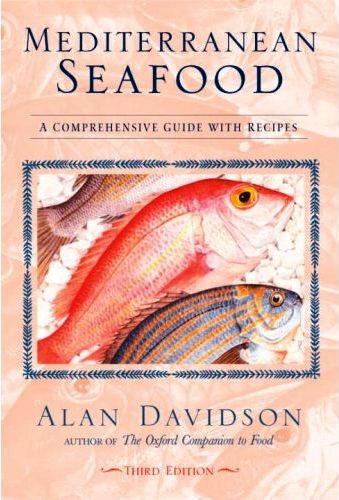
Such is my confusion that a friend of a friend on Facebook recommended I buy Alan Davidson’s book Mediterranean Seafood – in both English and Italian (called instead Il mare in pentola – The sea in a saucepan). The latter helpfully lists a lot of the Italian regional dialect names. Though not cerino.

Anyway, thank you very much photographer Mimi Mollica, a Sicilian who recommended the book and also gave us a recipe for fish stew and cous cous. Which I finally made today.

I’m going to try and blog the recipe in both English and Italian, which I’m learning, very slowly. Hence the Italian will probably be fairly crude for Italian speakers. Apologies in advance.

Proverò a mettere nel blog la ricetta del Pesce Stufato alla Siciliana in inglese e in italiano, che sto apprendendo molto lentamente. Il mio italiano sarà molto brutto per gli italiani e per le persone che parlano bene in italiano. Mi scuso in anticipo.

REVISIONE: La mia insegnante l’ha corretto. Grazie Clelia!

Anyway, Mimi recommends using firmer flesh, flavoursome fish like:
Comunque, Mimi suggerisce di usare un pesce con una polpa un po’ più dura e gustosa come:

English / Inglese Italian / Italiano Italian dialect / dialetto* Latin / Latino
Scorpion fish (red) Scorfano rosso Cappone (Toscano) Scorpaena rossa
Scorpion fish (black) Scorfano nero Scorpaena nero
Scorpion fish (small) Scorfanotto Scorpaena notata / ustulata
Weever (greater) Tracina drago Trachinus draco
Grouper (dusky) Cernia Zerola (Lazio) Epinephelus guaza / Serranus gigas
Gurnard (tub, tub fish) Capone gallinella Capone panaricolo (Lazio) Triglia hirundo / lucerna
Guarnard (red) Capone coccio Cappone imperiale (Lazio) Aspitriglia cuculus / Triglia pini
Gurnard (grey) Capone gurno Gallinella (Tuscano) Eutriglia gurnardus / Triglia malvus

* Just a few, too many to mention!
Solo qualche, ce ne sono tanti!

And other fish, preferably sustainable varieties.
E altre pesce, preferibilmente di tipo sostenibile.

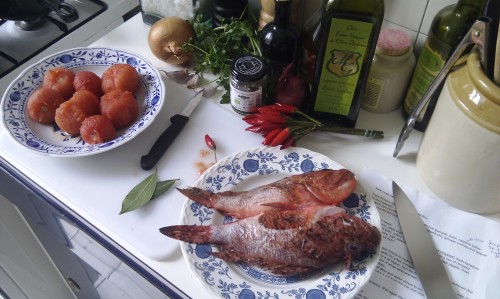
The recipe, in English

This isn’t a precise recipe – use your instincts with quantities.
Ask your fishmonger for enough fish for however many people you’re feeding.
I made it as a (large) meal for two, so I used:

Sauce
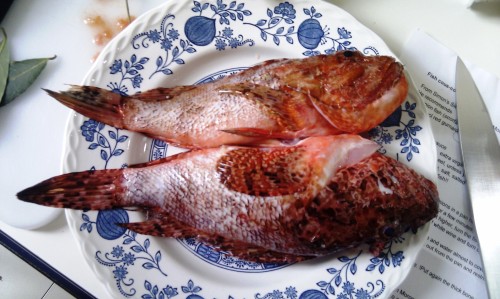
2 small-medium red scorpion fish
extra virgin olive oil
1 large white onion, coarsely chopped
2-3 cloves of garlic, peeled but left whole
White wine
500g fresh tomatoes, peeled (cut a cross in the skin, drop them in boiling water for about a minute, remove, peel) then coarsely chopped, or OR a tin of tomatoes
2-3 red chilies (depending on heat and your taste), de-seeded and chopped
salted capers, about a tablespoon, or more if you particularly like them
salt and pepper (freshly ground, naturally)

Soften the onions in a pan.
Add the garlic, and soften slightly.
Add the fish.
Increase the heat slightly and cook the fish, for about 4 minute each side.
Add a glass of white wine.
Increase the heat more, and cook off some of the alcohol.
Add the tomatoes, chilies, capers, more wine and water, to almost cover the fish.
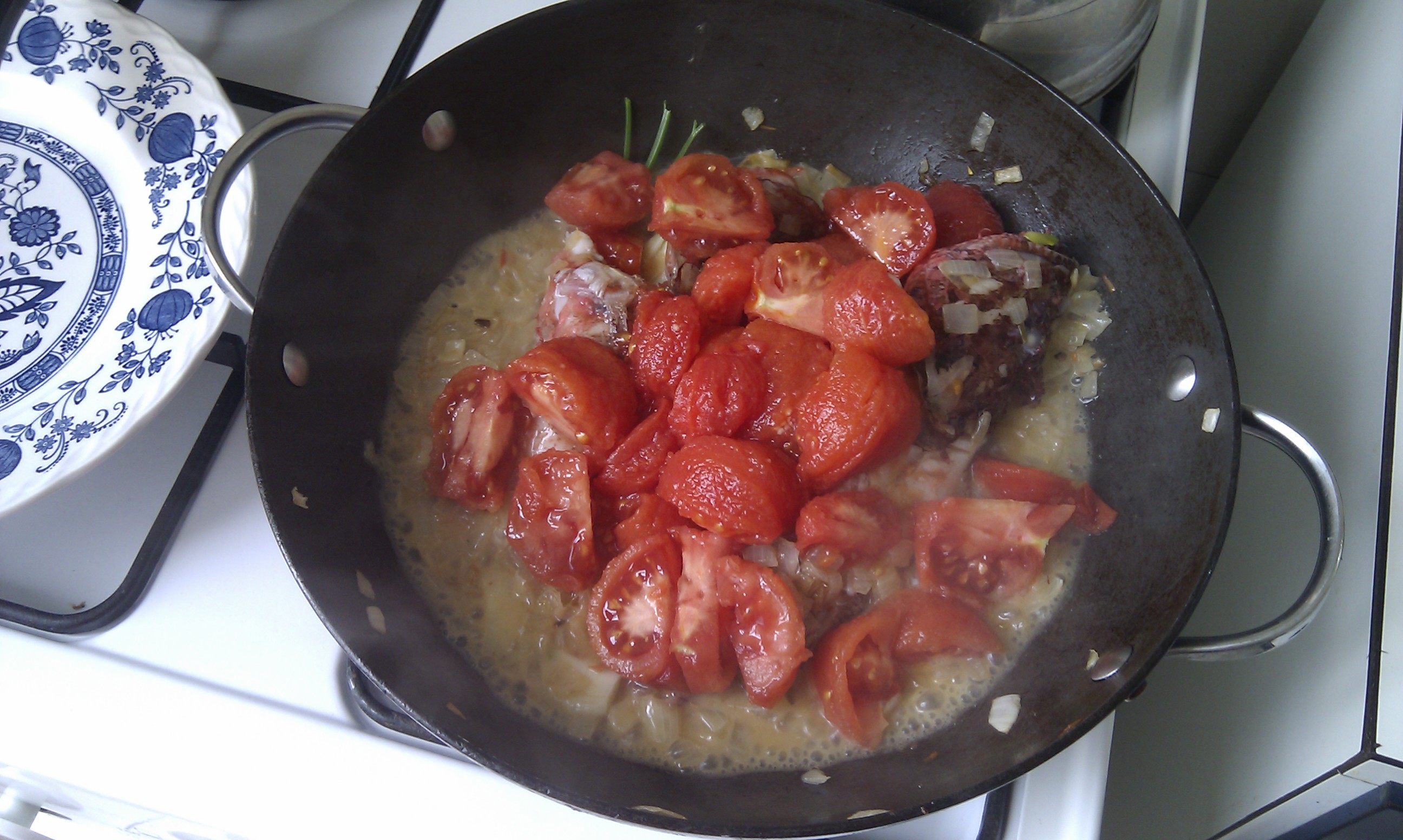

Simmer until the fish is cooked, the flesh coming away from the bone.
Remove the fish.
Take the flesh off the fish.
Put the fish spine back in the sauce.
Simmer the sauce to thicken.
Remove the fish spine.
Put the fish flesh back in the sauce.
Season to taste.

Meanwhile, make the couscous.

200g ish couscous
1 small red onion, in thick slices
2 bay leaves
Extra virgin olive oil
salt and pepper
fresh parsley, coarsely chopped

Put the couscous in a bowl with a few bay leaves, the red onion, and some salt.
Pour over boiling water and a slosh of olive oil and cover.
Stand for 10 minutes, then check it’s softened enough. If not, pour over some more boiling water, and stir in. If it is, stir to break up any lumps.

Serve the couscous with the fish stew, sprinkled with parsley.

I expect my version isn’t exactly authentic (I’ve never even been to Sicilian, never mind actually eaten the real thing), but it was very tasty.

La ricetta in Italiano

Questa non è una ricetta preciso – usa i tuoi istinti con la quantità!
Chiedi al tuo pescivendolo per abbastanza pesce per le persone a tavola.
Ho fatto un pasto (grande) per due, con:

Stufato
2 scorfani piccola-medi, puliti
olio d’oliva extravergine
2-3 spicchi aglio, intero e puliti
1 cipolla bianca, grande, tritata grossa
Vino bianco
500gr pomodori, pelati, o una scatoletta di pomodori pelati
2-3 peperoncini (come si preferisce), senza semi, tritati
capperi salati, un cucchiaio da tavola o più
sale & pepe nero (macinato fresco)

Soffriggi la cipolla in una pentola.
Aggiungi gli spicchi di aglio, e soffrigi un po’.
Aggiungi i pesci.
Aumenti la fiamma un po’ e cuoci i pesci, per circa 4 minuti ogni lato.
Aggiungi un bicchiere di vino bianco.
Aumenta la fiamma, e stufa un po’ di più.
Aggiungi i pomodori, peperoncino, capperi, e abbastanza vino e acqua fino quasi a coprire i pesci.
Stufa a fuoco lento fino a quando la polpa dei pesci è morbida e sollevata delle lische.
Prendi i pesce.
Togli la polpa dei pesci.
Rimetti le lische più grande (spine) nel stufato.
Cuoci a fuoco lento per addensare.
Insaporisci con sale e pepe.

Nel frattempo, fai il couscous.

200gr (circa) couscous
1 cipolla rossa, piccola, affettata grossa
2 foglie d’alloro
olio d’oliva extravergine
sale & pepe nero (maccinato fresco)
prezzemolo, tritato grosso

Metti le fette di cipolla, le foglie d’alloro e un po’ di sale in una ciotola.
Copri tutto con acqua bollente, aggiungi un po’ d’olio d’oliva e coprila.
Lasciala per 10 minuti, poi verifica se il couscous è abbanstanza morbido. Se non lo è, aggiungi un po’ d’acqua bollente e mescola. Quando è pronto, mescola di nuovo per rompere qualche pezzo.

Servi il couscous con il stufato, cospargere con il prezzemolo.

Penso che la mia versione non è proprio autentica (non ho visitato la Sicilia mai, ne ho mangiato mai il vero stufato Siciliano di pesce), ma era molto buono.

5 Comments

Filed under Food misc, Rome

Scones – cream first or jam first?

We’re big fans of scones in our household. My wife, Fran, is from Devon and I’ve got strong connections with this county in the southwest of England that, along with its neighbour Cornwall, is the homeland of the cream tea: scones with clotted cream and jam, washed down with (milky black) tea.

(Some say the scone comes from Scotland – does it? Are Scots and West Country scones the same thing? Or are they different types of “quick bread” with the same name? Some serious historical investigation needs to be done on that front before I’m persuaded either way. The word itself may derive from the Dutch “schoonbrot”, meaning fine bread or white bread, though that clarifies nothing.)

I’ve been making scones since childhood, presumably having fallen in love with them after childhood holidays in Devon and Cornwall.

Anyway, every time we eat them, the same two issues arise.

First, is it pronounced skon-ryhmes-with-John or skown-rhymes-with-own? (Seriously – there’s no either/or; as with many words, it varies, with the former pronunciation most common in Britain, especially in Scotland. See point 3.11 in this 1998 University College London British English pronunciation survey.)

And second, does one split the scone then spread it with clotted cream first, or jam first? I doubt UCL has done a survey on that, and among my friends things seem to be fairly evenly split. Fran is adamant is has to be jam first, then a blob of cream like a garnish, I’ve always spread the clotted cream first, like a kind of glorified (oh the glory!) butter.

Now, before I proceed, for any impoverished soul who hasn’t had the pleasure of eating clotted cream, let me tell you what you’re missing. Clotted cream – which most certainly is traditionally, and originally, from the West Country – is a very rich, delicious and generally delightful dairy product made using the cream of cow’s milk.

In days of yore it would have been made using the rich milk of local West Country cattle, like the charming Devon Reds, a breed that’s been making a comeback recently. (My parents’ neighbours in their place in Devon had a champion Devon Red bull called “Freddie” Yeomadon Ferdinand, whose offspring are used for beef; apparently it’s not viable to use Devon Reds for dairy these days so I’ve never tried any Devon Red milk or dairy products.) These days, clotted cream is mostly made using milk from Guernsey and Jersey cows, the breeds now most associated with rich, fatty milk.

Clotted cream is traditionally made by heating rich creamy milk over a low heat, possibly in a bain-marie type arrangement, reducing its water content, and encouraging the creation of thick creamy clots, which are skimmed off. I’ve made cheese, butter and yogurt but never clotted cream. They demonstrated this traditional production method in episode 9 of BBC’2 Edwardian Farm series. It looked painstaking and protracted so I don’t think I’m likely to try and reproduce it any time soon. (Read the Wikipedia entry if you’re interested in learning more about the modern, industrial production methods.)

On a recent visit to Devon, I bought some clotted cream from Langage Farm, a Devon brand that uses the milk of Guernsey and Jersey cows. Clotted cream is something I crave, and one of the international delicacies I’ve not been able to source in my current city-of-residence, Rome. So this pot travelled all the way home with me. Ridiculous food miles for a treat I know.

After making a batch of scones yesterday (see below for my basic recipe), we had a cream tea – something that presumably doesn’t happen very often in Rome, even at vintage tea room Babington’s, whose version of a “cream tea”, according to their online menu, consists of “A Scottish scone with butter and strawberry jam”. With whipped cream. That’s just plain wrong.

My friend and sometime catering collaborator Mr Dominic Rogers raised the above-mentioned cream-or-jam first question, and we discussed them being “tasty either way”, but not necessarily “tasting the same”. This is a noteworthy point, and one I had to address in more detail. So I did a taste test.

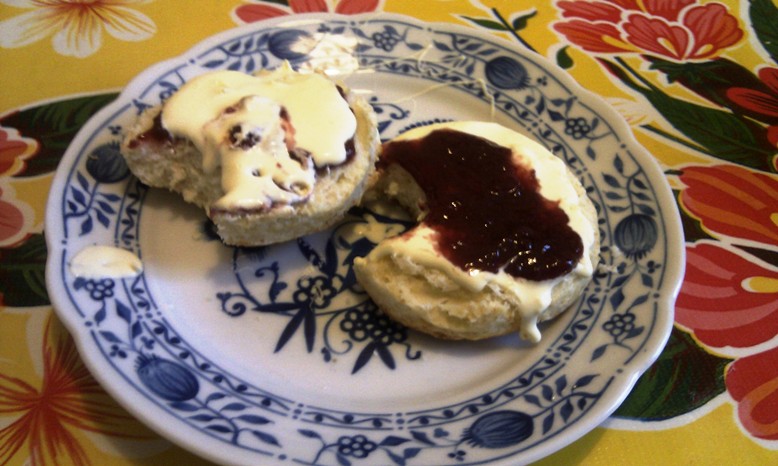
As illustrated by this photo, it wasn’t entirely scientific: I didn’t weight out the amounts of cream and jam (in this case fragole, strawberry) used to make sure they were identical in both cases, and I only used one scone, which meant one piece had the top crust and the other the bottom crust, which have slightly different textures. However, the results were interesting (well, interesting for scone obsessives). They are all pretty obvious if you think about it, but I still feel it’s worth recording, considering the perennial nature of the argument.

1 As you bite the jam-on-cream arrangement, your first flavour hit is of jam, which is tart, sugary-sweet and fruity.
1b Do you enjoy the sensation of thick cream as it potentially touches your top lip?
2 As you bite the cream-on-jam arrangement, your initial flavour hit is of clotted cream, which is of course, smooth, gloopy and dairy-sweet.
2b Do you enjoy the sensation of sticky jam as it potentially touches your top lip?
3 As you continue to bite down through the scone, this initially flavour hit is prolonged, being dragged down through the crumb of the scone by your upper incisors and of course moving onto your palette and tongue.
4 Your choice of jam-on-cream or cream-on-jam defines the opening flavour notes, and initial mouth-feel and flavour, before mastication results in more even mixing of flavours and textures.

Conclusion
So, arguably, you have a choice based on whether you prefer the taste of cream or jam, or prefer those as the initial taste.
Either, frankly, is bloody delicious.

Here’s my basic plain scone recipe. Some people use buttermilk; I don’t, as it’s not always easy to source, and I’m not convinced it makes a better plain scone.

450g self-raising flour (or use plain flour with about 4% baking powder, ie 435g plain flour sifted together with 15g baking powder)
80g unsalted butter, at room temperature
35g caster sugar
Pinch of salt
300g milk

1. Pre-heat the oven to 220C.
2. Grease two baking sheets.
3. Sieve the flour (and BP, if using plain flour) into a bowl, then rub in the butter until the mixture resembles breadcrumbs.
4. Stir in the sugar and salt.
5. Blend in the milk little by little using a knife.
6. Bring together as a rough dough but do not knead or otherwise handle too much.
7. Turn out onto a lightly floured work surface and roll out to around 22mm thick.
8. Create rounds using a pastry cutter, or simply cut into squares.
9. Repeat with any off-cuts.
10. Place on the baking sheets, dust with a little extra flour and bake for 12-15 minutes until starting to brown.
11. Serve just slightly warm – ideally with clotted cream and jam!

Scones are always best on the day they’re made.


6 Comments

Filed under Baking, Food misc, Main thread

Chestnut and walnut bread


Chestnuts were an important traditional foodstuff in parts of Italy. Peasants could supplement their diets with chestnuts, and flour was a natural extension of this. Roasted chestnuts remain a common sight in Roma over the winter, though I’m skeptical about whether this is because Romans demand it, or because it’s another cute novelty to sell to tourists.

Anyway, I bought some chestnut flour – farina di castagna – from the Testaccio Ex-Mattatoio producers’ market last weekend, on a whim. Didn’t really have any idea what to do with it. And nor do I particularly like chestnuts. Living in New Zealand years ago, some friends who tried to live as much as possible by foraging provided enough for me to eat far too many, resulting in a certain aversion. Which might not sound promising, but bear with me.

After a bit of Googling and polling friends, I plan to use it to make various items at some stage, including the Italian traditional castagnaccio – a kind of peasant cake that doesn’t include sugar and instead realies on the natural sweetness of chestnuts. (Chestnut flour is also known as farina dolce – sweet flour.) Also: chestnut flour pancakes (maybe on Shrove Tuesday, which is looming) and this cake, which comes from a gluten-free angle. If I can work out a replacement for crème fraîche, which isn’t readily available here in Roma. Apparently I can use panna acida.

But first, I made some bread, inspired by a recipe in Richard Bertinet’s Dough. His version uses rye flour; here I replaced that with chestnut flour. I also reduced the yeast in his recipe and added some white leaven. What the hell.

So:
400g strong white flour
100g chestnut flour
10g salt
320g water
6g fresh (fresh)
50g white leaven (100% hydration)

Combine the flours and salt.
Whisk together the leaven, yeast and water (warm – use dough temp x 2 minus flour temp to give you a water temp… or just warm…).
Add liquid to flours, bring to a dough.
Knead.
Form a ball, rest, covered, until doubled in height. I’m not going to suggest a time, as that really is so dependant on the temperature of your room.
I divided it into two, formed balls, rested 10 mins then I made rings, but really, knock yourself out with the shape.
Prove again, until doubled in height.
Bake at 220C for 15 mins, then lower temp to 200C and bake another 15 mins. Or if you’re doing one large loaf, it may need longer. Trust your judgment!

And you know what, it’s yummy. The nuts give the crumb a slight purply tinge and the taste is indeed subtly sweet.

I really ought to try and take better pictures though. Random snaps from my phone don’t cut it. And that tablecloth is getting a bit overused as a backdrop.

9 Comments

Filed under Baking, Food misc, Main thread, Rome

Innocenti is bliss

My noble quest to try castagnole and frappe from, well, as many different pasticcerie as possible, continues. Today we dropped by Innocenti, which, for sheer vintage cuteness, is incomparable.

Nestled in Via della Luce, a cobbled backstreet in the slightly less touristy part of Roma’s Trastevere (that is, to the east of Viale Trasteve), the shop is dominated by the vast form of a veteran conveyor oven, which is currently partially stacked with frappe and castagnole.

And very nice they are too. We bought castagnole con crema and yer basic frappe. Just scoffed a load, then managed a bit of self restraint and stashed some for later. That said, better finish them soon, so I can justify sampling some more from another outlet…

Innocenti, aka Biscottificio Artigiano Innocenti, 21 Via della Luce.

And look at all the goodies they sell. Not just biscuits. Yum. Got my work cut out for me.

2 Comments

Filed under Baking, Food misc, Rome

Pass the dolci

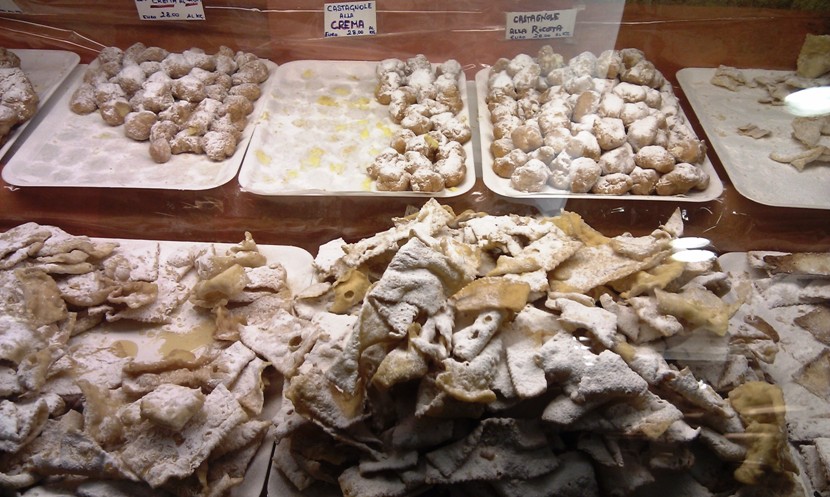
Italians love their dolci: sweets, desserts, ice cream and pastries, or pasticceria. I always assumed the French had the last word on patisserie, but living in Rome, I’m not so sure any more. In Monteverde Vecchio, our neighbourhood, indeed within about 100 metres of our flat, there are at least three pasticcerie (as I understand it, the word can mean the outlet, the trade and the product), as well as a bakery/tavolo caldo (“hot table” – meaning then sell hot snacks) that also does pasticceria. Two of these places, and another one just down the hill on Viale Trastevere, have counters around 4-5 metres long utterly packed with biscuits, pastries, chocolates and sweeties that you buy by weight. And none of them are chains.

That’s one thing I love about Italy – it’s got an incredibly strong business culture of independents, of SMEs (small-medium sized enterprises). As well as all the independent pasticceria, which are also cafés, there are umpteen independent cafés, which also sell pasticceria. Although I’m an oddity in this culture for my dislike of coffee, I’m more than happy to frequent these places and indulge in pastries and, as it’s the winter (hey, there was a frost last night), I can get away with drinking lots of the cioccolata calda without breaching too much strict Italian food and drink etiquette. Well, I say “drinking” but it’s frequently half-way to eating as Italian hot chocolate is generally thickened with cornflour, making it a thick, gloopy thing that’s almost like a hot chocolate mousse.

My current obsession is for castagnole and frappe, which started appearing in the pasticcerie shortly after Christmas, specifically at Epiphany; that’s 6 January for heathens. These are seasonal sweet treats for carnevale – carnival or Mardi Gras season. The Christian tradition is that Mardi Gras, aka Fat Tuesday, aka Shrove Tuesday, aka Pancake Day, is the day when you use up all your rich food products, fats and sugars to initiate Lent, the period of abstemiousness that leads up to Easter. While us Brits, and others, might have a pancake blow-out on just one day, here in Italy it looks like we’re getting weeks of the aforementioned treats.

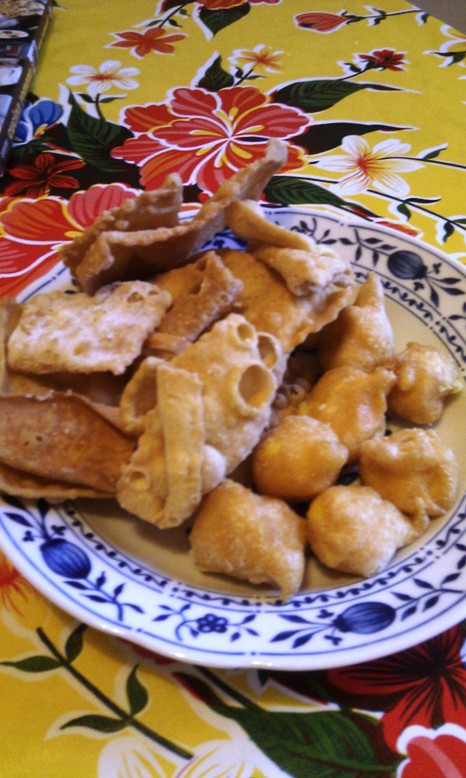
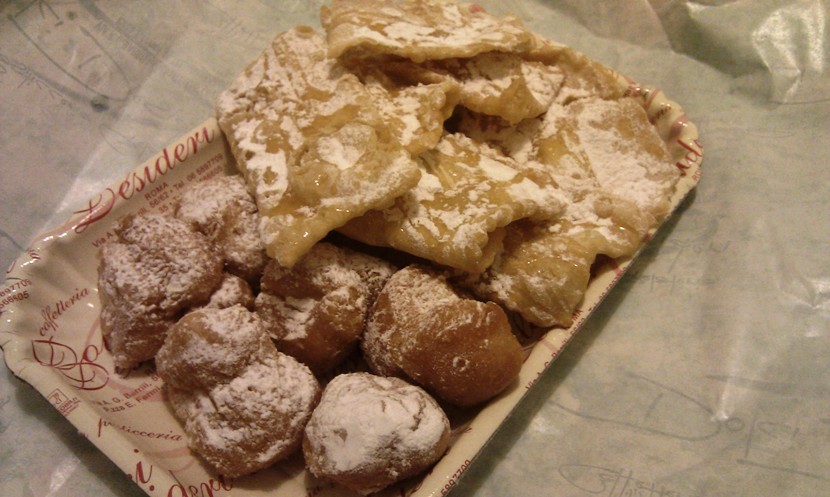
So, castagnole are small, deep-fried dough balls, a bit like doughnuts, but the dough isn’t leavened with yeast, but with chemical raising agents, ie baking powder or equivalent, according to both the ingredients taped up on the counter at Pasticceria Dolci Desideri (“Sweets you want”!; our local, on Via Anton G Barrili) and the recipe on this blog. The word presumably relates to castagna – chestnut – though they have no chestnut flavouring. Instead you can get them semplice (plain) or filled with crema (custard) or ricotta. Frappe, meanwhile, are basically thin rectangles of crisp, slightly puffy pastry, like a sweetened pasta, baked or deep-fried, and sprinkled with icing sugar, or sometimes flavoured with honey. The name itself (singular: frappa) is a bit confusing, as the similar word frappé means shake, or milkshake.

According to the above-mentioned blog, they’re also known as cenci (the plural of cencio, rag – not very appetising), stracci (shreds; stracciare is the verb to tear or rip up) and lattughe (lettuce) in other parts of Italy. We’ve been treating ourselves to castagnole and frappe, well, pretty much every day this week. It can’t go on, for obvious reasons, but not only are they delicious, there’s just something inherently lovely about going to a pasticceria and getting some treats wrapped up like a gift (eco concerns about over-packaging notwithstanding.) Really, Brits have a long way to go to make the patisserie experience as charming as this. Sure we have some wonderful independent bakeries these days, but their patisserie can still seem meagre by comparison, even if they have an array of poncy cupcakes. And for people who still don’t even have access to real bakeries, some foul mass-produced “Toffee Flavour Yum Yum” from “Greggs The Home of Fresh Baking” [sic] just doesn’t cut it.

4 Comments

Filed under Baking, Food misc, Main thread, Rome