Category Archives: Main thread

Pass the dolci

Italians love their dolci: sweets, desserts, ice cream and pastries, or pasticceria. I always assumed the French had the last word on patisserie, but living in Rome, I’m not so sure any more. In Monteverde Vecchio, our neighbourhood, indeed within about 100 metres of our flat, there are at least three pasticcerie (as I understand it, the word can mean the outlet, the trade and the product), as well as a bakery/tavolo caldo (“hot table” – meaning then sell hot snacks) that also does pasticceria. Two of these places, and another one just down the hill on Viale Trastevere, have counters around 4-5 metres long utterly packed with biscuits, pastries, chocolates and sweeties that you buy by weight. And none of them are chains.
That’s one thing I love about Italy – it’s got an incredibly strong business culture of independents, of SMEs (small-medium sized enterprises). As well as all the independent pasticceria, which are also cafés, there are umpteen independent cafés, which also sell pasticceria. Although I’m an oddity in this culture for my dislike of coffee, I’m more than happy to frequent these places and indulge in pastries and, as it’s the winter (hey, there was a frost last night), I can get away with drinking lots of the cioccolata calda without breaching too much strict Italian food and drink etiquette. Well, I say “drinking” but it’s frequently half-way to eating as Italian hot chocolate is generally thickened with cornflour, making it a thick, gloopy thing that’s almost like a hot chocolate mousse.

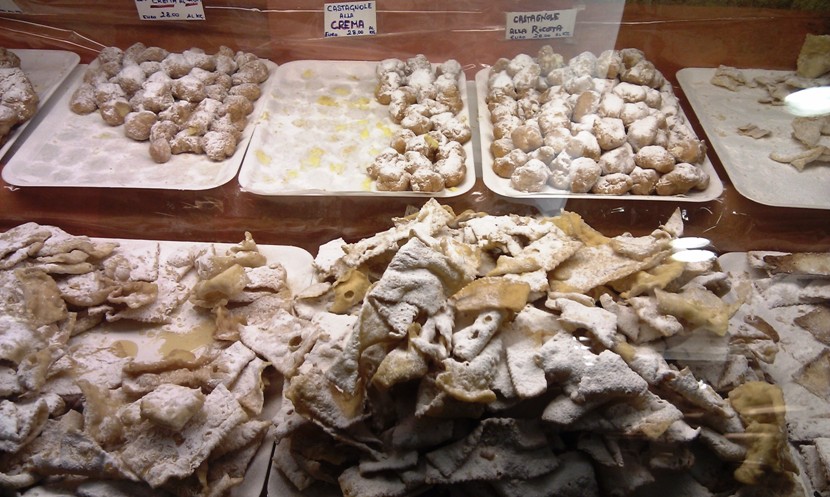
My current obsession is for castagnole and frappe, which started appearing in the pasticcerie shortly after Christmas, specifically at Epiphany; that’s 6 January for heathens. These are seasonal sweet treats for carnevale – carnival or Mardi Gras season. The Christian tradition is that Mardi Gras, aka Fat Tuesday, aka Shrove Tuesday, aka Pancake Day, is the day when you use up all your rich food products, fats and sugars to initiate Lent, the period of abstemiousness that leads up to Easter. While us Brits, and others, might have a pancake blow-out on just one day, here in Italy it looks like we’re getting weeks of the aforementioned treats.

So, castagnole are small, deep-fried dough balls, a bit like doughnuts, but the dough isn’t leavened with yeast, but with chemical raising agents, ie baking powder or equivalent, according to both the ingredients taped up on the counter at Pasticceria Dolci Desideri (“Sweets you want”!; our local, on Via Anton G Barrili) and the recipe on this blog. The word presumably relates to castagna – chestnut – though they have no chestnut flavouring. Instead you can get them semplice (plain) or filled with crema (custard) or ricotta. Frappe, meanwhile, are basically thin rectangles of crisp, slightly puffy pastry, like a sweetened pasta, baked or deep-fried, and sprinkled with icing sugar, or sometimes flavoured with honey. The name itself (singular: frappa) is a bit confusing, as the similar word frappé means shake, or milkshake.

According to the above-mentioned blog, they’re also known as cenci (the plural of cencio, rag – not very appetising), stracci (shreds; stracciare is the verb to tear or rip up) and lattughe (lettuce) in other parts of Italy. We’ve been treating ourselves to castagnole and frappe, well, pretty much every day this week. It can’t go on, for obvious reasons, but not only are they delicious, there’s just something inherently lovely about going to a pasticceria and getting some treats wrapped up like a gift (eco concerns about over-packaging notwithstanding.) Really, Brits have a long way to go to make the patisserie experience as charming as this. Sure we have some wonderful independent bakeries these days, but their patisserie can still seem meagre by comparison, even if they have an array of poncy cupcakes. And for people who still don’t even have access to real bakeries, some foul mass-produced “Toffee Flavour Yum Yum” from “Greggs The Home of Fresh Baking” [sic] just doesn’t cut it.

4 Comments

Filed under Baking, Food misc, Main thread, Rome

Translating cheesy Italian pop songs

Today, for some semblance of Italian self-education or compiti (homework), I’m going to try and translate the lyrics of this song they keep playing on the radio.

Thank you Ram Power 102.7FM for getting this one stuck in my head.

I can almost feel my music taste getting shifting, uncomfortably.

The inner me dismisses this one as deeply naff, like a kind of Italian Coldplay – a band that, well, no male should be listening to or enjoying, especially not if they’re beyond adolescence.

The song in question is ‘Tappeto di fragole’ by Modà. Check out the official video:

See, a girl, singing along. It’s for girls. And they leap around in their stadium like rockers, when they’re playing pop that by no stretch can be called rock. Other than by Wikipedia, which may well be down today to protest SOPA, but isn’t as comprehensively down in Italy. So the Italian page, translated by Google for me, says “The fashion are a band pop rock Italian .” [very much sic.]

And yet, my inner me isn’t entirely prevailing here. I kinda like it, as an exercise in cheesily emotive power pop pap, with lyrics I really can’t follow. All I could get initially was that he’s singing about strawberries, fragole. A carpet (tappeto) of them, in fact.

Here are the full lyrics:

Resto fermo tra le onde
mentre penso a te,
fuoco rosso luce e rondine..
tra le foglie soffia
un vento molto debole,
nel frattempo un fiore
sta per nascere..

eccoci qua,
a guardare le nuvole
su un tappeto di fragole..
come si fa,
a spiegarti se mi agito
e mi rendo ridicolo..

tu parlami e stringimi
oppure fingi di amarmi,

in una foto un po’ ingiallita
è tutto quello che ho,
e non capisco se ridevi o no..
qui trafitto sulla terra
steso me ne sto,
aspettando di volare un po’..

eccoci qua.
a guadare le nuvole
su un tappeto di fragole..
come si fa,
a spiegarti se mi agito
e mi rendo ridicolo,

tu parlami, stringimi
oppure fingi di amarmi
x2

And here is my terrible attempt to render them into English:
I remain still in the waves
While I think of you,
Firelight and swallows
Among the soft leaves
A gentle breeze
While a flower
is opening.

(Ooh boy, I could sense it was cheesy, but that is truly cheese-tastic. Even in bad English translation.)

And here we are
Watching the clouds
On a carpet on strawberries
How it is
I tell you how you make me feel.
And I make a fool of myself.

(? Hm. Dunno. Those reflexives and pronouns really mess me up. Sorry. Plus come si fa is an idiomatic expression so probably needs an English idiomatic expression, but I’m not sure which.)

You talk to me and hug me
Or you pretend to love me.

(I think. How sad. Boo hoo.)

In a yellowing photo
Is everything that I have
And I don’t understand why you were laughing o no
Who I pierce on the ground [??]
I lie down [???]
I am waiting to fly a bit.

(Sorry that lost me completely. With only basic Italian, it’s hard to a] understand the idiomatic usage and b] render that into viable, idiomatic English. Anyway, avanti!)

Oh, that’s it. Now it’s just the chorus again –

And here we are
Watching the clouds
On a carpet on strawberries
How it is
I tell you how you make me feel.
And I make a fool of myself.

– and the funny little extra chorus element, no idea what the technical term is –

You talk to me and hug me
Or you pretend to love me.
x2

Now I can sing along, in English! Maybe.

And apologies to anyone who’s offended by my jovial cynicism, good-humoured sarcasm, possible sexism, or general benign maligning of Modà.

2 Comments

Filed under Learning Italian, Main thread, Rome

Musical migrations

So after I slagged off Virgin Radio here, our kitchen radio struggled to stay tuned in to the station. It’s like the station had the hump with me, and didn’t want to play any more. The tuning kept migrating into static, or other stations. So I gave up, and wandered around the dial until I heard a palatable tune, and the radio’s stayed tuned to 102.7FM pretty much every since.

This is Ram Power, whose tagline is “Un successo del momento, un successo del passato”. I believe that means “A hit of the moment, a hit of the past”, or words to that effect. Not sure. It’s one of those frequent incidences where I know the words, but I’m not sure about their usage in this context.

Anyway, not only has this station been playing loads of 1980s music, transporting me back to my adolescence, albeit with cheesy numbers like Wham’s ‘Club Tropicana’ (a song that always makes me think of Center Parcs), alongside the cooler stuff like Propaganda’s ‘Duel’ (what a quality video; I particulary enjoy the amateur fight coordination towards the end) or Tears for Fears’ ‘Change’, it’s also, strangely, been winning me over with some of the contemporary Italian hits. Or so I thought.

The tune I was enjoying the most involved an Italian female singer and a male rapping in English. Although he sounded somewhat Eminem, he also sounded decidedly south of England. Thing is, as Ram Power is also a station that’s “senza chicchiera” (“without chat”), they never tell you what any of the songs are.

When, after four long months of Italian telecoms shenanigans, we finally got the internet, I was able to scour Ram Power and YouTube to actually find out what some of these song were, notably the Italian songs. Well, turns out the one I was particularly enjoying was, er, the UK number one, but, confusingly, an Italian version thereof. I’m talking about Prof Green’s ‘Read All About It’, released in the UK at the end of October 2011. In the UK it featured a chorus song by Emeli Sandé. I’d neither heard of him or her, for my ignorant sins, but in my defence, I’m both a bit old for most of the UK top 40, and that lack of real internet kinda left me cut off, with no access to internet radio etc.

(The Italian version; you might not be able to play it in the UK. Who knows. If it doesn’t work, maybe try this one.)

Anyway, confusingly, the track released in Italy featured Italian singer Dolcenera instead of Sandé.

And where Sandé sang:
“I wanna sing, I wanna shout.
I wanna scream till the words dry out.
So put it in all of the papers, I’m not afraid.
They can read all about it, read all about it, oh.”

Dolcenera sang:
“Faccio così, grido di più
Voglio che tu da lassù mi ascolti
E chi se ne frega se gli altri
Gli altri lo sanno
Non mi fai più paura
Non ho paura, no.”

Which really doesn’t mean the same thing. There’s no allusion to newspapers at all. In Italian, the song is still called ‘Read All About It’, but it has the subtitle ‘Tutto Quello Che Devi Sapere’ (“Everything that you should know”).

Now, again, I’m struggling translating this with my crap Italian. For a long time when  heard the song on the radio I thought Dolcenera was singing “Basta così”, which means “Enough of that”, but I can’t get my head around “Faccio così”. Faccio is the first person singular of fare, to do or to make, so it’s something like:
“I’ll do that, I shout louder
I want you to hear me up there.
And who cares if the others,
The others, know it.
No I’m not afraid any more
No I’m not afraid. ”
[with a little help from Fran; though she can’t quite get it right either]

It’s an interesting situation – well, I’m interested me, at least in passing. I’m intrigued as to who decided an Italian version was necessary – it’s not like Italy is a big market, as it’s not like Italian is a significant language internationally like Spanish or Mandarin. A Spanish or Mandarin version would have made much more sense.

Does Professor Green have a big following in Italy? Dunno? Did Dolcenera like the tune? Dunno, but she certainly gives an emotive performance in the Italian video. Which is kinda odd given that the rap itself is comes across as very personal to Green – aka Stephen Paul Manderson – whose father committed suicide (something that seems to be reflected in the rap’s theme of paternal abandonment). Dunno though. So maybe it was just a decision by some suits at Virgin. Dunno.

There’s certainly something very corporate going on, as, in Italy, I cannot watch the original version’s official video, it has a region block or something (“The uploader has not made this video available in your country.”). I can only watch the official video for the Italian version. I’m guessing that, as with the song itself, the video has the alternate chorus spliced in.

Manderson’s rap is clearly very heartfelt, but once the song’s released, it, like everything in modern culture, becomes just a product, which can then be manipulated for deployment in a new market. As much as I like Dolcenera’s lyric, and her performance in the video is suitably agonised, it’s hard not to be cynical. Especially for a cynic like me. That said, I’m still enjoying the song. Both official versions; I reckon Dolcenera’s voice pips Sandé’s though, it’s slightly richer IMHO. Strangely, both singers sport a similar quiff.

My YouTube travels also threw up the earnest phenomenon of people covering ‘Read All About It’. Now, I really should be cynical about all this. I cannot abide the whole TV talent contest culture of needy wannabes being showered in glitter and pantomime abuse, but people just sticking low-fi recordings of themselves on YouTube is kinda sweet. Even if some of the amateur ones are awful.

This one, however, is sweet but also really proficient. It’s by a London pair with the uninspired name The Chain (Ben Parker and Kate Aumonier) showing off some lovely voices. They seem to be crowd-sourcing an album or something here too. They do another song that they refer to as “our version of their version of his version”, which kinda sums up this culture of covers, versions and t’interweb*. Though I’m still kinda confused by the region blocks; what tedious corporate control freakery that is.


* And is the sort of creativity that may be buggered if SOPA is passed in the US.


Leave a comment

Filed under Main thread, Rome

Dislike a Virgin

Real internet continues to elude us in the capital city of Italy, so we’re surviving on a diet of dongles – including one whose software insisted on BSOD’ing my computer – and the tantalising whiff our neighbours’ WiFi networks.

All of which makes access to decent radio – ie 6Music and Radio 4, with perhaps a little Radio 2 – impossible. We can’t even get World Service here on a conventional radio.

The station that we’ve tuned to on our little non-digital number in the kitchen is Virgin. Let me just make it clear that this is the least bad station we can find. Which means it’s the station that plays the smallest amount of stupefyingly bad Italian pop/rock. It does play some though, and that’s mostly in the form of sub- and cod-Bryan Adams soft rock. Yes, apparently all Italian “rock” singers have to be gravelly voiced. I assume it’s in the constitution.

Those tracks, perhaps surprisingly, aren’t the worst Virgin has to offer though. The station also has a deeply irritating range of “spoken jingles” (I don’t know the technical term), performed by a gormless-sounding woman with a south of England accent. She intones things like “Style rock”, “Contemporary rock”, “Rock forever”. Even sometimes treating us to rolled Rs in “rock”. Oddly. Oh and yes, there’s a lot of English used, which is understandable when much of their fare is in English.

Another “jingle” samples someone saying “Let’s crank this motherfucker up.” Something that’s not ideal when my three-year-old nephew is around.

Now firstly I’d like to point out that while vintage panto heavy metal like AC/DC may qualify as “rock”, the oft-played Coldplay does not, by any stretch of the imagination. And why Coldplay may qualify as “contemporary”, I’m not sure that argument stretches to the adolescent poetry of The Doors (hey, I still like the music, but oh boy, those lyrics don’t scan so well as you age way beyond Morrison’s age).

More worryingly though, the station seems happy to excavate a disgusting seam of misogyny exemplified by a couple of songs currently in their (limited) playlist. One culprit is by far and away also the worst song they’re playing: “We’re all gonna die” by Slash. And Iggy Pop. I’m having to restrain myself from using lots of exclamation marks here. Iggy Pop!! I’m ashamed to say I maligned the entire Italian nation when I initially thought this had to be an Italian song. It’s jaw-droppingly moronic, tuneless, and lyrically odious. Did Iggy really co-write that? Is he singing? Is he doing it for a joke?

The other current culprit – and I’m having to Google this to find out who it is – is “The bitch came back” by Canadian bank Theory of a Deadman. Who I’d never heard of before this moment. This band may have done some other good songs; I don’t dislike their audio style per se, but the lyrics of this song are way out of order, or at least are way out of order for being played outside the confines of a some dumb male teenager’s bedroom. Sure, maybe it’s a comedy record, but it’s just plain nasty. Mr Branson, I think you need some higher ethical standards in this regard.

Anyway, you wonder why we turn the radio on at all. Well, because I like to have music while I cook, and because it’s not all bad. They do play plenty of music that I can tolerate, and sometimes even music I actually like. In no particular order these include: Depeche Mode, The Beatles, Smashing Pumpkins, Queen, Led Zep, Foo Fighters, Neil Young, Kasabian, Pink Floyd, Noel Gallagher, Travis, Jane’s Addiction, Vaccines etc.

Oh, and you too can enjoy those gormless verbal jingles here.

1 Comment

Filed under Main thread, Rome

The discomfort of strangers

On three separate occasions yesterday, random Italians talked to me in the street. Yikes!

Firstly, I’m baffled by this as I doubt I pass for Italian. I may be slightly more moro (dark, of skin and hair) than the average Caucasian Brit, but surely my style and manner is foreign. When we were talking about national stereotypes in a class, the things that came up for English and British* were: sciatti e sporchi (scruffy and dirty) and i denti brutti (you know, like Austin Powers)!

Secondly, though, these situations always catch me by surprise. Walking around I’m often mulling things over in Italian in my head, playing out conversational scenarios or whatever. Which, counter intuitively, means I really struggle when someone actually talks to me in real Italian. In the real world.

On the first occasion, I was going down some ridiculous steps near where we live (the top part is all made from slightly wobbly scaffolding, and would seem to be temporary were it not for the fact that it’s so weathered and there’s such a massive build-up of trash below. The bottom part is a huge, grand bit of 19th century construction. Go figure.). I was asked directions, and managed to fumble a reply in semi-Italian. Afterwards I was annoyed with myself for not getting my agreements right – I said l’altro scale, when it probably, maybe should have been le altre scale (the other steps). Ooops.

On the second occasion, I was taking a picture of this poster. (Note the apposite advert below.)

I believe it’s saying the junta of Renata Polverini (pres of Lazio) are using Villa Adriana, aka Hadrian’s Villa, in Tivoli, as a dump, or planning to. But don’t quote me on that. I tried to ask my teacher to explain, but I couldn’t quite follow her reply. This is the story I think, if you can actually read Italian. Anyway, some smart-looking chap started ranting and doing the classic hand gesture as he walked past me. I couldn’t tell if he was saying it was bullshit or it was a disgrace. Gah.

On the third occasion, I was musing while I walked through the artisan backstreets near Campo di Fiori and another chap said something to me. Given the context, he was either asking the time, asking for a light, or propositioning me. Annoyingly, in this case, I knew the words, almost, but just misheard. It sounded like avere scendere – “to have” “to descend”. Of course he was saying avere accendere or some variation thereof, with accendere being the verb “to light”. Which I only really grasped last thing at night when I quizzed Fran. D’oh!

Still, one and a quarter-ish out of three ain’t so bad.


* Many Italians appear to use the two interchangeably, which annoys me no end, and is certainly deeply offensive to the Welsh and Scots, but that’s another story.

5 Comments

Filed under Main thread, Rome

Non capisco

We’ve been in Italy for just over two months now. I’ve been studying Italian for about eight weeks, for about three hours each weekday. And I’m still utterly, utterly rubbish. In fact, I feel like I’m going backwards. Every encounter with an Italian speaker follows the same pattern – I manage to ask a question, just about, then they reply at a natural pace and I’m lost. Frustration and embarrassment ensue, to greater or lesser degrees depending on how low my generally meagre confidence is that day.

I’ve changed classes a few times already as teachers have left or been shuffled around. My first teacher was great, and made me feel very comfortable blundering through my first attempts at Italian. My second teacher was a blustering arse, who was uninterested in males and seemed to prefer a mode that involved a weird blend of bullying and brutish flirtation with the females. I changed classes. My third teacher was also good. But things were getting harder, and increasingly I’ve struggled to follow the flow. I always imagined language learning would be a gradual process of improvement, but currently I very much feel like I’m going backwards.

This week I’ve been with a fourth teacher – apparently an academic who’s written theses in Latin – who is also nice, but the class has been an enormous struggle. This is partly because it’s full of cocky, confident twenty-ish continental blokes, who all seem to already speak two or more languages (one guy rattled off a list of about five). In such circumstances, I’m utterly ashamed. Ashamed to be an inept monolinguist, grandson to a guy who spoke seven languages. And ashamed to be British. We really are crap with languages, especially now. The British empire of the 19th century, then the US empire of the 20th century may have made English a key international language, but while our empire is gone, the US empire is also on the decline, notably with the rise of China as the pre-eminent global power and trading nexus.

It’s a period when we really should be emphasising languages more at school, but instead they seem to be in decline. According to this article, the past decade and a half has seen GCSE and A-level French and German almost halving in the UK. Which may not really be a problem in an era when Mandarin and Spanish are surely becoming the most important global languages. But it also says uptake of “Chinese” has dropped, by, what, about 6%. It’s a real shame.

What’s also a shame is the very structure of language education in Britain, or at least my experience of it. I learned French at secondary school, for five years, between the ages of 11 and 16 ish (hey, it was a long time ago). You’d think after five years I’d be pretty fluent, but no, the teaching techniques were old-fashioned and of dubious efficacy, and we didn’t even have an exchange. Although my Italian is rubbish, oddly I am starting to feel it’s not a million miles away from my French, which does really highlight the failings of those five years.

The age range for those lessons was also utter nonsense. The human brain absorbs language readily pre-puberty, so if you’re going to teach languages, start at primary school, if not before, otherwise it’s verging on pointless. Unless after your GCSE or whatever you move to another country and get a local boy/girlfriend, for example – the other failsafe method of learning a language.

I fantasise about reaching that point where, after I’ve said something, I’ll actually be able to understand the reply. That point where you just understand conversation and ambient chat. That point where you even dream in another language. All things I have no concept of, and am starting to wonder if I ever will.

Being not of an outgoing disposition, middle-aged and married to a Brit (albeit one who bucks the shame by speaking very good French and pretty good Italian; the former consolidated by the aforementioned BF technique), I’m in a disappointing situation where I’m not really making Italian friends, whose companionship would be invaluable for learning the lingua. It’s said that the Italian social life revolves around family, so that excludes us sad childless types; and being an old fart, I’m not really out boozing with the ragazzi as that’d just be creepy. Perhaps worst of all though, I don’t like caffè and I’m not interested in calcio. The twin columns of Italian culture. Oh dear.

5 Comments

Filed under Main thread, Rome

Dem bones

Exploring Rome, I’ve visited various marvellous churches, from the absurdly ornate Chiese Nuove, to the fascinating San Clemente, with its three tiers of history. The most unusual church visit so far was, however, to Santa Maria della Concezione dei Cappuccini.

This church – one of innumerable Santa Marias in the city –  dates from the 1620s, and was built on the orders of Pope Urban VIII. Mr Urban’s bro was a member of the Capuchin order (you know, the people who invented the cappuccino. Not really. It’s named after their garb). This brother, Antonio Marcello Barberini – a member of one of Italy’s major aristocratic families – had the perfectly sane notion to exhume the bones of thousands of dead Capuchins and arrange their bones in the church’s crypt.

I know the memento mori – “remember your mortality” – is historically a perennial piece of artistic iconography, but this really does seem extreme. Apparently, they order simply got into the habit (ahem) of putting their own dead there, along with the bones of various other Romans – including children. Fresh corpses were buried without a coffin for 30 years, then exhumed to be used in the decorations. The soil itself was – get this – imported from Jerusalem. This grand art project religious undertaking only ceased in the late 19th century.

The whole thing is deeply, deeply macabre, and totally at odds with the kind of largely wholesome New Testement Christianity I grew up with. Indeed, even I, an avid consumer of humanity’s more grim cultural output in the form of horror films and whatnot, felt somewhat queasy in the presence of all those bones artfully arranged into patterns and, in the final chapel, a diminutive, bony Grim Reaper, who hangs above you.

The lanterns of bones, mere millimetres above my head as I walked down the corridor, brought to mind Ed Gein’s human skin lampshades, while the skeletons of monks dressed in their habits resembled the antagonists of Amando de Ossorio’s “Blind Dead” cult series of zombie films.

The cheery message is “Quello che voi siete, noi eravamo; quello che noi siamo, voi sarete.” (“What you are now, we used to be; what we are now, you will be.”). Which is fair enough. But seriously, it’s the weirdest expression of Catholicism I’ve ever seen, topping even the demi-Mayan hybrid activities of San Juan Chamula in Mexico.

My wife Fran said the presence of so many bones reminded her of the bone-filled memorial stupa of the Choeung-Ek Killing Field in Cambodia. Most of us, in the course of a modern, Western lifetime, simply don’t come this close to so many human remains. I can understand the function and power of Choeung-Ek, but I’m baffled by the practises of Santa Maria della Concezione. At least catacomb ossuaries, generally, just stack up the bones, and don’t play with them so ardently. As momento mori go, it’s raw, over-to-top and frankly somewhat pagan.

1 Comment

Filed under Main thread, Rome

From baths to quarry to tourist attraction

Went to the Baths of Caracalla the other day. First impression was that it was comparable with London’s dear old Battersea Powerstation: red brick, massively imposing,  not looking its best. It’s certainly a site that dwarfs much of the other extant (or exposed) remains in Rome from the Empire era.

I’m very ignorant about ancient Roman history, but what particularly interests me – and what I plan to read about once I’ve finished the fascinating Rome: Whispering City by Richard Bosworth – is what happened during the period of transition between the last Roman emperors and the new rule of the “barbarians”. I’m using pesky inverted commas because I’m reluctant to say German chieftains or suchlike, as no one seems to know the true origins of Oadacer, the chap who deposed Romulus Augustulus in 476AD. He was, however, known to have been a general in the Roman army, so there’s some continuity already – he wasn’t completely foreign, alien to Roman culture.

Wandering around the shell of the baths, I wondered what happened in and after 476AD. Did the staff (including slaves)  simply stop coming to work? Did punters arrive to find the doors locked and have to forgo their daily bathe? Or did life continue in much the same manner for decades, until the Gothic Wars in the 6th century when the technical systems were apparently knackered by Ostrogoths, who joined the list of armies who have invaded and romped around in Rome over the centuries.

The slow change of society is hard to grasp, and visiting such a place you only get a bare backbone of its history: built 212-216AD; fell into disrepair after the fall of the Western Empire; was used as a quarry during the middle ages; was pillaged for its statuary etc from the Renaissance onwards (most famously the Farnese Hercules); was deployed as a theatre by Mussolini. Very little remains of the details and decoration, bar some sections of frieze and restored mosaic. It takes an agile mind to extrapolate from this:

To this:

That’s not a great illustration, but it has the virtue of being colourful – these places would have been highly decorated.

This is a great image, by CR Cockerell, but it’s kinda drab:

Anyway, to get back to my original musings – this is exactly the kind of thing I’d love to see in a CGI time-lapse or somesuch. That’s not available though, so I’ll have to bolster my imagination the old-fashioned way: via books. Currently agonising over which book on the fall of Rome to buy. There are inevitably a lot, and books are effing pricey here in Rome, especially if you’re British, with our poor exchange rate.

When I was very young, my mum used to go shopping down the high street with a basket, visiting the green grocer, the butcher, the baker, and, er, Woolies, most likely. These days almost all grocery shopping occurs in supermarkets, and those independent high street shops are long gone, replaced by chains of mobile phone shops or hot milk drink franchises. That’s just in 30 or so years.

So the fabric of cities does change tangibly – albeit slowly – and even after mere decades you can look back and play a time-lapse in your mind. Presumably something similar happened at the Baths. Maintenance wouldn’t have been so assiduous, service would have worsened, prices would have risen… In fact, it sounds somewhat akin to what’s happening with services and facilities in a country like UK or Italy during this Depression (or is it just a Recession? Or “economic downturn?”).

Life expectancy in 4th century Rome would have been what, around 40 (if you survived childhood)? So individuals would have been unlikely to have been able to note the kind of changes I’ve seen in the high street of my home town. And if no one was alive to remember what things were like 50 or 60 years ago, presumably no one would really have mourned the gradual diminishment of services and eventual functional death of something like the Baths of Caracalla, other than perhaps an intellect elite who read history.

2 Comments

Filed under Main thread, Rome

Rats, bats, cats

I’ve been living in Rome for just three weeks now, and only in our flat for two weeks or so. Suffice to say, that whole time I’ve been suffering significant culture shock – and climate shock. The transition from 18C English “summer” to 35C Roman autumn hasn’t been easy. There are some elements of continuity, however. The past ten years or so has seen a rapid rise in the population of parakeets in London; we used to sit in our garden on an evening, with flocks of them flying over, squawking distinctively. That same squawk greeted me when I first walked through our charming local park, Villa Sciarra. It seems the same former pet species have gone wild here too, notably the ring-necked or collared parakeets.

Non-endemic species certainly cause profound problems in ecosystems where they did not evolve  but suffice to say, it’s hardly the parakeets’ fault, and in some ways I appreciated the familiarity factor.

Also common in Villa Sciarra are the local crow species. Back home in Lewes, Sussex, the Corvus genus was represented by plenty of jackdaws (Coloeus monedula), rooks (Corvus frugilegus), carrion crows (Corvus corone), but here I’ve seen lots of Hooded crows (Corvus cornix). Surely the name is inappropriate though – their handsome grey feathering is more like a cloak than a hood.

Magpies might be nasty, prolific buggers, but by and large I like crows, they’re a handsome crowd, and – without too much anthropomorphism – we can relate to their social nature.

In terms of common species, I’ve less affection for gulls. It seems, wherever you go in the world that’s within about 20 miles of the sea or a major river mouth, gulls will wake you at 5am with their irreverent cackling. Talking of early wake-up calls, we might have to contend with humanity doing its bit with the local campanile, but on our first night in our new flat in Monteverde Vecchio, it was a somewhat hysterical blackbird that woke us from a fitful sleep at around 4am.

Other birds I’ve registered so far – and, yes, these are all common species, but it’s first impressions – are cormorants. The Tiber may look pretty fetid, but if the cormorants fish it, it can’t be that bad right? Not as bad as when Garibaldi wanted to divert it into a canal and pave it all over. Imagine that. Another (non-bird) species that apparently fishes the Tiber is the coypu, or nutria. This excites me a lot. I know they’re aliens (native to South America), but having never managed to see an otter in the UK, or a beaver on a canoeing trip in Canada, I still long to glimpse one of this aquatic mega-rodent family.

On the rodent front, I’ve only had a few encounters so far. Rats are of course always close to humans, especially in places where garbage is strewn so readily. So far I’ve seen one rat going about its business, and another not so much. Lying dead among the litter, dog poo and graffiti on the Rampa di Monte Aureo, one of the many grand but grubby stairways leading up to Gianicolo and Monteverde itself, west of Trastevere. Now then, everyone says “ugh, rats”, but it’s not like they’ve helped spread any black death recently. Besides, the rats presumably play an unpaid role in the management of Rome’s prolific garbage.

Apparently, the ancient Romans just called them “Mus Maximus” – big mouse. Can you guess what a mouse was called? Mus Minimus. There’s got to be a comic or cartoon in there somewhere.

The other rodent I’ve been seeing a lot of – much more so than the rats – is bats. I love bats, they’re so endangered in much of Britain, and I only saw them very rarely in London, but they seem to be doing well here. Every night when sitting on our balconcino, they arrive as night falls. I’m guessing they have plentiful food in the form of all the dang-blasted mosquitoes. They probably like all the churches too, for roosts.

Confusingly, all bats seem to be called pipistrello here, while scientifically, pipistrellus refers to a specific bat genus, and the common pipistrel is Pipistrellus pipistrellus. (I love those double Latin names – the best has got to be Troglodytes troglodytes – an evocatively monstrous name for something as dainty as the wren.)

Finally, another species that any visitor to Rome is likely to see a lot is of course the cat, felis catus. Dismount a tram at Largo Torre Argentina, for example, peer down at the ruins in the centre – and you’ll find them draped with cats. These are members of the famous colonies of Rome, also found at the Forum, the Colosseum, and at the Non-RC Cemetery, where they’re fed by volunteers and cat lovers. Down our street, I’ve also seen bent-backed old ladies feeding the tough-looking local gatti. They’re not wild animals, sure, but they’re certainly not pets. The term “domestic cat” doesn’t really fit for animals that don’t inhabit domus.

Oh, and finally – not a bird, not a mammal, but a reptile. I’ve seen a fair amount of the Italian wall lizard (Podarcis sicula). Beautiful things. They visit our balconcino, hanging out in the window boxes full of spider plants. Again – strangely – it’s a nice element of continuity for me, as a few weeks before we left Sussex, I was lucky enough to see some similarly beautiful lizards (Lacerta vivipara) above the Seven Sisters.

1 Comment

Filed under Main thread, Rome

Moto city

Found a little bike shop in Rome today, near the Campo de’ Fioro, selling various hipster bikes (fixies, old-fashioned town bikes etc) and Bromptons. I’m not convinced they can be doing a roaring trade though, as Rome is very much a city of roaring motor traffic.

The only places I’ve seen cyclists pootling about is in the older, more maze-like areas of Trastevere, round Campo de’ Fioro, in the Centro Storico, as well as people in lycra doing circuits of the magnificent Villa Doria Pamphilj, a park we’re lucky enough to live near. There are some fine looking, two-lane cycle tracks along the Tiber, but I’ve never seen a single cyclist using them. Not a one. Rome just isn’t a bike city.

If cycling in a city like London can be intimidating, cycling in Rome doesn’t bear thinking about. One persistent element of the city’s auditory landscape is the distinctive uh-eeh-uh-eeh-uh of ambulance sirens. I hear them all the time. Some of them may be hallucinations; I can’t tell. Stop and strain your ears at any moment, it seems, and you’ll hear those sirens. And every time I do, I wonder – splatted pedestrian? Cyclist? Motorino-rider? Or just plain old traffic accident?

New arrivals in Rome – like us – can be easily identified standing perturbed on the pavement, trying to work out how to cross the road. Even at things that resemble zebra crossings it can be a baffling, frightening proposition. In fact, even when you’re wandering the cobbled streets and alleys of the above-mentioned antico parts of town, you have to keep a weather ear out for motos, even vans squeezing between the buildings.

Time Out’s Shortlist Rome 2008 provides some statistics that feed that perturbation. It quotes a 2004 study that says Rome is the most dangerous EU capital, with 8.37 dead per 1000; second in the list is Copenhagen, with a mere 1.47 per 1000. It attributes this to the sheer number of vehicles: “around 950 per 1000 population, three times that of London.”

Ironically, this all means travelling on Rome’s (admittedly meagre, two-line) metro, for example, is fairly civilised compared to the London Tube or New York Subway. Natives just don’t seem to want to use the public transport.  In their defence, at least you don’t see as many people who absurdly choose to use the descendants of military/agricultural vehicles as town cars, like those odious denizens of Chelsea, for example, with their notorious SUV “tractors”. Rome is a city still largely dominated by scooters and sensibly proportioned vehicles like Smart cars and Cinquecenti. Though it’s amusing when you see a vintage Cinquecento parked beside its modern namesake, or likewise with Minis. Not so Mini now.

So, yes, as much as I miss cycling, I don’t think I’ll be riding the streets of Rome any time soon. Though I would very much like to score a mountain bike to hit the paths of Doria Pamphilij.

Update. Unprompted, my Italian teacher gave us this expression today:
“Roma è uno citta molto caotica.”

Quick addendum
Two years later, Sept 2013. I’ve been cycling in Rome about six months now and although I’m still nervous, I’m not dead. In fact, just packed my Brompton up to send it home and I’m missing it already.

1 Comment

Filed under Main thread, Rome