Category Archives: Restaurants etc

Birrificio Italiano Bibock at Antica Focacceria San Francesco, Trastevere, Rome

Bibock from Birrificio Italiano at Antica Foccaceria di San Francesco, Trastevere, Rome

Unless it’s a curry or a kebab, we don’t normally eat in Trastevere. If you want Italian, or more specifically Roman food, it’s about the worst neighbourhood, as so many of the dense thicket of restaurants – in our experience – are lazy and mediocre. However, a friend drew our attention to the Antica Focacceria San Francesco, part of a Sicilian micro-chain whose management has apparently taken a stand against the Mafia.

As much as I’m aware of the big corporations of the (Sicilian) Mafia aka Cosa Nostra, (Calabrese) ʼNdrangheta and (Neopolitan) Camorra, as well as the other immigrant mafias that operate in Italy (Filipino, Chinese, etc), I naively assumed that the touristy Roman restaurant scene would be better protected. Ho ho. Another friend who’s lived in Italy for decades says most places – cafés, restaurants, shops – have to pay the pizzo (protection money), which is what makes Antica Focacceria San Francesco’s stand notable: they said no. The New York Times gives more of the story here (though it gets the address wrong, which makes me question its fact-checking slightly).

So anyway, we headed down to the Trastevere branch on a Friday evening. It’s set in one of this cute quartiere‘s cute piazze, just round the corner from Ma Che Siete Venuti A Fà? and the strip of boozers that’s generally heaving on a summer weekend evening.

When our group all assembled and some menus arrived, I was pleased to see the Slow Food symbol. I was also pleased to see the wine menu had two pages dedicated to Italian birre artigianali (craft beers).

So while we ordered a tonne of Sicilian snacks (schiticchi), antipasti and secondi, I also ordered a beer. I got a Bibock from Birrificio Italiano, a brewery located in Lombardia, south of Lake Como. What a name – they’re just called “Italian Brewery”. Though they probably have a right to wield such a grand name: the brewery was founded in 1996, the same year as the renowned Baladin, and as such can be considered, in the words of the Guide alle birre d’Italia 2013, “one of the principle players in the affirmation of the craft beer scene in our country”.

The warmly copper-brown Bibock smells of raspberries, toffee, rose. It’s got a reasonably frothy head. Its taste also has notes of caramel and toffee, along with a very nicely balanced cereal-maltiness and bitter-hoppiness and a fairly dry mouthfeel. It’s bottom-fermented (as befits its roots in German, bock brewing), 6.2% ABV and has a medium body. Very nice.

I’ve no idea if it was a good choice to accompany the food though. I really, really need to learn more about food and beer matching. I’m sorry. But I’ve never made any bones about my beer blogging here being anything but a learning process.

Antica Foccaceria San Franciso, Trastevere, Rome

As for said food, it was pretty good. The Sicilian street food pre-antipasti nibbles were tasty, especially the chickpea fritters (panelle). And the sardines balls were pleasant too. Who’d have thunk it? One flaw in the experience, though, was that pretty much everyone seemed to involve caponata.

Now I love this slightly sour Sicilian dish made with aubergines (/eggplant/ melanzane), tomatoes, capers etc. I like it so much I’d made it the day previously at home, and had it for two days running. Now I found myself eating more; it was getting to the point of OD. The Antica Focacceria must have had a giant cauldron of the stuff in their kitchen.

The only other flaw with the meal came later on when the very sweet and entertaining waitress tried to sell us some desserts. We were already pretty full (of caponata) so had our doubts, but when she said they were sent in every day from Palermo I had even more. She was so excited to tell us this (“And the fish!”) but for me it was like a red rag to a bull. Sent in? “In aero?” I asked. “In a plane?” Really? Really?

How in the blazes does this carbon puddingprint fit in with the place’s nominal Slow Food ethos, of local and sustainable? Even a short hop flight is toxic, particularly as in aviation a lot of the fuel is used getting the beast off the ground in the first place.

If you want Sicilian pastries in Rome, have a Sicilian pastry chef make them on site in Rome. The products won’t just be fresher and better as they’ll only travel a few metres, the whole package will also be more credible in sustainability and environment terms.

The beer was good, the food was good, even the caponata was good (albeit excessive) but I’m sorry, flying in your desserts is just fucking insane. Especially if your menu is plastered with the Slow Food snail symbol. Reality check please!

Info
Antica Focacceria San Francesco, Piazza di San Giovanni della Malva 14, Trastevere, Rome
(+39) 06 581 9503 | roma.lamalva@afsf.it | afsf.it

Birrificio Italiano
(+39) 031 895 450 | info@birrificio.it | birrificio.it
4 Comments

Filed under Ale, beer, Italian beer, Other food, Restaurants etc

Pizza and beer at La Gatta Mangiona, Monteverde Nuovo, Rome

Tscho! beer at La Gatta Mangiona

When, just over two years ago, we moved to Rome, and specifically just-outside-the-city-walls west Rome, we soon heard about La Gatta Mangiona. This pizzeria in Monteverde Nuovo (Gianicolense), the neighbourhood adjactent to our Monteverde Vecchio, was recommended as one of Rome’s best.

So we went. And were kinda disappointed.

Despite the inventive toppings (alongside classics) created by the renowned owner Giancarlo Casa (at it since 1973) and his staff, and the dough reportedly made with a lievito madre (sourdough starter) and long-fermentation, the pizza was flabby, the service somewhat indifferent. The experts over at The Rome Digest did, earlier this year, highlight the issue of the place’s inconsistency. Then another Rome food expert, Rachel Roddy, went recently and told us that not only was the food good, but there was also an excellent beer menu. I don’t remember the latter from our previous visit – so either it didn’t exist, or you had to be sufficiently in the know to ask specially to see if.

This time, we were in the know, and went with some other beer enthusiast friends. And overall, the experience was much better.

I wouldn’t say it was the best pizza I’ve had, but it was still delicious, the beer menu is indeed great, and the suppli were among the best I’ve tried in Rome.

Suppli at La Gatta Mangiona

I love suppli, Rome’s delectable deep-fried rice-and-mozzarella balls, but many are pretty average, and probably not even made on premises. La Gatta Mangiona’s, however, were clearly hand-made, clearly freshly made, and they even do suppli-of-the-day. Though they don’t exactly seem to be seasonal. We went in September, way outside spring’s asparagus season, but they had suppli made with them and saffron. The other suppli-of-the-day was sausage and cream; Fran says “Mmmm, it was delicious.”

I just had a classic suppli, made with tomato risotto. It was a decent size, slightly wonky, crisp, well-seasoned and perfectly cooked, with the mozzarella inside forming strings as it should. Yum. My pizza, meanwhile, was one of their specials, and was called “Four Onions”. Along with the onion frenzy, it also featured tomato, vaguely picante sardines, olives and flakes of salty pecorino.

Generally I’m from the school of thought that simplest, least cluttered pizzas are the best (and indeed we’ve got Italian friends who only ever eat Margherita), but this was great. Not as good as the suppli, but still great. Clearly, I was so excited to get started on it I failed to take even one in-focus photograph. Doh. (Check out Gillian’s Lists here for some excellent photos of Gatta Mangiona’s wares.)

4 cipolle pizza

Now, the beer. Being out with two Italians, one other Englishman and one Canadese, we didn’t demolish beer after beer as we might have done had we been out with solely boozy Brits, but we did try a couple from the menu. This menu is indeed extensive and far better than any other pizza place. Even Trastevere’s entertaining but kinda overrated Bir & Fud (geddit?) doesn’t have much beer by comparison, though they do have taps. Most pizzerie, including the great, bargain options Da Remo (Testaccio) and Ai Marmi (Trastevere) meanwhile, just offer wine or crappy industrial lager.

You can find La Gatta Mangiona’s beer and whisky menu from their site (click ‘Carta delle birre e dei distillati’ – a PDF; not entirely the same as the photocopy they gave us). The beers are divided into wheat beers, then light and dark beers of low, medium and high ABV (from 3.5 to 10.8). Clearly La Gatta Mangiona takes its beer very seriously.

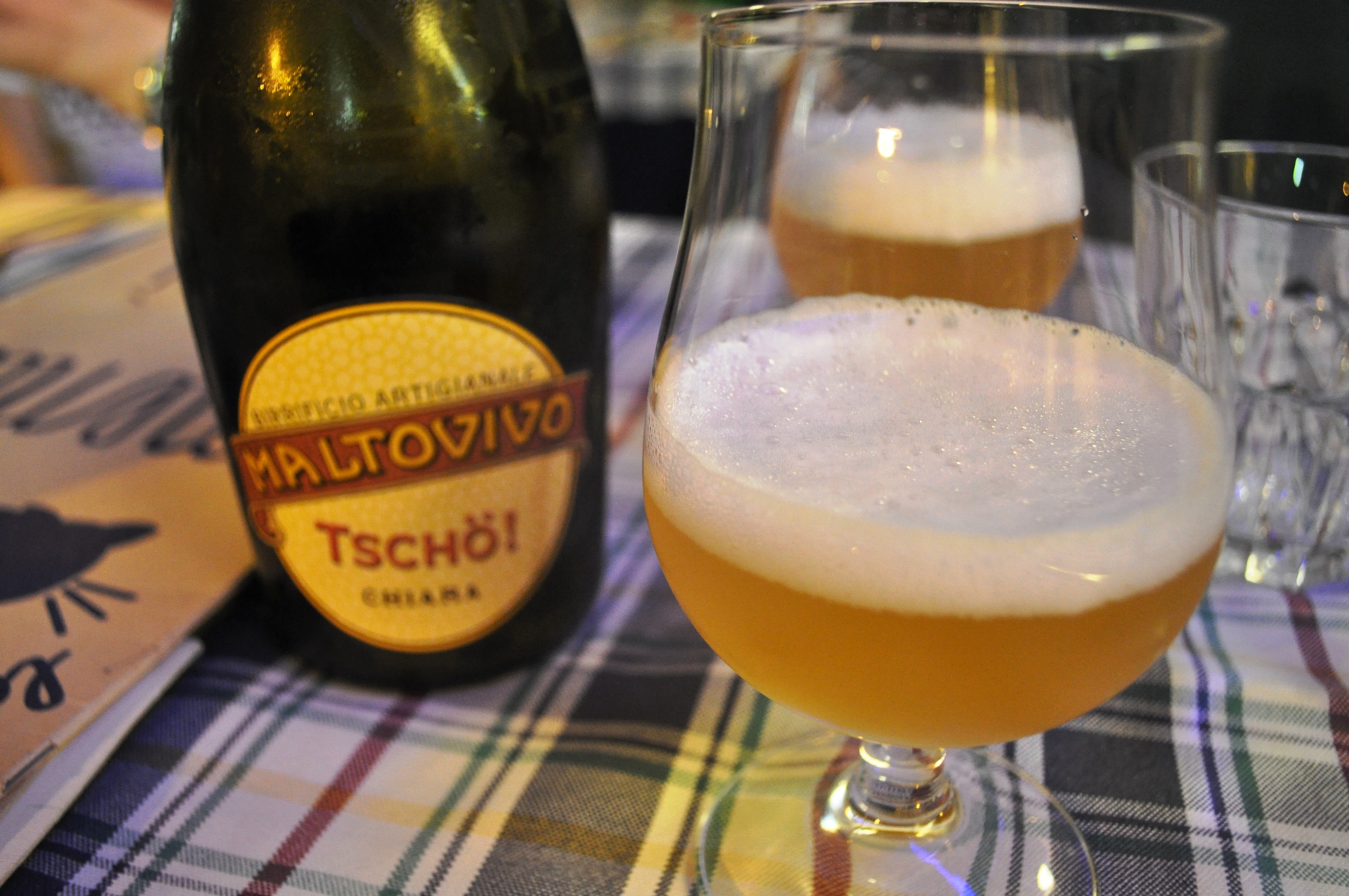
As I’d previously written about Calibro 5, a beer made with Kölsch that is designed to go well with pizza, it seemed suitable to have another beer made with the same yeast and in a similar style. This was the unpronounceable Tschö! from Maltovio brewery in Campania –that is, the region with Naples as its capital. (I’ll be talking about Naples again in the next post, as we’ve just been there.) Maltovio’s site can be found here. I really hope the photos are tongue-in-cheek. They remind me of comedy duo Armstrong and Miller‘s sketches about catalogue models in their natural habitat (sadly, I cannot find video snippets online).

This was a very straightforward beer, with some aroma of grass and hay, a blonde, murky body and a simple taste, with some slight citrus touches and a dry mouth-feel. Indeed, it probably would have been a perfect accompaniment to pizza, but between the six of us we finished it quickly while we were eating our antipasti.

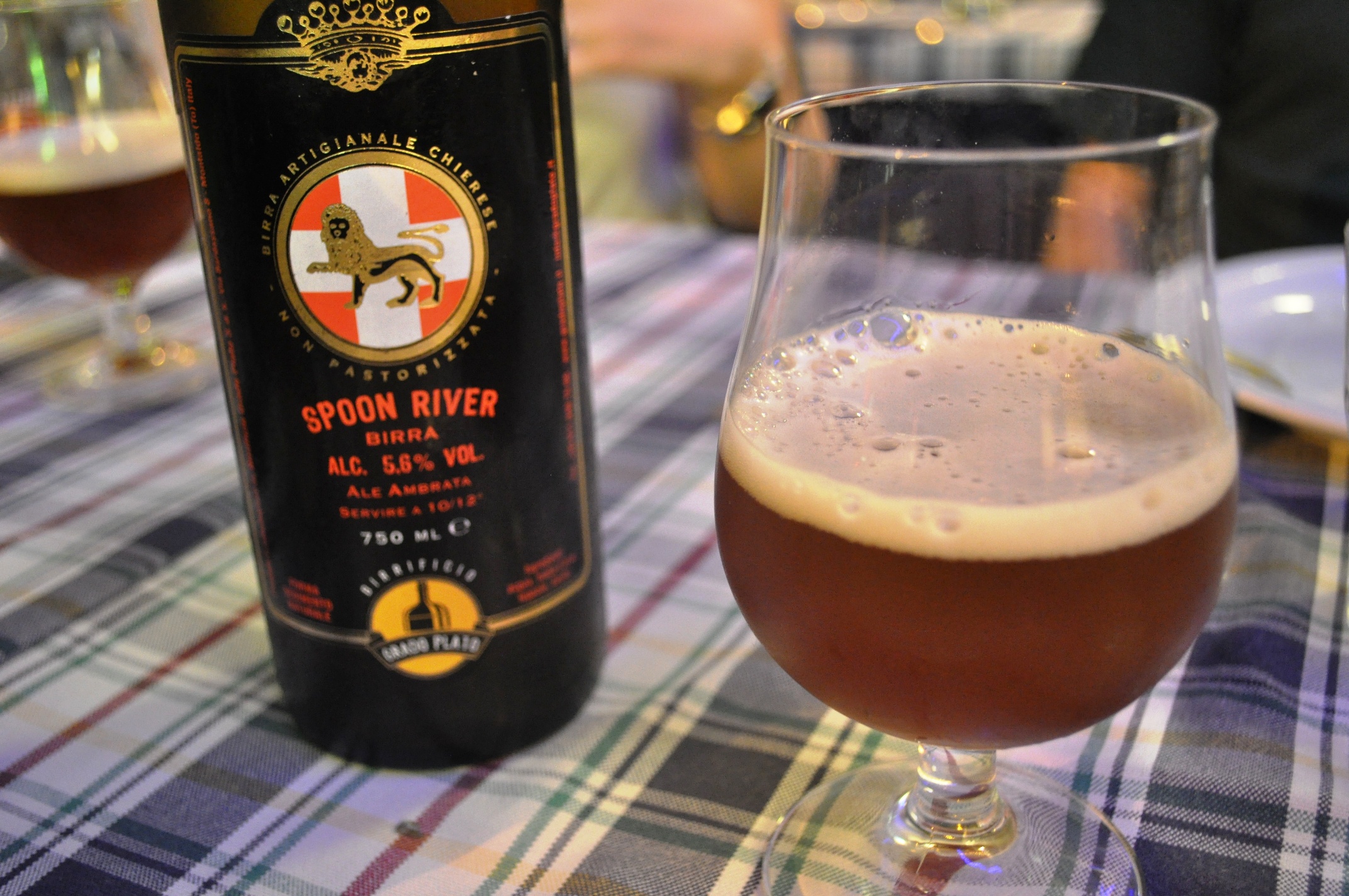
Grado Plato's Spoon River at La Gatta Mangiona

The second beer we had was Spoon River from Grado Plato brewery in the Piemont (Piedmont) region of northwestern Italy. The fact that it’s called Spoon River and not Fiume di cucchiaio fits in with this being in the style of a English bitter, or at least that’s what the Guida alle birre d’Italia 2013 (Italian Beer Guide 2013) says. Spoon River’s own site says it’s an amber ale that’s also (like Kölsch beers) good to “accompagnare a tutto pasto i piatti più svariati dai primi alle carni” – “accompany all meals, everything from primi (pasta, risotto etc) to meats.”

Its smell brought to mind toffee apples – so caramel malt and fruity. It’s got a medium body and yes, a very malty taste too, with some lasting bitterness.

I wish we’d tried more, but that’ll have to wait until next time.

Oh, and if you’re wondering about the name, a gatta is a female cat, and a mangiona is a glutton. So the Greedy Lady Cat. For want of a better word for a female cat. Why don’t we have a name for a female cat in English? If a male is a Tom (well, an intact male), what’s the equivalent? Some suggestions are a Queen, or a Molly, or a Dam, though these terms aren’t in common usage, especially for non-pedigrees. The Gluttonous Dam sounds nice though.

Info
Via Federico Ozanam 30-32, 00152 Rome, Italy
+39 06 534 6702 | lagattamangiona.com
Open from 19.45 to 23.30; closed Monday

Maltovio brewery
maltovivo.it

Grado Plato brewery
gradoplato.it

6 Comments

Filed under Ale, beer, Pizza, Restaurants etc

Italian breakfast, and why a cornetto isn’t a croissant

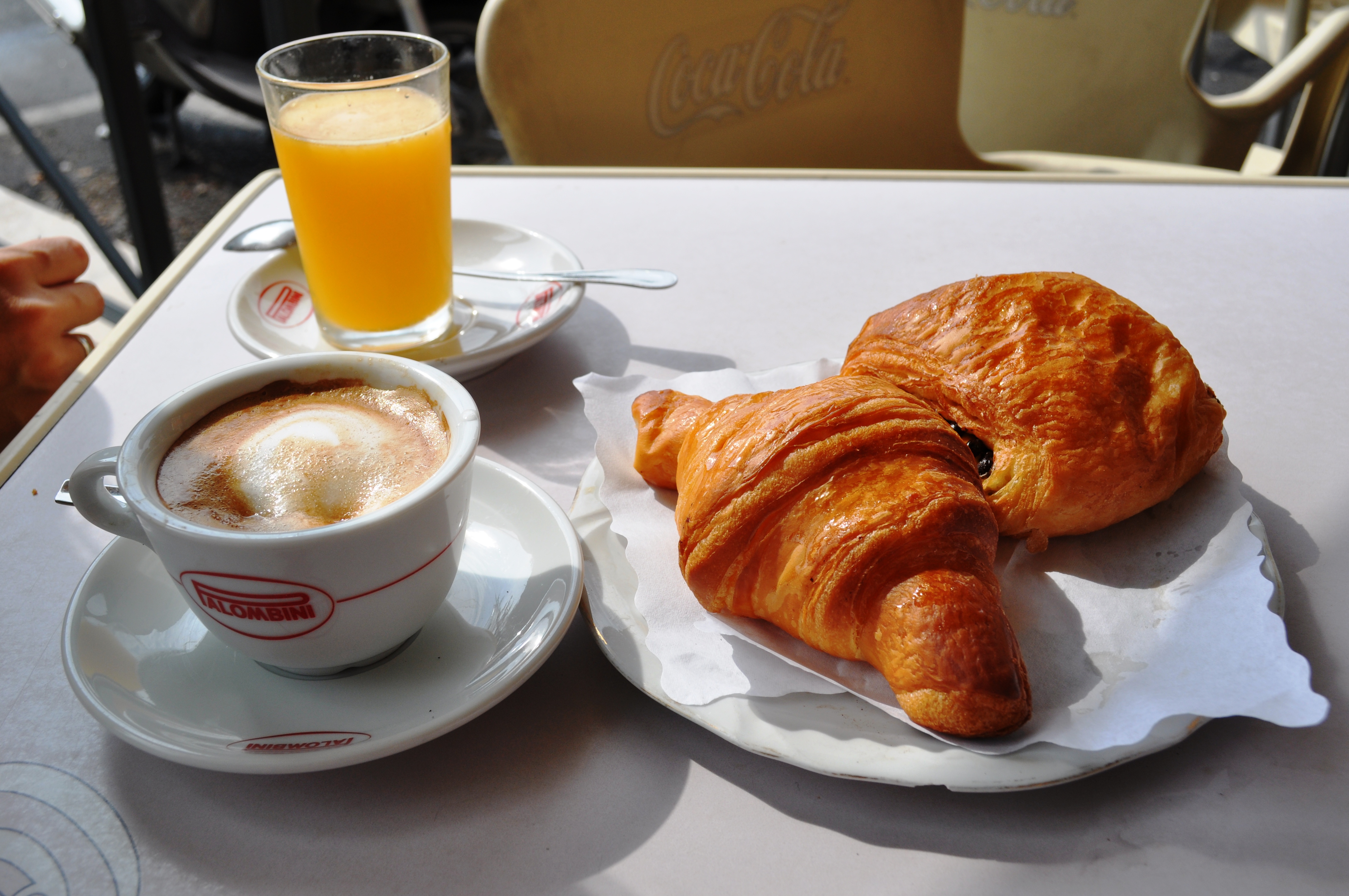
Cornetto, saccottino and cappucino at Baylon Cafe, Trastevere, Rome

Let the Games Begin (Che la festa cominci) is the latest novel by Italian writer Niccolò Ammaniti. He’s probably best known for Io non ho paura (I’m Not Scared), the 2001 novel that became a film in 2003.

A pretty broad satire of contemporary Roman society, Let the Games Begin is passingly entertaining, but it suffers from less-than-perfect translation and editing. As well as some fairly rudimentary editorial errors, the idiomatic translation doesn’t feel quite right. It’s also quite haphazard with its translation of Italian food names. While it’s content to refer to supplì as supplì, it seems to determinedly translate cornetto as croissant.

A cornetto (“little horn”) is not a croissant (French for “crescent”). Nor is it an ice-cream. It’s an Italian relative of the croissant, likely with the same origins, but today a distinct product. Sure they look similar, but they’re slightly different. Read on.

No one is in agreement about the origins of the crescent-shaped pastry, but one abiding story (or myth) is that it was invented in Austria to commemorate the defeat of the Ottomans, who besieged the city in 1683. Wikipedia gives more background. Whatever the origins of the pastry (other variables include chiffel and kipfel), since its birth the regional and national versions have diverged.

Breakfast pastries
Both the croissant and the cornetto are breakfast pastries. The quintessential breakfast I witness being consumed day-in day-out in Rome is a coffee – either a simple caffè (espresso) or cappucino (often just called cappuccio in Rome) – with a cornetto, normally just a cornetto semplice (“simple”, ie plain).

Many cafés offer a large selection of different breakfast pastries, or lieviti (literally “yeasteds” or “risens”, meaning pastries made with a yeasted dough) and if possible I get a saccottino al cioccolato. In Italian, a sacco is a sack, so this literally is a “little sack with chocolate”. And yes, it closely resembles another French – or Viennese – pastry: the pain au chocolat, known by many ignoramuses as a “chocolate croissant” . Guys, it’s not a crescent-shape, so how can it be a croissant?

The cornetto semplice is also apparently also known as the cornetto vuoto (“empty”), to contrast it with various types of cornetti ripieni (“filled”). These include cornetto alla crema (with custard), alla marmellata (with jam, marmalade or other conserve), al miele (with honey; this is often made with an integrale, wholewheat, dough), and cornetto al cioccolato. The latter is an actual cornetto that is usually filled with that vile brown vegetable-oil product beloved of Italians, Nutella.

Choice of pastries at Baylon Cafe, Trastevere, Rome

The (subtle) difference
The French really don’t go in for all these filled variables, beyond ones with almond paste, but the biggest difference between cornetti and croissant is the lamination.

A proper croissant must be made with butter, and must be repeatedly folded and rolled, to achieve a lamination wherein the rolled dough contains several thin layers of the fat. When the croissant is baked, water in the dough is turned to steam, but this is trapped by the fat, causing pressure and rising between the layers. The resulting pastry, when done right, should be crisp and flaky, with a taste of butter but no greasiness.

A cornetto on the other hand isn’t so assiduously laminated, and can even be made with lard, not butter. The dough also contains more sugar. The result is a pastry that is just a lot sweeter than a proper French croissant, and can have a more enriched bread or cake-like texture, more like a French brioche. Some cornetti are very flaky and like croissants, but many others are more cakey; there’s a lot of variation.

Indeed, cornetti are sometimes called brioche in some northern parts of Italy, though in Naples, Sicily and parts of south with a historical French influence, the name brioche is used for a pastry more like the Gallic version. But that’s another story.

Cappuccio, spremuta, pastries at Caffe Arabo, Trastevere, Rome

A couple of cafés
Our lifestyle at the moment takes us to two cafes regularly for weekend morning cornetti. I’m not saying these have the best cornetti in Rome – how could I, without sampling cornetti in every single one of the thousands of cafés and pasticcerie in Rome? – but they’re places we enjoy.

The first is Baylon, which we started frequenting because… well, I can’t really remember. They’re so grumpy and resolutely unfriendly that even after we’ve been going there two years only one of the staff actually acknowledges us. The Ricardo Darin-lookalike is a particular sourpuss. Unlike many more traditional Roman cafés, however, it has space to hang out, and Wi-Fi. Plus, unlike many places in the tourist nexus of Trastevere, they don’t charge stupid prices.

So we keep on going back – partly for the space, partly as we can get our Saturday morning weekly English language paper nearby, and partly because they it has great selection of lieviti. Apparently it used to be a local landmark pasticceria (pastry bakery), so at least they have their own kitchens for the baking.

Our Sunday routine, on the other hand, developed as we used to go down to the farmers’ market in Testaccio’s Ex-Mattatoio every week. Although that’s now sadly been shunted further out of town, at least a direct-from-farm shop has opened near Ponte Testaccio, on the Trastevere Station side of the river, where we can get many of the same quality fresh products. There’s also Porta Portese market every Sunday, with its enormous selection of tat, junk and bric-a-brac.

Case of pastries at Caffe Arabo, Trastevere, Rome

On our route down the hill from our house, via the massively grand 19th century, weed-infested, broken-glass strewn, graffitied Ugo Bassi steps, we go to Caffè Arabo on Viale di Trastevere. This is a more traditional Roman café, no Wi-Fi or anything of that poncy nonsense, but it’s still kinda idiosyncratic. Plus, a couple of the staff not only recognise us but are friendly, even amiably laughing at my ordering a (hot) tea on a hot day. “The British drink tea in every season, every weather,” I shrugged.

They don’t have a kitchen, so their cornetti are bought-in, but they’re not bad. And occasionally they even have saccottini al cioccolato to satisfy my chocolate cravings.

Neither places, however, has croissant. A few Roman cafés do apparently do French-style croissant, but I’ve yet to sample them.

Of course, not everyone has a coffee and cornetto for breakfast or elevenses here in Rome. We sat down at Arabo last Sunday, Fran ordered a cappucino and cornetto, I ordered a spremuta d’arancia (freshly sqeezed orange juice) and a saccattino al cioccolato – then two guys sad down beside us and ordered beers. It was 10.30am.

Info
Baylon Café
Via San Francesco A Ripa 151, 00153 Rome
bayloncafe.com

Caffè Arabo
Viale di Trastevere 20, 00152 Rome

48 Comments

Filed under Cakes (yeasted), Discussion, Other food, Restaurants etc

Birradamare’s Birra Roma at Zoc, Rome

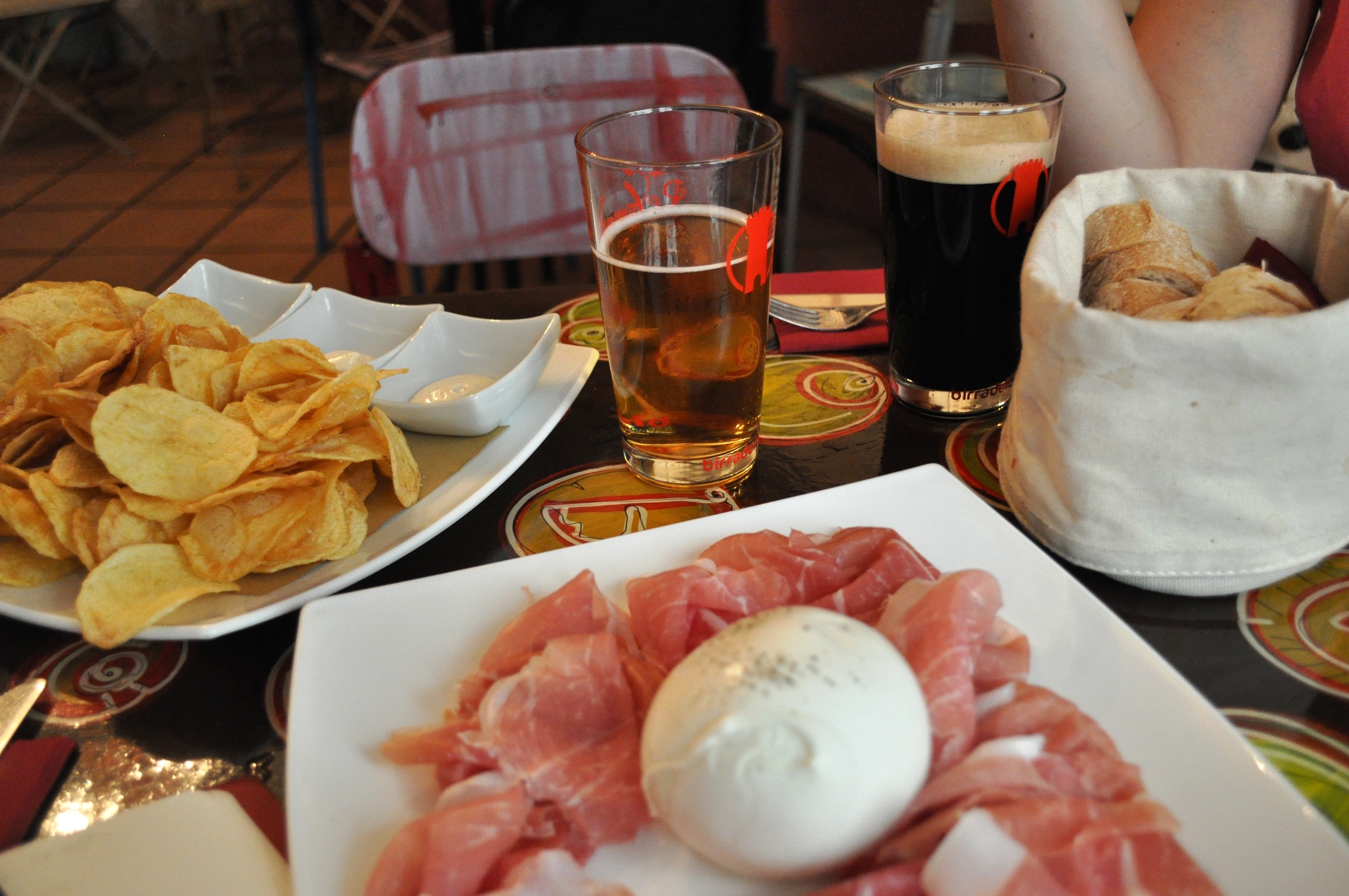
Birradamare's Birra Roma and 'Na Biretta Rossa

Saturday lunchtime we stopped by Zoc trattoria (aka Zoc 22) for some food and ale. Zoc is owned by the same people as the more established Urbana 47 in the Monti neighbourhood of Rome. Urbana 47 is stylish place where the food is produced along sound principles, with an emphasis on season and local (“KM0”), the provenance of ingredients front and centre on the menu.

As it should be.

We eat far too much food where we have no idea of the origins of the ingredients. This is important for all ingredients, but especially so for meat and dairy, where barbaric industrial techniques have cheapened the human relationship with animals, resulting in a form of de-humanised husbandry that emphasises quantity at any cost. Sadly, many people have been duped by the persuasiveness of the meat industry and supermarkets. Your intensively reared beef, pig unit pork, or industrial broiler chickens really aren’t that cheap if you factor in the subsidies and the cost we’ll all have to pay in the long run for the accompanying pollution and disease.

The bar at Zoc, Rome

So yes, bravo Urbana for its principles. These principles are similarly followed at Zoc, where the menu lists not just the ingredients, but the azienda that’s provided them. The trattoria even has photos on the wall of some of their suppliers, including one chap Fran recognised as the guy we’ve bought salumi from at the market in the Testaccio Ex-Mattatoio (currently closed for the summer – go figure).

I was also encouraged by the drinks list, which mostly consists of local wines, but also includes four bottled beers from Birradamare. Birradamare has pretty much established itself as the craft brewery for Rome. Although it’s not in the city, but instead is located at Fiumicino, the town at the mouth of the Tiber near the airport of the same name, its products are fairly ubiquitous here. If a Rome venue has just one craft beer brand on offer, chances are it’ll be Birradamare (eg here).

I ordered a Birra Roma, Fran a ʼNa Biretta Rossa. I’ve had the latter before – it’s a decent malty beer, inspired by German bocks, sweet and medium bodied, with 6.4% ABV. Its colour is amber or copper. Surprisingly, the Birra Roma was a similar colour (see pic, above), despite being called a birra oro (golden ale) on Birradamare’s site or even bionda (blonde) on the label. Birradamare’s own site says the Roma is 35EBC, which is about right, but there’s no way the Rossa is 74EBC (a serious porter tone). Surely that’s an error?

Anyway, the Birra Roma (5.5% ABV). Like Baladin’s Nazionale, which I tried a few days ago, the Roma seems to be one of the many experiments going on to create specifically, uniquely Italian style beers. In this case, even a specifically Roman beer. It’s a beer that clearly takes into consideration Italians’ love for fairly straightforward but strong lagers, as it was inspired by Bavarian Märzen lagers. I found it had a slight orange aroma, slightly hoppy. Taste-wise, it’s hoppy but not bitter (35 IBU apparently), crisp, fresh, with very faint smokiness and more body than a lager. Interestingly, Fran said it reminded her of the sea, of seaweed and salt and Breton Atlantic  beaches, the Côte Sauvage, which is far more poetic than I can be about it.

Birra Roma at Zoc Rome

So anyway, we were enjoying the beers, and the ambiance of the place, which is located in a 1950s block on the Centro Storico side of the river near the Ponte Sisto. The dining area is spacious, with high ceilings and some great design features, like an enlarged detail of a nautical map (I love maps). Much of the furniture is for sale, with price tags, so there’s a slightly distracting feeling of eating in a hip secondhand furniture showroom. There’s also a decent sized courtyard at the back, though it was a pretty hot day when we visited, and they seemed to be trying to cool it off with misters – which only succeeded in making everything soggy.

When the food finally arrived, it was pretty tasty. Fran had three chicken legs and a fig, the flavour profile a nice change to much Roman food, with some turmeric, cumin, rosemary. But it really was just three drumsticks and a fig, for €16. Mine, meanwhile, was half an aubergine (/ melanzana / eggplant) and one piece of cheese toast. Like Fran’s, the flavours were a nice change, more north African say, though it was underseasoned. And just plain meagre (for €9). I’m more than happy to pay for quality and provenance, for more ethical food, but there’s got to be some balance – the portions were so small we left feeling hungry, which isn’t what you want when your bill comes to €44. We even had to ask for bread (a dense, white sourdough, somewhat stale), and there we no other contorni (side dishes). Essentially we paid meal prices for a snack.

Blown up nautical charts on the wall of Zoc

This is all something they need to work on, to make for a more satisfying experience. They could also do with working on the service. The staff were amiable enough but just seemed a bit apathetic. When, for example, a fuse tripped, cutting out the fans and lights, the waiter wandered around for a while first before going to click it back on. He wasn’t busy either, there were just a few covers there for Saturday lunch. Perhaps it’s busier in the evening. Although it’s right near two very popular areas – Trastevere and the Centro Storico around Campo de’ Fiori – it’s just off the main drag. Although Urbana 47 suffers from the same small portions/ high-ish prices issue at least it’s got a bit more atmosphere from being busier, as Via Urbana is a more lively street.

So, Zoc: nice spot, good beer, sound principles, iffy value for money. Must try harder (er, as I may have had on my school reports a few times in days of yore).

Info:
Via delle Zoccolette 22, 00186 Rome, Italy
zoc22.it (English site, sort of) / 06 6819 2515 / info@zoc22.it

Birradamare
Birradamare.it (English homepage) / 06 658 2021 / info@birradamare.it

4 Comments

Filed under Ale, beer, Restaurants etc

Baladin and del Borgo beers at No.Au bistrot, Rome

Baladin Nazionale, Bira del Borgo Keto Reporter at no.au

Just to the northwest of the faintly grotesque tourist nexus that is Piazza Navona, Rome’s Centro Storico (“historic centre”) offers a maze of streets, alleyways and piazzette. There, it’s possible to wander, get lost, find yourself again, elude the tourists mobs, bump into them again, and even find filming locations from Eat Pray Love (ugh). Among the cobbles and crumbling apartment blocks are numerous bars, restaurants and gelaterie. Our destination last night was No.Au, a bar/restaurant located between the handsome Chiostro del Bramante and the somewhat chichi Via dei Coronari (which even boasts one of Rome’s few cupcake shops these days. Bloody cupcakes).

No.Au, which opened in summer 2012, is a collaboration between several big names in Italy’s craft brewing and food scene who wanted to “recreate the atmosphere of a Parisian bistro, with quality products and good company, in the centre of Rome.” You’ll find the whole spiel (in English), and an explanation of the name of the place, here on the Baladin site. Why is it on the Baladin site? Because one of those (five) big names is Teo Musso, the founder and master brewer of Baladin, Italy’s biggest craft brewer.The bar and taps at No.Au Rome

So key is Musso in the Italian craft brewery scene, a biography has even recently been published. It’s called ‘La birra artigianale è tutta colpa di Teo’ (“Baladin. Craft beer is Teo’s fault” – ie Musso is to blame, ie responsible, for the whole craft beer scene in Italy.) Presumably the title is slightly tongue-in-cheek, but certainly Musso is among the most influential of Italy’s craft brewers. His collaborators here are Luca Tosato (also of Baladin), Leonardo di Vincenzo (master brewer of Birra del Borgo), Paolo Bertani (also of Borgo, and previously Baladin) and Gabriele Bonci (renowned pizzaiolo and TV regular whose company produces the breads for Open Baladin bar. We did a pizza course with him last year).

It’s no surprise, then, that at No.Au, the main beers you’ll find on tap are from Baladin and del Borgo, but they also have others, in bottles, both Italian and international. Beside where we sat was an old box of US brewer Dogfish Head’s intriguing/strange Midas Touch. I stayed with Baladin for my first choice. As I’d tried a lot of the offerings on tap, I went for a Nazionale (6.5% ABV), which the friendly, helpful waitress described as a “simple” beer. It’s described as an Italian Ale – as it’s top fermented and also because it’s made with entirely Italian ingredients. This includes the hops – which was a pleasant surprise, as so many Italian craft beers seem to depend on international hops.

No.Au Rome snacks

This really was a pleasing beer, perfect to accompany the antipasti we’d ordered:  a plate of bufala e prosciutto and some very fine freshly cooked potato crisps/chips accompanied by three flavours of mayo. As the waitress said, it was simple – a golden yellow, with a quickly subsiding soft head, very subtle aroma of ginger and lemon, and a fairly sweet, mildly hoppy smooth taste (27 IBU). Molto beverina.

Fran’s first beer was Keto RePorter (5.2% ABV) from Birra del Borgo. This porter is made with the addition of Kentucky tobacco leaves, but it was also very mild from the few sips I had.

As the beers were served in half-pints, and we’d finished the antipasti, I fancied trying something a little more interesting, so the waitress recommended Baladin’s Open Rolling Stone, which they described as an Italian APA on their blackboard, but as an IPA on Ratebeer. Either way, this beer, branded for the magazine of the same name, is very tasty. It’s relatively strong, at 7.5%, and had a slight perfume of camomile and a reasonable head. At first taste it was soft and sweet, but this gave way to a drier, slightly hoppy flavour (it’s still only a fairly moderate 36 IBU though, according to Baladin’s site). I was enjoying this one, but about half-way through my half-pint it started getting a bit detergenty, losing its crispness.

Wine, food, beer at No.Au Rome

Fran’s second one was a Genziana from del Borgo. I’ve had this before, though didn’t try it last night. It’s a really interesting beer made with bitter gentian flowers.

When some friends arrived, we ordered some more food. The emphasis here is on snacks and food that’s either stirato (“ironed” ) or crudo (“raw”). The ironing takes place on a piastra (flat top grill).  I was slightly surprised to see a lot meat available (such as sandwiches made with burger buns and sliced roast beef), as over at Katie Parla’s site she reports how Bonci’s places are going vegetarian for a month to protest Rome’s lack of appreciation of Lazio’s farmers and producers. I asked the waitress, and she said the menu was in transition. So if you visit any time in late July, there may be more vegetarian food.  I had seppia (cuttlefish), which had been ironed in a folded sheet of parchment, with zucchini. Served with an ink mayo, it wasn’t bad, but I would say this place is more about the drinks and antipasti, more a place for aperitivi or after-dinner drinks.

Talking of after-dinner drinks, when we’d eaten, I ordered one more (hey, that still makes just one and a half pints).  I got Baladin’s Isaac, a 5% blanche made with orange zest and coriander and it was a perfect palette cleanser.

No.Au exterior, note like of sign

All in all, a very pleasant evening. Although the place only started to fill up, and the lights went down, around 8.30-9.00pm, it’s definitely a good place to visit for quality Italian craft beers. And plates of cheese. And maybe even some wine. Oh, and the music was pretty good too. All this within a stone’s throw of Piazza Navona and its thoroughly-worth-avoiding eating and drinking options.

Info
No.Au, Piazza di Montevecchio 16A, 00186, Rome
No.Au blog / noauroma@gmail.com / 06 45 65 27 70

Baladin brewery (English site)

Birra del Borgo brewery (English site)

4 Comments

Filed under Ale, beer, Bars, pubs etc, Breweries, Restaurants etc

Dinner at Plistia restaurant, Pescasseroli, Abruzzo

This post does not feature beer. But it does feature some bread, as well as as soup containing grains. And a little cake. Some of which is photographed with my rubbish phone’s rubbish camera.

I know, I know, quality blogging is all about quality photography, especially when food is involved, but generally we’re not lugging the DSLR around with us when we eat and drink. I really need to get a decent phone with a decent camera, or even a new compact camera.

In my defence, I’d say I was more of a writer than a photographer, so hopefully I can describe these dishes through the medium of the English language, to compensate for the blurry pics.

So, the weekend of Saturday 29 June 2013, we headed out of Rome to get some mountain air in Abruzzo. We stayed in the town of Pescasseroli, at the heart of Abruzzo National Park. I’ve written about our hikes here; at the end of our second, long hike, we had a restaurant booked for Fran’s birthday dinner. This was Plistia, a restaurant and albergo located on the main road through the small town.

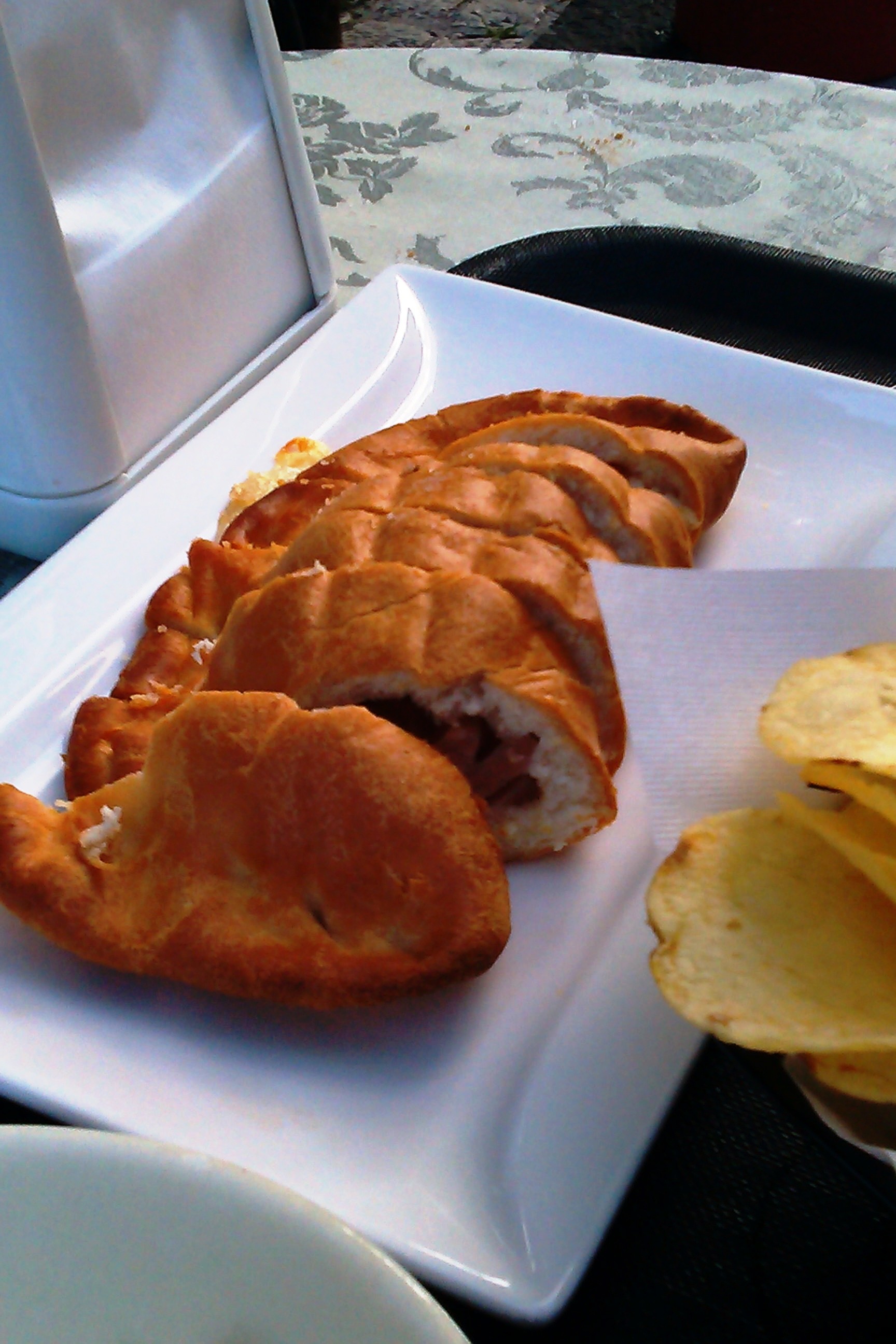
A kind of pasty - ok, a calzone - in Pescasseroli, Abruzzo

First, however, we had an aperitivo in a bar on the nearby piazza. The snacks included this Abruzzo “pasty” (probably actually a type of calzone, but they’re all related right?), and some sparkling Pecorino.

Many people don’t realise it, but Pecorino isn’t just the name of sheep’s milk cheese, it’s also a very good white wine from Abruzzo and adjoining regions, or more specifically a grape variety. Since we moved to Italy and started learning more about the vast number of Italian wines that don’t make an impression in the export market, it’s become our go-to white wine. Although Pecorinos (Pecorini?) vary, they’re generally slightly foral wines with some body – and as such a very nice versatile alternative to something like a Sauvignon Blanc or Pinot Grigio. When we moved on to Plistia, the host, Cicitto, settled us in and filled our glasses with more Pecorino.

No menus were offered, but we were absotuly happy with his. He just said, “We’re going to feed you, lots of food, take it slowly”. Considering you enter the restaurant via a dogleg hallway with a view straight into the open kitchen, they’re clearly confident about their food. Fran had researched the place more than me, but I was also reassured by this confidence, and years of Slow Food certificates on the wall.

On our honeymoon, in Croatia and Italy, Fran and I had agreed that for a couple of taster menus we had arranged, we would eat everything, despite our personal preferences (hers: red meat; mine: very little red meat). When Cicitto went to get the first dish, Fran and I shook on “Croatia rules”. Of course, this being inland Italy, where the food is hearty and the red meat ready and bleeding, that was always going to be more in her favour, but hey – it was her birthday!

The first course was a cheese plate. Cicitto said four of the seven cheeses were world champions. I don’t know anything about cheese world championships (it doesn’t really get the TV coverage of the World Cup, say), but they were delicious: five sheeps’ milk and one goats’ milk, of varying characteristics: young and sweet, mature and crunchy. The two harder, more mature ones we were instructed to eat with a strawberry sauce with balsamic, and a very nice combination it was too.

lardo bread

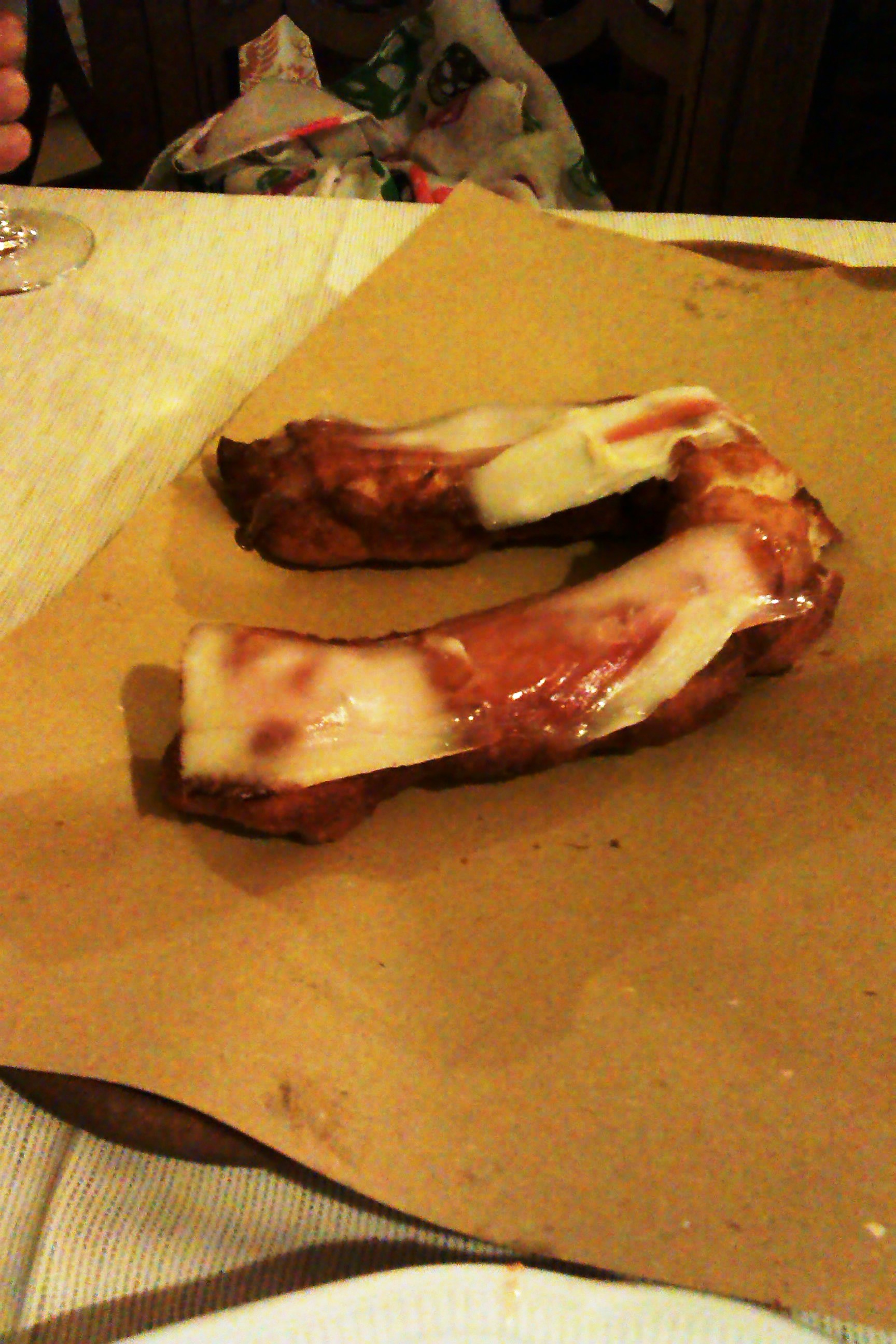
Next up we had something that was apparently an invention of the chef, Laura, Cicitto’s wife, rather than a traditional Abruzzo item with a name… I think. I could be wrong. Anyway, it was basically like a savoury doughnut, swathed in lardo. People assume lardo is just Italian for lard, but it’s a false friend. Lard is actually struzzo. Lardo is in fact a cured meat, like prosciutto crudo but with an emphasis on the fat. Racheleats discusses of the differences between several types of salumipancetta, guanciale and lardo – and has a good photo to illustrate it:

pancetta, guanciale, lardo from Racheleats

Again, despite the crapness of my photo it was delicious. The bread, made with a lievito madre (natural leaven), was white and soft inside, and the crust was crunchy and fatty, from the cooking oil and from the flavoursome melting lardo. It’s exactly the sort of thing I’d never naturally be inclined to try, but loved when I did.

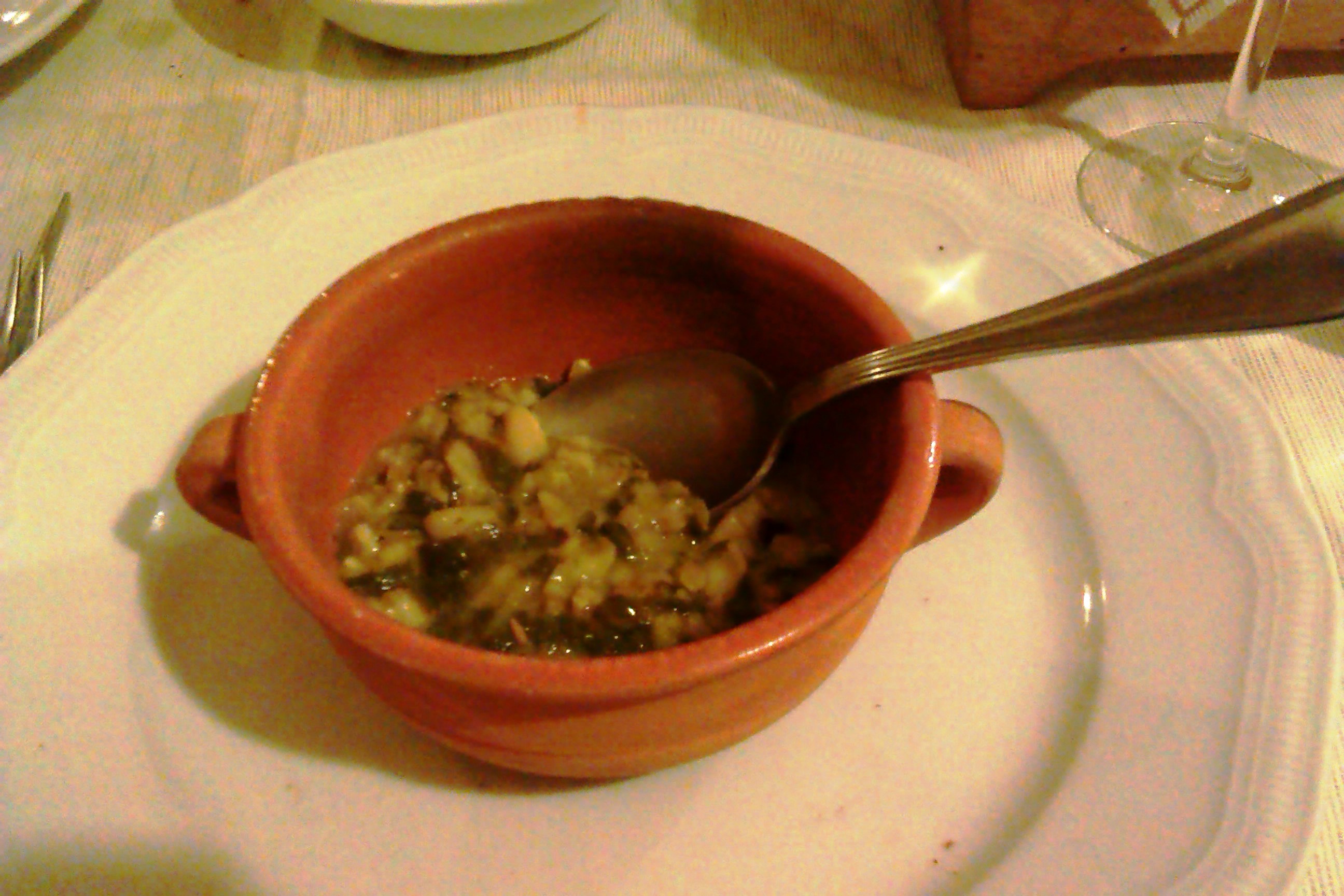
Next up was a soup. This was exactly the sort of thing I would naturally want to eat: a thoroughly rustic minestra. This one was made with grains, beans and greens. The grains were farro decorticato, or more specifically they were husked emmer. The beans were cannellini, or similar. The greens were an Abruzzo spinach. It was one of those soups that had such depth of flavour you wonder how it was achieved with such simple ingredients. It wasn’t even made with a meat stock, apparently. Fab. As much as I enjoyed the whole meal, the soup alone would have made me happy.

Soup at Plistia, Pescasseroli

After the soup we had not one but two pasta primi. The first was caramelle, that is filled pasta shapes that resemble wrapped hard sweets, or like ravioli that have had their ends twisted. The filling here was faraona – guinea fowl – and they had a buttery sauce with juniper berries. The latter are an important part of Abruzzo cuisine it seems.

Caramelle at Plistia, Pescasseroli

The second pasta was made with short, flat noodle pieces (possibly maltagliata – “badly cut”) that had parsley and pecorino cheese in the dough. It was served with a sauce with a little guanciale, saffron and some thin so-called wild asparagus. This was one of the meal’s weaker courses as it was a little salty and the asparagus was a bit woody. I’m surprised they had it, as over in Lazio we’re way past asparagus season. Sure there’s a different climate in the mountains of Abruzzo, but asparagus is a spring vegetable, and it was 30 June.

After all this, we were pieno come le uova (“full like eggs”), but meataholic Fran could hardly resist the offer of a steak. I don’t really eat steak, so we had one between us and she had the lion’s share. It was tender and bloody, and came in a deglazing sauce of red wine with black peppercorns and more juniper.

We were officially full by this point, but it seemed almost rude to deflect the offer of a desert. We had one plate, with a meringue and a kind of light custard, a ricotto cake and a chocolate form filled with more of the custard. These provided a sugary hit, but didn’t really compare with the flavoursome savoury courses.

Overall though, a suberb meal, and one of the best I’ve had in Italy. Furthermore, it cost about €40 a head – a price you could easily pay in Rome for just two mediocre courses and a few glasses of wine. Most certainly a meal with buon rapporto qualità-prezzo. So if you find yourself in Abruzzo, perhaps doing some hiking in the beautiful mountains, we heartily recommend a visit to Cicitto and Laura at Plistia’s restaurant.

Infodump:
Plistia, Via Principe di Napoli 28, 67032 Pescasseroli, Abruzzo
albergoristoranteplistia.it / info@albergoristoranteplistia.it / +39 (0) 863 910 732

3 Comments

Filed under Misc, Other food, Restaurants etc

Seta at Thien Kim and ʼnaBio at Ai Tre Scalini

As much as I love Italian food, sometimes you just want something a little different. A different set of flavours. As Brits, we regularly get cravings for curry. There are a few places in Rome that scratch the itch, but aren’t really anything to write home about. Another craving we’ve had is for Vietnamese food. Having lived in London for many years, we were spoiled by having access to some great Vietnamese places, notably on the Kingsland Road.

Over the past 20 months or so, we’ve walked past a Vietnamese place in Rome several times. It doesn’t have a menu outside, its window is graffitied and overall it doesn’t look prepossessing. But while the summer has arrived, and all the popup bars and restaurants are lining the Tiber, we thought, let’s ignore the evening sun and instead head into the gloom of Thien Kim, which is located on the Centro Storico side of Ponte Sisto, the pedestrian bridge that connects Trastevere.

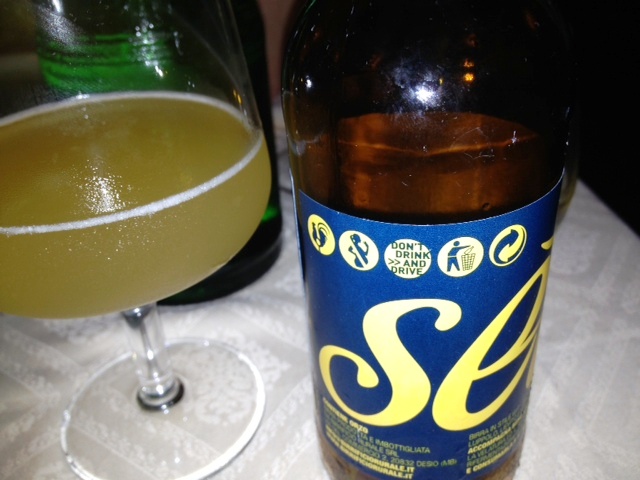
It was indeed gloomy, and quiet, but the welcome was friendly, and – would you believe it?– they had a few Italian craft beers on the menu. So alongside my food, I had Seta beer. The 5% ABV Seta is from Rurale brewery in Lombardy.

Seta

Seta means silk, and the beer was clearly designed to be a smooth, refreshing summer drink. It’s described as “Wit – blanche” on the Rurale site, that is a Witbier – a Belgian style top-fermented white beer that’s defined in part by the murkiness of the liquid. Seta is no exception, with a cloudy yellow colour and an even, mild body. Although it does contain hops, the hoppiness is negligible, and instead the flavour is defined by the presence of coriander and zest of both bitter and sweet oranges.

Interestingly (for a cereal enthusiast like me), it’s also made with three grains: malted barley, non-malted wheat (grano tenero, that is Triticum aestivum, common wheat), and oat flakes. Me and Fran got notes of ginger, jasmine, lemon. The bottled version I had didn’t have anything much in the way of head, and the body was only subtle fizzy. We’d just come from one of our favourite bars, where  – despite their sign outside saying “Birre artigianale” (artisan beers) – they’d run out of craft beers, so I had a Menabrea amber. It was foul and headachey, so the eminently drinkable Seta was a relief. It also ably lubricated the fair-to-middling food (some crisp courgette flowers stuffed with prawn, a tasty sweet-sour mushroom soup, then a totally over-salted squid main course).

The following day we were in town again and after escaping the heat to watch ‘Man of Steel’ (or “the new Superman film” as non-geeks might not get the “Man of Steel” name) in an air-conditioned cinema, we were wandering Monti thinking about dinner. As it was still fairly early though, we dived into Ai Tre Scalini, a bar and wine cellar “since 1895”. Har. It’s a characterful place though – cool without being affected, friendly without being disingenuous. When we sat down I spotted a picture on the wall of the actors Totò and Aldo Fabrizi in ‘Guardie e ladri’ (‘Cops and robbers’), one of Italian cinema’s great mid-20th century comedies of post-war struggle and social change. Cool, I like that film, thought I – only to notice that there were using the image as a sign warning you about pickpockets. That’s the first time I’ve seen such overt warnings in Rome, and it’s kinda depressing. Like British bars that look quite ordinary and pleasant but have bouncers outside them – indicating the place is rough and used to fights.

After some criminal highjinks in Naples a few weeks ago, we’re a bit nervy about such things now.  So I thrust my wallet deep and checked out the menu. It’s mostly a wine bar (Vino e specialità nostrane – “Wine and homemade/local specialities”) but they did have beers from ʼna Biretta, the brand of Birradamare brewery just outside Rome. You can’t really find a more local craft beer in Rome than ʼna Biretta. Indeed, he very brand name is Romanesco – with ʼna just being the typically truncated dialect for una, “one” or “a”. As in “Givvus a beer!”

'naBio

I’ve had a lot of ʼna Biretta but never tried their ʼnaBio, so ordered one. Although the beer is apparently ispirata alle lager tedesche (“inspired by German lagers”), it’s not as pissy, thin, sharp and headachey as ubiquitous industrial lagers, indeed it’s got a surprising body. In fact, BeerAdvocate classifies its style as Munich Helles Lager, that is a more malty, fuller bodied type of lager developed in Germany in the late 19th century to counter the inroads of Czech pilsners. Birradelmare don’t classify it as such, just calling it a lager, but it seems a reasonable assessment. Sort of. Because as well as being bio, that is “organic”, ʼnaBio, like the Seta above, also involves interesting use of grain.

Ratebeer classifies its style as Speciality Grain. In this case, the grain is farro, though in Italian that word is used for three different types of ancient wheat. A quick bit of detective work  Googling indicates that the organic farro used in the beer is from Monteleone di Spoleto in Perugia province, Umbria, and that they specifically cultivate Triticum dicoccum, or emmer wheat.

The emmer isn’t malted, but is combined in the brew with malted barley. The result is a beer with more body than a typical lager while also being light and refreshing, with a golden-yellow colour, negligible head and dry, crisp flavour, with a slight aroma of cut grass or even silage. My wife said “Brussels sprouts” – which might sound freaky, but she loves Brussels sprouts, so that’s a commendation. It went down very easily, and helped wash down the dry aperitivo snacks: deepfried chickpeas, delicious slightly spiced taralli.

The word that seems to be bandied around a lot for lighter, refreshing beers in Italian is dissetante. In Italian thirst is sete, and the verb to quench the thirst is dissetare. So yes, both Seta and ʼnaBio are definitely dissetante, thirst-quenching.

Infodump:
Thien Kim, Via Giulia 201, Centro Storico, Rome
+39 6 6830 7832

Ai Tre Scalini, Via Panisperna 251, Monti, Rome
+39 6 4890 7495 / aitrescalini.org / aitrescalini@colosseo.org

Birrificio Rurale
birrificiorurale.it / info@birrificiorurale.it

ʼna Biretta/Birradamare
nabiretta.it  / info@nabiretta.it

Leave a comment

Filed under Ale, beer, Bars, pubs etc, Restaurants etc