

We’re big fans of scones in our household. My wife, Fran, is from Devon and I’ve got strong connections with this county in the southwest of England that, along with its neighbour Cornwall, is the homeland of the cream tea: scones with clotted cream and jam, washed down with (milky black) tea.
(Some say the scone comes from Scotland – does it? Are Scots and West Country scones the same thing? Or are they different types of “quick bread” with the same name? Some serious historical investigation needs to be done on that front before I’m persuaded either way. The word itself may derive from the Dutch “schoonbrot”, meaning fine bread or white bread, though that clarifies nothing.)
I’ve been making scones since childhood, presumably having fallen in love with them after childhood holidays in Devon and Cornwall.
Anyway, every time we eat them, the same two issues arise.
First, is it pronounced skon-ryhmes-with-John or skown-rhymes-with-own? (Seriously – there’s no either/or; as with many words, it varies, with the former pronunciation most common in Britain, especially in Scotland. See point 3.11 in this 1998 University College London British English pronunciation survey.)
And second, does one split the scone then spread it with clotted cream first, or jam first? I doubt UCL has done a survey on that, and among my friends things seem to be fairly evenly split. Fran is adamant is has to be jam first, then a blob of cream like a garnish, I’ve always spread the clotted cream first, like a kind of glorified (oh the glory!) butter.
Now, before I proceed, for any impoverished soul who hasn’t had the pleasure of eating clotted cream, let me tell you what you’re missing. Clotted cream – which most certainly is traditionally, and originally, from the West Country – is a very rich, delicious and generally delightful dairy product made using the cream of cow’s milk.
In days of yore it would have been made using the rich milk of local West Country cattle, like the charming Devon Reds, a breed that’s been making a comeback recently. (My parents’ neighbours in their place in Devon had a champion Devon Red bull called “Freddie” Yeomadon Ferdinand, whose offspring are used for beef; apparently it’s not viable to use Devon Reds for dairy these days so I’ve never tried any Devon Red milk or dairy products.) These days, clotted cream is mostly made using milk from Guernsey and Jersey cows, the breeds now most associated with rich, fatty milk.
Clotted cream is traditionally made by heating rich creamy milk over a low heat, possibly in a bain-marie type arrangement, reducing its water content, and encouraging the creation of thick creamy clots, which are skimmed off. I’ve made cheese, butter and yogurt but never clotted cream. They demonstrated this traditional production method in episode 9 of BBC’2 Edwardian Farm series. It looked painstaking and protracted so I don’t think I’m likely to try and reproduce it any time soon. (Read the Wikipedia entry if you’re interested in learning more about the modern, industrial production methods.)
On a recent visit to Devon, I bought some clotted cream from Langage Farm, a Devon brand that uses the milk of Guernsey and Jersey cows. Clotted cream is something I crave, and one of the international delicacies I’ve not been able to source in my current city-of-residence, Rome. So this pot travelled all the way home with me. Ridiculous food miles for a treat I know.
After making a batch of scones yesterday (see below for my basic recipe), we had a cream tea – something that presumably doesn’t happen very often in Rome, even at vintage tea room Babington’s, whose version of a “cream tea”, according to their online menu, consists of “A Scottish scone with butter and strawberry jam”. With whipped cream. That’s just plain wrong.
My friend and sometime catering collaborator Mr Dominic Rogers raised the above-mentioned cream-or-jam first question, and we discussed them being “tasty either way”, but not necessarily “tasting the same”. This is a noteworthy point, and one I had to address in more detail. So I did a taste test.

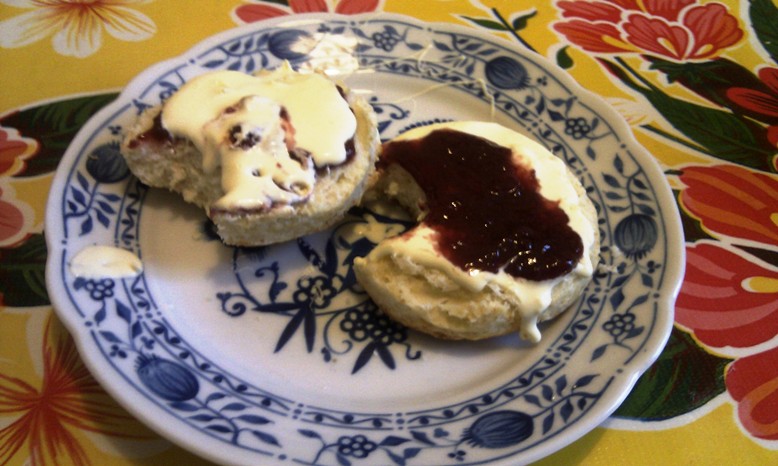
As illustrated by this photo, it wasn’t entirely scientific: I didn’t weight out the amounts of cream and jam (in this case fragole, strawberry) used to make sure they were identical in both cases, and I only used one scone, which meant one piece had the top crust and the other the bottom crust, which have slightly different textures. However, the results were interesting (well, interesting for scone obsessives). They are all pretty obvious if you think about it, but I still feel it’s worth recording, considering the perennial nature of the argument.
1 As you bite the jam-on-cream arrangement, your first flavour hit is of jam, which is tart, sugary-sweet and fruity.
1b Do you enjoy the sensation of thick cream as it potentially touches your top lip?
2 As you bite the cream-on-jam arrangement, your initial flavour hit is of clotted cream, which is of course, smooth, gloopy and dairy-sweet.
2b Do you enjoy the sensation of sticky jam as it potentially touches your top lip?
3 As you continue to bite down through the scone, this initially flavour hit is prolonged, being dragged down through the crumb of the scone by your upper incisors and of course moving onto your palette and tongue.
4 Your choice of jam-on-cream or cream-on-jam defines the opening flavour notes, and initial mouth-feel and flavour, before mastication results in more even mixing of flavours and textures.
Conclusion
So, arguably, you have a choice based on whether you prefer the taste of cream or jam, or prefer those as the initial taste.
Either, frankly, is bloody delicious.
Here’s my basic plain scone recipe. Some people use buttermilk; I don’t, as it’s not always easy to source, and I’m not convinced it makes a better plain scone.
450g self-raising flour (or use plain flour with about 4% baking powder, ie 435g plain flour sifted together with 15g baking powder)
80g unsalted butter, at room temperature
35g caster sugar
Pinch of salt
300g milk
1. Pre-heat the oven to 220C.
2. Grease two baking sheets.
3. Sieve the flour (and BP, if using plain flour) into a bowl, then rub in the butter until the mixture resembles breadcrumbs.
4. Stir in the sugar and salt.
5. Blend in the milk little by little using a knife.
6. Bring together as a rough dough but do not knead or otherwise handle too much.
7. Turn out onto a lightly floured work surface and roll out to around 22mm thick.
8. Create rounds using a pastry cutter, or simply cut into squares.
9. Repeat with any off-cuts.
10. Place on the baking sheets, dust with a little extra flour and bake for 12-15 minutes until starting to brown.
11. Serve just slightly warm – ideally with clotted cream and jam!
Scones are always best on the day they’re made.





 Bread, Cakes And Ale