Monthly Archives: January 2016

Brioche: not just a buttery French breakfast

Sicilian brioche

One of the projects I set myself last year was to perfect brioche. Specifically, I wanted a recipe where I could give a final prove overnight then bake in the morning to have for breakfast. I haven’t achieved that yet as the research is proving seemingly endless.

In many ways, brioche is the classic enriched dough. An enriched dough is a standard bread dough – yeast, water, flour, salt, time – that’s been made into something more indulgent by the addition of sugar, eggs, butter etc. Indeed, I always thought butter was pretty essential. But when I started looking at recipes, I realised there was enormous variation.

I already knew it was a bread that came in many forms – personally I’ve done tin braids, freeform braids (like challah), rings, and the classic Brioche à tête or parisienne, with the smaller ball on top of a large ball, usually baked in fluted tins. The variation, however, goes beyond the shape. I’ve got a list of 20-plus recipes, with the first eight alone coming from the 2011 Phaidon English version of Ginette Mathiot’s The Art of French baking, first published in the 1930s in France as Je sais faire le pâtisserie (“I know how to make patisserie”). There’s classic brioche, rich brioche (lots of eggs and butter), poor man’s brioche (very little butter and egg), brioche with no butter but crème fraîche instead, a brioche leavened with baking powder not yeast (and therefore more cake than bread) and even a Norwegian brioche (no eggs; peel and dried fruit).

The recipe I’m doing here, however, is another variation, from Sicily. Naples and Sicily have historical connections to France – not only did Normans invate Sicily around they same time they conquered England (what an incredible logistic achievement), but there was a 15th century invasion and claim to the throne, and a Napoleonic Kingdom in the 19th century – which in part explains a French influence in their baking traditions. Notably in the presence of brioche. I don’t know these parts of Italy, but I’m aware of the stupendous idea of eating small brioche as a kind of gelato sandwich, or with granita.

Interestingly, this brioche, based on the version in La cuccina Siciliana by Maria Teresa di Marco and Marie Cécile Ferré, doesn’t even contain butter. It’s instead made with lard, strutto. It’s called “Brioche con il tuppo di Nonna Adele”. So many Italian recipes seem to originate with someone’s nonna (grandmother).

A tuppo is a chignon, though it may also be related to tappo – plug, cork, stopper. Di Marco and Ferr also give the dialect variation tuppitieddu, which may be Catanese – from the port of Catania. Which is all getting a bit much for me with my basic linguistic skills.

250g strong white flour
250g plain flour
200g milk, tepid
80g caster sugar
75g lard, softened (or butter, see below)
2 eggs, about 110g beaten egg
15g fresh yeast (or about 8g active dried yeast)
3g fine sea salt
5g vanilla essence, or to taste
1 more egg, lightly beaten, for the glaze

1. Combine the flour, sugar and salt in a bowl.
2. Dissolve the yeast in the milk, then add this to the flour.
3. Add the vanilla and the salt and blend.
4. Add the softened lard and keep blending.
5. Keep working to achieve an elastic dough.
6. Rest the dough in the fridge, covered in plastic, for at least 6 hours, up to about 10.
7. Take the dough out of the fridge. The total dough weight should be about 1kg. Divide into 10 pieces, each scaled at about 100g.

Form bigger and smaller balls

8. Take pieces, about 20g, off each ball to form “u tuppitieddu”. Form small balls.

9. Tighten up the balls. Then roll the smaller ones into a teardrop shape.
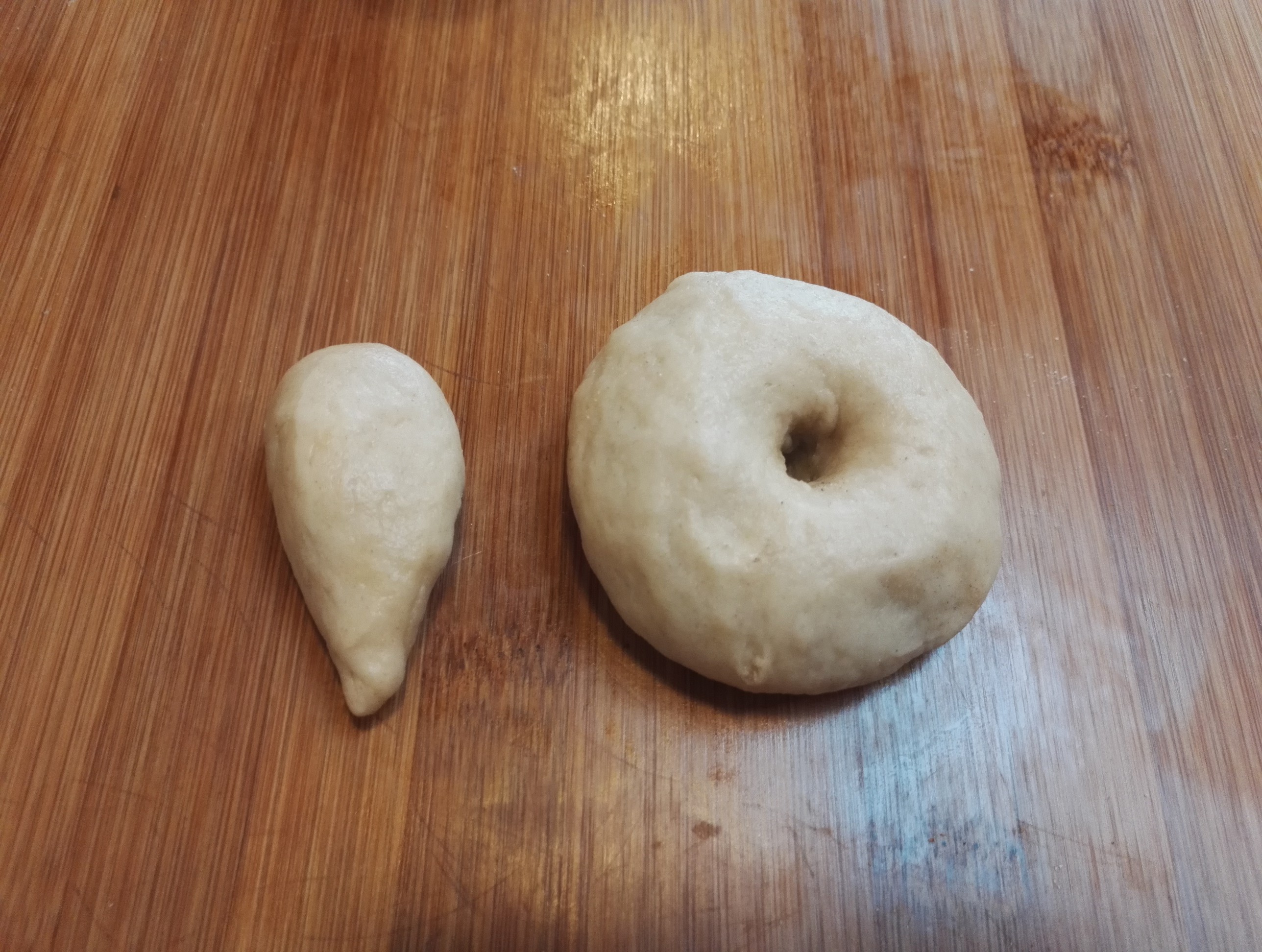
Form teardop shape and poke a hole in larger ball

10. Form a hole in the top of each of the bigger balls with your finger then insert the teardrops, pointy bit first. Make sure they’re well attached or they can fall off.
11. Put on baking sheets, cover with a cloth and leave to rise until doubled in volume, around an hour, hour and a half in a warm-ish kitchen.
12. Preheat oven to 180C.

Prove up and brush with beaten egg

13. Brush the buns with beaten egg then bake for about 15 minutes.

Now, I must say, I like these little brioche, the shape is fun, and I can imagine they’d work well with gelato or granita. As a breakfast bun, however, the lard quality isn’t half so nice as buttery brioche. It just feels like something’s missing.

Historically, poorer people may have had a pig, and therefore pig fat, as they can be kept in small spaces and eat almost anything. Dairy fats, on the other hand, require grazing – and land ownership was the preserve of the wealthier. So I can see how a lardy brioche might have evolved among Nonna Adele’s ancestors and their demographic peers. But these days, when we can easily buy butter, frankly, I’d use that instead. Unless you particularly like lard.

Oh, and apologies if my blog updating is a little haphazard these days. Not only did my computer just die an unfortunate death, forcing me to try and cope with Fran’s aged, badly maintained old laptop, but we’re also in the process of expanding our family. Big changes afoot.

13 Comments

Filed under Baking, Breads, Recipes

Sabbiosa, a cake from Lombarby

Sabbiosa cake

It’s taken me a long time to make this cake from Lombardy in northern Italy, whose name roughly means “sandy” – perhaps a reference to both its colour and its texture. I first saved a page out of the Independent newspaper back in 1999, with a recipe from Simon Hopkinson. He explained how he’d first eaten sabbiosa in 1984 but when he’d first tried to make it there had been some confusion about the type of flour used.

Via an erroneous translation, he laboured under the impression that the flour was corn starch, or what we know in British English as cornflour. Instead, however, it’s a potato flour. In Italian this is fecola di patate, which is translated on Wordreference as both “potato starch” and “cornstarch”. Given that patate is potato, it’s clearly not corn (ie maize) starch – which in Italian is amido di mais.

Adding to the confusion, Hopkinson gives his ingredient as “potato flour” – which some sources, such as this site, say is an entirely different ingredient to potato starch. There’s some logic to this, but Italian sources tend to just refer use fecola as a synonym for farina di patate, potato flour. Italian Wikipedia saysLa fecola di patate is a flour obtained from the dehydration and subsequent grinding of potato.”

Potato or wheat?
Furthermore, a lot of the Italian recipes I’ve seen for sabbiosa are simply made with wheat flour. I’ve had Hopkinson’s version filed for 17 years, so I wanted to stick with potato. I’m not going gluten-free or anything, heaven forefend, gluten is such a marvellous, useful protein* when treated right. But during a visit to Roma last week, I saw some fecola di patate in the shop at the Città dell’Altra Economia, which forms part of the Ex-Mattatoio, the handsome, sadly neglected 19th century former slaughterhouse, so I had to get it. In UK health food shops, the equivalent does seem to be called simply potato starch.

The other distinctive Italian ingredient I’ve used here is Lievito Pane degli Angeli (“Bread of the Angels leaven”!). This is just a brand of baking powder – a chemical blend of difosfato disodico (disodium diphosphate) and carbonato acido di sodio (sodium bicarbonate), much the same as my UK baking powder. Though the degli Angeli brand has a punch of aromi – flavourings. Rachel, who we saw last week, loves this stuff, and was enthusing about its miraculous qualities, but I find the aromi a bit pungently vanilla, and I’m suspicious whether it’s even real vanilla or some synthetic flavouring. Either way, if you’re using non-flavoured raising agent, you can add say a teaspoon or two (to taste) of real vanilla extract if you like.

The cake recipe also contains booze, which is similarly optional. Also optional is a mascarpone crema, made with raw eggs, much like that used in many tiramisu recipes. If you’re scared of raw egg, serve with cream, custard or even crème fraîche. Or nothing, for a weary nod towards tedious New Year dietary abstention.

The recipe

Ingredients for sabbiosa

400g unsalted butter, softened
400g caster sugar
400g potato starch, aka potato flour, aka fecola di patate
10g baking powder
Pinch salt
4 large eggs, beaten, about 225g
35g brandy (optional)

1. Preheat the oven to 180C.
2. Grease and line the base of a 25cm tin.
3. Beat together the butter and sugar until light and very fluffy.
4. Combine the beaten egg with the brandy (if using).
5. Beat the egg into the creamed mixture, adding a little of the potato starch if it starts to curdle.
6. When the egg is all combined with the creamed mixture, sieve in the potato starch and baking powder, and add the pinch of salt.

Making sabbiosa with potato starch
7. Fold the fecola through the batter until well combined.
8. Pour the mixture into the prepared tin.
9. Put in the oven and bake for about 45 minutes then, carefully, check the cake to see if the top is browning. If it is, cover with foil, then return to the oven.
10. Continue baking for until a skewer comes out clean, for another half hour or thereabouts.

Sabbiosa - leave to cool in the tin
11. Leave to cool in the tin then turn out onto a rack and cool completely.
12. Prepare the accompanying cream.

Mascarpone cream (crema di mascarpone):

2 eggs
250g mascarpone
70g caster sugar
20g rum or brandy, to taste (optional. Either leave our use some other booze. I used some bourbon as it smelled like it’d be nice… and it was!)

1. Separate the eggs.
2. Beat the yolks with the sugar until pale and creamy.
3. Beat in the mascarpone and booze (if using)
4. In another bowl, whisk the egg whites to stiff peaks.
5. Fold in the egg whites until you have a smooth mixture.

Dust the cake with icing sugar and serve slices with a good pour of the crema. Muse about the potatoes. Ignore new year diets.

Sabbiosa with mascarpone crema


* Or more accurately, combination of proteins: gliadin and glutenin.

13 Comments

Filed under Baking, Cakes, Recipes