Category Archives: Rome

Things I miss from home. And the question of beer.

In no particular order:
Kippers.
A good pub* (preferably in the company of old friends).
Interstate in Covent Garden, so I can buy some new jeans. Been buying my jeans (as well as sundry satchels and undies) there for about 12 years or more. [Edit: Interstate closed down while we were in Roma! End of an era]
Vaguely reliable, functional postal services.
Cinema. There are plenty of cinemas here, but unlike in Paris say, it’s hard to see English-language films in versione originale. And I’m damned if I’ll watch a dubbed film, especially in a language I don’t understand very well. I detest dubbing. There is one cinema here that shows films in VO, but for some reason they had The Iron Lady on there for three long effin’ months. I adore the big screen, indeed it was central to my job for a decade or so, so this dearth of big screen action is a difficulty for me.
Simple brand products – soap, roll-on etc that’s not perfumed, not coloured, just kind.

Things I don’t miss:
Trashiness.
The sheer trashiness of Britain and British culture.
The unfailing uniformity of British shopping streets (mobile phone shops, Boots, Tesco Metro, generic coffee franchises etc).
The grotesque ubiquity of CCTV. I remember my feelings of shock and discomfort when I first became aware of CCTV cameras, such as outside a bar in Radford in Nottingham, c1992, where dealers congregated. Thanks to Blair and co, we’re all treated like potential now criminals in the UK. So much for valuing our freedoms. Never mind the Olympics factor.
The lack of lizards.

By no means a complete list. And is it prejudiced and classist? Who knows. Me ne frego.

* I don’t necessarily have a painful longing for British beer. As much as I love a pint of proper British ale, there’s no shortage of decent beer here in Italy, thanks to what I understand to be a fairly recent growth of artigianale (artisan, or traditional) beer production.

In Rome, we just need to go to Ma Che Sieta Venuti a Fa’ or Open Baladin, or other birrerie (beer bars), or specialist beer shops. We can even get great ales from the supermarket. Last year, the boyfriend of a friend launched a new beer in Italy, and after being unable to source it in the specialist shops, I spied it in our local supermarket. And very nice it is too: Mastri Birrai Umbri.

4 Comments

Filed under Food misc, Main thread, Rome

Clear as mud, and the convolutions of mnemonics

Mnemonics are really useful for learning vocabulary in a new language. So for example, in Italian the pavement, or “sidewalk” if any North Americans happen upon this blog, is il marciapiede. To help me learned this one, I thought about marching along the pavement.The Latin factor is clearly very useful. Piedi, feet in Italian, is related to the French pied (thanks O-level, you weren’t completely useless after all), and also related to the English word pedicure. Or the Italian verb to hide is nascondere. I’m thinking that’s probably related to the English verb to abscond, somewhere along the line.

It’s not, however, always so straightforward. I was trying to translate the English idiom “clear as mud” in Italian, as I often find myself in a situation where clarity eludes me, notably in class. The word for mud in Italian is, however, fango. Semi-unhelpfully, the thing that sprung to mind here was “You know when you’ve been Tango’d”. Ok, thought I, that’s fine, I have a vision in my mind of someone splattered with mud.

Unfortunately, I remembered the mnemonic, but forgot the first letter of the actual word. Jango, mango, gango, gah!? Okay, thought I, fango is like fangs, so that brings to mind vampires. It’s clearly unrelated though, with no nice neat Latinate etymological chain of connections. Instead, I the mnemonic visualisation got increasingly silly. So now when I try to think of the word for mud, I imagine a mud-splattered vampire.

And finally I can say Chiaro come il fango.

Unfortunately, this isn’t one of the idiomatic expressions that directly shared between English and Italian, as far as I know. Hi ho.

Yesterday, I tried a semi-mangled Italian translation of the English expression “between a rock and a hard place” with my teacher, Giammarco: tra una pietra e un posto duro. Though looking now, apparently the Italian version is tra l’incudine e il martello – which means between the anvil and the hammer. Which is great, very evocative, but I’ll need some new mnemonics to learn these words, as for me the word martello brings to mind martello towers, the defensive towers built on England’s coast in the Napoleonic wars. Which, etymologically, have nothing to do with the Italian for hammer.

1 Comment

Filed under Learning Italian, Main thread, Rome

Me Talk Ugly This Day

Been reading David Sedaris’s ‘Me Talk Pretty One Day’ (thanks Marta!), an astute, highly entertaining collection of essays/autobiographical short stories. Several of them are concerned Sedaris’ move to France and his efforts to learn French.

I particularly love the way he renders bad student French in English – “That be common for I, also, but be more strong, you. Much work and someday you talk pretty.” (Hence the title of the book.) I’m aware that much of my Italian probably sounds like this. My teachers are used to such mangling and don’t even bat an eyelid, but staff in bars and restaurants in touristy areas, who inevitably have better English than my Italian, do tend to flinch and wince, giving a good idea of my standard

Teachers and linguists perennially say that a key problem adults have when learning a new language is self-consciousness, a fear of the blunders. Children don’t have this problem, or confident people, who just push on through. But I most certainly do; I don’t relish hearing myself talking like I’m retarded a semi-illiterate nincompoop.

Pitfalls and pratfalls

There are just so many pitfalls to cause linguistic pratfalls. One of my teachers, Giammarco, suggests that Italian is a largely logical language and while it’s hard to learn at the start, it gets easier. This is the complete opposite of my experience. At the start, having learned the present tense and the passato prossimo (simple past tense, ie “I bought a cake”) and a smattering of everyday vocabulary I felt a fleeting giddiness – “Wahey, I can speak Italian!” At least in class or alone with my wife.

After that, however, other tenses have presented themselves, tenses like the conjiuntivo passato (present perfect subjunctive), which not only involve learning new conjugations, but can also be somewhat baffling to translate; modern English, for example, doesn’t use the subjunctive much.

Prepositions – to, from, in, at, on – also continue to bewilder me, especially in combination with eight variations of the definite article (“the”). People say English is complex, but at least we only have one the. And I’m still trying to ignore complex constructions with indirect object pronouns.

Hell, it doesn’t help that during my 1970s and 1980s education, a literal teaching of grammar was out of fashion. Or at least seemed to be in my school; thanks for nothing St Peter’s, Winchester. Hence I didn’t even learn much of the terminology, like, oooh, “transitive” and “intransitive” verb, even if I instinctively know how to apply such elements of my own language.

Mister Sandwich

Anyway, I could very much relate when Sedaris talked evocatively of the bewilderment he felt when faced with the concept of nouns having gender. Or as he elaborates in ‘Make That a Double’: “Because it is female and lays egg, a chicken is masculine. Vagina is masculine as well, while the word masculinity is feminine…. I spent months searching for some secret code before I realized that common sense has nothing to do with it.”

Sedaris finally decided to avoid using gendered pronouns, and instead always talked in plurals. Which works fine linguistically in French, but did mean he’d end up buying food in bulk – so him and boyfriend Hugh are faced with the challenge of not just finding space in the fridge for four pounds of tomatoes, alongside two chickens, but also eating their “way through a pair of pork roasts the size of Duraflame logs.” (I had no idea what they were without the help of Google, but got the picture.)

This system wouldn’t work in Italy, and not just for the issue of acquiring too many groceries. In Italian, unlike the French plural the (les), plural definite articles are different between genders. So il (the, masculine) becomes i, or even sometimes the pronunciation challenge gli, while la (the, feminine) becomes le. There’s also l’ sometimes, which doesn’t even have the decency to appear with the predictability it has in French.

Now, Italian is broadly logical with its nouns – masculine nouns mostly end with o, feminine a in singular, with this changing to i and e respectively in plural. So a book, libro, becomes libri, while an apple, mela, becomes mele. I say broadly logical, because I’m increasing meeting nouns that don’t conform to this. The first that really threw me was egg, which is uovo – looking deceptively like a regular masculine singular. But then it becomes uova, which looks like a feminine singular but is actually a feminine plural of a masculine noun.

Italian seems to be tricksily littered with these transgendered nouns. A knee – ginocchio (m) – decides to become feminine in the plural, but looks like a feminine singular, ginocchia. Discussing running, for a long time I thought I was being smart (well, smart-ish) saying “I miei ginocchi sono rotti” – my knees are broken. Anyway, what I should have been saying (well, should-ish; I’d no idea how to be any more refined with expressions for to be damaged or injured) is “Le mie ginocchia sono rotte”. Maybe. I’m still not quite sure.

Another confusing customer is tower, which in the singular is torre – resembling a feminine plural. But in the plural it becomes torri, resembling a masculine plural.

How on earth did this gender reassignment evolve over history?

Gender confusion

Talking of which, one of the most confusing things I’ve encountered in Italian involves the various ways of saying “you”. Your choice of “you” depends not just on whether you’re addressing a individual or a group, but also on the formality of the situation. Ok, thought I, I learned a bit of the similarly Latinate French as a kid, I can handle that. So French uses tu for the singular “you”, then vous for the plural “you” – and the formal “you”. I assumed Italian would use the equivalent tu and voi but oh no. Ooooh no.

In Italian, the formal you is – get this – “her”. Lei. Yes, even if you’re addressing a person of a chap persuasion, you refer to them as her. So you’ll ask a male shop assistant or waiter “Lei ha…” – literally “She has…” – to mean “Do you have….?”

I can’t say I’ve exactly got my head around this, but I’m at least aware that I should use it. Or most of the time. I mean, I realise I’ve probably been a bit rude using the tu conjugation of the expression “how are you?” (come stai?) with an older neighbour but what really throws me is when, for example, I’m in a bar – frankly, a pretty informal situation – and the waiter or waitress is a lot younger than me. Do I still have to use Lei not tu? Really?

Another of my teachers, Clelia, says it’s a “cultural thing” and Italians will generally be fairly forgiving of foreigners being rude through basic ineptitude or ignorance. But still. Do I really have to use Lei for an amiable, young bartender? Sometimes they even go straight into tu conjugations with me – so if they can do it, can’t I? Or should I be offended? What’s Italian for faux pas?

Oh, and out of interest, apparently the Lei form of address evolved in the Florentine courts of the Middle Ages, when the nouns used for sycophantic greetings or whatever were feminine. Mussolini wanted to try and purge it, considering it too feminine and Spanish, and replace it comprehensively with voi, used like the French vous. Voi is used more for the formal address in southern Italy I believe. Though I’ve never experience that in Rome, which according to northern Italians is the south.

See, that’s a key factor too. Parts of Italy approach language very differently. Giammarco also likes to tell us that “Italian” doesn’t even really exist as a spoken language; most Italians will use one of innumerable dialects. Some people say that Florentine Italian (of refined, Dantean origins) is like the Queen’s English, but this is a misconception and a Florentine dialect is as alive and well as many other dialects in his long, diverse nation. So basically I’m trying to learn a language that no one even really uses. It’s not exactly heartening.

Leave a comment

Filed under Learning Italian, Main thread, Rome

Garden chairs, crutches, a cantakerous nonna

A common sight throughout Rome’s neighbourhoods are shops called negozi di casalinghi – basically homewares and tat shops – and ferramentaria – hardware shops. But we’ve been struggling to find some garden chairs, so we can actually take advantage of the communal garden of our palazzo. Contributions of our neighbour’s dog notwithstanding.

Finally, in our local hardware shop, they produced a catalogue. We went away to consider, then returned shortly afterwards to make an order. To find the shop – a vast space but with only about two square metres dedicated to customers – packed with people on crutches. Was it some kind of convention?

Anyway, as well-trained Brits, we dutifully queued. An old lady on crutches came in afterwards, accompanied by an even older lady (surprisingly not on crutches). The younger old lady took up a position beside us, and slightly to the front. Britons are famous/infamous for our queueing. Italians aren’t.

Despite the sprawling Aladdin’s cave that formed their domain, the two ironmongers themselves – a clueless older chap, and a younger chap who scurried up and down ladders, handling three orders at once – would reply to most enquiries with “Non c’è lo” (We haven’t got it), but confidenently assured the potential customers they knew what was meant. Each exchange took about 10 minutes.

Finally, the previous crutch-wielders in front of us, having dismissed all the screw options presented to them, vacated empty-handed – with some difficulty, as the 2m2  had become even more packed. The elder ironmonger then beckoned us forward. Prompting a furious micro-tirade, ejaculated by the older of the two ladies who had attempted to take up a position in front of us, something along the lines of “Damn these upstart foreigners, serve us first!” I didn’t catch the actual words, but the sentiment was clear.

She stood at my shoulder – well, more at my armpit as I’m tall and she was a little old Roman lady – glowering and grinding her teeth. The temperature in that 2m2 space seemed to drop a few degrees. Now, if my Italian – and possibly more importantly my Romano – was better, I could have engaged in the kind of feisty argument you frequently see among friends, family and strangers here. Sadly, it’s not, and, well, I’m too polite, so I just meekly put in “We are first,” and we went about our business with the older ironmonger, who delagated to the younger ironmonger.

The old lady – younger old lady – muttered a placatory “Mama…” and gave Fran, my wife, a vague “Sorry” look, though didn’t actually muster a “Mi dispace”. The ironmonger dealt with our order. The temperature rose again, crutches were shuffled and life went on in the Eternal City.

Of course, we then had to vacate the 2m2 space, shuffling through the crowd then running the gauntlet of the older old lady, now ensconced outside on a chair, with a ready glower. We avoided her eye. What we really should have done is glowered back, and vigorously employed the that quintessential Italian hand gesture, fingers together, pointing upwards, palm towards self, and the whole thing moved expressively, vigorously moved. “Boh! Che cosa vuole, nonna? Siamo stati certamente per prima!”

2 Comments

Filed under Main thread, Rome

Food ethics and seafood caveats

In my previous post, I talked about my enthusiasm for seafood, did a recipe for a Sicilian fish stew and talked about how useful I’m finding Alan Davidson’s book Mediterranean Seafood as I not only try to improve my seafood cookery, but also learn at least a few of the innumerable Italian names for fish etc. The recipe was very nearly accompanied by a caveat and some discussion of the ethics of eating seafood, but the entry would have just become too unwieldy.

So I’m doing it here instead.

My personal dietary inclinations are more towards fish and some seafood (love prawns and cephapods; not so keen on bivalves) over red meat, for example. For a while I was a vegetarian, a conversion that came as a result of living for five months at Newton Livery, a decidedly idiosyncratic small farm in New Zealand, learning that hey, eating without meat really isn’t that hard, and then coming home to the UK and pretty much immediately seeing a documentary on TV about the vile barbarism of intensive pig farming.

The imagery of a sow and her litter, struggling on a metal grill floor, in a dirty, confined space, brought about a minor epiphany. Mankind does not need to mistreat beasts through such husbandry when there are alternatives. And especially not animals like pigs, which are intelligent as dogs – an animal that people in the UK and here in Italy sentimentalise and anthropomorphise like there’s no tomorrow. Sheep – considerably more stupid – at least get to live outside.

I saw that documentary, and went vegetarian, in 1989, when the worst of the post-war intensification of food production in the UK was in no way balanced for the consumer by the option of free range and organic (or biologico as it’s know here in Italy), then the purview of a limited population of hippies and industry outsiders. Of course, I was fairly ignorant – I still ate dairy, blithe about the fact that its production is part and parcel of meat production, but at least I’d made an ethical step. Our obsession with meat consumption remains questionable, even in an era of less unethical alternatives like free range and organic for the simple fact of the calorific equation. To feed up beef cattle, for example, for the most part involves giving them considerably more calories in maize and other crops than the resulting meat gives the consumer in calories. And the more calories we use to produce food, the more extreme the environmental downsides – for example, in the fossil fuels used to transport those feed crops.

It’s an equation that most people, even the nominally ethical consumers, are oblivious to. It’s a particular problem in the early 21st century when developing world nations – China, India, etc– are rapidly embracing the kind of untenable red meat-based diets favoured by many Europeans and North Americans, hence the advent of the kind monstrously factory-style meat production exemplified by feed lots and Concentrated Animal Feed Operations (CAFOs), something that they are currently trying to popularise in the UK. Ethical issues aside, mega-ranch style farming just does not suit a small nation like the UK, where we’ve already seen biodiversity reduced markedly through the tearing out of traditional field boundaries, notably in places like East Anglia where the flatter landscape enables ranch-style farming. (And unlike in places like Devon, where the hillier terrain is at least preserving some aspects of Britain’s traditional plagioclimax environments, shaped by centuries of human intervention.)

There’s also the issue of methane – a natural gas produced in decomposition and in flatulence that’s also a potent greenhouse gas. Hence it’s a no brainer that the bigger our herds of cattle, the more the farting, the bigger the problem.

If you can’t face reading about such issues, I would recommend watching the feature documentary Food, Inc., which, in unsensationalist terms, evaluates the problems of these types of meat production, in both health and environmental terms.

Now I’m still a culprit, as a decade plus with my red-meat obsessive wife has re-calibrated both our diets somewhat – she eats less meat, I eat some – but I’d like to think we pursue a diet that’s at least nominally less unsustainable in planetary terms, eating locally produced food as much as possible, relying on pulses and grains – directly, rather than feeding them to animals to fatten them for meat. And only eating meat or fish a few times a week. While we have now been able to source some less unethical meat (locally bred, smaller scale, some free range or organic) in Rome via the two big weekend farmers’ markets at the Circo Massimo and in the Testaccio Ex Mattatoio, it’s hard to get a sense of how sustainably sourced any of the fish on the market or in restaurants is. Not very, I suspect.

Although I agonise (clearly) over food ethics, the question of seafood is something that has long confused me to boot. In contrast to animal husbandry, where an animal is bread specifically and living a life controlled by man, there are very different ethical issues at play in our consumption of the majority of seafood still. Notably for the simple fact that we are pillaging the oceans for food, exploiting a natural resource. (I don’t want to go into fish farming here, but suffice to say it’s not an easy solution – it’s potentially polluting, and like meat production involves a ridiculous calorific equation, where to produce say 1kg of salmon, at least 2.5kg of so-called forage fish, anchovies, herring, sardines etc, are required. Personally, I’d rather eat the sardines direct.)

Such exploitation was fine, arguably, prior to the human population explosion that accompanied the industrial revolution in Western nations and the comparable transition being undergone now by developing world nations. But today, everything we do is on such an vast scale it becomes untenable. It’s would be untenable for everyone on the planet to have a large personal vehicle and large air-conditioned house; but if one nation can live like that, who’s to say another cannot? Likewise it would be untenable for everyone – all seven-plus billion of us – to have eggs or bacon for breakfast and a steak for dinner. And likewise, if one nation eats an endangered tuna and insists it’s a traditional diet, who is anyone else to suggest they don’t, you know, fish it to extinction. Us Brits, for example, really really cannot get our heads around the fact that cod is anything other than readily available, always and forever. But there are major concerns over Atlantic cod (Gadus morhua), but it’s long been on Greenpeace’s Red List.

So to get to the point I was thinking about when I started this, as much as I like Davidson’s book, it’s very out of date, and oblivious to questions of sustainability. He even suggests tracking down dried dolphin meat at one point, in the form of a Genoese delicacy called musciame, dried dolphin meat. Now, if a marine creature is killed as bycatch, I’d rather it was actually eaten than thrown back dead, something that’s admirably being forced into the spotlight by the Fish Fight campaign, but I still find it difficult to consider eating dolphins, having grown up in the era of Save the Wale, knowing that dolphins are considerably smarter than fish (though does that mean they have any more or less right to life?), and having enjoying watching them in the wild, in NZ’s Bay of Islands.

Anyway, again to try and get to the soddin’ point: if, like me, you like eating fish and seafood, and live somewhere where there’s information about fish stocks, please check first before you choose what to use. The beast on the slab might be dead already, but if you change your habits, that’s one way of getting the message across the fisheries industries, by way of your fishmonger. If you have such a thing; if you only shop in supermarkets, look for the labelling, or indeed re-consider which supermarket you shop from, after looking at Greenpeace’s league table (no longer online).

Greenpeace also produces its Red List of threatened marine species. While in the UK, the Marine Stewardship Council produces a buyer’s guideto sustainable seafood. Also, if you live in the UK, Fish 2 Fork rates restaurants for the sustainability of the fish they use. (Not any more.)

I’m finding it hard to find information about sustainable fish here in Italy though. I’ve only lived here seven months, so I don’t want to display too much ignorance on this matter, but the country as a whole, despite being the home of the Slow Food movement, sadly doesn’t seem to be at the forefront of sustainability in, for example, meat production and fisheries. My Italian isn’t great, but it doesn’t look like Greenpeace Italia has a Red List or equivalent for Mediterranean fisheries. Broadly, the Med is notorious for the extreme exploitation it suffers.

As a general rule of thumb, I don’t eat any tuna or swordfish and haven’t for years, a principle solidified by watching the documentary The End of the Line. But I probably should go further than that. It’s a difficult challenge: balancing my enthusiasm for cooking and eating seafood with approaching food with at least a modicum of ethical consideration.

Quick edition 17 April

A friend posted this article on Facebook. It’s very pertinent, not just because Britain is experiencing a drought but also because of the wider value of water – and how it’s squandered in meat production. Eg “It takes, on average, 15,500 litres of water to produce one kilogram of beef. To put this in context, that is the equivalent of 50 baths of water to produce one steak – 15 times more water than is needed to produce one kilogram of wheat. To produce the diet of a typical meat-eater takes the equivalent of 5,000 litres of water per day…”

I would like such pieces to have links to sources, as the writer is the manager of the PETA Foundation so obviously have a very specific and very ardent agenda, but it’s still noteworthy. (Really, the argument that ‘everyone should turn vegan to save the world’ just isn’t going to wash. Instead, the message should be one of providing sufficient information and education to chivvy people in the direction of more ethical choices, and a more holistic understanding of the repecussions of everyday decisions.)


4 Comments

Filed under Discussion, Food misc, Main thread, Rome

Sicilian fish stew with couscous / Pesce Stufato alla Siciliana con couscous

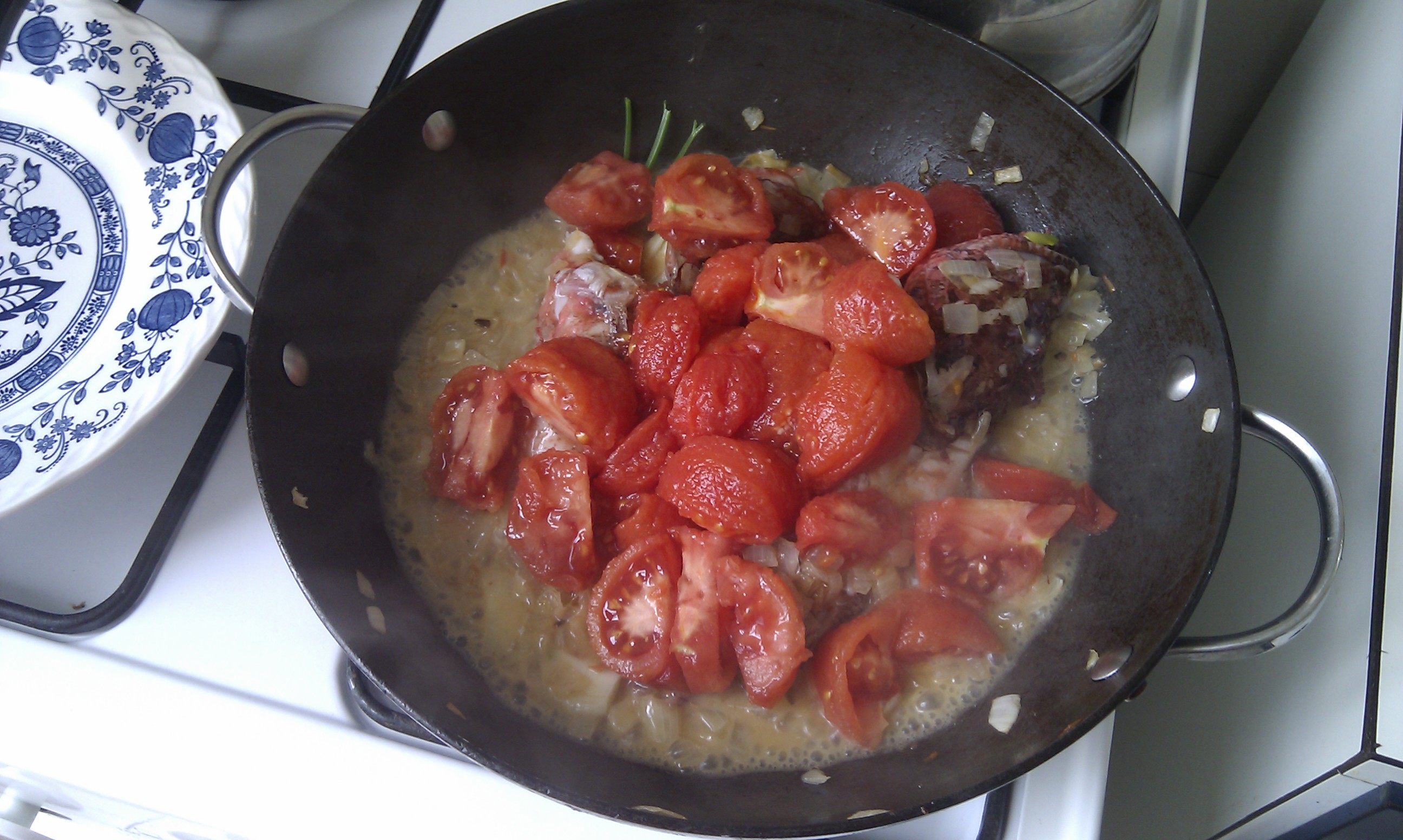
Our local market –  in the parallel street, six days a week – has a great fish stall, and during Lent it’s become even bigger, for obvious, traditional Christian diet-related reasons.

I love eating fish, but although I cook all the time, I’ve been fairly timid over my lifetime really embracing buying fresh fish and cooking it myself. The fish stall round the corner, however, is really motivating me, to try and cook more fish, to experiment, and to try and learn some of the innumerable Italian names for fish, both standard and dialect.

There are plenty of familiar species on the market, such as mackerel (sgombro), which offers one of the marginally less unethical choices in our era of overfishing. But there are also plenty of weird and wonderful species we don’t get in the UK, such as the stargazer (Uranoscopus scaber; pesce prete – priest fish).

I bought some stargazer without having a clue what it was, on the advice of the fishmonger (pescivendolo), and, through the miracle of Facebook, was able to use the groupmind to identify it.

When we bought some fish called cerino on the market, via Facebook again we were able to identify it as the slightly less exotic grey mullet. Cerino must be another dialect term, as the standard Italian term for grey mullet is cefalo, while another Lazio dialect name is mattarello (“rolling pin”).
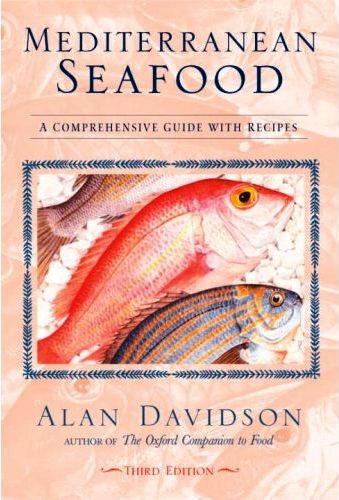
Such is my confusion that a friend of a friend on Facebook recommended I buy Alan Davidson’s book Mediterranean Seafood – in both English and Italian (called instead Il mare in pentola – The sea in a saucepan). The latter helpfully lists a lot of the Italian regional dialect names. Though not cerino.

Anyway, thank you very much photographer Mimi Mollica, a Sicilian who recommended the book and also gave us a recipe for fish stew and cous cous. Which I finally made today.

I’m going to try and blog the recipe in both English and Italian, which I’m learning, very slowly. Hence the Italian will probably be fairly crude for Italian speakers. Apologies in advance.

Proverò a mettere nel blog la ricetta del Pesce Stufato alla Siciliana in inglese e in italiano, che sto apprendendo molto lentamente. Il mio italiano sarà molto brutto per gli italiani e per le persone che parlano bene in italiano. Mi scuso in anticipo.

REVISIONE: La mia insegnante l’ha corretto. Grazie Clelia!

Anyway, Mimi recommends using firmer flesh, flavoursome fish like:
Comunque, Mimi suggerisce di usare un pesce con una polpa un po’ più dura e gustosa come:

English / Inglese Italian / Italiano Italian dialect / dialetto* Latin / Latino
Scorpion fish (red) Scorfano rosso Cappone (Toscano) Scorpaena rossa
Scorpion fish (black) Scorfano nero Scorpaena nero
Scorpion fish (small) Scorfanotto Scorpaena notata / ustulata
Weever (greater) Tracina drago Trachinus draco
Grouper (dusky) Cernia Zerola (Lazio) Epinephelus guaza / Serranus gigas
Gurnard (tub, tub fish) Capone gallinella Capone panaricolo (Lazio) Triglia hirundo / lucerna
Guarnard (red) Capone coccio Cappone imperiale (Lazio) Aspitriglia cuculus / Triglia pini
Gurnard (grey) Capone gurno Gallinella (Tuscano) Eutriglia gurnardus / Triglia malvus

* Just a few, too many to mention!
Solo qualche, ce ne sono tanti!

And other fish, preferably sustainable varieties.
E altre pesce, preferibilmente di tipo sostenibile.

The recipe, in English

This isn’t a precise recipe – use your instincts with quantities.
Ask your fishmonger for enough fish for however many people you’re feeding.
I made it as a (large) meal for two, so I used:

Sauce
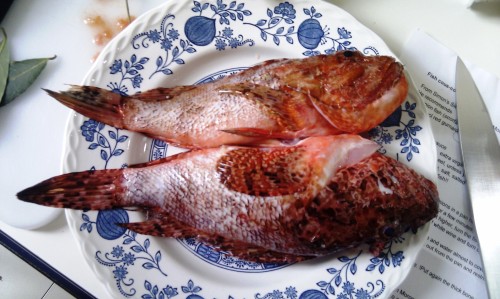
2 small-medium red scorpion fish
extra virgin olive oil
1 large white onion, coarsely chopped
2-3 cloves of garlic, peeled but left whole
White wine
500g fresh tomatoes, peeled (cut a cross in the skin, drop them in boiling water for about a minute, remove, peel) then coarsely chopped, or OR a tin of tomatoes
2-3 red chilies (depending on heat and your taste), de-seeded and chopped
salted capers, about a tablespoon, or more if you particularly like them
salt and pepper (freshly ground, naturally)

Soften the onions in a pan.
Add the garlic, and soften slightly.
Add the fish.
Increase the heat slightly and cook the fish, for about 4 minute each side.
Add a glass of white wine.
Increase the heat more, and cook off some of the alcohol.
Add the tomatoes, chilies, capers, more wine and water, to almost cover the fish.


Simmer until the fish is cooked, the flesh coming away from the bone.
Remove the fish.
Take the flesh off the fish.
Put the fish spine back in the sauce.
Simmer the sauce to thicken.
Remove the fish spine.
Put the fish flesh back in the sauce.
Season to taste.

Meanwhile, make the couscous.

200g ish couscous
1 small red onion, in thick slices
2 bay leaves
Extra virgin olive oil
salt and pepper
fresh parsley, coarsely chopped

Put the couscous in a bowl with a few bay leaves, the red onion, and some salt.
Pour over boiling water and a slosh of olive oil and cover.
Stand for 10 minutes, then check it’s softened enough. If not, pour over some more boiling water, and stir in. If it is, stir to break up any lumps.

Serve the couscous with the fish stew, sprinkled with parsley.

I expect my version isn’t exactly authentic (I’ve never even been to Sicilian, never mind actually eaten the real thing), but it was very tasty.

La ricetta in Italiano

Questa non è una ricetta preciso – usa i tuoi istinti con la quantità!
Chiedi al tuo pescivendolo per abbastanza pesce per le persone a tavola.
Ho fatto un pasto (grande) per due, con:

Stufato
2 scorfani piccola-medi, puliti
olio d’oliva extravergine
2-3 spicchi aglio, intero e puliti
1 cipolla bianca, grande, tritata grossa
Vino bianco
500gr pomodori, pelati, o una scatoletta di pomodori pelati
2-3 peperoncini (come si preferisce), senza semi, tritati
capperi salati, un cucchiaio da tavola o più
sale & pepe nero (macinato fresco)

Soffriggi la cipolla in una pentola.
Aggiungi gli spicchi di aglio, e soffrigi un po’.
Aggiungi i pesci.
Aumenti la fiamma un po’ e cuoci i pesci, per circa 4 minuti ogni lato.
Aggiungi un bicchiere di vino bianco.
Aumenta la fiamma, e stufa un po’ di più.
Aggiungi i pomodori, peperoncino, capperi, e abbastanza vino e acqua fino quasi a coprire i pesci.
Stufa a fuoco lento fino a quando la polpa dei pesci è morbida e sollevata delle lische.
Prendi i pesce.
Togli la polpa dei pesci.
Rimetti le lische più grande (spine) nel stufato.
Cuoci a fuoco lento per addensare.
Insaporisci con sale e pepe.

Nel frattempo, fai il couscous.

200gr (circa) couscous
1 cipolla rossa, piccola, affettata grossa
2 foglie d’alloro
olio d’oliva extravergine
sale & pepe nero (maccinato fresco)
prezzemolo, tritato grosso

Metti le fette di cipolla, le foglie d’alloro e un po’ di sale in una ciotola.
Copri tutto con acqua bollente, aggiungi un po’ d’olio d’oliva e coprila.
Lasciala per 10 minuti, poi verifica se il couscous è abbanstanza morbido. Se non lo è, aggiungi un po’ d’acqua bollente e mescola. Quando è pronto, mescola di nuovo per rompere qualche pezzo.

Servi il couscous con il stufato, cospargere con il prezzemolo.

Penso che la mia versione non è proprio autentica (non ho visitato la Sicilia mai, ne ho mangiato mai il vero stufato Siciliano di pesce), ma era molto buono.
5 Comments

Filed under Food misc, Rome

Confusion of mind, body, season, time

When I was younger, I spent a lot of time in glorious New Zealand/Aotearoa. It’s long been favourite country, but those sojourns are also probably the reason I never managed to learn another language… just acquired a bit of an accent (temporarily).

One thing I can’t remember in retrospect is whether my mind and body cried out “what the heck is going on?” as I lived through seasons in an unexpected order – leaving the end of a UK summer to start an NZ spring, for example. Even though living in Rome I’m still (obviously) in the same hemisphere, my mind and body are feeling very confused by the seasonality, amongst other things.

My northern European mind and body are currently confused by March weather that basically feels like an English summer at its best, with blazing sunshine and temperatures passing the mid-20s. Perversely, I have some deep-seated longing for some rain and grey skies – but hey, not too much. As I previously wrote, I’m also – consciously – pre-emptively freaking out about how hot it’ll be here in summer proper.

It’s not only the weather that’s confusing me though – at the end of the summer last year, when it finally cooled down for autumn around November, wild or waste areas near where I live started sprouting vigorously with fresh ground cover plants, notably with looks like alexanders (Smyrnium olusatrum). And daffodils flowered in the space in front of our flat. It felt more like spring than Autumn. Adding to the confusion I was feeling, the large plane trees nearby didn’t lose their foliage till December.

To confuse things even more, the clocks changed this weekend too. And we decided to switch bedroom. Throwing me, myself, I, my conscious and my unconscious, even more. I’m amazed I managed to pass the night without injury, scrabbling around at gawd knows what hour for a torch, avoiding unfamiliar (and decidedly hefty) furniture in unfamiliar locations, and remembering to turn left, not right when I left the bedroom, with the desired destination the bathroom, not the bottom of the cellar stairs, in a bruised, crumpled heap.

Oh, and while I’m on the subject of confusion, here’s a blend that tickled me: went to a café, in Portuense in Rome. The café had an Indian name, Shiva; had a sign outside in Portuguese; and the guy beside us was hanging out with his Siberian husky. Now there’s a creature who must feel even more innately confused in mind and body than me living through a Roman summer.

Leave a comment

Filed under Main thread, Rome

Just too northern European

Before anyone accuses me of moaning about the weather, I’d like to specify that I see this more as a pre-emptive freakout.

It topped 20C in Rome today. Just a few weeks ago it was the depths of winter. Although the snow here was aberrant, the generally cool temperatures weren’t. Our flat might not be designed for cold weather – it’s draughty, the heating doesn’t have a timer or a thermostat, and significant radiators don’t work – but by and large I found the winter here delightful. It suited me. I could dress in a preferred fashion (with layers, jacket). I didn’t get a stinky sweat on when I used my default form of transport – brisk walking.

The Roman summer, on the other hand is both something that I’m not used to and something that doesn’t suit me. I don’t like wearing just a shirt. And as much as I like to wear shorts, such attire is somewhat frowned upon here for a grown man. Getting your first pair of long trousers in Italy is (or was) like getting your first car in 1950s America, it’s a rite of passage, visibly liminal, a public declaration of your status. (There’s a scene in the film Malèna [2000], set in the 1940s, where the 13-year-old protagonist, desperate to appear more grown up, has a tailor re-cut his father’s suite trousers to fit him. His dad isn’t happy.)

I’m British. I’m used to British weather. And although, like many other Brits, I despair of the limbo of week after week of overcast, grey weather, I don’t have a problem with the temperatures in Britain. Mostly. I mean, admittedly, I was peeved when my June wedding day didn’t muster more than 8C but hey, it was northwest Devon, so that wasn’t so unexpected. What was unexpected was leaving a Sussex August at 18C and arriving in a Roma of 40C. A temperature that didn’t drop much through much all of September 2011.

Now, British friends will say “Wow, wonderful, I love temperatures like that and sunshine.” But really, what they mean is, they love temperatures like that and sunshine when they’re on holiday, and can spend most of the day on the beach, swimming in the sea, and potentially retreating to an air-conditioned hotel. That is a very different kettle of fish to living in a big (-ish) city, densely populated with people and cars, so many belching cars. And dogs, so many hysterical dogs. And dog owners, so many irresponsible dog owners who don’t pick up their beasts’ cacca [no spellcheck, I don’t mean cacao].

Last August was a very literal shock to the system to me. I didn’t acclimatise, the baking dumpsters and cacca griddling on the pavements were – objectively – disgusting, and I didn’t enjoy spending so much time self-consciously sudato e puzzolente (sweaty and stinky!). Basically, it being so warm now, so soon in the year, ho paura – I’m scared. Scared of if I’ll ever feel acclimatised here. Scared of another several months of trying to sleep when it doesn’t drop below 28C at night in our room, even after living in a bunker all day with all the shutters and windows closed to block out the sunshine and heat (something that’s counter-intuitive for a Brit used to craving rays and vitamin D, but necessary). And I’m really not looking forward to the return of the mosquitos (though it is lovely to see the lizards emerging again).

I am just too northern European. The prospect of another hot summer in Rome freaks me out.

4 Comments

Filed under Main thread, Rome

Docking the bay

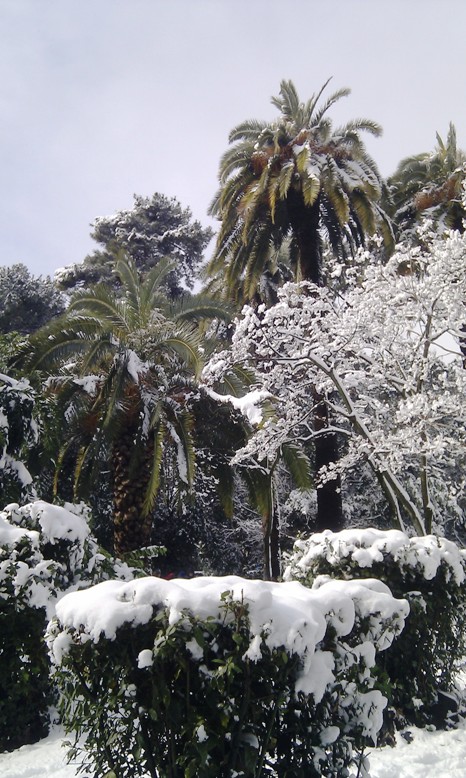
Villa Sciarra, our delightful local park, remains locked up. It has been since last weekend. Rome had its atypical dump of snow last Friday and overnight we got about 10cm. Apparently this is the most since 1986, when they got 20cm+; substantial snow apparently isn’t a common occurence, and the city doesn’t really know how to cope with it, much like much of Britain (but that’s another story). Panic ensues, schools and offices are closed, trains and roads become even more chaotic (and simultaenously less chaotic – with emergency rules that decree you can’t ride a scooter, or drive unless you have chains). For dedicated pedestrians, like myself, the pavement, the day after, was largely ice.

On the Saturday itself though, when the snow was fresh, Rome was beautiful. The ancient ruins and innumerable churches and monuments are always handsome, but an icing of snow gave them even more magic. The snow also beautified things by temporarily hiding all the little, dogshit and disintegrating roads and pavements.

The snow’s mostly gone now, bar some stubborn piles of ice. There’s more forecast for tomorrow and Saturday, but we shall see. In the meantime, I’m disappointed I can’t take my normal walking routes through Villa Sciarra, a lovely little place that nestles in a bulge in the 4th century AD Aurelian Wall. Throughout the year it’s an oasis of calm, away from Rome’s absurd traffic, and a place to enjoy some sun – or much-needed shade in the summer.

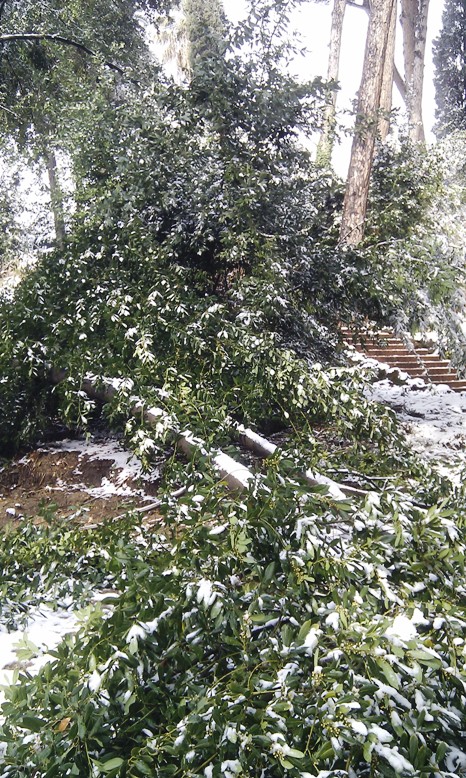
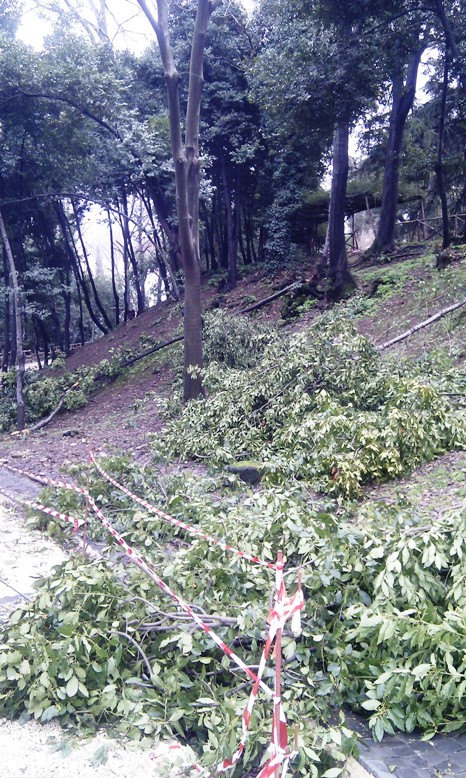
On Saturday, before the lock-down, it was a peculiar winter wonderland, the palms incongruously decorated with snow. It wasn’t all wonderful though, despite the exuberrance of the play. Alongside the palms, the park also has a substantial population of mature bay trees (bay laurels; laurus nobilis). I frequently help myself to the alloro leaves for cooking. And there were plenty to spare after the snow – as the bay population was reduced, I’d estimate, by about 10-20%. It’s hard to say, as I’ve not been able to get back in since the the lock-down. I assume it’s due to emergency tree surgery, to prune the trees with broken boughs and chop up the trees that were completely uprooted, or suffered from broken trunks.


It reminded me a little of the south of England after the Great Storm of 1987, which devastated a lot of the chalk downlands’ distinctive beech hangers. Of course, the bays aren’t quite on the same scale as the beeches – I’d say they grow to about 6m here – but it’s still sad if you’re a tree-lover, like me. Bays clearly aren’t designed to bear the weight of snow – like, say, firs or certain pines with downward sloping branches that slew off any build-up. Not all pines are designed for snow either though – the umbrellas, pinus pinea, also lost some branches here. Another park I walk through – Resistenza dell’otto Settembre – is also closed, though it only lost a few branches from its pines. It’s kinda over-zealous. Who’d have thunk Italy would have a health & safety culture that could out-daft Britain’s?

The streets in our neighbourhood, Monteverde Vecchio, are lined with another type of shrub-tree, which I can’t identify. It may be in the same family as privet, Ligustrum, but I’ve no idea. They lost a few branches too, but, again, nothing like the damage in the park.

As tragedies go, the damage to Villa Sciarra is minor, but it’s still sad. Let’s just hope if it does snow again, it’s not as much, as quickly, and the trees weather the storm.

Quick update, 20 Feb 2012. The park is now open again, and still looking handsome. But there’s still plenty of work being done clearing up dead and damaged bays.

Leave a comment

Filed under Main thread, Rome

Chestnut and walnut bread


Chestnuts were an important traditional foodstuff in parts of Italy. Peasants could supplement their diets with chestnuts, and flour was a natural extension of this. Roasted chestnuts remain a common sight in Roma over the winter, though I’m skeptical about whether this is because Romans demand it, or because it’s another cute novelty to sell to tourists.

Anyway, I bought some chestnut flour – farina di castagna – from the Testaccio Ex-Mattatoio producers’ market last weekend, on a whim. Didn’t really have any idea what to do with it. And nor do I particularly like chestnuts. Living in New Zealand years ago, some friends who tried to live as much as possible by foraging provided enough for me to eat far too many, resulting in a certain aversion. Which might not sound promising, but bear with me.

After a bit of Googling and polling friends, I plan to use it to make various items at some stage, including the Italian traditional castagnaccio – a kind of peasant cake that doesn’t include sugar and instead realies on the natural sweetness of chestnuts. (Chestnut flour is also known as farina dolce – sweet flour.) Also: chestnut flour pancakes (maybe on Shrove Tuesday, which is looming) and this cake, which comes from a gluten-free angle. If I can work out a replacement for crème fraîche, which isn’t readily available here in Roma. Apparently I can use panna acida.

But first, I made some bread, inspired by a recipe in Richard Bertinet’s Dough. His version uses rye flour; here I replaced that with chestnut flour. I also reduced the yeast in his recipe and added some white leaven. What the hell.

So:
400g strong white flour
100g chestnut flour
10g salt
320g water
6g fresh (fresh)
50g white leaven (100% hydration)

Combine the flours and salt.
Whisk together the leaven, yeast and water (warm – use dough temp x 2 minus flour temp to give you a water temp… or just warm…).
Add liquid to flours, bring to a dough.
Knead.
Form a ball, rest, covered, until doubled in height. I’m not going to suggest a time, as that really is so dependant on the temperature of your room.
I divided it into two, formed balls, rested 10 mins then I made rings, but really, knock yourself out with the shape.
Prove again, until doubled in height.
Bake at 220C for 15 mins, then lower temp to 200C and bake another 15 mins. Or if you’re doing one large loaf, it may need longer. Trust your judgment!

And you know what, it’s yummy. The nuts give the crumb a slight purply tinge and the taste is indeed subtly sweet.

I really ought to try and take better pictures though. Random snaps from my phone don’t cut it. And that tablecloth is getting a bit overused as a backdrop.

9 Comments

Filed under Baking, Food misc, Main thread, Rome