Roman parking – shame on you!

Rome has as pretty much many cars as London*. Problem is, it’s a city a third the size, around three million compared to nine million inhabitants. And much of the historical centre consists of tiny windy cobbled streets, some of them – nominally at least – off-limits to vehicles.

Hence, there’s an issue with parcheggio: parking.

We’ve always laughed a bit about the absurdity of Roman parking, about how if the road’s full or somehow off-limits, the pavement seems to be an acceptable alternative. Even if that means pedestrians have to squeeze by – and people with prams, or, god forbid, wheelchair users, cannot fit by at all. (I seriously feel for wheelchair users in Rome: the pavements are in a terrible state, even when they’re not garlanded with dog poo.) Even the cops up the road park on the zebra crossing. While many, many car owners don’t seem to care much about their tyres and ride up onto the kerb if they can’t be arsed to concentrate on parking well, or there isn’t quite enough room.

I even asked an Italian friend about it, and he was bewildered when I said it was largely unheard of, or at least thoroughly frowned on, to simply park on the pavement in London. I don’t think he was being ironic.

Frankly, though, it’s not funny – the packed parking reflects the vehicle ownership situation, and these levels of personal vehicle usage just shouldn’t be happening in the 21st century, here or anywhere else. It’s not viable. Not with all we know about climate change. Not with the basic fact that an environment dominated by vehicles isn’t an environment well suited to people.

I feel very strongly about this sort of thing; always fantasised about writing a book about how vehicles radically compromised the human environment through the second half of the 20th century. I never get my shit together but this guy, Taras Grescoe, has. Must read his book, even though it apparently doesn’t consider the major city I know best: London.

Anyway, I’ve been thinking about blogging about Roman parking for ages. Never quite reached that point where stimulus outweighs laziness though. Until today, when I saw a note shoved into the windscreen wiper (tergicristallo – new word for me) of a car nearby. telling the owner off for blocking the route to buggies and wheelchairs. So apparently not all Romans are blasé about random, inconsiderate parking.

This particular location has been bugging me for weeks. There’s a lovely flight of steps near where we live. It cuts through a patch of semi-wild land, dropping down between the hairpins of a street. At the bottom, a zebra crossing – frequently parked on – cuts straight across the road to, well, nothing much: more parked cars, a wall, no pavement. So you have to go diagonally, to a break in the wall, where the pavement resumes.

Except that someone had parked a car across the break in the wall, so you have to climb around. One form of protest I’ve seen here is to pull up the tergicristalli. It’s a quiet, vaguely polite form of protest, which would probably give the driver some irritation, but not really irritation commensurate with that of innumerable pedestrians.

The wiper protest was taken to another level with this particularly vehicle, as it has been there for so many weeks. Someone has broken the wipers. Gosh. This flyer, meanwhile, was left by a woman with a buggy I suspect. (Questo spazio non e’ un parcheggio. Vergognati! – “This isn’t a parking space. Shame on you!”) How she negotiated the blockage I don’t know.


Shame on you flyer

The increasingly knackered-looking car in question has been there so long, however, I’ve come to suspect it’s been dumped. Two other cars opposite were burnt-out earlier this week, so maybe it’s a popular spot for delinquents, joyriders or somesuch. But my suspicions were aroused mostly by the fact that the car doesn’t have Italian number plates. They’re Swiss. A Swiss would never park like that, surely?


* Time Out Rome 2008 quotes a Eurostat survey, that shows Rome to be the most dangerous EU capital for road safety: 8.37 dead and injured accidents per 1000 population. Next in the list is Copenhagen, with 1.4 per 1000. It says there are 950 vehicles per 1000 population, compared to London’s comparatively sane 300 per 1000 population. I don’t have TO’s source material and can’t find anything more recent. Hey, it’s a blog – don’t expect journalistic standards!
1 Comment

Filed under Italy, Rome

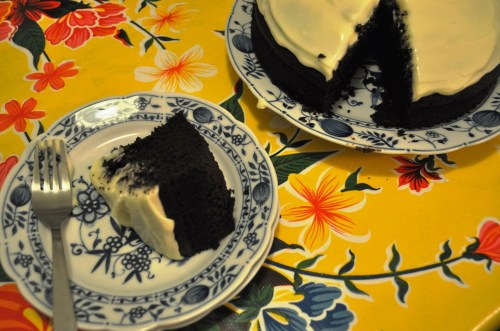
Chocolate cake with dark double-malt beer


Chocolate cake made with "birra scura doppio malto" (dark, double-malted beer)

One of my favourite breweries here in Italy is Mastri Birrai Umbri. They currently do three beers, one of which is Cotta 74, a doppio malto scura – a dark double-malt beer. A “birra doppio malto” is an Italian legal classification but this specific beer is made with a well-roasted malt as is not unlike a porter or stout. It’s got a warm, deep flavour, with a slight burnt caramel taste and hints of chocolate. So, thought I, why not try and use it in a chocolate cake recipe?

Mastri Birrai Umbri’s beers, developed by master brewer Michele Sensidoni,  also all use a unique ingredient, something distinctly Umbrian. In the case of Cotta 74, that ingredient is lentils, which are a traditional crop in Umbria. I believe they give the beer a slight nuttiness and earthiness. Also good for a chocolate cake, thunk I.

Anyway, available here is a recipe for a chocolate cake made with Guinness. It’s a Nigella Lawson recipe. I never had good results from her cake recipes, I found them unpredicable and unreliable. And nor do I like Guinness (it’s tastes too much like iron and mud, it’s too creamy). But the recipe proved a good foundation for a cake made with Cotta 74.

Of course this is a versatile recipe, so use whatever stout or porter you have to hand. Though I would recommend something good quality from a small brewery. Large scale industrial beer is never as nice.

(Note – I do liquids in grams. It’s more accurate, and perfectly easy if you’re using bowls and electronic scales. If you’re unconvinced, just use the liquid measures in ml.)

250g scura doppio malto, stout or porter
250g unsalted butter
100g cocoa
340g caster sugar
140g mascarpone
20g yogurt
2 eggs
1 tablespoon vanilla extract
270g plain flour
1.5 teaspoons bicarbonate of soda
1 teaspoon baking power

Preheat oven to 180C.
Grease and line a 23cm tin. (Springform is easier but not essential.)

In a pan, melt the butter in the beer.
Pour into a large mixing bowl.
Beat the cocoa and sugar into the beer/butter mix.
Allow this mixture to cool slightly.

Beat together the mascarpone, yogurt, eggs and vanilla essence.
When the main mix is cool enough, beat in the mascarpone mixture. (If it’s too hot, you’ll scramble the egg content.)

Sieve together the flour and raising agents.
Add this to the mixture and beat well.

Pour the mixture into the tin.

Bake for around 1 around, until it’s well risen and no longer too wobbly.

Leave to cool completely in the tin, on a wire rack.

Make a topping with
100g mascarpone
150g icing sugar

Sieve the icing sugar into the mascarpone and mix.
If it’s too sloppy, add more sieved icing sugar.

Enjoy!

3 Comments

Filed under Baking, Food misc, Italy

Rocket pesto – non si fa!


Pesto di rugula con spaghetti

If you’re here for a recipe for rocket pesto – scroll down! If you’re happy to sit through a little theorising and food history – read on!

Here’s a theory. It’s probably not an original one. Britain, being an island nation, has always existed as place of immigration and trade. As such, British society has been always been informed by integrating new ideas, new tastes, new cuisine. It’s intrinsically mutable and always has been, despite what certain more conservative types might believe. Just think of how the chicken tikka massala – which isn’t Indian, but certainly didn’t have its origins in Britain – has become a British national dish.

Italy, on the other hand, is a mountain nation, with the spine of Appennines, the Alps in the north, broken only by the Po Valley. The Ancient Romans might have imposed themselves on much of the known world, and they certainly integrated foreign ideas (such as the cult of Mithras say), but by and large it was a more stringent process of integration: people became Roman, Rome didn’t change. It was the Eternal City. It still is.

The rest of Italy, meanwhile, even during the Ancient Roman period, was a place of villages and rustic poverty. It largely remained so over the centuries. People were born and died in the same village, in the same valley, eating the same food, for generations. And there’s only one way that food was made – the way nonna did it, and the way mamma did it, and the way figlie then learned to do it.

Although Italy has of course opened up, especially since il boom of the 1950s, it remains a place where traditional and convention rule supreme. And those traditions and conventions remain very regional (after all, Italy has only been a nation just over a century and a half). Radio and TV early in the 20th century, then motorways and corporate chains of supermarkets and junk-food outlets later on, may have destroyed most comparable regional variation in Britain, but not so here. They do have corporate supermarkets here, for example, but Italians are holding out better against the insidious neutralisation of regional variation we’ve seen in the UK. Mussolini might have tried to force a specific linguistic culture, for example, on Italians using new media in the 1930s, but it didin’t work. The people we buy some of our meat and dairy products from on the farmers’ market say their dialect is different to that of their closest village. They say they even argue with people from the neighbouring village about how things should be done, how certain dishes should be made.  Regions – even individual villages – are enormously proud of their traditions and their regional foods, and rightly so. Campanilismo, it’s called – an association with all things within sight of your town or village’s belltower (campanile).

Non si fa!
There’s a classic utterance in Italian: non si fa, which literally means “that’s not how one does it,” but it’s probably closer to “it’s not the done thing”. If people from neighbouring villages bat that expression back and forth between them, just think how foreigners cooking nominally Italian food are looked upon.

So I knew I was risking a non si fa when, looking in the fridge and trying to decide what to have for lunch, I hit upon using up some slightly sad looking rocket by making pesto. As pesto is made with basil. Not rocket (aka rucola, rugula and Eruca sativa). Never rocket. There are regional variations of pesto of course. But they all use basil. The classic form we know in the UK is pesto alla genovese (Genoa pesto), made with basil, pine nuts, garlic, olive oil and Parmigiano Reggiano. Pesto alla siciliana (Sicilian pesto) includes tomato and almonds instead of pine nuts. Pesto alla calabrese is made with red peppers.

Internationally we’ve varied it in many ways. I’ve made it with nettles (Urtica dioica or similar varieties like Urtica urens) before. Nettles are a great free food, and very nutritional. It’s a good use of wild garlic (Ramsons, Allium ursinum) too, if you’re lucky enough to happen upon some. And, heck, I’m sure I’d heard of rocket pesto before. Though I suspect it must have been a recipe from back home. Jamie Oliver does mention using rocket for pesto here, calling it “slightly more American”. Though I’m not sure why rocket is any more US than UK in terms of adapting Italian cuisine. (I say adapting. An Italian would probably saying messing up, or violating, or ruining. Or would simply not recognise it as in any way related to real Italian food.) Either way, the US is an immigrant nation too, so like Britain historically has cuisine that’s had to adapt and evolve.

Anyway, rocket. Rocket is an interesting crop. I remember when it first started popping up in British supermarkets in the 1990s. It was dead trendy, right posh. Did we really not eat it before the 1990s? No, apparently not. My wife keeps telling me it was popularised as food crop by a colleague of hers, Dr Stefano Padulosi. Dottore Padulosi is an ethnobotanist who garnered the name of the “Rocket Man”. Why? Because when he worked for the International Plant Genetic Resources Institute he noticed rocket growing among the ruins of Pompeii – so the story goes. How apocryphal it is, I don’t know – and initiated a program to encourage its consumption. (IPGRI is now Bioversity. Part of its remit is to encourage the use of food crops marginalised by the increased intensification of agriculture through the 20th century.)

The Ancient Romans (them again) had eaten its leaves and seed, the latter being considered good for the production of, er, male seed. Though the same source mentions how the early Catholic Church tried to suppress its cultivation because of its dirty, dirty aphrodisiac association. So apparently, by the late 20th century it was one of those marginalised food crops. Outside Italy it was basically unknown. So we have Dottore Padulosi and his colleagues and their work to thank for introducing us to this plant, for popularising it internationally. Rocket is not only delicious in its pepperiness, it’s easy to grow and it’s also nutritionally rich. It’s a great source of vitamins A and C, folates, calcium and iron, among other goodies.

So the idea of making pesto out of rocket seems like a good idea – it’s tasty, it’s inexpensive, it munges up nicely in a blender.

Here’s my recipe. It’s flexible.

3 good handfuls of rocket/rugula/rucola/roquette (you could also use wild rocket, Diplotaxis tenuifolia, a similar species but from a different genus)
1 clove of garlic
80g (approx) pine nuts, lightly toasted
60g (approx) pecorino (You should probably use Parmigiano-Reggiano, but hey, it’s not like this is an authentic recipe. Use whichever you prefer or have in your fridge! I liked the idea of the sweeter pecorino in tandem with the pepperiness)
2-3 good slugs of extra virgin olive oil
Salt and freshly ground black pepper

Whizz the whole lot up in a food processor. Add oil to get a thick but not runny consistency. Season to taste.

If you’re old school, you could use a (large) mortar and pestle, with the cheese pre-grated and the leaves coarsely chopped.

Making it with a pestle would have a nice poetry to it, as the word pestle has its roots in the Latin pistillum, which is from pistus, the past participle of pīnsere, the verb to pound, crush. The word pesto itself comes from the Italian verb pestare – also to pound, to crush, from the same roots.

So get pounding and crushing! Unless of course you consider it non si fa.

Addedum, 19 October 2012:
Last night a Sicilian friend said her mother used to make pesto with rocket, and it was perfectly si fa.

Addendum 2, 11 January 2013:
My ignorance increasingly shines through when I look back at my old posts; but that’s ok. Blogging is a process of self-education as much as anything else.
Anyway, I’ve just read John Dickie’s excellent history of Italy and its food, Delizia. It has a lot of interesting stuff about pesto and what it can contain. “Genovese pesto today is a pulp of basil, leaves, cheese, garlic, pine nuts and olive oil. But according to the earliest dictionary definition, which was published in 1844, pesto was a condiment made fom a pounded mixture of garlic, oil, cheese and either basil or parsley or marjoram. Pine nuts were not mentioned. Neither was pasta. In 1844, it seems, pesto was a flavouring most often used in soup.” [Note the closely related southern French pistou still is a flavouring most used in soup.] The book has loads of other interesting things to say about how pesto alla genovese has evolved and how the version that’s deemed most “traditional” – with local Genovese basil, pine nuts etc – has only really been codified relatively recently.

2 Comments

Filed under Food misc, Rome

Penny buns and doughnuts

The end of the summer and the start of Autumn. The best time of year for fresh produce. September in Italy has been fairly mixed weather-wise – which is good, as a bit of rain encourages the fungi. The market stalls here have lovely displays of porcini (Boletus edulis, also knowns as ceps. Though I like the traditional British name: penny bun. As, you know, they look like little buns) and galletti (Cantharellus cibarius, chanterelles).

Both of which are lovely with pasta. I’ve cooked with porcini for years, but in Britain we more typically just get the dried ones. It’s not that penny buns don’t grow in the UK,  it’s just that we’re a bit crap at taking advantage of our wild fungi varieties. When I asked the girl on our fruit and veg stall about how best to cook these mushrooms, she basically just shrugged amiably and said “aglio, olio e prezzemolo”: garlic, olive oil and parsley. Your classic, basic Italian flavourings. If in doubt, aglio, olio…


The same day, we managed to work out how to watch The Great British Bake-off on iPlayer. Yay. In the episode we watched they were making doughnuts (or donuts). Which, inevitably, set off a craving. Your standard British jam-filled doughnut is something I’ve never seen in Rome. Which is fine and dandy – I wouldn’t expect or need to see it here. Instead, some local goodies hit the spot. Specifically some frittatine di mele, “little fried things with apple”, like mini apple doughnuts, purchased from Pasticceria Nonna Nani. This is a pasticceria that opened earlier this year, and is owned by the same people as Da Simone, an excellent pizza a taglio (pizza by the slice) place across the street. The street in question being Via Giacinto Carini in Monteverde Vecchio. The nonna (grandmother) in question, Nani, being conspicuous by her absence.


Leave a comment

Filed under Food misc, Rome

Improving my English by learning Italian

Not having learned Latin at school has long been a regret of mine, as the sort of person who likes words and etymology.

I’ve written before about how it would have helped me learning the names of animals in Italian, as so many of them are close to their Latin names. But I’m finding learning Italian is also now teaching me new words in English – words with shared Latin roots. Words that aren’t necessarily common in English, but are still interesting. Hey, it’s one of life’s main joys to keep learning new stuff.

So for example, I wanted to learn the Italian for “to dither”, as I’m a past master at dithering. Maybe. Sometimes.

To dither = esitare or tergiversare

I dug a little deeper with tergiversare, and it can also be translated as “to prevaricate” (ok) and “to tergiversate”. That latter one was new to me. It’s from the Latin “to turn back”.

Here are a few others I’m learning while trying to read this beer guide (gotta collect ’em all!):
organolettico – “organoleptic”, that is “perceived by a sense organ” or “capable of detecting a sensory stimulus”. (Okay, this one is from the Greek.)
appannaggio – “appanage”/”apanage”, that is an endowment, a prerogative, a rightful revenue or a necessary accompaniment. (I like this one. At the heart of the word is “pan”, as in bread – pane, pain, panis. In the sense of “to give bread”, or “to nourish”.)

Inevitably, my WordPress spellcheck doesn’t like a lot of these English words. I shouldn’t really be ashamed of my ignorance if it’s so ignorant too.

1 Comment

Filed under Learning Italian, Main thread

Rome: closed for the holidays

We’ve lived in Rome for nearly a year now. We arrived last August, and soon became familiar with shuttered-up shops and restaurants adorned with various signs saying “Chiuso per ferie”: Closed for the holidays. People, very sensibly, avoiding the heat, humidity, traffic fumes, and stench of garbage cooking in the dumpsters and dog shit dry-fried on the pavements.

Having said that, there’s also something pleasant about Rome in August: it calms down, marginally.

As summer rolled around again this year, the shutters started coming down. In July, the woman in our local pet supplies shop said to me: “When are you going?” “Going where?” I responded, slightly confused. “Vacanze!” Oh, right, of course. She was checking what supplies I needed for our cats as she was going away at the start of August, and wouldn’t be back till the end of the month.

It’s not like every business closes for the entirety of August, but a reasonable proportion still do. Apparently Rome used to be even quieter in August, especially from Ferragosto – the 15 August holiday that traditionally marks the hottest point of the year. (I reckon it’s heading for 40C ish this year.) The word, like ferie, is close to the Latin for festivals, Feriae, but I like to think of it as “ferro agosto” – iron august, when it’s so bloody hot, it’s like being hit with a metal bar. Or metal getting so hot you can’t touch it. Or something.

Anyway, the fruit and veg vendors I favour said bye in late July, and now the market is half-empty, the various metal shacks totally locked down. When we moved into our current flat on 4 September 2011, the big, popular restaurant on the corner was all closed still, but this year I spotted a sign proudly stating they’re open for August. Though maybe they’ll be staggering their holiday, and closing for September.

As a Brit, this continues to tickle me. It’s just such an alien concept. We have a different work ethic, and a different work-life balance. You’ve got to admire these people for retaining the sanctity of holiday, of time with family and friends. If Sunday is the week’s day of rest, then August is the year’s equivalent.

My only point of reference in British culture is from stories by the likes of W Somerset Maugham and EM Forster, describing a very middle-class, or upper middle-class milieu in Edwardian Britain. But even most well-off Brits wouldn’t consider taking a whole month off these days. It’s not like it’s a comparable class issue here though. Many Italians I speak to, from different walks of life, have seaside or country houses, including our neighbours, who aren’t wealthy by any stretch of the imagination (she’s a perpetually stressed single mother, for example). Maybe it’s a bit more like the New Zealand culture of the “bach”, a second property to retreat to for a break, be it a shack in the hills or a nice pad on the beach. (Oh, and many Brits are confused by “bach” – well, it’s short for bachelor pad, innit.)

I don’t know whether my friendly grocers have gone to a country retreat, but they’re certainly having a nice long holiday.

A few weeks back, in July, I wanted to get some chocolates for a present from a cioccolateria, and found a sign saying they were off for nearly three months.

Nearly three months! Respect. Is selling handmade chocs really that profitable? This is in Trastevere, a favourite location with tourists, so maybe it is. Or maybe it’s just a practicality. Perhaps it’s just too messy trying to sell handmade chocolates in the summer.

7 Comments

Filed under Main thread, Rome

Confusion, sometimes of a risqué variety

Here are some of the words that confuse me in Italian due to their similarity.

It can be a risky business, most notably with…

scroprire (past participle scoperto) – to discover, to find, to uncover
scopare (past participle scopato) – to sweep, but also to fuck

I’ve blundered with these two many a time, to a point where it seems like my brain is simply being bloody-minded and refusing to learn the difference. Maybe my brain thinks it’s funny. It’s so risky, I have to try and use workarounds, for example avoiding scroprire and using trovare (to discover), and using spazzolare, to sweep, to brush.

This is another very risky one, which I’ve messed up a few times in the rudimentary exchanges that generously could be called my attempts at “conversation”:
fido – loyal, faithful, also overdraft and I trust (fidare, to trust)
fida – he/she trusts (fidare)
sfida – challenge
fico – fig, but also cool, kewl
figo – as above
fica – slang term for vagina, which could be translated by that most harsh of Anglo-Saxon four-letter words, but I don’t think that’s quite right. It’s probably closer to the US English appropriation of a once-cute name for a cat. Wordreference.com also insists it can be used like the English word “babe”, but I’ve not heard that myself so can’t confirm.
figa – variation on the above.
sfiga – bad luck, as in Che sfiga!, What bad luck! Adding an s in front of words varies their meaning in Italian, though I can’t quite get the logic here.

This is a real minefield, especially in plurals, where fico becomes fichi, okay, but also fiche (according to wordreference.com). This is problematic as fica also becomes fiche. So I’m really not sure how one could safely ask for some figs on the market… And it’s fig season now too.

Now, I enjoy idiomatic expressions, especially old ones in English, such as “I don’t care a fig” as a tame way of saying “I don’t give a damn”. Apparently Italian has similar expressions, such as Non me ne importa un fico! or Non vale un fico! (It’s not worth a fig!).

What makes this interesting is how easily the anodyne expression, which presumably evolved to avoid using any Christian cussing, can become something really rather rude, with the adjustment of one letter.

Here’s a tamer one, but still ripe for comedy value:
tetto – roof
tetta – tit (at least this noun has the decency – and logic – to be feminine)
Just think of how wrongly I could say “I’m going up on the roof.”
Note the plurals too – tetti (roofs), tette (tits).

And now, just to get beyond my confusion/obsession with rude words and general turpiloquio (my teacher would be so proud), here are some more ordinary words I’m just trying to clarify for my own sake:

menta – mint (but also the first person present subjunctive conjugations of mentire, to lie)
mente – mind
mento – chin

detergente – detergent, washing up liquid
detersivo – detergent, washing powder

I think the difference between this two is loosely liquid vs powder, but don’t quote me on that.

I’ll add to this page as and when I encounter similarly confusing words.

Oh, and just a quick note – what I’m talking about here is standard Italian, a language that arguably doesn’t really exist. Most Italians speak dialects apparently. The mind boggles about the variables therein.

Addendum 1:

Here’s a classic confusing thing you may encounter in an Italian restaurant.

ostriche – oysters, not ostriches, in case you were wondering if they were doing ostriche state. (Singular ostrica. Ostrich in Italian is struzzo. In taxonomy, their family is Struthionidae, genus Struthio, which hints at the origins of the Italian word.)

And a few other similar words:
astice – lobster (also aragosta; taxonomically, the lobster infraorder is Astacidea.)
istrice – porucpine (also porcospino, literally spiny pig, a name that’s used for hedgehogs too. Naturally. I wish I’d studied both biology and Latin more as both are very handy for making guesses at the names of animals and plants in Italian: the Latin name for the family of Old World porcupines is Hystricidae).
strisce – stripes. (Singular striscia.) I’m enjoying an Italian beer at the moment called Stelle e strisce – stars and stripes. I imagine it’s inspired by a US ale.

Addendum 2:

Just learning this one yesterday, 10 March 2013. We were on the Aventine hill, and discussing the keyhole of the Knights of Malta compound, with its famous view of St Peters.
toppa – keyhole.
topa – slang word for vagina. Learning the pronunciation nuance of a single versus a double letter in Italian is a real challenge…
topo – mouse.

2 Comments

Filed under Learning Italian, Main thread

Macchinaphilia

Italians have a great passion for coffee, for food (notably offal in Rome), smoking (basta!), football (you should have heard the horns honking after the 2-0 Italy-Rep. Ireland match last night) and cars. It’s fundamentally evident in the language: la macchina means the machine, but it’s most commonly used to mean the car. The machine is the car. The car is the machine

They love their cars. I did read somewhere that around the turn of the millennium, Italian per capita car ownership exceeded that of the USA. I can’t find that stat now. This list on Wikipedia (of vehicles per capita, not specifically cars) has them at 10th in the league table of vehicle-crazy nations. Monaco is first (surely Monaco is small enough to just walk everywhere? Crazy). The US is second. The UK, perhaps surprisingly, is 30th – good for the UK. That’s a sanity point in the UK’s favour.

Anyway. So Italy is still up there. 690 cars per 1000 population.

This car obsession was re-iterated to me this morning not by an encounter with Rome’s daft traffic but by an exchange I overheard between a thirty-ish mother and a three-ish daughter.

“Mummy – what kind of car is that?”
“That’s a Chrysler dear.”

This child was certainly starting young. And a girl to boot. Would you ever hear a three-year-old British girl ask that? Maybe, but the cultures I’m a little more familiar with – British, New Zealand, even US via the old remote viewing of movies and TV – it’s the males who grow up to be petrol-heads.

1 Comment

Filed under Main thread, Rome

Translating cheesy Italian pop songs, pt 2

So I’ve already had a few attempts at translating Italian pop songs into English. These are generally songs that I’ve found catchy, but have been largely unable to translate in my head while I’m listening. I never know what they are or who they’re by, as the station our radio is mostly tuned to doesn’t give such info.

Anyway, a song struck me lately, so I looked it up online, and lo it’s by the same band that I translated before, here. The song’s called ‘Come un pittore’ – Like a painter – and the band’s Modà, and I guess they’re quite big here. I said before, they’re perhaps the Italian Coldplay. Though they sing in Italian, so haven’t quite been exported so successfully. Oh, and this one seems to be a song “feat. Jarabedepalo”, a Spanish group. I believe that’s their singer Pau Donés in the video, below.

I’d say this song sounds like a nursery rhyme (filastrocca), but that’d be unfair to nursery rhymes. When you think about it, a babyish love song is a disturbing thing.

And having said all that, I must admit I quite like it – it’s idiotically sentimental and cheesy but has singalong value, the bottom line of any good pop song. Plus, the fact that I can just about sing along with an Italian pop song, and understand some of it, gives me a good feeling, a sense of progress on my pathetically slow journey on the road to acquiring Italian.

Here’s the official video:

(Why is he making the – very rude – sign of the cuckold at the end of the vid?! I’m really confused now. Is it only rude the other way round?)

Here are the original lyrics:

Ciao, semplicemente ciao.
Difficile trovar parole molto serie,
tenterò di disegnare…
come un pittore,
farò in modo di arrivare dritto al cuore
con la forza del colore.

Guarda… Senza parlare.

Azzurro come te,
come il cielo e il mare
E giallo come luce del sole,
Rosso come le
cose che mi fai… provare.

Ciao, semplicemente ciao.
Disegno l’erba verde come la speranza
e come frutta ancora acerba.
E adesso un po’ di blu
Come la notte
E bianco come le sue stelle
con le sfumature gialle

E l’aria… Puoi solo respirarla!

Azzurro come te,
come il cielo e il mare
E giallo come luce del sole,
Rosso come le
cose che mi fai… provare.

Per le tempeste non ho il colore
Con quel che resta, disegno un fiore
Ora che è estate, ora che è amore…

Azzurro come te,
come il cielo e il mare
E giallo come luce del sole,
Rosso come le
cose che mi fai… provare.

And here’s my stab at a translation:

Hi, just hi.*
It’s hard to find the right words,
so I’ll try to sketch it…
like a painter,
that way, I’ll try to get straight to the heart
with the strength of colour.

Look*… without words*

Blue like you,
like the sky and the sea
And yellow like sunlight
Red like the
things you do to me… Trying.*

Hi, just hi.
I paint the grass green like hope*
and like fruit that’s not ripe.
And now, a bit of blue
Like the night
And white like the stars*
with hints of yellow

And the air…. You just want to breath it!

Blue like you,
like the sky and the sea
And yellow like sunlight
Red like the
things you do to me… Trying.

For storms, I just don’t have the colours
All that remains, I paint a flowerer
Now it’s the summer, now there’s love.

Blue like you,
like the sky and the sea
And yellow like sunlight
Red like the
things you do to me… Trying.

*
“Look” in the sense of “Behold!” perhaps.
“Without words” – or maybe “Without talking”
“Trying” – provare is the verb to try, but also to demonstrate, to feel, to experience. Not really sure what it means here.
Is hope green? Maybe in Italy.
“Like the stars” – or “like her stars”?

I’m probably doing these bards a terrible disservice with my crude translation.

Oh, and if anyone things I’m being rude about Italy here, I don’t agree. I’m being rude about cheesy pop. And I’m enjoying the challenge of translating it, as part of the process of learning Italian.
English language songs can, of course, be equally cheesy. Especially if they’re by Coldplay.

Leave a comment

Filed under Learning Italian, Main thread

Chicory international

A favourite vegetable dish here in Rome is cicoria, which of course means chicory. When the guy on our fruit and veg stall on the market said it was good, I bought a bunch last week, and decided to cook it up. Raw, in salads, it’s very bitter and not unlike dandelion leaves, a classic of free foraged food. It looks similar too.

One classic, basic way it’s served here in Rome ripassata – cooked down in olive oil, with some garlic and a little chili. Reading up on preparation methods got me thinking, and led me down an interesting path of leafy revelations.

So, the cicoria I bought was leaf chicory, or common chicory. To clarify slightly considering the various international names, in Latin it’s Cichorium intybus. To run with the Latin name for a mo, its genus is Cichorium, the family is Asteraceae – yep, that’s the Aster, daisy family – which includes Bellis perennis, the common daisy found in a million British garden lawns, as well as such popular domestic flowers as Leucanthemum vulgare, the oxeye daisy. And, yes, Taraxacum officinale – the common dandelion. (Which, incidentally, gets its English name from “dent-de-lion”, French for “tooth of the lion”, and is basically the same in Italian – dente di leone. The funnier French name, meanwhile, is “pissenlit” – “piss-the-bed”).

So yeah, no wonder raw common chicory leaves taste like dandelion leaves. The similarity is particularly marked if you get cicoria del campo, aka cicoria selvatica – the wild variety of Cichorium intybus, where the leaves – and flavour – are fairly indistinguishable from dandelion leaves. In the US, the leaves of Taraxacum officinale are eaten and known as “dandelion greens”, though I’ve also heard this term used for chicory, especially wild Cichorium intybus. Taxanomically, chicory, dandelion, lettuce and even salsify are not only all members of the Asteraceae family, but are also members of the Cichorieae Tribe.

Perhaps more interesting, however (if you’re a food obsessive with a passing interest in taxonomy that is), is the fact that both endive (ie Belgian endive, aka witlof or witloof) and radicchio (aka red chicory), are are cultivated varietals of Cichorium intybus. Which they bear no resemblance to, at least not in the forms you see them on the market. Though the taste is so similar – basically bitter – that the relationship becomes clear.

Also, what is commonly known as endive in some Anglophone countries, is also another chicory, another member of the Asteraceae family: Cichorium endivia.

It’s cultivated in two main forms, the first of which I’ve always known as frisée, or frisée lettuce in the UK, when it’s not a lettuce (genus: Lactuca) it’s a chicory (Cichorium). The French call it chicorée frisée, in the US curly endive, while here in Italy it’s called scarola riccia (“curly”). Cichorium endivia crispum.

The other version is Cichorium endivia latifolia – broad-leaved, which is also known as escarole (French) or indivia scarola here in Italy. I don’t even know what we call it in the UK. Probably just “that lettuce”, pointing or picking. We’re sophisticated like that.

Here in Rome (and other parts of Italy), another popular seasonal vegetable is puntarelle. You will see curly strips of this green in markets and restaurants for a long season from autumn through the winter. It’s also chicory: Cicoria di catalogna (Catalan chicory) or cicoria asparago. Though the common Italian name is cuter – puntarelle means “little points”, or “little tips”. I’m not 100% sure on this one, but I believe it’s just another cultivated varietal of Cichorium intybus.

Also, the coffee substitute made with chicory root also uses a variety of Cichorium intybus: Cichorium intybus var. sativum. It has long white roots that look not unlike fellow Cichorieae Tribe member black salsify, Scorzonera hispanica.

Addendum
A few months later (1 Oct 2012 to be exact). Here’s another lovely variety of radicchio that they’re selling on the market. It’s like a lovely little pink-flecked lettuce. But it’s not a lettuce! I can’t remember the Italian name for its just now, but will add it when someone reminds me.

5 Comments

Filed under Food misc, Rome