Monthly Archives: February 2010

Stevens’ malted and seeded loaf


These are my first loaves based on recipes from Dan Stevens’ River Cottage Handbook No.3: Bread.

In his intro to this recipe, Mr Stevens says it’s a very popular loaf at River Cottage. You really can’t beat a good loaf that uses “Granary”-style flour. “Granary” is trademarked to Hovis, so what we actually mean here is malted grain flour. Mr Stevens’ recipe is one of those fairly flexible ones, and he just talks about adding “2 handfuls of extras” in the form of whatever seeds you fancy, though with a caveat to watch the fennel seeds as they’re so pungent; I’d add “ditto caraway”, as any bread with caraway seeds in it is kinda defined by their flavour.

I made mine with pumpkin, sunflower, sesame (what is a sesame plant? Never occurred to me before but I have no idea), a few poppy seeds and some buckwheat (which I probably should have toasted first).

Unlike Mr Lepard in The Handmade Loaf and M Bertinet in Dough, Mr Stevens gives his water in volume, rather than weight, which suddenly felt a bit odd to me after using the former two books so much lately. Those guys have won be over with their rationale about the accuracy of weighing liquids rather than relying on eye to check mililitres.

Anyway. This uses:
1kg malted grain flour
10g dried easy-blend yeast (not used that for a while!)
20g fine salt
600ml warm water
And some old dough – I used 3T of my white leaven.
2 handfuls of seeds

I mixed all the dry ingredients, then made up the dough with the wet ingredients.

Mr Stevens’ basic dough method involves kneading for around 10 minutes, but my standard method these days, when I’m making a fairly dry dough such as this (and not using a sponge) is to use the Lepard method: knead for a few mins, form a ball, leave for 10 mins, knead for 10 secs or so, leave another 10 mins, knead for 10 secs or so, then again in another 10 mins.

Rested it for an hour and a half (ish), then I divided it 3/5th, 2/5ths, and made a small tin loaf and a large-ish baton. Left them to rise for another hour and a half ish. Brushed them with milk and sprinkled with sesame seeds.

Baking on baking stone for about 20 mins at 240C, then reduced it to about 190 and gave them another 20 mins.

Leave a comment

Filed under Baking

Ciabatta


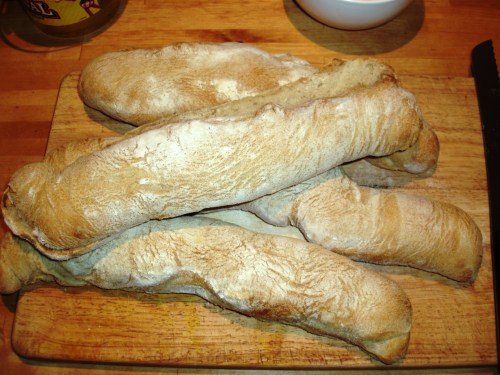
This is my first stab at ciabatta, using the recipe in Richard Bertinet’s Dough.

Despite being somewhat misshapen, they turned out very tasty. But it was touch-and-go for a while there.

Bertinet’s technique here involves making a “ferment” a day earlier – basically some dough that sits around giving the yeast a chance to do its thing. It’s kinda like a junior leaven. Except the batch I made with the quantities in the recipe resulted in a pretty dry ferment (350g flour, 180g water, 1/2 t fresh yeast), which looked nothing like the nice bubbly affair picture in the book. So when it came to making the second dough (450g strong white or ’00’ flour – I did a mix; 10g yeast, 340g water, 50g olive oil, 15 salt), and combining them, it was hard going. The dry ferment and wet dough mix just refused to integrate. A lot of messy manipulation ensued.

Next time, I might experiment by just using my leaven instead of Bertinet’s ferment. It’ll make the dough even moister, but that’s good for ciabatta as I understand it from reading Dan Stevens’ recipe in the River Cottage Handbook 3: Bread.

2 Comments

Filed under Baking, Breads

Bertinet baguettes

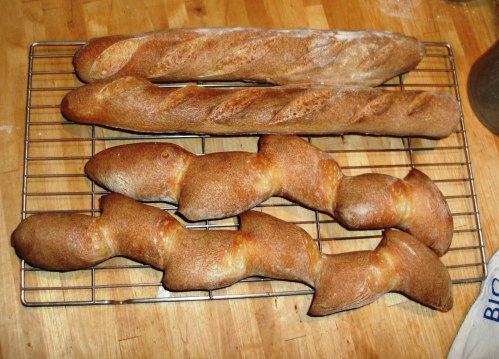
This is my first attempt at baguettes, using the recipe in Richard Bertinet’s Dough. (Bertinet is a Breton, who trained in Paris, worked at some award-winning pubs in Britain, and now runs the Bertinet Kitchen, in Bath.)

M Bertinet starts by dismissing British techniques for handling dough – we make it too dry, we abuse it with rough kneading, apparently. My past few years of baking have taught me not to add too much flour, and, when kneading, use the Dan Lepard technique where you simply oil the work surface slightly, rather than flouring it. Plus, I also already use a kneading technique that doesn’t involve half an hour of rough tugging and squashing. But Bertinent’s very wet dough is initially a little hard to get used to.

Bertinet’s technique involves lifting and slapping over the very wet, porridgey dough, to incoprate lots of air and encourage the formation of the nice, open structure. Luckily, the book comes with a DVD to explain this, as it’s a pretty feral process. He insists the dough will come together into a neat ball even with this high quantity of water, even without flouring the surface at all, but mine remained pretty recalcitrant, even after several minutes of kneading, so I succumbed to flouring the work surface just a wee bit. After that, it formed a ball nicely and became very manageable.

Before you get stuck into the messy kneading, he also uses an interesting technique where you rub fresh yeast into the flour dry, like rubbing fat into flour for scones or a crumble. I can’t see that this is any more effective than whisking it into the water, but it seems to work fine.

My ordinary domestic oven isn’t quite big enough for the stonking great long-as-your-arm baguettes you can buy commercially, but Bertinet encourages you to work small, make mini baguettes and whatnot. Which is fun, and good for mastering the techniques of shaping, folding, forming the spine of the dough so it retains an even shape on cooking (one of my baguettes came out a bit twisted so I’ve got to work on this!).

His also emphasises how important it is to use a baking stone and a peel, along with misting the inside of the oven. I didn’t have a baking stone or a particularly heavy baking tray to use instead at this point, and I didn’t trust myself to try and replicate the action of sliding the uncooked loaves off a tray (in lieu of a peel). So these are just a step in the right direction, risen and baked on a room temp baking sheet; the next batch I do I’ll use my new baking stone (actually a granite worktop saver – which only costs around a tenner) and report back with how that affects the texture. These weren’t bad for a first go. The crust was nice and crusty, and the flesh was open and light.

Oh, and the ones that aren’t actually standard straight baguettes are “epis” – you cut the raw baguette at intervals, turning the sections to alternate sides, making bits that can be broken off when sharing. The loaf resembles an ear of wheat – and indeed epi is the French word for the wheat ear. (Bit more about epi here). Rather nice.

3 Comments

Filed under Baking

Handmade loaves

Although I blog about my baking over at Cake-Off (now gone), the emphasis there is on cakes, cupcakes, tray-baked cakes, biscuits, cookies and all things sweet and yummy. For my bread-making, I’m going to try and write about it a little more here.

I’ve been making bread on and off most of my adult life, starting, like much of my more homely, traditional interests, with the time I spent on small organic farms in the Buller Gorge, South Island, New Zealand in the late 1980s and 1990s (a couple of years in total, on about off). There, mentored and encouraged by first Mr Stephen McGraph of Newton Livery then, more significantly, by Ms Nadia Jowsey of Old Man Mountain, a highly accomplished baker and chef, I started to learn all about making real bread.

Last year, I was given a copy of The Handmade Loaf as a present. This excellent book is by Dan Lepard, the master baker who has been writing the baking column in the Weekend Guardian the past few years. Its emphasis is on using a natural leaven – aka levain, aka ferment – in your breads. I’m not sure I can entirely summarise the difference in results between a homemade loaf made with just commercial yeast (be in easy-blend, dried or fresh) and one made with your own leaven, but it certainly adds different qualities: you can achieve very different textures, but the main difference is probably a depth of flavour. Plus, where making your own bread is always deeply satisfying, that feeling is multiplied when the only raising agent you’re using is a natural yeast you’ve cultivated yourself. There are different methods of doing this, but Lepard’s basically involves using the natural yeasts presents on the skin of raisins, feeding it with flour and water, and nurturing it over a week or so.

Not all my experiments with the recipes from The Handmade Loaf have been a resounding success, but all have been informative experiences. And some of them have resulted in some of the best breads I’ve ever made.

Here are just a few examples from the past few months.

The mill loaf
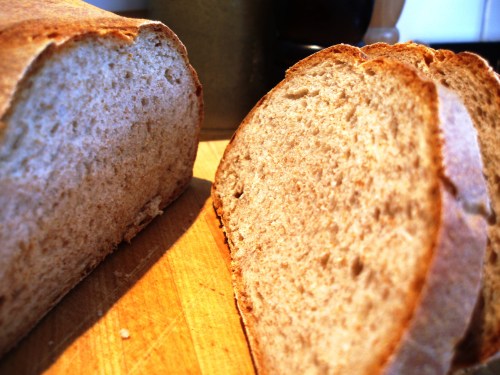
This is second recipe in The Handmade Loaf. It uses leaven made with white flour (you can make rye leavens, etc), alongside white flour, wholewheat flour and rye flour. It’s a great all-rounder, for wholesome sarnies, top toast or just a few slices with a meal. It’s one of the recipes in the book I make the most, though for home use I half the book’s quantities, which call for half a kilo of levian, along with a kilo of flours (combined), and more than half a kilo of water.
Onion and bay loaf
This is a yummy loaf where you chop some onion, then head it, along with some bay leaves, in milk. You then cool the milk and use it for the dough’s only liquid. The finished loaf is a lovely savoury affair, that’s both nice and alliumy and instilled with the distinctive sweetness of bay. This one uses both some white levain and some fresh yeast.

Lemon barley cob
Made this one a while back. It uses white leavain and some fresh yeast, combined with 100g barley flour and 150g white flour. A little lemon juice and zest gives it, in combination with the barley flour, gives it a slight tang. Need to practice this one a bit more.

Ale bread with wheat grains
This is a great one, though takes a little more advanced planning. Its given distinction by the addition of wheat grains, which you simmer, then soak overnight in ale. I love ale. I love bread. And of course the two are closely related – or at least they used to be, before the advent of commercial yeast when much baking would apparently involve using the barm from beer-making for your yeast starter.
Rolled oat and apple bread
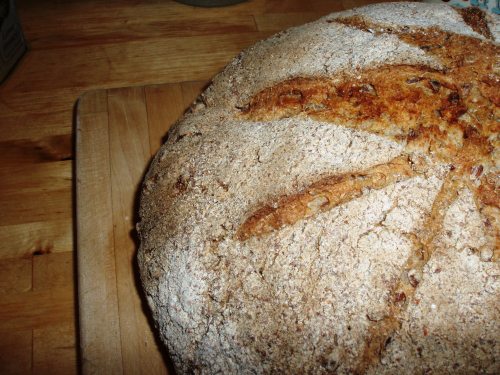
This is one of my favourites from The Handmade Loaf, so far. Adding the remains of the porridge to the bread dough was one of the things I learned from Stephen and Nadia, and this recipe incorporates a similar process – making some semi-porridge by soaking oats in boiling water. The apple here also keeps the loaf loaf and moist and soft. The recipe uses grated apple, but I had some pureed remains of our apples in the freezer, and added that instead on one occasion; the results were similarly successful.

Barm bread
Another connection with the old tradition of making beer with beer barm. Here, you make a barm by mixing bottle-conditioned ale with some white flour and white leaven the leaving it overnight. The loaf itself just uses this barm, water, strong white flour, and a little salt. Yum. Check out the texture – I’ve never achieved anything like that with a non-leaven bread. Though again, this needs a little practice, as it’s a bit too crusty.

Bottom line: get this book. And get baking! That said though, what’s with the prices on that book now? Mitchel Beazley – do another print run for crying out loud!

5 Comments

Filed under Baking, Breads

Flour

Quick inventory of the flour I’ve got:
Strong white flour
Strong wholemeal flour of an organic persuasion
Stromg wholemeal flour ground at the watermill at Otterton in Devon
Four grained malted flour from Swaffham Mill in Cambridge
Self-raising white flour
Plain white flour
Tipo ’00’ flour
Chickpea flour
Rice flour
Rye flour
Barley flour
White maize flour, aka masa harina
Buckwhea flour
And today’s new addition:
Millet flour

It’s all piling up on the top of/tipping off the kitchen cupboard. Having a passionate interest in baking can be a bit impractical when you don’t have much storage space…

Leave a comment

Filed under Main thread