Monthly Archives: February 2013

Baladin’s Nora at Le Café Vert, Monteverde, Rome

Thursday night, difficult week. Me and Mrs BC&A, aka Fran, decided we deserved a drink. Though we couldn’t be bothered to range beyond our Roman neighbourhood, Monteverde Vecchio. It’s not a best hood for a beer, but one café-bar-bistro has a reasonable selection of bottled craft beers (or whatever you want to call microbrewery fare. It’s called birra artigianale here in Italy – artisan beer). This is Le Café Vert, which opened not much more than a year ago, demonstrating how Italy’s urge to eat and drink continues to defy The Global Depression. As King Silvio said back in November 2011, “The life in Italy is the life of a wealthy country: consumptions haven’t diminished, it’s hard to find seats on planes, our restaurants are full of people.”

Quite why this bar has French name, and the lady serving us kept saying voila not the Italian equivalent ecco, I don’t know, but rest assured it’s in Rome, with great Italian beers and aperitivo snacks included in the price of the drink for a period every evening. According to their site, they stock beers from four Italian microbeweries: Baladin (which is Piedmont, NW Italy); Birra del Borgo (which is in Lazio, the central Italian region around Rome); ‘na Birretta (which is also in Lazio); and Birra di Fiemme (which is in Trentino, NE Italy).

We entered, glanced around, and I saw Baladin’s distinctive labels. I’ll be honest and say I don’t really like Baladin’s design style, which pervades Open Baladin bar in Rome and the labels on the bottle. It’s kinda scrappy, cartoony, vaguely Keith Haring, vaguely hippy, like someone’s mate did it, someone who’s not a professional designer. But remember kids, don’t judge a beer by its label. Baladin beers remain among my favourites, in part because Open Baladin was my entry point to birre artigianale. It’s not cosy like a nice British pub, its food is middling (especially if you’re not a fan of beef burgers on brioche buns), but its beer selection is stupendous, with dozens of craft beers, mostly Italian, on tap, and there are some very knowledgeable, helpful staff there too.

Anyway. We chose a Baladin “Nora” – we had to, as it was our friend Nora’s birthday, so we could drink it in her honour. This beer was named after another Nora – the wife of Teo Musso, the founder and master brewer of Baladin. Musso is a big name in the Italian beer scene, and for good reason. Baladin is apparently the biggest microbrewery by volume-produced in Italy (according to my chum, who is the brewmaster of the second-biggest, Mastri Birrai Umbri). Baladin brewery produces around a dozen varied, fascinating brews. Musso and his colleagues aren’t afraid of experimenting, of unusual ingredients, and Nora is no exception.

At first glance and sip, Nora’s a wheat beer, relatively pale, aromatic, slightly sickly-sweet (in a good way – if that’s possible. I’m not a big fan of wheat beers, so maybe that’s just me). But it’s not made with wheat, or at least it’s not made with a modern wheat strain. Instead, it contains both malted barley and “Kamut”, which is a branded version of Khorosan wheat (Triticum turanicum), an ancient strain. (I discuss wheat strains here.)

There are other ingredients too that make their presence felt in a certain spiciness and perfume: ginger and, get this, myrrh. Now we all know the latter was one of the gifts the Baby J got in Bethlehem, but did you know it’s a resin from the thorny shrub Commiphora myrrha. It’s an ingredient more commonly used in medicine and for incense (ah, memories of being the thurifer). As such Nora, is a beer that’s both sweet, citrussy and easily drinkable, and complex and slightly confounding. It’s also quite strong, if you’re British, but not that strong if you’re Italian: 7%ABV.

Final geek detail, it also alta rifermentata in bottiglie, which literally means “high-re-fermented in the bottle”, but I believe we’d say it’s top-fermented and bottle conditioned. Though I need to double-check that.
4 Comments

Filed under Ale, beer

Spelt experiments, or When bread goes wrong, and the dilemma of blogging the failures

So I was feeling experimental this week. I’d been both looking at old photos of breads I’ve made the past few years and browsing my favourite baking book, looking for inspiration. One of the breads I liked but haven’t tried too often is a 100 percent sourdough with some potato in the mix. I’d had great results once – a bread with a great, irregular crumb, which is something of a holy grail for bakers like me. It requires a high hydration dough and, generally, a natural leaven. It’s not something I’ve had much luck with lately, but I had done back in Blighty with a better kitchen and more familiar ingredients. I can’t find a photo of the bread in question, but here’s one with the kind of crumb I mean.

Okay, thought I, I’ll try that again – but with farro flour. Indeed, I’m going through a bit of a phase trying to use farro bianco all over the place, where, if I was still living in the UK, I’d use strong white or even plain flour.

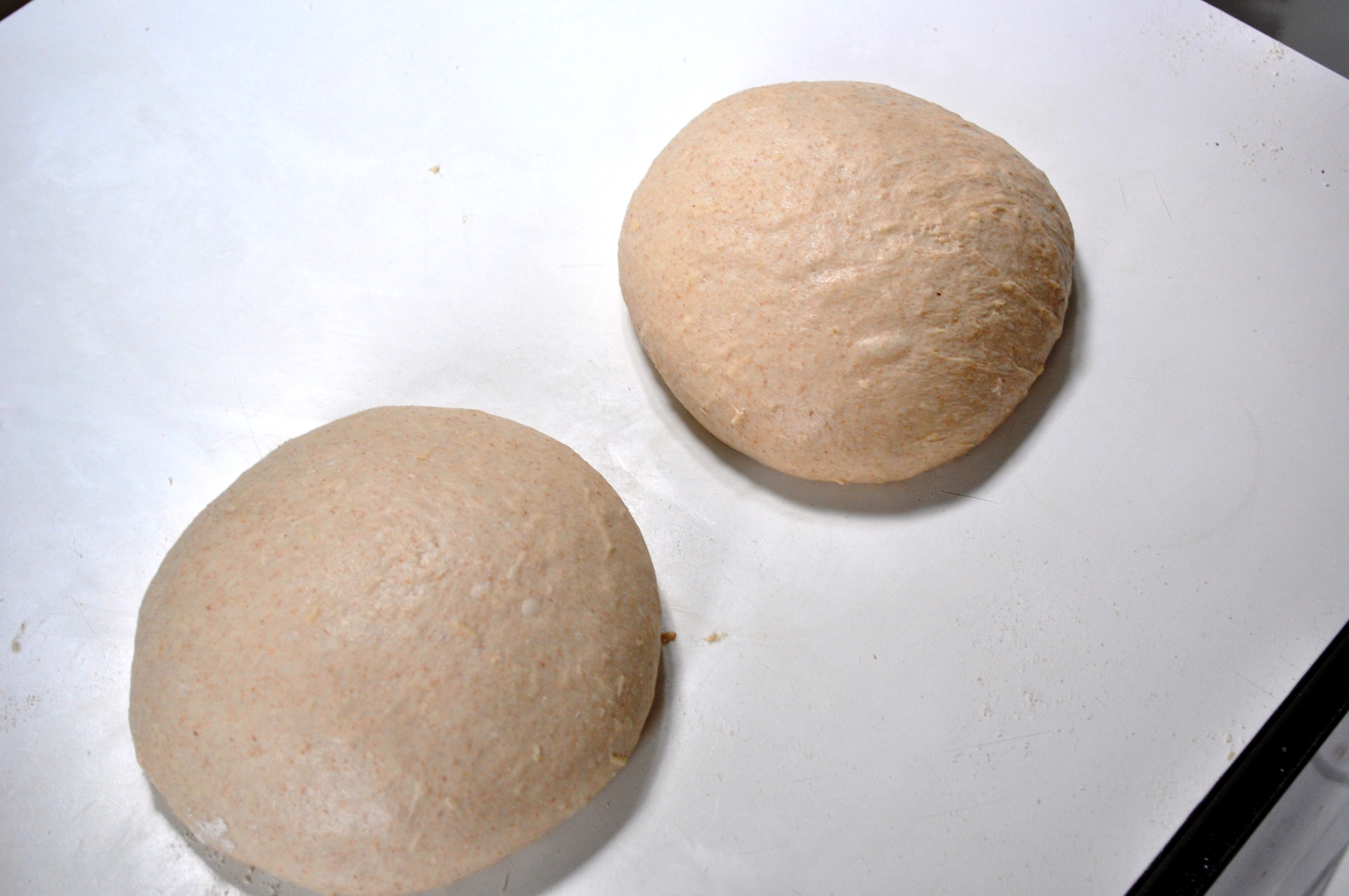
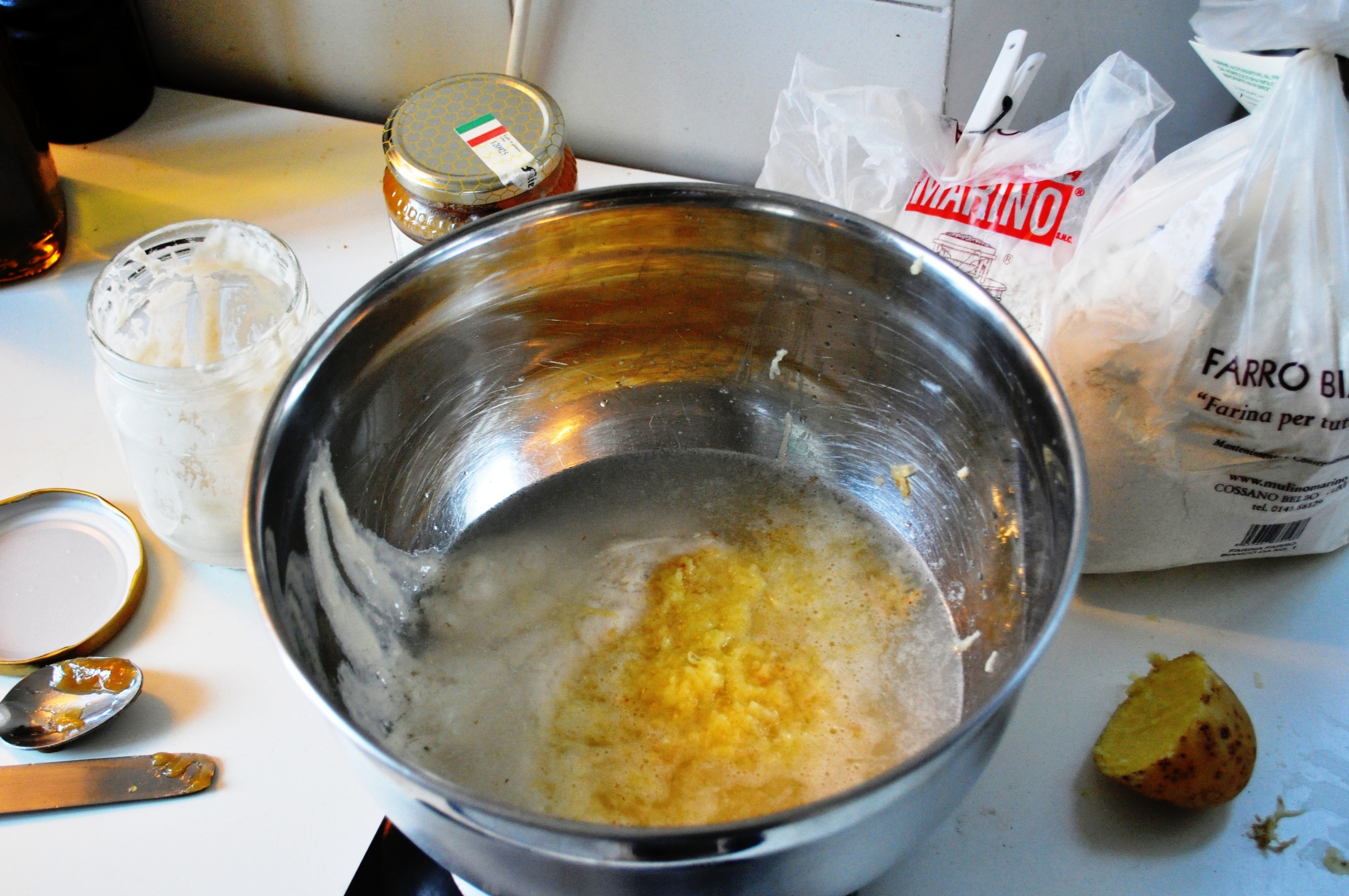
I revived my leaven over a few days, then got stuck in. Feeling optimistic, taking photos to record the process, thinking I could proudly blog the results, imagining cutting open a loaf with a crunchy crust and finding that wonderful irregular crumb structure again.

Except it didn’t go well. The bread is borderline terrible. Dense, heavy, and clearly lacking in life, with no oven spring. It tastes strangely like a teabread.

This left me with a dilemma. It’s one that’s probably faced by anyone who likes to make food and blog about it. If you make something, and it’s crap, should you blog about it? You of course want you food to look marvellous when you shove it out here on the interweb. But then I thought, Hang-on, this isn’t a glossy magazine or a recipe book, it’s a blog. It’s record of my endeavours, and not just the successes. So why shouldn’t I blog the failures? Or at least talk about the agonies of deciding whether to go public with the failures. And if by some miracle this is read by experts, perhaps that can give advice. (Yeah, right. Ed.)

So anyway, this is the recipe I used, a variation on Dan Lepard’s Crusty potato bread
250g leaven (mine was fed with farro, 80% hydration)
280g water
25g honey
75g unpeeled potato, scrubbed and grated
500g farro bianco flour
10g fine sea salt

1 Combine the leaven, water, honey and potato.
2 Add the flour and salt and blend to create a wet, sticky dough.
3 Rest for 10-15 minutes.
4 Turn out onto a lightly oiled work surface and give it a brief knead.
5 Return to a lightly oiled bowl and rest for around 10-15 minutes.
6 Repeat this process (it’s Dan L’s process, developed while he worked in a busy kitchen. In some ways it’s irritating – kneading, cleaning up, waiting, kneading, cleaning up, waiting – but in others it’s great. It seems particularly good for handling wetter doughs).
7 Repeat again 2-3 more times, then leave the dough covered for half an hour. Give the dough a fold if you like.
8 Divide the dough into two equal pieces and shape each into a ball.
9 Rest the balls, again covered, for about 10-15 minutes.
10 Shape batons, then place then in proving baskets lined with floured clothes, or if you ain’t gone none, place side my side on floured clothes, covered.
11 Leave again until doubled in size. This will vary according to the temperature of your room, but if it’s warm (around 20C) it’ll be around 4-5 hours.
12 Heat oven to 220C.
13 Turn out the loaves onto a baking sheet lined with parchment and dusted with semolina.
14 Bake for 20 minutes, then turn down the oven to 200C and bake for another 20 minutes.

So anyway, after all that, mine didn’t work. But if you use strong white flour instead, there’s a chance yours could. And if they do, it’s a lovely lovely bread.

Now for some diagnosis, some thoughts about why my bread didn’t work
1 The recipe really doesn’t like spelt flour. Although spelt has a not dissimilar proportion of protein to a strong white bread flour (around 14-15%), it has different proteins, which some sources refer to as “extremely fragile”. Compared to modern wheat varieties, it has less gluten, particularly gliadin, the protein that is integral to making easy stretchy white doughs. I’ve made plenty of decent loaves with spelt in the mix recently (like this one), but I think this is my first 100 percent spelt, 100 percent naturally leavened.
Which leads me to…
2 The leaven wasn’t sufficiently active. I perhaps should have fed and refreshed it over a few more days. Or maybe its current residents just aren’t happy with their conditions. It is Rome after all – so maybe it’s some kind of yeasty sciopero.
3 Or if I didn’t refresh it enough, I should have at least left the dough fermenting longer. It’s the winter, and our kitchen isn’t that warm, probably only around 15C (until I put the oven on). So yes, if it’s cold, it’ll take longer to ferment.
4 Except I also worry that if I left it fermenting too long, the yeasts would finish gorging themselves and any rise achieved would collapse back in on itself.
5 Some sources also talk about how you have to adjust the water. Well, I reduced it slightly from Dan L’s original recipe, and the dough did feel pretty good while I was working it. I dunno though , this place says “Too much [water], and the dough is sticky and weak and will not be able to hold the gasses that are produced during the fermentation process.”
6 Some other random factor. Like some unprecedented chemical reaction between the spud and the spelt. I know not.

Anyway, if you are a baker, and have any thoughts about what might have gone wrong here, please share!

In the meantime, I have to decide whether to continue my spelt experiments (I also used them in some brownies yesterday) or retreat to the comfort of strong white bread flour, or Manitoba as it’s known here in Italy, with its reliable if dietarily dubious gliadin and glutenin content.

Addendum

Here’s the recipe as baker’s percentages. I’m doing this partly because I’m getting out of practice and partly in response to talking to Jeremy.

250/500 = 0.5 x 100 = 50% leaven
280/500 = 0.56 x 100 = 56% water
25/500 = 0.05 x 100= 5% honey
75/500 = 0.15 x 100= 15% potato
500/500 = 1 x 100 = 100% flour
10/500 = 0.02 x 100 = 2% salt

Or if we’re getting serious (and it looks like we are), and factoring in the leaven… 250g leaven at 80% hydration = 112g water + 138g flour (rounded), so the total water is actually
392g, and the total flour is 638g.

392/638 = 0.61 x 100 = 61% water
25/638 = 0.039 x 100 = 3.9% honey
75/638 = 0.118 x 100 = 11.8% potato
638/638 = 1 x 100 = 100% flour
10/638 = 0.015 x 100 = 1.6% salt

12 Comments

Filed under Breads, Discussion, Flour & grain, Recipes