
Since I moved to Rome in August 2011, I’ve been keeping a list of the names for fish and seafood I encounter on market stalls and restaurant menus. Then I try to learn the English name for said fish. It’s a challenge though. As not only do common names change from region to region in Italy, but the same names are often applied to different species, most notably merluzzo, which, according to Italian Wikipedia, can refer to 15 species.
Basically, I’ve been utilising both the English and Italian versions of Alan Davidson’s ‘Mediterranean Seafood’ (aka ‘Il Mare in Pentola’), the classic book that comprehensively tackles of the subject of seafood nomenclature. (Although I do occasionally carry ‘Il Mare in Pentola’ with me at the market, it’s not very convenient when I’m out and about and end up in a restaurant: this list, on the other hand, I can access through my phone.)
I’ve also been cross-referencing both the English and Italian language versions of Wikipedia. Say what you like about Wikipedia, but it is constantly peer-reviewed by a vast number of contributors, so it can’t be all wrong – plus Davidson’s first did his work in the 1960s and even with later imprints, the updating process just isn’t as dynamic as that on Wikipedia. I’m also using other sources, both online and offline (like a poster I bought of seasonal fish species).

Please note though, I’m doing this more for linguistic and bloody-minded reasons. I’m not doing it as an overt exercise in seafood ethics. That said, many of these species are not sustainable, and shouldn’t really be eaten these days. Seafood sustainability is an issue there just wasn’t much awareness of when Davidson first wrote his book in the 1960s, and it still doesn’t really get a look-in even in the 2002 English or 2005 Italian editions that I have.
Greenpeace produces a Red List of fish to avoid. It’s handy as it simply lists the fish. They are also US and NZ specific versions, among others. A more comprehensive Red List is produced by the International Union for Conservation of Nature (IUCN). It’s not as user-friendly for consumers as you have to search by specific name (preferably a Latin, scientific name). Their database does however provide very detailed information; look, for example, at the entry for Atlantic bluefin tuna, Thunnus thynnus.
Back to practicalities: I’m doing fish (including some of the fresh water varieties I encounter), crustaceans and cephalopods together alphabetically, not in any separate categories. And I’m not going to list all the regional, dialect names Davidson mentions, though if you search here they may well be included alongside the standard Italian name. I’m also including a few bits of terminology, just cos.
Italian names are given in the singular form. Though (very) generally in Italian masculine nous ending in –o are pluralised –i, and feminine nouns ending in –a are pluralised with –e, there are exceptions, so I’ve included some for clarity. Note, for example, pesce (“fish”) is masculine, and becomes pesci in the plural.
Caveat: This whole undertaking is a minefield, linguistically and ethically. This list isn’t comprehensive, expert or entirely accurate. It’s just me trying to learn the names of fish I see used in Rome, and relate them to common English names. I’m British, so I’m talking about relating them to British English common names (which are more standardised than Italian common names, though not entirely standardised). But I’m also giving the principle scientific name for species, which can then be utilised to find common names in say, American English.
Please do comment or contact me though if you see something that you really don’t agree with. This is an ongoing project and I plan to keep revising it and honing it.
A
acciuga (plural acciughe) – European achovy. See alice.
acqua dolce – “sweet water”, that is freshwater. So freshwater fish are called pesce d’acqua dolce.
alice (plural alici) – the European anchovy (Engraulis encrasicolus). Some of the regional names are more similar to the English word anchovy or our more generic word for small, oily forage fish sardine, such as the Veneto’s anchiò and sardon, though this is an area of potential confusion as Engraulis encrasicolus isn’t considered a sardine species.
alalunga – see tonno alalunga.
alletterato – see tonno alletterato.
allevato in un vivaio – bred in a hatcher, fish farm
aluzzo – European/Mediterranean barracuda (Sphyraena sphyraena) aka luccio marino, luccio di mare, luzzo.
anguilla – eel, or more specifically the European eel (Anguilla anguilla – gotta love those tautonyms). Saw a big tub of these, alive, on the market just the other day.
aragosta – spiny lobster (Palinurus elephas). Also know as aligusta, aliusta (Lazio, Marche, abruzzo); agosta, langusta, grillo de mar (Veneto); ravosta, rausta (Campania); arausta, ariusta, laustra (Sicilia).
argentina – argentine (Argentina sphyraena).
aringa (plural aringhe) – herring, or more specifically Atlantic herring (Clupea harengus). Not a Mediterranean fish, but here in Rome there are smoked (affumicata) herring fillets available in the supermarket and I’ve even seen kipper-like affairs in specialist food shops or on the market in certain seasons.
astice – European lobster, common lobster (Homarus gammarus). Also known commonly as elefante di mare, longobardo (Liguria); grillo de mar (“sea cricket”, as in grasshopper, not the daft/dull English game involving balls and sticks; Venezia Giulia); lupicante, lupocantero, lupo di mare (another “sea wolf”; Toscania).
azzurro, pesce – see pesce azzurro.
B
barracuda – barracuda. Refers to the Mediterranean barracuda or barracouta (Sphyraena viridensis), though possibly also the European barracuda (Sphyraena sphyraena), which is also found in the Med. See aluzzo.
barracuda boccagialla – Mediterranean barracuda (Sphyraena viridensis).
baccalà – salt cod, that is dried salted Atlantic cod (Gadus morhua). See also stoccafisso. Note, Atlantic cod is categorised as “Vulnerable” on the IUCN Red List. Which is a problem for me, as traditional Roman trattorie frequently only have baccalà as the only alternative to red meat and offal. And I don’t much like red meat and offal.
bondella – see coregone.
boga – bogue, a type of seabream with one of the best tautonyms ever: Boops boops. It has a variety of cute regional names: buga, bacello, boba, boma, vopa, vova, vop, vopa, opa, uopa… you get the picture.
bottarga – related to fish roe, but I believe this is actually a product made from dried, compressed fish gonads, particularly from mullet (grey and red) and northern bluefin tuna (Thunnus thynnus). Used a kind of condiment, grated on certain pasta dishes.
bronzino – see spigola.
bianchetti – the young (fry) of certain oily fish; fish just past the larval stage. This name, and gianchetti, is more from the northwest, Liguria. Called neonata and muccu in Siciliano. Neonata means newborn. I’ve eaten polpette di neonate (the fishing of which is strictly seasonal) in a Sicilian restaurant and they were very much like whitebait fritters I ate in New Zealand.

C
calamaro (plural calamari) – European squid (Loligo vulgaris). According to Davidson, it’s also called totano in Liguria and Venezia-Giulia, but if you scroll down to totano, that’s primarily the name for Europoean flying squid (Todarodes sagittatus).
cannochia, cannocchia – a freaky looking mantis shrimp (Squilla mantis). I’ll let Italian Wikipedia provide the regional dialect names: “panocchia, pannocchia (Abruzzo); spernocchia, sparnocchia (Campania); canocia, canoccia (Friuli-Venezia Giulia); cicala di mare (Lazio); balestrin, sigà de maa (Liguria); cannocia, pannocchia (Marche); cannocchiella, cecala (Puglia); càmbara de fangu, solegianu de mari (Sardegna); astrea, cegala de mari (Sicilia); canocchia, cicala di mare (Toscana); canocia, canoccia (Veneto).” Though I’ve never personally seen cicala di mare (“sea cicada”) used in Rome.
cappasanta – scallop, pilgrim scallop (Pecten jacobaeus). See conchiglia.
conchiglia del pellegrino, or di San Giacomo, or di San Jacopo – scallop (Pecten jacobaeus). Has a lot of local names. I’ve seen cappasanta used here in Rome, and there are other variables on that and the general religious name (pellegrino = “pilgrim”) according to Davidson, such as: capa santa, santarela (Veneto); pellegrine (Liguria); cappa pellegrina (Marche), etc. Interesting story about scallops, and dubious fishing practices, here.
capone coccio – red or east Atlantic gurnard (Chelidonichthys cuculus). Coccio means “earthenware”, a reference to the red colour presumabloy. It’s a species I see a lot on the market, and also used to buy from the market back in England. I’ve seen it called the rather complimentary occhiobello (“beautiful eye”) in a restaurant in Toscana/Tuscany. According to Davidson, capone coccio is also used in Lazio for another member of the gurnard family: the piper (Trgila lyra).
capone gallinella – tub gurnard (Chelidonichthys lucerna / Trigla lucerna). Gallinella means “chick” (as in young chicken) and is also a Roman name for the salad crop lamb’s lettuce (Valerianella locusta). You know, just to add to the confusion. Also called cappone.
cappone – see capone gallinella.
cecinella – according to Norman Lewis in his superb account his wartime experiences in Italy, Naples ʼ44, this “tiny sand eels” eaten “fried in batter”.
cefalo – grey mullet (Mugli cephalus). In Lazio also known as mattarello, which also means “rolling pin”. Also muggine.
cefalopodo – cephalopod, ie those delicious molluscs in the Cephalopoda (“head-feet”) class that includes squid, cuttlefish and octopuses. I’m very sorry cephalopod populations but you provide some of my favourite seafood dishes.
cerino – literally “match”, “taper”, but also a name for a type of mullet. I’m not 100% sure, but possibly cefalo, grey mullet. Davidson says it’s also called cirinu in Sicilia, which is similar, and I think I’ve heard the pescivendolo use cerino and cefalo interchangeably at the market.
cernia – grouper, grouper family (Epinephelinae).
cernia bruna – dusky grouper (Epinephelus guaza). Also zerola (Lazio), according to Davidson, but again, I’ve only encountered cernia in Rome.
coccio – see capone coccio.
coda di rospo – what a great name. It literally means “tail of the toad” or “toad’s tail”. The other common name for this fish is rana pescatrice, “frog fisherwoman”. Slightly more prosaically, we call this type of monkfish “anglerfish” (Lophius piscatorius), though other English names are frog-themed. Some more colourful Italian names are: diavolo de mar (“sea-devil”, also a name used in English apparently), rospo di fango (“mud-toad”), pisatrice nera, etc. Novel names aside though, the angler is really one of the core species to not eat, and it’s been on the Greenpeace Red List since 2010. Even the UK Marine Conservation society rates it as 4 (with 5 the worst).
coregone – name used for several species of freshwater fish, notably the bondella or coregone bianco (Coregonus macrophthalmus, which occurs in Lake Constance in the Alps). We encountered this word on a menu in a restaurant at Lake Bracciano, north of Rome, so it may also refer to other small lake fish.
cozza – mussel, or more specificalloy the Mediterranean mussel (Mytilus galloprovincialis). Cozze (plural) is apparently the Lazio name. The more standard Italian name is mitilo,though of course there are numerous regional names including variations likes cozzica, cozzeca, cozzela, or peocio, peocchia and similar in northeast , etc.
D
dentice – generic name for the Dentex, but most commonly used to refer to the common dentex (Dentex dentex). The dentex family (Sparidae), is referred to as the seabream or porgy family and includes the sargus/sargo genus.
E
elefante di mare – see astice.
F
fasulari – another one from Norman Lewis’s Naples ʼ44, which he says are “bean-shaped bivalves” and a local speciality at Pozzuoli in the Bay of Naples.
fragolino – see pagello fragolino.
fellone – a name we encountered in Naples for a kind of crab; it turns out to be Eriphia verrucosa. Davidson says the full Campania name is rancio-fellone, while the standard Italian name is favallo.
G
gallinella – see capone gallinella.
gambarello – common prawn (Palaemon serratus). Presumably the serratus in the Latin name is related to the English word serrated, and another name for this one is gambero sega – where sega (politely) means “saw”.
gambero – prawn, shrimp. Can refer to several species, including the three below.
gamebero imperiale – see mazzancolla.
gambero rosa – red Mediterranean prawn (Parapenaeus longirostris). Rosa means “rose” or “pink”. It’s also called the gambero bianco, “white prawn”. This and the below don’t seem to have even vaguely specific English names (or at least nothing I’d use), but I suppose I’d use the French name, after eating a lot of them while on holidays in Brittany: crevettes.
gambero rosso chiaro – “red-clear shrimp” (Aristeus antennatus). Another one with confused colour-related naming, presumably on account of how it changes when cooked, it’s also called gambero viola (“violet shrimp”) in Italian.
ghiozzo paganello – goby, rock goby (Gobius paganellus).
gianchetti – see bianchetti.
granchio – crab; generic name but also used to refer to common shore crab (Carcinus maenas). Too many different regional names to mention them all, but some are: granso (Veneto), rancio (Campania), vranzi (Sicilia).
L
lanterna – see pesce prete (Uranoscopus scaber).
lanzardo – or sgombro cavalla is the Atlantic chub mackerel (Scomber colias). Also known as macarello (Lazio), a name it shares with Atlantic mackerel.
latte di pesce – “fish milk” literally, but referring to soft roe, milt. I bought some fish from our pescivondolo one day and, when gutting it, he told me how lucky I was to get the milt. I wasn’t entirely convinced, but for some people it’s a delicacy.
latterino – small fish from the order Atheriniformes, silversides or sand-smelt. If memory serves, I’ve seen small ones served deepfried in Rome (the Romans do love to deepfry).
leccia stella – doesn’t appear to have a British English name, but in American English is apprently (according to Davidson) the pompano (Trachinotus ovatus). In the English version of Mediterranean Seafood Davidson also mentions an older BE name: derbio. I’m sure I’ve heard them referred to here in Rome as simply “stelle”, but Davidson says they’re called leccia bastarda (Liguria), lissa (Veneto), pesce stella (“star fish”, Toscana), ricciola (Campania, just to confuse things with Seriola dumerili), sdofereo, cionare (Sicilia) etc etc.
luccio – pike, northern pike (Esox lucius). Traditionally eaten at Lake Bracciano, north of Rome but it was a pretty sorry affair when I tried it, small and most unlike the formidable predator freshwater fish of lore. Presumably fished too young.
luccio marino – “pike of the sea”, see aluzzo.
lupino – small bivalve, described to us as in a restaurant as a “small vongole”, where vongole really is just a generic word for members of the Veneridae (Venus clam) family. Specifically Dosinia exoleta and similar.

M
maccarello – see scombro/sgombro and lanzardo.
marmora – striped bream (Lithognathus mormyrus). Also mormua, mormora, marmarozza, marmolo, mirmora and other names that, helpfully, don’t sound at all similiar.
mazzancolla – a type of king prawn (Melicertus kerathurus), also commonly known as Gambero imperiale (“imperial prawn”), spannocchio. Davidson says mazzancolla is the Lazio name, though it’s also used on Italian Wikipedia.
mazzone – see ghiozzo paganello.
melù – blue whiting (Micromesistius poutassou). Davidson says it’s called stocco and stoccafisso in Tuscany, so perhaps this cod relative has a history of being used for “saltcod”. English Wikipedia says “The fish is usually not marketed fresh, but processed into fish meal and oil. However, in Russia and in southern Europe, blue whiting are sometimes sold as food fish.”
merluzzo – boy oh boy. This one is the one that’s quite possibly the trickiest. Just look at Italian Wikipedia and it says this generic word used to refer to 15 different species. Most commonly, it seems to refer to Atlantic cod, but also other cod, and other members of the wider cod family like hake (Merluccius merluccius; commonly called nasello in Italian) and also pollack (Pollachius pollachius; which isn’t common in the Med so is just legally known as pollack in Italy).
mitilo – mussel. See cozza.
moscardino – another type of octopus. It’s generally small when it’s sold or served, though my research seems to say it’s Eledone moschata – a pretty large species (growing up to 74cm, compared to 24cm for the common octopus). So this is either wrong, or they get it when it’s young.
motella – shore rockling (Gaidropsarus mediterraneus). Davidson calls it the three-bearded rockling, but according to Wikipedia that’s a different species (Gaidropsarus vulgaris). It also says they’re “often confused.” Also known as mosella, moustella, mostella, musdea e’ funnale. Hence potential confusion with musdea.
muggine – see cefalo.
musdea, musdea bianca – forkbeard, greater forkbeard (Phycis blennoides). Some of its regional names are mostella, mustella gianca, mustia – which sound like motella and some of its regional names. The two species are in the same order (Gadiformes) and family (Gadidae; the true cod family) but not the same genus. My guess is that they live in similar rocky environments, so were, in days of yore, caught together and discussed together by twinkly eyed, rough-handed fishermen.
N
nasello – hake (Merluccius merluccius). One of the fish commonly called merluzzo, but has numerous dialect names, such as pesce lupo (“wolf fish”; Marche), mazzone, mazzune, nuzz (Puglia), mbarluzzu, milluzzu, miruzzu (Sicilia) etc etc.
neonata – see bianchetti.
novellame – a generic word for young fish, just past larval stage. Although it’s on Italian Wikipedia, I’ve run it past several Italians and they looked kinda blank, so it can’t be that common. See bianchetti.

O
occhialone – see rovello.
occhi di canna – literally “eyes on stalks”, I saw this in a restaurant in Rome and it refers to small, young octopus, smaller than moscardini. Then I saw them on the market (pic below).
ombrina – doesn’t have a British English name as far as I can see (presumably because it’s a Med fish, not one from the seas around the UK) but seems to be called the Shi Drum (Umbrina cirrosa) in various places online.
orata – gilt-head (sea) bream (Sparus aurata). In this picture, it says they’re pescate, meaning fished (in the wild) not farmed.
ostrica (plural ostriche) – oyster, European flat oyster (Ostrea edulis). Although the (Latin-derived) Italian word is not unlike the English word, it also sounds like ostrich. In Italian an ostrich is the entirely dissimilar struzzu. Clear? Good.

P
paganello – see ghiozzo paganello.
pagello fragolino – common pandora (Pagellus erythrinus), which is in the same family as sea bream (Sparidae). It’s a cute name though as fragola means “strawberry”, and fragolino is means little strawberry, or wild strawberry. It’s presumably named for its red-pink skin.
pannochia, pannocchia – see canocchia.
palamita – Atlantic bonito (Sarda sarda), from the Scombridae family, that is related to mackerel and tuna. Despite the Latin name, not to be confused with sardines.
paranza – small fish such as ling and others. It literally means fishing boat, trawler. So small fish that’s trawled up and served up before its time.
palombo – a kind of houndshark, which Davison calls the Smooth hound. He says this can refer to the Mustelus asterias and Mustelus mustelus. The former is called the Starry smooth-hound on Wikipedia, the latter the Common smooth-hound. I often see fillets of palombo on the market, though have never tried it. Which is probably a good thing, as Mustelus mustelus is “Vulnerable” on the IUCN Red List. Such is the tragic irony of many species with “common” in the name.
passera – European flounder (Platichthys flesus).
pelagico – pelagic. Not a fish, but a word commonly used to describe oceanic species that shoal near the surface, such as mackerel. Handily it’s basically the same in English and Italian.
pesce azzurro – a generic Italian term for the smaller species of marine oily fish, from anchovies to mackerel. But also used to refer specifically to pesce serra (Pomatomus saltatrix).
persico – generic name for perch, also used to refer specifically to the European perch. See persico reale, below.
persico reale – European perch (Perca fluviatilis).
pesce castagna – Atlantic pomfret or Ray’s bream (Brama brama).
pesce persico – see persico, persioc reale.
pesci piatti (plural) – “plate fishes”, generic name for flat fish.
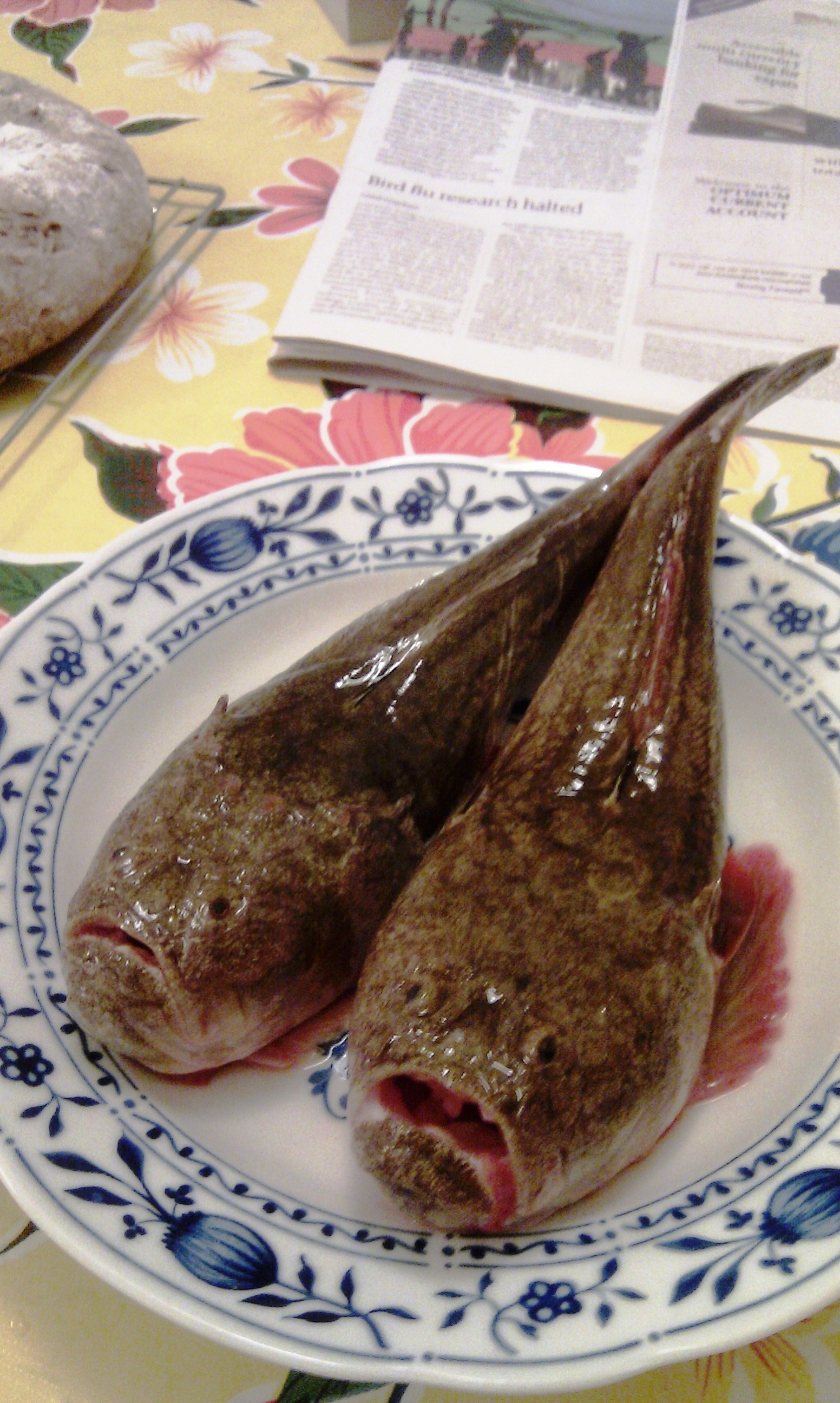
pesce prete – literally “priest fish”. This is the Atlantic stargazer (Uranoscopus scaber). This is the fish that started me on this mission. I’d asked the pescivendolo for something to make a stew and he sold me these ugly buggers. Some posting of pictures on Facebook led to long discussions, with ultimately the more helpful identification input coming from the Sicilian friend of a friend and from a British friend who’s an experienced diver, and drew on his diving community’s knowledge. I’ve seen them also called pesce lanterna and Davidson says regional names include pesce lucerna and lumera, though even in English “lanternfish” is very generic. A few other nice regional names from Davidson: bocca in cielo from Abruzzo and Campania, boca in cao from the Veneto, and pappacocciula, which I’d hazard mean the same thing: “mouth in the sky” (cielo means “sky” or heaven in “standard Italian”).
pesce sciabola – see spatola.
pesce serra – bluefish, blue fish (Pomatomus saltatrix). Had this in a restaurant in Sorrento. The waiter said it was also known as bandira, though Davidson doesn’t mention this name.
pesce spada – swordfish (Xiphias gladius). Spada does indeed mean “sword”, despite how much it might sound like “spade”. Greenpeace includes swordfish on the Red List, saying “Swordfish stocks… are fully fished in the Mediterranean.”
The IUCN Re List also says, “Globally, this species has shown a 28% decline over three generation lengths (20 years). The only stock that is not considered to be well-managed is the Mediterranean”. So really, the Med fisheries particularly need to pull their fingers out.
pezzogna – red (sea) bream or blackspot sea bream (Pagellus bogaraveo). Also known as rovello (see below).
platessa – this name, handily, directly relates to the Latin name Pleuronectes platessa, which is European plaice. Davidson says it is “not really a Mediterranean fish” and Italian Wikipedia says ” È rara nel Mediterraneo” (“it’s rare in the Mediterranean”) though I’ve seen it offered in restaurants here in Rome. Presumably not freshly caught. Or trawled to be specific: it’s also on the Greenpeace Red List, for the damaging bottom trawling, though the IUCN says ” A widespread species which is vulnerable to overfishing in the sea, but this is not currently thought to be causing a decline great enough to qualify the species as threatened.”
polpessa – this octopus seems to have a lot of names in English too: Atlantic white-spotted octopus, white-spotted octopus, grass octopus or grass scuttle. Its Latin name is great: Octopus macropus. Other regional Italian regional names include vurpessa, pruppessa, vurpàscele etc.
polpo, polpo commune – common octopus (Octopus vulgaris). Also polipo, piovra, folpo, tolbo, tulbo, fulbo, fulpo, vurpe, pruppu….
potassolo – see melù.

R
razza – ray.
razza bianca – bottlenose skate, white skate (Raja alba/Rostroraja alba). The IUCN Red List categorises it as “Endangered”.
razza chiodata – thornback ray (Raja clavata). Davidson says it’s called Arzilla pietrosa in Lazio, but on my local market’s fish stall in Rome, ray is just ray, razza, they don’t make distinctions. This species is categorised as “Near Threatened” on the IUCN Red List.
ricciola – greater amberjack (Seriola dumerili). Our first year in Italy, we asked the pescivondolo for something for Christmas Eve, when fish is traditionally eaten in Italy. They offered us a substantial ricciola, though we had no idea what it was. A white, very meaty fish it made a serious meal.
rombo – turbot; generic name for several species of flat fish (pesci piatti) not just Scophthalmus maximus; see below.
rombo liscio – “smooth turbot”, or brill (Scophthalmus rhombus). Also known as soarzo/soazo, rombo minore (Veneto); rombetto (Marche, Abruzzo); rombo d’arena, rombo piccolo (Lazio); linguata mascula (Sicilia).
rombo chiodato – “spiked turbot” (chiodo means “nail”, “spike”) turbot (Scophthalmus maximus, also Psetta maxima). Also known as rombo maggiore, rombo gigante, and several regional names like rombo di pietra (Lazio); rombo di sasso (Veneto); rummo petruso (Campania); romolo, rummulu pitrusu (Sicilia) and various names evoking stones and rocks (sasso, pietra, pitrusu etc). If it’s line or trap caught, it’s possibly okay to eaet, but frankly most vendors and restaurants won’t want to or be able to provide provenance information, and it’s likely it’ll be trawled. Trawling is not good.
rombo giallo – megrim, whiff (Lepidorhombus whiffiagonis).
rombo di rena –wide-eyed flounder (Bothus podas). Among the regional names are the delightful rumbo bastardo (Liguria) and quattr’occhio (Toscana). Inevitiably, variations on these names are used for different species in different regions.
rombo quattrocchi – “four-eyed turbot”, or four-spot megrim in English (Lepidorhombus boscii). Also known as suace, suacia etc.
rovello – another member of Sparidae (seabream, porgy) family: Pagellus bogaraveo, which seems to be known as red sea bream and blackspot sea bream (according to Wikipedia) and blue-spotted bream in English (according to Davidson). Also known as occhino, besugo, bezugo, mupo, mupa, occhialone, pampuni, pampini, pezzogna etc etc (Davidson gives many others). Even Italian Wikipedia concedes “anche se i vari nomi locali possono creare confusione tra le diverse specie di pagelli che si pescano nel mediterraneo” – that is, “the various local names can create confusion between the diverse species of the pagellus (genus) that are fished in the Mediterranean.”

S
salmone – salmon, Atlantic salmon (Salmo salar). These days, most of the salmon you eat will be farmed. I avoid it, as although fish farming has its place, it can be dubious, particularly when it involves carnivorous species (like salmon and bass) that have to be fed with other fish, at an inefficient rate of exchange. So for example, for 1kg of salmon you have to process 4kg of wild fish. Personally, I’d rather eat the wild sardines, anchovies etc than the salmon. Again, it’s a question of sense and sustainability.
sarago – generic name for Diplodus genus. Most commonly refers to Diplodus sargus, the white seabream or sargo, aka sargo maggiore.
sarago sparaglione – annular bream (Diplodus annularis). Here’s one where a lot of the regional dialect names at least sound similar (ish): saragu, spareddu, saraghetto, sparleto, sparlotto, sbaro, sparinole, sparo etc etc.
sardina – sardine (smaller, younger), pilchard (larger, adult). As in English, a generic word for small oily fish, but also used to refer specifically to the European pilchard(Sardina pilchardus). Most European langauges call it some variation on “sardine”, and there are also many Italian dialect names like sardon, saraghina, sarducola, but there are also plenty that are completely different sounding, like palassiol, renga, falloppe, biancomangiare, sfiggiata, nunnata. The later is Sicilian and sounds like neonata (see bianchetti).
sargo maggiore – white seabream or sargo (Diplodus sargus). Among the many regional names are: cappuccino (“hooded”; Abruzzo, Marche); saricu monica (Calabria); saricu tunnu (Sicilia).
scampo (plural scampi) – the prawn family member most commonly cooked up and known as scampi in the UK (though monkfish tail has, illegally, also been served up as scampi). This is the Dublin bay prawn, langoustine or Norway lobster (Nephrops norvegicus). Italian regional names include: arancio, arganello, astracio, scampolo.
scombro/sgombro – mackerel, Atlantic mackerel (Scomber scombrus). Also maccarello (Lazio; I see both names in Rome), lacerto (Liguria).
scombro cavallo – see lanzardo.
scorfano – scorpion fish. Refers to seveal species. I wrote my first investigations prompted by buying scorfano.
scorfano rosso – red scorpionfish (Scorpaena scrofa). Also called cappone in Toscana; cappone means “capon”, ie a castrated cockerel, but in the fishy world is also used for capone gallinella (tub gurnard).
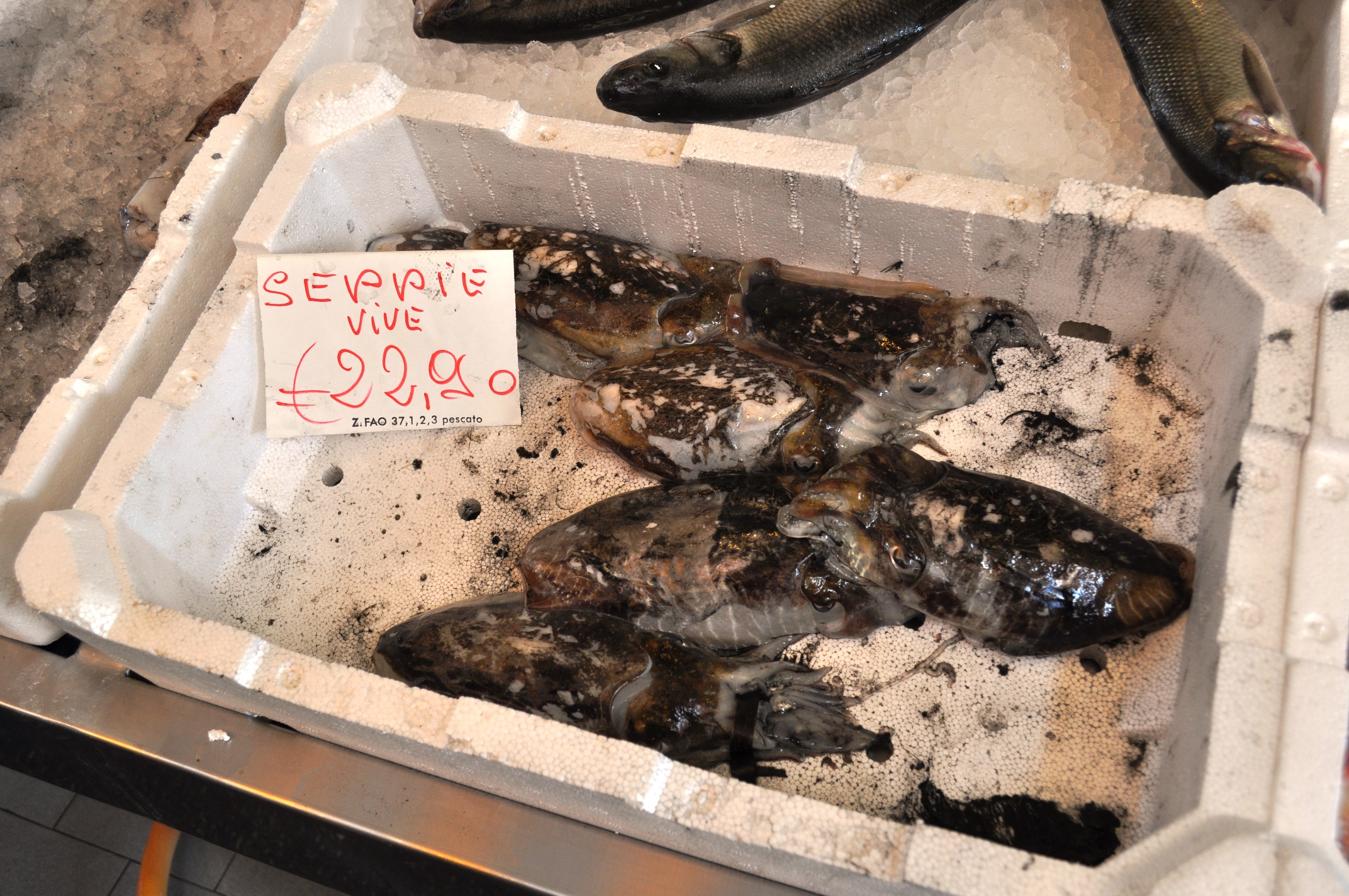
seppia – cuttlefish or common European cuttlefish (Sepia officinalis). Regional names include sepa, seccia, siccia, purpo siccia, pruppusiccia, so at least there’s a pattern. Though Davidson says it’s also called a scarpetta in Puglia. A scarpetta is a ballet shoe or trainer, and one nice Italian expression for when you mop up the sauce in your plate with a piece of bread is “fare la scarpetta” – make the ballet shoe – just to confuse things.
sciabola – see spatola.
seppioline – little cuttlefish.
serra – see pesce serra.
soace – see suacia.
sogliola – sole, or more specifically the common sole (Solea solea). Italians do catch other species, but this is the main variety, and one Brits will know as Dover sole. Another problematic species due to beam-trawling.
spigola – bass, European seabass, Mediterranean seabass (Dicentrarchus labrax). Also known as bronzino (Liguria); ragno (Veneto, Toscana); lupasso (Davidson says this is the Lazio name, but I’ve only ever seen spigola in Rome); lupu de mari (Sicilian); and pesce lupo, though frankly variations on the latter names (“wolf fish”) seems to pop up for various species, including Anarhichas lupus. These days, it’s commonly reared in fish-farms, something I’ve got very mixed feelings about (see salmone).
spatola – silver scabbard fish, frostfish, beltfish (Lepidopus caudatus). Pesce bandiera (Lazio).
squalo – generic noun for shark.
stella – see leccia stella.
stoccafisso, stoccofisso – like baccalà, dried salted cod, Gadus morhua. The difference between the two seems to be a matter of argument, but It’s possibly a question of where the Gadus morhua is sourced: baccalà being Atlantic, stoccafisso being Norwegian/Arctic. It’s also a question of a different salting process.
suacia – Mediterranean scaldfish (Arnoglossus laterna), a flatfish related to flounder. A lot of the northern Italian names seem to be variations on petrèe, petrale, pataracia, peteracchia, but in the south things just spread out and have no apparent similarities. Also commonly known as zanchetta. My poster also lists it as soacia, though I can’t find any reference to that name in Davidson or online.
sugarello – Atlantic horse mackerel, scad, jack mackerel (Trachurus trachurus). Confusingly, the fish that’s literally called “horse mackerel” in Italian, Sgombro cavallo, is a different species – see lanzardo. (Note, mackerel is one of those vague terms that doesn’t exclusively include members of the same family of fish. So while the true mackerel, Scomber scombrus, and the chub mackerel, Scomber colias, are members of the Scombridae family, this one is instead a member of the Carangidae family. They’re all, however, oily fish or pesce azzurro that have certain cosmetic similarities, notably the sheeny-shiny skins.) Scad isn’t generally eaten in the UK.
suro – see sugarello.

T
tellina – wedge shell, a type of bivalve (Donax trunculus). Apparently also known as fasiola and trilatera in Lazio, though in her book The Food of Rome and Lazio, Oretta Zanini de Vita just uses tellina, while Italian Wikipedia says they’re also called arsella. I had them in a pasta dish very much like spaghetti alle vongole, except that they’re small so it takes a lot longer to get the meat out of the shells. Tellina is also the French name. Strangely, Donax trunculus isn’t in the Tellina genus of bivalves – I can only assume it was scientifically reclassified after the Latin name became commonly used (via Vulgar Latin) for various edible bivalves.
tilapia – tilapia. Farmed tilapia is found in Italy, such as in my local DOC supermarket where they have it in packets, smoked. Unlike the aquaculture of salmon, which requires wild fish for feed, tilapia can be fed on a less unsustainable food source: algae. But they are also fed maize, a controversial crop (intensive monoculture, GM etc etc). Never mind the questions of hormones and chemicals. It’s a tricky one. I would say “try to buy organically reared tilapida” but a) you may not be able to get the relevant info and b) people will moan about it being pricier. You know what you – saving human civilisation in the face of environmental meltdown requires us to recalibrate their food consumptions habits. Anyway, back to tilapia in Italy. The farmed species found here are Nile tilapia (Oreochromis niloticus) and Mozambique tilapia(Oreochromis mossambicus).
tonnetto – see tonno alletterato.
tonno, tonno rosso – tuna, specifically northern bluefin tuna (Thunnus thynnus). I’ve tried not to eat this perenially popular fish, well, for most of my adult life really as it’s the poster boy of over-exploited marine life. Indeed, most tuna species are firmly Red Listed these days, despite what supermarkets may sell you about line-fishing or even “ranches”, which are fish farms that don’t raise tuna from eggs, but instead still deplete natural stocks by taking young fish from the wild. Insanely, “Ranching also uses high amounts of other wild fish as feed – about 20kg of wild fish to produce just 1kg of tuna.” (from Greenpeace, here). Here is it too on the IUCN Red List.
tonno alalunga – albacore, longfin tunny (Thunnus alalunga). It’s on my poster of seasonal fish, but even the albacore is on the Greenpeace Red List these days, while the IUCN Red List categorises it as “Near Threatened“, having undergone an estimated 37% decline in the past 20 years.
tonno alletterato – little tunny, little tuna, false albacore (Euthynnus alletteratus). This one’s not on the Red List (at the time of writing, Feb 2013), and Wikipedia gives its status as “least concern”. Also known in Italy with other diminutives like tonnetto, tunnella, tonnello, plus loads more dialect names like sanguinaccio in Tuscany (this also happens to be the name of a blood sausage and a chocolate pudding made with blood); ‘nzirru (Campania); alittratu, littrata, culuritu (Sicilia) etc.
totano, totano commune – European flying squid (Todarodes sagittatus). Totano may also be used for the southern shortfin squid (Illex coindetii), notably in Sicily. See discussion in comments, below.
tracina –general name for fish from the Trachinidae family, weevers.
tracina drago – greater weever (Trachinus draco). Also (Davidson): agno, aragno, dragena, ragna, ragno, varagno, tracena, parasaula, antracina, tracchio, ragnas, aragnas. Although drago means “dragon”, a lot of these names are related to ragno, standard Italian for “spider”. It would also seem to indicates a lot of interchangeable nomencleature with the tracina ragno (Trachinus araneus), below. Unless Davidson was getting in a muddle too.
tracina ragno – literally “spider weever” in both Italian and Latin (Trachinus araneus), though in English it’s called the spotted weever.
triglia – generic name for red mullets, goatfish.
triglia di fango – “mud mullet”, in English one of the two fish called red mullet (Mullus barbatus).
triglia di scoglio – “rock mullet” or “cliff mullet”, also known as red mullet in English but a different species to the above (Mullus surmuletus).
trota – trout, brown trout (Salmo trutta).
U
Uova di pesce – “fish eggs”, meaning roe, or specifically hard roe. For soft roe, milk, see “latte”.
V
vongola – clam, generic name for various members of the Veneridae (Venus clam) family. In Italy, for dishes like spaghetti alle vongole, it usually refers to to Venerupis decussata, in English the carpet shell, or cross-cut carpet shell. Davidson also gives Italian names vongola nera (black clam), vongola verace (true clam), and says it’s call capa incrocicchiata and archello in Lazio, though I’ve not seen or heard this.
Z
zanchetta – see suacia.
zerro – picarel, blotched picarel (Spicara smaris/Spicara maena). I’ve never actually seen this one, or heard of it before now, so I’m not even going to go there with the dozens of regional dialect names Davidson lists. Life’s too short.

Coda: If, like me, you enjoy eating seafood, but want to see stocks managed and fished sustainably, I’d urge you to get involved with organisations that campaign for changes to policies and law. In the UK, for example, there’s Fish Fight.
I’d also recommending watching the film The End of The Line, which has a global swep, and checking out the related charity, the Blue Marine Foundation.
If you’re based in the UK, another notable body is the Marine Conservation Society, which tries to provide consumer information via FishOnline and its Good Fish Guide.
















 Bread, Cakes And Ale