Monthly Archives: November 2016

Cattern cakes for St Catherine’s day

Cattern cakes

November 25 is the feast day of St Catherine of Alexander. Chances are, St Catherine isn’t someone you’ve heard of, beyond having a firework named after her, or more accurately after her mode of martyrdom – on a wheel. In my childhood, St Catherine was quite a well known figure. Well, not the saint herself exactly, but a hill named after her.

I grew up in Winchester, Hampshire. It was the city that was the capital of the great Saxon kingdom of Wessex, and arguably the capital of England before London. Earlier than this, however, it was a Roman city. And even earlier than this, there was an Iron Age settlement (around 500BC), on a hilltop just outside the city. This hill is known as St Catherine’s and there was a 12th century chapel on the top of the same name, until it was demolished in 1537, I believe at the behest of that great money-grubbing vandal Henry VIII during the Dissolution of the Monasteries,  in his massive pope-won’t-let-me-divorce royal hissy fit.

Mazes and wheels
When I was young and fitter and my knees worked properly I used to love running up there. It’s a wonderful place, and very much worth a visit. The views are good, there are orchids and other wild flowers, and there’s even a mizmaze, carved into the turf, with the winding path in exposed chalk. The form of such mazes is to an ancient, mysterious pattern, but this one is most likely from the second half of the 17th century. A local legend involves its creation being punishment for a pupil of the nearby privileged seat of learning, Winchester College.

St Catherine’s martyrdom in 310AD in Egypt on a wheel may also be the reason the hill is named after her, with the Iron Age ramparts forming a circular shape. Or it may just be because she is, among other things – wheels, obviously, librarians, knife sharpeners, hat makers, lacemakers, spinsters, etc etc – patron saint of hilltops. Or something. Such hagiography is a right shambles.

Another Catherine
Anyway, her feast day is 24 or 25 November. The date was also used to honour Catherine of Aragon, first wife of the abovementioned Henry, and the first victim of his desperation for a male heir. After 24 years of marriage, he blamed her for the lack of a living son, and changed the course of history to get shot of her. He had her imprisoned in Ampthill, Bedfordshire, 1531-1533. She became a patron of local lacemakers, and they began to celebrate her support on, naturally enough, St Catherine’s day.

One feast day treat for St Catherine’s day is Cattern cakes. These are closer to what we’d consider a cookie or biscuit today, and are flavoured with cinnamon and dried fruit. I’ve got recipes in a couple of books: Cattern Cakes and Lace by Julia Jones and Barbara Deer and Cakes Regional and Traditional by Julie Duff. Only one includes the peel, while the other includes caraway seeds. I like the idea of both, so here’s my version.

I’m only using self-raising flour here as I’ve got a lot in the cupboard. You could use plain instead, but use around 340g and 10g of baking powder.

350g self-raising flour
2g mixed spice
4g cinnamon powder
2g fine sea salt
50g ground almonds
350g caster sugar
50g currants
50g candied peel
4g caraway seeds
280g butter
1 egg, beaten
Extra sugar and cinnamon
1 more egg and 25g milk, beaten together, for a glaze

1. Preheat the oven to 180C.
2. Sift the flour, spices and salt into a mixing bowl.
3. Add the sugar, ground almonds, dried fruit and caraway seeds.
4. Add the melted butter and beaten egg.
5. Bring together to form a dough.
6. Bring the dough together, form a ball then cover with plastic and allow to rest in the fridge for about half an hour. This will firm the butter content up again.
7. Roll the dough out into a rectangle, about 12mm thick.
8. Brush the top with a little water, then sprinkle with extra sugar and cinnamon.
9. Roll the dough up like a Swiss roll to form a cylinder. It’s a pretty crumbly paste, but don’t worry: just squish it back together.

Space out well on baking sheets

10. Cut into slices about 10mm thick. As above squish back together as necessary. Place the slices on a baking sheet, lined with parchment or silicone.
11. Brush the tops with the glaze.
12. Bake for about 10-15 minutes, until lightly browned.
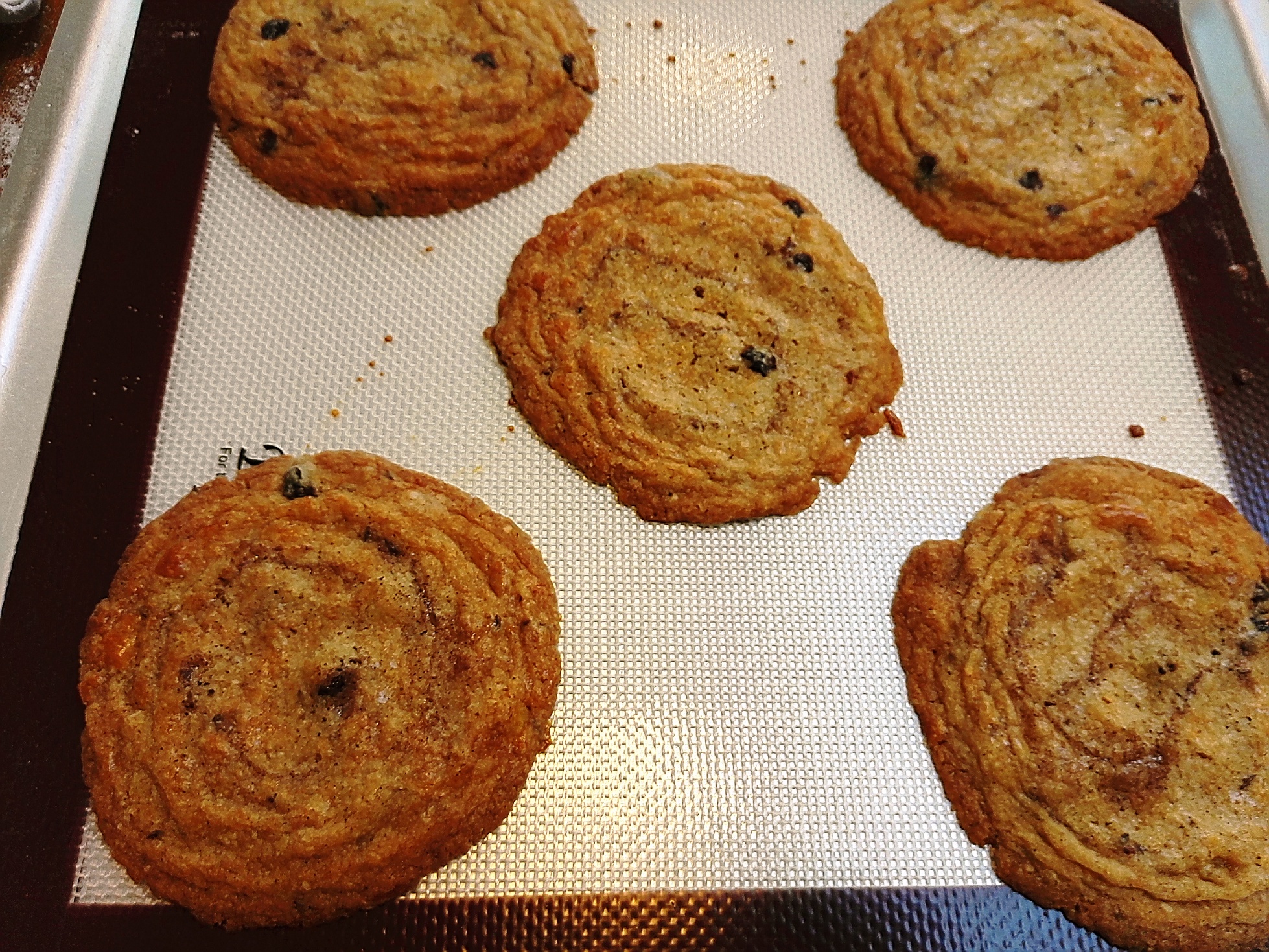
Cattern cakes

Despite the slightly fiddly dough, I like the results. They’re slightly unusual. One friend says “Christmassy” – but really, most feast day baked sweet treats involve similar spices and ingredients, such as peel, it’s just that we’ve lost so many of the other traditions, with most people’s only relationship with feast day foods being Christmas cake and plum pudding.

They spread as they bake, and come out somewhat wrinkly, like cooled lava. You can see a swirl or spiral from the rolling up, especially underneath. The caraway, or Persian cumin (Carum carvi) is a bit of a divisive flavour though, faintly medicinal and almost medieval. It’s perhaps most commonly found in rye breads these days, but for a long time a great British classic was seed cake – a sweet, teatime cake flavoured with caraway. It’s one of those flavours that’s arguably gone out of fashion somewhat for the British palette. If you don’t like it, just leave it out.

I’ll be in Winchester just after St Catherine’s day, so maybe we can go for a walk up the hill and take some of these for sustenance. Even if number one child, T-rex, has already rejected them, probably because of the caraway (unfamiliar flavour trumps sugary treat). Number two child, Stingray, is rather partial at least.

5 Comments

Filed under Baking, Biscuits, cookies, Feasts, Recipes

Pizza di San Martino for Martinmas

Pizza di San Martino

November 11 is Martinmas, the feast day of St Martin, or San Martino as he’s known in Italian. I talked about St Martin and his feast day here, and one of the related food products I mentioned was pizza di San Martino. This is a kind of enriched bread – as in Italy, “pizza” doesn’t necessarily imply a thing topped with tomato sauce and cheese. There are many variations on the theme.

Do a Google image search, and pizza di San Martino comes in several forms but they’re all basically yeasted cakes. It probably originates from the small Italian region of Molise, which reaches from the east coast into the Apennines, or possibly from the region to its north, Abruzzo. This area of central Italy, along with Umbria, has suffered recently from a series of earthquakes and aftershocks this year, so making this is one way of saying I’m thinking of friends living there, and anyone who’s lost their homes and livelihoods.

The patron saint of protection against earthquakes is actually Emygdius or Emidio, but he’s pretty obscure and I’m not aware of any baked goods associated with his feast day (5 and 18 August). I’ve adapted this pizza recipe from one found in Cooking with the Saints by Ernst Schuegraf; he doesn’t mention St Emygdius.

As I wrote in my previous piece about St Martin, a traditional pizza di San Martino would contain trinkets, favours, much like the inclusion of a silver coin in traditional British Christmas pudding or ceramic baby Jesus in galette de rois. This recipe doesn’t include any. There’s nothing to stop you adding trinkets though, for luck to whoever receives them.

1. Dissolve the yeast in the warm water.

Make the sponge, preferment

2. Add about 150g of the strong flour, and blend to form a sponge or pre-ferment.

Bubbly sponge

3. Allow the sponge to develop until it’s nice and bubbly – an hour or two, depending on warmth.

Combine the ingredients
4. Put the rest of the flour and the salt in a large bowl, then pour in the sponge, milk, beaten egg and melted butter and add the sugar, raisins and zest. I used orange and lemon zest.

Bring together - almost more a batter than a dough.

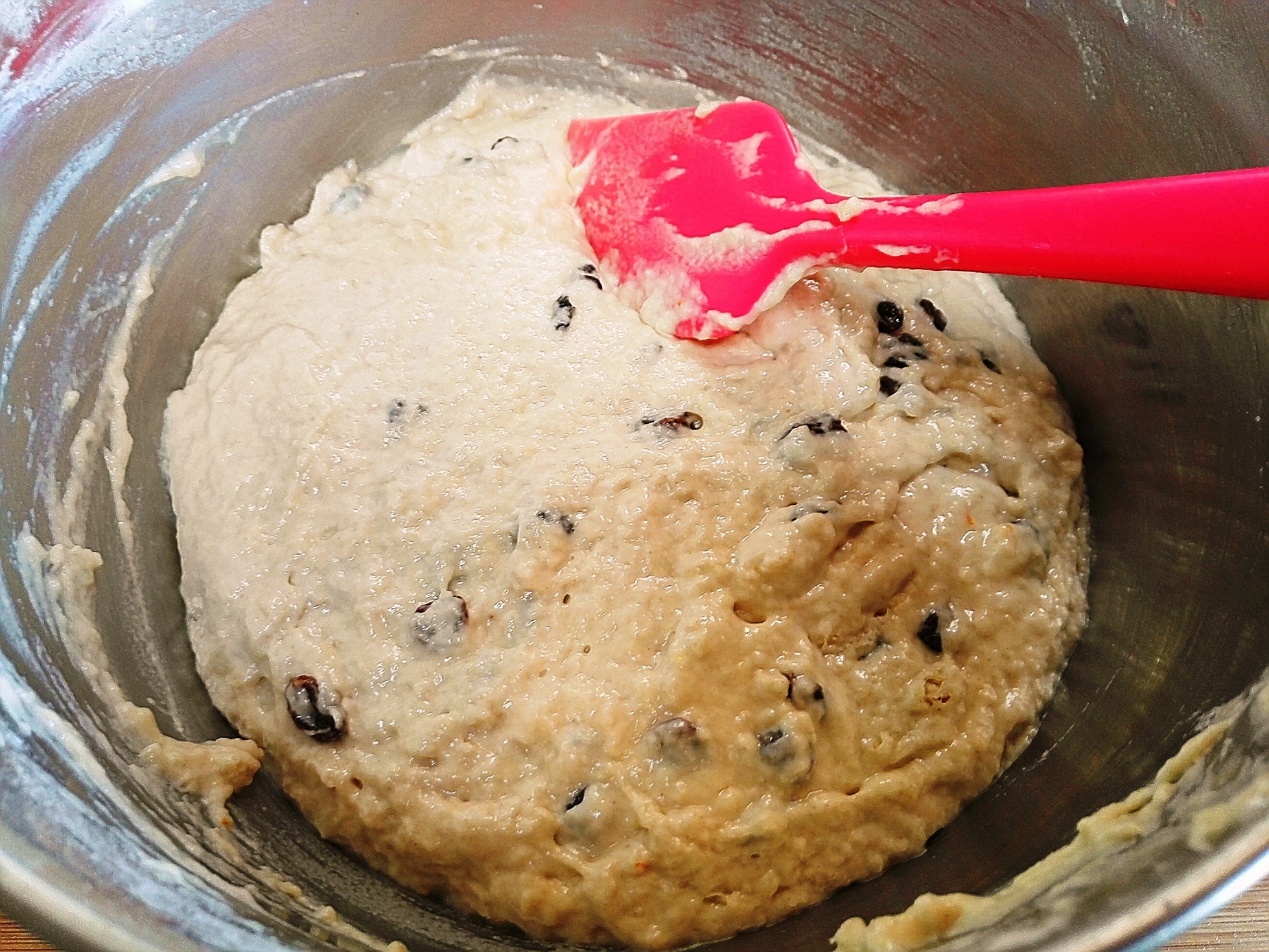
5. Mix to combine. It’ll be a fairly sticky dough. With just the water and milk, it’s about 67% hydration, but factor in the eggs and melted better too and that’s a fairly high proportion of liquid to flour.

Sticky dough

6. Turn out onto an oiled worktop and bring to a dough. For tips on how to handle sticky doughs, read my notes here.
7. Return to the bowl, cleaned and oiled, then cover and leave to prove until doubled in size.
8. Butter a round cake cake tin, ideally 26cm,  or even larger. (If you don’t have one, you could bake the pizza freeform, shaped like a disc, on a baking sheet.)
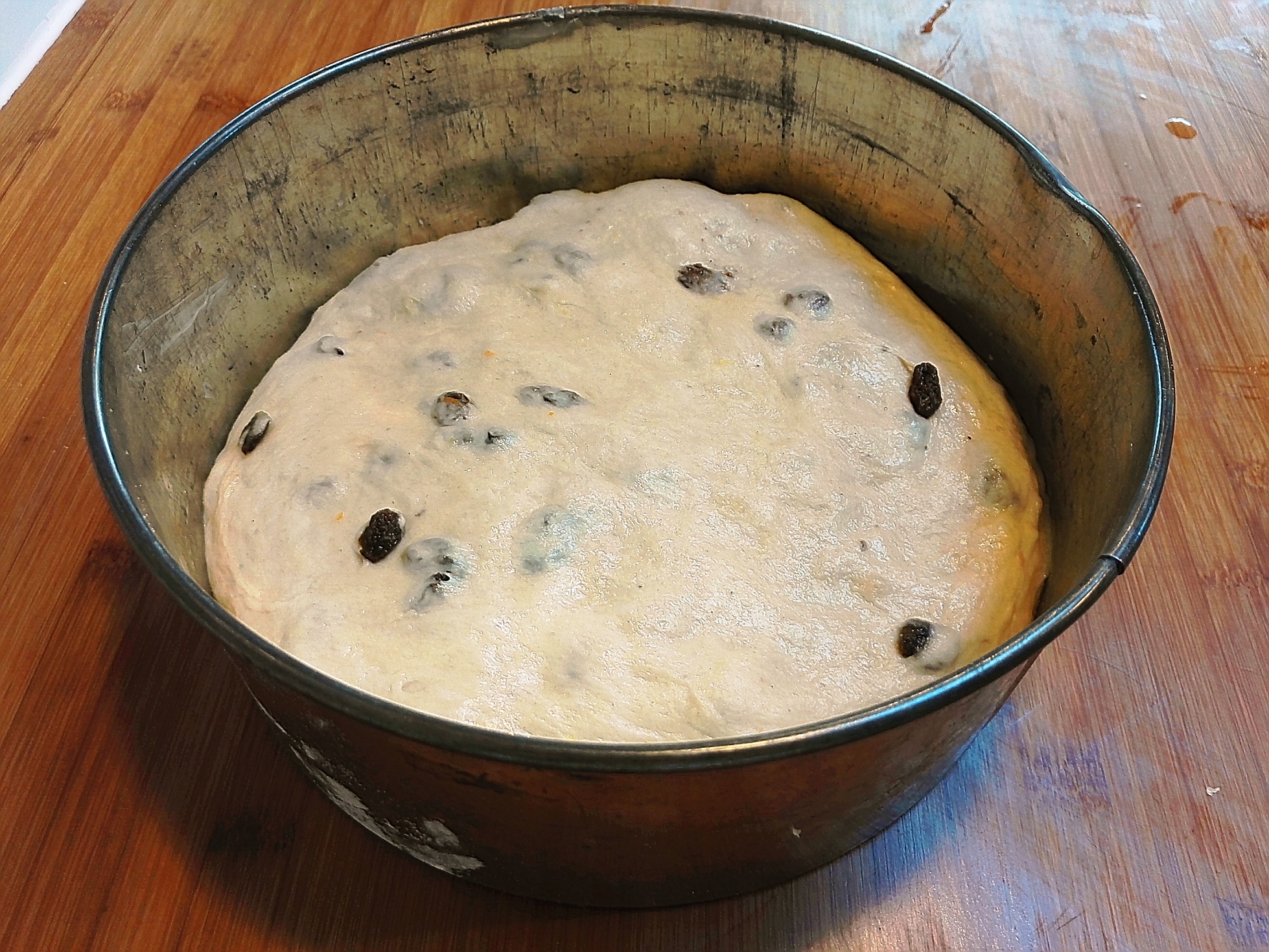
9. Turn out the dough and form into a ball. Push the ball down into the cake tin, then cover and leave to prove again.
10. Preheat the oven to 200C.

Put in round cake tin

11. When the dough is nicely risen, put it in the oven.
12. Bake for about 40 minutes. If it’s browning too much, cover with foil or turn down the oven.

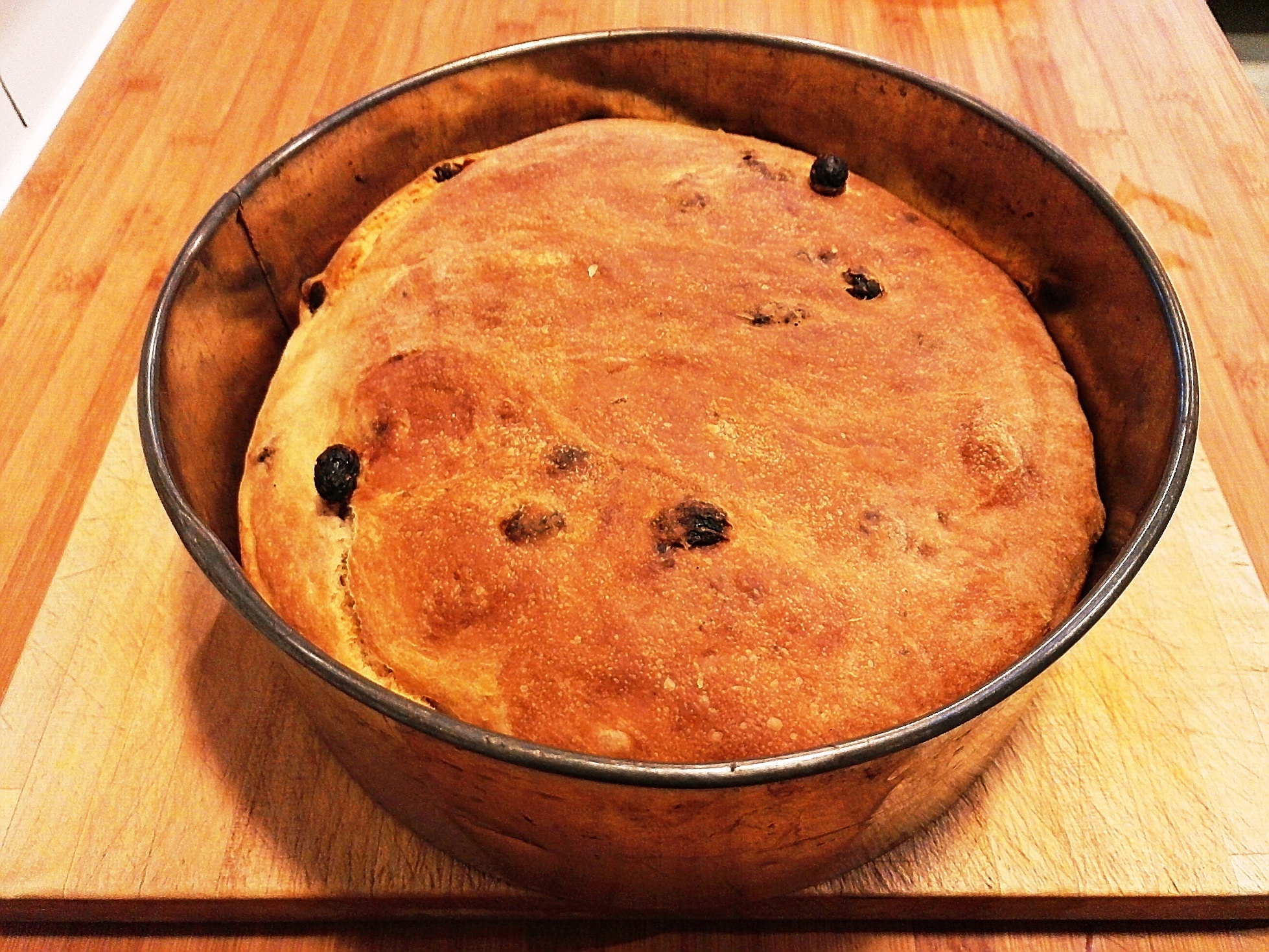
Freshly baked pizza di San Martino

13. Take out, turn out and cool on a rack.

It’s not unlike a kind of brioche, so eat for breakfast, or morning coffee, or with tea. If I’m honest, I’ve no idea how an Italian family would eat it. During my time in Italy I never really managed to inveigle myself into households to watch people eating Easter Colomba or Christmas panettone or other enriched feast day breads like this. So any central Italians reading, please do let me know.

4 Comments

Filed under Baking, Feasts, Recipes

Exmoor in and out pudding

Exmoor in and out pudding

A few years ago, before kids, Fran and I rode our bikes across Devon, her home county, in southwest England. It was lovely as we embarked from Tiverton Parkway in the east of the county, but as soon as we reached Exmoor, having climbed steeply from the village of Dulverton, the wind and rain set in.

Although this pudding is named after the moor, it’s hard to imagine it’s a place where many apples are grown. Sure there are some orchards within the confines of Exmoor National Park, but by and large the moor itself is, along with other West Country moors Dartmoor and Bodmin moor, is about as close to wilderness as you can experience in southern Britain. We certainly didn’t pass any orchards as we fought a fierce headwind.

Another county
I made this pudding with apples from my parents’ tree, in Winchester, Hampshire. It would have been hard to find Exmoor apples. Indeed, for crying out loud, it’s hard enough to find English apples in the supermarkets at the moment, despite it being apple season. I live in the southeast of England, in East Sussex. The adjacent county, Kent, is the historical heartland of apple cultivation – and yet our local supermarkets are filled with apples from France, Chile, South Africa and even New Zealand. This madness makes me want to scream. I suspect I’ve ranted about it here before.

Talking of madness: Brexit*. Will it mean fewer food imports as costs increase? Will it encourage domestic food production? Who knows. No one seems to know what’s going to happen, apart from an abiding smugness from aging little Englanders as we metaphorically unmoor ourselves and drift away into deepening obscurity.

Fall from grace
Anyway, back to the apples. My folks have a magnificent Bramley tree. While picking, I managed to fall off the ladder, knocking over not just my toddler, T-rex, but also my seventy-something dad. Sorry guys! Still, it’s great fruit. We should be celebrating home-grown Bramleys more than ever now following the news this summer that the original Bramley tree in Nottinghamshire is dying of a fungal infection, having been sown in 1809.

This is a lovely variation on the theme of apple pudding involving a cake-like mixture. The mixture has the distinction of by being made with rich, caramelly demerara sugar. It also contains some ground almonds, one of my favourite ingredients. Some Exmoor in and out puddings also contain suet. This recipe, based on one found in the National Trust’s Complete Traditional Recipe Book by Sarah Edington, doesn’t.

500g Bramleys, or other cooking apples
50g demerara sugar
5g cinnamon
60g apple juice, or water

110g unsalted butter, softened
110g demerara sugar
2 eggs
1/2 tsp almond essence
110g self-raising flour (or 105g plain flour and 5g baking powder)
50g ground almonds
Flaked almonds

1. Heat the oven to 180C.
2. Peel and slice the apples.
3. Combine the apple slices, cinnamon, demerara and apple juice or water then put into an overproof dish. Cover with a damp cloth so the apple doesn’t brown while you prepare the topping.

Exmoor in and out pudding

4. Cream together the butter and other portion of demerara sugar.

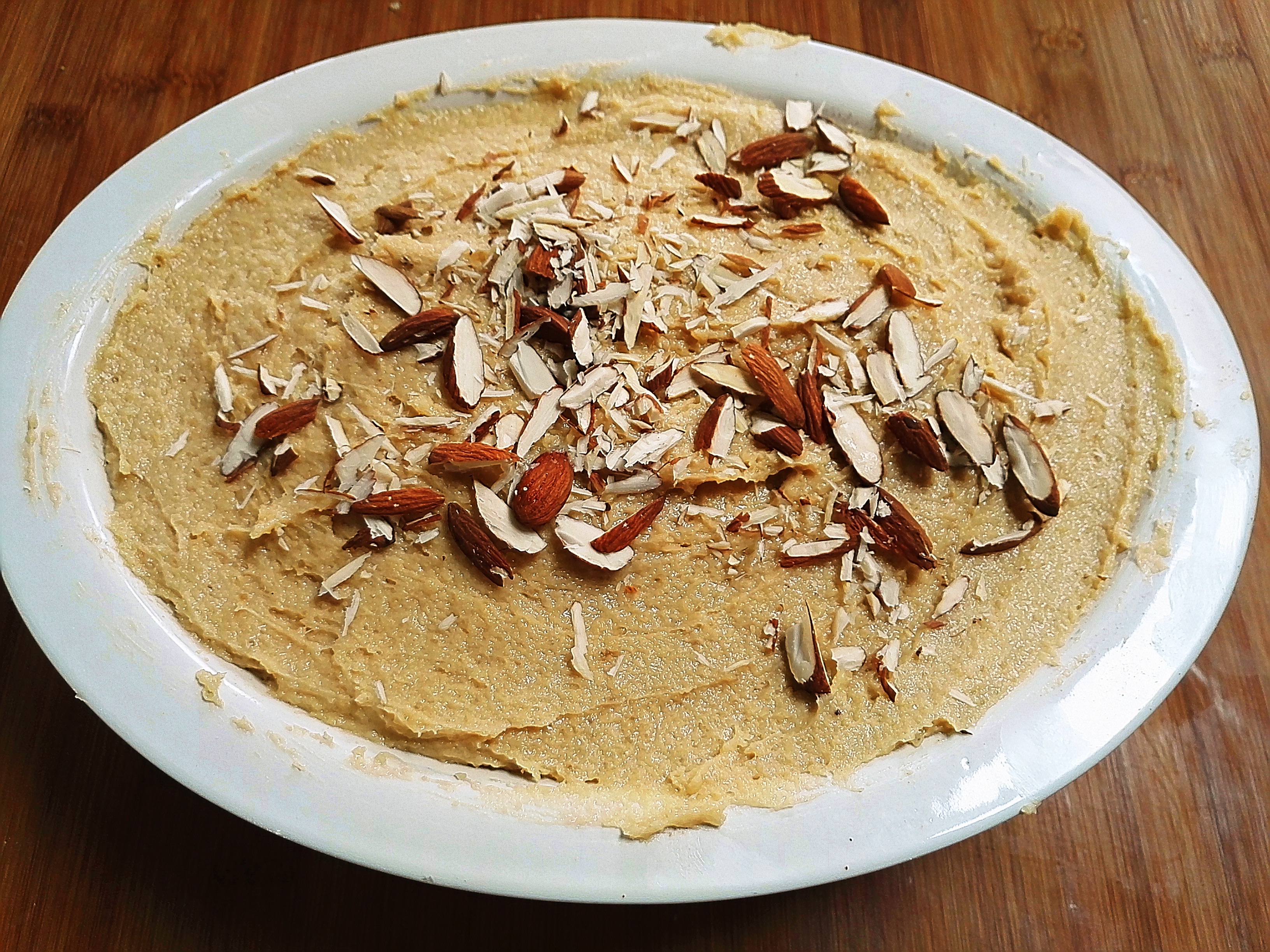
Exmoor in and out pudding mixture
. Lightly beat the eggs, with the almond essence, and slowly beat into the mixture. If it starts to curdle, add some of the ground almonds.
6. Add the ground almonds and sieve in the flour. Fold to combine.

Exmoor in and out pudding, cover apples with mixture

7. Put the topping on the apple mix.

Exmoor in and out pudding, ready to bake

8. Sprinkle with ground almonds.

Exmoor in and out pudding, baked

9. Bake until the top is nicely browned and the cake is firm to the touch, about 40 minutes.
10. Serve warm with cream, ice cream or even custard.


* As well as the actual process of the UK leaving the EU upsetting me, I detest the ugly neologism “Brexit”. But I can’t come up with a better, succinct alternative, so we’re stuck with it.

6 Comments

Filed under Baking, Puddings & desserts, Recipes