Category Archives: Ale, beer

Seta at Thien Kim and ʼnaBio at Ai Tre Scalini

As much as I love Italian food, sometimes you just want something a little different. A different set of flavours. As Brits, we regularly get cravings for curry. There are a few places in Rome that scratch the itch, but aren’t really anything to write home about. Another craving we’ve had is for Vietnamese food. Having lived in London for many years, we were spoiled by having access to some great Vietnamese places, notably on the Kingsland Road.

Over the past 20 months or so, we’ve walked past a Vietnamese place in Rome several times. It doesn’t have a menu outside, its window is graffitied and overall it doesn’t look prepossessing. But while the summer has arrived, and all the popup bars and restaurants are lining the Tiber, we thought, let’s ignore the evening sun and instead head into the gloom of Thien Kim, which is located on the Centro Storico side of Ponte Sisto, the pedestrian bridge that connects Trastevere.

It was indeed gloomy, and quiet, but the welcome was friendly, and – would you believe it?– they had a few Italian craft beers on the menu. So alongside my food, I had Seta beer. The 5% ABV Seta is from Rurale brewery in Lombardy.
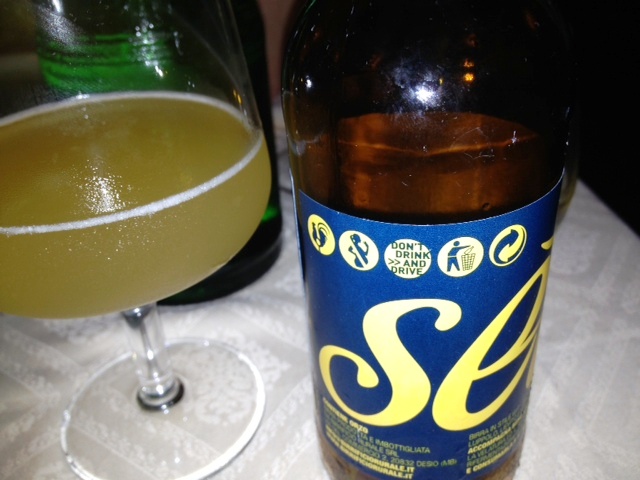
Seta

Seta means silk, and the beer was clearly designed to be a smooth, refreshing summer drink. It’s described as “Wit – blanche” on the Rurale site, that is a Witbier – a Belgian style top-fermented white beer that’s defined in part by the murkiness of the liquid. Seta is no exception, with a cloudy yellow colour and an even, mild body. Although it does contain hops, the hoppiness is negligible, and instead the flavour is defined by the presence of coriander and zest of both bitter and sweet oranges.

Interestingly (for a cereal enthusiast like me), it’s also made with three grains: malted barley, non-malted wheat (grano tenero, that is Triticum aestivum, common wheat), and oat flakes. Me and Fran got notes of ginger, jasmine, lemon. The bottled version I had didn’t have anything much in the way of head, and the body was only subtle fizzy. We’d just come from one of our favourite bars, where  – despite their sign outside saying “Birre artigianale” (artisan beers) – they’d run out of craft beers, so I had a Menabrea amber. It was foul and headachey, so the eminently drinkable Seta was a relief. It also ably lubricated the fair-to-middling food (some crisp courgette flowers stuffed with prawn, a tasty sweet-sour mushroom soup, then a totally over-salted squid main course).

The following day we were in town again and after escaping the heat to watch ‘Man of Steel’ (or “the new Superman film” as non-geeks might not get the “Man of Steel” name) in an air-conditioned cinema, we were wandering Monti thinking about dinner. As it was still fairly early though, we dived into Ai Tre Scalini, a bar and wine cellar “since 1895”. Har. It’s a characterful place though – cool without being affected, friendly without being disingenuous. When we sat down I spotted a picture on the wall of the actors Totò and Aldo Fabrizi in ‘Guardie e ladri’ (‘Cops and robbers’), one of Italian cinema’s great mid-20th century comedies of post-war struggle and social change. Cool, I like that film, thought I – only to notice that there were using the image as a sign warning you about pickpockets. That’s the first time I’ve seen such overt warnings in Rome, and it’s kinda depressing. Like British bars that look quite ordinary and pleasant but have bouncers outside them – indicating the place is rough and used to fights.

After some criminal highjinks in Naples a few weeks ago, we’re a bit nervy about such things now.  So I thrust my wallet deep and checked out the menu. It’s mostly a wine bar (Vino e specialità nostrane – “Wine and homemade/local specialities”) but they did have beers from ʼna Biretta, the brand of Birradamare brewery just outside Rome. You can’t really find a more local craft beer in Rome than ʼna Biretta. Indeed, he very brand name is Romanesco – with ʼna just being the typically truncated dialect for una, “one” or “a”. As in “Givvus a beer!”

'naBio

I’ve had a lot of ʼna Biretta but never tried their ʼnaBio, so ordered one. Although the beer is apparently ispirata alle lager tedesche (“inspired by German lagers”), it’s not as pissy, thin, sharp and headachey as ubiquitous industrial lagers, indeed it’s got a surprising body. In fact, BeerAdvocate classifies its style as Munich Helles Lager, that is a more malty, fuller bodied type of lager developed in Germany in the late 19th century to counter the inroads of Czech pilsners. Birradelmare don’t classify it as such, just calling it a lager, but it seems a reasonable assessment. Sort of. Because as well as being bio, that is “organic”, ʼnaBio, like the Seta above, also involves interesting use of grain.

Ratebeer classifies its style as Speciality Grain. In this case, the grain is farro, though in Italian that word is used for three different types of ancient wheat. A quick bit of detective work  Googling indicates that the organic farro used in the beer is from Monteleone di Spoleto in Perugia province, Umbria, and that they specifically cultivate Triticum dicoccum, or emmer wheat.

The emmer isn’t malted, but is combined in the brew with malted barley. The result is a beer with more body than a typical lager while also being light and refreshing, with a golden-yellow colour, negligible head and dry, crisp flavour, with a slight aroma of cut grass or even silage. My wife said “Brussels sprouts” – which might sound freaky, but she loves Brussels sprouts, so that’s a commendation. It went down very easily, and helped wash down the dry aperitivo snacks: deepfried chickpeas, delicious slightly spiced taralli.

The word that seems to be bandied around a lot for lighter, refreshing beers in Italian is dissetante. In Italian thirst is sete, and the verb to quench the thirst is dissetare. So yes, both Seta and ʼnaBio are definitely dissetante, thirst-quenching.

Infodump:
Thien Kim, Via Giulia 201, Centro Storico, Rome
+39 6 6830 7832

Ai Tre Scalini, Via Panisperna 251, Monti, Rome
+39 6 4890 7495 / aitrescalini.org / aitrescalini@colosseo.org

Birrificio Rurale
birrificiorurale.it / info@birrificiorurale.it

ʼna Biretta/Birradamare
nabiretta.it  / info@nabiretta.it

Leave a comment

Filed under Ale, beer, Bars, pubs etc, Restaurants etc

Laboratorio Piccolo Birrificio’s Steamer amber ale at Necci, Rome

steamer at Necci

Last night we made it back to Necci, in Pigneto – the neighbourhood that was once on the wrong side of the railway tracks, but has now become something of a haven for (young, and young-ish, black-clad) people wanting to do a bit of boozing and yakking away from any crazy Roman traffic. Via del Pigneto itself has a great traffic-free section that’s packed with bars, but cross over another set of tracks, turn a few corners among the unique low-rise buildings – very different to the apartment blocks of other Roman neighbourhoods – and you’ll get to Necci. Or !Necci dal 1924″.

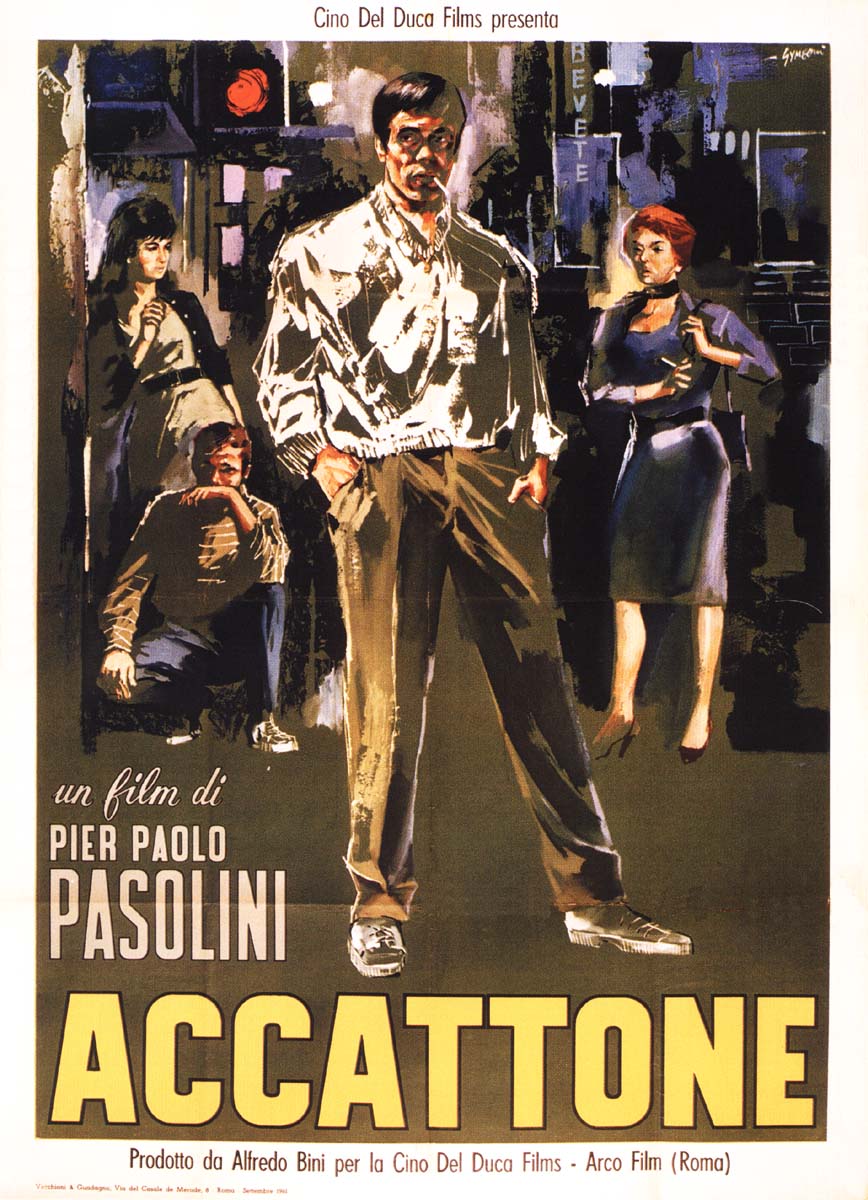
Now, as I wrote here, the whole “open since 1498” thing gets my goat. Innumerable osterie/trattorie/ristoranti proclaim their year of founding as if it’s somehow important even when they churn out mediocre food. Not so Necci. This is a place that’s doing so much right. Although it’s nearly a century old, and a neighbourhood landmark, and was the filmmaker Pier Paolo Passolini‘s main hangout when he made his breakthrough film Accattone (1961), it’s not stuck in aspic. The heritage is just part of the fabric of a lively, diverse venue that offers pretty much everything to all comers, any day of the week. Except, that is, a decent beer menu. More on which later.

Accattone

Although Necci has all this history, and is a great place physically, with a funky interior and shady terraces, its success is also down to a unique scenario whereby it’s run by business partners Massimo Innocenti (manager) and Ben­jamin Hirst (chef), who took over the venue in 2006. Hirst? That doesn’t sound very Italian, and indeed it’s not – he’s a British chef. A British chef running the kitchens of an  Italian eatery? Yes. Shocking.

This partnership is something that’s potentially unique in the Roman restaurant scene. After all, Italians in general are bloomin’ sniffy about the idea of foreigners being able to cook, and yet here’s a Brit proving them wrong, and overseeing a far more interesting menu than many places in Rome. I say that in part because the inventive dinner menu features not just the usual Roman offal, but a lot of fish dishes too – which can be a rarity in osterie/trattorie/ristoranti here, despite the city only being 20km or so from the sea.

It’s not just all about dinner at Necci though. It’s a café with a pasticceria on the opposite corner, a shop, a lunch venue and a great spot for an aperitivo. Indeed, it’s there I had my first (excellent) sbagliato: a “wrong” Negroni, made with vermouth, campari and prosescco instead of gin. They even have an decent wine list. The only disappointment for me was the selection of beers.

The whole ethos for Necci, according to the Projetto Gastronomico section of their site, is an emphasis on organic produce from Lazio and central Italy, and everything made on the premises – “from the cornetti (Italian croissants) to the bread, from the gelato to the tagliatelle, from the cakes to the gnocchi”.

The site uses the word autarchico, which translates into English as autarkic… Yes, I didn’t know that one either, but it means self-sufficient, independent. (They’re exactly the sort of principles I’d like to apply if I ever run a food business.) The site also says Hirst, who initially studied art history before getting into cuisine (working in France, the US and Italy, with experience in patisserie and vegeterian food, though there was little of the latter available last night) works to recreate traditional osteria dishes – but the ones that people may have forgotten. It’s slow food without the rhetoric, apparently. So, in amongst all this, why don’t they have a few more Italian craft beers? Although Massimo flagged up one Italian craft beer on their menu, Steamer, when we came to order, the waiter seemed to determined to sell me a Stella Artois. Which isn’t just industrial muck, it’s decidedly not from Lazio or central Italy or Italy at all. And yet Lazio alone boasts several microbreweries producing interesting, quality beers: Birra del Borgo, Turan and Itineris, to name but a few.

steamer label

Still, we had a great night, and the Steamer was delicious. It’s brewed by Lorenzo Bottoni under the label of Laboratorio Experimental Brews / Laboratorio Piccolo Birrificio (“little brewery lab/workshop”). The site has a section called Manifesto, where Bottoni talks about how his brewing is always a collaborative experience. Which is nice. Clearly Bottoni and his chums between them have a lot of knowledge and are deploying it to produce interesting beers. They don’t seem to have a fixed brewery location, but seem to be a kind of brewing flying squad. Well, not flying – cycling. I like them even more as, from a quick jaunt round their Facebook page, they seem to be pretty big on bikes. Bravi!

Anyway, Steamer. It’s a hoppy amber ale. But not that hoppy. Middlingly hoppy. On the nicely designed, informative site, the Laboratorio gives the IBU (International Bitterness Units) as 39.7, which puts it on the cusp between mellower pale ales (usually 20-40 IBU) and hoppier, more bittererer IPAs (usually 40-60 IBU, depending on your sources and on type). The hops in question here are a mixture of Cascade and Amarillo from the US, and Nelson Sauvin from New Zealand. Which makes me happy and strangely emotional, as I’ve spent a lot of time in and around Nelson, a marvellous little town that’s played a key role in NZ’s craft brewery scene.

Steamer’s fairly strong, at 7.6%, but goes down smooth, with a body that’s almost verging on the milkiness of a thick stout or porter. A fruity aroma is accompanied by a caramel and biscuitty taste, the latter possibly arising from the interesting use of malted rye, instead of barley. All in all, a highly notable beer. As the site itself says, it’s something that was developed In risposta allo strapotere delle IPA-DIPA-APA, una birra luppolata il cui amaro si accompagna alla setosa ruvidita’ conferitale dalla segale, that is “In response to the excessive power of the IPA-Double IPA-APAs, a hoppy beer in which bitterness is accompanied by the silky coarseness of the rye.” Okay.

So yes. I’m really enjoying Necci. Although I’m disappointed by the presence of generic and or non-Italian beers on the menu, I’m encouraged by the fact that the one Italian artisan beer included has clearly been chosen with care. I just wish this place was nearer where I live…

Infodump:
Necci, Via Fanfulla da Lodi 68, Pigneto, Roma
+39 6 9760 1552 / necci1942.com / info@necci1924.com
Open 8am-1am, seven days a week.

Laboratorio Piccolo Birrificio
piccololab.it / info@piccololab.it

2 Comments

Filed under Ale, beer

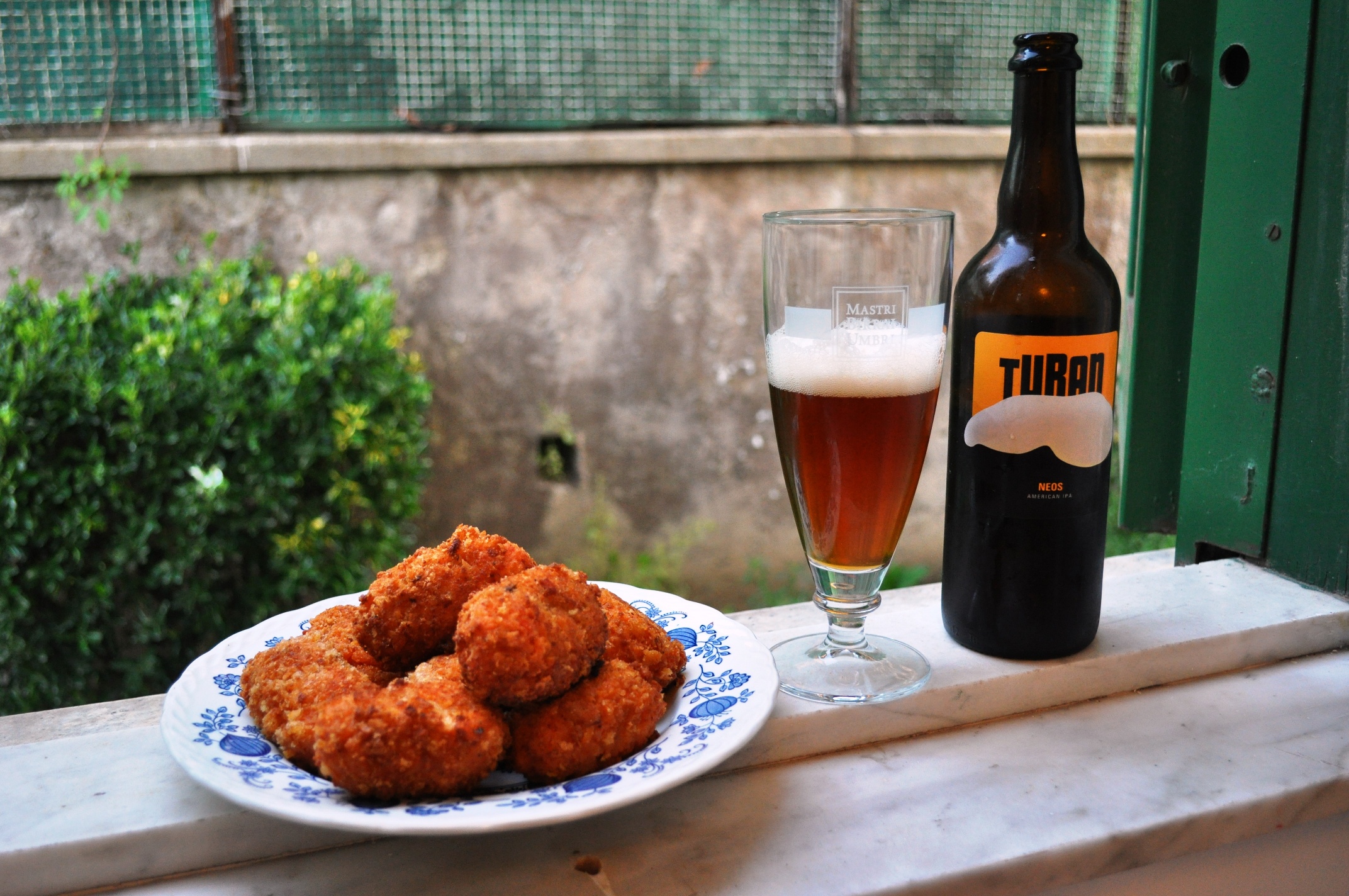
Turan Neos APA with suppli

suppli and Neos on windowsill 2

Sunday evening, our chum Cameron made a delicious tomato risotto. She made what’s known in the vernacular as a “shit ton” of the stuff, but that’s good. We’re in Rome. And in Rome, when you’ve got leftover risotto you make suppli. So on Monday we did. I’ve mentioned the Roman love of fried goodies before. Suppli have got to be the best though. Deepfried risotto croquettes with a heart of melty mozzarella. What’s not to like?

You can use plain risotto, or a fancy flavoured risotto, depending on what leftovers you have, but generally it’s risotto rice with tomato, at least round these ’ere parts. Said leftover risotto is made into a ball, a piece of mozzarella is stuffed in the middle, then the whole lot is rolled in flour, then dipped in beaten egg, then rolled in breadcrumbs or pangrattato (toasted/dried crumbs). Then deepfried – long enough to melt the mozzarella so that when you eat it, it forms a string. Apparently this recalls the curly telephone cable of yore, before wireless handsets and mobile phones and all that newfangled stuff and the full name is suppli al telefono.

Me and Cameron learned to make them while working in the kitchens of the American Academy in Rome. They can be a bit fiddly, as it can be a bit messy making sticky balls and dipping them in egg. Frankly, I’ve no idea how one keeps one’s hands clean making them, despite how much I was shouted at by Academy chefs. At the Academy, we used an icecream scoop to make the balls, but even then you had to do all that dipping. There was a video (featuring Mr Bonci), but the link’s dead now. There, they made a point of wetting their hands first. They even made a pastella – a batter – to roll the balls in, combing egg, flour and water. Might try that next time, though even they’re getting messy. In this video (Italian, but subtitled in English), he just uses flour then egg, and does manage to keep the whole thing nice and tidy. Practice I guess.

Still, having said all that about messiness, our suppli were the best I’ve had. A delicious risotto, with plenty of garlic and a subtle chili heat, and some lovely breadcrumbs from my own bread, all fried until golden brown in hot sunflower oil and then eaten with Neos American pale ale (APA) from Turan brewery in Lazio (in Montefiascone, north of Viterbo to be exact). Yum. I’d bought the Neos for a ridiculous price at the slightly ridiculous middle-class food emporium that is Eataly and been waiting for a special occasion to crack it open. Cameron had recently revealed she’d OD’d on APAs, coming from their heartlands of California, but I’m still loving them, or at least the Italian take on APA. Over here, one connoisseur writing in English and certainly more knowledgeable than me is quite sniffy about a Neos he had, draft, at Baladin bar, calling it “kind of boring,” but the bottled one we had was delicious.

Fougass, Neos and suppli (unfried)

It’s a dark amber ale, with a medium head that dissipates fairly quickly (thankfully, given that I’m often rushing and pouring badly trying to get the right photo…). Me and Fran enjoy malty beers (indeed, she’s a stout and porter kinda girl generally), so the fact that this is a fairly malted beer with strong flavour of caramellised, or even slightly burnt, sugar is good. Any sweetness is balanced by a subtle hoppiness and a medium-light body, making it a decent ale to accompany food. Fried food. Deepfried, cheesy food. Perhaps the bottled version differs to the version the guy had at Baladin.

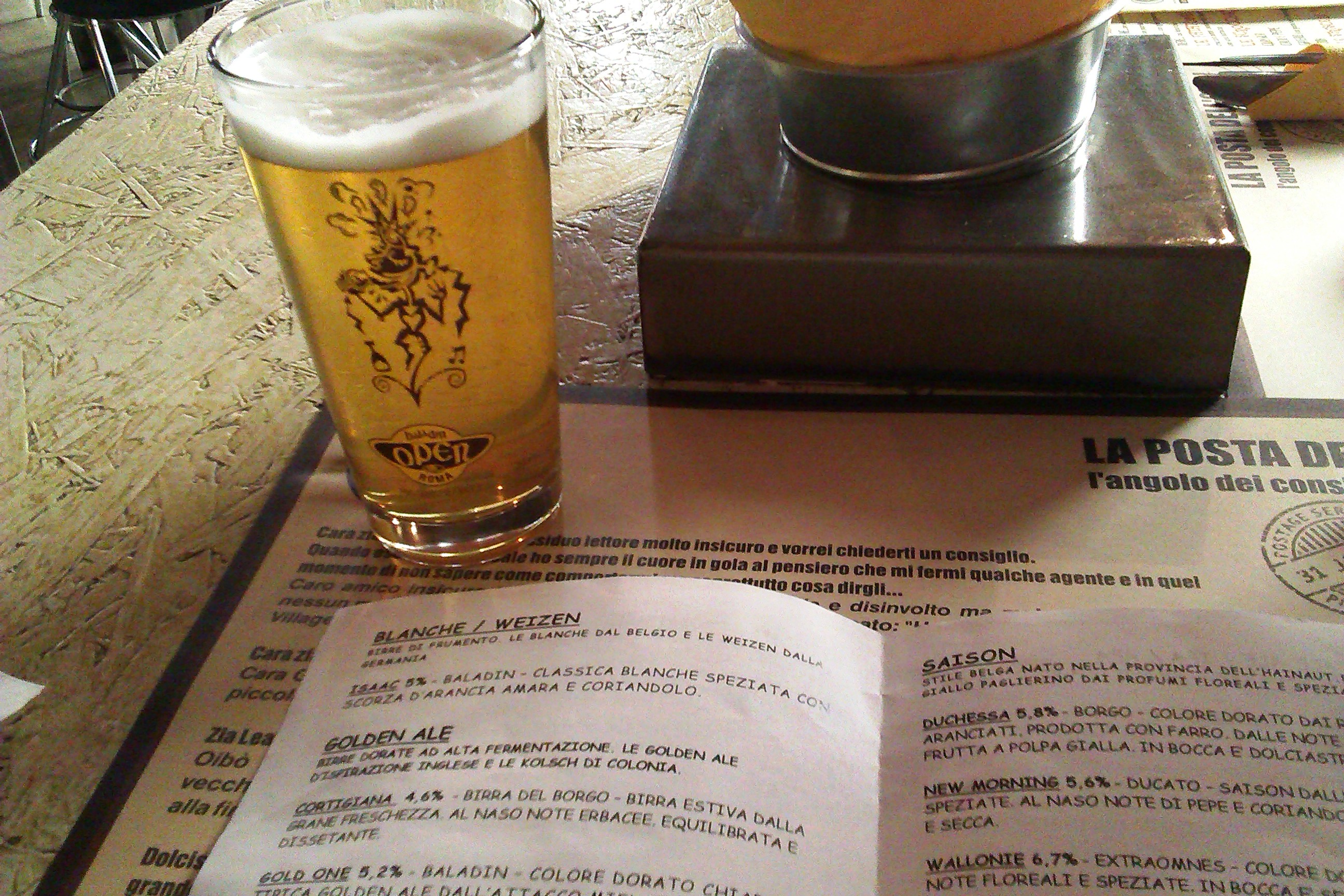
Talking of Baladin, and boring beers, we also had a few slightly disappointing beers at Open Baladin bar on Saturday. I’d been looking forward to some golden ale (with fond memories of things like Fuller’s Honey Dew – my gateway beer on the path to enjoying real beer) so was happy to see Baladin had a few listed in their menu. I tried Cortigiana (4.6%) from Birra del Borgo in Lazio, then Gold One (5.2%), from Baladin’s own brewery in Piedmonte and found both slightly weak and watery, more than like a lager or pils than a more full-bodied summer ale. They were fine, just a little underwhelming.

Baladin golden ales

Similarly underwhelming was FluviAle’s Golden Ale, at Porto Fluviale bar in Ostiense a few days previously. Though I don’t think I’ll be returning to Porto Fluvial for a while as the beer they served my friend Rachel, a Terminal, was terrible. It was very flat but worse it just tasted musty. When we complained the waitress said it was because it was hand-pumped. Hand-pumping might explain a lack of effevesence, sure, but not the mustiness. When my wife had another drink that also tasted musty, it put me off the place completely. Guys – there’s something mouldering in your system. Clean your pipes!

So yes, the best beer experience I’ve had the past week-ish, was definitely the one involving a  bottle of Neos and home-made suppli, served with a tasty tomato chutney.

6 Comments

Filed under Ale, beer, Other food

Casa Veccia’s Formenton and Dazio at Oasi della Birra, Testaccio, Rome

Formento

Haven’t been to Oasi della Birra in Testaccio for what seems like an age. It had become something of a regular haunt, but then something in the aperitivo buffet wasn’t quite right, then other life-things got busy, and well, months went by. But last night I found myself back there, enjoying the evening sun – after a faltering spring, the Roman summer has arrived – and wondering what had become of my chum Cameron. (Never did get those texts.)

On a previous visit, we’d tried a called Molo, a stout made with port from a confusingly named brewery that’s either called Casa Veccia or Ivan Borsato Casa Veccia or Casa Veccia Ivan Borsato Birraio. I’m afraid I hadn’t heard of Ivan Borsato before,  but I like your beers, Ivan, and I like their branding… even if the bottles neglect to actually include such salient information as what type of beer is contained therein.

So this time round, I asked one of the guys from the Oasi what Formenton was, clearly having forgotten what I wrote on my own blog in March. He said it was made with farro (I didn’t get into the issue of what specific farro). As I like my ancient wheat varieties, and it was a warm evening, that seemed like a good place to start. Like many wheat beers, it’s a beautiful bright golden yellow, especially when suffused with the Roman evening sun. I should probably mention the head, as Italian beer reviews always talk about the quality of the schiuma, but what can I say? It’s frothy. But not as frothy as the second beer (see below).

The taste is typically fruity. Cameron  and my wife Fran thankfully arrived before I got too sozzled drinking alone. They both talked about the banana notes (typical to weissbier), but I reckon it had a whole macedonia – that’s Italian for fruit salad – in there, with melon, grapefruit, orange zest, and apple flavours, and even a bit of ginger. At 5.5% it’s not exactly weak, but it’s refreshing and very drinkable, with negligible hoppiness.

Oh, and if you’re really serious about your wheat and white beers, and understand the difference, and can read Italian, there’s a spiel on the brewery’s site about how Formenton “was created from the union of two beers that marked the history of beer: weissbier [wheat beer] and blanchebier [white beer].” Now, I never really had a strong sense of the difference between these beers, as both exist under the wheat beer aegis. But according to the Borsato spiel, and a quick spin around online, the former are more German in origin, cleaner, simpler, with minimal hoppiness and, most of all, are defined by the proportion of wheat in place of some of the (malted) barley. The latter are more Belgian (and Dutch), and may have been made without hops – using herbs instead in something called a gruit. Modern gruit may involve herbs, but also citrus and hops. Both are top-fermented. And, frankly, in this era of innovative craft beers, the dividing line between them is blurred. Formenton, for example, made a point of it. That’s something that’s so good about Italian craft brewing; as the country doesn’t have laboriously rigid brewing heritage and tradition, it’s unafraid to mix things up. Yay. I imagine the two Matt Groening style cartoon chaps on the bottle saying an Italian “yay” at their success with Formenton.

Dazio with OTT head

The second Casa Veccia we tried, and is here featured in a terrible out of focus photo (crappy new phone), showing how I’d rushed to pour it and creating and ridiculous head, was the 6.2% ABV Dazio. The guy in Oasi said it was an ambrata (amber) ale but the Casa Veccia site specifies it’s an APA. As I was talking about yesterday, APA seem to be a very popular style in the Italian birra artigianale scene. And very nice they can be too. And again, unlike in other brewing traditions where beardy specialists might dogmatically insist there’s a distinction between an APA and an amber ale, in Italy it seems an APA can be ambrata.

Dazio was also delicious but very different. Arguably, it’s not as obvious a summer drink, with hints of toffee apple and such autumnal things , along with cinnamon and ginger, but it did the job very nicely thanks last night. Oh, and flavour-wise, Fran said “Turkish delight”, while the Casa Veccia site itself talks about this beer – “in an English style with American hops” – having Profumi terziari come pepe, cuoio, chiodi di garofano, liquirizia: “Tertiary aromas of black pepper, leather, cloves, liquorice.” I didn’t get all that myself, but fair enough. I like the idea of a leather-scented ale. The site also talks about its hoppiness and bitter flavour, but I felt it was pretty mild and mellow. The site also provides a nice bit of history about how the APA evolved from the IPA and the IPA evolved out necessity, with British soldiers in India craving beer, but the long voyage souring the milder ales of home. The solution was more hops, to better preserve the ale. Thanks Ivan and everyone in the Vetch House. Quite why the Dazio label features a cartoon astronaut I don’t know.

2 Comments

Filed under Ale, beer

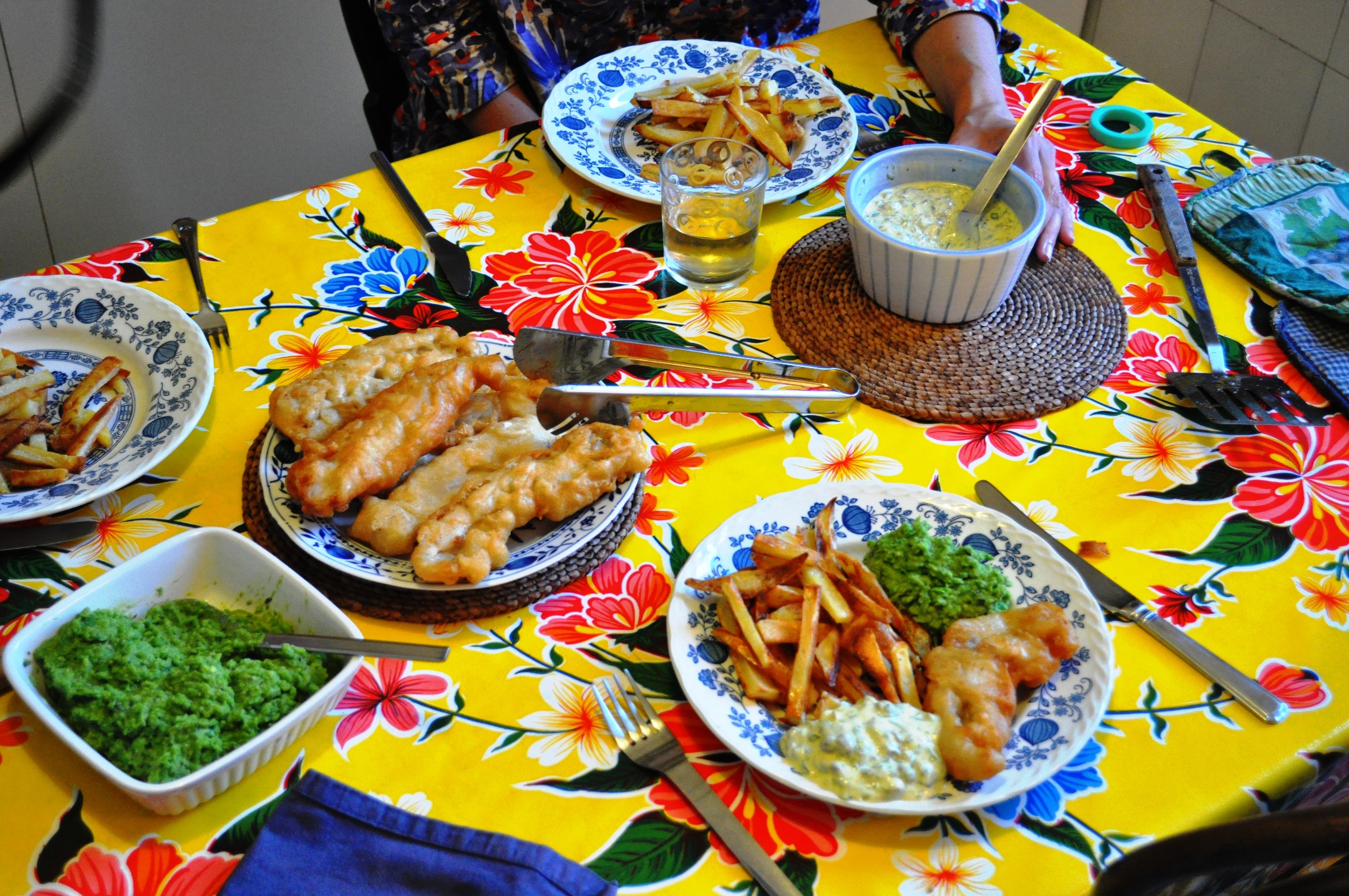
Beer-battered fish and chips with mushy peas and tartar sauce

aerial photo

This post perhaps takes the blog on a slight tangent, but what the heck. It involves beer. And the project was an excuse to buy a selection of beers from a new shop on Viale Quattro Venti in Rome (number 265; it’s a branch of the small chain Gradi Plato). It’s one of a crop of shops that’s been springing up in the time we’ve lived in Rome that specialise in selling international and craft beers.

This guy had a global selection, so I asked him for something Italian, and light and golden, as I wanted to use it to make batter… and drink. We discussed various things, and although he didn’t really seem to understand the term “golden ale” (though I have seen it on other beer menus here), we bought a pils (that is a Pilsner lager), an APA and a wheat beer.

lineup9 md

Now if only I could remember the name and address of the shop. I can’t. But it’s here on streetview, the righthand closed shutter.

Anyway. As strangers in a strange land, we occasionally crave the foods of home. In this case, we’re Brits, and I’ve been craving fish and chips. You could say that the Roman filetto di baccalà when served with patatine fritte is basically the same thing, but… well, no. Just no. Filetto di baccalà is made with salt cod, and while it is battered, it can be made too far in advance meaning the batter can be flaccid, the fish mushy. Plus, I just need my condiments and sauces. It always bemuses us that while Romans have such a passion for deep-fried goodies – fritti – they tend to eat them dry and unaccompanied. A plate of fritti like suppli (rice balls with mozz in the centre, coated in breadcrumbs and deep-fried), fiori di zucca (zucchini/courgette flowers stuffed with mozz and anchovy, deep-fried in batter), and various fried animal bits like animelle (sweetbreads) really ought to be eaten with a nice tangy sauce, something involving tomatoes and peppers, like a tangy chili jam. Even ketchup would be nice. But no.

This craving for fish and chips means I’ve been experimenting with making it at home. I’d only tried this a few times when we lived in the UK as, frankly, why bother in a land of chippies and gastropubs selling fish and chips?

I read around for good recipes and then broadly went with Felicity Cloake’s advice from her “How to cook the perfect…” column in the Guardian. Though her recipe makes too much batter for my needs. And I forgot to chill the flour. Apparently having all the ingredients as cold as possible makes for a lighter batter, but mine sufficed just with cold beer. Of the three beers I bought, I used the pils, reasoning that it was more effervescent, and would help keep the batter light. Plus, I don’t actually much like pils to drink so was more keen on drinking the other two.

I used a Madonna Pils from Free Lions in Tuscania, near Viterbo, Lazio, a brewery founded by Andreas Fralleoni after a career in the banking industry. Leaving behind the evils of banking to make craft beers? Well done that man. (They only have a holding page online at the moment, but it features their funny little logo.) So while I found this pils a bit acrid and hoppy to drink, it made an excellent batter ingredient.

whisking batter

Beer batter recipe

This makes enough for about 4 medium sized fillets.

200g plain / all-purpose / 0 or 00 flour
1/2 teaspoon baking powder
1/4 teaspoon fine sea salt
280g cold beer – preferably something light with a good sparkle

1 Preheat the cooking oil. I used sunflower oil. The fat you fry in is a whole other argument. A true fish and chip aficionado would say it has to be beef fat/dripping, but, well, sod that. Sunflower oil is fine and doesn’t conflict with the flavour of fish.
2 Sieve together the flour and baking powder and add the salt.
3 Whisk in the beer to achieve a thick, creamy consistency.
4 Batter the fish and deep-fry straight away.

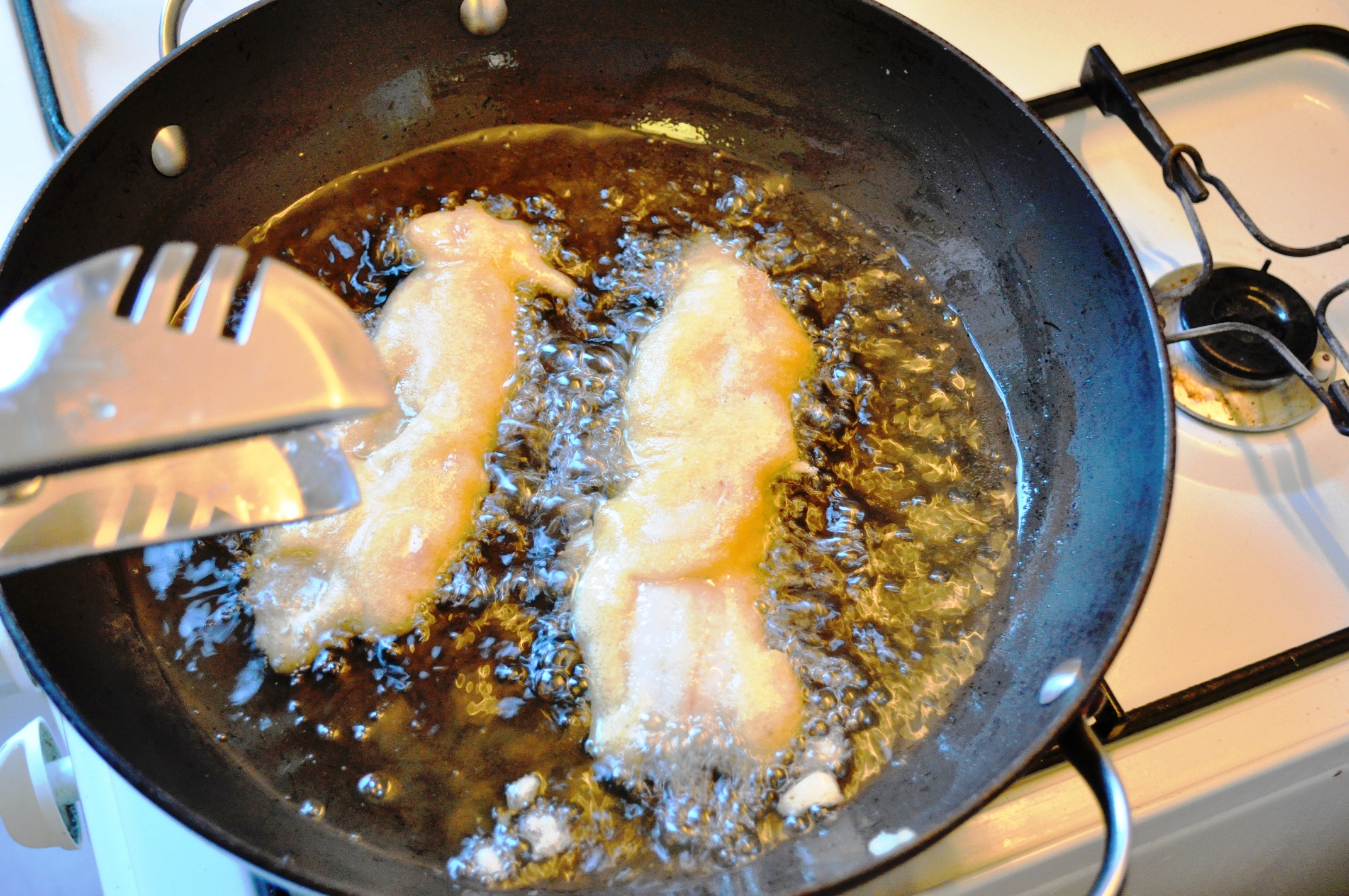
5 Fry for about 8-10 minutes. This will depend on the thickness of the fillets. You want a nice golden-brown, crisp batter.

deepfrying

The last time we experimented with this, Fran was in charge of buying the fish. As the names of the fish on our local market stall remain such a challenge (she clearly didn’t refer to my handy list of fish names in Italian, English and Latin), when she explained what she wanted the fillets for they persuaded her to buy palombo. Which was unfortunate as this may well be small, potentially endangered species of hound shark.

This time round, I was in charge. Buying “sustainable” fish is always a tricky proposition, and frankly something that’s subject to a lot of greenwash and disinformation. My loose rule of thumb is to avoid tuna species, avoid monkfish species, avoid cod, and generally stick with things like anchovies and mackerel, ideally caught by small, local fishing boats.

In this case, I ended up buying some fish the vendors referred to as “local”: musdea, aka mostella, which I believe is a type of forkbeard, a relative of cod, Phycis phycis or Phycis blennioides. Although neither are on the IUCN red list (they’ve not be assessed yet), the latter species is listed as one to avoid on the UK’s Marine Conservation Society site. Hopefully it’s not been so overfished in the Med, but I know that’s a vain hope. The only consolation is that we don’t do this too often. Sustainability is of course about making the right choices, but for a society like ours, predicated on over-consumption, realistically it’s also about doing the wrong things less frequently.

Anyway. After I’d fought the fillets to remove the bones, this forkbeard fried up really well. I don’t have an oil thermometer (though I would like one of those fancy IR guns, available from a corporate tax-dodger not very near you), so I just played it by ear. I did three batches, with the second two pretty much perfect. Apparently you want 185C or thereabouts for deep-frying fish in batter.

Fish & chips and ale

It went down very well with the other beers I’d purchased: La 68 from Math brewery in Florence, Tuscany, and Runner Ale from Pontino brewery, which seems to be part of All Grain SRL in Latina, southern Lazio.

Math don’t have a proper site up yet, and I don’t know anything about them, but I love their style already. The design is cool and La 68’s label includes a funny little fellow with a speech bubble with this beguiling epigram: Il disordine é l’ordine meno il potere, “Disorder is order without the power/means/ability” The beer itself was a fresh summer beverage: a 5% wheat beer whose ingredients also include spezie, “spices”. I’m not sure which, but it had a nice limey flavour and subtle hoppiness.

La 68

Like La 68, Runner Ale isn’t in my Italian craft beers guide, but it’s similarly very drinkable: notably because, unlike many of the Italian craft beers I encounter, it’s not overly strong, at only 4.5% ABV. It’s an (Italian) American Pale Ale. APA style beers seem very popular in the Italian microbrewery scene and, despite me being British, it’s a style I’m really enjoying at the moment. Italian APAs are often light yet full-bodied, tasty without being aggressively bitter or hoppy. And as with the La 68, the Runner Ale’s bottle also comes with a quirky quote, in this case Come tuo avvocato ti consiglio di andare a tavoletta. It’s attributed to Dr Gonzo, Hunter S Thompson’s creation, and I think it means “As your lawyer, I advise you to go to the bar.”

runner ale

Sides and condiments

As you can see, I went the whole hog here and did chips, tartar sauce and mushy peas. I’ll admit the chips were not proper chips. As I don’t have a proper deep-fat fryer or even a pan with a frying basket, I couldn’t be bothered. I’d read up Cloake and discussed proper chips with friends (the knowledgeable Oli Monday saying they were best when “oil-blanched”, frozen, then deep-fried a second time) for my last experiment, but this time I just cut chip shapes and roasted them, without any pre-cooking, with plenty of sunflower oil and salt. They tasted good even if they weren’t proper chips.

nice spread

As for the tartar sauce. I just had to. As I said above, fried food needs condiments. One of things that drives me made about British pubs is getting tartar sauce in those tiny sachets. I need about 10 per meal. So here I made a decent bowlful for the three of us.

Tartar sauce ingredients
1 egg yolk
1 cup / 240g oil (half-half sunflower oil and extra virgin olive oil)
1 teaspoon of Dijon mustard
A good handful of cornichons or gherkins, roughly chopped
A good handful of capers, rinsed, soaked, drained, squeezed out and roughly chopped
A good handful of parsley, roughly chopped
Some water, lemon juice and salt and pepper

1 Put the yolk in a bowl and whisk it a little with the Dijon.
2 Start adding the oil, whisking constantly, starting with just a few drops.
3 When the oil and yolk starts to emulsify, you can pour in the oil, whisking continuously.
4 When the mayo starts to thicken, thin it down with lemon juice and water, to taste.
5 Add the cornichons, capers, parsley and taste – your capers could be quite salty still, so you might not need to add more salt.
6 Add more lemon juice to taste.

And last but not least: mushy peas

Years ago, there was a great ad campaign in Britain that called some industrial brand of mushy peas “Yorkshire caviar”. Funny, if not entirely true. The industrial stuff, made with dried marrowfat peas (that is, big old starchy peas, Pisum sativum) rehydrated and dyed green, can be pretty nasty. Homemade mushy peas, however, are delicious.

To serve 3-4

1 About four good handfuls of peas. I used half-half frozen and freshly podded. (It’s the end of peas season here; if it’s not pea season, just use frozen peas.)
(Yes yes, I’m not being very accurate here but I didn’t bother to weigh any of these things. Say about 350-400g)
2 Place the peas in a pan with a good knob of butter, say 30g.
3 Add a handful of fresh mint, roughly chopped.
4 Add enough water to cover then bring to the boil and simmer for about 10 minutes, until the peas are tender.
5 Drain (keeping the cooking water) then puree with a zizzer (er, hand-blender), food processor, or just mash with a work to the desired consistency, adding more of the cooking water as necessary.
6 Add a bit more butter if you fancy it and season to taste with salt. You could add black pepper, but frankly with something so lovely and pea-y and minty, I don’t think it’s needed.

Serve it all together, warm and lovely. With good quality craft beers – chosen according to your taste and the season, naturally.

9 Comments

Filed under Ale, beer, Other food, Recipes

Birra Dolomiti and Bastarda Rossa at Osteria Pistoia, Rome

So the past week or so we’ve been to both branches of Osteria Pistoia in Rome. The more restaurant-y branch is in Piazza Madonna della Salette, in the off-the-tourist trail Monteverde Nuovo, while the other branch on Via Portuense – on Sundays, right in the thick of the Porta Portese market – is both a cafe and sit-down eatery. Both have a decent selection of beers, though the former had a sign boasting “More that 40”, while the latter had a list of about 12.

These osterie are among the surprisingly few places in central-ish Rome that seem unafraid to try and move away from the hackneyed mediocrity of many of the city’s eateries. Yes, mediocrity. Rome might be the capital of the nation that exports its culinary traditions to the world, but as a great food centre it hardly compares with London, and quite probably the world’s other great food cities like NYC and Paris. I just had a weekend in Naples, and, even among its chaotic disintegration, the restaurants were offering more interesting fare than in Rome. Why is Rome so bad for restaurants? Well, for me it’s partly because I just don’t like Roman cuisine’s emphasis on meat and offal (quinto quarto, the “fifth quarter”), but more broadly and less personally it’s also because the city is so touristy, and in the touristy areas, eateries can get away with murder. Tourists are so charmed by the cobbled streets and overwhelming sense of history in places like Trastevere and the Centro Storico that they don’t seem to notice the amorphous crapness of the over-priced restaurants they’re patronising.

Frankly, there are very few places I would eat in Trastevere, for example. Perhaps Ai Marmi for a cheap, crisp pizza and okay suppli; Da Augusto, for entertainingly no-frills/rough dining; Da Enzo, for sound Roman fare. (Though none of these places have decent beer.) Italian has an expression that I’ve just learned: buon rapporto qualità-prezzo, and it refers to a good balance or rapport between quality and price, value for money. This is something I’ve been talking about for ages in discussing my general disappointment at Roman food, without knowing this expression. So Ai Marmi and Da Augusto offer pretty basic food – but it doesn’t leave you feeling like you’ve be ripped off. On the other hand, many places offer poor-to-rudimentary fare that costs way more than is justified, leaving a bad taste in the mouth figuratively and quite possibly literally. So many places in Rome rest on their laurels, confusing being founded in 1916 (or whenever) and having a heritage with producing good, well-priced food now.

So yes, to get back to Osteria Pistoia. Anita from Trastevere’s Almost Corner Bookshop recommended it. For our first meal we decided to give the Monteverde Nuovo branch. I’m not going to review the food as that’s not what this blog’s about, but I will  say that it was good, with a buon rapporto qualità-prezzo. I had a galletto (young cockerel), that had been marinated for 24 hours in mix containing olive oil, white wine vinegar, rosemary, salt and black pepper. It was flavoursome and moist – where traditionally many Roman places will overcook their meat, desiccating it. (Though they did serve it on a piece of slate, not a plate, which is just fecking silly. Plates have a rim for a reason. At least it wasn’t a chopping board – which is both silly and unhygienic.) They had some fancy deserts too, including a sphere of white chocolate containing cinnamon-ginger gelato.

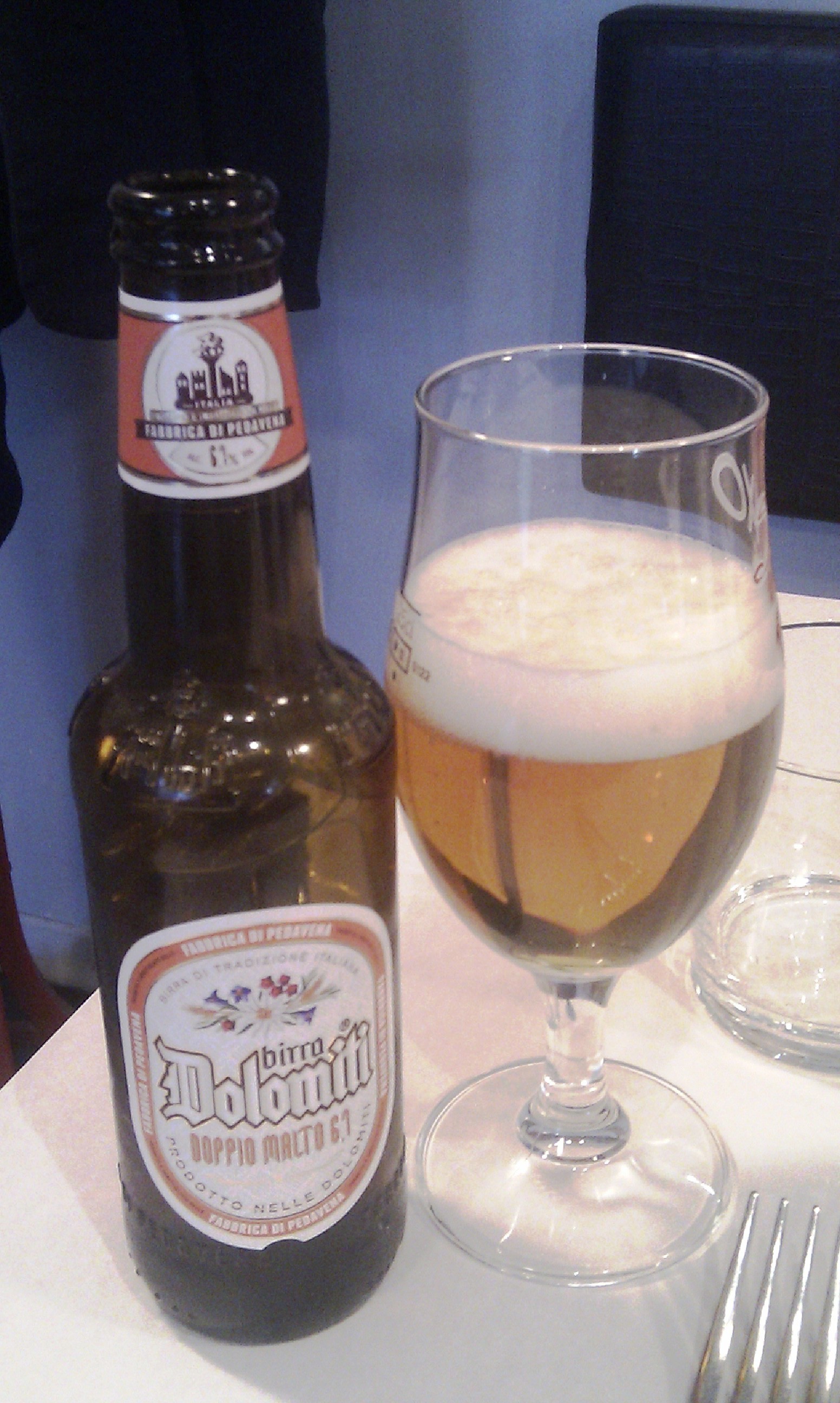
Birra Dolomiti Doppio Malto 6.7

Seeing the 40 beer-list, I of course had to go for the grain not the grape. (The wine list is short – only three whites and three reds if memory serves.) I asked for a recommendation of an Italian craft bee and the guy suggested a Birra Dolomiti Doppio Malto 6.7, then seemed to wince when I said okay. I don’t know why, but I wish I’d read his expression and changed my mind. I didn’t know this brewery – Birrificio Pedavena, in the Veneto – but it really wasn’t my kind of beer. It even had the kind of metallic taste that puts me off industrial beers and lagers generally. Which perhaps isn’t surprising – Padavena seems like a pretty big operation, founded in 1897 and even owned by Heineken from 1974 to 2004. Threatened with closure then, the brewery was instead bought in 2006 by another brewery that is found in the Birrifici industriali (“industrial breweries”) section of my Guida alle birre d’Italia 2013: Birrificio Castello, in Friuli-Venezia Giulia. This is another large brewery with historical connections to both Heineken and Birra Moretti. Ugh.

We did better on the beer front when we ate at the Via Portuense branch of the restaurant, though actually ordering the meal, and getting it, was like pulling teeth. The young boy attempting to wait really struggled. Furthermore, I’d got excited about seeing Orso Verde beers on the menu – I’d spied a bottle of their stuff previously and been taken by its label featuring… a green bear (un orso verde) – but they’d run out. Instead we ordered a Bastarda Rossa (“red bastard”) from Amiata, a brewery in Tuscany. It was a deep, dark russet colour, full-bodied and relatively strong at 6.5%. It had an almost fruity flavour, which may well come from the (IGP; indicazione geografica protetta) chestnuts that make up 20% of the fermentable mass, apparently. It’s also made with six types of malt and three of hops.

Bastarda rossa 2

So yes, a great beer. And while the chef wasn’t as good here as at the other branch of Osteria Pistoia, at least it’s a place that’s trying to do something a little fresh. Broadly the food was good, though my primo (a variant on pasta e ceci – with octopus) was totally underseasoned. But overall, both branches offered a buon rapporto qualità-prezzo. I’ll definitely return to Osteria Pistoia, but at this point I’m more inclined towards the Monteverde Nuovo branch – where the food was better (I suspect chef Alessandro Pistoia is based there), the waiting was more professional and the beer menu much, much longer.

[Apologies for crap pics. Esp the first one – taken on my old HTC phone. Now in the hands of some fence in dear old Napoli]

Leave a comment

Filed under Ale, beer

Bender Ale

This is what I’ve mostly been drinking lately, a pale or blonde American wheat ale. I’m not usually a big fan of wheat beers – partly because I find them a little sickly, partly because I made myself a little sickly on more than one occasion back in the day when I first discovered Hoegaarden. (It must have arrived in Britain around 1995, as I’ve got clear memories of drinking it, and Leffe, too much when I lived in Newcastle.) This one, however, is rather pleasant. It’s also the only beer on tap at the moment in the bar of the American Academy in Rome, where I’m currently working as a volunteer in the kitchens.

My background is in sitting-on-my-arse trades, notably as a film journalist, so being on my feet all day is pretty hard yakka. So a beer is most welcome at the end of the shift. Indeed, even when I’m working the pm shift (starting at lunch time, finishing after dinner), I start dreaming about beer at around 6pm.

Once we’ve cleaned up around 10pm, the beer is calling to me. In this case, it’s Bender calling to me. Now, if you’re British, and of a certain age, that’s a slightly unfortunate name for a beer, but if you’re not British, or are primarily a Futurama fan, it won’t carry any baggage of 70s school playground name-calling. Bender, of course, is Futurama’s resident alchoholic robot. (Though he’s not an alcoholic in the addiction sense – he needs booze to recharge his fuel cells.)

Despite the name of the beer, it is in fact Italian, from a microbrewery called Vecchia Orsa (“Old Bear”). The brewery is part of Fattoriabilità, a social coop in Bologna province, in Emilia-Romagna, set up in 2006 and brewing, I believe, since 2008. Visit their site, and they even seem to have some adorable donkeys. Whether they’re used for salami down the line I don’t know.

The beer itself is very drinkable, though as the weather warms up (and it is warming up fast – the Roman winter of coats and sweaters seems to turn a corner to a spring of t-shirts in just days), it’ll be even better. It’s a fresh, citrussy wheat ale that will be very pleasing drunk outside on a warm, sunny day. Plus, for me, it doesn’t have the strange slightly thick, doughy-ness that puts me off most wheat beers. I’m struggling to articulate this, but as much as I like baking bread, I don’t love the idea of drinking the dough, and that’s what wheat beers often feel like to me.

So anyway, as long as I remain on the pm shifts I think I’ll be enjoying a few more of these…

Leave a comment

Filed under Ale, beer

Another beer from 32 Via dei birrai brewery – Audace

Back at the Oasi della Birra in Testaccio last night. That’s “wah-zee”, not “oh-ace-ee” della Birra. My pronunciation got corrected (rightfully so) just the other day.

As per usual, you ask for beers from the scrappy menu, and they haven’t got them. So he suggested something else and as we were busy yacking we just said okay. We ended up having another of the range from 32 Via dei birrai birrificio (brewery), with their snazzily designed bottles, here terribly photographed on my phone.

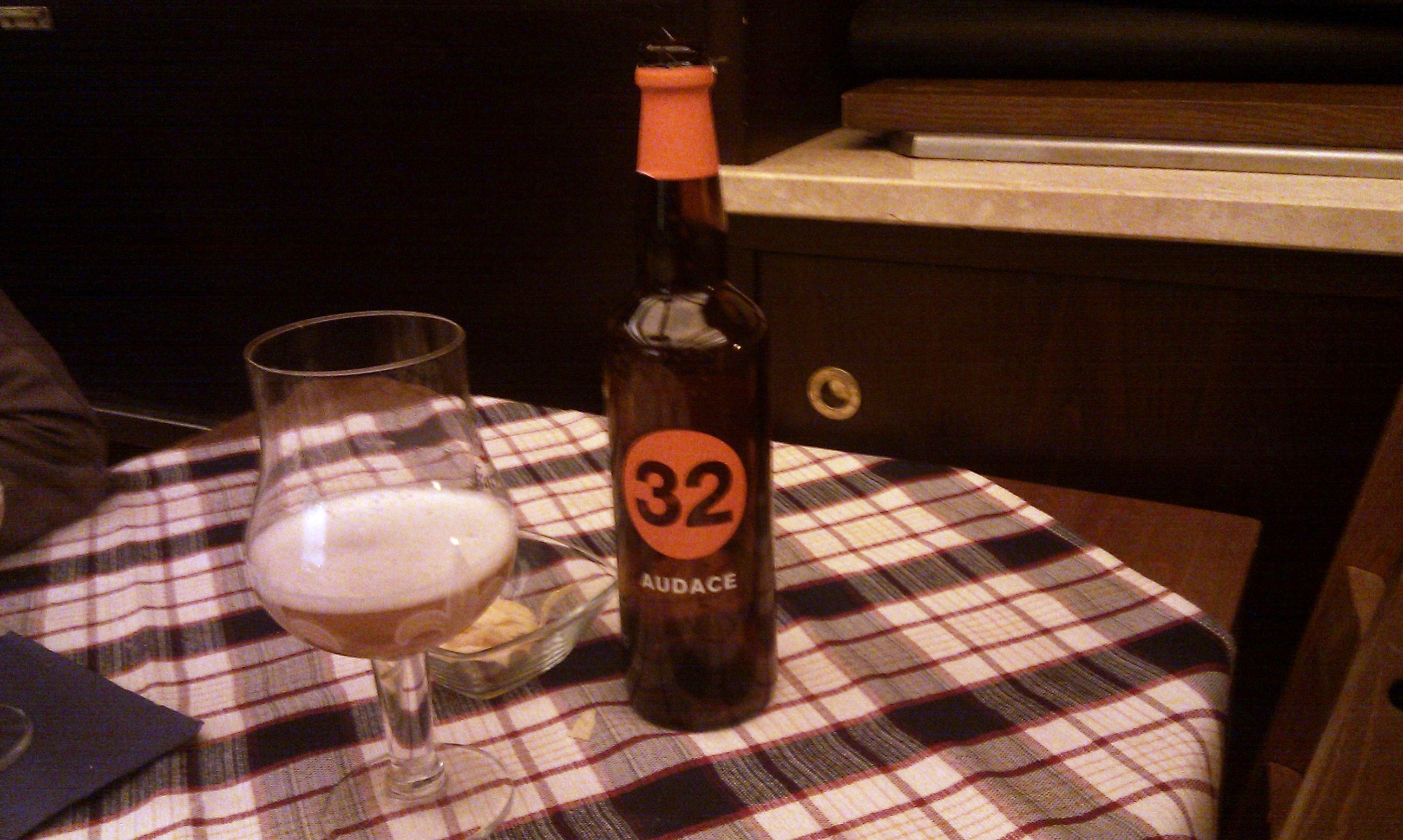
Last time, I tried their Atra, a strong brown ale (7.3% ABV). This time it was Audace. On their site, 32 describes it as a birra bionda forte (Belgian strong ale). The first bit means strong blonde beer – and indeed it was strong, even more so than the Atra, which is already hefty enough for someone who’s grown up with British ales. When I say “grown up with”, I of course mean, “learned to enjoy responsibly at a legal age”. So yes, Audace is 8.4% ABV. Audace indeed. In case you hadn’t guessed from the Latin root, the name means “audacious”.

It’s audacious on a couple of levels. Firstly and foremostly because it’s ridiculously drinkable for such a strong beer. Even the Guida alle birrre d’italia (Guide to Italian Beers) 2013 says it’s molto beverina, nonostante l’alta gradazione alcolica: “very drinkable, notwithstanding the high alcohol content”. Secondly, it’s got a really notable citrus, slighty spicey, flavour. The brewery’s in-house experts have got it right when they refer to its taste giving una sensazione citrica astringente: “an astringent citrus sensation”. It’s reasonably hoppy, but that is balanced beautifully by the citrus flavours, spicyness and malt (it’s double malted).

Just reading 32’s site some more now, it says something appropriate to the current flap in the UK media about certain stray red meat.

The site suggests what food it pairs well with: Cibi senza salse grasse ma sostanziosi, affumicati come gli sfilacci di cavallo, o salati come montasio stravecchio e ostriche, in quanto birra poco luppolata. Which means (ish), “As a lightly hopped beer, it goes well with hearty foods without greasy sauces, smoked foods like shredded, cured horsemeat, or savoury/salty foods like Montasio Stravecchio [a type of cheese] and oysters.” The northeastern food suggestions – both the horse and the cheese – are in part because 32 is in the Veneto, inland from Venice.

I’ve never encountered horsemeat in Rome, though it’s probably available here and, frankly, sfilacci di cavallo has got to be nicer than the pajata alla griglia I tried the other day. It’s the intestines of unweaned veal (though some say lamb), grilled. It smelled and tasted of the digestive tract. Which doesn’t come as a surpirse. What surprises me is some people’s passion for it. (Sorry Rachel – I know I had to experience it, but I can’t pretend I enjoyed it!)

Unsurprisingly, half a 75cl bottle later I was feeling quite amenable. While there wasn’t any sfilacci di cavallo available, the boss of Oasi did encourage mean to buy another of 32’s beers to take away. I won’t say “one for the road” as that a bloody silly expression as it implies driving. Come on people: Walk. Public transport. Taxi. Designated drivers.

Anyway. Watch this space. I’ll be reporting back on 32’s Oppale soon. Untappd calls it a Belgian pale ale, the gaffer at Oasi referred to it as a lager. It’s only 5.5%, which is another surprise considering these previous experiences with 32’s beers.

4 Comments

Filed under Ale, beer

Baladin’s Pepper and Borgo’s Maledetta at Open Baladin, Rome

Whenever I visit Open Baladin, possibly Rome’s finest birreria, I like to sample some novelties. It’s not hard, as they generally have several dozen beers on tap, of many ilks and genres. The menu, which changes every few days, is divided into categories. Yesterday these were: Blanche/Weizen (white and wheat beers); Bitter/Pale Ale/IPA/APA; Brown Ale; Saison; Lager; Belgian Strong Ale (style, not necessarily origin – they’re mostly Italian); Lambic; Smoked Ale; Golden Ale; Belgian Ale (again, mostly actually Italian); Honey Ale; Stout/Porter; Birra Alla Castagne (chestnut beers); Barley Wine. There were around 50 in total.

The first category on the menu, however, is generally Birre cha fanno stile a se’. I’m not sure I can translate this quite right, but it means something like “Beers with a style of their own”. That is, beers that don’t quite fit into the other, more conventional, categories. Not that a lot of those are conventional, especially by British standards – Saison are enigmatic ales, and chestnut beers are elusive in the UK.

Anyway, I like to go for the first category, see what’s new, what’s novel. So, without consulting the staff in any way, I ordered a Pepper, a 6% ABV mystery from Baladin’s own brewery. (On US site/app Untappd, it’s classified as a Saison / Farmhouse Ale, but that’s not how Baladin themselves categorise it). The menu said it’s produced with pepper, and called it fresh and lightly spiced. I love black pepper in cooking, and like spices, so it sounded good. When it arrived, though, I was baffled. Firstly, it had absolutely no head (schiuma, foam, froth – the term used for beer, waves and cappucini alike). Many of the Italian craft beers I’ve tried have a serious head on them, something that takes some getting used to as a British beer drinker. It was entirely still, not a bubble in sight. Sure un-fizzy ale isn’t a great rarity, it was just so surprisingly flat, inert. Check out the photo – it could almost be a wine or a liquor, visually.

As for the smell and flavours, the first thing that hit me as it neared my considerable snozz was nothing to do with pepper or spice, it was banana, which continued with the first sip, along with hints of honey. I had to reach a quiet, zen place before I could taste any elusive pepperyness. (And offer it to my wife, who said she could.)

It just didn’t seem right, somehow. I managed to ask a friend who works there and is very knowledgeable, and she confirmed it was indeed liscia, smooth, by character and not error and that she’s never order it herself! Oops. So she suggested my second beer. We’d only stopped for a swift one, but who was I to resist?

So beer number two for the evening (and only two, as my friend had a stinking cold and wasn’t up for it) was Maledetta, from Borgo, NE of Rome. It’s a great name for a beer – meaning damned or words to that effect. This 6% ABV Belgian Ale (Belgian style, Italian-made) was a much more enjoyable affair. The glass was a third full of head (again, it might be strange to a Brit, who’d probably ask for a top-up, but it’s important here, where the beer criticism talks about the character of the head alongside the smell, taste and colour of the liquid itself), and the first scent was of caramel, sugar just starting to burn. Tasted, it was was more grapefruity, with a nice full, almost chewy, body. I didn’t curse it, despite the name. Instead, I drank it with a mellow sense of satisfaction.

Leave a comment

Filed under Ale, beer

Baladin’s Nora at Le Café Vert, Monteverde, Rome

Thursday night, difficult week. Me and Mrs BC&A, aka Fran, decided we deserved a drink. Though we couldn’t be bothered to range beyond our Roman neighbourhood, Monteverde Vecchio. It’s not a best hood for a beer, but one café-bar-bistro has a reasonable selection of bottled craft beers (or whatever you want to call microbrewery fare. It’s called birra artigianale here in Italy – artisan beer). This is Le Café Vert, which opened not much more than a year ago, demonstrating how Italy’s urge to eat and drink continues to defy The Global Depression. As King Silvio said back in November 2011, “The life in Italy is the life of a wealthy country: consumptions haven’t diminished, it’s hard to find seats on planes, our restaurants are full of people.”

Quite why this bar has French name, and the lady serving us kept saying voila not the Italian equivalent ecco, I don’t know, but rest assured it’s in Rome, with great Italian beers and aperitivo snacks included in the price of the drink for a period every evening. According to their site, they stock beers from four Italian microbeweries: Baladin (which is Piedmont, NW Italy); Birra del Borgo (which is in Lazio, the central Italian region around Rome); ‘na Birretta (which is also in Lazio); and Birra di Fiemme (which is in Trentino, NE Italy).

We entered, glanced around, and I saw Baladin’s distinctive labels. I’ll be honest and say I don’t really like Baladin’s design style, which pervades Open Baladin bar in Rome and the labels on the bottle. It’s kinda scrappy, cartoony, vaguely Keith Haring, vaguely hippy, like someone’s mate did it, someone who’s not a professional designer. But remember kids, don’t judge a beer by its label. Baladin beers remain among my favourites, in part because Open Baladin was my entry point to birre artigianale. It’s not cosy like a nice British pub, its food is middling (especially if you’re not a fan of beef burgers on brioche buns), but its beer selection is stupendous, with dozens of craft beers, mostly Italian, on tap, and there are some very knowledgeable, helpful staff there too.

Anyway. We chose a Baladin “Nora” – we had to, as it was our friend Nora’s birthday, so we could drink it in her honour. This beer was named after another Nora – the wife of Teo Musso, the founder and master brewer of Baladin. Musso is a big name in the Italian beer scene, and for good reason. Baladin is apparently the biggest microbrewery by volume-produced in Italy (according to my chum, who is the brewmaster of the second-biggest, Mastri Birrai Umbri). Baladin brewery produces around a dozen varied, fascinating brews. Musso and his colleagues aren’t afraid of experimenting, of unusual ingredients, and Nora is no exception.

At first glance and sip, Nora’s a wheat beer, relatively pale, aromatic, slightly sickly-sweet (in a good way – if that’s possible. I’m not a big fan of wheat beers, so maybe that’s just me). But it’s not made with wheat, or at least it’s not made with a modern wheat strain. Instead, it contains both malted barley and “Kamut”, which is a branded version of Khorosan wheat (Triticum turanicum), an ancient strain. (I discuss wheat strains here.)

There are other ingredients too that make their presence felt in a certain spiciness and perfume: ginger and, get this, myrrh. Now we all know the latter was one of the gifts the Baby J got in Bethlehem, but did you know it’s a resin from the thorny shrub Commiphora myrrha. It’s an ingredient more commonly used in medicine and for incense (ah, memories of being the thurifer). As such Nora, is a beer that’s both sweet, citrussy and easily drinkable, and complex and slightly confounding. It’s also quite strong, if you’re British, but not that strong if you’re Italian: 7%ABV.

Final geek detail, it also alta rifermentata in bottiglie, which literally means “high-re-fermented in the bottle”, but I believe we’d say it’s top-fermented and bottle conditioned. Though I need to double-check that.

4 Comments

Filed under Ale, beer