Category Archives: Biscuits, cookies

Christmas biscotti

Christmas biscotti

So I wanted to create an all-purpose biscotti recipe, an equivalent to this eminently useful customised cookie recipe where you just make a basic dough then chuck in whatever else you feel like. The plan was to have a recipe that I could adapt to utilise some Christmas flavours, some spices, some peel – and use up some pistachios that were sitting in storage while we didn’t have a kitchen during our 12 weeks-became-24 weeks building project.

Here’s the Christmas version. I’ll post the all-purpose version when I’ve tried a few more variables.

3 cardamom pods
3 cloves
nutmeg
1/2 tsp cinnamon
250g plain flour
200g sugar (caster or granulated)
1 tsp baking powder
(30g raw cacao powder, optional – I just had some)
pinch salt
3 medium eggs, beaten (QB, see below)
100g pistachio nuts
85g candied peel

1. Preheat the oven to 180C.
2. Line some baking sheets with parchment.
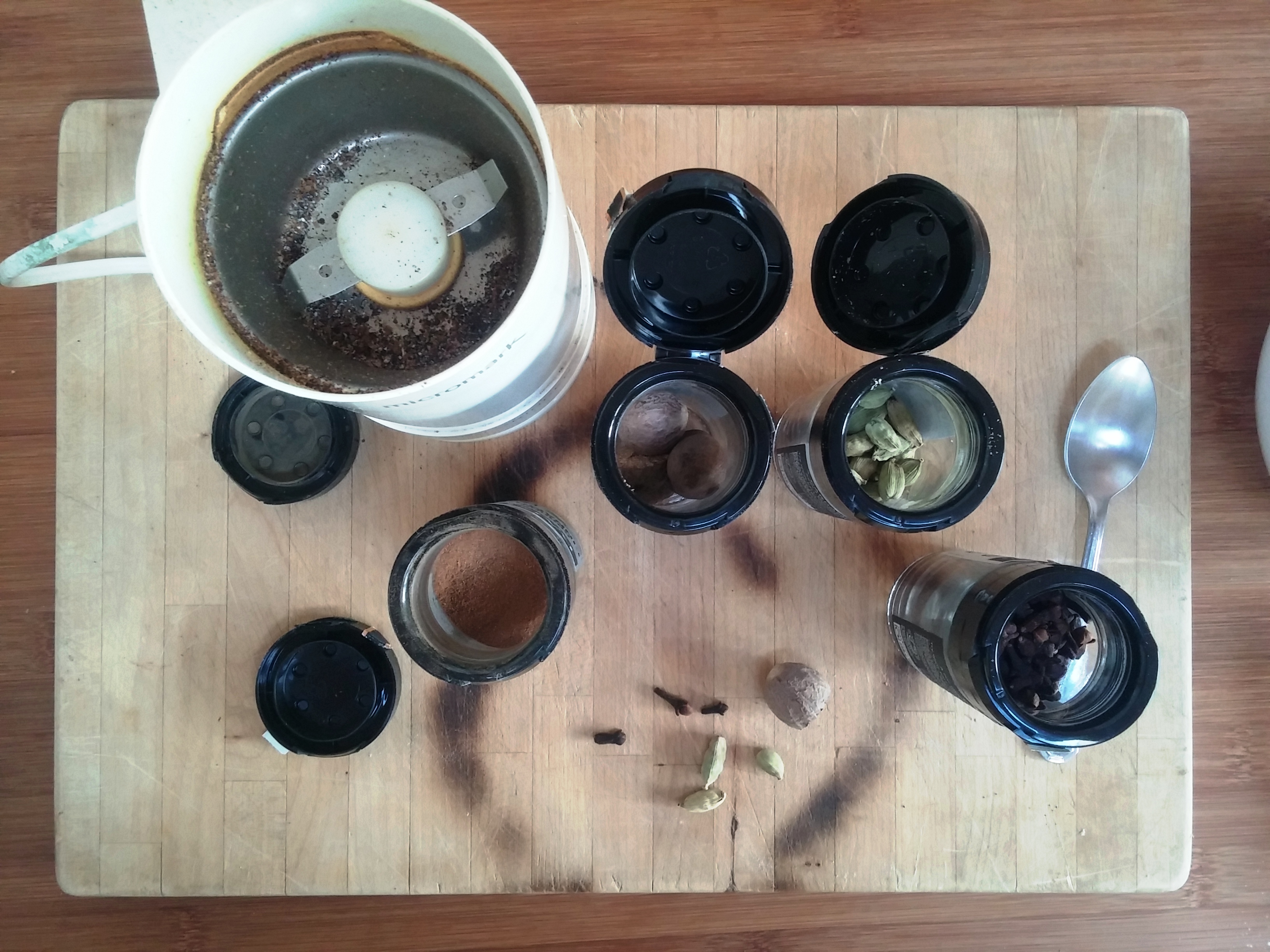
Christmas biscotti, spices

3. Prepare the spices: crack open the cardamom pods and take out the seeds then grind them up, along with the cloves. I use a mini electric grinder, but you could use a pestle and mortar (can’t find mine). Mix these spices with the cinnamon and a few grates of fresh nutmeg. Again, the spice mix is up to you really – all these spices are wonderfully evocative of mid-winter feasting to me, but if you don’t like or don’t have cardamom, for example, don’t worry.
4. Sieve together the flour, cacao powder if using, baking powder and spices and add the salt.
5. Make a dough by adding the beaten egg, a little at a time. You may not need to use it all. For example, my 3 medium eggs produced 170g of beaten egg, but I only needed 160g to make a dough that was malleable, not too dry, not too sticky. That’s QB – which is found in Italian recipes, is short for quanto basta, and means, “how much is enough”. In this case 160g was enough.

Christmas biscotti, dough
6. Add the nuts and peel and combine. Don’t knead it, it’s not bread, mix it just enough to homogenise.

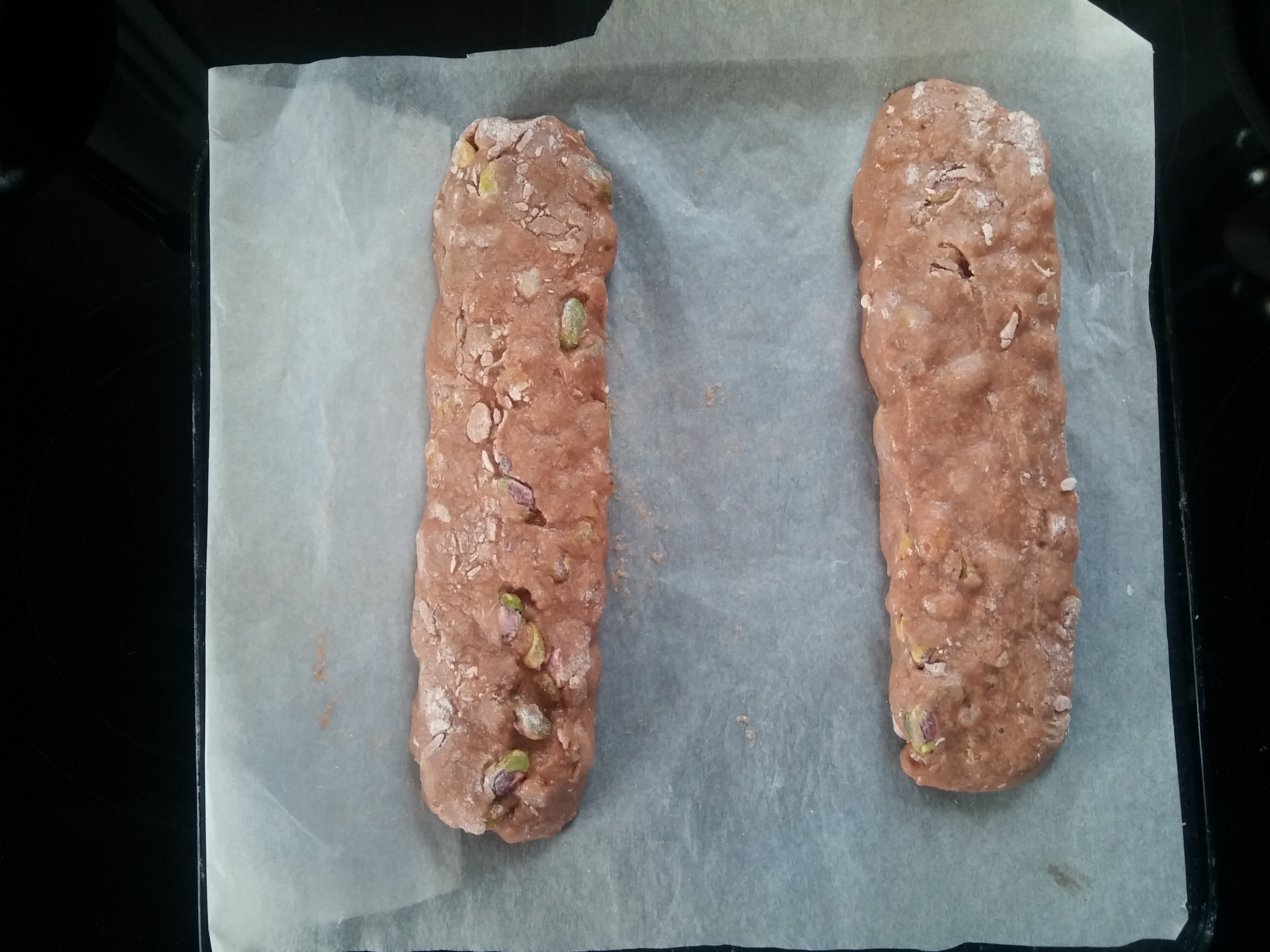
Christmas biscotti, logs, unbaked
7. Form the dough into three slightly flattened logs, about 40-50mm wide, and place these on the baking sheets, sufficiently spaced for some spread.
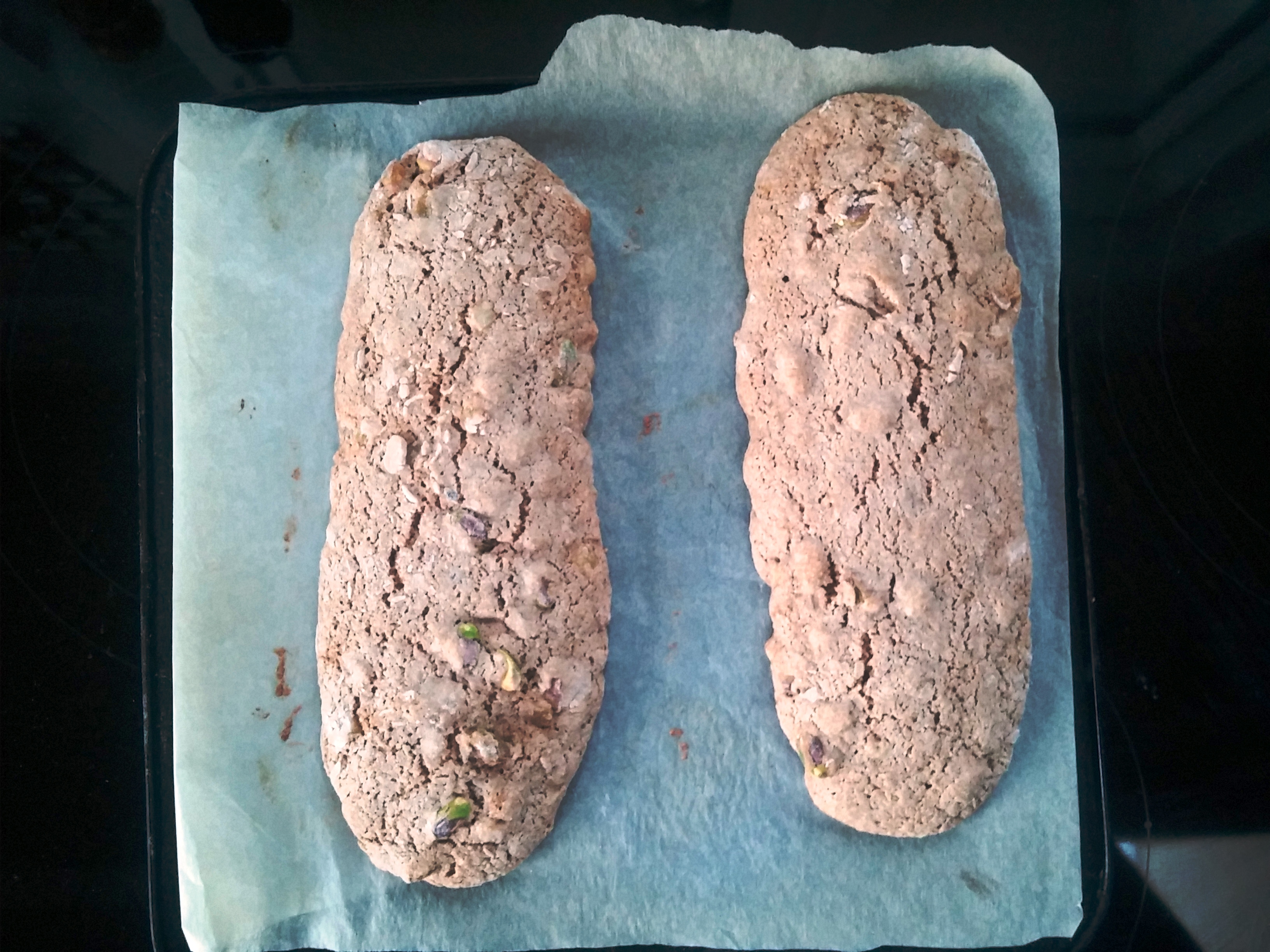
8. Bake for about 20-25 minutes. You want the logs baked but not dried out, not still gooey. If they’re too gooey inside still, they’re hard to slice for the next stage and the second bake.

Christmas biscotti, logs, baked
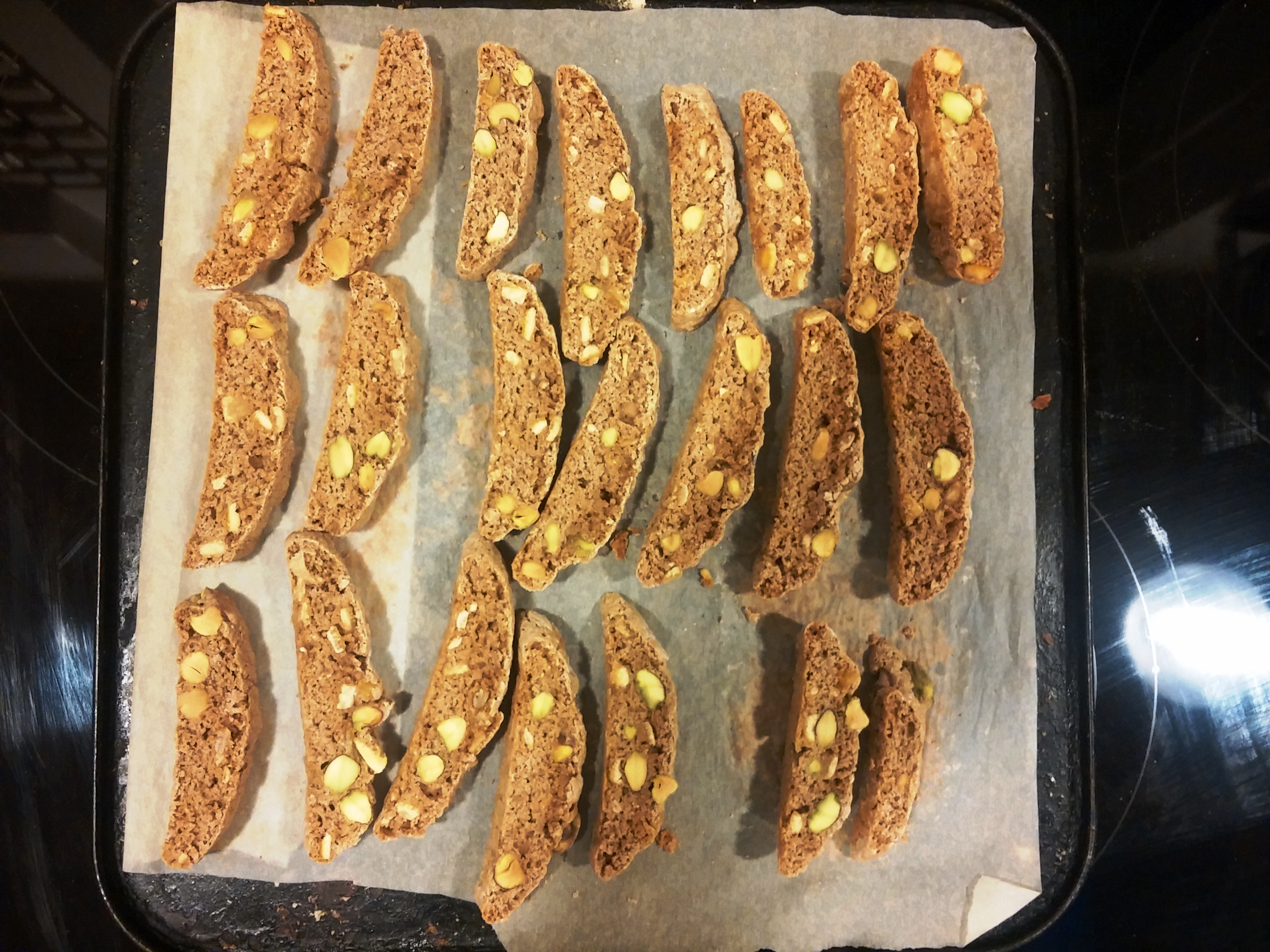
9. Allow the logs to cool slightly then, with a serrated bread knife, slice, on a slight angle, into pieces about 10mm thick.
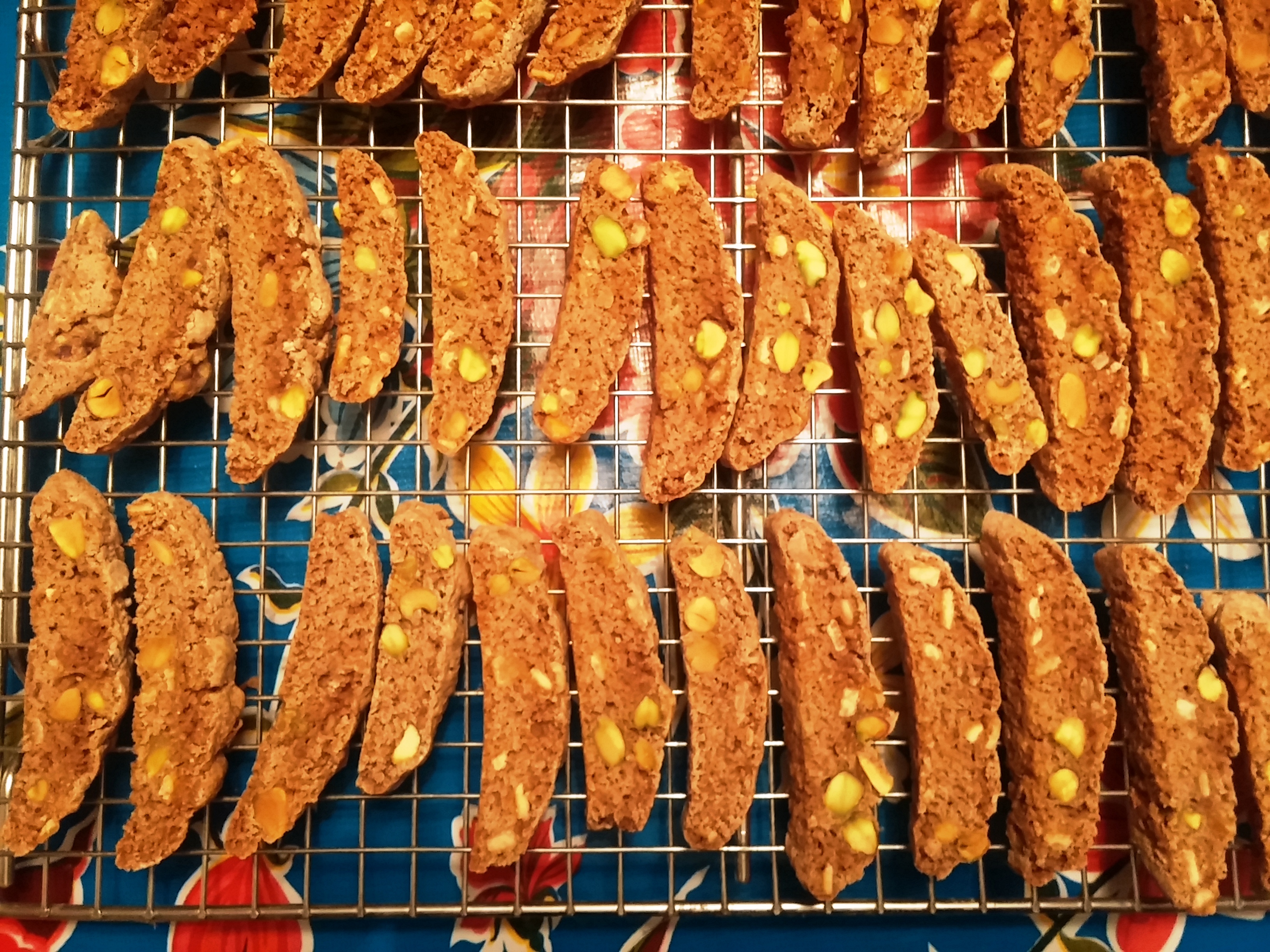
10. Return the biscuits to the baking sheets and bake again, for about 10-15 minutes. Take them out, turn them over, then bake again, to crisp up.

Christmas biscotti, sliced
11. Cool on a wire rack.

As they’re baked twice – biscotto literally means “twice baked” in Italian, from the Latin – they’ll be crisp and hard. They keep well in an airtight container and are suitable for dipping in a glass of desert wine, or a digestivo, or a hot drink if you’re being abstemious. It’s the season for abstemiousness right?

1 Comment

Filed under Baking, Biscuits, cookies, Recipes

Lebkuchen in my new kitchen

Lebkuchen

So we’re in week 22 or 23 of our 12 week building project now, with the few final jobs dragging on and on. But the good news is that we got a kitchen back in the past few weeks. We’ve now got it in pretty usable order.

It’s a fairly slow process getting used to a new kitchen: the layout, your workflow in the space, the new equipment. In this case, the only new kit we got was an oven. As a baker, this is obvious the most important thing. Especially as, suddenly, we seem to be poised on the verge of that annual blow-out that is Christmas.

Now, I love seasonal and festival specialities, and over the years I’ve enjoyed trying various international seasonal baked goods like stollen, panettone and kringle. I did the latter, a Scandinavian sweet bread, while living in Italy, and the panettone, the classic Italian sweet seasonal bread, while living in England. I’m in the process of revising my panettone recipe but in the meantime, I wanted to try another classic European Christmas baked treat – lebkuchen, the traditional German biscuit or small cake that’s related to other European sweets like British gingerbread biscuits and cakes, Danish honning hjerter (honey hearts), Polish Toruń pierniki, and various international spice and honey cakes.

As biscuits, these were considerably less of a challenge than an enriched dough when trying to get used to a new oven.*

Lebkuchen were a big part of our Christmas eating when I was younger – perhaps strangely as we’re thoroughly English. But my dad had business partners in Switzerland and Germany and the latter would send us a bag or tin of these spicy, soft German biscuits every year, possibly starting in 1979. Indeed, one large tin, decorated with seasonal scenes, is still in use by my parents as a biscuit tin 15 or so years after it was gifted to them.

Despite enjoying them over the years, I’d never tried to make them. So it was nice to see a recipe in The Guardian’s Cook section last week, from 2013 Great British Bake Off contestant and now newspaper food writer Ruby Tandoh. This was the first of Tandoh’s recipes I’d tried, if memory serves, and it worked well. I tweaked a few things though, partly as I like a tad more spice than she was suggesting, and as I’m pretty sure lebkuchen need honey in them.

I would also say the spice mix is up to you. Yes, they need ginger, but you can mix up the other spices to taste: basically you’re going for that medieval winter feast vibe, and traditionally lebkuchen can involve aniseed, allspice, cinnamon, cloves. As fresh spices are always more alive with flavour, if you have a small spice grinder or pestle and mortar, that’s great.

Here’s the original recipe on The Guardian’s site, and here’s my tweaked version:

120g unsalted butter, cut into small cubes
160g plain flour
1 t baking powder
5 t ground ginger
1/2 t cinnamon
6 whole cloves
2 cardamom pods
1/2 t aniseeds
100g ground almonds
80g soft light brown sugar
A pinch of salt
2 large egg yolks
60g runny honey

To glaze
20g water
100g icing sugar

1. Preheat your oven to 180C (fan oven)
2. Grind any fresh spices you’re using.
3. Sieve together the flour, baking powder and all the spices into a large bowl, discarding any big bits of cardamom pod etc.
4. Rub in the butter, until it resembles crumbs.
5. Add the ground almonds, sugar and salt to the flour and spice mix.
6. In a separate bowl, beat together the honey and egg yolks.

Lebkuchen 1

7. Pour the egg and honey mix into the dry mix and bring together with a fork or spatula to create a soft, moist dough.

Lebkuchen 2

8. Take lumps of the dough and roll into a ball. Ruby said “conker-sized” pieces, but as any British schoolchild of a certain age will know, conkers can seriously vary in size so I scaled mine at 30g. This resulted in 19 perfectly sized biscuits. Or go smaller, scaling them at 20g.

Lebkuchen 3

9. Squash the balls with your palms, flattening them out on lined baking sheets leaving some space between for expansion.
10. Bake for about 8 minutes then swap the trays around on the shelves so they bake evenly.
11. Bake for another 8 minutes or so – you want them nicely coloured, but not too dark. This will depend on the fierceness of your oven.

Lebkuchen 4

12. While they’re still baking, sieve the icing sugar into a small bowl then add a small dribble of water, about 20g, or 2 or 2 T. You want a runny, but not too runny, icing.
13. When the biscuits are baked, leave them on their trays and glaze by brushing on the icing “liberally” while still hot.

Lebkuchen 5

14. Leave to cool on the tray.

* A Rangemaster Professional + 110 Induction. My first impression is, sadly, that the ovens heat up slowly and are a good 10C less hot than it says on the dial. I should do a proper review at some stage as it’s not like you buy new cookers often, and it’s not like you can try before you buy.

2 Comments

Filed under Baking, Biscuits, cookies, Feasts, Recipes

Brutti ma buoni, mark III

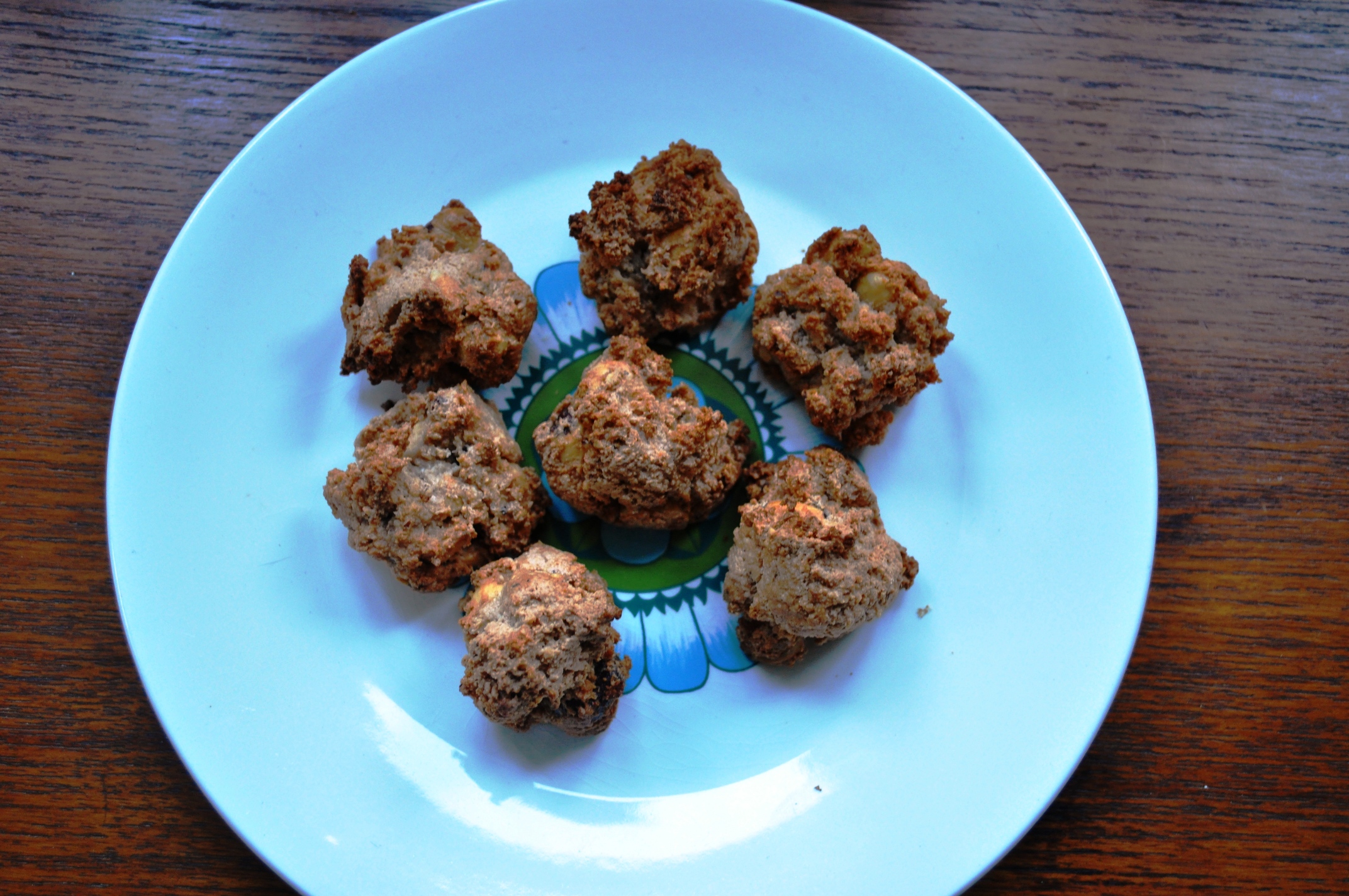
Brutti 3, plate

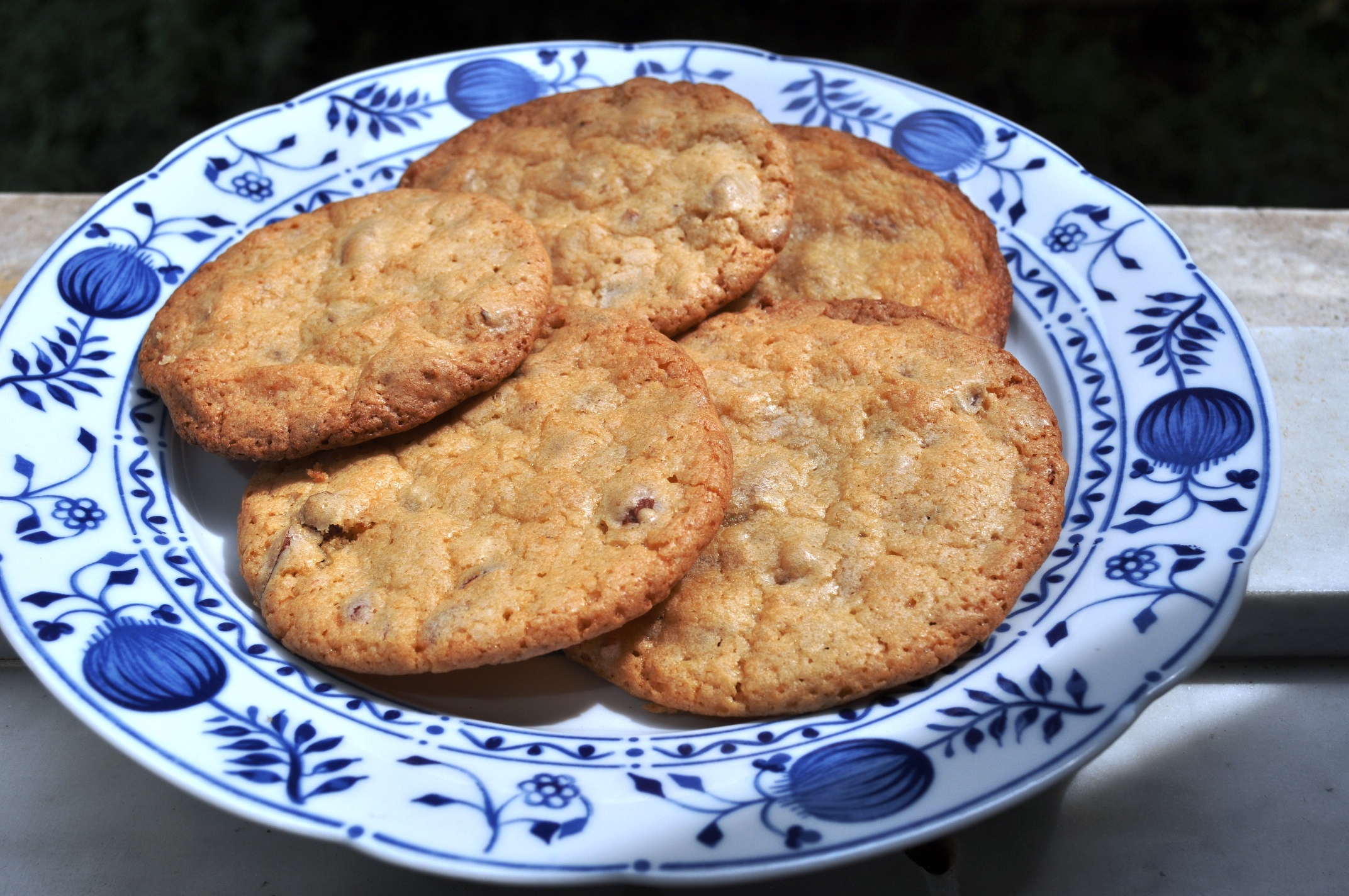
This is the third recipe for brutti ma buoni – Italian “ugly but good” hazelnut cookies.

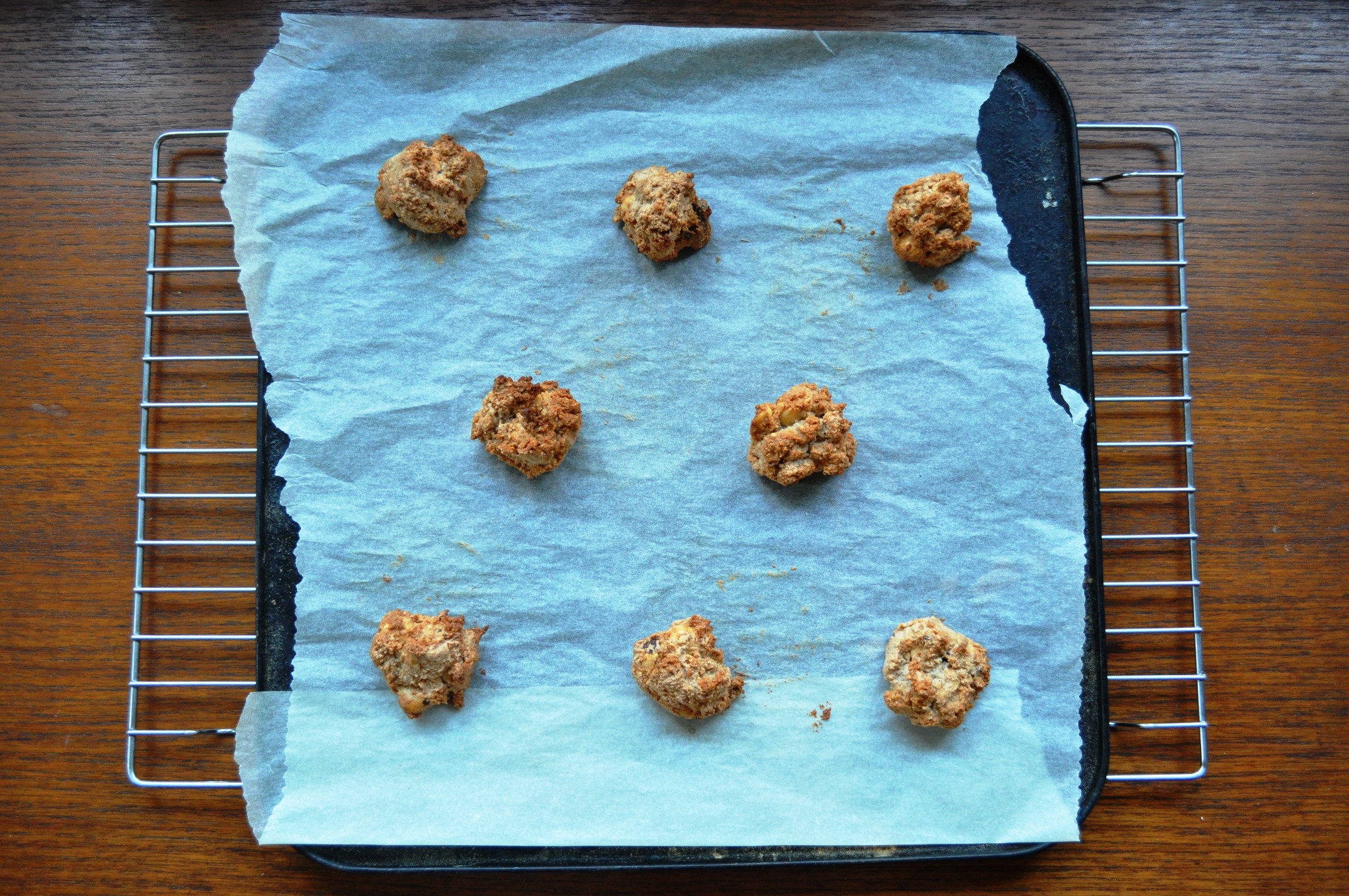
It’s very different to the others I’ve tried, or read, as it doesn’t involve whisking the egg whites. All the other recipes I’ve seen involve whisked egg whites, resulting in cookies with a meringue or macaroon-type character. Not these, which are still delicous, but much more crunchy little lumps, reminiscent of coconut macaroons, unlike the more disc-like previous version I tried, or the knobbly mounds of the first recipe I tried.

So many variations with so few variables!

Anyway, this recipe is from my favourite baker, Dan Lepard (whose personal site is still pending an update; it’s been down for yonks now, sadly!). His recipes in the Guardian newspaper are almost always reliable, and I recommend the book that collects them, Short and Sweet. I also heartily recommend his bread book, The Handmade Loaf. Of the three recipes I’ve tried for brutti ma buoni, however, I must admit this is my least favourite: I just prefer the texture when the egg whites are whisked.

The full recipe, along with Dan L’s panettone recipe, is available here.

Brutti 3, baking sheet

5 Comments

Filed under Biscuits, cookies

Brutti ma buoni, mark II

On plate 3

Considering brutti ma buoni – Italian “ugly but good” – cookies are basically just made of nuts, egg white and sugar, methods of making them are surprisingly varied. How much albumen? How much sugar? Grind the nuts? All of them? How fine? Leave some whole? Whisk the egg whites? Cook the mixture in a pan? Include some cocoa? Never mind the question of using almonds.

The first recipe I tried was from the American Academy in Rome’s Biscotti book. They were good, but I wasn’t entirely satisfied. It’s taken me this long to get round to trying a different recipe. I thought I’d better try an actual Italian one, direct from an Italian source.

One of the biggest, perhaps the biggest, Italian recipe site is Giallo Zafferano (“Yellow Saffron”). When googling Italian recipes you may well get prompted to visit there first. Although I’m gathering other recipes, I thought why not start here? So here’s a tweaked, reduced translation of their recipe. The original makes “about 70” cookies, which seems excessive for domestic consumption – unless you’ve got a very big family that loves hazelnut meringuey things.

Even if you don’t speak Italian, it’s worth checking out the site for the pics of the procedure.

Makes about a dozen.

200g whole, skin-on hazelnuts
20g water
25g caster sugar
1/2 t honey
35g egg white (ie the white of one egg, more or less)
90g icing sugar

On tray

1. Gently roast the hazelnuts, at about 150C, until they’re starting to brown. Remnove but keep the oven on.
2. Rub the hazelnuts in a tea towel (which I believe you US lot call a “dish towel”) or cloth to remove the skins. Don’t agonise if a little bit stays stuck.
3. Divide the nuts in two, and coarsely grind half of them in a food processor.
4. In a pan, warm the water and caster sugar until the latter dissolves, then stir in the honey and allow to cool slightly.
5. In a clean bowl, whisk the egg white to peaks.
6. Slowly pour in the syrup, whisking constantly.
7. Keep whisking for another few minutes or so (the original recipe says 10, but this seems excessive), then sieve in the icing sugar.
8. Keep whisking for another few minutes. You’ve basically got a meringue mix.
9. Add the ground nuts, then the remaining, whole, nuts and fold to combine.
10. Line a baking sheet (or two) with parchment, then dollop dessertspoonfuls onto it, leaving space between for the cookies to flow and expand a bit while baking.
11. Bake at 150C for about 12 minutes, until they’ve coloured slightly or as the original puts it, until they’ve achieved “un colore leggermente dorato” (“a lightly golden colour”). Which seems a bit misleading, as egg while plus hazelnut doesn’t really equal golden. It’s more a pale brown.
12. Cool. I actually left mine to cool in the oven, turned off, as you would meringues.

The result is very nice, note unlike some hazelnut meringues I remember my mother making on occasion when I was a nipper. I still don’t think this is quite the perfect brutti ma buoni recipe though, so I’ll try another soon, specifically one that uses the technique where the mixture is cooked first before baking, drying it out more. Onwards, bakers!

2 Comments

Filed under Biscuits, cookies, Recipes

Cocoa and cookies

Cookies and cocoa

Or, “hot chocolate and biscuits”, if I’m being both more and less accurate, and true to my Britishness.

Having arrived back in Britain in the middle of the flippin’ winter, we’ve been drinking a lot of hot chocolate. Now, I’m quite fussy about my hot chocolate. So many cafes (especially those chain places) just fail straight off by serving tepid drinks that aren’t particularly chocolaty. Seriously, the description of the product is in the name: it needs to be hot, and it needs to be chocolaty.

It surprises me how long it’s taking for hot chocolate to be taken as seriously as coffee as a drink. Sure, it’s a hot milky drink, so is perhaps more of a winter drink – but having said that, most so-called coffees served by those chain places are basically just flavoured (warm, frothy) milks drinks too.

Surely hot chocolate deserves as serious attention as coffee? Single estate and all that.

I was discussing this with Michael Temple, proprietor of the Coffee House on Fisher Street in the historic heart of Lewes, East Sussex, and he agreed, mentioning that hot chocolate was popularised in Europe before coffee. Coffee spread from Asia and Africa into Europe, via the Arab world and trade through Venice, in the 16th century, with coffee houses starting to open in England in the second half of the 17th century. Chocolate – which was a bitter drink of the Aztecs – reached Spain with Cortes in 1528, and was soon developed into a sweet drink. The first chocolate house opened in England in 1657.

I’m not a coffee drinker – I’ve never enjoyed the taste of coffee – but strangely I do prefer my chocolate, and by extension, my hot chocolate, to be bitter with coffee-ish notes.  (Talking of which, I’m on a side-quest to try chocolate with the highest percentage cacao; tried Mr Popple’s 88% Strong yesterday. It’s only sweetened with yacón syrup – no, I hadn’t heard of that before either – has a great, gritty crunchiness, and flavour that’s coffee-ish and sharp.)

Mr Popple's chocolate

Taking hot chocolate seriously

Michael takes his hot chocolate seriously enough to offer two types, which he calls “Italian” and “Spanish”. The former is made with (French) Valrhona and is 50% cacao. It’s very good, especially as he serves it suitably scalding. I’ve found another that pips it though, and it’s a local brand. This is Montezuma’s, a British chocolatier founded in 2000 and based just outside Chichester, West Sussex. Sure, the cacao’s not British-grown, but that doesn’t trouble my locavore inclinations too much. After all – this is chocolate we’re talking about. One’s personal ethics have to have some exceptions.

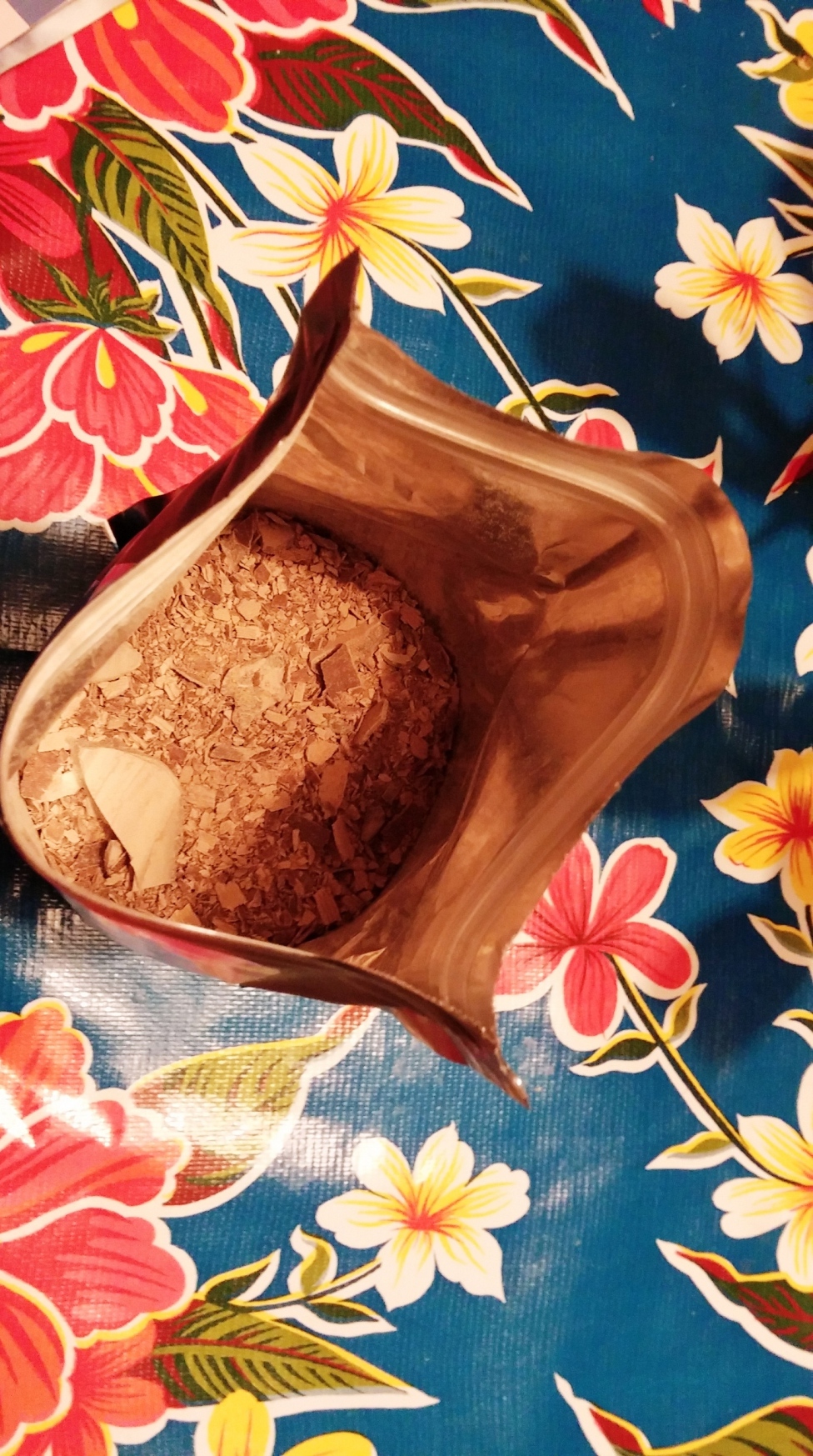
Montezuma’s do four hot chocolates at the moment, but I’m a purist so there’s only one for me: their Dark Chocolate, with 54% cacao. Years ago, I used to drink Green & Blacks, but by comparison that just seems too sweet and weak now (plus G&B sold out to Cadbury’s, who sold out to Kraft; meh). I also used to drink  stuff based on an original Sir Hans Sloane recipe that they sold at the Natural History Museum, but that brand was discontinued. Then we discovered Mortimer Chocolate Company‘s 70% chocolate powder. These guys take their drinking chocolate satisfyingly seriously, talking about blend and provenance in a language not unlike that used for coffee.

Leone and Venchi

In Italy, meanwhile, my favoured brand was first Venchi, then Fran found Leone, who did a 70% stoneground-coarse-granules hot chocolate. Montezuma’s comes in flakes and chunks, not granules, and is a thing of beauty, making a far superior drink to the other brand I bought recently – Clipper. Its powder form just seems oddly twee and lame in comparison to these chunky options.

Winter comforts

Drinking lots of hot chocolate is one of the great pleasures of winter, and has helped us through the past three weeks or so of largely miserable grey, wet, windy weather. It’s an even more pleasing, and comforting, experience when accompanied by some nice biscuits. So we had a little baking session. Fran did some shortbread from a Dan Lepard recipe in Short and Sweet. The results are good, though they have a little more chew than crunch.

I wanted something with a bit more snap, so I tried the Pain d’amande / Almond wafer cookies recipe in the American Academy in Rome’s Biscotti book.

As with most of the book’s recipes, it involves fairly large quantities and a fairly unclear, insufficiently tested, poorly edited recipe. Mine weren’t perfect, but dipped in hot chocolate they were yummy. They’re made with Demerara sugar, giving them a warm caramelly taste. The recipe called for slithered raw almonds but I only had flaked almonds, so used them. I think the cookies would have been better with the almond skin, so I’ll try that slicing whole almonds next time.

So anyway, here’s a recipe.

Almond wafer ingredients

40g water
110g unsalted butter
1/2 t ground cinnamon
150g Demerara sugar
70g whole almonds, sliced into slithers. Or flaked almonds if you CBA
150g plain/all-purpose flour
Pinch of baking soda
Pinch of salt

1. Warm the water, butter, cinnamon and sugar together in a pan. Melt, don’t boil!*
2. Pour the warmed mixture into a mixing bowl and stir in the nuts.
3. Sift together the flour and baking soda, and add, along with the salt, to the mixture.
4. Combine and form a dough.
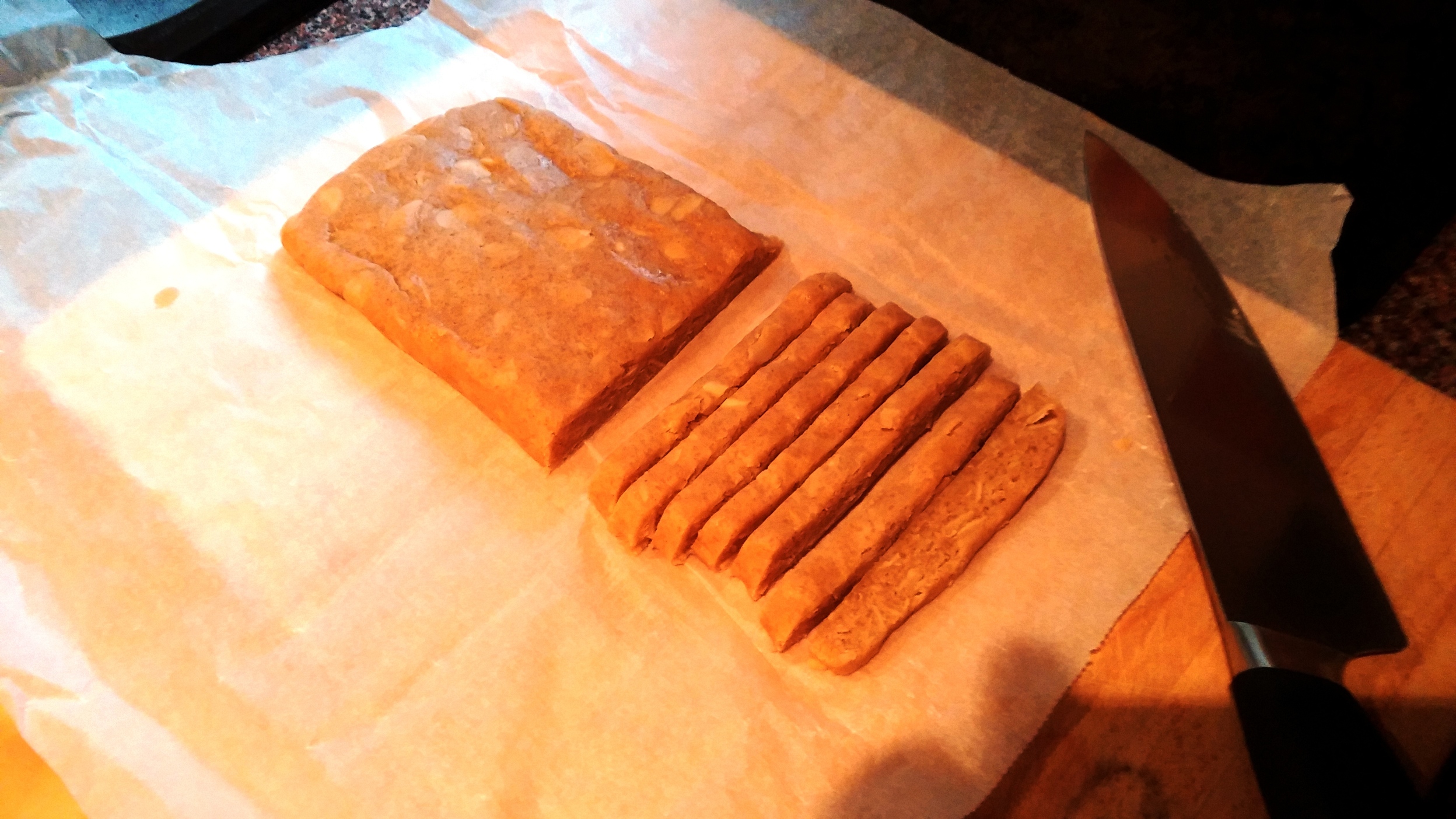
5. Shape the dough into a rectangle. You want it to be wide and flattish, about 25mm deep.
6. Wrap up the rectangle in plastic and rest in the fridge for about half an hour.
7. Preheat the oven to 160C.
8. De-fridge, de-plastic and the dough.
9. The slice rectangle across (not along) into pieces about 3mm thick.

Slicing the slab
10. Place on baking sheets lined with parchment and bake until golden. About 10 minutes.
11. Cool on a wire rack. They will crisp up as they cool.

Eat dipped in the best quality hot chocolate you can find. And made with flavoursome full-fat milk.

Now if only Montezuma’s would produce a 70%-plus hot chocolate to their range I’d love them forever. (Or at least until they sell to an ethics-free corporation. Please don’t sell out Montezuma’s!)

Montezumas Dark  Chocolate

(Oh, and if anyone has any WordPress wherewithal – why on earth would uploading just this one image have WordPress changing it from a landscape format 1747×983 image into a portrait format 976×1747 image?)

* I’ve been corresponding with Ilse Zambonini about these almond “wafers”, which she dubbed “dentist’s joy”. When you melt the sugar and butter, don’t bring it to the boil or you could make a caramel or even a very hard toffee! Also, when you slice, make sure they’re nice and thin, and when you bake, don’t over-bake. Follow these tips, and you’ll get a biscuit that’s crisp, but not too-breaking!

10 Comments

Filed under Biscuits, cookies

Ugly bread, pastries, lunch at L’Asino d’Oro, outer space and saucy suppli

Last loaf

The storms – apparently called Cyclone Penelope ­– arrived last night, rumbling over Roma and shaking our palazzo. I love being indoors, in bed, on such nights. Frequently in Rome, the stormy weather has the decency to blow over by the morning. Not so this morning though, when it was still raining buckets, piove a catinelle (where a catinella is a basin; I love the image of rain pouring down as if it’s overflowing celestial basins).

It looks like the Autumnal rain is settling in until we leave on Wednesday. In a way that’s just perfect – it’s re-acclimatising us to British weather. But it does look like yesterday was our last day that was dry enough for a long, casual, umbrella-less wander around town.

We started the day with a slice of bread – from the final loaf I’ll be baking in Rome. This was a bit of a disaster, but it was fun. It was a “using up leftover stuff before we leave loaf”. In this case meant a lot of seeds: specifically buckwheat, sunflower and poppy; and a some not-entirely ideal flour: 0 grano tenero (okay, fine), rice and amido di mais. The latter is what we’d call cornflour in the UK, meaning corn (maize) starch, so more a thickening agent than a bread ingredient. Hi ho. It felt like a good dough when I added the seeds, but went strange after that.

Adding seeds

As Fran pointed out, the resulting loaf looked like a giant brutti ma buoni  (“ugly but good”) cookie. It was pretty solid and, er, I might have forgotten to add any salt. But that’s fine: a lot of traditional bread from Tuscany and Umbria doesn’t contain salt, and as such is good for strongly flavoured bruschette. Not sure the seedy stuff will work as bruschette, but it’s good with good old Marmite.

We headed out down the hill, through Trastevere, past the enjoyable window displays of vintage pasticceria Valzani. This included their selection of “tea biscuits”:
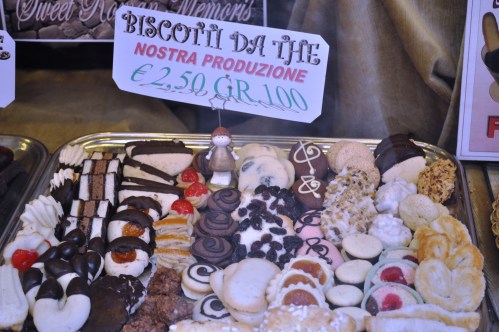
Valzani tea biscuits

Then slices of pangiallo romano, which literally means “yellow bread” and is a type of hard Roman  Christmas cake, made with honey, nuts and dried fruit; and panpepato (aka pampepato), a similar cake that originates from central Italy and, as well as containing dried fruits, candied fruit and nuts also contains spices like cinnamon and nutmeg, and even chocolate.

Pangiallo, panpepato at Valzani

Then the Roman version of the Campania sfogliatella, which look kinda squashed compared to the more refined Neopolitan sfogliatella riccia. Indeed, compared to say French patisserie, Roman patisserie often has this seemingly crude finish – but I like that, it’s less poncey. Alongside was a tray of cannoli siciliani, then a tray of maritozzi, Rome’s epic cream buns, which I made over here.
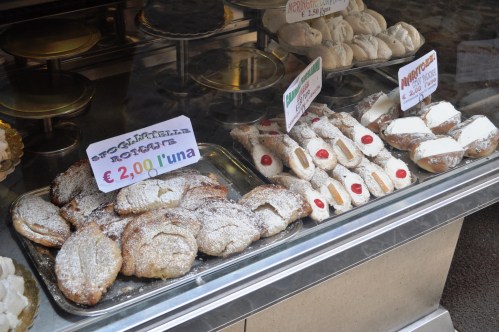
Valzani sfogliatelle romane, cannoli, maritozzi

After meeting a friend in the street, who was discussing the possibility of opening a café, we headed over Ponte Sisto into Regola, rione VII. Past this fab old sign for a biscuit shop that, sadly, isn’t a biscuit shop any more.

Biscotteria sign, Via dei Pettinari, Rome

We stopped at I Dolci di Nonna Vincenza (“Grandma Vincenza’s Sweets”), a Sicilian pasticceria chain that opened a branch here about a year or so ago.
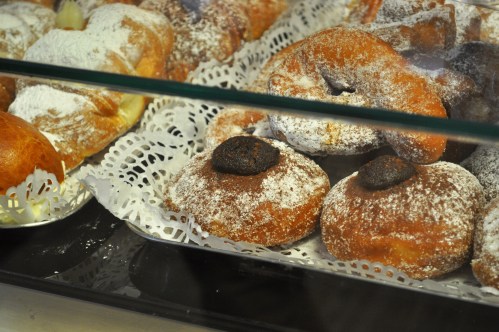
Brioche, ciambelle, Nonna Vincenza

It’s a bit cutesy, but the doughnut-type thing (“È una tipa di ciambella”) we had – that wasn’t the more common ring-shape of ciambelle, but more a knot – was good.

Ciambella, Nonna Vincenza

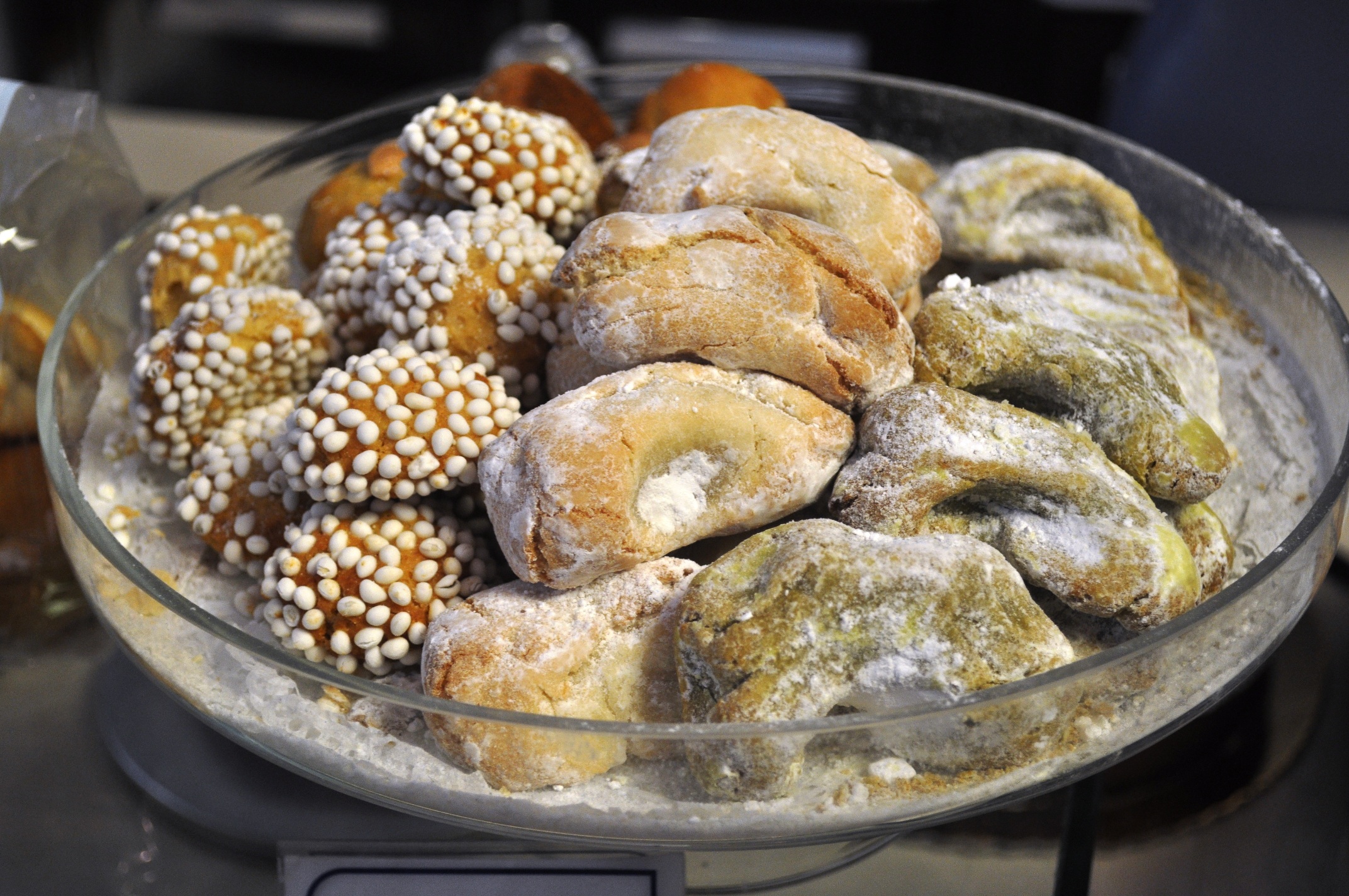
I got some almond paste cookies that were pretty good too.

Biscotti, Nonna Vincenza

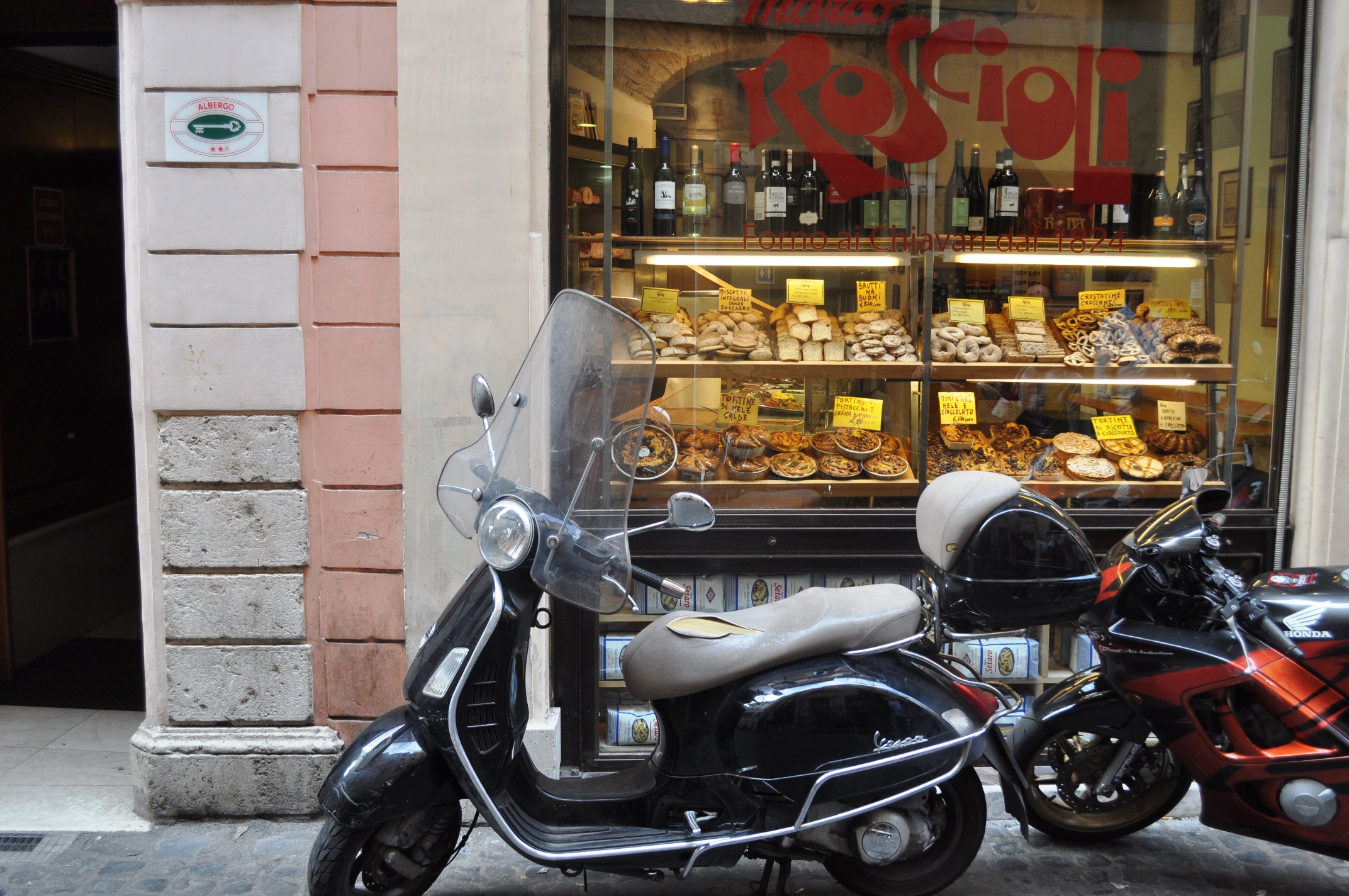
We chilled out on the pastry indulgences after that, even managing to walk by the justifiably renowned, somewhat pricey Roscioli bakery without buying anything.
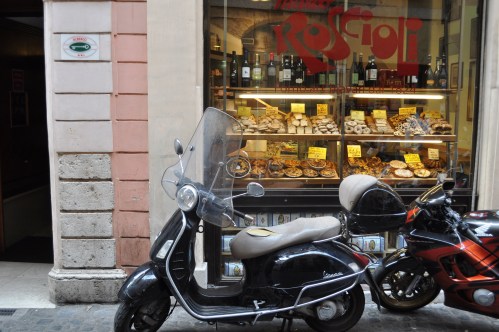
Roscioli

We wanted to save space for lunch at L’Asino d’Oro in Monti, one of our two favourite Rome restaurants. Our other fave is Cesare al Casaletto, which we’d vowed to go to at least once or twice more before leaving, but had been confounded by forgetting which day was their riposa settimanale (weekly rest day), then it being fully booked, and then by discovering that they were closed for our final 10 days in Rome. Nooooo! Fortunately, L’Asino d’Oro hit the spot.

Asino D'Oro

This is a superb restaurant, where chef Lucio Sforza (who, Renaissance scholars, may or may not be part of that family) uses seasonal, local, quality ingredients and every weekday does a pranzetto for (currently) €13. This set “little lunch” changes every day and is a serious contender for the best value, best quality lunch available in Rome. Thirteen flippin’ euros for bread, antipasto, primo, secondo, glass of wine and small bottle of water! And it’s always been excellent, every time I’ve been, though I prefer Friday, as that’s Rome’s main fish-eating day.

We had a bruschetta with bean purée, the best broccoli soup I’ve ever had, pasta with a ragù of cuttlefish, and a fillet of scorfano (scorpion fish). We then decided to order some dessert (which isn’t included in the menu) and a glass of Marco Carpineti’s delicious Ludum Passito dessert wine. Just cos.

Passito and zuppa inglese, L'Asino d'Oro

I had a zuppa inglese, which is basically Italian trifle. Although the name can be translated as “English soup”, I like the slightly deeper meaning of zuppa as a reference to bread dunked in broth, from the verb inzuppare, to soak, to immerse. In the case of zuppa inglese, there’s sponge cake soaked in alcohol and custard. Going to miss these lunches at The Golden Ass (or The Golden Donkey if you have that troubling American-English relationship with that word). Veramente un buon rapporto prezzo-qualità!

Cafe 2Periodico, Monti

Afterwards we had tea in a favoured nearby café in Monti, 2Periodico, watching the world go by before we continued on our way… to the movies. What?! You could say. Why sit in a cinema when Rome is only your city for a few days more? Well, I used to be a film journalist, and just adore the big screen and the darkened room. Plus, I fear a culpa d’aria got me so I fancied planting my donkey for a few hours, getting away from the tourist zombie hordes clogging up the streets.

Normally I cannot abide, and veto, 3D films, but the own lingua originale option was Gravity in 3D. And even with shonky 3D, in a cinema not designed specifically for 3D, it was an extraordinary experience. I’ve not felt that pushing-yourself-back-into-the-seat tension in a film for years.
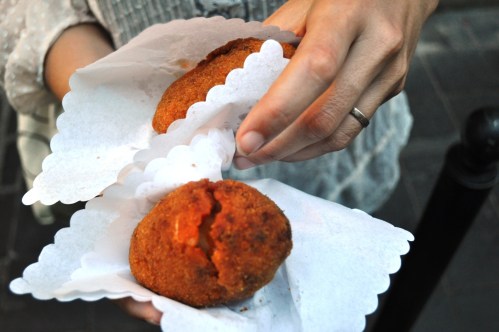
I Suppli, Trastevere

On the way home, we stopped in Via San Francesco a Ripa in Trastevere, buying some handmade chocolates from Dolce Idea to take home and a suppli from the small, seemingly nameless hole-in-the-wall pizzeria opposite to scoff straight away. It might just be called “I Suppli” as it has the word in green neon above the door. And rightfully so, as their suppli are great – the tomato risotto mix is very saucy, meaning they’re moister than many versions. Their structural integrity may suffer as a result but they’re so tasty.

So all in all a great day; eating and movies, two of my favourite things. I even managed an ale when I got home, so three of my favourite things.

Info
Pasticceria Valzani
Via del Moro 37b, Trastevere, 00153 Rome
+39 06 580 3792 | valzani.it

I Dolci di Nonna Vincenza
Via Arco del Monte 98a/98b, Regola, 00186 Rome
+39 06 92 59 43 22 | dolcinonnavincenza.it | arcodelmonte@dolcinonnavincenza.it

Roscioli (Forno)
Via dei Chiavari 34, Regola, 00186 Rome
+39 06 686 4045

L’Asino d’Oro
Via del Boschetto 73, Monti, 00184 Rome
+ 39 06 4891 3832

2Periodico Café
Via Leonina 77, Monti, 00184 Rome
+39 06 4890 6600

Dolce Idea
Via San Francesco a Ripa 27, Trastevere, 00153 Rome
+39 06 5833 4043 | dolceidea.com | info@dolceidea.com

Nameless Pizzeria (“I Suppli”?)
Via San Francesco A Ripa 137, Trastevere, 00153 Rome
+39 06 589 7110

1 Comment

Filed under Bakeries, Biscuits, cookies, Cakes

Red wine and chocolate ring cookies, or Ciambelline al vino rosso e cioccolato

Red wine and chocolate ciambelline, Ciambelline al vino rosso e cioccolato

These are a long way from authentic ciambelline al vino – ring cookies that are normally made plain or flavoured with fennel or anise seeds. But hey, I love chocolate. Chocolate doesn’t seem to play a big role in Italian biscotti etc, but as we’re moving house soon, and I have a large pot of cocoa in the cupboard that needs using up, I thought I’d try chocolate ciambelline.

Plus, we had a bottle of red wine that also needed using up. This cost us the princely sum of €1.50 so was clearly seriously and definitely hardcore cooking wine; or very desperate-at-the-end-of-an-evening-wine; or Withnail wine (“This is a far superior drink to meths!”).
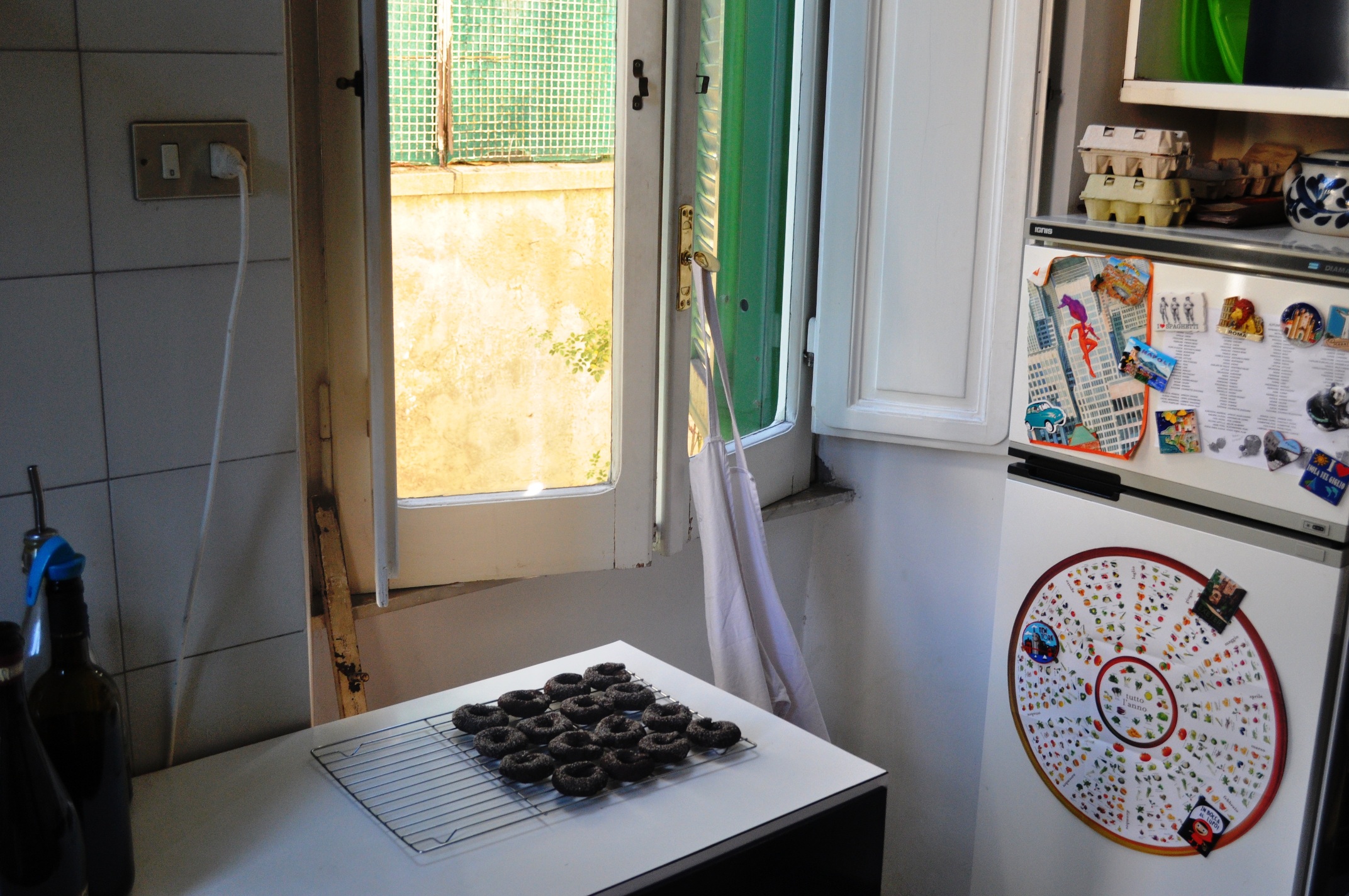
We also had a bar of chocolate and did chop it up and add it to the mix, but it caused problems with the rolling: the chips kept severing the dough. So if you do it, I’d recommend either chopping the chocolate up into small pieces (I’m talking chips of a just a few mm) or leaving it out completely. Ditto, some slithers of almond would be nice, but they’d have to be small or they’ll compromise the structural integrity. You don’t want a hull breach. (Sorry, going a bit Star Trek.)

Kitchen

Anyway, ciambelline are classic Italian cookies that are often served with a digestivo after a meal. They’re related to taralli, which are almost like hard-baked bagels (and, indeed, they’re boiled in water before baking), and tarallini, which are smaller versions thereof. I’ve generally encountered savoury taralli and tarallini, but in one seafood restaurant we like in central Rome, they serve you a Vin Santo desert wine with a few small, fennel-seed flavoured sweet ring biscuits that they call tarallucci.

So, as with so many Italian nouns relating to food, usage is fairly mutable! (Depending on region, slang, dialect, inclination, family etc.)

So anyway. Here’s my recipe. Bear in mind, these sorts of recipes are traditionally made with the whole qb approach: quanto basta, “how much is enough”. I always prefer to use grams but if you do make these, and you feel your dough isn’t quite right, just follow your instincts and adjust the amount of liquid or flour.

360g flour
50g cocoa
150g sugar
160g extra virgin olive oil
160g red wine
(Optional: 50g dark choc, cut in small pieces, or some small slithers of nut)

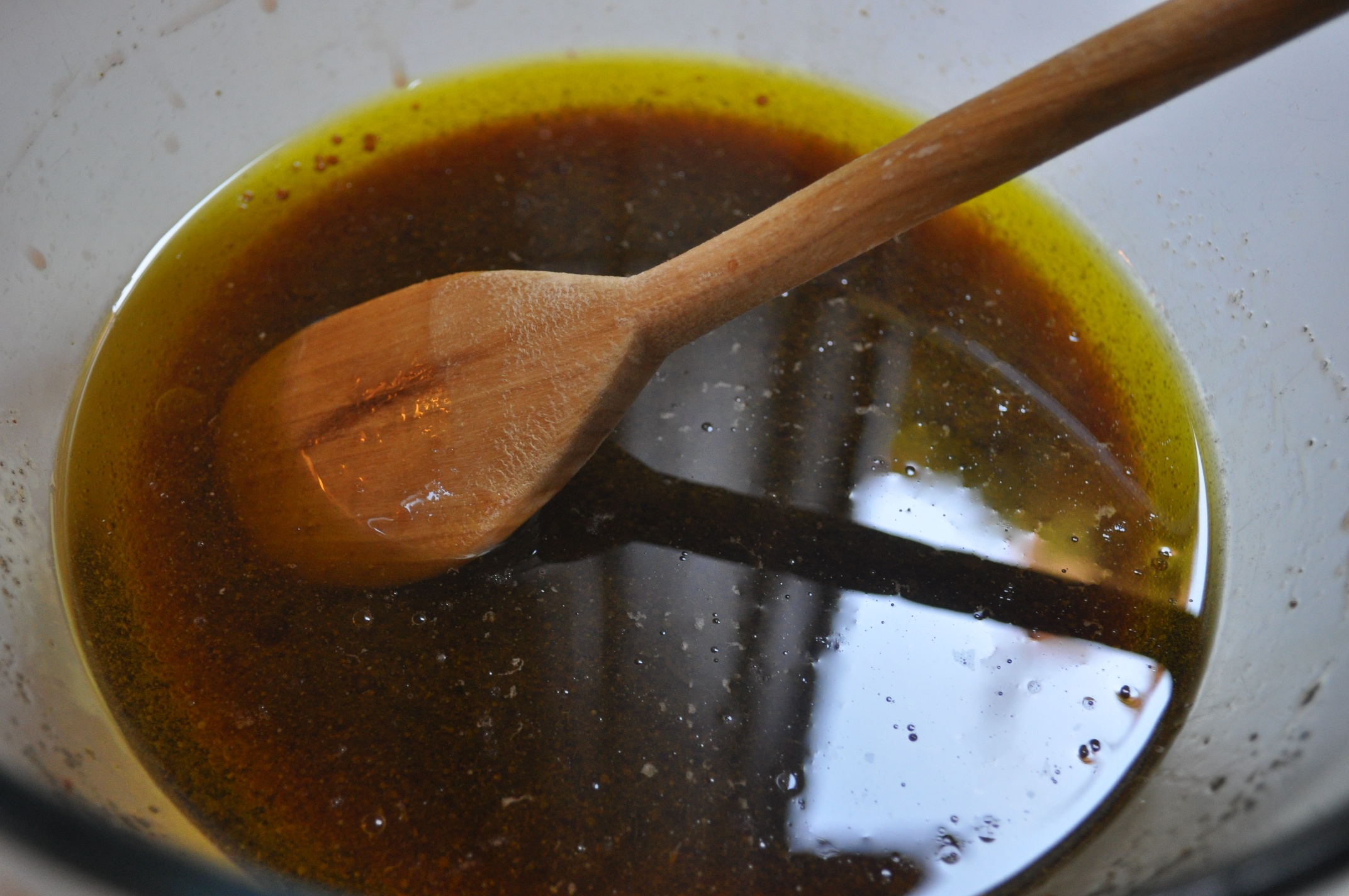
Red wine and chocolate ring cookies, or Ciambelline al vino con il cioccolato mix

1. Combine the wine, oil and sugar.
2. Sieve in the flour and cocoa, stirring.

Red wine and chocolate ciambelline, Ciambelline al vino rosso e cioccolato
3. Form a dough. Add more flour if it’s too wet, more oil or wine if it’s too dry.
4. Rest the dough, for about half an hour, to let it relax.

Red wine and chocolate ciambelline, Ciambelline al vino rosso e cioccolato
5. Preheat the oven to 180C.
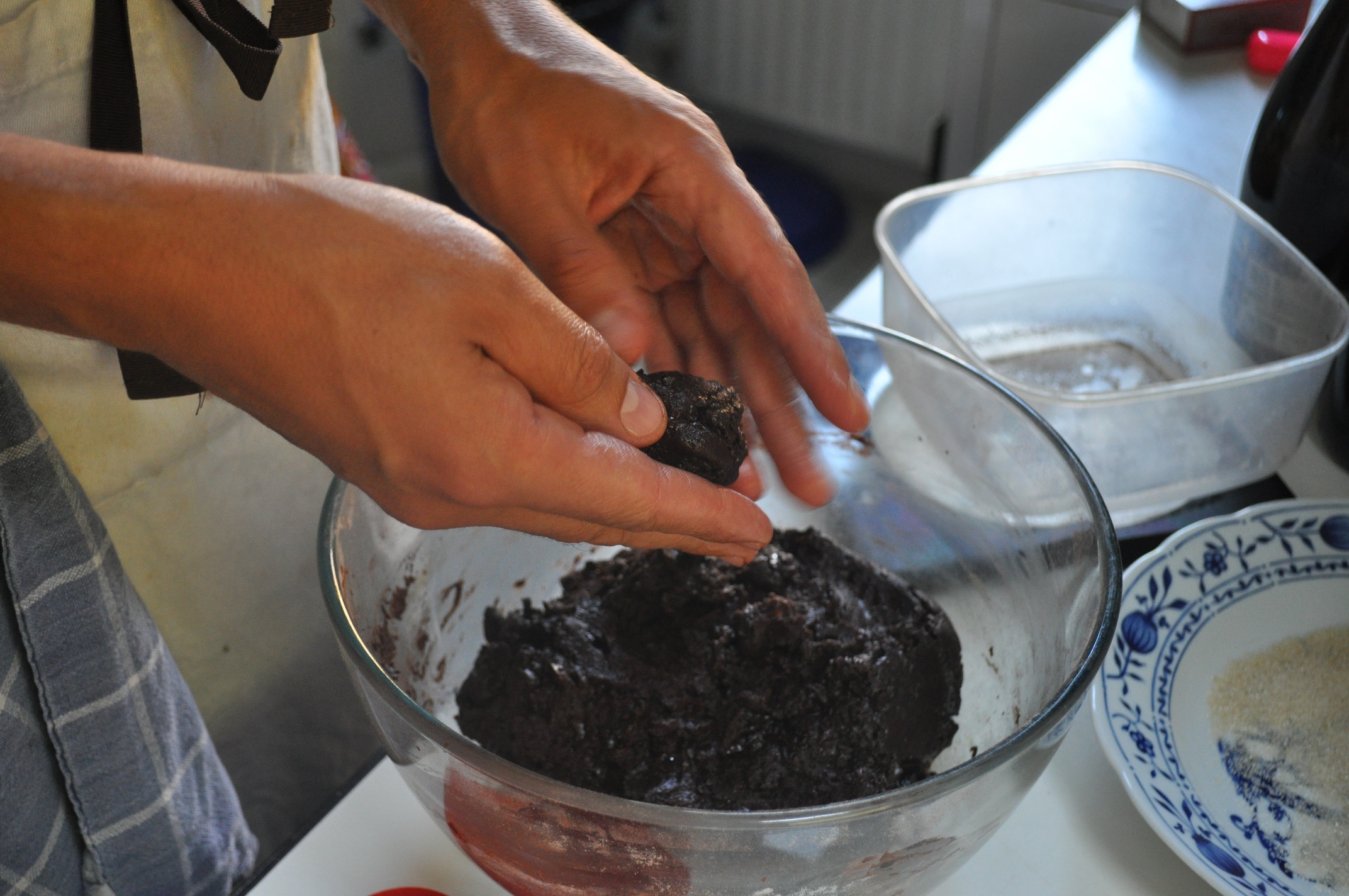
6. Form balls, about the size of a walnut. I went for a scaling weight of 30g, but ciambelline are often bigger, so you could go for 60-80g. Whatever you prefer.

Red wine and chocolate ciambelline, Ciambelline al vino rosso e cioccolato
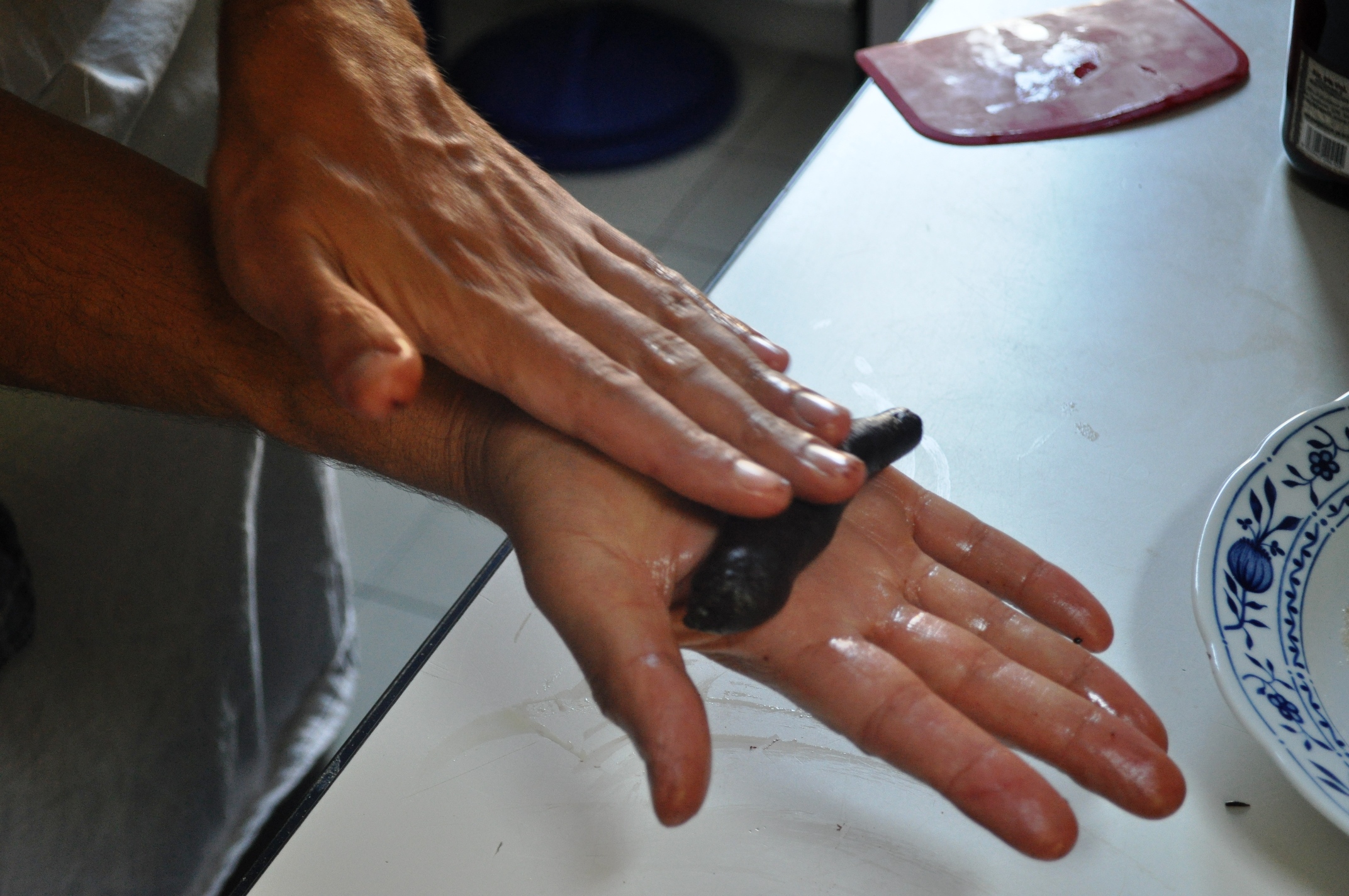
7. Roll the balls into sausages.
8. Form the sausages into rings, pinching together the ends.
9. Dip the top in granulated sugar.

Red wine and chocolate ciambelline, Ciambelline al vino rosso e cioccolato
10. Place on a baking sheet, lined with parchment.
11. Bake for about 20 minutes, depending on your oven.

Red wine and chocolate ciambelline, Ciambelline al vino rosso e cioccolato
12. You can crisp / harden them more by leaving them in the oven, switched off, while it cools. Though these harder ones may need stronger teeth / liquids for dipping and dunking.

Now of course, there’s something else about these ciambelline that’s so far going unsaid. It’s the elephant in the room of this recipe. If you don’t have appreciate scatological humour, browse away now! If you’re not easily fazed, scroll down and highlight the black.

Oh dear. Oh dear oh dear oh dear.
So yes, they look like poo. Especially when I was making them. All that cocoa and glistening olive oil – poo, or at least joke-shop plastic turds. And when I rolled them in the sugar, I couldn’t help thinking of the saying “You can’t polish a turd… but you can roll it in glitter.” But then, thought I, worry not: what could be more perfect in Rome, a city that’s totally and utterly and liberally decorated with dog mess, than a ciambelline of that resembles these pavement obstacles? (Our v borghese neighbourhood is especially bad – worse than Paris in the 1980s, and that’s saying something.)
Sorry.

1 Comment

Filed under Biscuits, cookies, Recipes

Pine nut cheesecake, or cheesecake della nonna

Pine nut cheesecake, cheesecake della nonna

If you’re in a Roman restaurant and they offer you desert, it’s quite likely you’ll encounter torta della Nonna – that is “Grandma’s tart” or “Grandma’s cake”. I’m not sure about the labour laws, but all this pudding-making must keep granny pretty busy.

Sources vary, but torta della nonna is either a Florentine or a Ligurian dish. Though surely any nonna has her own torta? There are variations, but most commonly in Rome it’s a tart made with a sweet pastry crust and a filling based on custard and/or ricotta. Its defining feature is pine nuts, pinoli.

This post isn’t, however, about torta della nonna. As I had some leftover cookies that had been smashed on their journey to and from the park for a picnic on Sunday, I thought I’d make a cheesecake with a della nonna twist: ie, with the addition of pine nuts.

A note on the cookies
I made some cornmeal cookies – they were basically like a digestive, but with a slightly different crunch, and a few spices (cinnamon, ginger). They worked well, but you can use whatever biscuits you like: digestives are most typical for UK cheesecakes, US recipes use graham crackers. My friend Juli-from-Jersey said the cornmeal cookies reminded her of snickerdoodles, though they’re cookies with a name so ridiculous I can’t quite bring myself to discuss them.

I won’t include the cornmeal cookies recipe, but will say digestives are so easy to make you don’t need to reach for some plastic-wrapped stuff from a factory. I’ve included a simple recipe at the bottom of this post. If you do use this recipe, I’d add some cinnamon and ginger to the crumb base mix.

A note on the candied peel
Only use your own candied peel, or other hand-made stuff. Don’t use that yucky sticky stuff you get in tubs from the supermarket. Peel is easy to make. Honest. Just Google it, if you’ve not tried before. I’m still using some of my candied-vodka-infused-kumquats-from-the-garden-peel.

A note on cheeses
Often, cheesecake recipes will just say “cream cheese” in the ingredient list. It’s a bit vague. Though perhaps it doesn’t matter what cream cheese, as a baked cheesecake mixture seems pretty forgiving. Here I used mascarpone and robiola. The latter could be replaced with something like Philadelphia, if you really had to. You could also do, say, half-half mascarpone and ricotta. I might try that next time as you can get stupendous fresh ricotta here in Roma.

Pine nut cheesecake slice, cheesecake della nonna

Ingredients
Base:
40g hazelnuts
120g cookies/biscuits like digestives
60g butter

Cheesy bit:
250g mascarpone
200g robiola
2 eggs
Zest of 1 lemon
100g caster sugar
30g candied peel
60g pine nuts

To serve:
30g pine nuts
Icing sugar

Method
1. Pre-heat the oven to 180C.
2. Toast the hazelnuts until starting to brown.
3. Grind the hazelnuts in a food processor until fairly fine, then add the cookies and grind to a medium crumb.
4. Melt the butter in a pan, then combine with the hazelnuts and cookie crumbs.
5. Push the crumb mix into the bottom of a 20cm loose-bottomed cake tin.
6. Combine the cheeses, eggs, sugar, and zest, blending well by hand or with a handheld zizzer.
7. Finely chop the candied peel and add to the cheese mix, along with the pine nuts.
8. Pour the cheese mix onto the crumb base.
9. Bake for around 50-60 mins until the top is browning and even cracking slightly, and firm to the touch.
10. Remove the sides of the tin, and leave to cool completely.
11. When the cake is cool, toast the extra pine nuts and sprinkle on top, dusting the whole lot with icing sugar.
12. You could serve it with some whipped cream, for added deliciousness. We didn’t as it’s hard to get nice cream here in Roma, despite the cornucopia of other wonderful dairy products.

Extra! Free! Digestive biscuits recipe
90g butter
120g wholemeal flour
120g oatmeal
40g caster sugar
Pinch salt
Pinch baking soda
1 egg, beaten

1. Preheat oven to 200C.
2. Rub butter into flour, stir in the rest and bind with beaten egg.
3. Roll and cut out rounds.
4. Prick with a fork.
5. Put on baking sheet, sprinkle with oatmeal and bake in a hot oven till browned.

2 Comments

Filed under Biscuits, cookies, Cakes, Pies & tarts, Puddings & desserts, Recipes

Almond and candied peel cookies

Almond and peel cookies

A few weeks ago, I made some cookies using almonds and candied peel (ideally homemade, or at least handmade). The flavour was great, but the cookie wasn’t quite right. So I thought I’d try similar flavourings again, but with a much more basic cookie recipe. It’s v simple.

So here it is.

125g butter
100g caster sugar
75g soft brown or demerara sugar
1 egg (with the white and yolk weighing about 50g)
1 t vanilla essence
1 t almond essence
100g plain flour
80g ground almonds
1/2 t baking powder
1 t cinnamon powder
50g candied peel, roughly chopped
50g plain almonds, roughly chopped

1. Preheat the oven to 190C.
2. Melt the butter, then combine with the sugar in a bowl.
3. Add the egg and essences and beat.
4. Sieve in the flour, ground almonds, cinnamon and baking powder. The ground almonds probably won’t go through the sieve entirely – don’t worry, just dunk the rest into the mix.
5. Add the chopped peel and nuts, and combine to form a fairly loose cookie dough.
6. Put desertspoonfuls on baking sheets lined with parchment.
7. Bake the cookies for around 10-12 minutes, until browning nicely.
8. Cool on a wire rack.
9. Enjoy.

1 Comment

Filed under Biscuits, cookies, Recipes

Flapjacks

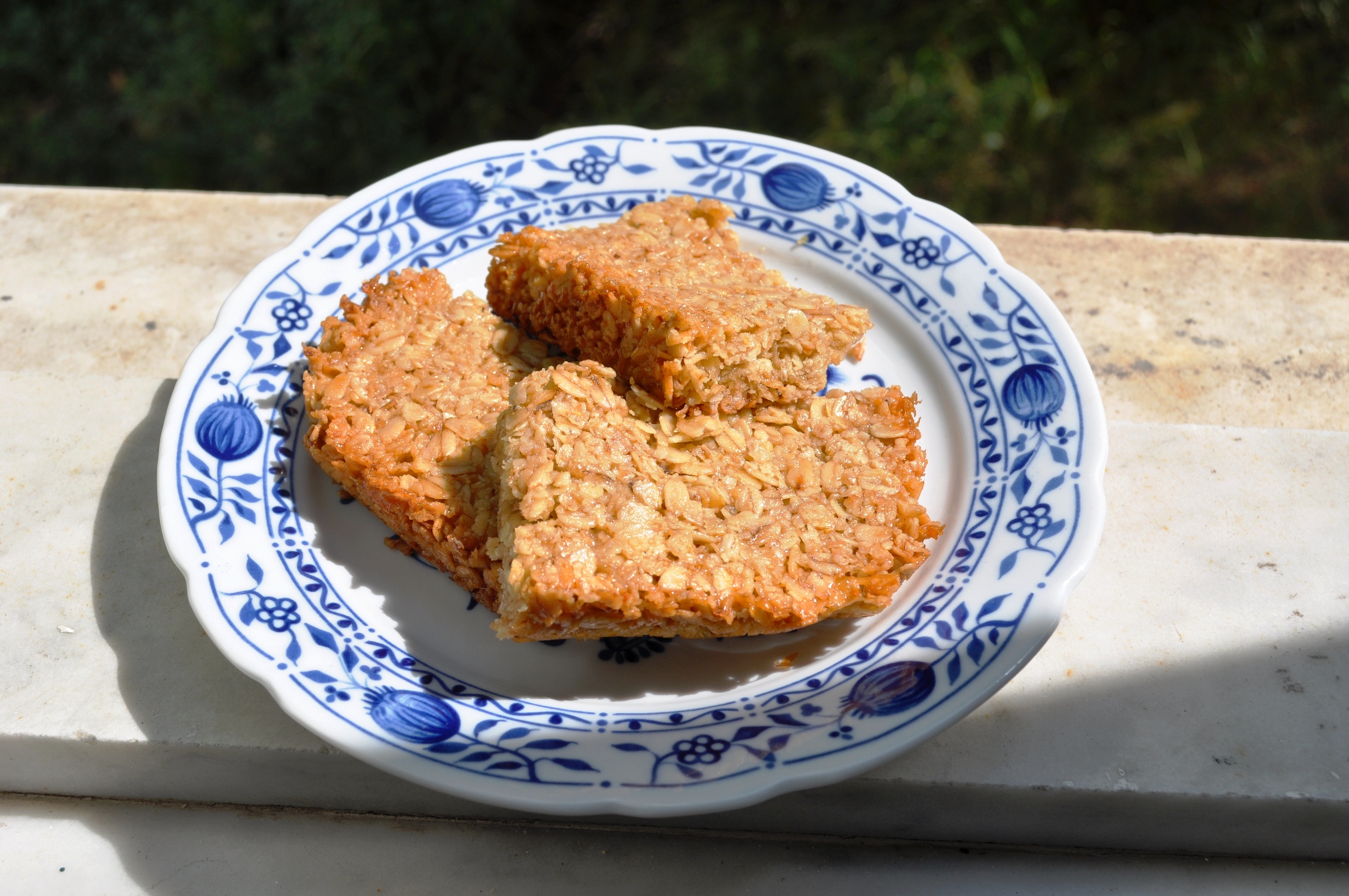
plate of flapjacks

Growing up in Britain, I was quite confused when I first heard the American English usage of “flapjack”. I ate a lot of flapjacks when I was a kid, and it was a staple of my university years, so the idea that the name could be used for anything other than a sweet slab of oaty goodness did not compute. Apparently the American usage of the word is for a pancake, something made with batter and fried in a pan. Wuh? What in blazes? What the flip?

I’ve experienced a lot of this low-level cultural confusion lately, having done three months in the kitchens of the American Academy in Rome. Some days I’d talk to a California colleague and they’d look at me totally blankly, following neither my accent nor my idiom. Other days, it seemed like everyone was doing comedy English accents, taking the piss. Anyway, I digress (as usual).

This is a flapjack. It’s made with rolled oats.

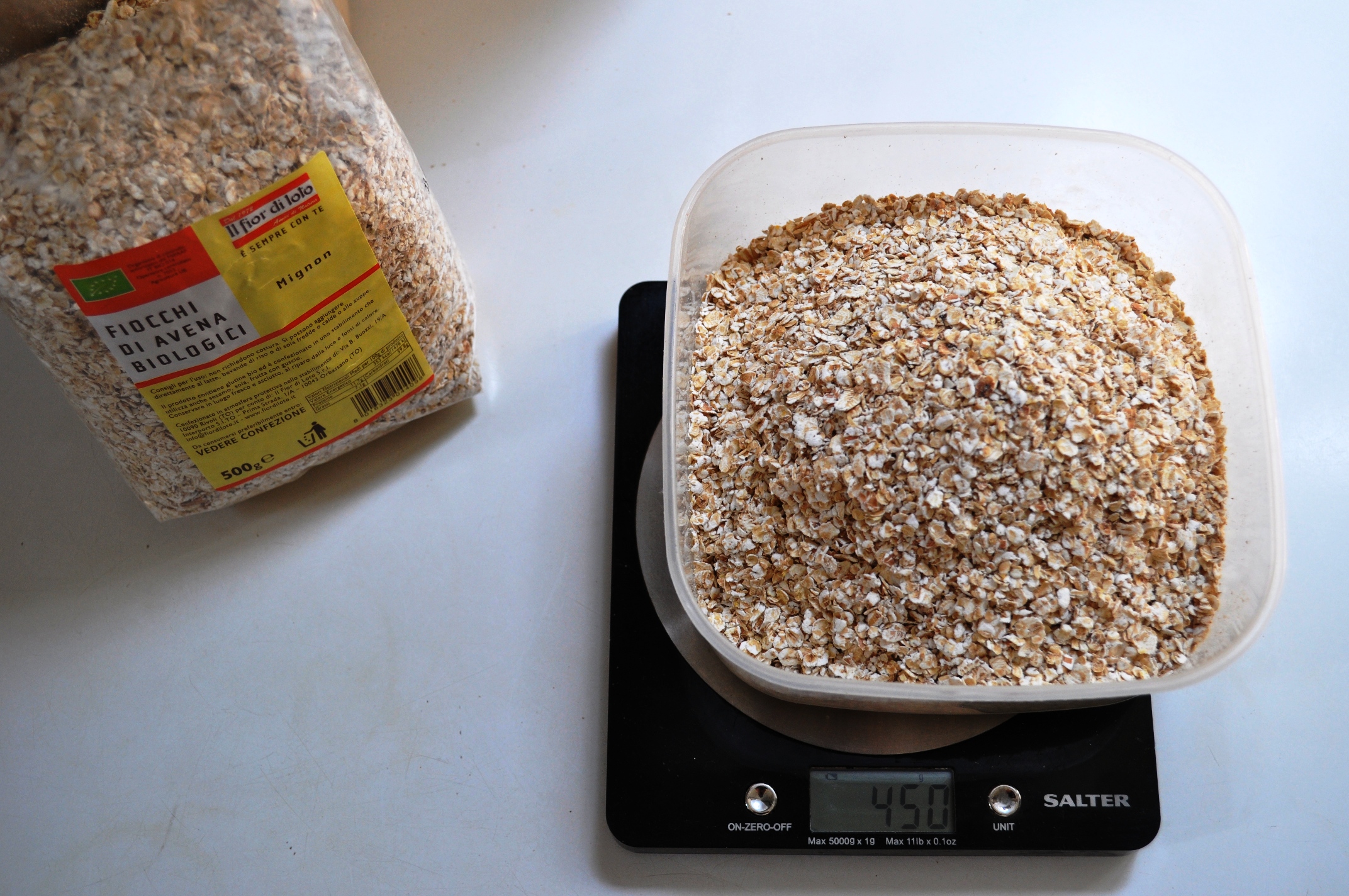
oats

We’re – finally – going hiking in the mountains this weekend, and when you’re hiking, you need energy food. Oats are perhaps the best straightfoward, real energy food you can get. Feed them to working horses and they’ll go and go. Eat porridge (gah – oatmeal!), muesli or granola for breakfast and you’re set till lunchtime. It’s all about the slow energy release from the complex carbohydrates. Oats are also great because the bran (the high fibre bit)  reduces low-density lipoprotein, or “bad cholesterol”. I should probably say “some research indicates” it reduces LDL or something, but I thought there was a pretty good scientific consensus these days. Oats are also high in protein – not the increasingly problematic proteins of starchy modern wheat, but a different type that’s reportedly akin to meat or egg protein.

Humble, but a real superfood.

So flapjacks are great. Except for the fact that, when making them, you undo a lot of the good work of the oat in its natural state by slathering it with butter and refined sugars, in the form of sugar and golden syrup.

Golden Syrup

The butter is essential for proper flapjacks, but what defines them is really the golden syrup. Ah, golden syrup. I believe this doesn’t exist many parts of the world, but in my British upbringing it was v important – notably for the quintessential winter steamed pudding known as treacle sponge. Which isn’t made with treacle (black, ie molasses) but is made with golden syrup (golden). It looks like honey, but is basically a viscous liquid sugar. Technically it’s an inverted sugar syrup. Felicity Cloake in The Guardian also dedicates one of her “How to make the perfect…” blogs to flapjacks. She discusses the whole crunchy vs chewy thing, so I’m not going to go into that. She also includes a link to this useful site, with an in-depth discussion of flapjacks.

Suffice to say, flapjacks are stupidly simple and unsophisticated, they’re packed with rolled oats, they’re very sweet, and they’ll help you get across mountains. I just hope it doesn’t thunder and lighting when we’re up there among the peaks of Abruzzo National Park, as that’d totally freak out Fran. And, as much as I’d dearly dearly love to see one of western Europe’s few (really tragically few – maybe a three dozen or) remaining brown bears, let’s just hope one doesn’t get too excited about the flapjacks, as that’s totally freak us both out. We should be alright; if they were made with honey, that’d be another story, as bears love honey right?

As for a recipe. Well, I made a lot of flapjacks when I was at universty, and played around with the recipe extensively. I’ve not made them for years though, and my recipe is tucked away somewhere, in another country, in a shed, in a box, in a knackered old blue scrapbook. So instead, I used Cloake’s, with a few minor tweaks that I’d probably tweak some more were I to make them again any time soon.

sugary fatty goodness

Preheat oven to 180C (160C fan).

Line a baking tin with baking parchment. Cloake suggests a 30x20cm tin, but I think these would be better thicker, so if you have a tin a size down from that, I’d recommend using it.

Melt 250g butter in a large pan, along with 70g of brown sugar (Demerara is traditional; I used more of a soft brown as sugar types are little different here in Italy to in the UK) and 150g golden syrup. (Guys – seriously, electronic scales, tare function, easy. Tablespooning golden syrup is messy and inaccurate. Not that accuracy really matters for a recipe like this. It’s not a fancy cake with exacting chemical reactions.)

When the mix is all melted, add 450g of rolled oats. You can use a mixture of jumbo and quick-cook porridge oats, whatever you fancy. Add a pinch of salt too, if you’ve used unsalted butter.

Bake for about 25 minutes until nice and golden brown. Mine are a bit underbaked but the darned oven in our rental flat has very aggressive bottom heat so I didn’t want to char the bottom trying to get a golden brown top. I’ve had a charred bottom before, and it’s not fun.

sugary fatty oaty goodness

3 Comments

Filed under Biscuits, cookies, Other food, Recipes