Category Archives: Biscuits, cookies

Honey, almond and peel cookies

fresh baked

This was a bit of a haphazard baking experience. I’d wanted to make some biscuits or cookies that included citrus peel, as I’d recently made some. I also wanted to try some more recipes from the American Academy in Rome’s Biscotti book.

It’s a handsome, nicely-designed book, and I know from working in the Academy kitchens that their biscotti and cookies are very good. But, like The Hummingbird Bakery Cookbook, Biscotti is a recipe book that really needed more testing, to make sure the recipes were scaled correctly for a domestic kitchen. Many of the recipes have large yields and rely on you having a proper food mixer. I don’t want to bake for 40 people, nor do I have a Hobart (I wish!).
melt honey and sugar 2

So I read the Biscotti di miele (honey cookies) recipe with some trepidation. It “Yields 60 cookies”. It doesn’t involve fat or eggs. It seems to rely on having a mixer. It uses baking soda, but doesn’t seem to have enough acid for the alkali sodium bicarbonate (baking soda) to react with – just some grappa. And even if it did, it says to rest the dough “in a cool place overnight (not in a fridge”). Which is confusing – won’t the soda just react with the grappa when they’re first combined, producing then dispersing the leavening CO2, then have not efficacy at all once it’s rested? Oh, and its summer here in Rome now, 35C-ish (that’s mid-90F, for you 19th century types) – so there is no “cool place” in my flat, beyond the fridge.

chopping peel

Still, I liked the sound of the flavours – honey, almonds, peel, some spices, so I plunged in. So this is my first attempt at a more domestic, less fussy version of these cookies. It’s not quite right, but the flavour is good. As I didn’t have any grappa (yuck), I changed the baking soda to baking powder, which is already combination of acid and alkali, designed to react and create leavening CO2 when heated. I also jettisoned some of the original recipes spices – cloves (because I find them a bit pungent, and too Christmassy) and nutmeg (because I didn’t have any).

chopping almonds

Ingredients
170g honey
125g granulated sugar
1/2 tsp almond essence
1 tsp baking powder
1/2 tsp cinnamon
260g plain/all-purpose flour
60g candied peel (I used my famous vodka-soaked kumquat zest, now candied), finely chopped
65g raw almonds, finely chopped, or indeed ground in a food mixer
50g (ish) milk
60g icing sugar + water for icing

bring together the dough

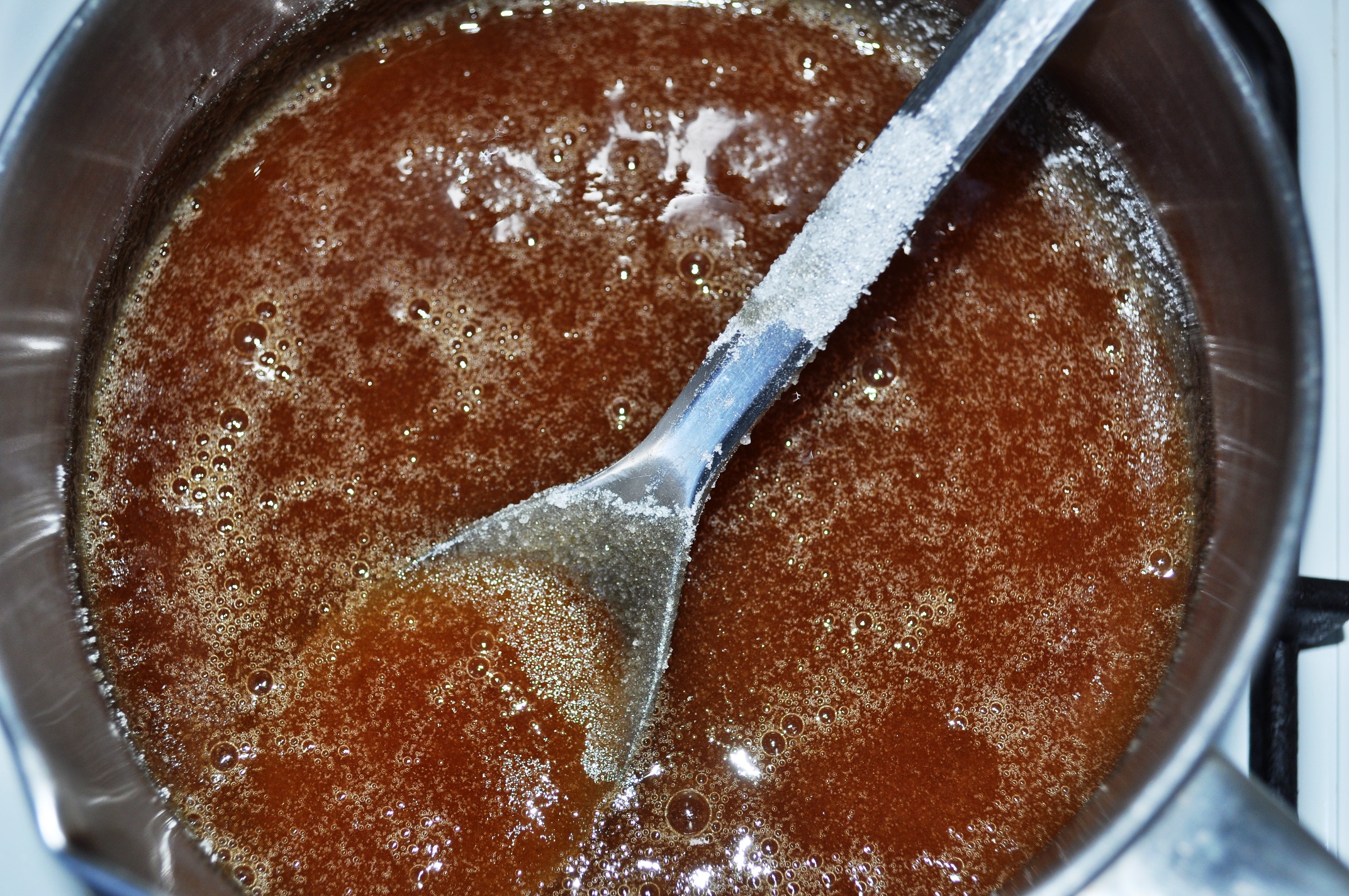
1. Melt together the honey and sugar, cooking until the sugar crystals have dissolvde.
2. Put aside to cool, adding the almond essence.
3. Sieve together the baking powder, flour and cinnamon.
4. Add the chopped almonds and peel to the honey.
5. Combine the gloopy honey mixture and flour. Ideally done in a mixer, but it’s possible by hand.
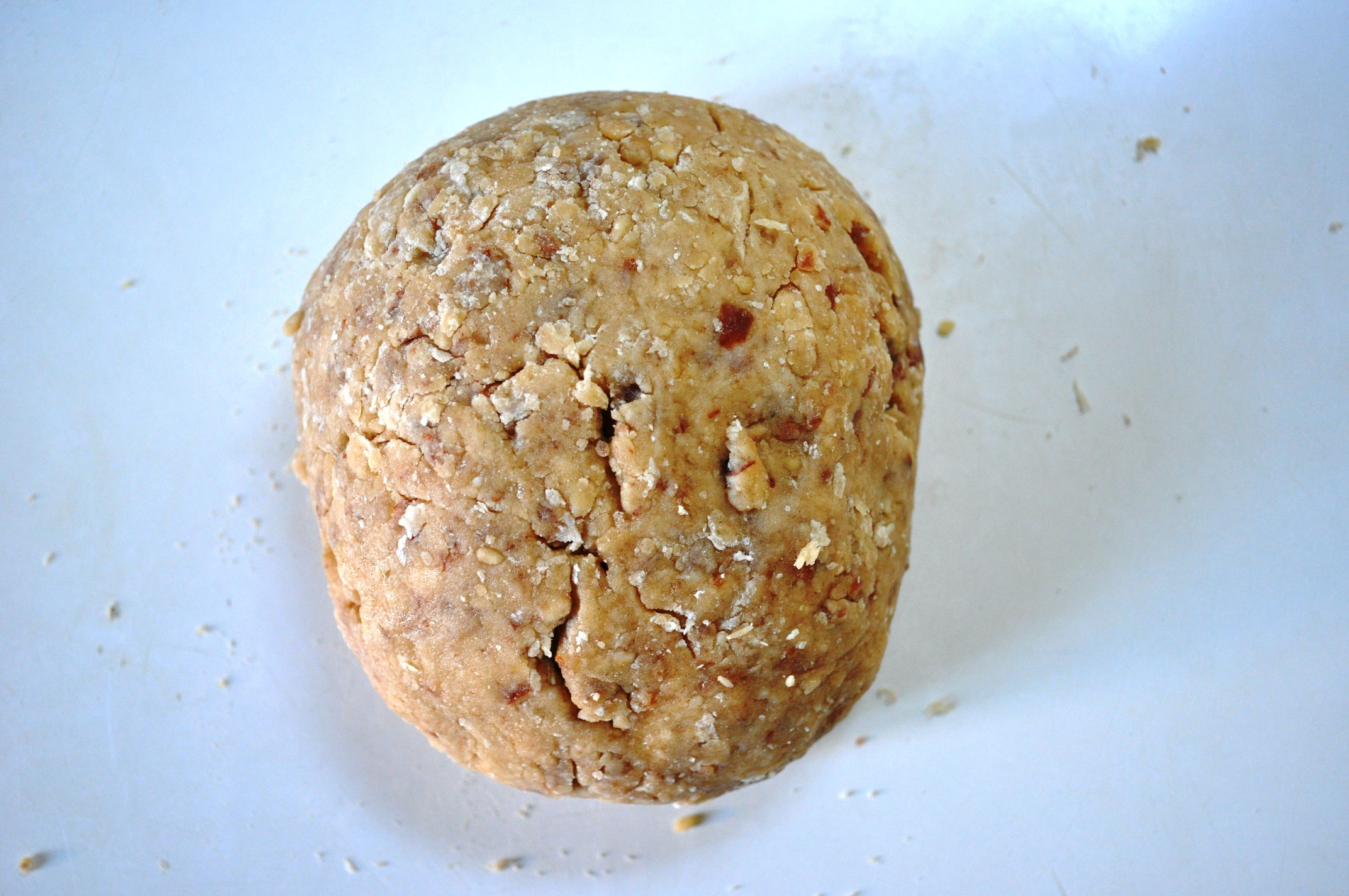
6. Bring to a dough. Add milk if it’s too dry.
7. Form a ball and rest, wrapped in plastic, for an hour or so.
bring together the dough 2
8. Roll out the dough thinly – less than 5mm ideally.
9. Cut with your cookie cutters of choice.
10. Bake on sheets lined with parchment for around 10 minutes in an oven preheated to 180C, until golden brown.
11. Place on a wire rack to cool.
12. While cooling, brush with a simple icing made from icing sugar mixed with water to achieve a runny consistency.
13. Allow the cookies to cool completely and the icing to set.
14. Eat, dunked in milky tea.

ready to bake

So yes, although they still feel somewhat experimental, these cookies were still delicious – particularly for the slight crunch of almond and the chewiness of the peel, the latter complimented by the cinnamon.

iced

1 Comment

Filed under Biscuits, cookies

Brutti ma buoni

Brutti ma buoni

The easiest way to describe Brutti ma buoni (“ugly but good”) is as nut meringue cookies. All the ones I’ve encountered in Rome have been made with hazelnuts, and many of the recipes online seem to be also. But there’s also a variant made with almonds.

Italian Wikipedia says they’re also called Bruttibuoni, made with almonds and are from Prato in Tuscany. I suspect a lot of other Italians might take issue with that though, as they do seem to be a fairly widespread. Indeed, a bit more googling, and another source claims they’re from Varese, in Lombardy, north of Milan. Yet another calls them Brut ma bon (a more French-sounding dialect name) and gets even more specific about their origin: not just Varese, but Gavirate, a town in the vicinity of Varese.

Hazelnuts reading for roasting

Whatever the history, bottom line is that they’re a meringue-type cookie (ie made with egg whites, no fat and little or no flour) that are rich in chopped nuts. Heck, even us Brits have a traditional hazelnut meringue, so I’m really not sure it’s the sort of recipe anyone can really stake a claim to.

I decided to make some as we had some egg whites left in the fridge from making custard. The recipe I used is from Biscotti: Recipes From The Kitchen Of The American Academy In Rome. It’s the third recipe I’ve tried from there following the wonderful Honey and farro cookies, and the Pinolate (pine nut cookies). I need to try the latter again before I blog it as my first batch wasn’t quite right.

Chopping nuts

Anyway. While baking these this morning, I looked around to compare recipes, and – would you Adam and Eve it – my favourite baker Dan Lepard published his recipe a few weeks ago in The Guardian. It’s an indication that despite how basic these cookies may be, there are several approaches to the method. His doesn’t require the eat whites to be beaten, uses pre-skinned hazelnuts, and involves combining all the ingredients in a saucepan. I will have to try that for comparison. One day. Not today. Not when I’ve already got 30 biscuits cooling in the kitchen. Another recipe, from a Canadian cookbook, meanwhile, also involves cooking the sugar and egg whites together, then beating them. That approach is more like a classic Italian meringue, and certainly the results in the pics look more meringue and less cookie.

Sugar, beaten egg whites etc md

So. As usual, I’m tweaking as I go along. The original recipe made a lot of mixture, but as you turn off the oven at the end of baking and let the cookies cool inside – as you do with meringues – you either need a massive oven, or should do half quantities. So I’ve halved the original recipe. I’ve also added some almond essence – simply because it’s more explicitly nutty than just using vanilla essence. Ideally I’d use hazelnut essence but I don’t have any.

250g hazelnuts (with skin)
1 egg white
125g granulated sugar
1 teaspoon vanilla essence
1/2 teaspoon hazelnut or almond essence
5g plain flour
Zest of half a lemon

Heat the oven to 150C.

1. Put the nuts on a tray, then roast them for about 15 minutes.
2. Turn the oven up to 180C.
3. Take the nuts out of the oven and rub them with a tea towel. This removes some of the skin. Don’t agonise though. The inclusion of some skin adds a depth of flavour, IMHO. (I also prefer my peanut butter to be wholenut, skins and all.)
4. Put half the nuts in a mixer and give them a quick whizz. Just break them up. You don’t want to grind them.
5. Put the other half of the nuts on a chopping board and chop roughly. (The original recipe has you chopping them all by hand, but a) that’s labour intensive and b) I like the mixture of sizes and texture this method creates. Mades the results extra-brutti.)
6. Beat the egg whites to a soft peak.
7. Beat the sugar into the egg whites, to a firm peak, then add the essences.
8. Add the zest and flour to the nuts.
9. Gently fold the egg white mix into the nuts.
10. Put teaspoonfuls on a baking sheet lined with parchment, leaving about 4cm between (though they don’t spread much).
11. Bake for about 12 minutes, until only just starting to colour.
12. Turn off the oven, leaving the cookies inside to continue baking as it cools. Leave for about 10 minutes
13. Remove and cool on a wire rack.
14. Enjoy.

Baked and cooling

3 Comments

Filed under Biscuits, cookies, Recipes

Biscuits and cookies – a note on terminology and etymology

Broadly, I’d say in the UK we use the word “biscuit” in the sense that the word “cookie” is used in the US.  For us Brits it means, generally, a small, flat (ish), sweet baked good that’s hard and rigid. Something you’d nibble and dunk in a cup of tea. They can be round or square or rectangular. They aren’t made with yeast, but could be made with chemical raising agents such as baking powder or bicarbonate of soda.

We do also use the word “cookie” in the UK, but I tend to use them fairly synonymously.

Which probably isn’t very helpful, as, for reasons revealed by a spot of etymology, they are technically somewhat different.

The word biscuit is from the 14th century Old French word bescuit. It literally means “twice-cooked”, or twice-baked and derives from bes bis  + cuire  to cook, from Latin coquere. The Italian word biscotti has an identical meaning. And indeed, the classic biscotti, the hard slices that you dunk in a digestivo or coffee – biscotti di prato, cantucci, cantuccini and tozzetti – are the best example of this process, as you bake the dough in a loaf form. You bake the dough in a loaf form first, then slice it, then bake the slices to crisp them up.

The word cookie on the other hand derives from the Dutch koek, meaning cake, in a diminutive form: “little cake”. Cookies are more technically, therefore, derived from a more cake-like dough or batter, often dropped in spoonfuls on a baking sheet, not manually moulded like a firmer biscuit dough.

Anyway, I’m going to keep my biscuits and cookies in the same category. But I will put crackers – basically savoury biscuits – in a separate category.

4 Comments

Filed under Biscuits, cookies, Discussion

Ciambelline con farro e miele (Ring cookies with farro and honey)

This is my first recipe from Biscotti: Recipes from the Kitchen of the American Academy in Rome, Rome Sustainable Food Project. The Academy is a handsome institution just along the hill from where I live. Since 2007, its kitchens have been run along sustainable lines, with an emphasis on local and seasonal ingredients. The Rome Sustainable Food Project has (so far) produced two recipe books, Biscotti and Zuppe (“Soup”).

Much as I love a good soup, that’s not the subject of this blog!

Anyway. These are lovely wholesome cookies, their flavour defined by the use of spelt (farro) flour and by your choice of honey. I used an Italian woodland honey, which is dark and has a deep robust flavour, almost smoky; if you used say a light, floral honey the flavour would be more subtle.

I tend to adjust recipes as I go along, so the below isn’t identical to what you’d find in the book. For example, I added some extra sesame seeds to the dough, as I like them.

Ingredients.
200g spelt flour (I used farro bianco – white spelt)
240g plain flour
12g baking powder
215g butter (if you use unsalted, you can add a pinch of salt to the recipe)
100g caster sugar
2 eggs
80g honey
15g vanilla extract
30g raw sesame seeds
Plus
1 egg, beaten
Extra raw sesame seeds and granulated sugar

1. Sieve together the flours and baking powder.
2. Cream together the butter and caster sugar, then beat in the egg, honey and vanilla.
3. Mix in 30g sesame seeds.
4. Make a dough by adding the flour to the creamed mixture.
5. Bring together then wrap in cling film and chill around half an hour.
6. Preheat the oven to 180C.
7. Line baking sheet(s) with parchment.
9. To make the cookies, pinch off lumps of dough around the size of a walnut. I went for 40g each, but I think 30g 10. might be nicer, for a slightly less macho cookie.
11. Roll the lump into a rope around 15cm long, then twist around the ends and pinch together.
12. Repeat until your baking tray is full.
13. I added an egg glaze to the original recipe to help with the adherence of the sesame seeds and granulated sugar that you sprinkle on the cookies.
14. Bake for 10-12 minutes, or until golden.

Unfortunately, my oven has a fierce bottom heat, and no fan, so the bottoms tend to brown before the tops, hence the variation in colour you see in the pic. No matter though – still yummy.

4 Comments

Filed under Biscuits, cookies, Recipes

Cute cookies

We had a bit of a baking frenzy in our house the weekend just gone. Which is actually fairly normal, but we possibly made even more stuff than usual on this occasion (not discussed here – a Madeira cake with fancy icing and some rolled fruit cookies), then fed a load of our ware to Ceri, Becca and Angharad for afternoon tea.

Fran made a big batch of vanilla cookie dough using this recipe:

225g unsalted butter and 225g caster sugar creamed together until light (by hand or with an electric beater).
Add 1 beaten egg and 1/2 t vanilla extract, and beat until smooth.
Incorporate a pinch of salt and 450g of sifted (or is it sieved?) plain flour, then bring together into a ball, or disc, and refrigerate for an hour or two.

It’s from Decorating Cakes and Cookies by Annie Rigg, a book that’s chock-full of cute and novel goodies. And some baddies too, as – and I’ve said it before – food colouring pastes can be really vile things, with some dubious chemical food colourings in them.

Still, we haven’t embraced the vile sugar pastes just yet. Instead, we tried to do most of our baking this weekend using ingredients that had natural colourings. This was a slight challenge for making the rather nifty Stained-glass biscuits.

We visited one of those cutesy “old-fashioned sweet-shops” that have become popular of late, but the shopgirl looked at us slightly blankly when we asked for simple boiled sweets. Really, if you’re going to work in an “old-fashioned sweet-shop”, at least learn some of the basic terminology. Hi ho. We did get a few types of sweets from there, but in the end, the best source for simple boiled sweets made with natural colourings was Sainsbury’s (called “Clear Fruits”).

So anyway – to make the stained glass biscuits, simple cut out shapes, then using smaller cutters, make holes. Place the biscuits on baking sheets lined with parchment, and fill the holes with boiled sweet that has been crushed (I found a pestle and mortar worked best). Bake at 180C (160C fan) for about 12 mins. Remove from the oven, then allow to cool – the crushed sweets will have melted, but will still be liquid, so leave 10 mins or so to allow them to set, then gently lift from the sheets.

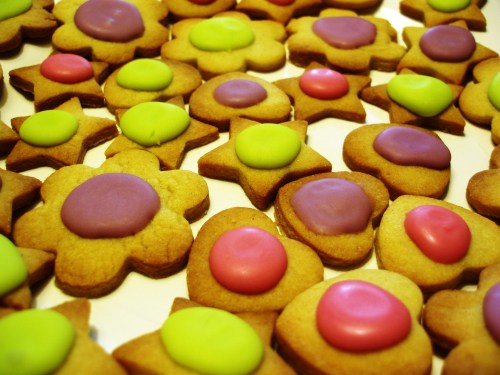
We used the smaller cut-outs to make iced-gem type biscuits (again, the colours here a result of using food colourings with natural ingredients – like spirulina for the green, heh). Very cute.

2 Comments

Filed under Baking, Biscuits, cookies