Category Archives: Main thread

Garden chairs, crutches, a cantakerous nonna

A common sight throughout Rome’s neighbourhoods are shops called negozi di casalinghi – basically homewares and tat shops – and ferramentaria – hardware shops. But we’ve been struggling to find some garden chairs, so we can actually take advantage of the communal garden of our palazzo. Contributions of our neighbour’s dog notwithstanding.

Finally, in our local hardware shop, they produced a catalogue. We went away to consider, then returned shortly afterwards to make an order. To find the shop – a vast space but with only about two square metres dedicated to customers – packed with people on crutches. Was it some kind of convention?

Anyway, as well-trained Brits, we dutifully queued. An old lady on crutches came in afterwards, accompanied by an even older lady (surprisingly not on crutches). The younger old lady took up a position beside us, and slightly to the front. Britons are famous/infamous for our queueing. Italians aren’t.

Despite the sprawling Aladdin’s cave that formed their domain, the two ironmongers themselves – a clueless older chap, and a younger chap who scurried up and down ladders, handling three orders at once – would reply to most enquiries with “Non c’è lo” (We haven’t got it), but confidenently assured the potential customers they knew what was meant. Each exchange took about 10 minutes.

Finally, the previous crutch-wielders in front of us, having dismissed all the screw options presented to them, vacated empty-handed – with some difficulty, as the 2m2  had become even more packed. The elder ironmonger then beckoned us forward. Prompting a furious micro-tirade, ejaculated by the older of the two ladies who had attempted to take up a position in front of us, something along the lines of “Damn these upstart foreigners, serve us first!” I didn’t catch the actual words, but the sentiment was clear.

She stood at my shoulder – well, more at my armpit as I’m tall and she was a little old Roman lady – glowering and grinding her teeth. The temperature in that 2m2 space seemed to drop a few degrees. Now, if my Italian – and possibly more importantly my Romano – was better, I could have engaged in the kind of feisty argument you frequently see among friends, family and strangers here. Sadly, it’s not, and, well, I’m too polite, so I just meekly put in “We are first,” and we went about our business with the older ironmonger, who delagated to the younger ironmonger.

The old lady – younger old lady – muttered a placatory “Mama…” and gave Fran, my wife, a vague “Sorry” look, though didn’t actually muster a “Mi dispace”. The ironmonger dealt with our order. The temperature rose again, crutches were shuffled and life went on in the Eternal City.

Of course, we then had to vacate the 2m2 space, shuffling through the crowd then running the gauntlet of the older old lady, now ensconced outside on a chair, with a ready glower. We avoided her eye. What we really should have done is glowered back, and vigorously employed the that quintessential Italian hand gesture, fingers together, pointing upwards, palm towards self, and the whole thing moved expressively, vigorously moved. “Boh! Che cosa vuole, nonna? Siamo stati certamente per prima!”

2 Comments

Filed under Main thread, Rome

Food ethics and seafood caveats

In my previous post, I talked about my enthusiasm for seafood, did a recipe for a Sicilian fish stew and talked about how useful I’m finding Alan Davidson’s book Mediterranean Seafood as I not only try to improve my seafood cookery, but also learn at least a few of the innumerable Italian names for fish etc. The recipe was very nearly accompanied by a caveat and some discussion of the ethics of eating seafood, but the entry would have just become too unwieldy.

So I’m doing it here instead.

My personal dietary inclinations are more towards fish and some seafood (love prawns and cephapods; not so keen on bivalves) over red meat, for example. For a while I was a vegetarian, a conversion that came as a result of living for five months at Newton Livery, a decidedly idiosyncratic small farm in New Zealand, learning that hey, eating without meat really isn’t that hard, and then coming home to the UK and pretty much immediately seeing a documentary on TV about the vile barbarism of intensive pig farming.

The imagery of a sow and her litter, struggling on a metal grill floor, in a dirty, confined space, brought about a minor epiphany. Mankind does not need to mistreat beasts through such husbandry when there are alternatives. And especially not animals like pigs, which are intelligent as dogs – an animal that people in the UK and here in Italy sentimentalise and anthropomorphise like there’s no tomorrow. Sheep – considerably more stupid – at least get to live outside.

I saw that documentary, and went vegetarian, in 1989, when the worst of the post-war intensification of food production in the UK was in no way balanced for the consumer by the option of free range and organic (or biologico as it’s know here in Italy), then the purview of a limited population of hippies and industry outsiders. Of course, I was fairly ignorant – I still ate dairy, blithe about the fact that its production is part and parcel of meat production, but at least I’d made an ethical step. Our obsession with meat consumption remains questionable, even in an era of less unethical alternatives like free range and organic for the simple fact of the calorific equation. To feed up beef cattle, for example, for the most part involves giving them considerably more calories in maize and other crops than the resulting meat gives the consumer in calories. And the more calories we use to produce food, the more extreme the environmental downsides – for example, in the fossil fuels used to transport those feed crops.

It’s an equation that most people, even the nominally ethical consumers, are oblivious to. It’s a particular problem in the early 21st century when developing world nations – China, India, etc– are rapidly embracing the kind of untenable red meat-based diets favoured by many Europeans and North Americans, hence the advent of the kind monstrously factory-style meat production exemplified by feed lots and Concentrated Animal Feed Operations (CAFOs), something that they are currently trying to popularise in the UK. Ethical issues aside, mega-ranch style farming just does not suit a small nation like the UK, where we’ve already seen biodiversity reduced markedly through the tearing out of traditional field boundaries, notably in places like East Anglia where the flatter landscape enables ranch-style farming. (And unlike in places like Devon, where the hillier terrain is at least preserving some aspects of Britain’s traditional plagioclimax environments, shaped by centuries of human intervention.)

There’s also the issue of methane – a natural gas produced in decomposition and in flatulence that’s also a potent greenhouse gas. Hence it’s a no brainer that the bigger our herds of cattle, the more the farting, the bigger the problem.

If you can’t face reading about such issues, I would recommend watching the feature documentary Food, Inc., which, in unsensationalist terms, evaluates the problems of these types of meat production, in both health and environmental terms.

Now I’m still a culprit, as a decade plus with my red-meat obsessive wife has re-calibrated both our diets somewhat – she eats less meat, I eat some – but I’d like to think we pursue a diet that’s at least nominally less unsustainable in planetary terms, eating locally produced food as much as possible, relying on pulses and grains – directly, rather than feeding them to animals to fatten them for meat. And only eating meat or fish a few times a week. While we have now been able to source some less unethical meat (locally bred, smaller scale, some free range or organic) in Rome via the two big weekend farmers’ markets at the Circo Massimo and in the Testaccio Ex Mattatoio, it’s hard to get a sense of how sustainably sourced any of the fish on the market or in restaurants is. Not very, I suspect.

Although I agonise (clearly) over food ethics, the question of seafood is something that has long confused me to boot. In contrast to animal husbandry, where an animal is bread specifically and living a life controlled by man, there are very different ethical issues at play in our consumption of the majority of seafood still. Notably for the simple fact that we are pillaging the oceans for food, exploiting a natural resource. (I don’t want to go into fish farming here, but suffice to say it’s not an easy solution – it’s potentially polluting, and like meat production involves a ridiculous calorific equation, where to produce say 1kg of salmon, at least 2.5kg of so-called forage fish, anchovies, herring, sardines etc, are required. Personally, I’d rather eat the sardines direct.)

Such exploitation was fine, arguably, prior to the human population explosion that accompanied the industrial revolution in Western nations and the comparable transition being undergone now by developing world nations. But today, everything we do is on such an vast scale it becomes untenable. It’s would be untenable for everyone on the planet to have a large personal vehicle and large air-conditioned house; but if one nation can live like that, who’s to say another cannot? Likewise it would be untenable for everyone – all seven-plus billion of us – to have eggs or bacon for breakfast and a steak for dinner. And likewise, if one nation eats an endangered tuna and insists it’s a traditional diet, who is anyone else to suggest they don’t, you know, fish it to extinction. Us Brits, for example, really really cannot get our heads around the fact that cod is anything other than readily available, always and forever. But there are major concerns over Atlantic cod (Gadus morhua), but it’s long been on Greenpeace’s Red List.

So to get to the point I was thinking about when I started this, as much as I like Davidson’s book, it’s very out of date, and oblivious to questions of sustainability. He even suggests tracking down dried dolphin meat at one point, in the form of a Genoese delicacy called musciame, dried dolphin meat. Now, if a marine creature is killed as bycatch, I’d rather it was actually eaten than thrown back dead, something that’s admirably being forced into the spotlight by the Fish Fight campaign, but I still find it difficult to consider eating dolphins, having grown up in the era of Save the Wale, knowing that dolphins are considerably smarter than fish (though does that mean they have any more or less right to life?), and having enjoying watching them in the wild, in NZ’s Bay of Islands.

Anyway, again to try and get to the soddin’ point: if, like me, you like eating fish and seafood, and live somewhere where there’s information about fish stocks, please check first before you choose what to use. The beast on the slab might be dead already, but if you change your habits, that’s one way of getting the message across the fisheries industries, by way of your fishmonger. If you have such a thing; if you only shop in supermarkets, look for the labelling, or indeed re-consider which supermarket you shop from, after looking at Greenpeace’s league table (no longer online).

Greenpeace also produces its Red List of threatened marine species. While in the UK, the Marine Stewardship Council produces a buyer’s guideto sustainable seafood. Also, if you live in the UK, Fish 2 Fork rates restaurants for the sustainability of the fish they use. (Not any more.)

I’m finding it hard to find information about sustainable fish here in Italy though. I’ve only lived here seven months, so I don’t want to display too much ignorance on this matter, but the country as a whole, despite being the home of the Slow Food movement, sadly doesn’t seem to be at the forefront of sustainability in, for example, meat production and fisheries. My Italian isn’t great, but it doesn’t look like Greenpeace Italia has a Red List or equivalent for Mediterranean fisheries. Broadly, the Med is notorious for the extreme exploitation it suffers.

As a general rule of thumb, I don’t eat any tuna or swordfish and haven’t for years, a principle solidified by watching the documentary The End of the Line. But I probably should go further than that. It’s a difficult challenge: balancing my enthusiasm for cooking and eating seafood with approaching food with at least a modicum of ethical consideration.

Quick edition 17 April

A friend posted this article on Facebook. It’s very pertinent, not just because Britain is experiencing a drought but also because of the wider value of water – and how it’s squandered in meat production. Eg “It takes, on average, 15,500 litres of water to produce one kilogram of beef. To put this in context, that is the equivalent of 50 baths of water to produce one steak – 15 times more water than is needed to produce one kilogram of wheat. To produce the diet of a typical meat-eater takes the equivalent of 5,000 litres of water per day…”

I would like such pieces to have links to sources, as the writer is the manager of the PETA Foundation so obviously have a very specific and very ardent agenda, but it’s still noteworthy. (Really, the argument that ‘everyone should turn vegan to save the world’ just isn’t going to wash. Instead, the message should be one of providing sufficient information and education to chivvy people in the direction of more ethical choices, and a more holistic understanding of the repecussions of everyday decisions.)


4 Comments

Filed under Discussion, Food misc, Main thread, Rome

Confusion of mind, body, season, time

When I was younger, I spent a lot of time in glorious New Zealand/Aotearoa. It’s long been favourite country, but those sojourns are also probably the reason I never managed to learn another language… just acquired a bit of an accent (temporarily).

One thing I can’t remember in retrospect is whether my mind and body cried out “what the heck is going on?” as I lived through seasons in an unexpected order – leaving the end of a UK summer to start an NZ spring, for example. Even though living in Rome I’m still (obviously) in the same hemisphere, my mind and body are feeling very confused by the seasonality, amongst other things.

My northern European mind and body are currently confused by March weather that basically feels like an English summer at its best, with blazing sunshine and temperatures passing the mid-20s. Perversely, I have some deep-seated longing for some rain and grey skies – but hey, not too much. As I previously wrote, I’m also – consciously – pre-emptively freaking out about how hot it’ll be here in summer proper.

It’s not only the weather that’s confusing me though – at the end of the summer last year, when it finally cooled down for autumn around November, wild or waste areas near where I live started sprouting vigorously with fresh ground cover plants, notably with looks like alexanders (Smyrnium olusatrum). And daffodils flowered in the space in front of our flat. It felt more like spring than Autumn. Adding to the confusion I was feeling, the large plane trees nearby didn’t lose their foliage till December.

To confuse things even more, the clocks changed this weekend too. And we decided to switch bedroom. Throwing me, myself, I, my conscious and my unconscious, even more. I’m amazed I managed to pass the night without injury, scrabbling around at gawd knows what hour for a torch, avoiding unfamiliar (and decidedly hefty) furniture in unfamiliar locations, and remembering to turn left, not right when I left the bedroom, with the desired destination the bathroom, not the bottom of the cellar stairs, in a bruised, crumpled heap.

Oh, and while I’m on the subject of confusion, here’s a blend that tickled me: went to a café, in Portuense in Rome. The café had an Indian name, Shiva; had a sign outside in Portuguese; and the guy beside us was hanging out with his Siberian husky. Now there’s a creature who must feel even more innately confused in mind and body than me living through a Roman summer.

Leave a comment

Filed under Main thread, Rome

Italy and the World War II combat film

I recently read Matthew Parker’s superb Monte Cassino. It provides an evocative account of the battle in the mountains south of Rome, after the Allies took Sicily, landed in Salerno, took Naples, then were fought to a standstill by the massive fortifications of the German forces’ Winter Line (in particular the Gustav Line). A protracted stalemate took place around town of Cassino.

So evocative is the book, it got me wondering – why aren’t there more, better, or better-known war films set during the Italian campaign? And why, in particular, has the monumental conflict set in and around Cassino not been fictionalised?
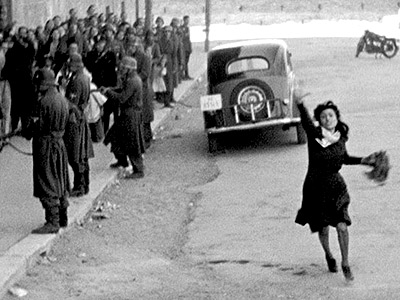
There are many films set in Italy during World War II, though perhaps the best are things like Roberto Rosselini’s Rome, Open City (Roma, Città Aperto, 1945), which maps the lives of ordinary civilians in Rome during the Nazi occupation in 1944. Rosselini shot the film mere months after the Nazis had left the city. I must admit here that I’ve not seen its companion piece, Paisà (Paisan, 1946), which might be something of a missing link for this essay, which is focussing more on the combat of the Italy campaign.

In terms of English language, international WWII Italian campaign films, which focus more on the experience of combatants, among the best from the early era – made during or just after the war – is Lewis Milestone’s A Walk in the Sun (1945). Milestone directed one of the best ever (anti-) war films, 1930’s WWI drama All Quiet on the Western Front, so in some ways his own bar is set too high. But A Walk in the Sun is still an interesting picture, presenting, philosophically, something of the uncertainty in ‘liberating’ a country that was not long before an Axis power. There’s a point in the film where Italian soldiers surrender to the protagonist US troops. For many of the Italian soldiery, the Allied landings in Salerno were a welcome end to their experiences, though the Italian situation is a complex one, and the soldiery will have of course represented the broad political spectrum of Italy itself.

Italy had been officially a Fascist state for longer than Germany. Benito Mussolini’s National Fascist Party (Partito Nazionale Fascista, PNF) was elected in 1922 – a full decade before the Nazi party achieved dominance in Germany, and 11 years before Hitler became Chancellor. So after the armistice of September 1943, Italian Fascists didn’t simply evaporate. And there was no possibility for a clear narrative of ‘liberation’. Many Italians were still Fascists, or at least sympathetic to the cause, which the Nazis were able to maintain via an Italian Fascist party power base in the north, with the PNF becoming the Republican Fascist Party (Partito Fascista Repubblicano, PFR).

Indeed, even after Mussolini’s killing in April 1945, and after the war, Fascism has remained a strong part of the Italian social and political landscape, albeit of a re-branded variety. It was not faced up to in the same way as it had to be in (occupied) Germany. Italy is a country without a vocal political centre, and through much of the 20th century extreme left-right tensions flared, notably in the years of terrorist attacks known as the Anni di Piombo, Years of Lead (1960s-1980s). Living in Rome today, I can tell you in no uncertain terms that extreme rightwing attitudes remain alive from the sheer amount of Fascist sloganeering and swastikas in graffiti and the tone of some posters, such as those with an anti-immigration message (“Immigrazione è invasione”).

Anyway, the point I’m making is that Italy was a mess in 1943-45, its war narrative is hugely complex. There was no simple case of the Allies arriving, and being welcomed, as they were in, say, Holland or Belgium. Within any village an abiding tension between left and right could potentially be found. Read, for example, Eric Newby’s Love and War in the Apennines (1971), an account of his time hiding in the mountains in northern Italy’s Po Valley, after he left his POW camp in 1943 – the Italian guards simply walking away after the armistice. Newby is frequently on the move, sheltered by various peasants, who live in fear of being shopped by neighbours. (See Addendum 3, below.)

This matter of the Italian soldiers leaving their posts as POW camp guards is seen on screen in Von Ryan’s Express (1968), a big, glossy film that combines elements of the escape and the combat film. It begins with Frank Sinatra’s Air Force colonel Ryan shot down and taken to a camp, which is mainly populated by British soldiers under a stuffy Major, played by Trevor Howard – an actor whose posh, stiff upper lip (and arguably slightly neurotic) version of masculinity hasn’t dated well in such roles. Especially since the story emerged that he wasn’t actually a war hero, as had been claimed: he was kicked out of the army for having a “psychopathic personality”. (Though I’d like to know the source of that info included at the bottom of this newspaper article.) Anyway, after the armistice, the camp’s commander, a Blackshirt, begs for his life, takes off his cap, spits on its Fascist badge. Later he’s saved by the Nazis, and realigns himself. He’s something of a caricature, but it’s easy to believe that in his period loyalties were indeed fluid.

American combatants are the focus of another of the bigger Italian campaign war films, released the same year as Von Ryan’s Express: Anzio. This was legendary Italian producer Dino Di Laurentiis’ attempt to produce something loosely comparable to things like the D-Day epic The Longest Day (1962). The Anzio landings, like the Battle of Monte Cassino, are a historically notable element of WWII, but again, even more so than was the case with Monte Cassino, aren’t easy to apply a heroic narrative to. Anzio, a port city in Lazio region, and nearby Nettuno, were the landing points for the Allied troops taking part in Operation Shingle, which was designed to break the deadlock of Monte Cassino, through the creation of a bridgehead further north along the shin of Italy. The American generals in charge, John P Lucas and Mark Clark, were, however, so concerned to fortify their bridgehead, they moved slowly, allowing German forces – who had in fact been caught on the hop – to dig in and create more formidable defences.

There’s the potential for a fascinating film there. Anzio, unfortunately, isn’t that film. The film’s starting point was apparently a 1961 book of the same name by respected war correspondent Wynford Vaughn-Jones, who took part in Shingle reporting for the BBC. It’s hard to believe it though, as the film descends into cliché, with the usually reliable Robert Mitchum plodding through much of the film looking bored as a cynical war correspondent ultimately forced to take up arms. Co-star Peter Falk, meanwhile, didn’t like the script and wanted to flee, but Di Laurentiis gave him the option to write his own dialogue (according to a Wikipedia reference to his autobiography). It doesn’t exactly shine through. I do like, however, how the film at least acknowledges Falk’s glass eye – after a brawl near the beginning he complains that whatever hit him in the eye felt like a “lead pipe”.

A film that manages to actually address something of the complexity of the Italian campaign, and the Italian situation, is a more recent affair, Miracle of St Anna (2008). Spike Lee undertook this project in an effort to redress an abiding issue in American WWII films: their lack of representation for African-American troops. This is an enormous and thorny issue, but the grievances are understandable when African-American troops died for a country that was still grotesquely segregated, two decades before the Civil Rights movement began to break down some the USA’s version of apartheid.

Lee was particularly riled by the absence of black faces in Clint Eastwood’s Iwo Jima diptych Flags of Our Fathers and Letters from Iwo Jima (both 2006). I won’t go into their high-profile slagging match too much here either, but Eastwood accused Lee of not knowing his history, to which Lee replied “I know history. I’m a student of history. And I know the history of Hollywood and its omission of the one million African-American men and women who contributed to the second world war. Not everything was John Wayne, baby.”

His response was Miracle of St Anna, which tells the story of a group of soldiers from the 92nd Infantry Division, an African-American unit (though with white officers). The 92nd fought in the Italian campaign from 1944 to the end of the war, in the Apennines. I must admit when I first tried to watch the film, I struggled. I’m a fan of many of Lee’s films, but here I found the score too intrusive, and didn’t entirely buy the way the characters were written, they didn’t feel credibly of the 1940s. But on a second viewing, I got on with it much better – indeed, it’s safe to say it’s one of the best, most interesting Italian campaign films. Not only for how it puts black soldiers front and centre, but for how it engages with Italians, and the political complexities.

The heroes (played by Laz Alonso, Derek Luke, Omar Benson Miller and Michael Ealy) are stranded behind enemy lines in Tuscany, and hole up in a village. There, they meet partisans, whose leader (Pierfrancesco Favino) and best friend/right hand man (Matteo Sciabordi), have conflicting political backgrounds and agendas. The narrative is far from easy: the black heroes are fighting for white officers who (mostly) treat them with callous disregard, for a country that has cafés that will serve German POWs but not them, despite their nationality, their patriotism, their uniforms. The partisans they meet, meanwhile, should be allies, but one betrays their trust as he’s got insidious dealings with the Nazis.

There’s actually an interesting sub-sub-genre of WWII films that deal with the contributions to the conflict of non-white soldiers. You may know  Windtalkers (2002), which featured Navajo soldiers deployed by the US Army for radio communications in the Pacific theatre: as the Axis forces couldn’t “break” their language. There’s also another film about Native Americans fighting in WWII  called Thunderbirds (1952), though as far as I recall it never graced TV screens in my UK 1970s-80s childhood (where I first learned to love WWII movies), and it’s not surfaced on DVD, so I don’t know much about it, except that is does feature the soliders landing at Salerno for the Italian campaign.
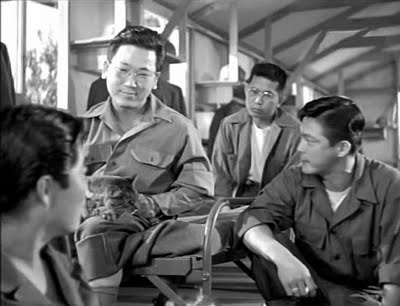
Go For Broke! (1951) is from a similar era to Thunderbirds – perhaps in the early 1950s there was a crisis of conscience in America about certain ethnic groups who fought for the nation in WWII. This one was presumably to in some part try and compensate for the mistreatment of Japanese-Americans who were interned. Its protagonists, from the 442nd Regimental Combat Team – made up of Nisei, Americans born to Japanese parents – are natural heroes for a movie, as they were one of the war’s most highly decorated outfits. It’s a remarkable story. Some of the troops in the film are Hawaiian Japanese-Americans (there’s plenty of ukulele action) who have suffered from the Japanese attack on Pearl Harbour attack. Others, mainlanders, get letters from home with news of mistreatment such as beatings and threats of lynching. “We’re good enough for German rifles, but not for picking sugar beet,” remarks Sam (Lane Nakano).

They’re not sent to the Pacific theatre unless they speak perfect Japanese (for intelligence work), as there’s a concern about friendly sniper fire, so instead they’re shipped to Italy. The film was shot in California, but uses stock footage of Naples and beyond, as the men – whose fellow Nisei in the 100th fought at Cassino – hike most of the way up Italy, their very white Texan lieutenant Grayson (Van Johnson) slowly overcoming his prejudices as they go, even to the point of slugging a fellow Texan who calls them “Japs”, rather than Japanese-Americans, Nisei or even “Buddha Heads”, their acceptable slang name.

It’s a pretty conventional film for the most part, with its various characters in the platoon, and uncomplicated portrayals of heroism, but the ethnic angle is fascinating. Even if the star is Johnson.


At one point in Go For Broke!, Grayson is fleetingly innamorato with an Italian signorina, who has a two-sided photograph, of her previous US lover on one side, and a prior German lover on the other. It’s a scene that recalls one of the very few Italian films I’ve seen that actually features Italian soldiers, where there are reversible portraits of Allies and Axis dignitaries. Il Due Colonnelli (The Two Colonels, 1962). This one isn’t actually set in Italy, it’s in Greece, where Italians and Brits vie for control of the same village, and the affections of its populace. It’s a broad, and distinctively Italian, comedy, which isn’t afraid to present the Italian soldiery as, by and large, foolish wastrels, though none is as bad as their commanding officer, a picolo Mussolini played by legendary Italian actor Totò, who apparently improvised most of his films.
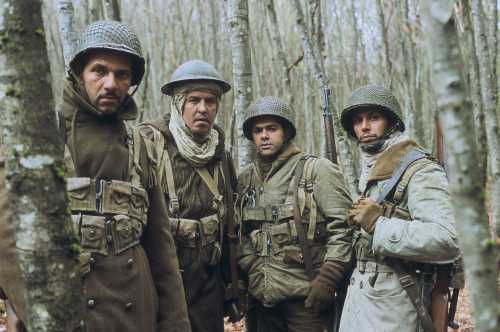
It’s not just the US that has produced films that highlight the sacrifices of non-white troops in WWII. Another fascinating film that features non-white soldiers and has sections set in Italy is Indigènes (aka Days of Glory, 2006). This Algerian-Belgian-French-Moroccan co-production directed and co-written by French-Algerian Rachid Bouchare, like Lee’s film, follows many of the hoary war-film conventions, notably by following a squad of bickering, bantering, diverse brothers-in-arms, living and dying together. Plus, again like Lee’s film, it’s one of the many WWII films that followed the revitalisation of the genre by Saving Private Ryan (1998). However, here the focus is on forces that may well have never been seen in a WWII previously: Algerian Tirailleurs and Tunisian or Moroccan Goumiers, the “indigenous people” of the title. It’s a fascinating film, but not necessarily a good war film, feeling flat in places, and I know it’s probably not politically correct to say it, but I struggled with the presence of Jamel Debbouze. He might be one of France’s biggest stars of North African origin (and is a good presence in things like Amélie and Asterix at the Olympic Games), but unlike the film itself, I found it hard to ignore his paralysed arm – something that in reality would have prevented someone from becoming a soldier, let alone actually firing a rifle.
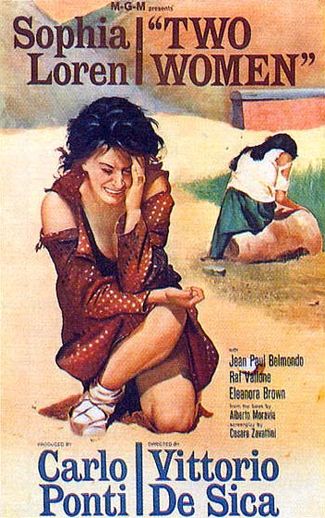
Tirailleurs and Goumiers played a major role in, for example, the worst of the fighting at Monte Cassino, and the efforts of Bouchare and Debbouze (star and co-producers) to use the film to address the issues of their rights are commendable. The film ends with a note that says the servicemen had their pensions frozen in 1959, three years after Tunisian and Moroccan independence and three years before Algerian independence. But there are stories about the Goumiers in Italy that didn’t find their way into the film. One very different portrait of the Goumiers can be found in Vittoria De Sica’s La ciociara (aka Two Women, 1960). This film dealt with the Marocchinate – an Italian word loosing meaning “the Moroccans’ acts” and used to refer to the mass rapes and even killings allegedly perpetrated by Goumiers on villagers in the Ciociaria region of central Italy, after the Allies broke through at Monte Cassino. Parker deals with this subject diplomatically in his book.

Suffice to say, there are open wounds for both the Goumiers mistreated bythe French military and government and the Italians who suffered at the hands of the Goumiers. There’s truth to be found, doubtless, in both Indigènes and La ciociara; between the two films, the complexities of the circumstances in Italy during WWII are hightlighted.

To get back on firmer ground, one of the greatest ever war films is Samuel Fuller’s The Big Red One (1980/reconstructed version 2004). It’s another film that utilises the classic squad format, and in other ways may be have been something of a template for Indigènes, notably in how it follows said squad through their experiences of various campaigns, a kind of bloody picaresque. Indeed, both films share the same trajectory: North Africa, Italy, France.

Although Fuller’s film looks and feels in some ways dated in an era when filmmakers like Spielberg can use CGI to fill the ocean off Normandy with ships, or give a gritty, graded realism to his footage of Omaha beach, replete with amputee actors ‘losing’ limbs to explosions, in other ways it’s a more authentic film than Saving Private Ryan will ever be. Why? Because Fuller himself was a highly decorated member of the Big Red One, the nickname for the US 1st Infantry Division, and did indeed see action in North Africa, Sicily, France and was at the liberation of Falkenau in Czechoslovakia in May 1945, setting for the film’s denouement. Furthermore, the film’s leading man, Lee Marvin, was also a veteran, who won a Purple Heart while fighting in the Battle of Saipan as a Marine.

The protagonists land in Sicily in July 1943, where one private loses a testicle to a mine. “You can live without it, that’s why they gave you two,” Marvin’s grizzled Sergeant tells him. It’s darkly humorous, at times farcical, such as when the squad captures a Hitler youth. When the Sergeant spanks him, his cries of “Heil Hitler! Heil Hitler!” turn into “Pappy! Pappy!”

The film is so episodic that much of it doesn’t take place in Italy at all, but its Sicily sequences capture something of the grimness and confusion of the Italian campaign. The squad in The Big Red One aren’t movie heroes per se, they just literally just solider on, from battle to battle. The only glory in war, according to Fuller’s stand-in character, Zab (Keith Carradine), is survival.

Survival, of course, being something that’s tantamount to impossible in Joseph Heller’s classic satire of war Catch-22, published in 1961 and adapted for the screen in 1970. The premise of the film is the ever-increasing number of missions its bomber crew protagonists must fly before they qualify to be sent home on leave. The number is so high that it exceeds the average life expectancy of missions. Which in itself is a catch, but the explicit catch of the book and film is that if a man applies for a psych evaluation to prove he’s insane, and can therefore be grounded, he’s clearly sane. The US airmen of the film are based on Pianosa, an island off the coast of Tuscany.

B-25s, the bombers featured in Catch-22, were among the aircraft involved with the bombing of Monte Cassino monastery and abbey on 15 February 1944. I can’t find out where the bombers that hit the monastery took off from, but it certainly wasn’t Pianosa, which,  in reality, is too small for such a substantial airbase. The bombing of the monastery, remains, however, perhaps the most dubious episode in the Italian campaign, which as a whole was by no means straightforward – and as such, while it has produced a highly varied section of films, none of them are themselves straightforward combat films.

The Italian campaign is too hard to shape into the kind of neat black and white narrative; it’s harder to reiterate notions of a the “just war” or “good war” when one reads about Monte Cassino, which could be considered the focal point of the Italian campaign. It was a battle – or series of battles – that was mired in shame, folly, and terrible losses. Not only was the destruction of the monastery infamous, but the combat itself was as wasteful of human life as the most notorious battles of the World War I.


It’s not just an issue of how problematic the battles of the Italian campaign were, but also the very nature of Italy. By comparison, de Gaulle and co did an impressive job of creating an official version of WWII history for France, where the nation was occupied, brave French fought in the Resistance, and were extremely glad to be liberated by, well, not exactly the Allies, but by de Gaulle. The question of the French right wing and the infrastructure of collaboration was largely suppressed, and only articulated successfully after decades had passed, with such things are Marcel Ophul’s epic documentary The Sorrow and the Pity (Le chagrin et la pitié, 1969), which dared question the Resistance mythology, and reminded the nation of its anti-Semitism. Italy not only lacks any true classic WWII combat films, it has nothing comparable with Ophuls’ film (as far as I know). Instead, more recently, Italy itself has produced things like La vita è bella (Life is Beautiful, 1997) and Malèna (2000), which feature the experiences of civilians, and how they’re affected by the war.

Anyway, this was meant to be just a short-ish blog post responding to reading Parker’s book and considering a few war films, but it seem to expand somewhat. I’ve probably missed several films, and missed several points too, but hopefully it’s food for thought.


Addendum:
Managed to watch The Secret of Santa Vittoria finally.

It’s a somewhat laboured film, and I struggle with ‘accent movies’ generally. Here they have a Mexican star and various Italian co-stars and extras all speaking English. But it has some merit as a (somewhat fanciful) portrait of a village during the war. It’s not strictly in the purview of a piece about movie portrayals of combat during WW2’s Italy campaign – I don’t believe a single shot is fired – but here are a few comments.

It starts just after Mussolini has been deposed: it’s “the end of the Fascists!” Said Mexican star, Anthony Quinn, plays Bombolini, a fool and drunkard in the wine-producing village of S Vittoria. By a quirk of fate, he becomes mayor.

The film chronicles his transformation to a wily leader (of sorts), who’s cunning enough to take on a German army captain (Hardy Krüger), whose forces occupy the town, in a battle of wits. This involves the matter of S Vittoria’s wine. Bombolini is inspired by reading Machiavelli’s The Prince and a suggestion from a recuperating Italian solider (Sergio Franchi) to hide the majority of their million bottles in tunnels, and brick them up.

Director Stanley Kramer enjoys giving us portraits of the local extras, contorte contadini and no mistake, but there’s a strong sense of disjunction between the international stars and the local extras. Though Anthony Quinn and Anna Magnani (who plays the long-suffering signora Bombolini) have an interesting rapport. The couple’s on-screen feuding was apparently backed up by off-screen loathing, with her demonstrating her renowned fieriness by breaking a toe kicking him, and drawing blood while biting him filming a fight scene.


Addendum 2:
Red Tails is a modern (2012) WW2 film from Lucasfilm, produced by Rick McCallum and executive produced by George Lucas. Lucas, as any Star Wars fan or general observer of the seismic shifts in popular culture of the past 40 ish years will know, is a huge fan of WW2 films, and the world of Star Wars was profoundly influenced by the iconography of the WW2 aerial dogfight, such as that found in such films as Angels One Five (1952) and Battle of Britain (1969). There is a very clear, tangible line between the dogfighting in such films and the iconography of the space battles between X-Wings and TIE fighters in the original Star Wars films, created with sophisticated use of traditional special techniques involving models and matting, as well as innovative computer-controlled (motion control) cameras.

The CGI technologies deployed to grotesquely recreate this universe in the over-adorned Star Wars prequels has now been used to create the aircraft action in Red Tails. It’s gone full circle. So oddly, although the special effects sequences in Red Tails are impressive, they also suffer from that innate sense of airlessness and artificiality that can accompany excessive deployment of CGI. But perhaps more troubling, the aircraft in the film seem to behave like X-Wings. Were WW2 prop-fighters really quite so manoeuvrable?

Just to backtrack a moment, Red Tails concerns the Tuskagee Airmen, African-American who fought in WW2 as part of the US Army Air Corps. As such, the film arguably fits into the sub-sub-genre mentioned above concerning the contributions of non-white ethnic groups to a war where many of their comrades and allies disdained them.

It’s a fascinating story, though this film doens’t exactly do it justice – it’s both troubled by the heavy CGI aesthetic and a profoundly hoary storytelling mode, predicated on thinly written characters that conform to the war movie requirement to have a squad made up of bitching, bonding stereotypes (the maverick lothario, the captain with a drinking problem, the kid, the religious kid etc).

Still, Red Tails provides one of the few American WW2 films where the combat (almost) all plays out in Italy. Here, it starts with the Tuskagee Airmen’s 332nd Fighter Group in Italy in 1944, harrying German supply lines, strafing trains and trucks. It’s an important job but they aspire to more, feeling they’re kept away from the real action because of their ethnicity. Their colonel (played by Terrence Howard) argues their case in Washington, and the group is brought in to Operation Shingle, providing support for the landings at Nettuno and Anzio. This helps cement their reputation as skilled airmen, and they’re subsequently assigned to bomber escort. They even get their old P-40s upgraded to P-51s (Mustangs). It’s not exactly the glorious dogfighting opportunity some of them craved but a way to prove their skills and abilities once and for all. Oh, and they do get to do some fancy dogfighting, even contending with the German’s remarkable new Messerschmitt Me 262. The film credits them as being the first to shoot down one of these fast jets, one of its historically questionable inclusions.

Anyway, Red Tails is not a great film, but it’s an interesting addition to the catalogue of WW2 Italian compaign films.

Addendum 3:
There is a TV movie based on the book, 2001’s In Love and War, and while it’s largely inoffensive, it’s very cursory compared to the Newby’s account. It’s a shiny, amiable, superficial romance, which skims over so much of Newby’s actual experiences. It doesn’t even mention the fact that the girl he met, who would become his wife, Wanda, was Slovenian not Italian. It’s a bit of a Euro-pudding like that, with the Italian, and Italian-speaking characters, slipping in and out of speaking Italian and speaking English with Italian accents.
4 Comments

Filed under Main thread

Just too northern European

Before anyone accuses me of moaning about the weather, I’d like to specify that I see this more as a pre-emptive freakout.

It topped 20C in Rome today. Just a few weeks ago it was the depths of winter. Although the snow here was aberrant, the generally cool temperatures weren’t. Our flat might not be designed for cold weather – it’s draughty, the heating doesn’t have a timer or a thermostat, and significant radiators don’t work – but by and large I found the winter here delightful. It suited me. I could dress in a preferred fashion (with layers, jacket). I didn’t get a stinky sweat on when I used my default form of transport – brisk walking.

The Roman summer, on the other hand is both something that I’m not used to and something that doesn’t suit me. I don’t like wearing just a shirt. And as much as I like to wear shorts, such attire is somewhat frowned upon here for a grown man. Getting your first pair of long trousers in Italy is (or was) like getting your first car in 1950s America, it’s a rite of passage, visibly liminal, a public declaration of your status. (There’s a scene in the film Malèna [2000], set in the 1940s, where the 13-year-old protagonist, desperate to appear more grown up, has a tailor re-cut his father’s suite trousers to fit him. His dad isn’t happy.)

I’m British. I’m used to British weather. And although, like many other Brits, I despair of the limbo of week after week of overcast, grey weather, I don’t have a problem with the temperatures in Britain. Mostly. I mean, admittedly, I was peeved when my June wedding day didn’t muster more than 8C but hey, it was northwest Devon, so that wasn’t so unexpected. What was unexpected was leaving a Sussex August at 18C and arriving in a Roma of 40C. A temperature that didn’t drop much through much all of September 2011.

Now, British friends will say “Wow, wonderful, I love temperatures like that and sunshine.” But really, what they mean is, they love temperatures like that and sunshine when they’re on holiday, and can spend most of the day on the beach, swimming in the sea, and potentially retreating to an air-conditioned hotel. That is a very different kettle of fish to living in a big (-ish) city, densely populated with people and cars, so many belching cars. And dogs, so many hysterical dogs. And dog owners, so many irresponsible dog owners who don’t pick up their beasts’ cacca [no spellcheck, I don’t mean cacao].

Last August was a very literal shock to the system to me. I didn’t acclimatise, the baking dumpsters and cacca griddling on the pavements were – objectively – disgusting, and I didn’t enjoy spending so much time self-consciously sudato e puzzolente (sweaty and stinky!). Basically, it being so warm now, so soon in the year, ho paura – I’m scared. Scared of if I’ll ever feel acclimatised here. Scared of another several months of trying to sleep when it doesn’t drop below 28C at night in our room, even after living in a bunker all day with all the shutters and windows closed to block out the sunshine and heat (something that’s counter-intuitive for a Brit used to craving rays and vitamin D, but necessary). And I’m really not looking forward to the return of the mosquitos (though it is lovely to see the lizards emerging again).

I am just too northern European. The prospect of another hot summer in Rome freaks me out.

4 Comments

Filed under Main thread, Rome

Scones – cream first or jam first?

We’re big fans of scones in our household. My wife, Fran, is from Devon and I’ve got strong connections with this county in the southwest of England that, along with its neighbour Cornwall, is the homeland of the cream tea: scones with clotted cream and jam, washed down with (milky black) tea.

(Some say the scone comes from Scotland – does it? Are Scots and West Country scones the same thing? Or are they different types of “quick bread” with the same name? Some serious historical investigation needs to be done on that front before I’m persuaded either way. The word itself may derive from the Dutch “schoonbrot”, meaning fine bread or white bread, though that clarifies nothing.)

I’ve been making scones since childhood, presumably having fallen in love with them after childhood holidays in Devon and Cornwall.

Anyway, every time we eat them, the same two issues arise.

First, is it pronounced skon-ryhmes-with-John or skown-rhymes-with-own? (Seriously – there’s no either/or; as with many words, it varies, with the former pronunciation most common in Britain, especially in Scotland. See point 3.11 in this 1998 University College London British English pronunciation survey.)

And second, does one split the scone then spread it with clotted cream first, or jam first? I doubt UCL has done a survey on that, and among my friends things seem to be fairly evenly split. Fran is adamant is has to be jam first, then a blob of cream like a garnish, I’ve always spread the clotted cream first, like a kind of glorified (oh the glory!) butter.

Now, before I proceed, for any impoverished soul who hasn’t had the pleasure of eating clotted cream, let me tell you what you’re missing. Clotted cream – which most certainly is traditionally, and originally, from the West Country – is a very rich, delicious and generally delightful dairy product made using the cream of cow’s milk.

In days of yore it would have been made using the rich milk of local West Country cattle, like the charming Devon Reds, a breed that’s been making a comeback recently. (My parents’ neighbours in their place in Devon had a champion Devon Red bull called “Freddie” Yeomadon Ferdinand, whose offspring are used for beef; apparently it’s not viable to use Devon Reds for dairy these days so I’ve never tried any Devon Red milk or dairy products.) These days, clotted cream is mostly made using milk from Guernsey and Jersey cows, the breeds now most associated with rich, fatty milk.

Clotted cream is traditionally made by heating rich creamy milk over a low heat, possibly in a bain-marie type arrangement, reducing its water content, and encouraging the creation of thick creamy clots, which are skimmed off. I’ve made cheese, butter and yogurt but never clotted cream. They demonstrated this traditional production method in episode 9 of BBC’2 Edwardian Farm series. It looked painstaking and protracted so I don’t think I’m likely to try and reproduce it any time soon. (Read the Wikipedia entry if you’re interested in learning more about the modern, industrial production methods.)

On a recent visit to Devon, I bought some clotted cream from Langage Farm, a Devon brand that uses the milk of Guernsey and Jersey cows. Clotted cream is something I crave, and one of the international delicacies I’ve not been able to source in my current city-of-residence, Rome. So this pot travelled all the way home with me. Ridiculous food miles for a treat I know.

After making a batch of scones yesterday (see below for my basic recipe), we had a cream tea – something that presumably doesn’t happen very often in Rome, even at vintage tea room Babington’s, whose version of a “cream tea”, according to their online menu, consists of “A Scottish scone with butter and strawberry jam”. With whipped cream. That’s just plain wrong.

My friend and sometime catering collaborator Mr Dominic Rogers raised the above-mentioned cream-or-jam first question, and we discussed them being “tasty either way”, but not necessarily “tasting the same”. This is a noteworthy point, and one I had to address in more detail. So I did a taste test.

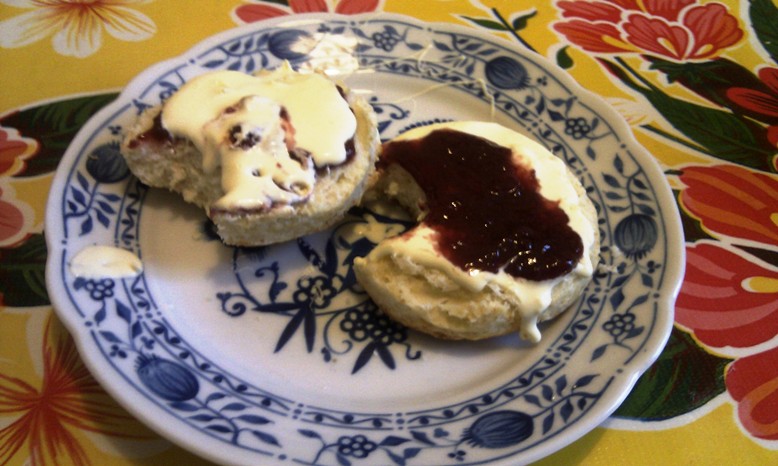
As illustrated by this photo, it wasn’t entirely scientific: I didn’t weight out the amounts of cream and jam (in this case fragole, strawberry) used to make sure they were identical in both cases, and I only used one scone, which meant one piece had the top crust and the other the bottom crust, which have slightly different textures. However, the results were interesting (well, interesting for scone obsessives). They are all pretty obvious if you think about it, but I still feel it’s worth recording, considering the perennial nature of the argument.

1 As you bite the jam-on-cream arrangement, your first flavour hit is of jam, which is tart, sugary-sweet and fruity.
1b Do you enjoy the sensation of thick cream as it potentially touches your top lip?
2 As you bite the cream-on-jam arrangement, your initial flavour hit is of clotted cream, which is of course, smooth, gloopy and dairy-sweet.
2b Do you enjoy the sensation of sticky jam as it potentially touches your top lip?
3 As you continue to bite down through the scone, this initially flavour hit is prolonged, being dragged down through the crumb of the scone by your upper incisors and of course moving onto your palette and tongue.
4 Your choice of jam-on-cream or cream-on-jam defines the opening flavour notes, and initial mouth-feel and flavour, before mastication results in more even mixing of flavours and textures.

Conclusion
So, arguably, you have a choice based on whether you prefer the taste of cream or jam, or prefer those as the initial taste.
Either, frankly, is bloody delicious.

Here’s my basic plain scone recipe. Some people use buttermilk; I don’t, as it’s not always easy to source, and I’m not convinced it makes a better plain scone.

450g self-raising flour (or use plain flour with about 4% baking powder, ie 435g plain flour sifted together with 15g baking powder)
80g unsalted butter, at room temperature
35g caster sugar
Pinch of salt
300g milk

1. Pre-heat the oven to 220C.
2. Grease two baking sheets.
3. Sieve the flour (and BP, if using plain flour) into a bowl, then rub in the butter until the mixture resembles breadcrumbs.
4. Stir in the sugar and salt.
5. Blend in the milk little by little using a knife.
6. Bring together as a rough dough but do not knead or otherwise handle too much.
7. Turn out onto a lightly floured work surface and roll out to around 22mm thick.
8. Create rounds using a pastry cutter, or simply cut into squares.
9. Repeat with any off-cuts.
10. Place on the baking sheets, dust with a little extra flour and bake for 12-15 minutes until starting to brown.
11. Serve just slightly warm – ideally with clotted cream and jam!

Scones are always best on the day they’re made.


6 Comments

Filed under Baking, Food misc, Main thread

Docking the bay

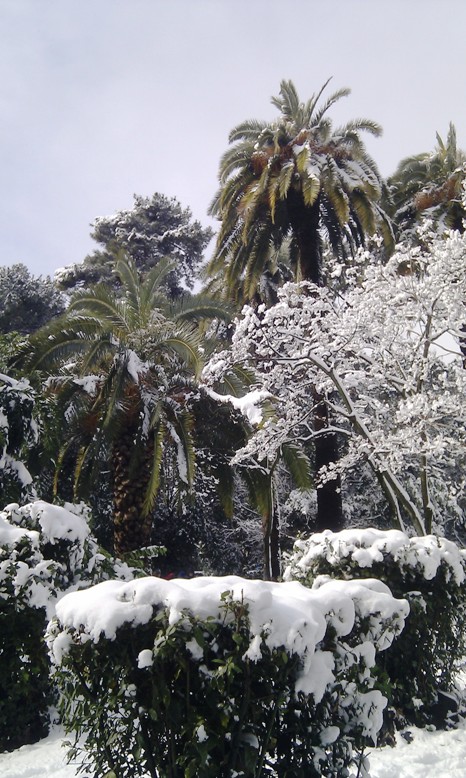
Villa Sciarra, our delightful local park, remains locked up. It has been since last weekend. Rome had its atypical dump of snow last Friday and overnight we got about 10cm. Apparently this is the most since 1986, when they got 20cm+; substantial snow apparently isn’t a common occurence, and the city doesn’t really know how to cope with it, much like much of Britain (but that’s another story). Panic ensues, schools and offices are closed, trains and roads become even more chaotic (and simultaenously less chaotic – with emergency rules that decree you can’t ride a scooter, or drive unless you have chains). For dedicated pedestrians, like myself, the pavement, the day after, was largely ice.

On the Saturday itself though, when the snow was fresh, Rome was beautiful. The ancient ruins and innumerable churches and monuments are always handsome, but an icing of snow gave them even more magic. The snow also beautified things by temporarily hiding all the little, dogshit and disintegrating roads and pavements.

The snow’s mostly gone now, bar some stubborn piles of ice. There’s more forecast for tomorrow and Saturday, but we shall see. In the meantime, I’m disappointed I can’t take my normal walking routes through Villa Sciarra, a lovely little place that nestles in a bulge in the 4th century AD Aurelian Wall. Throughout the year it’s an oasis of calm, away from Rome’s absurd traffic, and a place to enjoy some sun – or much-needed shade in the summer.

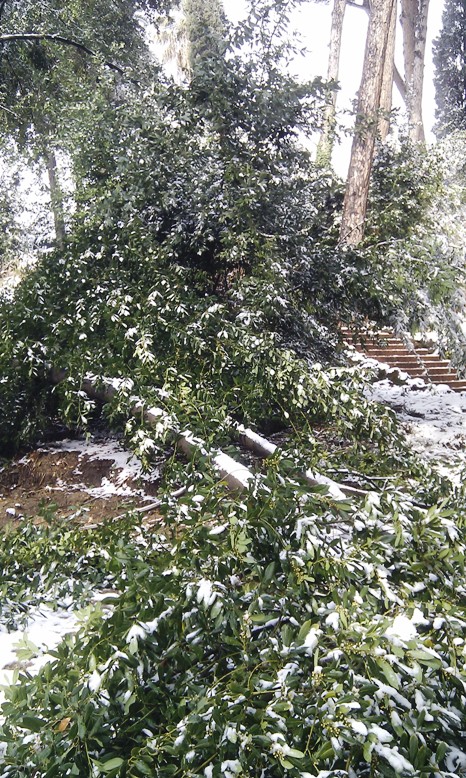
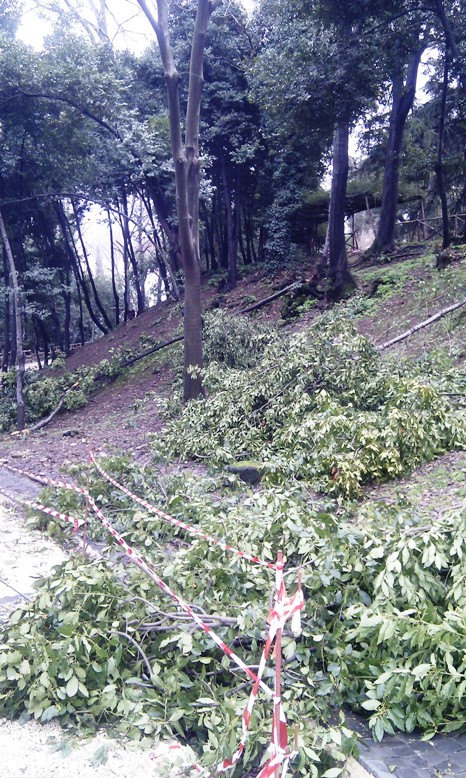
On Saturday, before the lock-down, it was a peculiar winter wonderland, the palms incongruously decorated with snow. It wasn’t all wonderful though, despite the exuberrance of the play. Alongside the palms, the park also has a substantial population of mature bay trees (bay laurels; laurus nobilis). I frequently help myself to the alloro leaves for cooking. And there were plenty to spare after the snow – as the bay population was reduced, I’d estimate, by about 10-20%. It’s hard to say, as I’ve not been able to get back in since the the lock-down. I assume it’s due to emergency tree surgery, to prune the trees with broken boughs and chop up the trees that were completely uprooted, or suffered from broken trunks.


It reminded me a little of the south of England after the Great Storm of 1987, which devastated a lot of the chalk downlands’ distinctive beech hangers. Of course, the bays aren’t quite on the same scale as the beeches – I’d say they grow to about 6m here – but it’s still sad if you’re a tree-lover, like me. Bays clearly aren’t designed to bear the weight of snow – like, say, firs or certain pines with downward sloping branches that slew off any build-up. Not all pines are designed for snow either though – the umbrellas, pinus pinea, also lost some branches here. Another park I walk through – Resistenza dell’otto Settembre – is also closed, though it only lost a few branches from its pines. It’s kinda over-zealous. Who’d have thunk Italy would have a health & safety culture that could out-daft Britain’s?

The streets in our neighbourhood, Monteverde Vecchio, are lined with another type of shrub-tree, which I can’t identify. It may be in the same family as privet, Ligustrum, but I’ve no idea. They lost a few branches too, but, again, nothing like the damage in the park.

As tragedies go, the damage to Villa Sciarra is minor, but it’s still sad. Let’s just hope if it does snow again, it’s not as much, as quickly, and the trees weather the storm.

Quick update, 20 Feb 2012. The park is now open again, and still looking handsome. But there’s still plenty of work being done clearing up dead and damaged bays.

Leave a comment

Filed under Main thread, Rome

Chestnut and walnut bread


Chestnuts were an important traditional foodstuff in parts of Italy. Peasants could supplement their diets with chestnuts, and flour was a natural extension of this. Roasted chestnuts remain a common sight in Roma over the winter, though I’m skeptical about whether this is because Romans demand it, or because it’s another cute novelty to sell to tourists.

Anyway, I bought some chestnut flour – farina di castagna – from the Testaccio Ex-Mattatoio producers’ market last weekend, on a whim. Didn’t really have any idea what to do with it. And nor do I particularly like chestnuts. Living in New Zealand years ago, some friends who tried to live as much as possible by foraging provided enough for me to eat far too many, resulting in a certain aversion. Which might not sound promising, but bear with me.

After a bit of Googling and polling friends, I plan to use it to make various items at some stage, including the Italian traditional castagnaccio – a kind of peasant cake that doesn’t include sugar and instead realies on the natural sweetness of chestnuts. (Chestnut flour is also known as farina dolce – sweet flour.) Also: chestnut flour pancakes (maybe on Shrove Tuesday, which is looming) and this cake, which comes from a gluten-free angle. If I can work out a replacement for crème fraîche, which isn’t readily available here in Roma. Apparently I can use panna acida.

But first, I made some bread, inspired by a recipe in Richard Bertinet’s Dough. His version uses rye flour; here I replaced that with chestnut flour. I also reduced the yeast in his recipe and added some white leaven. What the hell.

So:
400g strong white flour
100g chestnut flour
10g salt
320g water
6g fresh (fresh)
50g white leaven (100% hydration)

Combine the flours and salt.
Whisk together the leaven, yeast and water (warm – use dough temp x 2 minus flour temp to give you a water temp… or just warm…).
Add liquid to flours, bring to a dough.
Knead.
Form a ball, rest, covered, until doubled in height. I’m not going to suggest a time, as that really is so dependant on the temperature of your room.
I divided it into two, formed balls, rested 10 mins then I made rings, but really, knock yourself out with the shape.
Prove again, until doubled in height.
Bake at 220C for 15 mins, then lower temp to 200C and bake another 15 mins. Or if you’re doing one large loaf, it may need longer. Trust your judgment!

And you know what, it’s yummy. The nuts give the crumb a slight purply tinge and the taste is indeed subtly sweet.

I really ought to try and take better pictures though. Random snaps from my phone don’t cut it. And that tablecloth is getting a bit overused as a backdrop.

9 Comments

Filed under Baking, Food misc, Main thread, Rome

Old geezers with the horn

One of our Sunday routines in Roma is going to theEx-Mattatoio – the old abattoir in Testaccio – to the producers’ market. Wandering home yesterday, laden with veg, cheese, eggs, walnuts, chestnut flour and cose, we headed off Viale di Trastevere, up a snicket we’ve discovered, under looming apartment blocks, towards to our hilltop neighbourhood, Monteverde Vecchio.

Further up, through the labyrinth of looming walls liberally decorated with graffiti (extremist politics and/or football mostly), navigating the perennial Roman pavement adornments c/o sundry cani and their inconsiderate owners (seriously, it’s worse than Paris), we passed along Via Giambattista Marino, behind an ecclesiastical establishment. There are many in the neighbourhood, but this one’s particularly grand. Not sure what it is – a school? A monastery? Anyway, both Fran and I assumed there was some sort of event going on, as music appeared to be emerging from within burly stonework. Except that when we turned the corner at the top of the street, the acoustics changed radically and the music was revealed to be a brass rendition of ‘Strangers in the Night’. Not part of the Church’s typical Sunday program.

Heading up our street, the sound got louder, and clearer until we spotted due vecchi, two old geezers, seemingly serenading an apartment. If serenading is the right word. It looked like they had a small amp and backing track, and while one was giving it his all with a battered old French horn, the other was clutching a trumpet. This chap, a decidedly lively little chap, was so digging the tune, he kept stopping playing to dance, among the giant wheelie bins and closely packed parked cars.

We wandered past, and further up, two other, very different old geezers, were packing their rifles and gear into their car, presumably for a spot of hunting in the hills of Abruzzo.

The day before this scene, we’d watched Fellini’s Roma, a 1972 film that, via a series of loose sketches, recounts some autobiography. We see the young Fellini arriving in 1930s Rome from his native Rimini, and immediately becoming embroiled in a vigorously communal way of life, getting a room in a sprawling apartment full of large woman, squalling kids, a sunburned mammone (mother’s boy) and a selection of eccentric tenants. Going out to dinner, meanwhile, the local community (is it supposed to be Testaccio?) convenes to eat at long tables outside a restaurant, joking, arguing, critiquing the food. This includes, I believe, pajata, a delightful, typically Roman dish of veal intestines, which congeal somewhat on cooking, much like rennet from cows’ cuts is used to curdle milk for cheese-making; and snails, which prompt a few saucy comments about how mastering the art of eating them can educate a young man in how to please a woman.

A little kid sings a dirty song about how the new young man, Fellini, is going to have sex with, well, basically everyone. A young man abusively beckons his haughty sister down from where she’s posing on a balcony. Middle-aged women vie for Fellini’s attentions.

The film cuts between such scenes and scenes of contempory Rome, which is now dominated by traffic. It seems to be suggesting the exuberant, social street life of the 1930s has been destroyed, disappeared. Certainly it’s true that the streets are now overwhelmed by Rome’s very tangible car problem* – not just a traffic problem, but a problem with the sheer scale of ownership. Streets are packed with parked cars, and the character of innumerable venerable piazze and piazzale is utterly compromised by them simply having become car parks. Old neighbourhoods didn’t evolve with car-parking in mind.

These days it’s frequently hard to even walk along the pavement as it’s often appropriated for parking. Not ideal for wheelchair users or people with kids in buggies. Our personal favourite is when cop cars from the station up the road block the zebra crossing.

Anyway, so, yes, of course the modern world has quashed the traditional world of street life, but not completely. Summers in Rome are still defined by al fresco dining into the night; restaurants generally have walls of planters to prevent their spots being used for parking. And, well – the two old geezers with their feisty miniature brass section wouldn’t have looked out of place Fellini’s Roma. Their musical endeavours went on long after we’d got home, the brass still echoing down the street for at least an hour. Quite who they were serenading, I don’t know, but from the duration, she never emerged.

* something I’ve written about before:
Moto city
“Death on the Highway”

Leave a comment

Filed under Main thread, Rome

Wholewheat farro bread


Invented this one as I had some farro grain, which I’d bought when I was trying to make the Tuscan zuppa di fagioli e farro, aka bean and farro soup. Farro itself is a type of wheat grain, though the word can also be used to refer to barley and other grains, depending on where you are in Italy or who you’re talking to. Wikipedia has a good page, which doesn’t really clarify!

I played it by ear (well, by fingers) with some of the quantities, and I wanted to keep the dough very soft and wet – hence it flattened slightly when I moved it from the proving basket to bake. But flavour-wise, it’s great.

I’ve been struggling to get used to Italian flours. Many of them are low protein, unlike your standard British bread flour, which is ground from harder wheat. Harder wheat produces stronger flour, with more protein, say 13% or higher – giving the requisite gluten proteins to create certain bread structures, for the types of bread we’re more used to making in the UK.

Anyway, the recipe:

Cook about 50g of farro in water, simmering for about 45 minutes, until the grain is soft.
(You could use the cooking water for the sponge, though I didn’t in this case. You can also soak the grain overnight in ale, wine or friuit juice, if you’re interested in experimenting! Also, if you can’t get farro, wheat grains, aka wheat berries, would be fine.)

Make a sponge with:
360g water
250g wholewheat flour (I used an Italian integrale)
10g fresh yeast (or say 5g ADY if you can’t find fresh)

Leave the sponge to ferment for 8-12 hours. I did it overnight, in a fairly cold kitchen. (We’re in Rome, but it is January – nights getting down to around 0C.)

Make up the dough with:
The sponge
10g salt
150g wholewheat flour
100g white bread flour (I used an Italian bread which, despite being called “Farina di grano duro” – flour from hard wheat – and professing to be “per pane, focacce e dolci” – for bread, foccacia and sweets – is only 10% protein. See my perplexity? It worked ok though, so you could use a British plain flour.)

Bring the dough together and add the farro grains.
Knead. It’s sticky, that’s good, don’t worry!
Clean off your hands with some extra flour and bring the dough to a ball.
Ferment, covered, for about 4 hours, or until doubled in size.
I gave mine a few turns.
Turn out, form a ball, and rest for 10 minutes.
I formed a baton and proved it in a 36cm (14″) long basket.
Final prove until doubled in volume.
I turned it onto a baking sheet and made one long dorsal cut.

Bake in a preheated oven at 220C for 20 minutes, then turn down to 200C and bake for another 20 minutes. Or thereabouts.

2 Comments

Filed under Baking, Main thread