Scones – cream first or jam first?

We’re big fans of scones in our household. My wife, Fran, is from Devon and I’ve got strong connections with this county in the southwest of England that, along with its neighbour Cornwall, is the homeland of the cream tea: scones with clotted cream and jam, washed down with (milky black) tea.

(Some say the scone comes from Scotland – does it? Are Scots and West Country scones the same thing? Or are they different types of “quick bread” with the same name? Some serious historical investigation needs to be done on that front before I’m persuaded either way. The word itself may derive from the Dutch “schoonbrot”, meaning fine bread or white bread, though that clarifies nothing.)

I’ve been making scones since childhood, presumably having fallen in love with them after childhood holidays in Devon and Cornwall.

Anyway, every time we eat them, the same two issues arise.

First, is it pronounced skon-ryhmes-with-John or skown-rhymes-with-own? (Seriously – there’s no either/or; as with many words, it varies, with the former pronunciation most common in Britain, especially in Scotland. See point 3.11 in this 1998 University College London British English pronunciation survey.)

And second, does one split the scone then spread it with clotted cream first, or jam first? I doubt UCL has done a survey on that, and among my friends things seem to be fairly evenly split. Fran is adamant is has to be jam first, then a blob of cream like a garnish, I’ve always spread the clotted cream first, like a kind of glorified (oh the glory!) butter.

Now, before I proceed, for any impoverished soul who hasn’t had the pleasure of eating clotted cream, let me tell you what you’re missing. Clotted cream – which most certainly is traditionally, and originally, from the West Country – is a very rich, delicious and generally delightful dairy product made using the cream of cow’s milk.

In days of yore it would have been made using the rich milk of local West Country cattle, like the charming Devon Reds, a breed that’s been making a comeback recently. (My parents’ neighbours in their place in Devon had a champion Devon Red bull called “Freddie” Yeomadon Ferdinand, whose offspring are used for beef; apparently it’s not viable to use Devon Reds for dairy these days so I’ve never tried any Devon Red milk or dairy products.) These days, clotted cream is mostly made using milk from Guernsey and Jersey cows, the breeds now most associated with rich, fatty milk.

Clotted cream is traditionally made by heating rich creamy milk over a low heat, possibly in a bain-marie type arrangement, reducing its water content, and encouraging the creation of thick creamy clots, which are skimmed off. I’ve made cheese, butter and yogurt but never clotted cream. They demonstrated this traditional production method in episode 9 of BBC’2 Edwardian Farm series. It looked painstaking and protracted so I don’t think I’m likely to try and reproduce it any time soon. (Read the Wikipedia entry if you’re interested in learning more about the modern, industrial production methods.)

On a recent visit to Devon, I bought some clotted cream from Langage Farm, a Devon brand that uses the milk of Guernsey and Jersey cows. Clotted cream is something I crave, and one of the international delicacies I’ve not been able to source in my current city-of-residence, Rome. So this pot travelled all the way home with me. Ridiculous food miles for a treat I know.

After making a batch of scones yesterday (see below for my basic recipe), we had a cream tea – something that presumably doesn’t happen very often in Rome, even at vintage tea room Babington’s, whose version of a “cream tea”, according to their online menu, consists of “A Scottish scone with butter and strawberry jam”. With whipped cream. That’s just plain wrong.

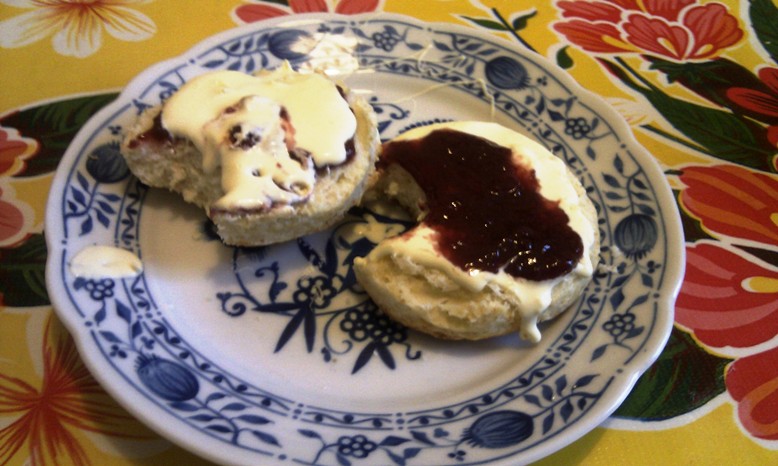
My friend and sometime catering collaborator Mr Dominic Rogers raised the above-mentioned cream-or-jam first question, and we discussed them being “tasty either way”, but not necessarily “tasting the same”. This is a noteworthy point, and one I had to address in more detail. So I did a taste test.

As illustrated by this photo, it wasn’t entirely scientific: I didn’t weight out the amounts of cream and jam (in this case fragole, strawberry) used to make sure they were identical in both cases, and I only used one scone, which meant one piece had the top crust and the other the bottom crust, which have slightly different textures. However, the results were interesting (well, interesting for scone obsessives). They are all pretty obvious if you think about it, but I still feel it’s worth recording, considering the perennial nature of the argument.

1 As you bite the jam-on-cream arrangement, your first flavour hit is of jam, which is tart, sugary-sweet and fruity.
1b Do you enjoy the sensation of thick cream as it potentially touches your top lip?
2 As you bite the cream-on-jam arrangement, your initial flavour hit is of clotted cream, which is of course, smooth, gloopy and dairy-sweet.
2b Do you enjoy the sensation of sticky jam as it potentially touches your top lip?
3 As you continue to bite down through the scone, this initially flavour hit is prolonged, being dragged down through the crumb of the scone by your upper incisors and of course moving onto your palette and tongue.
4 Your choice of jam-on-cream or cream-on-jam defines the opening flavour notes, and initial mouth-feel and flavour, before mastication results in more even mixing of flavours and textures.

Conclusion
So, arguably, you have a choice based on whether you prefer the taste of cream or jam, or prefer those as the initial taste.
Either, frankly, is bloody delicious.
Here’s my basic plain scone recipe. Some people use buttermilk; I don’t, as it’s not always easy to source, and I’m not convinced it makes a better plain scone.

450g self-raising flour (or use plain flour with about 4% baking powder, ie 435g plain flour sifted together with 15g baking powder)
80g unsalted butter, at room temperature
35g caster sugar
Pinch of salt
300g milk

1. Pre-heat the oven to 220C.
2. Grease two baking sheets.
3. Sieve the flour (and BP, if using plain flour) into a bowl, then rub in the butter until the mixture resembles breadcrumbs.
4. Stir in the sugar and salt.
5. Blend in the milk little by little using a knife.
6. Bring together as a rough dough but do not knead or otherwise handle too much.
7. Turn out onto a lightly floured work surface and roll out to around 22mm thick.
8. Create rounds using a pastry cutter, or simply cut into squares.
9. Repeat with any off-cuts.
10. Place on the baking sheets, dust with a little extra flour and bake for 12-15 minutes until starting to brown.
11. Serve just slightly warm – ideally with clotted cream and jam!

Scones are always best on the day they’re made.
 

6 Comments

Filed under Baking, Food misc, Main thread

Docking the bay

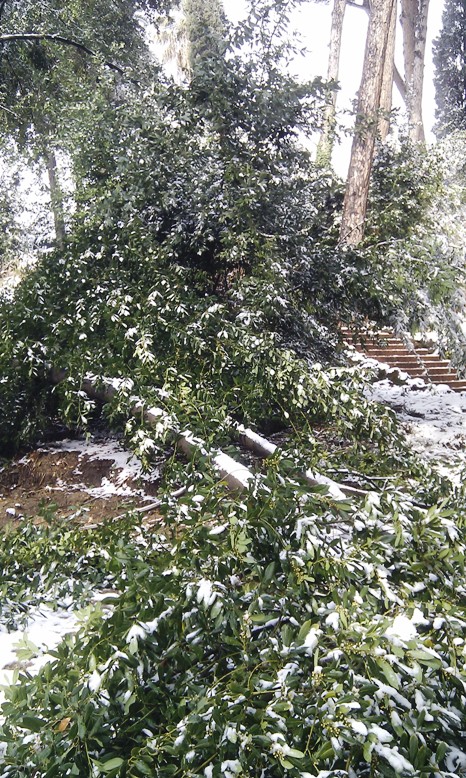
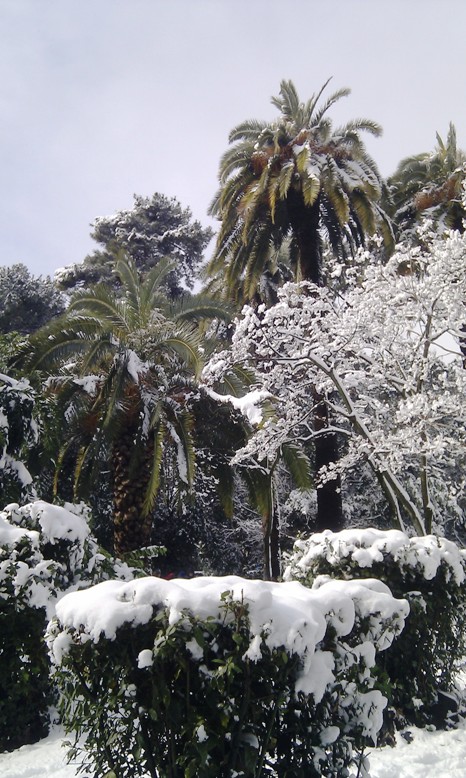
Villa Sciarra, our delightful local park, remains locked up. It has been since last weekend. Rome had its atypical dump of snow last Friday and overnight we got about 10cm. Apparently this is the most since 1986, when they got 20cm+; substantial snow apparently isn’t a common occurence, and the city doesn’t really know how to cope with it, much like much of Britain (but that’s another story). Panic ensues, schools and offices are closed, trains and roads become even more chaotic (and simultaenously less chaotic – with emergency rules that decree you can’t ride a scooter, or drive unless you have chains). For dedicated pedestrians, like myself, the pavement, the day after, was largely ice.

On the Saturday itself though, when the snow was fresh, Rome was beautiful. The ancient ruins and innumerable churches and monuments are always handsome, but an icing of snow gave them even more magic. The snow also beautified things by temporarily hiding all the little, dogshit and disintegrating roads and pavements.

The snow’s mostly gone now, bar some stubborn piles of ice. There’s more forecast for tomorrow and Saturday, but we shall see. In the meantime, I’m disappointed I can’t take my normal walking routes through Villa Sciarra, a lovely little place that nestles in a bulge in the 4th century AD Aurelian Wall. Throughout the year it’s an oasis of calm, away from Rome’s absurd traffic, and a place to enjoy some sun – or much-needed shade in the summer.

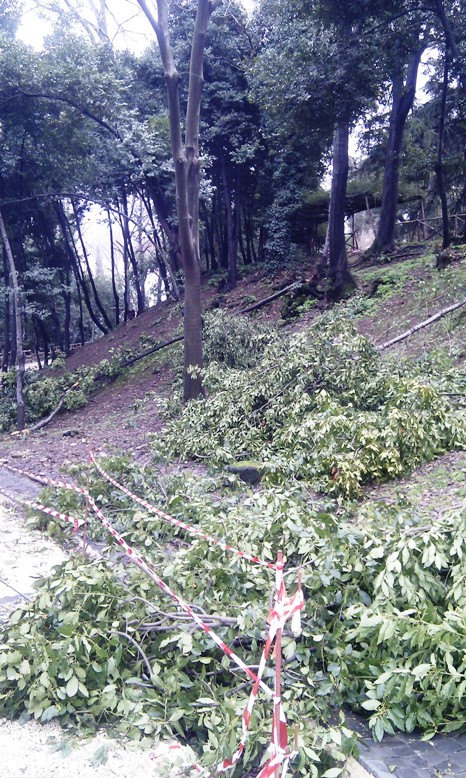
On Saturday, before the lock-down, it was a peculiar winter wonderland, the palms incongruously decorated with snow. It wasn’t all wonderful though, despite the exuberrance of the play. Alongside the palms, the park also has a substantial population of mature bay trees (bay laurels; laurus nobilis). I frequently help myself to the alloro leaves for cooking. And there were plenty to spare after the snow – as the bay population was reduced, I’d estimate, by about 10-20%. It’s hard to say, as I’ve not been able to get back in since the the lock-down. I assume it’s due to emergency tree surgery, to prune the trees with broken boughs and chop up the trees that were completely uprooted, or suffered from broken trunks.


It reminded me a little of the south of England after the Great Storm of 1987, which devastated a lot of the chalk downlands’ distinctive beech hangers. Of course, the bays aren’t quite on the same scale as the beeches – I’d say they grow to about 6m here – but it’s still sad if you’re a tree-lover, like me. Bays clearly aren’t designed to bear the weight of snow – like, say, firs or certain pines with downward sloping branches that slew off any build-up. Not all pines are designed for snow either though – the umbrellas, pinus pinea, also lost some branches here. Another park I walk through – Resistenza dell’otto Settembre – is also closed, though it only lost a few branches from its pines. It’s kinda over-zealous. Who’d have thunk Italy would have a health & safety culture that could out-daft Britain’s?

The streets in our neighbourhood, Monteverde Vecchio, are lined with another type of shrub-tree, which I can’t identify. It may be in the same family as privet, Ligustrum, but I’ve no idea. They lost a few branches too, but, again, nothing like the damage in the park.

As tragedies go, the damage to Villa Sciarra is minor, but it’s still sad. Let’s just hope if it does snow again, it’s not as much, as quickly, and the trees weather the storm.

Quick update, 20 Feb 2012. The park is now open again, and still looking handsome. But there’s still plenty of work being done clearing up dead and damaged bays.

Leave a comment

Filed under Main thread, Rome

Chestnut and walnut bread


Chestnuts were an important traditional foodstuff in parts of Italy. Peasants could supplement their diets with chestnuts, and flour was a natural extension of this. Roasted chestnuts remain a common sight in Roma over the winter, though I’m skeptical about whether this is because Romans demand it, or because it’s another cute novelty to sell to tourists.

Anyway, I bought some chestnut flour – farina di castagna – from the Testaccio Ex-Mattatoio producers’ market last weekend, on a whim. Didn’t really have any idea what to do with it. And nor do I particularly like chestnuts. Living in New Zealand years ago, some friends who tried to live as much as possible by foraging provided enough for me to eat far too many, resulting in a certain aversion. Which might not sound promising, but bear with me.

After a bit of Googling and polling friends, I plan to use it to make various items at some stage, including the Italian traditional castagnaccio – a kind of peasant cake that doesn’t include sugar and instead realies on the natural sweetness of chestnuts. (Chestnut flour is also known as farina dolce – sweet flour.) Also: chestnut flour pancakes (maybe on Shrove Tuesday, which is looming) and this cake, which comes from a gluten-free angle. If I can work out a replacement for crème fraîche, which isn’t readily available here in Roma. Apparently I can use panna acida.

But first, I made some bread, inspired by a recipe in Richard Bertinet’s Dough. His version uses rye flour; here I replaced that with chestnut flour. I also reduced the yeast in his recipe and added some white leaven. What the hell.

So:
400g strong white flour
100g chestnut flour
10g salt
320g water
6g fresh (fresh)
50g white leaven (100% hydration)

Combine the flours and salt.
Whisk together the leaven, yeast and water (warm – use dough temp x 2 minus flour temp to give you a water temp… or just warm…).
Add liquid to flours, bring to a dough.
Knead.
Form a ball, rest, covered, until doubled in height. I’m not going to suggest a time, as that really is so dependant on the temperature of your room.
I divided it into two, formed balls, rested 10 mins then I made rings, but really, knock yourself out with the shape.
Prove again, until doubled in height.
Bake at 220C for 15 mins, then lower temp to 200C and bake another 15 mins. Or if you’re doing one large loaf, it may need longer. Trust your judgment!

And you know what, it’s yummy. The nuts give the crumb a slight purply tinge and the taste is indeed subtly sweet.

I really ought to try and take better pictures though. Random snaps from my phone don’t cut it. And that tablecloth is getting a bit overused as a backdrop.

9 Comments

Filed under Baking, Food misc, Main thread, Rome

Old geezers with the horn

One of our Sunday routines in Roma is going to theEx-Mattatoio – the old abattoir in Testaccio – to the producers’ market. Wandering home yesterday, laden with veg, cheese, eggs, walnuts, chestnut flour and cose, we headed off Viale di Trastevere, up a snicket we’ve discovered, under looming apartment blocks, towards to our hilltop neighbourhood, Monteverde Vecchio.

Further up, through the labyrinth of looming walls liberally decorated with graffiti (extremist politics and/or football mostly), navigating the perennial Roman pavement adornments c/o sundry cani and their inconsiderate owners (seriously, it’s worse than Paris), we passed along Via Giambattista Marino, behind an ecclesiastical establishment. There are many in the neighbourhood, but this one’s particularly grand. Not sure what it is – a school? A monastery? Anyway, both Fran and I assumed there was some sort of event going on, as music appeared to be emerging from within burly stonework. Except that when we turned the corner at the top of the street, the acoustics changed radically and the music was revealed to be a brass rendition of ‘Strangers in the Night’. Not part of the Church’s typical Sunday program.

Heading up our street, the sound got louder, and clearer until we spotted due vecchi, two old geezers, seemingly serenading an apartment. If serenading is the right word. It looked like they had a small amp and backing track, and while one was giving it his all with a battered old French horn, the other was clutching a trumpet. This chap, a decidedly lively little chap, was so digging the tune, he kept stopping playing to dance, among the giant wheelie bins and closely packed parked cars.

We wandered past, and further up, two other, very different old geezers, were packing their rifles and gear into their car, presumably for a spot of hunting in the hills of Abruzzo.

The day before this scene, we’d watched Fellini’s Roma, a 1972 film that, via a series of loose sketches, recounts some autobiography. We see the young Fellini arriving in 1930s Rome from his native Rimini, and immediately becoming embroiled in a vigorously communal way of life, getting a room in a sprawling apartment full of large woman, squalling kids, a sunburned mammone (mother’s boy) and a selection of eccentric tenants. Going out to dinner, meanwhile, the local community (is it supposed to be Testaccio?) convenes to eat at long tables outside a restaurant, joking, arguing, critiquing the food. This includes, I believe, pajata, a delightful, typically Roman dish of veal intestines, which congeal somewhat on cooking, much like rennet from cows’ cuts is used to curdle milk for cheese-making; and snails, which prompt a few saucy comments about how mastering the art of eating them can educate a young man in how to please a woman.

A little kid sings a dirty song about how the new young man, Fellini, is going to have sex with, well, basically everyone. A young man abusively beckons his haughty sister down from where she’s posing on a balcony. Middle-aged women vie for Fellini’s attentions.

The film cuts between such scenes and scenes of contempory Rome, which is now dominated by traffic. It seems to be suggesting the exuberant, social street life of the 1930s has been destroyed, disappeared. Certainly it’s true that the streets are now overwhelmed by Rome’s very tangible car problem* – not just a traffic problem, but a problem with the sheer scale of ownership. Streets are packed with parked cars, and the character of innumerable venerable piazze and piazzale is utterly compromised by them simply having become car parks. Old neighbourhoods didn’t evolve with car-parking in mind.

These days it’s frequently hard to even walk along the pavement as it’s often appropriated for parking. Not ideal for wheelchair users or people with kids in buggies. Our personal favourite is when cop cars from the station up the road block the zebra crossing.

Anyway, so, yes, of course the modern world has quashed the traditional world of street life, but not completely. Summers in Rome are still defined by al fresco dining into the night; restaurants generally have walls of planters to prevent their spots being used for parking. And, well – the two old geezers with their feisty miniature brass section wouldn’t have looked out of place Fellini’s Roma. Their musical endeavours went on long after we’d got home, the brass still echoing down the street for at least an hour. Quite who they were serenading, I don’t know, but from the duration, she never emerged.

* something I’ve written about before:
Moto city
“Death on the Highway”

Leave a comment

Filed under Main thread, Rome

Innocenti is bliss

My noble quest to try castagnole and frappe from, well, as many different pasticcerie as possible, continues. Today we dropped by Innocenti, which, for sheer vintage cuteness, is incomparable.

Nestled in Via della Luce, a cobbled backstreet in the slightly less touristy part of Roma’s Trastevere (that is, to the east of Viale Trasteve), the shop is dominated by the vast form of a veteran conveyor oven, which is currently partially stacked with frappe and castagnole.

And very nice they are too. We bought castagnole con crema and yer basic frappe. Just scoffed a load, then managed a bit of self restraint and stashed some for later. That said, better finish them soon, so I can justify sampling some more from another outlet…

Innocenti, aka Biscottificio Artigiano Innocenti, 21 Via della Luce.

And look at all the goodies they sell. Not just biscuits. Yum. Got my work cut out for me.

2 Comments

Filed under Baking, Food misc, Rome

Wholewheat farro bread


Invented this one as I had some farro grain, which I’d bought when I was trying to make the Tuscan zuppa di fagioli e farro, aka bean and farro soup. Farro itself is a type of wheat grain, though the word can also be used to refer to barley and other grains, depending on where you are in Italy or who you’re talking to. Wikipedia has a good page, which doesn’t really clarify!

I played it by ear (well, by fingers) with some of the quantities, and I wanted to keep the dough very soft and wet – hence it flattened slightly when I moved it from the proving basket to bake. But flavour-wise, it’s great.

I’ve been struggling to get used to Italian flours. Many of them are low protein, unlike your standard British bread flour, which is ground from harder wheat. Harder wheat produces stronger flour, with more protein, say 13% or higher – giving the requisite gluten proteins to create certain bread structures, for the types of bread we’re more used to making in the UK.

Anyway, the recipe:

Cook about 50g of farro in water, simmering for about 45 minutes, until the grain is soft.
(You could use the cooking water for the sponge, though I didn’t in this case. You can also soak the grain overnight in ale, wine or friuit juice, if you’re interested in experimenting! Also, if you can’t get farro, wheat grains, aka wheat berries, would be fine.)

Make a sponge with:
360g water
250g wholewheat flour (I used an Italian integrale)
10g fresh yeast (or say 5g ADY if you can’t find fresh)

Leave the sponge to ferment for 8-12 hours. I did it overnight, in a fairly cold kitchen. (We’re in Rome, but it is January – nights getting down to around 0C.)

Make up the dough with:
The sponge
10g salt
150g wholewheat flour
100g white bread flour (I used an Italian bread which, despite being called “Farina di grano duro” – flour from hard wheat – and professing to be “per pane, focacce e dolci” – for bread, foccacia and sweets – is only 10% protein. See my perplexity? It worked ok though, so you could use a British plain flour.)

Bring the dough together and add the farro grains.
Knead. It’s sticky, that’s good, don’t worry!
Clean off your hands with some extra flour and bring the dough to a ball.
Ferment, covered, for about 4 hours, or until doubled in size.
I gave mine a few turns.
Turn out, form a ball, and rest for 10 minutes.
I formed a baton and proved it in a 36cm (14″) long basket.
Final prove until doubled in volume.
I turned it onto a baking sheet and made one long dorsal cut.

Bake in a preheated oven at 220C for 20 minutes, then turn down to 200C and bake for another 20 minutes. Or thereabouts.

2 Comments

Filed under Baking, Main thread

Pass the dolci

Italians love their dolci: sweets, desserts, ice cream and pastries, or pasticceria. I always assumed the French had the last word on patisserie, but living in Rome, I’m not so sure any more. In Monteverde Vecchio, our neighbourhood, indeed within about 100 metres of our flat, there are at least three pasticcerie (as I understand it, the word can mean the outlet, the trade and the product), as well as a bakery/tavolo caldo (“hot table” – meaning then sell hot snacks) that also does pasticceria. Two of these places, and another one just down the hill on Viale Trastevere, have counters around 4-5 metres long utterly packed with biscuits, pastries, chocolates and sweeties that you buy by weight. And none of them are chains.

That’s one thing I love about Italy – it’s got an incredibly strong business culture of independents, of SMEs (small-medium sized enterprises). As well as all the independent pasticceria, which are also cafés, there are umpteen independent cafés, which also sell pasticceria. Although I’m an oddity in this culture for my dislike of coffee, I’m more than happy to frequent these places and indulge in pastries and, as it’s the winter (hey, there was a frost last night), I can get away with drinking lots of the cioccolata calda without breaching too much strict Italian food and drink etiquette. Well, I say “drinking” but it’s frequently half-way to eating as Italian hot chocolate is generally thickened with cornflour, making it a thick, gloopy thing that’s almost like a hot chocolate mousse.

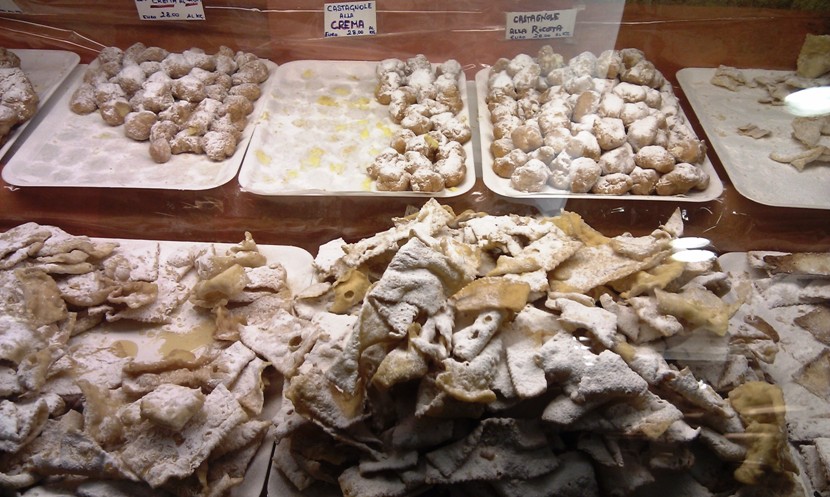
My current obsession is for castagnole and frappe, which started appearing in the pasticcerie shortly after Christmas, specifically at Epiphany; that’s 6 January for heathens. These are seasonal sweet treats for carnevale – carnival or Mardi Gras season. The Christian tradition is that Mardi Gras, aka Fat Tuesday, aka Shrove Tuesday, aka Pancake Day, is the day when you use up all your rich food products, fats and sugars to initiate Lent, the period of abstemiousness that leads up to Easter. While us Brits, and others, might have a pancake blow-out on just one day, here in Italy it looks like we’re getting weeks of the aforementioned treats.

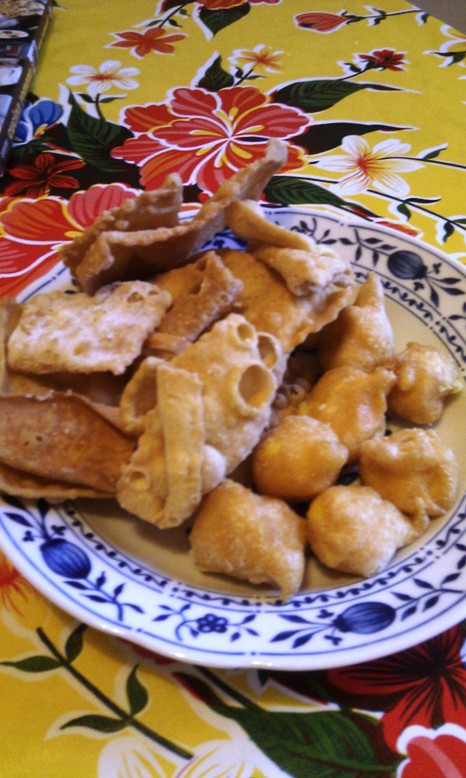
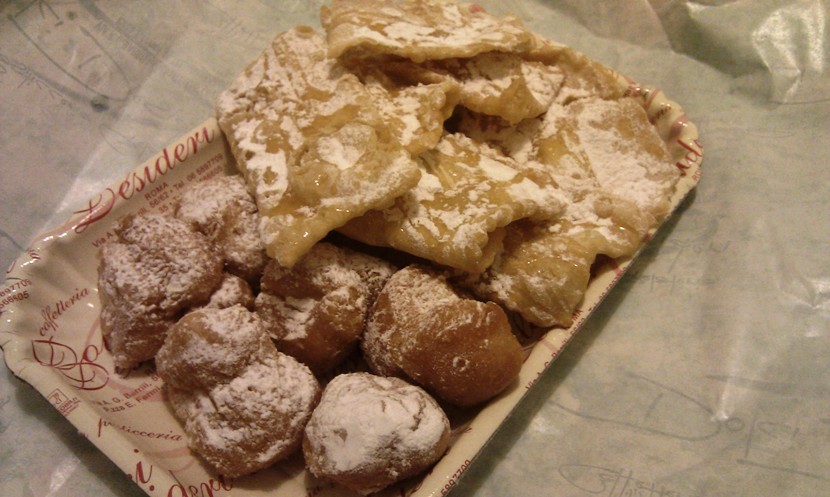
So, castagnole are small, deep-fried dough balls, a bit like doughnuts, but the dough isn’t leavened with yeast, but with chemical raising agents, ie baking powder or equivalent, according to both the ingredients taped up on the counter at Pasticceria Dolci Desideri (“Sweets you want”!; our local, on Via Anton G Barrili) and the recipe on this blog. The word presumably relates to castagna – chestnut – though they have no chestnut flavouring. Instead you can get them semplice (plain) or filled with crema (custard) or ricotta. Frappe, meanwhile, are basically thin rectangles of crisp, slightly puffy pastry, like a sweetened pasta, baked or deep-fried, and sprinkled with icing sugar, or sometimes flavoured with honey. The name itself (singular: frappa) is a bit confusing, as the similar word frappé means shake, or milkshake.

According to the above-mentioned blog, they’re also known as cenci (the plural of cencio, rag – not very appetising), stracci (shreds; stracciare is the verb to tear or rip up) and lattughe (lettuce) in other parts of Italy. We’ve been treating ourselves to castagnole and frappe, well, pretty much every day this week. It can’t go on, for obvious reasons, but not only are they delicious, there’s just something inherently lovely about going to a pasticceria and getting some treats wrapped up like a gift (eco concerns about over-packaging notwithstanding.) Really, Brits have a long way to go to make the patisserie experience as charming as this. Sure we have some wonderful independent bakeries these days, but their patisserie can still seem meagre by comparison, even if they have an array of poncy cupcakes. And for people who still don’t even have access to real bakeries, some foul mass-produced “Toffee Flavour Yum Yum” from “Greggs The Home of Fresh Baking” [sic] just doesn’t cut it.

4 Comments

Filed under Baking, Food misc, Main thread, Rome

Translating cheesy Italian pop songs

Today, for some semblance of Italian self-education or compiti (homework), I’m going to try and translate the lyrics of this song they keep playing on the radio.

Thank you Ram Power 102.7FM for getting this one stuck in my head.

I can almost feel my music taste getting shifting, uncomfortably.

The inner me dismisses this one as deeply naff, like a kind of Italian Coldplay – a band that, well, no male should be listening to or enjoying, especially not if they’re beyond adolescence.

The song in question is ‘Tappeto di fragole’ by Modà. Check out the official video:

See, a girl, singing along. It’s for girls. And they leap around in their stadium like rockers, when they’re playing pop that by no stretch can be called rock. Other than by Wikipedia, which may well be down today to protest SOPA, but isn’t as comprehensively down in Italy. So the Italian page, translated by Google for me, says “The fashion are a band pop rock Italian .” [very much sic.]

And yet, my inner me isn’t entirely prevailing here. I kinda like it, as an exercise in cheesily emotive power pop pap, with lyrics I really can’t follow. All I could get initially was that he’s singing about strawberries, fragole. A carpet (tappeto) of them, in fact.

Here are the full lyrics:

Resto fermo tra le onde
mentre penso a te,
fuoco rosso luce e rondine..
tra le foglie soffia
un vento molto debole,
nel frattempo un fiore
sta per nascere..

eccoci qua,
a guardare le nuvole
su un tappeto di fragole..
come si fa,
a spiegarti se mi agito
e mi rendo ridicolo..

tu parlami e stringimi
oppure fingi di amarmi,

in una foto un po’ ingiallita
è tutto quello che ho,
e non capisco se ridevi o no..
qui trafitto sulla terra
steso me ne sto,
aspettando di volare un po’..

eccoci qua.
a guadare le nuvole
su un tappeto di fragole..
come si fa,
a spiegarti se mi agito
e mi rendo ridicolo,

tu parlami, stringimi
oppure fingi di amarmi
x2

And here is my terrible attempt to render them into English:
I remain still in the waves
While I think of you,
Firelight and swallows
Among the soft leaves
A gentle breeze
While a flower
is opening.

(Ooh boy, I could sense it was cheesy, but that is truly cheese-tastic. Even in bad English translation.)

And here we are
Watching the clouds
On a carpet on strawberries
How it is
I tell you how you make me feel.
And I make a fool of myself.

(? Hm. Dunno. Those reflexives and pronouns really mess me up. Sorry. Plus come si fa is an idiomatic expression so probably needs an English idiomatic expression, but I’m not sure which.)

You talk to me and hug me
Or you pretend to love me.

(I think. How sad. Boo hoo.)

In a yellowing photo
Is everything that I have
And I don’t understand why you were laughing o no
Who I pierce on the ground [??]
I lie down [???]
I am waiting to fly a bit.

(Sorry that lost me completely. With only basic Italian, it’s hard to a] understand the idiomatic usage and b] render that into viable, idiomatic English. Anyway, avanti!)

Oh, that’s it. Now it’s just the chorus again –

And here we are
Watching the clouds
On a carpet on strawberries
How it is
I tell you how you make me feel.
And I make a fool of myself.

– and the funny little extra chorus element, no idea what the technical term is –

You talk to me and hug me
Or you pretend to love me.
x2

Now I can sing along, in English! Maybe.

And apologies to anyone who’s offended by my jovial cynicism, good-humoured sarcasm, possible sexism, or general benign maligning of Modà.

2 Comments

Filed under Learning Italian, Main thread, Rome

Musical migrations

So after I slagged off Virgin Radio here, our kitchen radio struggled to stay tuned in to the station. It’s like the station had the hump with me, and didn’t want to play any more. The tuning kept migrating into static, or other stations. So I gave up, and wandered around the dial until I heard a palatable tune, and the radio’s stayed tuned to 102.7FM pretty much every since.

This is Ram Power, whose tagline is “Un successo del momento, un successo del passato”. I believe that means “A hit of the moment, a hit of the past”, or words to that effect. Not sure. It’s one of those frequent incidences where I know the words, but I’m not sure about their usage in this context.

Anyway, not only has this station been playing loads of 1980s music, transporting me back to my adolescence, albeit with cheesy numbers like Wham’s ‘Club Tropicana’ (a song that always makes me think of Center Parcs), alongside the cooler stuff like Propaganda’s ‘Duel’ (what a quality video; I particulary enjoy the amateur fight coordination towards the end) or Tears for Fears’ ‘Change’, it’s also, strangely, been winning me over with some of the contemporary Italian hits. Or so I thought.

The tune I was enjoying the most involved an Italian female singer and a male rapping in English. Although he sounded somewhat Eminem, he also sounded decidedly south of England. Thing is, as Ram Power is also a station that’s “senza chicchiera” (“without chat”), they never tell you what any of the songs are.

When, after four long months of Italian telecoms shenanigans, we finally got the internet, I was able to scour Ram Power and YouTube to actually find out what some of these song were, notably the Italian songs. Well, turns out the one I was particularly enjoying was, er, the UK number one, but, confusingly, an Italian version thereof. I’m talking about Prof Green’s ‘Read All About It’, released in the UK at the end of October 2011. In the UK it featured a chorus song by Emeli Sandé. I’d neither heard of him or her, for my ignorant sins, but in my defence, I’m both a bit old for most of the UK top 40, and that lack of real internet kinda left me cut off, with no access to internet radio etc.

(The Italian version; you might not be able to play it in the UK. Who knows. If it doesn’t work, maybe try this one.)

Anyway, confusingly, the track released in Italy featured Italian singer Dolcenera instead of Sandé.

And where Sandé sang:
“I wanna sing, I wanna shout.
I wanna scream till the words dry out.
So put it in all of the papers, I’m not afraid.
They can read all about it, read all about it, oh.”

Dolcenera sang:
“Faccio così, grido di più
Voglio che tu da lassù mi ascolti
E chi se ne frega se gli altri
Gli altri lo sanno
Non mi fai più paura
Non ho paura, no.”

Which really doesn’t mean the same thing. There’s no allusion to newspapers at all. In Italian, the song is still called ‘Read All About It’, but it has the subtitle ‘Tutto Quello Che Devi Sapere’ (“Everything that you should know”).

Now, again, I’m struggling translating this with my crap Italian. For a long time when  heard the song on the radio I thought Dolcenera was singing “Basta così”, which means “Enough of that”, but I can’t get my head around “Faccio così”. Faccio is the first person singular of fare, to do or to make, so it’s something like:
“I’ll do that, I shout louder
I want you to hear me up there.
And who cares if the others,
The others, know it.
No I’m not afraid any more
No I’m not afraid. ”
[with a little help from Fran; though she can’t quite get it right either]

It’s an interesting situation – well, I’m interested me, at least in passing. I’m intrigued as to who decided an Italian version was necessary – it’s not like Italy is a big market, as it’s not like Italian is a significant language internationally like Spanish or Mandarin. A Spanish or Mandarin version would have made much more sense.

Does Professor Green have a big following in Italy? Dunno? Did Dolcenera like the tune? Dunno, but she certainly gives an emotive performance in the Italian video. Which is kinda odd given that the rap itself is comes across as very personal to Green – aka Stephen Paul Manderson – whose father committed suicide (something that seems to be reflected in the rap’s theme of paternal abandonment). Dunno though. So maybe it was just a decision by some suits at Virgin. Dunno.

There’s certainly something very corporate going on, as, in Italy, I cannot watch the original version’s official video, it has a region block or something (“The uploader has not made this video available in your country.”). I can only watch the official video for the Italian version. I’m guessing that, as with the song itself, the video has the alternate chorus spliced in.

Manderson’s rap is clearly very heartfelt, but once the song’s released, it, like everything in modern culture, becomes just a product, which can then be manipulated for deployment in a new market. As much as I like Dolcenera’s lyric, and her performance in the video is suitably agonised, it’s hard not to be cynical. Especially for a cynic like me. That said, I’m still enjoying the song. Both official versions; I reckon Dolcenera’s voice pips Sandé’s though, it’s slightly richer IMHO. Strangely, both singers sport a similar quiff.

My YouTube travels also threw up the earnest phenomenon of people covering ‘Read All About It’. Now, I really should be cynical about all this. I cannot abide the whole TV talent contest culture of needy wannabes being showered in glitter and pantomime abuse, but people just sticking low-fi recordings of themselves on YouTube is kinda sweet. Even if some of the amateur ones are awful.

This one, however, is sweet but also really proficient. It’s by a London pair with the uninspired name The Chain (Ben Parker and Kate Aumonier) showing off some lovely voices. They seem to be crowd-sourcing an album or something here too. They do another song that they refer to as “our version of their version of his version”, which kinda sums up this culture of covers, versions and t’interweb*. Though I’m still kinda confused by the region blocks; what tedious corporate control freakery that is.


* And is the sort of creativity that may be buggered if SOPA is passed in the US.


Leave a comment

Filed under Main thread, Rome

Katching-22, part 2

Quick update on our exasperating Italian broadband situation, 3 January 2012.

This is more for my benefit really, to keep a record.

So, we finally get a call and another appointment is made for the guy to deliver the router. No explanation for the no-show, no apology.

Thursday 22 December, the guy arrives, early no less. There’s me thinking, hope against hope, we might have internet for Christmas, so we could Skype family and friends freely.

Firstly the guy groans as there’s no power socket near the phone socket. Relax, geezer, we can just use an extension (in Italian, una prolunga – love that). So he plugs in the router and… zilch. He announces the phone line is not active, despite the visit from a Telecom Italia guy to activate it, what, back in late October.

He makes some phone calls to Fastweb. Even he – an employee of Fastweb – has to stay on hold for long periods. Finally he announces the phone line will be activated (again) within 72 hours. Three days, which would take us to Christmas day.

I don’t really believe anything will happen over Christmas, but hey, I’m hopeful maybe some extra lights will illuminate on the router afterwards, indicating an active line.

Zilch.

So Fran spends a frustrating day trying to call Fastweb from her mobile, with a UK SIM, with an Italian SIM, from my mobile. Nothing. Their number – 192 193 – just won’t work for us.

So Thursday 29 December we make the tediously predicatable schlep over to the nearest Fastweb shop, in the Prati, about a mile away from where we live. It’s a nice walk at least, and we can check out the huge – life-size – presepio (crib) in St Peter’s Square. It’s predicatably kitsch, but not really kitsch enough. One of the oxen has a manic glower. Maybe he could turn it on the telecoms company representatives/.

Things proceed as usual in the shop. The guy is cordial. He taps his keyboard for 5 minutes, tells us the line was activated in late October, or there must be another problem or something (my Italian is too shit, and Fran couldn’t quite follow either), then announces we’ll get a call within 48-72 hours to arrange for another guy to visit and do some tests.

We also ask if they have another number so we can contact them without a landline. He says no, and even acknowledges that many people have the same problem trying to call 192 193 from mobiles

We go home, with very little faith. It’s a Telecoms company. It’s Italy. It’s the Christmas holidays.

I don’t really believe anything will happen over Christmas, but hey, I’m hopeful maybe some extra lights will illuminate on the router afterwards, indicating an active line.

Zilch.

Meanwhile, Fran’s dongle, or chiavetta, craps out. Not for lack of data allowance, it just starts disconnecting randomly. With 6 gigs of paid-for data still on it. Gah.

Given that having two dongles just about made life without real internet bearable, this is annoying. So we go to the TIM telecoms shop. The guy tells Fran to try re-installing the software from her laptop (Mac). Which is patently bollocks, as Fran tried her dongle in my laptop (Windows), which has the comparable software installed, and it had the same problem, though my chiavetta (same model) is fine. As I predict, that solves zilch. Nada. Niente. Sweet effing FA.

Italians – or to be more specific Italian telecom company employees – really are masters of the art of fobbing you off.

Fran is back at work now, with a phone line where she can actually reach 192 193. However, that number doesn’t have an automated menu option for new customers-who-have-yet-to-be-connected, and the people on the other options (for mobile, for home phone etc) refuse to help her or give her another number, just saying someone will contact us within 48 to 72 hours.

The irony here is that surely someone, somewhere in that commercial company wants us to finish the process so they can start taking a direct debit, or whatever the convoluted, draconlian Italian banking equivalent is.

Oh, and another profound irony is that a friend who lives round the corner, and is an existing, paid-up Fastweb customer, had a helpful, smooth experience with them over the Christmas period. It’s beyond perverse.

[Insert cartoon of shooting self in head here]

Quick update, 5 hours later.

So, a colleague of Fran had a go at ringing Fastweb and was put through to someone in the technical support department. Fran’s Italian isn’t bad, but does it really take a native speaker to get you through to the right people at a call centre?

They got an entirely new story this time. Why the guy in the shop couldn’t have told us this I don’t know.

“Telecom Italia are sitting on the change over of the line. They have to switch over the line at their central exchange. They are not doing it fast enough, there is a backlog and the technical guy suspects that the Christmas holidays haven’t helped. FastWeb are already paying for those lines, are losing money, and are very keen to get their customers to reiumburse them as soon as possible  so are leaning on them very heavily every day to get this sorted out. Once Telecom Italia does the switch over – which it seems is very simple – then FastWeb can automatically turn on our line and it will be working. Telecom Italia have promised them to resolve it by Monday.”

Telecom Italia have promised… Hm. Yes. Ok. We shall see.

2 Comments

Filed under Rome