Tag Archives: cinnamon rolls

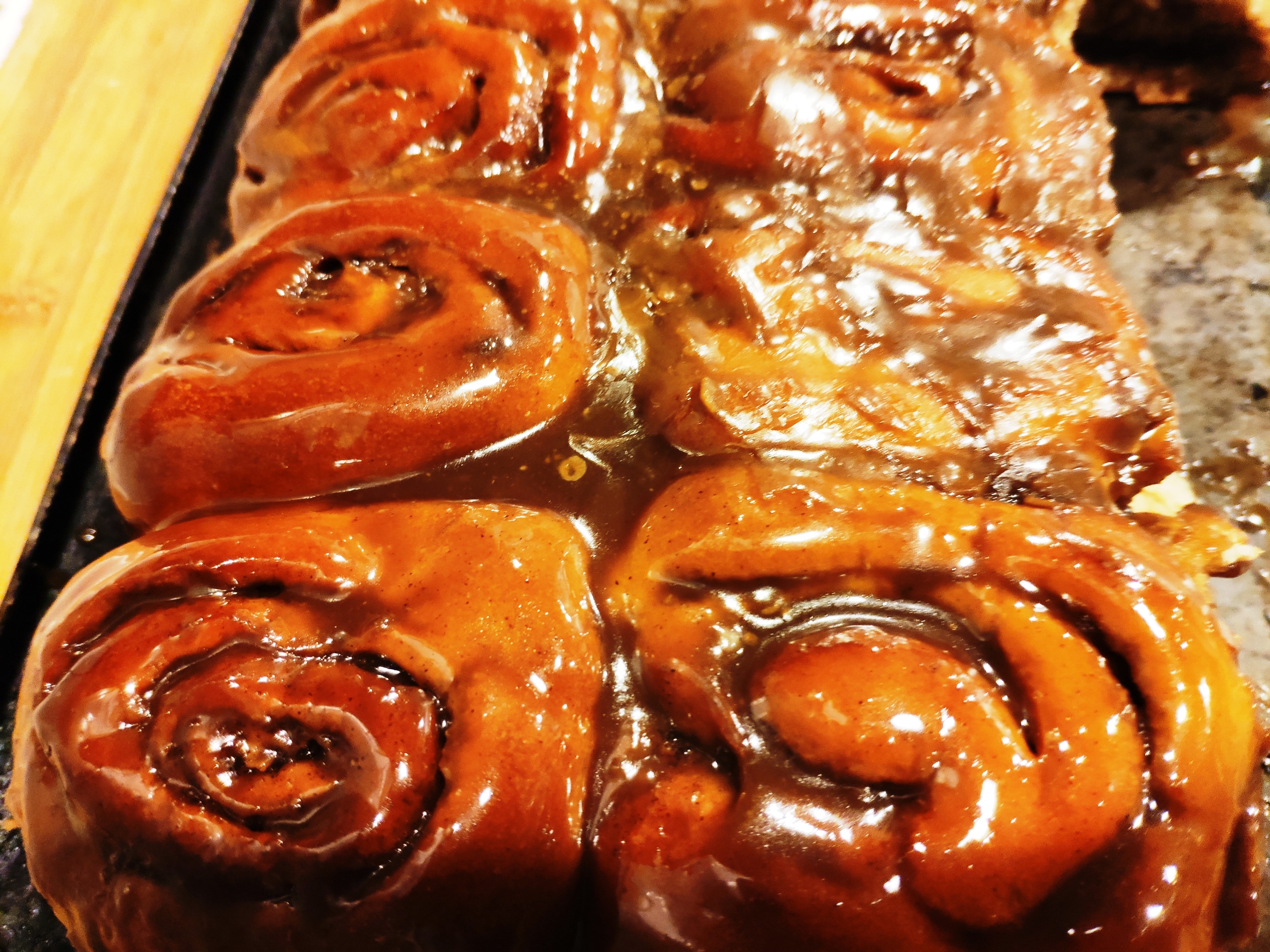
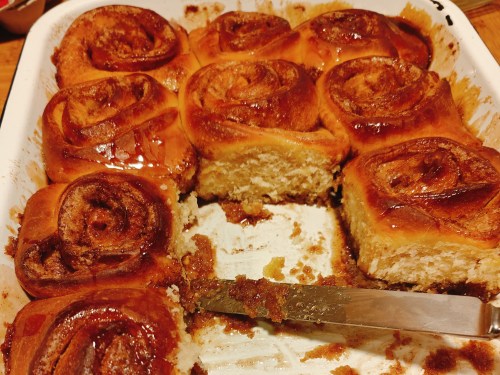
Alison Roman’s sticky cinnamon rolls

In the second season of the TV series The Bear, a Chicago neighbourhood sandwich shop is being transformed into a posh restaurant. In the remodelling, they put in an office, and in that office is a shelf of cookbooks. The only baking book among them, as far as I could see, was Sweet Enough by US food writer Alison Roman. I bought it, based on good reviews, and since then it’s been my favourite book for making new treats. Roman seems to be one of those reliable recipe creators and of the twenty or so recipes I’ve used so far (and frequently returned to), only one was a bit of a duff.

Ridiculous indulgence
The most recent one I’ve tried is her sticky cinnamon rolls, as we all love such things in this family. Enriched dough is quite possibly my favourite area of baking. Indeed, the past year or so I’ve been using my brioche dough to make chocolate babka, but that’s for another post. Roman’s cinnamon rolls are the most ridiculously indulgent bake I’ve done since monkey bread. Both utilise an enriched dough along with serious quantities of butter and sugar. Roman’s cinnamon ramps up the absurdly indulgent factor with the addition 200g of maple syrup, poured directly into the baking receptacle. Oh my giddy aunt.

Seven spices
Another food item I’ve been enjoying recently is a jar of Lebanese seven spice or baharat (literally “spices”). Supplied by a friend of a friend, direct from Egypt, I believe, its label is in Arabic. Until I asked my multi-lingual friend Ioni what the label said, the strongest scent I got was cloves so I started chucking it in other sweet bakes – parkin on Bonfire, a steamed ginger pudding. Turns out the spice mix also includes cinnamon, black pepper, cumin, coriander, cardamon, nutmeg; some versions also include ginger, cassia and saffron. I need to show the actual jar to Ioni to get this clarified. Either way, it’s a good mix for that wintry, festivally warmth I so enjoy at this time of year. So I chucked some in my cinnamon roll filling too.

This recipe and process is similar to my brioche; the key difference is that Roman does a cold mix to start. This seemed to not give the chance for the yeast to activate at all, and for the final prove, there didn’t seem to be much vigour. Another misgiving was the inclusion of baking powder. I believe baking powder works in two ways: it activates with moisture then with heat. So surely during this recipe’s long prove, it would be activated, and the resulting CO2 would dissipate? So you’re only getting the heat reaction and the CO2 that results from that. Having said all that, the oven spring* was good, and the resulting dough was light when freshly eaten, so all good. As I said, reliable recipes. Thanks, Ms Roman.

Dough
240g full fat milk
50g granulated sugar
7g active dried yeast
245g plain white flour
200g strong white flour
6g baking powder
4g fine salt
2 large eggs, beaten
115g unsalted butter, cut into small pieces

Filling
200g maple syrup
180g soft brown sugar
10g powdered cinnamon
(3g baharat or any other entirely optional spices to taste)
115g unsalted butter, soft

1. Combine the milk, yeast and granulated sugar in the bowl of a mixer.
2. Sieve together the flour and baking powder, then add this to the yeast mix.
3. Mix on a low speed to combine then slowly add the beaten egg, scraping down the sides of the bowl to incorporate well.
4. Add the butter a little at a time, incorporating and scraping down.
5. Keep mixing until the sticky mass becomes smoother and entirely incorporated.
6. Grease a clean bowl, then transfer the dough. Cover with clingfilm then refrigerate for 12-24 hours. This will rest the dough, help the flavours mature and firm up the fats.
7. Grease a roasting dish or tray 23x33cm, or similar, then pour in the maple syrup.
8. Combine the sugar and cinnamon (etc).
9. On a lightly floured surface, roll out the dough to a rectangle around 30x60cm (grab a tape measure!), moving it around frequently to stop it sticking.
10. Smear the softened butter all over your dough rectangle, then sprinkle the cinnamon sugar onto this, smearing it all together gently to mix.


11. With long side of the rectangle towards you, roll up the dough.
12. Cut the log into two, then cut each of these into six. I used the tape measure again to measure then divide. Each piece will be about 5-6cm.
13. Lay the slices into the roasting dish, in their maple syrup bath.
14. Cover again, then leave for their final prove. As mentioned, I found the dough pretty sluggish at this point, but I don’t have a warm proving drawing or cupboard. At an ambient temperature of around 18C, this final prove took a few hours.


15. Heat oven to 180C.
16. When you’re satisfied with the prove, bake the rolls for about 20 minutes, rotating the dish to keep the bake even. Bake for another 10-15 minutes until golden.
17. Remove from the oven then brush or drizzle with more syrup while still warm.
18. Cool in the tin. Eat them fresh, even still a little warm. Seriously. Ridiculous.


* When the yeast feels the oven heat, it has a burst of vigour, releasing CO2 and making the dough expand. This is called oven spring. Then it gets too hot and is killed. Sorry yeast.

2 Comments

Filed under Baking, Cakes (yeasted), enriched dough, Recipes

Vital wheat gluten and sticky cinnamon rolls

Of the many food fads that have come and gone in my lifetime, one that particularly bemused me is when people took against gluten. Obviously I’m a baker and love bread, so I love gluten and what is does for us. What riled me was the sense that many people didn’t even know what gluten was. What is gluten? It’s protein. Or more specifically, two proteins: gliadins and glutenins. How bad is wheat protein?

If you have coeliac disease*, your body cannot handle gluten, so obviously it needs to be avoided, but for most of the rest of the population, it represents the protein component of bread, the staff of life. Derived (usually) from wheat grain it’s what gives bread its structure, while the main part of the grain, the starch, the carbohydrates, provide the bulk, the energy.

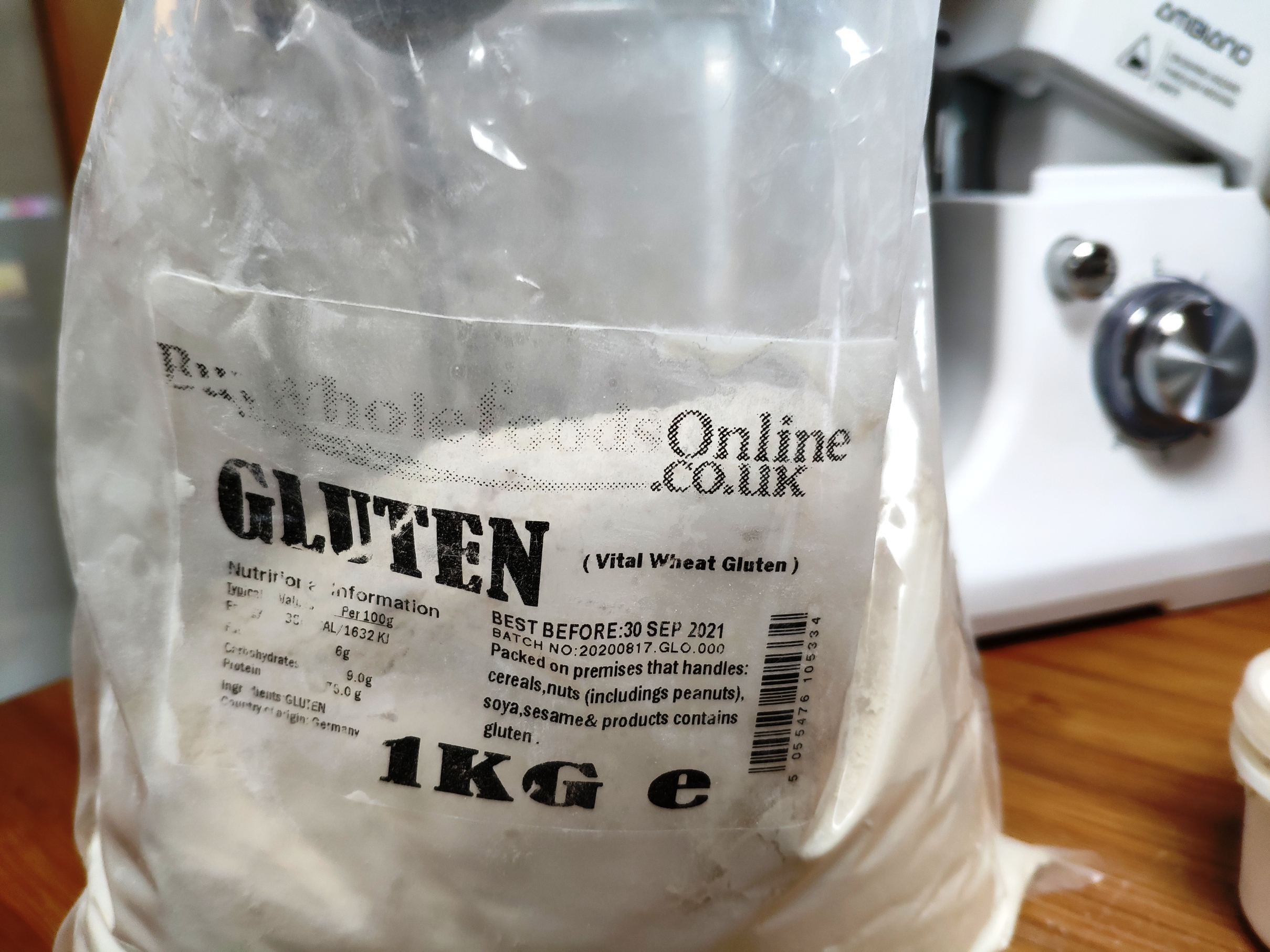
When I first encountered seitan in health food shops in Rome, it was around the time the anti-gluten fad was at its height. Seitan is another high-protein meat-alternative alongside the soy bean-based tofu and tempeh, but is made from wheat – specifically wheat that has been processed to remove the starch, leaving mostly the gluten. In its dried, powdered form, this is called vital wheat gluten.

Although I’ve eaten a fair amount of seitan, somehow I’ve managed to miss baking with vital wheat gluten. With another lockdown in England now, and the schools closed again, we need treats to get us through, especially as this lockdown comes at the hardest time of year – the dank, grey months after Christmas. So I wanted to make some cinnamon rolls.

The recipe is from the 1993 baking classic The Bread Book by Linda Collister and Anthony Blake. They got it from a Kansas champion baker called Viola Unruh and it includes an optional tablespoon and a half of vital wheat gluten. Intrigued, I bought some online, something that wasn’t really an option back in 1993. I’m glad I did. I work with a lot of different doughs, and working this it didn’t feel particularly different to other relatively low hydration, enriched doughs. But the resulting buns had a chewy, moist crumb, not at all crumbly, indeed like the sort of crumb achieved by professional bakers in commercial products.

I plan to experiment with vital wheat gluten more: I’ve just used some in my standard, feed-the-family bread and it seems moister, and I plan to add a tablespoon next time I do brioche. In the meantime, here’s the sticky cinnamon rolls recipe. I’ve revised it slightly, ie standardising all weights in grams and adapting the method slightly. What I haven’t changed is the addition of a cream/muscovado sugar mixture to the tin when you’ve nearly finished baking to add a totally over-the-top sticky sauce to the finished bun. Oh boy. A long way from healthy.

Makes 15 buns

7g active dried yeast or 15g fresh yeast**
115g water, warm
5g caster sugar
4g fine sea salt
50g unsalted butter, diced
50g caster sugar
280g water, hot (around 65C)
680g strong white bread flour
15g vital wheat gluten
1 egg, beaten, around 45g

Filling
85g unsalted butter, softened
85g muscovado sugar – light or dark. I used a mix
12g cinnamon, or to taste

Caramel topping
200g muscovado sugar. I used light muscovado
115g double cream

1. Grease a roasting tin, around 30 x 22cm, and line with parchment. You’ll also need a lightly greased baking sheet, preferably one without a lip.
2. Activate the yeast by adding to the 115g water with the 5g of caster sugar. Leave to froth up.
3. Put the 50g of diced butter, 50g of caster sugar and 4g salt in a mixing bowl, or the bowl of a mixer if you’re using one. Pour over the 280g of hot water and stir, until the butter has melted.
4. Add 230g of the flour to the mixing bowl along with the vital wheat gluten and beat to combine.
5. Add the yeast mix and beaten egg and beat to combine.
6. Cover and rest for 10 minutes.
7. Add the remaining 550g of flour and bring to a dough, either in a mixer or by hand. As it’s fairly low hydration, you’ll achieve a fairly manageable soft, smooth dough that’s not particularly sticky.
8. Grease a clean mixing bowl, put the dough in and leave to rest. After about an hour, give it a stretch and fold.
9. Cover again and leave to prove. After about an hour, give it another stretch and fold.
10. Cover again then leave to prove until doubled in size.
11. Meanwhile, make the filling by creaming together the 85g of softened butter, with the 85g of muscovado sugar and the cinnamon.
12. Turn out the dough and stretch it into a rectangle, using a rolling pin if you prefer, about 35x50cm.


13. Spread the cinnamon filling over the dough rectangle, then roll it up from the long side.
14. Measure the length of your sausage (fnar) and divide it into 15. Mine came to 15 slices at about 6m each. Cut these pieces.


15. Put the slices, in a 3×5 grid, in the prepared roasting tin.
16. Cover and leave for a final prove, until doubled in size. This will depend on the temperature, but should take around an hour or so.


17. Preheat your oven to 180C.
18. Put the rolls in the oven and bake for around 30 minutes.
19. Meanwhile, make the caramel topping by mixing the cream and muscovado.

20. When the rolls are baked and a nice golden brown, take them out of the oven and turn them out (and over) onto the lightly greased baking sheet.
21. Pour the caramel into the roasting tin, then return the rolls to it –with the tops on the bottom so they’re sitting in the caramel.
22. Bake for another 10 minutes.
23. Allow the rolls to cool for a few minutes, then remove from the roasting tin and allow to cool.

24. To serve, pull them apart and have a cloth ready to wipe any messy children. They’re lovely warm, but also last well as they’re so rich and slathered with sugar and dairy.

So good. So badly photographed….

* Or significant gluten sensitivity health issues.
** If you can source it in sensible quantities. I prefer using fresh, and used to be able to get it – lievito di birra – in small blocks in supermarkets in Italy. It’s not sold in convenient small blocks in British supermarkets. It’s not sold in Britain supermarkets at all, or at least not in my experience. I used to get it from a health food shop, but they do it in bigger lumps now and I don’t like to waste it. So I’ve resorted to active dried yeast (ADY) again. I talk about yeast types here.

7 Comments

Filed under Baking, Breads, Cakes (yeasted), Flour & grain