Monthly Archives: January 2013

32 Via Dei Birrai brewery’s Atra beer at Oasi della Birra

One of the reasons I started this blog was to keep a record of all the wonderful Italian artisan beers I’ve been trying. I’ve been remiss.

I won’t say I’m going to “review” these beers. I might have reviewed several hundred films and videogames in my time, but I’m really not sure I have the right vocab for appraising alcohol. So yes, it’s just a record, and hopefully a source of some useful info for other anglophone beer enthusiasts who might find themselves in need of a good brew while in Italy.

Anyway. We had this one last night, in the wonderfully named Oasi della Birra (“Oasis of Beer”) in Testaccio in Rome. It’s a pretty cool place, basically a shop that’s expanded sideways and crams in dining tables among the wares (which can give it a feeling of eating in a warehouse, though at least that’s novel).  In all honestly, though, a better of oasis of Italian craft beers in Rome is still Open Baladin bar, for the simple reason it has dozens on tap, whereas the Oasi, disappointingly, only has German beers on tap. Go figure.

The Oasi does, however, have an extensive menu of bottle beers, and a fairly epic menu of wines. Why it’s not called the Oasi del Vino I don’t know. It also does a reasonable aperitivo buffet, where you can pile up a plate for a fraction of what a restaurant meal would cost you, that is €10 for a drink and a plateful. (The cost of eating out is something that continues to confuse me in Rome – restaurants, and even most trattorie, are not cheap. Broadly, the only cheap way to eat sitting down in an establishment is an aperitivo buffet. There don’t really seem to be many options half-way between, in terms of price, bar a few genuinely cheap trattorie, mostly outside touristy areas, or the occasional good tavola calda. This literally means “hot table”; wordreference.com translates it as either “cafeteria” or “hash house”, neither of which is quite right. The former makes me think of British caffs, the latter sounds like “crack house” or “opium den”. They’re places that are generally defined by seating and a glassed-in counter displaying various dishes you can select. Volpetti in Testaccio has a good one, but it’s overpriced. The yummiest I’ve tried food-wise is Pasta… e pasta on Via Ettore Rolli near Ponte Testaccio, but I don’t want to get into the habit of eating there there I have an ethical problem with the throwaway plastic plates, cutlery, cups etc. Every diner creates probably around 50g of waste with each meal. It might not sound like much, but imagine the pile after just one busy day, say, and think of all that plastic sitting in a landfill for millennia. It’s a waste of resources, full stop. I know food and catering is all about overheads but we just have to think more sustainably in the 21st century.)

Anyway. Back to the beer.

So last night I tried to get a Sally Brown, a lovely brown (yep) beer that I’ve had at Open Baladin. It’s from Birrificio del Ducato, and on their site here it’s described as Birra di alta fermentazione, a cavallo tra le oatmeal Stout e le Porter inglesi – “A top- fermentation beer that straddles the styles of oatmeal stout and English porters.” The Oasi, however, had run out. This seems to be a typical factor of drinking from the Oasi beer menu. They don’t generally have what’s on the tatty photocopy, but are always happy to give advice about an alternative. It’s a process I really enjoy actually, as it usually involves trying something new.

This time, that something new was, well, I couldn’t work out what it was called last night, so had to check online today and in my Guida alle birre d’Italian 2013. The 75ml bottle is very elegant, with a minimal design. But as I’d never encountered this beer or this brewery before, I wasn’t sure immediately what was what from the label. Now I know though. The brewery (birrificio) is called 32 Via Dei Birrai.

The blurb on the homepage of their site says:  32 Via dei Birrai è il primo micro birrificio artigianale italiano a ottenere la certificazione di qualità ISO 9001:2008 DNV e la certificazione CI, a testimonianza di un prodotto 100% Made in Italy. / Passione, per 32, significa infatti selezione di materie prime e accorti procedimenti che rendono onore al nome stesso di essere e fare birra. Which means: “32 Via dei Birrai is the first Italian micro bewery to obtain the certificate of quality ISO 9001:2008 DNV and the CI certificate, testimony to a product that’s 100% made in Italy. Indeed, passion, for 32, first and foremost means the choice of materials and a grasp of how to make beer that honours our name.”  (I know I could just put my [not Google translate’s] English translation, but I like the two side-by-side, it helps me learn Italian. Plus, my translation is probably a bit shonky, so if you speak Italian and English, you can likely do it better.)

Anyway, 32’s beers. Atra is from a range of nine beers, most of which are made with top fermentation and bottle conditioned. Atra itself is, well, molto buono, as the waiter who recommended it said. But then he also said it’s non troppo forte, “not too strong”, when in fact it’s 7.3%ABV. I love how that’s not strong in Italy. In the UK, anything above about 5% is considered strong. To give some context to the Italian attitude to beer strength, Tennent’s Super is popular here, and that’s 9%. Apparently, it’s even considered kinda classy, as it was among the first import beers to make inroads here. The mind flippin’ boggles, as in Britain Tennent’s Super is basically a beer for alcoholic tramps on park benches. I’ll say now, so as not to confuse things, it’s popular among undiscerning Italian beer-drinkers, in much the same way as Fosters, say, is popular among British drinkers despite them having so many wonderful quality beers to choose from; hell, even if you like lager, you can choose a better lager… (I’m trying not to get started.)

Okay, Atra itself. It’s dark (“the colour of friars’ habits”), with a taste that’s charcoaly (ie from well-toasted malt) and surprisingly sweet. It’s very pleasant indeed. We had no idea whether it’s the done thing to drink such beers while eating, but it went very well with a plate of salads and cheese and salumi and bread. Indeed, now I’m reading the brewery’s own description, it seems like it’s fine to drink it with food. But as with wine culture, Italian micro-breweries are very specific in their descriptions of their beers and what to drink them with. So here it says, Abbinamento suggerito: contorni di lenticchie e fagioli, minestre con legumi, stinco con cotenna caramellata, torta al cioccolato, crème caramel, panna cotta. “Suggested accompaniment: lentils and bean sidedishes, vegetable soup, shin with browned bacon rind, chocolate tart, crème caramel, panna cotta [‘cooked cream’ desert].”

If you want a more in-depth appraisal, the Guida 2013 says it has scents of coffee, cocoa, liquorice and toasted cereal and a taste of barley coffee, cocoa and caramel. I’m not sure I got the liquorice, but I can’t argue with the rest. Delicious. And also remisicent of my friend Michele’s Cotta 74 from Mastri Birrai Umbri brewery, which I talked about here.

Hopefully next time we go to the Oasi, they’ll have more from 32 Via dei Birrai, as I’m keen to try the others. And I do like the design of the bottles. Especially now I know 32 is the abbreviation for the name of the brewery.
4 Comments

Filed under Ale, beer, Rome

The Euro-mankiss

Hugs are great. I love a good hug. They’re versatile. They can be reassuring at a teary emotional level. They can cement a reunion between friends of any sex, whether it’s after just a few days separation or several years. They can celebrate a shared experience. They can even celebrate a shared manly experience like scoring a goal or, I dunno, shooting a boar. In a perfectly masculine way. Heck, think of all the American movies where a bunch of “the guys” are watching “the game” and their team scores “a touchdown” or whatever, and they leap up, spilling their cans of pissy beer, high-fiving, bumping chests and, yes, hugging.

It’s all good.

I’m really not very British about hugging. Many Brits are still more stiff and formal, proferring a hand for gentlemanly shake. Not me. When I was younger, I lived in New Zealand on and off for about three years with people others would probably describe as hippies. I would have been described as a hippy too. We all enjoyed hugs. I like hugs with my family too. Even with my more conventional brother, who’s tall like me (1.89m) but burly, so does a good bear hug. I’m even perfectly happy for a good Italian chum to give be jovial hugs or take my arm when we’re joking in the street.

When I am very British, however, is when a Euro-mankiss is involved. That’s where I draw the line, which leads to some slightly awkward situations living in Rome. I’m not sure how widespread the mankiss is, but from an outsider’s perspective, it seems to be absolutely commonplace in Italy, France and other countries in the Romance language group. Perhaps it’s the ancient Romans’ fault. Somehow, however, the habit didn’t survive the crossing to the barbarous shores of Britain with Caesar and co. For a Brit, it’s just not done. Unless you’re in theatre. Or unless you live on the continent and have gone really native. And I haven’t. My wife is a Brit too, and we have plenty of friends here who are either British or have a slightly closer cultural heritage (like Canadians). There’s no mankissing with them. We have plenty of Italian friends too, though, and that’s where the trouble starts.

It’s not all good.

So, the other night we were going out to meet some friends. She’s Sicilian, his background is from various parts of Italy. We go to a restaurant. I’m already antsy as I don’t like eating at Italian dinner time. For me, I’m generally hungry around 6pm, and my family always ate dinner at 7pm. I can survive a little longer if I have snacks, but not too many as I don’t want to ruin my appetite (as my mum would say) for the proper meal. Eating at 9.30pm plus seems crazy to me, especially if you’re shovelling away all the courses, and dolce, and coffee and digestivo. How can the body cope with all that? Never mind the diners who I hear yacking away at midnight in the summer at the restaurant just down the road from our flat. How the heck do they digest and get up for work the next morning? I mean, strong coffee is the obvious answer, but surely there’s a cumulative effect of eating late, not getting much sleep and drinking loads of coffee? I don’t geddit. But then I’m northern European.

Anyway. The restaurant. So we arranged to meet at 8pm. They finally arrive about 8.30pm. By which time, my (self-diagnosed) hypoglycemia is making me go squiffy. I can’t really think straight. I manage a Euro-womankiss, one on each cheek. That’s fine. I used to be involved with the art scene enough to have practised that at gallery openings and whatnot. But then my hungry brain and body have to contend with the male greeting. He goes in for a mankiss, I go in for a quick hug. He ends up airkissing, the hug happens sideways. Feathers aren’t notably ruffled; it’s a tolerably minor cross-cultural semi-faux pas. But I’m relieved half an hour later when some food finally arrives and I can start to think straight again. First thing I think is that next time I’ll have to try and line up my approach for either a handshake or a hug or both a bit better. Though I’m not quite sure what body language is required to give the message “Nice to see you but I don’t do the Euro-mankiss.”

3 Comments

Filed under Italy, Learning Italian, Rome

Chocolate fudge pudding. Aka self-saucing chocolate fudge pudding

My current city of residence Rome might reach temperatures of around 40C in August, but that doesn’t mean it’s entirely lacking in the winter department. This time last year we had a dump of snow, and this year we’ve had several weeks of cool, wet weather, with some mornings starting just above freezing. Sure, it’s not winter like Moscow or Owen Sound, ON., but that’s still quite a notable temperature differential. Never mind the fact that our flat is all stone floors, white walls and seriously draughty shutters. Ergo, I feel perfectly justified in indulging in some classic, hot, stodgy British winter puddings.

This is one of my life-long favourites. It’s one of those things I simply have to eat when it’s cold and gloomy and damp.

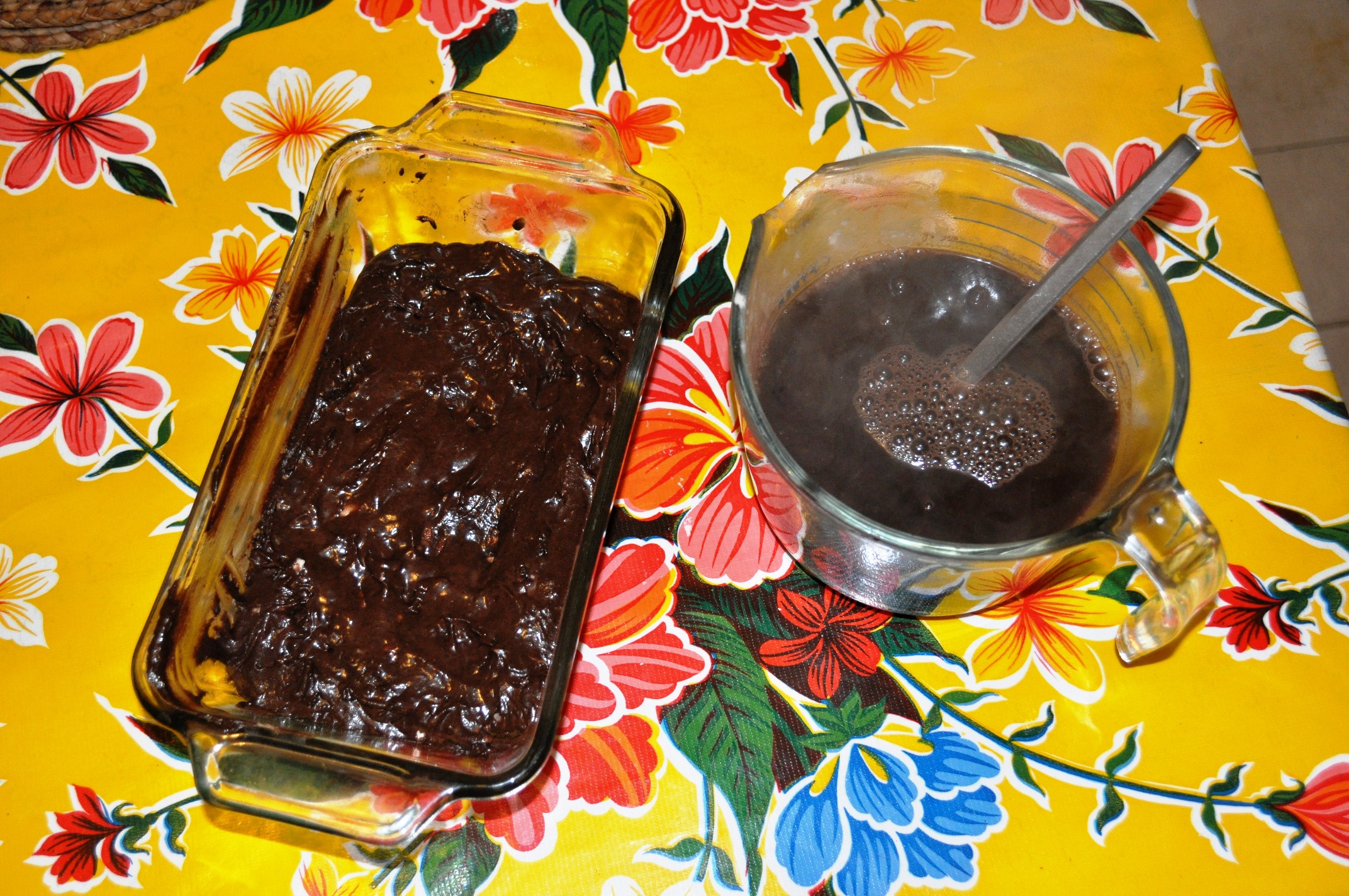
There are several recipes knocking around, which all use the basic variant of a sponge batter with some cocoa, and a unprepossessing looking liquid made using sugar, more cocoa and hot water that is poured onto the batter before baking. It’s one of those processes where it’s hard to believe it’ll work. But work it does. The batter bakes into a lovely sponge, enriched by the sauce that, if you don’t over-bake it, pools in the bottom of the dish as you scoop the pud out to serve.

The recipe we use in our family is from The Times Cookbook (published 1972) by Katie Stewart, a cookery writer whose reputation is undergoing a well-deserved resurgence since her recent death. That cookbook was an important part of my cookery education as a kid, alongside the more successfully branded Delia Smith’s Complete Cookery Course (1978-80). Both were very reliable. Indeed, this chocolate fudge pudding recipe seems to be one of the most reliable. I’ve tried or read a few more, and some of them just seem a bit strange. For example, this one from Lisa Faulkner, says “Cover with cling film and put in the fridge overnight to set.” Why would that be necessary? And the overnight delay really just doesn’t cut it when you’ve got the specific craving and need the hot chocolaty hit in less than an hour.

So. For the batter you need:
85g self-raising four (or 82g plain and 3/4 a teaspoon of baking powder), sieved
25g cocoa
112g butter
112g caster sugar
2 eggs
1/2 t vanilla essence
50g chopped walnuts (or pecans, or whatever nut you like)
50g chopped chocolate (optional. Dark is classiest, white can be a nice surprise, milk is dandy)
1-2 T milk

For the sauce
112g soft brown sugar
25g cocoa
285g hot water

Heat the oven to 180C.

1. Cream together the butter and sugar until light and fluffy.
2. Beat together the eggs, add the vanilla, then gradually beat this into the creamed mixture.
3. Sieve together the flour (or flour and baking powder) and cocoa.
4. Beat in a little of the flour. (This helps it stop curdling.)
5. Add the rest of the flour/cocoa mix and fold it in.
6. Fold in the nuts and chopped chocolate.
7. You want a “medium soft” batter. Add some milk if it’s too thick.
8. Put the batter in a greased baking dish (volume around 1 litre/2 pints).
9. Make the sauce by combining the sugar and cocoa, then adding the hot water and stirring well. Don’t worry if it’s a bit gloopy.
10. Pour the sauce over the batter.
11. Bake for around 40 minutes.
12. Serve hot with vanilla ice cream, or whipped cream, or even clotted cream. Something that’s denied to me living in Rome. *Sob*
13. Feel warm and contented.

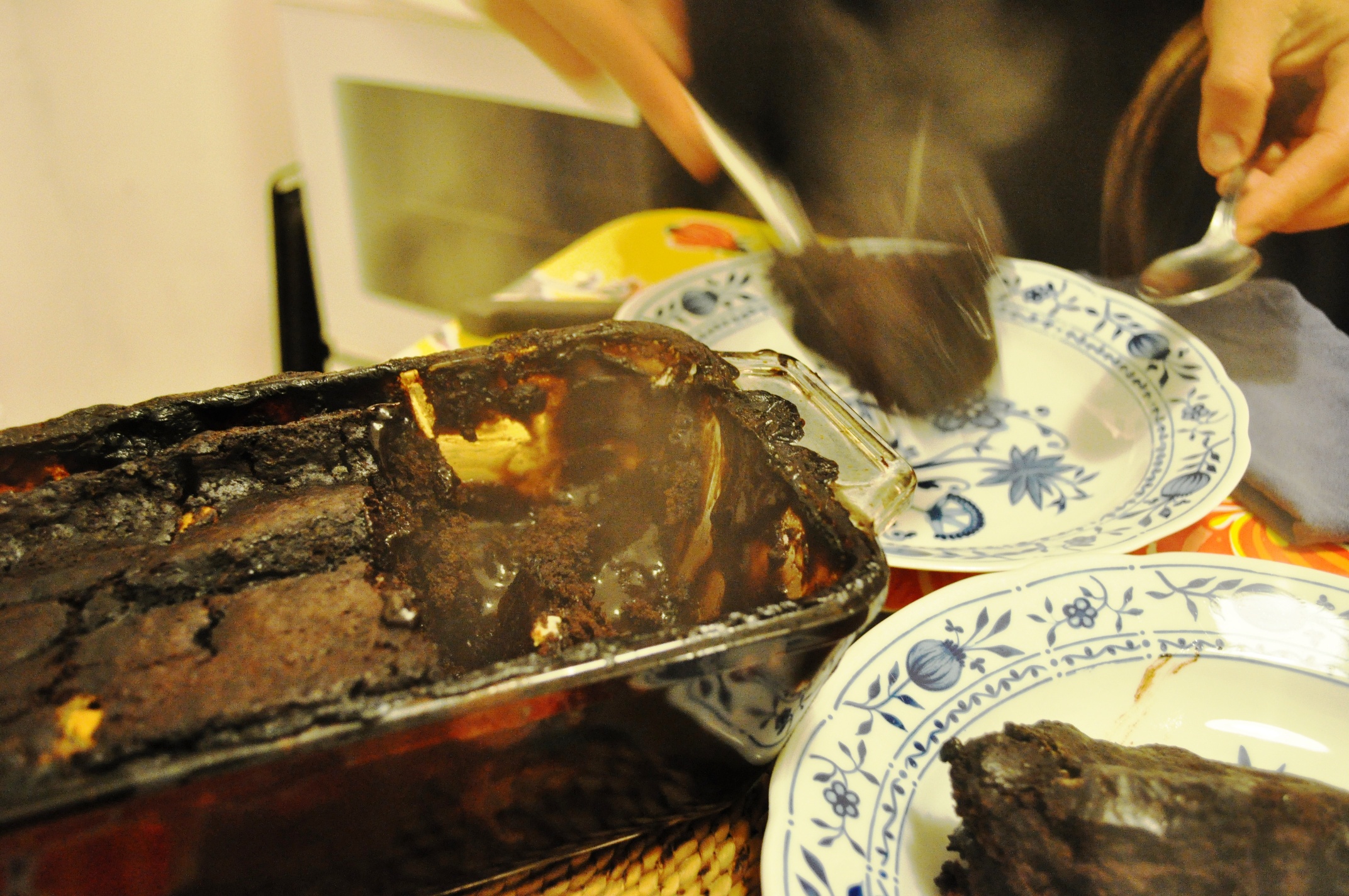
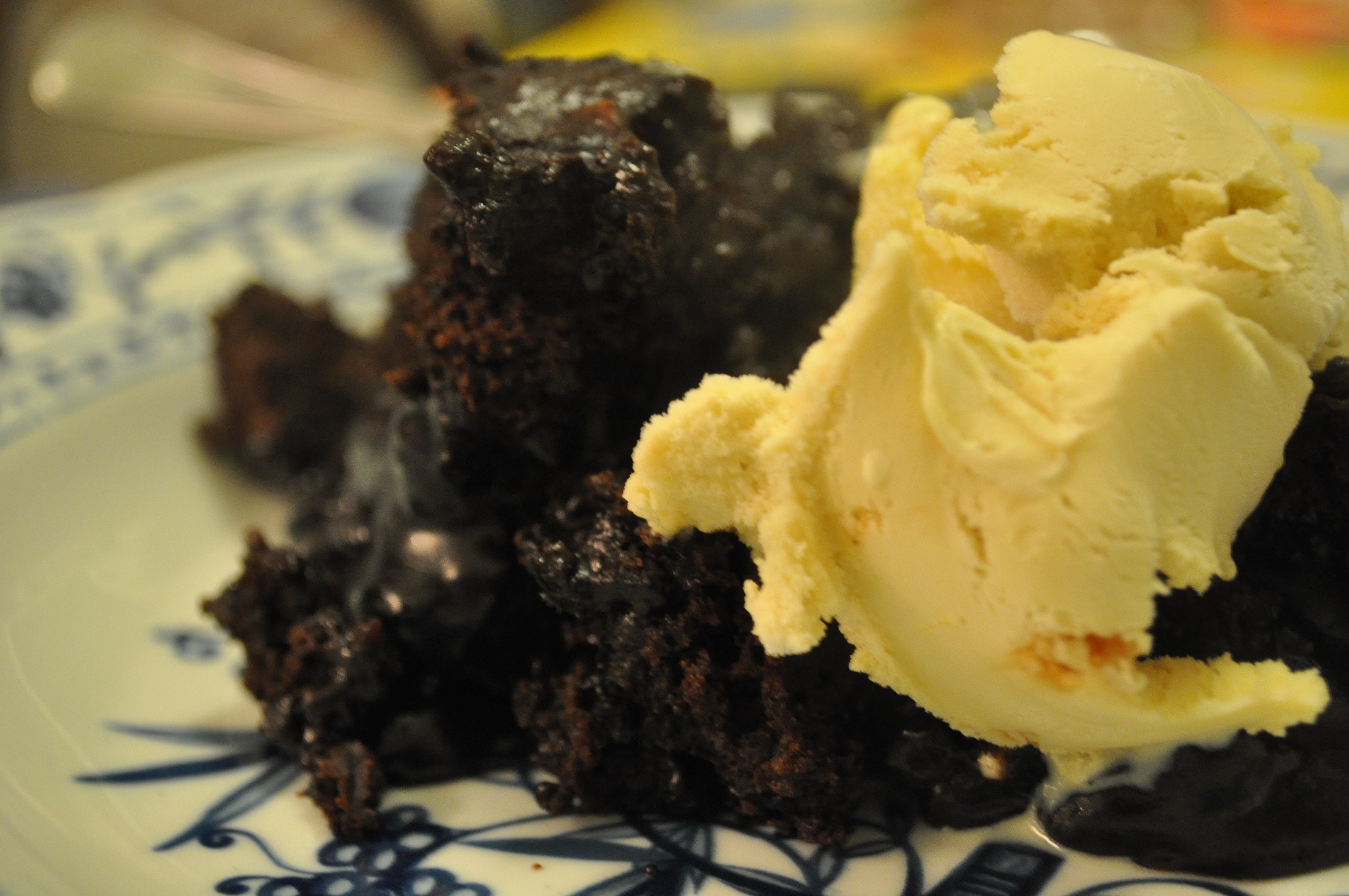
BTW, these photos are of two different puds made over the last few weeks. Most of them are from a pud that contained some white chocolate and is served with ice cream. The last pic is of a version that contains hazelnuts, and is served with whipped cream. If I’ve was forced to decide, I’d say my favourite variant is walnuts-dark choc chunks-served with vanilla ice cream.

9 Comments

Filed under Puddings & desserts, Recipes

Translating Tensione Evolutiva by Jovanotti into English

As usual, I’m hearing Italian music on Rampower, a radio station that doesn’t tell you what the songs are or who they’re by, or on the supermarket tannoy. And as I’m so resounding ignorant* of Italian music, I have to Google to get any info.

Anyway, this is one I genuinely like (until I get sick of it it being played to death). It’s a catchy combo of gutsy ballad and rave tune that shouldn’t work, but does. Some googling tells me it’s  ‘Tensione Evolutiva’ by Jovanotti  (aka Lorenzo Costantino Cherubini), a massive star here. It’s a far more sophisticated bit of song-writing than the last bit of Italian pop I had a go at translating.

Even if I didn’t know his name before, checking up on him now, I already knew some of his tunes. My chum Michele says it was Jovanotti who introduced hip-hop to Italy, as both a DJ and performer, but he has innumerable other influences beside. This familiar track from 1995, ‘L’ombelico del mondo’, exhibits a similar set of influences to Manu Chao. While his 1988 Italo house tune ‘Welcome’, released under the name ‘Gino Latino’, apparently reached number 17 in the UK charts.

I can’t say I like much of his older stuff listening to it now on YouTube (he started out doing iffy reggae), but I like ‘Tensione Evolutiva’ more after watching the great video, which is directed by Gabriele Muccino, who’s made a few Hollywood films. Though his most recent one looks terrible.

Anyway, I also like the song more after having a stab at this translation, as it seems to actually have something interesting to say, something that can still be rare in pop songs.

Here’s the video:

And here are the original lyrics (by Jovanotti and Michele Canova Iorfida):

Abbiamo camminato sulle pietre incandescendi
Abbiamo risalito le cascate e le correnti
Abbiamo attraversato gli oceani e i continenti
Ci siamo abituati a i più grandi mutamenti
Siamo stati pesci, e poi rettili e mammiferi
Abbiamo scoperto il fuoco, inventato i frigoriferi
Abbiamo imparato a nuotare, poi a correre, e poi a stare immobili.

Eppure ho questo vuoto
Tra lo stomaco e la gola
Voragine incolmabile
Tensione evolutiva
Nessuno si disseta
Ingoiando la saliva.

Ci vuole pioggia, vento, e sangue nelle vene
Pioggia, vento, e sangue nelle vene
E sangue nelle vene
E sangue nelle vene
E sangue nelle vene.

E una ragione per vivere
Per sollevare le palpebre
E non restare a compiangermi
E innamorarmi ogni giorno, ogni ora
Ogni giorno, ogni ora, di più
Oh-oh, di più
Oh-oh, di più.

Abbiamo confidenza con i demoni interiori
Sappiamo che al momento giusto poi saltano fuori
Ci sono delle macchine che sembrano un miracolo
Sappiamo come muoverci nel mondo dello spettacolo.

Eppure ho questo vuoto
Tra lo stomaco e la gola
Voragine incolmabile
Tensione evolutiva
Nessuno si disseta
Ingoiando la saliva.

Ci vuole pioggia, vento, e sangue nelle vene
Pioggia, vento, e sangue nelle vene
E sangue nelle vene
E sangue nelle vene
E sangue nelle vene.

E una ragione per vivere
Per sollevare le palpebre
E non restare a compiangermi
E innamorarmi ogni giorno, ogni ora
Ogni giorno, ogni ora, di più
Oh-oh, di più
Oh-oh, di più
Oh-oh, di più
E innamorarmi ogni giorno, ogni ora
Ogni giorno, ogni ora di più.

Pioggia, vento, sangue nelle vene.

E innamorarmi ogni giorno ogni ora
Ogni giorno, ogni ora, di più
Ogni giorno, ogni ora
Ogni giorno, ogni ora di più.

And here’s my (not entirely literal) stab at translation:

We’ve walked on burning stones
We’ve pushed our way up cascades and currents
We’ve crossed the oceans and the continents
We’ve got used to massive changes
We were fish, and then reptiles and mammals
We discovered fire, invented fridges
We learned to swim, then run, and then stand still.

Yet still I have this emptiness
Between the stomach and the throat
Unbridgeable chasm
Evolutionary anxiety
No one can slake the thirst
By swallowing saliva.

We need rain, wind, and blood in the veins [see below]
Rain, wind, and blood in the veins
And blood in the veins
And blood in the veins.

And a  reason for living
To raise the eyelids
And not going on feeling sorry for ourselves
And fall in love every day, every hour
Every day, every our, and more
Oh-oh, more
Oh-oh, more
Oh-oh, more
And fall in love every day, every hour
Every day, every hour, and more.

We have assurance with our inner demons
We know that at the right moment they’re jump out
There are miraculous machines
We know how to hurry ourselves in the world of showbiz. [see below again]

[Then repeated bits. ]

So yes. Anyway. It seems to be saying we need more than just what modernity has to offer us – and what we’ve evolved into – to get the most out of life.

Ci vuole pioggia, vento, e sangue nelle vene = We need rain, and wind, and blood in the veins
“ci vuole” literally means “he/she/it needs”, but I think he’s saying more that we – humanity – need these things, to live fully. We’ve evolved from lizards to people with fridges and more static lives, but we – our animal or atavistic selves – need stimulation.
We need these things – and falling in love. (E innamorarmi ogni giorno, ogni ora – “And fall in love every day, every hour”.) It is a pop song after (and an Italian pop song to boot). What’s a pop song without mentioning love and/or falling in love?

Ci sono delle macchine che sembrano un miracolo = There are machines that resemble a miracle, or There are miraculous machines
Sappiamo come muoverci nel mondo dello spettacolo = We know how to rush in the world of showbiz. Or something. I’m a bit lost here. Shame really, as it’s the last lines (before the repeats), so I’m sure it’s significant.


* As for this ignorance of Italian music – my theory is that if you’re an Anglophone, and have grown up with the great music produced in such cities as London, Liverpool, Manchester, Glasgow, New York, Detroit, Memphis, Seattle etc, you have an attitude that’s not unlike the attitude Italians have about foreigners’ knowledge and understanding of food.

Italians disdain the very idea that foreigners know anything about food, and that they could even begin to produce food worth eating. (It’s a board stereotyping generalisation, but I’ve encountered it enough to believe it.)

So similarly, if you’re an Anglophone, you don’t grow up consuming Europop. Why would you? You don’t even think it’s possible for France or Italy or wherever to produce decent pop music.

Of course there are exceptions. It’s just a working theory. But I think the Italians-food/ Anglophones-music analogy is reasonable and viable.


2 Comments

Filed under Italy, Learning Italian

The natural leaven, or sourdough starter

What is a leaven?
A leaven is simply the agent that causes a bread or other baked item to rise. It can be a chemical agent like baking powder, or it can be a type of yeast, which is encouraged to fart out carbon dioxide to fill your dough with pockets of gas – the holes in the crumb.

The yeasts (products, not species) most commonly used in bread-making are the powdered, instant or easy-blend yeast; the granular active dried yeast (ADY) aka dried active yeast; and fresh yeast, compressed bakers’ yeast, which is known as lievito di birra (beer yeast) here in Italy, a reminder of the relationship between baking and brewing. On this blog, however, I also talk a lot about natural leavens, which I often just refer to as leavens.

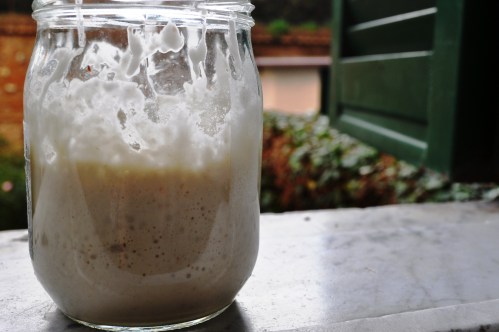
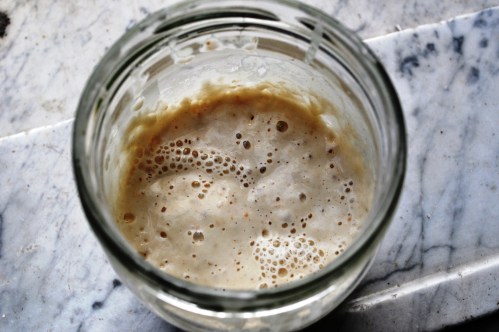
Healthy leaven

Yeast, bacteria and a long, strange symbiosis
A natural leaven is also known as sourdough, or lievito naturale or madre (mother) here in Italy (where it’s generally a much lower hydration), or a levain (if you prefer to use a French term to sound extra sophisticated).

The natural leaven is a culture containing both yeast and bacteria strains. So while bakers’ yeast is the strain Saccharomyces cerevisiae, a natural leaven will contain a colony of various strains of wild yeasts and lactobacilli. The latter is a remarkable genus of bacteria that humanity has had a relationship with for millennia. Lactobacilli play a part in the production of many fundamental consumable delights, such as beer, wine, cheese, yogurt, cocoa and, of course, bread.

It’s a fascinating symbiotic relationship, and one I enjoyed exploring while living on a smallholding in New Zealand years ago, making some crazy cheeses. And who’d have thunk chocolate involved fermentation? Well, it does: the pulp and seeds of the harvested cocoa pods are fermented before drying. Gotta love Theobroma cacao – that is “Cocoa: food of the gods” in Greek.

Anyway, I digress. (As usual.)

When humanity first started making leavened bread, it was thanks to lactobacilli and wild yeasts. In a bread natural leaven, the lactobacilli and yeasts live alongside one another in a sludgy slurry of flour and water, the starter. This was the chief way of making leavened bread from around 1500BC (or earlier) until the Middle Ages, when bakers starting using beer barm, the froth on the fermenting brew.

In the 19th century, when the likes of Louis Pasteur were not only overhauling our understanding of disease but also revolutionising the production of fermented foods, Saccharomyces cerevisiae was finally identified and became, effectively, a crop: brewers’ yeast.

When you mix yeasts with flour, the sugars in the cereal grains (notably maltose) provide them with food. The result of this feeding is lactic and other acids; the by-product is the carbon dioxide. These acids are what can give sourdoughs a pronounced, even tart flavour. Rye flour gives an especially sharp flavoured bread, but some wheat-based sourdoughs can be as mild as breads made with bakers’ yeast.

Healthy leaven

How to create a leaven culture
The easiest way to start a leaven may well be to buy a good book, like Dan Lepard’s The Handmade Loaf. This gives a great account of how it’s done with plenty of lovely pics. Or you could read on, for a somewhat less professional lesson.

If you’re using a good quality flour, one where the character of the grain hasn’t been brutalised too much by industrial processing, it may well contain have suitable wild yeast strains already. The yeasts are also on and in your body, and even in the atmosphere. Some people collect them by leaving a jar of flour and water outside but if you live in a polluted city you might want to control the process a little more carefully.

You can do this by putting a handful of raisins and a few teaspoons of live yogurt in a mixture of equal proportions of water and flour. Another baker here recommends rhubard. While Sandor Ellix Katz says “organic plums, grapes, or berries.”1 The fruit will (hopefully) have just the right yeasts on their skin, the yogurt will introduce the lactobacilli. Put the jar, covered with a cloth or with the lid on loosely, in a warm place.

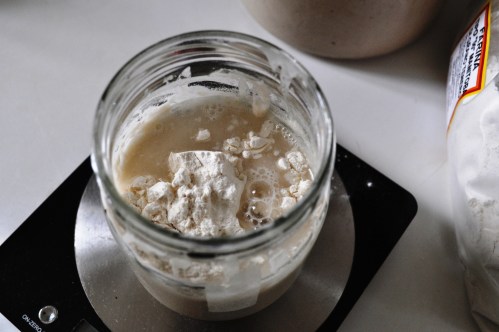
Over the following few days, feed more flour and water to the leaven, stirring it well. To keep things at a reasonable domestic scale, I tend to feed mine around 20g each of flour and water, morning and night. Equal proportions of water and flour mean you have a “100 per cent hydration” leaven2. Lepard suggests increasing the proportion of flour slightly to slow down the fermentation.

It should start to bubble – not like a fizzy drink of course, but you’ll see gas in the sludge and perhaps some foaminess. The smell will become slightly alcoholic too. If your leaven is nice and active and bubbly, it’s happy – so strain out the raisins, their work is done. You can now use some for baking. (Instead of straining out the raisins at this point, you can just soak them overnight at the start and use the liquid. Watch the video here on Viva La Foccacia. It’s in Italian, but even if you don’t understand, the process is clear.)

If you just keep feeding the leaven, without removing any to use, it can become unhealthy, with too much ethanol (another yeast by-product) in the mix. If this happens, simply take a small amount, and, in a fresh jar, start feeding it again.

Feeding the leaven

Your pet slurry
When you have a natural leaven, you have to think of it almost like a pet: it’s a living thing that needs care, needs feeding. But that doesn’t mean it’s hard to maintain. If I’m not baking much, or not making sourdoughs, I leave my jar of the leaven in the fridge for weeks, even months occasionally. This retards the fermentation process, as the culture prefers a temperature of 25-35C, not the 4C or so of a fridge.

After a while, the leaven will divide into a grey, putty-like goop, with a watery liquid on top. It’s not dead though, just a bit unhappy. To revive it, you can take a spoonful of the goop, put it in a clean jar and start feeding it again, as described above.

If you change the flour, the yeast strains may well change, and your bread may well taste different, but to me that’s all part of the fun. My leaven is about four years old now, had moved house three times and even moved from Britain to Italy. During this time, it’s been fed on white wheat flour, wholewheat flour, durum wheat flour, emmer flour, spelt flour and rye flour.

For a while I had two parallel cultures, one white wheat, one rye, but it didn’t really seem necessary. If you plan ahead, you can simply take some leaven and feed it with a different flour, creating another strain. This may take around a week of regular feeding.

Be nice to your pet slurry and it could last you a lifetime. Or several lifetimes. There are stories of prospectors in the American gold rush who carried their sourdoughs, which may well have originated in Europe, across North America. I can well believe this as, years ago, I knew an Austrian guy in New Zealand who’d transported his culture around the world in the form of dried flakes, which he rehydrated when he wanted to bake. (He was basically smuggling. Introducing food, vegetable matter and organisms to the Antipodes is a serious no-no these days as they have major problems with foreign species. Don’t do it kids!)

Anyway, some of the US immigrant natural leaven cultures may well still be used today in the thriving sourdough bakery scene of the West Coast US. Certainly some cultures still in use date to the mid-19th century. Gotta love that symbiosis.

Footnotes
1 Katz is a respected US fermentation expert. Something of a guru in fact, who treats his HIV with fermented foods. His book Wild Fermentation includes a recipe for Basic Sourdough Starter (page 95), which says this about the inclusion of fruit: “One effective technique for speeding up the introduction of wild yeasts into your sourdough is to drop a little unwashed whole fruit into it. Often on grapes, plums, and berries you can actually see the chalky film of the yeast (‘the bloom’) that is drawn to their sweetness. These and other fruits with edible skins… are great for getting sourdoughs bubbling. Use organic fruit for this. Who knows what antimicrobial compounds could lurk on the skins of the fruits of chemical agriculture?”

2 Bakers’ percentages are based on the amount of liquid (usually, but not always, water) as a proportion, a percentate of the flour in the recipe. There’s more info here. Leaven percentages are considered in the same way as dough percentages.

12 Comments

Filed under Breads, Flour & grain

Genoise, génoise, genoese. And trifle

Much as we don’t like traditional British Christmas cake in our household and always try alternatives, we don’t like traditional Christmas pudding either. I’m fascinated by its history, its origins in Medieval cuisine, the relationship of such puddings to, say, sausages (discussed here). I just don’t like eating it.

Instead, our traditional Christmas pudding is trifle. My wife introduced me to this tradition years ago; apparently it comes from her mum’s mum, “a great trifle maker”.

Trifling things

British trifle is not unlike a variety of other international deserts. Indeed, in the mists of time, it has common roots with both zuppa inglese (“English soup”, or more broadly “English dunked stuff” – a type of [northern] Italian desert that is, basically, trifle) and its cousin tiramisu (tirami sù – literally “pick me up”, though if you really need waking up surely a ristretto would do the job better?). The bottom line is that all these deserts use custards and/or whipped dairy products and sponges. But not just any sponges: specifically genoise sponge, or the closely related pan di spagna. (Which was, probably apocryphally, developed by the Genoese ambassador to Spain in the middle of the 17th century. More on the distinction between these two later).

Genoise – okay, look I’m going to call it genoese, as that’s the spelling I grew up with – originates from Genoa, the capital of Liguria in northern Italy. Today, it forms the basis of many sweets, in not just Italy and France, but Britain and elsewhere. But, you may say, tiramisu uses sponge fingers! (Aka ladyfingers, or boudoirs in French, or Savoiardi in Italy) But what are sponge fingers? Well, they’re just small cakes made of crisply baked piped fingers of genoese mixture.

So for our Christmas trifle, I generally make a genoese, while the missus makes custard.

Genoese sponge recipe

60g unsalted butter
125g plain flour
Pinch of fine salt
4 medium eggs
125g caster sugar

Folding in the flour

Preheat the oven to 180C.

1 Melt the butter, then leave it to cool slightly.
2 Use a little of the butter to grease your cake tin(s), sprinkle it with flour, shake the flour around to coat, then remove the excess. Line with baking parchment. This recipe will make two fairly thin cakes in 18cm round tins. If you want it square and deeper, use say just one 20cm square tin.
3 Sift the flour and salt together.
4 Put a pan of water on and bring to a simmer.
5 Combine the eggs and sugar in a heatproof bowl, and set this over the simmering water.
6 Using (ideally) an electric hand blender or a whisk, whisk the egg and sugar mix for about 5 to 10 minutes. It should triple in volume and achieve slight peaking.
7 Take the bowl off the heat.
8 Sift half the flour into the egg/sugar mixture and gently fold it in with a large metal spoon. You want to do this as gently as possible so you don’t knock the air out of the mixture
9 Sift in the other half of the flour and fold carefully again.
10 Gently pour in the melted butter, and carefully fold this in too to just combine.
11 Pour the mixture into the prepare tin(s). Gently does it!
12 Bake until firm to the touch, around 25 minutes depending on the depth of your mixture.
13 Cool in the tin for a few minutes, then turn out and cool completely on a wire rack.

Pouring in the butter

Trifle

Now, if you want to make a trifle, cut half of this cake into chunks, spread them with jam, and put them in a medium bowl. Pour on some sherry if you like such things. Add some fruit of choice. We used (not very seasonal or local) raspberries and banana. Cover the lot with homemade custard (go on – it’s not hard, and it tastes sooo good). Then cover all that with whipped cream.

I like to sprinkle some lightly toasted flaked almonds on top. Most of all though, I just like the extraordinary indulgence of genoise, custard and cream. It’s always a sad moment on 26 or 27 December when we finish the trifle.

Trifle

The difference between genoese sponge and pan di spagna

Genoese is made with the above technique involving cooking the eggs and sugar together, and whisking them, over a bain marie, with some melted butter subsequently added to the mix. Pan di spagna is made cold, with the eggs separated and lightness achieved by whipping the whites to stiff peaks. We’d call pan di spagna a “whisked fatless sponge cake” in English.

If you can read Italian, or trust translator software, there’s a good description of the difference here.

The results are quite similar. One of these days I’ll have to arrange a blind tasting, as TBH, I’m not sure I could tell the difference. Some people don’t even seem to recognise the difference: after all, Italian Wikipedia has a photo of pan di spagna that is reused to illustrate genoese on English Wikipedia. Outrageous.

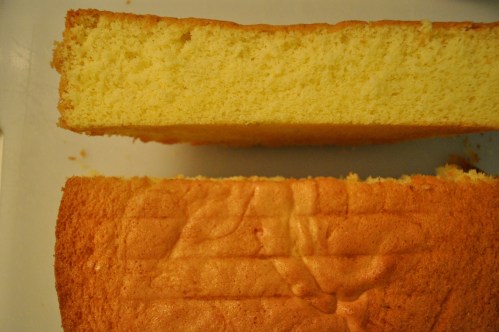
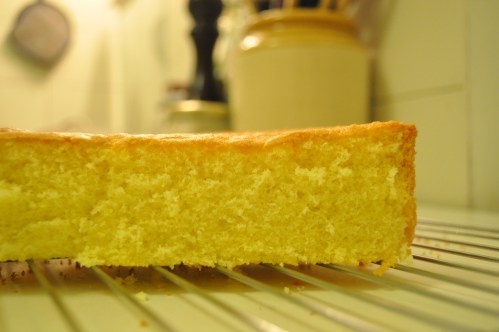
Anyway. Here’s a final pic of mine. Slight sag in the middle, but otherwise lovely.

Cross section

3 Comments

Filed under Cakes, Puddings & desserts, Recipes

Usciun

I cannot find a single mention of these anywhere else online. And I’ve only encountered them once in Italy. Capodanno (New Years), 2012.

We went to dinner with two friends. She’s Neopolitan, he’s from Cassino (yes, the town virtually destroyed during one of the grimmest battles of World War 2). He says these are unique to Cassino. I don’t have any reason to doubt him.

They’re basically deep-fried, filled dough balls. Not unlike castagnole, but savoury. The ones they made for us had uva secca (dried grape, so raisins. Which is a bit of a mystery to me as I have never found raisins for sale in Rome, but do see uva sultanina, sultanas).

They also said larger versions can be filled with baccalà (salt cod), and other savoury fillings.

I believe they’re not unlike certain pizzelle napoletane fritte, which can be small discs, but can also be balls, like here or here.

I’m kicking myself for not taking a photo, but I only had my phone. A bowl of doughballs would be hard to photo at the best of times, let alone with a phone, in the half-light of New Year’s Eve, lit only by candles and the flashes of seasonal explosions going off outside.

2 Comments

Filed under Uncategorized