Monthly Archives: June 2015

Yuval Noah Harari’s Sapiens and palaeo-romanticism

Sapiens by Yuval Noah Hariri is one of those grand, sweeping books that skips deftly between disciplines and gets you thinking in equal measure. Its title may recall Hawking’s Brief History of Time but a more salient comparison might be Jared Diamond’s Guns, Germs, Steel.

The book is subtitled ‘A Brief History of Humankind’, but it’s Part Two: The Agricultural Revolution that really interests me – not unsurprisingly given my interest in grain-based foods.

In my Anglo-centric education, the term “The Agricultural Revolution” was used to refer to the changes in British farming in the late 18th and 19th centuries. Harari is looking at a much bigger picture though: the Neolithic (new stone age) Agricultural Revolution. The period when Homo sapiens made the transition from hunter gatherers, foragers, to cultivators, agriculturalists.

The received wisdom is that learning to farm freed up humanity from the dirty primitivism of the forager lifestyle. Harari, thrillingly, turns this on its head. It wasn’t a liberation, he posits, but an enslavement. Most specifically an enslavement to Triticum, the wheat genus. This includes that dietary bogeyman modern wheat, as well durum and their forebears spelt, emmer and einkorn.

“Scholars once proclaimed that the agricultural revolution was a great leap forward for humanity,” he writes. “They told a tale of progress fuelled by human brain power. Evolution gradually produced even more intelligent people. Eventually, people were so smart that they were able to decipher nature’s secrets, enabling them to tame sheep and cultivate wheat. As soon as this happened, they cheerfully abandoned the gruelling, dangerous, and often spartan life of hunter-gatherers, settling down to enjoy the pleasant, satiated life of farmers.”

“That tale is a fantasy. There is no evidence that people became more intelligent with time… Rather than heralding a new era of easy living, the Agricultural Revolution left farmers with lives generally more difficult and less satisfying than those of foragers. … The Agricultural Revolution certainly enlarged the sum of food at the disposal of humankind, but the extra food did not translate into a better diet or more leisure. Rather, it translated into population explosions and pampered elites. The average farmer worked harder than the average forager, and got a worse diet in return. The Agricultural Revolution was history’s biggest fraud.”

Not being an accomplished archaeo-anthropologist, I can’t contest this. It’s certainly a compelling theory.

Feeding humanity
Humans – the whole Homo genus – had been hunter gatherers for about 2.5 million years. Then, around 12,000 years ago, it all changed: “The transition to agriculture began around 9500-8500 BC in the hill country of south-eastern Turkey, western Iran, and the Levant.” Wheat and goats came first, around 9000BC, then peas and lentils, then olive trees, horses and by around 3500BC, grapevines.

“Even today, with all our advanced technologies, more than 90 per cent of the calories that feed humanity [my italics] come from the handful of plants that our ancestors domesticated between 9500 and 3500BC – wheat, rice, maize, potatoes, millet and barley”. For all our culinary flamboyance and seeming diversity today, he writes that “If our minds are those of hunter-gatherers, our cuisine is that of ancient farmers.”

Unnatural selection
If you think of living things as repositories of DNA, which they are designed to simply pass on as much as possible, then Triticum, other food grains and farmed animals, have overcome the literal process of natural selection and been given huge, unnatural leg-ups by modern humans.

In a nice little exercise Hariri says, “Think for a moment about the Agricultural Revolution from the viewpoint of wheat. Ten thousand years ago wheat was just a wild grass, one of many, confined to a small range in the Middle East. Suddenly, within a few short millennia, it was growing all over the world. According to the basic evolutionary criteria… wheat has become one of the most successful plans in the history of the earth…. Worldwide, wheat covers about 2.25 million square kilometres of the globe’s surface, almost ten times the size of Britain. How did this grass turn from insignificant to ubiquitous?”

No turning back
How indeed? Well, by the aforementioned enslavement. “Wheat did it by manipulating Home sapiens to its advantage. This ape had been living a fairly comfortable life hunting and gathering… but then began to invest more and more effort into cultivating wheat. Within a couple of millennia, humans in many parts of the world were doing little from dawn till dusk.”

Homo sapiens shifted from a wandering lifestyle and an omnivorous diet to a hard-working settled lifestyle and a grain-based diet. “By 8500BC, the Middle East was peppered with permanent villages such as Jericho, whose inhabitants spent most of their time cultivating a few domesticated species,” he says. “The average person in Jericho of 8500BC lived a harder life than the average person in Jericho of 9500BC of 13,000 BC.”

We may have invented writing (in Sumeria and Egypt by around 2500BC, China by 1200BC, Central America 1000-500BC) and culture, but, he suggests, Homo sapiens has been trapped ever since, with the escalation of commitments of the early agriculturalists still echoed today in the habit of needing to work more to earn more to afford more.

It’s fascinating, but the theory does seem to have a certain inherent palaeo-romanticism. Indeed, many people who feel stressed or adrift or lost in the rush that is modern life, the idea of sitting around chatting with your tribe, spending a few hours foraging, then sitting around some more, before moving on to a new spot where you’ve previously had good fortune with the foodstuffs is potentially appealing. I certainly do, despite my love of grain-based foods.

Thing is, we’re somewhat committed now.

Palaeo-schmalaeo
Arguably people today do indeed try to act out palaeo-romantic fantasies, notably with the so-called “paleo diet”. It really bugs me. I’m sorry, but Stone Age man didn’t have a shopping bag filled with chia berries, and lemons, and avocado, and beef, quinoa and kaniwa, stevia powder and fresh tomatoes. All that stuff’s from different continents and different seasons and, indeed, mostly wasn’t even available as a foodstuff yet in the Stone Age. He would have had a load of starchy roots one day, stripped a tree of fruit another, ground up some wild grains another, then maybe had a pig-out on mammoth or giant elk or a giant flightless bird, depending on where he lived, the season, knowledge and luck.

Am I being too literal? Yes. But gah, food faddism drives me mad, especially so in the paleo case as it’s so much the product of a pampered, wealthy, western culture. Sure, I agree wholehearted that one should avoid industrially processed foods and artificial sweeteners and beef from drug-pumped cattle standing in their own faeces in concentrated feed lots. But really – what happens when all 7.3 billion (World population clock) of us want to live on beef and seafood and year-round avocado? A serious acceleration of the environment crisis, that’s what, as such diets are heavily predicated on an inefficient oil economy.

We could not feed humanity without staples: grains and legumes. There’s still a place for whole grains and legumes – the staples of the Agricultural Revolution – in a balanced, realistic, healthy, minimally industrial diet.

That said, if we do destroy our own civilisation with greed and overconsumption, maybe Homo sapiens will be able to go back to being hunter-gatherers after all (if if we survive at all). Something for your grand-children to look forward to perhaps?

10 Comments

Filed under Discussion

Galettes aux vin blanc with Tom Hunt’s strawberry ice cream

Galettes aux vin blanc with strawberry ice cream

Me and Fran got married at this time of year, six years ago. June is the height of strawberry season in England, and three days before our wedding we got nicely sun-burned at a pick-your-own. It was 26C and beautiful. Three days later it was 8C and raining. And our skins matched the strawberries in the huge bowls of Eton mess made by my mother, Helen.*

This June is shaping up pretty similarly. Summer one day, winter the next. But the strawberries are still good. I got a big tray at reduced price the other day. That same week, the Guardian’s Saturday Cook section featured recipes from Tom Hunt. Tom, who I met at Rachel’s book launch last week, is the chef, founder of Poco restaurant in Bristol and author of Guardian The Natural Cook. His ethos is one of combating waste and encouraging sustainability and seasonality. Hence the strawberries recipes right now.

There was a fruit and veg stall in the precinct the other day and their strawberries were imported from Holland. Why? Are there none from Sussex or the southeast of England? Does it really economic sense to ship them across the channel? Possibly with our skewy economics, but it doesn’t seem to make environmental sense.

Fellow Brits – enjoy British strawberries why you can! The more local the better. Then enjoy them again next year, when they’ll taste even better for being a seasonal treat.

Or make big batches of ice cream and preserves to spin out the pleasure.

Tom’s ice cream recipe is wonderfully simple: strawberries, macerated and quickly boiled with some sugar, whipped cream, some mascarpone. Best of all, it doesn’t call for an ice cream maker. I know you can make most ice creams by hand-churning, without a machine, but it always puts me off when the recipe stipulates a machine, one piece of kitchen kit I don’t have.

I served it with a puree made from some of the other strawberries, which I macerated in some blackberry gin made by our friend Becky in 2010, and with galettes aux vin blanc. These could be called “white wine biscuits” and are another recipe from the 2011 edition of The Art of French Baking by Ginette Mathiot, which I talked about in the previous post.

The galettes are not unlike a type of shortbread, -ish, and as strawberries and shortbread are a classic combo, it seemed to make sense. (In all honesty they’re not as delicates and short as shortbread; they’ve got more body.) I also had some white plonk that needed using up.

200g plain (all-purpose) flour
100g caster sugar
100g unsalted butter, softened
Pinch of fine sea salt
45g white wine (3 tbsp)
1 egg yolk, beaten

1. Preheat oven to 200C and grease a couple of baking sheets.
2. Put the flour in a roomy bowl.
3. Stir in the sugar and salt, pour in the wine then add the butter, cut into small pieces.
4. Get your hands in there and squidge it all together to form a dough.
5. Lightly flour the work surface and turn out the dough. Knead lightly to homogenize but don’t over-work it.
6. Roll out the dough to 5mm thick.

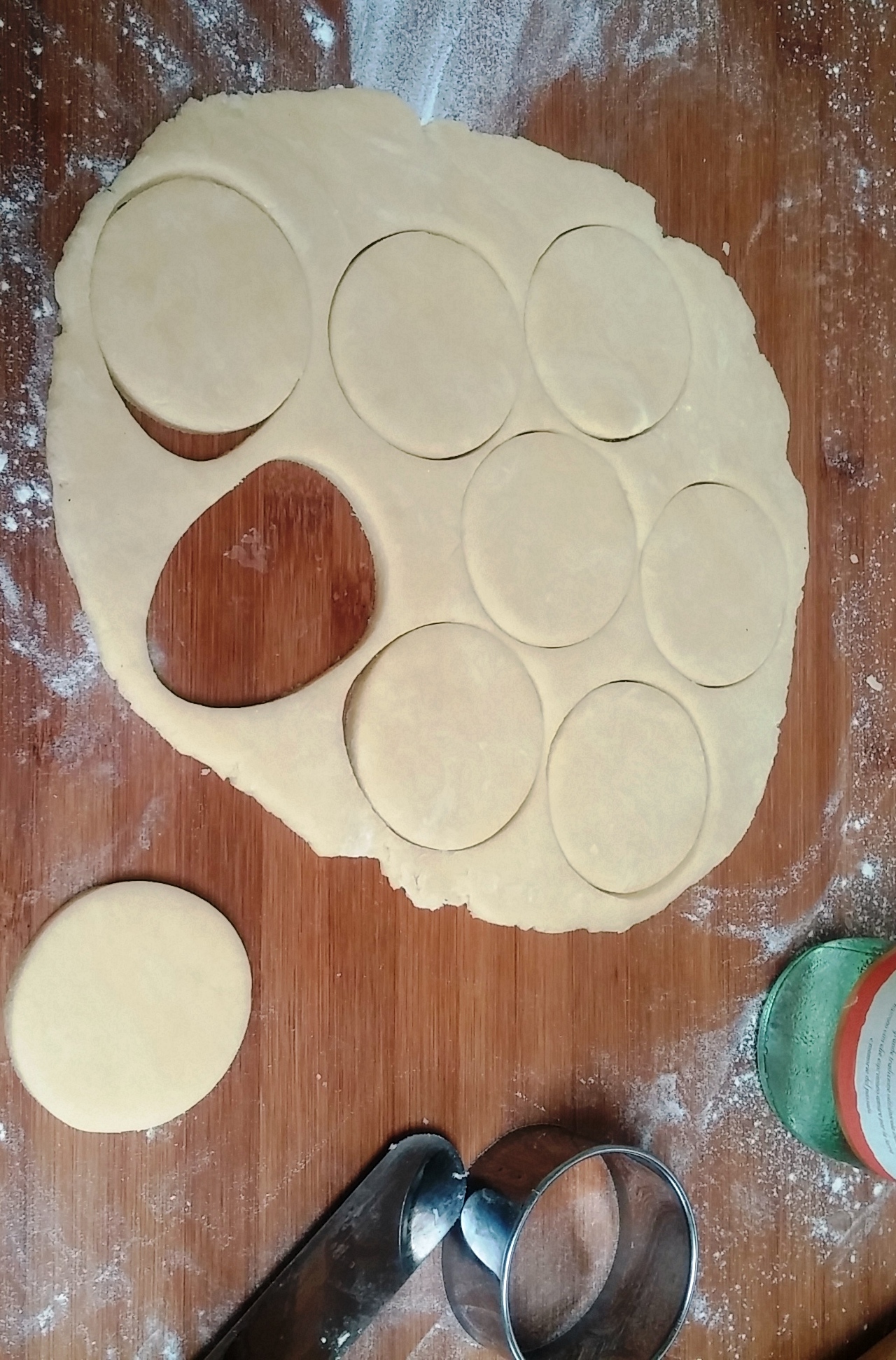
Cutting galettes aux vin blanc
7. Cut circles with a round pastry cutter. One with a diameter of about 5cm (2″) is good.
8. Put on the baking sheets, brush with beaten egg yolk to glaze and bake for about 15 minutes until nicely golden.
9. Allow to cool.

Galettes aux vin blanc with strawberry ice cream

Serve with strawberry ice cream. I’m not sure this is how the French would eat galettes aux vin blanc. They would probably add some actual wine consumption to the mix – quite possibly a dessert wine. French-speaking Francophile Fran can give me no further information on this issue. Any French who read this, please do let me know.


* We were a little burned, but not really strawberry coloured. That was a joke. I’m lucky as I’m fairly dark skinned for an Anglo-Saxon-British mongrel, Fran not so much. Kids – don’t forget that sun-block, especially if you’re fair-skinned.

8 Comments

Filed under Baking, Recipes

Reminiscences and butter biscuits

Petits beurres biscuits

I’ve just spent a great long weekend with Rachel Roddy, helping out with the food for the party celebrating the launch of her book, Five Quarters, catching up with Rome friends and meeting lots of interesting new people.

Given the theme of Rachel’s book and the fact that we met there, inevitably Rome was a big topic of conversation at the party. There’s a lot I’m missing about Rome. We know why we moved back in December 2013 – to try and adopt. But that doesn’t mean I’m not pining for certain things, especially food-related things: a six-days-a-week food (etc) market on the next block; a great gelateria two blocks away on our street; restaurants and cafés where you can get good food and drink for a sensible price (a fairly elusive concept in much of England); checking out the latest birra artigianale; going to the Città dell altra Economia in Testaccio to meet friends and buy huge, affordable chunks of local cheese on a Sunday. I could go on, but I won’t.

As I said in my post about Rachel’s book, I have to avoid the rose-coloured specs. But it’s hard, especially now while we’re at a difficult stage in the adoption process. We’ve been approved, but there don’t seem to be any children that are a suitable match for us. It’s a form of limbo – and as such all too conducive to drifting memories, reminiscing.

So much in our life now re-connects us to Rome. Even all the recipes I’m currently trying from The Art of French Baking by Ginette Mathiot. My sister – another Rachel – gave me this book just as we moved to Rome in August 2011 and in my mind’s eye I can still see it sitting on the shelf in our kitchen there, alongside a few I’d brought with me – Lepard’s The Handmade Loaf, Bertinet’s Dough – and some we acquired there – The Food of Rome and Lazio by Oretta Zanini de Vita, La Cucina di Roma e del Lazio (ie the same title) by di Marco and Ferré, Cucina Romana by Sara Manuelli, er, Cooking Apicius by Sally Grainger etc.

The Mathiot was a newly published Phaidon edition of the 1938 book Je sais faire la pâtisserie (“I know how to make patisserie”), translated and adapted by Clotilde Dusoulier. The book provides, in Dusoulier’s words, “the elemental components of French baking”: pastries, biscuits, cakes and puddings.

I used it a bit, but in all honestly I didn’t embrace it at the time. Why? Well – because Rome was all around us and I was somewhat distracted by all the pasticcerie (patisseries), biscotterie (biscuit bakeries), forni and panifici (bread or general bakeries) had to offer. I ate, I found favourites, I learned to make them at home. I got a bit obsessed with Italian baked goods. We have French-style patisseries in England, but Italian ones are considerably less common, so there was a lot to learn. (And still is1.)

I’m enjoying the Mathiot a lot now. I used it during my puff pastry experiments back in January, and I’ve been trying a lot of the biscuit and galette2; recipes, and musing over the brioche recipes. All eight of them. Eight. Rachel’s been talking about brioche too – they’re a common product in Sicily and Naples – so I plan to test them all, as well as the others in my cookbook collection. In the meantime, however, some biscuits.

Twice the fat, twice the pleasure
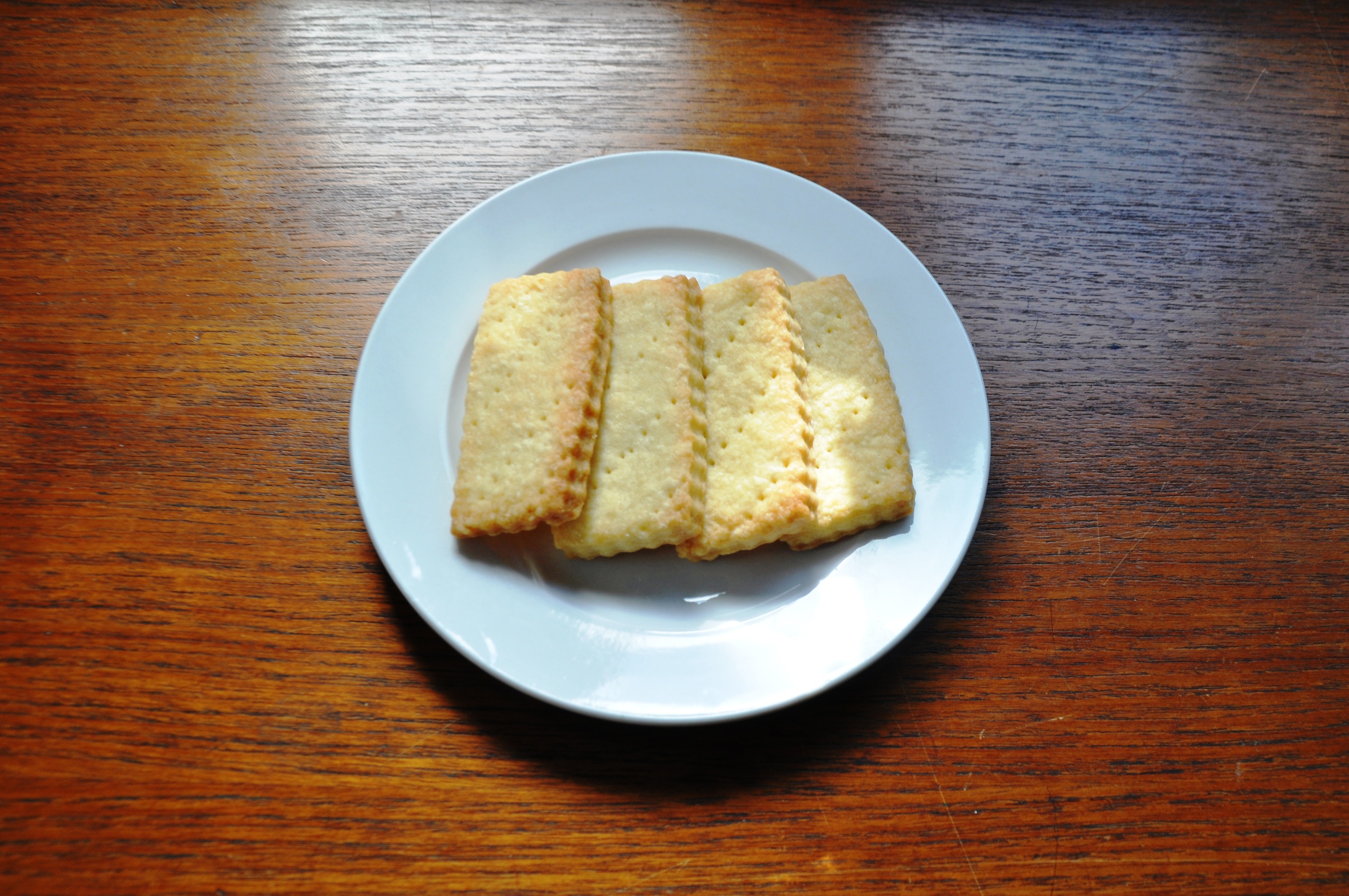
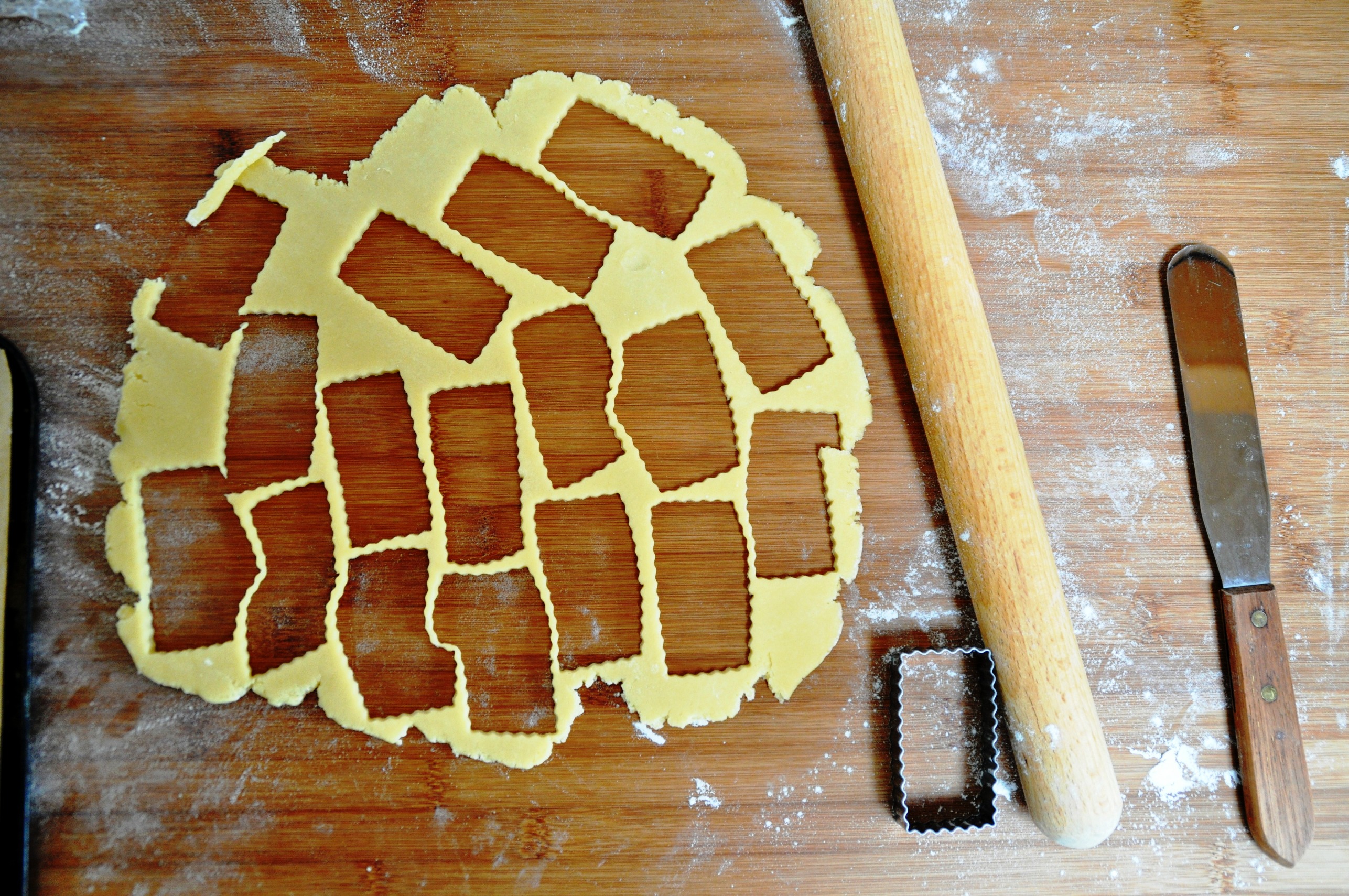
If Italian food is synonymous with olive oil3, French food is synonymous with butter. Petits beurres4 – for those who don’t have spectacular school French like mine – simply means “little butters”, or little butter biscuits. But not only do they have a good proportion of butter, they have the same proportion of double cream too. The result is a rich, light, crumbly biscuit. I make mine with a small, rectangular cutter that’s 40x75mm, so each one is a perfect size for a couple of bites.

I love this cutter. The result is not unlike the famous French industrial biscuit the “Petit Beurre LU” or “Véritable Petit Beurre” from Lefèvre-Utile. There isn’t much about it online in English, but French Wikipedia gives the story. It says the 1886 recipe by Louis Lefèvre-Utile was originally inspirant des productions anglaises de l’époque. “It was inspired by English products of the era”. That’s not something you hear the French admit very often. It’s also officially 65x54mm so slightly different proportions to mine.

These petits beurre are – unsurprisingly – considerably richer than the LU factory version, which doesn’t have half as much butter and no cream, instead being made with milk powder. Bugger that. Butter + cream = pleasure. As many chefs will tell you: “fat is flavour”. It’s something I heard often from Chris Behr, chef at the American Academy in Rome, when I did an internship there.

100g unsalted butter, chilled and diced
250g plain (all-purpose) flour
50g caster sugar
Pinch salt
100g double cream

1. Put the flour in a bowl and rub in the butter until the mixture resembles breadcrumbs.
2. Add the sugar and salt and combine.

Petits beurres - add the creamPetits beurres - form a dough

4. Pour in the cream then combine to form a dough, working it by hand. Work it enough to clear and form a smooth dough. Don’t overwork it. It’s basically a rich, sweet pastry paste, without raising agents, and overworking it can toughen it up.
5. Form a ball, squash it into a disk, wrap it in plastic and put it in the fridge to rest for least half an hour.
6. Preheat the oven to 180C and grease your baking sheets.
7. Dust the work surface with flour then roll out the dough to about 5mm.

Petits beurres - cutting out

8. Cut out rectangles. If you don’t have a rectangular cutter you’ll have to do it by hand.
9. Place the biscuits on the sheets and prick them in diagonal pattern with a fork.
10. Bake for 15-20 minutes until starting to turn golden.
11. Transfer to a wire rack and allow to cool. I got 24 from this batch, but it depends on how big you cut them.

Enjoy. With a cup of tea or even alongside a nice strawberry dessert – as they’re in season here in England now. You should always seize British produce seasons as they’re not half so long as those in Italy. Damn it, there’s me reminiscing again!

Petits beurres

Notes
1 Italy, as you probably know, is a country of regions with strong local, cultural and culinary identities. Each region has dozens of food specialities, even when it comes to baked goods, breads and pastries etc. My two years in Italy were just a start really. It would be a lifelong project to learn them all.
2 Galette is a French word that doesn’t have an immediate equivalent in English. Sometimes it refers to something we’d translate as a pancake (eg Breton buckwheat pancakes), other times things we’d call a pastry, and others it’s more like a cookie. I looked at the etymology over in my post about galette des rois.
3 Despite that being a more historically southern Italian thing, with strutto – lard – arguably a more common fat in the mountains and the north.
4 Should they be called petits beurres or petits-beurre? They can’t seem to agree on the agreement. The English is just petit beurre biscuits.

15 Comments

Filed under Baking, Recipes

Rachel Roddy’s Five Quarters

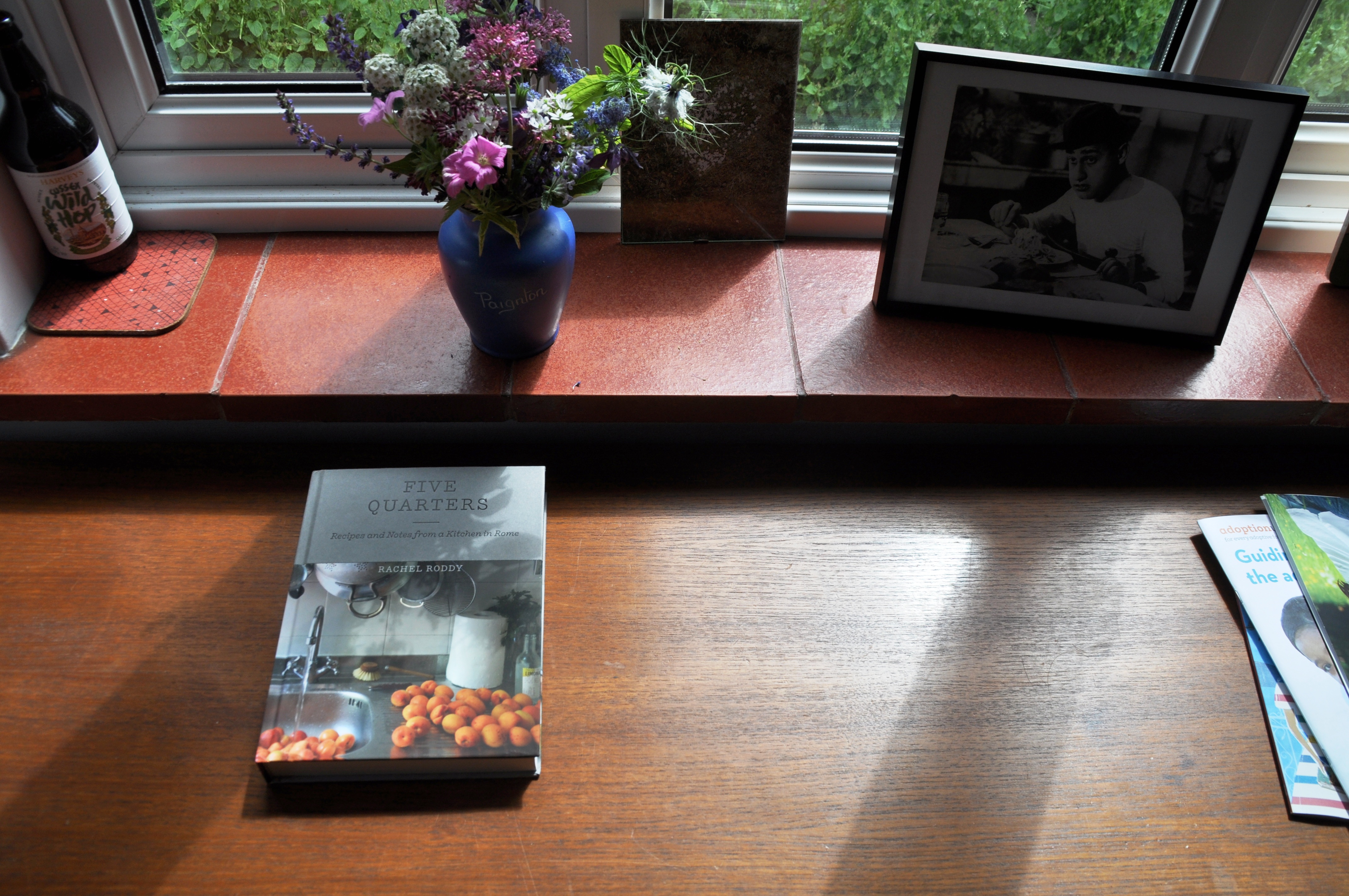
Rachel Roddy's Five Quarters

In the front porch this morning were a couple of bills, a wedding anniversary card and a large padded envelope. The card was nice, but it was latter that really got me excited. It contained a copy of Five Quarters: Recipes and Notes from a Kitchen in Rome by Rachel Roddy, a must-have food book published today by Saltyard Books.

Anyone who knows me or reads this blog will know Fran and I lived in Rome for a few years, moving there in August 2011. Recently, as we’ve struggled with the adoption process and a cold English spring, it’s been tempting to reminisce about Rome – the sunshine, the food,  friends, the fascinating city itself. But I have to keep reminding myself to not don the rose-coloured spectacles. Our first year in Rome was hard. Fran’s job was challenging, I was floundering around on various writing projects, I didn’t speak Italian, I missed my own house, I didn’t know what I was doing there, we felt a long way from friends and family. And it took five flippin’ months to connect the internet in the mausoleum-like Roman flat we were renting.

A marked improvement to our lives in Rome came one day in Autumn 2012, while me and Fran were walking through Testaccio. We had stopped to use an ATM when an English voice mentioned that it was dodgy, and recommended we use the other one across the piazza. We mumbled some very English thanks while a tall woman with a small child strapped to her chest strode away. Something passed between me and Fran along the lines of “she looked cool, let’s say hello.” Fran says we stalked her, I like to think we just overcame our English reserve.

This was Rachel Roddy. We became friends outside Volpetti on the corner of Via Alessandro Volta and Via Marmorata in what, we would learn, was the heart of Rachel’s turf. She was even living on Via Marmorata at the time, and took us to her local cafe, Barberini. It was a friendly and gracious gesture and the start of a new stage of our life in Rome.

We made other friends, but I particularly clicked with Rachel, which was such a relief after a fairly lonely year. We had things in common – we’d left London for difficult or sad reasons and ended up in Rome; we both had family from the north of England but had grown up in the south; both had a speedy way of conversing; and – of course – both had an obsession with food. I was blogging at the time, a bit about my baking, a bit about my general experiences of living in Rome, but it was Rachel, with her successful Rachel Eats blog, who encouraged me to start a new blog, focussed on the baking and beer. This blog in fact, which I launched in November 2012.

Over the months until we left Rome in October 2013, we saw a lot of Rachel, hanging out a lot at Tram Depot, just over the road from Volpetti and a perfect place to rendezvous on warm evenings, with Fran getting off the train home from work at nearby Ostiense station. Rachel became a great friend. She helped us get to know Rome, empathised as we slogged through our attempting-to-start-a-family saga. She encouraged me to try for the internship in the kitchens of the American Academy in Rome, I gave her the occasional baking lesson and raved at her about my latest favourite birra artigianale (“artisan beer”). We got to know her boyfriend Vincenzo, and watched the half-Roman Luca grow out of his baby-sling and start running around the piazze and mercato. And Rachel told us about her book deal, which we discussed enthusiastically as she poured energy into what would become Five Quarters.

Hand modelling

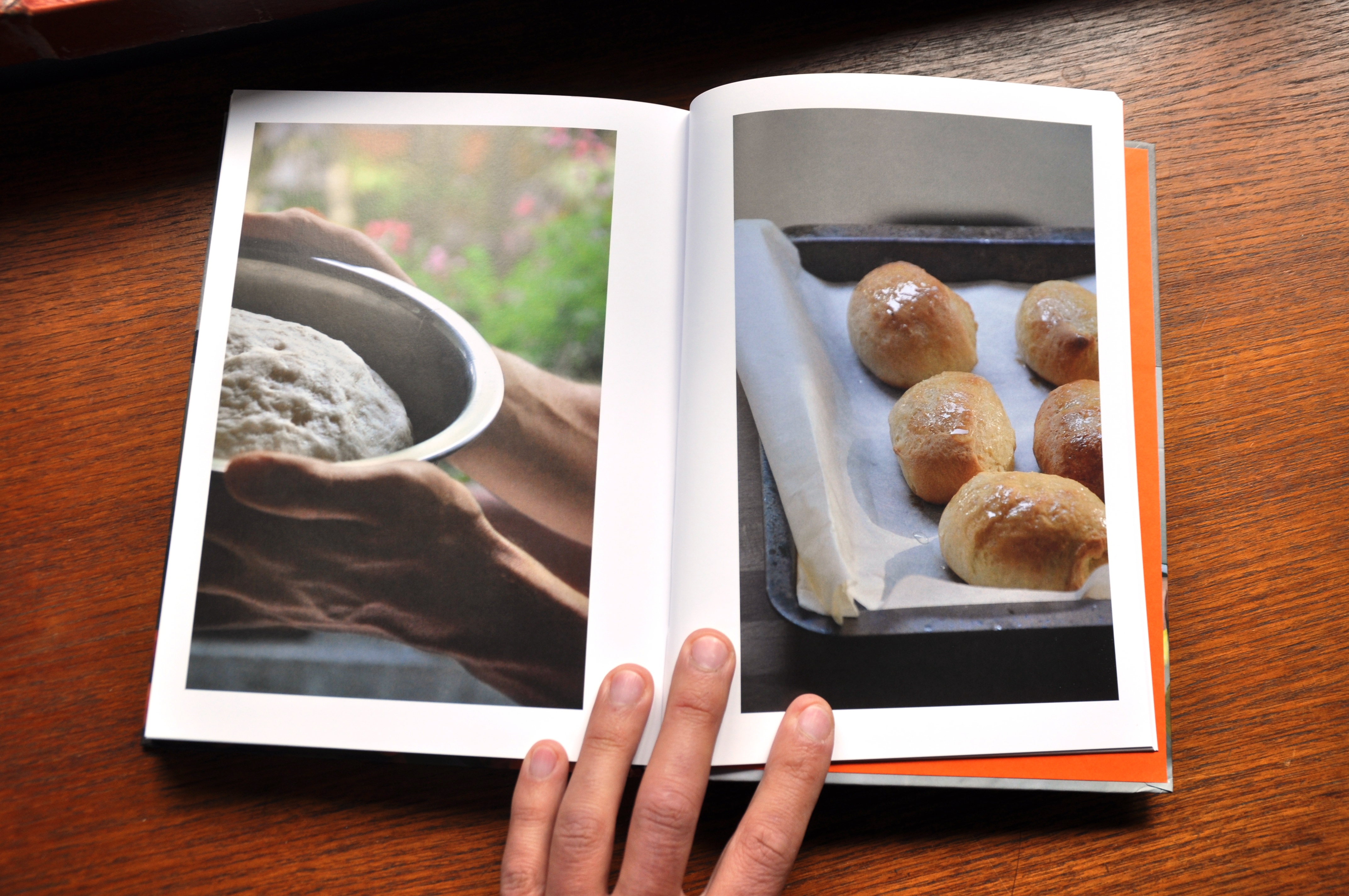
It’s been an exciting process, and I’ve been thrilled to be involved as a sounding board, occasional recipe tester and even, at one thrilling point in June 2014 (I believe), a hand model. Vincenzo’s hands appear fairly often in the book but those are mine on p358 holding a bowl of dough, and my wrist on p357, with a young Luca looking upwards with a mischievous sense of anticipation about the tray of proving maritozzi. These are Rome’s sweet breakfast rolls, which I blogged about here; Rachel includes a version of the recipe in Five Quarters. She also uses a version of my recipe for frappe, deep-fried sweet pasta treats eaten for Carnevale.

Although I read various bits and pieces of the book while Rachel was writing it, tried some of the recipes and talked about the progress, frequently via Skype, it’s a great to be holding the finished book. Blogs are all well and good, but a book, especially a handsomely bound book full of great photos and inviting text, is deeply pleasing.

I struggle with a lot of recipe books – they’re just recipes, and perhaps a photo of the dish, overly styled and not looking terribly like something you’d produce from your humble home kitchen. The recipes are often so lacking in context. Five Quarters, on the other hand, is a book all about context. It’s about the Testaccio quartiere, and Rachel connecting with that quarter. It’s about food, and Rachel learning about it, exploring it, interpreting it. It’s about real food, made in a real kitchen – and photographed in that kitchen. Rachel’s kitchen is nothing fancy, it’s small and modestly appointed; it’s not some fancy professional kitchen or cookery studio with disingenuous props. As such, it’s a built-in reassurance that you too can make these dishes, you too can learn about Roman food.

She covers a broad sweep of Roman food, so much of the things I crave now while living in small-town England. From the joys of the deep-fried antipasti, to the reassurance of the classic pulse-and-pasta dishes than span the gap between soup and stew, to vegetables and dolci (my area of obsession, obviously).

The book may also introduce readers to the food of Testaccio, which gives the book its name: the quinto quarto, “fifth quarter” – the meat and the offal dishes developed by the workers in the local slaughterhouse (used c1890-1975). Rachel doesn’t get too hardcore here, as such dishes are a far cry from the so-called Mediterranean diet people might expect of all Italian food (it’s an abiding misconception). But they do connect nicely not just with the nose-to-tail eating ethos, and also, as Rachel points out, with many traditional dishes of northern England. Rachel often makes these connections, or gives an anecdote – some context – for how she first encountered a dish.

As such Five Quarters is a book that’s a good read, a book that’s pleasure to learn about cooking from, a book that’s an aesthetically pleasing object, with Rachel’s own pictures of food production accompanied by pictures of Testaccio, the neighbourhood, its streets, shops, market, restaurants and denizens by Nick Seaton. I’m trying to keep on top of my sentiment, but it’s also a book that’s making me pine for Rome, and meeting Rachel to go for a grattachecca and an obessive rant about the latest recipe we’ve tried or foodstuff we’ve bought. *sigh*

In the meantime, I heartily recommend you buy Five Quarteres from your local independent bookshop. Failing that, here it is on Waterstones and Amazon.


26 Comments

Filed under Discussion, Misc, Rome

Burger buns and khobz variations


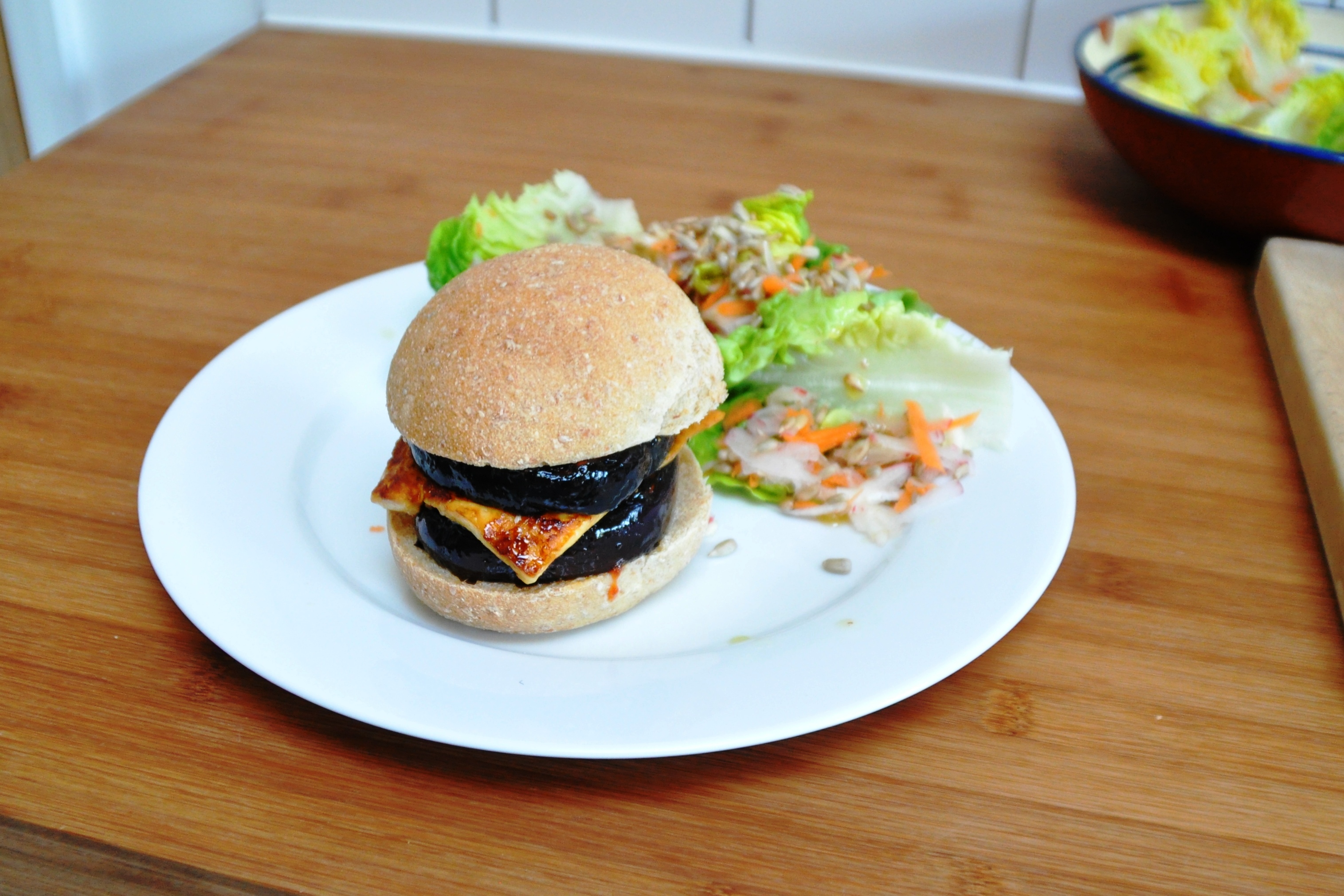
Aubergine and halloumi burger with khobz bun

Back in the old days, I’m sure we always ate burgers with a sesame bun. It wasn’t exactly the greatest bread, but at least it was savoury. These days, all the hip and wannabe burger joints sell theirs in brioche buns. I do not get this at all. Brioche is a sweet breakfast bread.* I don’t want a sweet burger bun, it’s just plain weird.

I was a vegetarian or pescatarian for about 20 years and although I’m more omnivorous these days I still don’t eat much red meat; in fact, I reckon I’ve only eaten beef about three times in the last 30 years, in part as I’m not a huge fan, in part as, in much mainstream modern industrial farming, beef can be reared in grim and environmentally unsustainable ways*. So meat burgers aren’t really my thing. But I do love the format, so when I saw this veggie option on Hermione’s Pantry for burgers with aubergine (eggplant, melanza) and halloumi – one of my desert island foodstuffs – I had to try it.

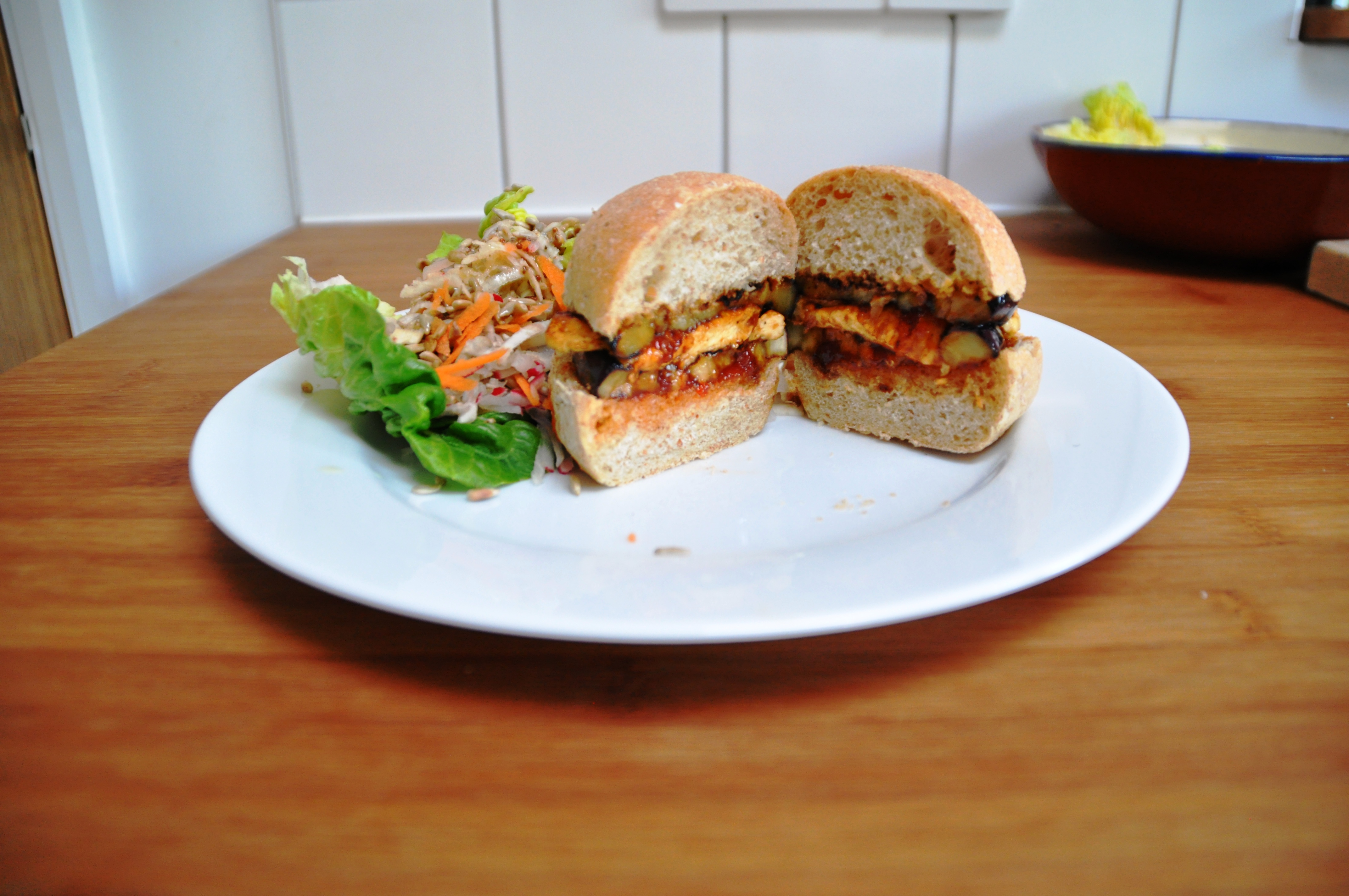
Khobz bun with aubergine halloumi 2

A month or so ago, I did a version of the khobz, an Arabic bread made with semolina and wholemeal wheat flour. I’ve been enjoying playing around with the recipe. I thought why not try the same dough for burger buns. I divided the same quantity of dough from my khobz recipe into eight and rather than making flatter, disc-shaped loaves, made balls for burger buns. I then used them for this aubergine and halloumi burger. I tweaked Hermione’s marinade and left it much longer than she says, but the result was great, with a juiciness that’s often lacking from veggie burgers and the khobz dough making for a good, suitably savoury, bun.

The khobz recipe involves a very satisfying combination of flours, and has also proved itself suitable for large, tear-and-share breads. Rather than dividing the dough into six for small loaves, I divided it in two and made these for a meal with friends a few weeks ago:

Large khobz


* Just read up on concentrated animal feedlots (CAFOs), deeply messed-up arrangements involving cattle being crammed into fenced pens, with no grazing, and instead a diet of maize – something they’ve not evolved to eat. They stand around in their own excrement and get sick, necessitating intensive regimes of antibiotics. CAFOs, or at least similarly brutal intense operations, are creeping into Britain and, likely, will become increasingly common as countries like China become wealthier and more of the world’s seven billion start shifting to more heavily meat-based diets.

Although it’s a US-oriented book by California-based writer Michael Pollen, I’d recommend anyone, even in Britain, read The Omnivore’s Dilemma.  It not only looks at meat (and, by extension, cheese) production in the food supply chain, it even evaluates the virtues, or otherwise, or locavorism, something that’s close to my heart but also something I’m happy to question and be further educated about.

In the meantime, I prefer my bovine products to come from cattle like this. Except for the one beast that isn’t a cow, but instead seems to be a fallow deer that has adopted the herd!

Cattle on the South Downs, Southerham, 30 May 2015

* Except when it’s not. I’ve got a few recipes for savoury brioche, eg the cheesy brioche de gannat.

5 Comments

Filed under Baking, Recipes