Category Archives: Baking

Baking – Daniel Etherington’s bread experiements

Busy baking, Christmas and new years 2010-2011, including panettone

It’s been a very busy month on the baking front for me.

For Lawrence and Jo’s wedding on 19 December 2010, I made the cake, with Fran doing much of the decoration. I’m slightly disappointed with most of the photos I got of the cake, many of them are pretty gloomy – not ideal for something involving so much dark chocolate! But anyway, here’s one:

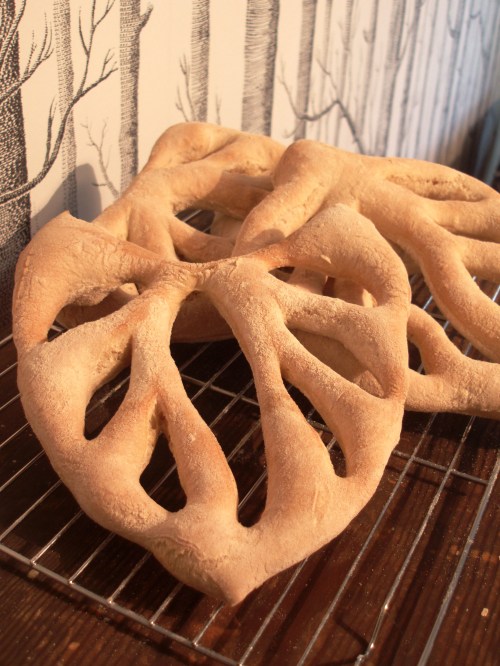
Dom and myself also did some catering for the late evening supper at the wedding. For this, I baked three different types of bread from three of my favourite baker-writers. These were Andrew Whitley’s seeded rye bread a 100% rye sourdough from Bread Matters; the wonderfully moist rolled oat and apple bread from The Handmade Loaf by Dan Lepard; and Richard Bertinet’s lovely simple fougasse from Dough.

For Christmas itself, I was keen to try and make a panettone. I really want to follow a traditional recipe – meaning, making a naturally leavened dough. Yep, apparently an authentic panettone is what many people would term a “sourdough” – it doesn’t use any commercial yeast, but instead involves a slow fermentation process based on a natural leaven. As that natural leaven is wheat-based, personally I wouldn’t call it a sourdough, but there you go.

Having said all that, though, when it came to the crunch, after all of the above, I didn’t really have the time to experiment with a fully naturally leavened panettone, so I cheated and kinda made up a recipe that used from yeast too.

I didn’t really write it all down properly, but I used:
50g white leaven
10g active dried yeast (ie granular yeast) or 22g fresh yeast
350g water – my flour was cold, only about 16C, so the water was about 38C.
Combined.

In a large bowl, I mixed:
800g strong white flour
50g caster sugar
10g salt
zest of one lemon
100g pine nuts
50g flaked almonds
100g raisins
100g mixed peel
2 eggs, beaten
50g melted butter

Then added the leaven/yeast mix, and brought it to a soft dough.

Proved until doubled in volume, knocked back, rested, then formed into a ball, which I squashed into more of a teardrop shaped and put in a large catering tin, which I’d lined with baking parchment.

Proved again, till doubled in volume – or at least until it felt right with the pinch test. Glazed with basic egg wash, though I’ve seen recipes (like this one on the Wild Yeast blog, which I got via this thread on The Fresh Loaf) that use much more elaborate glazes. Some of them seem to glaze after baking too. There’s still a lot to learn about making panettone.

Baked At 200C for around 45 mins, I think. Doh, should have written more notes.

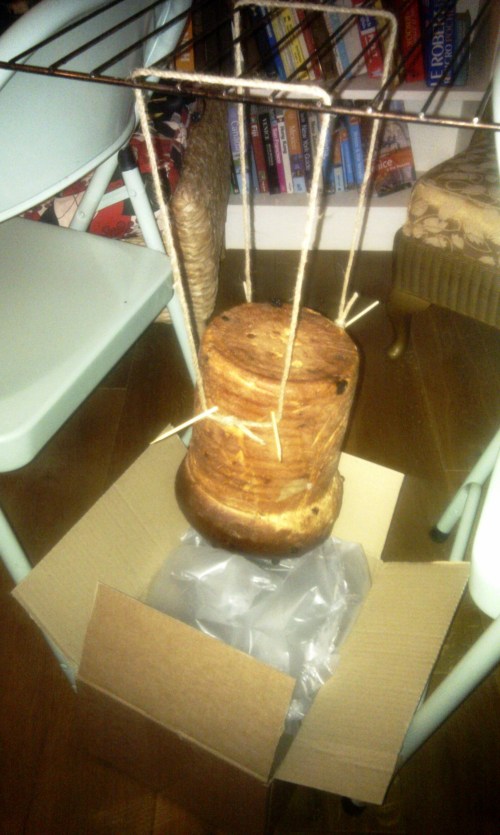
Anyway, the Wild Yeast blog had some interesting pics – notably about how to cool a panettone, by hanging it upside down. I rigged up an absurd set-up with two chairs and an oven rack. I put a box with soft packing material underneath just in case, as the loaf was heavy the skewers were tearing through.
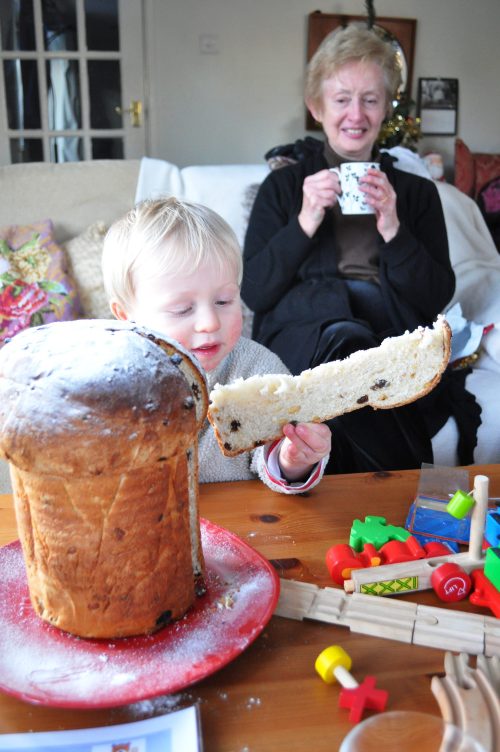
Here’s the finished panettone:
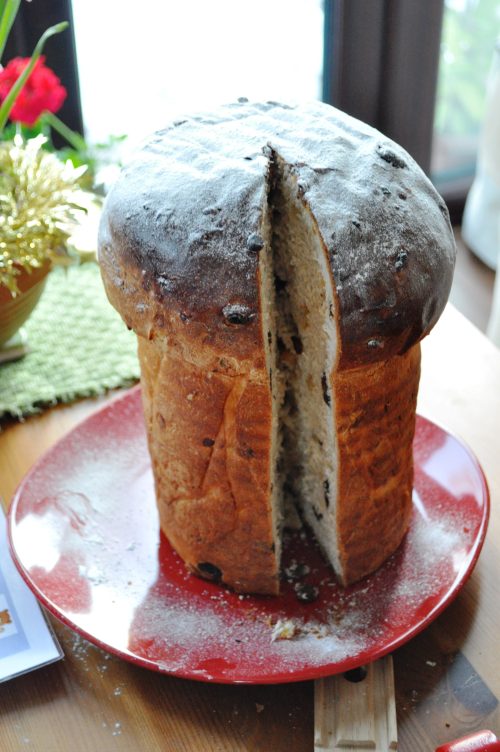
Being critical for a moment, I think it was too dense. Next Christmas I’ll try and fully naturally-leavened version with longer fermentation to try and open up the crumb more – get some nice big, ciabatta style air-holes. It was very nice though. Ellis certainly thought so.
Other goodies I made over Xmas included this cake:
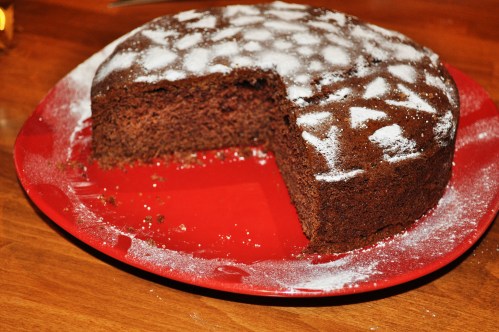
It was based on my fave cake batter again (Mollie Katzen‘s Cardamom coffee cake), but shrunk, and converted to Xmas spices:
200g soft butter
200g light brown sugar
2 eggs
220g sour cream
220g plain flour
1 t baking powder
1 1/4t baking soda
1 t ground cinammon
1/2 t ground ginger
1 t ground allspice
1/2 t ground cardamom
a good few grates of fresh nutmeg

Cream butter and sugar, add egg.
Sieve together dry ingredients, then add it bit by bit to creamed mix, alternating with additions of sour cream.
Put batter in lined 20cm tin, and bake at 140C (fan over) for about an hour and 20 mins, until skewer comes out clean.
I was tempted to add peel and fruit to make it even more Xmassy, without it being a nasty traditional Xmas cake, but decided against that as the panettone had such fruit in already.

Then, for new years, I made this one:

This one is from Diana Henry’s Roast Figs Sugar Snow. She calls it her “Italian chocolate nut Christmas cake, with chestnuts, hazelnuts and walnuts”. We had whole chestnuts, which I roasted, then skinned and broke up as per the recipe – they were a bit hard and chewy. Maybe this means they were too old or something. If not, I’d be tempted to leave them out as their toughness wasn’t nice in combination with the more crumbly texture of the other nuts. It was cracking nonetheless. Henry says she was inspired by panforte but in many ways, it’s quite like the Sachertorte recipe I use. It’s very rich, involves nuts (including ground almonds), and is made by melting butter and choc, adding sugar, egg yolks, then ground almonds, and nuts, then folding in whisked egg whites. It also uses orange zest, but I’m wondering whether that was even necessary.

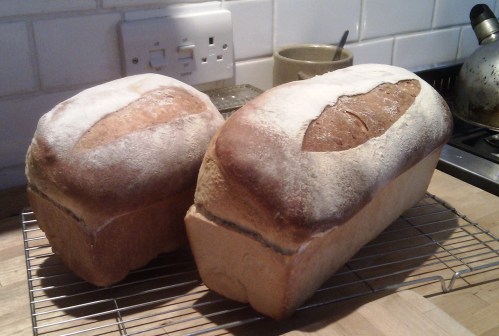
Oh, finally, I also made mince pies, as usual. Here’ my version.
4 Comments

Filed under Baking

Sour cream sandwich bread

The tops grew kinda sideways in the oven, but otherwise these are cracking loaves. Perfect sandwich loaves, and just the sort of thing to win over people who don’t believe you can make soft white bread in the home. The sour cream adds fat, which is a way of keeping bread moist.

The recipe comes care of Mr Dan Lepard and can be found here.

Very easy to make too.

I did double quantities, and these two were baked in a long 900g (2lb) loaf tin and a standard 450g (1lb) loaf tin, but for single quantities Dan L recommends a large, deep 2lb tin.

Leave a comment

Filed under Baking

24 hour leaven bread

I dropped my camera. My dear old camera. And now it refuses to focus. It was just a compact, but it has been with me a long time, and it certainly took better pics than my phone – as demonstrated with this post.

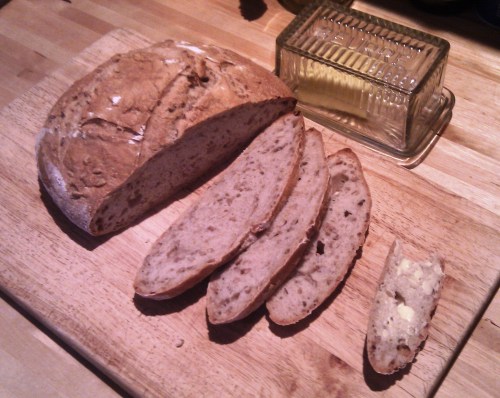
This is a loaf I made up as an experiment. I wanted to only use my own white wheat leaven, and not any bought yeast. So I made a sponge up with 300g of leaven, 600g water and 400g strong white flour, and left it, covered, for 24 hours.

I then added a few tablespoons of ground linseed, 2t salt, 150g wholemeal flour, 100g rye flour, 200g white flour, and 300g of rye grain that had been boiled and soaked in wine (that’s 300g after the boiling and soaking, not 300g dry) and mixed up a pretty wet dough. I really ought to try and work out the percentages, but I’m not fully apprised of that system yet. Bear with me! Just started a baking course, so hope to get my head around all that soon.

I made two disc or cob loaves, each one with 1100g of dough.

There was some pretty unsightly cracking on baking (220C for 10 mins then turned down for another half hour ish), but on cooling and cutting they have a nice crumb, some good open air holes (a feature desired of sourdoughs etc, if not of more standard loaves) and a reasonable flavour. And the rye grains are great for a nice chewiness, almost a crunch.

Leave a comment

Filed under Baking

Polenta crust tomato bread

This is a Dan Lepard recipe – published in the Saturday Guardian.

In his intro, Dan says it’s “A loaf that’s unfairly despised by foodies and artisan bakers…”. I wonder why it’s despised. It’s not got the deep flavours of a naturally leavened bread, say, but it’s  fun and with its red hue and lumps of sundried tomato it certainly adds variety to sarnies. The crust, created by rolling the loaf in polenta, is great.

Leave a comment

Filed under Baking

Daktyla

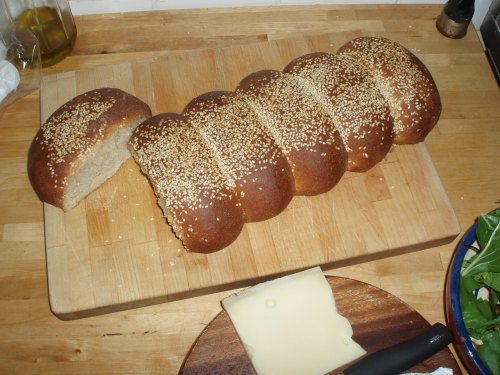
This is a Eastern Med bread, from Greece, Cyprus, Turkey. I’ve bought it from Turkish grocers in England, but never knew what it was called.

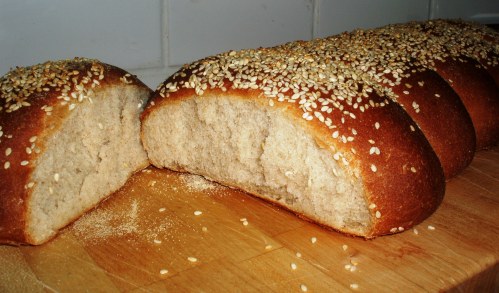
Daktyla apparently means “fingers” in Greek. Supposedly the loaf resembles a row of fingers, or somesuch. Whatever, it’s very pleasant to eat, and visually pleasing for plonking on the table and sharing during dinner.

Here’s the recipe to make one medium-sized loaf.

Small loaf (or use the above and divide accordingly)

5g active dried yeast or 8g fresh yeast
175g water
175g strong white flour
32g wholemeal flour
33g cornmeal flour, eg masa harina
3g (1/2 tsp) fine sea salt
2 tsp olive oil
2 tsp runny honey
2 tsp milk
Sesame seeds

1. Activate the yeast in the water for 10 mins.
2. Mix the flours and salt in a bowl, and make a well.
3. Pour the water into the flours.
4. Blend half of flour into the water to make a sponge. (Alternatively, just mix half the flours with the water/yeast keeping back the other half of the flour).
5. Cover with cloth and leave the sponge for 30-60 mins, until bubbling nicely.
6. Mix the olive oil, honey and milk into the sponge.
7. Blend the remaining flour into the sponge and bring together to make a soft, moist dough.
8. Knead.
9. Rest for until doubled in size (1 1/2 hr), in bowl covered with damp cloth.
10. Turn out, deflate gently, form into a ball and leave to rest for 10 mins.
11. Divide the dough – if you’re using the bigger quantities, and want a bit loaf, divide into 6. If you’re using the bigger quantities, and want two smaller loaves, divided into twice. If you’re using the small loaf quantities, divide into 6 equal pieces. (Do with a weighing scale if you want to be accurate).
12. Form the pieces into balls and leave to rest for 10 mins.
13. Shape the balls into ovals/rectangles.
14. Place the ovals in a row on a floured baking sheet, leaving a slight gap between them.
15. Cover with cloth and prove until doubled in size – maybe 45 mins.
16. Preheat the oven to 230C.
17. Brush with milk, sprinkle with sesame seeds then bake for 25 mins, or until nicely browned and hollow-sounding when tapped on the bottom.

Leave a comment

Filed under Baking

Pide

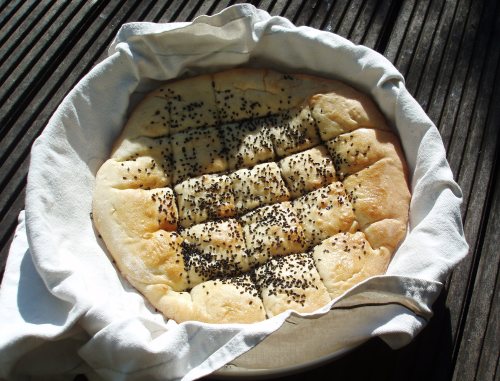
I used to make a flatbread like this years ago but lost the recipe, so glad to rediscover this one.

“Pide” is basically the same word as “pita” as far as I can make out, meaning simply “bread”. Unlike what’s commonly meant by pita, this pide doesn’t have a pocket. Instead, it’s a spongier bread, marked with a pattern and, in this case, sprinkled with nigella seeds (aka kalonji, aka onion seed).

These quantities make two loaves.

2 tsp / 10g of dried yeast or 15g of fresh yeast
1/2 tbsp sugar
325g tepid water
500g strong white flour
1 tsp fine sea salt
2 tbsp olive oil
Egg for glazing
Nigella seeds

1. Dissolve the sugar in the water, sprinkle on the yeast and leave for 5 or 10 minutes. Stir to break up and mix in the yeast.
2. Put the flour and salt in a bowl, then pour in the yeast water and olive oil and bring to a dough. You’ll want a nice soft, damp dough. Don’t keep chucking in extra flour!
3. Knead until smooth.
4. Form into a ball, and rest in a bowl covered with a towel or plastic bag. Leave till doubled in size – around 1 1/2 hours depending on the warmth of your room.
5. Turn the dough out, deflate with your finger tips.
6. Divide into two equal pieces (easiest with scales).
7. Form the pieces into balls, and rest, covered, for 10 minutes.
8. Preheat the oven to 220C (200C fan).
9. Roll the balls out into rounds about 25cm in diameter then rest, covered, for another 20 minutes.
10. Using the straight edge of a dough scraper, mark a criss-cross pattern in the discs, four lines in each direction.
11. Glaze with an egg/water wash, and sprinkle with nigella seeds.
12. Bake for around 12 minutes until a nice golden colour.
13. Wrap the breads in clean tea towels immediately to keep them nice and soft.

4 Comments

Filed under Baking, Breads

A box of bread

Here’s some of the bread I did, catering for a birthday party. From the left: fougasse, apple and oat loaf, alsace loaf with rye.

1 Comment

Filed under Baking

Maize bread


This one uses polenta, as well as maize flour (I used Cool Chile Co Masa harina).

I thought the result would be crumbly and a bit dry, but it’s not. Instead, it’s got a good crumb and a pleasant yellowing colour. Quite a handsome loaf too.

As with much of my bread-making here, it’s another one from Dan Lepard’s The Handmade Loaf, which I’m slowly working my way through.

1 Comment

Filed under Baking

Fougasse

My first go at fougasse, which look fab but are actually very simple. I followed Richard Bertinet’s recipe from Dough for these ones. It just involves making his basic white dough then shaping it.

His basic white dough is 10g fresh yeast rubbed into 500g strong white flour, then 10g salt mixed in, and 350g water added. Bring together the sticky dough, knead until it becomes nice and elasticky (don’t add loads of extra flour!), then rested for until doubled in volume (about two hours in my case).

Heated the oven – with baking stone – to 230C.

After the resting, I just cut the dough into four, gently stretching each piece, then cutting slits with the edge of my dough scraper. I gently opened up the slits, then carefully slid/lifted the shaped piece onto a floured, rim-less baking sheet (use peel if you have one) and slid it onto the baking stone. Baked for around 14 minutes, until starting to brown.

Oh, and the word geek in me loves the fact that fougasse is related to foccacia – both words come from focus, the Latin for hearth. As ever, some nifty factology and further explanation on Wikipedia.

1 Comment

Filed under Baking

Buckwheat muffins


More Dan Lepard from the essential book The Handmade Loaf. Some proper teatime muffins. It’s crazy I feel I have to refer to these as “English muffins”, as I’m English and was eating these long before US-style muffins invaded Britain.

Muffins are like yeasted buns, but are cooked on a griddle or hotplate. Alongside crumpets, muffins are wonderful teatime fare, especially when slathered with butter and jam or honey.

Dan L has added toasted buckwheat to this recipe, which adds a nice depth of flavour. Though not a crunch, as he uses 75g of buckwheat, toasted, and then soaked in 100g boiling water and 2 T of cider vinegar, which soften the seeds (they’re not grains, folks).

Make the dough by adding 1 t fine sea salt to 350g strong white flour.
Add 3/4 t fresh yeast to 200g water (at 20c), then add the soaked buckwheat.

Pour the yeasty, buckwheat liquid into the flour, and mix to a soft dough with 25g melted butter.

Give the dough two more short kneads at 10 minute intervals, forming into a ball and putting in a covered bowl in between. Then leave for an hour in the covered bowl.

On a lightly floured work surface, roll out the dough to about 2cm thick, and cut out rounds with an 8 or 10cm cutter (Dan L says the latter, I used the former and it finished result seemed a suitable size).

Rest the muffins on a floured baking sheet, covered, for another 45 mins.

Preheat a heavy pan or flat griddle over a low-medium heat. Dust each muffin with a little extra flour, then griddle them over a medium heat for about 5-7 minutes each side. Serve warm, or cool, then split and toast.

We had them for afternoon tea along with some rather cute biscuits.

Leave a comment

Filed under Baking