From baths to quarry to tourist attraction

Went to the Baths of Caracalla the other day. First impression was that it was comparable with London’s dear old Battersea Powerstation: red brick, massively imposing,  not looking its best. It’s certainly a site that dwarfs much of the other extant (or exposed) remains in Rome from the Empire era.

I’m very ignorant about ancient Roman history, but what particularly interests me – and what I plan to read about once I’ve finished the fascinating Rome: Whispering City by Richard Bosworth – is what happened during the period of transition between the last Roman emperors and the new rule of the “barbarians”. I’m using pesky inverted commas because I’m reluctant to say German chieftains or suchlike, as no one seems to know the true origins of Oadacer, the chap who deposed Romulus Augustulus in 476AD. He was, however, known to have been a general in the Roman army, so there’s some continuity already – he wasn’t completely foreign, alien to Roman culture.

Wandering around the shell of the baths, I wondered what happened in and after 476AD. Did the staff (including slaves)  simply stop coming to work? Did punters arrive to find the doors locked and have to forgo their daily bathe? Or did life continue in much the same manner for decades, until the Gothic Wars in the 6th century when the technical systems were apparently knackered by Ostrogoths, who joined the list of armies who have invaded and romped around in Rome over the centuries.

The slow change of society is hard to grasp, and visiting such a place you only get a bare backbone of its history: built 212-216AD; fell into disrepair after the fall of the Western Empire; was used as a quarry during the middle ages; was pillaged for its statuary etc from the Renaissance onwards (most famously the Farnese Hercules); was deployed as a theatre by Mussolini. Very little remains of the details and decoration, bar some sections of frieze and restored mosaic. It takes an agile mind to extrapolate from this:

To this:

That’s not a great illustration, but it has the virtue of being colourful – these places would have been highly decorated.

This is a great image, by CR Cockerell, but it’s kinda drab:

Anyway, to get back to my original musings – this is exactly the kind of thing I’d love to see in a CGI time-lapse or somesuch. That’s not available though, so I’ll have to bolster my imagination the old-fashioned way: via books. Currently agonising over which book on the fall of Rome to buy. There are inevitably a lot, and books are effing pricey here in Rome, especially if you’re British, with our poor exchange rate.

When I was very young, my mum used to go shopping down the high street with a basket, visiting the green grocer, the butcher, the baker, and, er, Woolies, most likely. These days almost all grocery shopping occurs in supermarkets, and those independent high street shops are long gone, replaced by chains of mobile phone shops or hot milk drink franchises. That’s just in 30 or so years.

So the fabric of cities does change tangibly – albeit slowly – and even after mere decades you can look back and play a time-lapse in your mind. Presumably something similar happened at the Baths. Maintenance wouldn’t have been so assiduous, service would have worsened, prices would have risen… In fact, it sounds somewhat akin to what’s happening with services and facilities in a country like UK or Italy during this Depression (or is it just a Recession? Or “economic downturn?”).

Life expectancy in 4th century Rome would have been what, around 40 (if you survived childhood)? So individuals would have been unlikely to have been able to note the kind of changes I’ve seen in the high street of my home town. And if no one was alive to remember what things were like 50 or 60 years ago, presumably no one would really have mourned the gradual diminishment of services and eventual functional death of something like the Baths of Caracalla, other than perhaps an intellect elite who read history.

2 Comments

Filed under Main thread, Rome

Rats, bats, cats

I’ve been living in Rome for just three weeks now, and only in our flat for two weeks or so. Suffice to say, that whole time I’ve been suffering significant culture shock – and climate shock. The transition from 18C English “summer” to 35C Roman autumn hasn’t been easy. There are some elements of continuity, however. The past ten years or so has seen a rapid rise in the population of parakeets in London; we used to sit in our garden on an evening, with flocks of them flying over, squawking distinctively. That same squawk greeted me when I first walked through our charming local park, Villa Sciarra. It seems the same former pet species have gone wild here too, notably the ring-necked or collared parakeets.

Non-endemic species certainly cause profound problems in ecosystems where they did not evolve  but suffice to say, it’s hardly the parakeets’ fault, and in some ways I appreciated the familiarity factor.

Also common in Villa Sciarra are the local crow species. Back home in Lewes, Sussex, the Corvus genus was represented by plenty of jackdaws (Coloeus monedula), rooks (Corvus frugilegus), carrion crows (Corvus corone), but here I’ve seen lots of Hooded crows (Corvus cornix). Surely the name is inappropriate though – their handsome grey feathering is more like a cloak than a hood.

Magpies might be nasty, prolific buggers, but by and large I like crows, they’re a handsome crowd, and – without too much anthropomorphism – we can relate to their social nature.

In terms of common species, I’ve less affection for gulls. It seems, wherever you go in the world that’s within about 20 miles of the sea or a major river mouth, gulls will wake you at 5am with their irreverent cackling. Talking of early wake-up calls, we might have to contend with humanity doing its bit with the local campanile, but on our first night in our new flat in Monteverde Vecchio, it was a somewhat hysterical blackbird that woke us from a fitful sleep at around 4am.

Other birds I’ve registered so far – and, yes, these are all common species, but it’s first impressions – are cormorants. The Tiber may look pretty fetid, but if the cormorants fish it, it can’t be that bad right? Not as bad as when Garibaldi wanted to divert it into a canal and pave it all over. Imagine that. Another (non-bird) species that apparently fishes the Tiber is the coypu, or nutria. This excites me a lot. I know they’re aliens (native to South America), but having never managed to see an otter in the UK, or a beaver on a canoeing trip in Canada, I still long to glimpse one of this aquatic mega-rodent family.

On the rodent front, I’ve only had a few encounters so far. Rats are of course always close to humans, especially in places where garbage is strewn so readily. So far I’ve seen one rat going about its business, and another not so much. Lying dead among the litter, dog poo and graffiti on the Rampa di Monte Aureo, one of the many grand but grubby stairways leading up to Gianicolo and Monteverde itself, west of Trastevere. Now then, everyone says “ugh, rats”, but it’s not like they’ve helped spread any black death recently. Besides, the rats presumably play an unpaid role in the management of Rome’s prolific garbage.

Apparently, the ancient Romans just called them “Mus Maximus” – big mouse. Can you guess what a mouse was called? Mus Minimus. There’s got to be a comic or cartoon in there somewhere.

The other rodent I’ve been seeing a lot of – much more so than the rats – is bats. I love bats, they’re so endangered in much of Britain, and I only saw them very rarely in London, but they seem to be doing well here. Every night when sitting on our balconcino, they arrive as night falls. I’m guessing they have plentiful food in the form of all the dang-blasted mosquitoes. They probably like all the churches too, for roosts.

Confusingly, all bats seem to be called pipistrello here, while scientifically, pipistrellus refers to a specific bat genus, and the common pipistrel is Pipistrellus pipistrellus. (I love those double Latin names – the best has got to be Troglodytes troglodytes – an evocatively monstrous name for something as dainty as the wren.)

Finally, another species that any visitor to Rome is likely to see a lot is of course the cat, felis catus. Dismount a tram at Largo Torre Argentina, for example, peer down at the ruins in the centre – and you’ll find them draped with cats. These are members of the famous colonies of Rome, also found at the Forum, the Colosseum, and at the Non-RC Cemetery, where they’re fed by volunteers and cat lovers. Down our street, I’ve also seen bent-backed old ladies feeding the tough-looking local gatti. They’re not wild animals, sure, but they’re certainly not pets. The term “domestic cat” doesn’t really fit for animals that don’t inhabit domus.

Oh, and finally – not a bird, not a mammal, but a reptile. I’ve seen a fair amount of the Italian wall lizard (Podarcis sicula). Beautiful things. They visit our balconcino, hanging out in the window boxes full of spider plants. Again – strangely – it’s a nice element of continuity for me, as a few weeks before we left Sussex, I was lucky enough to see some similarly beautiful lizards (Lacerta vivipara) above the Seven Sisters.

1 Comment

Filed under Main thread, Rome

Moto city

Found a little bike shop in Rome today, near the Campo de’ Fioro, selling various hipster bikes (fixies, old-fashioned town bikes etc) and Bromptons. I’m not convinced they can be doing a roaring trade though, as Rome is very much a city of roaring motor traffic.

The only places I’ve seen cyclists pootling about is in the older, more maze-like areas of Trastevere, round Campo de’ Fioro, in the Centro Storico, as well as people in lycra doing circuits of the magnificent Villa Doria Pamphilj, a park we’re lucky enough to live near. There are some fine looking, two-lane cycle tracks along the Tiber, but I’ve never seen a single cyclist using them. Not a one. Rome just isn’t a bike city.

If cycling in a city like London can be intimidating, cycling in Rome doesn’t bear thinking about. One persistent element of the city’s auditory landscape is the distinctive uh-eeh-uh-eeh-uh of ambulance sirens. I hear them all the time. Some of them may be hallucinations; I can’t tell. Stop and strain your ears at any moment, it seems, and you’ll hear those sirens. And every time I do, I wonder – splatted pedestrian? Cyclist? Motorino-rider? Or just plain old traffic accident?

New arrivals in Rome – like us – can be easily identified standing perturbed on the pavement, trying to work out how to cross the road. Even at things that resemble zebra crossings it can be a baffling, frightening proposition. In fact, even when you’re wandering the cobbled streets and alleys of the above-mentioned antico parts of town, you have to keep a weather ear out for motos, even vans squeezing between the buildings.

Time Out’s Shortlist Rome 2008 provides some statistics that feed that perturbation. It quotes a 2004 study that says Rome is the most dangerous EU capital, with 8.37 dead per 1000; second in the list is Copenhagen, with a mere 1.47 per 1000. It attributes this to the sheer number of vehicles: “around 950 per 1000 population, three times that of London.”

Ironically, this all means travelling on Rome’s (admittedly meagre, two-line) metro, for example, is fairly civilised compared to the London Tube or New York Subway. Natives just don’t seem to want to use the public transport.  In their defence, at least you don’t see as many people who absurdly choose to use the descendants of military/agricultural vehicles as town cars, like those odious denizens of Chelsea, for example, with their notorious SUV “tractors”. Rome is a city still largely dominated by scooters and sensibly proportioned vehicles like Smart cars and Cinquecenti. Though it’s amusing when you see a vintage Cinquecento parked beside its modern namesake, or likewise with Minis. Not so Mini now.

So, yes, as much as I miss cycling, I don’t think I’ll be riding the streets of Rome any time soon. Though I would very much like to score a mountain bike to hit the paths of Doria Pamphilij.

Update. Unprompted, my Italian teacher gave us this expression today:
“Roma è uno citta molto caotica.”

Quick addendum
Two years later, Sept 2013. I’ve been cycling in Rome about six months now and although I’m still nervous, I’m not dead. In fact, just packed my Brompton up to send it home and I’m missing it already.

1 Comment

Filed under Main thread, Rome

Cats and Keats

Rome is, arguably, one of the most handsome cities in the world. Not that I’ve been to every city in the world, of course, but that’s its reputation. But it’s also a city that’s in many ways defined by its debris, its dereliction, its waste. The glory of ancient Rome over the centuries became the picturesque ruination so beloved of artists, the bourgeoisie and the artistic bourgeoisie holidaying on what became consolidated as the ‘Grand Tour’. Which reached its sublime expression in things like this, by old JMWT:

Of course, in our modern world, defined by its barbaric plague of combustion engines, single-use plastic packaging  and solvent-based territorial marking, it’s not quite so picturesque, despite Rome still having an embarrassment of antique riches.

Trastevere, the former working class district now beloved of tourists, students and ex-pats, where we’ve been staying, is plastered with graffiti (I’m a fan of quality street art, but not this rampant, artless tagging), while the various stairways up the Janiculum Hill and up to the more down-to-earth residential neighbourhood of Monteverde Vecchio, where we’re moving tomorrow, are adrift in litter. All that odious non-biodegradable crap that defines our era. The plasticocene, or something. And lots of crap tagging and graf too.

Today, however, we drifted over to Testaccio, on the east side of the Tiber. It’s a neighbourhood with a very different character again. (Here’s a quick caveat: these observations are all of course only initial, pretty superficial, and made in August, when many Romans are elsewhere.) Testaccio, historically, is defined by its huge rubbish mound, Monte Testaccio, which is made up of broken amphorae, and by its long heritage in the meat industry, based at the old (now closed) slaughterhouse, the Ex-Mattatoio.

The area around the base of the Monte seemed pretty seedy during the daytime, with its ring of closed-up bars and nightclubs. I’m not really the demographic to sample its nocturnal delights methinks. What we did delight in, however, was a visit to the Protestant – or more accurately, Non-Roman Catholic – Cemetery. It’s not a grand place like Paris’s sprawling necropolis of Père Lachaise, but it’s similarly fascinating, and boasts some notable residents, like Keats. Percy Bysshe Shelley was cremated, but his ashes were put here at Mary Wolstonecraft Shelley’s request; according to the Rough Guide she had quite a wrangle with the papal authorities. Their son, William, is also buried here. As are numerous other important, wealthy or just plain forrin non-RC types; some of the English residents are clearly of that rarefied type of upper class who can get away with names like “Viking”.

It’s a wonderful place, with extra interest granted by the fact that it’s loomed over by Caius Cestius’s pyramid, built after his death in 12BC. He had a thing for Egypt. His slaves built it in 330 days, apparently. He freed them on his death; whether they built it when still ‘under contract’ I don’t know (and can’t be bothered to Google just yet). Beside the pyramid is a little cat sanctuary, and a couple of little feline charmers accompanied us on part of our stroll.

Apparently Romans are cat lovers, and these ones seemed pretty happy. You came across several contented-looking beasts drowsing among the gravestones.

The cemetery is also pleasing and relaxing because I didn’t spot a single piece of litter or scrawled tag. Litter really upsets me, it’s a sign of humanity’s lack of self-respect and foresight, and widespread distain for the environment, and this is especially tangible when it’s draped over a city as unique as Rome.

Oh, and just so I don’t end this post on a downer, we ate lunch at the best place we’ve tried so far in Rome, La Fraschetta di Mastro Giorgio. Very much about grilled meats (suitably enough), but we also had some wonderful cheese and some great focaccia. Focaccia in its British incarnation can be quite plump and puffy. Before we left the UK I made some that was much thinner, crisper. I was very pleased to see the stuff here was much more akin to that effort of mine.

2 Comments

Filed under Main thread, Rome

Lewes to Rome in seven stages

After three or so years of deliberating, my wife Fran and I decided to move out of London to Lewes, in sunny East Sussex. Then,  would you Adam and Eve it, Fran was offered a job – a dream job – in Italy. As Fran had always said she wanted to live and work in one of Europe’s other grand capitals, ideally Paris or Rome, I could hardly quash her aspirations.

So three months after moving to Lewes – three months of frantic DIY, fantastic walks on the South Downs, and pleasant socialising  – we were off to Rome. Rather than trying to take a couple of hefty bags of our worldly possessions on a low-rent, high-discomfort, feisty surcharge airline, we opted to go by train. Both of us prefer train travel where possible, and we both enjoy sleeper trains. On our honeymoon we went to Verona on the sleeper, and were even lucky enough to score a return journey on the legendary Orient Express (one of the finest coups of my journalistic career).

The standard sleeper isn’t a patch on the Orient Express of course, but it’s still a delight compared to air travel, particularly for larger people with personal space issues who can only ever afford to fly cattle class, ie people like me. The prime appeal of a sleeper train is getting a cabin – all yours, room to stretch your legs, room for your luggage,  and a locked door. Space and privacy just isn’t an option with aviation.

Of course, the reality of this kind of travel inevitably puts romantic notions to the test; particularly when you’ve seven long stages between a front door in Lewes and a rented flat in Rome. And particularly when, despite you telling your wife for long weeks that her practice packing should bear in mind the weight of her luggage, said wife ends up with heftier luggage than she can really manage. Resulting in sensible husband having to take some of the clobber in his (marginally more) sensibly packed luggage. We had a wheelie bag and a rucksack each, and I suspect the total weight was about 70kg. Fine and dandy once you’re ensconced in that lovely little sleeper, but not so hot when you’ve got a taxi to Lewes station, a busy commuter train to London Victoria, a black cab ride to St Pancras International, a Eurostar to Gare du Nord, a cab ride to Paris Gare de Bercy. Then the sleeper train…

… which was, in familiar UK-style, delayed. Not what we expected of French/Italian rail services! Outrageous. But the coup de grace was quite possibly the fact that our sleeper train, the Artesia ‘Palatino’, had a broken door for our coach, meaning we had to wrench our bastard baggage through the adjacent coach.

And yet. And yet, once we were in that cabin, and the steward welcomed us, and another steward came to ask what sitting we wanted for the restaurant coach, we were happy travellers. Or happy emigrants even.

On a side note, we didn’t sample the restaurant car as you can’t lock the cabin doors from the corridor on this particular train; there’s only an interior night lock – a shame for those lugging around sundry valuables, but more sensible travellers with manageable, lockable luggage may be unperturbed. So, instead, we picnicked on Sussex salami and Sussex cheese, crackers and two apples from a young apple tree we’d planted in the garden of our house in Lewes (it was a wedding present from a few years ago; variety ‘Scrumptious’; they were).

For those more interested in all the details of the Artesia ‘Palatino’, the cabin itself was lovely. I think it was fitted out (or re-fitted) in the late 90s, but it was in good condition, with a nifty little corner sink, replete with fresh towels, soap, a toothbrush, disposable loo seat covers and whatnot. As for the loos themselves – often the most dreadful factor of any journey – the ‘Palatino’ seemed to have four in each coach. Two were knackered. Investment in these trains seems to be dwindling, which is understandable in this era of global economic, meltdown, when, I believe, they’re still state-run, but it’s a real shame none-the-less, as it’s a gorgeous way to travel, Europe drifting by outside your private picture window before you’re lulled to sleep by the rattling rhythms.

On the matter of sleeping, the steward turns your couch into bunks, and makes them up with fresh sheets. Our cabin has fabric bunks which also made for a better night’s sleep than when we travelled Bercy to Verona (on Artesia ‘Stendahl’, which terminates at Venice), where our bunks had a plastic style mattress – unexpectedly slippery when cruising round the many corners of central Europe by night.

That’s quite a long enough post, but on the off-chance someone stumble across this looking for practicalities, here’s the English language site. (EDIT 2013: not any more – that service is defunct, replaced by Thello.) And remember – travelling light is a lot easier!

14 Comments

Filed under Main thread, Rome

Zombie cakes

Been learning how to decorate cakes. I’ve done some frou frou and flowers, so I thought it was about time I did something closer to my heart – zombies!

This project involved making six mini-cakes, themed around a festival… so my excuse is that it’s Samhain/Halloween, you know, the night when the barriers between life and death are at their thinnest, and the dead rise from their graves. So yeah, my cakes are ghouls rising from the ground.

Inside is fruit cake, all the rest is made from sugar paste and food colourings.

And here they are individually:

Anyone guess who this guy’s inspired by?

This one’s inspiration is a little more tricky:

And the inspiration for this one is pretty obscure (unless you’re a fan of a certain strand of zombie movies… ):

These last three were all a bit more ad-libbed. I’m particularly proud of this chap’s cranial occurence:

zombie cake brains

Palatable?

Zombie cake eyeball

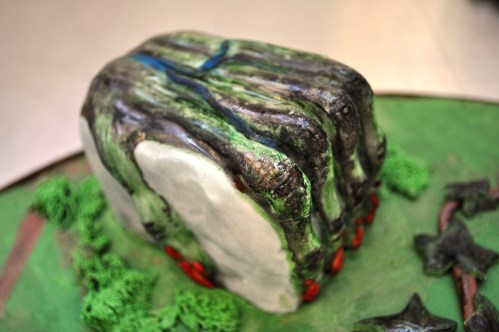
And finally, a grasping zombish hand (cos we had to do at least 2 different shapes for this project).


SPOILERS
I’m putting this here retrospectively to remind myself before I forget.
The first individual head is inspired by Michael Jackson’s look in the Thriller video.
The second is inspired by the Deadite version of Ed Getley in Sam Raimi’s 1987 classic The Evil Dead II.
The third is inspired by the poster for Lucio Fulci’s 1980 film City of the Living Dead. My friend Jamie also used the poster as inspiration for this book cover.
The character with the exposed brain and the one with his eyeball hanging out were more generic inventions. Ditto the hand.]

1 Comment

Filed under Baking, Cakes

Hazelnut loaf with rye grains

This is my first take on another recipe from Dan Lepard’s essential The Handmade Loaf.

As we’re gearing up to move house, I’m trying to use up ingredients – resulting in some changes to Dan L’s recipe. I also didn’t strictly follow his method – hey, a baker’s got to follow their instincts right?

So, ingredients:
250g strong white flour
150g plain flour
150g rye flour
8g salt
300g water
3g active dried yeast
50g honey
450g white leaven
50g butter, melted then cooled slightly
80g hazelnuts, toasted and chopped
280g cooked, soaked rye grains
(In this case, I boiled the rye grains for about 45 mins, cooled them, drained them, and soaked them overnight in apple juice. I used the cooking water for make up the dough.)

Method:
1. Add the yeast to the water (the rye cooking water), with the honey, and leave to activate.
2. Whisk the leaven into the yeast/water mix.
3. Combine the flours and salt in a roomy bowl.
4. Pour the liquid into the flours, along with the melted butter.
5. Bring to a dough and knead thoroughly.
6. Stretch out, then sprinkle on the chopped nuts and rye grains. (I’m adding them later than Dan L instructs as it struck me that chopped nuts could tear the dough, and damage the gluten structure, if added when initially making the dough.)
7. Knead to combine, then return to the bowl, cleaned and oiled slightly.
8. Leave 30 minutes, then give it a turn (ie stretch out, fold into thirds).
9. Leave another 30 minutes, then give it another turn.
10. Leave the dough now until doubled in size.
11. Turn out, weigh, scale two pieces, then hand each one up into a ball and rest 10 minutes.
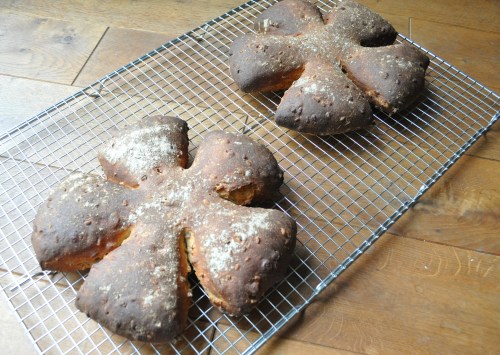
12. Pin out each piece to a disc about 20cm in diameter, and cut five slits through the dough around the edge. Stretch each one of these, er, pseudopodia….
13. Cover and leave to prove, until doubled in size and suitably soft to the touch.
14. Bake in an oven preheated to 210C for 35 mins – check after half an hour; Dan L says they should be “a good rich brown in colour”.

Yep, I’ll admit it, mine are perhaps a little too “high bake”… the recipe says bake 40-50 mins, and I stupidly didn’t check mine before 40 mins.

Leave a comment

Filed under Baking, Breads

Couronne experiments

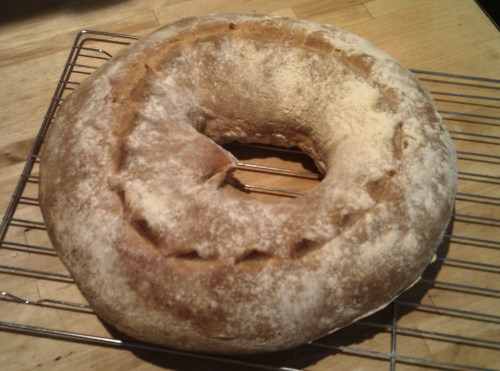
I’m loving the ring shaped loaf at the moment. It’s also called a couronne apparently, though I don’t know much about the real thing from France. I did this one summer 2010:

Annoyingly, I didn’t make a record of it at the time and I can’t remember where I got the recipe.

Recently, however, I learned this version, which was referred to as a “French crown”. This is scaled for a 1kg loaf:
536g Flour (100%)
311g Water (58%)
5g Fresh yeast (1%)
5g Sugar (1%)
11g Salt (1.9%)
134g White leaven (25%)

It used a 2-4 hour fermentation time, and created a nice plump, white version. It also uses a French white flour – apparently, to recreate this softer flour in the UK, we can do a blend of strong white and plain flours.

I want to develop a version that uses more natural leaven (or sourdough starter), a longer fermenation and isn’t 100% white flour. I’ve also been experimenting with overnight proving in the fridge.

Here’s what I’ve been using.

Sponge:
170g strong white flour
100g rye flour
310g water
200g white leaven (mine’s currently made with 50/50 water/flour)
[I’ve also been adding a little yeast – 1g ADY or easyblend, or 2g fresh; hey sourdough purists, I’m experimenting!]

I’ve been leaving this sponge for around 9 to 16 hours, then making up a dough by adding:
100g strong white flour
170g plain flour
11g salt

I’ve been kneading for around 10 mins, then leaving it half an hour, and giving it a quick knead. I’ve also done a few folds.

On one occasion, I proved it for a few hours, then shaped the ring, and left that to for its final prove overnight in the fridge. Took it out, left it for around two hours to bring the dough temp up again, then baked it. It was very nice, with a decent irregular crumb, chewy crust and low-to-middling sourness.

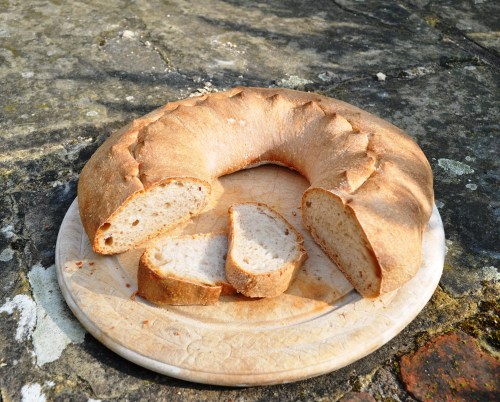
On a second occasion, I made up the dough, kneaded it, then proved it overnight in the fridge. In the morning, I left it to warm to ambient temp (around 17-18C), then gave it a few folds, shaped it, and gave it a final prove of a few hours, then baked. This is the result for that one:

When I get this just right, I reckon it just might be my signature loaf.

Leave a comment

Filed under Baking, Breads

Wheatberry tin loaves

This one is loosely based on a sourdough from The Ballymaloe Bread Book, but I varied it to use some other bits and pieces, and use techniques I’m more comfortable with.

It doesn’t use any commercial yeast, just a leaven – in this case one made with a strong white flour.

In a roomy bowl, combine:
150g wheat leaven
225g strong white flour
225g water (warm, but as this is a long fermentation, the exact temp isn’t crucial)
Mix and leave for around a day.

Then add:
400g wholemeal flour (I’m using stuff grown in Sussex, so it’s fairly soft, but works ok. Best of all, it’s milled on water-powered grindstones at Winchester City Mill).
50g rye flour
100g strong white flour
14g fine sea salt
150g (ish) of wheatberries – ie whole wheat grains that have been boiled until soft.
50g of butter, melted
225g water (warm, but again, as it’s a long fermentation, it just has to be suitable for encouraging the leaven’s lifeforms)
Mix to a good dough, and knead. I gave it a good initial knead, then did the Dan Lepard technique of three more short kneads, every 10 mins.

Scale into two pieces, rest, form batons, then put in two greased 2lb loaf tins.

Prove for around 5 hours (depend on the temperature of your room; my kitchen was only around 18c), then bake in an oven fully preheated to 220C for around 40 mins.

Leave a comment

Filed under Baking, Breads

Busy baking, Christmas and new years 2010-2011, including panettone

It’s been a very busy month on the baking front for me.

For Lawrence and Jo’s wedding on 19 December 2010, I made the cake, with Fran doing much of the decoration. I’m slightly disappointed with most of the photos I got of the cake, many of them are pretty gloomy – not ideal for something involving so much dark chocolate! But anyway, here’s one:

Dom and myself also did some catering for the late evening supper at the wedding. For this, I baked three different types of bread from three of my favourite baker-writers. These were Andrew Whitley’s seeded rye bread a 100% rye sourdough from Bread Matters; the wonderfully moist rolled oat and apple bread from The Handmade Loaf by Dan Lepard; and Richard Bertinet’s lovely simple fougasse from Dough.

For Christmas itself, I was keen to try and make a panettone. I really want to follow a traditional recipe – meaning, making a naturally leavened dough. Yep, apparently an authentic panettone is what many people would term a “sourdough” – it doesn’t use any commercial yeast, but instead involves a slow fermentation process based on a natural leaven. As that natural leaven is wheat-based, personally I wouldn’t call it a sourdough, but there you go.

Having said all that, though, when it came to the crunch, after all of the above, I didn’t really have the time to experiment with a fully naturally leavened panettone, so I cheated and kinda made up a recipe that used from yeast too.

I didn’t really write it all down properly, but I used:
50g white leaven
10g active dried yeast (ie granular yeast) or 22g fresh yeast
350g water – my flour was cold, only about 16C, so the water was about 38C.
Combined.

In a large bowl, I mixed:
800g strong white flour
50g caster sugar
10g salt
zest of one lemon
100g pine nuts
50g flaked almonds
100g raisins
100g mixed peel
2 eggs, beaten
50g melted butter

Then added the leaven/yeast mix, and brought it to a soft dough.

Proved until doubled in volume, knocked back, rested, then formed into a ball, which I squashed into more of a teardrop shaped and put in a large catering tin, which I’d lined with baking parchment.

Proved again, till doubled in volume – or at least until it felt right with the pinch test. Glazed with basic egg wash, though I’ve seen recipes (like this one on the Wild Yeast blog, which I got via this thread on The Fresh Loaf) that use much more elaborate glazes. Some of them seem to glaze after baking too. There’s still a lot to learn about making panettone.

Baked At 200C for around 45 mins, I think. Doh, should have written more notes.

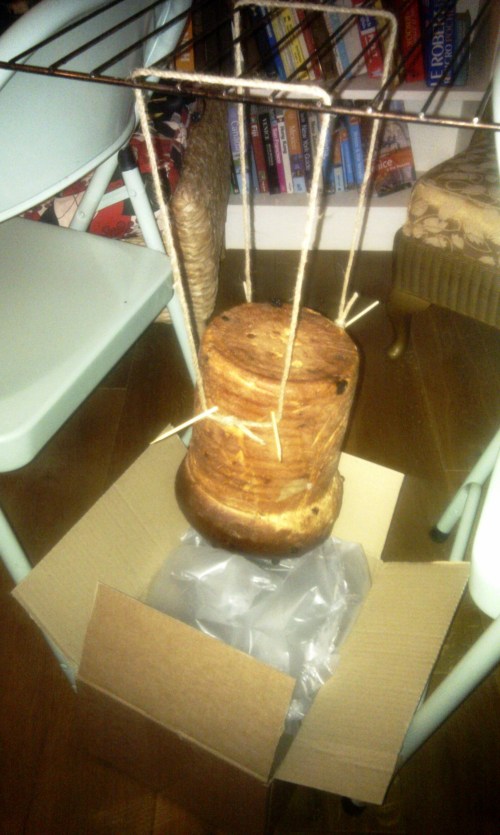
Anyway, the Wild Yeast blog had some interesting pics – notably about how to cool a panettone, by hanging it upside down. I rigged up an absurd set-up with two chairs and an oven rack. I put a box with soft packing material underneath just in case, as the loaf was heavy the skewers were tearing through.

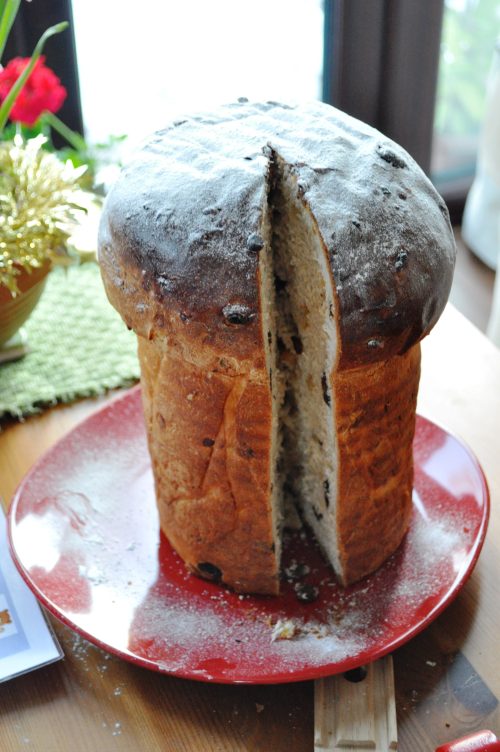
Here’s the finished panettone:

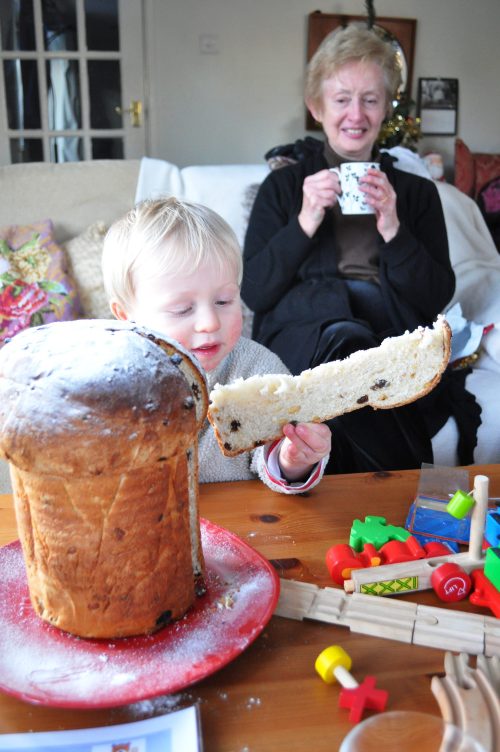
Being critical for a moment, I think it was too dense. Next Christmas I’ll try and fully naturally-leavened version with longer fermentation to try and open up the crumb more – get some nice big, ciabatta style air-holes. It was very nice though. Ellis certainly thought so.

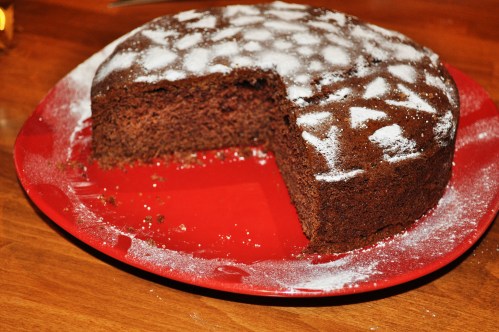
Other goodies I made over Xmas included this cake:

It was based on my fave cake batter again (Mollie Katzen‘s Cardamom coffee cake), but shrunk, and converted to Xmas spices:
200g soft butter
200g light brown sugar
2 eggs
220g sour cream
220g plain flour
1 t baking powder
1 1/4t baking soda
1 t ground cinammon
1/2 t ground ginger
1 t ground allspice
1/2 t ground cardamom
a good few grates of fresh nutmeg

Cream butter and sugar, add egg.
Sieve together dry ingredients, then add it bit by bit to creamed mix, alternating with additions of sour cream.
Put batter in lined 20cm tin, and bake at 140C (fan over) for about an hour and 20 mins, until skewer comes out clean.
I was tempted to add peel and fruit to make it even more Xmassy, without it being a nasty traditional Xmas cake, but decided against that as the panettone had such fruit in already.

Then, for new years, I made this one:

This one is from Diana Henry’s Roast Figs Sugar Snow. She calls it her “Italian chocolate nut Christmas cake, with chestnuts, hazelnuts and walnuts”. We had whole chestnuts, which I roasted, then skinned and broke up as per the recipe – they were a bit hard and chewy. Maybe this means they were too old or something. If not, I’d be tempted to leave them out as their toughness wasn’t nice in combination with the more crumbly texture of the other nuts. It was cracking nonetheless. Henry says she was inspired by panforte but in many ways, it’s quite like the Sachertorte recipe I use. It’s very rich, involves nuts (including ground almonds), and is made by melting butter and choc, adding sugar, egg yolks, then ground almonds, and nuts, then folding in whisked egg whites. It also uses orange zest, but I’m wondering whether that was even necessary.

Oh, finally, I also made mince pies, as usual. Here’ my version.

4 Comments

Filed under Baking