Monthly Archives: June 2014

The Eighteenth South Downs Beer & Cider Festival, Lewes, 20-21 June 2014

18th South Downs Beer Festival in Lewes town hall. With many empty casks.

The poster for the 18th South Downs Beer and Cider Festival nicely riffs on the cover design of Neil Young’s 1972 classic album ‘Harvest’. As I’m a fan of both real beer and that album, it got me excited about the event when I first spotted it. As Fran was interested in going, and couldn’t do the first day, a Friday, due to work commitments, I got tickets for the 11am to 5pm Saturday session.

South Downs Beer Festival 2014 PosterHarvest album cover

A week or so before the event, I went to the CAMRA site and printed off the list of breweries represented, going through it to highlight all the local ones. This festival, being held in the handsome Lewes Town Hall, marked forty years of the Brighton and South Downs Branch of CAMRA, so promised to be special.

So it was a kick in the teeth when we arrived at about 1pm on the Saturday to find pretty much all the local beers had run out, bar those from Harveys. Now I love Harveys, but I drink it most days, so I was most keen on trying other stuff from around Sussex. So it was disappointing to see crosses through the signs for both the beers from 360 Degree brewery at Sheffield Park, just north of Lewes; through those of Bedlam in Aldbourne, West Sussex; through both the beers from Burning Sky at nearby Firle; ditto Downlands, at Small Dole, West Sussex; ditto both beers from Goldstone, from nearby Ditchling; ditto Kissingate of Lower Beeding, West Sussex; ditto Brighton’s Laine; ditto Pin-Up Brewery of Southwick, East Sussex; ditto the intriguing Rectory of Streat, East Sussex, brewed by a priest.

Guttering and empty casks. Sorry, bad photo.

The few local beers I tried were: Lammas Ale from 1648 Brewing Co in East Hoathly, East Sussex. This had bubblegum-ish aroma, from malted wheat, and low carbonation, medium body. Then a Wolseley Best from The Stanley in Portslade, also East Sussex (though currently brewed at Downlands). This had nice hints of liquorice, charcoal and nuts, but frankly, I drink Harveys Best all the time and I wasn’t here for the best bitters. Cavedweller from Caveman Brewery, over in Kent, was a bit more interesting, a porter nicely combined blackcurranty flavours with more piney, resiny hints from UK Bramling Cross hops. I wouldn’t call porter a summer beer though. Another more interesting one was Regaler from Franklins, in Bexhill-on-Sea, East Sussex. The notes called it a “cold-fermented lager-style ale”. I assume it was a Kölsch-style beer, top-fermented like an ale and more full-bodied and less carbonated than most lagers.

Festival beer list

All of which was fun, but not what I was hoping for. Interestingly, a lot of what had run out was the more hoppy American craft beer-style stuff: not what you typically associate with CAMRA, which can he thanked for keeping British cask ale, notably bitters, alive through the 1970s and 1980s when dreadful industrial lagers took over British pubs. Although Britons still drink mostly industrial lager by proportion now, we’re coming back round to real beer – in part thanks to CAMRA, but also in part thanks to the vitality of the highly influential US craft beer movement and the exciting flavours and aromas offered by US hops.

My favourite beers these days are those that take our incredible British brewing heritage but aren’t afraid to be inspired by US beers and US hop flavours. That’s what I was hoping to try more at the festival, things like Burning Sky’s ‘Arise’ “Session strength IPA”, here available in cask. But it had run out.

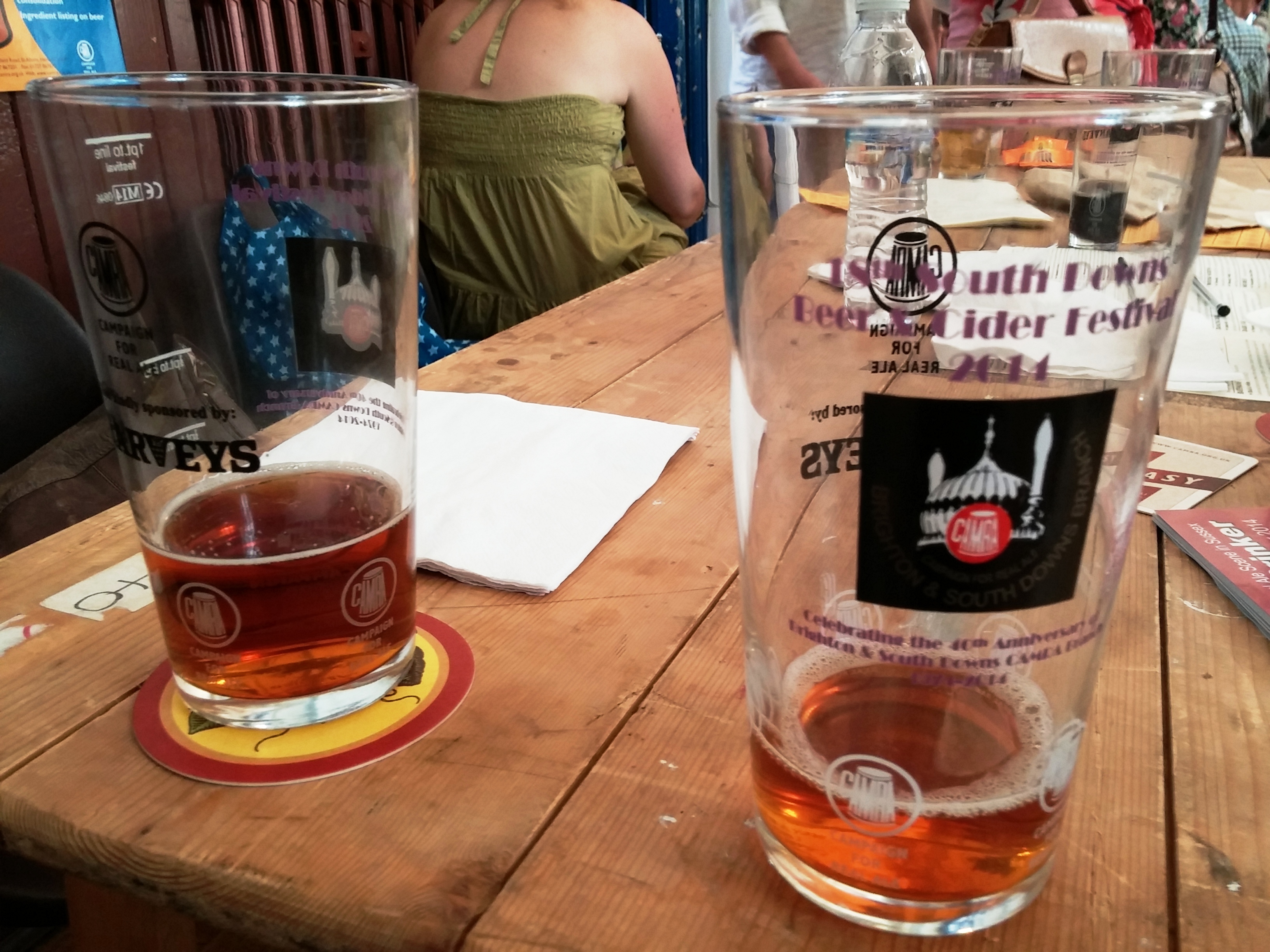
Drinking out third-pints at the 18th South Downs Beer Festival

Now, I’m aware that things do – and have to – run out at these beer festivals, but considering the event was running from 11am on the Friday to the evening of the Saturday, when everything was finished, a total of about 20 hours of sessions, it seemed pretty poor that so much was gone already when we arrived – at roughly just after the mid-point. I realise part of the buzz of a beer festival is the first rush to try the latest products of interesting breweries on the first day, but well, it just seemed like poor event management that so many punters like us who didn’t arrive till the second day were deprived of the so many of the beers, in particular those local brews.

Now if I was writing about the event in a journalistic capacity, I would contact the Brighton CAMRA branch and the festival organiser, Ruth Anderson, but instead I’m just blogging about it as a disappointed punter and don’t feel like chasing around after them for quotes. Plus, I suspect they’d just reiterate the line about how it’s normal for casks to run dry after the initial evening throng has been at them. I really didn’t want to be writing a moany post about the event I’d been so looking forward to but, well, here we are.

Lewes Corn Exchange, with surprisingly mixed crowd at the beer festival

Still, while pretty much all the stuff I’d marked on my print-off had run out, at least it meant we’d only drunk a few third-pint samples each and were subsequently able to cycle down to the Kingston village fete, along a lovely traffic-free path. The festival was held in the Lewes Town Hall and corn exchange, a great venue where I usually just go to give blood, but as it was a gorgeous hot, sunny day, being outside appealed greatly.

Pints at the Kingston village fete

At the fete, we met some friends. And visited the beer tent – which not only had a cask of Burning Sky’s delicious Plateau pale ale, but the guy serving the drinks even gave us a free glass from Long Man, another nearby brewery. We went home via The Swan in Southover, where we had a Harveys Olympia golden summer ale in the lovely garden, so the day turned out well in the end.

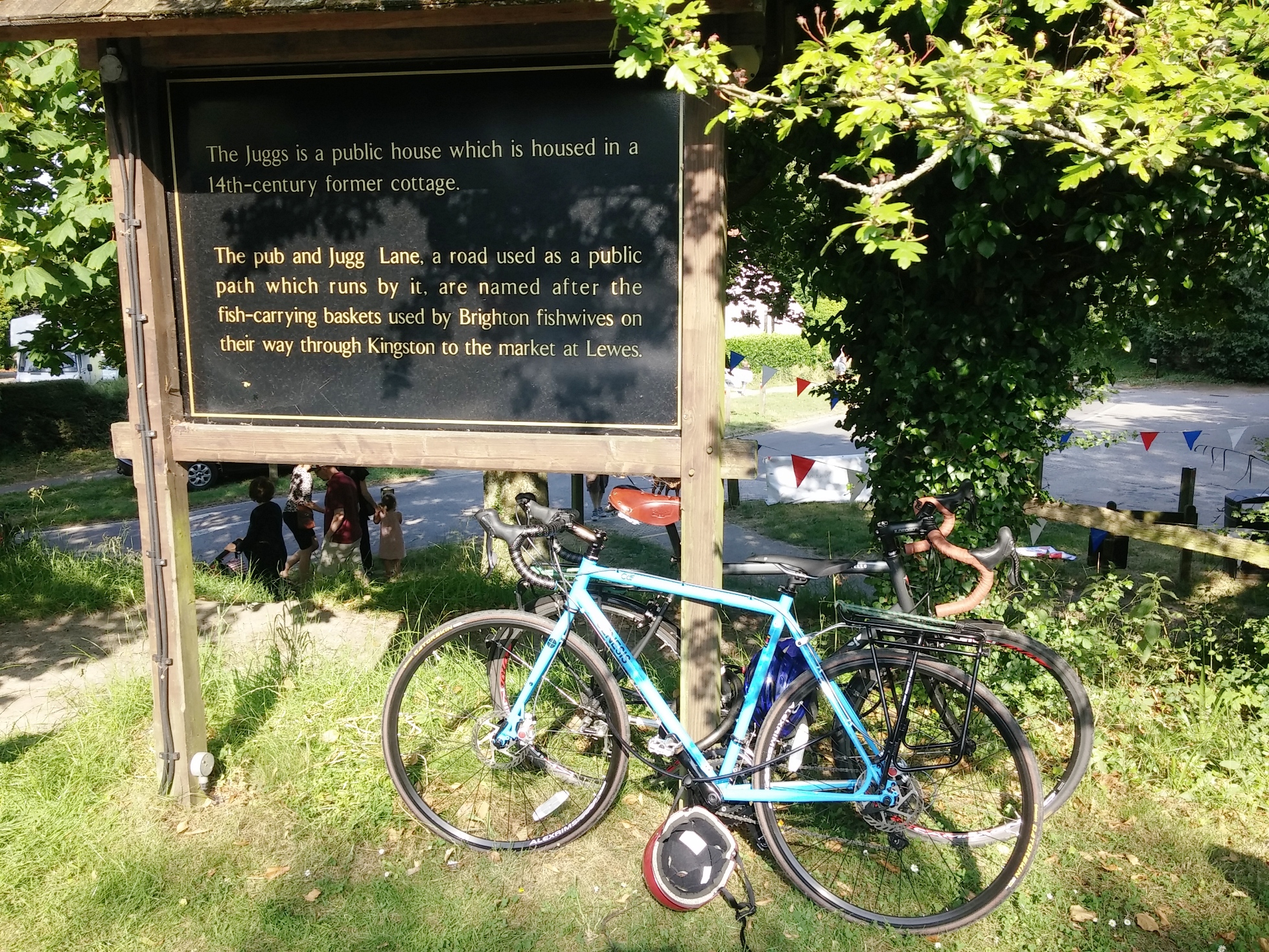
Bikes outside fete, nr pub

2 Comments

Filed under Ale, beer, Breweries, British beer, Discussion, Events

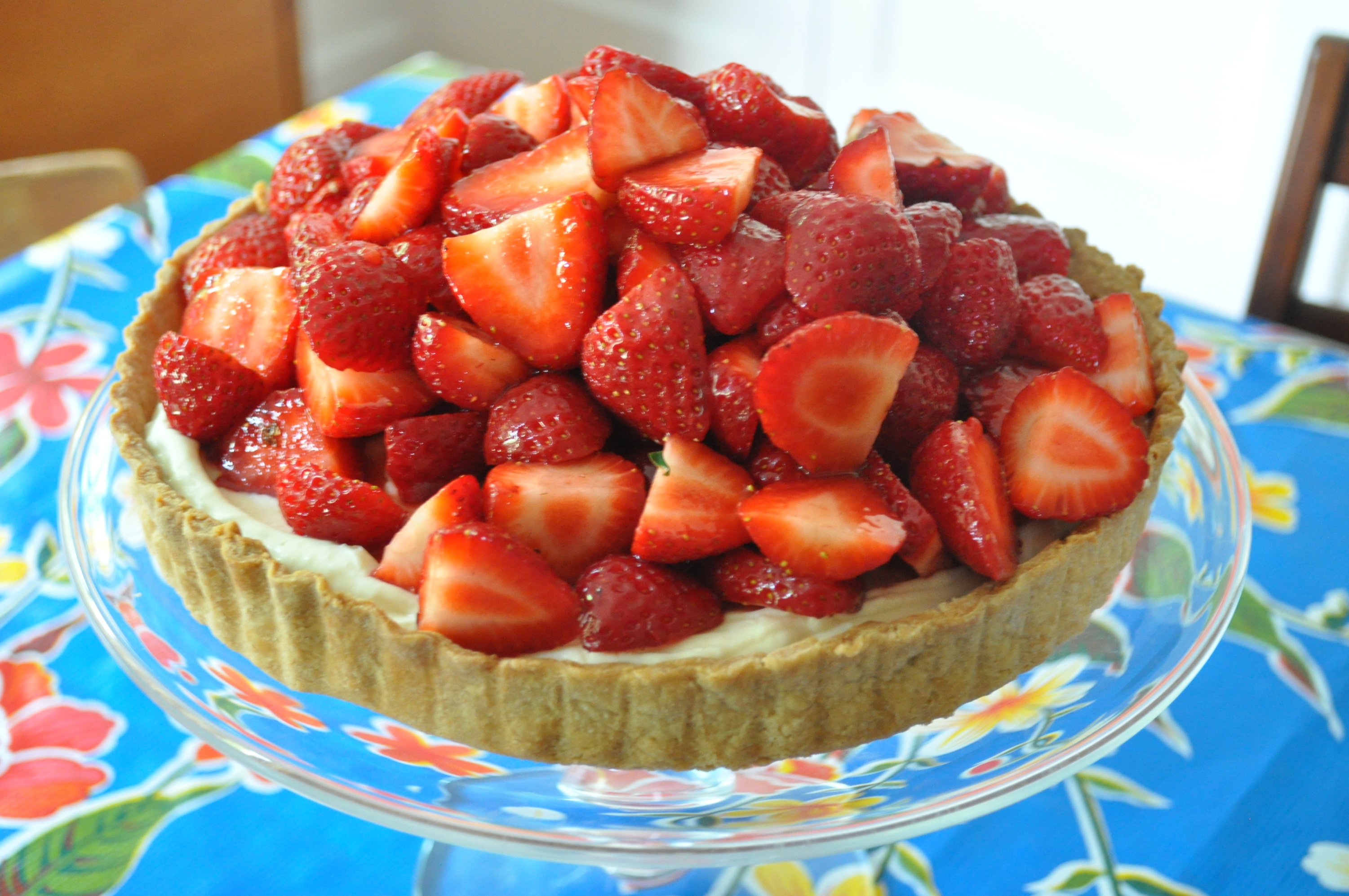
Strawberry tart

Strawberry tart

We’ve had some proper summer weather here in southern England the past few weeks. I’m quite shocked. It’s potentially looking like a good year for fruit too. All that rain in January-Febuary then a strangely hot and sunny spell in March might count for something in that department. Already our plum tree is sagging under the weight of ripening fruit, and out goseberry bush is starting to look ready to yield its sour green offerings.

I was planning to use the goosebrrries, a fruit I ate a fair amount as a child but haven’t touched for years, if not decades, for a tart yesterday, when we had friends visiting for lunch, but decided they weren’t quite ripe (the bush is in a very shady spot). Instead, the farmers market had a stall loaded with (ripe) gooseberries, cherries, strawberries and tayberries. I hadn’t encountered the latter before, but they’re a common blackberry (Rubus fruticosus)/raspberry (Rubus idaeus) cross. We bought a punnet, but mostly we bought strawberries as I’d seen a handsome looking recipe in Dan Lepard’s ‘Short & Sweet’. Another version of his recipe is available here on the Guardian.

It involves a slightly unusual custard, or sort-of custard. I’m not sure it’s a strict definition but I always assumed custard referred to things made with a mixture of milk or cream and egg yolk. This one, however, is made with egg white. Which is a typically nifty Lepard trick, as you use yolk in the pastry, and can then use up the leftover white. You make a mixture of milk, cornflour, sugar and the egg white, cook it till thick, then cool this, later on combining it with crème fraîche. Lepard uses a similar process for another of his custards, though that one does use yolks, then is mixed with double cream. It’s very handy.

So anyway.

Strawberries
About 500g strawberries
A little caster sugar

Pastry
125g plain flour (all-purpose or cake flour)
25g icing sugar (confectioners sugar)
Pinch salt
75g unsalted butter, cold, cut in small cubes
1 egg yolk
A little cold water

Custard
130g milk
20g cornflour (corn starch)
1 egg white
50g caster sugar
1 tsp vanilla extract
250g crème fraîche

1. Cut the stalky bits off the strawberries then slice into two or three or four, depending on the size of the individual fruit.
2. Put the strawberries in a bowl, sprinkle with caster sugar, then leave in the fridge to macerate, stirring occasionally.
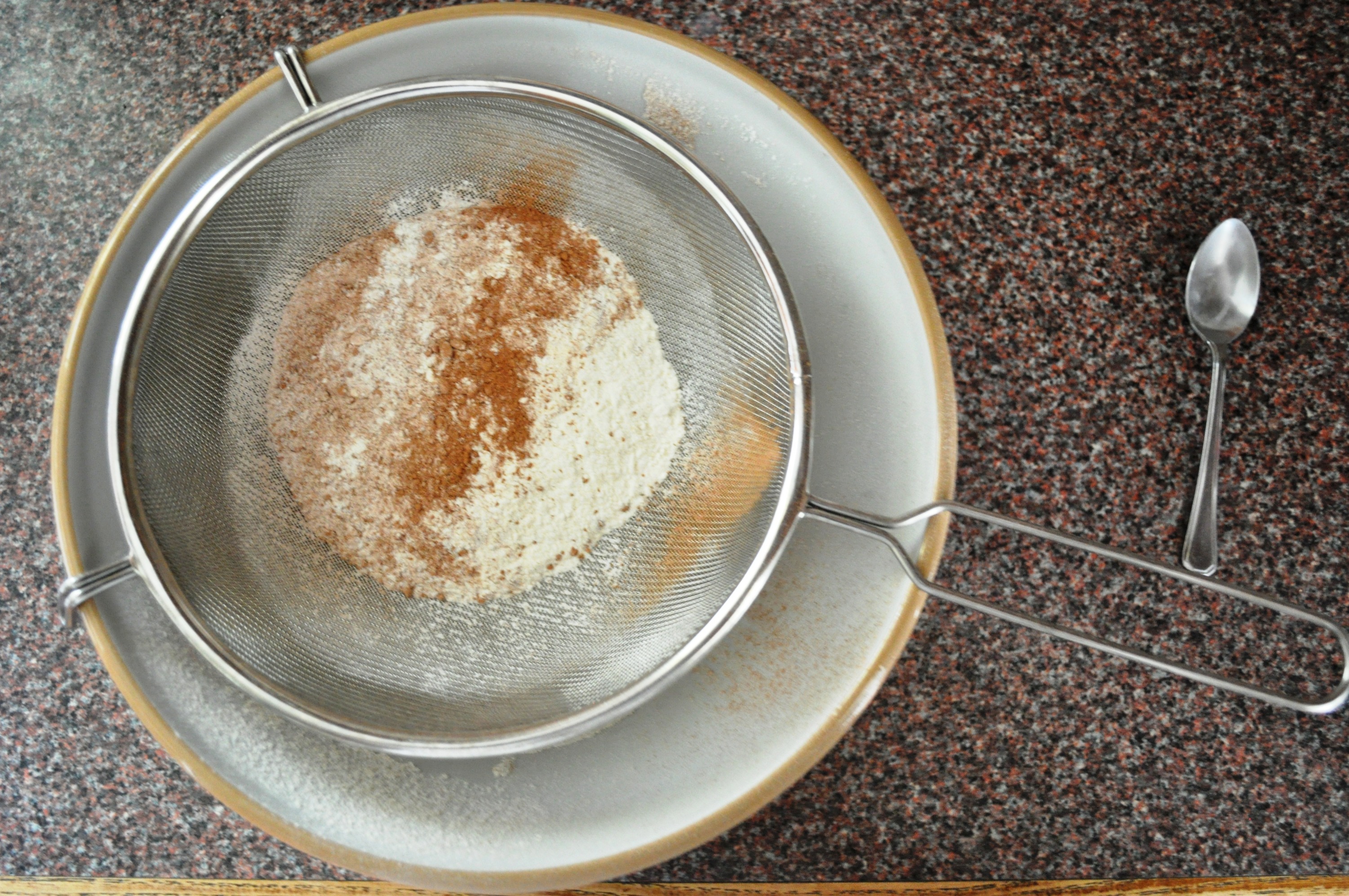
3. Make the pastry by sieving together the flour and icing sugar, adding the salt then the cubed butter. Rub together until the mixture resembles breadcrumbs (you could do this in a food processor), then add the egg yolk and water and bring together a dough. Don’t be tempted to add too much water. A tablespoon or so should be enough. You want the pastry crumbling not sticky.
4. Form the pastry into a disc then wrap in plastic and rest in the fridge.
5. Combine the milk, cornflour, egg white sugar and vanilla in a saucepan.
6. Whisking well, put over a low heat. Continue whisking, increasing the heat slightly, until the mixture thickens. It can get pretty thick, so don’t get too carried away. And watch it doesn’t burn.
7. Put the thick mixture into a bowl, cover with a plate and allow to cool. Then leave in the fridge until you need it.
8. Roll out the pastry and use it to line a 25cm-ish pie or flan tin.
9. Preheat the oven to 170C.
10. Bake the pastry case blind – that is, covering the pastry with a lining of parchment and filling it with baking beans. I used to use my childhood marbles, but I’ve lost them (ahem), so currently I’m just using kidney beans. Bake for about 15 minutes then remove the beans and parchment and keep baking until the case is golden.
11. Allow the pastry case to cool.
12. Put the thick custard mix in a large bowl and loosen it up with electric beaters.
13. Add the crème fraîche and keep beating until it’s all nicely blended.
14. Put the crème fraîche-custard in the cooled pastry case.
15. Arrange the macerated strawberries over the top.
16. Serve.

Strawberry tart 2

I was hoping we’d have a little of ours leftover but eight of us – five adults, three kids – demolished it in mere seconds. Well, a few minutes perhaps. All in all, it was a lovely end to a very satisfying lunch. For starters we did some fiore di zucca: battered, deep-fried zuccchine flowers, filled with mozzarella and a little anchovy. Then for the the main course we did honey-glazed roast chicken with lemon thyme and smoked paprika, a great Tom Kerridge recipe that can be found here; smashed new potatoes with mint; broad bean, pea and mint salad with Medita (our local version of feta, from High Weald Dairy); and a simple lettuce salad. The kids didn’t fuss about any of it – indeed, they demolished most of the mains in seconds too. Kids can really be the worst critics of food, so we were very chuffed with this result. Wish we’d taken a few photos.

All accompanied by local beer and incredible sunshine, and a post-prandial walk on Malling Down, part of the South Downs, an area that’s just received a special Biosphere status from Unesco alongside places like the Amazon and the Rockies, it was a wonderful day. Which compensated nicely for my disappointment about the 18th South Downs Beer & Cider Festival, which we’d attended the day before.

6 Comments

Filed under Baking, Pies & tarts, Puddings & desserts, Recipes

Peanut butter tahini swirl chocolate brownies

Plate
Peanut butter and tahini, two lovely, tasty oily pastes that can be great editions to baked goods. I love peanut butter, especially good stuff made without daft additives. It doesn’t need added sugar, it doesn’t need artificial sweeteners and it doesn’t need palm oil, soya oil, rapeseed oil, especially not hydrogenated oil.

Peanuts, simply ground up, make for a delicious and suprisingly nutritious product. Peanuts are actually legumes – more pea than nut – so are full of protein for starters. I remember learning about calories in biology at school (many many years ago) by weighing then burning then weighing a peanut. They’re essentially half fat, but much of that is unsaturated: 31% polyunsatuared, 46% monounsatured, 18% saturated*. Peanuts also contain fibre, antioxidants, vitamins thiamin (B1), niacin (B3), folate (B9) and others, and minerals magnesium, potassium, phosphorus, copper and manganese . Tahini, ground-up sesame seeeds, meanwhile contains essential fatty acids, copper and manganese.

Adding peanut butter and tahini to a brownie mix makes it especially gooey and delectable. I’d seen recipes online that used some one or the other, but as I had a jar of each, both running out, my version involved both, plus the tahini swirl. My version also involves both cocoa and chocolate, cut up into coarse chunks. If you’re making brownies, you can’t mess around with the chocolate – it has to be plentiful, rich and dark.

As for the peanut butter, I used my normal type, which is wholenut crunchy, with skins and all, no added sugar. Some brownie recipes might suggest you use a smooth type with all that sugar and extra oil but meh to that. The wholesome crunchy type adds depth of flavour and texture. I’ve also used some oats as they help keep it moist. And as I don’t have a problem with wheat – indeed, I love the stuff, especially well-husbanded grain ground into quality flour – I added some wheat flour too.

Pile of tahini brownies

This recipe is loosely adapted from Lick and Spoon, who adapted it from here, though the my tahini swirl is inspired by yet another recipe, here.

I’m not going to pretend these are “skinny” – there’s enough sugar in there for them to qualify as a properly sweet, calorific treat, an indulgent part of a balanced diet and relatively active lifestyle. They do at least contain a smattering of the abovementioned vitamins and minerals if you’re the type who likes to beat themselves up about their foods.

70g peanut butter
50g tahini
80g full-fat yoghurt
160g full-fat milk
1 egg
1 tsp vanilla essence
Pinch salt
1 tsp baking powder
50g plain flour
50g cocoa powder
50g oatmeal
130g light brown sugar
100g dark chocolate (60% cocoa mass or more), chopped into chunks

Tahini swirl
1 egg
60g tahini
20g caster sugar
1/2 t vanilla essence

1. Preheat oven to 180C.
2. Grease and line a square 20 x 20cm baking tin.
3. Sieve together flour, cocoa and baking powder.
4. Stir in the salt, oats, sugars and chocolate chips.
5. Beat together the peanut butter, yogurt, milk, egg.
6. Pour the wet mix into the dry, beating with hand blender.
7. Blend to a runny mixture.
8. Pour into the baking tin.
9. Beat together the tahini swirl ingredients until well combined and blended.
10. Drop blobs on top of choc mixture and swirl with tip of a knife.
11. Bake for 20-25 minutes.
12. Cool, cut and serve.

Tin

* ‘The Food Bible’, Judith Wills


8 Comments

Filed under Baking, Cakes, Recipes

Sweet Sussex stout chocolate muffins

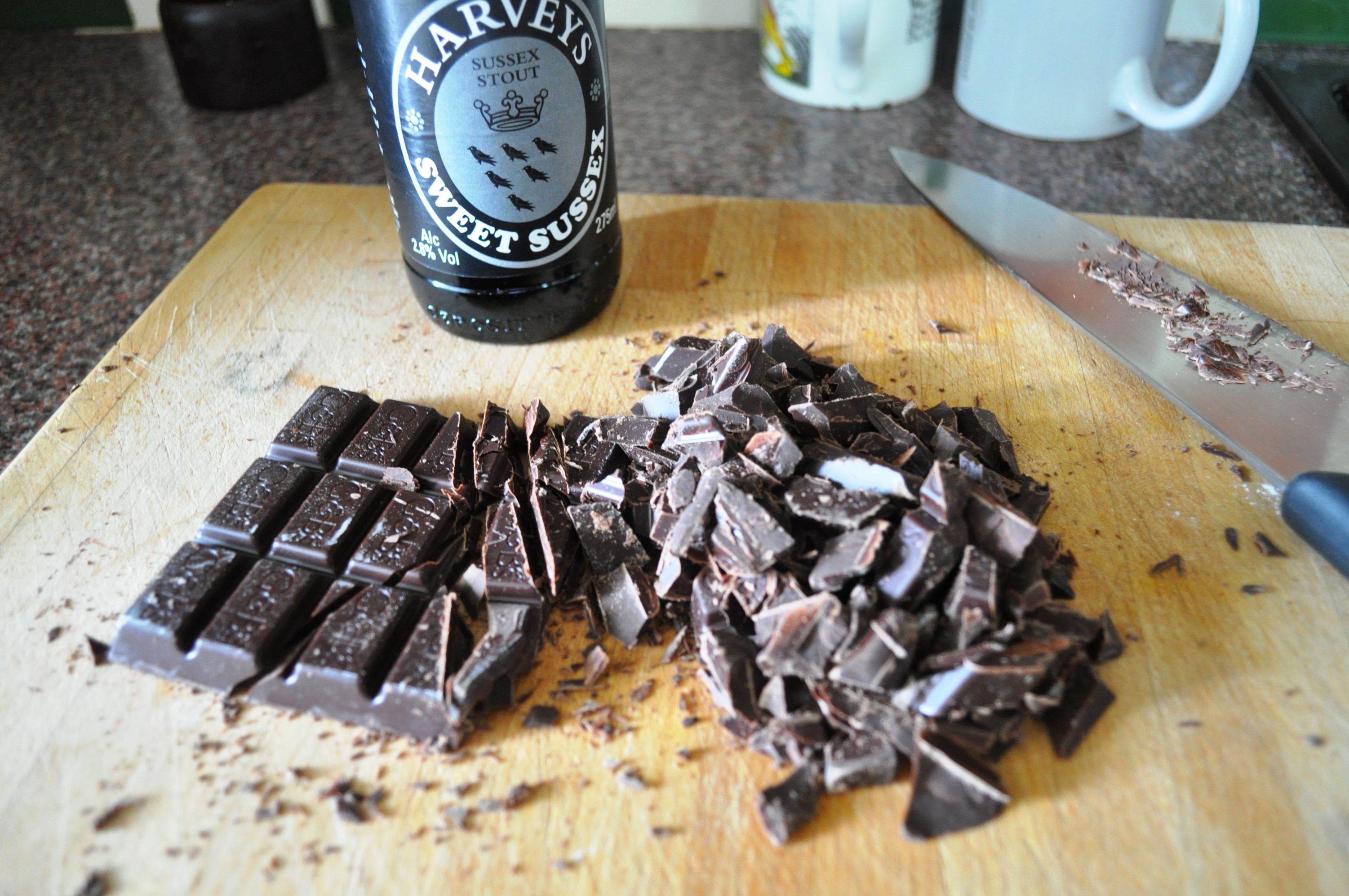
Sweet Sussex and chocolate

Today, 16 June, is Sussex Day. It’s probably not a festival many people celebrate – especially as it was only invented in 2006. Though it is based on the saints day of St Richard, patron of Sussex, the land of the south Saxons. Richard de Wych was a 12th century bishop of Chichester, now the county town of West Sussex. I’m over here in Lewes, the county town of East Sussex. The historic county of Sussex, based on the ancient kingdom of the south Saxons, was divided into two modern, administrative counties in the 1860s. Chichester and Lewes are very different, notably because the former is a cathedral city of about 24,000 people, while Lewes only has about 14,000 people, and the only “cathedral” is Harveys brewery.

Later on today I plan to head down to Harveys and check out the new St Richard’s Ale, which they’re launching on Sussex Day, but in the meantime, here’s recipe made using another Harveys, county-themed ale: Sweet Sussex.

Ye olde stout vs porter
On the label and site, Harveys says Sweet Sussex is a “lush, sweet stout named after the county in which it is brewed.” It has an ABV of just 2.8%, which raises the interesting question of what truly defines a stout. Well, in linguistic terms “stout” originally meant proud, brave and courageous, but this segued into meaning physically strong, well built. As a description of people it evolved again to start meaning bulking, then fat, but in beer terms it stuck with strong. Specifically it was used to describe strong porter, the type of beer that emerged in London in the 18th century as a refreshing, nutritious, fortifying drink of hardworking porters

Dark brown or black ales, porters were made with well roasted malts, which lent them a sweet, charcoally flavour. Eventually, the term “stout porter” shifted again, with stout becoming its own town for a rich, dark ale – though not necessarily a strong one. Indeed, today, the terms stout and porter are fairly interchangeable.

Sussex Sweet may be called a stout, but it’s certainly not stout in the sense of strong. Indeed, it’s so weak, compared to those old historic stout porters which will have been 8% ABV or so, that it’s more defined by its sweetness. It’s almost like a kind of charcoal milkshake. And just the thought of thing that goes well with dark chocolate.

Muffin

Muffins vs cupcakes
I wanted to bake something chocolaty yesterday, but didn’t want something as rich as a full-on cake (like I made here with dark ale) or iced cupcakes, so I made some muffins instead. Like stout and porter, the terms muffin and cupcake have slightly blurred meanings, though broadly I’d say a muffin contained less sugar, less butter, and were broadly a tad healthier. A lot of muffins, of course, contain bran, or fruit, or are even savoury. These ones are only vaguely sweet, and have a hint of that charcoally flavour from the beer.

20g cocoa
230g self-raising flour
1 teaspoon baking powder
50g butter, melted and cooled slightly
70g sugar (I used caster, but you could use a dark muscovado say)
150g dark chocolate (at least 65% cocoa solids), coarsely chopped
2 eggs, lightly beaten
250g Sweet Sussex or other stout or porter, or a mixture of stout or porter and milk

1. Preheat the oven to 200C.

Light cacao
2. Sieve the cocoa, flour and baking powder into a bowl.
3. Stir in the sugar and chocolate chips.
4. Add the eggs, vanilla and beer, or beer and milk mix, along with the melted butter, to the flour mix.
5. Beat to combine.
6. Fill about a dozen muffin cases and bake for about 25 minutes.
7. Cool and enjoy, with a cuppa or perhaps with a stout. Or porter.

Muffins, baked

A note on the cocoa
There’s only a little bit of cocoa in here, but I was also using a very light-coloured type of cocoa powder, hence the results aren’t very dark. This cocoa powder I’m using is actually the Raw Chocolate Company’s Raw (organic, Fairtade, thoroughly right-on) Cacao Powder. See here for more info.

Cocoa? Cacao? Whaʼ? Don’t worry about the difference. There isn’t really one. The English word cocoa is basically a synonym for the cacao, with Theobroma cacao the scientific name for the tree that yields the beans that produce those all-important chocolate products, with “cacao” coming from the Mayan and Mesoamerican language word for the tree and “Theobroma” from the Greek for “food of the gods”. Beer and chocolate – both worthy of that name I’d say.

2 Comments

Filed under Ale, beer, Baking, Cakes, Recipes

Sourdough pizza and Hastings Brewery’s No 6 Hop Forward Pale Ale

Sourdough pizza with Hastings Brewery No 6 Pale Ale

Even though we ate tonnes on Saturday night, accompanied by various local beers and wines, I was making bread dough on Tuesday evening and thought, heck, why not make another pizza? One of the justifications was that on Saturday night one batch we did was slightly over-baked and the other slightly under-baked, so I wanted to keep on experimenting with our oven to try and get it right.

Anyone who’s made real pizza in a domestic oven will know it can be slightly challenging, largely because you simply can’t get the heat. My oven goes up to about 250C (480F) but a wood-fired pizza oven can get up to 450C (840F), enabling flash baking. You can improve things in a domestic oven by using a baking stone. Stones are excellent as you heat them in the oven first, so when the pizza is slid onto them, they’re already hot and help bake the dough through, quickly, as well as crisping up the base.

But I’ve not got one at the moment.

Currently, I’m just using a metal baking sheet, which goes into the oven cold. It’s not ideal, as, depending on the temperature variables in your oven, you can get a done, or potentially burnt, top, before the base is full baked. Even though I’m pleased with this recipe, the base wasn’t baked to perfection. That’s the challenge – for me and for you, as your oven will be different again.

Hastings Brewery No 6. With cat

Hopping forward
The other enjoyable factor about this pizza dinner – aside from being able to eat it outside on a warm English summer evening, 20C, no mosquitoes – was a great beer. I mentioned in my previous post I don’t think the light mild beer I was drinking was a good food pairing. This time round I chose a considerably more hoppy beer, and it worked well.

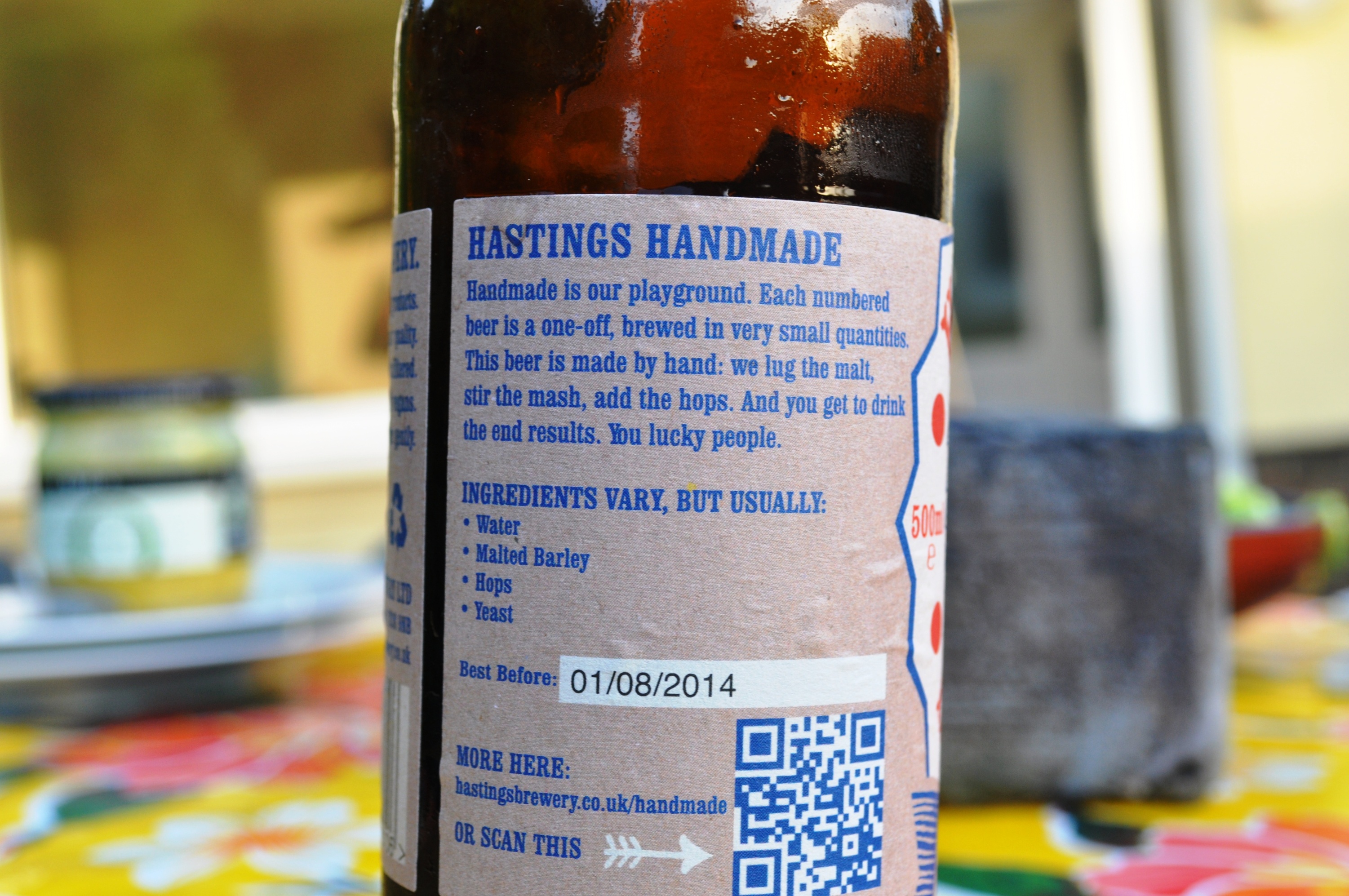
This was a Handmade No 6 Pale Ale bottled beer from Hastings Brewery, bought from the excellent Trafalgar Wines in Brighton, a booze shop with an excellent selection of beers. Apparently Hastings Brewery beers are their second-best selling now, after beers from The Kernel in London.

Hastings Brewery is a new discovery for me. I’m slowly working my way through all the local breweries. This one is 23 miles away from my home in Lewes. It started with founders Pete Mason and Brett Ross inspired “whilst litter picking after the Hastings Beer & Music Festival in July 2010.” Pete’s dad Andy got on board and by 2011 they’d bought “a larger – but still small – brewery”.

They’re an interesting outfit as not only do they do everything by hand on a small scale, with brews of 800 litres, they’re also make entirely vegan products. A lot of drinkers may not realise beer generally isn’t very vegetarian or vegan, but it’s often filtered with isinglass finings, which are fish bladders. Pete Mason is a vegan, as is their sales manager. Their beers are unfiltered. For some, this is appealing as filtering, arguably, can remove some of the flavour and mouthfeel.

The brewery’s label design and branding is great too. Their labels – all featuring a lion with fine mane and tongue sticking out1 – certainly stood out on the shelf at Trafalgar Wines.

Handmade

The 4.8% ABV beer, with its slightly unwieldy full name of ‘Hastings Handmade No 6 Hop Forward Pale Ale (Columbus)’, is very much a British take on a US craft beer. It’s defined by its use of Columbus, an American hop variety with a high alpha acid (around 15%), making it suitable for assertive bittering, 48 IBUs apparently. I suspect they’ve also used it for late-hopping (adding later in the boil, so it the oils aren’t totally broken down) or even dry hopping (adding during the conditioning stage so the oils remain largely intact) as the beer is highly aromatic: citrus, ginger, passion fruit, honey. The taste, while defined by massive bitterness, is also honeyed, with a salty, minerally aftertaste that verges on soapiness. [See below – actually they used a hopback.]

This beer really reminded us of our travels in the US, and while I have vague feelings of disloyalty to more traditional, malty, subtly hopped British beer styles when I drink something like this, I also love how British brewers are playing around with US styles. I love all the international cross-pollination of tastes and styles. The beer also went really well with our pizza, which I topped with mozzarella, thinly sliced pancetta from Beals Farm Charcuterie and a pecorino romano, for that added salty goodness.

I was hoping to add some asparagus but while I still saw plenty on the farmers’ markets a few days ago, guess what? Waitrose – nominally the less unethical British supermarket – only had asparagus from Peru! Southafeckingmerica!!! It’s asparagus season here – in England – right now, the end of the season sure, but still now. Now. In England. I’ve seen signs outside farms as I’ve cycled around Sussex, mere miles from that branch of Waitrose. Supermarket food economics is bonkers. Not to mention environmentally appalling.

Baked pizza

Sourdough pizza recipe
This makes one large-ish pizza, about 30cm (12 inch), but could cut up and manipulated differently. If you roll it flat, you’ll get a much more Roman-style pizza. If you open out the centre more and leave a wider, fatter edge, you’ll get a more Neapolitan-style pizza. The latter is called a cornicione and is the speciality of Michael Hanson at The Hearth in Lewes. Lewes, depressingly, has about four industrial chain pizza places; I’d say my pizza is better than all of theirs, easily, though still second-best in Lewes, after The Hearth.

This is a naturally leavened dough, so you want to make it the day before, to give it time to do a nice long fermentation.

250g strong white bread flour (or a mixture of strong, high protein flour and plain, all-purpose flour)
180g water
50g sourdough starter (100% hydration. I used a rye-based one, but wheat-based would be fine too)
15g olive oil (a good glug basically, QB)
5g salt

1. Whisk together the sourdough starter and water. It doesn’t matter if the water is cool, as it’s a long fermentation it doesn’t really need that boost of using body-temperature water. Try and use water that’s not too chlorinated or fluorinated. I filter my tap water with a Brita and the sourdough starter seems to prefer it.
2. Add the flour and salt and stir together well.
3. Add the olive oil and keep blending until well-combined.
4. Turn the dough out onto a work surface lightly greased with more olive oil and give it a short knead. It is a relatively wet dough. If you find it too sloppy, add a little more flour – but not too much or you’ll make a nasty dry dough.2
5. Put the dough back in the bowl, cleaned and oiled, and let it rest for 15 minutes before giving it another quick knead, stretching it and folding it over. Repeat this twice more, then put the dough back in the bowl, again, cleaned and oiled.
6. Cover the bowl with plastic wrap or a shower cap, and put it in the fridge and let it ferment slowly for about 24 hours.
7. Take the dough out of the fridge about an hour before you want to use it.
8. Form it into a ball on a floured work surface. Cover.
9. When you want to bake, preheat your oven to the highest setting.
10. Gently stretch out the dough. Don’t be too rough, or you’ll damage the structure that’d been developing during the fermentation period. How you open it up depends on what shape of pizza you’re making (see above).
11. Once you have opened up the dough to almost the desired shaped, gently transfer it to an oiled baking sheet, hanging it over your forearm and taking care not to poke your fingers through it.
12. Cover with your desired toppings. I did a pizza rossa – with tomato sauce – along with the abovementioned cheese and pancetta. Here’s the pizza before it went into the oven:

Unbaked pizza.
13. Bake in your preheated oven until it’s done. Yes, I know that’s vague, but it could be 10 minutes, it could be 25, with the oven turned down a little lower to make sure the middle of the base bakes and the top doesn’t char (too much).
14. Enjoy. Preferably al fresco with a quality, hoppy local beer.


Info
Hastings Brewery, 12 Moorhurst Road, Hastings TN38 9NB
hastingsbrewery.co.uk | info@hastingsbrewery.co.uk | 01424 572051


Trafalgar Wines, 23 Trafalgar St, Brighton BN1 4EQ
01273 683325


Footnotes
1 Some local ignorance – is the lion a Hastings thing? Maybe, as there are lions – or one lion and two half-lion/half-boat things – on the town’s crest.
2 The mixture is really 275g flour and 205g water, as the 50g of leaven at 100% hydration is 25g water, 25g flour. So this is a 74.5% hydration dough in bakers’ percentages. I’m using Stoates organic strong white bread flour; I find it quite absorbent, possibly as it’s stoneground and contains more bran. If you’re using a whiter, less branny flour that’s less absorbent, and

7 Comments

Filed under Ale, beer, Baking, British beer, Pizza, Recipes

Fritti, pizza, local Sussex booze – and chocolate pine nut ricottta tart

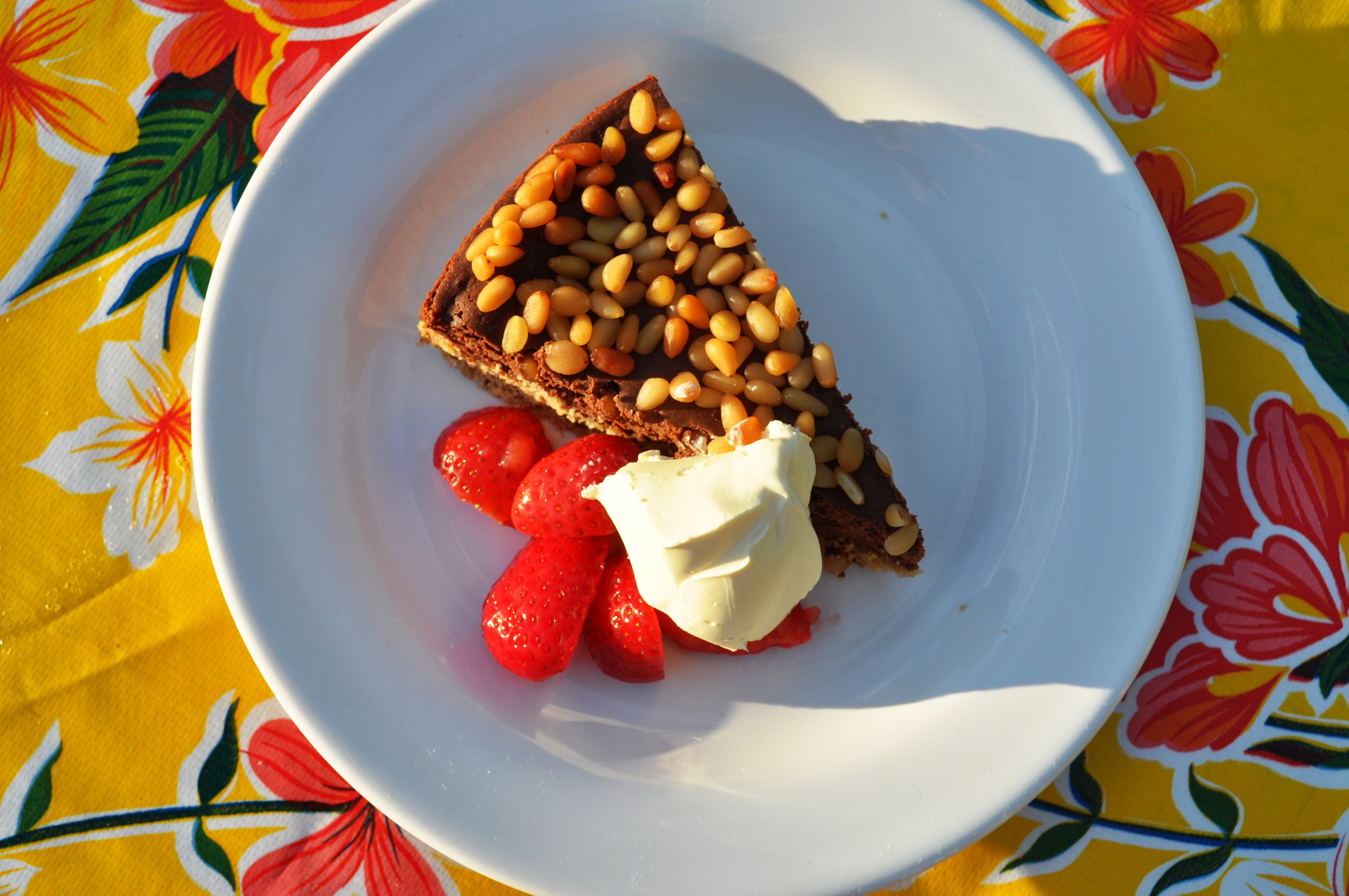
Slice with strawbs and cream

We’d been planning a pizza and local beer evening with friends here in Lewes, Sussex, for a while. This evolved into a pizza, local beer, local wine, local cider and Roman-style fried starters (fritti) evening, with the latter becoming viable after we borrowed a deep fat fryer.

We started the evening with an aperitivo of kir royales made with sparkling wine from Breaky Bottom, one of several vineyards we’re lucky enough to have near us on the chalk South Downs. I tried not to drink too much though, as I was driving the deep fat fryer.

Breaky Bottom

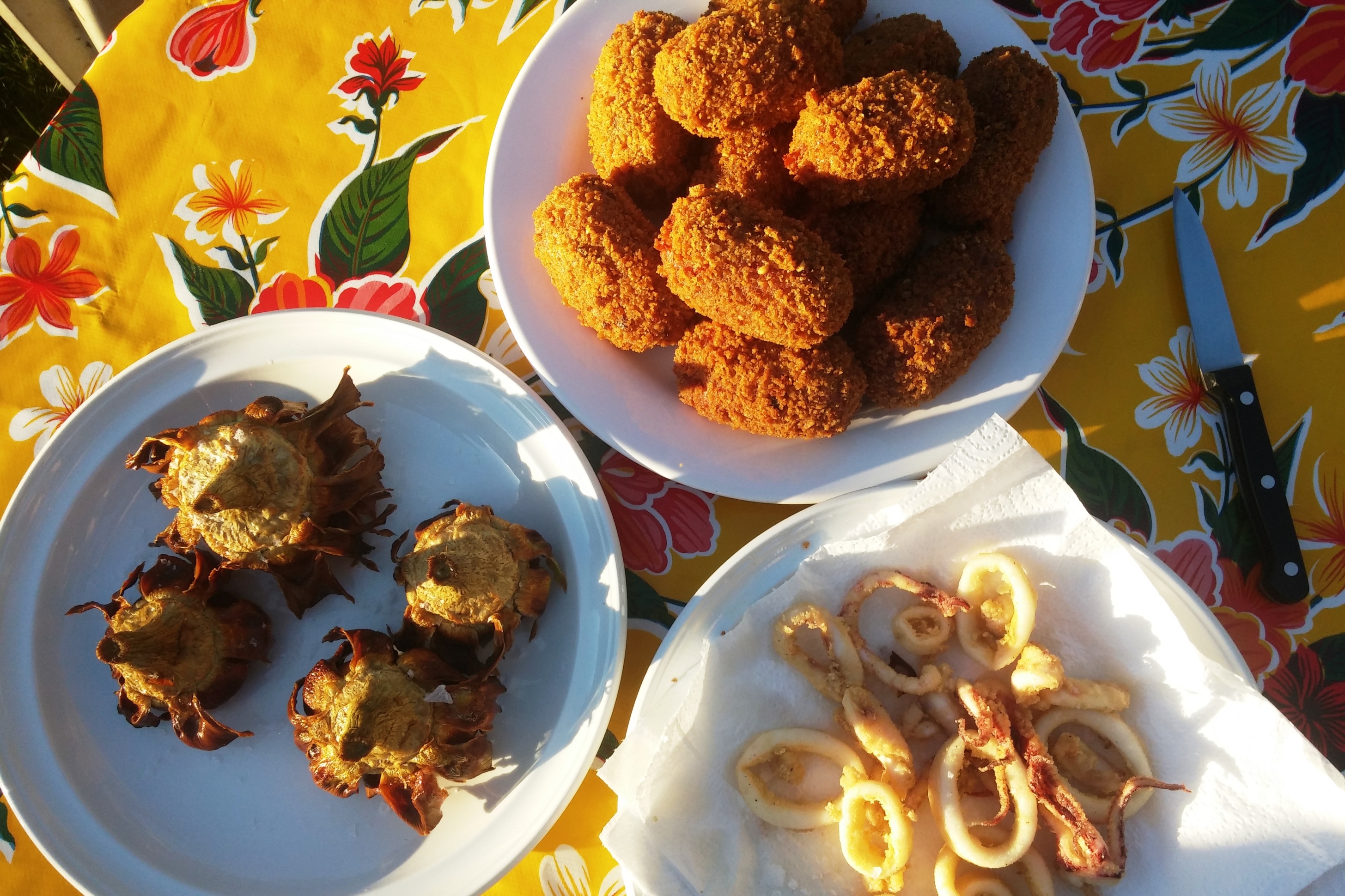
Missing these things from Rome, we did suppli al telefono, which are deep-fried balls of risotto with melting mozzarella inside; carciofi alla giudia, Romano-Jewish deep-fried artichokes, which I’d never done before, but worked very well (you trim the artichoke, remove the choke, then deep-fry it. Then deep-fry it again); and calamari fritti – fried squid bits, which I simply floured with semolina.

Fritti

Seasonal pizza
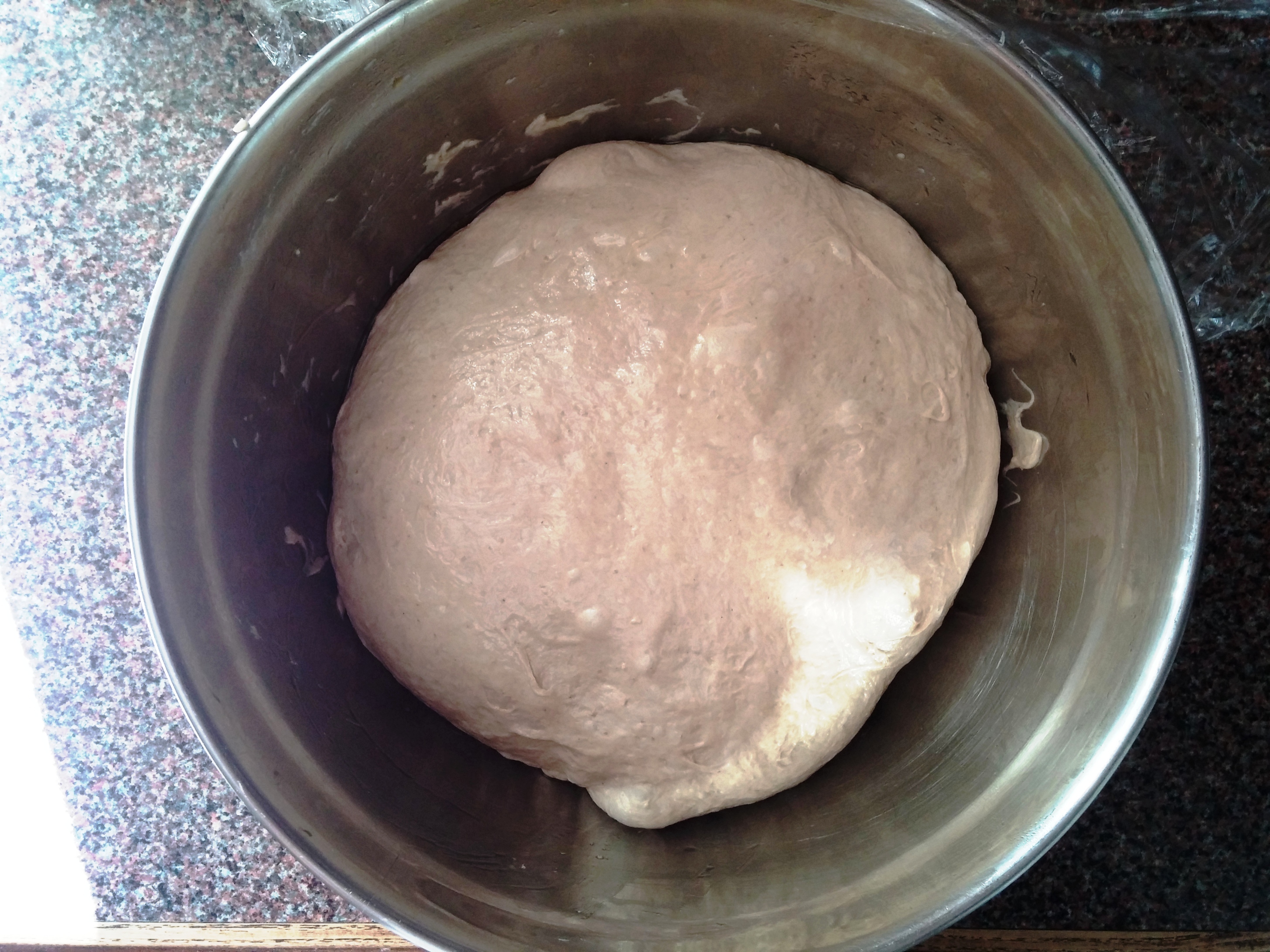
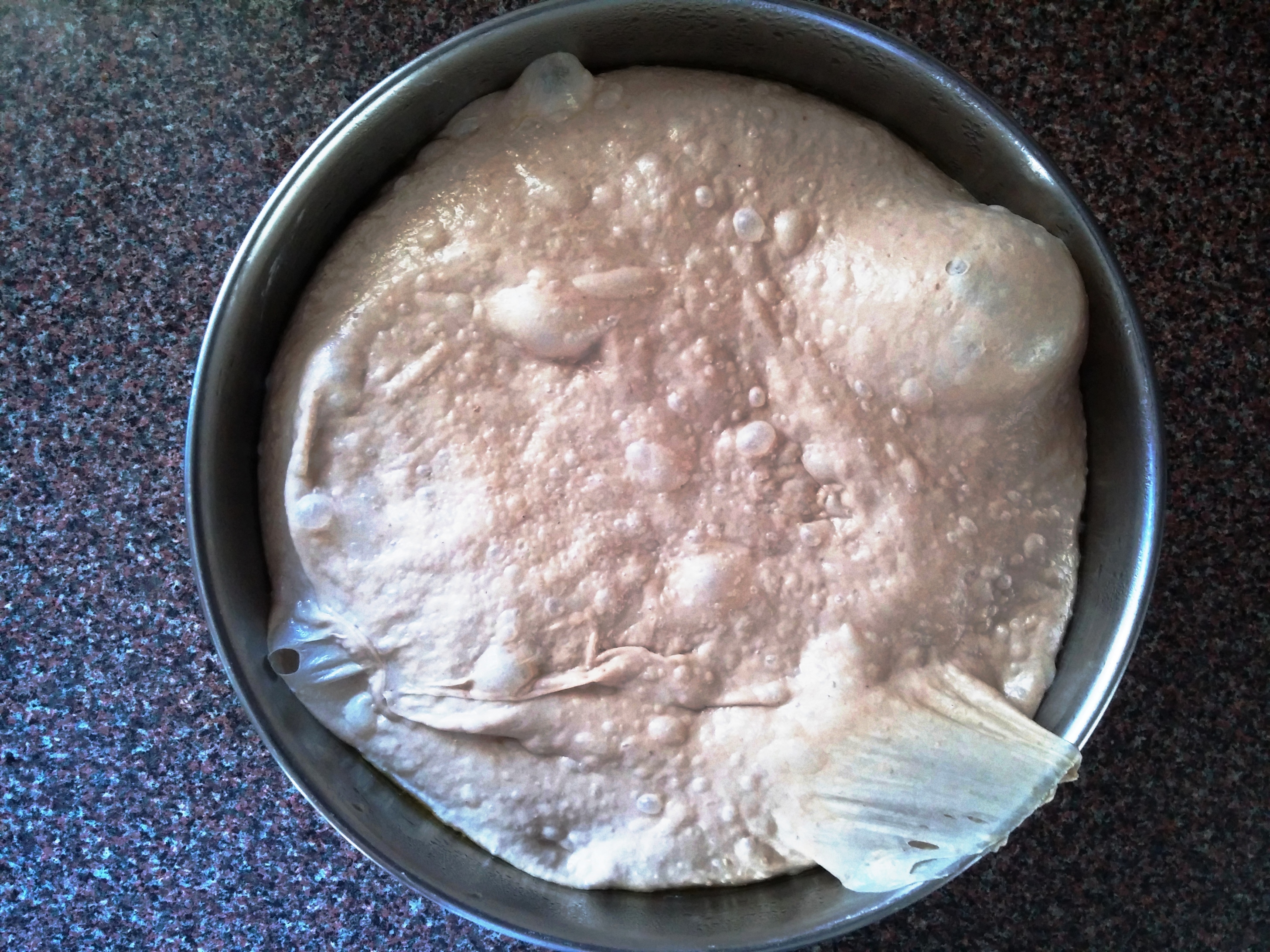
For the pizzas, I did about 2kg of dough. Here it is before and after its 24 hour prove. It was a monster.

Pizza doughPizza dough, after final prove

Then we made four different topping. One thing we learned from Gabrieli Bonci in Rome is to not be afraid to experiment with toppings, not be a slave to the canonical pizzas, and to use seasonal ingredients. It’s a great time of year for seasonal produce, so alongside the artichokes, the markets also furnished us with other good stuff like asparagus and radicchio. Here’s our pizza menu, typos and all.

Pizza menu

We were so busy trying to bake them and serve them – and drink our way through a very fine selection of further wines, cider and beer – we forgot to take any pics. The booze included Danebury Vineyards’ Madeline Angevine white (not Sussex, but Hampshire, though bought from Harveys) and various beers from Harveys and Long Man, the brewery named after the giant figure on the hillside at Wilmington, about 10 miles east of Lewes.

We did do one classic pizza, a Margherita, but otherwise we used seasonal ingredients and local cheeses and meats. For the latter, we used some smoked pancetta from Beal’s Farm Charcuterie, combined with local asparagus. The other two pizzas we did were bianche – white, that is, without tomato sauce. This is commonplace in Rome, but international pizza all seems to default to rossa (red), with tomato sauce. First, we did radicchio, fresh garlic and two cheeses from High Weald Dairy: their ricotta and Medita, a salty feta-style sheep’s milk cheese. Second, we did roasted baby leeks with mozzarella and Twineham Grange, a local parmesan-style cheese, aged for 15 months, which satisfies my need for a local cheese that’s good for grating on pasta dishes etc. We did use bog-standard mozzarella throughout, as no one’s making a Sussex version. Yet.*

Pie!
After all that fried food and stodge, what else did the meal need? Ah yes, fat and sugar. A dessert. After making a pine nut tart recently, I’ve been wondering about a chocolate version. As, like any sane person, I adore chocolate. Plus, we’d seen the High Weald ricotta on the market.

Side, through glass cloche

Anyway, the chocolate pine nut ricotta tart is based on a recipe by Giada de Laurentiis, granddaughter of the legendary film producer Dino and iconic actress Silvana Mangano. The original recipe was in cup measures. I tried translating these to grams using online charts, as well as using actual cup measuring spoons: each approach gave me completely different weights. This is why I’m not a fan of cups – for flour, especially, they’re inaccurate, as there’s the question of how compacted the powder is.

The resulting pastry was very crumbly and impossible to roll, so I effectively filled the bottom of a loose-bottom cake tin with it, as you would with biscuit crumbs for a cheesecake. Indeed, this is basically a type of cheesecake, though the filling is dense and very rich. After all that fritti and pizza and booze it was perhaps a bit much – or at least a big slice was a bit much. Perhaps it’d be a more suitable end to a slightly lighter meal!

You’ll need a food processor for this recipe.

Pastry
200g plain flour
20g polenta
100g pine nuts, toasted
35g caster sugar
Pinch salt
120g butter, melted and cooled slightly

Filling
110g water
150g caster sugar
225g dark chocolate, chopped
200g ricotta
8og full-fat cream cheese
3 eggs
100g pine nuts

1. To make the pastry, combine the plain flour, polenta, 35g sugar, salt and 100g toasted pine nuts in a food processor, blending until the nuts are well ground.
2. Add the butter and pulse until the mixture is well combined. It’s unlikely it’ll ball up like a normal pastry dough.
3. Use the mix to line a 26cm loose-bottomed tin. I used a cake tin, though a flan or pie tin would work.
4. Put the pastry case in the fridge for at least half an hour, or for a day or so if you make it in advance.
5. Preheat oven to 180C (160C fan).
6. Line the pastry case with baking parchment then fill with baking beans.
7. Bake for about 25 minutes, then remove the beans and parchment and bake for another 10 minutes until golden.
8. Allow the pie case to cool while you prepare the filling.
9. Heat the water and 150g sugar in a small saucepan, bring to the boil and simmer to dissolve the sugar, then remove from the heat and allow to cool slightly.
10. Over a separate pan of simmering water, melt the chocolate in a heatproof bowl, avoiding contact with the water.
11. Beat together the eggs.
12. Using a hand blender or the food processor again, combine the ricotta and cream cheese, then slowly add the egg.
13. Continue beating or processing until smooth.
14. Slowly add the sugar syrup, beating or processing until all combined.
15. Pour the filling into the pastry case and bake, at the same temperature, until almost set – check at about 15 minutes.
16. Sprinkle the other, non-toasted pine-nuts over the top then continue baking until it’s all set and the pine-nuts are nicely toasted, another 15-20 minutes, depending on your oven.
17. Allow to cool and serve. We served it with some cream and macerated strawberries.

Cloche

A note on the food matching
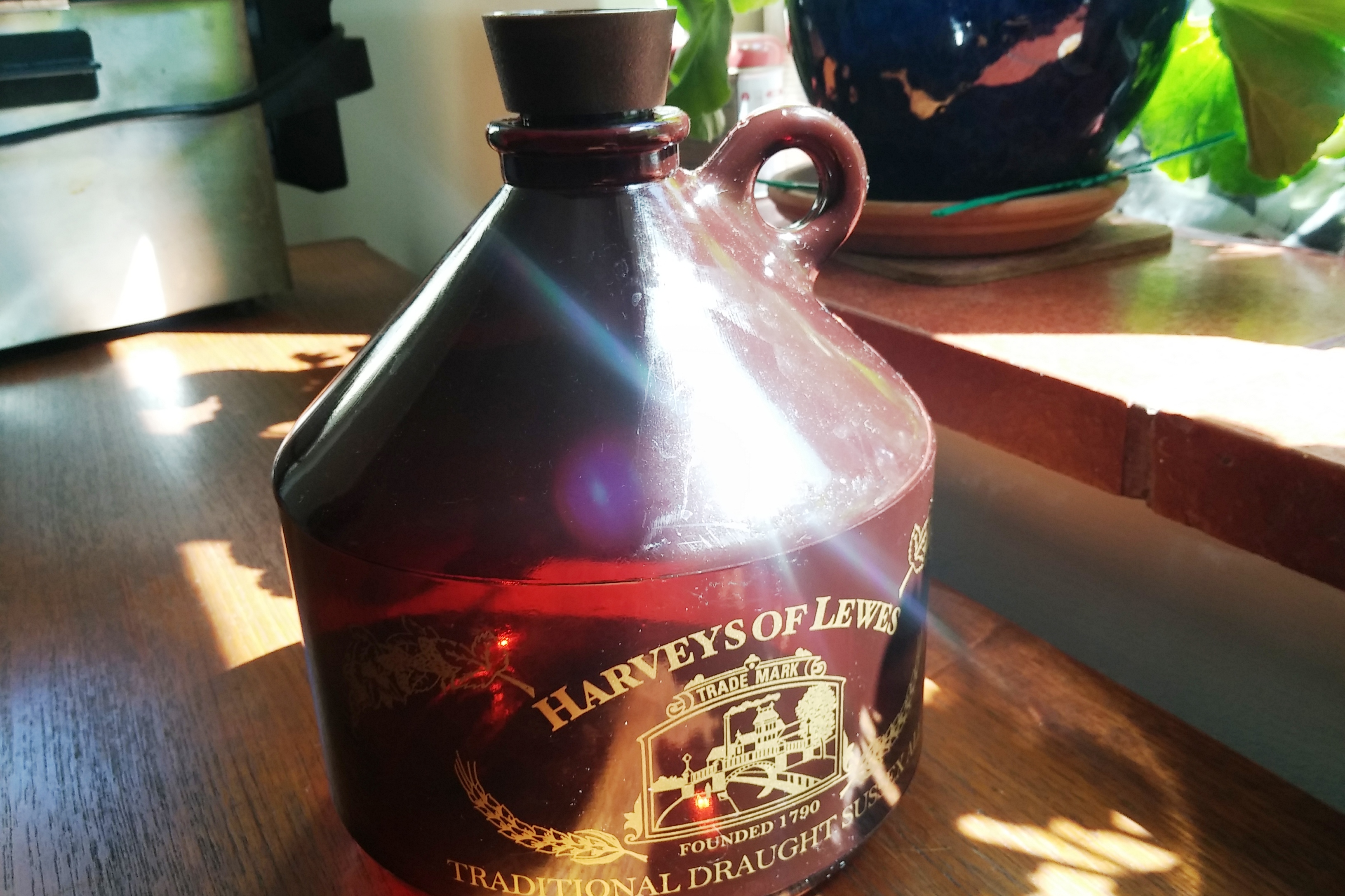
Although we and our guests put together a great collection of local boozes, after the initial aperitivo I stuck with Harveys’ Knots of May. This is a seasonal light mild, reddish-brown in colour and only 3%, which I bought direct from cask at Harveys in a 4 pint / 2.4 litre plastic jug, aka container, aka rigger, aka growler, aka polysomething or other.

It’s a delicious beer, but I’m not sure its malty sweetness made for the best food pairing with the fritti and pizza. Something a little more acid or bitter might have been better for cutting through the fattiness of the cheese etc.

It did, however, work well with the desert. I’m still blundering uncertainly through the beer and food matching business but that malty sweetness, and light, low body, went well with the dense, chocolately pudding.

Little brown jug - empty


* There is a British buffalo mozzarella being made these days, from my home county of Hampshire, just to the west. I’ve yet to try it. Plus, mozzarella di bufala is far too good – and pricey – to use for melting directly on pizza. For that you use the standard cow milk mozzarella, known as fior di latte (“flower of milk”, “milk flower”) in Italy. Bufala is best added after the end comes out of the oven and allowed to melt just slightly with the latent heat.

2 Comments

Filed under Ale, beer, Baking, Pies & tarts

A bike ride, “gluten-free” cake, X-Men and orchids. Lots of orchids

Bank of orchids near Lewes

One of the things that bugs me about the whole anti-gluten issue is that bakeries are induced to label products as “gluten free” even if they’re traditional types of cake or biscuit that have always been made without wheat flour. It’s not like these things have just been invented to cash in on a food fad / epidemic of wheat-related health issues. Think things like the classic sachertorte, its south Italian cousin torta caprese, various Sicilian almond paste delights. Never mind other things made up by celeb chefs more recently, like this lovely citrus polenta cake that’s based on a Nigel Slater recipe.

I adore cakes based on ground nuts or featuring alternatives to wheat flour, like polenta, which is maize, Zea mays, or what Americans call corn (when I was growing up we still used the word corn in the old English sense as a generic term for cereal grain). Maize, being a cereal plant and a member of the Poaceae (grass) family does contain proteins related to those that people have issues with in wheat, which specifically contains gliadin, one of the proteins that forms “gluten”. I also enjoy things made with other non-cereal flours like potato and buckwheat, which isn’t a Poaceae cereal or grain, it’s the seed of a member of the rhubarb, sorrel family and Japanese knotweed family, Polygonaceae. They can create all sorts of interesting textures and moistness. But sometimes you just need wheat.

More orchids

So anyway, today I took a quick jaunt on my bike from home in Lewes up to Uckfield, about nine miles away. Not exatly being overburdened with employment at the moment, I don’t have any excuses to not keep relatively fit. I was also toying with the idea of catching a matinee of X-Men Days of Future Past. As a former film critic, sometime comics journalist and increasingly reluctant comics collector (that stuff is just so heavy!), I was keen to see it, especially as the original comic storyline the film is loosely inspired by, first published in 1981 and created by Chris Claremont, John Byrne and Terry Austin, is an utter classic.

While in Uckfield, I checked out Hartfields Produce Store. It’s a cool little place with the right attitude – “a small independant produce store and cafe based in Uckfield. Our aim is to provide great, fresh food, locally sourced wherever possible and always full of flavour!” [Sic] As I love the aforementioned ground nut-based cakes I had to try their chocolate and almond torta, despite it carrying the now-essential sign declaring its gluten-free status.

I know this shouldn’t rile me, but I’m a baker, and wheat is the backbone of baking. I’m a firm believer that many people wouldn’t suffer their wheat-related issues if they ate properly fermented bread, and avoided any and all shit industrial wheat-based products, that are made in a rush without sufficient fermentation. I touched on the evils of the Chorleywood (so-called) Bread Process here, but also went into more detail about this subject here. So I won’t rehash here. Suffice to say, I don’t consider industrial wheat-based products fit for human consumption. And frankly, I wouldn’t feed white sliced “bread” to my pigs or chooks (if I had any).

Hartfields chocolate almond torta

Anyway, back to Hartfields. In total, my bike-ride apparently burned 697 calories – presumably kcals – according to Strava. I know nothing about the calories (ie kcals) in food, as I’ve always tried to have a sensible attitude to food and fitness, and not get hung up, but I’m guessing there were at least half the number of kcals I burned on the ride in the slice. But you know, that’s why I cycle and walk regularly – so I can enjoy cake. And this was great cake. Bravo Hartfields.

After the cake, I stopped by the cinema to discover it was a parents-and-babies matinee, so as I didn’t fancy earnest X-dialogue combined with potential squalling, and as it was a nice day, I headed home. Into a terrible headwind on the final five miles heading south down the Ouse river valley on the A26. But that’s fine – the whole stretch was utterly littered with orchids, with some patches of dozens, even hundreds. I’ll have to check with my brother, who’s the family expert on such things, but I believe they were common spotted orchids (Dactylorhiza fuchsii), in varying shades of pale pink through to a darker almost-purple, some of them up to half a metre tall. Wonderful.

Orchid

Info
Hartfields Produce Store, 71 High Street, Uckfield TN22 1AP

1 Comment

Filed under Bakeries, Cakes

A tour of my local brewery: the famed, historic Harveys of Lewes

Harveys chimney

Anyone who’s read my blog before will know I’m an advocate of local produce. And a big fan of real beer. For me, “local plus beer” means Harvey & Son Ltd (aka Harveys, Harveys of Lewes) – a traditional brewery that is a mere 800 metres as the crow flies from my house in Lewes, East Sussex.

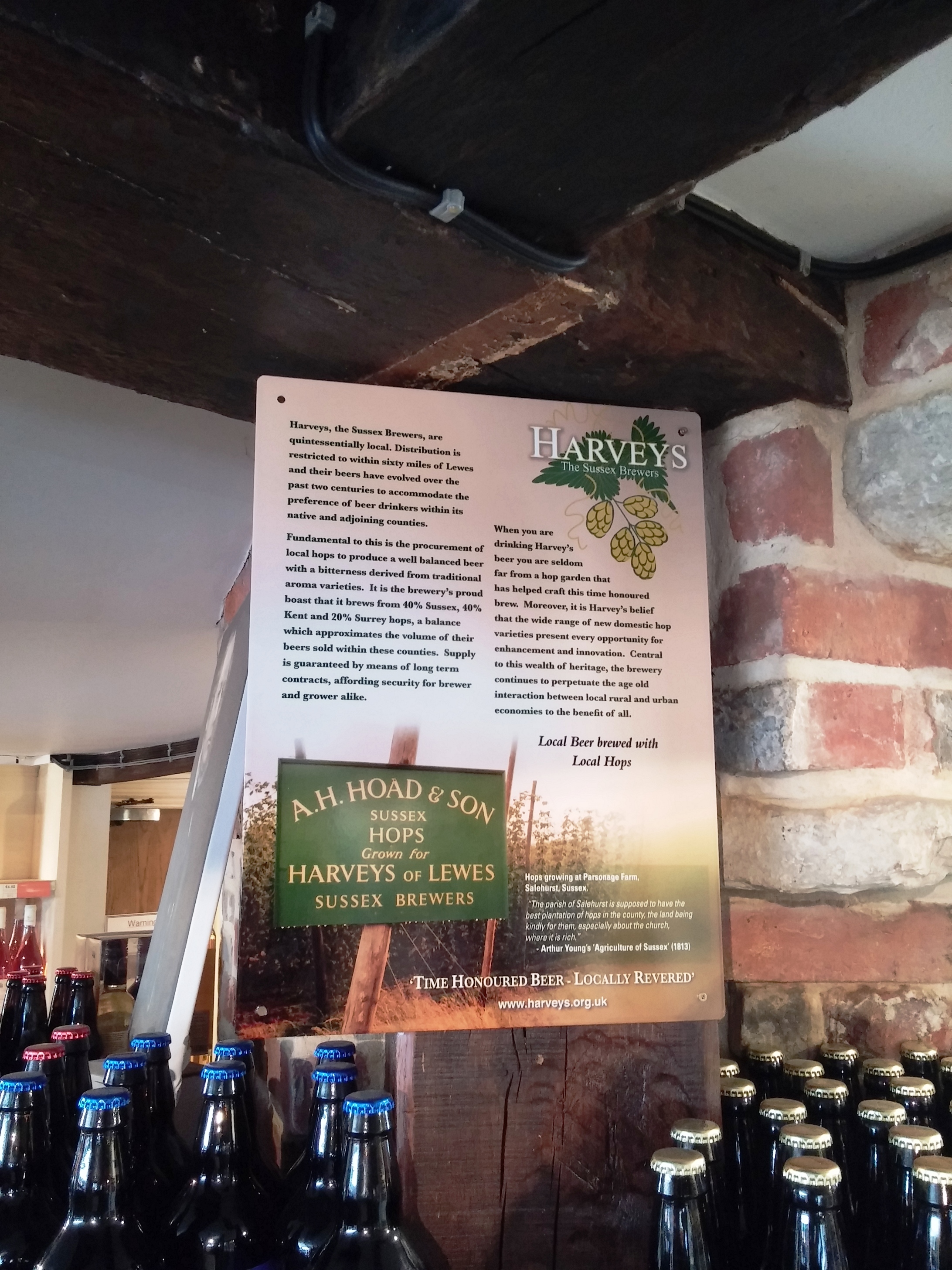
Harveys also has an emphasis on local. The brewery gets uses water from a borehole, using local rain – or more specifically, as Edmund Jenner explained, local rain that’s been filtered through the rocks over the past 30 years. Locally grown hops and barley for their malt are the main other ingredients, and most of their beer is consumed within 60 miles of the brewery. Head brewer and joint managing director Miles Jenner has said ubiquity “diminishes the product”. It’s also an eminently sensible attitude in an era where the fuel burnt when transporting foodstuffs is a major contributor to climate change.
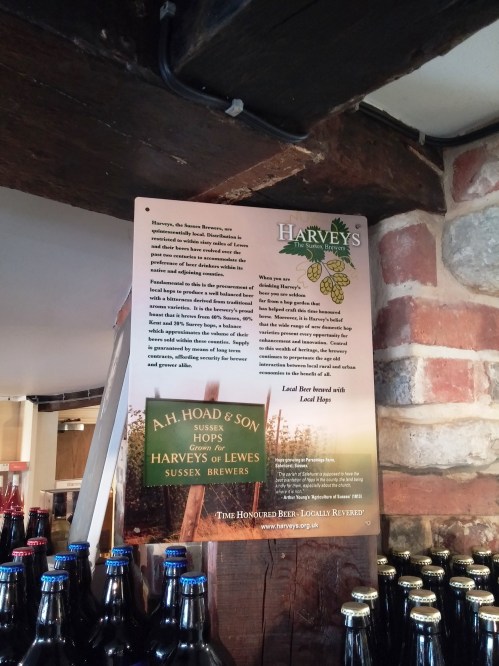
Shop poster

Shopaholic
Harveys also has an excellent shop in the centre of Lewes, where I buy my Harveys beers, then take the bottles back for reuse. I really am lucky to have this operation on my doorstep. And as I keep going and asking questions when I’m buying beer (and wine) from the shop, I got invited on a brewery tour – something that otherwise has a two-year waiting list. Even luckier!

The aforementioned Edmund is the son of Miles. As well being a member of the family that’s been brewing at Harveys for since the 1930s and a man who knows his brewing, he’s also a historian: which is ideal when talking about a firm that was established in 1790.

The original John Harvey was a wine merchant – hence the shop has an excellent selection of wine alongside the Harveys beers. (My favourite currently is from Danebury Vineyards – which grows on the flank of an Iron Age hill fort where I used to play and picnic a lot as a child.) Since medieval times, Lewes had been an important port, despite being about seven miles inland. Wharfs lined the banks of the Ouse in the centre of town, and John Harvey used these to bring in wines, spirits, and even coal – indeed, Harveys is still technically a coal merchant too, despite a spat with bureaucrats in 1948.

Danebury wine

Flood waters and liquor
The current brewery yard, alongside the river, used to contain a pile of coal – previously used as the principle fuel for the brewery. They were still burning through the pile when the floods of October 2000 hit Lewes, overwhelming the flood wall – then in construction – and rushing into the brewery. There’s a mark on the doors into the yard indicating the height the flood-waters reached. I’m more than six foot tall and it’s near my eye-level.

Ed explained they had just filled the hopbacks on the ground floor with 50 barrels (about 8,185 litres) with wort when the Ouse rushed in. They were used to flooding in the brewery, as indeed the whole of this stretch of the Ouse valley has a long history of it, but this inundation was atypical and extreme. Yet two days later, the hopbacks were intact in situ, the weight of the liquid holding them in place, despite damage to other equipment. The insurers said they wouldn’t be back in business for nine months, but they were actually brewing again in nine days, in part thanks to the help of other breweries like Kent’s Shepherd Neame. The beer that had been in fermenting upstairs during the crisis was saved and sold as the renowned “Ooze Booze”, with profits going to the flood appeal.

Back to the 1830s
John Harvey had acquired the Bridge Wharf site in 1838. Three of his offspring, Henry, Edwin and William, developed Harvey & Son. John himself died in 1862, while Henry and Edwin died in 1866. William, no brewer, brought in a chap with the wonderfully Victorian name of Henry Titlow-Barrett to handle the growing brewery business. The borehole that supplies the water  was one of T-B’s developments. His incentive? Well, Ed said there was a typhoid breakout, which was traced to the local utility company. That’s a pretty good motivator.

Any brewer will tell you of the importance of the water, or the “liquor” as it’s known by many British brewers, but Ed says that, “along with the yeast strain, it defines the character of the beer.”

Another of T-B’s major contributiuons to the history of the brewery was the redevelopment of the Bridge Wharf site, with substantial new buildings constructed in 1881, designed by famed brewery architect William Bradford.

The brewery still utilises Bradford’s energy-efficient tower design to this day, though a second tower was added in 1985 – just before the building acquired a Grade II listing. The building certainly has a memorable roofline, with its towers, flues and even a brick smokestack – part of the old coal-burning plant, which was half-demolished in the 1950s, then rebuilt in the 1970s, and is graced with a slight curve. I’ve read that some people call the grand old brewery building “Lewes Cathedral”, though I’ve yet to hear that.
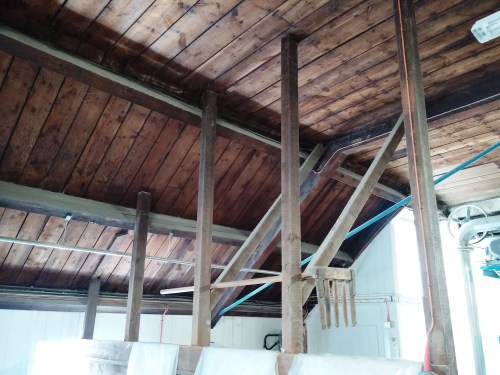
Harveys malt room

Grains of truth
After a quick jaunt into the yard, to appreciate Bradford’s oriel window, we headed back inside and upstairs to the malt room. A grand chamber, it’s wood-lined and packed with sacks of malt, notably the popular Maris Otter.

Ed described the malting process, though I won’t go into too much detail about that here – suffice to say, the grain is tricked into germinating to unlock its sugars. The sugars are essential to brewing, as the fermentation involves feeding the yeast. And what does yeast like to eat? Sugars.

Ed also talked about the “extract potential” of grain – that is, how much sugar it will be able to yield. This has a bearing on brewing as strong beers need more sugars to feed the yeast, which then produces the alcohol. So either you have to use more malt, or use malt with a higher extract potential. Speciality malts – chocolate, roast, caramel, biscuit, crystal malts etc – are used to give beers colours and flavours but generally have lower extract potentials. So while Harveys’ Sussex Best Bitter, their flagship brew and what I was drinking in the Lewes Arms last night, contains just two per cent speciality malts, their Imperial Extra Double Stout contains up to a third.

Ed Jenner in hop room

The green stuff
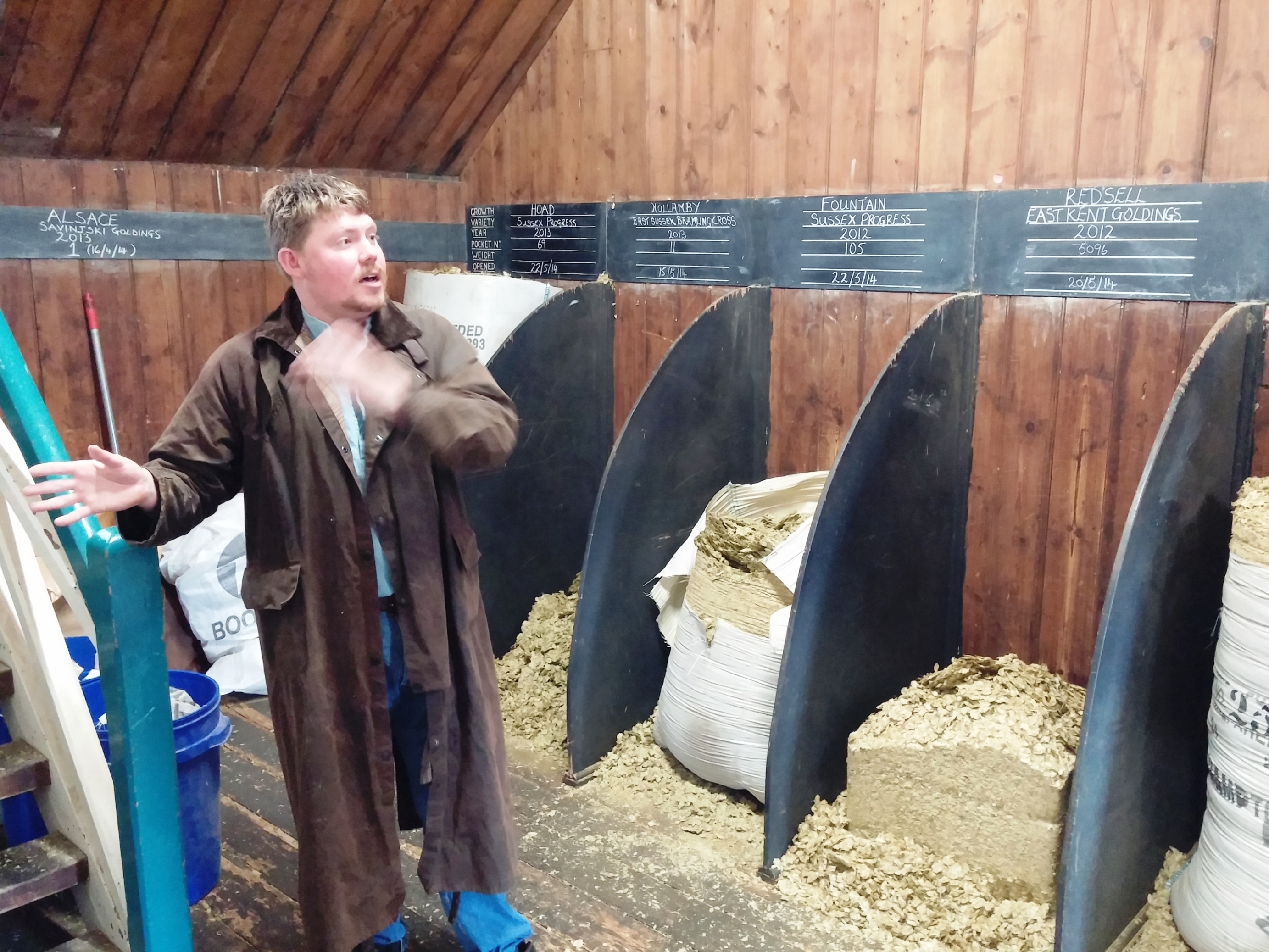
Next door to the malt room is the hop storage room, with contains wooden alcoves resembling stalls for seriously truncated horses.

Here we got into the fascinating discussion – about the historical difference between ale and beer. Although these days both terms are used fairly generically, with ale meaning “not lager”, originally “beer” was a Dutch drink – made with malted barley and hops. The older British styles of drink were made with malted barley and potentially other herbs for flavouring and preservation (see my post about Harveys’ Priory Ale). English brewers were fairly prejudiced against hops, seeing them as foreign muck, but within few centuries of them arriving (c1500), most British ale was made with at least some hop, for its preservative qualities. The term “ale”had come to mean a “less well-hopped brew”.

Ed also described some of the key qualities of hops for us, notably their alpha acid characteristics. Whereas hops, and specifically home-grown hops, were used in Britain more for their preservative and certain bittering qualities, these days, many craft beers contain New World hops that are much more overtly flavoursome and stridently aromatic.

Flavour and aroma distinctions are largely defined by the hops used, and the alpha acid levels of those hops. So while British hops might have alpha acids of about 4-6%, and give arguably more subtle bittering, New World hops might have up to 16% alpha acid (or higher). This higher alpha acid doesn’t just result in more explicit bitterness, but can also bring more overt aromas of tropical fruit, citrus and pine. Though it’s not just a question of the provenance of the hop variety, it’s also a question of where it’s grown, as the climate and terroir have an influence. Cascade is a classic American hop, originating in Oregon, though when grown in Britain, it will have different qualities – and indeed, Harveys use British Cascade in their intriguing Sussex Wild Hop, alongside a hedgerow variety discovered nearby in 2004. (This is a story I want to get to the bottom of; watch this space.) Hop essential oils are also significant for aromas.
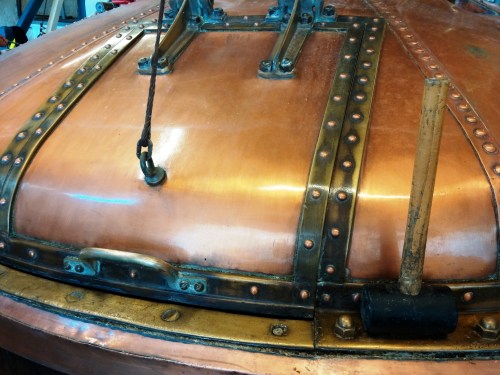
Harveys copper mash tun

The mash tuns
Moving sideways and down a bit, we reached Harveys’ mash tuns. I always love any mention of mash tuns, as my the main pub of my teenage years was named The Mash Tun. Not all the memories are good – notably as it was the 1980s, when bad lager really dominated, and I was too ignorant to know anything about real beer – but I still have a fondness for these large vessels where the malt, ground into grist, is cooked up with liquor. I like the feel of the words in my mouth – as well as the promise of their product.

Harveys has two mash tuns one copper, located in the old tower, and one stainless, put in in 1985 in the new tower. The copper one was from a design patented in 1853 and was made in 1924. It was used by Page and Overton brewery in Croydon and in a 1954 auction, Mr Jenner had to go up against scrap merchants – who deferred to his bids when they learned he actually wanted it for brewing.

Each mash tun holds 120 barrels, that is about 19,650 litres. They’re first warmed by steaming to 70C (158F; Ed did everything in Fahrenheit, which is a foreign language to me). After the enzymes have worked the mash, freeing up more of those sugars, half the husk from the grist settles to a false floor in the vessels. The sweet wort is then gradually drained, lautered. It’s then sparged, sprayed with more water to get out as much of the goodness as possible.

Near the mash tuns, on the other side of the head brewer’s office, the brewery still contains two old steam engines, one of them, a small eight horsepower machine, is from the old Beards brewery. Beards was one of the dozen or so other Lewes breweries that didn’t survive the ebb and flow of the industry.

Harveys copper no 1

Flowing downhill
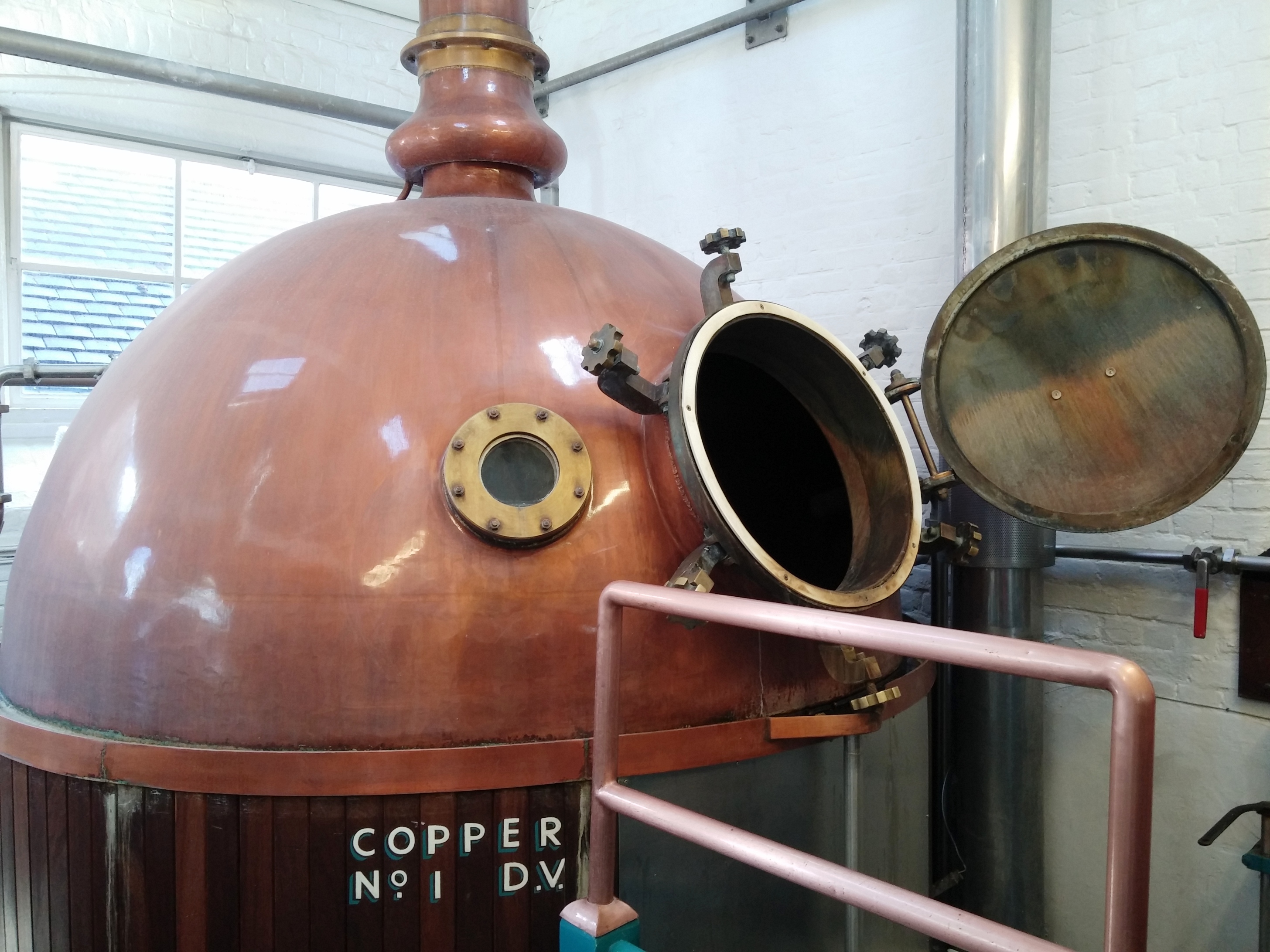
The wort then continues its journey, into receivers, then into the coppers, or boiling kettles. Harveys has two – Number 1 is copper, and looks very Jules Verne, but was actually made in 1999 in Scotland. Number 2 is stainless steel.

Here, hops are added at two different points, and the heating izomerises them – changing the atoms in the molecule into something that gives a bitter flavour . The liquid from the kettles then flows on downstairs again, into the abovementioned hopbacks. The journey continues with the liquid pumped through heat exchangers, cooling it enough for the addition of the yeast – for the next, perhaps most important stage: the fermentation.

After the wort is cooled to 15C (60F), yeast is added – Ed said at a rate of “one pound per barrel”, so that’s about 454g per 164 litres. (164 litres is more or less the size of a UK barrel, 36 imperial gallons. A US beer barrel is 31 US gallons, or 26 imperial gallons, about 117 litres. And that, folks, is why I like metric.)

Harveys, barm in fermenter

So if the day’s brewing starts at 6am, it takes until 4.30pm to get the liquid into the fermenters, which Ed also referred to as tuns. Once the yeast is added, this all-important organism, which I’ve previously made the argument for being man’s true best friend, gets to work. As ales are made using mostly top-fermenting yeasts, it diffuses through the liquid but mostly settles on the top. Anaerobically, it metabolises the sugars, creating alcohol and carbon dioxide – bubbles. To encourage the yeast to reproduce (asexually), the fermenting mix is aerated, the temperature kept low and steady.

The fermentation continues for three days, the yeast forming a thick crust on the top in an “intestine or brain pattern”, which protects the beer, keeps it pure.

Harveys, fermenter brain crust 2

Harveys has been using the same yeast culture since 1957, with Ed explaining it “gives us our flavour, our brand identity.” Before then, their yeast was supplied by the Burton Pure Yeast Company. When it went bust, Harveys had a scramble to try and find a replacement source of the same strain. The sample Harveys received was wrong, so they asked for further samples from breweries all over the country. They eventually received one from John Smiths in Tadcaster that was right, enabling Harveys to keep on brewing consistently.

Or almost consistently. Ed says that the yeast culture itself is changing subtly with every brew, every generation and he conjectures this “little variation stops it being dull to the palette”. I certainly like this idea – it’s like a sourdough culture that might be decades old, but colonies of yeasts and bacteria evolve and change slightly with every use, every generation.

Fermenters

The right temperature
After fermentation, the beer is cooled to 60F / 15C again: closer to cellar temperature, which CAMRA defines as 12-14C, and the optimal temperature for serving many ales. Descending, we reached the racking cellar, where some of the final steps take place – notably the clarification of the beer, using finings – that is, derivatives of fish swim bladders. Quite how anyone ever discovered they had this effect is bewildering, but long molecules of the finings sink through the liquid, collecting sediment.

The beer will undergo some secondary fermentation in the cask, adding some extra fizz. This period of cask conditioning varies depending on the beer in question. So their Old Ale is conditioned for four weeks, their Porter for six, and their Imperial Stout for 18 months.

Not that Ed is entirely staunch about just drinking cask beer. Like me, he agrees that good beer is good beer, if it’s made with knowledge and skill, if it’s served properly. So if it comes in a bottle or a keg, that can be fine too. I drink a lot of Harveys in bottles at home, as I mentioned at the start. Though I do prefer a hand-pumped cask beer, I’m not averse to real beer from a keg. In the meantime, we ended the tour by trying several of Harveys’ classics brews – from a handsome row of casks in the cellar.

All in all, a wonderful experience, and a fascinating compare and contrast with some of the other breweries I’ve visited the past few years, notably Mastri Birrai Umbri in Umbria. The latter is purpose-built, but relies on traditional knowledge and values from a family with a similarly long tradition of food production. And both have a not dissimilar output: Harveys produces 45,000 UK barrels per year, which in new money is about 74,000 hectolitres, while Mastri produces 100,000hl.

For more information about Harveys, their website is comprehensive – about everything from their beer to their history to their environmental credentials, though this doesn’t even mention that their new depot, a few hundred metres away over the river, has a roof covered in PV solar panels, which generated 98kW of power. Again, eminently sensible. What a great company.

5 Comments

Filed under Ale, beer, Breweries, British beer