Category Archives: Breads

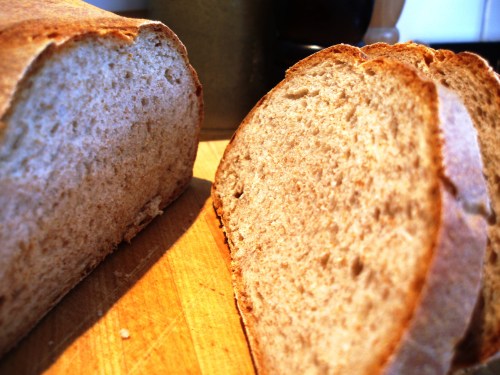
Wheatberry tin loaves

This one is loosely based on a sourdough from The Ballymaloe Bread Book, but I varied it to use some other bits and pieces, and use techniques I’m more comfortable with.

It doesn’t use any commercial yeast, just a leaven – in this case one made with a strong white flour.

In a roomy bowl, combine:
150g wheat leaven
225g strong white flour
225g water (warm, but as this is a long fermentation, the exact temp isn’t crucial)
Mix and leave for around a day.

Then add:
400g wholemeal flour (I’m using stuff grown in Sussex, so it’s fairly soft, but works ok. Best of all, it’s milled on water-powered grindstones at Winchester City Mill).
50g rye flour
100g strong white flour
14g fine sea salt
150g (ish) of wheatberries – ie whole wheat grains that have been boiled until soft.
50g of butter, melted
225g water (warm, but again, as it’s a long fermentation, it just has to be suitable for encouraging the leaven’s lifeforms)
Mix to a good dough, and knead. I gave it a good initial knead, then did the Dan Lepard technique of three more short kneads, every 10 mins.

Scale into two pieces, rest, form batons, then put in two greased 2lb loaf tins.

Prove for around 5 hours (depend on the temperature of your room; my kitchen was only around 18c), then bake in an oven fully preheated to 220C for around 40 mins.

Leave a comment

Filed under Baking, Breads

Pide

I used to make a flatbread like this years ago but lost the recipe, so glad to rediscover this one.

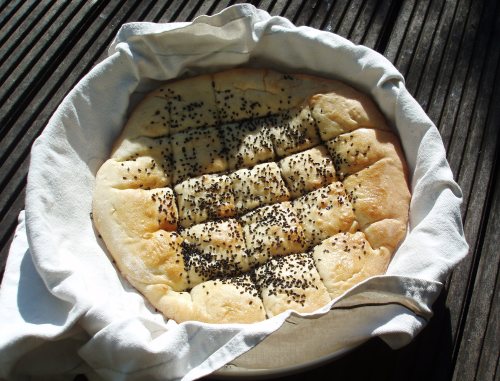
“Pide” is basically the same word as “pita” as far as I can make out, meaning simply “bread”. Unlike what’s commonly meant by pita, this pide doesn’t have a pocket. Instead, it’s a spongier bread, marked with a pattern and, in this case, sprinkled with nigella seeds (aka kalonji, aka onion seed).

These quantities make two loaves.

2 tsp / 10g of dried yeast or 15g of fresh yeast
1/2 tbsp sugar
325g tepid water
500g strong white flour
1 tsp fine sea salt
2 tbsp olive oil
Egg for glazing
Nigella seeds

1. Dissolve the sugar in the water, sprinkle on the yeast and leave for 5 or 10 minutes. Stir to break up and mix in the yeast.
2. Put the flour and salt in a bowl, then pour in the yeast water and olive oil and bring to a dough. You’ll want a nice soft, damp dough. Don’t keep chucking in extra flour!
3. Knead until smooth.
4. Form into a ball, and rest in a bowl covered with a towel or plastic bag. Leave till doubled in size – around 1 1/2 hours depending on the warmth of your room.
5. Turn the dough out, deflate with your finger tips.
6. Divide into two equal pieces (easiest with scales).
7. Form the pieces into balls, and rest, covered, for 10 minutes.
8. Preheat the oven to 220C (200C fan).
9. Roll the balls out into rounds about 25cm in diameter then rest, covered, for another 20 minutes.
10. Using the straight edge of a dough scraper, mark a criss-cross pattern in the discs, four lines in each direction.
11. Glaze with an egg/water wash, and sprinkle with nigella seeds.
12. Bake for around 12 minutes until a nice golden colour.
13. Wrap the breads in clean tea towels immediately to keep them nice and soft.

4 Comments

Filed under Baking, Breads

Alsace loaf with rye


Very pleased with this one. It’s another recipe from Dan Lepard’s The Handmade Loaf, a book that’s kept me busy for many a weekend, and will doubtless do so for years to come. Although I’m yet to perfect my stick-shaping technique, the flavour was delicious, the texture nice and open, the crust crunchy without being tough or overly thick.

I finally got round to making a rye leaven. I simply took a few tablespoons of my wheat leaven, then started feeding it with 100ml of water and 120g of rye flour every day. After a week or so, it was looking pretty good, gassing away nicely.

This loaf is given distinction by the fact it uses not just a rye leaven, but also rye grains. Use about 120g of rye grains, then boil them for about an hour in water. Save the water, then put the rye grains in another bowl, and, when they’re cool, cover them with white wine and leave in the fridge overnight. This makes them nice and soft, and tangy. The recipe says you can also use yogurt or juice, but I used a Chardonnay we had hanging around. I really don’t like Chardonnay, so this seemed like a perfect way to use it up.

To make the dough, combine 25g honey, 4g crumbled fresh yeast and 325g water (use the water you cooked the grains in, made up with extra if necessary) in a bowl and leave it to sit.

After it’s sat for 10 minutes or so, add 150g of rye leaven and 300g of the wine-soaked rye grains (drained; I used up the rye-ish wine in a stew thing).

In a large bowl, mix:
350g strong white flour
100g wholemeal flour
50g rye flour

Then add the wet yeast/leaven mix and combine by hand until you have a rough dough. Leave to rest for 10 minutes, then turn it out onto a lightly floured surface. Stretch it out a bit, and sprinkle with 1 1/4 teaspoons of fine sea salt and 25g of melted butter (or other fat).

Knead briefly, then put it back in the bowl to rest for half an hour. Knead again briefly, then return to the bowl.

Give it a turn after half an hour (ie, take it out, stretch it, then fold it in three). Return to bowl.

Give it another turn after another half an hour. Return to bowl, then leave another half an hour.

After this one and a half hour proving period, divide the dough up into five equal portions, of around 250g. Shape into balls, and leave to rest for 10 minutes.

Shape into batons by flattening out, then pulling the two corners opposite you out slightly and folding them towards the centre of the disc, sealing in. This will create a slight point. Fold that towards the centre too, and seal. Rotate, and do the same with the other side. Fold this in half, and seal. Buy Dan’s book – it’s got some very useful pictures of this process.

Let the batons rest for another 10 minutes.

To shape into sticks, take the baton, and fold in half again, along the length, starting at one end and sealing as you progress along the length. Roll on the work surface, and make pointy ends if you like that look. This is part of the baking process I’ve yet to perfect. The problem is creating a stick with a neat, tight seam, then not twisting it at all, so it will retain a regular shape when you bake. I guess I just need to make a few hundred more.

Lay the sticks, seam-side up, on a baking sheet lined with a floured cloth, making pleats of cloth between them so they don’t stick as they rise. Leave until doubled in height. The recipe says “1 hour”; that’s fine if you have a warm, moist environment, but my kitchen is quite open and cool so rising generally takes longer for me.

Heat the oven to 210C.

Carefully overturn a couple of the loaves, either on a baking sheet, or a peel (or substitute peel) if you use a baking stone. Slash the tops diagonally. As I use a stone, I then slide them into the oven, moistening it with a water spray. Bake for 25-30 minutes, then remove when they’re a nice colour, and sound hollow when knocked on the bottom.

Leave a comment

Filed under Baking, Breads

Ciabatta


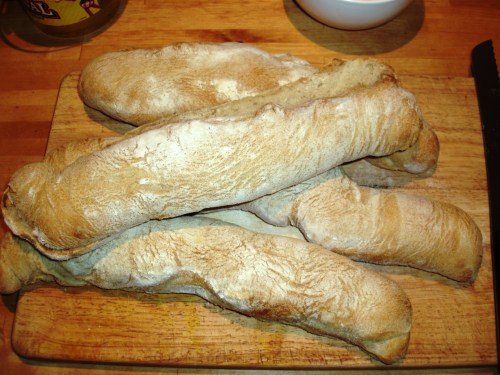
This is my first stab at ciabatta, using the recipe in Richard Bertinet’s Dough.

Despite being somewhat misshapen, they turned out very tasty. But it was touch-and-go for a while there.

Bertinet’s technique here involves making a “ferment” a day earlier – basically some dough that sits around giving the yeast a chance to do its thing. It’s kinda like a junior leaven. Except the batch I made with the quantities in the recipe resulted in a pretty dry ferment (350g flour, 180g water, 1/2 t fresh yeast), which looked nothing like the nice bubbly affair picture in the book. So when it came to making the second dough (450g strong white or ’00’ flour – I did a mix; 10g yeast, 340g water, 50g olive oil, 15 salt), and combining them, it was hard going. The dry ferment and wet dough mix just refused to integrate. A lot of messy manipulation ensued.

Next time, I might experiment by just using my leaven instead of Bertinet’s ferment. It’ll make the dough even moister, but that’s good for ciabatta as I understand it from reading Dan Stevens’ recipe in the River Cottage Handbook 3: Bread.

2 Comments

Filed under Baking, Breads

Handmade loaves

Although I blog about my baking over at Cake-Off (now gone), the emphasis there is on cakes, cupcakes, tray-baked cakes, biscuits, cookies and all things sweet and yummy. For my bread-making, I’m going to try and write about it a little more here.

I’ve been making bread on and off most of my adult life, starting, like much of my more homely, traditional interests, with the time I spent on small organic farms in the Buller Gorge, South Island, New Zealand in the late 1980s and 1990s (a couple of years in total, on about off). There, mentored and encouraged by first Mr Stephen McGraph of Newton Livery then, more significantly, by Ms Nadia Jowsey of Old Man Mountain, a highly accomplished baker and chef, I started to learn all about making real bread.

Last year, I was given a copy of The Handmade Loaf as a present. This excellent book is by Dan Lepard, the master baker who has been writing the baking column in the Weekend Guardian the past few years. Its emphasis is on using a natural leaven – aka levain, aka ferment – in your breads. I’m not sure I can entirely summarise the difference in results between a homemade loaf made with just commercial yeast (be in easy-blend, dried or fresh) and one made with your own leaven, but it certainly adds different qualities: you can achieve very different textures, but the main difference is probably a depth of flavour. Plus, where making your own bread is always deeply satisfying, that feeling is multiplied when the only raising agent you’re using is a natural yeast you’ve cultivated yourself. There are different methods of doing this, but Lepard’s basically involves using the natural yeasts presents on the skin of raisins, feeding it with flour and water, and nurturing it over a week or so.

Not all my experiments with the recipes from The Handmade Loaf have been a resounding success, but all have been informative experiences. And some of them have resulted in some of the best breads I’ve ever made.

Here are just a few examples from the past few months.

The mill loaf
This is second recipe in The Handmade Loaf. It uses leaven made with white flour (you can make rye leavens, etc), alongside white flour, wholewheat flour and rye flour. It’s a great all-rounder, for wholesome sarnies, top toast or just a few slices with a meal. It’s one of the recipes in the book I make the most, though for home use I half the book’s quantities, which call for half a kilo of levian, along with a kilo of flours (combined), and more than half a kilo of water.

Onion and bay loaf
This is a yummy loaf where you chop some onion, then head it, along with some bay leaves, in milk. You then cool the milk and use it for the dough’s only liquid. The finished loaf is a lovely savoury affair, that’s both nice and alliumy and instilled with the distinctive sweetness of bay. This one uses both some white levain and some fresh yeast.

Lemon barley cob
Made this one a while back. It uses white leavain and some fresh yeast, combined with 100g barley flour and 150g white flour. A little lemon juice and zest gives it, in combination with the barley flour, gives it a slight tang. Need to practice this one a bit more.

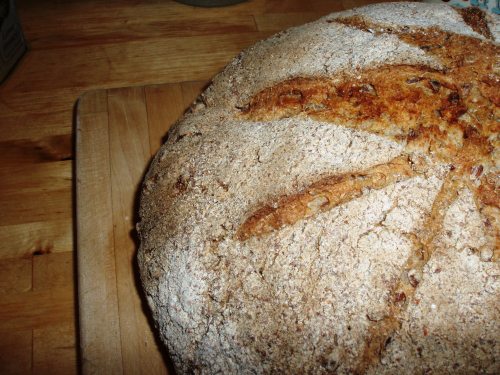
Ale bread with wheat grains
This is a great one, though takes a little more advanced planning. Its given distinction by the addition of wheat grains, which you simmer, then soak overnight in ale. I love ale. I love bread. And of course the two are closely related – or at least they used to be, before the advent of commercial yeast when much baking would apparently involve using the barm from beer-making for your yeast starter.

Rolled oat and apple bread
This is one of my favourites from The Handmade Loaf, so far. Adding the remains of the porridge to the bread dough was one of the things I learned from Stephen and Nadia, and this recipe incorporates a similar process – making some semi-porridge by soaking oats in boiling water. The apple here also keeps the loaf loaf and moist and soft. The recipe uses grated apple, but I had some pureed remains of our apples in the freezer, and added that instead on one occasion; the results were similarly successful.

Barm bread
Another connection with the old tradition of making beer with beer barm. Here, you make a barm by mixing bottle-conditioned ale with some white flour and white leaven the leaving it overnight. The loaf itself just uses this barm, water, strong white flour, and a little salt. Yum. Check out the texture – I’ve never achieved anything like that with a non-leaven bread. Though again, this needs a little practice, as it’s a bit too crusty.

Bottom line: get this book. And get baking! That said though, what’s with the prices on that book now? Mitchel Beazley – do another print run for crying out loud!

5 Comments

Filed under Baking, Breads