Category Archives: Cakes

Syrupy almond-semolina cake – revani or basbousa

Revani cake

Some time in the late-1990s, I cut this recipe out of a newspaper. The writer was definitely Andy Harris, the paper was possibly The Independent. I went through a phase of making it loads then, I don’t know, it just seemed to get forgotten. I’ve no idea why, as it’s great. Just my sort of thing – quite dense and textured thanks to its use of almonds and semolina and moist thanks to a flavoursome syrup poured over after baking.

The name Harris used was revani (alternatively ravani), and he wrote about it as a Greek cake. Actually, similar and related cakes made with almonds, semolina and citrus syurp are common through much of the Eastern Mediterranean, Levant, Maghreb and Middle East. These are known as basbousa (rendered into English in various spellings), hareesa/harisa, namoura and kalbelouz. Some versions also feature coconut. I don’t fancy this as syrup is spiced up with cinnamon, cloves and orange and in tandem with the flavour of almonds, I think the coconut would be a bit much.

I’ve added a little orange blossom water to the original recipe. In part to boost that orangey-ness, but also as I find it’s the sort of ingredient that gets pushed to back of the cupboard and forgotten until it’s a decade over its best-before date. So I want to keep using it. Harris’s recipe featured brandy, but I don’t have any, I’m not sure what it would add, and I’m pretty certain that when this cake it made in Muslim nations it wouldn’t contain any booze.

Fitting in with my interest in feast day foods too, it may also eaten by Coptic Christians in Egypt and beyond for their Great Lent and Christmas celebrations. Though this info seems to be lurking on Wikipedia, unverified, and repeated elsewhere by lazy bloggers. Oh, oops. I’m struggling to confirm it, and don’t know any Copts.

Syrup
350g granulated sugar
700g water
1 cinnamon stick
6 whole cloves
Zest and juice of 1 orange
1 tbsp orange blossom water (optional)

Cake
200g granulated sugar
225 g unsalted butter
6 medium eggs (about 300g beaten egg)
110 g plain flour
175 g semolina
1 tbsp baking powder
110 g blanched almonds [or ground almonds, see below]
1/2 tsp vanilla essence
1/2 tsp almond essence
Extra blanched almonds to decorate

1. To make the syrup, dissolve the 350g sugar in the 700g water in saucepan over a low heat.
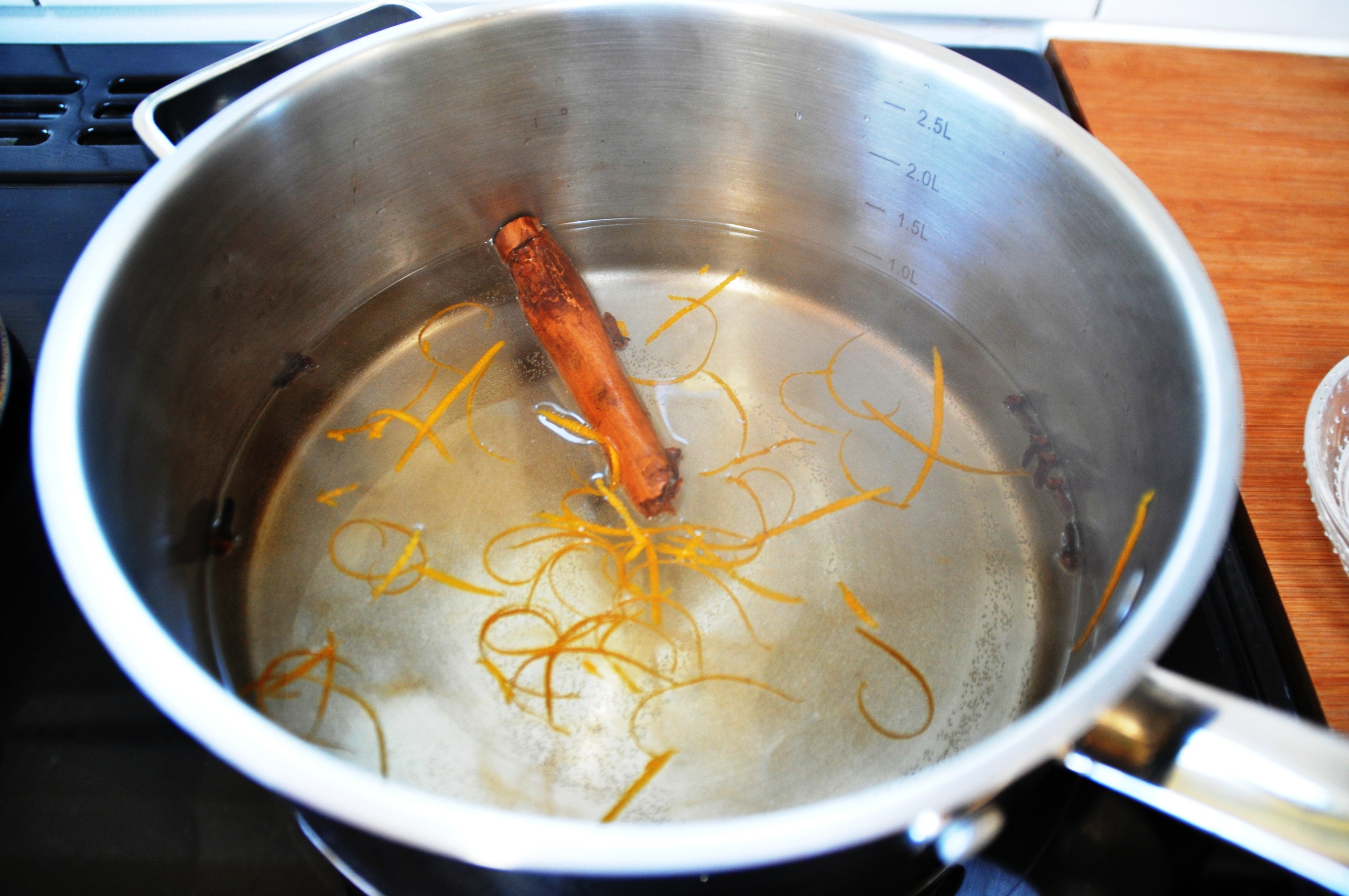
Revani cake syrup
2. Add the cinnamon stick, cloves and orange zest and juice and simmer for 15 minutes.
3. Take the syrup off the heat and allow to cool. Stir in the orange blossom water, if using.

Revani cake ingredients

4. In a large bowl, or with a food mixer, beat the butter and sugar together until creamy and light.
5. Beat the eggs with the vanilla and almond essences, then gradually add the egg to the creamed mixture, incorporating well.
6. If using blanched almonds, chop them finely – either by hand or in a food processor. Alternatively use ground almonds – you won’t have quite such an interesting texture but it’s easier. I used a mix this time round – 40g ground almonds and 70g blanched almonds, chopped.
7. Sieve together the flour, semolina and baking powder. Add the chopped almonds/ground almonds.
7. Add the flour mix to the creamed mix and blend well.
8. Preheat the oven to 180C.
9. Grease a rectangular tin, about 32x20cm.
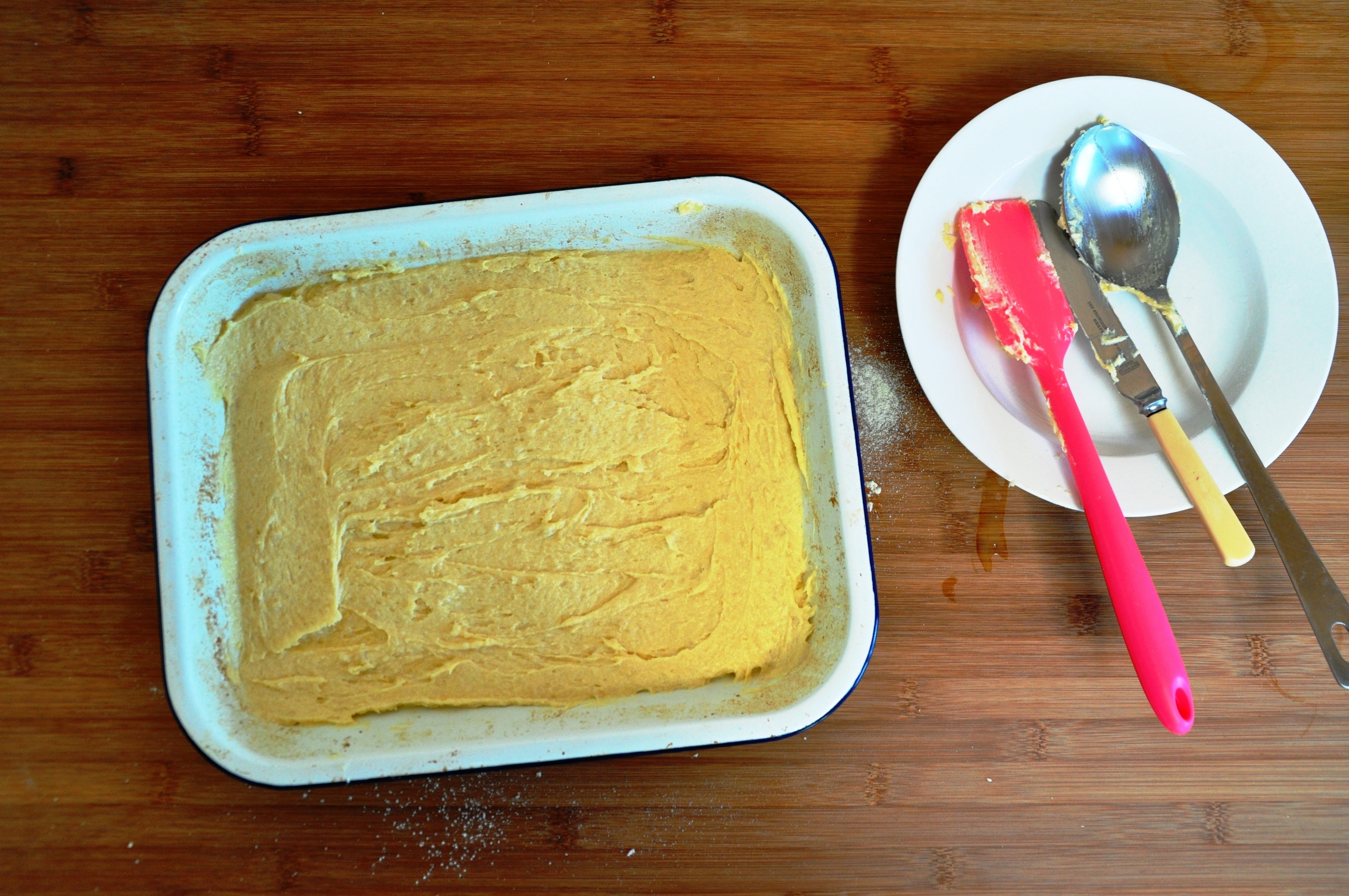
Revani cake batter

10. Spoon the batter into the tin, smooth it, and put in the oven for about 30-40 minutes, until firm and browned.
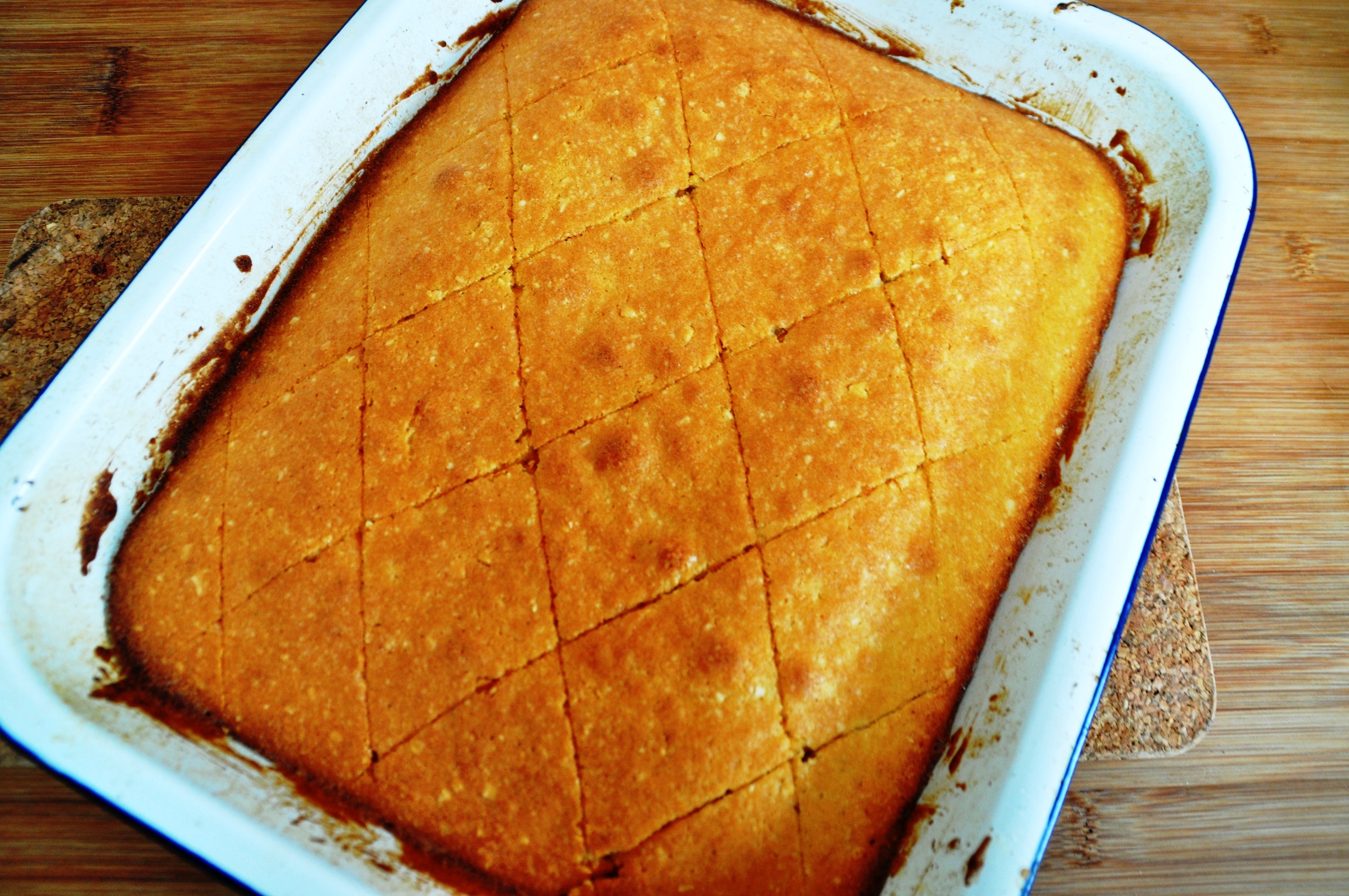
Revani cake - score a diamond pattern

11. Remove from the oven and score a diamond pattern in the top with a sharp knife.

Revani - pour syrup over, straining out the spices

12. Pour the syrup onto the warm cake – through a sieve or strainer to catch the spices and zest.

Revani - decorate with blanched almonds
13. Decorate the diamonds with a blanched almonds.
14. Allow to cool and serve at room temperature for tea or as a dessert. The latter can be souped up by being served with honey-sweetened Greek yogurt or poached fruit.

Revani, basbousa

A note on photography
When I thought I’d broken Fran’s camera last week, actually I’d just broken the lens thread. Phew. So we got a new (well, second-hand) lens. It’s an 18-200mm F/3.5-6.3, so Fran could use it more for landscapes and stuff.

I’m not a photographer, and struggled enough to learn how to use the kit lens effectively, but now I’m struggling again. I can’t quite get in close enough, suspect I won’t be able to rely on the autofocus as much, and doubly suspect I probably could do with a faster 35mm or 50mm prime lens or something with a better macro. Gawd knows. It’s all changed so much since I got my photography O-level in 1986….

Leave a comment

Filed under Baking, Cakes

Tippaleivät – Finnish May Day fritters

Tippaleivat

In England, for May Day we all – of course – morris dance around poles bestrewn with ribbons and get drunk on ale*. I’m not sure we have any particular traditional celebration foods. So I was looking around for treats from other nations. I came across tippaleivät (plural) or tippaleipä (singular).

Tippaleivät are eaten in Finland as part of celebrations on Vappu, the Finnish May Day, Walpurgis day. Love that word, Walpurgis. Walpurgisnacht. That’s German of course, though Germany has a relative of tippaleivät, cruller, the US has its funnel cake, while they’re all also arguably a distant relative of the South Asian jalebi. Mmm. Jelabi.

Frying 2

Basically they’re just swirly fritters, which can be flavoured with lemon zest and vanilla, though the latter can come via a dusting of vanilla-flavoured icing (powdered) sugar. I’ve seen recipes for yeasted versions, versions with baking powder, and versions with no raising agent at all. I’ve taken the middle path.

My Finnish friend Tomps tells me that tippaleipä means “drop bread” – as in, you’re dropping the batter. I’ve read lots of tips on how to shape the fritters as you fry them as you just pipe a worm of thick-ish batter straight into the oil. Some people say use a ladle, others a metal ring of some persuasion, or even a tin can with both ends removed.

But using a ladle and a piping bag simultaneously over hot oil seems a tad fiddly to me, whilst most tin cans these days have a plastic lining – not ideal in oil at 180C (360F, for those of you in the 19th century). So I just did mine free-form. They’re perhaps not the neatest, but they hit the spot.

Squeezing, dribbling

Happy May Day! Happy Vappu! And indeed happy Beltane!

2 medium eggs (about 100g beaten egg)
25g caster sugar
200g plain flour
1 tsp baking powder
1/2 tsp fine salt
100g milk
1/2 tsp vanilla essence [optional]
zest of half a lemon [optional]
Sunflower or rapeseed (canola) oil, for deep-frying
Icing sugar, for serving

1. In a large-ish bowl, combine the egg and sugar, and vanilla (if using), and beat slightly.
2. Sieve together the flour and baking powder, add the salt and zest (if using).
3. Alternately add flour mix and milk to the egg, beating to create a thick batter.
4. Put the batter in a piping bag fitted with a smallish nozzle, max about 5mm. Alternatively you could use a plastic freezer bag and snip off the corner. Just keep it away from the hot oil!
5. Heat the oil to 180C.
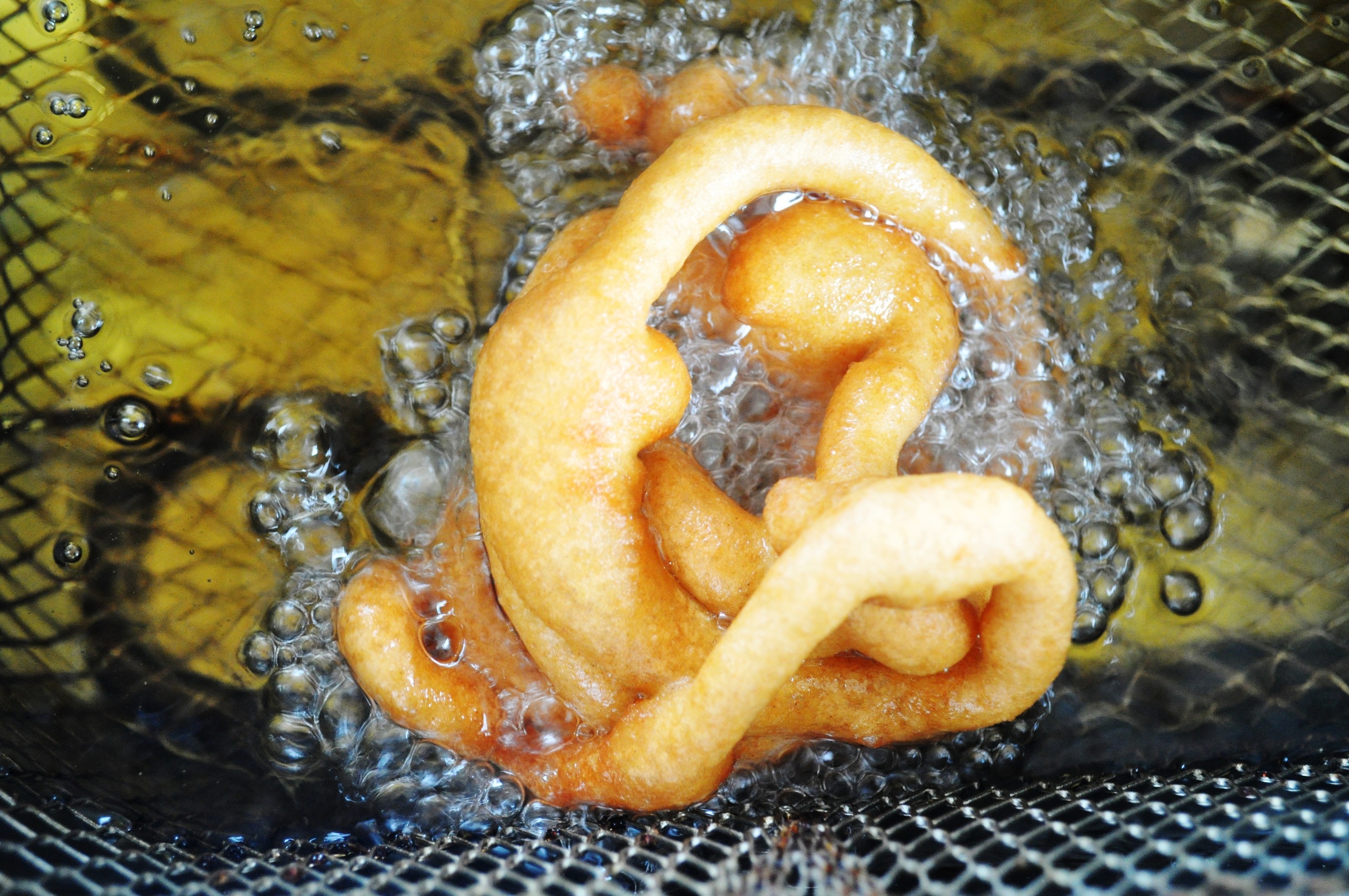
6. Drizzle a thread of batter into the oil, forming a nest shape.

Dribbling, frying
7. Cook until golden, about 4 minutes, then take out and drain on paper towels.

Frying
8. Serve dusted with icing sugar.

In Finland, they’re eaten with a lemony mead drink, sima. We’re just having ours with coffee and hot chocolate.

Tippaleivat, overhead


* Or not. Due to the convention of Bank Holiday Mondays, today isn’t a national holiday – that comes on Monday. Which isn’t actually May Day.

6 Comments

Filed under Cakes, Pastry, Recipes

Hande’s pear, chocolate and hazelnut cake

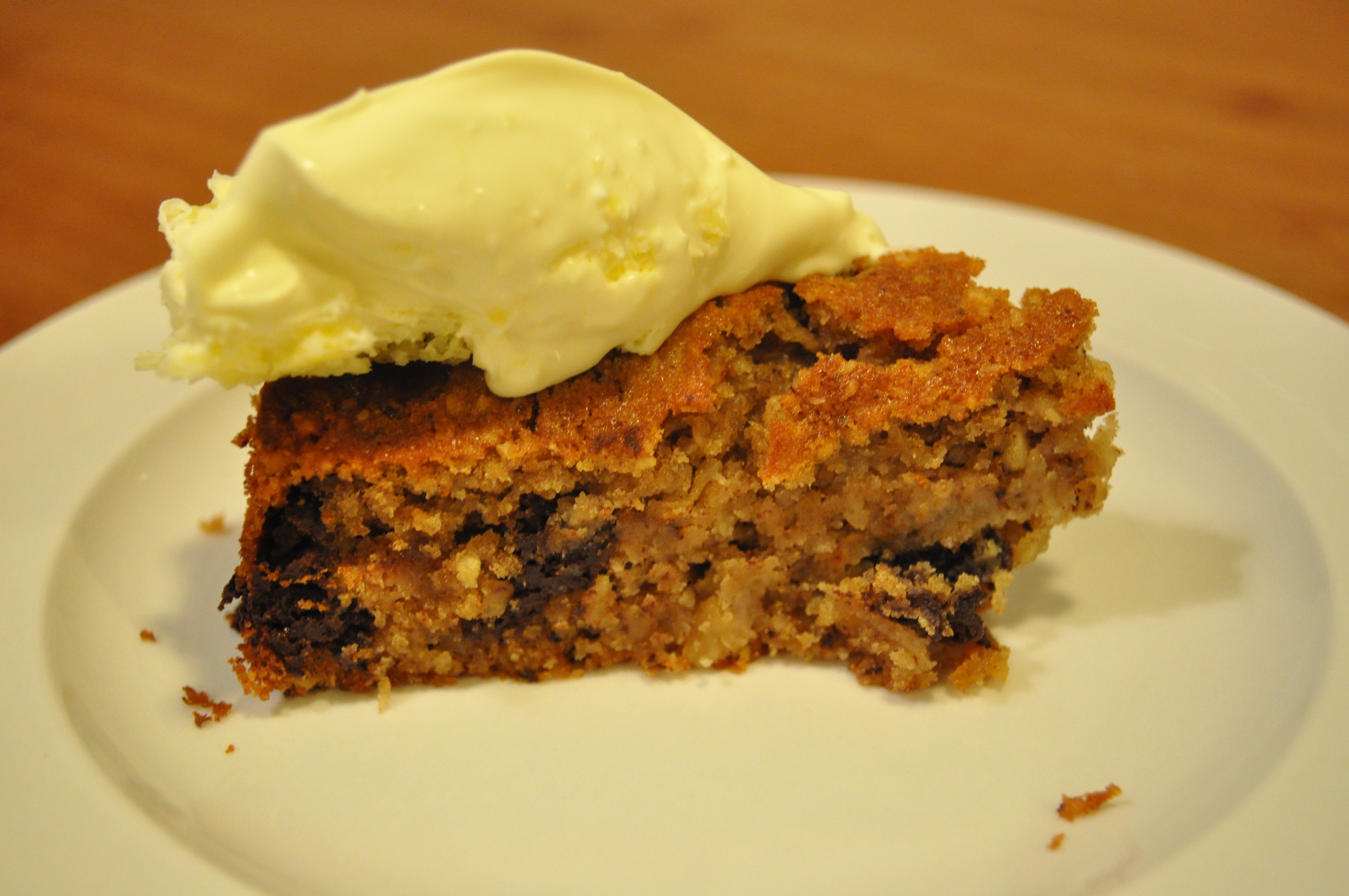
Pear, choc, hazelnut cake, with clotted cream

Hande Leimer is the founder and owner of Vino Roma, a wine studio – with an absurdly historic cellar – located in the centre of Rome. Not only is she an expert sommelier and polyglot wine educator, she’s an excellent cook too. And baker. When she posted a pic of her pear, chocolate and hazelnut cake on her Instagram a few weeks ago, I had to try it.

These three ingredients make for a classic combination. I’ve always loved pear and chocolate, and indeed pear with chocolate sauce was a pudding I grew up with. But I also love anything made with ground nuts, so this really was a cake for me. Furthermore, Hande developed the recipe with the aim of balancing them, so no flavour dominated the other but each was clear and evident. The individual flavours are sharpened and delineated further with the judicious inclusion of some hot spice.

She included piment d’espelette / esplenette pepper, but as that’s not easy to source in the UK, changing that is one of the tweaks I made. I think Hande also made hers in a loaf tin, but I favoured a round tin.

I suspect my version is a little moister than Hande’s. I used local Concorde pears (a hybrid of Conference and Comice), which were firmly ripe, but still added a fair bit of moisture to the mix. Hande said “I aimed for a batter that is not too runny but not too stiff either, when you pour it into the pan it does hold for a couple of seconds before gently flowing to all corners”, giving an optional 1 tablespoon of breadcrumbs if your batter was too runny. I didn’t do this, but instead increased the flour slightly.

I also suspect I assembled mine in a different manner to Hande, but it’s one of those forgiving batters where the ingredients could be combined in various orders. It’s not the sort of cake where you’re trying to achieve a super-light texture, instead it’s got a texture that’s defined by the nuts – crunchy, slightly oily – and the pears – moist, with the whole concoction shot through with bursts of dark chocolate.

500g pear
125g hazelnuts
100g dark choc (at least 70% cocoa solids)
115g unsalted butter, melted
70g light muscovado sugar
40g caster sugar
1 egg
2 tsp vanilla extract
Pinch salt1
1 tsp cinnamon
Pinch of cayenne pepper and a few grinds of black pepper
130g plain/all-purpose flour, or low protein 00
2 1/2 tsp baking powder

1. Grease and line a 20cm round tin.
2. Preheat oven to 180C.
Skinning hazelnuts
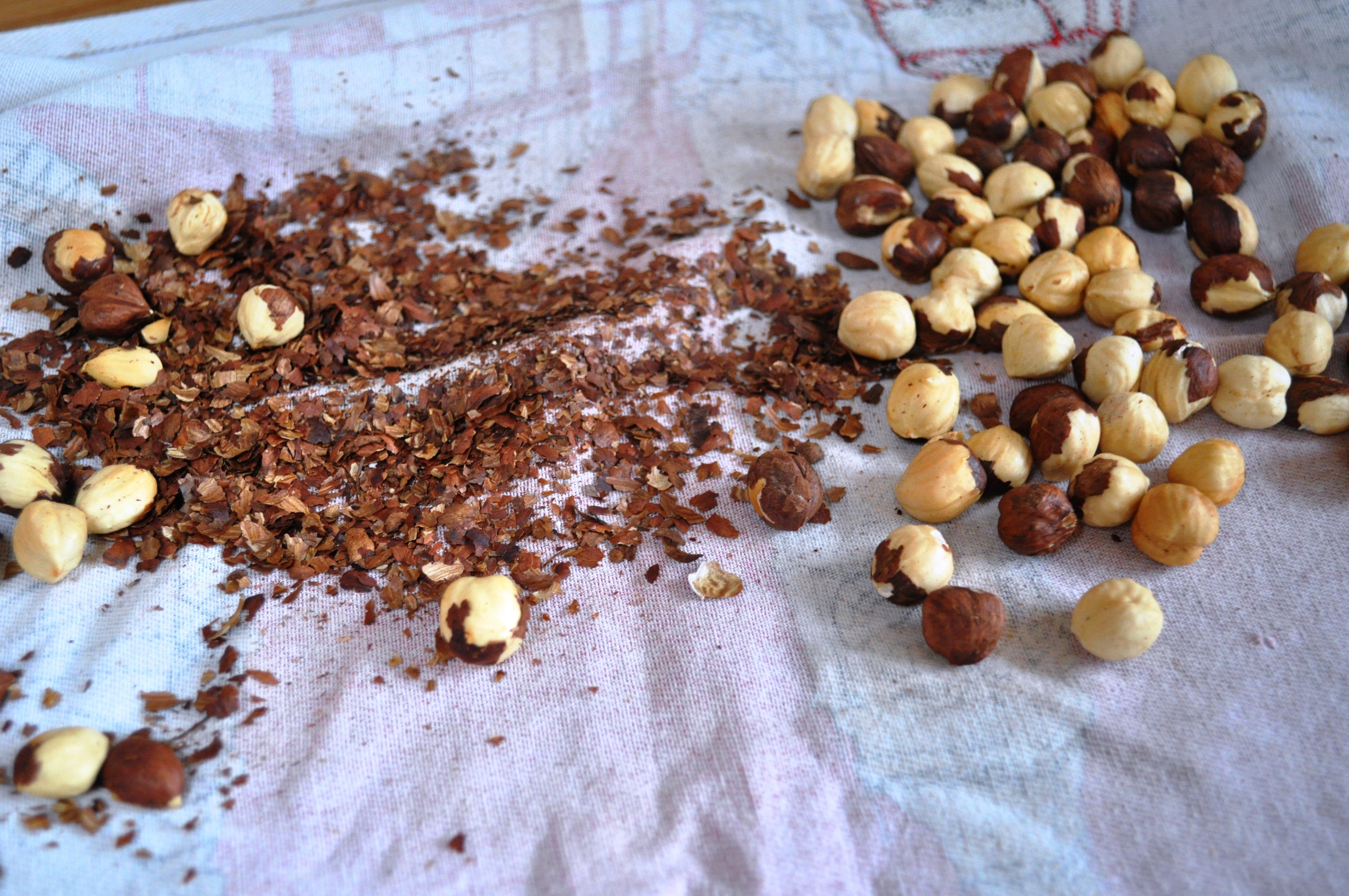
3. Lightly toast the hazelnuts, rub off the skins (using a tea towel or cloth; I wasn’t too assiduous about this – too many skins can be bitter, but a little adds flavour) and grind in a food processor to a medium meal.
4. Coarsely chop the dark chocolate.
Peeling pears
5. Pear, core and coarsely grate the pear.
6. Sieve together the flour, baking powder and spices to mix.
7. In a large bowl, beat together the sugars and melted butter. Add the egg, vanilla and pinch of salt and beat again to blend.
8. Add the nut meal, pear and chocolate to the bowl and combine.
9. Fold in the flour.
10. Pour the mixture into the prepared tin.
11. Bake for about 45 minutes, or until firm to the touch and lightly browned.
12. Cool in the tin for 10 minutes then turn out. Serve warm with cream2 or ice cream, or allow to cool completely. Hande had hers for breakfast. But then she lives in Rome and the sort of cake us Brits would treat as a tea-time treat or pudding gets eaten for breakfast there.


Notes
1 So yes, I’ve made a point of saying “unsalted butter” then added a pinch of salt. Why? Well, salt is essential for all foods, unless you have no sense of taste or somehow like your food bland. Put simply, it’s the ultimate flavour enhancer, so even sweets – especially sweets like this with a variety of flavoursome components – benefit from a bit of salt. A pinch. Too much and you may get a salty taste, but too little and it won’t be there to do its work. In the words of renowned London-based chocolatier and pâtissier Paul A Young salt “lifts and balances the sweetness and brings out other flavours.” I have used salted butter in cakes in the past, especially when I’ve not got any unsalted, but the problem with that is that you can’t control the quantity effectively as you can’t be sure how much salt is already in the butter. So it might seem perverse to use unsalted butter then add salt to the mix, but there’s a logic to it!
2 We had clotted cream. I could eat the stuff every day… if I was a bit more blithe about my arteries.

17 Comments

Filed under Baking, Cakes, Recipes

Justin Gellatly almond cake

Gellatly almond cake slice

This is my first recipe from the book Bread, Cake, Doughnut, Pudding by Justin Gellatly, formerly of St John now of Bread Ahead bakery, London. It’s a book I needed on my shelf, really, given the overlap with my area of interest – and the name of this blog. So thanks Rachel for the gift.

Gellatly lists this as Swiss almond cake, but I can’t quite bring myself to do that. Thing is, I’m sure this is a version of toscakaka – a Swedish almond cake (here’s a version on Poires au Chocolat). Either way, it’s delicious. A huge, almondy beast with an absurdly rich, crunchy, buttery almond topping. As with the classic toscakaka, you partially bake the batter, then add the topping, then continue baking.

Topping mix
200g butter
200g caster sugar
4 tbsp milk (full fat)
40g plain flour
50g ground almonds
200g flaked almonds

Cake mix
200g unsalted butter
260g caster sugar
400g plain flour (I use Stoate & Sons stoneground, which isn’t that pale bleached colour of more mainstream flours)
1 tsp baking powder
100g double cream
1 1/2 tsp almond extract or essence*

1. Grease and line the base and sides of a 26cm springform cake tin.
2. Preheat the oven to 160C.
3. Make the topping mix by gently heating together the butter and sugar in a saucepan. When melted, add the milk, flour, ground almonds and flaked almonds and stir to combine. Put aside.
4. Make the cake batter, starting with melting the butter.
5. In a large bowl, beat together the eggs and caster sugar until the colour lightens and the mix is airy. (I reduced the sugar from 300g to 260g and it was still very sweet!)
6. Beat in the melted butter, then the cream and essence (or extract!).
7. Sieve together the flour and baking powder then fold this into the batter.
8. Pour the batter into the cake tin, then bake for 25 minutes.
9. Carefully take the cake out of the oven, and gently spread the topping on.
10. Increase the heat of the oven to 180C then put the cake back in and bake for another 40 or so minutes. It’s tricky to judge when this cake is done, as the skewer may come out of the cake itself clean, but the topping will still be smeary. You want the topping itself to be browned nicely.
11. Cool in the tin for 20 minutes then remove and either serve warm with cream or whatever you fancy, or allow it to cool completely.

Gellatly almond cake

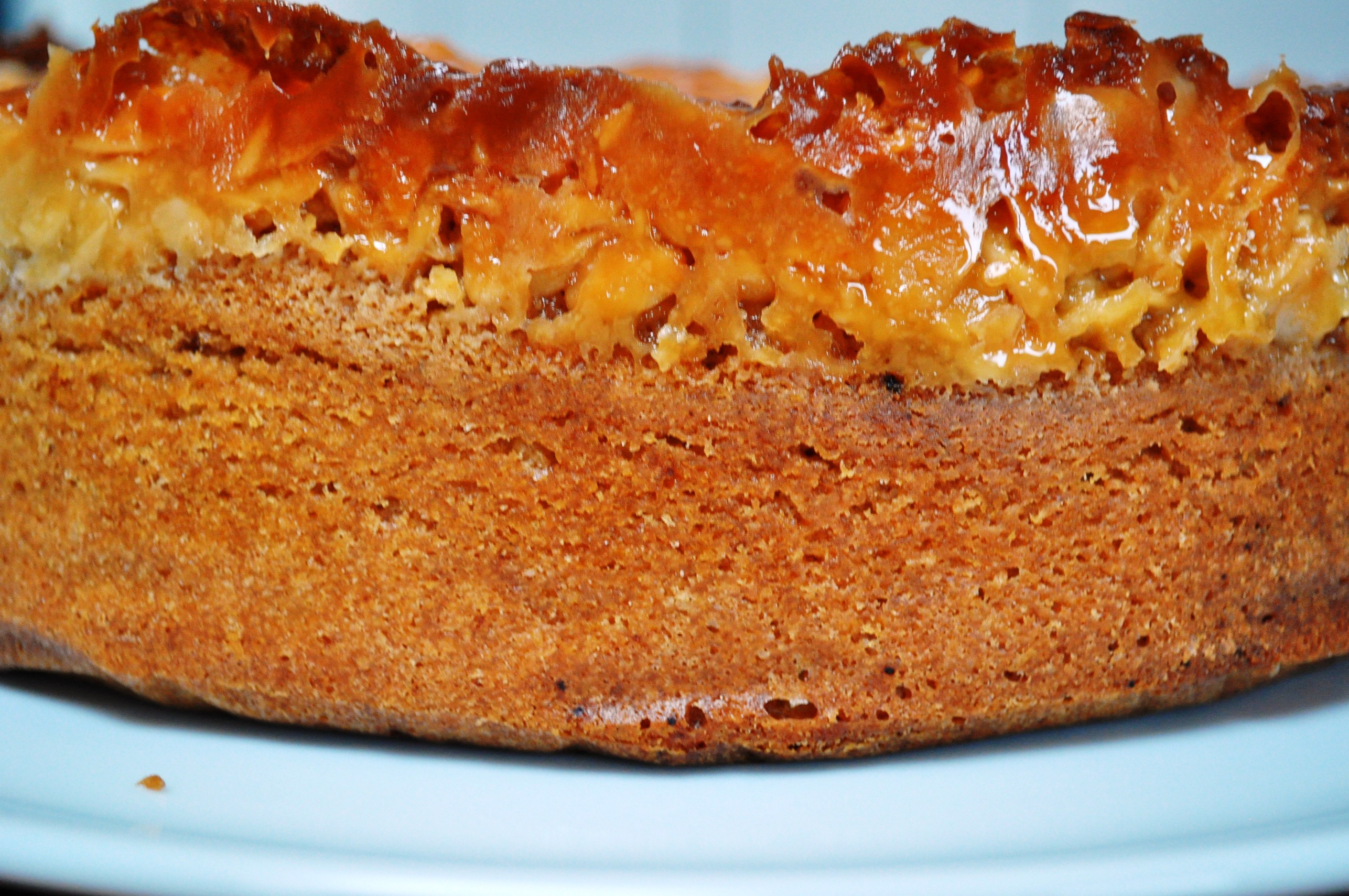
Oh, and you might want to invite friends over to help you as it is substantial. The best bit is the edge of the topping where it’s caramellized against the tin. Good stuff, thank you Mr Gellalty.

Gellatly almond cake side

* I’m not going to try and explain the difference here, just use what you have – preferably a natural not synthetic product)

2 Comments

Filed under Baking, Cakes

Castagnole recipe

Castagnole

Lent this year starts this Wednesday, 18 February. (Making today Collop Monday in olde British parlance.)  Which means it’s still Carnival, Carnevale, and there’s time for a few more traditional treats of the season. Anyone who’s read my blog before will know I enjoy castagnole, the Italian Carnevale sweets that are basically dough-ball doughnuts. The name relates to the Italian for chestnut, castagna, as they’re of similar dimensions, and deepfried to a lovely brown colour but there’s nothing else chestnut related in the recipe.

I ate loads of them last week when we visited Rome, but here’s my own recipe, for those of us living in countries with a more miserably chaste take on Carnevale.

You can make castagnole without any leavening agent at all, or there are recipes that are leavened with yeast. But I found this worked well, resulting in the balls puffing up and cracking slightly when you deep-fry them, and a fairly open, spongy interior.

250g plain/all-purpose or low protein 00 flour
1 tsp baking powder
Pinch salt
50g caster sugar
Zest of half a lemon (optional)
50g butter, melted and cooled slightly
2 medium eggs, lightly beaten
1/2 tsp vanilla essence
Sunflower oil for frying*
Sugar for serving

1. Sieve the flour and baking powder into a bowl. Add the pinch of salt, sugar and zest.
2. Add the vanilla to the eggs and beat slightly, then add this along with the butter to the flour mixture.

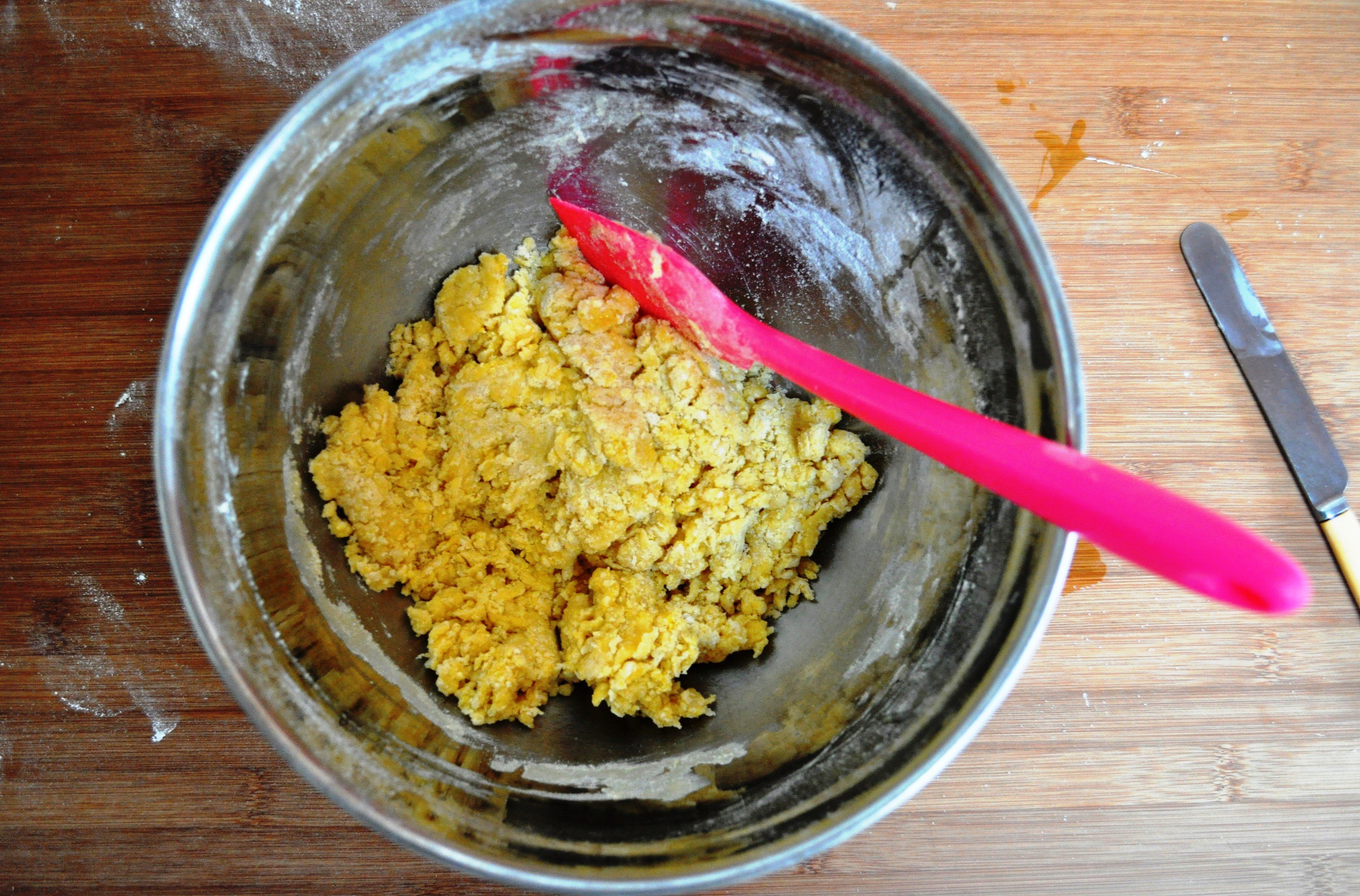
Castagnole componentsCastagnole dough 1

Castagnole dough 2Castagnole dough 3
3. Combine all the ingredients, then turn out and work to a soft, smooth dough. Don’t overwork it.
4. Wrap in plastic and rest for half an hour.

Shaping castagnole
5. Divide the ball of dough up into pieces and roll these into sausage shapes.
6. Cut the sausages into small pieces, about 20g each.
7. Roll these piece between your hands to form small balls.

Frying castagnole
8. Heat oil in a large pan (to about 180C if you have a thermometer) then deepfry the balls in small batches, until golden, about 2-5 minutes.
9. Remove from the oil and drain on kitchen paper, to absorb some of the oil.

Castagnole cooling
10. To serve, liberally with icing sugar (aka powdered sugar, confectioner’s sugar) or roll in caster sugar. Or indeed both if you really like refined sugar. So healthy!

Enjoy… while you can. I mean, you can make them any time you like, especially if you’re not Catholic or are entirely nonreligious, but personally I like keeping seasonal specialities special by having them at the relevant time of the year. So that means I have to eat all these before Wednesday. It’s not like I’m religious and going to have an ascetic Lent, but I respect the principle.

Castagnole close up


* Italian recipes I looked at say “Olio di semi” – seed oil, ie sunflower seed oil – or simply “Olio per frittura” – oil for frying, while another says “strutto” – lard. We talked about this on our last visit to Italy, where people even use olive oil for deep-frying, something that’s contrary to what we’ve been told here in the UK. There are, however, a lot of arguments (smoke points, cost factors, etc) and a lot of myths (destruction of nutrients etc), which I won’t go into now. Suffice to say, I actually used a mix of sunflower oil and rapeseed oil, as the latter is something that’s produced locally to where I live, unlike olive oil, which, sadly, isn’t.

5 Comments

Filed under Cakes, Feasts, Recipes

Barm brack for St Brigid’s Day, or Imbolc

Barmbrack

Also called barmbrack, barnbreak, bairín breac or bairínbreac, this is the Irish cousin of the Welsh bara brith, with both names meaning “speckled bread” – bread dotted with speckles of dried fruit.

It’s traditionally eaten on Halloween as well as on 1 February, the feast day of one of Ireland’s patron saints: Brigid or Brigit of Kaldare.* This is one of those Christian feast days, in combination with Candlemas on 2 February, that was a rebranding of an older, pagan festival: Imbolc, the mid-point between winter and spring equinoxes. Indeed, although Brigid was nominally a historical figure who lived in the 5th-6th centuries, there was also an older, Irish, or Celtic goddess of the same name and the feast effectively amalgamates the two.

It’s not a big feast day for us Brits, but as Fran and myself both have Irish great-grandparents, it’s a good excuse to try a recipe.

Barm brack is one of the breads that originally would have been made with yeast from brewing, but these days you can either make a yeasted version, ie more an enriched bread, or a chemically leavened one, ie more a fruit cake. Several months ago I accidentally bought an 8kg sack of self-raising flour, so as much as I like yeasted breads, I made the latter, as part of my efforts to use it up.

If it’s not St Brigid’s Day or Imbolc or Halloween, don’t worry – you can still make this brack, and just call it a tea brack, a relative of the other similar baked goods known as tea breads in English.

Oh, and while researching recipes, I found some that were adamant you had to bake in a round tin, some that were free-form (yeasted) loaves, though the consensus seems to be to bake in a loaf tin, which makes sense as you can then slice it and spread it with butter and eat it for afternoon tea.

250g dried fruit – currants, raisins, sultanas or a mixture
300g black tea. We used Earl Grey for that citrus tang from the bergamot
1 medium egg
50g butter, melted
140g sugar, soft brown
270g self-raising flour, or 260g plain/all-purpose flour sifted together with 2 tsp baking powder
Some spice, to taste
Pinch salt
50g candied peel

1. Put the currants/raisins/sultanas in a bowl and pour over the hot tea. Leave it for a few hours, or overnight, so the fruit plumps up a bit.
2. Preheat the oven to 180C, or 160 if you have a fan. That said, my fan oven is pretty puny, so 170C seemed OK. Basically, a medium oven.
3. Grease and line a 900g/2lb loaf tin.
4. Put the flour in a large bowl, add a bit of spice if you like (I used cinnamon, a few grates of nutmeg and a pinch of black pepper, which is probably unconventional, but seemed appropriate) and the salt.
5. Add the sugar. I used soft brown and a bit of dark muscovado that was hanging around.
6. Add all the rest of the ingredients, and stir to combine. The resulting batter will be pretty sloppy.
7. Pour into the tin and bake for about one and a quarter hours, turning down the heat slightly and covering the loaf with foil if the top is browning too much.
8. When it comes out of the oven, you can brush it with a simple sugar syrup made from a few tablespoons of water and a few of sugar, dissolved then boiled quickly.
9. Turn out, allow to cool and serve.

Funny, I never much liked fruit breads and cakes, but I’m increasingly enjoying them, and this was lovely. We ate several slices, sitting around with our friend Liv, drinking gallons of tea. I was tempted to open an ale, as one source I read insists you have it with ale; which would make sense, but only a rich, malty ale, without too much newfangled hoppiness.

I’ll make a yeasted version come Halloween, but we’ve got spring and summer first, so I’m not wishing the year away on this cold late winter day.

Barmbrack 2

* Her name is also spelled Bride, and some suggest Saint Bride’s Well, and Bridewell Palace (mostly destroyed in the Great Fire of London) and St Bride’s Church in the City of London take their name from her too, possibly via Irish monks who came to England to convert the heathens.

7 Comments

Filed under Baking, Breads, Cakes, Feasts, Recipes

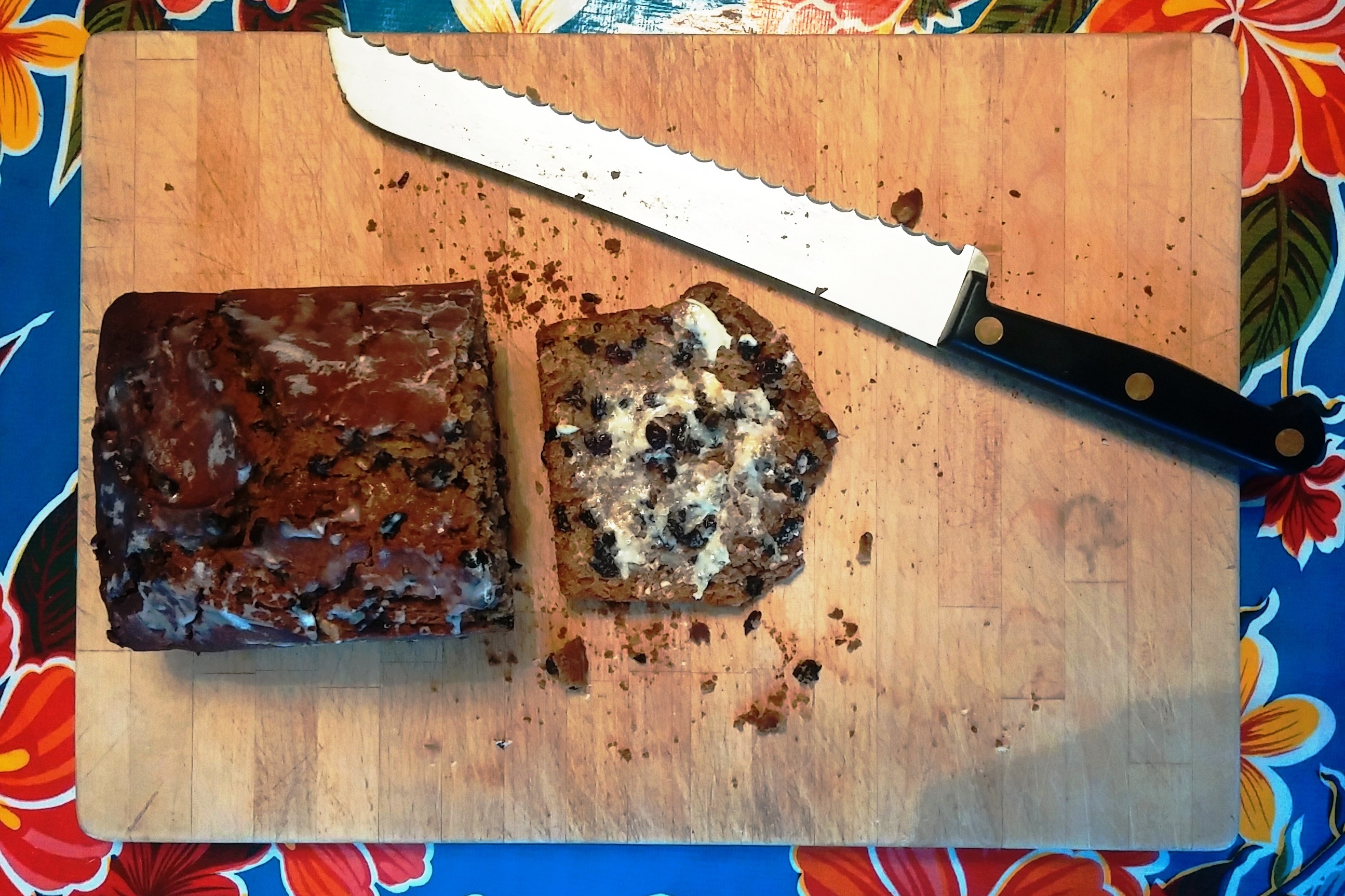
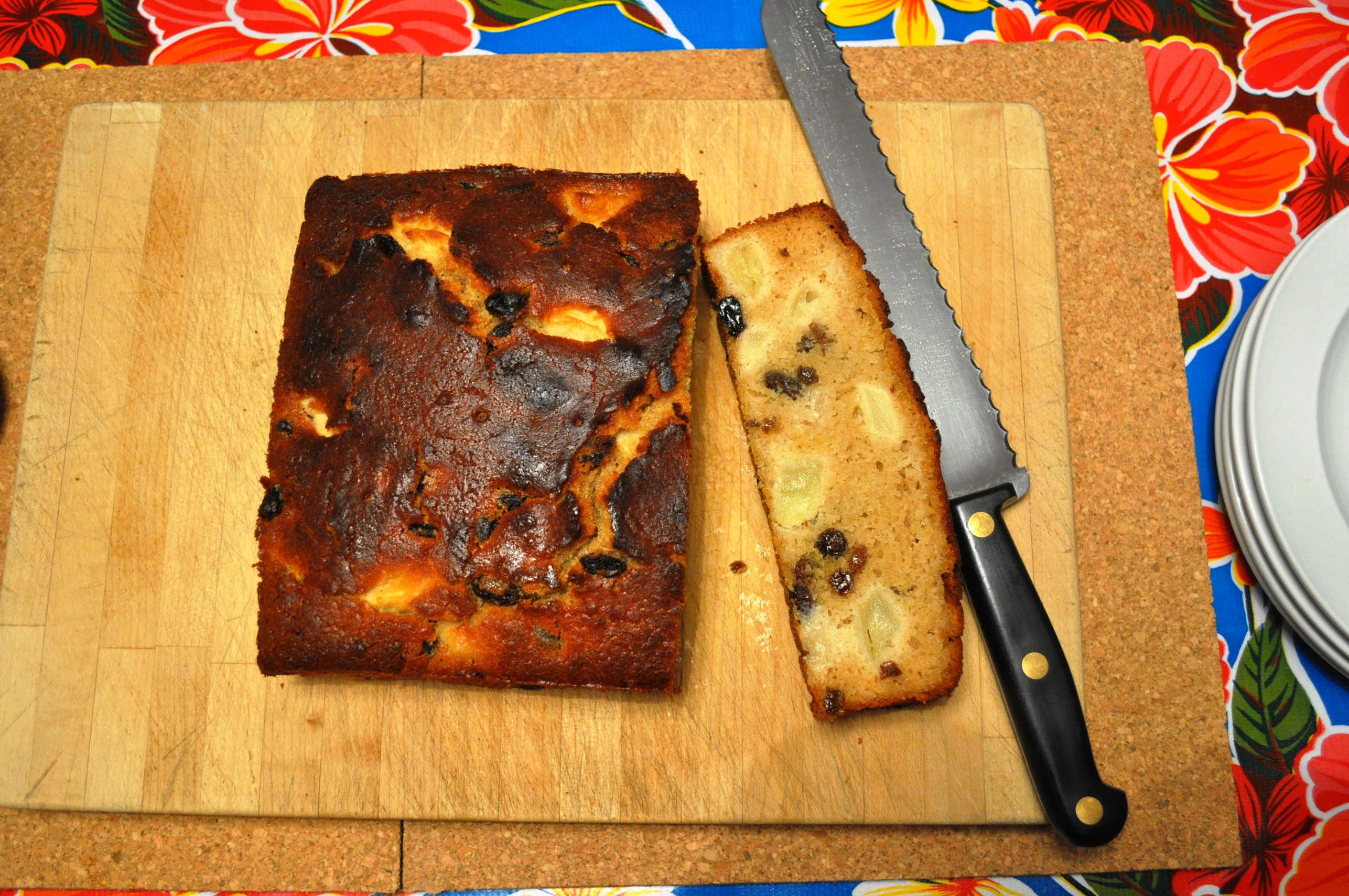
Sussex wassail apple cake

Sompting wassail cake
We live in a somewhat charmless 1950s-1960s neighbourhood, but we have a decent-sized garden and are close to some beautiful countryside. That garden contains, among other things, two old apple trees. A neighbour who’s lived here since the estate was built says much of it was an orchard beforehand. So those veteran apple trees, gnarled and neglected, deserve some respect as survivors.

One way we in southern Britain, particularly the southwest and southeast of England, traditionally paid our respects to our apple trees was by wassailing. To wassail is to salute, to wish good health, with the ail part of this Old English/Old Norse word equivalent to the modern English hale, as in “hale and hearty”, whole and in good health.

The word also refers to a drink drunk when wassailing, from a wooden “wassail bowl”. I must admit I didn’t make the drink this time, as the recipes I found on this fascinating site are types of punch-like concoction involving mulled cider, mulled ale, mulled cider and ale mixed, mulled cider and ale and fortified wine mixed, all often also mixed with whipped egg and garnished with toast. For toasting your apple trees, your neighbours, your community, in the hope of winning over apple tree spirits and guaranteeing a good harvest – and plenty more cider the following year. As a teenager I drank far too much snakebite – half-half beer and cider – and it made me so sick it put me off alcohol for years. So although I love tradition, I’m wary of cider-ale combinations.

Wassailing is traditionally carried out on Twelfth Night – that is, 5 January, the night before Epiphany. However, there’s also a tradition that favours Old Twelvey Night – the night of 17 January, the eve of the Epiphany according to the Julian calendar, which was replaced by the Gregorian calendar for most Westerners and Christians in 1582. This is – or was – favoured in the southwest of England, where Fran’s from, and my mother’s mother was from.

Anyway, after a few ciders – both local and from Normandy, another gift from some family friends – Fran and my mother, Helen, started singing a wassailing song, that goes (oddly, considering most the trees are bare of leaves):

“Here we come a-wassailing
Among the leaves so green;
Here we come a-wand’ring
So fair to be seen.”

The song is probably Victorian. Indeed, although these traditions may well be ancient, possibly with pre-Christian origins, as we so much British folk culture, the form we know today was likely largely shaped by the Victorians.

While they tried to remember the song, I made an apple cake. This recipe is from Sompting, a Sussex village about 16 miles (25km) away from where we live in Lewes. The original recipe makes for a fairly substantial foot-square cake, a little large for my family gathering.

The woman who provided the recipe, one Marjorie Clarke said of the cake tin, “We use a special one with a hole in the base, so that the cake can be carried on the end of a spear in the procession.” That’s probably not the sort of cooking kit you have. I certainly don’t, and don’t really fancy drilling a hole in one of my tins. So I think a standard square, or similarly proportioned rectangular one should do. I reduced the quantities and tweaked it slightly. Then burned the top a bit in my new oven. But no matter, that felt suitably rustic and the cake was lovely and moist, the raisins fattened with very natural Wobblegate Sussex Scrumpy I used.

Local ingredients

225g eating apples
110g raisins
225g cider
170g butter
100g (4 tbsp) honey
4 medium eggs (approx 190g egg white & yolk)
200g self-raising flour
2 tsp baking powder

1. Grease and line an 18cm square baking tin, or similar.
2. Preheat the oven to 180C.
3. Put the raisins in a saucepan, cover with the cider, bring to the boil then remove from the heat.
Apple, raisins, cider
4. Add the apple pieces to the cider and raisins, and allow to cool while you continue.
5. Cream the butter and honey then gradually add the beaten egg. If it starts to curdle, add a little of the flour.
6. Sieve together the flour and baking powder.
7. Add half the flour to the batter, and combine.
8. Add half the cider mixture to the batter, and combine.
9. Add the other half of the flour and fold in.
10. Add the rest of the cider mix and carefully combine, until the mixture is uniformly mixed, but not over-mixed.
11. Pour the mix into the tin.
12. Bake for about an hour, or until risen and firm.

We didn’t visit neighbours and sing to them and their apple trees. Instead we stayed indoors and ate cake and raised our glasses of cider in the direction of our apple trees – the old ones augmented by a crabapple I planted last year and a dwarf apple I planted three years ago, which was a wedding present from my cousin and her husband. Here’s to a good fruit-bearing year! Wassail!*


* Yes, I know I should have posted this on Saturday, but there’s always next year.

5 Comments

Filed under Baking, Cakes, Feasts, Recipes

Kladdkaka – gooey Swedish chocolate cake

Kladdkaka sliced

So this isn’t very Christmassy, but I’ve wanted to try making a kladdkaka for a while. I really must get a Swedish or Scandinavian baking book as I’m enjoying everthing I try making from recipes from that part of the world.

Kladdkaka is a kind of gooey chocolate cake. It’s unleavened – no baking powder, no soda, no yeast, so it’s not intended to be light and airy. Instead, the aim seems to be to basically leave the inside somewhat unbaked, so it’s moist to the point of runny, so it’s not unrelated to things like chocolate fondant and brownie.

In English, it can be called mud cake, but from what I can tell from online dictionaries, kladd means either draft, or rough, or daub, something a bit messy and unfinished, or goo, gunk. A Swedish-speaking friend meanwhile (he’s Finnish but is one of those annoying types who speaks multiple languages perfectly) says that “If something is ‘kladdigt’ it’s sticky, gooey, doughy, maybe even messy.” Thanks. Tom.

135g butter
55g cocoa powder
110g plain flour
320g granulated sugar
1 tsp vanilla essence
3 eggs
icing sugar, for dusting

1. Preheat the oven to 180C.
2. Grease and line a round tin, ideally 18cm or 20cm (7 or 8 inch).
3. Melt the butter then remove from the heat.
4. Sieve the cocoa and plain flour into mixing bowl.
5. Beat together the eggs and vanilla.
6. Pour the butter and egg mix into the flour, and beat together with the sugar until the mixture is combined.
7. Pour the mixture into the tin then bake for around 20-30 minutes. This is the important bit and will vary depending on the character of your oven. You want it to start pulling away from the edges of the tin, but not be baked dry in the middle.
8. Cool in the tin for about 20 minutes, then turn out.
9. Dust with icing sugar.

Kladkakka dusted

You can eat it warm, with ice cream or whipped cream. I had mine with custard, though I doubt Swedes do this; we just had some fresh custard in the fridge that needed me to nobly step in to finish it. It’s also very nice cooled completely, to a more truffle-like texture, and eaten with a cuppa.

7 Comments

Filed under Baking, Cakes, Recipes

Microwave chocolate cake experiments

Microwave chocolate cake - weird texture?

As you may have noticed, this beer-and-baked-goods site isn’t featuring much of the latter at the moment. Due to buildings works, we’ve not had a kitchen for a month, and probably won’t have one for another couple of months at least, so there’s not baking going on here. Instead, we have a pathetic electric hotplate and a basic microwave.

And can you bake in a microwave? No, you can’t. Not literally at least, as the verb to bake apparently has its origins, via the Middle English baken, the Old English bacan, the Old Norse baka, and even the Old High German bahhan, in the Greek phōgein meaning to roast, to parch, to warm. So in essence baking is a process based around heat, specifically dry heat. Microwaving, on the other hand, involves zapping the food item with energy from approximately the middle of the electromagnetic spectrum.

You’re not cooking with thermal energy as you do in a conventional oven, you’re cooking with energy that generates thermal energy. You’re not baking with a dry heat, you’re causing molecules in the food – particularly the liquid component, the water – to dance and get hot.

I didn’t grow up with microwaves, and only acquired one when a relative of Fran’s died about a decade ago. I know they’re an efficient way of preparing food, but if you take pleasure in cooking, it’s quite likely you take pleasure in the tangibility of real heat: from an electric element in an oven, from a gas flame on a hob. The latter particularly has a kind of primal immediacy, like a neat, manageable campfire.

Is this baking? No. Give me a flame or a heating element.

So having said all that, I must report I’m surprised at my first microwave cake. How can you make a cake without baking it? I can’t really reconcile that, yet the mixture I made was a pretty normal cake mix, and it was cooked in the microwave in about five minutes, and the results are most definitely a cake. Not a good cake, but definitely a cake.

It’s not all good news though. What makes it not a good cake is a certain dryness, a weird airy homogeneity, a lack of depth of flavour and a slightly dry, ashy mouthfeel. Though the latter may be partly explained from the relatively high amount of baking powder in this recipe. Some jam and ganache, or even some standard water icing, might mask that, and compensate a bit for the dryness, but it’s definitely not as good as a real, proper, baked-in-an-oven cake. Nuking all the water molecules to cook the batter is no substitute for real heat.

But while I’ve not got an oven, it’ll have to do.

140g plain flour
40g cocoa
3 tsp baking powder
150g caster sugar
100g sunflower oil
100g hot water
2 eggs
1 tsp vanilla essence

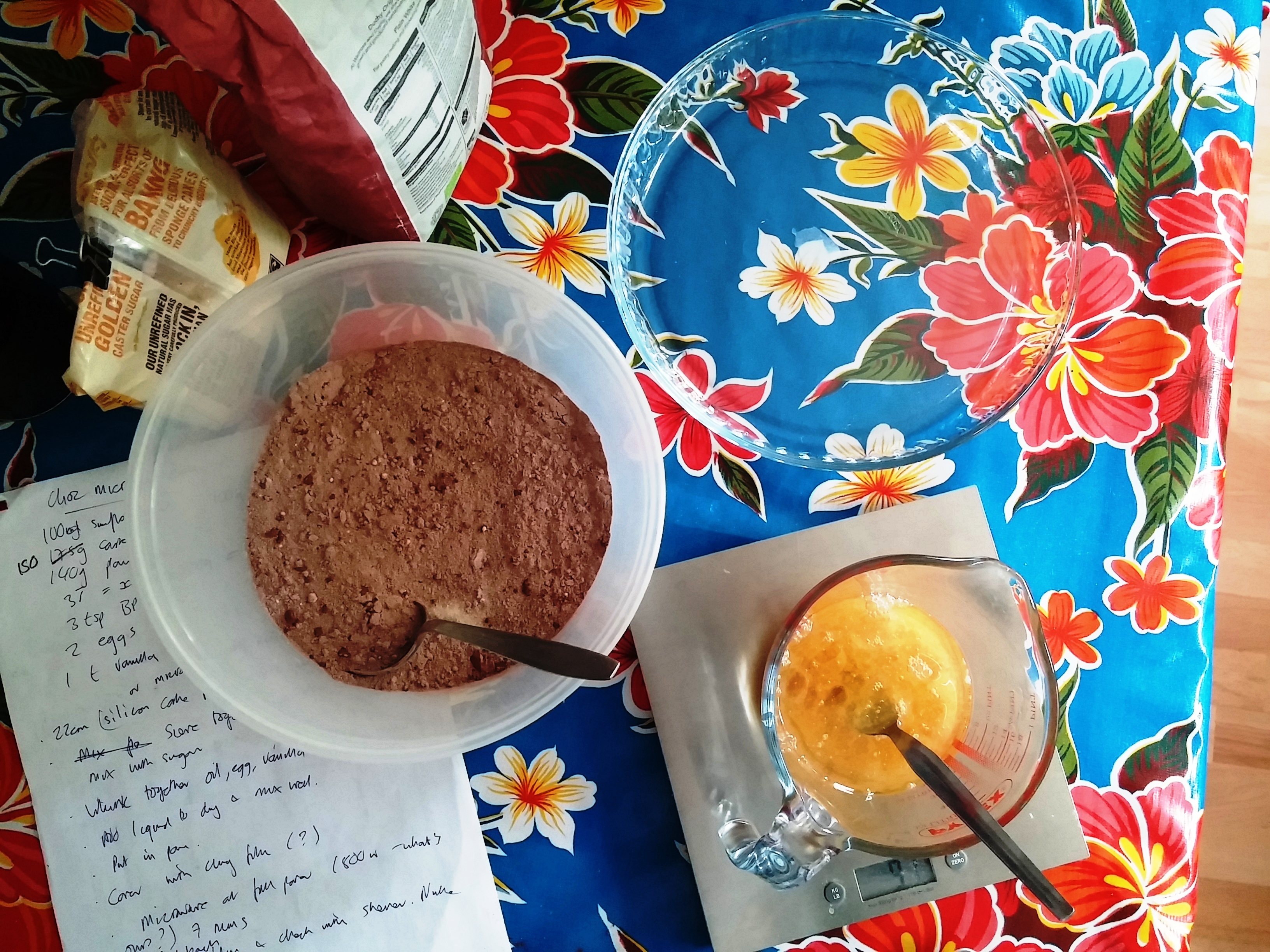
Microwave choc cake ingredients

1. Grease and base-line a 22cm microwave-safe cake container. This could be a glass dish or a silicon cake pan.*
2. Sieve the flour, cocoa and baking powder together into a mixing bowl.
3. Stir the sugar into the flour mix.
4. Whisk together the sunflower oil, hot water, eggs and vanilla essence in a jug.
5. Pour the liquid mix into the dry mix and combine well to break down any dry lumps.
6. Pour the batter into the prepared pan or dish.
7. Cover with clingfilm (aka plastic wrap). This is the bit that freaks me out. Making a cake? With heat? With plastic?

Before cooking - cover with plastic
8. Put the pan or dish in the microwave and hit it at max power. Time will depend on your microwave. Mine is 700W, and it took seven minutes. If yours is 800W max, it may only take 5 or 6 minutes. Peel back the plastic and check with a skewer to see if the cake is cooked fully. If not, nuke it a bit more.
9. Remove from the microwave and allow to sit for about five minutes.

After cooking - remove plastic
10. Run a palette knife around the edge then turn out and allow to cool completely.

Slice

11. Decorate with ganache, or apricot jam and melted chocolate and butter like a sachertorte. Plain like this (above) it’s a bit dry.


* I tried to buy the latter, a silicone cake pan from a brand called Zeal. Unfortunately it didn’t say whether it was microwave-safe. I assume it would be, but don’t know enough about microwaving to be certain. So I didn’t buy it. I’ve emailed the Kitchen Innovations, the company behind the Zeal brand, but they’ve not replied. Got to love a brand that communicates with its potential customers.

2 Comments

Filed under Cakes, Misc, Recipes

Gooseberry and thyme cake

Slice of gooseberry thyme cake

We’ve not had a kitchen for just over a week now. We’re having building work done on our house, and although the original plan was to only remove the kitchen half-way through the three-month schedule, on the first day the builder turned to me and said it’d be better if they did it straight away. Immediately. Post-haste. Subito. Or at least the day after.

So I baked my final cake and final two loaves of bread, then set about removing the units. It was a hideous kitchen, and far from practical, but not having a kitchen at all is, to say the least, even less practical. Only so much baking I can do with a kettle and a microwave. Indeed, I never really use microwaves for anything other than softening butter for making cakes, so I don’t know what else you can do with them. Apparently you can “bake” in a microwave, but I can’t really imagine how. Not in a metal cake tin – unless I actively want to add exploded microwave to the chaos.

Just before the demolition started, I was moving some shrubs from the area where we were building. One of these was a much-neglected gooseberry bush, which, despite being basically in the shade, had managed to produce a fair crop, just shy of a kilo. So that final cake had to involve gooseberries.

Now, I can’t say I’m a huge fan of the “spiny grape”, as it’s called in Italian (uva spina). I used to eat them when I was a kid in the 1970s and early 1980s, but I have a feeling they’re slightly out of fashion these days. Despite how popular “retro” and “vintage” may be, I don’t hear people talking excitedly about gooseberry fools, an old-fashioned British summer recipe.

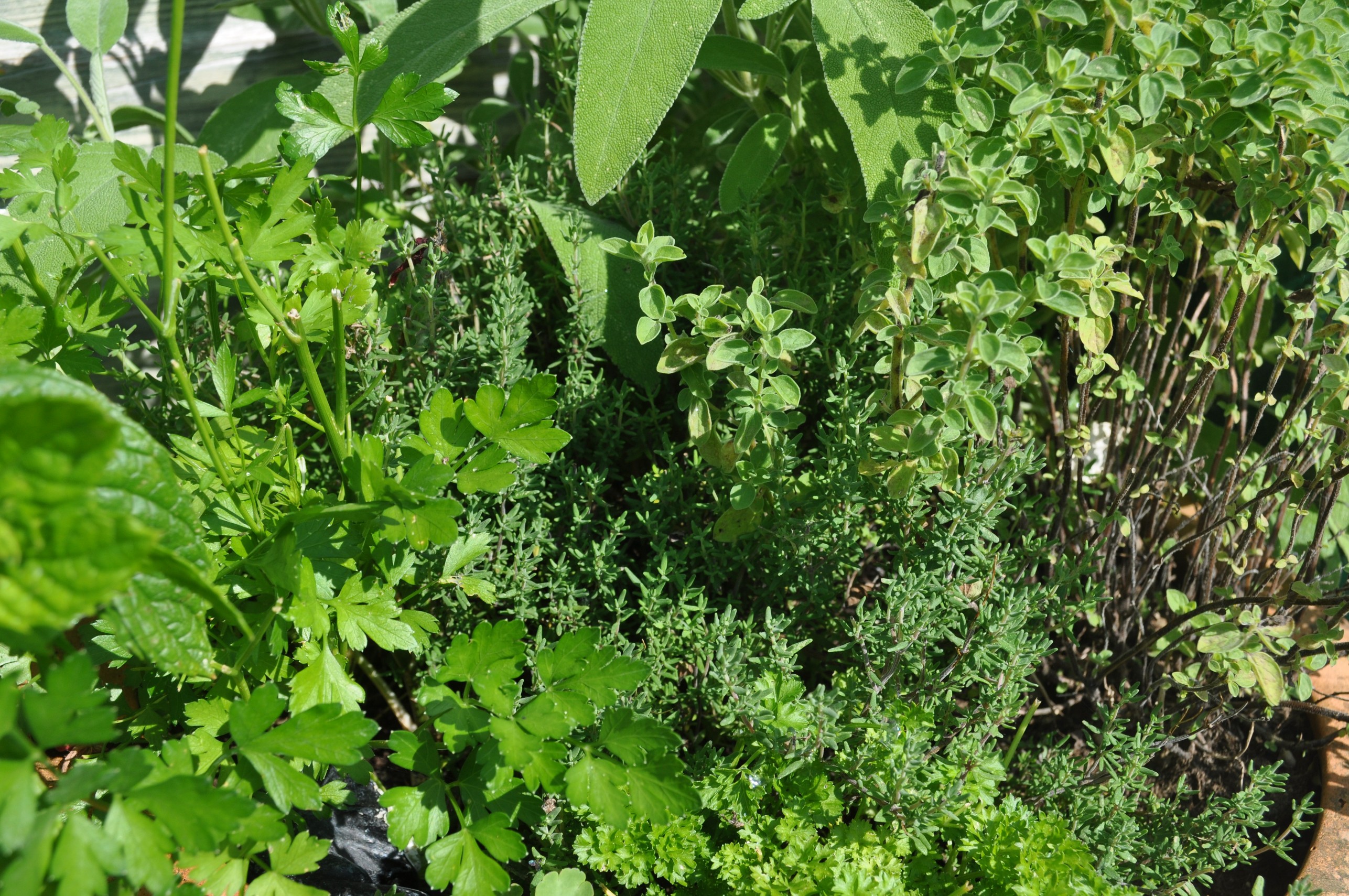
I can suffer a fool, gladly, but rather than just defaulting to using the gooseberries to make one, I wanted to try a cake. I found some good recipes from both Nigel Slater and Diana Henry, two cookery writers who are proponents of great British produce. Henry had one featuring thyme, which intrigued me. Even though I don’t have lemon thyme as her recipe suggests, my own herbs have been doing very well in this year’s shockingly pleasant south of England summer, so I used some good old Thymus vulgaris, common thyme. (Though I think my variety is the French, narrow-leaf, not the English.)

Herbs

Henry’s original recipe can be found here on the Torygraph site. I’ve tweaked it a bit.

The fruit:
350g gooseberries
60g caster sugar

For the cake:
125g butter
120g caster sugar
3 large eggs, lightly beaten
2 tsp thyme leaves, chopped (ideally lemon thyme)
1 lemon
100g plain flour, sifted with
1t baking powder
75g ground almonds

For the syrup:
50g granulated sugar
2 large lemons, juiced [I used 1 lemon, 1 orange], about 100g juice
2 small sprigs of thyme

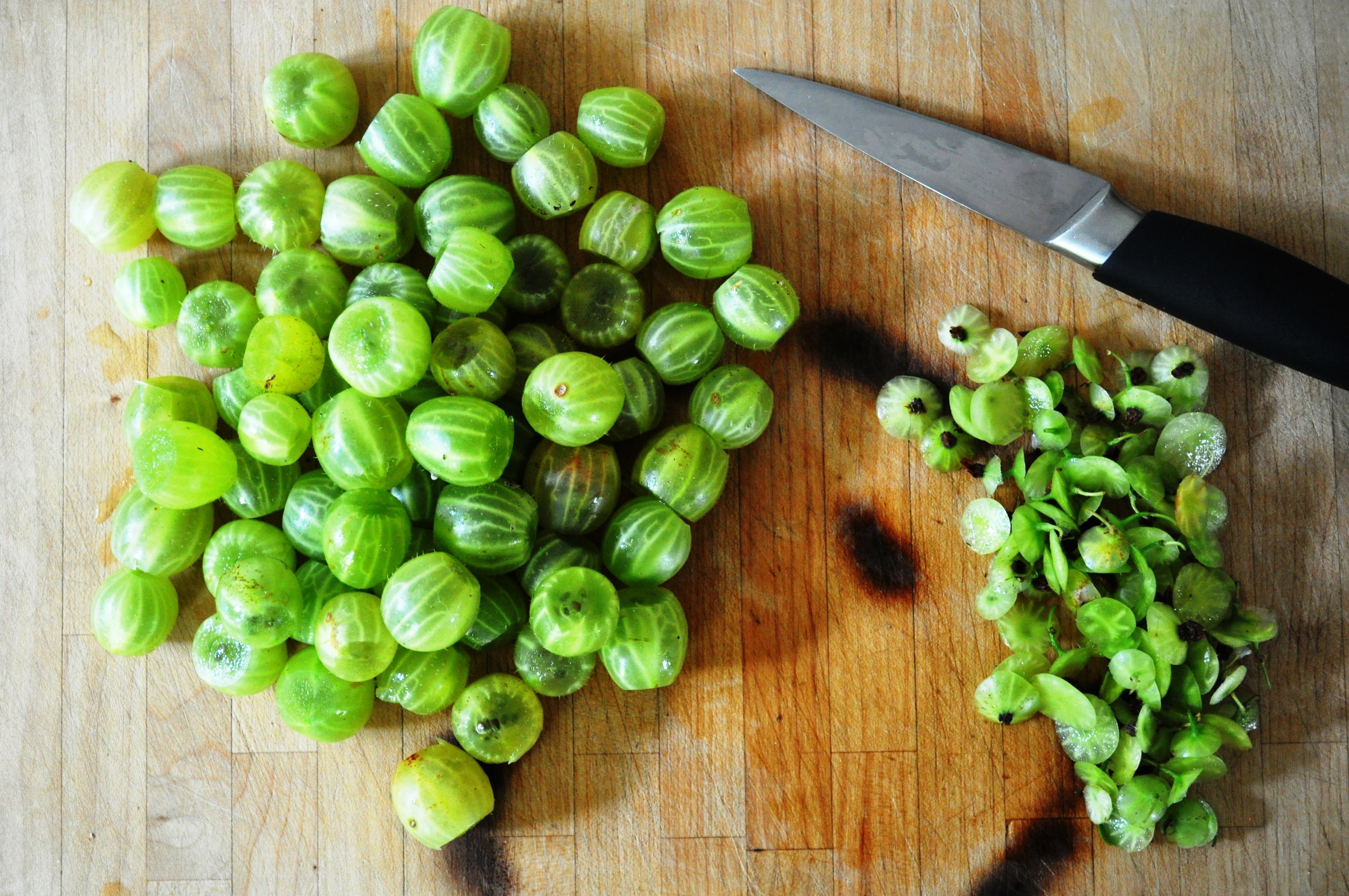
Top & tail

1. Preheat the oven to 190C.
2. Grease and base-line a 20cm spring-form cake tin.
3. Top and tail the gooseberries then toss with 60g of caster sugar and leave them to macerate slightly.
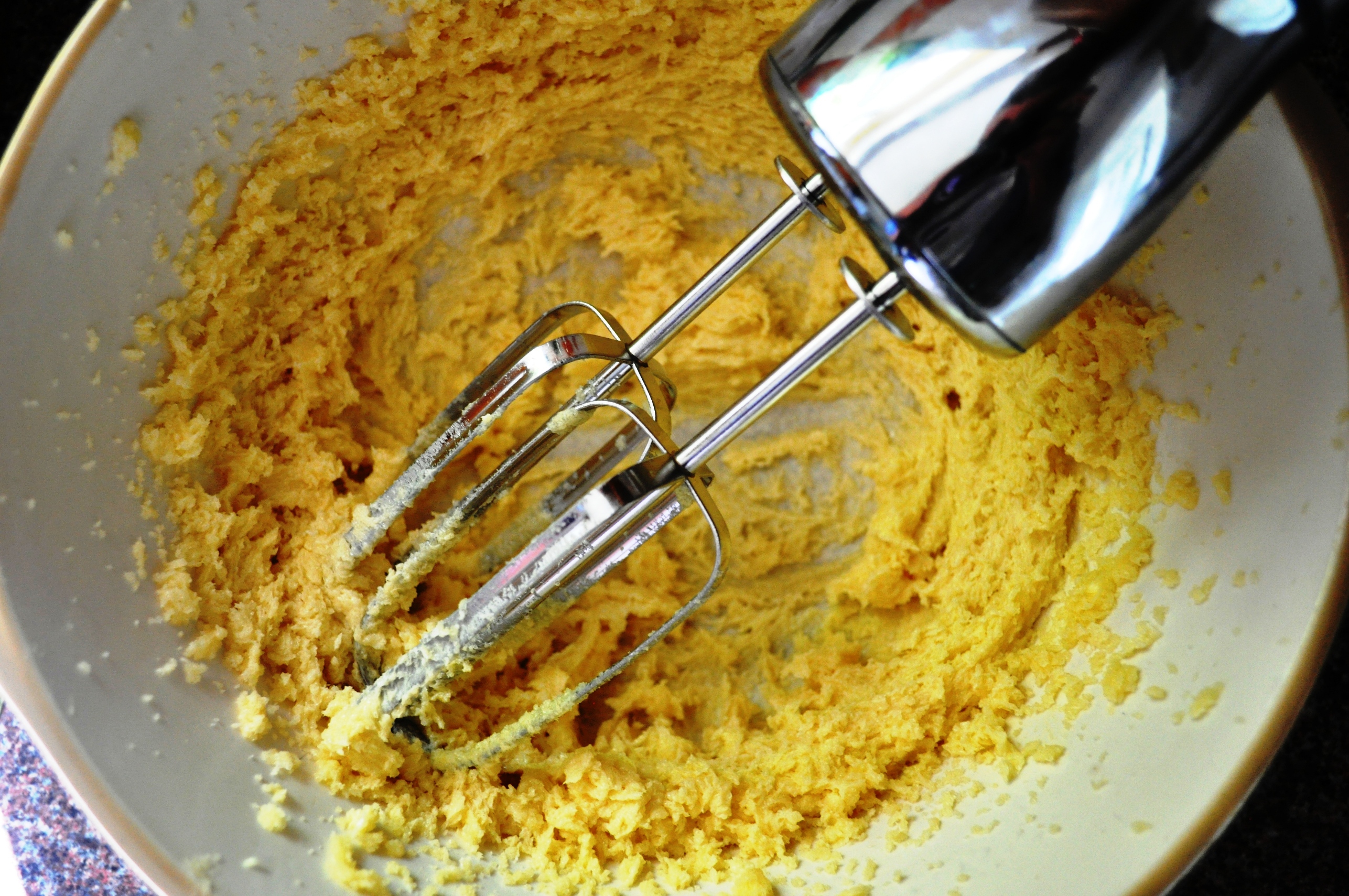
4. Beat the butter and 120g caster sugar until pale and fluffy.

Creaming
5. Add the egg a little at a time, beating well after each addition. If it curdles at all, add a little flour.
6. Finely grate the zest of the lemon. I also used some orange zest. Just cos. Finely chop the zests together with the thyme to free up all those lovely essential oils.

Zest and thyme chopped together
7. Add the zest and herbs to the batter and combine.
8. Sieve in the flour and baking powder, then fold to combine, along with the ground almonds.
9. Spoon, pour and scrape the mixture into the tin.
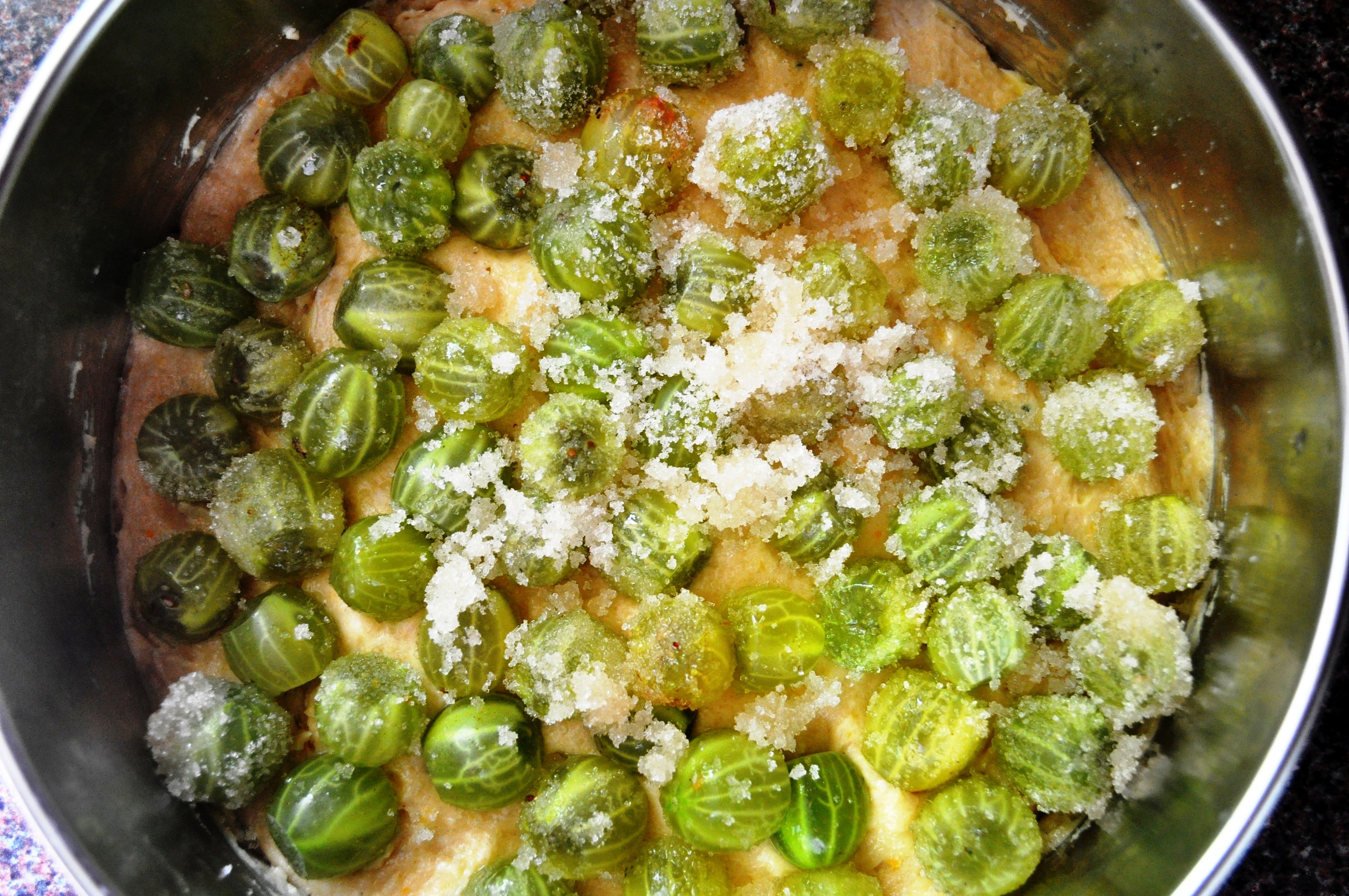
10. Spread the gooseberries over the top of the mixture.

Add fruit
11. Bake for 45 minutes and test with a skewer.

Baked
12. While the cake is still warm, make the syrup by dissolving the sugar in the lemon juice, with the thyme.
13. Pierce the cake with a skewer then pour over the syrup, removing the sprigs of thyme.
14. Leave to cool then serve. You can just with icing sugar, and serve with crème fraîche, cream or ice cream.

Henry also has another one here, with flaked almonds. I think that could be nicer as the crunch of the almonds would contrast with the eyebally squish of the cooked fruit. Next year perhaps. Or perhaps Slater’s recipe, which involves a kind of crumble. Or perhaps I’ll just revisit the fool.

8 Comments

Filed under Baking, Cakes, Recipes