
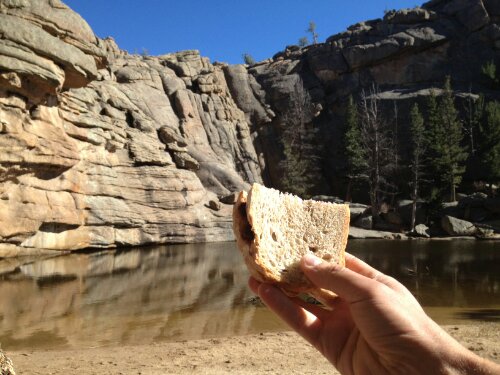
My second loaf of bread in the US. Stood us in good stead for a picnic lunch at Gem Lake, near Estes Park in Rocky Mountain National Park.
My second loaf of bread in the US. Stood us in good stead for a picnic lunch at Gem Lake, near Estes Park in Rocky Mountain National Park.
Filed under Breads, Travelling
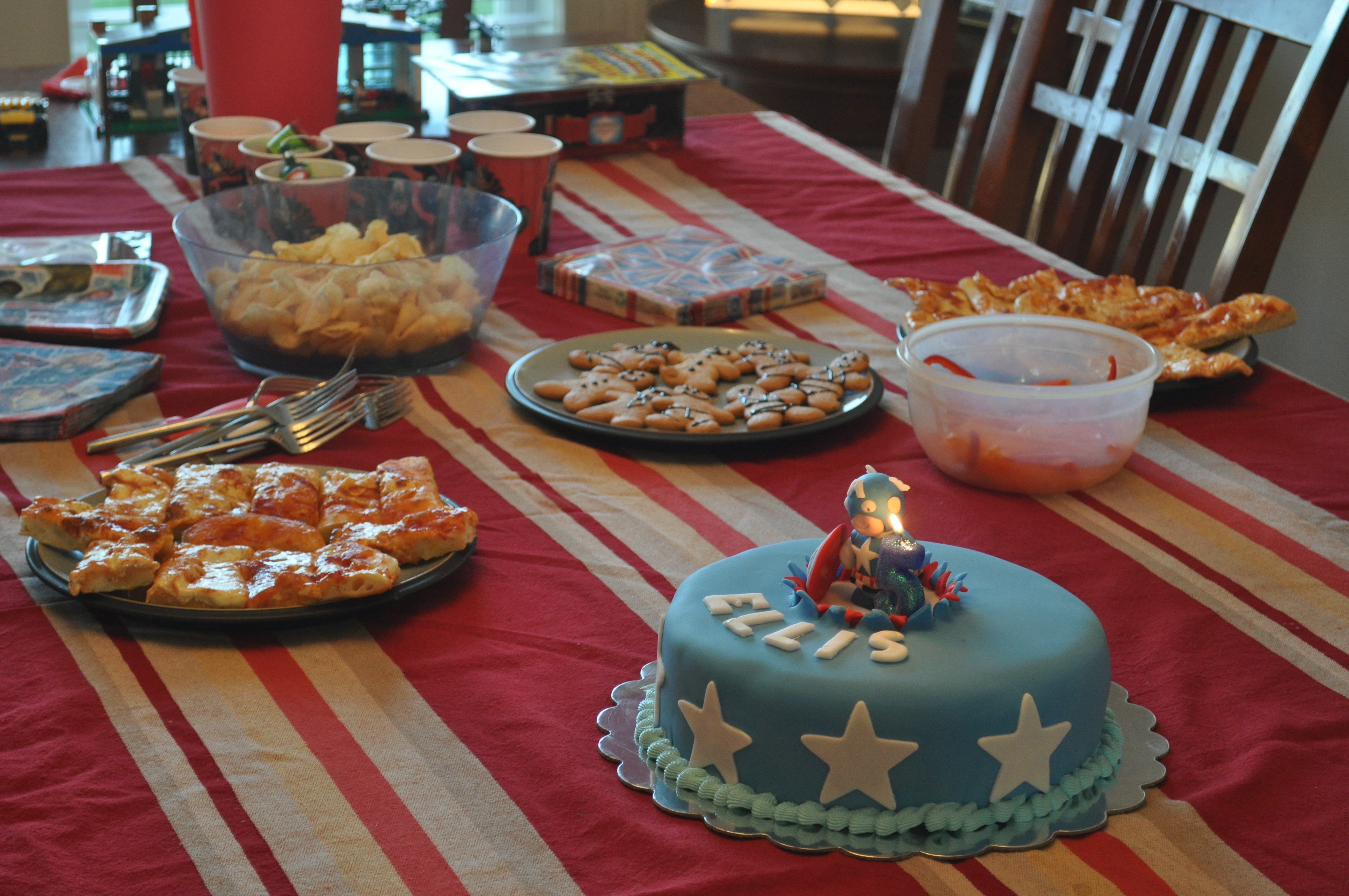
Our young nephew Ellis turned five on Monday. He’s a little bit obsessed with superheroes, particularly Captain America. He spends a lot of time in a Captain America outfit. He must be the only Captain America with an English (/slightly Welsh/slightly midwestern) accent.
Although I’m really not a cake decorator, and I really really really don’t like artificial food colourings, I couldn’t say no when sister-in-law Sharon said we had to make Ellis a Captain America birthday cake. Especially as I’m a big comics geek.

This involved a late-night session making one of those cake-dec bobble head figures. It was a collaborative effort: I did the head and some trimmings, Sharon the body, Fran the shield. We were all quite pleased with it. Partly as it was fun to do, but partly as our Captain America is amusingly portly, like he’s retired and taken to the beer. Even his belt and the stripey part of his costume looked more like a girdle or corset. Oh, and we’d had a little booze too: the girls on local Missouri wine from Pirtle in the historic town of Weston, me on beer from Boulevard Brewing Co in Kansas City (which is also in Missouri, mostly).
Really enjoying their bottle-conditioned beers. (I’m drinking one now too.) Like the sound of the brewery too. “Boulevard’s mission is simple: to produce fresh, flavorful [sic] beers using the finest traditional ingredients and the best of both old and new brewing techniques.” That’s what I like to hear.
Slightly bemused that US beers seem to have to carry the government health warning but don’t have to include the ABV on the bottle though.
We’ve tried Boulevard’s Unfiltered Wheat Beer, which is 4.4% according to the site, and surprisingly mellow for a wheat beer. Apparently it’s also the “best-selling craft beer in the Midwest.” Their 5.5% Pale Ale, meanwhile, is also pretty mellow, but with a really well balanced hoppy tang and caramel maltiness. As for what I’m drinking now – not sure. The brother-in-law said the label came off after a session in the chilly bin/eski/cooler/cool box (delete according to nationality) and he can’t remember; and I can’t find it on the brewery site.

Anyway.
The cake. Although I can’t really eat coloured sugar paste, I made a nice chocolate cake underneath. I used one of my favourite recipes. It’s originally based on a cardamom cake by Mollie Katzen of Moosewood, but it’s such a great recipe it can be varied according to inclination and occasion. Here’s a metric version of the original US recipe on Cake-off, a site I used to do with my friend Jo. The chocolate version I did left out the nut mix, and replaced about 50g of the flour with cocoa. I also added some finely chopped dark chocolate. It’s such a good cake: dense but moist.

For the party we also did some pizza. This was an interesting challenge, as was making a loaf of bread later on. Like when I first moved to Italy, I find myself in a country where the types of flour, and their packaging, are entirely unfamiliar. And here a lot of the flour is made with GM grain. At least a badge that indicates the non-GMO options seems to be a legal requirement.

A lot of the flour, sadly, is also bleached, and packed with gratuitous additives. Still, there’s also some organic available – even in the dreaded Walmart, that poster child for the problems of the industrialised food chain and a place I visited for the first time this week.
Perhaps more problematic in practical, rather than ethical, terms, however, was the way the packages labelled protein content – there was no percentage. So I really couldn’t get a great sense of what was a high protein bread flour. Still, Fran did a sterling job of making pizza dough… until we baked it and managed to totally burn the bottom of one. Our oven in Rome similarly had very fierce bottom heat, but Sharon was possibly even worse; never mind any confusion from being faced with ye olde daffy Fahrenheit after years of using nice sane Celsius.
Still, it all went off well. The cake was a hit with Ellis and the kids; the (unburnt) pizza was avidly consumed, with several of the other ex-pats here being very appreciative of a freshly baked bread product; and me and Sharon even managed to make a decent wholewheat tin loaf too.
Oh cripes. Another rambly post. I’m sorry. I’m not sure I’ll get any structure or succinctness back into this site until I’m settled back in England at the end of the year…
 BK as in Brooklyn, not in the De La Soul, junk-food sense.
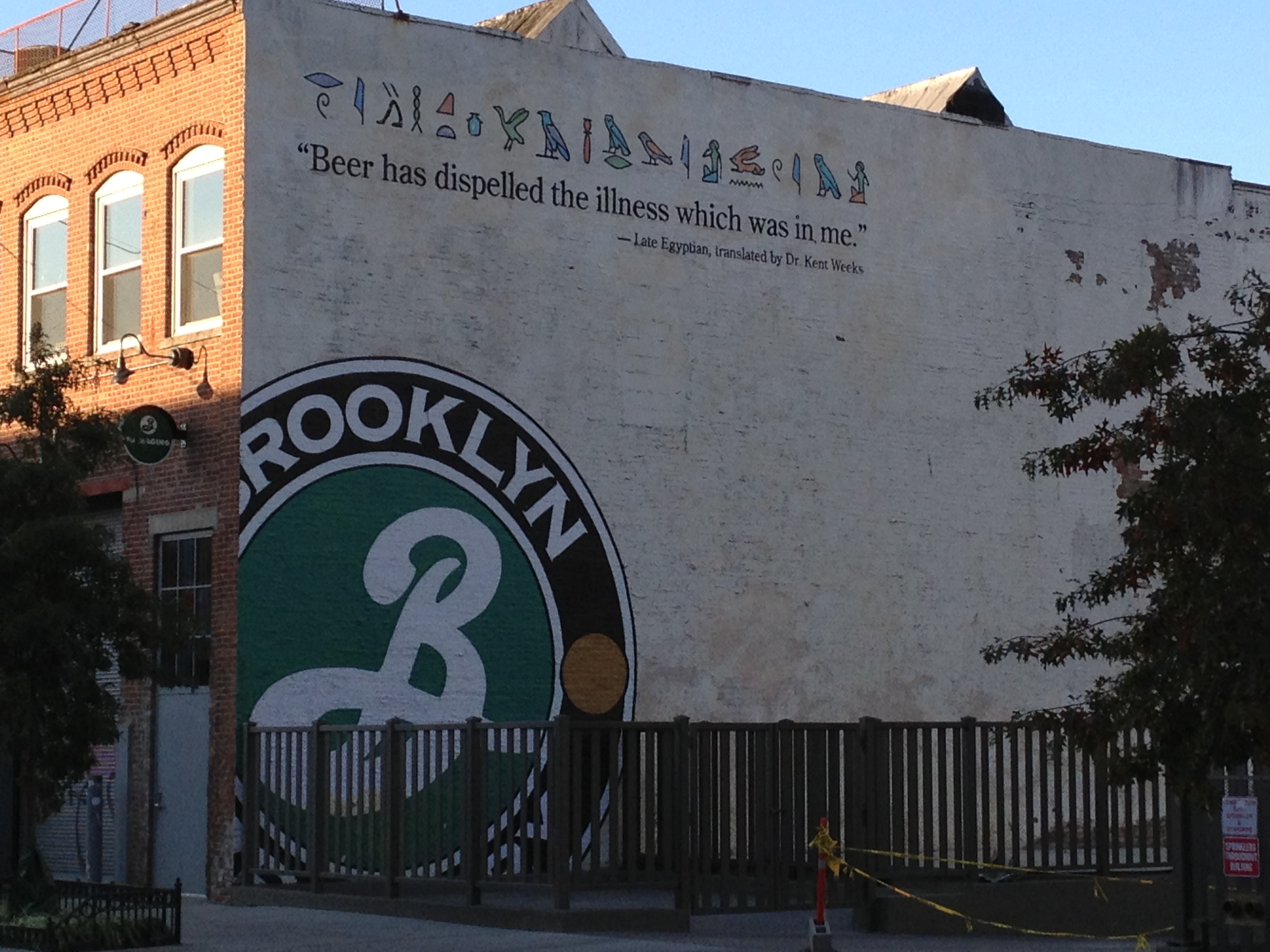
After a few days in Manhattan we went east to deepest Bed-Stuy to visit Emma, one of my oldest friends, who lives there. She took us on a tour to her old stomping grounds in Williamsburg, which included a stroll by the renowned Brooklyn Brewery, whose wares I was trying my best to sample as much as possible.

I was very pleased to see that something I’ve been saying quite a lot recently was also painted on there wall of the brewery and attributed to American poet John Ciardi: “Fermentation and civilization are inseparable.” Yep. As mankind began to settle, and leave behind hunter-gathering, and build, it also began to ferment: honey for mead, grapes for wine, and of course grains for bread and beer. (Never mind all the rest: from yogurt to sauerkraut.) Our relationship with yeasts, etc, helps give paramters to our history.
We didn’t try to rush around all the borough’s best beer bars, but we did enjoy some pleasant brews. Well, I did; Emma insists on drinking industrial Pilsner, for her sins.
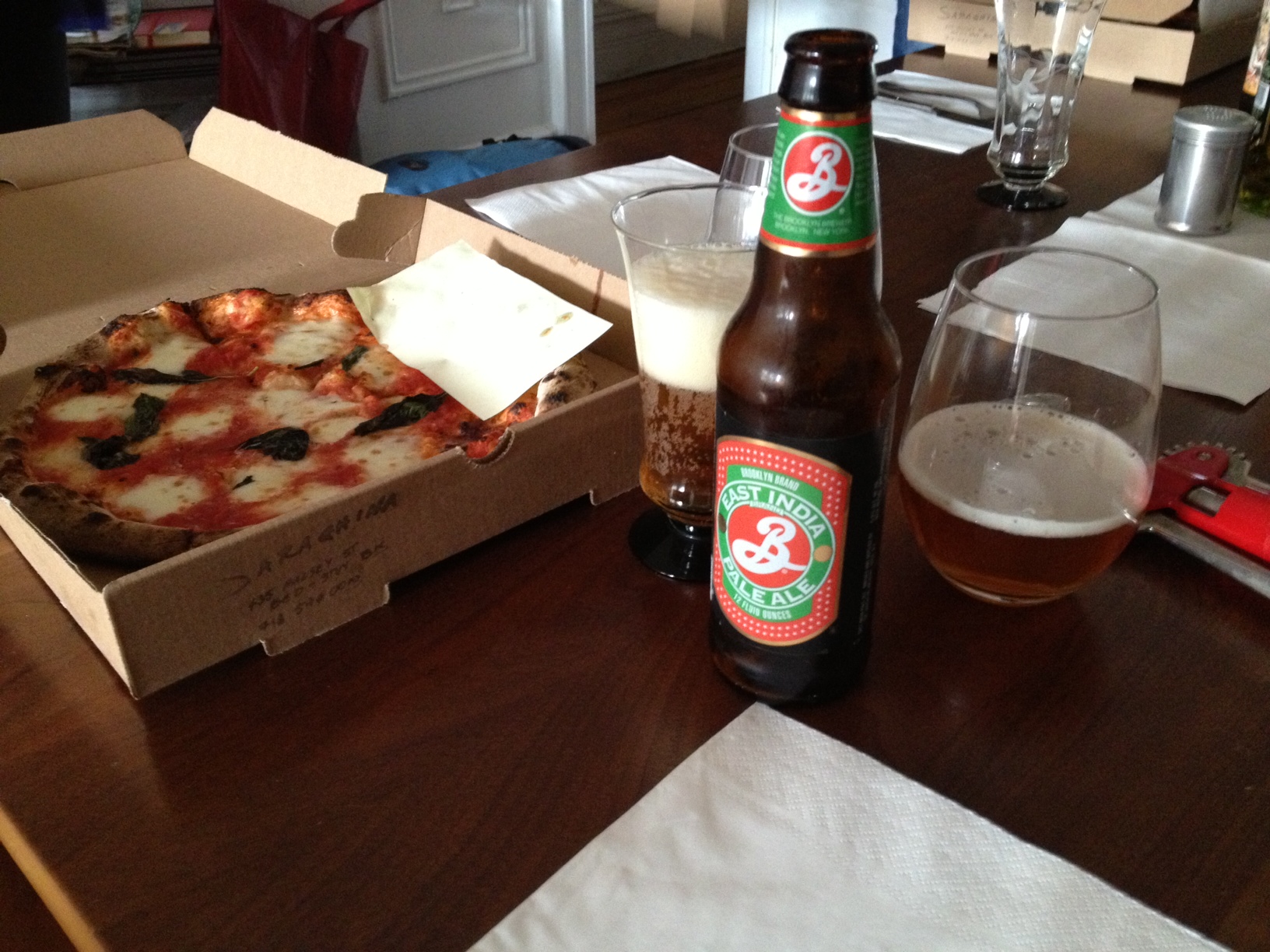
During a day or so I managed to try several of Brooklyn Brewery’s beers, and very much enjoyed their Brown Ale and IPA. The most interesting beer we had, though, was probably when we went to collect some pizza from Saranghina, a great place in Bed-Stuy (435 Halsey St, NY 11233).

We got talking to Bryan (Brian?), the guy on the bar, and I kinda regretted my dedication to trying to be a Brooklyn beer locavore. All they had was the Brooklyn Lager, which was pleasant as lagers go but no great shakes. Instead, the best beer they had was a fascinating brew from Germany called… I don’t know what. I didn’t have my notepad, didn’t write in the phone and can’t for the life of me read the daffy German font on the bottle’s label.
Bryan explained it was put in the lagering tunnels and left uncovered, allowing further fermentation with wild yeasts. It’s then bottled or casked unfiltered and unpasteurised and is rich in B vitamins (from the yeast).
It really was nothing like any other German beers I’ve ever tried, a little malty, but also sharp, and a tad sour. Even Emma liked it.
Thankfully, with Fran’s patient deduction and the power of Google, we’ve found it again. It’s from Mahrs Bräu in Bamberger and it’s called Kellerbier (which I’m assuming means “cellar beer”) Ungespundet Hefetrüb (which I’m going to ask my German-speaking dad to have a crack at translating).
So all in all, a great visit to Brooklyn: some good beer, and a great catch-up with an old chum, and a chance to meet her grandly monikered new bairn. Now, however, we’re in Kansas, and today found ourselves walking part of the Lewis & Clark trail in the beauty of the Missouri autumnal leaf fall, then doing some tasting of local Missouri wines, and then beers. In my shocking ignorance, I didn’t even know about Missouri wine, but apparently the state is the US’s second biggest producer after California. Well I never.
Filed under Ale, beer, American beer, Travelling
Last week we were in Rome, a few days ago in my home town, Winchester, then we had a night in Hounslow, way west London. An unprepossessing area, perhaps, but we had a great curry at a place called Mantra, all enormous chandeliers, mirrored walls and lighting that phased through various colours, disconcertingly changing the pallor of Fran and our friend Nick as we chewed and chatted. I’ve never before experienced this blend of south Asian kitsch and east European mob (the waitresses were intimidating eastern blondes).
Now, however, we’re in New York, one of the greatest cities in the world despite the ennui of the guy in the Saint James stripy Breton shirts shop and the strange sense of synthesis and deadness in parts of Greenwich Village where no one seems to live anymore but you can spend $700 on a Barbour jacket that would cost you half as much in London.
We started the day yesterday with the worst croissant I’ve ever had and coffee Fran said was “vile”, but it got better. Before going to a Swedish shop playing 80s British music (Joy Division and Sisters of Mercy) in Little Italy, I had a good sfogliatella at Cafetal Social Club. This was a nice bit of continuity as I’ve enjoyed these pastries in Naples (their home) and Rome the past month or so.
The rest of the day involved a visit to an excellent produce market in Union Square and walking the length of the High Line, the wonderful linear park that rehabilitates a section of old raised railway, and a younger cousin to Paris’ Promenade Plantée. Along the way, there was even a stall that sold Zuppe and Biscotti, two of the books from the American Academy in Rome’s Rome Sustainable Food Project – another nice bit of continuity from the life I’ve just left behind.

We subsequently got down to the serious business of sampling some US craft beer. The Blind Tiger Ale House in the West Village was having a Pumpkin Fest with Elysian Brewing, in Seattle, celebrating the new season’s pumpkin ales. Pumpkin ales are a big deal in the US, but previously the only one I’d tried was Italian brewery Baladin’s Zucca; I’ve never seen them in the UK, though British craft brewers are also getting in on the act now.
We tried four, and I must say, I found three of them a bit tricky, and one of them borderline disgusting. It was a great bit of cultural learning, but Elysian Night Owl, a 5.9% ABV pumpkin ale was just too nutmeggy for me, too much spice, cinnamon, ginger, cloves, allspice, to the point where both the more typical flavours of beer – hops and malt – along with any sense of pumpkin were obliterated. Fran identified a smell that recalled tea tree but I can’t say this made it any more palatable.

Fran tried a couple of the dark pumpkin ales, Elysian Dark Side of the Moon (6.5%) and Kuka Pumpkin Porter (7.6%). The latter was from a lot more nearby, with the Kuka Andean Brewing Company being based in Rockland County, New York state. The former had a lot of the Christmas pudding spice flavours going on, along with liquorice, orange chocolate (like Green & Black’s Maya Gold), ginger cake. The latter meanwhile, she said, smelled “a bit like garbage”, rotting veg, cabbage, but was much more balanced flavour-wise, with some pepper, liquorice and smokyness but not so heavy on the Xmas spices.
A helluva lot nicer was the Elysian Hop Squash, where any Christmas pudding spice overload was replaced instead by a serious floral, crisp hoppiness from Sorachi and Motueka hops. The pumpkin came through in a touch of buttery body. Of the four we tried, this one was much my favourite.
I’m not sure about this whole pumpkin ale lark – if there was more overt vegetably pumpkin flavour, sure, maybe, but they all seem much more like pumpkin pie ales, with a lot of sweetness and some serious heavy-handedness with the nutmeg, cinnamon, ginger etc.
Before the jetlag totally floored us, we headed further west again and went to The Spotted Pig, a notable location for its coat of plants and trees, potted along the pavement, cascading from the windows. I really liked this place – it successfully combines the feel of a transported, tweaked British pub with a New York restaurant. Whereas when many British pubs get gastrated, the results lose the quintessential pubbiness, this place gets the balance just right. Feels like a pub, but offers you a (not too formal) restaurant experience.
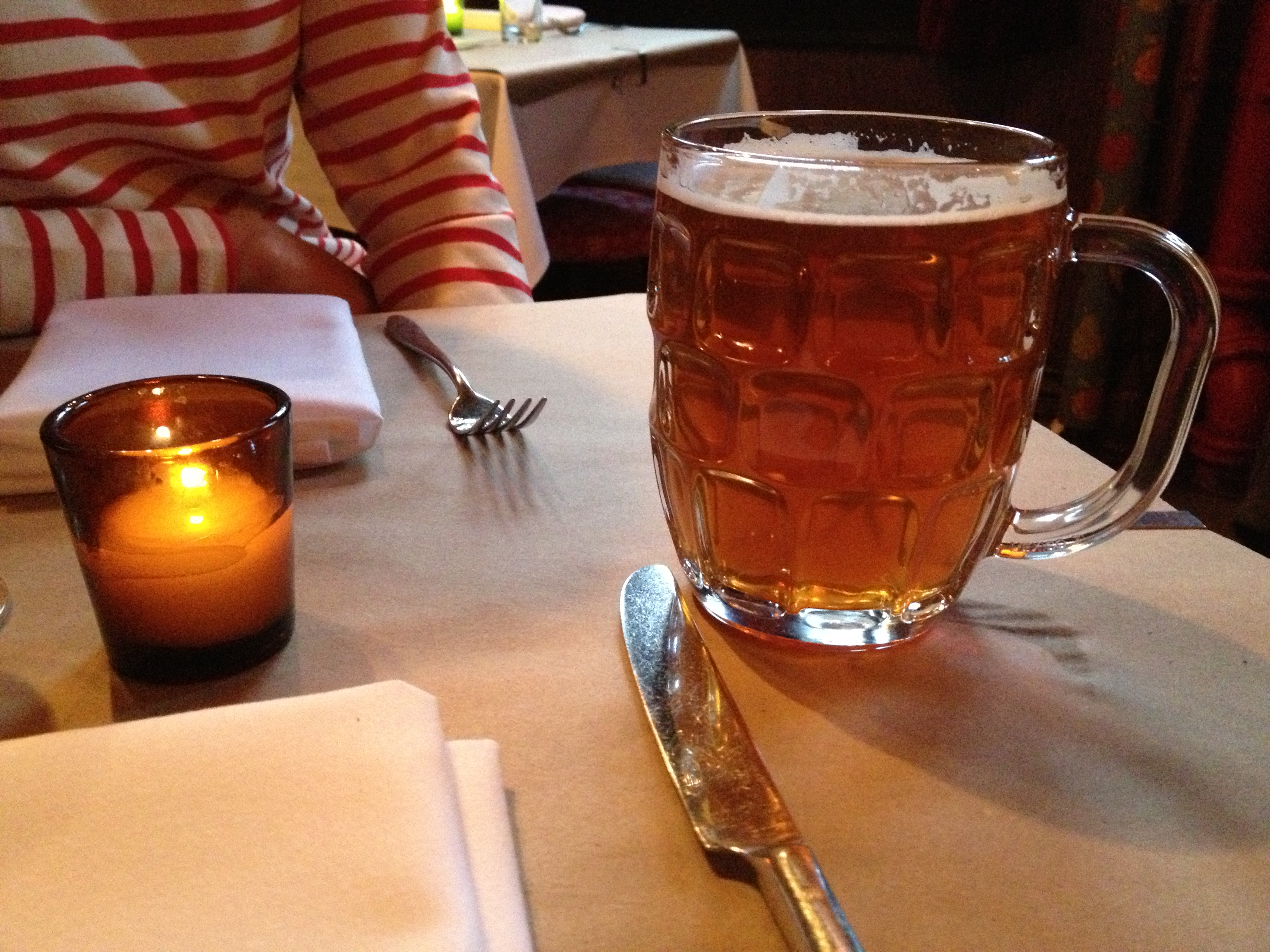
They even have a decent selection of beers, bottled, keg and cask. The latter – served in handles – included their own Spotted Pig Bitter, which Fran said “smells of new shops”. It’s a sweet, malty, fruity brew, with very low carbonation, no head and a medium body. It’s pleasant, but a kind of stereotype-confirming version of flat, warm English bitter, brewed by Brooklyn Brewery. The other cask ale was Snake Dog IPA, from Flying Dog Ales in Maryland. This was much hoppier, with an almost metallic taste and something that made me think of (delicious, nutritious) stinging nettles.
The Spotted Pig also came with another connection to our old life in Rome. The chef and co-owner, April Bloomfield, is English and trained at The River Café in London before also doing a stint at Chez Panisse, in Berkeley, famously founded by Alice Waters – who also set up the Rome Sustainable Food Project.
We continued the local, seasonal food theme with our lunch today, at Cookshop on 10th Avenue, not far from the midpoint of the High Line. I’ve been becoming increasingly passionate about local, seasonal food the past decade and a half, but after my stint at the Academy, and living in Rome generally and trying to buy as much of our food as possible from the farmers’ markets, I feel strangely freaked out now when I encounter out of season produce: it’s just started to feel so profoundly wrong. I can’t quite explain it, but imported out of season, produce has started to repulse me as much as heavily industrially processed food. My mind and body react badly, crying out why, WTF is this? It’s Autumn, why are they offering asparagus (or whatever)? How far has that travelled?!
Really, if you genuinely care about food that’s healthy for you and healthy for the environment, local, seasonal food is the only option. (I’m no saint though, so of course I eat badly sometimes; plus, well, we’re off to the Midwest in a few days, and I get the impression it can be quite hard to find real food there, so I’ll either go hungry or have to eat stuff from the industrial food chain.)

Anyway, the food at Cookshop was excellent, but they also had some great craft beers. I had a Resin from Sixpoint Brewery in Brooklyn. I was slightly disconcerted by the can, being more used to bottle-conditioned real beer, but heck, why not? This was a great beer – a celebration of the hop, and hop resin, at 9.1% ABV and 103 IBU (International bitterness units; broadly, 30 IBU could be considered an average bitterness). It was both intensely floral and warmly earthy, with a very crisp, dry mouthfeel.
Fran, meanwhile, had Scythe & Sickle from Ommegang, based in Cooperstown, upstate New York. If the US Midwest these days is defined by its industrial maize production, the Autumn 2013 seasonal Scythe & Sickle (5.8%) is a celebration of the old world grains traditionally grown in the northeast: it contains not just barley, but wheat, oats and rye too. It’s lightly malty, with a smooth sweetness that… despite the wholesomeness of this endeavour perversely reminded me of 1970s childhood sweeties.
So, all in all, despite not knowing NYC, and being half-dead from the cumulative effects of moving house, flying, London, home, then flying across the pond, never mind being increasingly unequivocally middle-aged, we’ve managed a pretty good few days of food and booze.
Oh, and excuse me if this is even more rambly than usual. My own laptop is too big to take travelling, so I’ve been bodging this copy together trying to get used to a tiny keyboard for my tablet, as well as getting my head around Fran’s infuriating old Mac (seriously Macaholics – iPhoto? Really? Can you really, honestly and genuinely make an argument for that software exemplifying Apple’s purported ease of use and intuitiveness?! And enough Ken Burns already!)
Info
Cafetal Social Club
285 Mott Street, New York, NY 10012
+1 212 966 1259 | cafetalsocialclub@gmail.com | cafetalsocialclub.com
The High Line
West Side Manhattan, New York
+1 212 500-6035 | info@thehighline.org | thehighline.org
Blind Tiger Ale House
281 Bleecker Street, New York, NY 10014
+1 212 462 4682 | blindtigeralehouse@gmail.com | blindtigeralehouse.com
The Spotted Pig
314 W 11th Street, New York, NY 10014
+1 212 620 0393 | info@thespottedpig.com | thespottedpig.com
Cookshop
156 10th Ave, New York, NY 10011
+1 212 924 4440 | cookshopny.com
Filed under Ale, beer, American beer, Bars, pubs etc, Restaurants etc
We finally left Rome on Wednesday. The flat was scoured, the kitchen was re-cluttered with the piles of stuff belonging to our landlady that we’d stashed in the basement, and, well, the place didn’t really look very different. It was sad to leave Rome, but it wasn’t exactly sad to leave that flat, where we always felt besieged by the other denizens of the palazzo: mad, sad or just pretty unfriendly to know. And all of them shouters, barkers and door-slammers.
One final, expensive international-house-move hiccough happened when we tried to check in our bags at the airport. We’re not naive, and understand perfectly that budget airlines make their money by hitting you from all sides with extra ways, many unexpected, to help you part with your cash, but EasyJet’s luggage policy is especially dubious. We didn’t think to question that spending money to carry extra luggage meant you were spending money to carry extra weight. That’s a logical assumption. You’re paying for the extra weight, right? Um, no – you’re paying simply to have the option to spread your luggage between more bags. So one hold bag: 20kg. Two hold bags: 20kg. Eh?
We’re both pretty web literate, but this info isn’t exactly front and centre on the site when you’re booking; it’s stashed, to help encourage punters to make this costly mistake. Being told we had to pay several hundred euro extra there and then before our clobber would be added to the flight was a shocker.
Oddly, carry-on has “No weight restriction applies as long as you can place and retrieve the cabin bag safely in the overhead lockers without assistance.” I’ve always treated carry-on as a means of transporting my passport and my reading matter, not being one of those people who blocks up boarding and disembarking. So yeah, I suppose I am naive. And the bank account is somewhat lighter too. Ouch.
Still, at least our arrival in Blighty was fairly painless; if British railways’ gulp-inducing prices could ever be considered painless. (No they can’t – they’re a national disgrace, each year leaping ahead of the rate of inflation with undisguised exploitative neoliberal glee.) Struggling with our marginally hefty, now somewhat highly priced luggage, we went into London then out again to our old hood, Herne Hill, where we met the friend Becca, who, with husband Ceri and daughter Angharad, is looking after our cats, who survived their road trip from Rome.
A taxi took us to their house, and a reunion with the beasts in question, Lux and Pip. They’d settled in well. Further reunions followed when we headed further into deepest sarf London and Honor Oak. Some were of the human variety, with old friends Jo and Lawrence and their somewhat enlarged, considerably more articulate kids, and some were with beer.
This isn’t a blog about child development though, so I’ll stick to the latter.

We went to a tapas place called Donde, where they had Meantime London Pale Ale and London Stout on tap. Founded in 2000, Meantime was on the first of the new generation of London breweries I drank their products a reasonable amount before we moved out of London in 2011, and always enjoyed them. Although I enjoyed my pint of London Pale Ale, it struck me as somewhat generic and decided over-carbonised; the latter is partly because it was keg not cask. The former is – I don’t know – perhaps it’s one of those cases where a traditional brewery has got so successful and grown so much that the product, while still good quality, has lost its distinction.
Sure they still exemplify a continuity in the great brewing traditions of London, but with a more industrial approach. They, for example, had a relationship with supermarket chain Sainsbury’s to make some of their own-branded beers. I’m really not sure about this. Surely something as avowedly authentic and artisanal as traditionally brewed beer shouldn’t really cosy up with something as antithetical to all things artisanal, local and traditional as a corporate supermarket.
I really can’t decide what I think about all this. Do success and scale implicitly go hand in hand with a compromise in quality?
It’s something I’ve thought about a lot through two years of enjoying Italian craft beers, especially given that a friend, Michele Sensidoni, is master brewer at one of Italy’s biggest craft breweries. A brewery with an output that some in Italy won’t even acknowledge as “artigianale” (100,000hl / 6,097 UK barrels / 8,547 US barrels – big for Italy, but tiny by US or multinational standards). I talked about Michele’s brewery here, then went on to discuss this question of what defines craft beer: for me, with fermented products like bread and beer, time is one of key factors. Not rushing. Michele doesn’t rush their beers: they’re bottle conditioned for long periods and remain unpasteurised and unfiltered. He also regularly brews up new tests beers, a very hands-on process.
One such beer was smuggled in the luggage I paid an arm and a leg to transport back to Britain. As such, it’s not only the first of its kind to reach these shores, it also had a pretty substantial relative value, thanks to EasyJet’s €14 per excess kilo. (Yes, €14 – about £12, or US$19. I still need a take a breath when I think about that).

The beer is a stout. As with many of Michele’s beers, it’s made with atypical ingredients. So while there’s nothing new about stout that tastes very chocolaty, this one is specifically made with cocoa/cacao beans. They give the beer a delicious smell of chocolate. The beer itself was pretty carbonised and had a similarly delicious taste of chocolate, well toasted malts, charcoal. I’d want perhaps a little less carbon and a bit more body ultimately though.
We drank the beer over dinner, with Ceri and Becca and the cats, then moved on to a bottle of The Kernel Breweryʼs Table Beer. This added a nice balance to the evening: I started drinking beer from one of the founders of London’s new generation of breweries, said farewell to Italian craft beer in the middle, then continued with one of the big success stories of more recent London craft breweries.
The Kernel was founded in 2009. Sadly, I didn’t even become aware of it until I left London in early 2011, but during my time in Rome its name came up a lot as being at the heart of London’s newly revitalised craft brewing scene. The brewery was part of the burgeoning real food scene in Maltby Street, in Bermondsey, southeast London. Like Meantime, they quickly established a reputation and moved to bigger premises in 2012. I’ve only tried a few of their beers so far, but both have been great.
The Table Beer features The Kernel’s neat, pleasing brown packing paper style labels, where, while completely failing to take a photo, I noticed it was just 3.3% ABV. This was an interesting surprise after so many strong beers in Italy. It’s also a delicious beer, very easy drinking with a floral scent and fresh, citrusy taste. Compared to the Meantime London Pale Ale, this is a thinner kind of pale ale, with less body, but it’s also perfectly carbonised, very drinkable and feels, well, uncomplicated but eager. It’s eager to sit on your table and be drunk along with food in lieu of a table wine.
Now I’m sitting here at the kitchen table in my parents’ house in Winchester, the ancient capital of England. I grew up here, looking out over the hillfort that predated the Roman settlement whose street plan still dictates something of the nature of the contemporary city. Rome itself is about 850 miles or 1370km to my south. It was cold and blue and beautiful this morning, but now the rain is sheeting down and the cliché of English weather is asserting itself.
We’ve got a few days here in Blighty, enough time to do one of the best things this island has to offer: avoiding the rain by going to pubs. Then we’ll be off to New York City, and whatever bread, cakes and ale I encounter there. Just to add to the neatness of Wednesday’s beer consumption reflected my current trajectory, Ceri also opened a bottle of Brooklyn Breweryʼs Brooklyn Lager. In a week or so we’ll be able to try it again, mere miles from where it’s brewed.
Info
Donde Tapas
37–39 Honor Oak Park, Honor Oak, London SE23 1DZ
(+44) 20 8291 2822 | dondetapas.com | share@dondetapas.com
Meantime Brewery
Lawrence Trading Estate, Blackwall Lann, Greenwich, London SE10 0AR
(+44) 20 8293 1111 | meantimebrewing.com | sales@meantimebrewing.com
The Kernel Brewery
1 Spa Business Park, Spa Road, Bermondsey, London SE16 4QT
+44 (0)20 7231 4516 | thekernelbrewery.com | contact@thekernelbrewery.com
Filed under Ale, beer, Breweries, British beer, Discussion, Italian beer
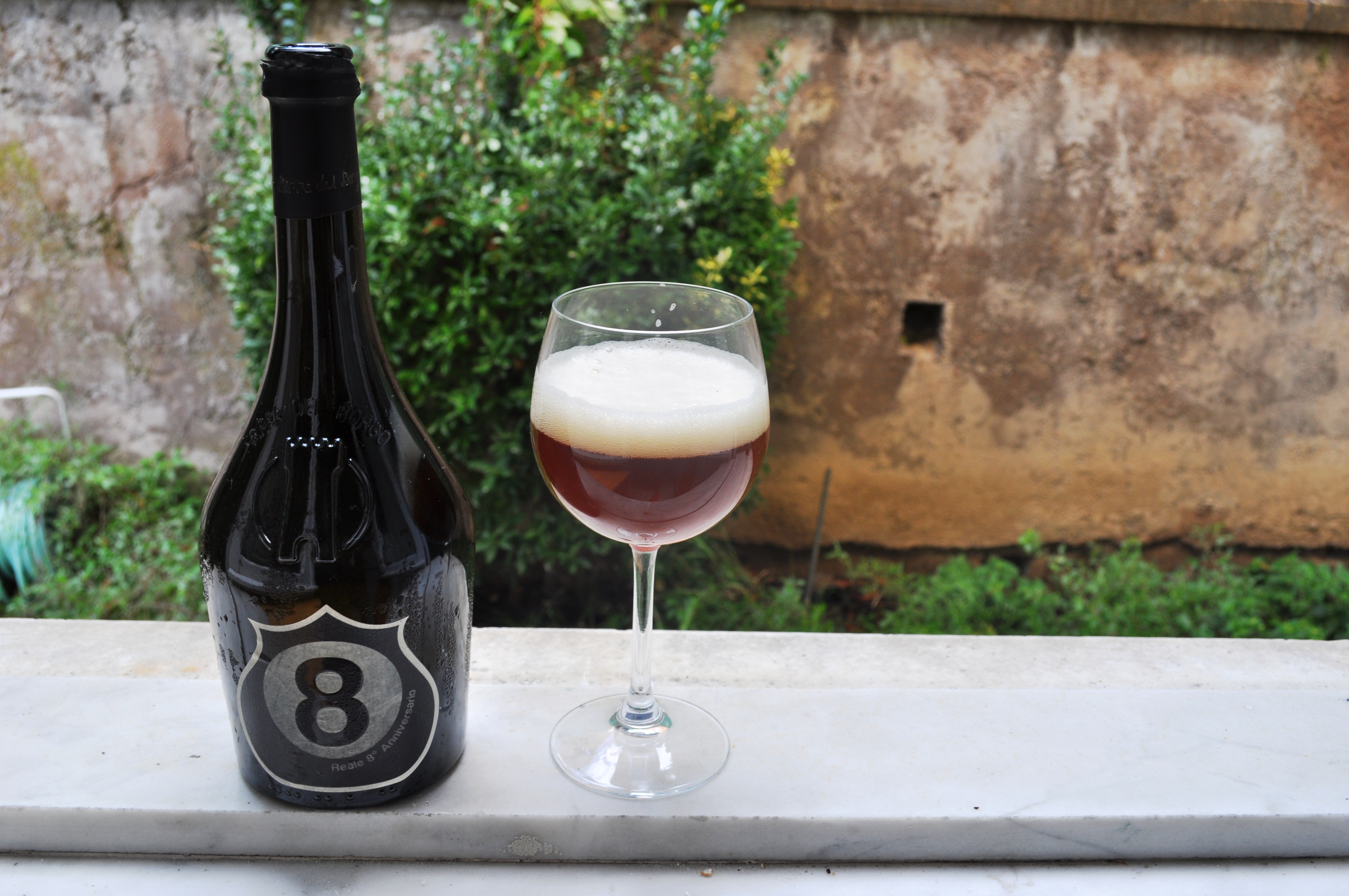
We’re leaving Rome tomorrow. The shipments of boxes we sent a few weeks ago has arrived in England, the cats similarly made it home on their road trip. But we’re still here until tomorrow, with just a suitcase and rucksack each. And massive piles of clobber to fit therein. It seems to have bred since we packed the boxes.
And of course we have a few final bottles of beer, one of which is this Birra del Borgo eighth anniversary brew, ReAle 8, from their birthday back in May 2013.
Along with Baladin, Birra del Borgo is one of Italy’s most respected breweries. Plus, it’s in Lazio, so, during our time in Rome, I could drink a lot of their wares while also maintaining locavore inclinations. Yay.

ReAle 8 is an Italian American Pale Ale-style brew, amber in colour and part of their annual birthday celebration variations on a theme. I’d love to tell you about the scent/nose/odour/smell, but I’ve got a stinking cold. All Fran can say is “metallic”.
The taste, however, I am getting (at least in part): it’s full-bodied, rich and fruity, providing one of those great, almost chewy mouthfuls with its well-balanced flavour of malts, stewed apple, caramel, and a hoppiness that’s fresh rather than overly bitter. It’s also made with gentian, but I’d be lying if I said I got that.
Thanks to Michele Sensidoni from Mastri Birrai Umbri, who gave us this beer, along with five bottles of one his new test brews. One of which I’m hoping to smuggle back to Britain tomorrow. He’s been a big part of my education in Italian craft beer.
Thanks also to everyone who’s ever served me a craft beer here in Italy, notably Elise Grazzini at Open Baladin whose knowledge and multilingual skills also helped with my education, after we first found the bar early in our time here.
Oh, and thanks to Nanni Moretti too. His film Caro Diario (Dear Diary, 1993) was one of the first specifically Rome-based films we watched when we moved here, and it helped give us a sense of affection for, and some rudimentary glimpses of understanding of, the city. And, would you believe it, he moved in next door a few weeks ago. So we arrive seeing him on film, riding his motorino up Via Dandalo, and we leave seeing him in the RW, parking his motorino just outside our palazzo.
Filed under Ale, beer, Italian beer

The storms – apparently called Cyclone Penelope – arrived last night, rumbling over Roma and shaking our palazzo. I love being indoors, in bed, on such nights. Frequently in Rome, the stormy weather has the decency to blow over by the morning. Not so this morning though, when it was still raining buckets, piove a catinelle (where a catinella is a basin; I love the image of rain pouring down as if it’s overflowing celestial basins).
It looks like the Autumnal rain is settling in until we leave on Wednesday. In a way that’s just perfect – it’s re-acclimatising us to British weather. But it does look like yesterday was our last day that was dry enough for a long, casual, umbrella-less wander around town.
We started the day with a slice of bread – from the final loaf I’ll be baking in Rome. This was a bit of a disaster, but it was fun. It was a “using up leftover stuff before we leave loaf”. In this case meant a lot of seeds: specifically buckwheat, sunflower and poppy; and a some not-entirely ideal flour: 0 grano tenero (okay, fine), rice and amido di mais. The latter is what we’d call cornflour in the UK, meaning corn (maize) starch, so more a thickening agent than a bread ingredient. Hi ho. It felt like a good dough when I added the seeds, but went strange after that.

As Fran pointed out, the resulting loaf looked like a giant brutti ma buoni (“ugly but good”) cookie. It was pretty solid and, er, I might have forgotten to add any salt. But that’s fine: a lot of traditional bread from Tuscany and Umbria doesn’t contain salt, and as such is good for strongly flavoured bruschette. Not sure the seedy stuff will work as bruschette, but it’s good with good old Marmite.
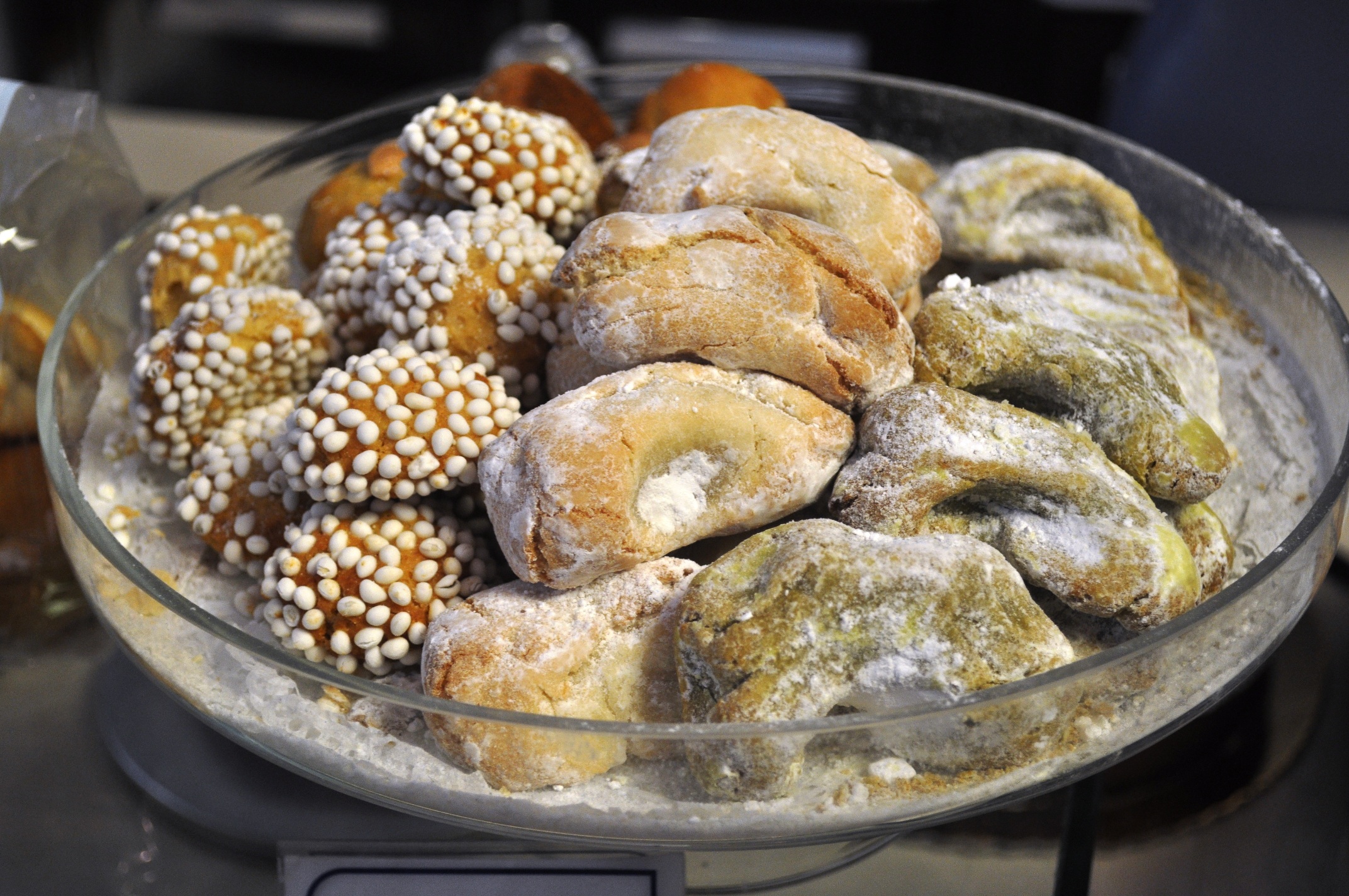
We headed out down the hill, through Trastevere, past the enjoyable window displays of vintage pasticceria Valzani. This included their selection of “tea biscuits”:

Then slices of pangiallo romano, which literally means “yellow bread” and is a type of hard Roman Christmas cake, made with honey, nuts and dried fruit; and panpepato (aka pampepato), a similar cake that originates from central Italy and, as well as containing dried fruits, candied fruit and nuts also contains spices like cinnamon and nutmeg, and even chocolate.

Then the Roman version of the Campania sfogliatella, which look kinda squashed compared to the more refined Neopolitan sfogliatella riccia. Indeed, compared to say French patisserie, Roman patisserie often has this seemingly crude finish – but I like that, it’s less poncey. Alongside was a tray of cannoli siciliani, then a tray of maritozzi, Rome’s epic cream buns, which I made over here.

After meeting a friend in the street, who was discussing the possibility of opening a café, we headed over Ponte Sisto into Regola, rione VII. Past this fab old sign for a biscuit shop that, sadly, isn’t a biscuit shop any more.

We stopped at I Dolci di Nonna Vincenza (“Grandma Vincenza’s Sweets”), a Sicilian pasticceria chain that opened a branch here about a year or so ago.

It’s a bit cutesy, but the doughnut-type thing (“È una tipa di ciambella”) we had – that wasn’t the more common ring-shape of ciambelle, but more a knot – was good.

I got some almond paste cookies that were pretty good too.
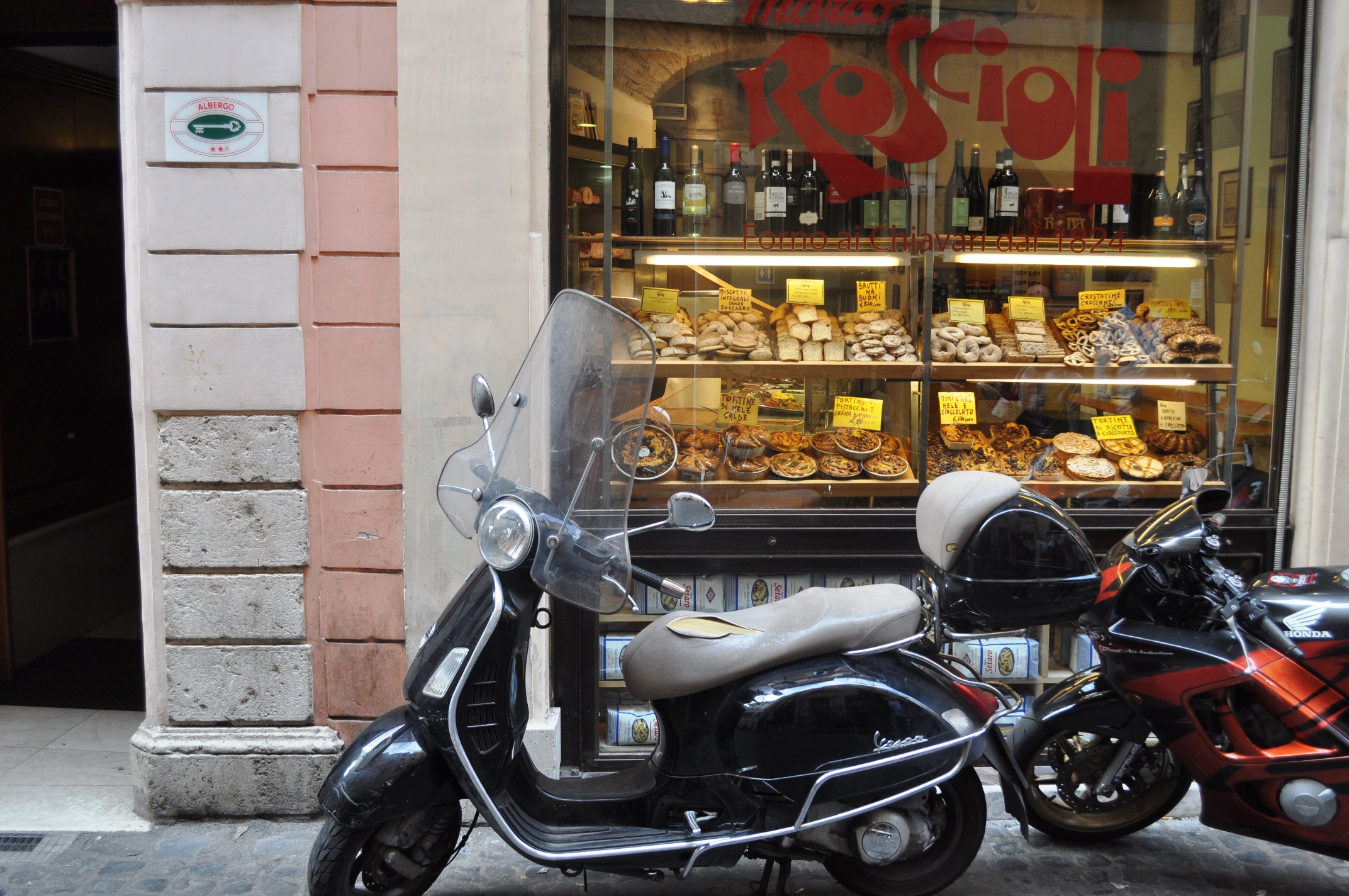
We chilled out on the pastry indulgences after that, even managing to walk by the justifiably renowned, somewhat pricey Roscioli bakery without buying anything.
We wanted to save space for lunch at L’Asino d’Oro in Monti, one of our two favourite Rome restaurants. Our other fave is Cesare al Casaletto, which we’d vowed to go to at least once or twice more before leaving, but had been confounded by forgetting which day was their riposa settimanale (weekly rest day), then it being fully booked, and then by discovering that they were closed for our final 10 days in Rome. Nooooo! Fortunately, L’Asino d’Oro hit the spot.

This is a superb restaurant, where chef Lucio Sforza (who, Renaissance scholars, may or may not be part of that family) uses seasonal, local, quality ingredients and every weekday does a pranzetto for (currently) €13. This set “little lunch” changes every day and is a serious contender for the best value, best quality lunch available in Rome. Thirteen flippin’ euros for bread, antipasto, primo, secondo, glass of wine and small bottle of water! And it’s always been excellent, every time I’ve been, though I prefer Friday, as that’s Rome’s main fish-eating day.
We had a bruschetta with bean purée, the best broccoli soup I’ve ever had, pasta with a ragù of cuttlefish, and a fillet of scorfano (scorpion fish). We then decided to order some dessert (which isn’t included in the menu) and a glass of Marco Carpineti’s delicious Ludum Passito dessert wine. Just cos.

I had a zuppa inglese, which is basically Italian trifle. Although the name can be translated as “English soup”, I like the slightly deeper meaning of zuppa as a reference to bread dunked in broth, from the verb inzuppare, to soak, to immerse. In the case of zuppa inglese, there’s sponge cake soaked in alcohol and custard. Going to miss these lunches at The Golden Ass (or The Golden Donkey if you have that troubling American-English relationship with that word). Veramente un buon rapporto prezzo-qualità!

Afterwards we had tea in a favoured nearby café in Monti, 2Periodico, watching the world go by before we continued on our way… to the movies. What?! You could say. Why sit in a cinema when Rome is only your city for a few days more? Well, I used to be a film journalist, and just adore the big screen and the darkened room. Plus, I fear a culpa d’aria got me so I fancied planting my donkey for a few hours, getting away from the tourist zombie hordes clogging up the streets.
Normally I cannot abide, and veto, 3D films, but the own lingua originale option was Gravity in 3D. And even with shonky 3D, in a cinema not designed specifically for 3D, it was an extraordinary experience. I’ve not felt that pushing-yourself-back-into-the-seat tension in a film for years.

On the way home, we stopped in Via San Francesco a Ripa in Trastevere, buying some handmade chocolates from Dolce Idea to take home and a suppli from the small, seemingly nameless hole-in-the-wall pizzeria opposite to scoff straight away. It might just be called “I Suppli” as it has the word in green neon above the door. And rightfully so, as their suppli are great – the tomato risotto mix is very saucy, meaning they’re moister than many versions. Their structural integrity may suffer as a result but they’re so tasty.
So all in all a great day; eating and movies, two of my favourite things. I even managed an ale when I got home, so three of my favourite things.
Info
Pasticceria Valzani
Via del Moro 37b, Trastevere, 00153 Rome
+39 06 580 3792 | valzani.it
I Dolci di Nonna Vincenza
Via Arco del Monte 98a/98b, Regola, 00186 Rome
+39 06 92 59 43 22 | dolcinonnavincenza.it | arcodelmonte@dolcinonnavincenza.it
Roscioli (Forno)
Via dei Chiavari 34, Regola, 00186 Rome
+39 06 686 4045
L’Asino d’Oro
Via del Boschetto 73, Monti, 00184 Rome
+ 39 06 4891 3832
2Periodico Café
Via Leonina 77, Monti, 00184 Rome
+39 06 4890 6600
Dolce Idea
Via San Francesco a Ripa 27, Trastevere, 00153 Rome
+39 06 5833 4043 | dolceidea.com | info@dolceidea.com
Nameless Pizzeria (“I Suppli”?)
Via San Francesco A Ripa 137, Trastevere, 00153 Rome
+39 06 589 7110
Filed under Bakeries, Biscuits, cookies, Cakes
The past few weeks we’ve been increasingly scombussolati (“de-compassed”, discombobulated, unsettled). Moving house is always a bit of a whirlwind, and we’re on our third move in less than three years. Moving internationally is even more complicated – especially when we can’t actually move back into our own house in England just yet.
While our clobber went off in 11 hefty boxes last week, yesterday was even worse – we said goodbye to our beloved cats. Now, if you’re not an animal person, look away, as you probably won’t understand.
If you are an animal person, and you’re childless like us, you may well understand how important pets are. They’re not exactly surrogate kids, as it’s not like they’ll ever become stroppy teenagers, threaten to leave, then actually do leave, then come back again with dirty laundry. But you do invest a lot of time, money and affection in them.
We didn’t have an easy transition to living in Rome in August 2011, and it was only when our cats arrived in May 2012 that the apartment we were inhabiting here actually took on some of the qualities of a home.

They went off yesterday, chauffeured by a nice lady called Den and accompanied by three other cats, also making their way from Italy, specifically Naples, to south London, with their owners. It was all very emotional, so we had to get out of the flat, which felt oddly dead without them. To paraphrase something Jean Cocteau reportedly said, cats become the soul of the home, and that soul had just left in a cage in the back of a people carrier.
It seemed like the ideal opportunity to go and indulge ourselves in some of the greatest grain-related goodies available in Rome: specifically Gabriele Bonci’s hole-in-the-wall pizza takeaway Pizzarium, and Rome’s best beer bar, Open Baladin. I’ve been meaning to write more about the latter for ages, as Baladin really is the most important brewery in Italy’s craft beer scene, but I seem to have accidentally deleted most of my photos (ecco: scombussolato) so that’ll have to wait.

Instead: Pizzarium. We heard about this place pretty soon after we arrived in Rome. It’s an institution and Bonci himself is a celebrated pizzaiolo and TV celebrity. When we went there first, I wasn’t entirely convinced, as I was hung up on the thin, crispy, slightly burned Roman pizzas of places like Ai Marmi in Trastevere and Da Remo in Testaccio. I still love those pizzas, but I’m totally a Bonci convert now.
Bonci’s principles were of course more in line with mine – he uses stoneground flours made from older wheat varieties, natural leavens and long fermentation, and tops the pizza with local and seasonal ingredients, along Slow Food lines. But I wasn’t entirely sold on the thick bases and felt the toppings tended towards overload. The latter can still arguably be the case, but they’re delicious nonetheless. I’m tired of the over-quoted Vogue soundbite about him that draws parallels with a certain Renaissance man and is included on his upcoming English book* but he’s certainly a master craftsman of the pizza and great ambassador for real food.
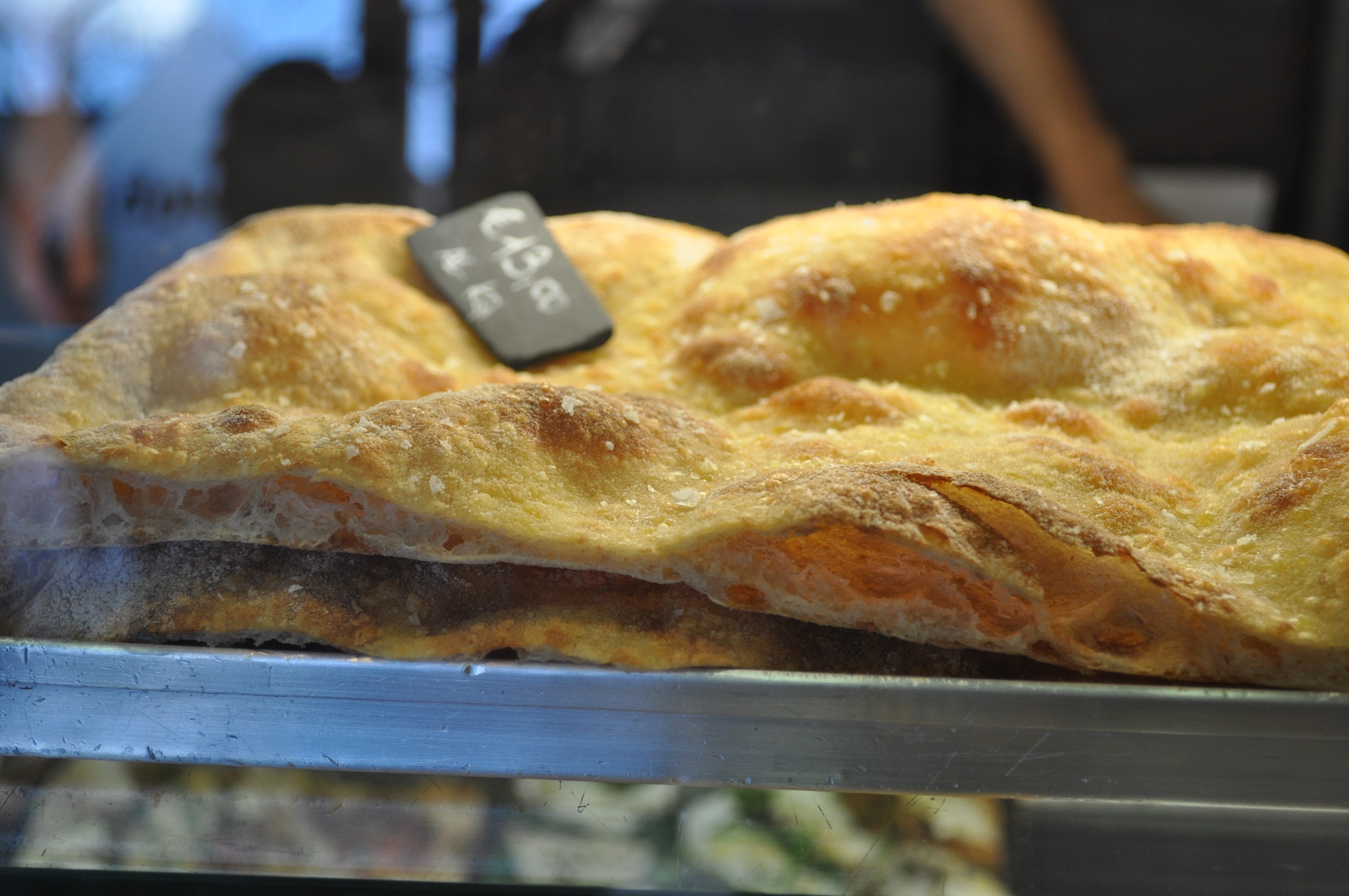
I have mentioned Bonci before, as we did a pizza-making class with him last year. And he’s a big part of the scene I really enjoy here in Rome. Along with Baladin brewery’s Theo Musso and Leonardo di Vincenzo of Birra del Borgo, he’s a co-founder of Open Baladin bar. The same trio is also behind the more recently opened bistro No.Au (another place we need to go before we leave). Bonci baked goods are available at both venues.

After a half hour walk in the hot October sun, along the Aurelian wall, then around the south and north Vatican walls, we reached Pizzarium, which is in the Trionfale quartiere. We were sold the moment we walked into Pizzarium and asked about one particular pizza. Or at least Fran was sold, as the pizza was cavolini di Bruxelles (Brussels sprouts, the first of the season) e mortadella, two of her favourite things. And seriously, who’d have ever thought of combining these on a pizza? That’s Bonci right there – he’s innovative and got a surprising sense of what will work.
We also had a pizza farcita (filled pizza), a kind of sandwich with two layers of dough and a layer of primo sale (“first salt”, a young sheep’s milk cheese), rocket and tomato pesto between. It was delicious, with a lovely balance between the slight pepperiness of the rocket, the sharpness of the pesto and the smoothness of the cheese, itself an interesting alternative to mozzarella.
The other we had was the classic potato pizza. People may think, Hey – carb and carb? Really? But it’s delicious and quite possibly my favourite type of pizza, especially when there’s a bit of rosemary in play too. It was surprisingly light, with a good crunch where the dough and potato have caught slightly in the oven, with a pleasing, simple saltiness.
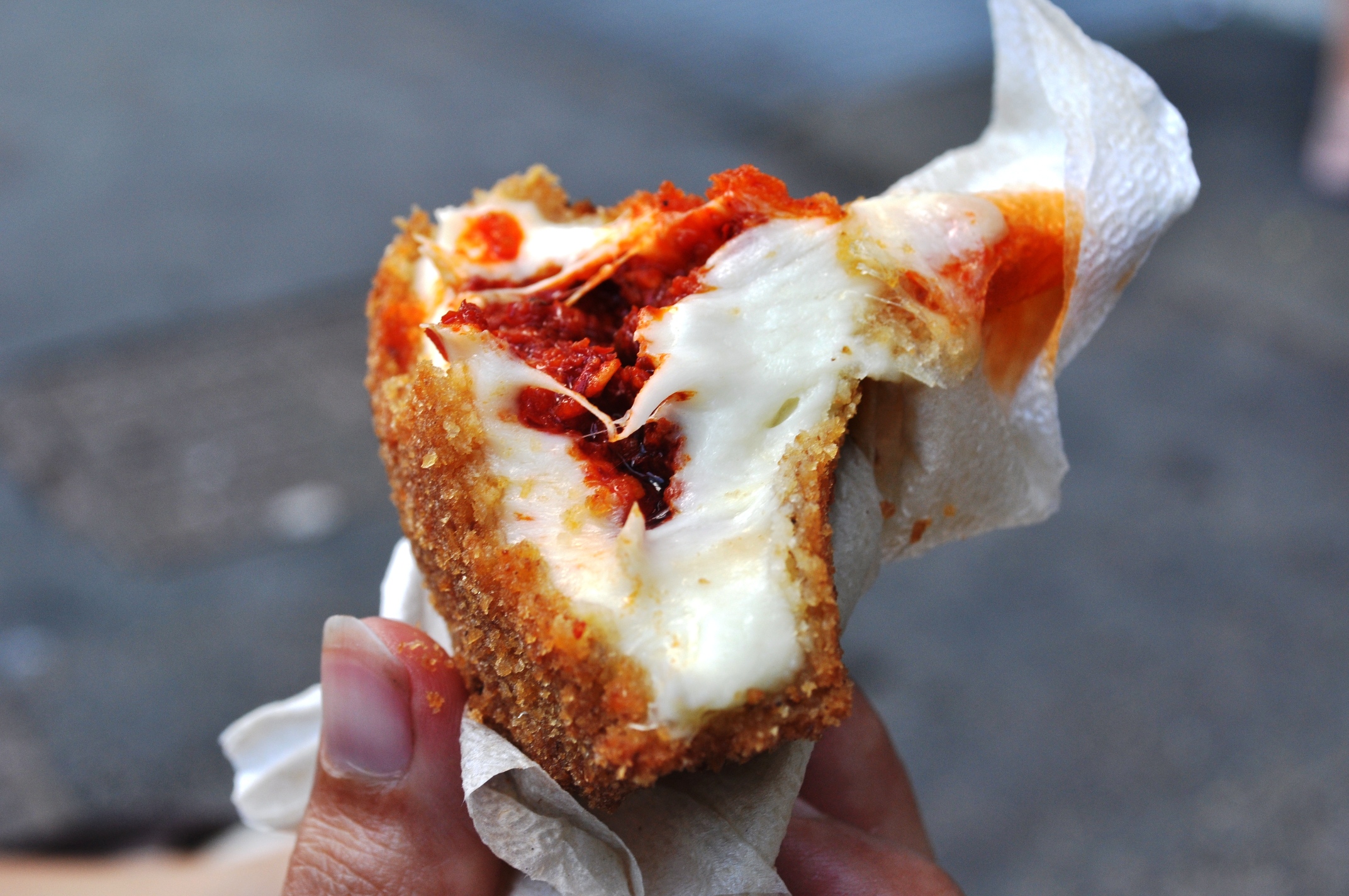
We also had some suppli – a classic and one made with primo sale and ʼnduja, soft spicy sausage from Calabria. Both delicious, but I’d still say the best suppli I’ve had yet in Rome was at La Gatta Mangiona. Though Bonci’s pizza pips theirs.
We ate all this sitting outside on the one bench, luckily having avoided the lunchtime rush, when we had been busy coercing the poor cats into the back of the people carrier and feeling mighty guilty and sad about it.
Most of the rest of the Pizzarium punters were foreigners, proving how Bonci’s reputation has made this small pizza al taglio hole in the wall a key stop of the tourist schedule for discerning food enthusiasts visiting Rome. I just wish we’d been a few more times, but it’s in a slightly awkward location up behind the Vatican. Well, awkward for us, as it’s not on a handy bus route, we’re not on Metro line A, and we don’t contribute to Rome’s excessive population of polluting cars and scooters.

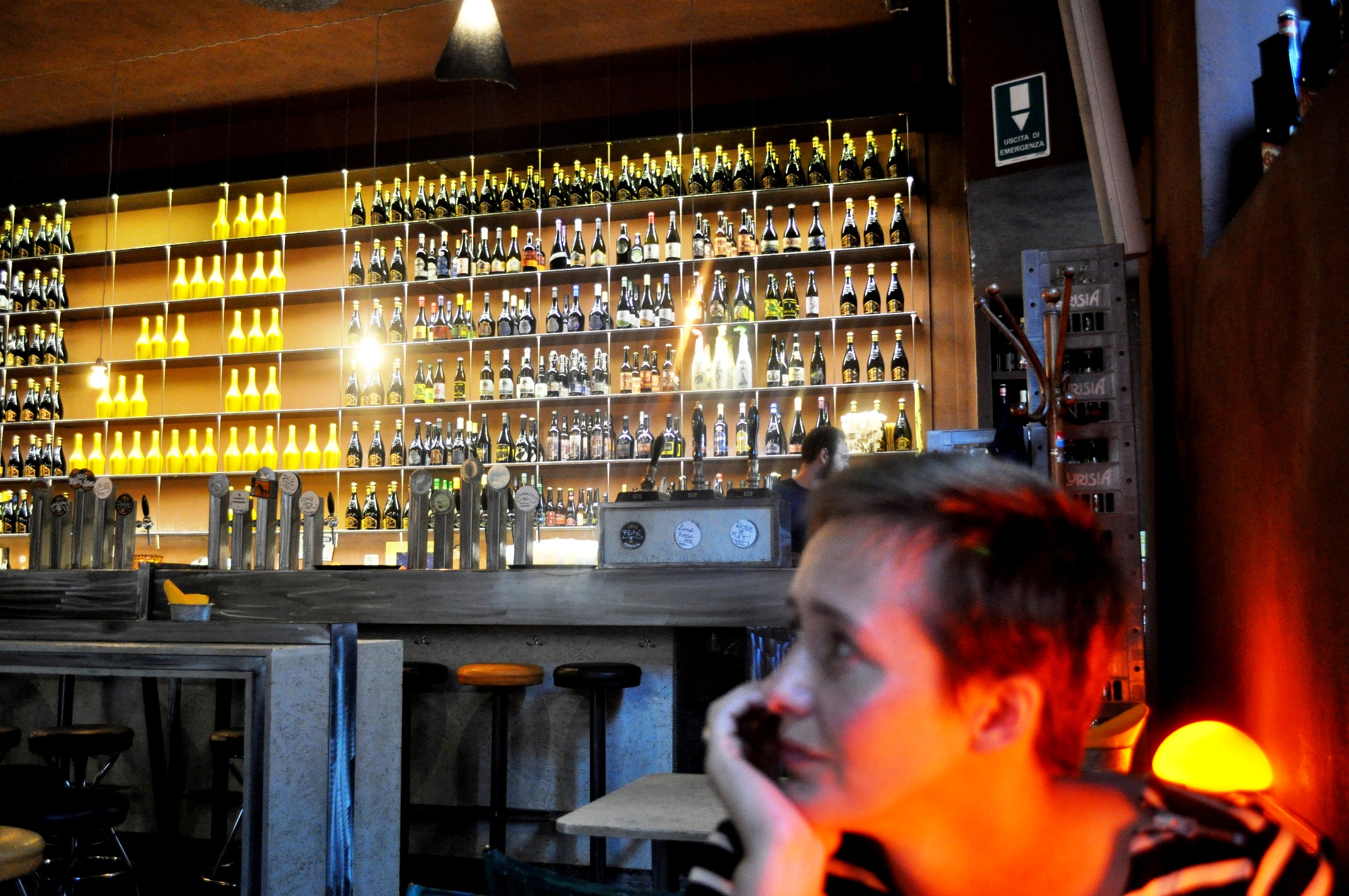
Afterwards, not wanting to go back to a house that was like Tony Makarios without his daemon, we continued our long head-straightening walk. We headed back into town, and down to Open Baladin, near Campo deʼ Fiori. And drank much-needed restorative ales.
The sharp, firm hoppiness of my Hopbleoem, a special from Extraomnes brewery in Lombardy, with its notes of salty sweat, citrus and tomato plants, provided a good slap in the face though it was still sad going home, via another fight with our mobile phone provider (what does it take to cancel this account? Blood!? Si, certo), to an empty flat.
Info
Pizzarium, Via della Meloria 43, 00136 Rome.
Metro Line A; station: Cipro
bonci.it
* ‘Pizza – Seasonal Recipes from Rome’s Legendary Pizzarium’, due out this month. It’s a slightly more modest title than that of his Italian book: ‘Il gioco della pizza – Le magnifiche ricette del re della pizza’, ‘The Game of Pizza – The Magnificent Recipes of the King of Pizza’. I’m guessing the former is an English translation of the latter, but I’ve not seen it yet, so can’t be sure.
Oh, and PS, when we did our course, we met a half-English, half-Italian guy called David who talked about opening a place called Pizzarium Sutton, in Sutton, south London. I’m not sure this ever happened. If I find out, I’ll of course post about it.

According to WordPress’s strange date conventions I started this blog with a post published 2012/11/07. For most of the world1, this would otherwise be known as 07/11/2012, 7 November 2012.
It was started so I had a place to write about my baking experiments, my interest in the baked goods I encountered while living in Rome, where we moved in August 2011, and my burgeoning enthusiasm for Italian birre artigianali (artisan beers, craft beer).
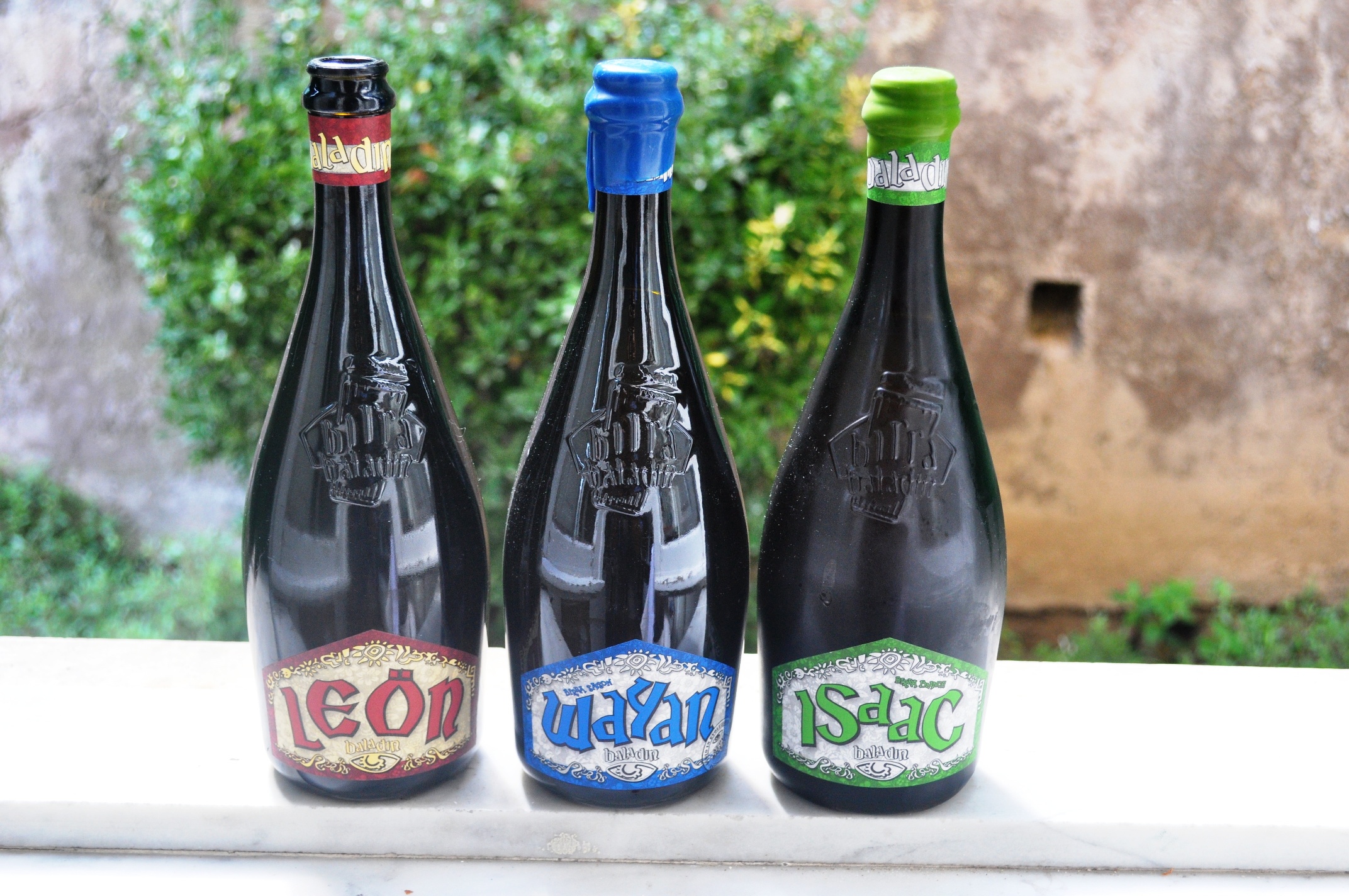
Leon, Wayan and Isaac from Baladin, the brewery that really kicked it all off in Italy and still produces many of the best, most intereting beers here.
Now, almost 11 months later, I’ve arrived at my 100th post…. just as we’re preparing to leave Rome after two roller-coaster years. These included:
difficult work (Fran);
unpaid work/unemployment (me; including one [dubious] SF-fantasy novel, an internship on the American Academy’s Sustainable Food Project, and this educating-myself-about beer and waffling on about baking project);
faltering attempts to learn Italian;
lots of baking (some great; some heavy; some that went mushy);
lots of food (some amazing, a lot mediocre);
lots of beer (mostly interesting);
bewilderment at the Italian ways of doing things (or not doing things; like having to wait five months to get our internet connected, or the post office that doesn’t sell stamps);
still no kids (sadly);
neighbours from hell (WTF!? It’s 4am! Again! Che cazzo state facendo?! Stiamo provando di dormire. Mortacci tua!);
zanzare;
some great new friends;
witnessing Palme d’Or winner Nanni Moretti move in next door;
and, overall, an incredible immersion in this bonkers, intoxicating, dilapidated, exasperating, traffic-choked, caffeine-fuelled, history-sozzled city.

Draco, from Birrificio Montegioco. Made with bilberry (aka blueberry) syrup, no less.
When I wrote the 99th post, I thought, “Accidenti! I better do something interesting for the arbitrary landmark of number 100″. But that stymied me.
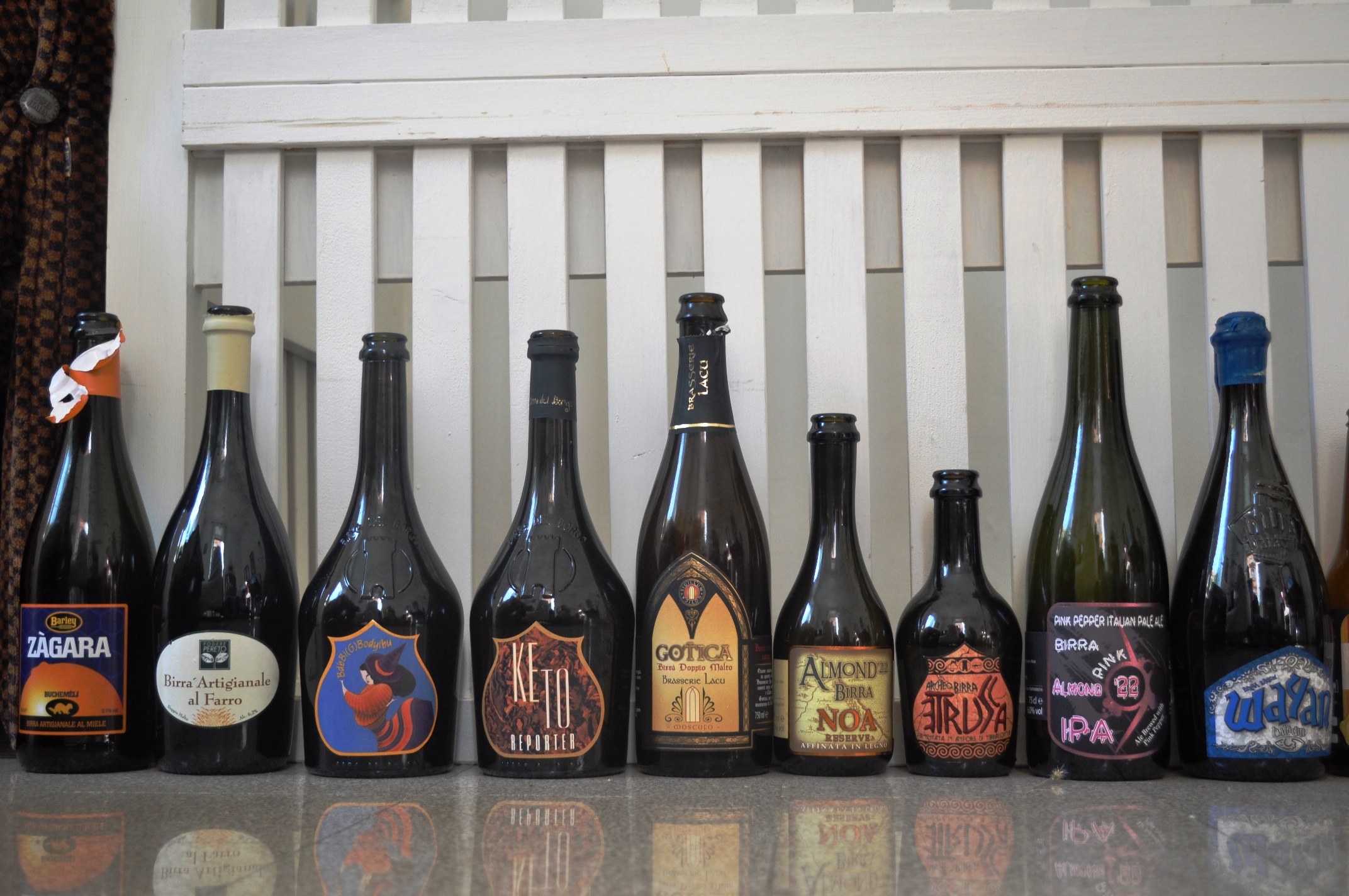
So instead, here are a load of pictures of beer. They’re mostly from a party we had at the weekend that doubled tripled up as a goodbye, a free jumble sale, and a celebration of Italian craft beer. Although we had a great selection of fascinating brews, they are only the tip of the iceberg of the 500 or so birra artigianale breweries currently operating in Italy. I wish I could stay here and keep on drinking my way through them, but we need to return to Britain.
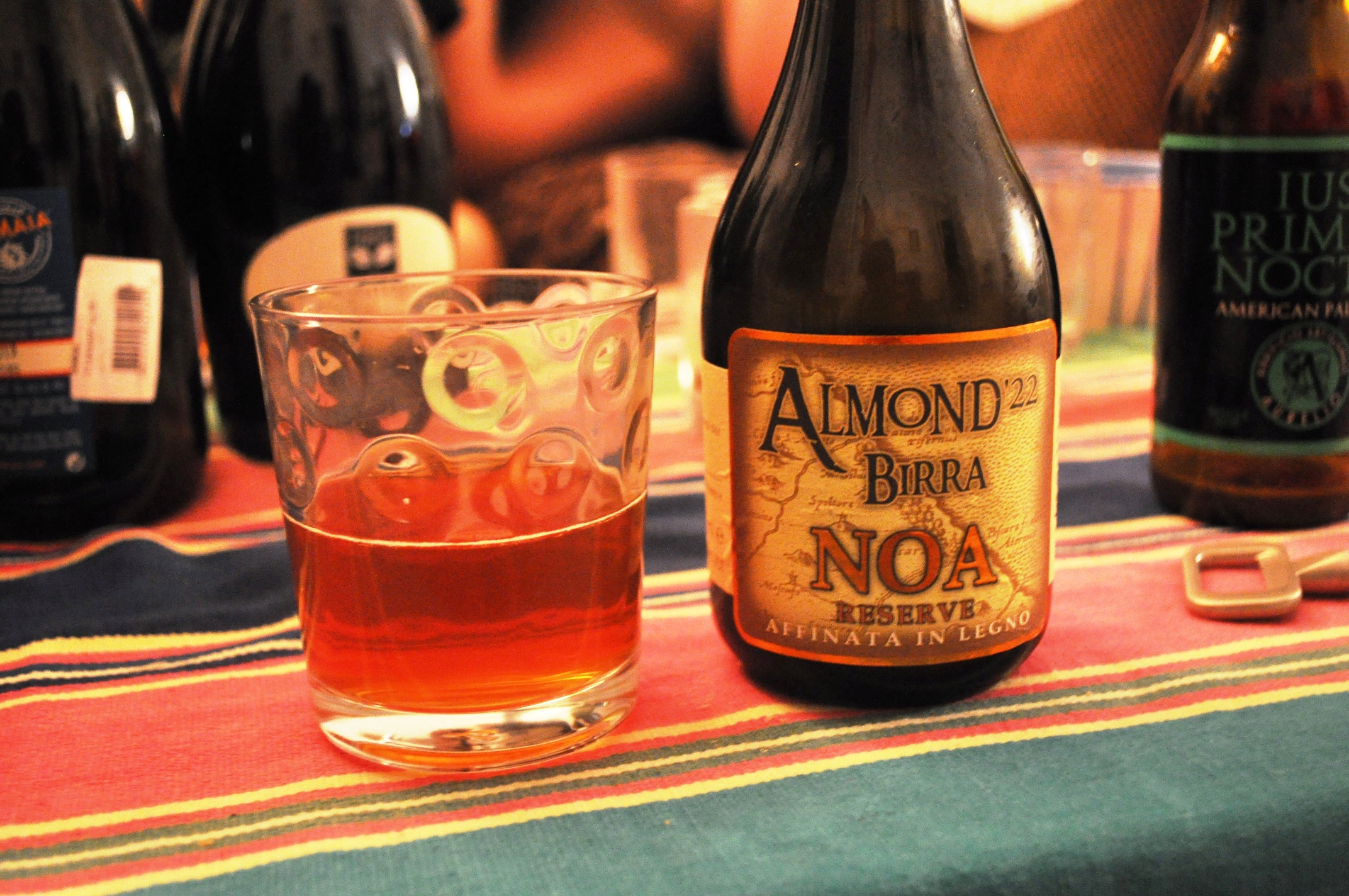
Noa Reserve – one of the strangest beers we had that evening. Aged in barrels, it basically tastes of whisky, brandy, or as our friend MM said, “a memory of foreign land you’ve never been too.”
I do hope any readers of this blog won’t be put off by the fact I won’t have the glamorous “I live in Rome” factor any more. For the next few months, we’ll be visiting friends and family in the US and NZ, before settling back home around Christmas. So the blog will change slightly – not its tone, but its context.
We’ll see how it goes.
I certainly have no intention of stopping baking and I’m really excited to get back to the real beer scene in the UK, which, like that of Italy, has grown exponentially the past few years, with 197 new breweries opening in the past year alone, while London alone has nearly 50, up from just two in 2006.
Ecco, more photos of beer:

Marchè’l Re from Loverbeer brewery. Possibly even stranger than Noa Reserve, me and chef Chris Behr concluded it was like “drinking fruit beer from an ashtray”.2
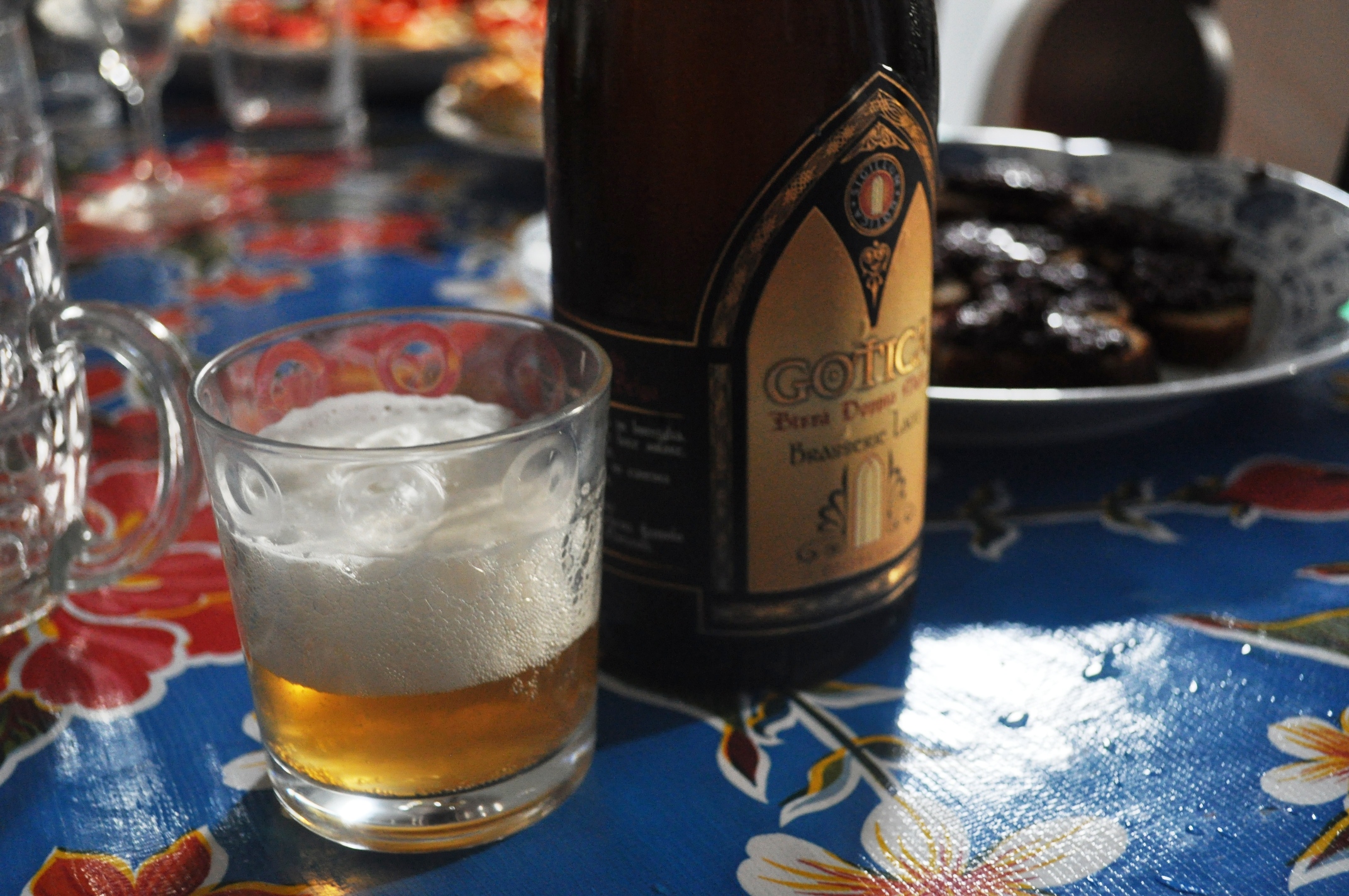
Gotica from Brasserie Lacu, a light double malted Belgian abbey ale – made in Belgium for the Italian market.

Can’t really find out much about this one, Rubbiu, but it was a great gift – as it came from a small brewery in a friend’s small home town outside Rome.

Zagara beer, an orange blossom honey ale from Barley brewery in Sardinia. So the first Sardinian beer I’ve ever had.


And finally, a bit of nocturnal ambience. Thanks to anti-mosquito candles.

1 Except you contrarians in the US, of course, who would insist on confusing the rest of us by using putting 11/07/2012 for 7 November 2012.
2 We didn’t necessarily mean this in a bad sense. I wish I’d written about Loverbeer more in my time here, but I’ve only really discovered them fairly recently. (I did write about their Madamin.) As they really are producing some of the most interesting beers in Italy. They seem intent on combining the traditions and tastes of wine and beer. So their D’uva beer is made with 20% grape must and tastes much more like a sparkling wine than a beer, not unlike say Birra del Borgo’s Rubus.
I’m increasingly interested in this whole area of making beer that doesn’t really taste of hops or malt. It’s fascinating, and I’m very divided. The above mentioned Noa Reserve, from Almond ’22 brewery, is another example, as is the fascinating Etrusca (which can be seen in one of the above pics), a beer made by three different breweries (Baladin and Borgo in Italy, and Dogfish Head in the US) according to an ancient recipe; it tastes much more like wine or mead than beer. I very much enjoyed experiencing the weirder beers we had, but I think my favourite of the evening was Ius Primae Noctis (“right of the first night”, Latin for “droit du seigneur”), a hoppy, citrussy Italian APA from Birrificio Aurelio, which is in Ladispoli, not far from Rome. So yes, I’m clearly not leaving behind hoppy beers any time soon.
Filed under Ale, beer, Discussion, Italian beer

Pizza bianca is ubiquitous in Rome. Although Romans don’t by and large like eating on the move, chances are you will see people wandering along clutching bready packages and chances are, they’ll be folded pieces of pizza bianca, either plain or filled (farcita).
Pizza bianca – “white pizza” – is effectively plain pizza, simply sprinkled with coarse salt. It can be fairly thin, or it can be fairly puffy – more akin to what we’d called focaccia in the UK. There are fine lines between different types of flat bread, but what we call focaccia (literally “hearth bread”, from the word focus – Latin for hearth) is probably more akin specifically to the focaccia Genovese. Usage of the words “pizza” and “focaccia” vary a lot around Italy; for example, in our local Sardinian restaurant here in Rome, they serve discs of crisp flatbread that they call… focaccia.
This is my second attempt at pizza bianca. I made some in February 2012, but my oven has such fierce bottom heat, I struggled to get the top golden without over-baking the bottom.

Plus, well, as pizza bianca can be found in every bakery and pizza takeaway place in Rome, it seemed almost silly to persist in trying to master it. Except recently, when we’d decided to leave, it seemed I really ought to. Then last week I stopped by Rachel’s place while she was making it, and it galvanised me to revisit the document that’s been sitting on the my desktop the past few month called “Pizza bianca recipes”.
The most important factors
Pizza bianca is made with a fairly basic white bread dough, but there are several important things to consider:
You want a a nice moist dough.
You want to give it some folds.
You have to give it time to ferment.
You need to be gentle with it.
And ideally you want decent extensibility, as with any pizza dough.
Mine fell down slightly on the final factor: perhaps an autolyse process at the start would help, but this didn’t seem to be traditional. Or I could have tried to increase the hydration.
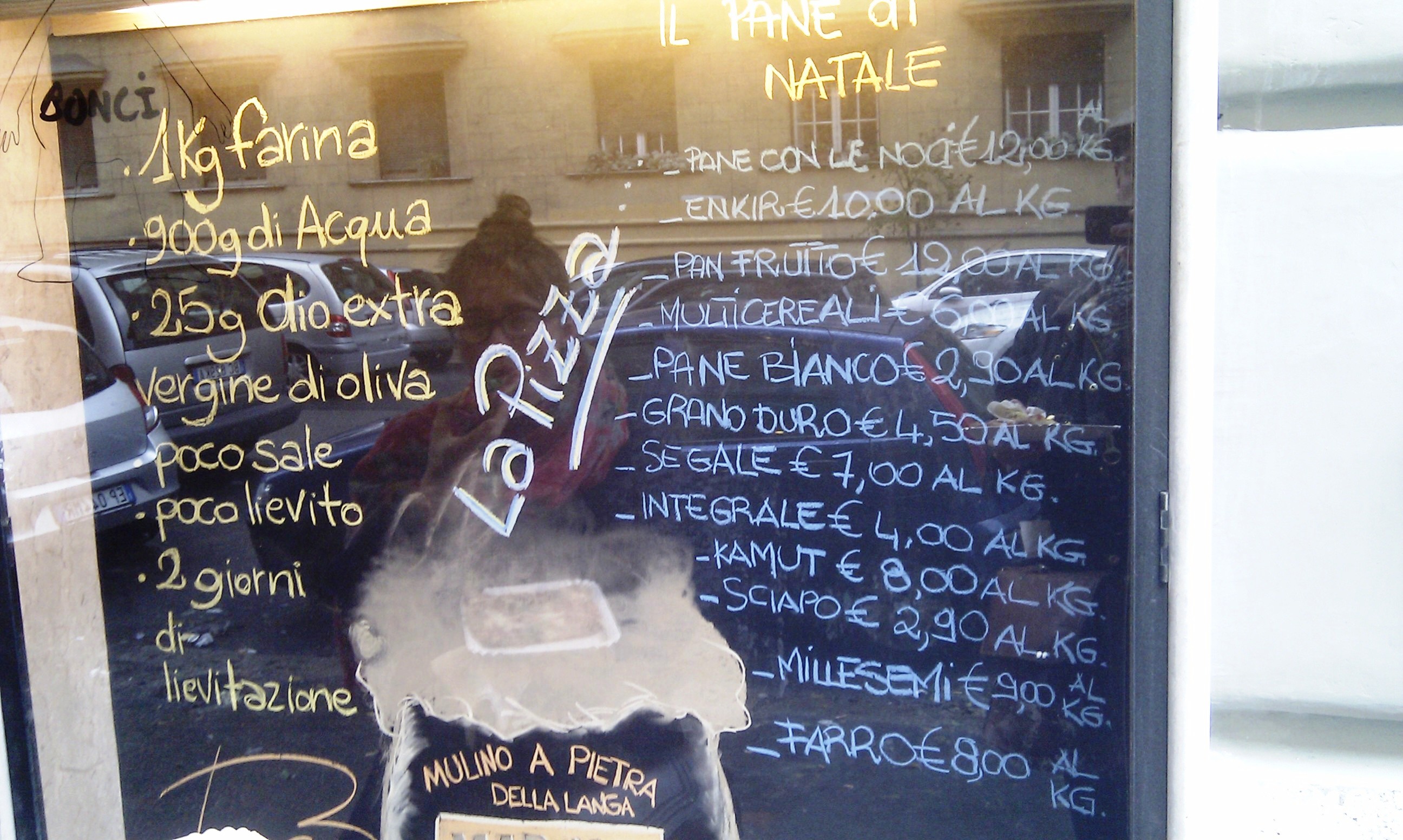
Rachel used the recipe from Gabriele Bonci’s book (so far only available in Italian), which was 70% hydration (ie 700g water to 1kg flour), but last December we saw this recipe in the window of Bonci’s bakery in Prati. Ninety flippin’ percent hydration and two days of leavening. I was just discussing the challenge of high,70%+ hydration ciabatta dough yesterday with Jeremy; that’s tricky enough. I’d love to see Bonci handling his 90% dough.
Otherwise my first effort was okay; I would have liked to get a nicer golden colour on top, but couldn’t manage that with my pesky oven…. which will only be my pesky oven for another 10 days, before we leave our home of the last two years and head back to Blighty, then on to a bit of a trip to see friends and family in the US and NZ. So all very bittersweet. Yay to visiting friends and family in the US and NZ, boo to leaving Roma friends and infuriating, wonderful Roma.
Variation and experimentation
As usual with my recipes, I’m experimenting as I go along. You can just make this with commercial yeast, but I did a mixture of fresh yeast and my leaven/sourdough. If you don’t use leaven, increase the yeast to 12g.
A note on the flour too. All the Italian recipes that I’ve seen specify using a grano tenero flour – that is “soft grain”, not a high protein wheat flour. I used Mulino Marino’s organic 0 grano tenero. (00, 0 etc refer to the fineness of the milling; see here for more discussion of Italian flour terminology). This is now available in the UK, but frankly, it’s always better to use local produce as food transportation is a massive contributor to climate change. So see if you can find a medium protein (12-13%) fairly fine flour from your most local mill.
Some recipes also use other ingredients like milk, sugar and even “strutto di maiale” (lard), but at its purest pizza bianca is just flour, water, yeast, salt. And olive oil. But then, what’s any Italian food without some olive oil?* Though the oil here is a classic qb element.

The recipe
So here’s my recipe. It makes quite a lot – two fairly large, squarish pizzas – so you’ll need some room in your fridge. Or do half quantities.
The process seems quite convoluted, but mostly it’s about time and gentleness.
1000g flour
700g water
5g fresh yeast (or 3g active dried yeast)
50g white leaven (100% hydration)
20g fine sea salt
30g extra virgin olive oil… or qb.
1. Combine the water, yeast and leaven.
2. Put the flour and salt in a bowl and mix together quickly.
3. Pour the liquid into the flour and mix, along with a sloosh of olive oil. Use your hands or a rubber spatula.

4. Turn the rough dough out onto a work surface and knead. Try to stretch the dough and fold it over, to incorporate air.

5. It will be sticky. Don’t keep adding more flour. When you’ve got it nicely combined, clean off your hands with some flour, rubbing it between your fingers like soap.

6. Put the ball of dough in a bowl, cover with film or a cloth or a shower cap and leave to rest at room temperature.
7. Put a drop of olive oil on the work surface and rub. This won’t stop it sticking, but it can help a little…

8. Turn out the dough, and stretch it to form a rough rectangle. Be gentle.

9. This next bit is important. It’s called stretching and folding, and it’s a gentle way of redistributing the gases building up in the dough and helping develop the structure, aligning the proteins, while avoiding any of that old-school British violent mistreatment of the dough.

10. Once you have a rough rectangle, fold one third inwards, then fold over the opposite end, to form a kind of envelope. A dough scraper, or tarocco (“tarot card”), is essential here.

11. Fold this envelope in half again in the centre of the long rectangle, to make a more cube-type shape (sorry, no photo). Put it back in the bowl and cover again.
12. Repeat this process two or three more times at 20 minute intervals.
13. Clean your bowl, or use a fresh container, oil it, then put the dough back. Cover with film or a lid, and put it in the fridge.
14. Leave the dough to quietly, slowly ferment for about 20-24 hours.
15. Remove the dough from the fridge.
16. Depending on how big you want your pizzas to be, divide up the dough. I’ve got an oven sheet that’s 40x40cm (about 16”), so I did divided the dough in two.
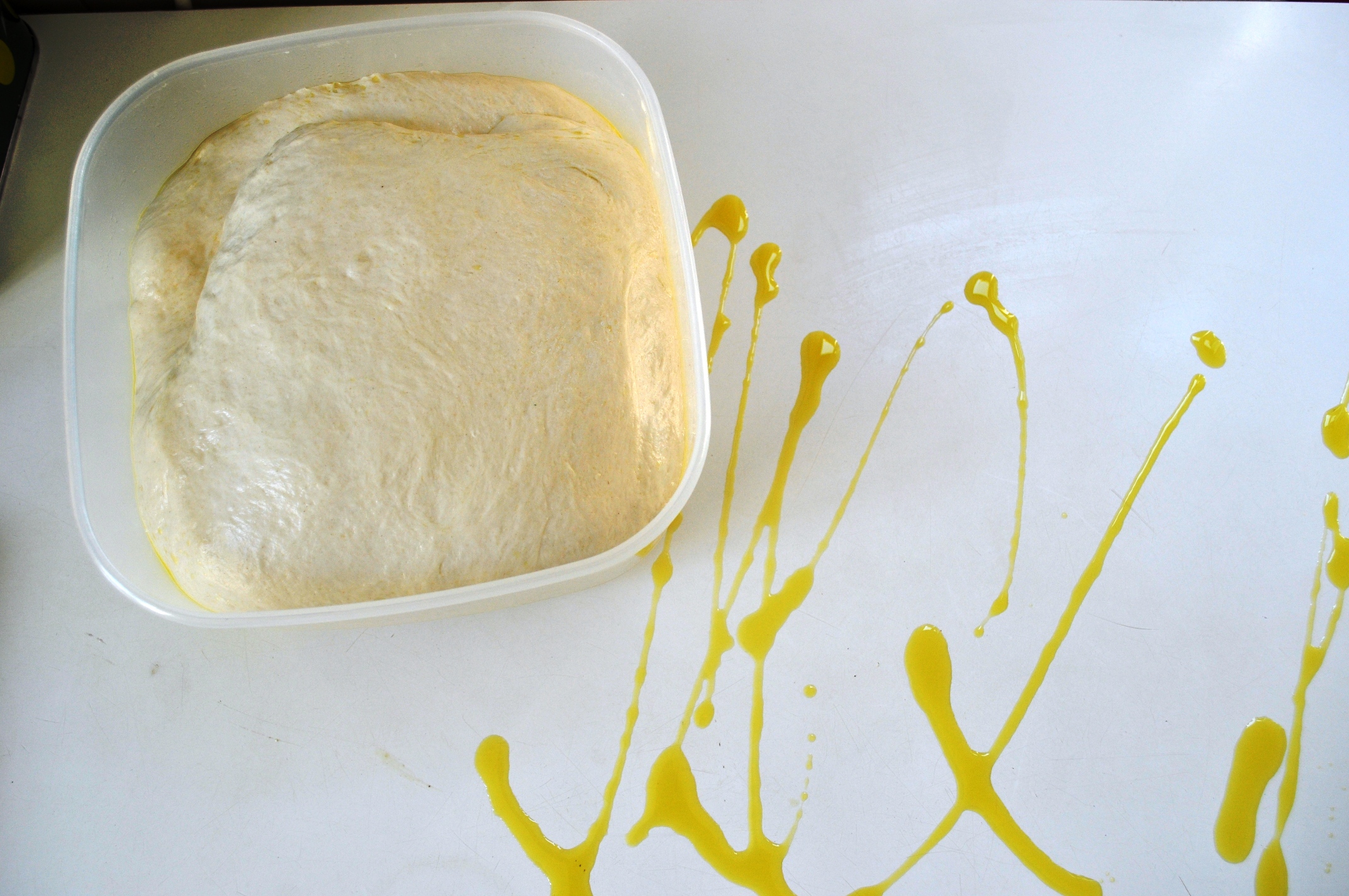
17. Give the dough another gentle fold, form a loose ball, then leave to rest again, bringing it back to room temperature.
18. Preheat your oven – ideally about 250C, or as hot as it’ll go. Baking any pizza, the hotter the oven, the better. (A good wood-fired oven can top 500C.)

19. Take your ball of dough and gently extend it into a square or rectangle to fill your baking sheet or pan. Do this gently, as you want to retain the nice gassy structure. You can either do this on a flour or oiled work surface and transfer it, or it directly on your baking sheet/pan. The more you push your fingers into the dough, the thinner your pizza will be.
20. Drizzle with a bit more olive oil. You can also sprinkle it with coarse sea salt before baking.
21. Then bake for about 12-18 minutes. You want a nice golden finish, something that eludes me…

22. Once it’s baked you, drizzle with a bit more oil, so it’ll be absorbed while the pizza is still warm. If you didn’t sprinkle it with salt beforehand, you can do it now instead.
The results
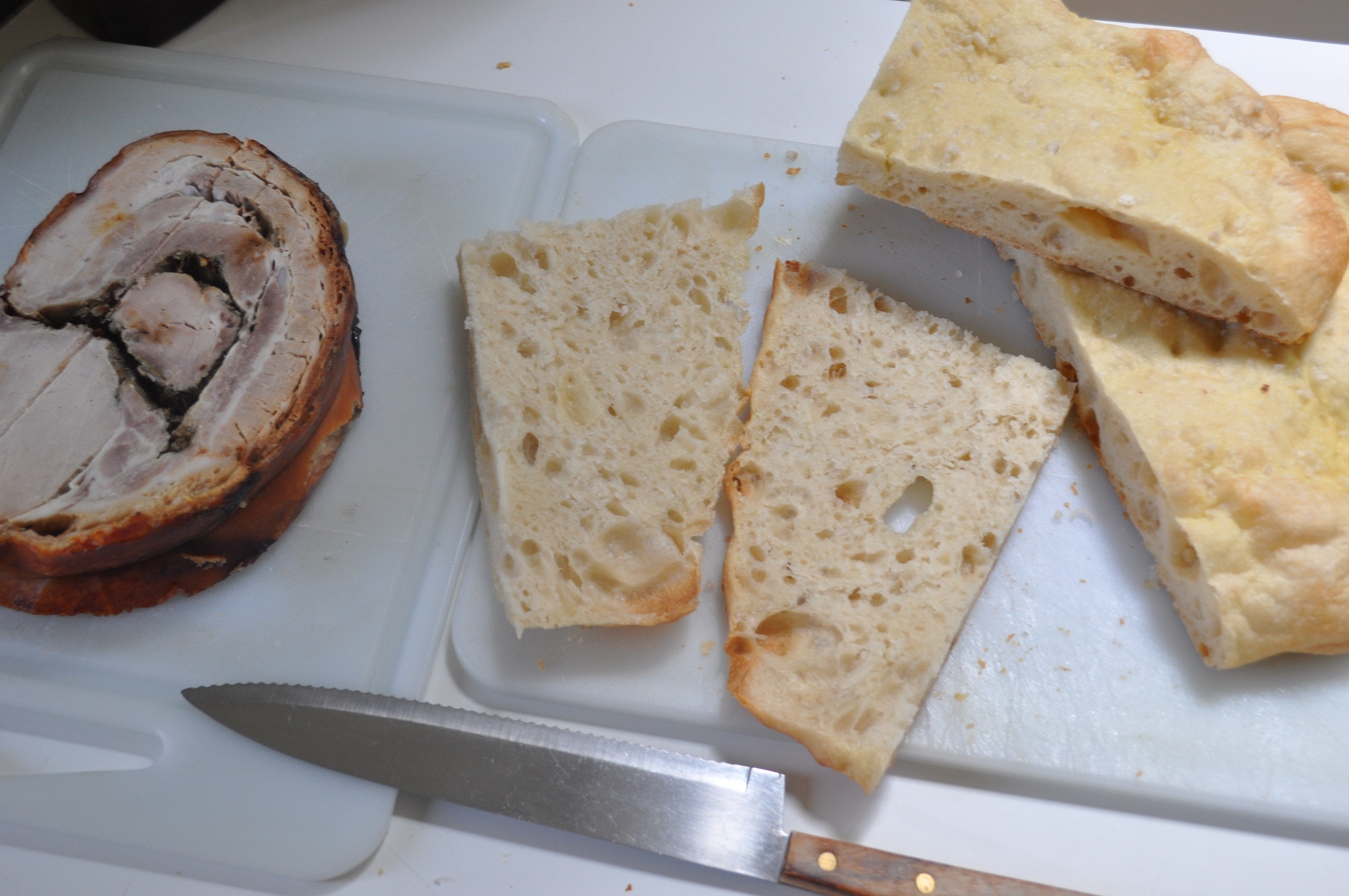
The result should be a delicious salty, slightly crunchy bread with an open, irregular structure.
You can vary it by adding olives or rosemary beforehand, but this really is entering focaccia territory, and a true Roman pizza bianca is plain.
We split ours open and filled it with porchetta, a speciality from the Rome area that’s a rolled pork roast with layers of stuffing made with garlic, rosemary and other herbs and has, ideally, some serious crackling to boot.
I’m not a meataholic like Fran, but this made for a cracking sarnie. We served finger-food sized pieces last night at our farewell-please-take-our-stuff-while-drinking-Italian-craft-beer party. Boy oh boy, what a great selection of beers we had.

* Of course, this was a flippant comment. Reading about Marcella Hazan, who died 29 Sept 2013, I feel quite dumb to have even made this off-hand comment, as, of course, some things are better fried in butter or types of vegetable oil, even in Italian cuisine. Frying fritti, for example, in extra virgin olive oil would be a total waste, plus, inversely, EV olive oil can be just too strong a taste for more delicate dishes.
 Bread, Cakes And Ale