Monthly Archives: May 2014

Cornish saffron cake

Overhead

Last week, I spent several days down in north Devon, helping my father shift part of a 14 ton pile of gravel. It wasn’t our only activity though. I also counted 80 marsh orchids in their meadow; saw my first Leworthy lizard (was it lost? Surely it’s far too soggy there for a sun-loving reptile?), visited Holsworthy Ales and tried their new honeyed golden ale, Bizzy Buzzy (very pleasant on a sunny day, despite the infantile name and label); and I even saw my first ever British kingfisher, which shot underneath me when I was standing on a small footbridge over the river Deer. Plus, this being the Etherington family, I also did a lot of eating, include a requisite cream tea.

Scones and clotted cream

Normally, when visiting my folks in that part of the world we go for a meal at The Castle Restaurant, Bude, over the Devon border, on the Cornish coast. But sadly it closed down in October 2013 after a six-year run. It’s a real shame, as it was one of the only places serving real food in that area of north Devon/Cornwall. It’s also a wider shame there aren’t more real food places in that area, as it’s got an interesting food heritage. For example, Stratton, just inland from Bude on the way back to Holsworthy, used to be one of England’s key saffron-growing centres.

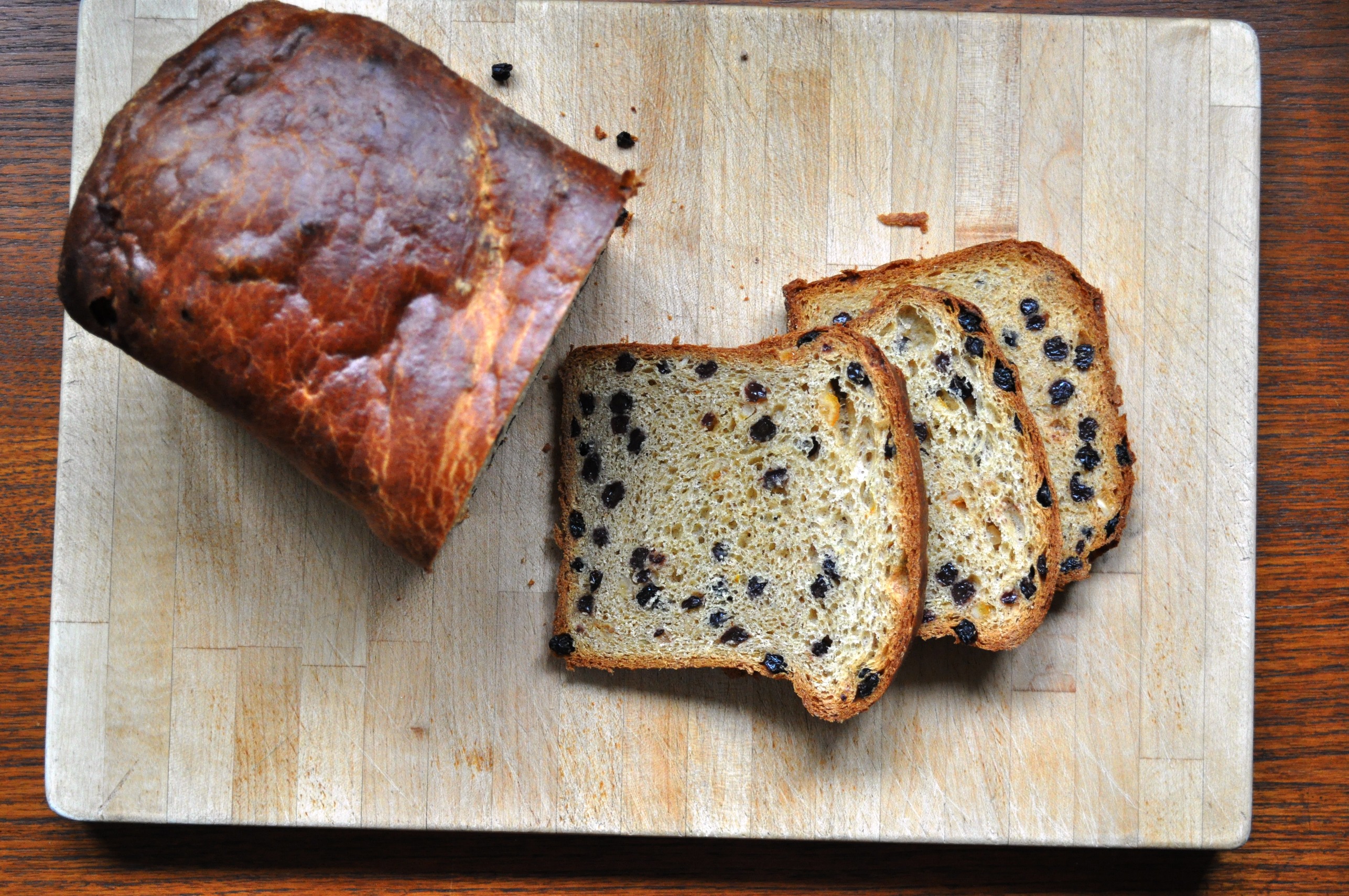
The saffron grown there would have been used in, among other things, Cornish saffron cake. This is an enriched bread, something like a yeasted cousin to English tea loaf (aka tea bread), though dyed (slightly) with the distinctive orange-yellow of saffron. In ‘English Food’, Jane Grigson says, “Saffron has always been expensive, even during the Middle Ages when it was at the height of European popularity for flavouring dishes, and even more for the colour it gave them. People liked their food to look gay, so that saffron… was found in every prosperous household.”

While in ‘English Bread and Yeast Cookery’, Elizabeth David says, “Among the most costly of spices used in early English cooking, and one which has survived – that is in our true native cooking – almost solely in yeast cakes and buns, is saffron. Originally treated as a colouring rather than a flavouring agent, it was used lavishly in sauces and for almost any category of dish, whether fruit, flesh, fowl or fish, sweet cream or savoury stew, whenever it was felt that a fine yellow colour would be appropriate.” She said its use died out through the 19th century – except in the West Country for buns and saffron cake. She suggests that when WWII deprivation forced people to replace saffron with annatto, they came to realise the former “was a very great deal more than just a colouring agent.”

Price spice
Saffron is the stigmas of Crocus sativus – Saffron crocus – which have to be harvested by hand. I imagine it’s backbreaking, slow work. The little pot I’ve got simply gives that frustratingly vague “Produce of more than one country”, which may mean India, Iran, Spain, Turkey, Morocco, Egypt, Spain, probably even China and perhaps even Greece, where the plant’s presumed wild ancestor (Crocus cartwrightianus) may have originated.

Grigson says, “It has been estimated it takes a quarter of a million flowers to produce one pound,” that is 454g. So if my little pot contained just 0.5g of stigmas, that’s still around 275 flowers (I think; maths isn’t my strong point). Sheesh. Or to look at it another way, if Waitrose Spanish saffron costs £3.99 for 0.4g, that’s £9.96 for 1g, for £9,975 for a kilo. The classic comparison is with gold, which at the time of writing costs about £24,000 per kilo (depending on carat).

Grigson also says the crocus was introduced to England in the 16th century and was still cultivated here until the practise died out at start of the 20th century. One enterprising grower did, however, start cultivating it in Essex again in 2001. His works out at £15 for 0.2g, or £75,000 a kilo. This is clearly a lot more than gold, but such high prices are a reflection the labour-intensiveness of a small scale operation in a first-world economy. I wonder if anyone grows it in Devon or Cornwall still? Or at least has Crocus sativus in their garden without realising the worth of its tiny red stigmas, despite how excruciatingly hard they are to extract.

For this recipe, I referred to the one in ‘English Food’ and another recipe from one of those little old-school ‘Favourite recipe’ books published by J Salmon Ltd (“Britain’s oldest post card and calendar publisher”). Despite the (somewhat haphazard) recipes, given with pounds and ounces only, and the cute watercolour wash illustrations, the books are a great repository of traditional British recipes. David also has a recipe, but I didn’t look at that till afterwards. In it she says one “valuable detail” she learned in her research was that “the little bits of saffron in the infusion which colours the cake are not strained out”. I hadn’t. They really help maintain the flavour, and just go to prove you didn’t use any old yellow colouring.

1 good pinch of saffron
A few tablespoons of boiling water
250g strong white bread flour
200g plain white flour
200g milk
7g instant yeast, or 20g fresh
100g butter
100g lard (or just use 200g butter)
1/2 t fine salt
60g caster sugar
1/2 t cinnamon
A few grates of fresh nutmeg
150g currants
50g candied peel

Saffron strands

1. In a small bowl, cover the saffron filaments with the boiling water and leave to infuse – for at least 5 hours, or overnight.
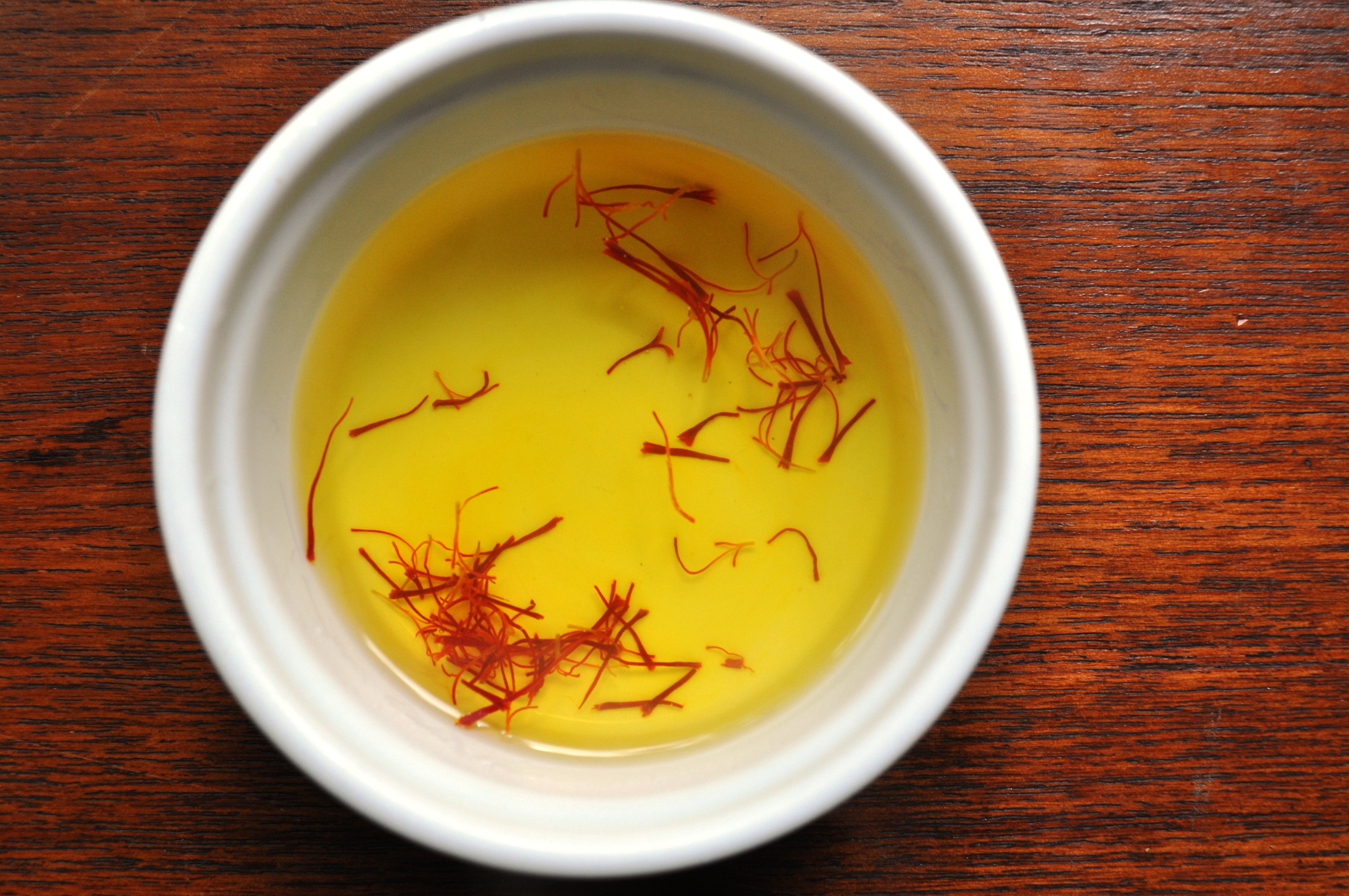
Saffron, infusing
2. Make a sponge or pre-ferment by mixing 150g strong white flour, the yeast and the milk, warmed to about body temperature. Don’t agonise about this. If it’s cooler, it’ll simply ferment slower. Just don’t get it too hot.
3. Let the sponge ferment until it’s nice and frothy.
4. In another, large mixing bowl combine the other 100g strong white bread flour and the 200g plain flour.
5. Cut the fats into cubes, then rub into the flour until it resembles breadcrumbs, more or less.
6. Add the salt, the sugar and the spices to the fatty floury mixture.
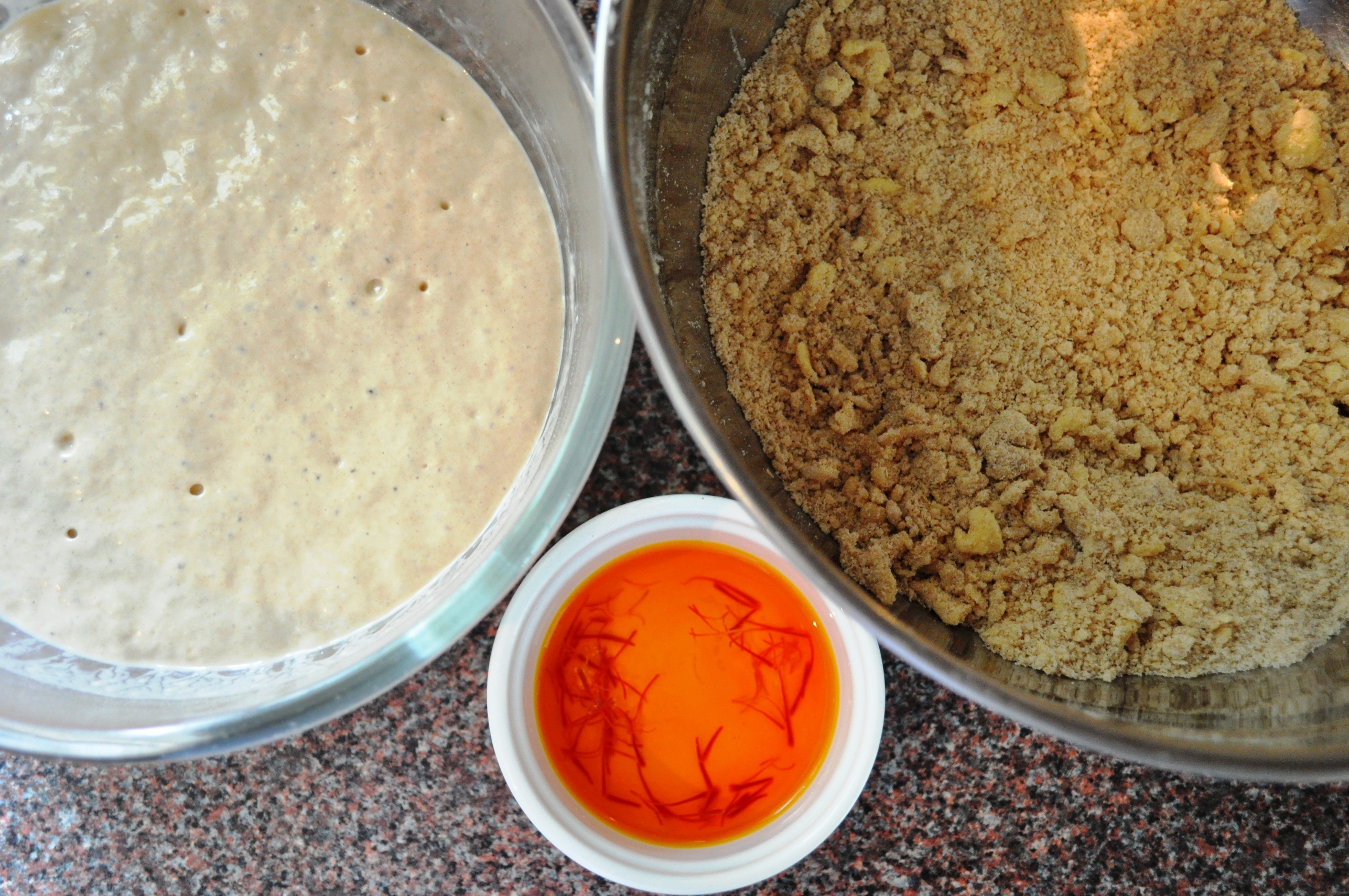
Ferment, flour mix and saffron infusion
7. Add the sponge along with the saffron and water to the floury mix.

Combine
8. Combine all the ingredients to form a dough. You want it moist; if it’s too dry, add a little more water or milk.
9. Give the dough a good knead, for 5 minutes or so, until it’s nice and smooth.
10. Stretch out the dough, add the dried fruit, then give it until gentle knead to distribute the fruit.
11. Form the dough into a ball and put back in the bowl, cleaned and oiled slightly.
12. Cover the bowl with a cloth or shower cap and leave to prove in a draught-free place until doubled in size. Time will vary depending on the temperature and the mood of your yeast.
13. Remove the dough and form it into a ball again, then rest this for another ten minutes or so.
14. Preheat your oven to 220C (200C fan oven).

Final prove
15. Form the dough into a baton and place this in a greased loaf tin. Cover it and leave to prove again, until it’s risen again and the dough re-inflates slightly when you push a finger into it.
16. Bake for about 20 minutes, then turn the oven down 20 degrees and keep baking for another 30 minutes. Watch it doesn’t colour too much – if it looks like it’s going to burn, cover it with foil.
17. Once baked, take it out of the tin and leave it to cool completely on a wire rack. (Or if you don’t mind a bit of indigestion, eat it while it’s still warm. Bakers don’t recommend this as a loaf that’s still warm is effectively still baking.)
18. Serve at tea time, generously buttered. It’s nice for breakfast or elevenses too.
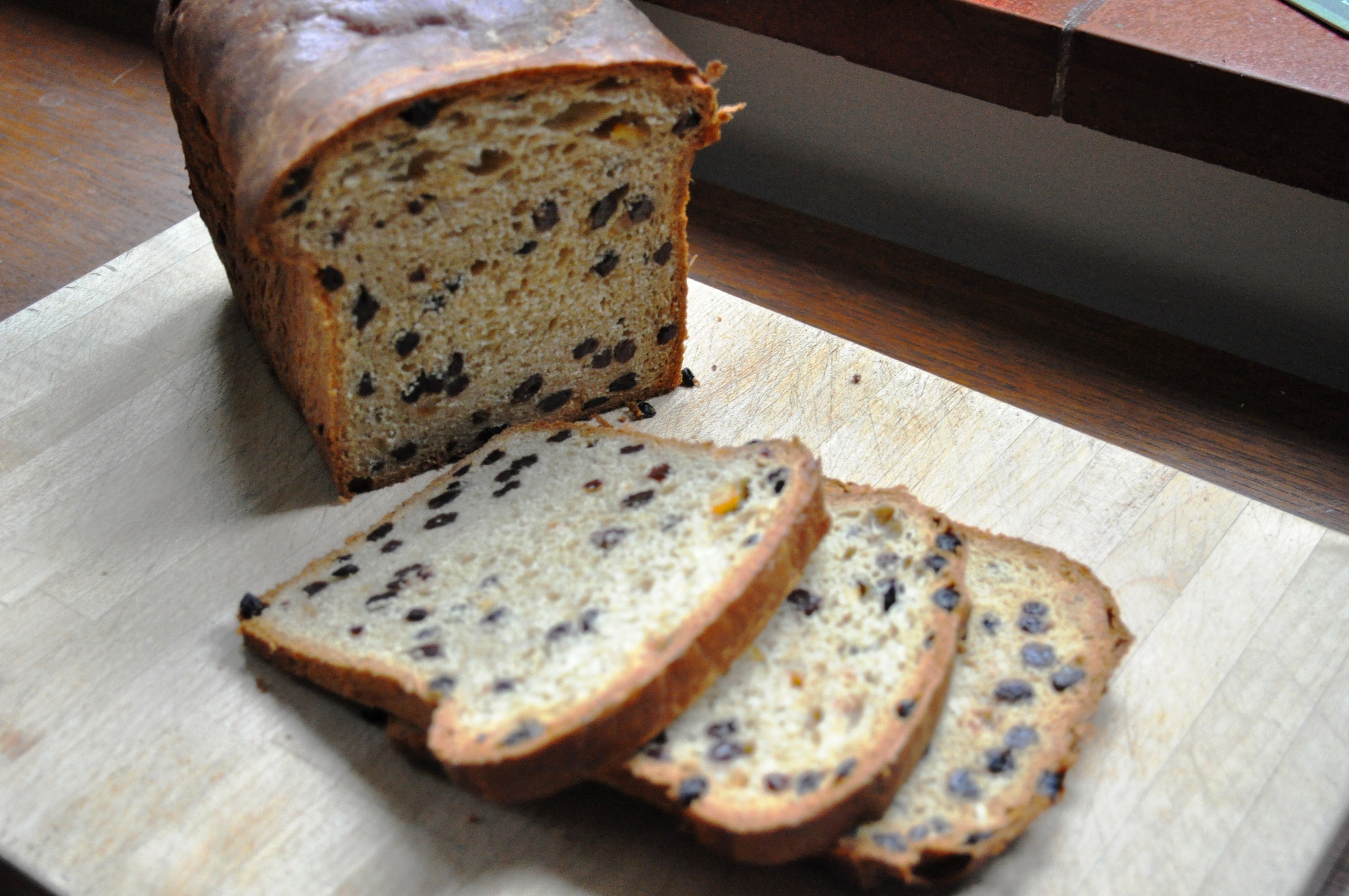
Cut

Anyway, having done all that, I also subsequently noticed that David gives recipes for Cornish saffron cake and a Devonshire cake, a “variation” that can be made with one of my favourite foodstuffs – clotted cream. So I really ought to do that next time, considering my folks’ place is actually in Devon, and Fran, the missus, is a Devonshire girl. Although my mother’s mother was from a Cornish family (the Olivers of St Minver), and I developed a strong love of Cornwall after several childhood holidays, so I suppose I’m allowed to feel torn.

A note on the flour
I’ve just bought some supplies from Stoates in Dorset. Or “Stoate & Son / Established since 1832” as it says on their site, though I’ll overlook the grammatical strangeness as they’re producing quality stone-ground products using a proportion of locally grown grain. The site also says, “We take great care in selecting our wheat much of which is sourced locally but is always blended with a proportion of Canadian wheat to achieve an end product with consistent baking and eating qualities.”I contacted Stoates about the specific blend and Michael Stoate got back to me saying “The mix at present is about 65% local UK grain (Paragon spring wheat) and 35% Kazakhstan high protein wheat. This is giving a protein content of about 12.50% – 13.00%.”

Stoates flours

The Stoates white flours, being stone-ground and less heavily sieved retains more the bran than more industrially produced flours. It’s also not bleached. So it’s not so bright white, meaning my “white” loaves will never quite achieve that gleam like a Hollywood film star’s teeth. But they will be healthier and more wholesome.

6 Comments

Filed under Baking, Breads, Cakes (yeasted), Flour & grain, Recipes

Pine nut tart

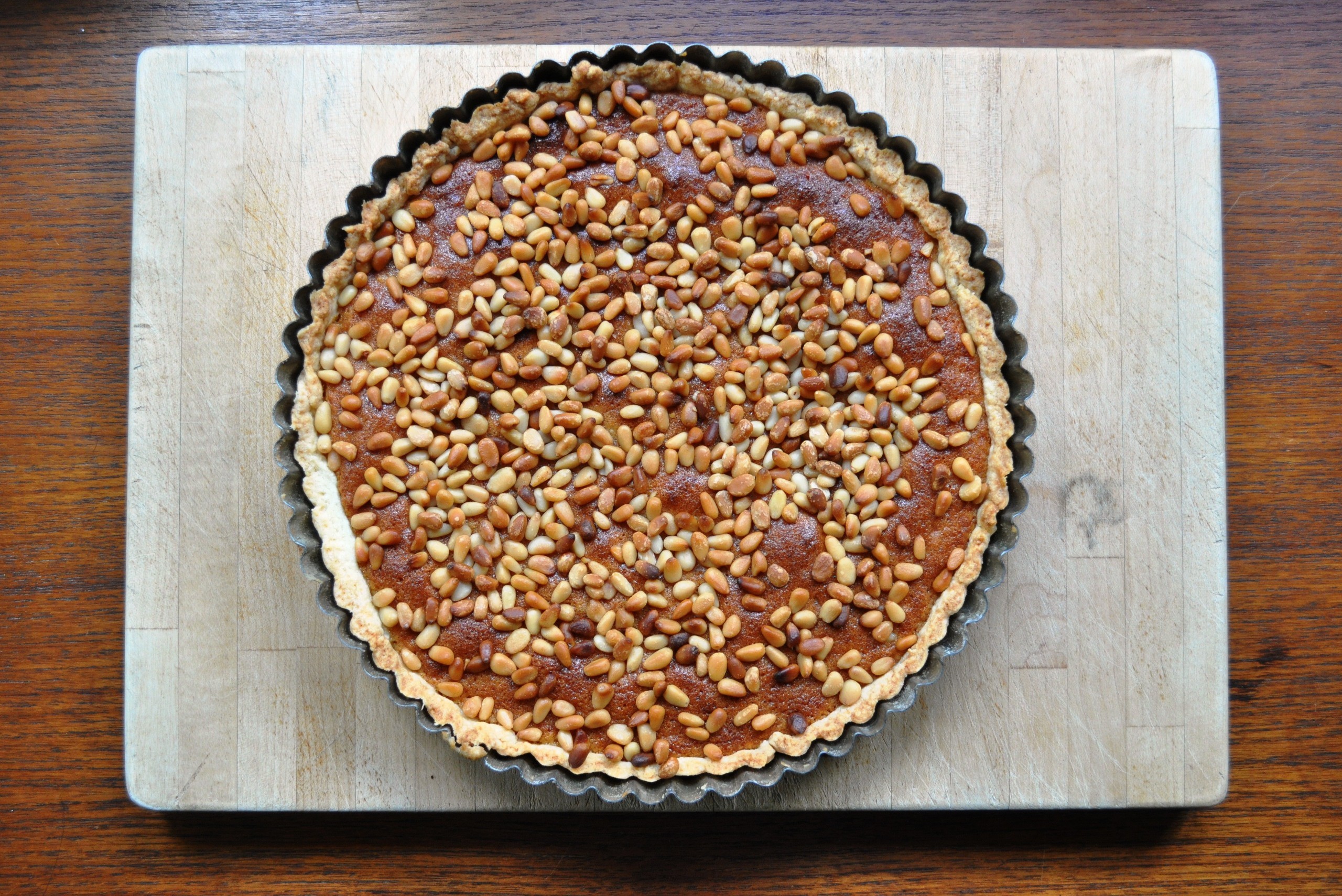
Pine nut tart

Torta della nonna – you’ll often see this on menus in Rome and other parts of Italy. It just means “grandma’s tart” or “granny’s cake”. I’m not sure I believe every single restaurant I saw it in had a grandmother toiling away making them, but it’s a cute selling point. I’m also not sure there’s a specific type of dessert tart that qualifies as torta della nonna – though the basic theme seemed to be variations on custard and pine nut tarts, made with or without ricotta, and with or without pine nuts on top.

The other day, our friend Dom asked me to supply the pudding for a meal he was making for his wife’s Min’s birthday. Immediately, I thought “tart” – for the pudding that is, not insulting either of them. A quick browse of the contents of the fridge and store cupboard, and of a few books, notably ‘Sweet Pies and Tarts’ by Linda Collister, suggested a pine nut tart. Which brought about fond memories of torta della nonna, even if this recipe is made without ricotta and has a filling that’s more an almondy sponge than a custard. Who knows though, I’m sure there are nonne out there who do use a bit of farina di mandorle (ground almonds) in their tarts.

The politics of pine nuts
Since coming home from Italy I’ve been having a bit of an issue with pine nuts. In Italy, I bought Italian pine nuts, harvested from Italian pine trees. Here, even in the most nominally right-on of health-foody shops, all the pine nuts seem to be from China. And I really can’t bring myself to buy them. It just seems insane to lug such produce half-way round the world, especially from China, a country with a dubious regime, a country that’s achieved borderline world-domination in everything from clothes to electronics, and a country that’s not exactly a paragon of environmental standards, with its economic revolution’s high energy demands. I’m not sure I trust its organic certification either.

Infinity Foods in Brighton, for example, sells Chinese pine nuts; pretty much all their dried beans are from China too – it’s really unfortunate as pulses are a big part of my diet. Can’t we grow anything a little closer to home? Can’t we get beans and pine nuts in Britain with slightly better ethical credentials? I realise the economics are complex, but cheaper food – cheaper imported food – often has hidden costs in terms of the environmental repercussions.

Plus, I remember Dom talking a few years ago about how Chinese pine nuts were leaving a strange metallic taste in his mouth – something to do with pollution perhaps? Or because Chinese exporters were mixing nuts from Pinus koraiensis trees with cheaper nuts from Pinus armandii, which some reports suggest is the cause of this “pine nut syndrome”. The EU changed rules regarding imports of the latter, but is it really that well regulated? And is it really just down to the Pinus armandii? (I’ll stop before I start sounding any more conspiracy theorist.)

I did finally find some pine nuts at La Porte’s in Lewes that were from the EU. Phew. This is what I had in my store cupboard.

Despite the depressing popularity of a certain political party whose name sounds like an injunction to have a nap* in last week’s elections, I’m happy to with a cultural identity that’s English, British and European, and as someone who prefers to buy food from as close to home, EU-grown produce is preferable to Chinese.

For the pastry:
90g butter, cold
150g plain flour
20g caster sugar
1 egg
1-2 tablespoons water (cold)

For the filling:
55g butter, at room temp, or softened slightly in microwave or a warm location
70g caster sugar
2 tablespoons honey (say 30g)
2 eggs, beaten
70g ground almonds
25g plain flour
1/2 teaspoon baking powder
120g pine nuts

1. Dice the butter then toss it in the flour. If you’re using unsalted butter, add a pinch of salt.
2. If making by hand, rub the butter into the flour until it resembles breadcrumbs, if you’re using a food processor, pulse it quickly to achieve a similar result.
3. Add the egg and bring the dough together, again either by hand on by machine. Add some cold water to form a dough, but not too much! You don’t want it squishy, you want it dry-ish, and short and crumbly once baked.
4. Form the dough into a ball, wrap in plastic and to in the fridge to rest.
5. Make the filling by creaming together the butter and sugar, then beating in the honey and egg.
6. Add the ground almonds, then sieve in the flour and baking powder together. Combine the mixture.
7. Add about a third of the pine nuts to the mixture.
8. Get your dough out of the fridge, roll it out and use it to line a loose-bottom flan tin, about 22-25cm in diameter. If you do this ahead of time, you can rest it again in the fridge for a while.
9. Preheat the oven to 180C.
10. Put the filling in the pastry case, then bake for about 10 minutes.
11. Carefully remove the half-baked tart, and gently sprinkle the rest of the pine nuts on top.
12. Put it back in the oven and bake for about 15-20 minutes, until nicely browned.
13. Remove from the oven and cool on rack. Serve warm or cold, preferably with a huge dollop of thick or clotted cream.


* Ukip – geddit?

4 Comments

Filed under Baking, Pastry, Pies & tarts, Puddings & desserts

Harveys’ Priory Ale and the 750th anniversary of the Battle of Lewes

Harveys Priory Ale, 11 May 2014

Harveys of Lewes, my local brewery, founded in 1790, has just released a new brew: Priory Ale. Although I drink Harveys Best often in the pub, and I’ve been enjoying working my way through their bottled beers, this is a novelty. The 6% ABV ale has been brewed especially to commemorate the 750th anniversary of the Battle of Lewes, which is being celebrated this weekend.

For those who don’t know their English 13th century history, the Battle of Lewes was a clash between the forces of Simon de Montfort, 6th Earl of Leicester, and those of King Henry III. The royal forces outnumbered those of Simon (10,000 versus 5,000) but he won anyway, and as a result he and his allies were able to force a reduction in the king’s autocratic powers.

The battle for democracy
Although you could see the battle as a squabble between Norman aristocrats, idealists instead couch it as an important step in the journey towards parliamentary democracy in England. That’s certainly the line taken here in Sussex and in Lewes, a town with strong links to the history of democracy. (Thomas Paine lived here for six years before heading to America in 1774, where his writing and philosophies contributed to the American Revolution and helped shape the ensuing nation’s democracy.)

The Priory Ale is the most interesting beer I’ve drunk in a while. Harveys’ head brewer and joint managing director Miles A Jenner and brewer Peter Yartlett have created a fascinating concoction, a kind of historical recreation of a 13th century-style beer. (I love this kind of thing – check out my efforts to make a bread using beer barm, as they would have done for centuries in Britain before yeast became something that could be cultivated in the late 19th century.)

The label says the ale “is brewed using ingredients that were available to the Cluniac Order at the Priory of St Pancras in Lewes in 1264, where a brew house was known to exist.” Which is nice, as we visited the ruins of the priory on Sunday too – or at least all that’s left of it, mostly just the foundations of massive medeival toilet blocks. The rest, including a vast church (128m long internally) was knocked down in Henry VIII’s Dissolution of the Monasteries. Interestingly, Henry employed an Italian engineer – who was presumably a catholic. Surely he must have had his doubts about his path to the afterlife being employed by an excommunicated reformer to knock down catholic houses?

For centuries, the site was used a quarry. Then the Victorians topped the vandalism by ploughing a massive railway cutting through the middle. Much as I love railways, I probably love historical buildings more, or at least am shocked at their mistreatment. I thought we didn’t do that anymore in England – certainly the local authority here is fussing about us building an extension, saying we have to have an archaeologist present. But then my mum and dad, whose house’s foundations are on the Roman walls of the city of Winchester, told me developers up the road were allowed to demolish a stretch of those walls to build some new flats!!!!!! My jaw genuinely dropped when I heard this.

Anyway, I digress.

Priory Ale label text, 11 May 2014

Harveys’ description of the Priory Ale also says, “Fermentable sugars are produced from a mash of barley, oats and wheat prior to being boiled with hops and yarrow to impart bitterness.” Though hops (Humulus lupulus) were not used in British ales in the 13th century. Chatting to Ed Page in the Harveys shop, we concurred on the notion that hops didn’t become commonplace in British brewing until the 16th century, with him saying they probably came over with Flemish workman. He also said these workmen probably invented cricket around the same time too. Ed explained Harveys used hops in the Priory Ale as their modern yeast strains simply couldn’t cope without some of the chemicals provided by the hops, the fermentation wouldn’t work.*

Hops in England
On this question of when hops arrived in Britain, Martyn Cornell gives his usual levels of detail and research into the history of the plant in brewing here. They were being grown in the Netherlands in the 14th century, and “The first import of Low Countries ‘beere’ into England seems to have come in 1362/63”. Though he continues, “However, the first brewer of the hopped drink in England does not appear until 1412.”

He corroborates what I’d been chatting about in the Harveys shop, saying, “The English beer trade seems to have stayed in the hands of immigrants from the Low Countries for the next century, as the conservative-minded natives stuck to their unhopped ale. As a result, the first beer brewers in England apparently imported all their hops from across the Channel, with no attempt to cultivate the plant here until early in the 16th century.” Hop growing in southeast England became established in the middle of the 16th century and had spread to “at least 14 English counties” by 1655.

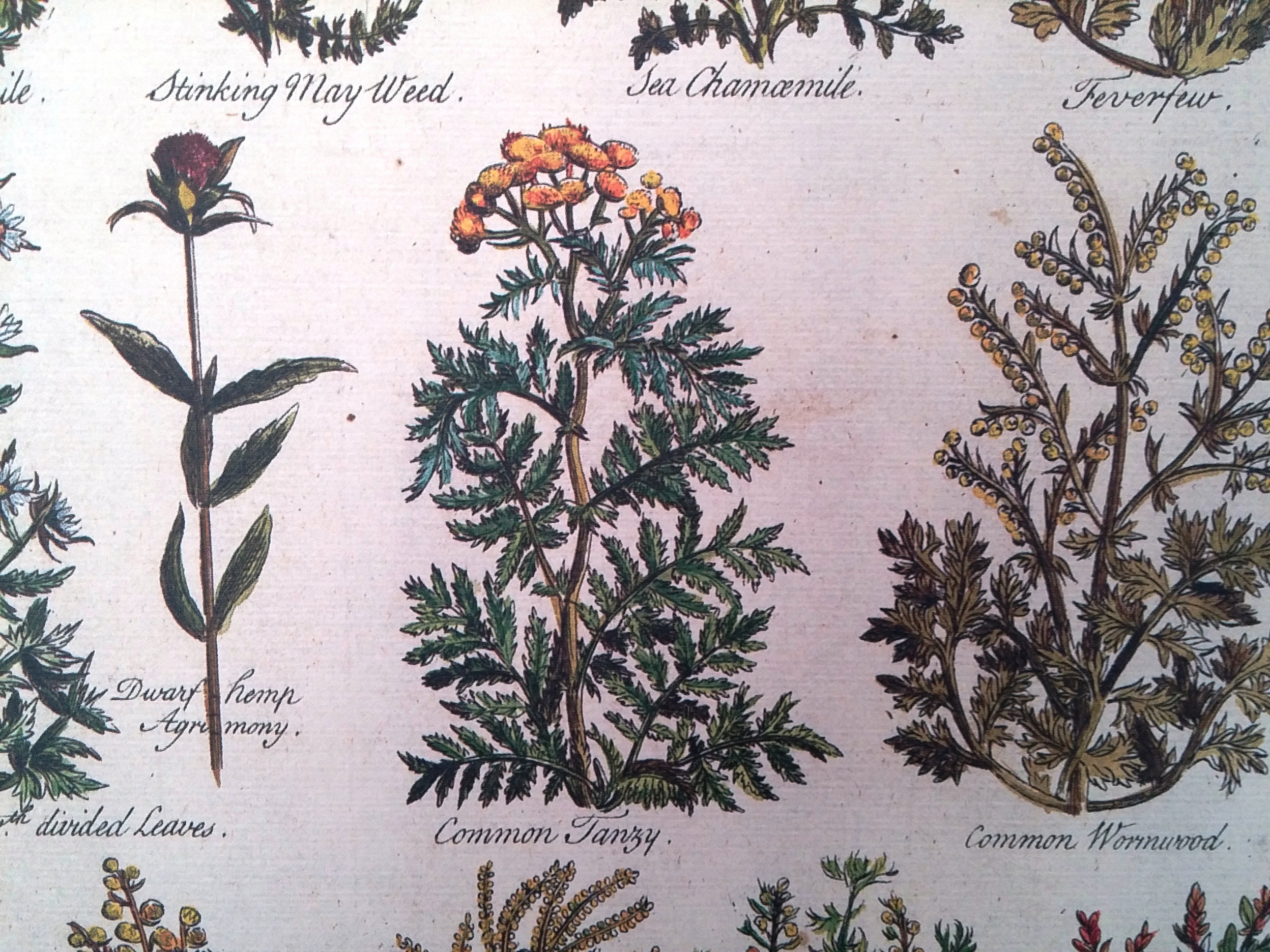
As for other plants used in brewing, Cornwell says, before hops brewers “had been using a huge range of other plants to flavour their ale in the meanwhile: the bushy, aromatic moorland shrub bog myrtle, for example, the grassland weed yarrow, the hedgerow plant ground-ivy, even rosemary and sage.” He later mentions “bitter hop alternatives such as broom and wormwood”. Harveys are using yarrow (Achillea millefolium) alongside hops in the boil. They do use other herbs for flavouring, though: “The resultant brew is conditioned in vats with ale cost, also known as tansy, rosemary and thyme.”

The Lewes Priory ruins include a wonderful herb garden now, where all these herbs can be found, emulating the site’s original, somewhat larger herb garden.

Strangely, the resulting beer has a somewhat ginger-beery taste, though I would say the thyme (Thymus vulgaris) provides the dominant flavour. Or more likely the thyme essential oil, thymol, which lends a distinctive herbal-antiseptic odour.

What is “ale cost”?
I’d never heard of “ale cost” before, so that got me investigating. A couple of Google book searches specify “alecost”, “ale-cost” or “ale cost” is specifically a name for the herb Tanacetum balsamita, also known as costmary. It’s related to the abovementioned tansy, which is Tanacetum vulgare.

Tansy

‘Breverton’s Complete Herbal’ (2011), an updating of ‘Culpeper’s Complete Herbal’ (originally published 1653) says, “‘Cost’ refers to costus, a spicy Asian plant related to ginger, which has a slightly similar flavour. … ‘Alecost’ translates into ale-cost or ‘spicy herb for ale’ as it [Tanacetum balsamita] was once an important flavouring of ales.” (Link here.) This is confirmed by the wonderfully titled 1823 ‘Universal Technological Dictionary Or Familiar Explanation of the Terms Used in All Arts and Sciences Containing Definitions Drawn From The Original Writers’, here. The costus in question, also Costi amari radix or costus root, which the costmary or alecost is reminiscent of and partly named after, was apparently an important trade item for the ancient Romans. It’s been identified as a member of the Saussurea genus, S. lappa.Which isn’t related to ginger at all.

So, yes, Harveys, I very much enjoyed your Priory Ale, both as a striking, slightly strange ale and as a historical experiment. And as a stimulant to learn more about random old herbs and plants and the term “ale cost” – which arguably Harveys are using with some poetic brewers’ license.

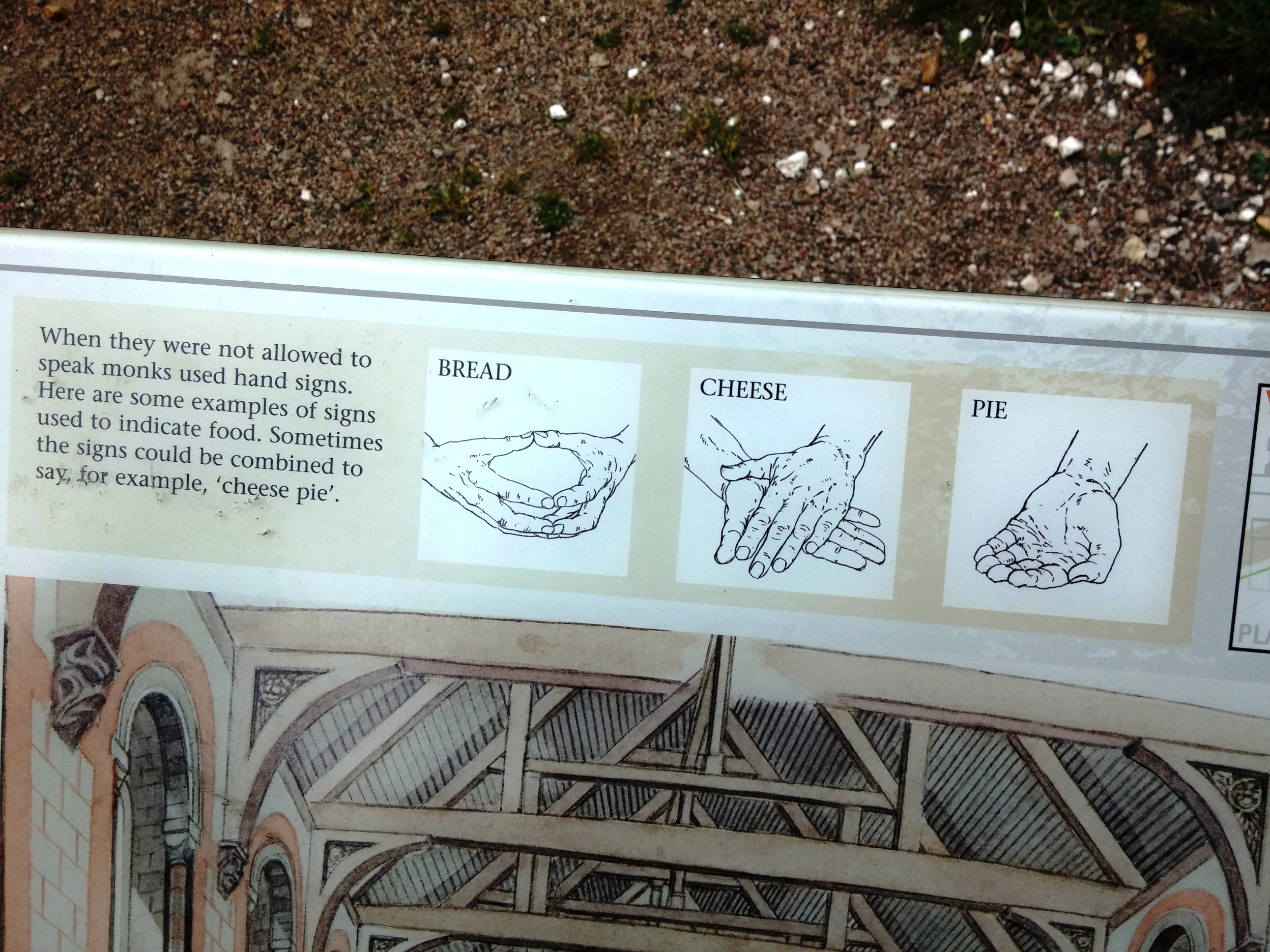
Oh, and among the info boards at the priory is this one, explaining the sign language used by the monks when eating in their refectory. It doesn’t include the sign for “ale”, surprisingly, as this was of course made at the priory, a hugely important drink and quite possibly somewhat like a murkier version of Harveys’ Priory Ale – but without the hops. Perhaps they just used the same sign we do – imaginary glass held up in front of mouth, hand tilted back and forth slightly.

Monastic sign language

* Since writing this, I’ve been ruminating about it, and chatting to brewers. I can’t really understand how yeast – which feeds on the sugars in the wort, from the mashed malt – would be affected by the presence, or not, of yeast. I hope to try and ask Ed Page in Harveys to clarify this. Addendum 2: I spoke to Ed again yesterday and he reiterated that their yeast does need a bit of hop in the fermentation. He said they’ve had the same yeast culture for 60 years, so at about 300 brews a year, that’s about 18,000 generations of yeast – and he said it’s become so used to the hop in the mix that while it will still ferment, “it doesn’t function to its best without it”.
Addendum 3 (24 May 2014): So I met Edmund Jenner, son of head brewer Miles Jenner. He’s called “Beer ambassador” on the Harveys site, and is certainly very knowledgebale – as you’d expect from a member of this renowned brewing family. He called their yeast “hop dependent”, explaining they need the alpha acids from the hops “to perform”. For the brew, they use a small amount of Alsace-grown Savinski Goldings hops (which I believe are Styrian Goldings, a Slovenian form of the British Fuggles hop.)
Addedum 4 (7 June 2014): Ran into Edmund again, and he said that although he’d talked about hop dependency of yeast at Brewlab, when he mentioned it to the brewing team at Harveys they weren’t convinced. So now I’m confused. Again. Ed says he’ll look into it further and I’m sure we’ll discuss it further next time we meet.

Leave a comment

Filed under Breweries, British beer

Real Bread Maker Week, 10-16 May 2014

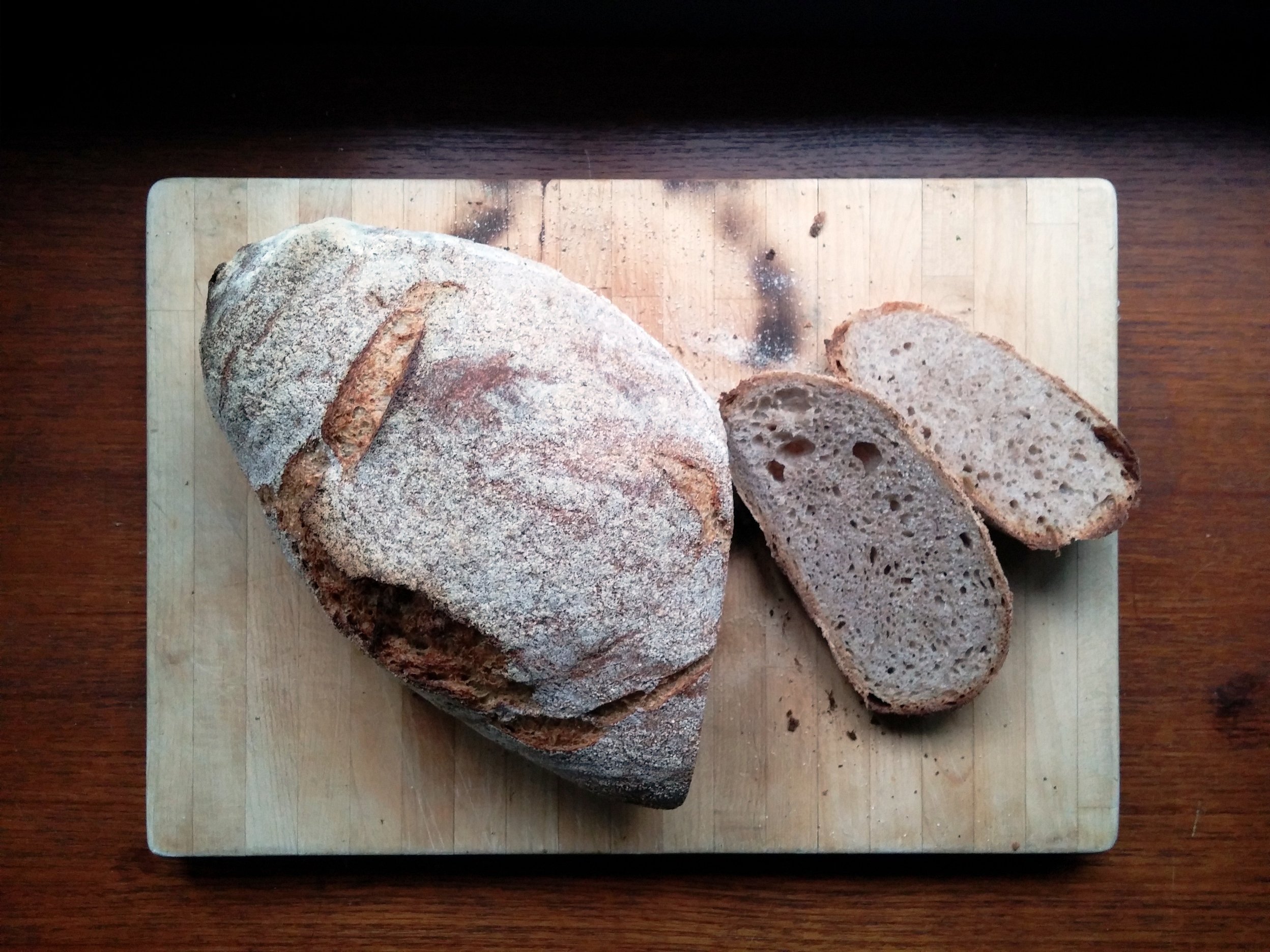
Sliced overhead
Earlier this week I had a fantastic bike ride up from Lewes to Wapsbourne Manor (44km there and back along verdant Sussex country lanes; route here), home of the renowned campsite also known as Wowo. There, I met owner Paul Cragg along with Andy Forbes of the Brockwell Bake, who is working to restore British heritage wheats and has a crop at Wapsbourne.

Our conversations were informative and wide-ranging and I’m still trying to work out how to write a blog about it all. This is partly because the Brockwell Bake is involved in a fascinating range of activities, all interconnected around questions of grain and bread, cultivating and baking, but each with its own detail and complexities. Among the activities are educational projects, encouraging a wider understanding of what goes into bread and how it’s made. And when I say bread, I mean real bread, not that wheat-based garbage wrapped in plastic you find on supermarket shelves.

Real Bread Campaign
In this respect, the Brockwell Bake’s work overlaps with that of the Real Bread Campaign. The campaign is part of the charity Sustain – the alliance for better food and farming. Their primary remit involves education about what constitutes real bread – a healthy item that’s been a part of the human diet for millennia but has been tarnished by the grotesque compromises of the mid-20th century industrialisation of food production. And how you can make it. Or where you can buy it. Or indeed, how you can set up your own business making and selling it. You can find out more about what the campaign here.

Anyway, tomorrow, 10 May, marks the start of the campaign’s Real Bread Maker Week: “The annual celebration of Real Bread and its makers: on your high street, in the back of your kitchen cupboard and at the ends of your sleeves.” Furthermore, according to the site, “The main aim of the week is to encourage people to get baking Real Bread or buying it from local, independent bakeries.” Various events are taking place around the country. Find out more here.

RealBread_MakerWeek_small

Red casserole bread
In the meantime, here’s the latest real bread I’ve made. I’m really loving using an old red casserole dish I acquired from my mother, who inherited it from her mother. It’s a heavy Danish cast-iron piece of kit that lends itself really well to the technique of pre-heating it as hot as your oven will go, then adding the bread, putting the lid on and baking.

Rye and wheat casserole bread

This is sourdough made with the sponge-and-dough technique. This involves making a pre-ferment – the sponge – with some of the flour and the liquid, letting that ferment, then adding the rest of the flour and salt and forming your dough.

Sponge:
100g rye leaven/sourdough starter (at 100% hydration)
320g water (filtered)
270g flour (I used 170g local wholegrain wheat, 100g slightly less local strong white)

1. Whisk together the water and leaven.
2. Add the flour and mix well.
3. Cover with a cloth and leave to ferment for 9-16 hours. Say while you’re at work.

Dough:
11g salt
270g flour (again, I used a mixture of wholegrain wheat and strong white).

Sliced, angle

4. Combine the salt and flour.
5. Add to the sponge and bring together with a spatula or wooden spoon or you can even get your hands in there if you want.
6. Bring to a dough with a quick knead, to make sure everything is well combined.
7. Form a ball and return to the bowl (cleaned and oiled slightly). Cover again and leave for few hours.
8. Take out the ball of dough, stretch it and give it a fold – that is, folding up one then, then the other down to form a kind of enveloped. Return to the bowl, then repeat this process again a few more times every 15 minutes.
9. Cover the bowl with cling film or put it in a plastic bag, then put it in the fridge for about 8-10 hours – I did it overnight.
10. Take out the dough, and allow it to come back to room temperature.
11. Gently form the dough into a ball, then rest it for 15 minutes.
12. Form the ball into a baton – but gently as you don’t want to de-gas it too much. (I really must do a series of photos or some videos of shaping dough.)
13. Give the dough one final prove (or proof) in a basket lined with floured cloth, with the seam of the baton upwards. I did this for about an hour in the airing cupboard, which is 24C.
14. Preheat the oven – I did mine as hot as it’ll get, 250C.
15. Put the casserole in the oven to get to the same temperature – I left mine for 30 minutes.
16. Take the casserole out and quickly and carefully invert the dough into it, so the seam goes to the bottom.
17. Put the lid back on, and bake for 30 minutes.
18. Take the lid off and bake for another 15 minutes, or until the top is nicely coloured – I like nice “high bake”, a dark colour.
19. Take out the loaf and allow to cool completely on a wire rack.

Oh, and while you’re baking, what better item to wear than a snazzy Real Bread Campaign apron? You can get a limited edition “I [loaf] Real Bread’ apron from Balcony Shirts here, with £3 from every sale going to the campaign.

Real Bread Campaign apron


1 Comment

Filed under Baking, Breads, Discussion, Flour & grain, Misc

Ricotta rough puff pastry and sbriciolata di millefoglie

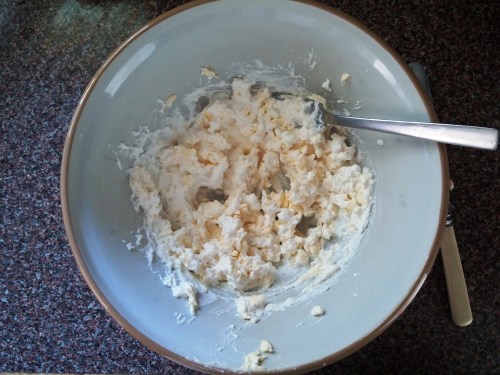
Butter and ricotta

It’s probably fair to say that Italian cuisine isn’t most famous for its desserts and puddings. Sure, tiramisu has an internation reputation, but generally the desserts aren’t really up there with Italy’s other great, world-dominating culinary exports (you know, pizza, pasta, that kind of thing).

Italian pastries, biscuits and cakes are great, but they’re not typically desserts. Pastries like cornetti (the sweet Italian equivalent of a croissant) and maritozzi con la panna (sweet cream buns) are typically eaten for breakfast. Cakes and enriched breads are often used to celebrate feast days (like panettone at Christmas, colomba or pizza cresciuta at Easter). And biscuits, such as the famed hard biscotti di Prato / cantuccini (and similar) and ciambelline al vino, are generally eaten with a glass of strong digestivo liquor after dinner.

The Roman pasticcerie we frequented would sell small pastries and cakes – described with the French name mignon (dainty). These could be bought by weight on trays, neatly wrapped and used as gifts when visiting friends or family. I never quite got my head around what time of day they’d be consumed, but the one time we did an English afternoon tea party for friends in Rome, many of the Italians were very confused to be faced by sweet baked goods, dolci, mid-afternoon.

Deconstructured mille-feuille
Having said all that, one Italian dessert, very much offered by restaurants in Rome after you’d eaten your primo and/or secondo piatto (pasta and meat/fish courses), was sbriciolata di millefoglie. I have very affectionate memories of eating it at Trattoria da Bucatino in Testaccio.

The name sbriciolata di millefoglie means something like “crumbled up mille-feuille” – that is, a kind of rough, deconstructed take on the Italian version (millefoglie) or the French mille-feuille, that pastry whose name means “thousand leaves” in both languages and refers to the layering of puff pastry with a filling of cream or custard, specifically thick pastry custard, crema pasticcera in Italian, or crème pâtissière1 in French. (Note, in Italian, custard is just called crema, while cream is panna.) So a sbriciolata di millefoglie could simply be described as a bowl of custard with broken puff pastry on top.

And yet it’s so good. I made a weird onme a while back after I’d made frappe. Italians would say non si fa (it’s just not done), but I had some broken frappe, and fancied some custard, and the result was good. I then thought I should try it again with a proper, non-deep-fried pastry, puff,  or at least a rough puff, pastry.

So I did. Then Fran’s camera broke and I didn’t get any photos of the finished desert. Plus, well, we had lots of guests over the bank holiday weekend so scrabbling around with cameras and crude attempts at food styling might have been a bit antisocial and broken the flow of the very important business of eating. (And boy did we eat a lot.)

For the custard just find yourself a recipe for crème pâtissière or similar thick custard. Dan Lepard has a good one called Extra thick vanilla cream custard in ‘Short and Sweet’, or you could use something like this. (I may revisit this at some point and find a more specifically Italian custard recipe.)

For the pastry, I used a lovely Italian pasta sfoglia2 veloce – quick rough puff pastry – made with butter and ricotta.

Butter and ricotta 2

250g plain (all-purpose) flour
250g ricotta
125g butter, coarsely grated
1/2 t salt

Mash together

1. In a bowl, mash together the ricotta and grated butter with a fork. You could also do this with a zizzer – aka hand blende. But don’t overdo it, as you don’t want to heat up the mixture too much.

Add flour
2. Add the flour and salt and keep mashing together, hen bring together a dough with your hands.

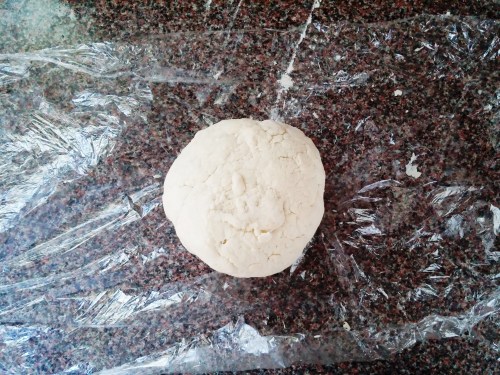
Form dough
3. Wrap the dough in plastic and leave to rest for a few hours, or even overnight.

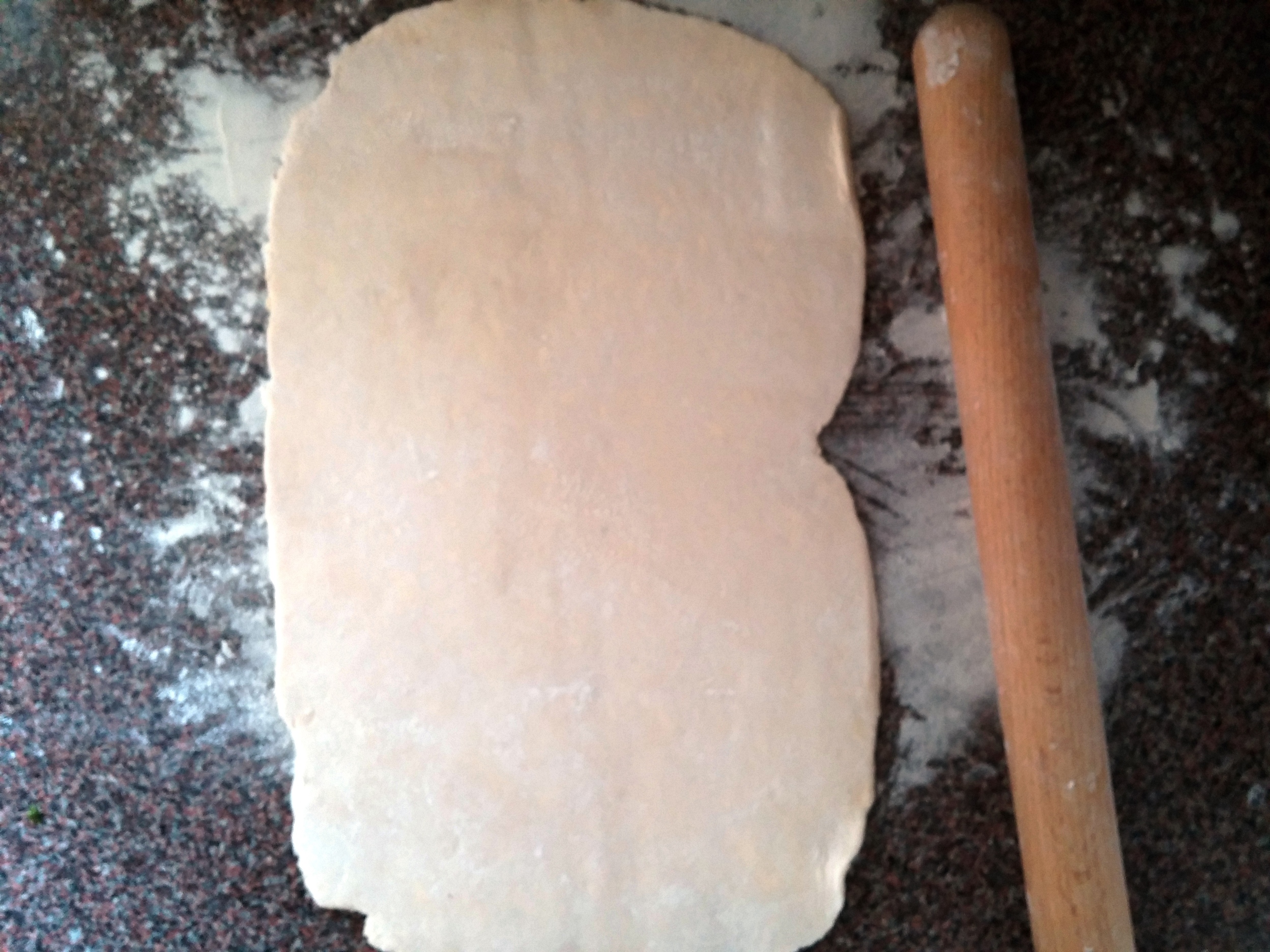
Roll out
4. Roll out the dough to form a rectangle about 20 by 35cm (or 8 by 14 inches for you 19th century types) and give it a letter fold, that is folding up one third, then folding the other third down over the top.

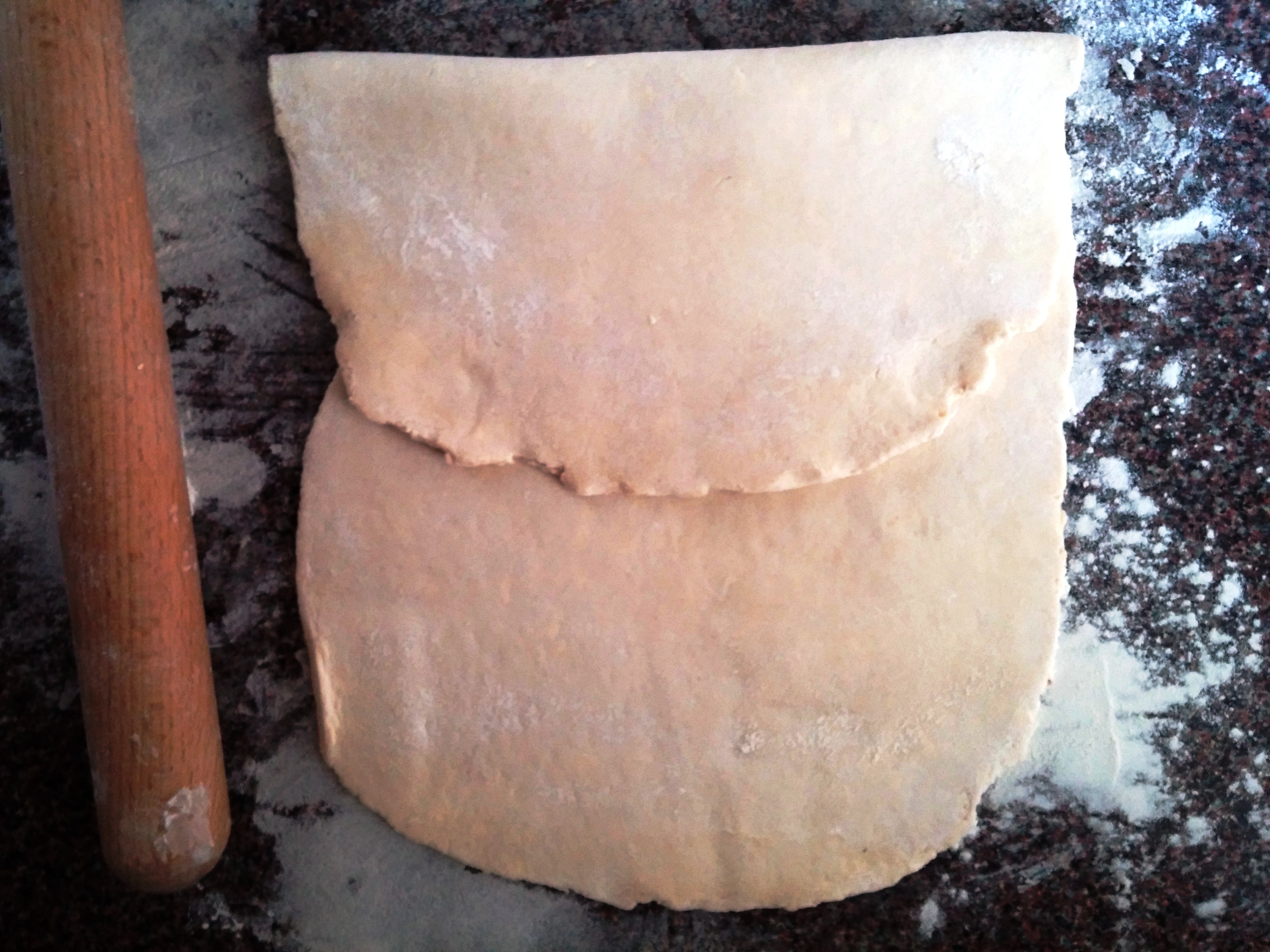
Fold
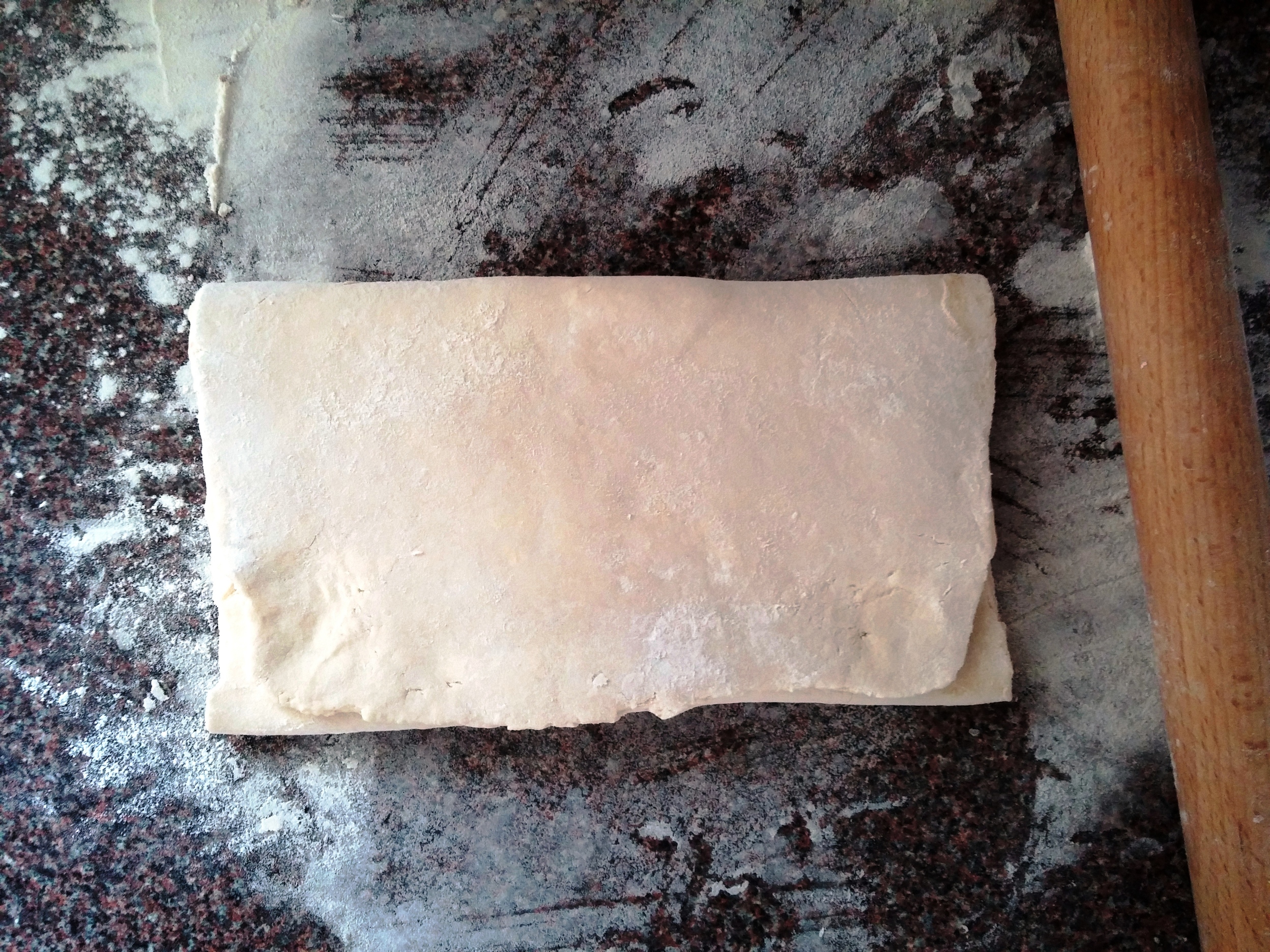
5. Roll out and repeat the folding process. Repeat this once more. Try to strech the corners a bit to neaten up the rectangles if you like, but it’s not essential – this is rough form of pastry lamination after all.

Fold again
6. Wrap in plastic and rest again, for at least half an hour.

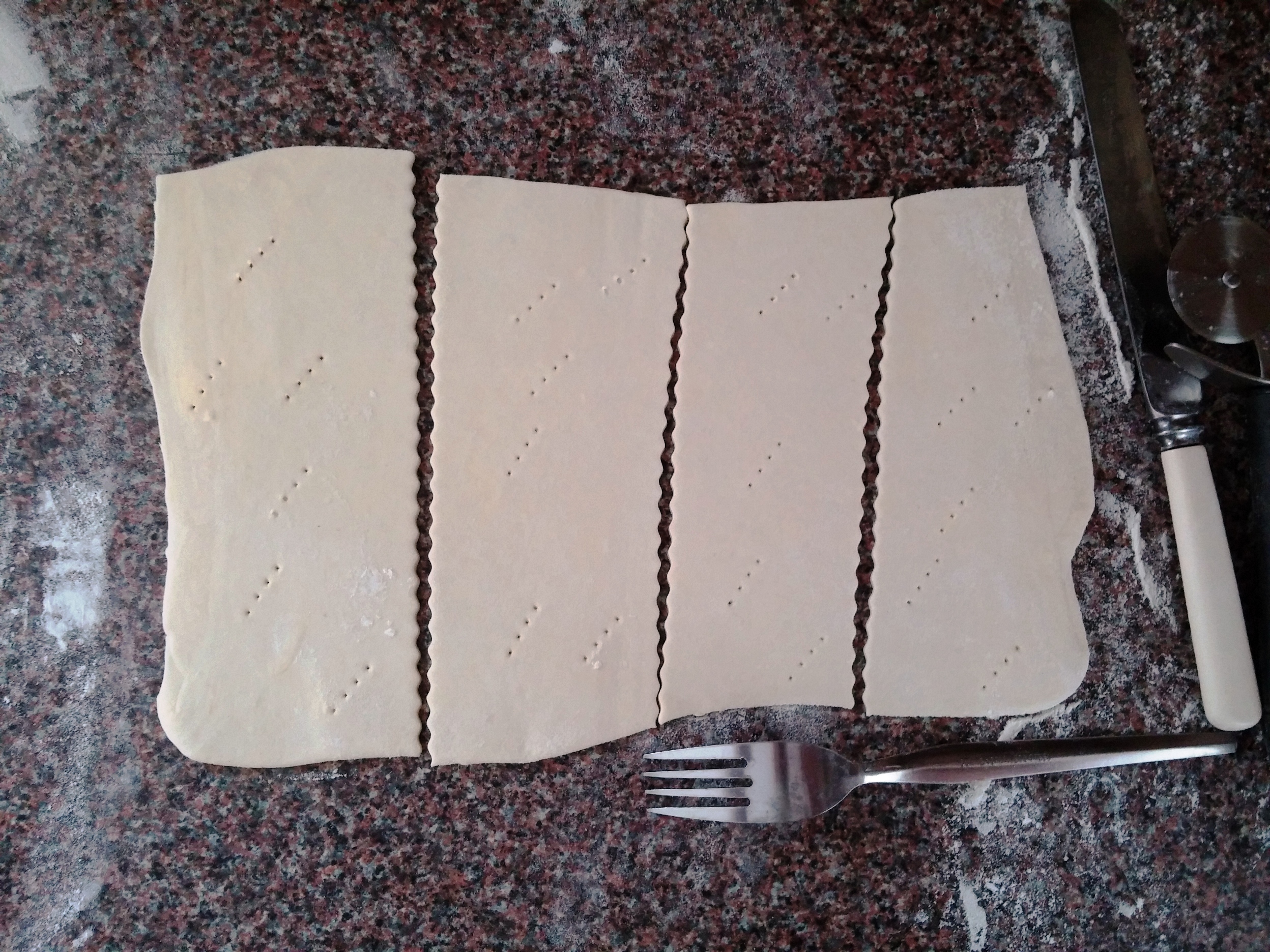
Cut out and prick
7. Roll out the dough to few milimetres thick and cut into required shapes. I just wanted crumbled scraps for my sbriciolata so didn’t do them very reguarly, but if you were doing, say, Italian-style millefoglie, cut them into regular rectangles about 4 by 10cm.

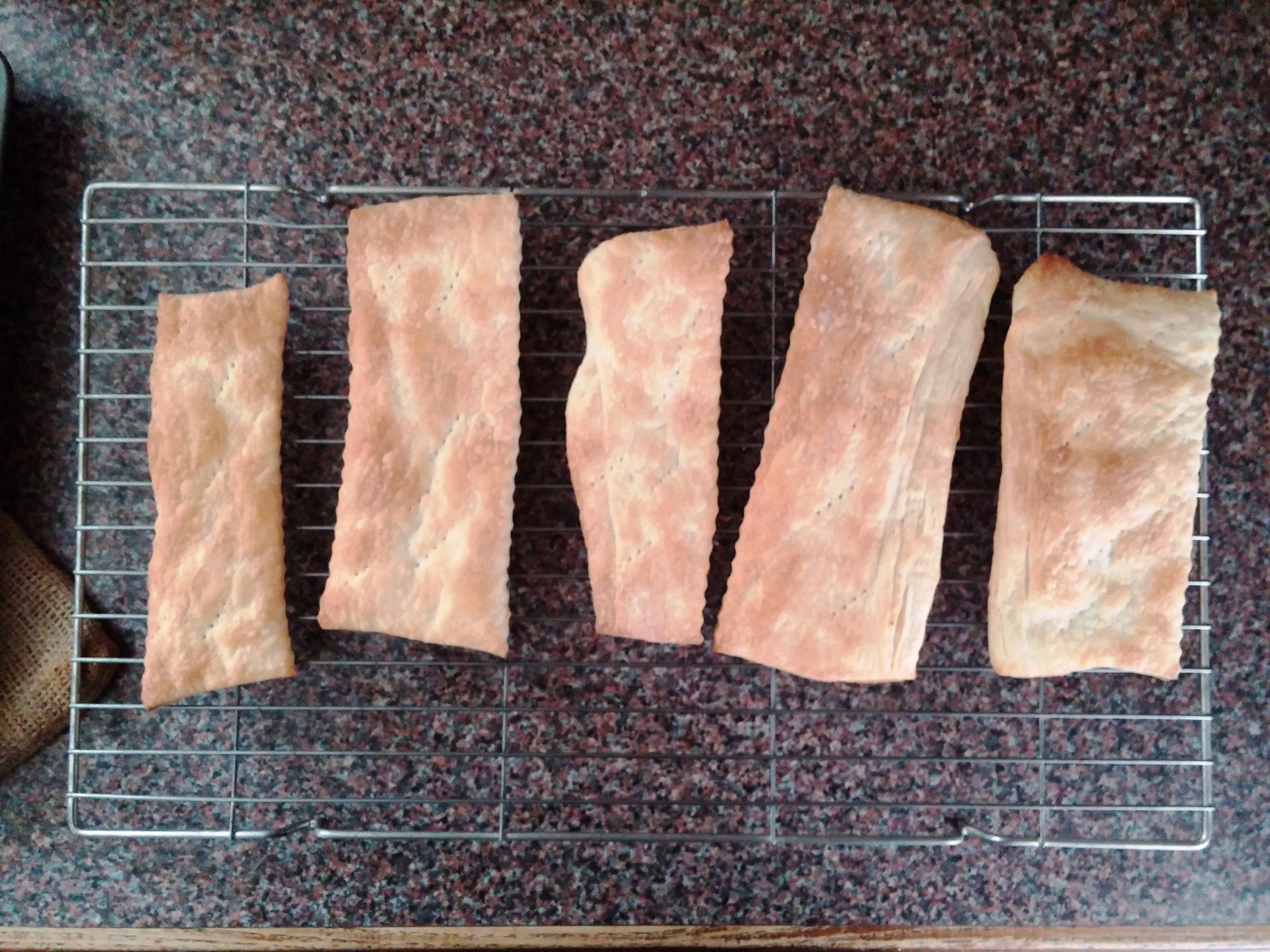
Baked
8. Prick with a form then bake in an oven preheated to 200C for about 15 minutes, until nicely browned. You want the pastry crisp

To assemble a sbriciolata di millefoglie, fill individual bowls with the thick custard, or do one large family bowl. Break up your pieces of pastry roughly, and sprinkle the pieces onto the custard. Before serving, dust with icing (powdered) sugar.


1 Can I just say, it’s pronounced “crem pa-teess-i-air” ([patisjɛːʁ]), not “crem pa-teess-er-ree” ([pɑtisʁi]) as so many people seem to say on Great British Bake Off etc. A “pa-teess-er-ree” is a pâtisserie, the shop where you buy the sweet pastries and cakes that may or may not be made with crème pâtissière.
2 So while millefoglia means “thousand leaves”, with foglia the Italian for leaf (feuille in French), sfoglia is the Italian for a leaf or layer of filo or puff pastry. Foglio, meanwhile, means sheet or leaf of paper, or indeed the English folio. It all relates to or is derived from from the Latin folium (plural folia), leaf.

2 Comments

Filed under Baking, Pastry

Holey-er than thou

Holey bread 1

A lot of my recent bread has been fairly dense, with a close crumb. I like bread like this, especially with wholegrain breads like the 100% wholegrain wheat and spelt I’ve been making recently. They’ve tasted great and when fresh aren’t bad for open sandwiches and when a bit old they’re perfect for toast. But the favoured style of “artisan” bread these days is all about the open crumb. A nice crisp crust and an open, irregular crumb with a variety of big holes.

I know I’ve made holey bread like that in the past, but, I dunno, through all my experiments the past few years with seriously rustic flours, bought from farmers’ markets in Rome and here in Sussex, I seem to have lost the knack slightly. Learning to bake is one of those life-long challenges, especially if you’re a home baker and aren’t churning out massive batches. But it’s funny to feel you’ve learned something then forgotten it again.

High extraction challenge
It does seem that holey breads are a particular challenge if you’re using flour with a high extraction rate. The extraction rate is the amount of the grain that remains in the milled flour. So a genuinely wholegrain flour in principle should be 100% extraction. Modern, industrial, nominally brown flours, however, may only be about 80-85% extraction, whereas white flours, which have been sieved or bolted1 may be closer to 70% extraction – with the bran and germ (ie, the healthiest bits) removed and just the starches and proteins remaining. 

I’m sure the masters of the contemporary bread scene, especially those who work with ancient and heritage grains (like Chad Robertson of Tartine and the bakers producing the great looking results of the Brockwell Bake) could get a nice open, irregular holey crumb from 100% extraction flours, but not me. The wholegrain flours I’ve been buying lately have been very branny, stoneground, and I suspect probably close to 100% extraction. They taste great, but I need to get at it to open that crumb out.

I did go back to a classic Dan Lepard 100% white sourdough recipe the other day, and did get a holey crumb. Bit it’s wholly too holey. Holey-er than though. With giant crazy giant holes. So I’ve gone from one extreme to the other.

I reckon the next few weeks, I’m going to try and make breads that are 50/50 white and wholegrain and try the so-called “no knead” method. This seems to be very popular among US bakers and does seem to give holey crumb loaves. It involves mixing up the dough, resting it, and giving it a few stretch-and-folds over time. This does seem very similar to Dan L’s method of mixing, doing a short knead, resting it, and doing another short knead, then repeating, as those kneads basically just involve folding over the dough. I generally use Dan L’s method, with a few stretch-and-folds anyway. And there’s arguably a fine line between “kneading” and “folding”.

In the meantime, here are some pics of my comically holey bread. The flour was nothing fancy2, but the loaves still tasted pretty good. Even if they weren’t idea for making sarnies.

Holey bread 2


1 Etymology geek chums, bolting generally means sieving – or indeed sifting – through cloth. The word comes from 12th century Middle English bulten, from the old French bulter, which is probably from the Old High German būtil, meaning bag.)

2 Strong white from Waitrose supermarket. Although Waitrose/John Lewis does has its own farm,  the Leckford Estate in Hampshire, my home county, and to the west of Sussex in the south of England, they don’t seem to grow wheat that produces a strong white bread flour. The Waitrose own brand strong white is “produce of more than one country” – they, and even the likes of Dove’s Farm and Shipton Mill, Britain’s two big organic flour brands, don’t seem to be forthcoming about which countries. Presumably Canada, Kazakhstan, India, etc. I’ve now ordered some strong white flour from Stoate & Sons now instead. I believe they do manage to locally source and mill  a strong, high protein variety of wheat  in Dorset, the next country along from Hampshire.)

5 Comments

Filed under Baking, Breads, Discussion, Flour & grain