Category Archives: Baking

Baking – Daniel Etherington’s bread experiements

Chocolate cake with dark double-malt beer


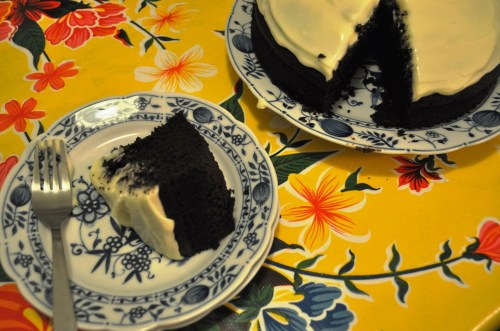
Chocolate cake made with "birra scura doppio malto" (dark, double-malted beer)

One of my favourite breweries here in Italy is Mastri Birrai Umbri. They currently do three beers, one of which is Cotta 74, a doppio malto scura – a dark double-malt beer. A “birra doppio malto” is an Italian legal classification but this specific beer is made with a well-roasted malt as is not unlike a porter or stout. It’s got a warm, deep flavour, with a slight burnt caramel taste and hints of chocolate. So, thought I, why not try and use it in a chocolate cake recipe?

Mastri Birrai Umbri’s beers, developed by master brewer Michele Sensidoni,  also all use a unique ingredient, something distinctly Umbrian. In the case of Cotta 74, that ingredient is lentils, which are a traditional crop in Umbria. I believe they give the beer a slight nuttiness and earthiness. Also good for a chocolate cake, thunk I.

Anyway, available here is a recipe for a chocolate cake made with Guinness. It’s a Nigella Lawson recipe. I never had good results from her cake recipes, I found them unpredicable and unreliable. And nor do I like Guinness (it’s tastes too much like iron and mud, it’s too creamy). But the recipe proved a good foundation for a cake made with Cotta 74.

Of course this is a versatile recipe, so use whatever stout or porter you have to hand. Though I would recommend something good quality from a small brewery. Large scale industrial beer is never as nice.

(Note – I do liquids in grams. It’s more accurate, and perfectly easy if you’re using bowls and electronic scales. If you’re unconvinced, just use the liquid measures in ml.)

250g scura doppio malto, stout or porter
250g unsalted butter
100g cocoa
340g caster sugar
140g mascarpone
20g yogurt
2 eggs
1 tablespoon vanilla extract
270g plain flour
1.5 teaspoons bicarbonate of soda
1 teaspoon baking power

Preheat oven to 180C.
Grease and line a 23cm tin. (Springform is easier but not essential.)

In a pan, melt the butter in the beer.
Pour into a large mixing bowl.
Beat the cocoa and sugar into the beer/butter mix.
Allow this mixture to cool slightly.

Beat together the mascarpone, yogurt, eggs and vanilla essence.
When the main mix is cool enough, beat in the mascarpone mixture. (If it’s too hot, you’ll scramble the egg content.)

Sieve together the flour and raising agents.
Add this to the mixture and beat well.

Pour the mixture into the tin.

Bake for around 1 around, until it’s well risen and no longer too wobbly.

Leave to cool completely in the tin, on a wire rack.

Make a topping with
100g mascarpone
150g icing sugar

Sieve the icing sugar into the mascarpone and mix.
If it’s too sloppy, add more sieved icing sugar.

Enjoy!

3 Comments

Filed under Baking, Food misc, Italy

Scones – cream first or jam first?

We’re big fans of scones in our household. My wife, Fran, is from Devon and I’ve got strong connections with this county in the southwest of England that, along with its neighbour Cornwall, is the homeland of the cream tea: scones with clotted cream and jam, washed down with (milky black) tea.

(Some say the scone comes from Scotland – does it? Are Scots and West Country scones the same thing? Or are they different types of “quick bread” with the same name? Some serious historical investigation needs to be done on that front before I’m persuaded either way. The word itself may derive from the Dutch “schoonbrot”, meaning fine bread or white bread, though that clarifies nothing.)

I’ve been making scones since childhood, presumably having fallen in love with them after childhood holidays in Devon and Cornwall.

Anyway, every time we eat them, the same two issues arise.

First, is it pronounced skon-ryhmes-with-John or skown-rhymes-with-own? (Seriously – there’s no either/or; as with many words, it varies, with the former pronunciation most common in Britain, especially in Scotland. See point 3.11 in this 1998 University College London British English pronunciation survey.)

And second, does one split the scone then spread it with clotted cream first, or jam first? I doubt UCL has done a survey on that, and among my friends things seem to be fairly evenly split. Fran is adamant is has to be jam first, then a blob of cream like a garnish, I’ve always spread the clotted cream first, like a kind of glorified (oh the glory!) butter.

Now, before I proceed, for any impoverished soul who hasn’t had the pleasure of eating clotted cream, let me tell you what you’re missing. Clotted cream – which most certainly is traditionally, and originally, from the West Country – is a very rich, delicious and generally delightful dairy product made using the cream of cow’s milk.

In days of yore it would have been made using the rich milk of local West Country cattle, like the charming Devon Reds, a breed that’s been making a comeback recently. (My parents’ neighbours in their place in Devon had a champion Devon Red bull called “Freddie” Yeomadon Ferdinand, whose offspring are used for beef; apparently it’s not viable to use Devon Reds for dairy these days so I’ve never tried any Devon Red milk or dairy products.) These days, clotted cream is mostly made using milk from Guernsey and Jersey cows, the breeds now most associated with rich, fatty milk.

Clotted cream is traditionally made by heating rich creamy milk over a low heat, possibly in a bain-marie type arrangement, reducing its water content, and encouraging the creation of thick creamy clots, which are skimmed off. I’ve made cheese, butter and yogurt but never clotted cream. They demonstrated this traditional production method in episode 9 of BBC’2 Edwardian Farm series. It looked painstaking and protracted so I don’t think I’m likely to try and reproduce it any time soon. (Read the Wikipedia entry if you’re interested in learning more about the modern, industrial production methods.)

On a recent visit to Devon, I bought some clotted cream from Langage Farm, a Devon brand that uses the milk of Guernsey and Jersey cows. Clotted cream is something I crave, and one of the international delicacies I’ve not been able to source in my current city-of-residence, Rome. So this pot travelled all the way home with me. Ridiculous food miles for a treat I know.

After making a batch of scones yesterday (see below for my basic recipe), we had a cream tea – something that presumably doesn’t happen very often in Rome, even at vintage tea room Babington’s, whose version of a “cream tea”, according to their online menu, consists of “A Scottish scone with butter and strawberry jam”. With whipped cream. That’s just plain wrong.

My friend and sometime catering collaborator Mr Dominic Rogers raised the above-mentioned cream-or-jam first question, and we discussed them being “tasty either way”, but not necessarily “tasting the same”. This is a noteworthy point, and one I had to address in more detail. So I did a taste test.
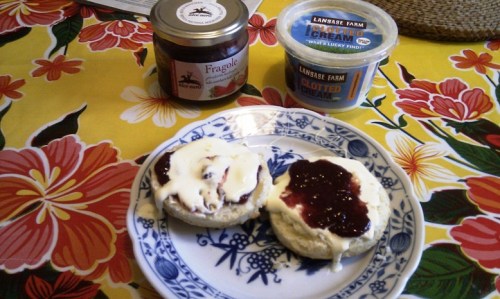
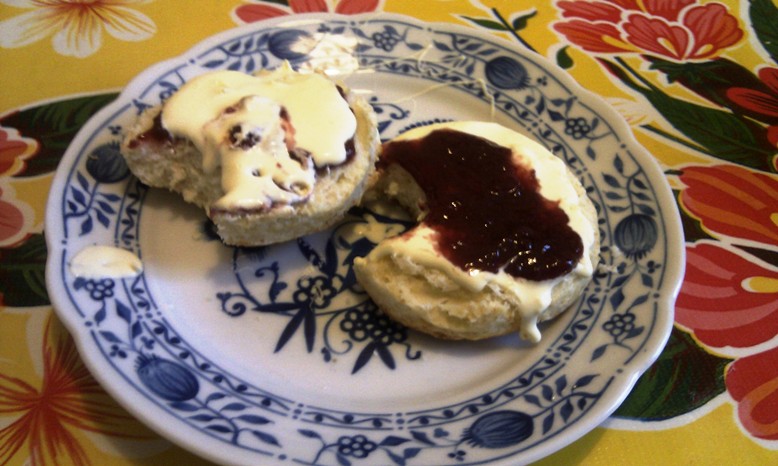
As illustrated by this photo, it wasn’t entirely scientific: I didn’t weight out the amounts of cream and jam (in this case fragole, strawberry) used to make sure they were identical in both cases, and I only used one scone, which meant one piece had the top crust and the other the bottom crust, which have slightly different textures. However, the results were interesting (well, interesting for scone obsessives). They are all pretty obvious if you think about it, but I still feel it’s worth recording, considering the perennial nature of the argument.

1 As you bite the jam-on-cream arrangement, your first flavour hit is of jam, which is tart, sugary-sweet and fruity.
1b Do you enjoy the sensation of thick cream as it potentially touches your top lip?
2 As you bite the cream-on-jam arrangement, your initial flavour hit is of clotted cream, which is of course, smooth, gloopy and dairy-sweet.
2b Do you enjoy the sensation of sticky jam as it potentially touches your top lip?
3 As you continue to bite down through the scone, this initially flavour hit is prolonged, being dragged down through the crumb of the scone by your upper incisors and of course moving onto your palette and tongue.
4 Your choice of jam-on-cream or cream-on-jam defines the opening flavour notes, and initial mouth-feel and flavour, before mastication results in more even mixing of flavours and textures.

Conclusion
So, arguably, you have a choice based on whether you prefer the taste of cream or jam, or prefer those as the initial taste.
Either, frankly, is bloody delicious.
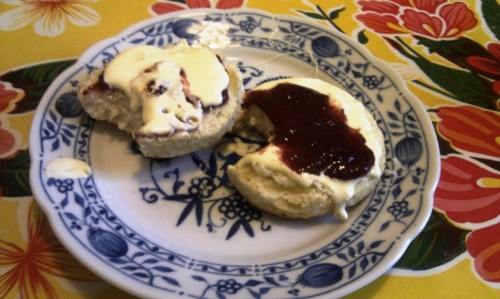
Here’s my basic plain scone recipe. Some people use buttermilk; I don’t, as it’s not always easy to source, and I’m not convinced it makes a better plain scone.

450g self-raising flour (or use plain flour with about 4% baking powder, ie 435g plain flour sifted together with 15g baking powder)
80g unsalted butter, at room temperature
35g caster sugar
Pinch of salt
300g milk

1. Pre-heat the oven to 220C.
2. Grease two baking sheets.
3. Sieve the flour (and BP, if using plain flour) into a bowl, then rub in the butter until the mixture resembles breadcrumbs.
4. Stir in the sugar and salt.
5. Blend in the milk little by little using a knife.
6. Bring together as a rough dough but do not knead or otherwise handle too much.
7. Turn out onto a lightly floured work surface and roll out to around 22mm thick.
8. Create rounds using a pastry cutter, or simply cut into squares.
9. Repeat with any off-cuts.
10. Place on the baking sheets, dust with a little extra flour and bake for 12-15 minutes until starting to brown.
11. Serve just slightly warm – ideally with clotted cream and jam!

Scones are always best on the day they’re made.

 

6 Comments

Filed under Baking, Food misc, Main thread

Chestnut and walnut bread


Chestnuts were an important traditional foodstuff in parts of Italy. Peasants could supplement their diets with chestnuts, and flour was a natural extension of this. Roasted chestnuts remain a common sight in Roma over the winter, though I’m skeptical about whether this is because Romans demand it, or because it’s another cute novelty to sell to tourists.

Anyway, I bought some chestnut flour – farina di castagna – from the Testaccio Ex-Mattatoio producers’ market last weekend, on a whim. Didn’t really have any idea what to do with it. And nor do I particularly like chestnuts. Living in New Zealand years ago, some friends who tried to live as much as possible by foraging provided enough for me to eat far too many, resulting in a certain aversion. Which might not sound promising, but bear with me.

After a bit of Googling and polling friends, I plan to use it to make various items at some stage, including the Italian traditional castagnaccio – a kind of peasant cake that doesn’t include sugar and instead realies on the natural sweetness of chestnuts. (Chestnut flour is also known as farina dolce – sweet flour.) Also: chestnut flour pancakes (maybe on Shrove Tuesday, which is looming) and this cake, which comes from a gluten-free angle. If I can work out a replacement for crème fraîche, which isn’t readily available here in Roma. Apparently I can use panna acida.

But first, I made some bread, inspired by a recipe in Richard Bertinet’s Dough. His version uses rye flour; here I replaced that with chestnut flour. I also reduced the yeast in his recipe and added some white leaven. What the hell.

So:
400g strong white flour
100g chestnut flour
10g salt
320g water
6g fresh (fresh)
50g white leaven (100% hydration)

Combine the flours and salt.
Whisk together the leaven, yeast and water (warm – use dough temp x 2 minus flour temp to give you a water temp… or just warm…).
Add liquid to flours, bring to a dough.
Knead.
Form a ball, rest, covered, until doubled in height. I’m not going to suggest a time, as that really is so dependant on the temperature of your room.
I divided it into two, formed balls, rested 10 mins then I made rings, but really, knock yourself out with the shape.
Prove again, until doubled in height.
Bake at 220C for 15 mins, then lower temp to 200C and bake another 15 mins. Or if you’re doing one large loaf, it may need longer. Trust your judgment!

And you know what, it’s yummy. The nuts give the crumb a slight purply tinge and the taste is indeed subtly sweet.

I really ought to try and take better pictures though. Random snaps from my phone don’t cut it. And that tablecloth is getting a bit overused as a backdrop.

9 Comments

Filed under Baking, Food misc, Main thread, Rome

Innocenti is bliss

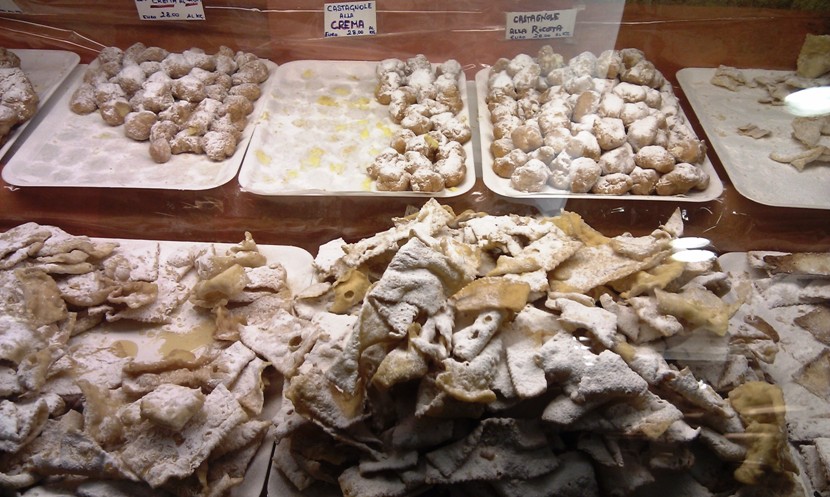
My noble quest to try castagnole and frappe from, well, as many different pasticcerie as possible, continues. Today we dropped by Innocenti, which, for sheer vintage cuteness, is incomparable.

Nestled in Via della Luce, a cobbled backstreet in the slightly less touristy part of Roma’s Trastevere (that is, to the east of Viale Trasteve), the shop is dominated by the vast form of a veteran conveyor oven, which is currently partially stacked with frappe and castagnole.

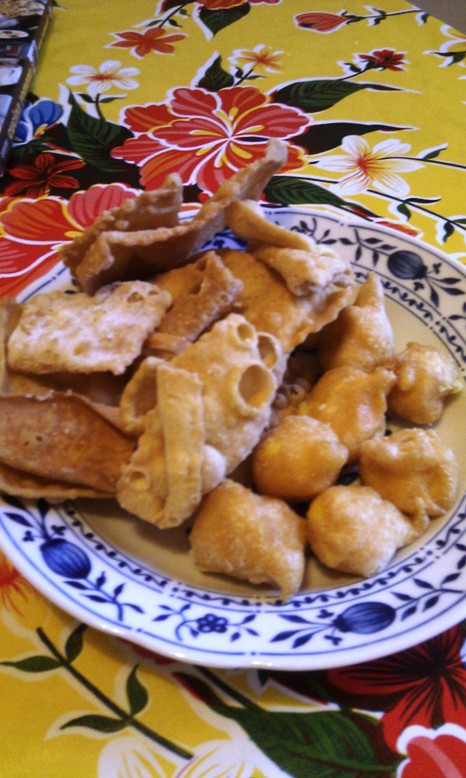
And very nice they are too. We bought castagnole con crema and yer basic frappe. Just scoffed a load, then managed a bit of self restraint and stashed some for later. That said, better finish them soon, so I can justify sampling some more from another outlet…

Innocenti, aka Biscottificio Artigiano Innocenti, 21 Via della Luce.

And look at all the goodies they sell. Not just biscuits. Yum. Got my work cut out for me.

2 Comments

Filed under Baking, Food misc, Rome

Wholewheat farro bread


Invented this one as I had some farro grain, which I’d bought when I was trying to make the Tuscan zuppa di fagioli e farro, aka bean and farro soup. Farro itself is a type of wheat grain, though the word can also be used to refer to barley and other grains, depending on where you are in Italy or who you’re talking to. Wikipedia has a good page, which doesn’t really clarify!

I played it by ear (well, by fingers) with some of the quantities, and I wanted to keep the dough very soft and wet – hence it flattened slightly when I moved it from the proving basket to bake. But flavour-wise, it’s great.

I’ve been struggling to get used to Italian flours. Many of them are low protein, unlike your standard British bread flour, which is ground from harder wheat. Harder wheat produces stronger flour, with more protein, say 13% or higher – giving the requisite gluten proteins to create certain bread structures, for the types of bread we’re more used to making in the UK.

Anyway, the recipe:

Cook about 50g of farro in water, simmering for about 45 minutes, until the grain is soft.
(You could use the cooking water for the sponge, though I didn’t in this case. You can also soak the grain overnight in ale, wine or friuit juice, if you’re interested in experimenting! Also, if you can’t get farro, wheat grains, aka wheat berries, would be fine.)

Make a sponge with:
360g water
250g wholewheat flour (I used an Italian integrale)
10g fresh yeast (or say 5g ADY if you can’t find fresh)

Leave the sponge to ferment for 8-12 hours. I did it overnight, in a fairly cold kitchen. (We’re in Rome, but it is January – nights getting down to around 0C.)

Make up the dough with:
The sponge
10g salt
150g wholewheat flour
100g white bread flour (I used an Italian bread which, despite being called “Farina di grano duro” – flour from hard wheat – and professing to be “per pane, focacce e dolci” – for bread, foccacia and sweets – is only 10% protein. See my perplexity? It worked ok though, so you could use a British plain flour.)

Bring the dough together and add the farro grains.
Knead. It’s sticky, that’s good, don’t worry!
Clean off your hands with some extra flour and bring the dough to a ball.
Ferment, covered, for about 4 hours, or until doubled in size.
I gave mine a few turns.
Turn out, form a ball, and rest for 10 minutes.
I formed a baton and proved it in a 36cm (14″) long basket.
Final prove until doubled in volume.
I turned it onto a baking sheet and made one long dorsal cut.

Bake in a preheated oven at 220C for 20 minutes, then turn down to 200C and bake for another 20 minutes. Or thereabouts.

2 Comments

Filed under Baking, Main thread

Pass the dolci

Italians love their dolci: sweets, desserts, ice cream and pastries, or pasticceria. I always assumed the French had the last word on patisserie, but living in Rome, I’m not so sure any more. In Monteverde Vecchio, our neighbourhood, indeed within about 100 metres of our flat, there are at least three pasticcerie (as I understand it, the word can mean the outlet, the trade and the product), as well as a bakery/tavolo caldo (“hot table” – meaning then sell hot snacks) that also does pasticceria. Two of these places, and another one just down the hill on Viale Trastevere, have counters around 4-5 metres long utterly packed with biscuits, pastries, chocolates and sweeties that you buy by weight. And none of them are chains.

That’s one thing I love about Italy – it’s got an incredibly strong business culture of independents, of SMEs (small-medium sized enterprises). As well as all the independent pasticceria, which are also cafés, there are umpteen independent cafés, which also sell pasticceria. Although I’m an oddity in this culture for my dislike of coffee, I’m more than happy to frequent these places and indulge in pastries and, as it’s the winter (hey, there was a frost last night), I can get away with drinking lots of the cioccolata calda without breaching too much strict Italian food and drink etiquette. Well, I say “drinking” but it’s frequently half-way to eating as Italian hot chocolate is generally thickened with cornflour, making it a thick, gloopy thing that’s almost like a hot chocolate mousse.

My current obsession is for castagnole and frappe, which started appearing in the pasticcerie shortly after Christmas, specifically at Epiphany; that’s 6 January for heathens. These are seasonal sweet treats for carnevale – carnival or Mardi Gras season. The Christian tradition is that Mardi Gras, aka Fat Tuesday, aka Shrove Tuesday, aka Pancake Day, is the day when you use up all your rich food products, fats and sugars to initiate Lent, the period of abstemiousness that leads up to Easter. While us Brits, and others, might have a pancake blow-out on just one day, here in Italy it looks like we’re getting weeks of the aforementioned treats.

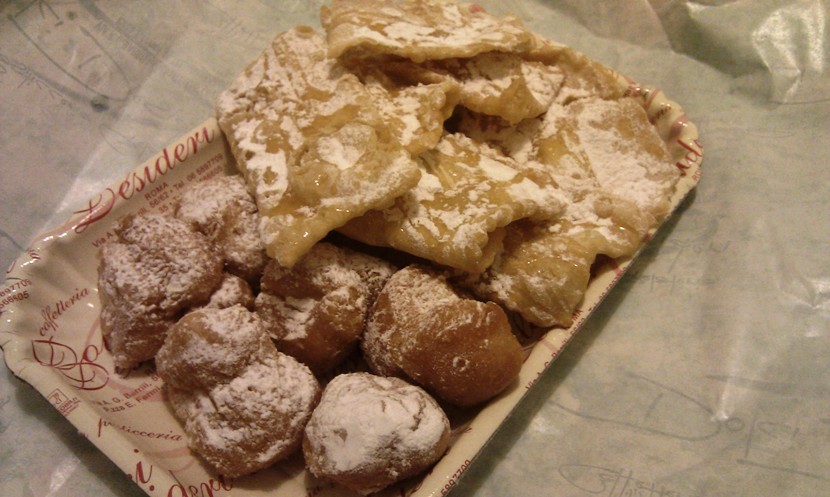
So, castagnole are small, deep-fried dough balls, a bit like doughnuts, but the dough isn’t leavened with yeast, but with chemical raising agents, ie baking powder or equivalent, according to both the ingredients taped up on the counter at Pasticceria Dolci Desideri (“Sweets you want”!; our local, on Via Anton G Barrili) and the recipe on this blog. The word presumably relates to castagna – chestnut – though they have no chestnut flavouring. Instead you can get them semplice (plain) or filled with crema (custard) or ricotta. Frappe, meanwhile, are basically thin rectangles of crisp, slightly puffy pastry, like a sweetened pasta, baked or deep-fried, and sprinkled with icing sugar, or sometimes flavoured with honey. The name itself (singular: frappa) is a bit confusing, as the similar word frappé means shake, or milkshake.

According to the above-mentioned blog, they’re also known as cenci (the plural of cencio, rag – not very appetising), stracci (shreds; stracciare is the verb to tear or rip up) and lattughe (lettuce) in other parts of Italy. We’ve been treating ourselves to castagnole and frappe, well, pretty much every day this week. It can’t go on, for obvious reasons, but not only are they delicious, there’s just something inherently lovely about going to a pasticceria and getting some treats wrapped up like a gift (eco concerns about over-packaging notwithstanding.) Really, Brits have a long way to go to make the patisserie experience as charming as this. Sure we have some wonderful independent bakeries these days, but their patisserie can still seem meagre by comparison, even if they have an array of poncy cupcakes. And for people who still don’t even have access to real bakeries, some foul mass-produced “Toffee Flavour Yum Yum” from “Greggs The Home of Fresh Baking” [sic] just doesn’t cut it.

4 Comments

Filed under Baking, Food misc, Main thread, Rome

Zombie cakes

Been learning how to decorate cakes. I’ve done some frou frou and flowers, so I thought it was about time I did something closer to my heart – zombies!

This project involved making six mini-cakes, themed around a festival… so my excuse is that it’s Samhain/Halloween, you know, the night when the barriers between life and death are at their thinnest, and the dead rise from their graves. So yeah, my cakes are ghouls rising from the ground.

Inside is fruit cake, all the rest is made from sugar paste and food colourings.

And here they are individually:

Anyone guess who this guy’s inspired by?

This one’s inspiration is a little more tricky:

And the inspiration for this one is pretty obscure (unless you’re a fan of a certain strand of zombie movies… ):

These last three were all a bit more ad-libbed. I’m particularly proud of this chap’s cranial occurence:

zombie cake brains

Palatable?

Zombie cake eyeball

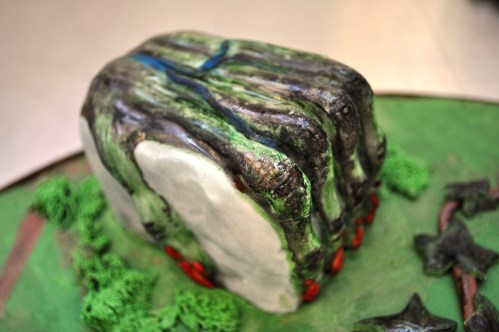
And finally, a grasping zombish hand (cos we had to do at least 2 different shapes for this project).


SPOILERS
I’m putting this here retrospectively to remind myself before I forget.
The first individual head is inspired by Michael Jackson’s look in the Thriller video.
The second is inspired by the Deadite version of Ed Getley in Sam Raimi’s 1987 classic The Evil Dead II.
The third is inspired by the poster for Lucio Fulci’s 1980 film City of the Living Dead. My friend Jamie also used the poster as inspiration for this book cover.
The character with the exposed brain and the one with his eyeball hanging out were more generic inventions. Ditto the hand.]

1 Comment

Filed under Baking, Cakes

Hazelnut loaf with rye grains

This is my first take on another recipe from Dan Lepard’s essential The Handmade Loaf.

As we’re gearing up to move house, I’m trying to use up ingredients – resulting in some changes to Dan L’s recipe. I also didn’t strictly follow his method – hey, a baker’s got to follow their instincts right?

So, ingredients:
250g strong white flour
150g plain flour
150g rye flour
8g salt
300g water
3g active dried yeast
50g honey
450g white leaven
50g butter, melted then cooled slightly
80g hazelnuts, toasted and chopped
280g cooked, soaked rye grains
(In this case, I boiled the rye grains for about 45 mins, cooled them, drained them, and soaked them overnight in apple juice. I used the cooking water for make up the dough.)

Method:
1. Add the yeast to the water (the rye cooking water), with the honey, and leave to activate.
2. Whisk the leaven into the yeast/water mix.
3. Combine the flours and salt in a roomy bowl.
4. Pour the liquid into the flours, along with the melted butter.
5. Bring to a dough and knead thoroughly.
6. Stretch out, then sprinkle on the chopped nuts and rye grains. (I’m adding them later than Dan L instructs as it struck me that chopped nuts could tear the dough, and damage the gluten structure, if added when initially making the dough.)
7. Knead to combine, then return to the bowl, cleaned and oiled slightly.
8. Leave 30 minutes, then give it a turn (ie stretch out, fold into thirds).
9. Leave another 30 minutes, then give it another turn.
10. Leave the dough now until doubled in size.
11. Turn out, weigh, scale two pieces, then hand each one up into a ball and rest 10 minutes.
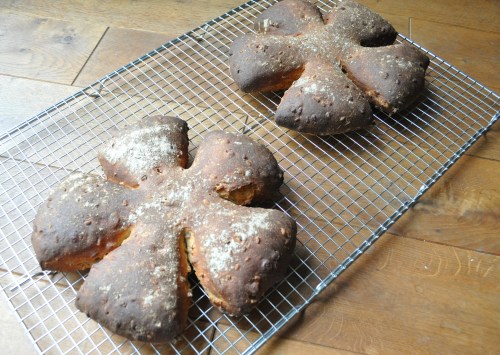
12. Pin out each piece to a disc about 20cm in diameter, and cut five slits through the dough around the edge. Stretch each one of these, er, pseudopodia….
13. Cover and leave to prove, until doubled in size and suitably soft to the touch.
14. Bake in an oven preheated to 210C for 35 mins – check after half an hour; Dan L says they should be “a good rich brown in colour”.

Yep, I’ll admit it, mine are perhaps a little too “high bake”… the recipe says bake 40-50 mins, and I stupidly didn’t check mine before 40 mins.

Leave a comment

Filed under Baking, Breads

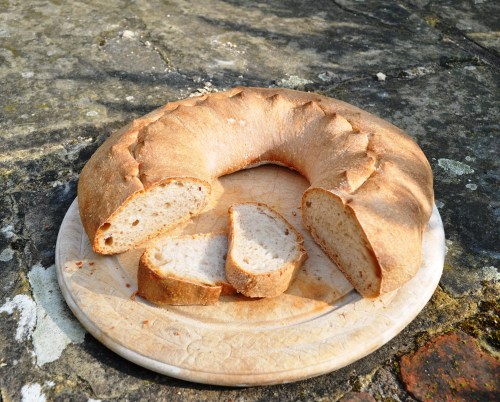
Couronne experiments

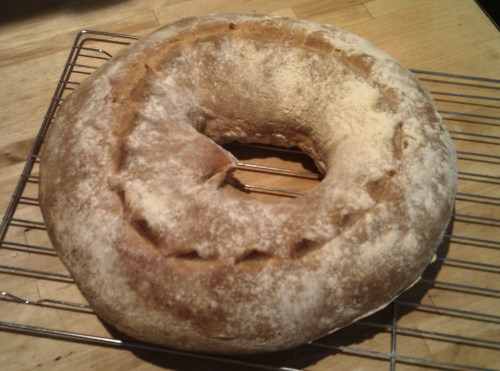
I’m loving the ring shaped loaf at the moment. It’s also called a couronne apparently, though I don’t know much about the real thing from France. I did this one summer 2010:

Annoyingly, I didn’t make a record of it at the time and I can’t remember where I got the recipe.

Recently, however, I learned this version, which was referred to as a “French crown”. This is scaled for a 1kg loaf:
536g Flour (100%)
311g Water (58%)
5g Fresh yeast (1%)
5g Sugar (1%)
11g Salt (1.9%)
134g White leaven (25%)

It used a 2-4 hour fermentation time, and created a nice plump, white version. It also uses a French white flour – apparently, to recreate this softer flour in the UK, we can do a blend of strong white and plain flours.

I want to develop a version that uses more natural leaven (or sourdough starter), a longer fermenation and isn’t 100% white flour. I’ve also been experimenting with overnight proving in the fridge.

Here’s what I’ve been using.

Sponge:
170g strong white flour
100g rye flour
310g water
200g white leaven (mine’s currently made with 50/50 water/flour)
[I’ve also been adding a little yeast – 1g ADY or easyblend, or 2g fresh; hey sourdough purists, I’m experimenting!]

I’ve been leaving this sponge for around 9 to 16 hours, then making up a dough by adding:
100g strong white flour
170g plain flour
11g salt

I’ve been kneading for around 10 mins, then leaving it half an hour, and giving it a quick knead. I’ve also done a few folds.

On one occasion, I proved it for a few hours, then shaped the ring, and left that to for its final prove overnight in the fridge. Took it out, left it for around two hours to bring the dough temp up again, then baked it. It was very nice, with a decent irregular crumb, chewy crust and low-to-middling sourness.

On a second occasion, I made up the dough, kneaded it, then proved it overnight in the fridge. In the morning, I left it to warm to ambient temp (around 17-18C), then gave it a few folds, shaped it, and gave it a final prove of a few hours, then baked. This is the result for that one:

When I get this just right, I reckon it just might be my signature loaf.

Leave a comment

Filed under Baking, Breads

Wheatberry tin loaves

This one is loosely based on a sourdough from The Ballymaloe Bread Book, but I varied it to use some other bits and pieces, and use techniques I’m more comfortable with.

It doesn’t use any commercial yeast, just a leaven – in this case one made with a strong white flour.

In a roomy bowl, combine:
150g wheat leaven
225g strong white flour
225g water (warm, but as this is a long fermentation, the exact temp isn’t crucial)
Mix and leave for around a day.

Then add:
400g wholemeal flour (I’m using stuff grown in Sussex, so it’s fairly soft, but works ok. Best of all, it’s milled on water-powered grindstones at Winchester City Mill).
50g rye flour
100g strong white flour
14g fine sea salt
150g (ish) of wheatberries – ie whole wheat grains that have been boiled until soft.
50g of butter, melted
225g water (warm, but again, as it’s a long fermentation, it just has to be suitable for encouraging the leaven’s lifeforms)
Mix to a good dough, and knead. I gave it a good initial knead, then did the Dan Lepard technique of three more short kneads, every 10 mins.

Scale into two pieces, rest, form batons, then put in two greased 2lb loaf tins.

Prove for around 5 hours (depend on the temperature of your room; my kitchen was only around 18c), then bake in an oven fully preheated to 220C for around 40 mins.

Leave a comment

Filed under Baking, Breads