Category Archives: Baking

Baking – Daniel Etherington’s bread experiements

Kladdkaka – gooey Swedish chocolate cake

Kladdkaka sliced

So this isn’t very Christmassy, but I’ve wanted to try making a kladdkaka for a while. I really must get a Swedish or Scandinavian baking book as I’m enjoying everthing I try making from recipes from that part of the world.

Kladdkaka is a kind of gooey chocolate cake. It’s unleavened – no baking powder, no soda, no yeast, so it’s not intended to be light and airy. Instead, the aim seems to be to basically leave the inside somewhat unbaked, so it’s moist to the point of runny, so it’s not unrelated to things like chocolate fondant and brownie.

In English, it can be called mud cake, but from what I can tell from online dictionaries, kladd means either draft, or rough, or daub, something a bit messy and unfinished, or goo, gunk. A Swedish-speaking friend meanwhile (he’s Finnish but is one of those annoying types who speaks multiple languages perfectly) says that “If something is ‘kladdigt’ it’s sticky, gooey, doughy, maybe even messy.” Thanks. Tom.

135g butter
55g cocoa powder
110g plain flour
320g granulated sugar
1 tsp vanilla essence
3 eggs
icing sugar, for dusting

1. Preheat the oven to 180C.
2. Grease and line a round tin, ideally 18cm or 20cm (7 or 8 inch).
3. Melt the butter then remove from the heat.
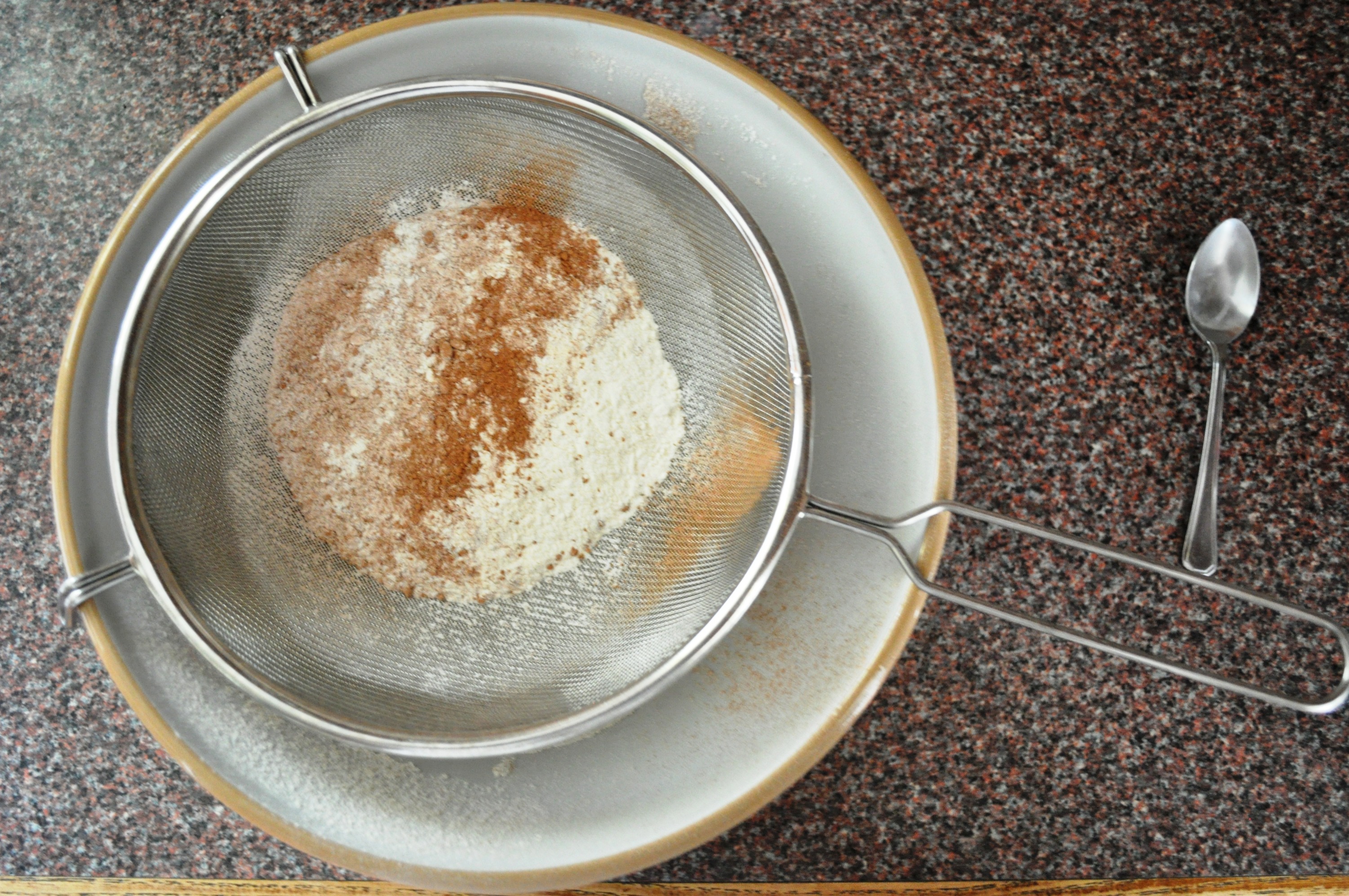
4. Sieve the cocoa and plain flour into mixing bowl.
5. Beat together the eggs and vanilla.
6. Pour the butter and egg mix into the flour, and beat together with the sugar until the mixture is combined.
7. Pour the mixture into the tin then bake for around 20-30 minutes. This is the important bit and will vary depending on the character of your oven. You want it to start pulling away from the edges of the tin, but not be baked dry in the middle.
8. Cool in the tin for about 20 minutes, then turn out.
9. Dust with icing sugar.

Kladkakka dusted

You can eat it warm, with ice cream or whipped cream. I had mine with custard, though I doubt Swedes do this; we just had some fresh custard in the fridge that needed me to nobly step in to finish it. It’s also very nice cooled completely, to a more truffle-like texture, and eaten with a cuppa.

7 Comments

Filed under Baking, Cakes, Recipes

Lebkuchen in my new kitchen

Lebkuchen

So we’re in week 22 or 23 of our 12 week building project now, with the few final jobs dragging on and on. But the good news is that we got a kitchen back in the past few weeks. We’ve now got it in pretty usable order.

It’s a fairly slow process getting used to a new kitchen: the layout, your workflow in the space, the new equipment. In this case, the only new kit we got was an oven. As a baker, this is obvious the most important thing. Especially as, suddenly, we seem to be poised on the verge of that annual blow-out that is Christmas.

Now, I love seasonal and festival specialities, and over the years I’ve enjoyed trying various international seasonal baked goods like stollen, panettone and kringle. I did the latter, a Scandinavian sweet bread, while living in Italy, and the panettone, the classic Italian sweet seasonal bread, while living in England. I’m in the process of revising my panettone recipe but in the meantime, I wanted to try another classic European Christmas baked treat – lebkuchen, the traditional German biscuit or small cake that’s related to other European sweets like British gingerbread biscuits and cakes, Danish honning hjerter (honey hearts), Polish Toruń pierniki, and various international spice and honey cakes.

As biscuits, these were considerably less of a challenge than an enriched dough when trying to get used to a new oven.*

Lebkuchen were a big part of our Christmas eating when I was younger – perhaps strangely as we’re thoroughly English. But my dad had business partners in Switzerland and Germany and the latter would send us a bag or tin of these spicy, soft German biscuits every year, possibly starting in 1979. Indeed, one large tin, decorated with seasonal scenes, is still in use by my parents as a biscuit tin 15 or so years after it was gifted to them.

Despite enjoying them over the years, I’d never tried to make them. So it was nice to see a recipe in The Guardian’s Cook section last week, from 2013 Great British Bake Off contestant and now newspaper food writer Ruby Tandoh. This was the first of Tandoh’s recipes I’d tried, if memory serves, and it worked well. I tweaked a few things though, partly as I like a tad more spice than she was suggesting, and as I’m pretty sure lebkuchen need honey in them.

I would also say the spice mix is up to you. Yes, they need ginger, but you can mix up the other spices to taste: basically you’re going for that medieval winter feast vibe, and traditionally lebkuchen can involve aniseed, allspice, cinnamon, cloves. As fresh spices are always more alive with flavour, if you have a small spice grinder or pestle and mortar, that’s great.

Here’s the original recipe on The Guardian’s site, and here’s my tweaked version:

120g unsalted butter, cut into small cubes
160g plain flour
1 t baking powder
5 t ground ginger
1/2 t cinnamon
6 whole cloves
2 cardamom pods
1/2 t aniseeds
100g ground almonds
80g soft light brown sugar
A pinch of salt
2 large egg yolks
60g runny honey

To glaze
20g water
100g icing sugar

1. Preheat your oven to 180C (fan oven)
2. Grind any fresh spices you’re using.
3. Sieve together the flour, baking powder and all the spices into a large bowl, discarding any big bits of cardamom pod etc.
4. Rub in the butter, until it resembles crumbs.
5. Add the ground almonds, sugar and salt to the flour and spice mix.
6. In a separate bowl, beat together the honey and egg yolks.

Lebkuchen 1

7. Pour the egg and honey mix into the dry mix and bring together with a fork or spatula to create a soft, moist dough.

Lebkuchen 2

8. Take lumps of the dough and roll into a ball. Ruby said “conker-sized” pieces, but as any British schoolchild of a certain age will know, conkers can seriously vary in size so I scaled mine at 30g. This resulted in 19 perfectly sized biscuits. Or go smaller, scaling them at 20g.

Lebkuchen 3

9. Squash the balls with your palms, flattening them out on lined baking sheets leaving some space between for expansion.
10. Bake for about 8 minutes then swap the trays around on the shelves so they bake evenly.
11. Bake for another 8 minutes or so – you want them nicely coloured, but not too dark. This will depend on the fierceness of your oven.

Lebkuchen 4

12. While they’re still baking, sieve the icing sugar into a small bowl then add a small dribble of water, about 20g, or 2 or 2 T. You want a runny, but not too runny, icing.
13. When the biscuits are baked, leave them on their trays and glaze by brushing on the icing “liberally” while still hot.

Lebkuchen 5

14. Leave to cool on the tray.

* A Rangemaster Professional + 110 Induction. My first impression is, sadly, that the ovens heat up slowly and are a good 10C less hot than it says on the dial. I should do a proper review at some stage as it’s not like you buy new cookers often, and it’s not like you can try before you buy.

2 Comments

Filed under Baking, Biscuits, cookies, Feasts, Recipes

From building site to castle. Real, actual castle

Kingswear Castle sunflare
As our building works were plodding into their most inconvenient stages we’d arranged to go away. I went down to Devon to see my folks, visiting a strangely dead village on the way down where all the cafes were closed but there was this great carving on an old pub.

Wheatsheaf

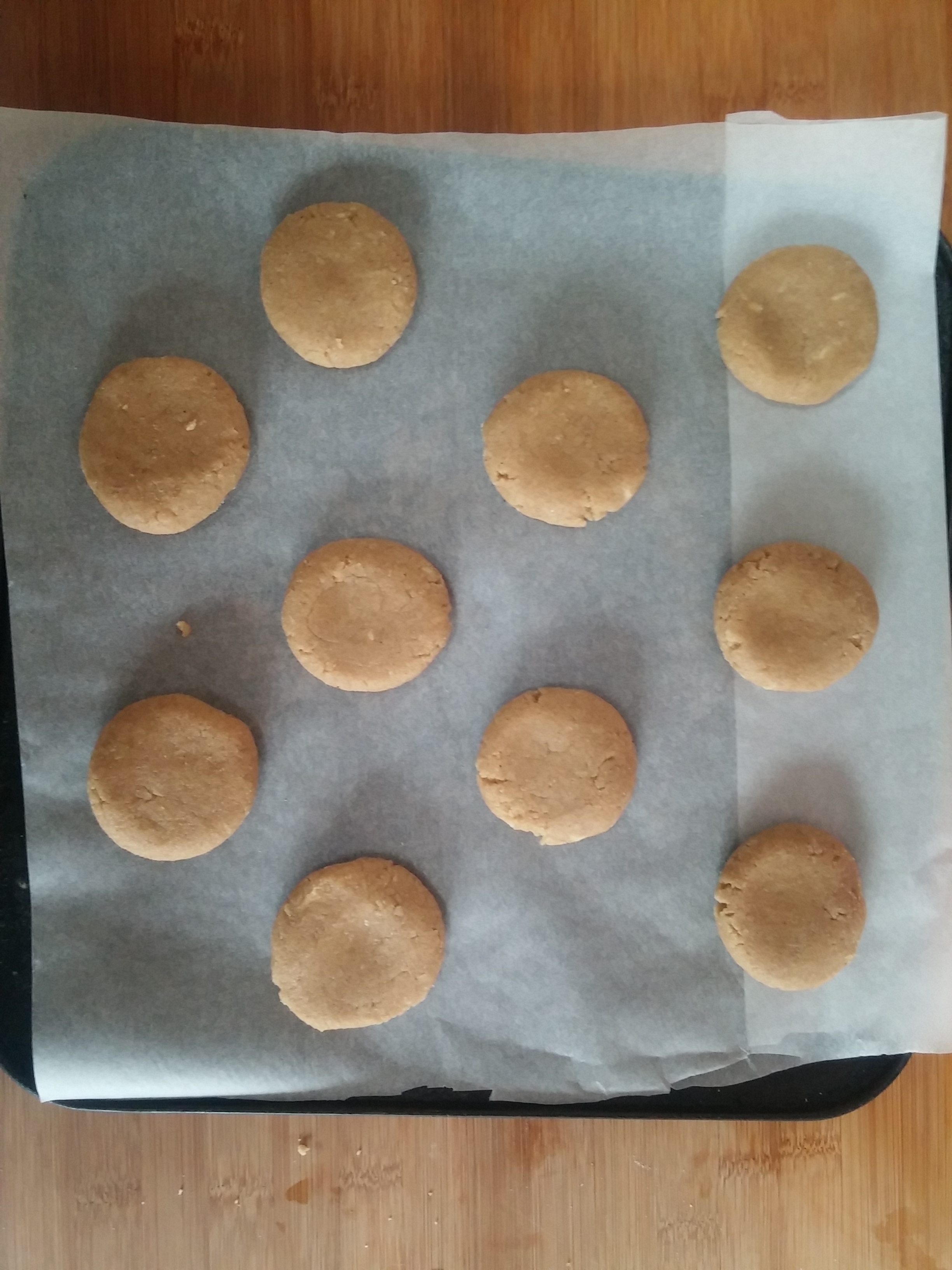
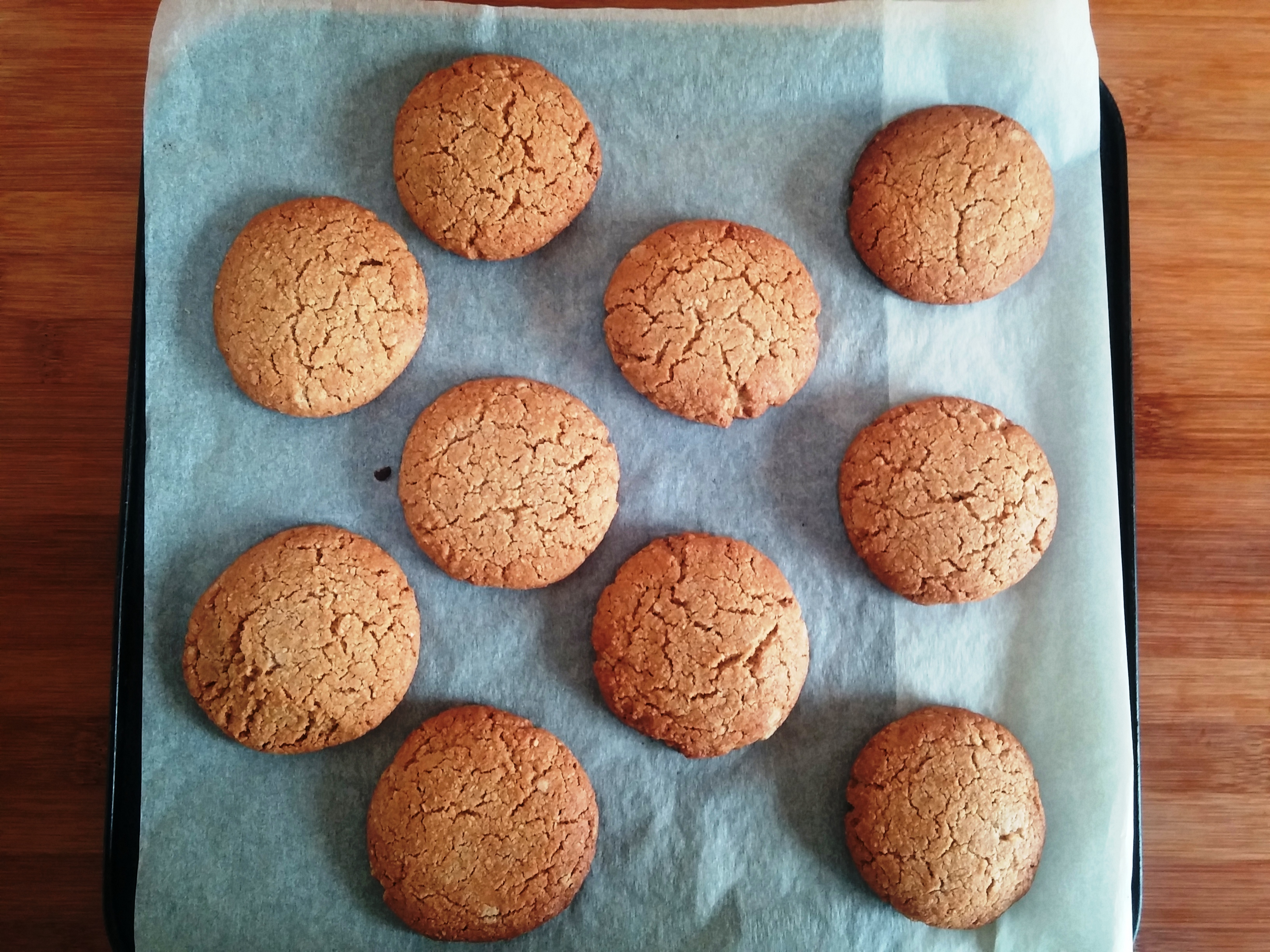
Being in Devon was lovely in itself as we got to enjoy the last vestiges of summer while mowing a meadow, but also because staying at my parents’ house meant I had use of an actual kitchen, something I’ve not had for 13 weeks now. So I could get stuck straight in with the baking, using up some something aging ingredients to make a surprisingly good loaf and okay almond and candied peel cookies.

Bread and biscuits crop

For the weekend, thanks to a generous gift for Fran’s big birthday and my less significant one from my folks, we went and stayed in a castle. An actual castle. Surely all boys – and many girls – fantasise about living in castles when they’re young, and this was about as good a fulfilment of that as I could hope for, aged forty-something in the 21st century.

Dartmouth and Kingswear castles

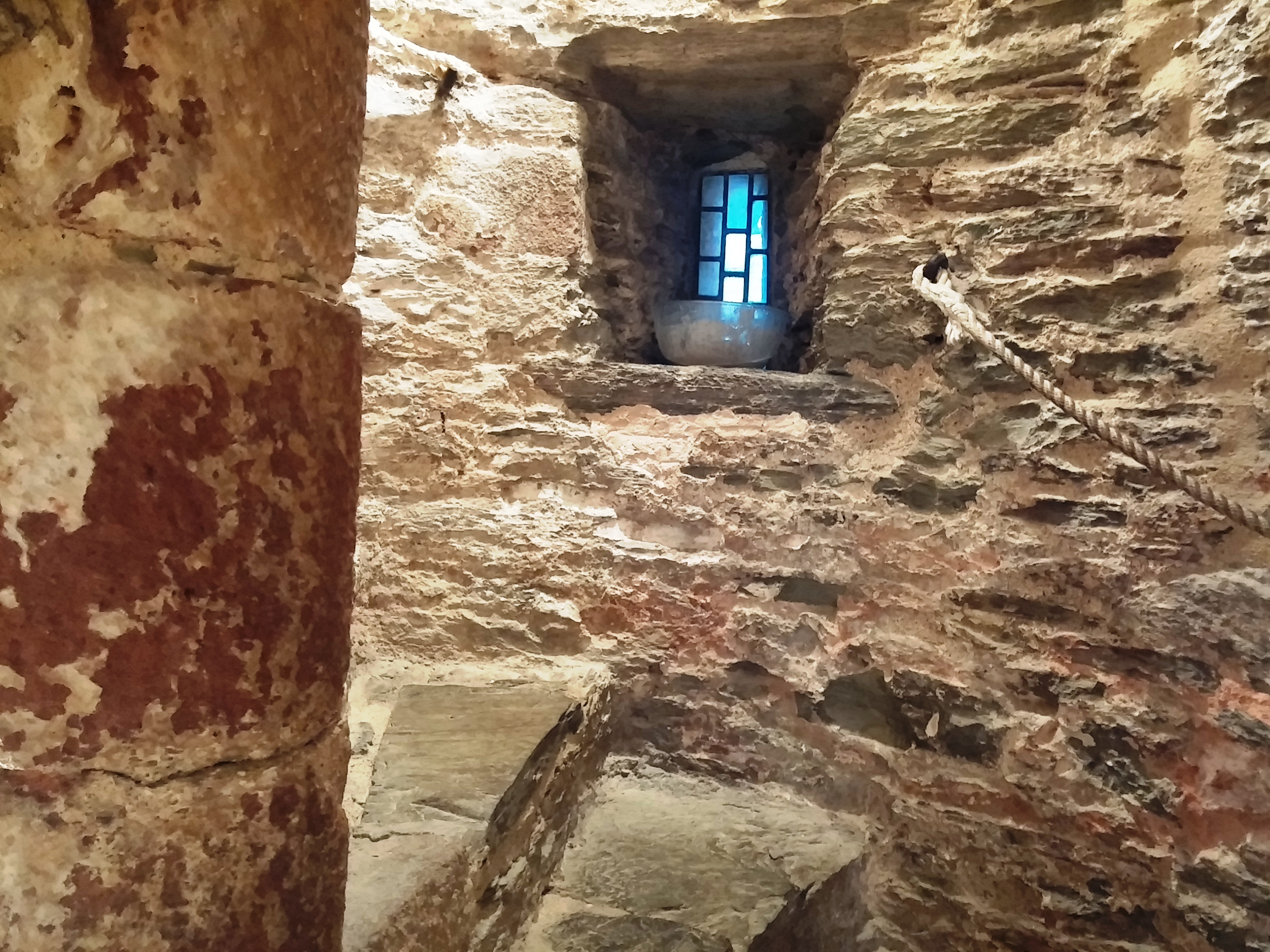
Kingswear Castle is a small defensive fort built a few meters above the waterline of the mouth of the river Dart. It was constructed at the turn of the 15th century to form a pair with Dartmouth Castle just over the river. Both were fitted with cannons to cover the mouth of the river in case of attack by enemy ships trying to take advantage of the sheltered port of Dartmouth. Improving technology soon made Kingswear Castle obsolete and it fell into disrepair. A Victorian aristocrat owned it in the 19th century, then the local MP in the mid-20th century, but I can imagine it wasn’t the easiest home. The gardener there told us the winter 2013-2014 storms involved waves breaking into not just a small Victorian bedroom in a turret at ground level, but also into an upstairs bedroom. Like Dartmouth opposite, it was also a significant spot in WW2, and there’s a blockhouse in the garden.

Shadow, blockhouse, rocks

As a place to visit though, with some mixed but not extreme weather, it was a wonderful experience. Partly, again, as it had a kitchen so I could do some cooking and baking, but partly because it had a kitchen with a view across the mouth of the River Dart or out to sea.

Apple cake, Dartmouth Castle

Among the things I made were the Dan Lepard apple and orange crumble tart I mentioned in my last post. It was delicious, especially with some of that divine dairy nectar clotted cream. (In this case, from Riverford Dairy. So good.)

Apple cake 2

I also made a loaf, about 80 per cent spelt, given an overnight fermentation. First I put it the dough an embrasure on the spiral stairway to prove.

Spiral staircase long prove

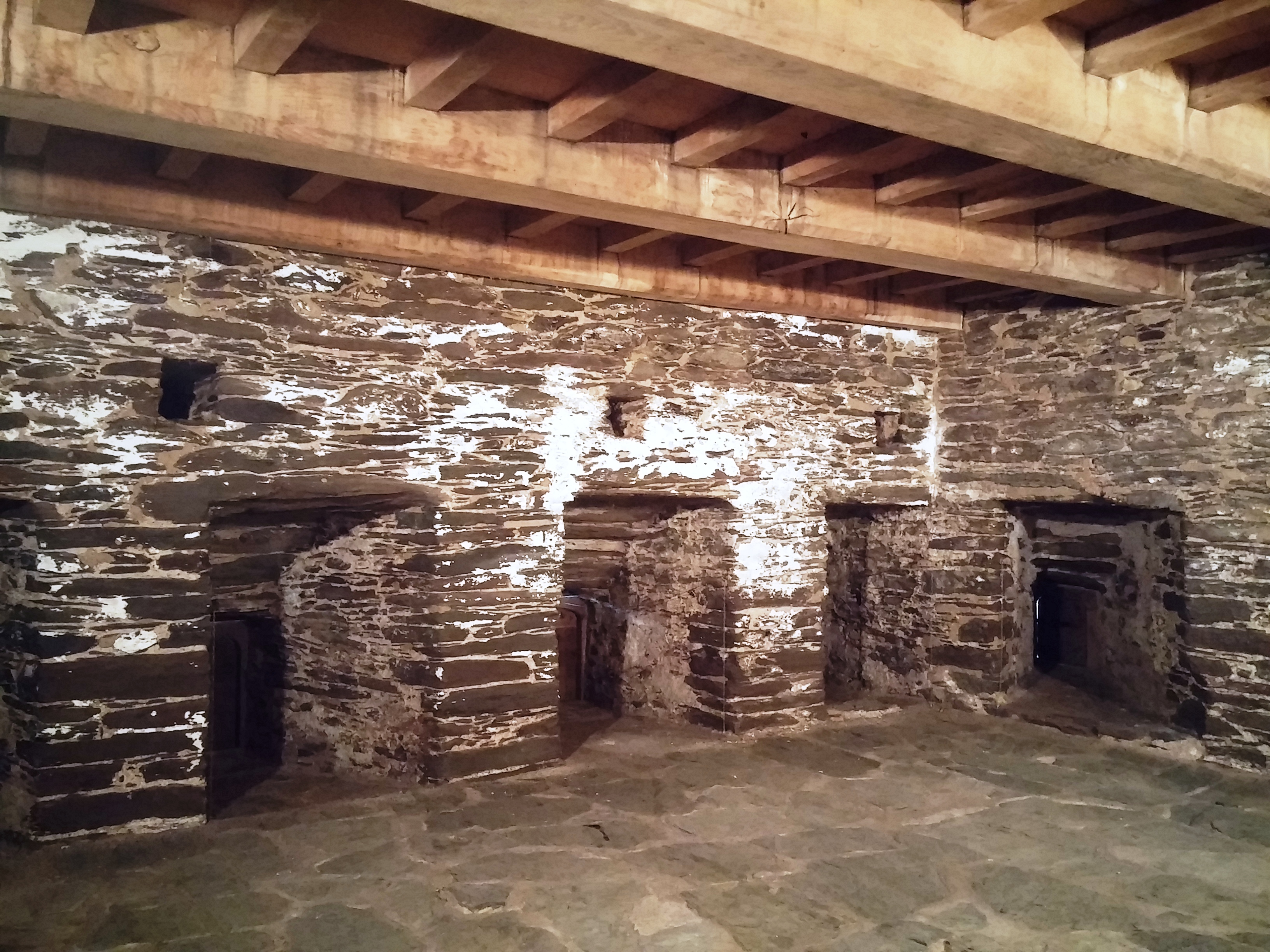
But I think there was too much warm air coming up, so I moved it to the ground (or rock) floor, where the old gun ports are. The finished loaf looked a bit like a seal, suitably enough as I’d seen one on the evening we arrived.

Gun floor

On our final morning, the weather was a tad wild and windy, and the waves were breaking into these ports. No wonder it wasn’t an easy place to live, especially for the MP, who put his kitchen in here and presumably watched it floating around in the surf on regular occasions.

Kingswear Castle panorama

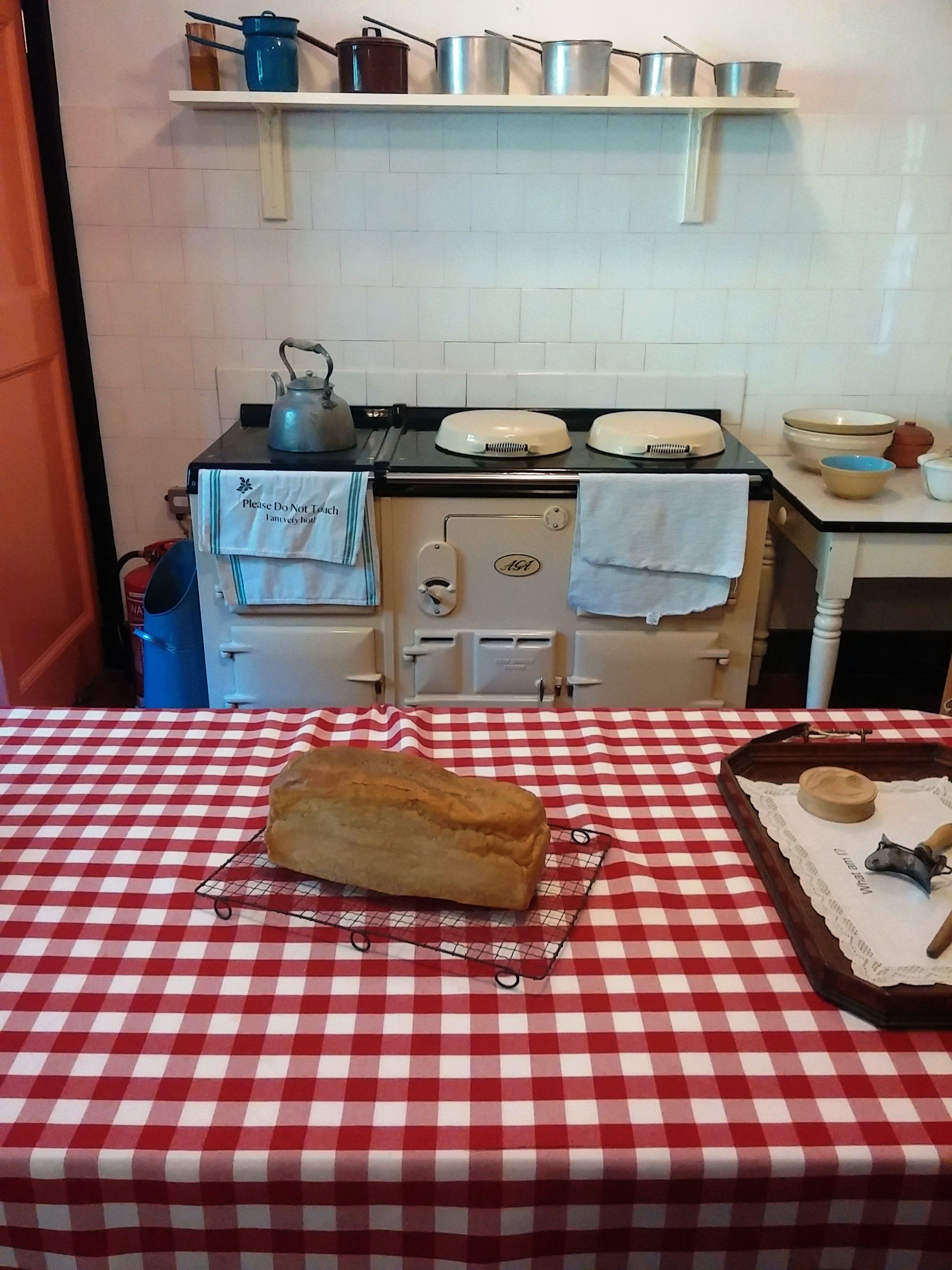
Before the final wet and windy morning, however, we had some lovely weather. Good enough for a sunny walk along the coast path, via the old WW2 installations and current Coastwatch station at Froward Point, to Coleton Fishacre. This is a National Trust property, built in the 1920s for the D’Oyly Carte family, founders of the Savoy Theatre and patrons of Gilbert and Sullivan. I loved the 1920s styling, but particularly enjoyed the kitchens, replete with their fake loaf of bread.

D'Oyly kitchen

The sunny weather also gave us a nice backdrop for a patriotic moment and some beer tasting. This included a range from a new brewery near Winchester, my home town, called Mash. To be brutally honest, we found most of their beers insubstantial, not ready for release. But good luck to them. I always enjoy encountering a new brewery.

Mash and flag

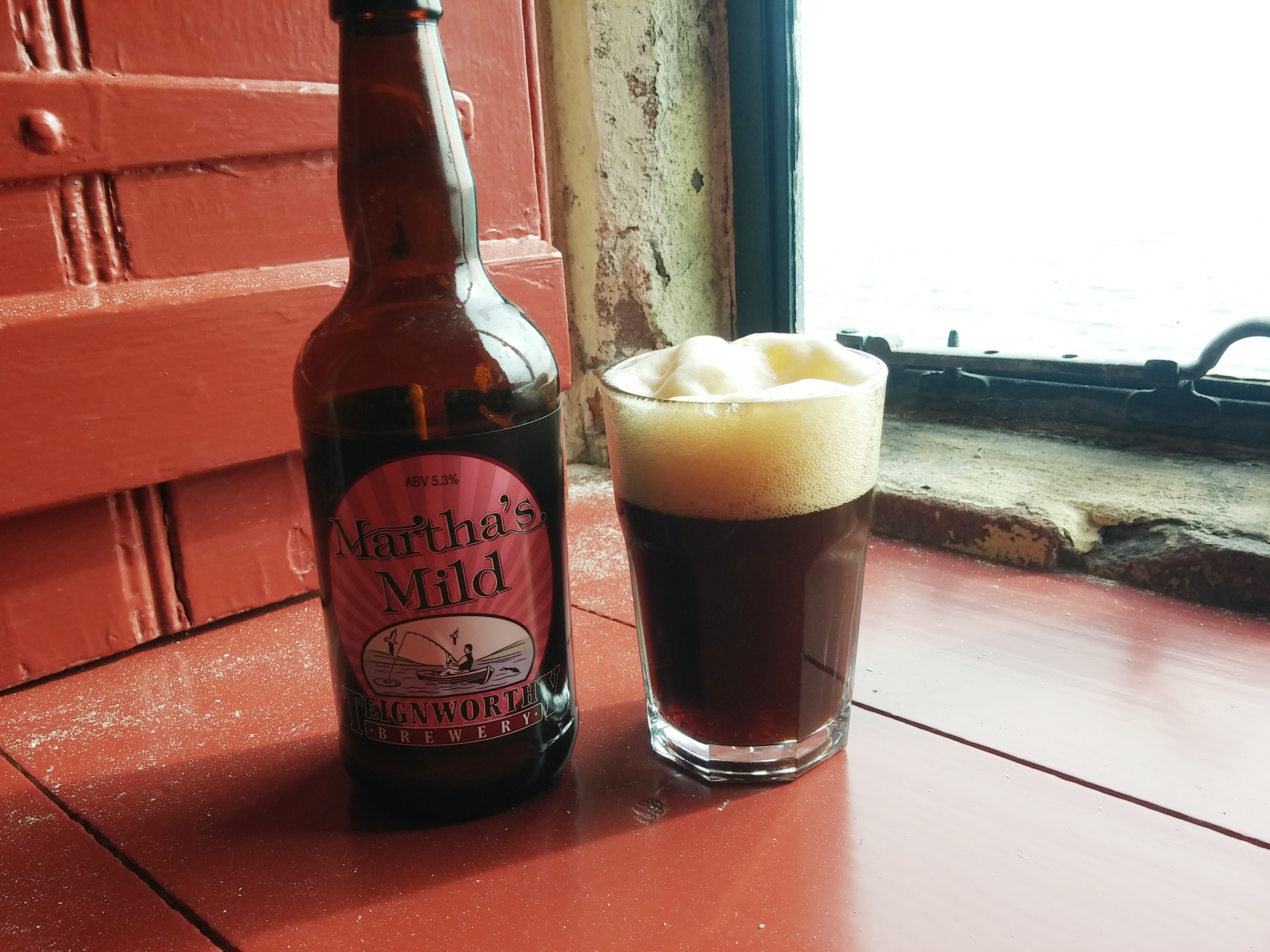
Then we had some more local beers from Teignworthy Brewery in the Devon village of Newton Abbot (which we’d driven through.) This mild was almost a porter, with charcoally hints and a medium body.

Teignmouth Martha's Mild

The (sensible) boozing didn’t stop when we’d left either. We tried some more beers from Clearwater Brewery, in the north Devon village of Bideford.

Clearwater beers

The baking didn’t stop either. I was able to make one more loaf, this time with Wessex Mill‘s Wessex Cobber, a lovely malty flour I’ve tried before. As well as being an amazing holiday, it was just such a relief to have an opportunity to do some baking. For someone who makes bread every week, being without a kitchen for so long has been an interesting trial.

Wessex Cobber loaf

2 Comments

Filed under Ale, beer, Baking, Misc, Travelling

Sourdough September

Sourdough, plus Lux

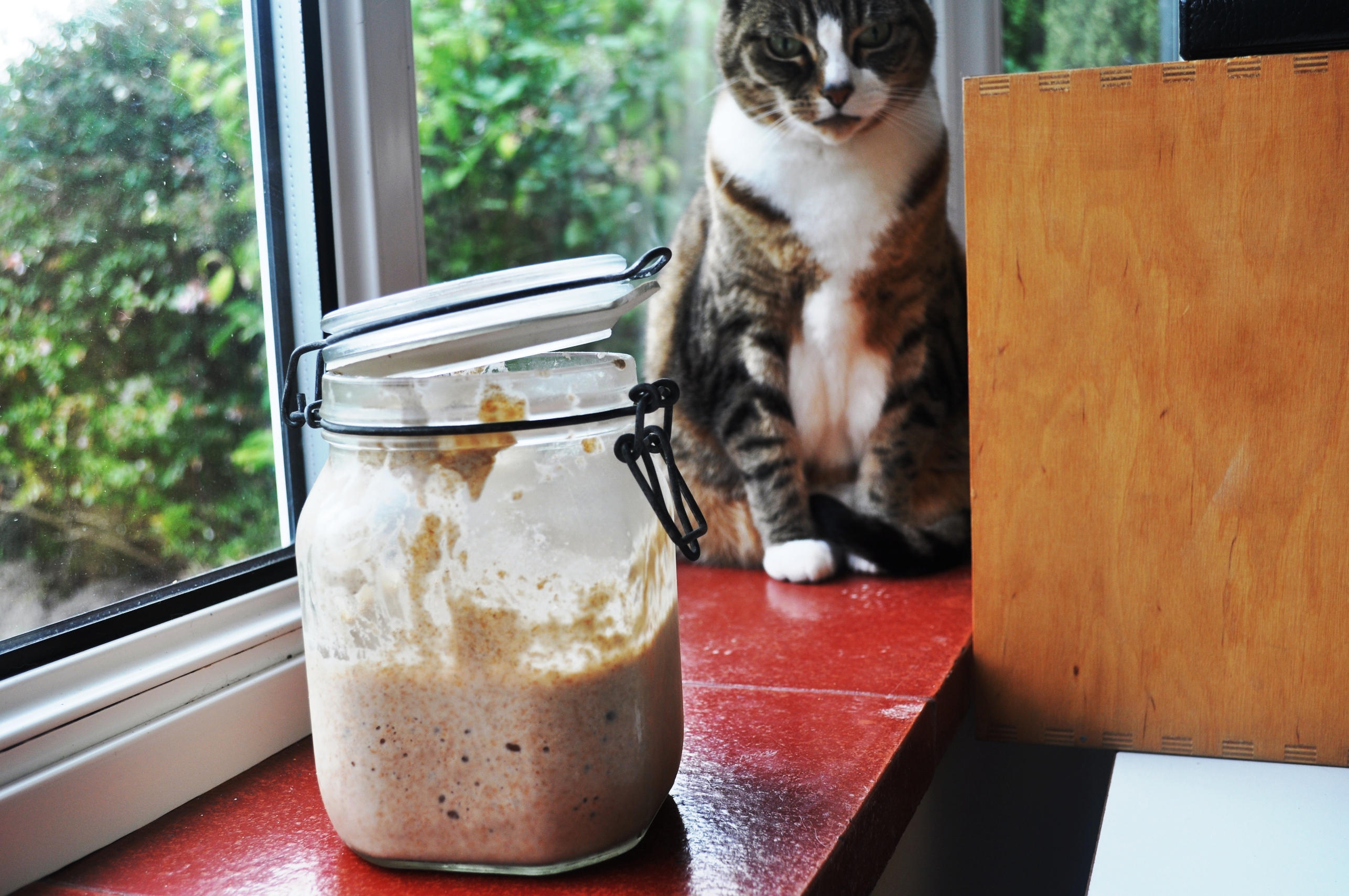
Although I’ve still not got a kitchen, and can’t bake – seven weeks and counting – doesn’t mean I’m not thinking about baking. I think about baking a lot. I wish I could just knock up a batch of cookies, or put make some bread. I have, at least, been tending my sourdough starter, which is quietly biding its time at the back of the fridge, not entirely dormant, but not particularly active.

Sadly, I still won’t have a kitchen, or an oven, until late October, so I won’t be able to do any naturally leavened loaves during Sourdough September. This is the annual event organised by the Real Bread Campaign, a series of “local events and activities to help share sourdough secrets and demystify the delicious delights of the oldest way of raising a loaf.”

Not only is making your own bread not that difficult,  creating your own natural leaven, or sourdough culture, to use instead of commercial yeast, isn’t either. Read all about it here.

Oh, and that’s Lux with my sourdough. I notice she didn’t wipe her feet when she came in from the building site, which isn’t very hygienic. I’ll have a word with her about that before she heads off to the spa (okay, cattery) while me and Fran get out of the way of the builders for a week, firstly by walking the South Downs Way from Lewes to Winchester.


2 Comments

Filed under Baking

Gooseberry and thyme cake

Slice of gooseberry thyme cake

We’ve not had a kitchen for just over a week now. We’re having building work done on our house, and although the original plan was to only remove the kitchen half-way through the three-month schedule, on the first day the builder turned to me and said it’d be better if they did it straight away. Immediately. Post-haste. Subito. Or at least the day after.

So I baked my final cake and final two loaves of bread, then set about removing the units. It was a hideous kitchen, and far from practical, but not having a kitchen at all is, to say the least, even less practical. Only so much baking I can do with a kettle and a microwave. Indeed, I never really use microwaves for anything other than softening butter for making cakes, so I don’t know what else you can do with them. Apparently you can “bake” in a microwave, but I can’t really imagine how. Not in a metal cake tin – unless I actively want to add exploded microwave to the chaos.

Just before the demolition started, I was moving some shrubs from the area where we were building. One of these was a much-neglected gooseberry bush, which, despite being basically in the shade, had managed to produce a fair crop, just shy of a kilo. So that final cake had to involve gooseberries.

Now, I can’t say I’m a huge fan of the “spiny grape”, as it’s called in Italian (uva spina). I used to eat them when I was a kid in the 1970s and early 1980s, but I have a feeling they’re slightly out of fashion these days. Despite how popular “retro” and “vintage” may be, I don’t hear people talking excitedly about gooseberry fools, an old-fashioned British summer recipe.

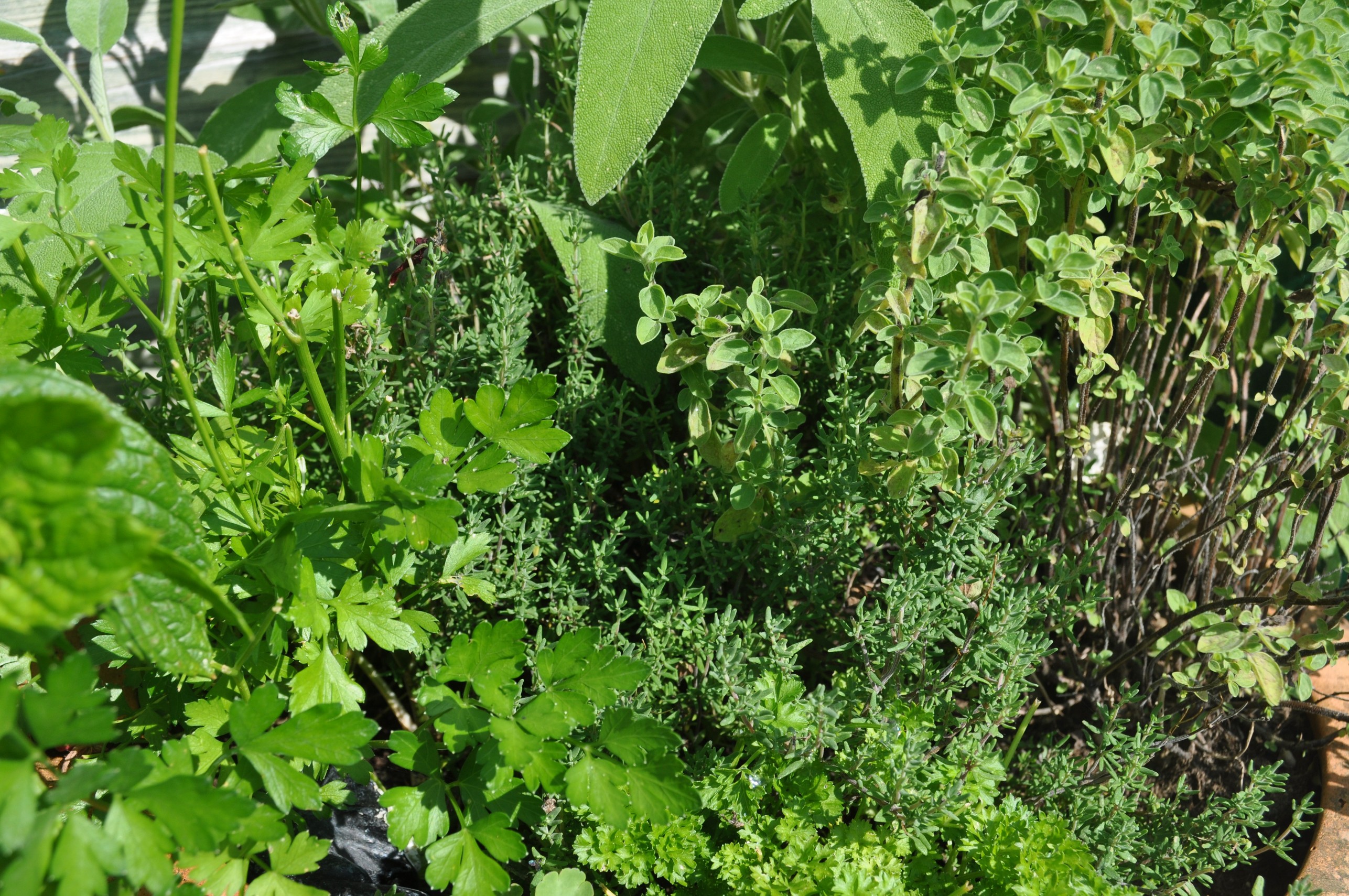
I can suffer a fool, gladly, but rather than just defaulting to using the gooseberries to make one, I wanted to try a cake. I found some good recipes from both Nigel Slater and Diana Henry, two cookery writers who are proponents of great British produce. Henry had one featuring thyme, which intrigued me. Even though I don’t have lemon thyme as her recipe suggests, my own herbs have been doing very well in this year’s shockingly pleasant south of England summer, so I used some good old Thymus vulgaris, common thyme. (Though I think my variety is the French, narrow-leaf, not the English.)

Herbs

Henry’s original recipe can be found here on the Torygraph site. I’ve tweaked it a bit.

The fruit:
350g gooseberries
60g caster sugar

For the cake:
125g butter
120g caster sugar
3 large eggs, lightly beaten
2 tsp thyme leaves, chopped (ideally lemon thyme)
1 lemon
100g plain flour, sifted with
1t baking powder
75g ground almonds

For the syrup:
50g granulated sugar
2 large lemons, juiced [I used 1 lemon, 1 orange], about 100g juice
2 small sprigs of thyme

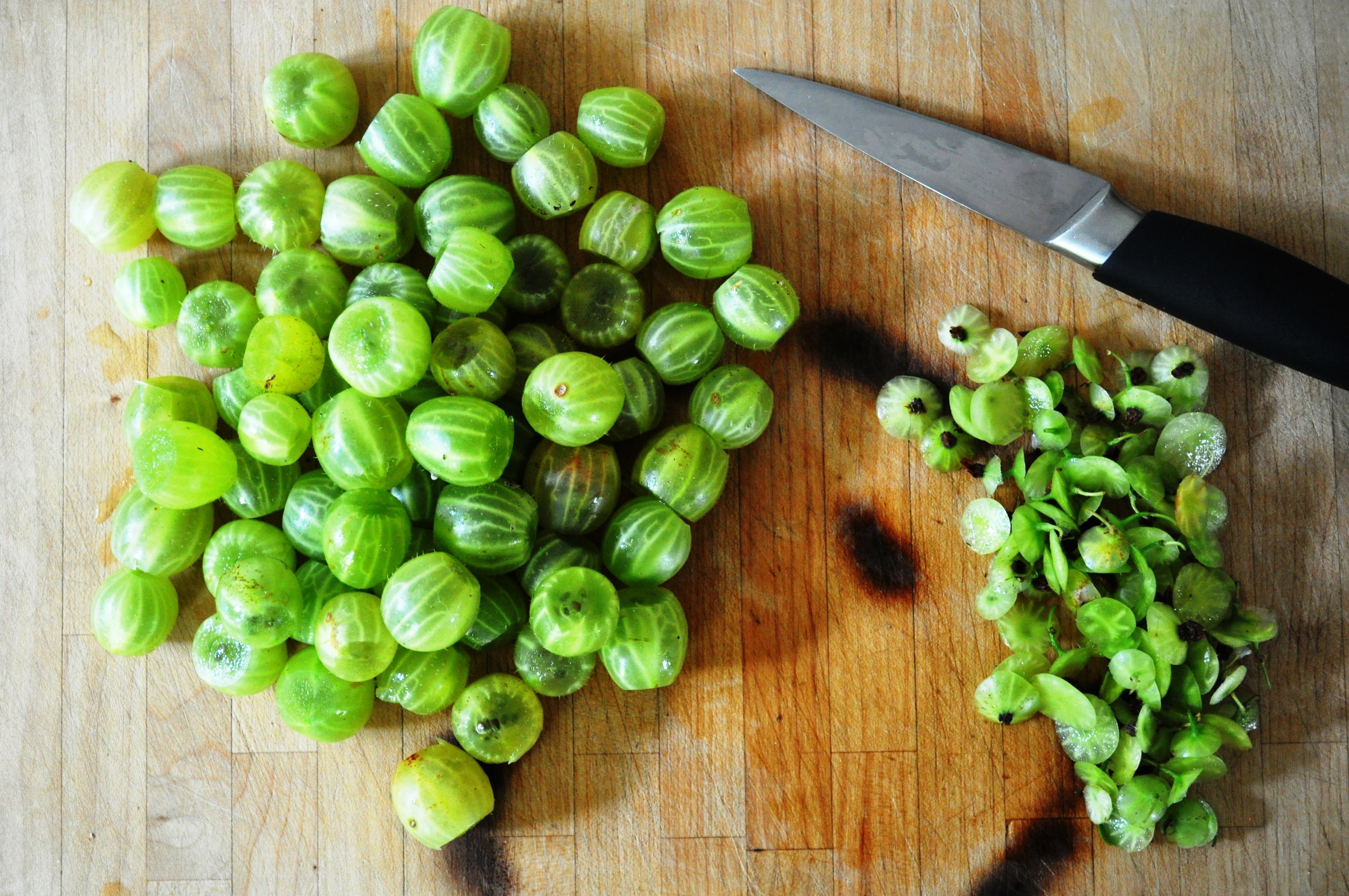
Top & tail

1. Preheat the oven to 190C.
2. Grease and base-line a 20cm spring-form cake tin.
3. Top and tail the gooseberries then toss with 60g of caster sugar and leave them to macerate slightly.
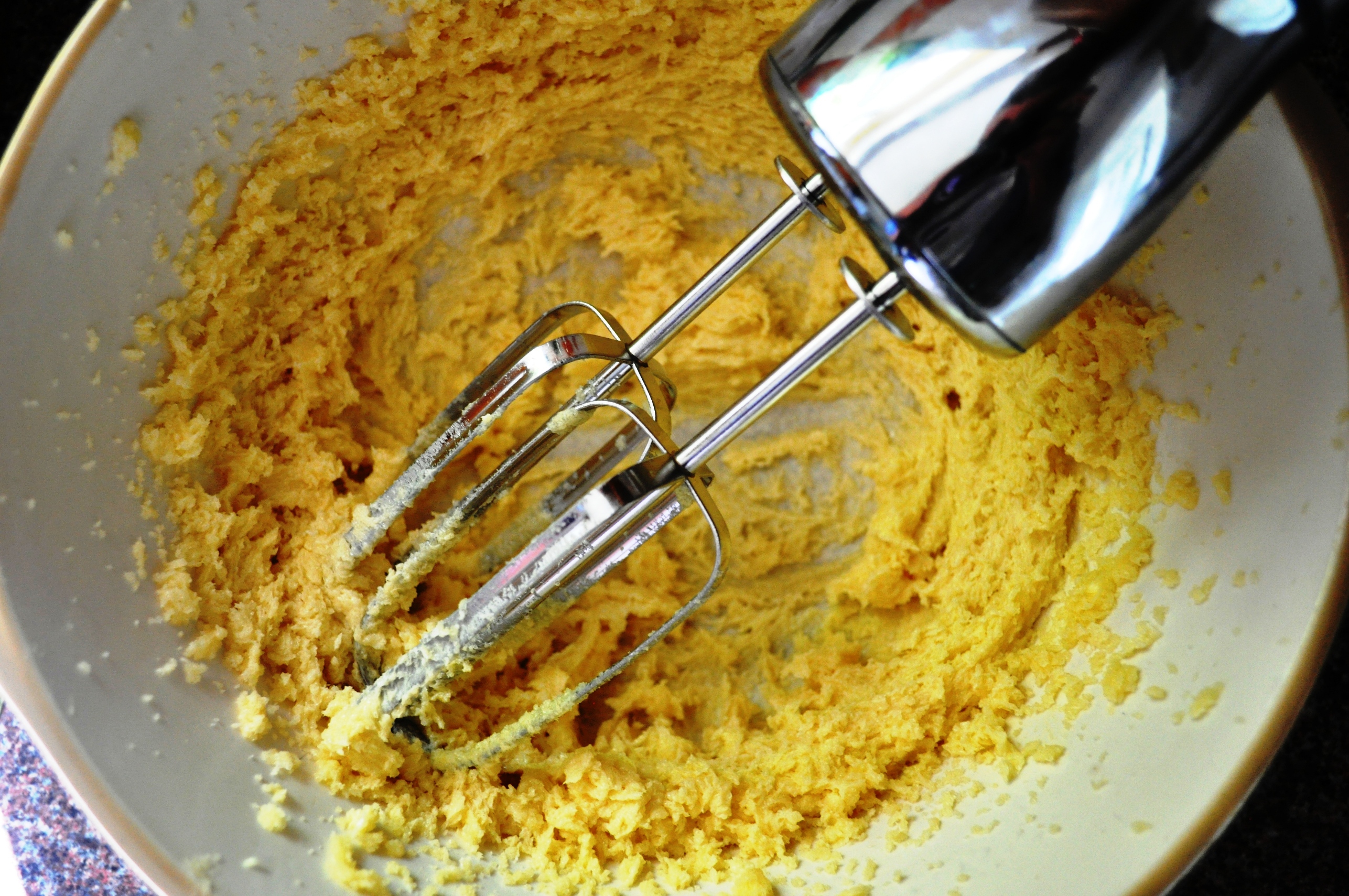
4. Beat the butter and 120g caster sugar until pale and fluffy.

Creaming
5. Add the egg a little at a time, beating well after each addition. If it curdles at all, add a little flour.
6. Finely grate the zest of the lemon. I also used some orange zest. Just cos. Finely chop the zests together with the thyme to free up all those lovely essential oils.

Zest and thyme chopped together
7. Add the zest and herbs to the batter and combine.
8. Sieve in the flour and baking powder, then fold to combine, along with the ground almonds.
9. Spoon, pour and scrape the mixture into the tin.
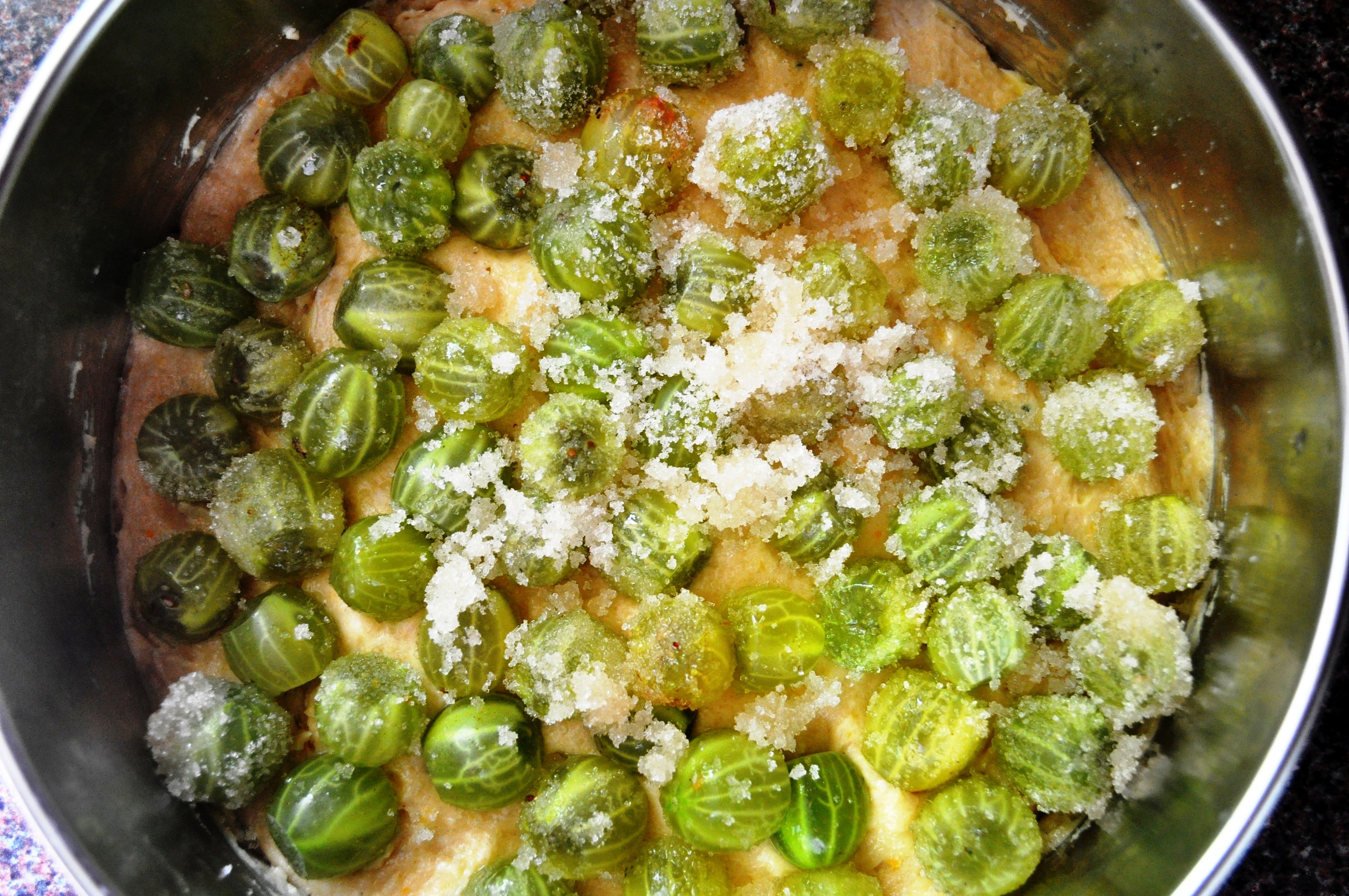
10. Spread the gooseberries over the top of the mixture.

Add fruit
11. Bake for 45 minutes and test with a skewer.

Baked
12. While the cake is still warm, make the syrup by dissolving the sugar in the lemon juice, with the thyme.
13. Pierce the cake with a skewer then pour over the syrup, removing the sprigs of thyme.
14. Leave to cool then serve. You can just with icing sugar, and serve with crème fraîche, cream or ice cream.

Henry also has another one here, with flaked almonds. I think that could be nicer as the crunch of the almonds would contrast with the eyebally squish of the cooked fruit. Next year perhaps. Or perhaps Slater’s recipe, which involves a kind of crumble. Or perhaps I’ll just revisit the fool.

8 Comments

Filed under Baking, Cakes, Recipes

A week in Rome: pizza and pizza bianca

Biddy on the beach, where we had pizza bianca for our lunch

A couple of my pizza or pizza-related ambitions for this trip didn’t come to fruition – a trip to the vaunted Pepe in Grani pizzeria and a chance to try the intriguing pinse. The former just felt like too much of a mission, as it’s in the sticks, a two-hour drive or doubtless convoluted journey by public transport from Rome. The latter because the place I’d been told about by Hande Leimer, not just the expert sommelier of Vinoroma, but a great knowledge on Roman eating, was closed when we passed by around midday on our way back from closing our Italian bank account. Or attempting to close it. I’ll eat my hat – okay, I’ll just nibble it a bit – if that cheque ever arrives at our UK address.

Shame really, as pinse are a kind of rare Roman and Lazio relative of the pizza, made with a dough based on grains other than wheat, such as millet, oats or barley, in a mix with older wheat varieties. Next time.

And it’s not like we were otherwise deprived.

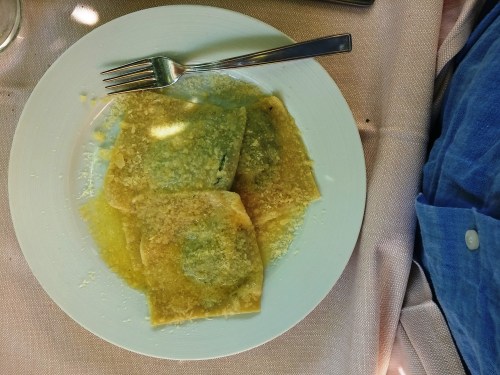
The best meal we had was for Fran’s birthday lunch, which we celebrated at the excellent trattoria Da Cesare (Via del Casaletto 45, Casaletto/Monteverde Nuovo, 00151 Rome – at the end of the number 8 tram route). It’s an old favourite, via Rachel, Hande and her colleague Katie Parla, and the place where I had one of my most memorable meals ever, last year on Ferragosto – the public holiday that’s celebrated on 15 August, the day that’s considered the hottest of the year. For Fran’s birthday, we gorged ourselves on amazing fritti (deep-fried antipasti) and fresh pasta dishes, like these giant ravioli, accompanied by some great wines recommended by Hande (who told me the boss is also a sommelier and has a great selection). They do do pizza, though I’ve never tried it.

Giant ravioli of ricotta and spinach at Cesare a Casaletto

More basically though, we also ate a fair amount of pizza, including at one one of my favourite pizzerias. Da Remo (Piazza di Santa Maria Liberatrice 44, Testaccio, 00153 Rome) is isn’t a place that sells products that are entirely in line with my more ardent principles about long fermentation and whatnot, but it does offer a consistent, consistently tasty product: classic, thin Roman-style pizzas, nicely charred from their wood-fired oven and served an atmospheric slightly rough, rushed setting.

When we went there I had a pizza without tomato sauce – that is, a white pizza or pizza bianca. The topping was simply mozzarella, a few zucchine flowers and some anchovies and it totally hit the spot, washed down with dubious house wine.

Da Remo

Shades of white
The term pizza bianca can be a little confusing in Rome as the other thing it refers to is a simple snack of basic pizza dough embellished with little more than a slosh of olive oil and a sprinkle of salt. I love the stuff. Can’t get enough. Which is good, as it’s ubiquitous in bakeries and pizza takeaways, which bake long planks of it and sell it by weight. It’s such a popular staple with Romans, I suspect even mediocre outlets put more effort into getting it right.

I’ve got a recipe here, but I’ll be honest – while I’m pleased with it, it’s never quite as good as the real thing, baked in a proper commercial oven oven, cut from a massive plank, eaten on a Roman street. Or nearby beach (where the old biddy, above, was our neighbour), here topped with some caciotta di pecora (sheep’s milk cheese) and prosciutto.

Pizza bianca 'sandwich'

Or as part of a simple lunch, here accompanied by burrata – not a Roman cheese, but from Puglia, and one of the most stupidly indulgent simple pleasures that exists.

Simple lunch

We bought ours from Il Panificio Passi (Via Mastro Giorgio 87, Testaccio), which was basically underneath the flat we were staying in and fortunately does decent pizza bianca.

Pizza bianca torn open, showing its moliche - crumb or guts

Name games
Rome, and Italy in general, is a great place for getting confused about the names of foods you might previously have considered yourself well-acquainted with. So while pizza bianca refers to both plain pizza, or topped pizza, pizza rossa refers to both pizza based topped with little more than a smear of tomato sauce, and the types of topped pizzas that have that sauce along with other elements.

Furthermore, Romans even use the word focaccia to refer to a very thin, crisp, crunchy bread that some trattorie serve in their baskets of bread that accompany every meal. I love it, though I didn’t take a photo when we had some as the waiter was so grumpy about my query it put me off my stride.

The plumper flatbread us Brits (and I suspect Americans) know as focaccia, meanwhile, can be simply called pizza alla genovese, as that style is from Genova/Genoa and Liguria.

Pizza rossa, pizza bianca and (the fatter stuff) pizza/focaccia alla genovese at Passi, Testaccio.

It’s all six of one and half a dozen of another though, as arguably all flat breads can be considered focaccia. The name simply means “hearth bread”, bread cooked on the hearth, from the Latin focus. Furthermore, Wikipedia’s attempt at making a distinction between focaccia and pizza is clearly spurious as it says things like “while focaccia dough uses more leavening, causing the dough to rise significantly higher” and “focaccia is most often square whereas conventional pizza is more commonly round”, both things fairly disabused by the kind of Roman food mentioned above.

It’s also worth noting, no one really seems to know the etymology of the word pizza anyway, so sod it – if you want to make something thin or thick, round or square, with a hole in the middle or not, heavily topped or simply sprinkled with salt, I’m not sure it’s really worth any fuss if you call it focaccia or pizza. Or indeed pinsa, a word that some suggest has the same roots as pizza anyway. Or not. Chissa?

Leave a comment

Filed under Baking, Breads, Pizza, Restaurants etc, Rome

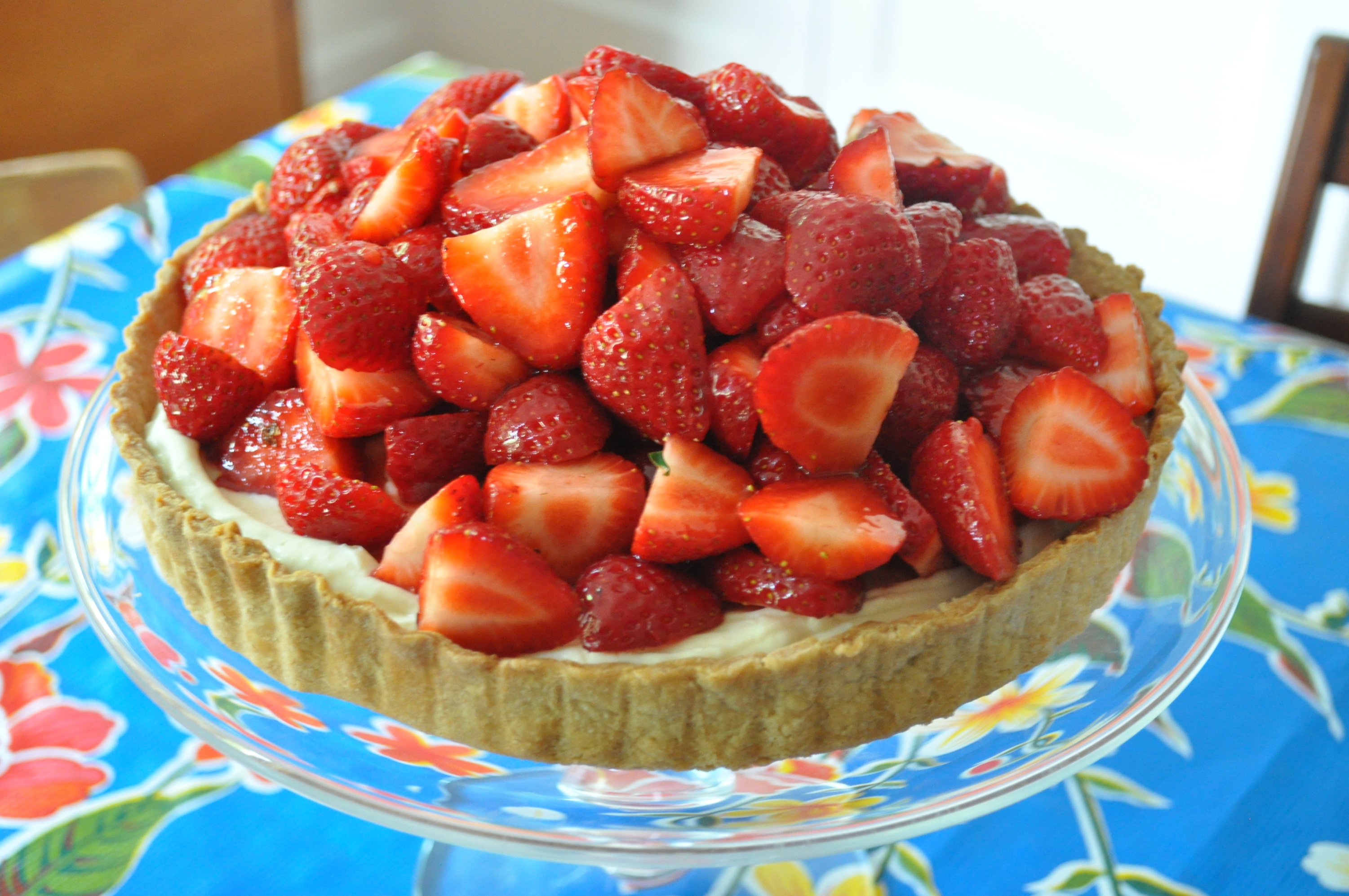
Strawberry tart

Strawberry tart

We’ve had some proper summer weather here in southern England the past few weeks. I’m quite shocked. It’s potentially looking like a good year for fruit too. All that rain in January-Febuary then a strangely hot and sunny spell in March might count for something in that department. Already our plum tree is sagging under the weight of ripening fruit, and out goseberry bush is starting to look ready to yield its sour green offerings.

I was planning to use the goosebrrries, a fruit I ate a fair amount as a child but haven’t touched for years, if not decades, for a tart yesterday, when we had friends visiting for lunch, but decided they weren’t quite ripe (the bush is in a very shady spot). Instead, the farmers market had a stall loaded with (ripe) gooseberries, cherries, strawberries and tayberries. I hadn’t encountered the latter before, but they’re a common blackberry (Rubus fruticosus)/raspberry (Rubus idaeus) cross. We bought a punnet, but mostly we bought strawberries as I’d seen a handsome looking recipe in Dan Lepard’s ‘Short & Sweet’. Another version of his recipe is available here on the Guardian.

It involves a slightly unusual custard, or sort-of custard. I’m not sure it’s a strict definition but I always assumed custard referred to things made with a mixture of milk or cream and egg yolk. This one, however, is made with egg white. Which is a typically nifty Lepard trick, as you use yolk in the pastry, and can then use up the leftover white. You make a mixture of milk, cornflour, sugar and the egg white, cook it till thick, then cool this, later on combining it with crème fraîche. Lepard uses a similar process for another of his custards, though that one does use yolks, then is mixed with double cream. It’s very handy.

So anyway.

Strawberries
About 500g strawberries
A little caster sugar

Pastry
125g plain flour (all-purpose or cake flour)
25g icing sugar (confectioners sugar)
Pinch salt
75g unsalted butter, cold, cut in small cubes
1 egg yolk
A little cold water

Custard
130g milk
20g cornflour (corn starch)
1 egg white
50g caster sugar
1 tsp vanilla extract
250g crème fraîche

1. Cut the stalky bits off the strawberries then slice into two or three or four, depending on the size of the individual fruit.
2. Put the strawberries in a bowl, sprinkle with caster sugar, then leave in the fridge to macerate, stirring occasionally.
3. Make the pastry by sieving together the flour and icing sugar, adding the salt then the cubed butter. Rub together until the mixture resembles breadcrumbs (you could do this in a food processor), then add the egg yolk and water and bring together a dough. Don’t be tempted to add too much water. A tablespoon or so should be enough. You want the pastry crumbling not sticky.
4. Form the pastry into a disc then wrap in plastic and rest in the fridge.
5. Combine the milk, cornflour, egg white sugar and vanilla in a saucepan.
6. Whisking well, put over a low heat. Continue whisking, increasing the heat slightly, until the mixture thickens. It can get pretty thick, so don’t get too carried away. And watch it doesn’t burn.
7. Put the thick mixture into a bowl, cover with a plate and allow to cool. Then leave in the fridge until you need it.
8. Roll out the pastry and use it to line a 25cm-ish pie or flan tin.
9. Preheat the oven to 170C.
10. Bake the pastry case blind – that is, covering the pastry with a lining of parchment and filling it with baking beans. I used to use my childhood marbles, but I’ve lost them (ahem), so currently I’m just using kidney beans. Bake for about 15 minutes then remove the beans and parchment and keep baking until the case is golden.
11. Allow the pastry case to cool.
12. Put the thick custard mix in a large bowl and loosen it up with electric beaters.
13. Add the crème fraîche and keep beating until it’s all nicely blended.
14. Put the crème fraîche-custard in the cooled pastry case.
15. Arrange the macerated strawberries over the top.
16. Serve.

Strawberry tart 2

I was hoping we’d have a little of ours leftover but eight of us – five adults, three kids – demolished it in mere seconds. Well, a few minutes perhaps. All in all, it was a lovely end to a very satisfying lunch. For starters we did some fiore di zucca: battered, deep-fried zuccchine flowers, filled with mozzarella and a little anchovy. Then for the the main course we did honey-glazed roast chicken with lemon thyme and smoked paprika, a great Tom Kerridge recipe that can be found here; smashed new potatoes with mint; broad bean, pea and mint salad with Medita (our local version of feta, from High Weald Dairy); and a simple lettuce salad. The kids didn’t fuss about any of it – indeed, they demolished most of the mains in seconds too. Kids can really be the worst critics of food, so we were very chuffed with this result. Wish we’d taken a few photos.

All accompanied by local beer and incredible sunshine, and a post-prandial walk on Malling Down, part of the South Downs, an area that’s just received a special Biosphere status from Unesco alongside places like the Amazon and the Rockies, it was a wonderful day. Which compensated nicely for my disappointment about the 18th South Downs Beer & Cider Festival, which we’d attended the day before.

6 Comments

Filed under Baking, Pies & tarts, Puddings & desserts, Recipes

Peanut butter tahini swirl chocolate brownies

Plate
Peanut butter and tahini, two lovely, tasty oily pastes that can be great editions to baked goods. I love peanut butter, especially good stuff made without daft additives. It doesn’t need added sugar, it doesn’t need artificial sweeteners and it doesn’t need palm oil, soya oil, rapeseed oil, especially not hydrogenated oil.

Peanuts, simply ground up, make for a delicious and suprisingly nutritious product. Peanuts are actually legumes – more pea than nut – so are full of protein for starters. I remember learning about calories in biology at school (many many years ago) by weighing then burning then weighing a peanut. They’re essentially half fat, but much of that is unsaturated: 31% polyunsatuared, 46% monounsatured, 18% saturated*. Peanuts also contain fibre, antioxidants, vitamins thiamin (B1), niacin (B3), folate (B9) and others, and minerals magnesium, potassium, phosphorus, copper and manganese . Tahini, ground-up sesame seeeds, meanwhile contains essential fatty acids, copper and manganese.

Adding peanut butter and tahini to a brownie mix makes it especially gooey and delectable. I’d seen recipes online that used some one or the other, but as I had a jar of each, both running out, my version involved both, plus the tahini swirl. My version also involves both cocoa and chocolate, cut up into coarse chunks. If you’re making brownies, you can’t mess around with the chocolate – it has to be plentiful, rich and dark.

As for the peanut butter, I used my normal type, which is wholenut crunchy, with skins and all, no added sugar. Some brownie recipes might suggest you use a smooth type with all that sugar and extra oil but meh to that. The wholesome crunchy type adds depth of flavour and texture. I’ve also used some oats as they help keep it moist. And as I don’t have a problem with wheat – indeed, I love the stuff, especially well-husbanded grain ground into quality flour – I added some wheat flour too.

Pile of tahini brownies

This recipe is loosely adapted from Lick and Spoon, who adapted it from here, though the my tahini swirl is inspired by yet another recipe, here.

I’m not going to pretend these are “skinny” – there’s enough sugar in there for them to qualify as a properly sweet, calorific treat, an indulgent part of a balanced diet and relatively active lifestyle. They do at least contain a smattering of the abovementioned vitamins and minerals if you’re the type who likes to beat themselves up about their foods.

70g peanut butter
50g tahini
80g full-fat yoghurt
160g full-fat milk
1 egg
1 tsp vanilla essence
Pinch salt
1 tsp baking powder
50g plain flour
50g cocoa powder
50g oatmeal
130g light brown sugar
100g dark chocolate (60% cocoa mass or more), chopped into chunks

Tahini swirl
1 egg
60g tahini
20g caster sugar
1/2 t vanilla essence

1. Preheat oven to 180C.
2. Grease and line a square 20 x 20cm baking tin.
3. Sieve together flour, cocoa and baking powder.
4. Stir in the salt, oats, sugars and chocolate chips.
5. Beat together the peanut butter, yogurt, milk, egg.
6. Pour the wet mix into the dry, beating with hand blender.
7. Blend to a runny mixture.
8. Pour into the baking tin.
9. Beat together the tahini swirl ingredients until well combined and blended.
10. Drop blobs on top of choc mixture and swirl with tip of a knife.
11. Bake for 20-25 minutes.
12. Cool, cut and serve.

Tin

* ‘The Food Bible’, Judith Wills


8 Comments

Filed under Baking, Cakes, Recipes

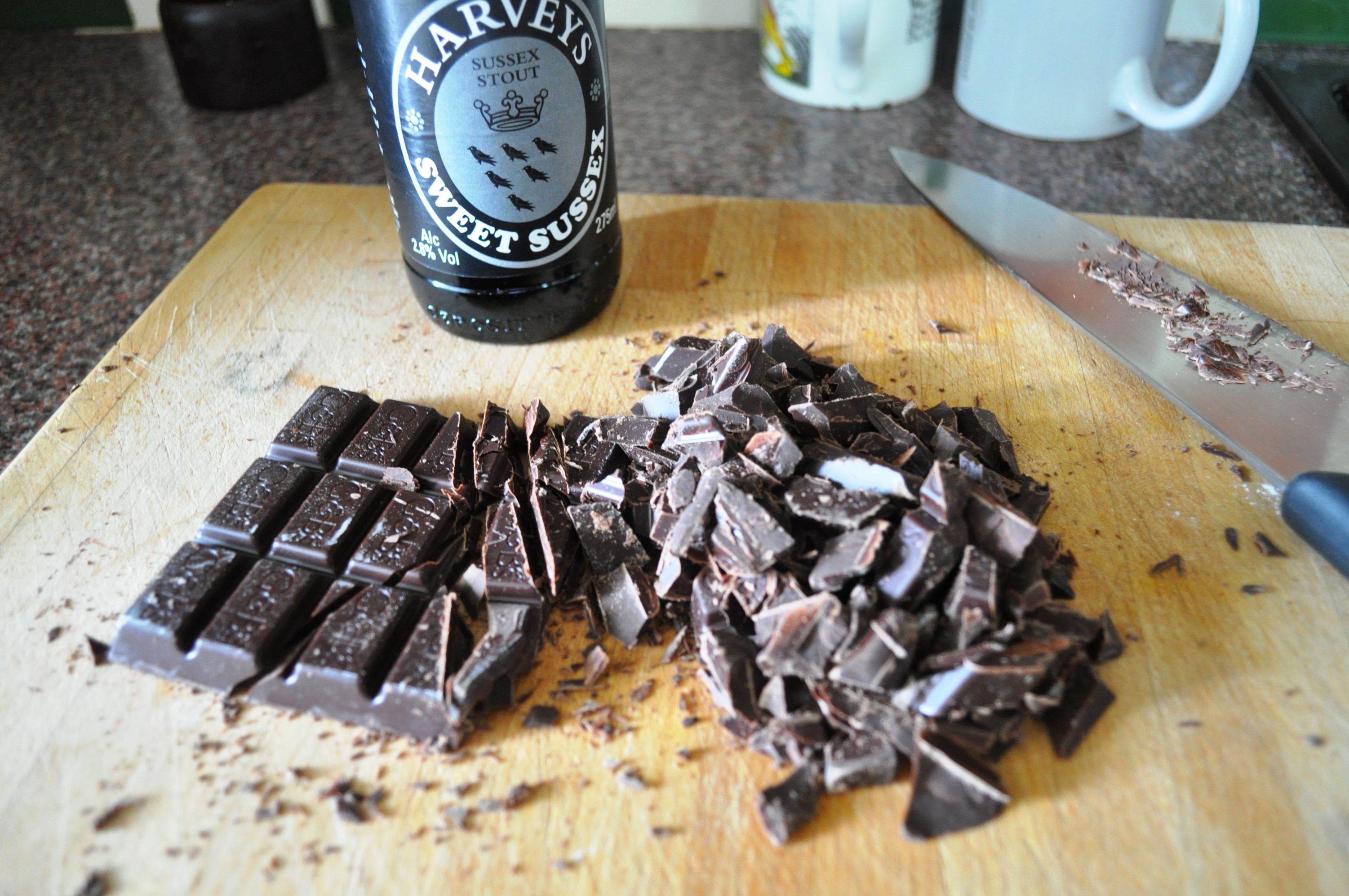
Sweet Sussex stout chocolate muffins

Sweet Sussex and chocolate

Today, 16 June, is Sussex Day. It’s probably not a festival many people celebrate – especially as it was only invented in 2006. Though it is based on the saints day of St Richard, patron of Sussex, the land of the south Saxons. Richard de Wych was a 12th century bishop of Chichester, now the county town of West Sussex. I’m over here in Lewes, the county town of East Sussex. The historic county of Sussex, based on the ancient kingdom of the south Saxons, was divided into two modern, administrative counties in the 1860s. Chichester and Lewes are very different, notably because the former is a cathedral city of about 24,000 people, while Lewes only has about 14,000 people, and the only “cathedral” is Harveys brewery.

Later on today I plan to head down to Harveys and check out the new St Richard’s Ale, which they’re launching on Sussex Day, but in the meantime, here’s recipe made using another Harveys, county-themed ale: Sweet Sussex.

Ye olde stout vs porter
On the label and site, Harveys says Sweet Sussex is a “lush, sweet stout named after the county in which it is brewed.” It has an ABV of just 2.8%, which raises the interesting question of what truly defines a stout. Well, in linguistic terms “stout” originally meant proud, brave and courageous, but this segued into meaning physically strong, well built. As a description of people it evolved again to start meaning bulking, then fat, but in beer terms it stuck with strong. Specifically it was used to describe strong porter, the type of beer that emerged in London in the 18th century as a refreshing, nutritious, fortifying drink of hardworking porters

Dark brown or black ales, porters were made with well roasted malts, which lent them a sweet, charcoally flavour. Eventually, the term “stout porter” shifted again, with stout becoming its own town for a rich, dark ale – though not necessarily a strong one. Indeed, today, the terms stout and porter are fairly interchangeable.

Sussex Sweet may be called a stout, but it’s certainly not stout in the sense of strong. Indeed, it’s so weak, compared to those old historic stout porters which will have been 8% ABV or so, that it’s more defined by its sweetness. It’s almost like a kind of charcoal milkshake. And just the thought of thing that goes well with dark chocolate.

Muffin

Muffins vs cupcakes
I wanted to bake something chocolaty yesterday, but didn’t want something as rich as a full-on cake (like I made here with dark ale) or iced cupcakes, so I made some muffins instead. Like stout and porter, the terms muffin and cupcake have slightly blurred meanings, though broadly I’d say a muffin contained less sugar, less butter, and were broadly a tad healthier. A lot of muffins, of course, contain bran, or fruit, or are even savoury. These ones are only vaguely sweet, and have a hint of that charcoally flavour from the beer.

20g cocoa
230g self-raising flour
1 teaspoon baking powder
50g butter, melted and cooled slightly
70g sugar (I used caster, but you could use a dark muscovado say)
150g dark chocolate (at least 65% cocoa solids), coarsely chopped
2 eggs, lightly beaten
250g Sweet Sussex or other stout or porter, or a mixture of stout or porter and milk

1. Preheat the oven to 200C.

Light cacao
2. Sieve the cocoa, flour and baking powder into a bowl.
3. Stir in the sugar and chocolate chips.
4. Add the eggs, vanilla and beer, or beer and milk mix, along with the melted butter, to the flour mix.
5. Beat to combine.
6. Fill about a dozen muffin cases and bake for about 25 minutes.
7. Cool and enjoy, with a cuppa or perhaps with a stout. Or porter.

Muffins, baked

A note on the cocoa
There’s only a little bit of cocoa in here, but I was also using a very light-coloured type of cocoa powder, hence the results aren’t very dark. This cocoa powder I’m using is actually the Raw Chocolate Company’s Raw (organic, Fairtade, thoroughly right-on) Cacao Powder. See here for more info.

Cocoa? Cacao? Whaʼ? Don’t worry about the difference. There isn’t really one. The English word cocoa is basically a synonym for the cacao, with Theobroma cacao the scientific name for the tree that yields the beans that produce those all-important chocolate products, with “cacao” coming from the Mayan and Mesoamerican language word for the tree and “Theobroma” from the Greek for “food of the gods”. Beer and chocolate – both worthy of that name I’d say.

2 Comments

Filed under Ale, beer, Baking, Cakes, Recipes

Sourdough pizza and Hastings Brewery’s No 6 Hop Forward Pale Ale

Sourdough pizza with Hastings Brewery No 6 Pale Ale

Even though we ate tonnes on Saturday night, accompanied by various local beers and wines, I was making bread dough on Tuesday evening and thought, heck, why not make another pizza? One of the justifications was that on Saturday night one batch we did was slightly over-baked and the other slightly under-baked, so I wanted to keep on experimenting with our oven to try and get it right.

Anyone who’s made real pizza in a domestic oven will know it can be slightly challenging, largely because you simply can’t get the heat. My oven goes up to about 250C (480F) but a wood-fired pizza oven can get up to 450C (840F), enabling flash baking. You can improve things in a domestic oven by using a baking stone. Stones are excellent as you heat them in the oven first, so when the pizza is slid onto them, they’re already hot and help bake the dough through, quickly, as well as crisping up the base.

But I’ve not got one at the moment.

Currently, I’m just using a metal baking sheet, which goes into the oven cold. It’s not ideal, as, depending on the temperature variables in your oven, you can get a done, or potentially burnt, top, before the base is full baked. Even though I’m pleased with this recipe, the base wasn’t baked to perfection. That’s the challenge – for me and for you, as your oven will be different again.

Hastings Brewery No 6. With cat

Hopping forward
The other enjoyable factor about this pizza dinner – aside from being able to eat it outside on a warm English summer evening, 20C, no mosquitoes – was a great beer. I mentioned in my previous post I don’t think the light mild beer I was drinking was a good food pairing. This time round I chose a considerably more hoppy beer, and it worked well.

This was a Handmade No 6 Pale Ale bottled beer from Hastings Brewery, bought from the excellent Trafalgar Wines in Brighton, a booze shop with an excellent selection of beers. Apparently Hastings Brewery beers are their second-best selling now, after beers from The Kernel in London.

Hastings Brewery is a new discovery for me. I’m slowly working my way through all the local breweries. This one is 23 miles away from my home in Lewes. It started with founders Pete Mason and Brett Ross inspired “whilst litter picking after the Hastings Beer & Music Festival in July 2010.” Pete’s dad Andy got on board and by 2011 they’d bought “a larger – but still small – brewery”.

They’re an interesting outfit as not only do they do everything by hand on a small scale, with brews of 800 litres, they’re also make entirely vegan products. A lot of drinkers may not realise beer generally isn’t very vegetarian or vegan, but it’s often filtered with isinglass finings, which are fish bladders. Pete Mason is a vegan, as is their sales manager. Their beers are unfiltered. For some, this is appealing as filtering, arguably, can remove some of the flavour and mouthfeel.

The brewery’s label design and branding is great too. Their labels – all featuring a lion with fine mane and tongue sticking out1 – certainly stood out on the shelf at Trafalgar Wines.

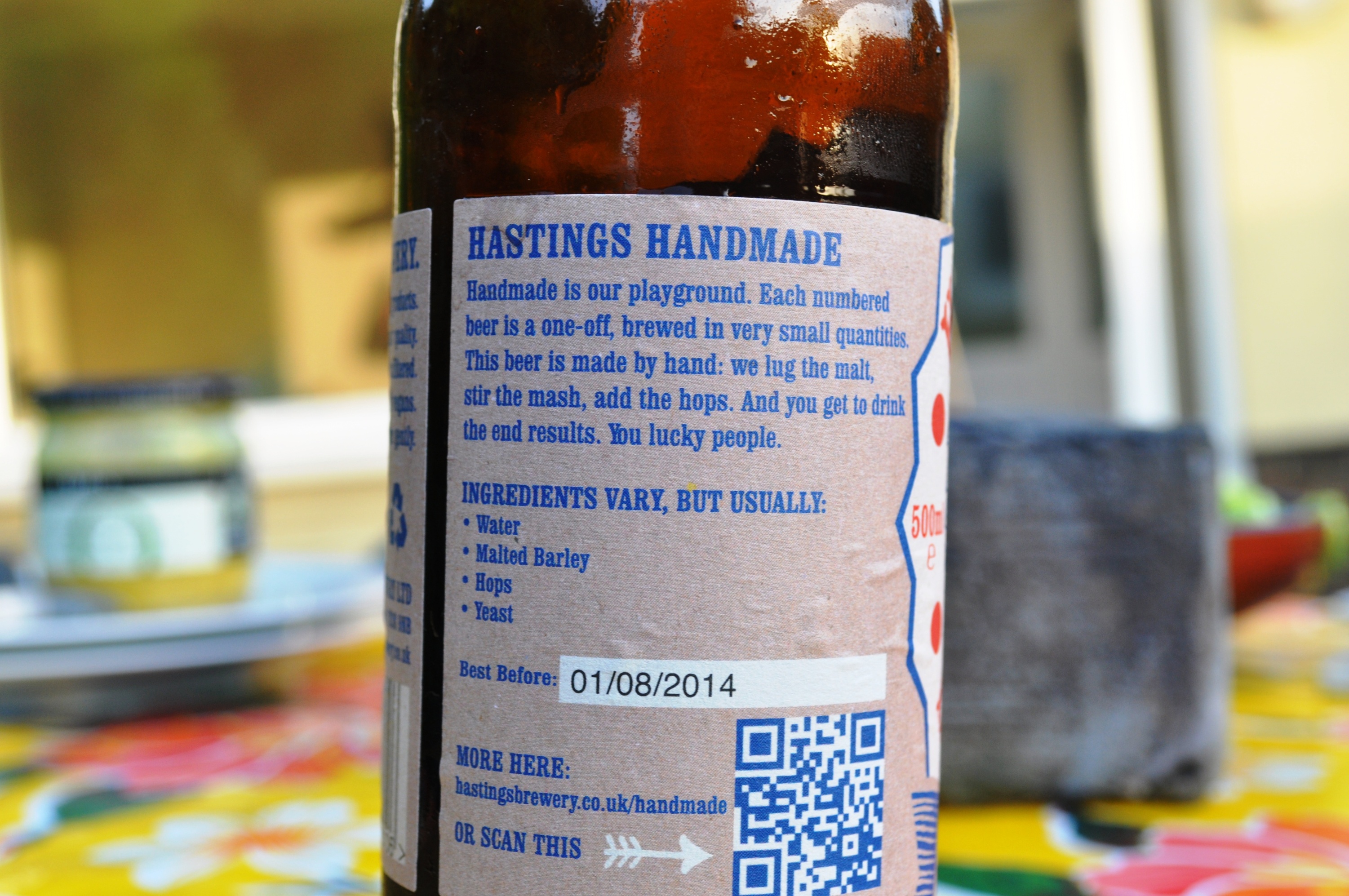
Handmade

The 4.8% ABV beer, with its slightly unwieldy full name of ‘Hastings Handmade No 6 Hop Forward Pale Ale (Columbus)’, is very much a British take on a US craft beer. It’s defined by its use of Columbus, an American hop variety with a high alpha acid (around 15%), making it suitable for assertive bittering, 48 IBUs apparently. I suspect they’ve also used it for late-hopping (adding later in the boil, so it the oils aren’t totally broken down) or even dry hopping (adding during the conditioning stage so the oils remain largely intact) as the beer is highly aromatic: citrus, ginger, passion fruit, honey. The taste, while defined by massive bitterness, is also honeyed, with a salty, minerally aftertaste that verges on soapiness. [See below – actually they used a hopback.]

This beer really reminded us of our travels in the US, and while I have vague feelings of disloyalty to more traditional, malty, subtly hopped British beer styles when I drink something like this, I also love how British brewers are playing around with US styles. I love all the international cross-pollination of tastes and styles. The beer also went really well with our pizza, which I topped with mozzarella, thinly sliced pancetta from Beals Farm Charcuterie and a pecorino romano, for that added salty goodness.

I was hoping to add some asparagus but while I still saw plenty on the farmers’ markets a few days ago, guess what? Waitrose – nominally the less unethical British supermarket – only had asparagus from Peru! Southafeckingmerica!!! It’s asparagus season here – in England – right now, the end of the season sure, but still now. Now. In England. I’ve seen signs outside farms as I’ve cycled around Sussex, mere miles from that branch of Waitrose. Supermarket food economics is bonkers. Not to mention environmentally appalling.

Baked pizza

Sourdough pizza recipe
This makes one large-ish pizza, about 30cm (12 inch), but could cut up and manipulated differently. If you roll it flat, you’ll get a much more Roman-style pizza. If you open out the centre more and leave a wider, fatter edge, you’ll get a more Neapolitan-style pizza. The latter is called a cornicione and is the speciality of Michael Hanson at The Hearth in Lewes. Lewes, depressingly, has about four industrial chain pizza places; I’d say my pizza is better than all of theirs, easily, though still second-best in Lewes, after The Hearth.

This is a naturally leavened dough, so you want to make it the day before, to give it time to do a nice long fermentation.

250g strong white bread flour (or a mixture of strong, high protein flour and plain, all-purpose flour)
180g water
50g sourdough starter (100% hydration. I used a rye-based one, but wheat-based would be fine too)
15g olive oil (a good glug basically, QB)
5g salt

1. Whisk together the sourdough starter and water. It doesn’t matter if the water is cool, as it’s a long fermentation it doesn’t really need that boost of using body-temperature water. Try and use water that’s not too chlorinated or fluorinated. I filter my tap water with a Brita and the sourdough starter seems to prefer it.
2. Add the flour and salt and stir together well.
3. Add the olive oil and keep blending until well-combined.
4. Turn the dough out onto a work surface lightly greased with more olive oil and give it a short knead. It is a relatively wet dough. If you find it too sloppy, add a little more flour – but not too much or you’ll make a nasty dry dough.2
5. Put the dough back in the bowl, cleaned and oiled, and let it rest for 15 minutes before giving it another quick knead, stretching it and folding it over. Repeat this twice more, then put the dough back in the bowl, again, cleaned and oiled.
6. Cover the bowl with plastic wrap or a shower cap, and put it in the fridge and let it ferment slowly for about 24 hours.
7. Take the dough out of the fridge about an hour before you want to use it.
8. Form it into a ball on a floured work surface. Cover.
9. When you want to bake, preheat your oven to the highest setting.
10. Gently stretch out the dough. Don’t be too rough, or you’ll damage the structure that’d been developing during the fermentation period. How you open it up depends on what shape of pizza you’re making (see above).
11. Once you have opened up the dough to almost the desired shaped, gently transfer it to an oiled baking sheet, hanging it over your forearm and taking care not to poke your fingers through it.
12. Cover with your desired toppings. I did a pizza rossa – with tomato sauce – along with the abovementioned cheese and pancetta. Here’s the pizza before it went into the oven:

Unbaked pizza.
13. Bake in your preheated oven until it’s done. Yes, I know that’s vague, but it could be 10 minutes, it could be 25, with the oven turned down a little lower to make sure the middle of the base bakes and the top doesn’t char (too much).
14. Enjoy. Preferably al fresco with a quality, hoppy local beer.


Info
Hastings Brewery, 12 Moorhurst Road, Hastings TN38 9NB
hastingsbrewery.co.uk | info@hastingsbrewery.co.uk | 01424 572051


Trafalgar Wines, 23 Trafalgar St, Brighton BN1 4EQ
01273 683325


Footnotes
1 Some local ignorance – is the lion a Hastings thing? Maybe, as there are lions – or one lion and two half-lion/half-boat things – on the town’s crest.
2 The mixture is really 275g flour and 205g water, as the 50g of leaven at 100% hydration is 25g water, 25g flour. So this is a 74.5% hydration dough in bakers’ percentages. I’m using Stoates organic strong white bread flour; I find it quite absorbent, possibly as it’s stoneground and contains more bran. If you’re using a whiter, less branny flour that’s less absorbent, and

7 Comments

Filed under Ale, beer, Baking, British beer, Pizza, Recipes