Category Archives: Cakes

Peanut butter tahini swirl chocolate brownies

Plate
Peanut butter and tahini, two lovely, tasty oily pastes that can be great editions to baked goods. I love peanut butter, especially good stuff made without daft additives. It doesn’t need added sugar, it doesn’t need artificial sweeteners and it doesn’t need palm oil, soya oil, rapeseed oil, especially not hydrogenated oil.

Peanuts, simply ground up, make for a delicious and suprisingly nutritious product. Peanuts are actually legumes – more pea than nut – so are full of protein for starters. I remember learning about calories in biology at school (many many years ago) by weighing then burning then weighing a peanut. They’re essentially half fat, but much of that is unsaturated: 31% polyunsatuared, 46% monounsatured, 18% saturated*. Peanuts also contain fibre, antioxidants, vitamins thiamin (B1), niacin (B3), folate (B9) and others, and minerals magnesium, potassium, phosphorus, copper and manganese . Tahini, ground-up sesame seeeds, meanwhile contains essential fatty acids, copper and manganese.

Adding peanut butter and tahini to a brownie mix makes it especially gooey and delectable. I’d seen recipes online that used some one or the other, but as I had a jar of each, both running out, my version involved both, plus the tahini swirl. My version also involves both cocoa and chocolate, cut up into coarse chunks. If you’re making brownies, you can’t mess around with the chocolate – it has to be plentiful, rich and dark.

As for the peanut butter, I used my normal type, which is wholenut crunchy, with skins and all, no added sugar. Some brownie recipes might suggest you use a smooth type with all that sugar and extra oil but meh to that. The wholesome crunchy type adds depth of flavour and texture. I’ve also used some oats as they help keep it moist. And as I don’t have a problem with wheat – indeed, I love the stuff, especially well-husbanded grain ground into quality flour – I added some wheat flour too.

Pile of tahini brownies

This recipe is loosely adapted from Lick and Spoon, who adapted it from here, though the my tahini swirl is inspired by yet another recipe, here.

I’m not going to pretend these are “skinny” – there’s enough sugar in there for them to qualify as a properly sweet, calorific treat, an indulgent part of a balanced diet and relatively active lifestyle. They do at least contain a smattering of the abovementioned vitamins and minerals if you’re the type who likes to beat themselves up about their foods.

70g peanut butter
50g tahini
80g full-fat yoghurt
160g full-fat milk
1 egg
1 tsp vanilla essence
Pinch salt
1 tsp baking powder
50g plain flour
50g cocoa powder
50g oatmeal
130g light brown sugar
100g dark chocolate (60% cocoa mass or more), chopped into chunks

Tahini swirl
1 egg
60g tahini
20g caster sugar
1/2 t vanilla essence

1. Preheat oven to 180C.
2. Grease and line a square 20 x 20cm baking tin.
3. Sieve together flour, cocoa and baking powder.
4. Stir in the salt, oats, sugars and chocolate chips.
5. Beat together the peanut butter, yogurt, milk, egg.
6. Pour the wet mix into the dry, beating with hand blender.
7. Blend to a runny mixture.
8. Pour into the baking tin.
9. Beat together the tahini swirl ingredients until well combined and blended.
10. Drop blobs on top of choc mixture and swirl with tip of a knife.
11. Bake for 20-25 minutes.
12. Cool, cut and serve.

Tin

* ‘The Food Bible’, Judith Wills


8 Comments

Filed under Baking, Cakes, Recipes

Sweet Sussex stout chocolate muffins

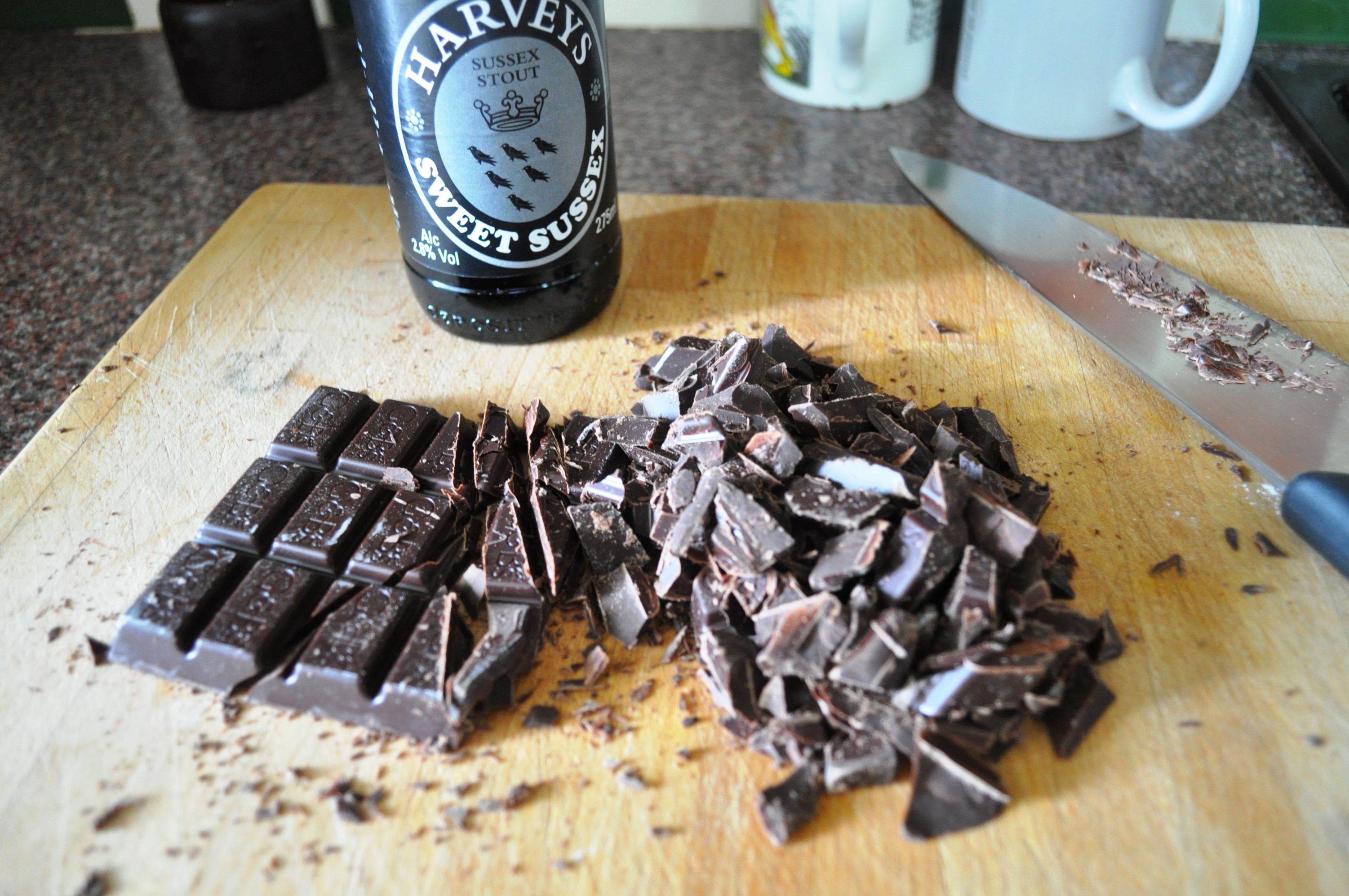
Sweet Sussex and chocolate

Today, 16 June, is Sussex Day. It’s probably not a festival many people celebrate – especially as it was only invented in 2006. Though it is based on the saints day of St Richard, patron of Sussex, the land of the south Saxons. Richard de Wych was a 12th century bishop of Chichester, now the county town of West Sussex. I’m over here in Lewes, the county town of East Sussex. The historic county of Sussex, based on the ancient kingdom of the south Saxons, was divided into two modern, administrative counties in the 1860s. Chichester and Lewes are very different, notably because the former is a cathedral city of about 24,000 people, while Lewes only has about 14,000 people, and the only “cathedral” is Harveys brewery.

Later on today I plan to head down to Harveys and check out the new St Richard’s Ale, which they’re launching on Sussex Day, but in the meantime, here’s recipe made using another Harveys, county-themed ale: Sweet Sussex.

Ye olde stout vs porter
On the label and site, Harveys says Sweet Sussex is a “lush, sweet stout named after the county in which it is brewed.” It has an ABV of just 2.8%, which raises the interesting question of what truly defines a stout. Well, in linguistic terms “stout” originally meant proud, brave and courageous, but this segued into meaning physically strong, well built. As a description of people it evolved again to start meaning bulking, then fat, but in beer terms it stuck with strong. Specifically it was used to describe strong porter, the type of beer that emerged in London in the 18th century as a refreshing, nutritious, fortifying drink of hardworking porters

Dark brown or black ales, porters were made with well roasted malts, which lent them a sweet, charcoally flavour. Eventually, the term “stout porter” shifted again, with stout becoming its own town for a rich, dark ale – though not necessarily a strong one. Indeed, today, the terms stout and porter are fairly interchangeable.

Sussex Sweet may be called a stout, but it’s certainly not stout in the sense of strong. Indeed, it’s so weak, compared to those old historic stout porters which will have been 8% ABV or so, that it’s more defined by its sweetness. It’s almost like a kind of charcoal milkshake. And just the thought of thing that goes well with dark chocolate.

Muffin

Muffins vs cupcakes
I wanted to bake something chocolaty yesterday, but didn’t want something as rich as a full-on cake (like I made here with dark ale) or iced cupcakes, so I made some muffins instead. Like stout and porter, the terms muffin and cupcake have slightly blurred meanings, though broadly I’d say a muffin contained less sugar, less butter, and were broadly a tad healthier. A lot of muffins, of course, contain bran, or fruit, or are even savoury. These ones are only vaguely sweet, and have a hint of that charcoally flavour from the beer.

20g cocoa
230g self-raising flour
1 teaspoon baking powder
50g butter, melted and cooled slightly
70g sugar (I used caster, but you could use a dark muscovado say)
150g dark chocolate (at least 65% cocoa solids), coarsely chopped
2 eggs, lightly beaten
250g Sweet Sussex or other stout or porter, or a mixture of stout or porter and milk

1. Preheat the oven to 200C.

Light cacao
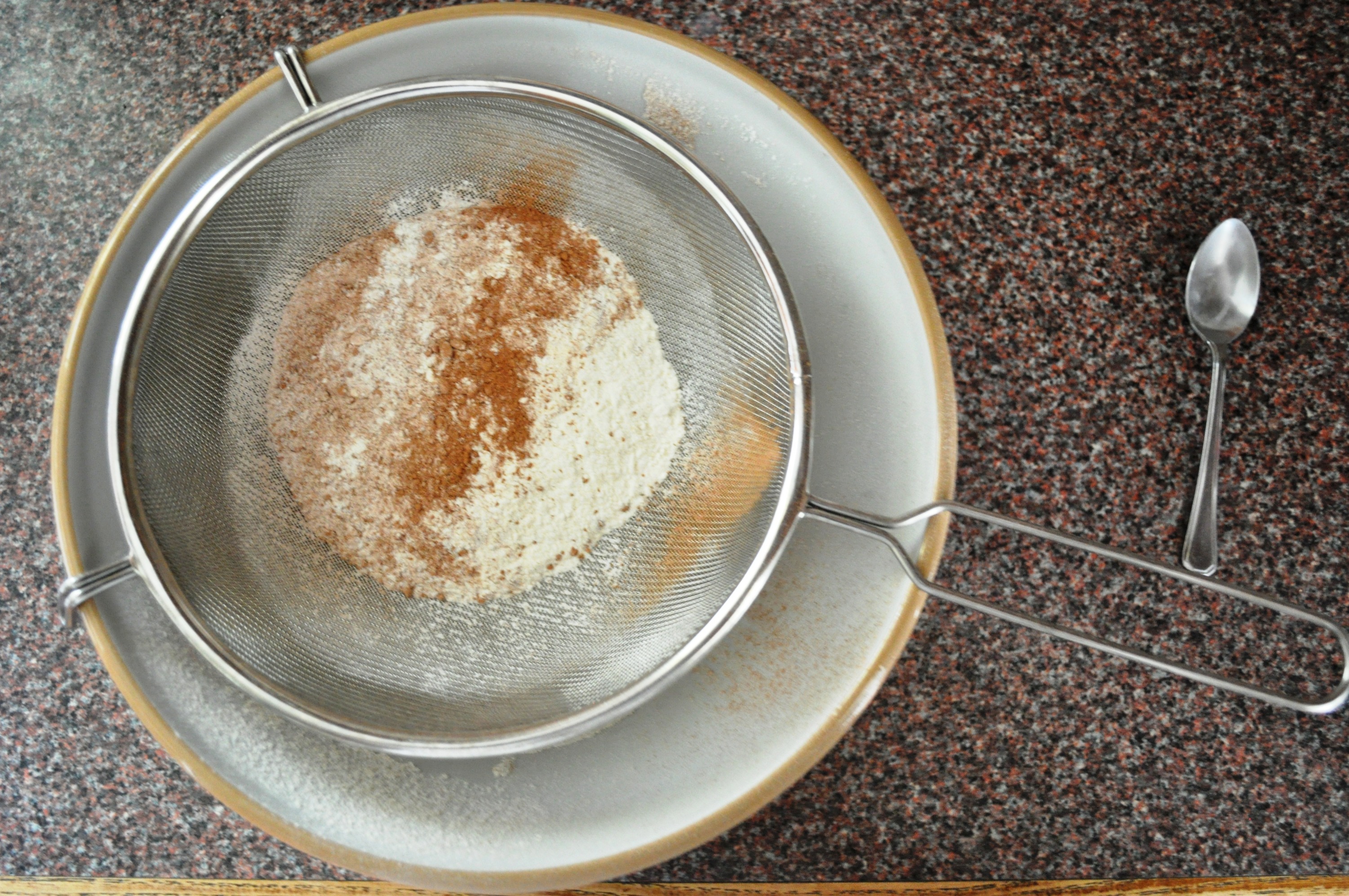
2. Sieve the cocoa, flour and baking powder into a bowl.
3. Stir in the sugar and chocolate chips.
4. Add the eggs, vanilla and beer, or beer and milk mix, along with the melted butter, to the flour mix.
5. Beat to combine.
6. Fill about a dozen muffin cases and bake for about 25 minutes.
7. Cool and enjoy, with a cuppa or perhaps with a stout. Or porter.

Muffins, baked

A note on the cocoa
There’s only a little bit of cocoa in here, but I was also using a very light-coloured type of cocoa powder, hence the results aren’t very dark. This cocoa powder I’m using is actually the Raw Chocolate Company’s Raw (organic, Fairtade, thoroughly right-on) Cacao Powder. See here for more info.

Cocoa? Cacao? Whaʼ? Don’t worry about the difference. There isn’t really one. The English word cocoa is basically a synonym for the cacao, with Theobroma cacao the scientific name for the tree that yields the beans that produce those all-important chocolate products, with “cacao” coming from the Mayan and Mesoamerican language word for the tree and “Theobroma” from the Greek for “food of the gods”. Beer and chocolate – both worthy of that name I’d say.

2 Comments

Filed under Ale, beer, Baking, Cakes, Recipes

A bike ride, “gluten-free” cake, X-Men and orchids. Lots of orchids

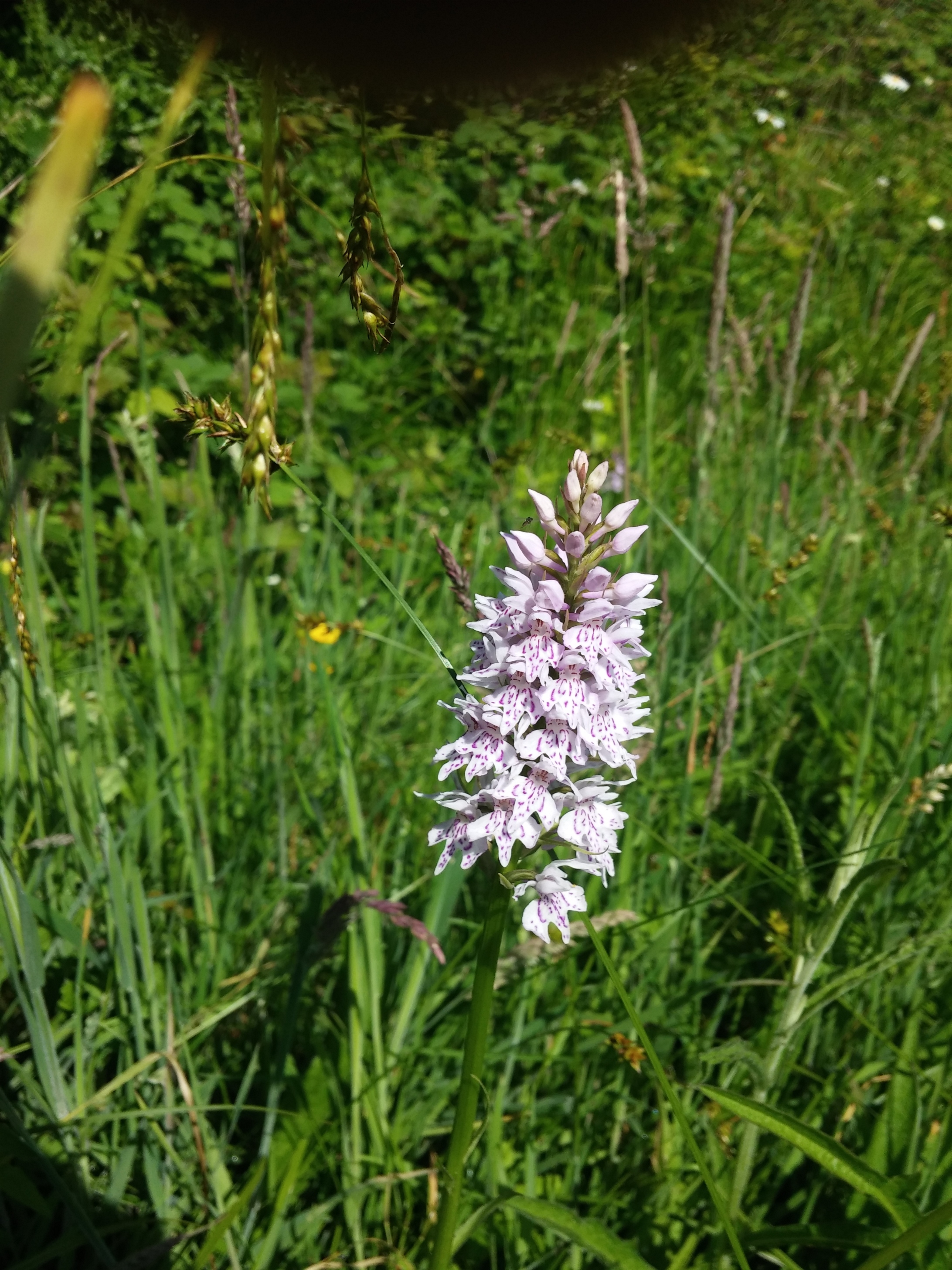
Bank of orchids near Lewes

One of the things that bugs me about the whole anti-gluten issue is that bakeries are induced to label products as “gluten free” even if they’re traditional types of cake or biscuit that have always been made without wheat flour. It’s not like these things have just been invented to cash in on a food fad / epidemic of wheat-related health issues. Think things like the classic sachertorte, its south Italian cousin torta caprese, various Sicilian almond paste delights. Never mind other things made up by celeb chefs more recently, like this lovely citrus polenta cake that’s based on a Nigel Slater recipe.

I adore cakes based on ground nuts or featuring alternatives to wheat flour, like polenta, which is maize, Zea mays, or what Americans call corn (when I was growing up we still used the word corn in the old English sense as a generic term for cereal grain). Maize, being a cereal plant and a member of the Poaceae (grass) family does contain proteins related to those that people have issues with in wheat, which specifically contains gliadin, one of the proteins that forms “gluten”. I also enjoy things made with other non-cereal flours like potato and buckwheat, which isn’t a Poaceae cereal or grain, it’s the seed of a member of the rhubarb, sorrel family and Japanese knotweed family, Polygonaceae. They can create all sorts of interesting textures and moistness. But sometimes you just need wheat.

More orchids

So anyway, today I took a quick jaunt on my bike from home in Lewes up to Uckfield, about nine miles away. Not exatly being overburdened with employment at the moment, I don’t have any excuses to not keep relatively fit. I was also toying with the idea of catching a matinee of X-Men Days of Future Past. As a former film critic, sometime comics journalist and increasingly reluctant comics collector (that stuff is just so heavy!), I was keen to see it, especially as the original comic storyline the film is loosely inspired by, first published in 1981 and created by Chris Claremont, John Byrne and Terry Austin, is an utter classic.

While in Uckfield, I checked out Hartfields Produce Store. It’s a cool little place with the right attitude – “a small independant produce store and cafe based in Uckfield. Our aim is to provide great, fresh food, locally sourced wherever possible and always full of flavour!” [Sic] As I love the aforementioned ground nut-based cakes I had to try their chocolate and almond torta, despite it carrying the now-essential sign declaring its gluten-free status.

I know this shouldn’t rile me, but I’m a baker, and wheat is the backbone of baking. I’m a firm believer that many people wouldn’t suffer their wheat-related issues if they ate properly fermented bread, and avoided any and all shit industrial wheat-based products, that are made in a rush without sufficient fermentation. I touched on the evils of the Chorleywood (so-called) Bread Process here, but also went into more detail about this subject here. So I won’t rehash here. Suffice to say, I don’t consider industrial wheat-based products fit for human consumption. And frankly, I wouldn’t feed white sliced “bread” to my pigs or chooks (if I had any).

Hartfields chocolate almond torta

Anyway, back to Hartfields. In total, my bike-ride apparently burned 697 calories – presumably kcals – according to Strava. I know nothing about the calories (ie kcals) in food, as I’ve always tried to have a sensible attitude to food and fitness, and not get hung up, but I’m guessing there were at least half the number of kcals I burned on the ride in the slice. But you know, that’s why I cycle and walk regularly – so I can enjoy cake. And this was great cake. Bravo Hartfields.

After the cake, I stopped by the cinema to discover it was a parents-and-babies matinee, so as I didn’t fancy earnest X-dialogue combined with potential squalling, and as it was a nice day, I headed home. Into a terrible headwind on the final five miles heading south down the Ouse river valley on the A26. But that’s fine – the whole stretch was utterly littered with orchids, with some patches of dozens, even hundreds. I’ll have to check with my brother, who’s the family expert on such things, but I believe they were common spotted orchids (Dactylorhiza fuchsii), in varying shades of pale pink through to a darker almost-purple, some of them up to half a metre tall. Wonderful.

Orchid

Info
Hartfields Produce Store, 71 High Street, Uckfield TN22 1AP

1 Comment

Filed under Bakeries, Cakes

Lardy Johns and the simple pleasures of pig fat-based baked goods

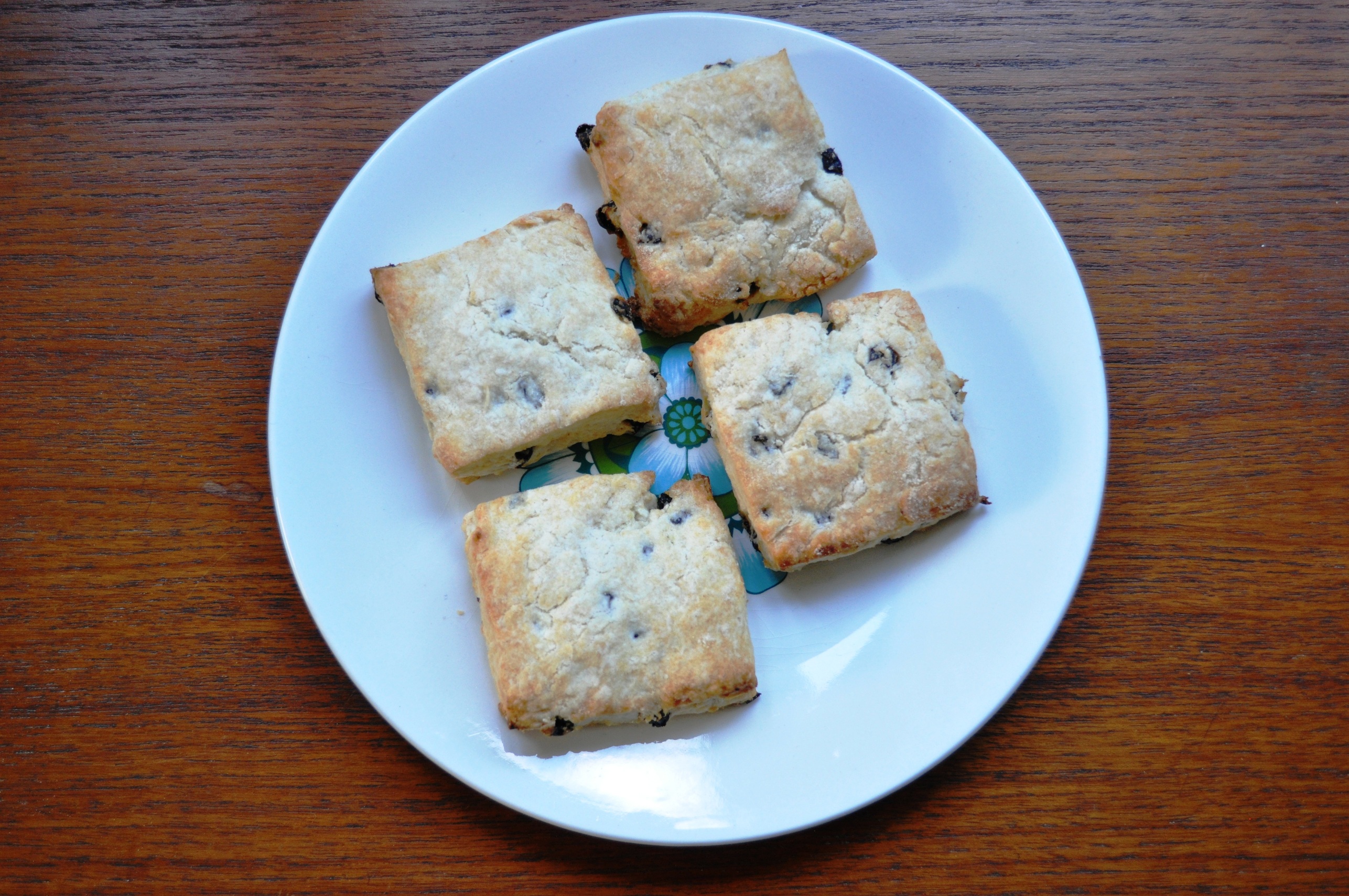
Johns on plate

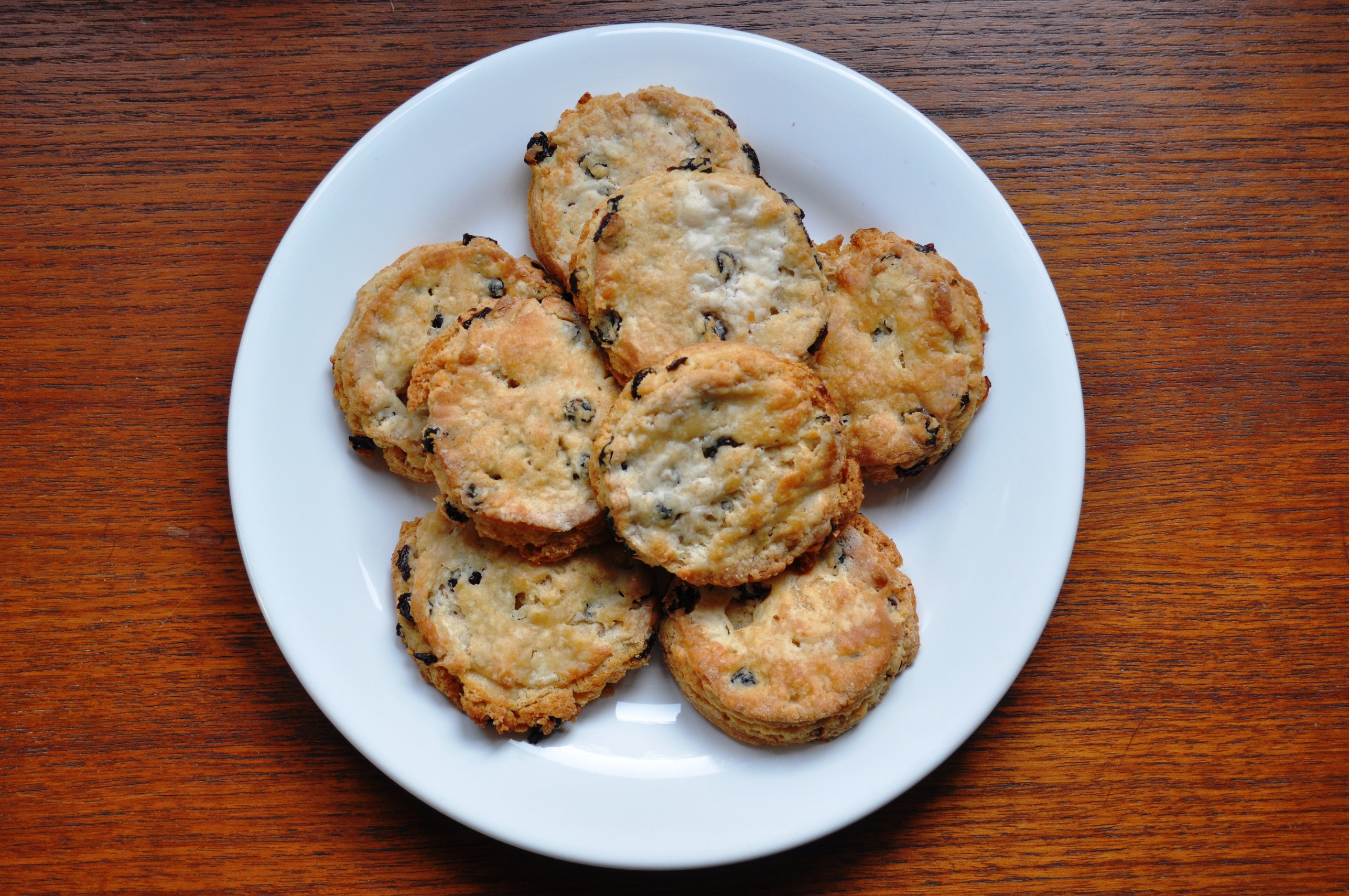
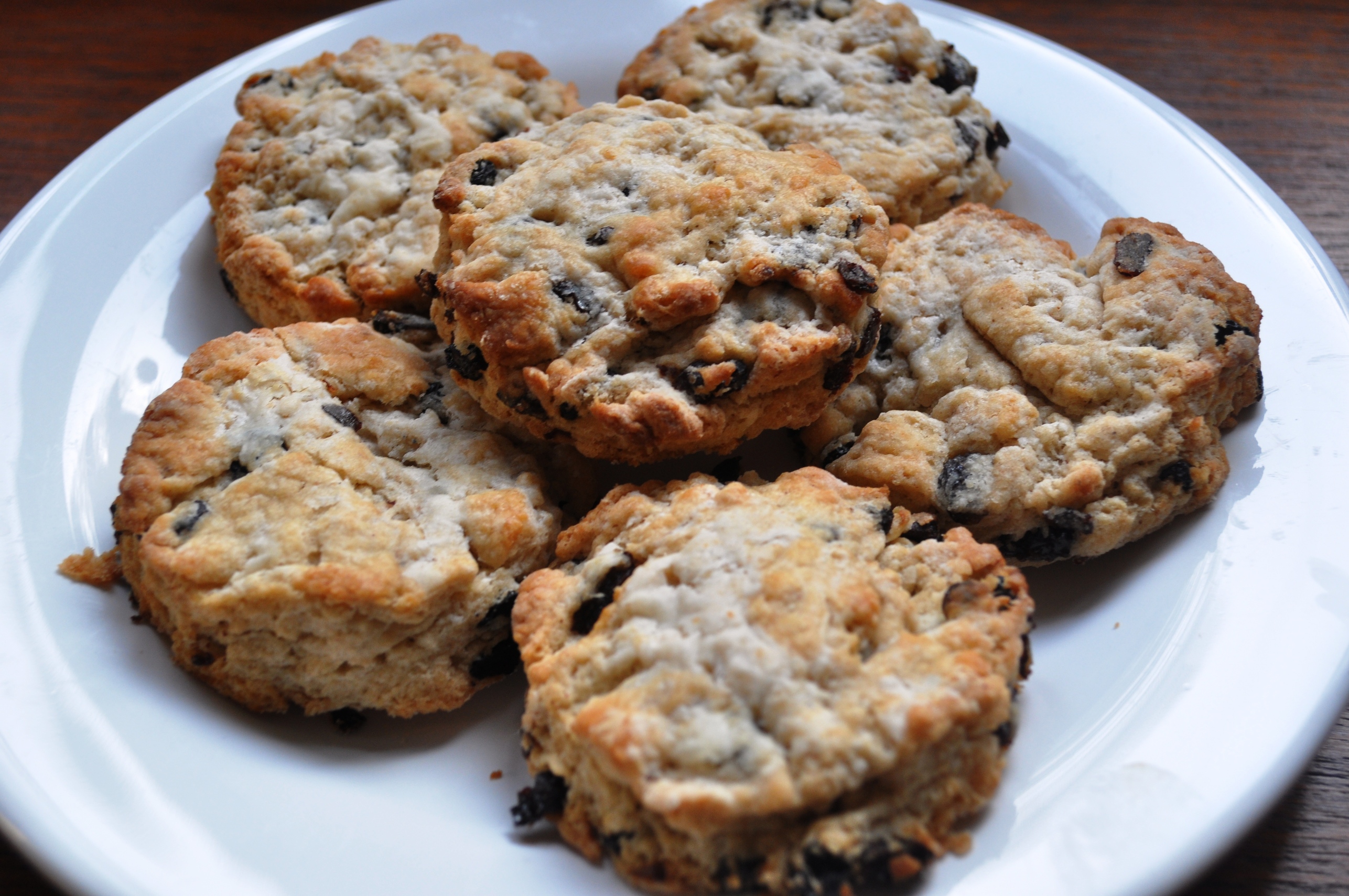
Here’s another traditional Sussex product that doesn’t really seem to exist any longer. Much like the Sussex plum heavies I did a month ago I’ve never seen the superbly named Lardy Johns in bakeries, and there’s very little information about them online. Also much like plum heavies they sit on the fruit pastry-scone spectrum and utilise that more old-fashioned baking fat: lard.

This recipe is from ‘Sussex Recipe Book With a few excursions into Kent’, a collection of traditional recipes by Margaret Samuelson, published in 1937. Some are her own or her family, many are gathered from interviews, while others are from 18th and 19th century sources.

The book doesn’t provide the source for the Lardy Johns recipe, which is given in the following wonderfully abrupt format: “Quarter pound flour, 2oz lard, 3/4 teaspoonful baking powder, 2 teaspoons sugar and a sprinkling of currants. Rub all together in your hands, and add enough water to make a stiff paste. Cut the paste into squares and bake for about 10 minutes.”

Putting that into a modern recipe format:
120g plain flour
3/4 t baking powder
60g lard
12g sugar
25g currants
40g water – more or less

1. Sieve together the flour and baking powder.
2. Cut the lard into small pieces and rub into the flour.
3. Add the sugar. I used granulated, but caster would be fine while Demerara or other brown sugar would give a slightly richer flavour.
4. Add the currants.

Lardy mixture
5. Bring the dough together with water. It’s 40g, more or less – what Italian recipes would put as “QB” – quanto basta, “how much is enough”.
6. Roll the dough out about 12mm (half inch) thick.

Unbaked
7. Cut into squares of about 50mm (2 inches). This recipe produced six, so if you want more double it.
8. Bake in an oven preheated to 200C for about 10 minutes, until lightly browned.

Baked
9. Eat warm, or let them cool, split and eat like scones (skohn, skon) with jam.

Scone-style

These really are very basic. Ten minute jobs. Simple fare from an era before fancy fats and flavourings. But they are surprisingly good. Slightly sweet, with a texture that’s light, slightly crisp and shorter than you’d get with a crumblier scone, which is likely made with butter and/or buttermilk.

And discuss
In ‘English Bread and Yeast Cookery’, Elizabeth David says, “If you cannot lay hands on pure pork lard, don’t attempt lardy cakes.” Well, I’m not sure of the purity of the stuff I’m use. It’s certainly not pure in a moral sense, being a product of the heinous industrial meat industry, something I try as much as possible not to engage with. But as I said in the heavies post, it seems almost impossible to source lard of good provenance. I’ve asked one of the meat purveyors on our local farmers’ market if she could do me some lard, so hopefully that’ll come through.

My vegetarian younger self 10 or 20 years ago would be horrified, but I’m enjoying these lard baking experiments – never mind the fact that products like these are a big part of the English culinary heritage. David suggests lardy cakes were traditionally made when people didn’t have their own stove and would bulk bake once a week. She explains, “… all the lardy cakes, the yeast dumplings, the buns and small cakes … were made from any extra dough not used for bead.” She goes on to say, “For these lovely cakes and rolls, lard is essential to achieve the proper texture, richness and weight. There is no such thing as a really light lardy cake.”

This suggests the Lardy Johns recipe from Samuelson is fairly modern,  developed from the yeast dough recipes with the advent of baking powder – a 19th century invention. Interestingly, the more common surviving members of the English lardy cake family are yeasted. Central and southern English counties like Hampshire and Wiltshire are associated with lardy cake, and the Wikipedia entry says lardy cake is found in “in several southern counties of England”. David, however, also gives a recipe for a Northumbrian version that neatly defenestrates that anonymous Wikipedia contributor’s theory.

I would hazard that lard, and a bit of sugar, and a few currants, when combined with a basic dough, would have been used by poorer folk throughout Britain to make a treat through from the early modern era to the mid-20th century, when intensification of farming made butter more cheaply available. They’re modest treats, sure, but compared to the absurdity of the cupcake, and suchlike contemporary middle-class obsessions, they have an assertive honesty and simplicity.

Leave a comment

Filed under Baking, Cakes, Cakes (yeasted)

Brazil nut, maple and white chocolate blondies

White chocolate maple Brazil nut blondies

If you’re a baking obsessive and have a bit of a sweet tooth, you’ll know that feeling when you just have to have something sweet and homemade in the house. Call it a sugar addiction, but I prefer to think of it as enthusiasm. (I’m not allowed to say I’m passionate about it though, as that’s Fran’s linguistic bugbear du jour.)

The other day, I was heading home, thinking, Damn, we’ve eaten all the last batch of cookies. I fancied something chocolately, and while some chocolate cookies are quick to knock out and conventional brownies are  easy to make (I normally use a no-nonsense Stephanie Alexander recipe I’ll post here one of these days), I thought I’d veer towards blondies instead.

For those who haven’t encountered them before, blondies are like brownies – a gooey, sweet, tray-bake – but are light in colour and flavoured more by the sugar (something rich like Demerara), and not by cocoa and dark chocolate.

White chocolate maple Brazil nut blondies

Here’s what I came up with.

75g unsalted butter
100g Demerara sugar
80g maple syrup
75g plain flour
1 t baking powder
2 eggs
1 t vanilla essence
100g brazil nuts
100g white chocolate

1. Preheat the oven 180C (160F fan).
2. Grease and line a square or rectangular baking tin. I used a 22cm square.
3. Melt together the butter and sugar, until the latter is starting to dissolve.
4. Add the maple syrup to the butter and sugar and remove from heat.
5. Sieve together the flour and baking powder.
6. Beat the sugar-butter mixture into the flour.
7. Beat the eggs and vanilla into the mixture.
8. Coarsely chop the nuts and white chocolate and stir into the mixture.
9. Pour the mixture into the baking tin and smooth.
10. Bake for about 20 minutes. As with brownies, you don’t want to over-bake blondies, you want them to retain some moisture and squidge. Exact cooking time will depend on your oven.


2 Comments

Filed under Baking, Cakes, Recipes

Sussex plum heavies

Sussex heavies, plum heavies

Seeing some Eccles cakes in Lewes got me thinking. Lewes, SE England, is a long way from the Eccles cake’s origins: Eccles, in Greater Manchester (and formerly Lancashire), NW England.

Why have these small cakes, made with flaky pastry and a currant filling, become commonplace in England when so many other traditional, regional products are virtually forgotten? After all, there’s nothing terribly unique about a product made with flour, sugar, fat and dried fruit. Indeed, other variables not unlike the Eccles cake include the Banbury cake* (Oxfordshire), the Chorley cake (Lancashire) and even the Cornish heavy, which has a distinctive criss-cross pattern on top. Furthermore, surely there’s a Sussex equivalent?

A quick Google lead me to Sussex heavies, aka (as I understand it) plum heavies. Which may once have been made with dried plums (prunes) but seem to have evolved into yet another variation the small curranty pastry-cake.

I’ve never seen these in a bakery, in Sussex or elsewhere. Maybe some places still make them, but I doubt it – a Google image search for “plum heavies” brought up one image when I wrote this, but that site has subsequently died. If they were more of them out there, I’m sure today’s baking enthusiast foodie bloggers would have posted more about them.

Fat and flour

Pastry archaeology
So investigating them is a form of archaeology. Reading about them and planning a recipe is like an archaeologist looking at bones and fabric scraps and trying to envisage what the person must have looked like. You can’t ever be sure, and any idea that what I’m doing here is “authentic” is a bit silly.

It’s particularly tricky in this case as there seem to be various different interpretations. Such diversity is not unusual with any traditional recipe of course, but quite often, as with Eccles cakes, the simple fact of their popularity, and their larger-scale production, means they have become more standardised.

Flour, fat, currants, sugar

Elizabeth David’s ‘English Bread and Yeast Cookery’ put me on to another book called  ‘Sussex Recipe Book, with a Few Excursions into Kent’ by MK Samuelson. Although originally published in 1937, I’ve acquired a 2005 reprint. It contains two different recipes, acquired from a pair of 1930s Sussex ladies, one for “Sussex plum heavies” and one for “Plum heavies”. The former is simply “dough”, lard, currants and brown sugar worked together and formed into buns. The latter is much more like a scone, with lard and butter rubbed into flour, with sugar and raisins added, and a dough formed with milk. They’re rolled, cut into rounds, brushed with milk and baked.

“You have got plum-heavies for tea”

Other information suggests heavies were snacks for outdoor workers like famers and shepherds, as well as for children. Recipewise says “they were also commonly given out at Halloween to trick or treaters”, but I’m dubious. Trick or treating wasn’t a widespread English activity before recent commercial cash-ins on the US tradition (though arguably that had its origins in Celtic culture).

Recipewise does quote another nice source though, an 1875 Lewes publication with the wonderfully Victorian title of ‘A dictionary of the Sussex dialect and collection of provincialisms in use in the county of Sussex’ by Rev.WD Parish, vicar of Selmeston, Sussex. The full text includes this definition of the plum heavy: “A small round cake made of pie-crust, with raisins or currants in it.” It also includes this anecdote: “Dr JC Sanger, of Seaford [Sussex], when Government Surgeon at the Cape of Good Hope, was sent for to see an English settler. Reaching the house at tea-time, he joined the family at their meal, and on sitting down to the table he said, ‘You come from Sussex.’ ‘ Yes,’ was the answer, ‘from Horse-mouncies (Hurstmonceux), but how did you know that?’ ‘Because you have got plum-heavies for tea,’ said the doctor, ‘which I never saw but when I have been visiting in Sussex.'” (p88).

Sussex heavies, plum heavies

Anyway, all sources online agree they were called heavies as they were dense concoctions made with plain flour, quite possibly in the form of leftover scraps of pastry. In some modern recipes they’re more like a scone, in others more like an Eccles cake, with the paste given extra flakiness by the use of lard ­– a key cooking fat in traditional English baked goods, despite how out of fashion it may be now. I found a few recipes that even involved some basic lamination. So that’s what I’ve based mine on. And I’ve used self-raising flour, to make them slightly less heavy heavies.

Recipe

225g self-raising flour
1/4 t salt
85g lard
85g butter [170g fat, total]
100g currants
50g soft brown sugar
100g milk, QB
Beaten egg to glaze

Method
1. Sift together the flour and salt.
2. Cut the fats into small pieces, or even grate it coarsely.
3. Rub 50g of the fat into the flour.
4. Add the currants and sugar and, using a palette knife, bring together with milk. Don’t pour all the milk in at once – use just enough to combine. What Italian recipes call QB, quanto basta, “how much is enough”.
5. Turn out the dough onto a lightly floured surface and knead lightly. Like with pastry, if you overwork the dough, it’ll toughen up.
6. Form a rough slab and roll it out to form a rectangle about 30 by 12 cm.

Rolling out
7. Flake one-third of the remaining fat (40g) over the bottom two-thirds of the dough.

Adding fat
8. Fold the un-fatty top third down onto the fatty middle third, then fold the fatty bottom third up.

First fold
9. Rotate 90 degrees then roll out again to about the same size and repeat the process with another 40g of fat.

Second fold
10. Give it one final fold in the same way with the last 40g of fat.
11. Wrap the dough in plastic and leave to rest in the fridge of about 45 minutes. More won’t hurt.
12. Preheat the oven to 200C (180C fan).
13. Roll out the dough about 6mm thick
14. Cut out 6.5cm rounds. (Or whatever size round cutter you have. This is all I could find. Lost loads of kitchen stuff in our double house move, including a large portion of Fran’s cookie cutter collection. *weep*.)

Cutting rounds
15. Place on baking sheets (greased or lined with parchment) and brush with beaten egg. Or milk, which is easier.

Before baking
16. Gather the scraps and roll out again. Cut more rounds, until you’ve used all the dough.
17. Bake for about 15 minutes, or until a nice golden brown.

Baked
18. Cool on a wire rack.

This recipe, with a 6.5cm cutter, produced about 14 rounds, then another 8 or so from the scraps. The ones made from the scraps rerolled have a slightly different consistency. The first rolling retains the lamination, but recombining then re-rolling the scraps mean it will be shredded. These ones, however, are probably more like the historical Victorian Sussex heavies, simply made with pastry scraps, some fruit and a sprinkle of sugar. Both are yummy, short, flaky and not too sweet.

Sussex heavies

A very enjoyable bit of food archaeology. Now I just wish some 90-year-old Sussex native would see this and reply with a description of the real things they ate as kids.


* The April 2014 issue of ‘Great British Food’ magazine has this intriguing story: “It’s possible that the recipe for Banbury cakes was brought to England by crusaders in the 12th century – a similar type of cake is known to have existed in Syria at the time, and the soldiers would have been able to acquire dried fruit and spices at a reasonable prices.” It’s a credible theory, as Midle Eastern delights like baklava and ma’amoul are in the same broad family of sweet-pastries-filled-with-dried-fruits-and-nuts. As are fig rolls, an industrialised incarnations of an (ancient) Egyptian pastry.

14 Comments

Filed under Cakes, Recipes

High tea, post-colonial-style, at Raffles, Singapore

View of Raffles
Last time we visited Singapore, we were arriving from India, barely recovered from a nasty dose of food poisoning garnered in the picturesque squalor of Kerala’s backwaters and were so relieved to be in this generally clean, orderly city with its reliable food hygiene. This time round we were coming from amiable, underpopulated New Zealand. We did frequent one food hall in Auckland for a bit of Asian food, but Singapore really is an amazing place for such affairs, known here as hawker centres.

I love hawker centres. For a few dollars and you can indulge in all sorts of Asian goodies – predominantly representing Singapore’s mix of Chinese, Malay and South Asian/Indian ethnic groups, but also Indonesian, Japanese, Thai and more.

Singapore really is an amazing food city.

Not that it’s all about the hawker centres though. The city boasts eating options in all price categories and styles. Indeed, our first morning we had breakfast in a place called Prego, which was a pizzeria by night and had walls covered in Italian sayings (such as “A tavola non si invecchia” – at the table, one doesn’t age). Elsewhere are fancy cake shops, restaurants with French or American-trained chefs, fusion places, and a gazillion other eateries tucked away in the endless malls, quaysides, hotels and science fiction developments. (Wandering around the Marina and some of the malls was like being in the sets for Logan’s Run or THX-1138, and entering the Marina Bay Sands – a trio of skyscrapers with what looks like a giant ship laid across the top – gave me a flashback to playing Halo 3 ODST.)

Then of course there’s the colonial heritage. Which of course means Raffles.

Raffles Tiffin Room

Named after Sir Thomas Stamford Raffles (1781-1826), the founder of Singapore, Raffles is the quintessential 19th century remnant of the British Empire’s endeavours in Southeast Asia. It started life as a modest harbour-side bungalow in 1887 then went on to expand into an array of white, colonnaded, neoclassical buildings that seem to cover at least an acre and, miraculously in a city of thrusting capitalistic redevelopment, managed to survive the wrecking ball purges of the 20th century.

We’d had discussions with various friends about visiting this place, but the fact that we were in a room in a modern hotel across the road, overlooking the Raffles complex, decided us that we just had to go, despite the costs. But would it be? A bar? Which bar? An evening Singapore Sling? No – it had to be high tea in the Tiffin Room.

Raffles Xmas cakes w Santa

I love afternoon tea and high tea. It’s my favourite form of party (okay, when it sprawls into the evening and some boozing that’s even better). I love to make cakes, scones and biscuits. We’ve had afternoon tea at various venues over the years, but this had to be the most storied. And certainly the most expensive. The Raffles cake stand and buffets set us back way more than the combined cost of all our other Singapore meals put together. They’d even bumped up the price about 30 per cent to celebrate Christmas. Yay.

And although the food itself wasn’t exactly the most refined – there were no fine pastries, no choux, no macaroons – it was still lovely. What you were really paying for was the venue – a beautiful high-ceilinged room – and the service – dozens of staff moving between the tables, removing your used plates to make room for another trip to the buffet, topping up your teacup so you end up consuming litres, and generally being very courteous. If slightly haphazard with their info – our first guy got his scones and mince pies mixed up, called marzipan “cookies” and flapjack “fruitcake”.

It was all good fun, though I had to restrain myself from starting to refer to the staff as “My good man” and wishing people a “Frightfully good Christmas.”

Anyway, we started with a cake rack, with white sliced bread triangular cucumber, salmon, egg etc sandwiches, crusts removed of course, mince pies (nice crusty pastry, mild mincemeat) and a white chocolate high-heeled shoe, dyed red, and filled with brandy flavoured whipped cream. Oookay. This latter didn’t seem so popular with the other diners; I felt kinda sorry for whoever laboured over them in the kitchen.

Then there were several buffets – one with dim sum, one with an array of cakes and scones, one with fruit, and even one with a variety of iced teas.

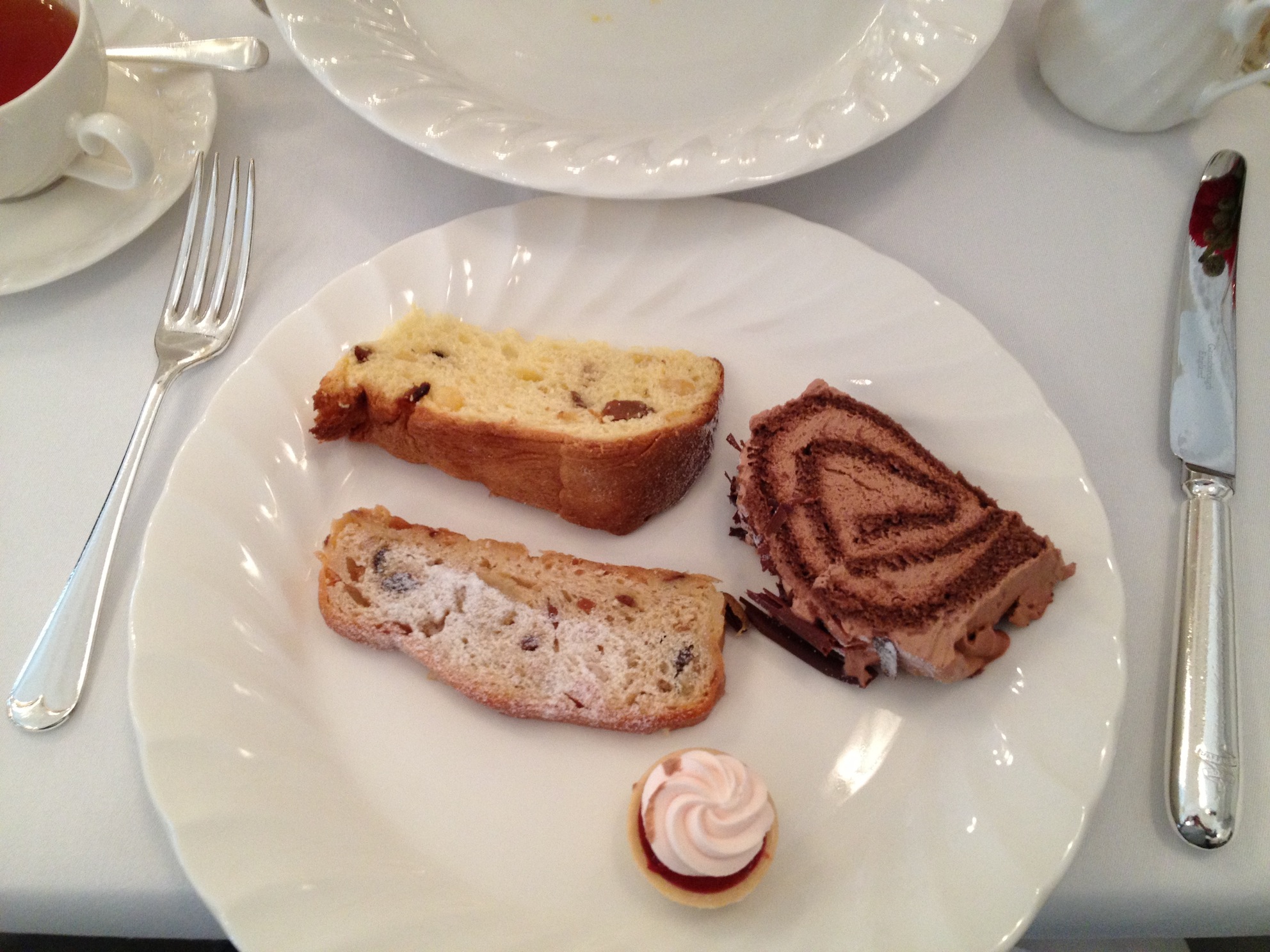
Stollen, panettone, yule log at Raffle Christmas high tea

I enjoyed being able to fill up a plate with various national Christmas cakes – panettone, stollen and chocolate yule log. Fran favoured a white chocolate, rose, guava and champagne log thing. The stollen’s label had migrated several metres to the right, somehow, to beside a bowl of cream – clotted cream! Miraculous. A scone with clotted cream on the Malay Peninsula at Christmastime.
The German marzipan-filled enriched bread even inspired me to create this Christmas-cracker-worthy joke: “Where did you buy your German Christmas cake?” “I didn’t, it’s stollen.”

Too much tea perhaps…

What a fab experience.

They even had a harpist playing ‘Greensleeves’, ‘Parsley, Sage, Rosemary and Thyme,’ and ‘Here, There and Everywhere’.

The only real disappointment was the fact that they have a dress code – smart casual, shirts with collars etc – but don’t enforce it enough. Call me a snob, but spending all that money, and enjoying the opportunity to dress up a bit (as much as possible when one’s lived out of a backpack for two months), it was a bit shoddy to have people in jeans, T-shirts and trainers sitting nearby. Come on Raffles – standards! Standards!

3 Comments

Filed under Cakes, Restaurants etc, Travelling

The long way round to whitebait pizza

Whitebait pizza

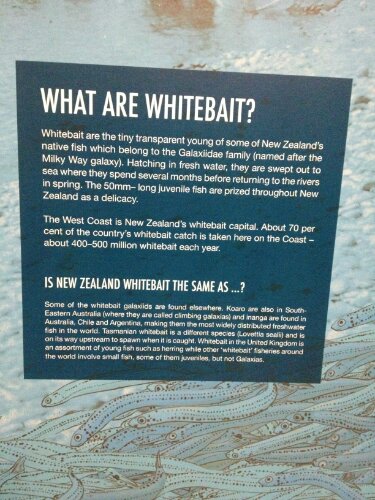
Whitebait fritter is a classic NZ dish. In the season – or all year round if you catch enough and freeze them – whitebait is mixed with egg and fried up like a fishy omelette. Done well, it’s delicious. Done badly, well, it’s a bit of a pointless slaughter of many little fishies. And added to a pizza, well that’s a whole different story, and one we encountered this evening.

This morning, we left Mount Cook/Aoraki and headed for the South Island’s wild and woolly West Coast. Although Mount Cook is only about 50km from the coast as the crow flies, by combustion engine it’s more like 500km plus.

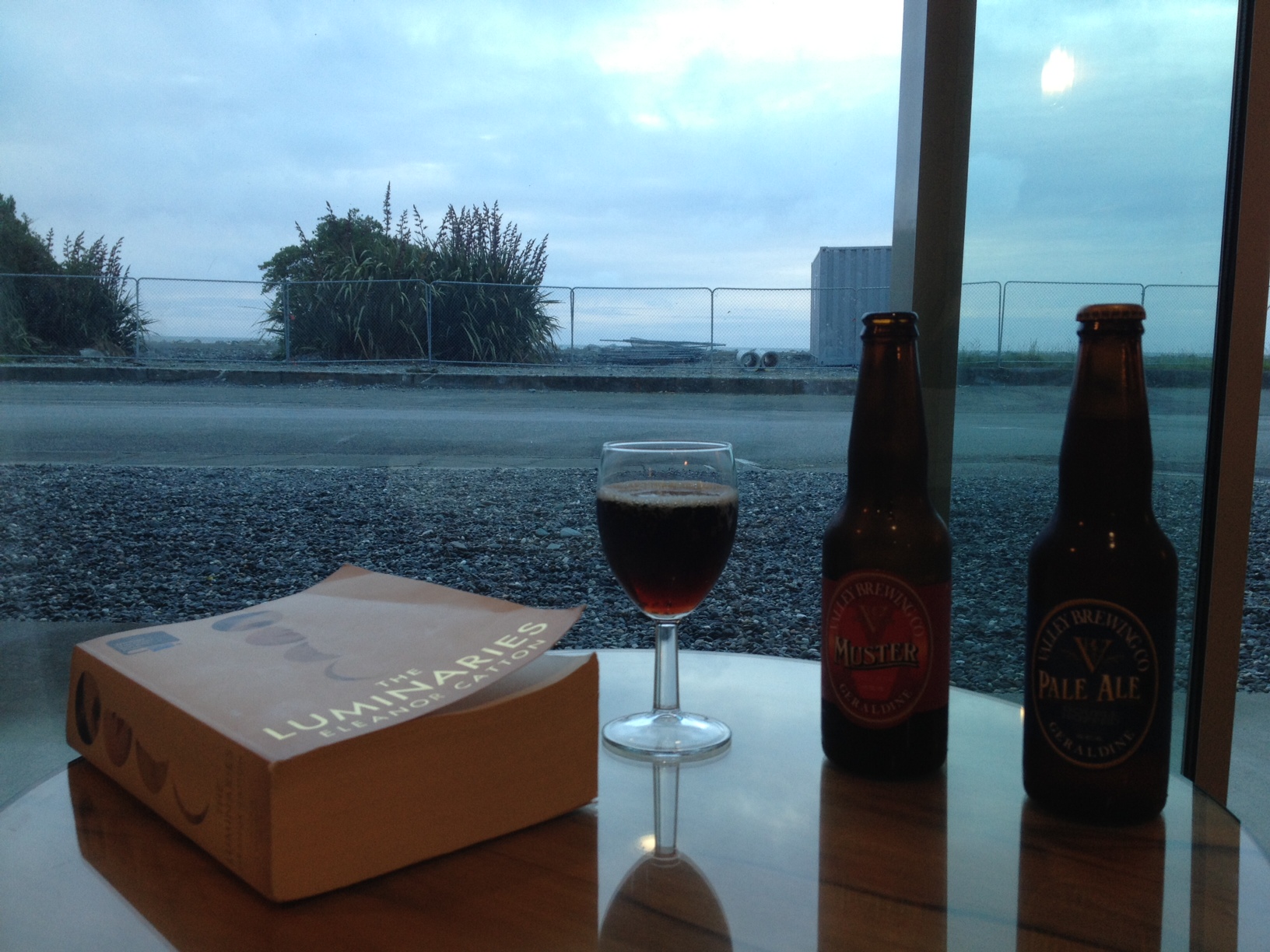
Cars can’t really manage the bloody great glaciated mountain range, you see. You have to drive all the way out from Mount Cook Village’s dead end highway, then east, then northeast towards Christchurch, then finally northwest and west over Arthur’s Pass, an impressive route that saddles at 920m. Alternatively, we’d have had to backtrack to Wanaka in the south, then loop up north over the Haast Pass. Either way is a mission. But Fran was determined to go to Hokitika – she’s reading Eleanor Catton’s award-winning, 832 page novel The Luminaries, which is set in this West Coast town in its 1860s gold-rush days.

Luminaries and beer

It was a great journey though. We left our hostel, visited one last, epic glacier (Tasman), then drove out along the massive glaciated valley, past bright blue lakes, hydro projects, and onto the Canterbury Plains, along very English, or even French, avenues of poplars, oaks and willows. Through alpine tussock grasslands, past the incredible rock formations of Flock Hill and Kura Tawhiti, aptly named Castle Hill in English, past various ski areas, and then we got back to some areas that hadn’t been deforested for sheep stations.

Arthur’s Pass, and the descent toward the West Coast is precipitous in places, an amazing route, surrounded by peaks and native forest, frequently by keas (NZ’s unique alpine parrot) but not always entirely fun when the inevitable speeding local in a 4WD tries to chase you at 100kmh around every sharp bend marked with a 45kmh sign.

Pinwheel and citrus slice in Geraldine

En route, we stopped at Geraldine, famed for a Bayeux Tapestry replica made with sewing machine needles (or somesuch). We didn’t check it out, concerned about our timing, but did eat a few idiosyncratic Kiwi snacks like a pinwheel, a savoury bun stuffed with cream cheese and red pepper, and citrus slice, a kinda of granola bar whose health benefits were undone by a thick layer of lemony icing. We also bought a few beers from the nearby Valley Brewing Co, a double hopped Pale Ale and Muster Red Ale (“Local barley and Nelson hops”), which we’re enjoying now.

The culinary highlight of the day, and indeed of the last week, however, was the abovementioned whitebait pizza. Rome’s renowned pizzaiolo Gabriele Bonci has opened my eyes to new levels of pizza inventiveness (with seasonal delights like Brussels’ sprouts and mortadella) but even he didn’t prepare me for this.

Fat Pipi Pizza

The venue was Hokitika’s Fat Pipi Pizza, and this is their signature dish. The full 26 inch version supposedly includes a quarter pound (114g) of whitebait. I had the slightly more modest 20 inch, which still featured a serious amount of whitebait fritter, combined with mozzarella, capers and parsley, and served with lemon wedges. It was delicious. The capers and lemon cut through any fattiness from the cheese and egg, while the fish offered some slightly salty protein, care of the Hokitika River.

Tomorrow we plan to visit some of the remarkable old gold workings in the Hokitika Gorge, but in the meantime, we’re enjoying sitting in a hotel room, digesting pizza and feeling vaguely threatened by the sea. The room was going cheap, as recent storms have been trying to scour away the beach, and by extension the town, and apparently we’ll be woken by diggers working at low tide tomorrow morning trying to shore the place up. No matter, it’s still a delight to be listening to the waves a mere 20m away, and watching a line of sunset brightness slicing through the grey cloud.

Addendum
Whitebait is a big deal in Hoki. The town’s history museum dedicates about a third of its space to whitebait, including a lot of blurb from Booker-winning author Keri Hulme (The Bone People), who says “she’s not particularly serious about anything except whitebaiting.”
image


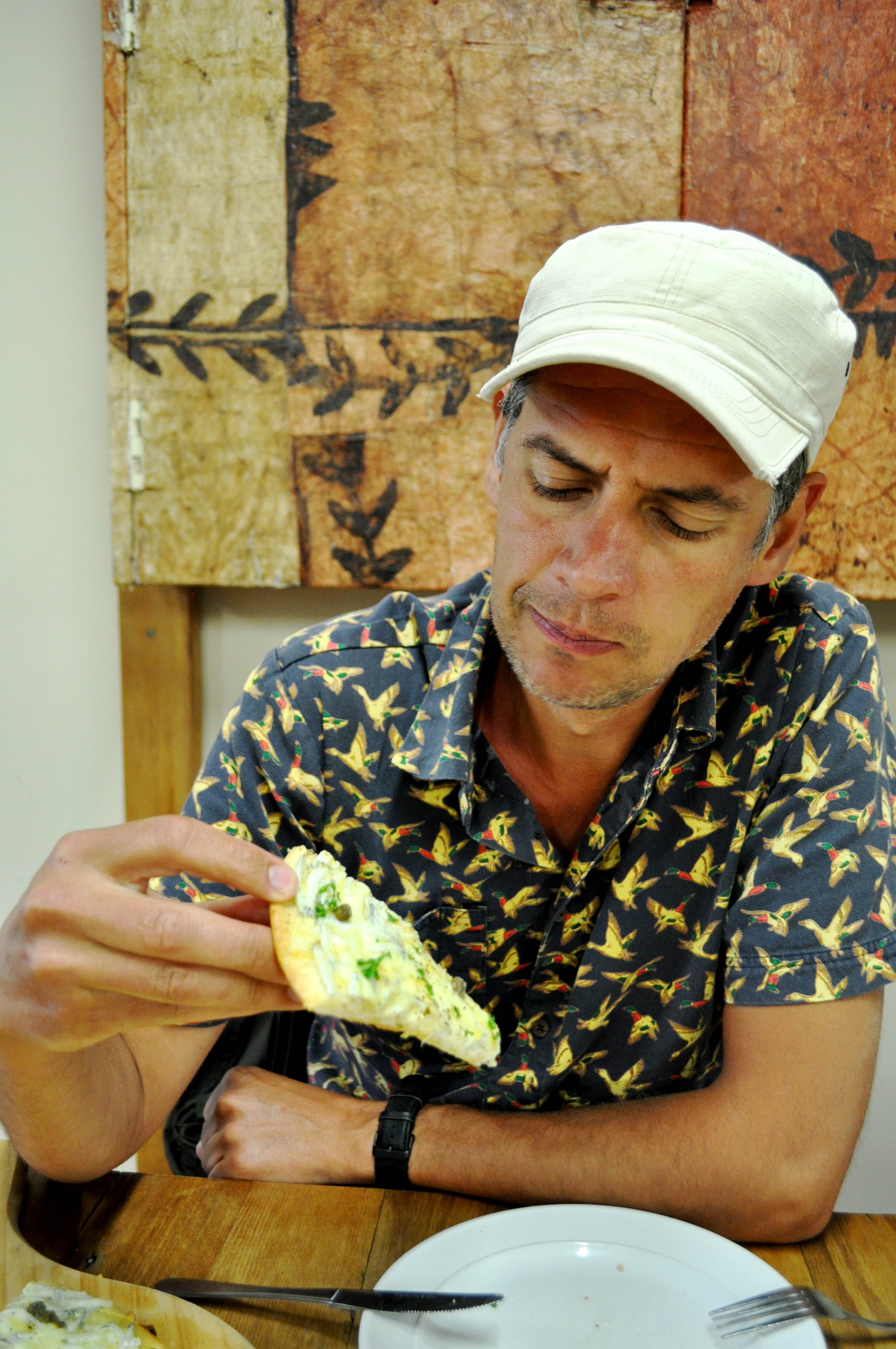
Oh, and months later, after Fran had finally had a chance to look at her pics, I found this. I don’t look quite convinced at this point:

Whitebait pizza


5 Comments

Filed under Cakes, New Zealand beer, Pizza, Travelling

A British Captain America tea party

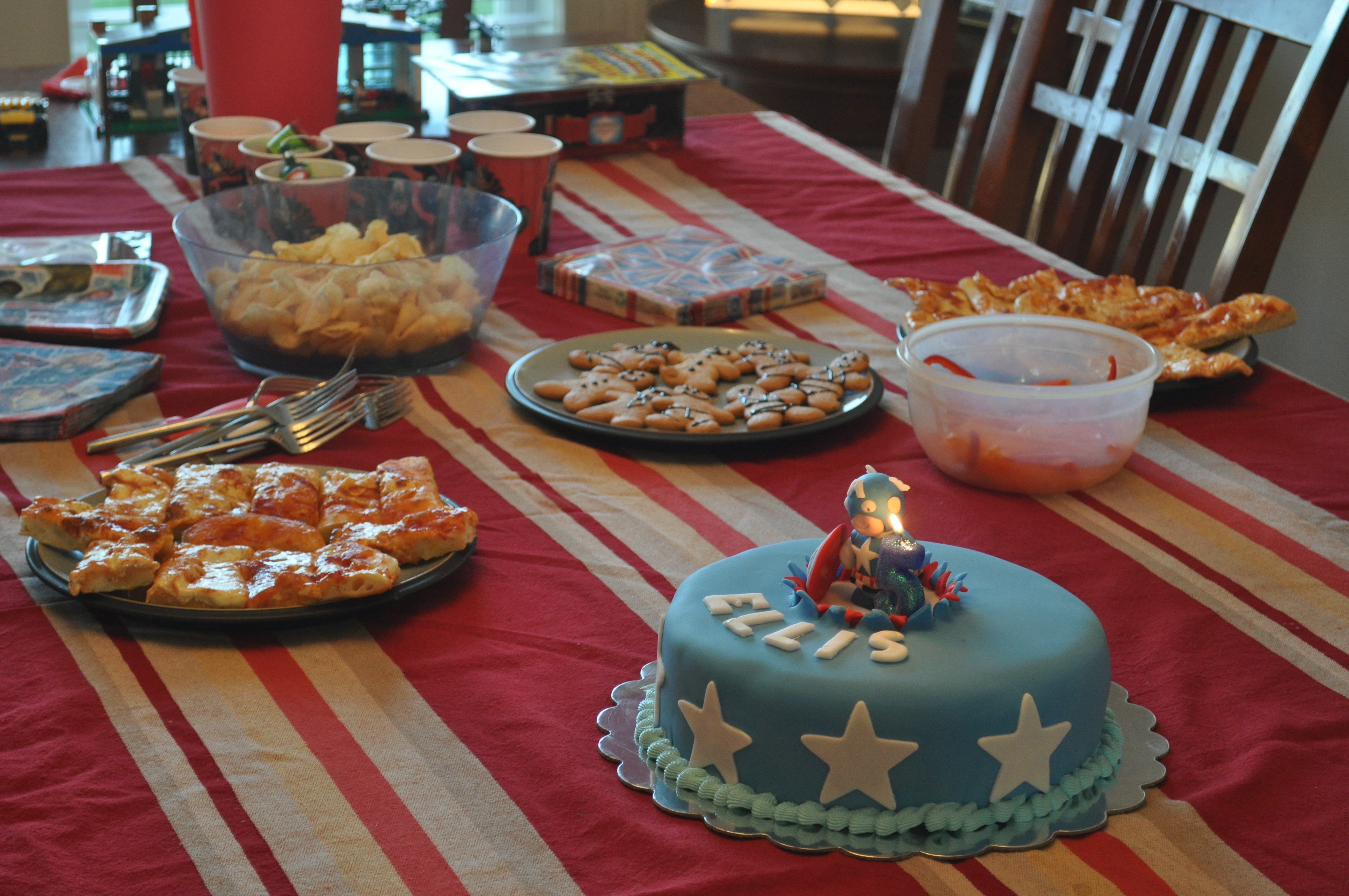
Spread, lit candle

Our young nephew Ellis turned five on Monday. He’s a little bit obsessed with superheroes, particularly Captain America. He spends a lot of time in a Captain America outfit. He must be the only Captain America with an English (/slightly Welsh/slightly midwestern) accent.

Although I’m really not a cake decorator, and I really really really don’t like artificial food colourings, I couldn’t say no when sister-in-law Sharon said we had to make Ellis a Captain America birthday cake. Especially as I’m a big comics geek.

Captain America sugar paste figure

This involved a late-night session making one of those cake-dec bobble head figures. It was a collaborative effort: I did the head and some trimmings, Sharon the body, Fran the shield. We were all quite pleased with it. Partly as it was fun to do, but partly as our Captain America is amusingly portly, like he’s retired and taken to the beer. Even his belt and the stripey part of his costume looked more like a girdle or corset. Oh, and we’d had a little booze too: the girls on local Missouri wine from Pirtle in the historic town of Weston, me on beer from Boulevard Brewing Co in Kansas City (which is also in Missouri, mostly).

Really enjoying their bottle-conditioned beers. (I’m drinking one now too.) Like the sound of the brewery too. “Boulevard’s mission is simple: to produce fresh, flavorful [sic] beers using the finest traditional ingredients and the best of both old and new brewing techniques.” That’s what I like to hear.

Slightly bemused that US beers seem to have to carry the government health warning but don’t have to include the ABV on the bottle though.

We’ve tried Boulevard’s Unfiltered Wheat Beer, which is 4.4% according to the site, and surprisingly mellow for a wheat beer. Apparently it’s also the “best-selling craft beer in the Midwest.” Their 5.5% Pale Ale, meanwhile, is also pretty mellow, but with a really well balanced hoppy tang and caramel maltiness. As for what I’m drinking now – not sure. The brother-in-law said the label came off after a session in the chilly bin/eski/cooler/cool box (delete according to nationality) and he can’t remember; and I can’t find it on the brewery site.

Covering cake

Anyway.

The cake. Although I can’t really eat coloured sugar paste, I made a nice chocolate cake underneath. I used one of my favourite recipes. It’s originally based on a cardamom cake by Mollie Katzen of Moosewood, but it’s such a great recipe it can be varied according to inclination and occasion. Here’s a metric version of the original US recipe on Cake-off, a site I used to do with my friend Jo. The chocolate version I did left out the nut mix, and replaced about 50g of the flour with cocoa. I also added some finely chopped dark chocolate. It’s such a good cake: dense but moist.

Ellis Capt America

For the party we also did some pizza. This was an interesting challenge, as was making a loaf of bread later on. Like when I first moved to Italy, I find myself in a country where the types of flour, and their packaging, are entirely unfamiliar. And here a lot of the flour is made with GM grain. At least a badge that indicates the non-GMO options seems to be a legal requirement.

Heidi pizza

A lot of the flour, sadly, is also bleached, and packed with gratuitous additives. Still, there’s also some organic available – even in the dreaded Walmart, that poster child for the problems of the industrialised food chain and a place I visited for the first time this week.

Perhaps more problematic in practical, rather than ethical, terms, however, was the way the packages labelled protein content – there was no percentage. So I really couldn’t get a great sense of what was a high protein bread flour. Still, Fran did a sterling job of making pizza dough… until we baked it and managed to totally burn the bottom of one. Our oven in Rome similarly had very fierce bottom heat, but Sharon was possibly even worse; never mind any confusion from being faced with ye olde daffy Fahrenheit after years of using nice sane Celsius.

Still, it all went off well. The cake was a hit with Ellis and the kids; the (unburnt) pizza was avidly consumed, with several of the other ex-pats here being very appreciative of a freshly baked bread product; and me and Sharon even managed to make a decent wholewheat tin loaf too.

Oh cripes. Another rambly post. I’m sorry. I’m not sure I’ll get any structure or succinctness back into this site until I’m settled back in England at the end of the year…

7 Comments

Filed under Cakes, Misc, Pizza

Ugly bread, pastries, lunch at L’Asino d’Oro, outer space and saucy suppli

Last loaf

The storms – apparently called Cyclone Penelope ­– arrived last night, rumbling over Roma and shaking our palazzo. I love being indoors, in bed, on such nights. Frequently in Rome, the stormy weather has the decency to blow over by the morning. Not so this morning though, when it was still raining buckets, piove a catinelle (where a catinella is a basin; I love the image of rain pouring down as if it’s overflowing celestial basins).

It looks like the Autumnal rain is settling in until we leave on Wednesday. In a way that’s just perfect – it’s re-acclimatising us to British weather. But it does look like yesterday was our last day that was dry enough for a long, casual, umbrella-less wander around town.

We started the day with a slice of bread – from the final loaf I’ll be baking in Rome. This was a bit of a disaster, but it was fun. It was a “using up leftover stuff before we leave loaf”. In this case meant a lot of seeds: specifically buckwheat, sunflower and poppy; and a some not-entirely ideal flour: 0 grano tenero (okay, fine), rice and amido di mais. The latter is what we’d call cornflour in the UK, meaning corn (maize) starch, so more a thickening agent than a bread ingredient. Hi ho. It felt like a good dough when I added the seeds, but went strange after that.

Adding seeds

As Fran pointed out, the resulting loaf looked like a giant brutti ma buoni  (“ugly but good”) cookie. It was pretty solid and, er, I might have forgotten to add any salt. But that’s fine: a lot of traditional bread from Tuscany and Umbria doesn’t contain salt, and as such is good for strongly flavoured bruschette. Not sure the seedy stuff will work as bruschette, but it’s good with good old Marmite.

We headed out down the hill, through Trastevere, past the enjoyable window displays of vintage pasticceria Valzani. This included their selection of “tea biscuits”:
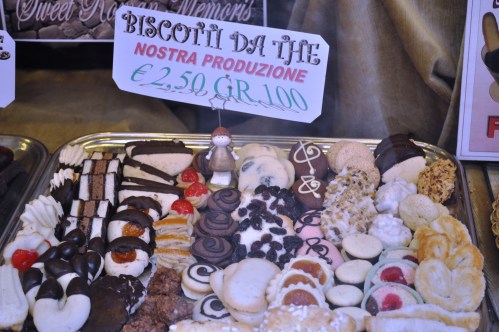
Valzani tea biscuits

Then slices of pangiallo romano, which literally means “yellow bread” and is a type of hard Roman  Christmas cake, made with honey, nuts and dried fruit; and panpepato (aka pampepato), a similar cake that originates from central Italy and, as well as containing dried fruits, candied fruit and nuts also contains spices like cinnamon and nutmeg, and even chocolate.

Pangiallo, panpepato at Valzani

Then the Roman version of the Campania sfogliatella, which look kinda squashed compared to the more refined Neopolitan sfogliatella riccia. Indeed, compared to say French patisserie, Roman patisserie often has this seemingly crude finish – but I like that, it’s less poncey. Alongside was a tray of cannoli siciliani, then a tray of maritozzi, Rome’s epic cream buns, which I made over here.
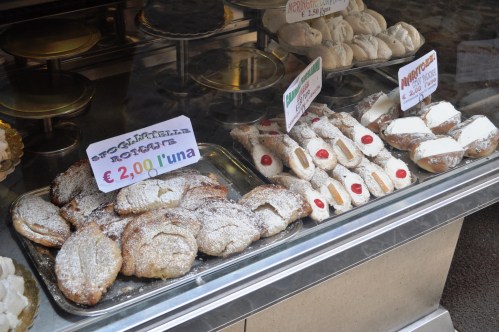
Valzani sfogliatelle romane, cannoli, maritozzi

After meeting a friend in the street, who was discussing the possibility of opening a café, we headed over Ponte Sisto into Regola, rione VII. Past this fab old sign for a biscuit shop that, sadly, isn’t a biscuit shop any more.

Biscotteria sign, Via dei Pettinari, Rome

We stopped at I Dolci di Nonna Vincenza (“Grandma Vincenza’s Sweets”), a Sicilian pasticceria chain that opened a branch here about a year or so ago.
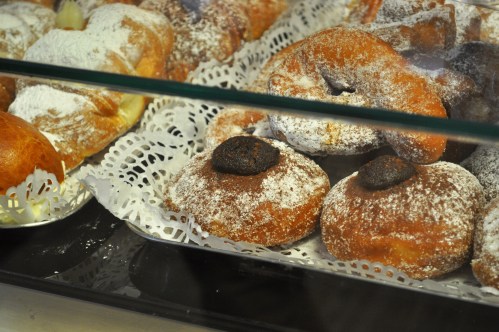
Brioche, ciambelle, Nonna Vincenza

It’s a bit cutesy, but the doughnut-type thing (“È una tipa di ciambella”) we had – that wasn’t the more common ring-shape of ciambelle, but more a knot – was good.

Ciambella, Nonna Vincenza

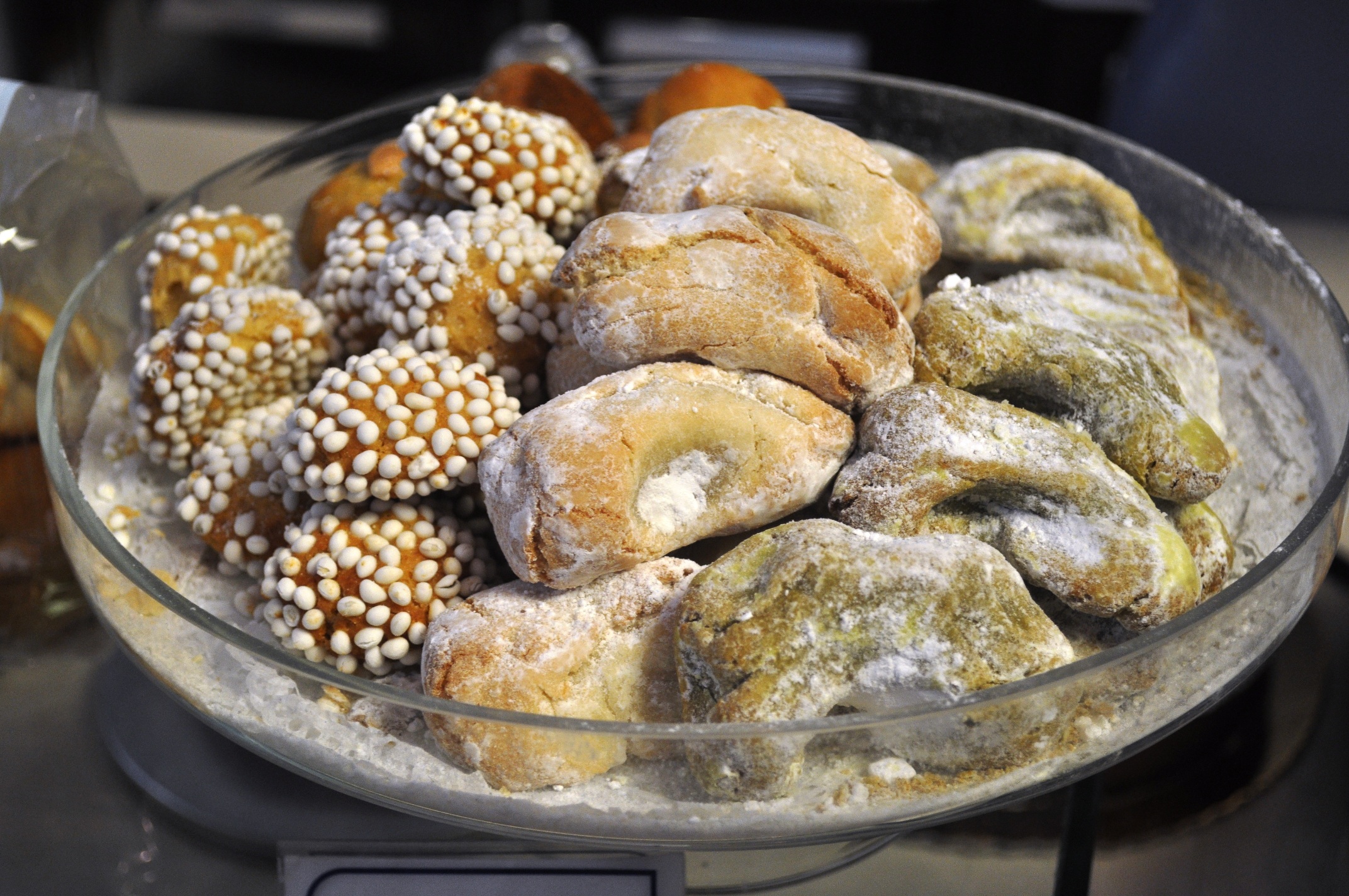
I got some almond paste cookies that were pretty good too.

Biscotti, Nonna Vincenza

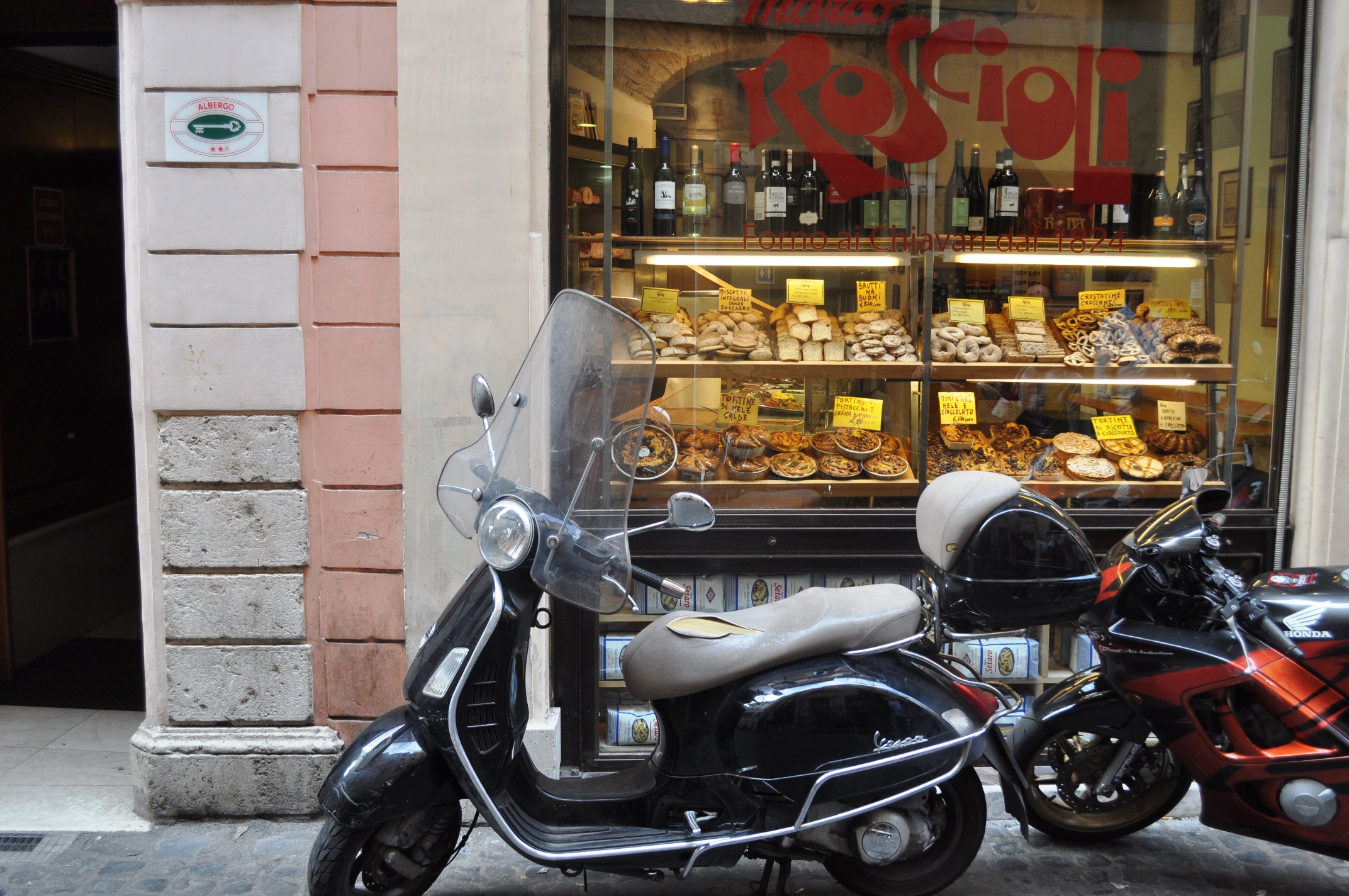
We chilled out on the pastry indulgences after that, even managing to walk by the justifiably renowned, somewhat pricey Roscioli bakery without buying anything.
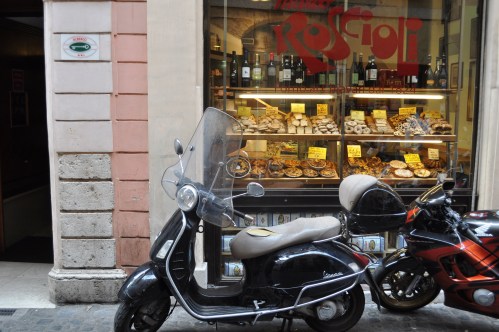
Roscioli

We wanted to save space for lunch at L’Asino d’Oro in Monti, one of our two favourite Rome restaurants. Our other fave is Cesare al Casaletto, which we’d vowed to go to at least once or twice more before leaving, but had been confounded by forgetting which day was their riposa settimanale (weekly rest day), then it being fully booked, and then by discovering that they were closed for our final 10 days in Rome. Nooooo! Fortunately, L’Asino d’Oro hit the spot.

Asino D'Oro

This is a superb restaurant, where chef Lucio Sforza (who, Renaissance scholars, may or may not be part of that family) uses seasonal, local, quality ingredients and every weekday does a pranzetto for (currently) €13. This set “little lunch” changes every day and is a serious contender for the best value, best quality lunch available in Rome. Thirteen flippin’ euros for bread, antipasto, primo, secondo, glass of wine and small bottle of water! And it’s always been excellent, every time I’ve been, though I prefer Friday, as that’s Rome’s main fish-eating day.

We had a bruschetta with bean purée, the best broccoli soup I’ve ever had, pasta with a ragù of cuttlefish, and a fillet of scorfano (scorpion fish). We then decided to order some dessert (which isn’t included in the menu) and a glass of Marco Carpineti’s delicious Ludum Passito dessert wine. Just cos.

Passito and zuppa inglese, L'Asino d'Oro

I had a zuppa inglese, which is basically Italian trifle. Although the name can be translated as “English soup”, I like the slightly deeper meaning of zuppa as a reference to bread dunked in broth, from the verb inzuppare, to soak, to immerse. In the case of zuppa inglese, there’s sponge cake soaked in alcohol and custard. Going to miss these lunches at The Golden Ass (or The Golden Donkey if you have that troubling American-English relationship with that word). Veramente un buon rapporto prezzo-qualità!

Cafe 2Periodico, Monti

Afterwards we had tea in a favoured nearby café in Monti, 2Periodico, watching the world go by before we continued on our way… to the movies. What?! You could say. Why sit in a cinema when Rome is only your city for a few days more? Well, I used to be a film journalist, and just adore the big screen and the darkened room. Plus, I fear a culpa d’aria got me so I fancied planting my donkey for a few hours, getting away from the tourist zombie hordes clogging up the streets.

Normally I cannot abide, and veto, 3D films, but the own lingua originale option was Gravity in 3D. And even with shonky 3D, in a cinema not designed specifically for 3D, it was an extraordinary experience. I’ve not felt that pushing-yourself-back-into-the-seat tension in a film for years.
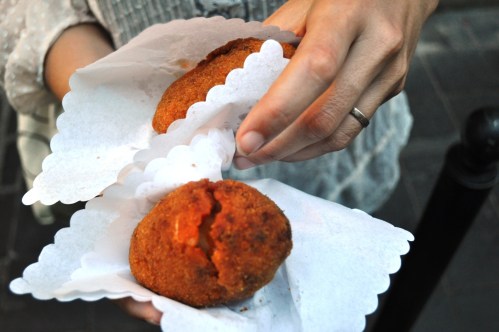
I Suppli, Trastevere

On the way home, we stopped in Via San Francesco a Ripa in Trastevere, buying some handmade chocolates from Dolce Idea to take home and a suppli from the small, seemingly nameless hole-in-the-wall pizzeria opposite to scoff straight away. It might just be called “I Suppli” as it has the word in green neon above the door. And rightfully so, as their suppli are great – the tomato risotto mix is very saucy, meaning they’re moister than many versions. Their structural integrity may suffer as a result but they’re so tasty.

So all in all a great day; eating and movies, two of my favourite things. I even managed an ale when I got home, so three of my favourite things.

Info
Pasticceria Valzani
Via del Moro 37b, Trastevere, 00153 Rome
+39 06 580 3792 | valzani.it

I Dolci di Nonna Vincenza
Via Arco del Monte 98a/98b, Regola, 00186 Rome
+39 06 92 59 43 22 | dolcinonnavincenza.it | arcodelmonte@dolcinonnavincenza.it

Roscioli (Forno)
Via dei Chiavari 34, Regola, 00186 Rome
+39 06 686 4045

L’Asino d’Oro
Via del Boschetto 73, Monti, 00184 Rome
+ 39 06 4891 3832

2Periodico Café
Via Leonina 77, Monti, 00184 Rome
+39 06 4890 6600

Dolce Idea
Via San Francesco a Ripa 27, Trastevere, 00153 Rome
+39 06 5833 4043 | dolceidea.com | info@dolceidea.com

Nameless Pizzeria (“I Suppli”?)
Via San Francesco A Ripa 137, Trastevere, 00153 Rome
+39 06 589 7110

1 Comment

Filed under Bakeries, Biscuits, cookies, Cakes