Category Archives: Recipes

Genoise, génoise, genoese. And trifle

Much as we don’t like traditional British Christmas cake in our household and always try alternatives, we don’t like traditional Christmas pudding either. I’m fascinated by its history, its origins in Medieval cuisine, the relationship of such puddings to, say, sausages (discussed here). I just don’t like eating it.

Instead, our traditional Christmas pudding is trifle. My wife introduced me to this tradition years ago; apparently it comes from her mum’s mum, “a great trifle maker”.

Trifling things

British trifle is not unlike a variety of other international deserts. Indeed, in the mists of time, it has common roots with both zuppa inglese (“English soup”, or more broadly “English dunked stuff” – a type of [northern] Italian desert that is, basically, trifle) and its cousin tiramisu (tirami sù – literally “pick me up”, though if you really need waking up surely a ristretto would do the job better?). The bottom line is that all these deserts use custards and/or whipped dairy products and sponges. But not just any sponges: specifically genoise sponge, or the closely related pan di spagna. (Which was, probably apocryphally, developed by the Genoese ambassador to Spain in the middle of the 17th century. More on the distinction between these two later).

Genoise – okay, look I’m going to call it genoese, as that’s the spelling I grew up with – originates from Genoa, the capital of Liguria in northern Italy. Today, it forms the basis of many sweets, in not just Italy and France, but Britain and elsewhere. But, you may say, tiramisu uses sponge fingers! (Aka ladyfingers, or boudoirs in French, or Savoiardi in Italy) But what are sponge fingers? Well, they’re just small cakes made of crisply baked piped fingers of genoese mixture.

So for our Christmas trifle, I generally make a genoese, while the missus makes custard.

Genoese sponge recipe

60g unsalted butter
125g plain flour
Pinch of fine salt
4 medium eggs
125g caster sugar

Folding in the flour

Preheat the oven to 180C.

1 Melt the butter, then leave it to cool slightly.
2 Use a little of the butter to grease your cake tin(s), sprinkle it with flour, shake the flour around to coat, then remove the excess. Line with baking parchment. This recipe will make two fairly thin cakes in 18cm round tins. If you want it square and deeper, use say just one 20cm square tin.
3 Sift the flour and salt together.
4 Put a pan of water on and bring to a simmer.
5 Combine the eggs and sugar in a heatproof bowl, and set this over the simmering water.
6 Using (ideally) an electric hand blender or a whisk, whisk the egg and sugar mix for about 5 to 10 minutes. It should triple in volume and achieve slight peaking.
7 Take the bowl off the heat.
8 Sift half the flour into the egg/sugar mixture and gently fold it in with a large metal spoon. You want to do this as gently as possible so you don’t knock the air out of the mixture
9 Sift in the other half of the flour and fold carefully again.
10 Gently pour in the melted butter, and carefully fold this in too to just combine.
11 Pour the mixture into the prepare tin(s). Gently does it!
12 Bake until firm to the touch, around 25 minutes depending on the depth of your mixture.
13 Cool in the tin for a few minutes, then turn out and cool completely on a wire rack.

Pouring in the butter

Trifle

Now, if you want to make a trifle, cut half of this cake into chunks, spread them with jam, and put them in a medium bowl. Pour on some sherry if you like such things. Add some fruit of choice. We used (not very seasonal or local) raspberries and banana. Cover the lot with homemade custard (go on – it’s not hard, and it tastes sooo good). Then cover all that with whipped cream.

I like to sprinkle some lightly toasted flaked almonds on top. Most of all though, I just like the extraordinary indulgence of genoise, custard and cream. It’s always a sad moment on 26 or 27 December when we finish the trifle.

Trifle

The difference between genoese sponge and pan di spagna

Genoese is made with the above technique involving cooking the eggs and sugar together, and whisking them, over a bain marie, with some melted butter subsequently added to the mix. Pan di spagna is made cold, with the eggs separated and lightness achieved by whipping the whites to stiff peaks. We’d call pan di spagna a “whisked fatless sponge cake” in English.

If you can read Italian, or trust translator software, there’s a good description of the difference here.

The results are quite similar. One of these days I’ll have to arrange a blind tasting, as TBH, I’m not sure I could tell the difference. Some people don’t even seem to recognise the difference: after all, Italian Wikipedia has a photo of pan di spagna that is reused to illustrate genoese on English Wikipedia. Outrageous.

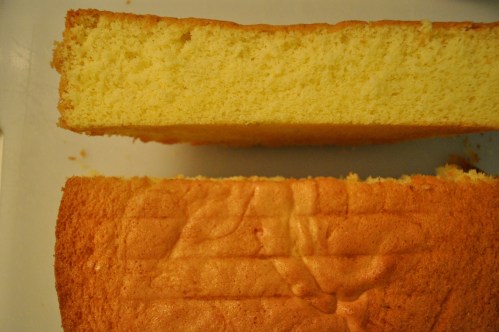
Anyway. Here’s a final pic of mine. Slight sag in the middle, but otherwise lovely.
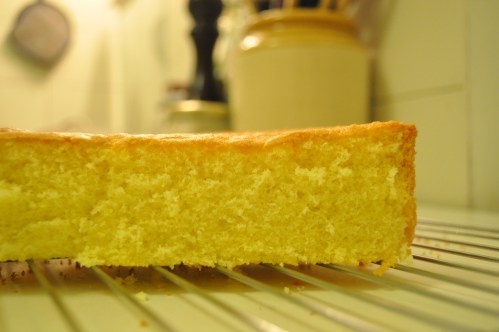
Cross section

3 Comments

Filed under Cakes, Puddings & desserts, Recipes

Christmas kringle

Kringle cut

Most Christmases I like to try a different type of seasonal cake. Anything but a British Christmas cake. Yuck. So in the past I’ve done stollen, and a few years ago a panettone (scroll down a bit on this page). This year, despite being in Italy, I’ve made a kringle, from a recipe I found in an in-flight magazine.

The recipe is from Norwegian-raised, London-based Signe Johansen. She doesn’t give much pre-amble, but says “Kringle gets its name from the Old Norse for a ring, and is eaten across Scandinavia during the festive period.”

As with the Italian ciambella though, the name kringle seems to cover a broad variety of baked goods, ranging from things that resemble a pretzel, to various ring-shaped cakes, and even ring-shaped variants make with flaky pastry. It looks like something that’s doesn’t just vary throughout Scandinavia, but also varies extensively across the Scandinavian diaspora, notably in the US.

This version is an enriched yeasted dough and much more like stollen (especially as it also has a marzipan filling) or panettone than the strudel-like versions in the above link. It’s also made with white spelt flour (farina di farro bianco in Italian). As much as I like to eschew using too much modern wheat, I’m not sure about this and if I did it again, I might be tempted to use half-half plain and strong white flours.

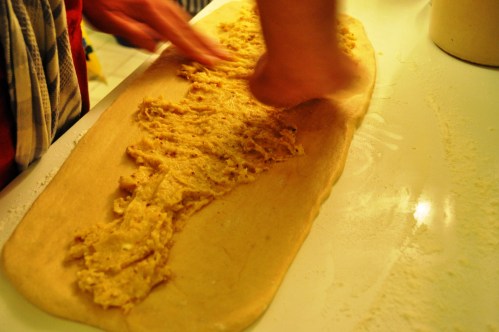
Spreading the filling

Anyway, I’ve no idea how authentic it is, whether it resembles a particular kringle from a particular nation or location, or whether it’s a total mongrel. It’s just a pleasing bit of seasonal baking, with a rich dough, plenty of almonds and a delightful touch of cardamon.

So, ingredients:

Dough
300g milk (whole, full-fat)
75g butter (unsalted)
525g refined spelt flour
100g caster sugar
1 tsp ground cardamom
3/4 tsp fine sea salt
15g fresh yeast (or 7g fast action dried yeast)
1 egg, beaten

Kringle rolling

Filling
100g raisins (soaked for 15-20 minutes then drained)
150g marzipan (she uses mandelmasse, which is another almond paste variable that. According to my Scandinavian baking consultant Tom Rönngård “marzipan has more added sugar”. So maybe just make some marzipan – which is v easy* – and reduce the sugar.)
75g almonds
50g butter (unsalted)
1 tsp vanilla extract
1 egg, beaten
1/4 tsp fine sea salt
caster sugar to taste

Glaze
1 egg, beaten
flaked almonds
Demerara or granulated sugar

Kringle round

Method:

1 Warm the milk and butter. Scald them, take off the heat and allow to cool.
2 Mix the flour, caster sugar, cardamom and salt together in a large bowl.
3 When the milk and butter have cooled to around 28C, crumble in the yeast.
4 Leave the milk and yeast for a few minutes, then add one beaten egg.
5 Pour the liquid into the flour and beat to combine. Beat until it starts to come together as a dough. You could use a food processor or mixer with a dough hook. She doesn’t seem to knead it at all.
6 Form the dough into a ball then leave to prove in a large, clean bowl, covered with cling film.
7 Turn around and ready your food processor.
8 To make the filling, blitz together the marzipan/mandelmasse, almonds, butter, vanilla, one more beaten egg, salt. You want a rough paste.
9 Add caster sugar to taste to the filling – 30-45g or so.
10 When the dough has doubled in size, take it out of the bowl and put on a lightly floured work surface.
11 Stretch and roll the dough out into a rectangle 60x15cm.
12 Spread the filling on the dough.
13 Starting from a long edge, roll the dough up.
14 Dampen the other long edge to seal the cylinder.
15 From the cylinder into a ring shape, pinching the ends together. (I’m not entirely sure how this works; it felt a bit bodgy to me.)
16 Preheat the oven to 200C.
17 Transfer the ring to a large baking sheet, lined with parchment.
18 Cover the dough and leave to prove again, until roughly doubled in size. She says “If it has proved enough, the indentation should stay after a gentle poke.” Which is nice.
19 When it is ready to bake, glaze with egg, and sprinkle with flaked almonds and Demerara sugar. I had some egg whites so used them. I also didn’t have any flaked almonds, so just sliced some blanched almonds. And I used granulated sugar instead or Demerara.
20 Bake for around 40 minutes, then cool on a rack.

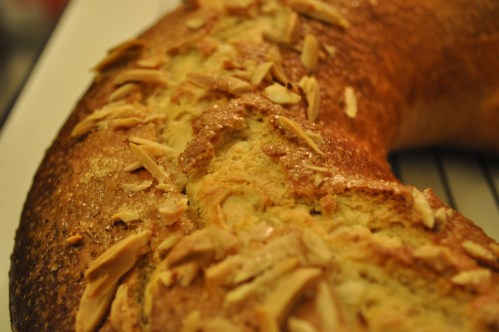
Kringle close-up

My blasted oven has fierce bottom heat, so despite triple-traying it, I still got a slightly burnt bottom. Otherwise, it was jolly good when we had it for breakfast this morning. The recipe says serve “on the day of baking”, but with a dough that’s so rich in fats and sugar I’m sure it’ll last happily for a several days.

* Marzipan tweaked a bit to become more like mandelmasse

30g golden caster sugar
60g icing sugar, sifted
120g ground almonds
1/2 tsp vanilla essence
1 egg, beaten
1/2 tsp lemon juice

Mix the sugars and almonds.
Add the egg, lemon and vanilla.
Blend with a knife then knead briefly.
Wrap with cling film and store in a cool place.
It’ll keep fine for a few days, if not more.

4 Comments

Filed under Breads, Cakes (yeasted), Recipes

Brutti ma buoni

Brutti ma buoni

The easiest way to describe Brutti ma buoni (“ugly but good”) is as nut meringue cookies. All the ones I’ve encountered in Rome have been made with hazelnuts, and many of the recipes online seem to be also. But there’s also a variant made with almonds.

Italian Wikipedia says they’re also called Bruttibuoni, made with almonds and are from Prato in Tuscany. I suspect a lot of other Italians might take issue with that though, as they do seem to be a fairly widespread. Indeed, a bit more googling, and another source claims they’re from Varese, in Lombardy, north of Milan. Yet another calls them Brut ma bon (a more French-sounding dialect name) and gets even more specific about their origin: not just Varese, but Gavirate, a town in the vicinity of Varese.

Hazelnuts reading for roasting

Whatever the history, bottom line is that they’re a meringue-type cookie (ie made with egg whites, no fat and little or no flour) that are rich in chopped nuts. Heck, even us Brits have a traditional hazelnut meringue, so I’m really not sure it’s the sort of recipe anyone can really stake a claim to.

I decided to make some as we had some egg whites left in the fridge from making custard. The recipe I used is from Biscotti: Recipes From The Kitchen Of The American Academy In Rome. It’s the third recipe I’ve tried from there following the wonderful Honey and farro cookies, and the Pinolate (pine nut cookies). I need to try the latter again before I blog it as my first batch wasn’t quite right.

Chopping nuts

Anyway. While baking these this morning, I looked around to compare recipes, and – would you Adam and Eve it – my favourite baker Dan Lepard published his recipe a few weeks ago in The Guardian. It’s an indication that despite how basic these cookies may be, there are several approaches to the method. His doesn’t require the eat whites to be beaten, uses pre-skinned hazelnuts, and involves combining all the ingredients in a saucepan. I will have to try that for comparison. One day. Not today. Not when I’ve already got 30 biscuits cooling in the kitchen. Another recipe, from a Canadian cookbook, meanwhile, also involves cooking the sugar and egg whites together, then beating them. That approach is more like a classic Italian meringue, and certainly the results in the pics look more meringue and less cookie.

Sugar, beaten egg whites etc md

So. As usual, I’m tweaking as I go along. The original recipe made a lot of mixture, but as you turn off the oven at the end of baking and let the cookies cool inside – as you do with meringues – you either need a massive oven, or should do half quantities. So I’ve halved the original recipe. I’ve also added some almond essence – simply because it’s more explicitly nutty than just using vanilla essence. Ideally I’d use hazelnut essence but I don’t have any.

250g hazelnuts (with skin)
1 egg white
125g granulated sugar
1 teaspoon vanilla essence
1/2 teaspoon hazelnut or almond essence
5g plain flour
Zest of half a lemon

Heat the oven to 150C.

1. Put the nuts on a tray, then roast them for about 15 minutes.
2. Turn the oven up to 180C.
3. Take the nuts out of the oven and rub them with a tea towel. This removes some of the skin. Don’t agonise though. The inclusion of some skin adds a depth of flavour, IMHO. (I also prefer my peanut butter to be wholenut, skins and all.)
4. Put half the nuts in a mixer and give them a quick whizz. Just break them up. You don’t want to grind them.
5. Put the other half of the nuts on a chopping board and chop roughly. (The original recipe has you chopping them all by hand, but a) that’s labour intensive and b) I like the mixture of sizes and texture this method creates. Mades the results extra-brutti.)
6. Beat the egg whites to a soft peak.
7. Beat the sugar into the egg whites, to a firm peak, then add the essences.
8. Add the zest and flour to the nuts.
9. Gently fold the egg white mix into the nuts.
10. Put teaspoonfuls on a baking sheet lined with parchment, leaving about 4cm between (though they don’t spread much).
11. Bake for about 12 minutes, until only just starting to colour.
12. Turn off the oven, leaving the cookies inside to continue baking as it cools. Leave for about 10 minutes
13. Remove and cool on a wire rack.
14. Enjoy.

Baked and cooling

3 Comments

Filed under Biscuits, cookies, Recipes

Pane di San Martino

In the autumn of 2011, I noticed bags of a yellow-ish powder on a stall in the farmers’ market in the Ex-Mattatoio in Testaccio, Rome. It was farina di castagna – chestnut flour. That is, flour made from the dried and milled nuts of Castanea sativa, the sweet chestnut tree.

At the time, I experimented with it. A friend commented that there is in fact a traditional Italian bread made with chestnut flour, called pane di San Martino, or St Martin’s bread. The feast day of St Martin is 11 November, just around the time the year’s chestnut flour becomes available.

Anyway, I mentioned this bread to a teacher who I was doing a (food-focussed) conversation class with. She dug out a recipe. Well, she clearly Googled a recipe, as a quick Google myself soon found her source, which is here (in Italian).

After having gone through all that, I then completely failed to try the recipe. A year went by, autumn returned – and so too did the chestnuts, and chestnut flour. So last week I bought a new pack, and determined to revisit the pane di San Martino recipe.

Firstly, however, I had to translate it.

It talked in vague terms: “Prendere mezzo mestolo di farina di castagne e mezzo mestolo di farina di frumento…”, that is “Take half a ladle of chestnut flour and half a ladle of wheat flour…” But which ladle? I’m not a fan of the cup measure in recipes – especially as a US and an Australian cup, say, are different sizes. But what about an Italian ladle? I had two in my kitchen, one medium-small, one medium-large. Was either suitable? I plumped for using the medium-large one, and weighing the flours in grams. (If you’re interesting in scaling up recipes, using grams and kilos makes things a lot easier, in part as the maths are more manageable when you’re working with percentages and a measures based around factors of ten. Ounces smounces.)

Anyway, I translated and converted the recipe, but it still wasn’t quite right in terms of the liquid/dry quantities, so I also revised it while making the dough. Indeed, all flours have different absorbency, so you will have to have a feel for dough when you’re adding mixing the water and flours. This time, I used an organic, stoneground farro bianco – white spelt – flour from the renowned Marino Mulino. If you use a wholewheat flour it will require a more water than a white flour.

So. Pane di San Martino. My teacher gave me some notes that said this bread is found from Emilia-Romagna in north Italy to Salento, in Puglia, the heel. I’ve never seen it in Rome though. In fact, I’ll come clean and say I’ve never seen it anywhere, in the crumby flesh. So although my version is based on an Italian recipe, my version has no claim to authenticity. Which might upset an Italian baker, but shouldn’t be a problem if you stumble upon this recipe from other climes.

The recipe uses both a leaven (sourdough culture) and fresh yeast. This is a technique used by one of my favourite bakers, Dan Lepard, though it might upset some purists. OK, purists, that’s two warnings now.

Make a sponge with:
50g chestnut flour
50g of wheat or spelt flour
12g fresh yeast
50g wheat or spelt leaven/sourdough culture (100% hydration – that is, made with 50% water, 50% flour)
180g tepid water

Cover and leave to ferment for around two hours.

Make a dough with:
The pre-ferment
350g wheat or spelt flour
250g chestnut flour
300g water. Add more if the dough feels too tight.
20g olive oil
12g salt

Combine with a spoon or spatula. You want a moist dough. Don’t be afraid to add more water. When it’s a good consistency, knead to combine.

Cover and leave to rest for 10 minutes.

Add:
180g walnuts and knead gently to combine.

Cover and leave to rest for 10 minutes.

As the original recipe didn’t involve first and second proving periods, nor does this version. (I think I may work on this recipe though, and adjust the proving. Watch this space.)

Weigh the dough and divide in two. Form two balls, then leave these to prove in baskets or bowls lined with flour clothes.

Leave to rest for around two hours in a warm place away from draughts. Timing will vary depending on the temperature of where your prove the dough.

Preheat the oven to 220C.

Line a baking sheet with parchment. (I’m not using a stone at the moment, just a fierce domestic gas oven.)

When the dough feels springy and alive, almost jelly-like, you’re ready to bake.
Gently upturn the proving baskets/bowls onto the baking sheet.
Make cuts in the top – you can make slashes how you feel, as long as you use a sharp blade and don’t drag at the dough. (Slashes in a loaf used to be the owner’s signature when people used communal village bread ovens.)

Bake for 20 minutes, then reduce the temperature to 200C and bake for a further 20 minutes.

You want the loaf to have a nice colour, and sound hollow when you knock on the bottom. (This isn’t an exact science either but if it sounds hollow, that’s some indication the dough isn’t still soggy and doughy inside, instead it’s baked and dry.)

Leave to cool on a wire rack.

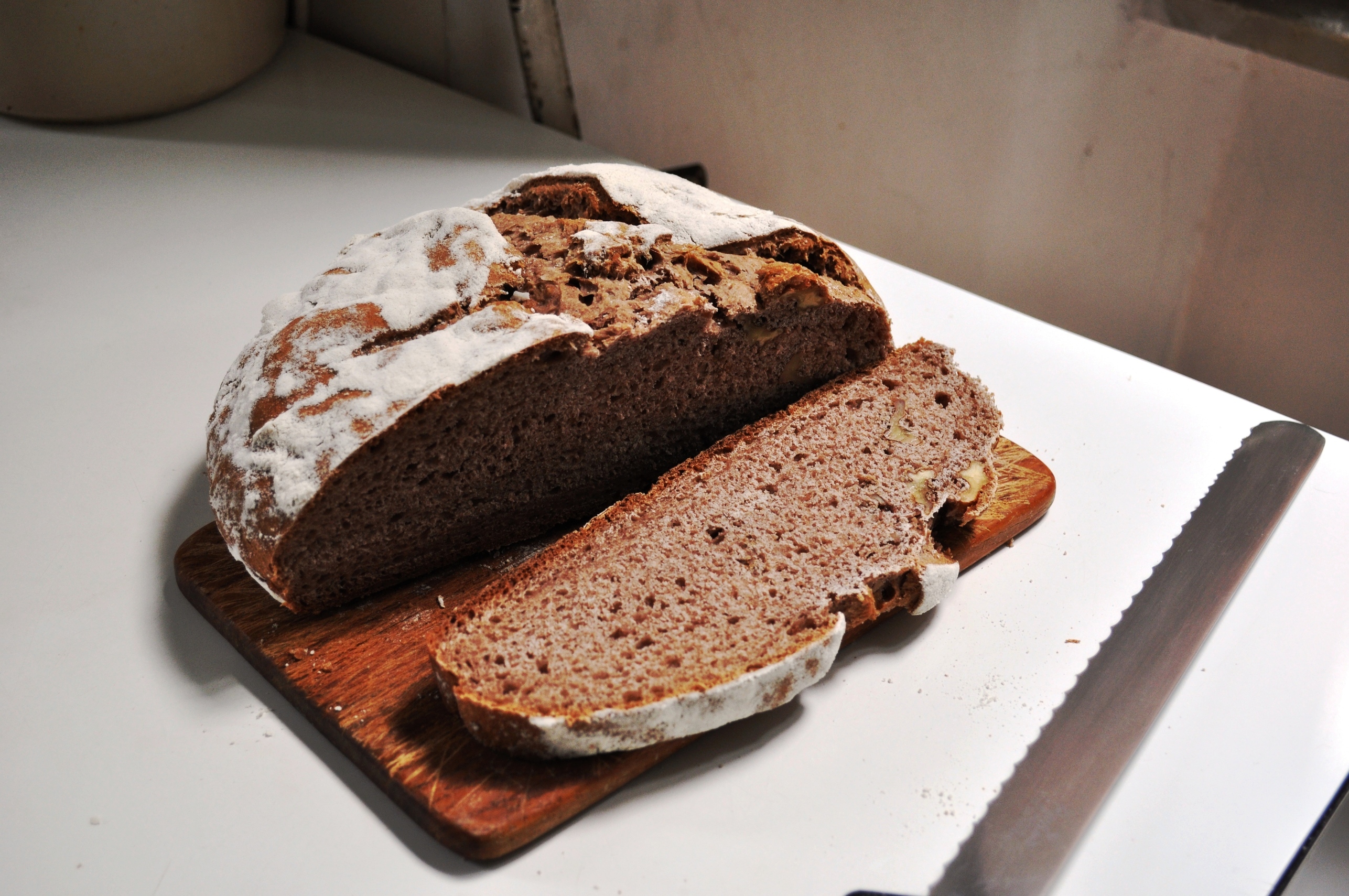
The resulting bread is sweet, almost cake-like, and pleasant for breakfast or afternoon tea, and makes good toast when it’s aged past its initial softness.

Addedum
The great travel writer Eric Newby had a strong connection to Italy – he hid in the Italian mountains during WWII, as described in his wonderful Love and War in the Apennines, and he and his wife – who he met during the war – returned there many times, eventually buying a house in the mountains in 1967. It was called I Castagni, “The Chestnuts”; on the theme of said foodstuff, in A Small Place in Italy he writes “This room extended the whole height of the building and had originally been constructed for the purpose of drying chestnuts. They were laid out and dried over a fire that had a chimney which extended up to the height of the roof. When they were dry they were ground up into a pale, brownish flour and used to make a rather sickly, sweetish sort of bread called castagnaccia which, until long after the last war, was a staple food in many parts of mountain Italy.”

Later on, he writes more about the importance of chestnut trees for “the principle necessities of life”, from building materials to food, specifically castagnaccia, “what had been a stabple food that most old contadini [peasants] now wanted to forget they had ever eaten, because of the memories it brought back of long years of poverty.” Interestingly, the suffix -accio / -accia often indicates a perjorative, so castagnaccia could be translated – very loosely – as “yucky chestnut bread”.

3 Comments

Filed under Baking, Breads, Recipes

Ciambelline con farro e miele (Ring cookies with farro and honey)

This is my first recipe from Biscotti: Recipes from the Kitchen of the American Academy in Rome, Rome Sustainable Food Project. The Academy is a handsome institution just along the hill from where I live. Since 2007, its kitchens have been run along sustainable lines, with an emphasis on local and seasonal ingredients. The Rome Sustainable Food Project has (so far) produced two recipe books, Biscotti and Zuppe (“Soup”).

Much as I love a good soup, that’s not the subject of this blog!

Anyway. These are lovely wholesome cookies, their flavour defined by the use of spelt (farro) flour and by your choice of honey. I used an Italian woodland honey, which is dark and has a deep robust flavour, almost smoky; if you used say a light, floral honey the flavour would be more subtle.

I tend to adjust recipes as I go along, so the below isn’t identical to what you’d find in the book. For example, I added some extra sesame seeds to the dough, as I like them.

Ingredients.
200g spelt flour (I used farro bianco – white spelt)
240g plain flour
12g baking powder
215g butter (if you use unsalted, you can add a pinch of salt to the recipe)
100g caster sugar
2 eggs
80g honey
15g vanilla extract
30g raw sesame seeds
Plus
1 egg, beaten
Extra raw sesame seeds and granulated sugar

1. Sieve together the flours and baking powder.
2. Cream together the butter and caster sugar, then beat in the egg, honey and vanilla.
3. Mix in 30g sesame seeds.
4. Make a dough by adding the flour to the creamed mixture.
5. Bring together then wrap in cling film and chill around half an hour.
6. Preheat the oven to 180C.
7. Line baking sheet(s) with parchment.
9. To make the cookies, pinch off lumps of dough around the size of a walnut. I went for 40g each, but I think 30g 10. might be nicer, for a slightly less macho cookie.
11. Roll the lump into a rope around 15cm long, then twist around the ends and pinch together.
12. Repeat until your baking tray is full.
13. I added an egg glaze to the original recipe to help with the adherence of the sesame seeds and granulated sugar that you sprinkle on the cookies.
14. Bake for 10-12 minutes, or until golden.

Unfortunately, my oven has a fierce bottom heat, and no fan, so the bottoms tend to brown before the tops, hence the variation in colour you see in the pic. No matter though – still yummy.

4 Comments

Filed under Biscuits, cookies, Recipes