Italian flour: types and terminology

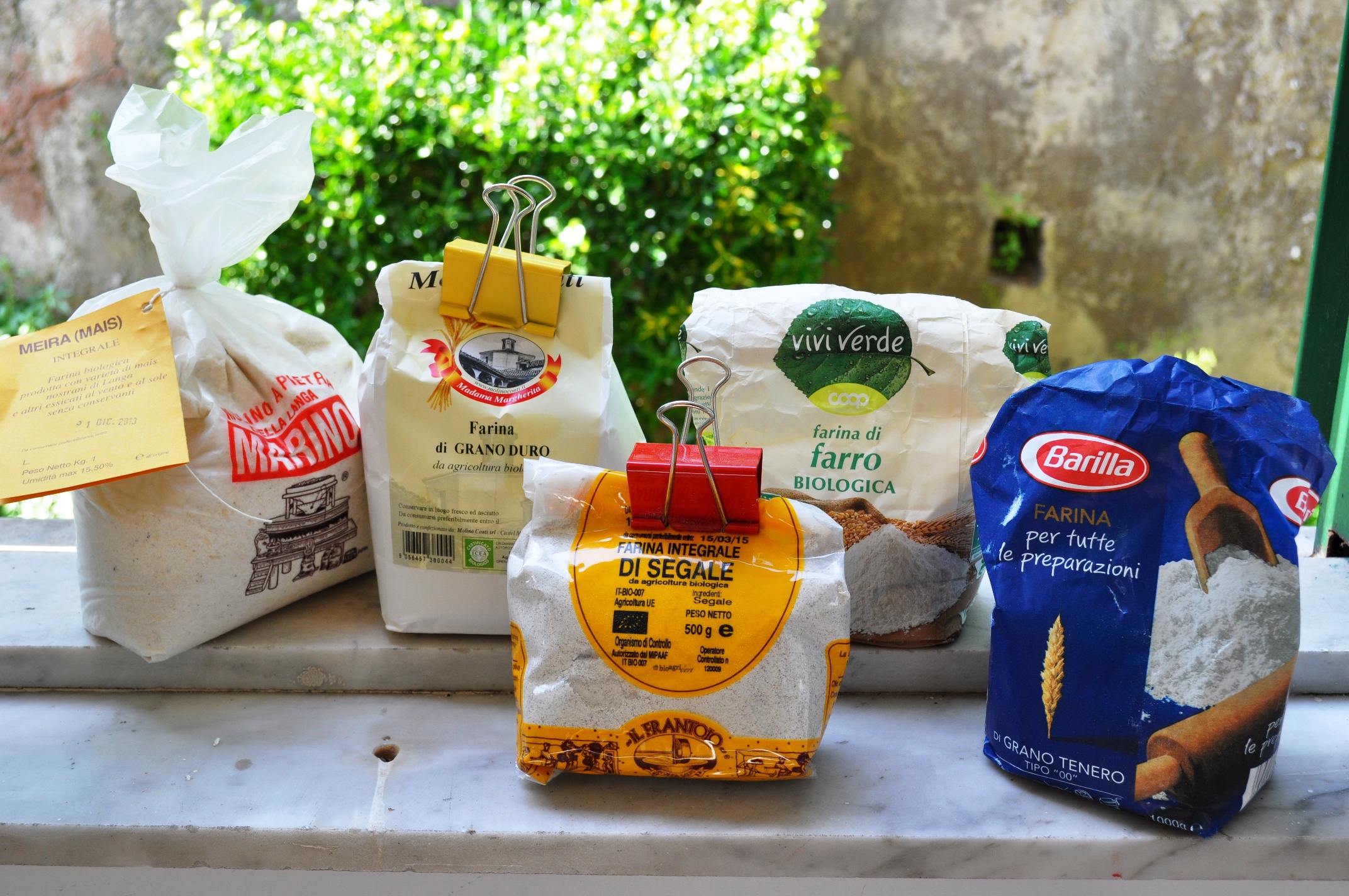
A selection of flours

Today’s bread is being made with farina di farro biologica from the Coop supermarket’s own brand, farina integrale di segale di agricoltura biologica from the Il Frantoio brand, and “Setaccio” farina semi-integrale di grano tenero from Mulino Marino. There really is no shortage of types of flour (farina) to experiment with here in Italy, if you’re into baking and bread-making. In fact, there so many flour varieties and variables it can be boggling.

Over the 20 months or so I’ve lived in Italy I’ve used many of them, but I still get confused. Previously, for example, I wrote about the various types of grain (and flour) known as farro to try and clarify what they were – as they’re often, erroneously, just translated into English as “spelt”. Here I hope to clarify a little more the other types of grain and flour you might encounter in Italy, or be able to buy as imports in other parts of the world.

Anyway.

Italian words for grains and more

A caveat – these are standard Italian words. There are doubtless a gazillion local dialect words as well, but let’s stay on target.

The wheat family:

The word grano (plural grani) means grain, though it’s frequently used as a synonym for wheat.
Frumento is the more specific word for wheat. In the modern world, wheat generally means bread wheat (Triticum aestivum), which accounts for 95% of global production.
Farro is name given to three, older members of the wheat family, “heritage grains”. Briefly it can refer to:
Farro piccolo (“small”) or farro monococco (Triticum monococcum) – that is, domesticated einkorn wheat, also known as enkir.
Farro medio (“medium”) or farro dicocco (Triticum dicoccum, aka Triticum turgidum var. dicoccon) – that is, emmer.
Farro grande (“large”) or farro spelta (Triticum spelta, aka Triticum aestivum var. spelta ) – that is, spelt. (Also known as dinkel.)

Grano turanicum – a name for Khorosan wheat (Triticum turanicum), another ancient grain type.
Kamut – the trade name for Khorasan wheat (Triticum turanicum).
Manitoba – the Italian name for bread flours with a higher percentage of protein, like what we’d call strong bread flour in the UK. It may or may not be from Manitoba province in Canada. Indeed, according to a blurb on a pack of Ecor brand flour, Manitoba flour is also known as farina americana.
Saragolla – another one I’ve encountered, which is proving tricky to identify with any real certainty. One Italian source says it’s similar Khorasan wheat (Triticum turanicum, but refers to it as Triticum polonicum, Polish wheat.

I’ve also seen things labelled with grano antico, which isn’t very helpful, as it could refer to any one of these ancient wheat species.

two old grains

Non-wheat cereals:
Avena is oats. Fiocchi di avena are oatflakes, or porridge oats.
Orzo is barley.
Miglio is millet.
Riso is rice.
Segale is rye.

Wholegrain rye flour

And not forgetting the that poster boy of industrialised, ecosystem-destroying, logical-economics-manipulating monocrop agriculture: maize (Zea mays), or corn: mais in Italian, also granone (“big grain”), granturco, granoturco and various other dialect names.

Polenta is, of course, made from maize, which arrived in Europe from the Americas in the 15th century, replacing earlier gruels made of orzo or emmer. Polenta (cornmeal) comes in various degrees of coarseness, some quite gritty, some more floury. You can also buy amido di mais, which what we’d call cornflour in the UK, or (more descriptively) corn starch in the US.

Other non-cereal flours you may encounter could be made from:
Amaranto – amaranth (Amaranthus caudatus).
Castagna – chestnut (used for Pane di San Martino).
Saraceno – buckwheat (Fagopyrum esculentum). Buckwheat isn’t a member of the grass family like the above grains. Instead, it’s a member of the Polygonaceae family and related to things like rhubarb.

There are see flours made from legumes such as:
Ceci – chickpea (Cicer arietinum).
Lenticchia – lentil (Lens culinaris).
Soia – soya, soybean (Glycine max).

Marino closer

Other useful terms:
amido – starch.
biga – type of low hydration, firm preferment, which can made with a sourdough starter or commercial yeast.
biologico – organic, organically farmed or produced.
chicco – grain (also bean, pellet, bead), eg chicco di grano, grain of wheat
crusca – bran.
germe – germ, eg germe di grano.
glutine – gluten.
integrale – wholegrain, eg farina di segale integrale.
lievito – yeast, raising agent.
lievito madre – “mother yeast”, meaning a natural leaven or sourdough culture.
lievitare – to rise, to raise, to grow (with a raising agent).
lievito naturale – natural leaven or sourdough.
macinata a pietra – stoneground. Always good, as it doesn’t damage the grain as much as modern milling with massive steel rollers, as such maintaining more nutrients and more flavour.
macinare – to mill (flour).
mulino – mill, eg uno mulino a vento is a windmill.
pagnotta – loaf.
pane – bread.
semi-integrale – semi-wholegrain. I’m not entirely sure what the preparation of such a flour involves – more sieving? Or blending?

Hard and soft

You’ll often see farina di grano duro and farina di grano tenero on packets of Italian flours. These translate as “hard wheat flour” and “soft wheat flour” (or, more literally, as “hard grain flour” and “tender grain flour”), but shouldn’t be confused with what we consider “hard” wheat in English, which is generally a higher protein bread flour.

Farina di grano duro is flour milled from the wheat species Triticum durum (aka Triticum turgidum var. durum), with durum and duro meaning “hard” in Latin and standard Italian respectively. Triticum durum is most commonly used for making pasta. It is the second most significant type of wheat grown globally, accounting for about 5% of production. It is ground into products of varying coarseness:
Farina di grano duro – the finest, most floury
Farina di semola – a slightly coarser flour
Semolina – the coarser middlings and yes, the stuff used for old-fashioned British puddings, (though the term is also used generically to refer to other wheat middlings).

Farina di grano tenero is flour milled from a subspecies of the wheat species Triticum aestivum, the most commonly cultivated strain of this useful grass. Also known as bread wheat. In Italy, it generally has a medium protein percentage, around 12%, though it can vary greatly. As with farina di grano duro, it is milled into products of varying degrees of coarseness, which is where the whole “00” thing comes into play. Read on…

Mulino Marino 00

Licensed to bake: the “00” system

When you see a flour graded as 00, it’s not a reference to a particular type of grain or species of wheat, it’s simply a reference to how finely the flour has been milled, and how much bran and germ has sieved out, and what sort of colour the flour is as a result.

The various types are: 00 (doppio zero, the finest grade), 0, 1, 2 (the coarsest grade, more akin to a meal). The coarsest grain is effectively integrale, that is, wholegrain.

Although 0 and 00 are commonly used for bread-baking, both are loosely interchangeable with British plain flour or US all-purpose flour. Indeed, if you look at the dark blue packet in the photo at the top of this page, the Barilla brand flour is labelled per tutte le preparazioni, which could be translated as “all-purpose”, and it’s a grano tenero 00.

The blurb on the side of a pack of ‘Ecor’ flour I mentioned above, also explains that il grado di raffinazione indica la quantità di farina ottenuta macinando 100kg di chicchi. Tanto più alto è questo indice tanto più grezza è la farina: the grade of refining indicates the quantity of flour obtained from grinding 100kg of grain. The higher the grade, the coarser the flour.”

Also, as the first table on this rather technical page indicates, the higher the grade, the higher the ash content and protein of the flour. Though these Italian flours are all still fairly low protein, between 9% and 12%, and different grains would give different results – that is, this table’s data has to be taken with a pinch of salt.

And the rest

I’ve probably missed all sorts of pertinent things, but can add them as and when I encounter them. For specific types of Italian bread and baked goods, I may mention them elsewhere on the site. In the meantime, if, like me, you’re into baking and an English-speaking learning Italian (there must be a few of us in that demographic out there), I hope this has been useful.
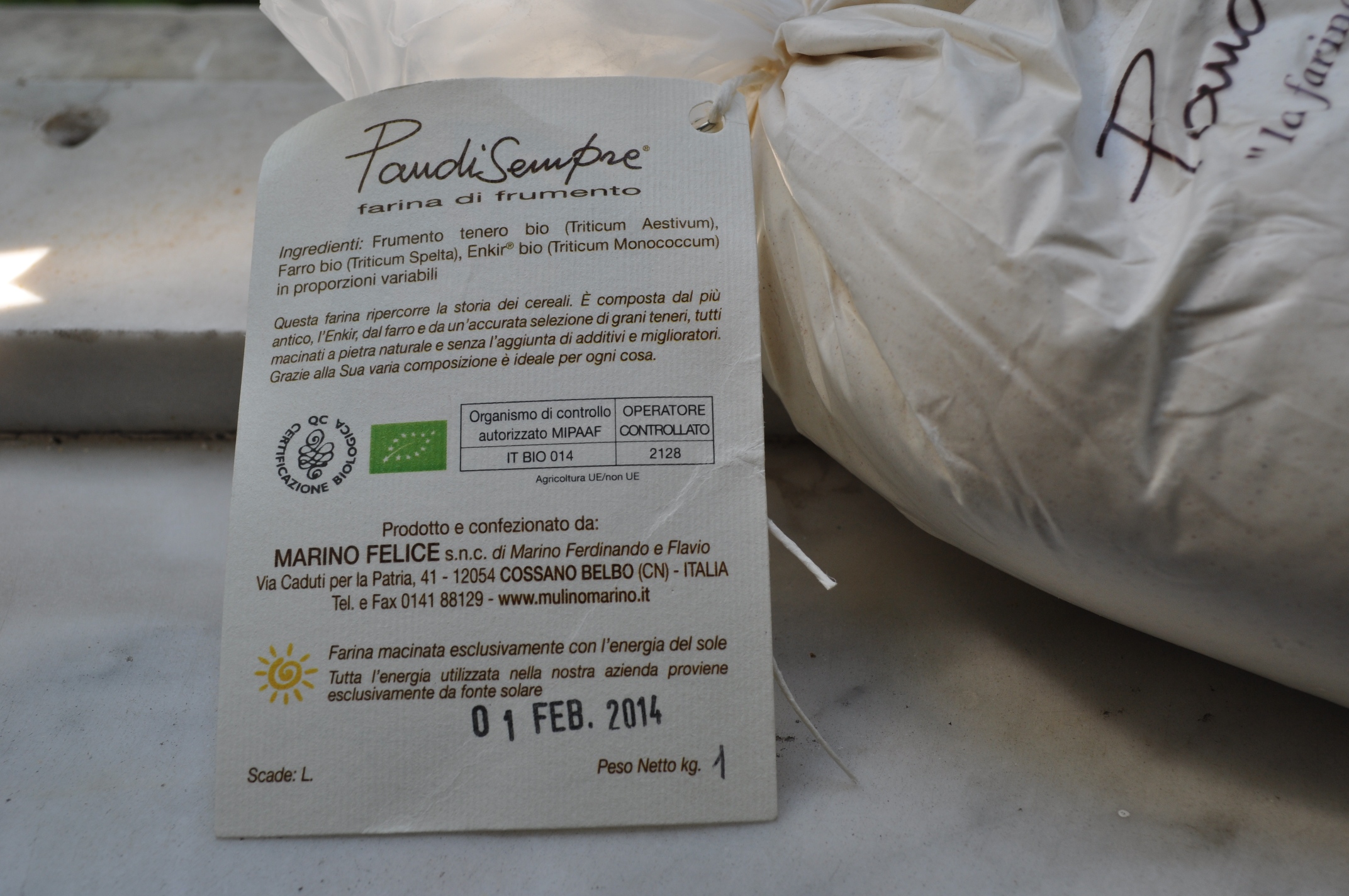
Pandi Sempre

Love this spiel “This flour recounts the (his)story of cereal crops. It’s composed of the most ancient grain, Enkir, of farro, and of a careful selection of soft wheats, all naturally stone-ground without the addition of additives or ‘improvers’. Thanks to its varied composition, it’s ideal for every use.”

84 Comments

Filed under Discussion, Flour & grain

Pastiera from Naples

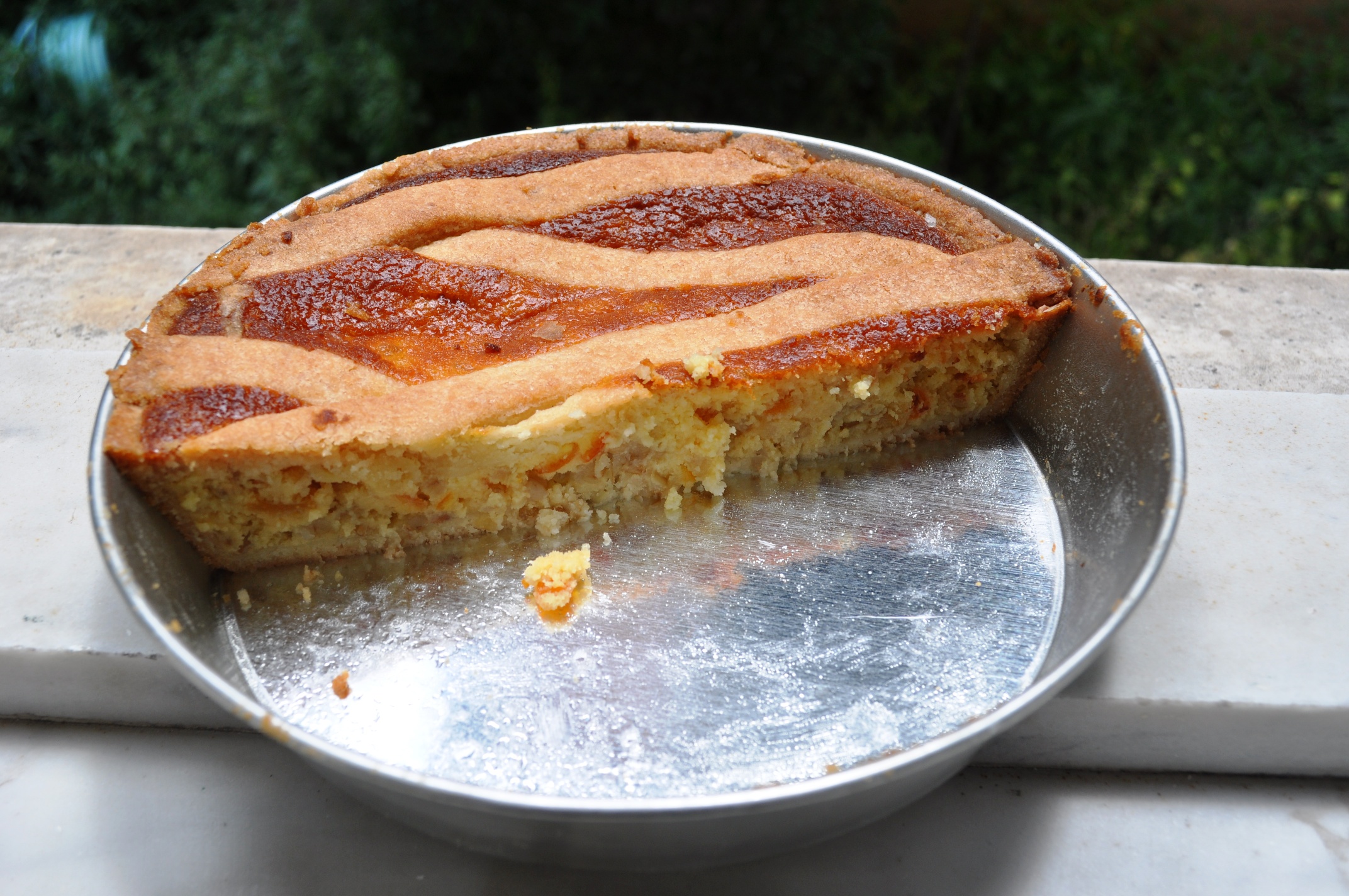
slice of pastiera

So here’s another Italian sweet I need to learn how to make, as it’s my kind of thing: a light tart containing sweetened ricotta and cooked whole grains. It’s pastiera, which comes  from Naples. In fact, this one literally came from Naples – we just spent a weekend in that seething, decaying metropolis. We stayed in the centro storico, and walking one of the decumanus streets – the ancient Roman east-west thoroughfares – we spied a bakery that basically just sold pastiera, its windows full of these fab tins.

It might be a bit cutesy, and aimed in large part at tourists, old biddies etc, but Italy does have do a nice line in old-style packaging, notably for shop-bought biscuits. The biscuits might be made in an anonymous factory, but some 19th century style design on the tin makes the product strangely appealing. In this case, the tin seems to be saying “Eat pastiera while you still can – before Vesuvius blows its top again and buries us all like in Pompei, 79AD”. Well, perhaps.

Pastiera tin cu

In this case, the tarts were all made by hand in the small bakery. It was on via Benedetto Croce, near the crossroads with via San Sebastiano. The tart cost a stupid amount, considering it would only cost a few euros to buy the ingredients, but hey, the whole experience was nice. They even had a “Periodic table of the dessert” on the wall of the shop. Said niceness really counted considering our day had been a tad stressful – Naples fulfilling its remit as deeply dodgy when we encountered some pickpockets so flagrant it was almost comical on the bus. (I’ll laugh one day, but I’m still smarting slighting from my naivity and not realising that the guy I was pushing away from my dad’s pockets probably had a colleague stealthing my pocket, and getting my phone. Luckily it was a crappy old phone. And probably covered in bacteria, as such things are. I hope the thief and his fence get sick from it.)

pastiera in its tin

So, yes, anyway. Pastiera –  watching the recipe demonstration here on giallozafferano it looks like a pretty basic construction, featuring ricotta, sugar, eggs, cooked grain and candied fruits. I should try my own version at some stage as I’ve been experimenting with making peel – in this case, candying the last of the alcohol soaked kumquat zest I used in my lemon kumquat cake.

2 Comments

Filed under Pies & tarts

Birra Dolomiti and Bastarda Rossa at Osteria Pistoia, Rome

So the past week or so we’ve been to both branches of Osteria Pistoia in Rome. The more restaurant-y branch is in Piazza Madonna della Salette, in the off-the-tourist trail Monteverde Nuovo, while the other branch on Via Portuense – on Sundays, right in the thick of the Porta Portese market – is both a cafe and sit-down eatery. Both have a decent selection of beers, though the former had a sign boasting “More that 40”, while the latter had a list of about 12.

These osterie are among the surprisingly few places in central-ish Rome that seem unafraid to try and move away from the hackneyed mediocrity of many of the city’s eateries. Yes, mediocrity. Rome might be the capital of the nation that exports its culinary traditions to the world, but as a great food centre it hardly compares with London, and quite probably the world’s other great food cities like NYC and Paris. I just had a weekend in Naples, and, even among its chaotic disintegration, the restaurants were offering more interesting fare than in Rome. Why is Rome so bad for restaurants? Well, for me it’s partly because I just don’t like Roman cuisine’s emphasis on meat and offal (quinto quarto, the “fifth quarter”), but more broadly and less personally it’s also because the city is so touristy, and in the touristy areas, eateries can get away with murder. Tourists are so charmed by the cobbled streets and overwhelming sense of history in places like Trastevere and the Centro Storico that they don’t seem to notice the amorphous crapness of the over-priced restaurants they’re patronising.

Frankly, there are very few places I would eat in Trastevere, for example. Perhaps Ai Marmi for a cheap, crisp pizza and okay suppli; Da Augusto, for entertainingly no-frills/rough dining; Da Enzo, for sound Roman fare. (Though none of these places have decent beer.) Italian has an expression that I’ve just learned: buon rapporto qualità-prezzo, and it refers to a good balance or rapport between quality and price, value for money. This is something I’ve been talking about for ages in discussing my general disappointment at Roman food, without knowing this expression. So Ai Marmi and Da Augusto offer pretty basic food – but it doesn’t leave you feeling like you’ve be ripped off. On the other hand, many places offer poor-to-rudimentary fare that costs way more than is justified, leaving a bad taste in the mouth figuratively and quite possibly literally. So many places in Rome rest on their laurels, confusing being founded in 1916 (or whenever) and having a heritage with producing good, well-priced food now.

So yes, to get back to Osteria Pistoia. Anita from Trastevere’s Almost Corner Bookshop recommended it. For our first meal we decided to give the Monteverde Nuovo branch. I’m not going to review the food as that’s not what this blog’s about, but I will  say that it was good, with a buon rapporto qualità-prezzo. I had a galletto (young cockerel), that had been marinated for 24 hours in mix containing olive oil, white wine vinegar, rosemary, salt and black pepper. It was flavoursome and moist – where traditionally many Roman places will overcook their meat, desiccating it. (Though they did serve it on a piece of slate, not a plate, which is just fecking silly. Plates have a rim for a reason. At least it wasn’t a chopping board – which is both silly and unhygienic.) They had some fancy deserts too, including a sphere of white chocolate containing cinnamon-ginger gelato.

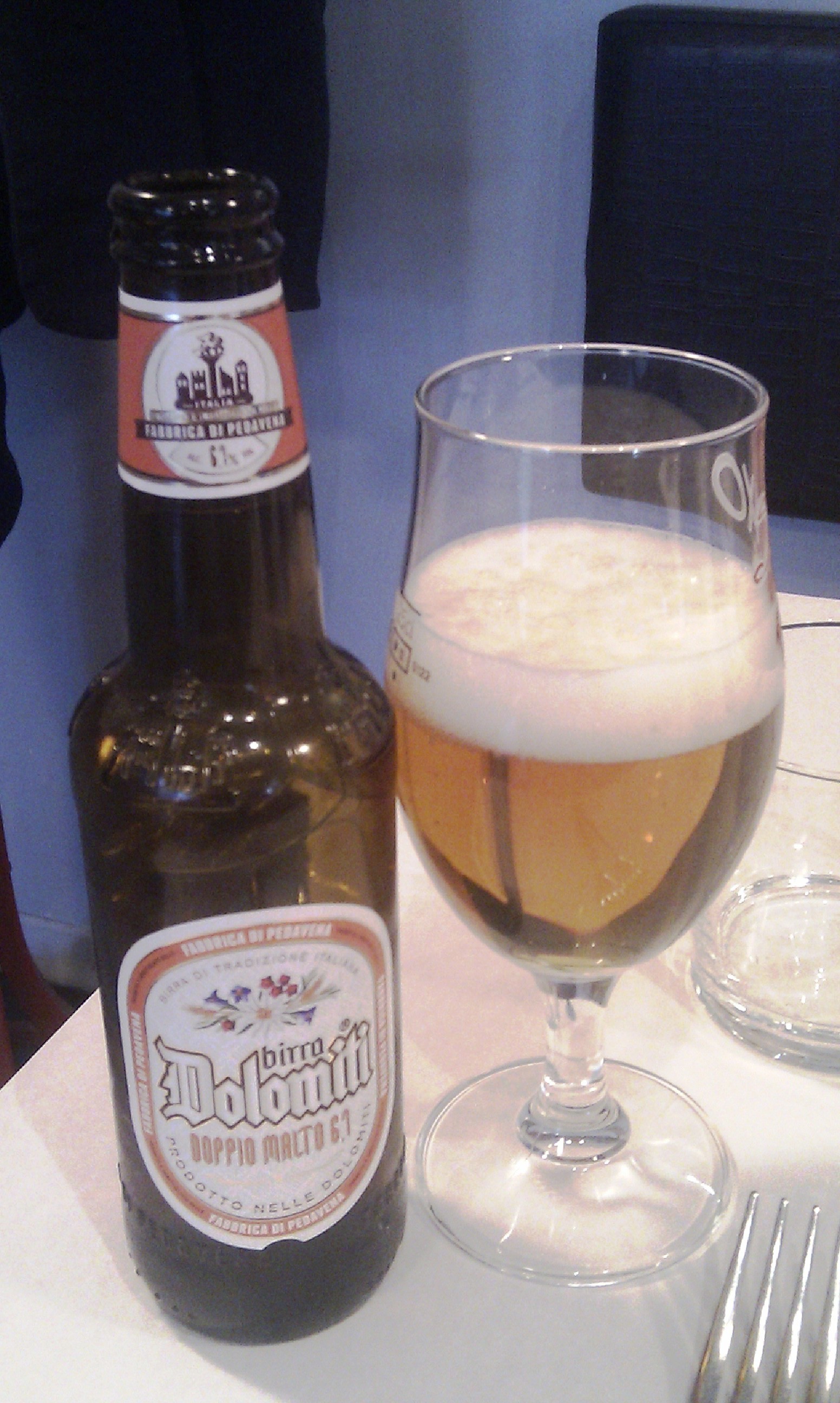
Birra Dolomiti Doppio Malto 6.7

Seeing the 40 beer-list, I of course had to go for the grain not the grape. (The wine list is short – only three whites and three reds if memory serves.) I asked for a recommendation of an Italian craft bee and the guy suggested a Birra Dolomiti Doppio Malto 6.7, then seemed to wince when I said okay. I don’t know why, but I wish I’d read his expression and changed my mind. I didn’t know this brewery – Birrificio Pedavena, in the Veneto – but it really wasn’t my kind of beer. It even had the kind of metallic taste that puts me off industrial beers and lagers generally. Which perhaps isn’t surprising – Padavena seems like a pretty big operation, founded in 1897 and even owned by Heineken from 1974 to 2004. Threatened with closure then, the brewery was instead bought in 2006 by another brewery that is found in the Birrifici industriali (“industrial breweries”) section of my Guida alle birre d’Italia 2013: Birrificio Castello, in Friuli-Venezia Giulia. This is another large brewery with historical connections to both Heineken and Birra Moretti. Ugh.

We did better on the beer front when we ate at the Via Portuense branch of the restaurant, though actually ordering the meal, and getting it, was like pulling teeth. The young boy attempting to wait really struggled. Furthermore, I’d got excited about seeing Orso Verde beers on the menu – I’d spied a bottle of their stuff previously and been taken by its label featuring… a green bear (un orso verde) – but they’d run out. Instead we ordered a Bastarda Rossa (“red bastard”) from Amiata, a brewery in Tuscany. It was a deep, dark russet colour, full-bodied and relatively strong at 6.5%. It had an almost fruity flavour, which may well come from the (IGP; indicazione geografica protetta) chestnuts that make up 20% of the fermentable mass, apparently. It’s also made with six types of malt and three of hops.

Bastarda rossa 2

So yes, a great beer. And while the chef wasn’t as good here as at the other branch of Osteria Pistoia, at least it’s a place that’s trying to do something a little fresh. Broadly the food was good, though my primo (a variant on pasta e ceci – with octopus) was totally underseasoned. But overall, both branches offered a buon rapporto qualità-prezzo. I’ll definitely return to Osteria Pistoia, but at this point I’m more inclined towards the Monteverde Nuovo branch – where the food was better (I suspect chef Alessandro Pistoia is based there), the waiting was more professional and the beer menu much, much longer.

[Apologies for crap pics. Esp the first one – taken on my old HTC phone. Now in the hands of some fence in dear old Napoli]

Leave a comment

Filed under Ale, beer

Durum wheat bread with linseed and farro grains

grano duro, farro, linseed bread

Another one of my bread experiments. For some reason I’d ended up with two packets of farina di grano duro – that is, flour made from Triticum durum wheat (with duro meaning “hard” in Italian and Latin respectively.) It’s more typically used for making pasta, but it seems to be a reasonable bread component too and is used fairly widely. I have used it in the mix with good results before, such as in my Absurdly wholesome multigrain, multiseed loaf, but this one made with a much higher proportion of farina di grano duro.

So anyway.

100g farro grains. I used farro perlato. With farro here meaning farro dicocco (Triticum dicoccum), also known in English as emmer. You could use any type of wheat grain (such as spelt grains), or even, say, pearl barley.
50g linseed (“good for you mane and tail” as my friend Stephen McGrath of Newton Livery, NZ, once told me)
8g fresh yeast
300g cooking liquid from the grain (see below)
80g leaven
100g strong white flour (I used what’s known as “Manitoba” in Italy)
400g farina di grano duro / durum wheat flour or fine semolina flour
10g fine sea salt

1. Cook the farro grains in water until they’re soft but a little chewy. This can take around 20 minutes, but will more likely be more. Keep tasting them to check.
2. Strain the cooked grains, reserving the cooking water.
3. Weight out 150g of the cooked farro grains. (You can use any leftovers for other breads, or add them to salads.)

Cooked farro grain
4. Grind the linseed to break it up a bit but don’t completely pulverise. You can use a pestle and mortar, coffee grinder or even a liquidiser goblet.
5. Cover the broken linseed with a little of the cooking water. (This will help soften it up slightly before it’s added to the dough, but arguably isn’t strictly necessary.)
6. Combine the yeast, 300g of the grain cooking water and leaven and whisk together.
7. Put the flours and salt in a large bowl and mix slightly to distribute the salt.
8. Add the yeasty mix to the flours and bring to a dough.
9. Turn out onto a lightly oiled work surface and knead to combine. As this bread is using so much durum wheat, the dough won’t be as springy and stretchy as one made with a strong white bread flour.
10. Form a ball and return the dough to the bowl (cleaned). Rest for ten minutes, then knead again briefly. Repeat this process once more.
11. Gently stretch out the dough, then add the seeds and grains. Knead to combine.
12. Leave the dough to prove in a bowl covered with a clean cloth until it’s doubled in size. Times will vary, according to the temperature and the liveliness of your leaven.
13. Once the dough has doubled, take it out of the bowl and knead briefly and gently before forming a ball. Cover and rest for 10 minutes.
14. Tighten up the ball, then place in a proving basket or bowl lined with a floured cloth, with the smooth surface downwards and the “tucked” surface upwards.
15. Cover and prove again until doubled in size.
16. Preheat your oven to 220C.
17. Turn out the dough on onto a lined baking tray.
18. I brushed mine with egg white as I had some spare, but you could use whole egg or milk to give slightly different glazes.
19. Cut a cross.
20. Put in the oven and bake for 20 minutes, then turn down the oven to 200C and bake for a further 20 minutes.
21. If it’s baked enough (tap the bottom, check the colour; don’t be afraid to overbake a bit more if you’re not sure it’s done), take out and cool on a wire rack.
22. Eat as you see fit.

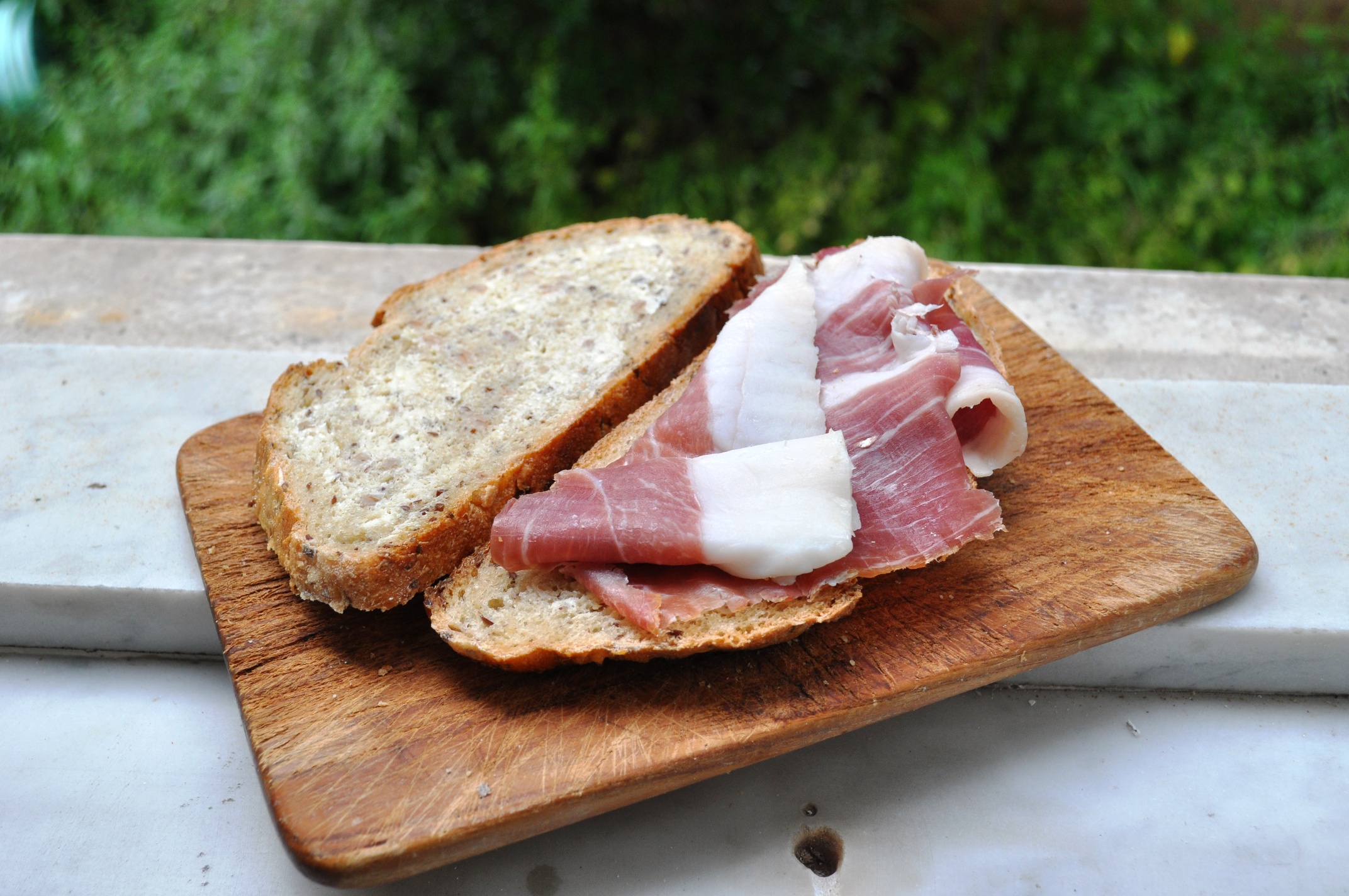
Prosciutto sandwich

Leave a comment

Filed under Breads, Recipes

Lemon kumquat cake with citrus curd and mascarpone

Okay, okay – I know it’s been pretty quiet round here lately but I’ve been busy working in the kitchen of the American Academy in Rome. Three intense, informative months at the Rome Sustainable Food Project came to a close last Friday. So without long days podding fava beans and agonising over the perfect cacio e pepe, some life will now return to Bread, Cakes and Ale.

As the RSFP was founded by renowned US chef and activist Alice Waters it seems only fitting that my first post in a while is based on one of her recipes. Given that I’m a cake obsessive, the first recipe I tried from The Art of Simple Food just had to be her core cake – the 1-2-3-4 Cake, which she says is the sort of simple, flexible recipe that can be manipulated to various ends: “Unadorned, it makes a simple tea cake perfectly suited for a garnish of fresh fruit; decorated, it can be anything from a birthday cake to a wedding cake to individual cupcakes.”

Also, as the RSFP is predicated on the ideas of a diet based on local, seasonal food, as well as not wasting food (all logical principles that our greedy, deluded species needs to acknowledge more), my version involves a few relevant twists.

Lemons are available pretty much the whole year in Italy, thanks to different varieties with staggered seasons. So lemons played a part. Also, we have a kumquat tree in our garden, with the fruit coming into season, so they’re in there too. Plus, I used some of the kumquats a year or so ago to make a flavoured vodka. Although the booze itself is long gone, the steeped zest has been hanging around in my kitchen looking for a purpose in life, so that played a part too.

Finally, though, before the recipe, a gripe. The Art of Simple Food is a beautiful book, essential reading for anything interested in food who wants to commit more to sustainable eating. However, all its recipes are in cup measures. This frustrates me. Cups are awkward and inaccurate – just Google around for conversions, and you’ll find they vary according to source. Only by a few grams here and there, but it’s enough to mess up the chemistry of something that needs accuracy like a cake recipe.

Cups are especially baffling when talking about things like butter – a cup of butter? How does that work? Do you have to melt it, fill the cup, then let it set up again? Or just squash a load of grease into a cup, then painstakingly scrape it out again? (Okay, I’m half-joking.)

I’ve said it before, but will say it again, grams (aka grammes) make life so much easier. For consistency and for scaling up recipe when necessary you can’t argue with a decimal system.

Yes, yes, I know that the cake is named a 1-2-3-4 cake for the quantities of ingredients, and yes yes, I can imagine a frontier mom in her gingham apron making it thusly with an old tin cup, but it’s the 21st century people. Electronic scales. Grams. Simple.

So anyway, I found an actual cup in our kitchen that conforms to the standard US cup, which is half a US pint or 236.59ml, then went through the ingredients weighing them on an electronic scale. (Again, I do liquid measures in grams too – it’s consistent, it’s more accurate, and it’s easy with a jug, electronic scales and a tare function.)

Having said all that, things like half a teaspoon of a powder don’t convert so well so I’ve included them in both formats.

Okay. The recipe(s).

The cake

Ingredients
4 eggs
240g milk
375g plain (all-purpose) flour
4 teaspoon (20g) baking powder
1/2 teaspoon (2.5g) salt
400g caster sugar
225g unsalted butter
Grated zest of 3 lemons
Grated zest of 5 kumquats
Finely chopped zest of 5 kumquats soaked for a year in vodka with cinnamon and sugar. (Okay, you’re very unlikely to have this ingredient. Don’t worry… just leave it out!)
Juice of half a lemon, around 20g

Preheat the oven to 180C.
Grease and base line two 21cm cake tins.

Method
1. Sieve together the flour and baking powder.
2. Separate the 4 eggs.
3. Beat together the sugar and butter until light and fluffy.
4. Gradually beat in the egg yolks.
5. Beat in all the zest and lemon juice.
6. Alternately fold in the flour and milk, though don’t beat or over-mix.
7. Whisk the egg whites to soft peaks.
8. Add a third of the egg whites to lighten up the mixture, combining well but again without over-mixing.
9. Gently fold in the rest of the egg whites.
10. Divide the mixture between the cake tins.
11. Bake for around 35 minutes. The cakes should feel firm to the touch and a skewer or cocktail stick should come out clean when inserted.
12. Cool in the tins then turn out onto a wire rack and cool completely. Wrap them if you want to use them the next day. The baked cake keeps well.

The filling

250g mascarpone
Citrus curd made with another recipe from The Art of Simple Food. Read on…

Ingredients
3 lemons, washed and dried
5 kumquats, washed and dried
2 eggs
3 egg yolks
2 tablespoons of milk
65g caster sugar
1/4 teaspoon salt
85g unsalted butter, cut into small pieces.

Method
1. Zest and juice the citrus fruit. You probably won’t get much juice from the kumquats, but don’t worry, a hint is fine and the oils in the zest are doing much of the work anyway.
2. Lightly beat together the other ingredients, except the butter.
3. Stir the juice and zest into the beaten mixture.
4. Add the butter and put into a small, heavy-bottomed non-reactive saucepan (eg stainless steel, ceramic or glass; not aluminium or copper)
5. Cook the curd mixture very slowly, stirring continually, over a low heat. Do not overheat or let it sit too long without stirring or the egg will start to curdle. If it starts to curdle, you can plunge the (bottom of) the pan into a sink of cool water to cool it off, then press the mixture through a sieve or fine strainer and continue. I know this because it’s what I did… Curds aren’t really my forte, but this one worked well in the end.
6. Cook until the mixture starts to thicken and will coat the back of a metal spoon and a line drawn with a (clean) finger will hold its shape. This is called a nappe. I didn’t know that word until yesterday, so thanks to Cameron for the education.
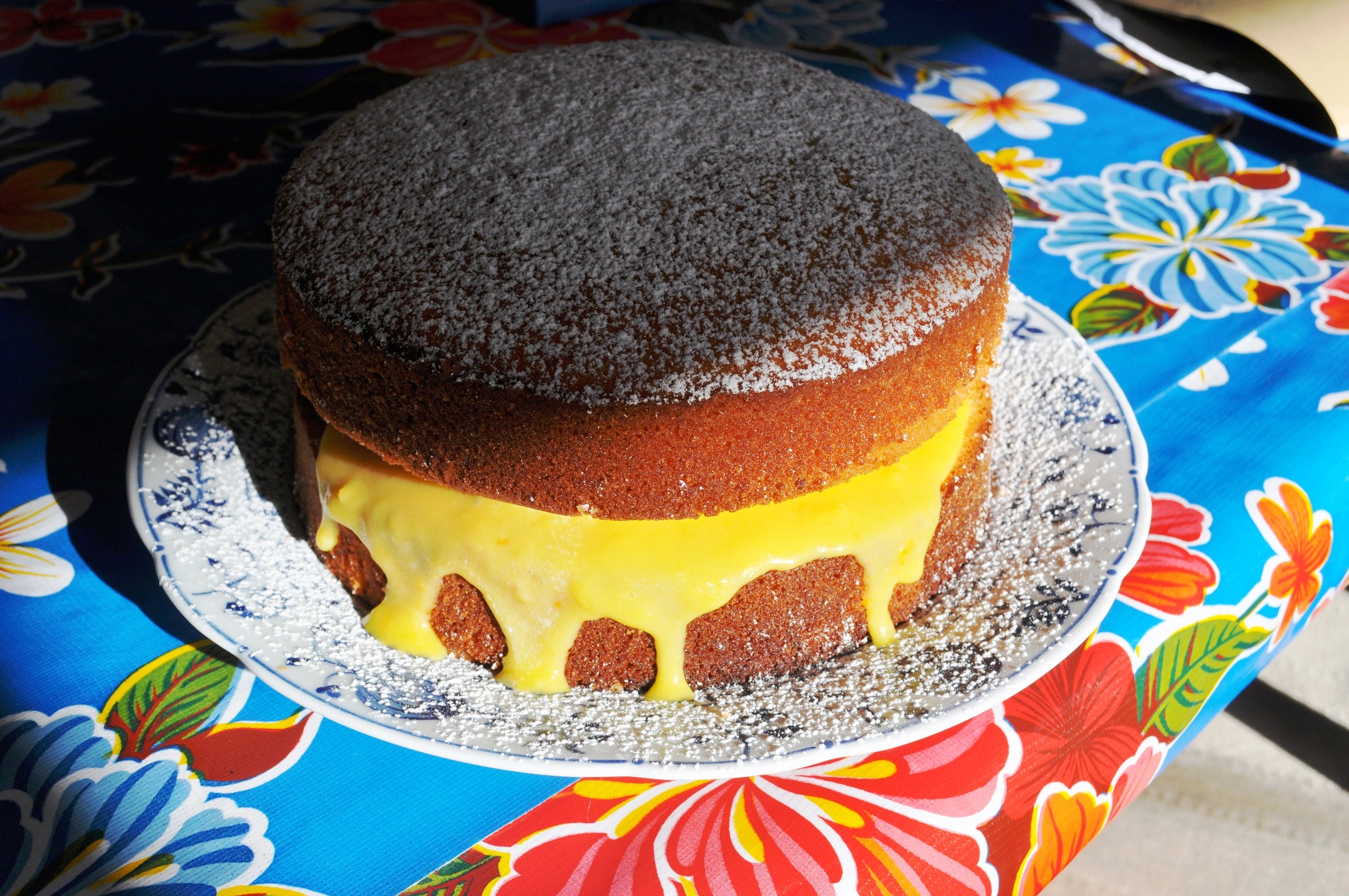
7. Pour the curd into a bowl, jug or jar to cool. It’ll thicken when it’s cooled further in the fridge. As you can see from the photo, mine was still a little runny, but it was pretty good after a few hours more in the fridge.

Assembly

I think I fell at the final hurdle slightly. I wasn’t very refined with the mascarpone, so I’ll write here what I should have done, not what I did.

1. Beat the mascarpone slightly to soften it up. If by any freak chance you have any kumquat liquor, you could beat a little in. Or use a little limoncello.
2. Spread the top of the lower cake with curd. You can slice off the top if it’s peaked too much in the oven, to make a more level surface. I used about half of the curd I made from the above recipe.
3. Spread the undersize of the upper cake with mascarpone.
4. Sandwich the cakes together.
5. Sprinkle the top with sifted icing sugar (aka powdered sugar, confectioners’ sugar or zucchero a velo – “veil sugar”)
6. Eat large slices. You can serve with extra curd too, or make a swoosh on the plate if you’re that way inclined.

5 Comments

Filed under Cakes, Recipes

How hard can it be to… buy stamps?

As with many ex-pats, I have a love-hate relationship with Rome. There are just so many ways to get exasperated. Now, I’m British, so I know a thing or two about the seemingly mundane things in life leading to exasperation (eg hoping that a train will run on time, or having any successful, succinct, constructive communication with companies that deal with communications, like ISPs) but really, things are taken to a whole new level in Italy. (Or Rome specifically, as that’s the only placed I’ve lived in Italy.)

So, I’ve been trying to retain a nice, old-school correspondence with a dear old chum who lives in New York, by way of postcards. She always finds wonderful vintage ones, I generally only manage lame tourist ones, but the sheer fact of getting something amiable and interesting in the snail mail is the motivation. I’ve got a postcard of part of Luca Signorelli’s wonderful frescoes in the Duomo in Orvieto to send her, but it’s stuck on my desk, awaiting a stamp. I knew I needed stamps, it’s been on my to-do list a few weeks, but I’ve been a bit busy to actually go and buy some.

Today’s my day off, though, so “Stamps” duly went on the shopping list, and off I trotted into the April sun, which is already hot enough to make a brisk walker sweat. (One of my main problems with living in Rome – I love to walk everywhere, at a swift pace, but at least four months of the year the heat give the process a somewhat uncomfortable, antisocial dimension.)

Buying a paper, I asked my regular newsvendor if he had any stamps as I’m sure I’ve bought them before from edicole (news-stands). He said no, he was a bit short of stamps for postcards. Okay, I’m in Trastevere, it’s full of tourists, and postcard outlets, said outlets must also have stamps. So I did a 360 and went over to a tabaccheria that has a lot more cards than it does nicotine products. The lady said she had stamps, but only if I bought postcards. Wuh?

Another errand I had to run was picking up a book, so I went to the bookshop – which also sells postcards – and asked on the off-chance if they had any. This really isn’t so strange in Britain, as most bookshops, and news agents, and supermarkets, and, heck, just about anywhere, sells stamps. But no, they didn’t have any. She suggested the post office – which is obvious, of course, but I’d be trying to circumvent such a place as they’re usually defined by long queues and long waits.

As I’d tried all the other options, though, I felt I had to. And at least the post office would have stamps, right? Wrong. Of course a post office in one of the most touristy parts of Rome wouldn’t have stamps, how silly of me. There was no queue at least, but the grumpy woman behind the counter said, “No, we don’t have stamps” – in a tone that inferred it was a stupid bloody request in the first place. She then said that I’d have to go over the river to another post office. Over the river? Just to buy stamps? Don’t be silly.

So I gave up, and headed home, back up the hill. As I reached my neighbourhood, I debated visiting the big local post office there. But by this time it was past 1pm, and far be it from a state-run institution to stay open at lunch time. The employees needed their hour and a half lunch break, where they could perhaps shrug their shoulders, with a few ah behs, in a brief mention of their lack of stamps.

4 Comments

Filed under Italy, Rome

Easter in Rome – colomba, casatiello, seasonal pizzas and the like

If you like baked goodies (and considering you’re visiting a blog named Bread, Cakes and Ale, I have to conclude that you do), Easter is a great time to be living in Rome. Sure, the Spring might be making half-hearted attempts to arrive, and sure the mild + damp has resulted in my first 5am mosquito strafing (damn them), and sure the city council might have decided to move my favourite farmers market out of walking distance (from Testaccio’s Ex-Mattatoio to Garbatella – *weep*. End of an era) BUT the bakeries the past week of so have been full of seasonal specialities. Which compensates nicely.

This is my, um, second Easter in Rome, and I vowed I’d try and make X or Y after seeing, buying, consuming and enjoying them last year. But you know what, I can’t get that really nice light airy crumb on an enriched dough in my domestic oven, and I’m working long hours, so I thought stuff it, I’ll just buy an X. In this case the X refers to colomba.

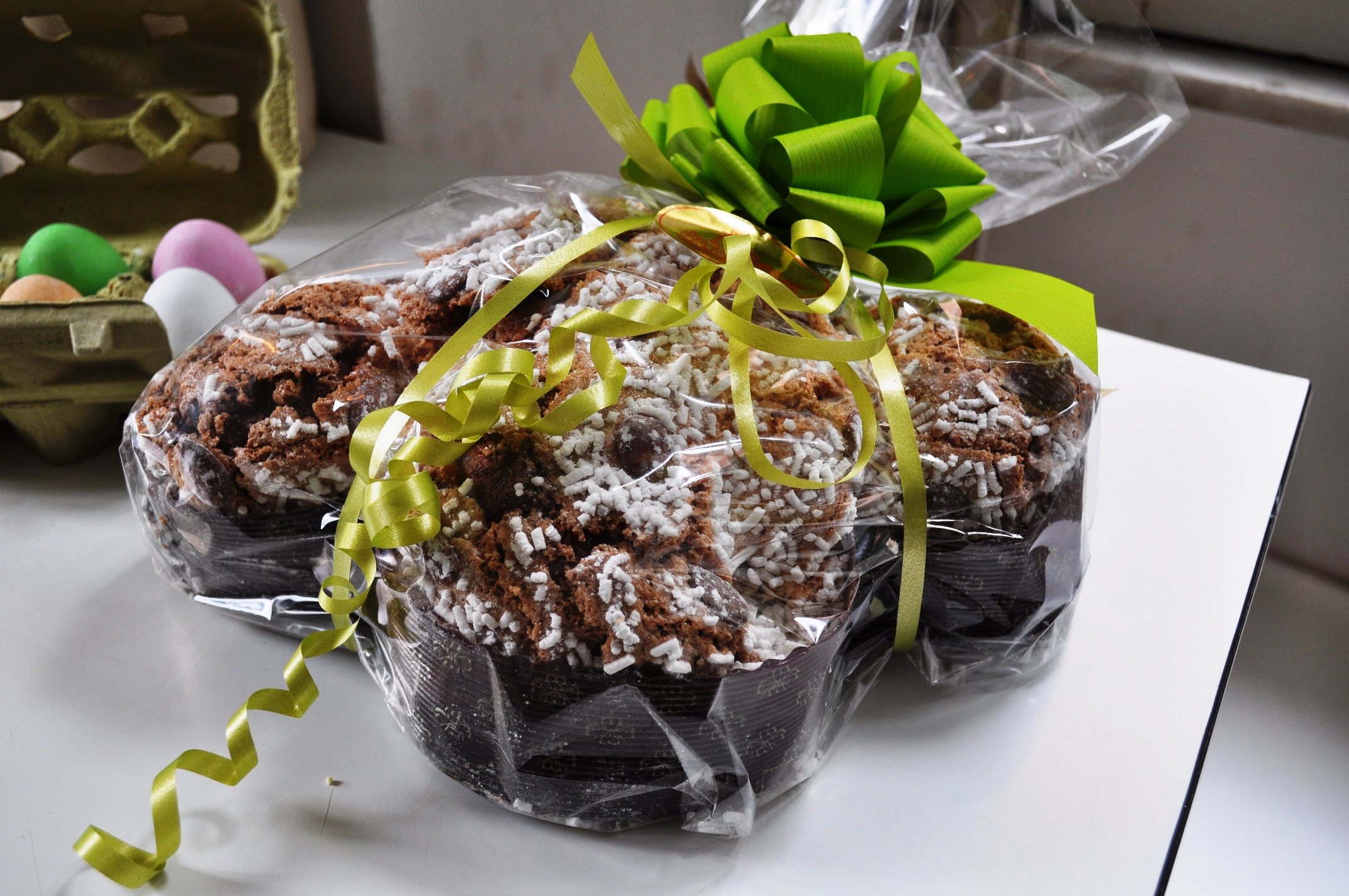
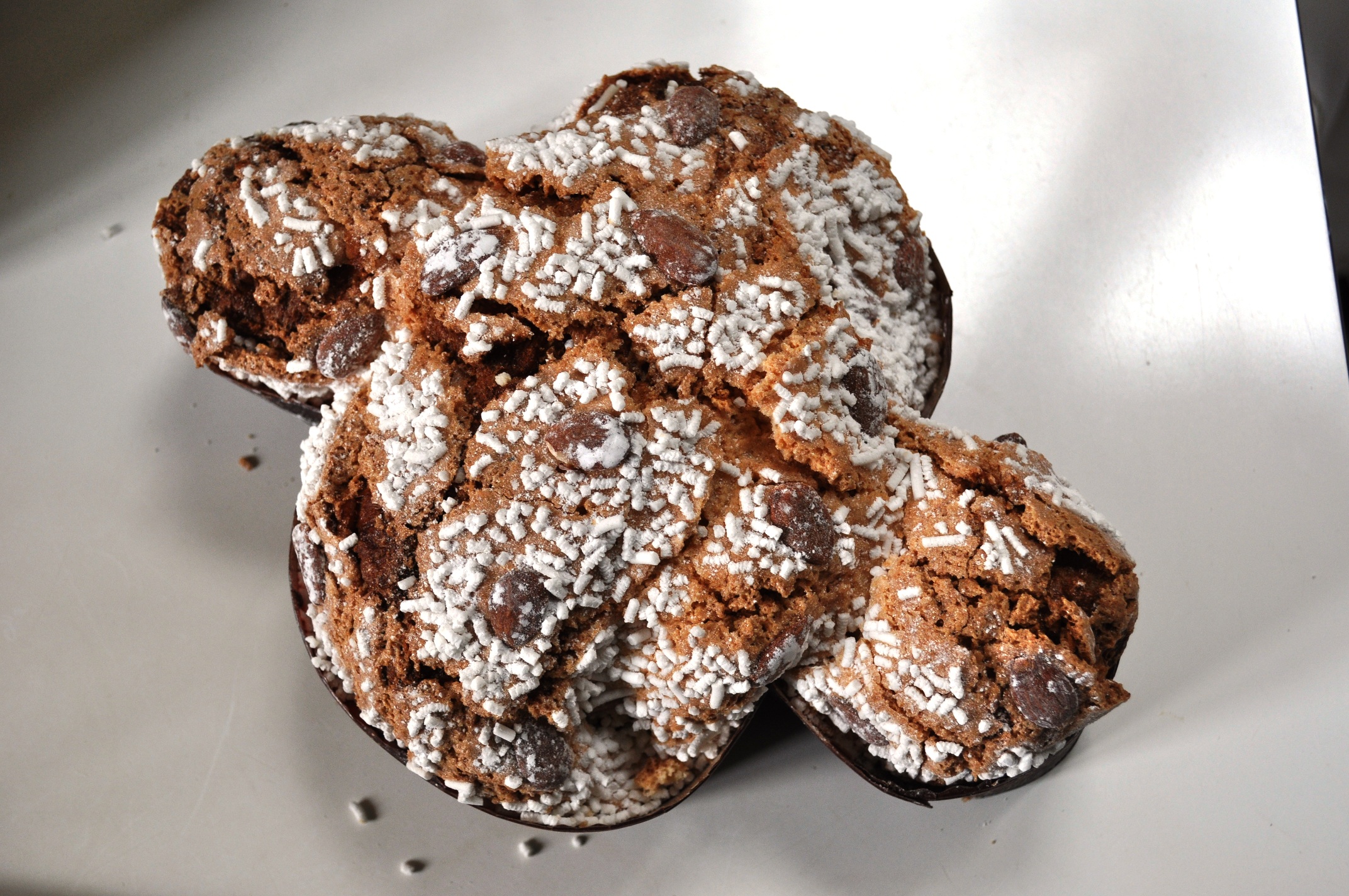
Colomba di Pasqua

Colomba means dove in Italian, so this is an Easter dove cake. No doves are used in the bake though. Instead, Colomba is basically the same kind of enriched dough as used in a Panettone, just baked in a different form. Indeed, it’s shaped like an X, appropriately enough for Easter and considering my phrasing above. Though the X isn’t supposed to represent a cross, it’s supposed to represent the shape of a bird, in flight. You know, wings outstretched on either side, head, tail. Ta da.

We bought ours from Pasticceria Nonna Nani, Via Giacinto Carini 35, Monteverde Vecchio. It was made with a natural leaven though it had no trace of a sour sourdough flavour, presumably thanks to the generous presence of sugar, eggs and candied peel. Very nice.

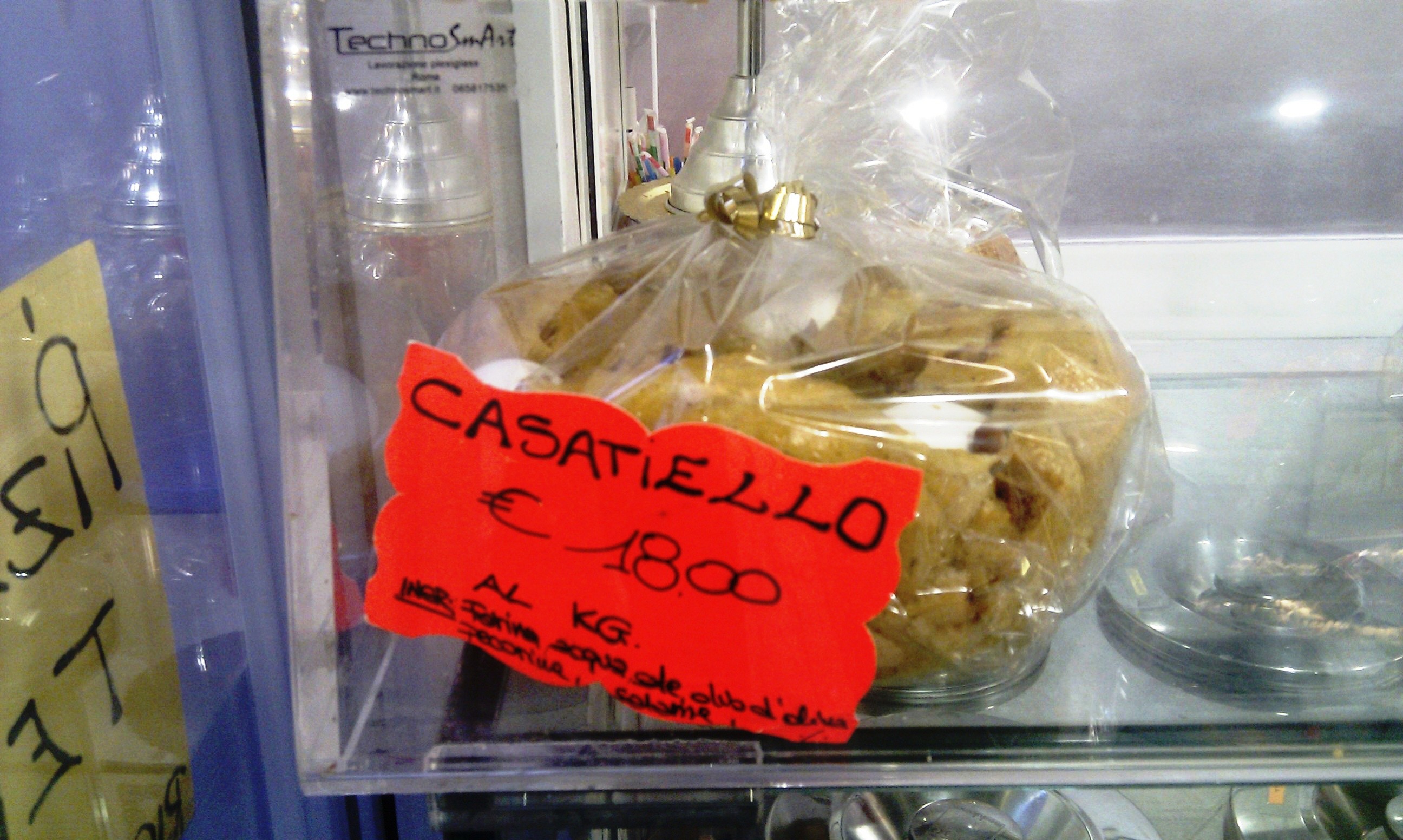
Casatiello

While buying the Colomba I also spied Nonna Nani’s Casatiello. I’ve seen these a lot in Roman bakeries the past two Easters, though apparently they’re not Roman traditionally, they’re Neopolitan. Indeed, a Neopolitan lady who was giving me Italian classes last year gave me some.

This bread is most notable for the presence of eggs placed in the dough before baking, whole, intact and intero, including the shell. The dough is made with lard, and also contains cheese(s) and cured meats. This recipe on the Giallo Zafferano site includes pancetta and salami, but the Italian Wikipedia entry says it should contain cicoli. Otherwise known as ciccioli. In the ‘Pig’s Fat’ entry of Gillian Riley’s Oxford Companion to Italian Food, she says “Strutto is the name of lard: fat from all parts of the carcass, internal and external, rendered down – the delicious crispy bits left over are called ciccioli.”

So now you know.

Now, I’m not much of a meat fiend, so I’ve never really been that drawn to Casatiello, though my wife Fran is a meataholic, and was keen to bake something meatily traditional this Easter. It’s the end of Lent, so a blow-out is kinda traditional I suppose. As I was researching Italian Easter baked goods, sweet and savoury, I came across pizza gaina/pizzagaina, also known as pizza chiena.

Pizza gaina, aka pizza chiena

This seems to be a type of pizza rustica or pizza ripiena that’s made for Easter. Before you say, “eh, pizza?”, note that the word doesn’t just refer to flat bread discs with stuff smeared on top here in Italy. Pizza rustica, for example, is a generic term for things that are basically rustic pies – though rather than being made with a pastry crust, they’re made with a yeasted pizza dough crust. Pizza ripiena, meanwhile, literally just means stuffed or filled pizza. No one really seems to be that in agreement about the origins of the word pizza, so I’m not going to go on an etymology ramble. If you read Riley, or John Dickie’s Delizia!, the term seems to have had many and varied uses.

Oddly, I can’t really get a handle on where pizza gaina/chiena is from. I’ve not actually seen it in bakeries here in Rome and most of the recipes online seem to be American, or Italian-American, rather than Italian. And even Britain’s own Nigella Lawson has a version, though she makes no mention of Easter, and simply calls it Pizza rustica. Indeed, it’s quite a natural fit with British food, as it’s really not unlike a ham and egg pie.

The version Fran did was basically just an excuse for a meat (and cheese) fest. She made a basic white dough and used it to line a springform cake tin. She then filled the case with various strata of cheese and meat. Vegetarians – look away! Vegans – look away and weep!

In this pic (above) you can see the freshly baked pizza gaina, still cooling in its springform tin. Alongside is a wholemeal farro loaf.

Pizza ricresciuta (or cresciuta) di Pasqua

Another type of Easer pizza I have seen in Rome is the pizza ricresciuta. This is even more unlike your familiar disc-shaped pizzas because it’s tall, round loaf or cake eaten for Easter breakfast. Indeed, it seems to come in sweet and savoury versions, though I’ve mostly seen cheesey ones in the windows of Roman bakeries. Crescere, btw, means to grow, to grow up, to increase, so I guess you could imagine it as a pizza dough that’s been left to expand, to shake off the shackles of disc-like flatness.

And finally

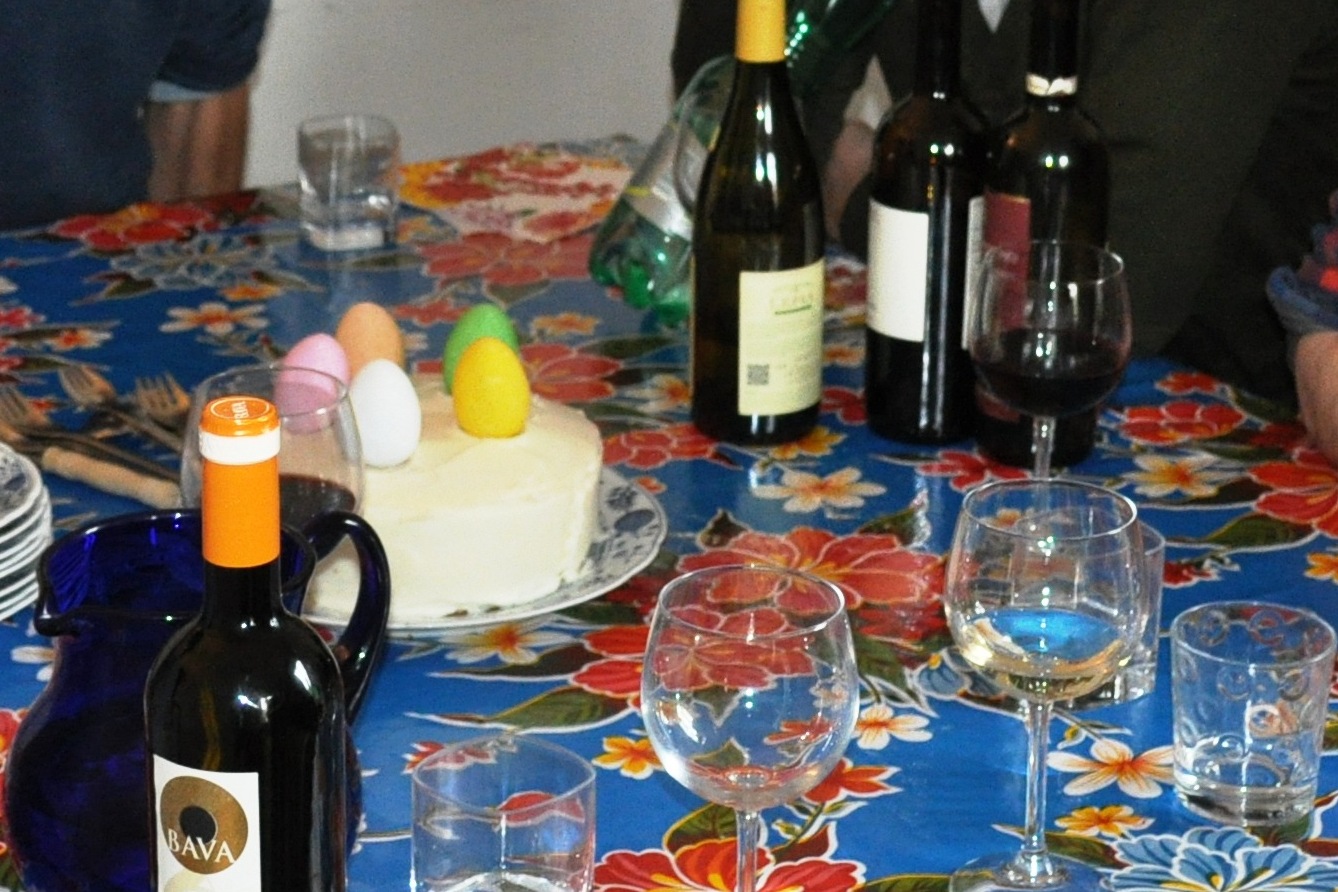
Look, I know the Simnel Cake is the traditional British Easter cake, but I really don’t much like dense fruit cakes, okay? In our family, we’ve always just made a lemon sponge decorated with lemon butter icing and Mini Eggs. So that’s just what I did. Annoyingly, I didn’t really get to thinking about it until Easter Sunday then made it Easter Monday. What I really thought would be a nice Italian twist would be to put a layer of mascarpone in the middle, along with a layer of lemon curd (maybe that bit’s not quite so Italian), then maybe just a sprinkle of icing sugar on top. None of that happened though. I noobed my lemon curd, and we couldn’t get any Mini Eggs, so instead went with those sugar-coated chocolate eggs that resemble real eggs. And are really hard on the teeth.

Then I forgot to take a proper photo, which is a shame as it was cute. All I’ve got is this crop, with the cake nestled among many wine bottles. We were  doing a sensible, sophisticated wine tasting, honest.

Wine and Easter cake

Anyway, Happy Easter, belatedly.

1 Comment

Filed under Breads, Cakes (yeasted)

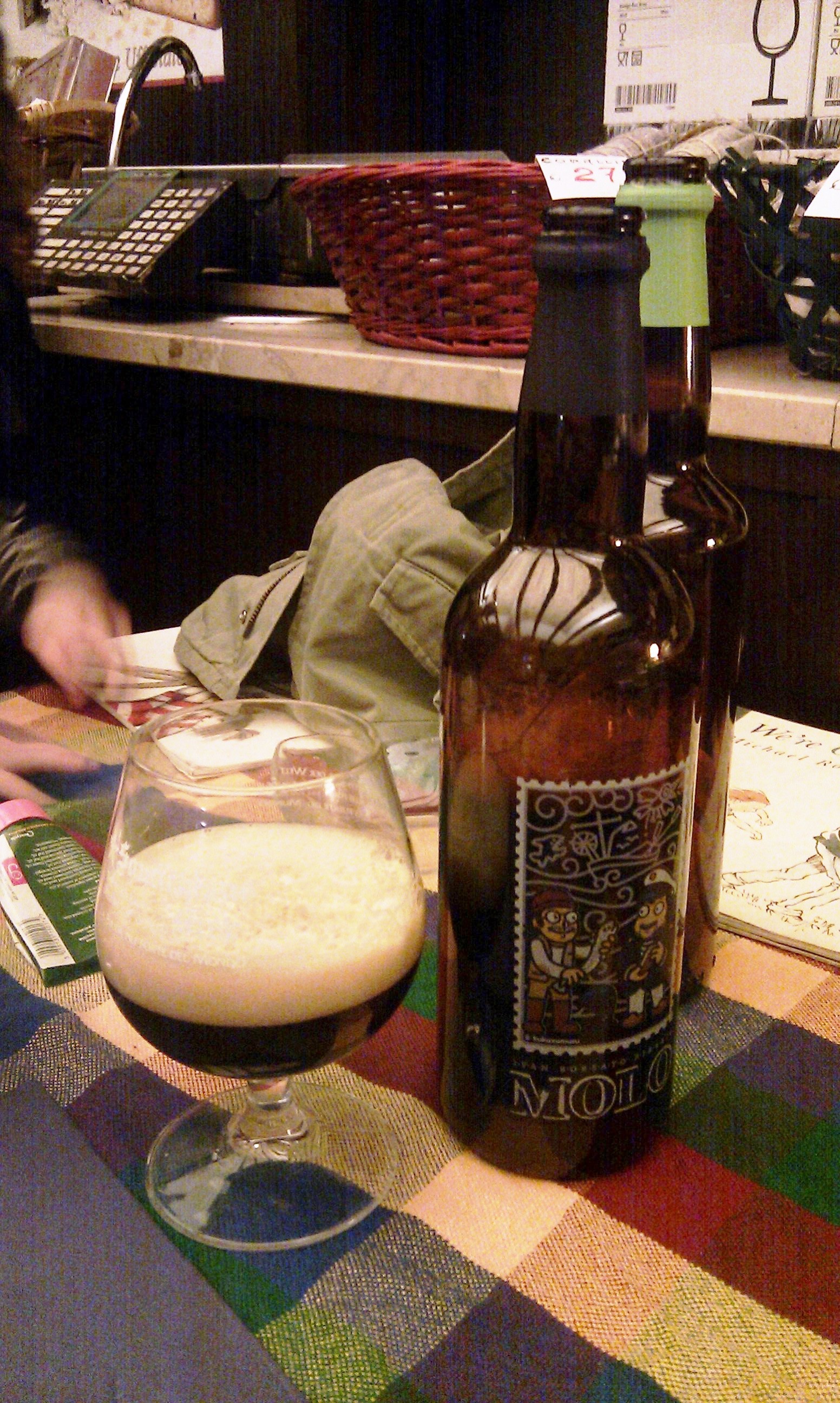
Casa Veccia’s Molo

Back at Oasi della Birra in Testaccio, with my chum Rachel and my wife Fran. Fran’s beers of choice are unfailingly porters and stouts. As the bar – disappointingly – doesn’t have any Italian beers on tap, we were drinking bottled beers. We asked for a 32 Via dei Birra Altra, a double-malted dark brown ale. They’d run out, but offered us another dark beer. This turned out to be Molo from a micro birrifficio (microbrewery) called Casa Veccia. Not one I’d heard of before. Turns out it’s in Povegliano, in Treviso province of the Veneto, inland from Venice.

Reading the info on Casa Veccia’s Facebook page, the story of the brewery seems not unlike that of several of the other Italian microbreweries I’ve been learning about. (Indeed, it’s a story that’s repeated in the microbrewery scene across the world.) Ivan Borsato, a chef and cookery teacher, says he started making beer for a laugh with three friends in April 2009 but by the end of the year he’d glimpsed an opportunity take it to a professional level. By January 2011 they were producing their first commercial beer, Dazio, an American Pale Ale, then Formenton, a wheat beer.

Borsato, meanwhile, is recognised on all the labels, which says “Micro Birrificio Casa Veccia Ivan Borsato Birraio” with birraio meaning master brewer. (And veccia meaning “vetch“, that is the Vicia genus of Fabaceae, the pea family or legumes.) In fact, I’m not really even sure what the brewery is called, as my beer guidebook simply lists it as Ivan Borsato Birraio.

The labels are also distinctive for their Matt Groening-esque cartoons. (Actually designed by Kulkuxumusu from Pamplona, Spain.) Molo’s label seems to feature some kind of exchange between salty sea dogs, swapping a fish for a bottle of beer.

Anyway. Enough pre-amble. The beer.

The most notable thing about Molo is that it’s a dark, dense 6.5% stout that contains tawny porto, that is tawny port – port that’s been aged in wooden barrels and, according to Wikipedia, imparted with a nutty flavour through gradual oxidation. Now personally, I don’t touch port, not after a work Christmas party about 20 years ago when I learned the hard way how it  gives the worst hangovers. Something to do with congeners. But it certainly added a depth of flavour to the Molo, an almost rare meatiness alongside the more typical stouty flavours of well-roasted and toasted malt, slightly burnt biscuit etc. Though nothing fishy, despite the image on the label.

2 Comments

Filed under Uncategorized

The Unexpected Pharmaceutical

Even after a year and a half living in Rome, there are still many aspects of everyday life that confuse me. Any engagement with pharmacies, and even erboristerie (herbalists – places that basically sell a lot of the stuff that’s similar to what you’d find in health food shops), is one of these aspects. Unless I’m just buying some plasters (cerotti), the experience almost always yields unexpected results.

Pharmacies are ubiquitous in Rome, but we frequent the one nearest our flat. The staff know us now (we’re repeat and memorable visitors for sorry reasons I won’t go into now), and they’re friendly and helpful. But that doesn’t always mean you get quite what you want. And even if you do, broadly, get what you want, there’s bound to be something just plain weird about it.

So this week. Yesterday we visited both the pharmacy and the erboristeria. Fran needed something to sooth a cough that was keeping her (well, us) awake at night, I needed some cream for my hands. I’m working in a busy kitchen and the constant hand-washing with industrial strength soap is just simply wreaking havoc with my skin, darling.

Nothing too challenging or unusual there.Right?

We asked in both shops, they acted like they knew exactly what we wanted, we had a quick look, said ok, thanks, and made the purchases. Then we got home and looked a little closer. Fran said the cough mixture tasted weird. Cough mixture is always weird and full of unnecessary shit – like artificial sweeteners for example. Over-the-counter mainstream medicines have enough dodgy shit in them, so for me adding chemical sweeteners just seems like overkill. Plus medicine doesn’t need to taste sweet or nice, it’s not supposed to be a pleasant treat. The weirdness here? Vanilla and apricot flavourings. Vanilla? Is that really associated with cold rememdies?

As for my hand cream. It was okay, and when I tried it in the shop, its smell reminded me of our holiday on the Giglio last year as its primary ingredient is Helichrysum italicum, a herb that covers the island. But the weird factor was that the box says the cream is “Protective and Bleaching”. You what? Never mind the fact that something that bleaches is surely hardly good for you, why would you want a restorative skin cream to bleach your skin anyway? Perhaps it’s just a weird translation. Or not. The original Italian blurb is Protettrice e Sbiancante – protective and bleaching, or brightening, or blanching. It’s perturbing. I quite like my skin tone and don’t need it bleached or blanched thanks. A friend suggested it might be for old ladies wanting to bleach away liver spots. Thanks so much, lady in the shop, for lumping me with that demographic.

Other examples of this bewilderment include trying to buy some sort of basic antiseptic cream for small cuts, and being persuaded to buy something that, it transpired, contained antibiotics. Really, if I’m going to use antibiotics, I want to save them for when there’s a serious chance of serious infection, not when I’ve nicked my finger with a knife. We live in an era when antibiotics really really need to be used very selectively due to the rise of resistant “superbugs” and having them in an over-the-counter cream is arguably irresponsibly stupid.

Another friend also mentioned she’d asked for something for the flu. She came away with something, tried it, felt nothing, and only then discovered it was homeopathic. Whatever your feelings about homeopathy, when you’ve got a crappy flu, you really just want something a bit heavy duty than sugar water with unquantifiable magic vibrations.

Of course, the moral of the story is read the box closely before purchasing. But if you’re in a queue, or are dealing with a friendly pharmacist who behaves like they’re being very helpful and entirely understand your needs, or your Italian isn’t good enough for the medical blurb on the box, this can be tricky. Ultimately, sometimes all you want is something familiar. But tough – there ain’t no Lemsip in Italy.

5 Comments

Filed under Italy, Learning Italian, Rome

Bender Ale

This is what I’ve mostly been drinking lately, a pale or blonde American wheat ale. I’m not usually a big fan of wheat beers – partly because I find them a little sickly, partly because I made myself a little sickly on more than one occasion back in the day when I first discovered Hoegaarden. (It must have arrived in Britain around 1995, as I’ve got clear memories of drinking it, and Leffe, too much when I lived in Newcastle.) This one, however, is rather pleasant. It’s also the only beer on tap at the moment in the bar of the American Academy in Rome, where I’m currently working as a volunteer in the kitchens.

My background is in sitting-on-my-arse trades, notably as a film journalist, so being on my feet all day is pretty hard yakka. So a beer is most welcome at the end of the shift. Indeed, even when I’m working the pm shift (starting at lunch time, finishing after dinner), I start dreaming about beer at around 6pm.

Once we’ve cleaned up around 10pm, the beer is calling to me. In this case, it’s Bender calling to me. Now, if you’re British, and of a certain age, that’s a slightly unfortunate name for a beer, but if you’re not British, or are primarily a Futurama fan, it won’t carry any baggage of 70s school playground name-calling. Bender, of course, is Futurama’s resident alchoholic robot. (Though he’s not an alcoholic in the addiction sense – he needs booze to recharge his fuel cells.)

Despite the name of the beer, it is in fact Italian, from a microbrewery called Vecchia Orsa (“Old Bear”). The brewery is part of Fattoriabilità, a social coop in Bologna province, in Emilia-Romagna, set up in 2006 and brewing, I believe, since 2008. Visit their site, and they even seem to have some adorable donkeys. Whether they’re used for salami down the line I don’t know.

The beer itself is very drinkable, though as the weather warms up (and it is warming up fast – the Roman winter of coats and sweaters seems to turn a corner to a spring of t-shirts in just days), it’ll be even better. It’s a fresh, citrussy wheat ale that will be very pleasing drunk outside on a warm, sunny day. Plus, for me, it doesn’t have the strange slightly thick, doughy-ness that puts me off most wheat beers. I’m struggling to articulate this, but as much as I like baking bread, I don’t love the idea of drinking the dough, and that’s what wheat beers often feel like to me.

So anyway, as long as I remain on the pm shifts I think I’ll be enjoying a few more of these…

Leave a comment

Filed under Ale, beer