Category Archives: Cakes

Splits, clotted cream and a Roman summer afternoon tea

Devon splits, Cornwall splits

Among the few things we crave but are just impossible to source in Rome are halloumi cheese and clotted cream. For those who don’t know, the latter is a nectar-like dairy product that comes from the Southwest of England. Fran’s from the southwest and I have strong connections, so we both have clotted cream in the blood. So to speak. It’s an essential component of a proper cream tea.

I’ve always used clotted cream with scones, but it’s also used with a less well known variation the cream tea: with splits. When I smuggled a massive tub of clotted cream back home from Blighty last week, I resolved to make splits, and do a bit of a comparison with scones.
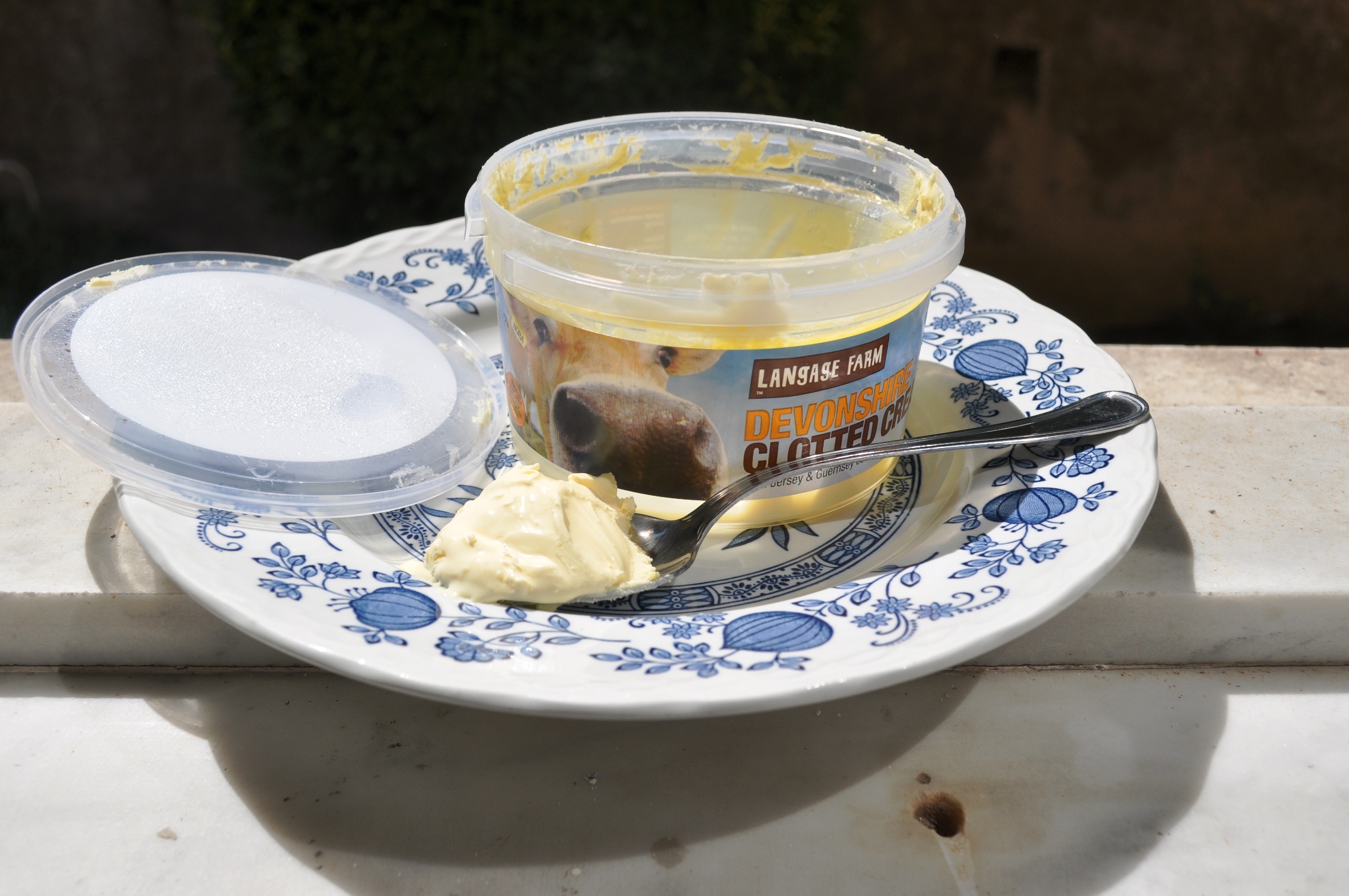
A large - nearly empty - ot of Langage clotted cream

What is a split anyway? Well, it’s basically just a cream bun, made with a basic enriched dough, split and smeared with jam and clotted cream. (Messily smeared in our case – I’m a little ashamed we didn’t do it a bit more neatly, but then I’m no food stylist and we just wanted to scoff them!). As Rachel pointed out when we were doing just that yesterday, as it’s really not unlike a maritozzo con la panna. Though with slightly more demure amounts of cream. Sort of – clotted cream is cooked, so it’s denser and richer than whipped cream.

A split and a scone

The next question involves their origins. Are they Cornish splits? Can they be Devonshire splits? Or is the Devon cream tea always based on the split’s easier-to-make cousin the scone? I’ve always assumed splits are actually “Cornish splits”, but then I started encountering recipes for “Devonshire splits”. What you call them probably just depends your loyalties. The white cross on black or the white cross on dark green? (Something that’s almost entirely irrelevant to people outside the spatting ground of southwestern England.)

And is there a difference between a Devon and a Cornwall version? Discussing splits, and Elizabeth David’s recipe, here Nigel Slater suggests Devon splits are smaller, though the recipe I based mine on was called “Devonshire splits” – and they’re quite big.

Initial dough mixture for Cornish split, or Devon split - flour, sugar, butter, milk, yeast

And why do these two counties get their knickers in such a twist anyway? After all, surely pasties and cream teas are from the West Country, not from either county in particular? Hey, I just love the West Country in general; I’ve been going there all my life and my mother’s mother’s family is from border country in northeast Cornwall/northwest Devon. Although there are cultural differences between Devon and Cornwall, there are plenty of cultural similarities too: clotted cream for starters.

This delicious treat is, frankly, from the West Country in general and neither county in particular. Especially not now in our industrial age when clotted cream is no longer produced by local farms and dairies but instead comes from larger producers like Langage (Devon) and Rodda’s (Cornwall) – both of which are available in supermarkets in both counties and beyond.

Kneading Devonshire split dough

Anyway, I’ve made scones all my life and I even did a very scientific experiment to address the important question of whether cream or jam goes on first (includes recipe). This is my first go at splits though. They were very nice, but I’m not sure they’ll dethrone scones from my tea-time repertoire. For starters, scones are easier to make (just don’t overwork the dough!) and have a satisfying crunchy crust and crumby interior, which I found preferable to the more bread-like consistency of the splits.

Anyway. Here’s the recipe:

Makes 12 splits.

25g fresh yeast (aka lievito di birra)
300g full-fat milk
25g unsalted butter
500g strong (high protein) white bread flour (farina di Manitoba in Italy)
3g fine sea salt
25g caster sugar

Shaping balls of dough for Devonshire splits. Or Cornish splits

1. Warm the milk and butter, melting the latter and bring the liquid to around body temperature.
2. Crumble the yeast into the liquid, and give it a whisk.
3. Put the flour, salt and sugar in a large bowl and stir to combine. (If you want to use easyblend yeast, add 10g now instead).
4. Add the liquid to the flour mix, and bring together.
5. Turn out and make a dough, kneading until smooth.
6. Put the dough in a clean bowl, and cover with clingfilm/plastic wrap.
7. Leave to ferment and prove until doubled in size.
8. Turn out, gently deflate and divide into 12 pieces – they should each weigh around 68-70g.
9. Form the pieces into balls, keeping them covered with a cloth.
10. Place the balls on a baking sheet, and again, keep them covered.
11. Let them prove again, for about 20 minutes, until they’re soft to the touch. (Time will vary depending on the temperature.)
12. Preheat the oven to 200C.
13. Bake the balls for about 15 minutes. Again, time will vary depending on your oven. You want them to start browning nicely on top.
14. Remove from the oven and cool completely on a rack.
15. When cool, slice the buns on a diagonal. Into this split (hence the name) add jam of choice and clotted cream.
16. Serve dusted with icing sugar.
17. Eat, messily. Whether you’re nearly two or 42.

Balls of dough, pre-bake, for Devonshire splits. Or Cornish splits

I clearly lied in my last post about getting back to talking about Italian and Roman beer and baked goods didn’t I? Oh well – if it’s any consolation, we were sitting in a Roman garden, drinking prosecco, getting eaten by mosquitoes and being glowered at my our oddball neighbours when we ate these.

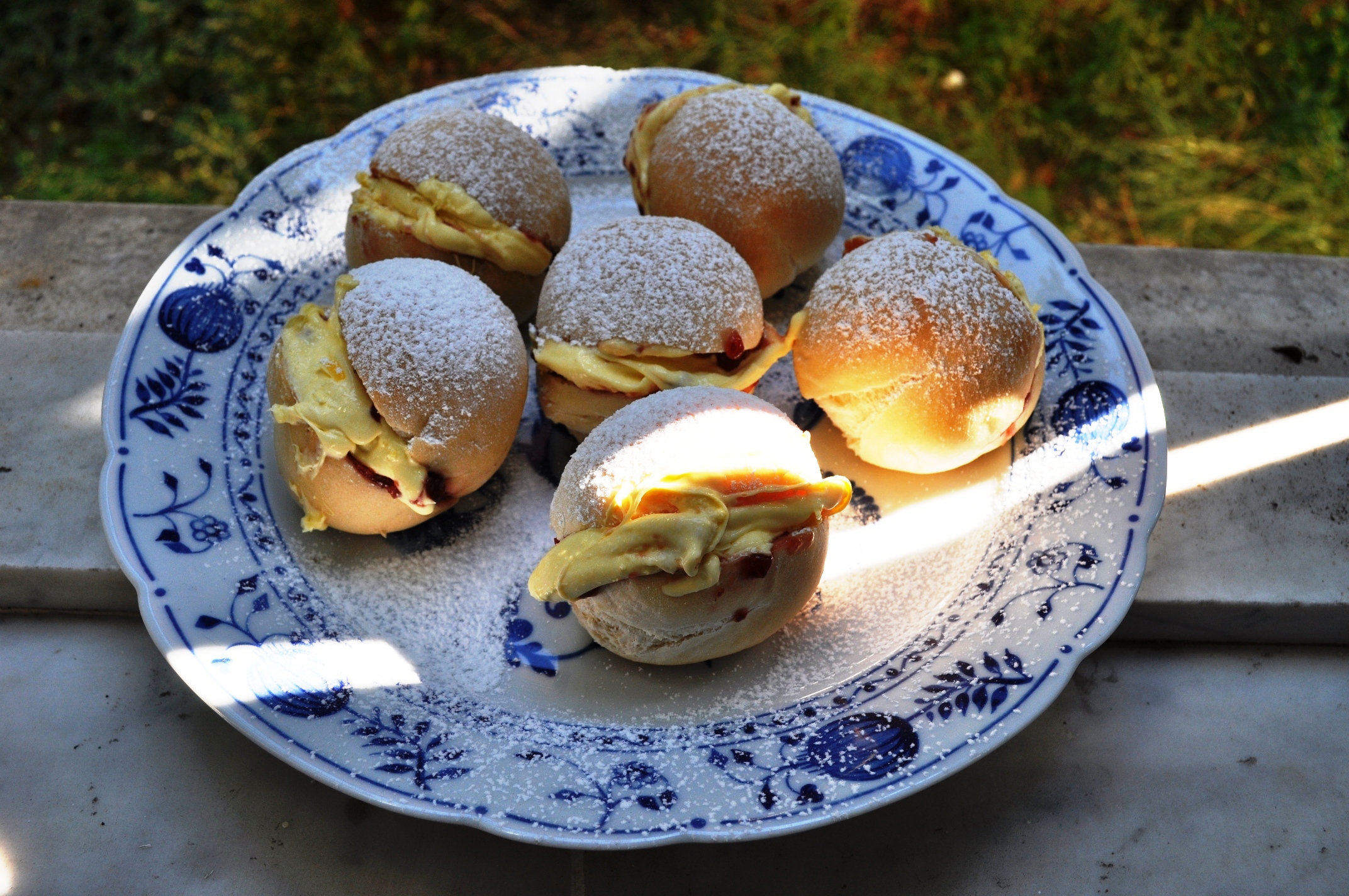
Freshly baked  Devonshire split buns

So it was a kind of English-Roman hybrid cream tea. But probably the best cream tea consumed in Rome for a while. I don’t make any bones about saying my scones are excellent, and good clotted cream is always awesome. Plus, well, Babington’s, the famous “English” tea room by the Spanish Steps, serve their cream with whipped cream not clotted cream – which is frankly just an abomination. No contest.

11 Comments

Filed under Breads, Cakes, Recipes, Uncategorized

Pine nut cheesecake, or cheesecake della nonna

Pine nut cheesecake, cheesecake della nonna

If you’re in a Roman restaurant and they offer you desert, it’s quite likely you’ll encounter torta della Nonna – that is “Grandma’s tart” or “Grandma’s cake”. I’m not sure about the labour laws, but all this pudding-making must keep granny pretty busy.

Sources vary, but torta della nonna is either a Florentine or a Ligurian dish. Though surely any nonna has her own torta? There are variations, but most commonly in Rome it’s a tart made with a sweet pastry crust and a filling based on custard and/or ricotta. Its defining feature is pine nuts, pinoli.

This post isn’t, however, about torta della nonna. As I had some leftover cookies that had been smashed on their journey to and from the park for a picnic on Sunday, I thought I’d make a cheesecake with a della nonna twist: ie, with the addition of pine nuts.

A note on the cookies
I made some cornmeal cookies – they were basically like a digestive, but with a slightly different crunch, and a few spices (cinnamon, ginger). They worked well, but you can use whatever biscuits you like: digestives are most typical for UK cheesecakes, US recipes use graham crackers. My friend Juli-from-Jersey said the cornmeal cookies reminded her of snickerdoodles, though they’re cookies with a name so ridiculous I can’t quite bring myself to discuss them.

I won’t include the cornmeal cookies recipe, but will say digestives are so easy to make you don’t need to reach for some plastic-wrapped stuff from a factory. I’ve included a simple recipe at the bottom of this post. If you do use this recipe, I’d add some cinnamon and ginger to the crumb base mix.

A note on the candied peel
Only use your own candied peel, or other hand-made stuff. Don’t use that yucky sticky stuff you get in tubs from the supermarket. Peel is easy to make. Honest. Just Google it, if you’ve not tried before. I’m still using some of my candied-vodka-infused-kumquats-from-the-garden-peel.

A note on cheeses
Often, cheesecake recipes will just say “cream cheese” in the ingredient list. It’s a bit vague. Though perhaps it doesn’t matter what cream cheese, as a baked cheesecake mixture seems pretty forgiving. Here I used mascarpone and robiola. The latter could be replaced with something like Philadelphia, if you really had to. You could also do, say, half-half mascarpone and ricotta. I might try that next time as you can get stupendous fresh ricotta here in Roma.

Pine nut cheesecake slice, cheesecake della nonna

Ingredients
Base:
40g hazelnuts
120g cookies/biscuits like digestives
60g butter

Cheesy bit:
250g mascarpone
200g robiola
2 eggs
Zest of 1 lemon
100g caster sugar
30g candied peel
60g pine nuts

To serve:
30g pine nuts
Icing sugar

Method
1. Pre-heat the oven to 180C.
2. Toast the hazelnuts until starting to brown.
3. Grind the hazelnuts in a food processor until fairly fine, then add the cookies and grind to a medium crumb.
4. Melt the butter in a pan, then combine with the hazelnuts and cookie crumbs.
5. Push the crumb mix into the bottom of a 20cm loose-bottomed cake tin.
6. Combine the cheeses, eggs, sugar, and zest, blending well by hand or with a handheld zizzer.
7. Finely chop the candied peel and add to the cheese mix, along with the pine nuts.
8. Pour the cheese mix onto the crumb base.
9. Bake for around 50-60 mins until the top is browning and even cracking slightly, and firm to the touch.
10. Remove the sides of the tin, and leave to cool completely.
11. When the cake is cool, toast the extra pine nuts and sprinkle on top, dusting the whole lot with icing sugar.
12. You could serve it with some whipped cream, for added deliciousness. We didn’t as it’s hard to get nice cream here in Roma, despite the cornucopia of other wonderful dairy products.

Extra! Free! Digestive biscuits recipe
90g butter
120g wholemeal flour
120g oatmeal
40g caster sugar
Pinch salt
Pinch baking soda
1 egg, beaten

1. Preheat oven to 200C.
2. Rub butter into flour, stir in the rest and bind with beaten egg.
3. Roll and cut out rounds.
4. Prick with a fork.
5. Put on baking sheet, sprinkle with oatmeal and bake in a hot oven till browned.

2 Comments

Filed under Biscuits, cookies, Cakes, Pies & tarts, Puddings & desserts, Recipes

Plum and almond muffins

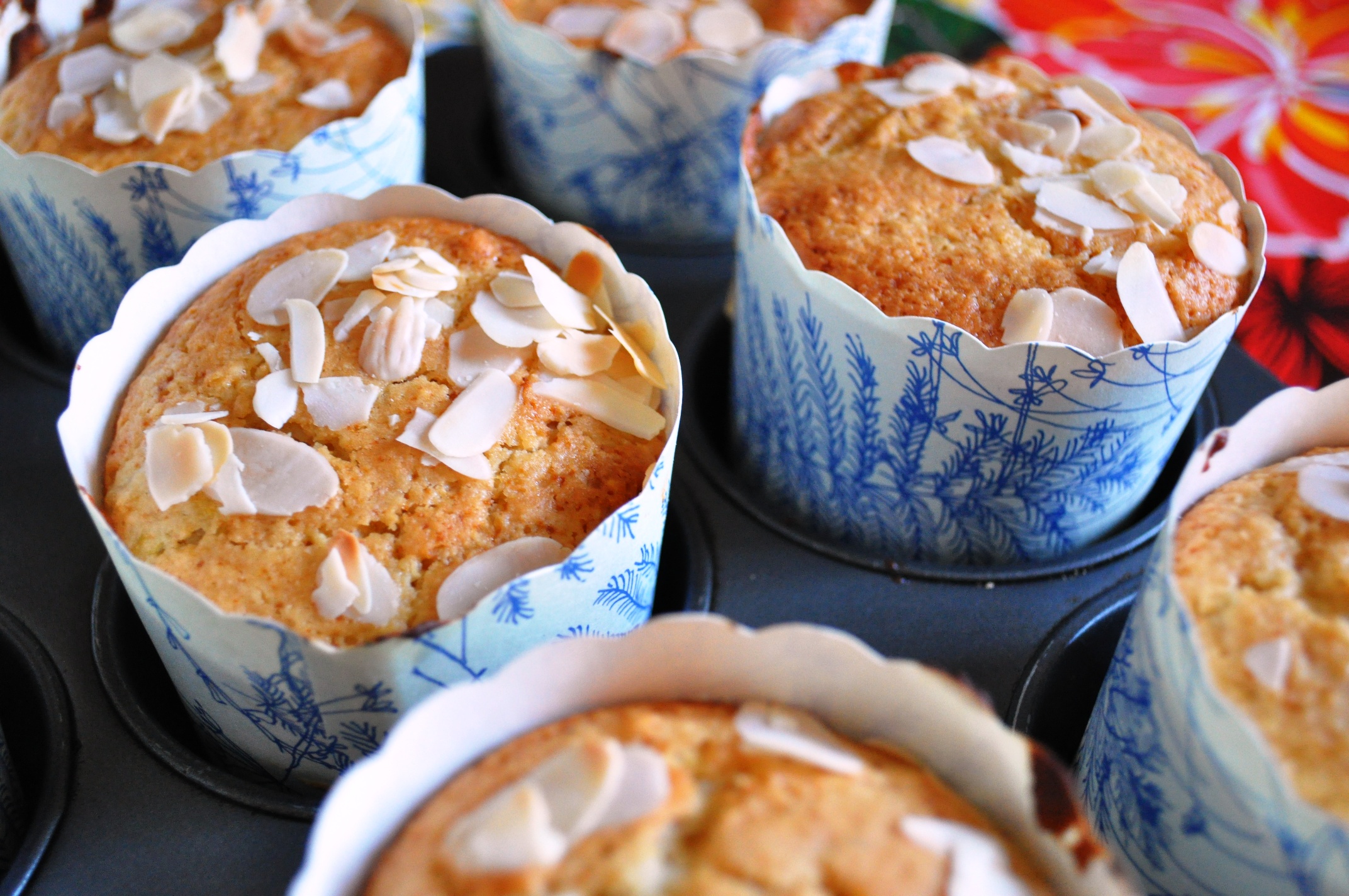
Freshly baked plum and almond muffins

At the weekend, our next-door neighbour gave us a big tray of plums. We used the majority of them to make spiced plum ketchup (recipe at the bottom), but had some left over.

I don’t like plums. In fact, I don’t much like fruit generally… though I can eat it happily if it’s baked into something with evil refined sugar. Even better if it’s then served with vanilla ice-cream, gelato or cream (especially clotted cream: West Country caviar). So I was planning to use the plums to make some kind of torta di prugna (plum cake). I found some recipes, worked on them, headed for the kitchen and strapped on my apron – only to find the missus had left the bottom of my spring-form cake-tin at work. Gee, thanks wife.

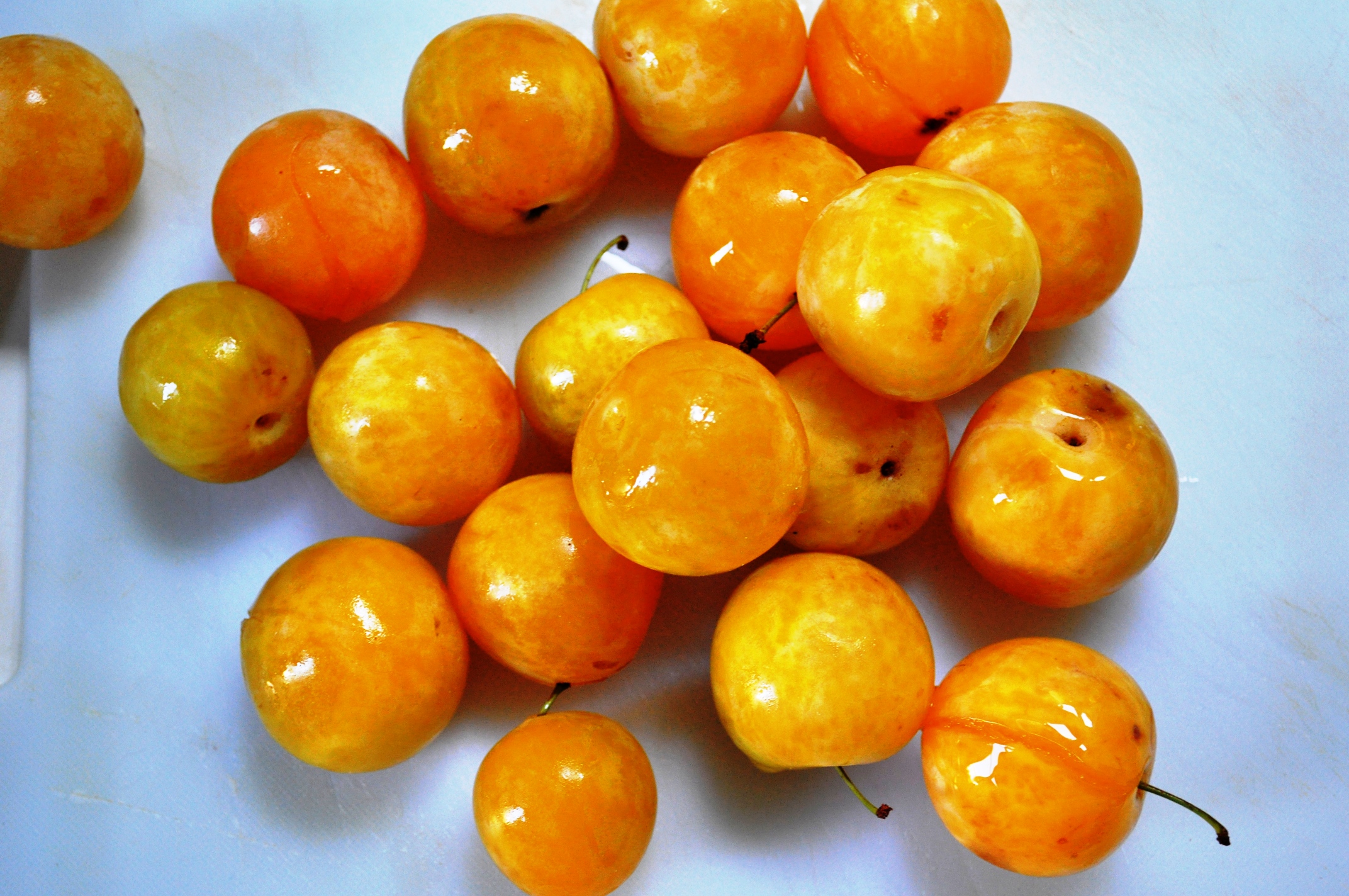
Plums

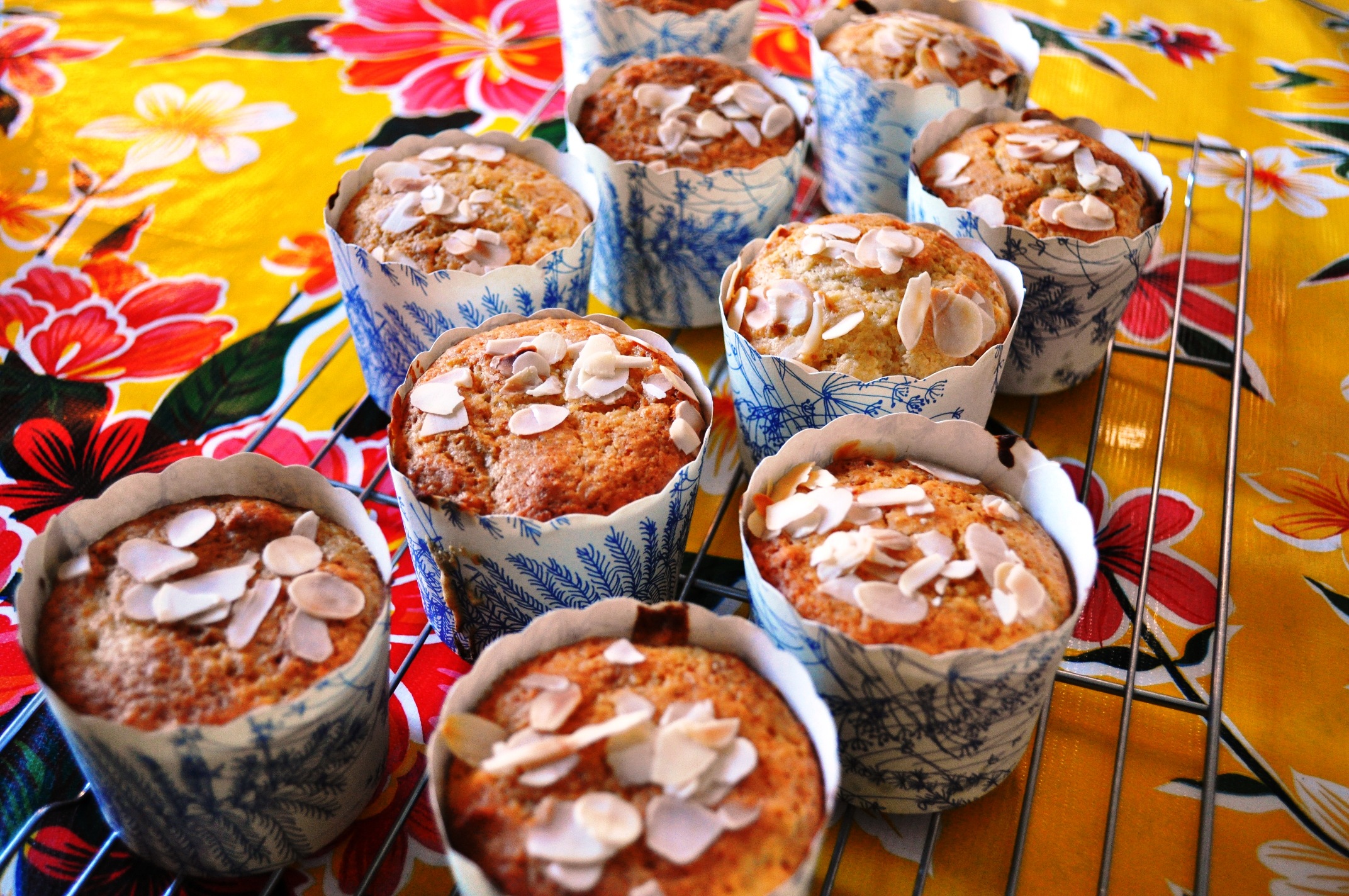
So instead, I thought I could use some of the fancy muffin cases1 I bought from a kitchenware stall on Testaccio market that’s full of lovely wood, enamel and crockery stuff; all a bit old-fashionedy-vintage-style-hip, but delightful. These cases are very handsome, though they don’t quite sit right in my muffin tray. Hence, some of the muffins turned out a bit wonky. Plus, I would have liked the muffin top to have peeked out of the case a bit more (ahem), but hey, this was – as usual – a fairly experimental recipe I adapted from other recipes, so you learn by doing right?

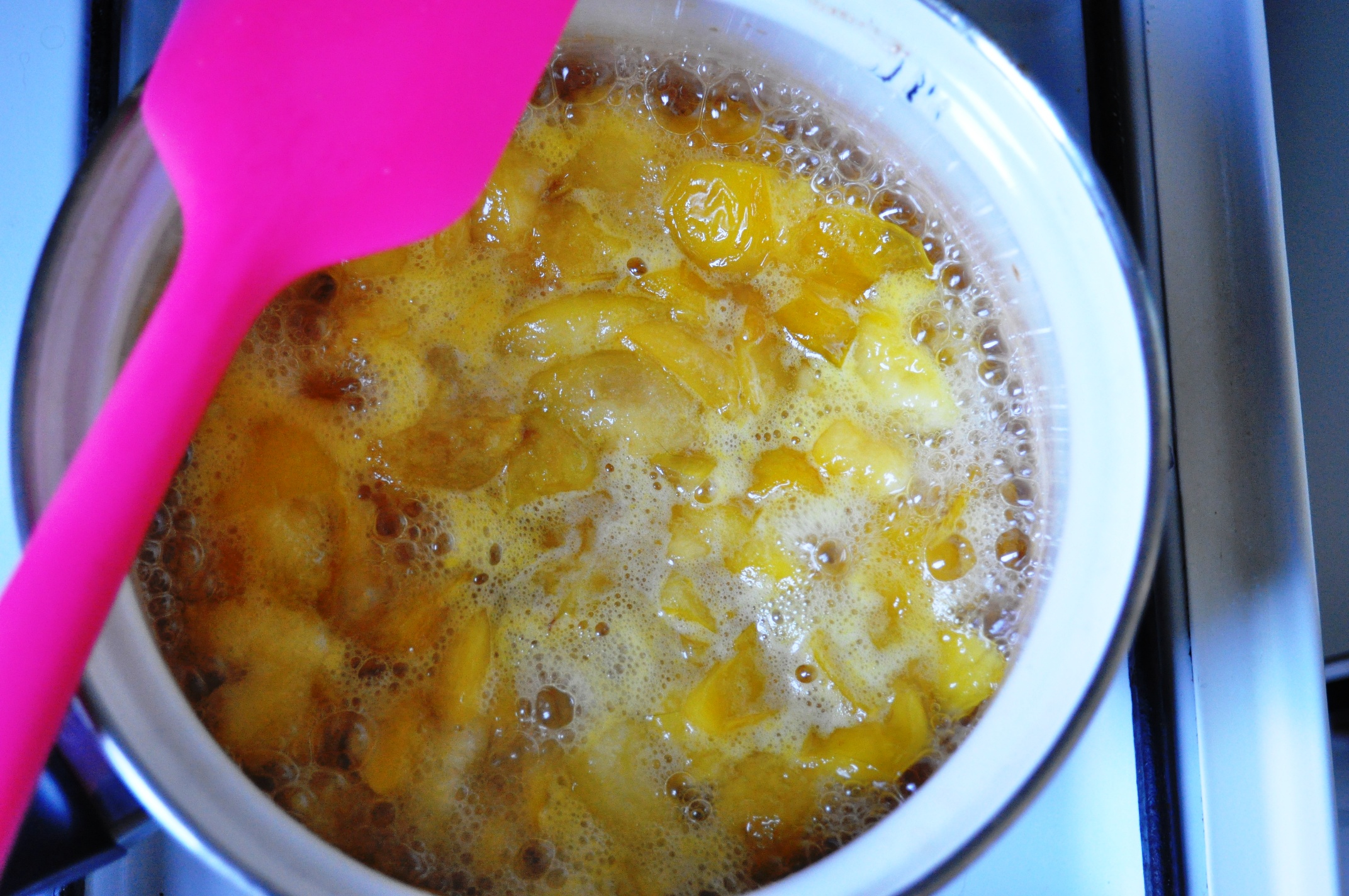
Making a sweetened, stewed, sloppy semi-puree of plums

As for the plums, I much prefer dark purple ones, but our neighbour gave us a yellow variety, possibly a Mirabelle or similar. They were over-ripe, but that’s fine. I wasn’t aiming for chunks, just some flavour in the form of a sweetened, stewed, sloppy semi-puree.

Also, I think some crystallised ginger or preserved ginger would have been nice in this recipe but I didn’t have any. Not even sure I can get it in Roma, though I did tend to have a few jars malingering in the back of the fridge when I lived in the UK.

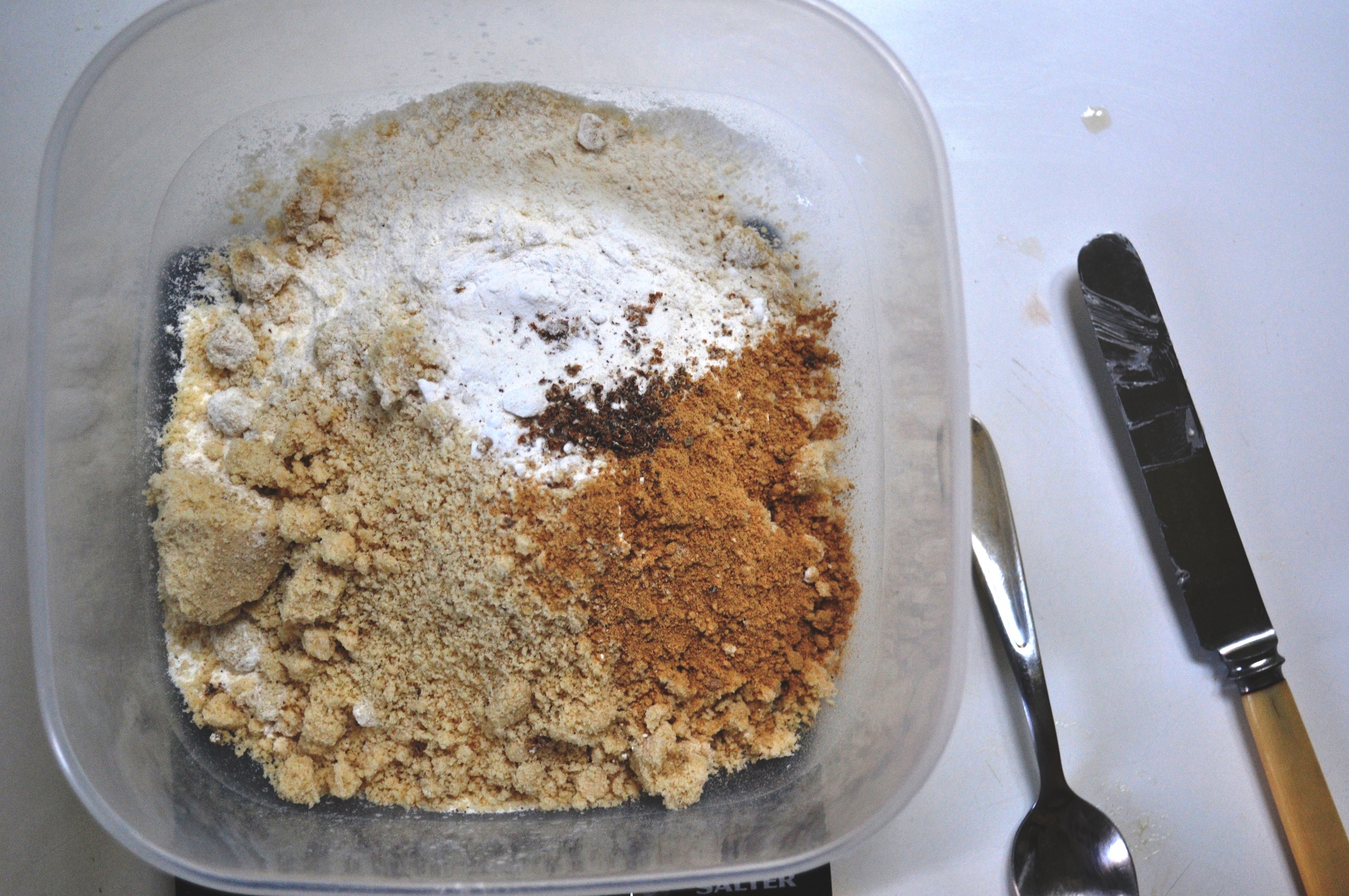
Flour, ground almonds, ground ginger, cardamom

Recipe ingredients

A dozen-ish good-sized plums
50g golden syrup (use sugar if not available)
100g caster sugar
100g butter
1 egg
40g yogurt (none of that low-fat nonsense)
220g self-raising flour2
80g ground almonds
1 tsp baking powder
1/2 tsp baking soda
1 t ground ginger (or more, if you really like ginger)
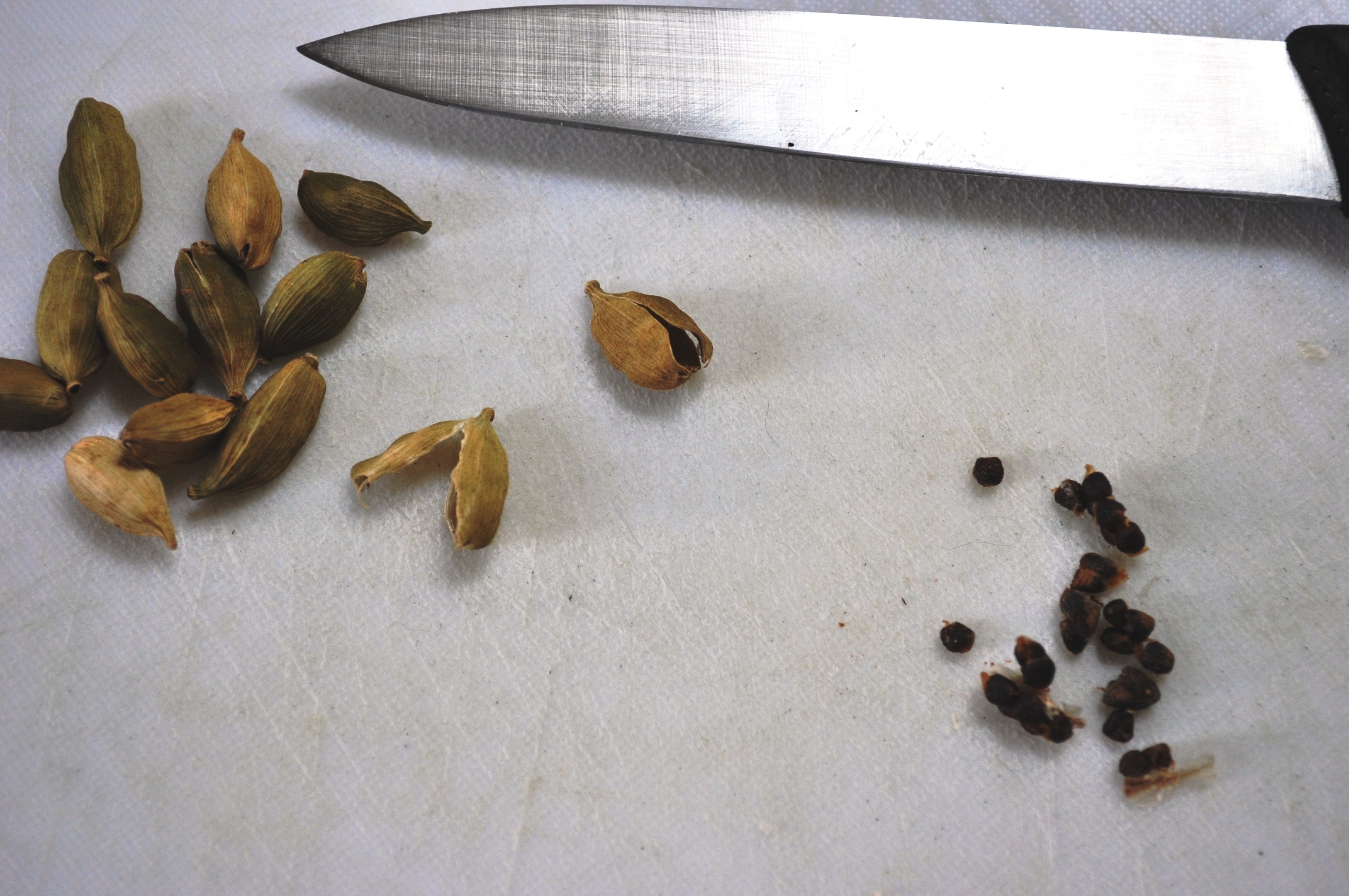
1/2 ground cardamom (again, more to taste if you really like cardamom)

Cardamom pods and seeds

Method

1. Preheat the oven to 180C.
2. Prepare a muffin tray and 12 (ish) cases.
3. Roughly chop and de-stone the plums.
4. Put the plum pieces in a pan with the golden syrup or sugar.
5. Good the plums for 10 minutes or so. It doesn’t matter if they break down.
6. Remove from the heat and allow to cool.
7. Cream together the butter and caster sugar. (Using a hand blender, or food mixer, or good old-fashioned spoon.)

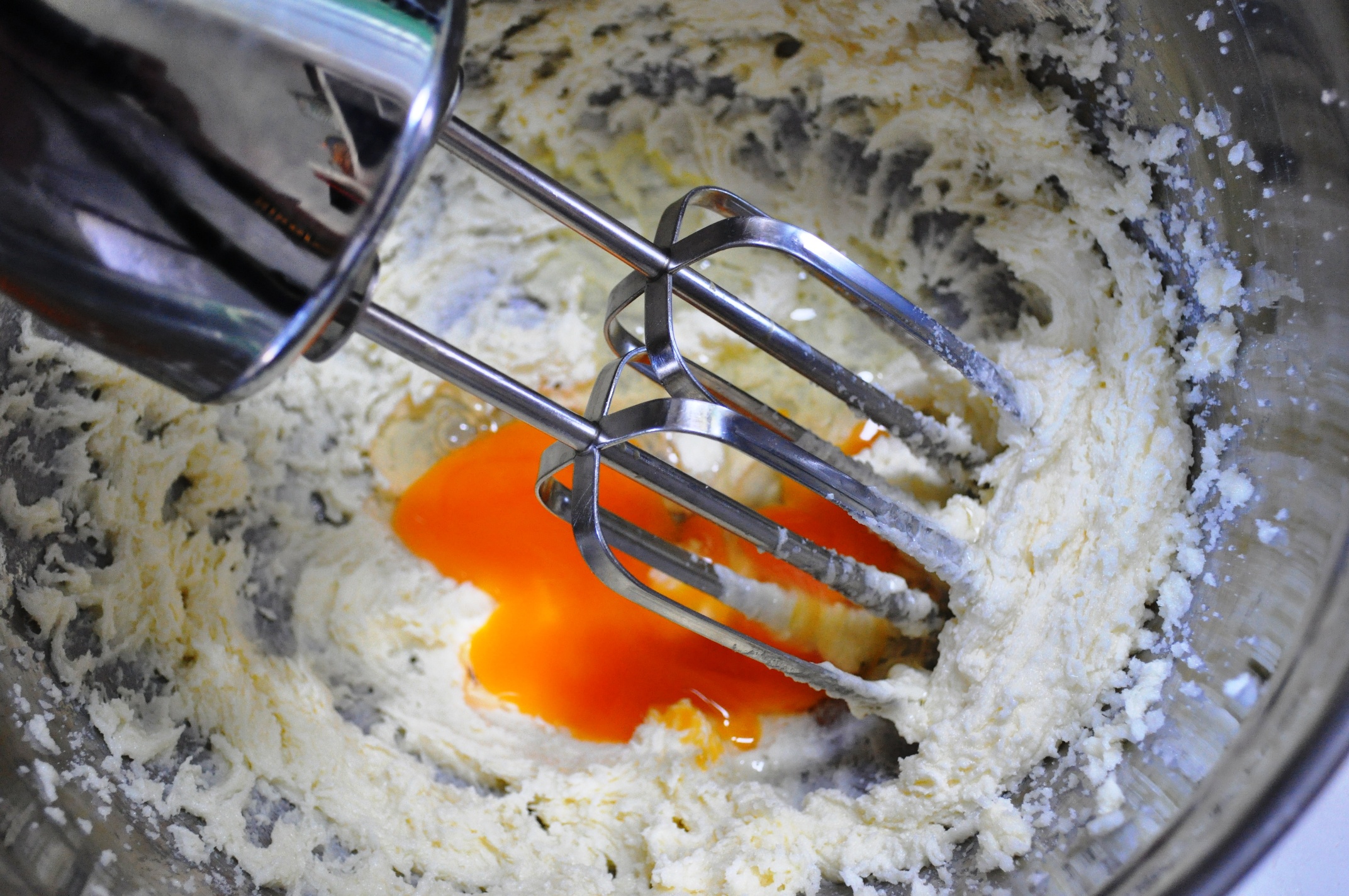
Beat in the egg to plum muffin mix
8. Add the egg and beat. If all your ingredients are at room temp, it shouldn’t curdle. If it does, don’t worry, just add a little of the flour.
9. Add the yogurt and beat.
10. Add the plums and their syrupy juice.
11. Combine the flour, ground, almonds spices, raising agents. Sieve together. The ground almonds probably won’t all go through the sieve. I wouldn’t worry about this, the sieving is more to loosen up and combine the powders than really aerate it (that’s the raising agents’ job, when you bake).
12. Add the powder mix and combine.
13. It’ll be a pretty wet, light mix (the bicarb starts working subito). Spoon it into the muffin cases, to about three-quarters full.

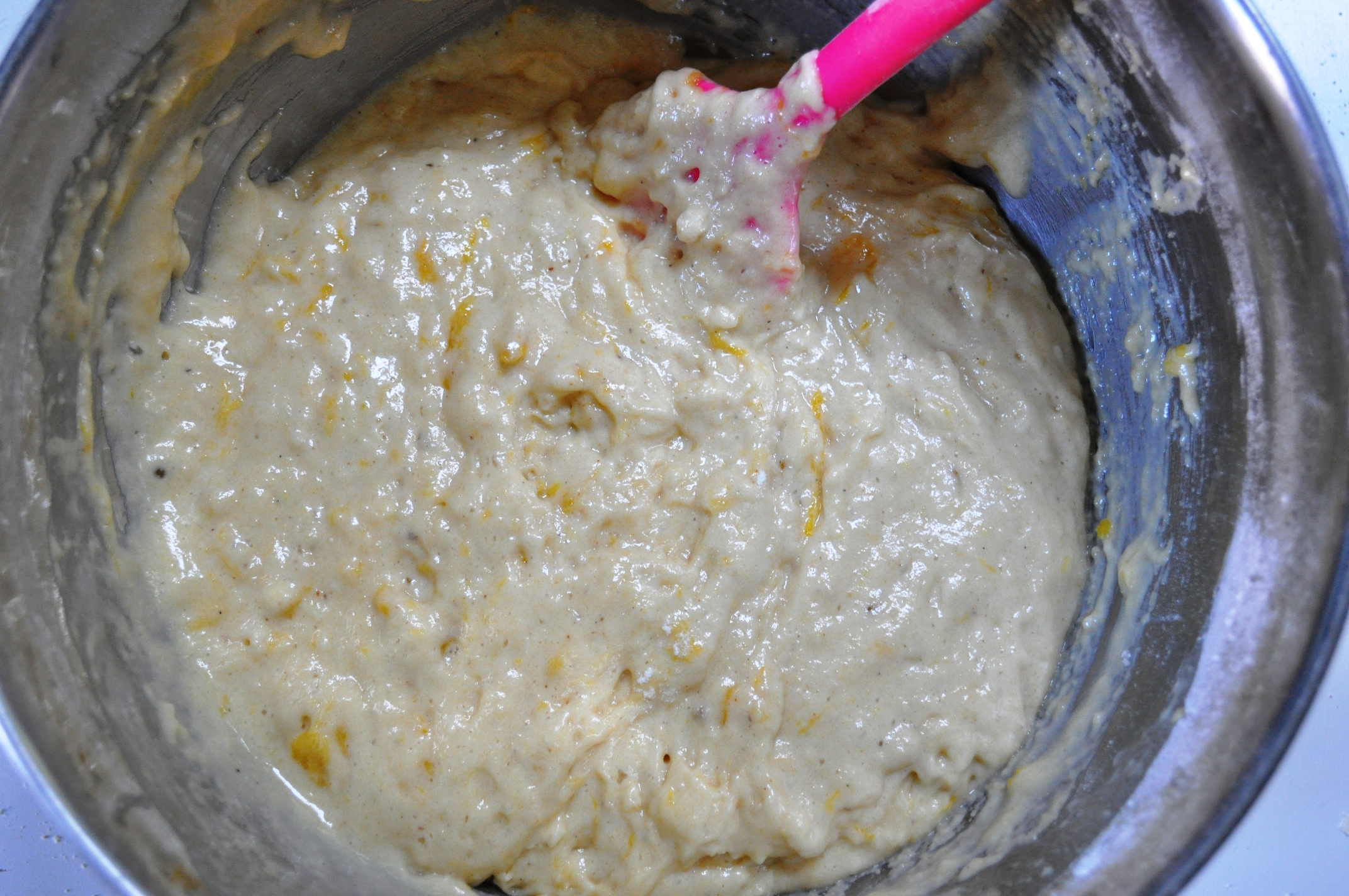
Plum muffin mix, all combined
14. Sprinkle the tops with flaked almonds.
15. Bake for around 20-25 minutes, until nicely browned and firm to the touch.
16. Cool, in muffin cases, on a wire rack.

Baked plum muffins

Footnotes, etc

1 The muffin cases are a brand called House Doctor. They don’t seem to have a clear online presence, but they’re available in the UK from this outlet, based on Brighton, Sussex.

2 If you don’t have self-raising flour, just use plain or all-purpose flour. Add 1 teaspoon of baking powder to every 110g of flour. So instead of 220g self-raising flour here, the recipe would require 220g plain flour with 2 extra teaspoons of baking powder (along with the other 1 teaspoon of baking powder and half teaspoon of baking soda). And if you don’t have baking powder, but do have baking soda and cream of tartar (tartaric acid) you can make your own baking powder too. See this page in the BBC baking glossary.

If you work in cups, there are plenty of conversion tools online, like here and here, though they all seem to vary a little. Instead, I’d urge you – buy some electronic scales! They can be very affordable and make life so much easier.

Spicy plum ketchup

This is a great recipe, especially if you have a plum tree and often find yourself with a glut. It’s from my friend Nadia in New Zealand. Old Man Mountain, the farm where she used to live, had a great big old purple plum tree and we’d make a batch every year. It’s a pretty versatile recipe though – although it’s best with purple plums, you can use any. We had a Mirabelle in our garden in London, and we used Mirabelle again this time round. Plus, as it’s hard to get malt vinegar in Italy, we also used red wine vinegar this year. Seems to have worked okay.

This is for a small batch – enough for a about 1.2 litres. So double or triple or quadruple it if you like it and have more plums!

1.8kg plums
2 large onions
30g allspice
8g cayenne
900g white sugar
30g whole ginger, bruised
75g salt
570ml malt vinegar

1. Stone the plums.
2. Put all the ingredients in a large saucepan.
3. You can put all the spices in a bag, but I don’t bother – I just add them to the mix.
4. Simmer for three hours.
5. Put through a mouli legume if you’ve got one. Alternatively, push through a sieve. (And discard the bits.)
6. Put in sterilised bottles (we used wine bottles with screw-tops or those bottles with olde worlde style clip/stopper).

6 Comments

Filed under Cakes, Recipes

Maritozzi at Regoli Pasticceria, Rome

Pasticceria Regoli, Rome

We – me, Rachel, and Luca, 22 months – went on a field trip this morning. To do research. Honest. Serious research. Which involved eating serious cream cakes. Specifically maritozzi con la panna (maritozzi “with cream”). Specfically at Pasticceria Regoli.

This is what I wrote about maritozzi some time in 2012:

“Typical to Lazio, or even more specifically, Rome, this is a vaguely more exotic cousin to a British cream bun, in that it’s a bun made with a sweet yeasted dough, which it split after its baked and cooled and filled with cream. Go on, Google both and the pics will look remarkably similar. The only major difference is that the maritozzo dough may contain raisins or sultanas, candied peel and pine nuts.

Pasticceria Regoli, Rome

According to Italian Wikipedia they (or an older sweet bun) were given to people getting married and the name relates to that – possibly in Romanesco. (In standard Italian marito means husband.)”

I can clarify that a little more now, after a visit to Regoli, and a few hours to come down off the semi-delirium induced by consuming about a litre of whipped cream slathered on a sweet bun and a hot journey across Rome. Regoli is a renowned pasticceria and came highly recommended by Rachel and her knowledgeable foodie contacts.

We headed across town on the number 8 tram. It’s too hot to walk in Rome now without getting horrendously sweaty, and the tram is a far more civilised way to travel than the bus. Regoli is in Esquilino neighbourhood, roughly between the Basilica of Santa Maria Maggiore and Piazza Vittorio Emmanuele II, location of the intriguing but easy-to-miss-among-the-snoozing-drunks Porta Alchemical. Oh, and MAS, the most bonkers shop in Rome. But that’s another story.

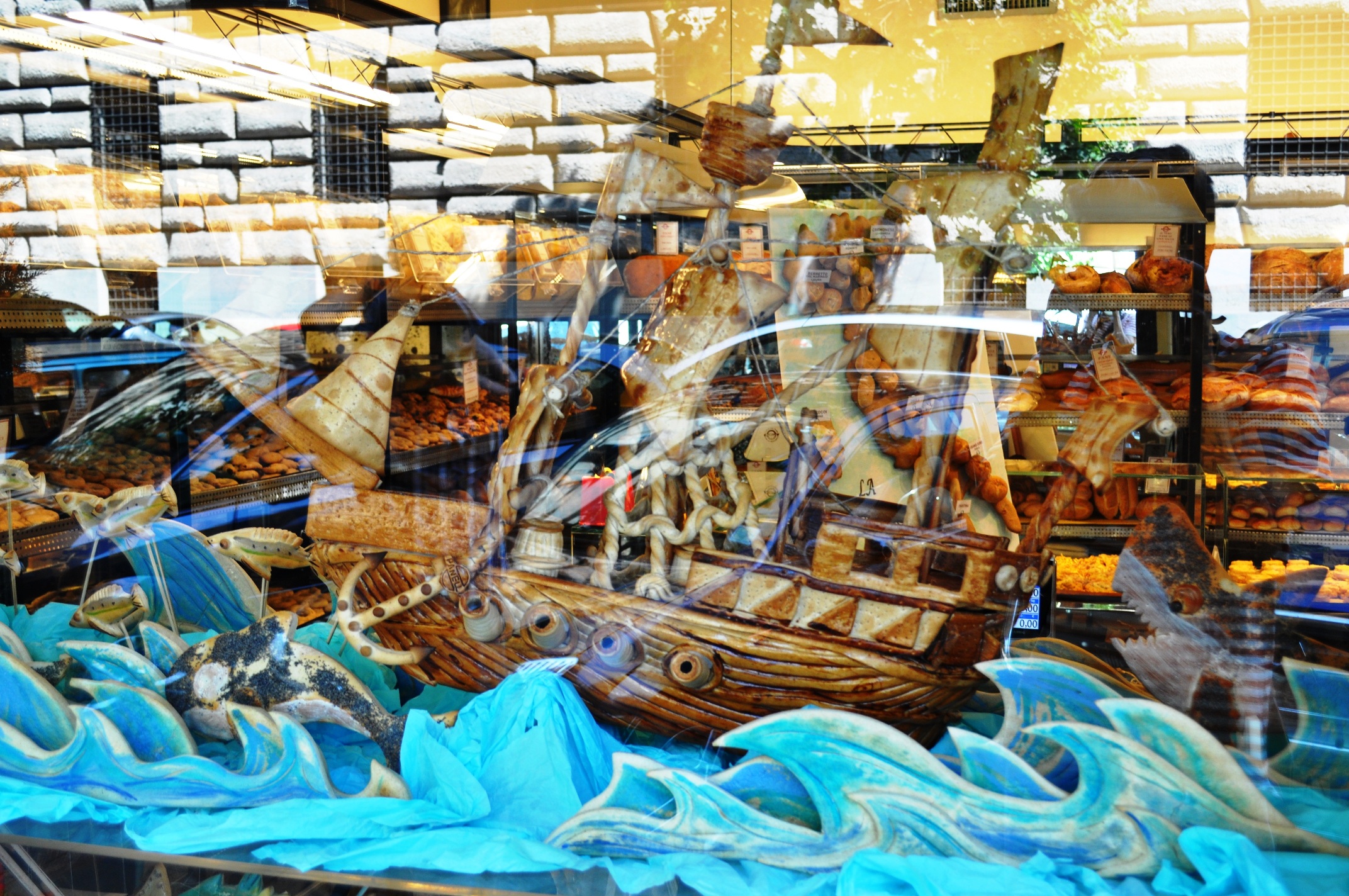
Panella window display

It’s just around the corner from Panella bakery, which has some impressive bread sculptures in the window, but that’s another story too. (Panella’s website – beware un-turn-offable audio spam.)

Regoli (“dal 1916”) itself is a modest-looking establishment, its window display its wares. And those wares – including the baked goods inside – consist entirely of pastries and biscuits, with a choice of perhaps a few dozen. Now, I find this reassuring for any establishment – a degree of focus. Do just a few things, and do them well.

Serious maritozzi at Regoli, Rome

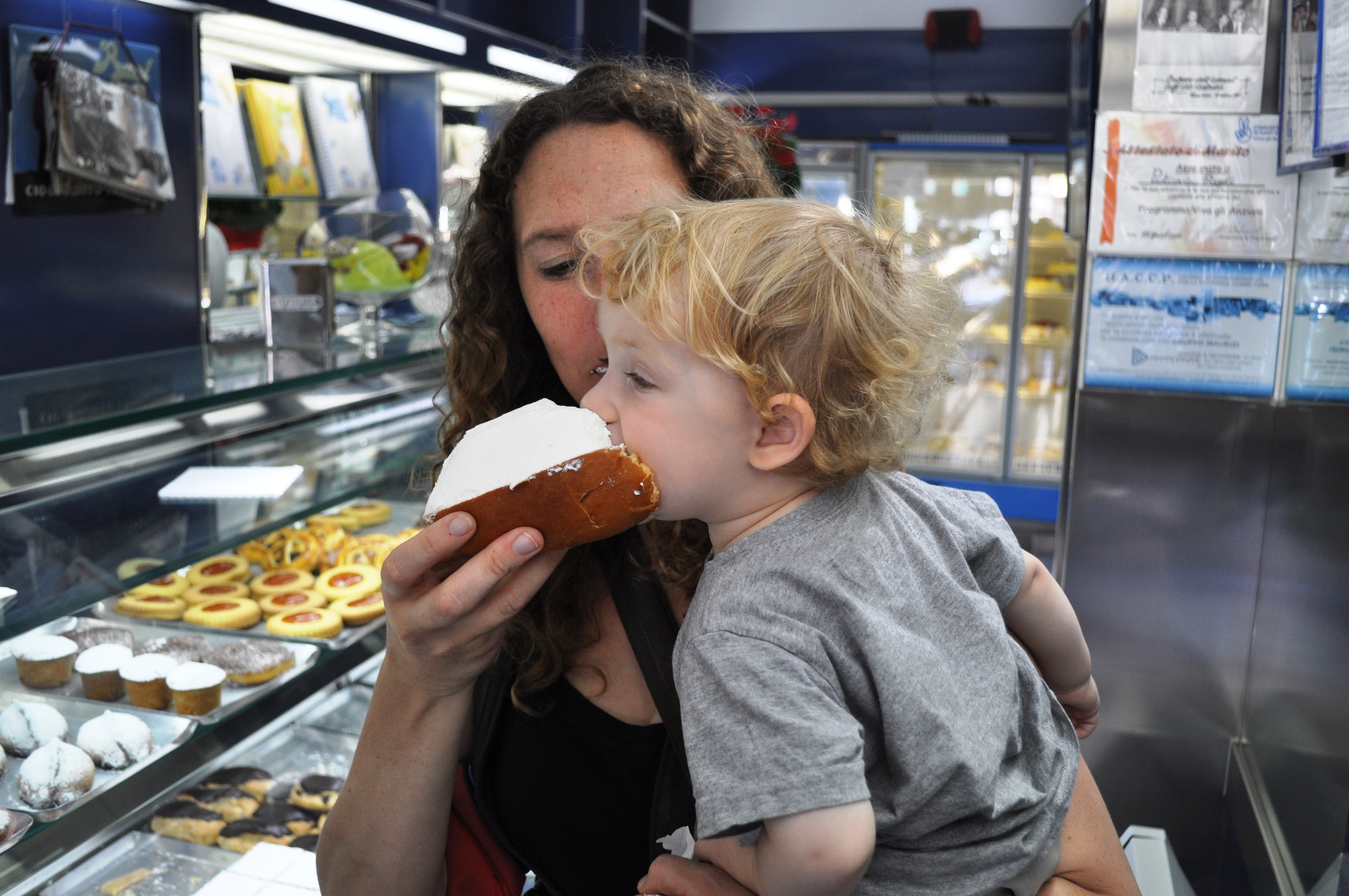
I must admit I found Regoli’s maritozzi con la panna slightly intimidating. Whereas many of the maritozzi seen in Rome are a finger bun with a modest split along the top filled with smoothed-off whipped cream, Regoli’s version were split in two, folded outwards and totally covered in a thick layer of whipped cream. By weight, I’d imagine each bun was equal parts dough and cream. I like cream, but, well, I couldn’t even imagine how to eat it, at least not in a civilised manner.

Rachel didn’t seem to have any reservations though, and leapt in to make the purchase. Luca didn’t have any reservations either and dived into all the creamy goodness face-first.

Luca dives in

I struggled with my wife’s DSLR in one hand and the massive treat in the other. Cream escaped. It wasn’t pretty. But boy was it tasty. Sure, it was very like a British cream bun, but it just felt like such a treat, such an epic indulgence, guzzling all that cream.

We chatted a bit with the staff, and it does sound their maritozzi are made with a fairly standard enriched bread dough. They also sold maritozzi quaresimali – Lenten buns. Even though it’s July. These differ in that they don’t involve whipped cream, but instead the dough contains dried fruit (sultanas or raisins), candied peel (probably cedroCitrus medica), zest and even pine nuts. As such, they’re not dissimilar to something like a hot cross bun, but in a finger roll form. Regoli’s combination of dried fruit and citrus flavours give them a delicious tang.

maritozzi quaresimali, Regoli, Rome

So all in all, a good field trip. Hard work though. Despite how much of a glutton I am, I don’t think I could handle a Regoli maritozzo con la panna more than a few times a year, given the truly epic amount of whipped cream involved!

My maritozzi con la panna recipe can be found here.

12 Comments

Filed under Bakeries, Cakes, Cakes (yeasted)

Lemon kumquat cake with citrus curd and mascarpone

Okay, okay – I know it’s been pretty quiet round here lately but I’ve been busy working in the kitchen of the American Academy in Rome. Three intense, informative months at the Rome Sustainable Food Project came to a close last Friday. So without long days podding fava beans and agonising over the perfect cacio e pepe, some life will now return to Bread, Cakes and Ale.

As the RSFP was founded by renowned US chef and activist Alice Waters it seems only fitting that my first post in a while is based on one of her recipes. Given that I’m a cake obsessive, the first recipe I tried from The Art of Simple Food just had to be her core cake – the 1-2-3-4 Cake, which she says is the sort of simple, flexible recipe that can be manipulated to various ends: “Unadorned, it makes a simple tea cake perfectly suited for a garnish of fresh fruit; decorated, it can be anything from a birthday cake to a wedding cake to individual cupcakes.”

Also, as the RSFP is predicated on the ideas of a diet based on local, seasonal food, as well as not wasting food (all logical principles that our greedy, deluded species needs to acknowledge more), my version involves a few relevant twists.

Lemons are available pretty much the whole year in Italy, thanks to different varieties with staggered seasons. So lemons played a part. Also, we have a kumquat tree in our garden, with the fruit coming into season, so they’re in there too. Plus, I used some of the kumquats a year or so ago to make a flavoured vodka. Although the booze itself is long gone, the steeped zest has been hanging around in my kitchen looking for a purpose in life, so that played a part too.

Finally, though, before the recipe, a gripe. The Art of Simple Food is a beautiful book, essential reading for anything interested in food who wants to commit more to sustainable eating. However, all its recipes are in cup measures. This frustrates me. Cups are awkward and inaccurate – just Google around for conversions, and you’ll find they vary according to source. Only by a few grams here and there, but it’s enough to mess up the chemistry of something that needs accuracy like a cake recipe.

Cups are especially baffling when talking about things like butter – a cup of butter? How does that work? Do you have to melt it, fill the cup, then let it set up again? Or just squash a load of grease into a cup, then painstakingly scrape it out again? (Okay, I’m half-joking.)

I’ve said it before, but will say it again, grams (aka grammes) make life so much easier. For consistency and for scaling up recipe when necessary you can’t argue with a decimal system.

Yes, yes, I know that the cake is named a 1-2-3-4 cake for the quantities of ingredients, and yes yes, I can imagine a frontier mom in her gingham apron making it thusly with an old tin cup, but it’s the 21st century people. Electronic scales. Grams. Simple.

So anyway, I found an actual cup in our kitchen that conforms to the standard US cup, which is half a US pint or 236.59ml, then went through the ingredients weighing them on an electronic scale. (Again, I do liquid measures in grams too – it’s consistent, it’s more accurate, and it’s easy with a jug, electronic scales and a tare function.)

Having said all that, things like half a teaspoon of a powder don’t convert so well so I’ve included them in both formats.

Okay. The recipe(s).

The cake

Ingredients
4 eggs
240g milk
375g plain (all-purpose) flour
4 teaspoon (20g) baking powder
1/2 teaspoon (2.5g) salt
400g caster sugar
225g unsalted butter
Grated zest of 3 lemons
Grated zest of 5 kumquats
Finely chopped zest of 5 kumquats soaked for a year in vodka with cinnamon and sugar. (Okay, you’re very unlikely to have this ingredient. Don’t worry… just leave it out!)
Juice of half a lemon, around 20g

Preheat the oven to 180C.
Grease and base line two 21cm cake tins.

Method
1. Sieve together the flour and baking powder.
2. Separate the 4 eggs.
3. Beat together the sugar and butter until light and fluffy.
4. Gradually beat in the egg yolks.
5. Beat in all the zest and lemon juice.
6. Alternately fold in the flour and milk, though don’t beat or over-mix.
7. Whisk the egg whites to soft peaks.
8. Add a third of the egg whites to lighten up the mixture, combining well but again without over-mixing.
9. Gently fold in the rest of the egg whites.
10. Divide the mixture between the cake tins.
11. Bake for around 35 minutes. The cakes should feel firm to the touch and a skewer or cocktail stick should come out clean when inserted.
12. Cool in the tins then turn out onto a wire rack and cool completely. Wrap them if you want to use them the next day. The baked cake keeps well.

The filling

250g mascarpone
Citrus curd made with another recipe from The Art of Simple Food. Read on…

Ingredients
3 lemons, washed and dried
5 kumquats, washed and dried
2 eggs
3 egg yolks
2 tablespoons of milk
65g caster sugar
1/4 teaspoon salt
85g unsalted butter, cut into small pieces.

Method
1. Zest and juice the citrus fruit. You probably won’t get much juice from the kumquats, but don’t worry, a hint is fine and the oils in the zest are doing much of the work anyway.
2. Lightly beat together the other ingredients, except the butter.
3. Stir the juice and zest into the beaten mixture.
4. Add the butter and put into a small, heavy-bottomed non-reactive saucepan (eg stainless steel, ceramic or glass; not aluminium or copper)
5. Cook the curd mixture very slowly, stirring continually, over a low heat. Do not overheat or let it sit too long without stirring or the egg will start to curdle. If it starts to curdle, you can plunge the (bottom of) the pan into a sink of cool water to cool it off, then press the mixture through a sieve or fine strainer and continue. I know this because it’s what I did… Curds aren’t really my forte, but this one worked well in the end.
6. Cook until the mixture starts to thicken and will coat the back of a metal spoon and a line drawn with a (clean) finger will hold its shape. This is called a nappe. I didn’t know that word until yesterday, so thanks to Cameron for the education.
7. Pour the curd into a bowl, jug or jar to cool. It’ll thicken when it’s cooled further in the fridge. As you can see from the photo, mine was still a little runny, but it was pretty good after a few hours more in the fridge.

Assembly

I think I fell at the final hurdle slightly. I wasn’t very refined with the mascarpone, so I’ll write here what I should have done, not what I did.

1. Beat the mascarpone slightly to soften it up. If by any freak chance you have any kumquat liquor, you could beat a little in. Or use a little limoncello.
2. Spread the top of the lower cake with curd. You can slice off the top if it’s peaked too much in the oven, to make a more level surface. I used about half of the curd I made from the above recipe.
3. Spread the undersize of the upper cake with mascarpone.
4. Sandwich the cakes together.
5. Sprinkle the top with sifted icing sugar (aka powdered sugar, confectioners’ sugar or zucchero a velo – “veil sugar”)
6. Eat large slices. You can serve with extra curd too, or make a swoosh on the plate if you’re that way inclined.

5 Comments

Filed under Cakes, Recipes

Torta Caprese

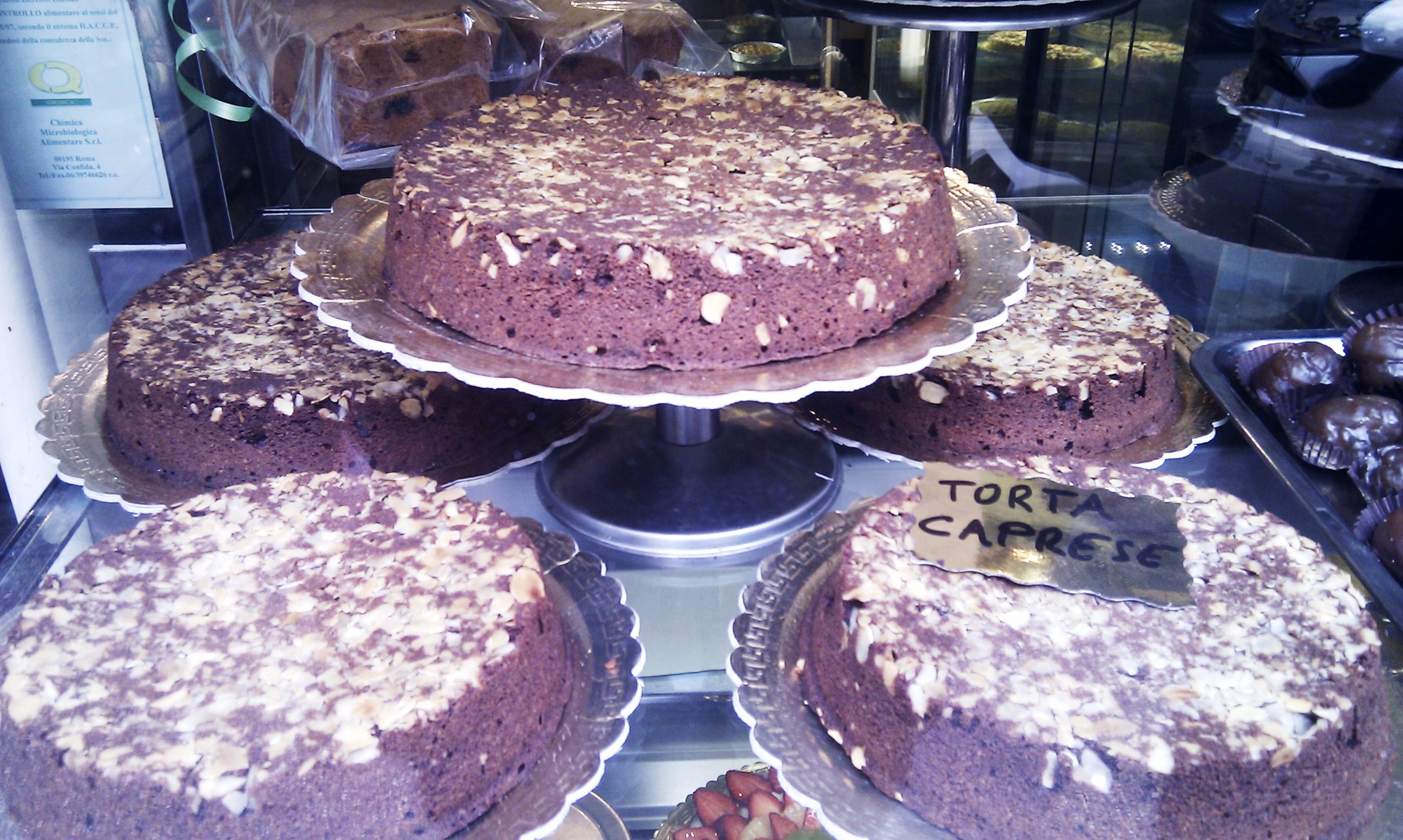
I see a lot of sachertorte in Roman pasticceria, but the other day I spotted a torta Caprese in the window of a place that seems to just be called Pasticceria Trastevere. It’s a pasticceria. In Trastevere. Not very imaginative. (Specifically, it’s on Via Natale del Grande 50, opposite the wonderful Cinema America building. Currently Occupato).

It’s not a cake I’ve encountered before, oddly considering I love chocolate cakes. And love cakes made with ground nuts. (And considering even a certain middle-class UK supermarket even does a brand version, I discover now.) My friend Rachel described it – and frankly it sounded much like a sachertorte, but without the apricot jam and chocolate glaze. That is a rich, flourless chocolate cake made with ground almonds.

Now that was something I had to try. And make. Without ever having eaten it before.

Pasticceria Trastevere

Some considerations

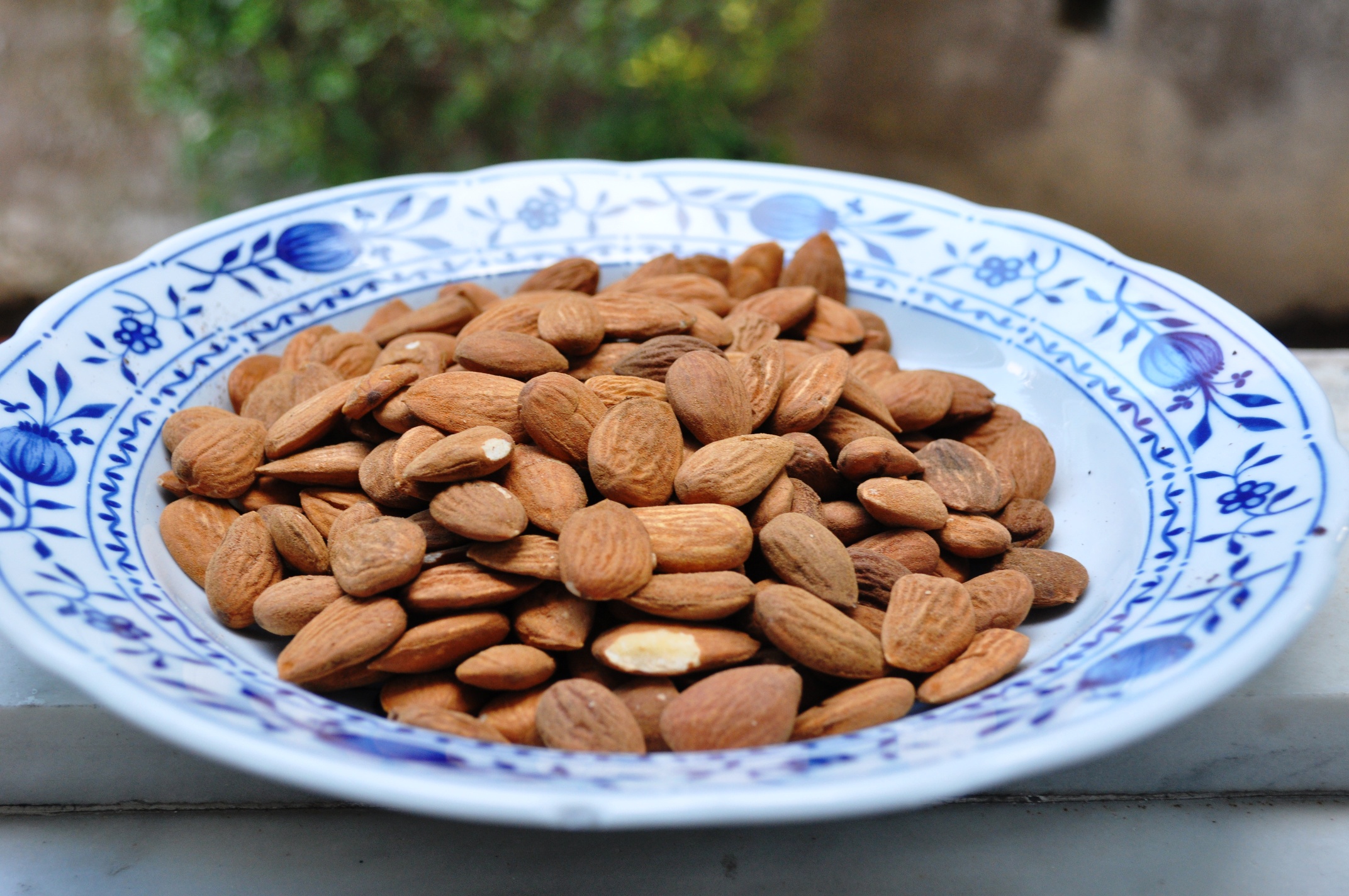
I scoured the internet for recipes, mostly in Italian. There seemed to be a some variation, notably in the question of what sort of almonds to use. Some used pre-ground almonds (or farina di mandorle – almond flour), some used blanched almonds that you then ground, others used skin-on almonds that you blanched and peeled yourself (a labour intensive job) before grinding, and others used skin-on almonds, ground as is.

Almonds

I liked the idea of the latter, not just as it’s less labour intensive, but because the skins add depth of flavour. (Much like I prefer my peanut butter wholenut, not skinned. Even though peanuts aren’t nuts, of course.)

Almonds, ground

The other key factor with a cake like this is the egg whites. The most important thing is to get the egg whites whisked to soft peaks, then be very gentle when you add the egg white to the nut/choc/fat/sugar/tuorli (egg yolks. Such a nice word. Sounds a bit like “twirly”). Seriously: be gentle when you fold in the egg whites, as this is only your way of lightening the cake, as there are no raising agents and it’s full of fairly dense ground nuts. Sure it’s going to be a fairly heavy cake, that’s the nature of nut-based, flourless cakes, but you don’t want it totally dense and biscuit-like.

Adding the egg whites

I have seen a few recipes with some baking powder, but it shouldn’t really be necessary for a cake with whisked egg whites. Plus, if you’re hoping to make a gluten-free cake, adding baking powder can be problematic. Why? Because baking powder often contains some starch, which absorbs moisture during storage. This can be from potatoes, or corn/maize, but it can also be from wheat. The stuff I’ve got in my cupboard, is clearly labelled: “Ingredients: Disodium Dihydrogen Diphosphate, Sodium Hydrogen Carbonate, Wheatflour (contains Gluten)”.

The other variable is how the other ingredients are combined. Obviously. This is interesting as frankly, I’m not sure it would make much difference if you did any of the following – as long as things are well mixed and you were gentle with the whites.

So, the recipes I read involved these various approaches

1 melting together the butter, chocolate and sugar, then adding the ground nuts, then beating in the egg yolks, and folding in the egg whites.
2 melting just the chocolate. Creaming together the sugar and butter, then adding the egg yolks, then the nuts, and melted chocolate, then the whisked egg whites. (This is how it’s described on English Wikipedia, but not in the majority of the Italian recipes I’ve looked at.)
3 melting together the chocolate and butter, beating together the sugar and yolks, then adding the ground nuts, then the liquid chocolate and butter, then folding in the whites.
4 Reversing the addition of liquid choc/butter and ground nuts. Theconcern here is that if the melted liquid is still hot, it could cook and scramble the egg yolk, unless you’ve cooled it somewhat first. So I’ve plumped for 3.

Some observations

The torta Caprese in Pasticceria Trastevere had slightly sloping edges – ie, it’s not baked in straight-sided cake tins. I was planning to use a 20cm straight-sided cake tin for this, to make a deeper cake, but my wife had left it at work. Which turned out to be helpful in the end, as I looked around for other tins and found one (not mine I believe, but belonging to our landlady) that seemed more appropriate, despite being somewhat shallow. I suppose it’s more like what we’d call a flan or pie tin in the UK, though it’s not got fluted sides.

Components 2

Also, the version I saw in Pasticceria Trastevere had flaked almonds on the top. Though this top was clearly the bottom, which was then inverted for serving. This seemed like a lovely idea, though I didn’t really use enough almonds, so I also decorated the finished cake with some icing sugar, which seems to be the norm.

Use good dark chocolate, at leat 65% cocoa solids. I used Venchi Cuor di Cacao 75%. Serious stuff.

Serious chocolate, chopped

One final note. Some of the recipes also call for some Strega (“witch”), a digestivo liquer traditionally made with herbs, but these days is probably mostly just made with E-numbers (as most of the “traditional” liquers seem to be). Not many of the recipes I’ve looked at, and indeed none of the Italian ones, include it. So I’m not bothering.

The recipe

4 eggs, separated
250g almonds, shelled but skin on
200g butter
200g dark chocolate
170g caster sugar
A good handful of flaked almonds

Preheat the oven 180C.

1 Grease and line the base of a 22cm round tin.
2 Generously sprinkle flaked almonds in the base of the tin.
3 Grind the whole almonds to a coarse powder in a food processor. (If you’ve not got a food processor you could, for example, use half ground almonds and half whole almonds that you’ve chopped… fairly comprehensively.)
4 Melt together the chocolate and the butter in a bowl suspended over a pan of gently simmering water.
5 Beat together the sugar and egg yolks. It’s quite a thick mix, but beat until creamy.
6 Beat the ground almonds into the sugar and egg yolks.
7 Add the melted chocolate and butter to the eggy-almond mix and beat.
8 Whisk the egg whites to soft peaks. That is, when you lift up the whisk, and a peak is formed, it sags over slowly.
9 If the main mixture feels particularly stiff, you can beat in one tablespoon of the beaten egg whites. Gently fold in the egg whites.
10 Gently pour into the prepared tin.
11 Bake for around 45 minutes, until firm to the touch. This time will vary according to the character of your oven. With a fan oven, you might want to lower the temp to 160C.
12 Leave to cool in the tin on a wire rack.
13 Turn out and serve inverted. Decorate with sieved icing sugar if you like.

Enjoy.

Addendum, 27 Feb 2013.
I want to try this again, but with an extra egg. Not sure I’ll have time for a while though, as I’ve started volunteering on the Rome Sustainable Food Project, and it’s pretty full-on, hours-wise. After separating four eggs for this recipe the other day, yesterday I seperated 120 for 6kg of pasta… My home baking will be a bit of a back burner for a few months, so the blog might be a bit quiet.

11 Comments

Filed under Cakes, Recipes

Carnival and castagnole 2013

We don’t really do Carnival in England or the rest of the UK. Or at least, as Wikipedia says, “Carnival is traditionally held in areas with a large Catholic… makeup. Protestant areas usually do not have Carnival celebrations or have modified traditions, such as the Danish Carnival or other Shrove Tuesday events.”

Although I was raised a Catholic, we didn’t do anything like Carnival in my home – it was just Shrove Tuesday, aka Pancake Day (a blowout on pancakes, lemon and sugar that even heathens enjoy), then Lent (restraint for Catholics), then Easter (a blowout on highly religious chocolate eggs…). So Carnival here surprises me. The Romans once more express their love of  fireworks and a snow of confetti is added to the general mess in the streets.

(As an aside – confetti is clearly an Italian loanword in English. Though confusingly, it’s not the Italian for confetti – ie the stuff you throw at the happy couple at weddings. Rice and small paper thrown at weddings, or used to celebrate Carnival, is called coriandoli in Italian – the plural of the herb/spice coriander. Confetto [plural confetti] instead means both a pill or a sugared almond.)

More cheery than the garbage are  the seasonal edible goodies. Last year, we discovered castagnole and frappe, treats sold specifically at Carnival. I wrote these treats last year (here and here), their characteristics, the other regional names used in Italy, etc then so I’ll try not to go on too much now.

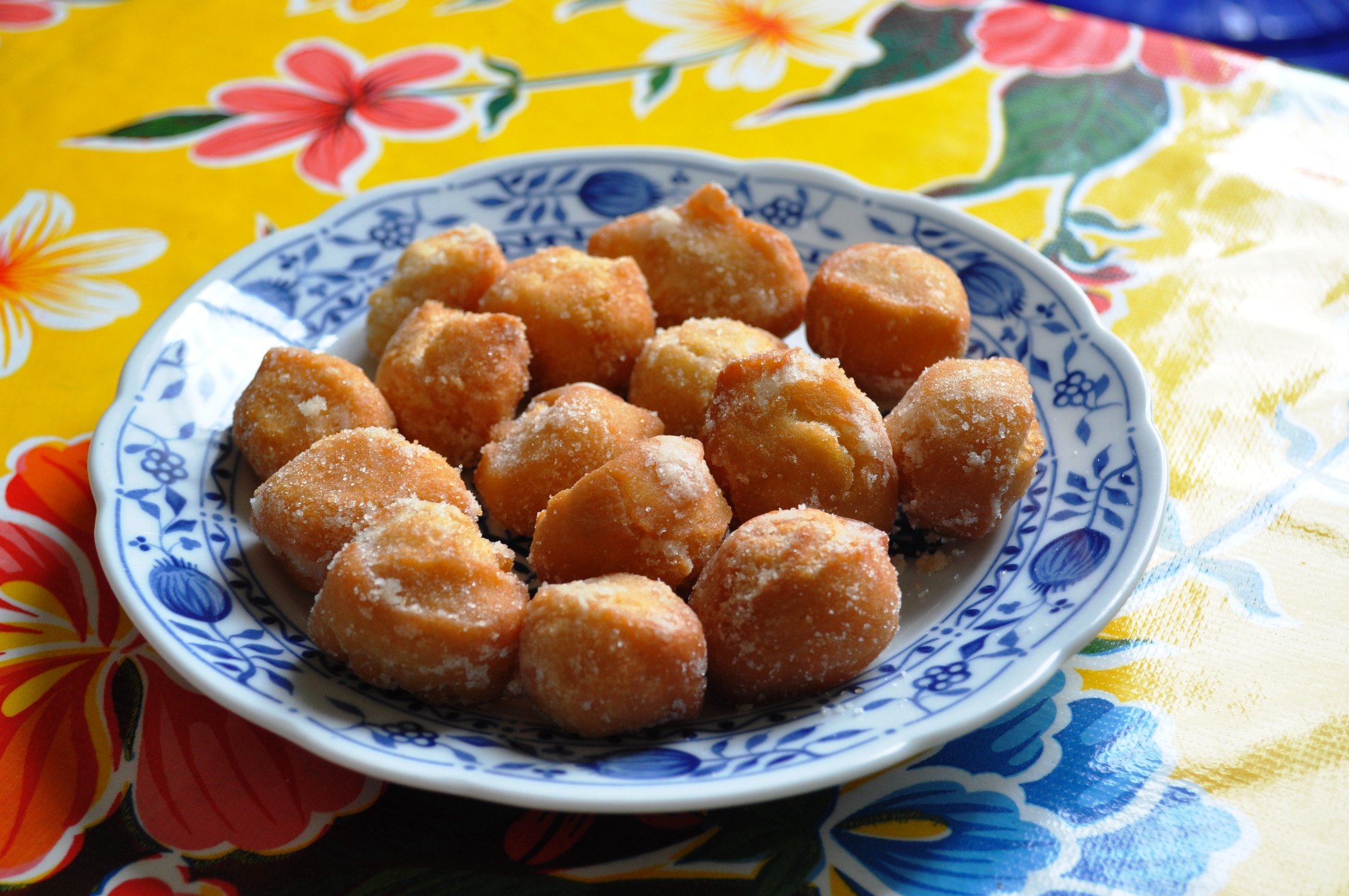
This year we’ve been eschewing the crunchy delights of frappe, deep-fried sweet pasta shreds, dusted with icing sugar. Instead, we’ve mostly been focussing on castagnole, smallish balls of deep-fried dough that may or may not be filled with custards or ricotta. We’ve been favouring the non-filled, castagnole semplici this year. They’re basically dough-balls, very similar in taste and texture to a British doughnut – sweet dough, deep-fried, rolled or coated in sugar. You can watch some being made here, with the recipe (in Italian or English). TBH, I walk past so many pasticcerie on a daily basis that are brimming with castagnole I don’t feel the need to make them. But if I do, I will of course report back.

Since Christmas I’ve been vowing to ease off on the making and scoffing of cakes, ease off on the purchasing and scoffing of pasticceria wares. But hey, it’s still winter, it’s cold, and I think we can justify the intensive regime of carbs for a few more weeks. At least until Shrove Tuesday, then we should really stop for Lent (Quaresima). Oh, hang on, that’s tomorrow. Oh, hang on again though – we’re not religious, so it’s okay. I’m not sure about the rest of the population of good Catholics here though: the pasticcerie don’t suddenly stop selling castagnole and frappe for Quaresima, so somebody’s still busy eating them, all the way to Easter. So not really observing Lent very assiduously. Vergogna! For shame!

2 Comments

Filed under Cakes, Discussion

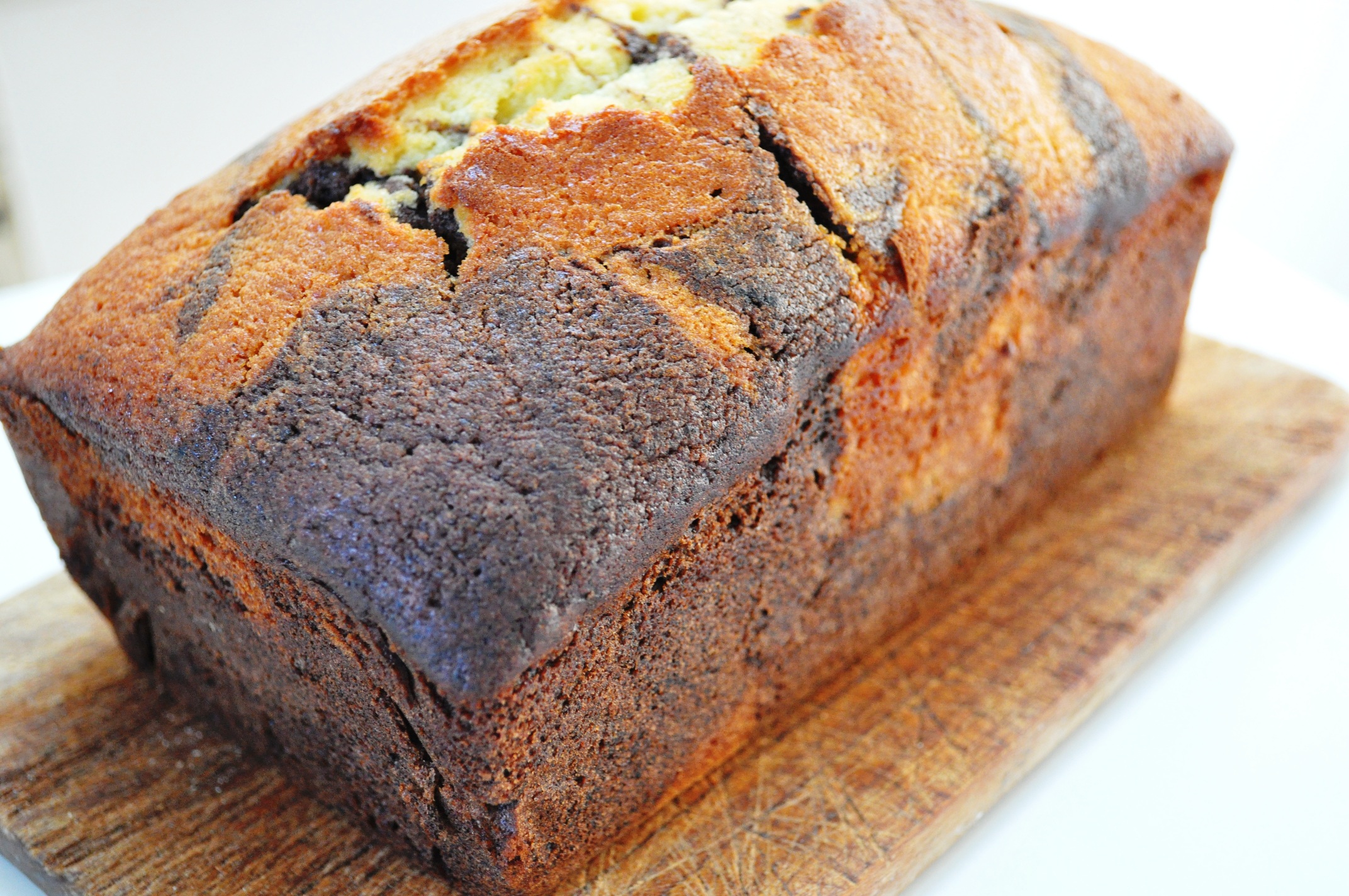
Mocha ricotta marble cake

Marble cake 2 slices

I don’t drink coffee. There, I said it. I live in Italy, but I don’t like the national drink/quotidian drug. It’s a slight problem for me, as really, the caffè (café) is all about the caffè (coffee), right down to sharing the same word. Having said that, I don’t mind a little bit of coffee flavoured cake-action. I think it’s a fond memory of my grandmother’s coffee-walnut cakes, which I’d happily eat as a small child, while never actually developing a taste for the actual drink.

Oddly, though, I do like really bitter ch ocolate, and other bitter flavours. People have told me this is silly, as the bitterness of a serious dark chocolate is not unlike the bitterness of a good coffee. (My favourite chocolate at the moment is 73 percent cacao with cacao bean nibs.) Although I realise I miss out on a major factor in the Italian socio-cultural dynamic, in many ways it’s good I never developed a taste for it: I’m a fairly twitchy person and a bad sleeper at the best of times. A caffeine habit wouldn’t help.

Anyway. One of my Christmas presents was Short & Sweet, a collection of baking recipes by Dan Lepard, some of which from his ever-reliable column in The Guardian. I had some butter than was threatening to go rancid, so I had to bake something, subito! (Which is Italian for “immediately”, even though in English we use the Italian word pronto – meaning “ready” – to mean “immediately”. How did that switcheroo happen?) It was unsalted, and I suspect they hadn’t washed the buttermilk off the fat sufficiently well.

uniced 2

Browsing the book, I found his Coffee and ricotta marble cake. There’s something eminently satisfying about the mottled crumb of a marble cake, plus coffee and ricotta are quintessentially Italian. We have some wonderful fresh ricotta available to us here. At the farmers’ market in the Ex-Mattatoio in Testaccio (open 9am to early evening Sat, 9am to around 2pm Sun), you can get sheep, cow or goat milk ricotta. Possibly even buffalo ricotta, as you can get buffalo mozzarella (bufala) – the best type, ahead of cow’s milk mozzarella, which is distinguished by being called fiore di latte, “milk flower”.

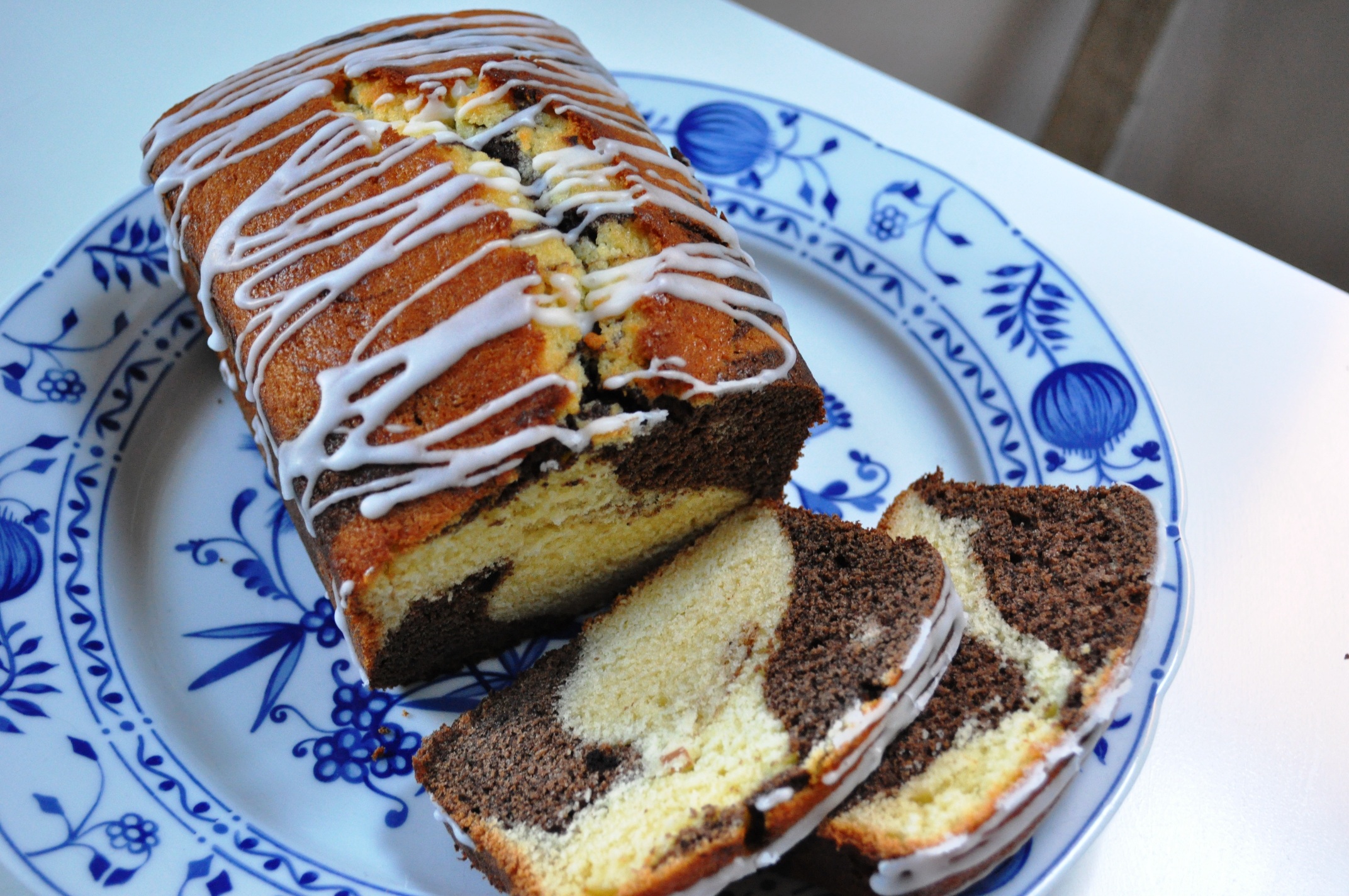
Dan L’s recipe divides the mixture, and mixes one with strong coffee, the other with marsala or rum. Given my attitude to coffee, I wasn’t entirely convinced by this, especially as I didn’t think it’d make the sponge distinctly dark enough, so I made a coffee/cocoa mix instead. Hence it’s a mocha ricotta marble cake. Which, frankly, has a lovely ring to it too. I knocked back the sugar in his recipe too as quite so much didn’t seem necessary.

Recipe
10g ground coffee
10g cocoa powder
25g boiling water
125g unsalted butter
175g caster sugar
200g plain flour
150g ricotta
3 medium eggs (about 50g each)
2 teaspoons baking powder
25g marsala or rum

1. Preheat the oven 180C.
2. Grease and line a deep loaf time, around 18cm long.
3. Pour the boiling water onto the coffee and cocoa powder.
4. Cream together the sugar and butter.
5. Add about 50g of the flour to the sugar and butter mixture and beat in.
6. Sieve together the remaining 150g flour with the baking powder.
7. Beat the ricotta into the sugar and butter mixture.
8. Beat in the eggs, one at a time.
9. Gently beat the remaining flour/BP into the mix.
10. Divide the mixture in two. You don’t have to weigh it unless you’re especially pedantic.
11. Mix the mocha liquid into one half, the marsala into the other.
12. Put alternating spoonfuls of the mixtures in the tin, smooth down the surface with wet knuckles, and run a skewer or spoon handle through the mixtures to create some marbling. .
13. Bake for around 50 minutes, or until a skewer comes out clean.
14. Cool in the tin for around 20 minutes, then remove and cool on a rack.

To serve
You can serve it dusted with icing sugar or drizzled with a smooth basic water icing made with around 50g icing sugar and cold water. Add the water in tiny amounts and blend until you have a slightly runny consistency.

I did my icing  with a small paper piping bag. They’re nifty little items. This video shows you how to make them, but I would say divide the initial triangle into two smaller triangles as you only need a small bag for such a small amount of icing. Also, for small bags (I’m talking about the length of a finger), you don’t need a nozzle either, just snip the very end off to make a whole of around 2mm and it’ll be perfect for drizzling.

4 Comments

Filed under Cakes, Recipes

Genoise, génoise, genoese. And trifle

Much as we don’t like traditional British Christmas cake in our household and always try alternatives, we don’t like traditional Christmas pudding either. I’m fascinated by its history, its origins in Medieval cuisine, the relationship of such puddings to, say, sausages (discussed here). I just don’t like eating it.

Instead, our traditional Christmas pudding is trifle. My wife introduced me to this tradition years ago; apparently it comes from her mum’s mum, “a great trifle maker”.

Trifling things

British trifle is not unlike a variety of other international deserts. Indeed, in the mists of time, it has common roots with both zuppa inglese (“English soup”, or more broadly “English dunked stuff” – a type of [northern] Italian desert that is, basically, trifle) and its cousin tiramisu (tirami sù – literally “pick me up”, though if you really need waking up surely a ristretto would do the job better?). The bottom line is that all these deserts use custards and/or whipped dairy products and sponges. But not just any sponges: specifically genoise sponge, or the closely related pan di spagna. (Which was, probably apocryphally, developed by the Genoese ambassador to Spain in the middle of the 17th century. More on the distinction between these two later).

Genoise – okay, look I’m going to call it genoese, as that’s the spelling I grew up with – originates from Genoa, the capital of Liguria in northern Italy. Today, it forms the basis of many sweets, in not just Italy and France, but Britain and elsewhere. But, you may say, tiramisu uses sponge fingers! (Aka ladyfingers, or boudoirs in French, or Savoiardi in Italy) But what are sponge fingers? Well, they’re just small cakes made of crisply baked piped fingers of genoese mixture.

So for our Christmas trifle, I generally make a genoese, while the missus makes custard.

Genoese sponge recipe

60g unsalted butter
125g plain flour
Pinch of fine salt
4 medium eggs
125g caster sugar

Folding in the flour

Preheat the oven to 180C.

1 Melt the butter, then leave it to cool slightly.
2 Use a little of the butter to grease your cake tin(s), sprinkle it with flour, shake the flour around to coat, then remove the excess. Line with baking parchment. This recipe will make two fairly thin cakes in 18cm round tins. If you want it square and deeper, use say just one 20cm square tin.
3 Sift the flour and salt together.
4 Put a pan of water on and bring to a simmer.
5 Combine the eggs and sugar in a heatproof bowl, and set this over the simmering water.
6 Using (ideally) an electric hand blender or a whisk, whisk the egg and sugar mix for about 5 to 10 minutes. It should triple in volume and achieve slight peaking.
7 Take the bowl off the heat.
8 Sift half the flour into the egg/sugar mixture and gently fold it in with a large metal spoon. You want to do this as gently as possible so you don’t knock the air out of the mixture
9 Sift in the other half of the flour and fold carefully again.
10 Gently pour in the melted butter, and carefully fold this in too to just combine.
11 Pour the mixture into the prepare tin(s). Gently does it!
12 Bake until firm to the touch, around 25 minutes depending on the depth of your mixture.
13 Cool in the tin for a few minutes, then turn out and cool completely on a wire rack.

Pouring in the butter

Trifle

Now, if you want to make a trifle, cut half of this cake into chunks, spread them with jam, and put them in a medium bowl. Pour on some sherry if you like such things. Add some fruit of choice. We used (not very seasonal or local) raspberries and banana. Cover the lot with homemade custard (go on – it’s not hard, and it tastes sooo good). Then cover all that with whipped cream.

I like to sprinkle some lightly toasted flaked almonds on top. Most of all though, I just like the extraordinary indulgence of genoise, custard and cream. It’s always a sad moment on 26 or 27 December when we finish the trifle.

Trifle

The difference between genoese sponge and pan di spagna

Genoese is made with the above technique involving cooking the eggs and sugar together, and whisking them, over a bain marie, with some melted butter subsequently added to the mix. Pan di spagna is made cold, with the eggs separated and lightness achieved by whipping the whites to stiff peaks. We’d call pan di spagna a “whisked fatless sponge cake” in English.

If you can read Italian, or trust translator software, there’s a good description of the difference here.

The results are quite similar. One of these days I’ll have to arrange a blind tasting, as TBH, I’m not sure I could tell the difference. Some people don’t even seem to recognise the difference: after all, Italian Wikipedia has a photo of pan di spagna that is reused to illustrate genoese on English Wikipedia. Outrageous.

Anyway. Here’s a final pic of mine. Slight sag in the middle, but otherwise lovely.

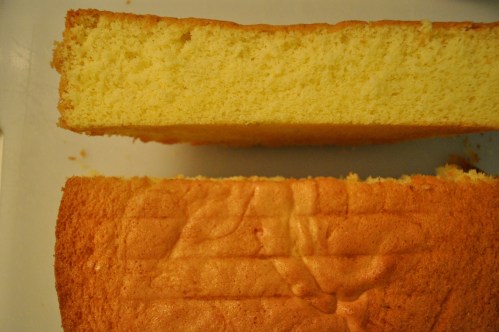
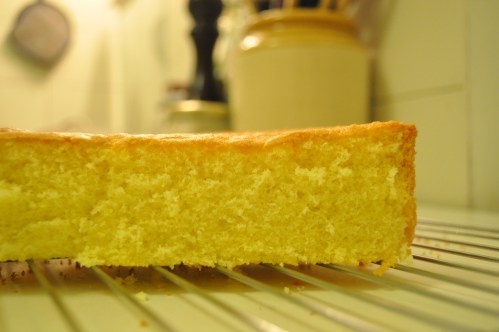
Cross section

3 Comments

Filed under Cakes, Puddings & desserts, Recipes

Zombie cakes

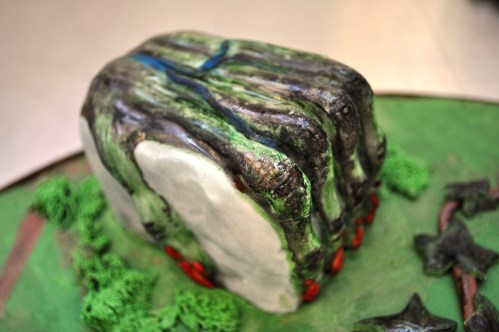
Been learning how to decorate cakes. I’ve done some frou frou and flowers, so I thought it was about time I did something closer to my heart – zombies!

This project involved making six mini-cakes, themed around a festival… so my excuse is that it’s Samhain/Halloween, you know, the night when the barriers between life and death are at their thinnest, and the dead rise from their graves. So yeah, my cakes are ghouls rising from the ground.

Inside is fruit cake, all the rest is made from sugar paste and food colourings.

And here they are individually:

Anyone guess who this guy’s inspired by?

This one’s inspiration is a little more tricky:

And the inspiration for this one is pretty obscure (unless you’re a fan of a certain strand of zombie movies… ):

These last three were all a bit more ad-libbed. I’m particularly proud of this chap’s cranial occurence:

zombie cake brains

Palatable?

Zombie cake eyeball

And finally, a grasping zombish hand (cos we had to do at least 2 different shapes for this project).


SPOILERS
I’m putting this here retrospectively to remind myself before I forget.
The first individual head is inspired by Michael Jackson’s look in the Thriller video.
The second is inspired by the Deadite version of Ed Getley in Sam Raimi’s 1987 classic The Evil Dead II.
The third is inspired by the poster for Lucio Fulci’s 1980 film City of the Living Dead. My friend Jamie also used the poster as inspiration for this book cover.
The character with the exposed brain and the one with his eyeball hanging out were more generic inventions. Ditto the hand.]

1 Comment

Filed under Baking, Cakes