Category Archives: Baking

Baking – Daniel Etherington’s bread experiements

Neolithic bread

Back in 1999, an archaeological dig in Yarnton, Oxfordshire, “unearthed two 5,000-year-old pieces of bread – the earliest fragments of bread to be recovered in the British Isles”.

Despite my enthusiasm for history, British food history and bread in general, I’d not heard about this before, so thanks to Jeremy Cherfas and his Newsletter from Eat This Podcast.

It’s a wonderful story. Not only is it amazing to have such fragments, which survived as they were charred and have been carbon dated as from “between 3,620 and 3,350 BC”, but also, in this era of blanket demonisation of bread, it’s a salient reminder of how long humanity has had an important relationship with grain-based foods. Even here in Britain, which was, a long way from the civilisations of the Middle East, central Asia, China etc.

At the time of the announcement, they had identified one of the grains as barley. I wonder if they managed to identify any more of the ingredients and if anyone had a go at re-creating the ancient loaf? It sounds like an interesting challenge, but one would need not only true ancient grain varieties, but also a quern-stones to mill them. That’s not something that’s part of my kitchen kit at this point.

There’s a little more on this 1999 discovery here and here, but I can’t find anything subsequent.


Leave a comment

Filed under Baking, Misc

Kubaneh – Yemeni Jewish breakfast bread

Kubaneh

The latest addition to my cookbook library is Honey & Co’s The Baking Book, by Sarit Packer and Itomar Srulovich. It has the same UK publisher as my friend Rachel’s Five Quarters (which boasts a couple of my recipes), so I went along to the launch event a few weeks ago, bought a copy, got it signed and have been trying out the recipes since.

I love enriched doughs, so I was drawn to the recipe for kubaneh. Sarit’s family has Egyptian and Yemeni connections, and this bread is from the latter culture, specifically it’s a Yemenite-Jewish Sabbath breakfast bread. Reading more about it now, it’s traditionally baked overnight in a sealed tin. While Sarit’s version bakes for a fairly long time, it’s not overnight.

Some versions include whole eggs, and can be eaten as more savoury affair, with tomatoes or a tomato dip, or skhug, Yemeni hot sauce*. This one is sweeter. It’s rich in butter (or smen/semneh fermented sheep or goat milk butter; or margarine, depending on your dietary restrictions and inclinations and shopping options) and drizzled with honey, which caramelises together slightly.

Why haven’t I heard of this before?! Just my kind of thing.

Notes
I’ve tweaked the process slightly and given the ingredients in a more consistent format, so as to also include bakers’ percentages (below).

It’s a fairly moist dough – the original recipe says 300-350ml water, but I split the difference at 325ml: 325g. That works out at about 65% hydration, so quite wet and sticky. Check out my post on handling sticky doughs.

For this baking vessel, they use a “traditional lidded aluminium pot” but say you can also use a 20cm fixed bottom round cake tin, with a “lid” made of foil.

I used fresh yeast. You could use 10g active dry/granular yeast instead. If you only have instant/powdered yeast, you don’t need to mix it with liquid first – just combine it with the flour.

The dough
60g light soft brown sugar
15g fresh yeast
325g water, at about body temperature
250g strong white bread flour
250g plain (all-purpose) white flour
6g fine salt

Plus
Vegetable oil
Unsalted butter, softened (or margarine or smen, if you can get it. Very unlikely here in England!)
Runny honey

Here is it in bakers’ percentages (rounded):

Ingredient Quantity Percentage
Light soft brown sugar 60g 12%
Fresh yeast 15g 3%
Water 325g 65%
Strong white flour 250g 50%
Plain white flour 250g 50%
Salt 6g 2.5%

1. Mix together the water, sugar and yeast. Stir to dissolve the yeast.
2. Weigh out the flours into a large bowl and add the salt.
3. Add the yeast mixture to the flour and bring together a dough. I don’t have a mixer, so my instructions are for doing it by hand. If you do, just mix until well combined and smooth.

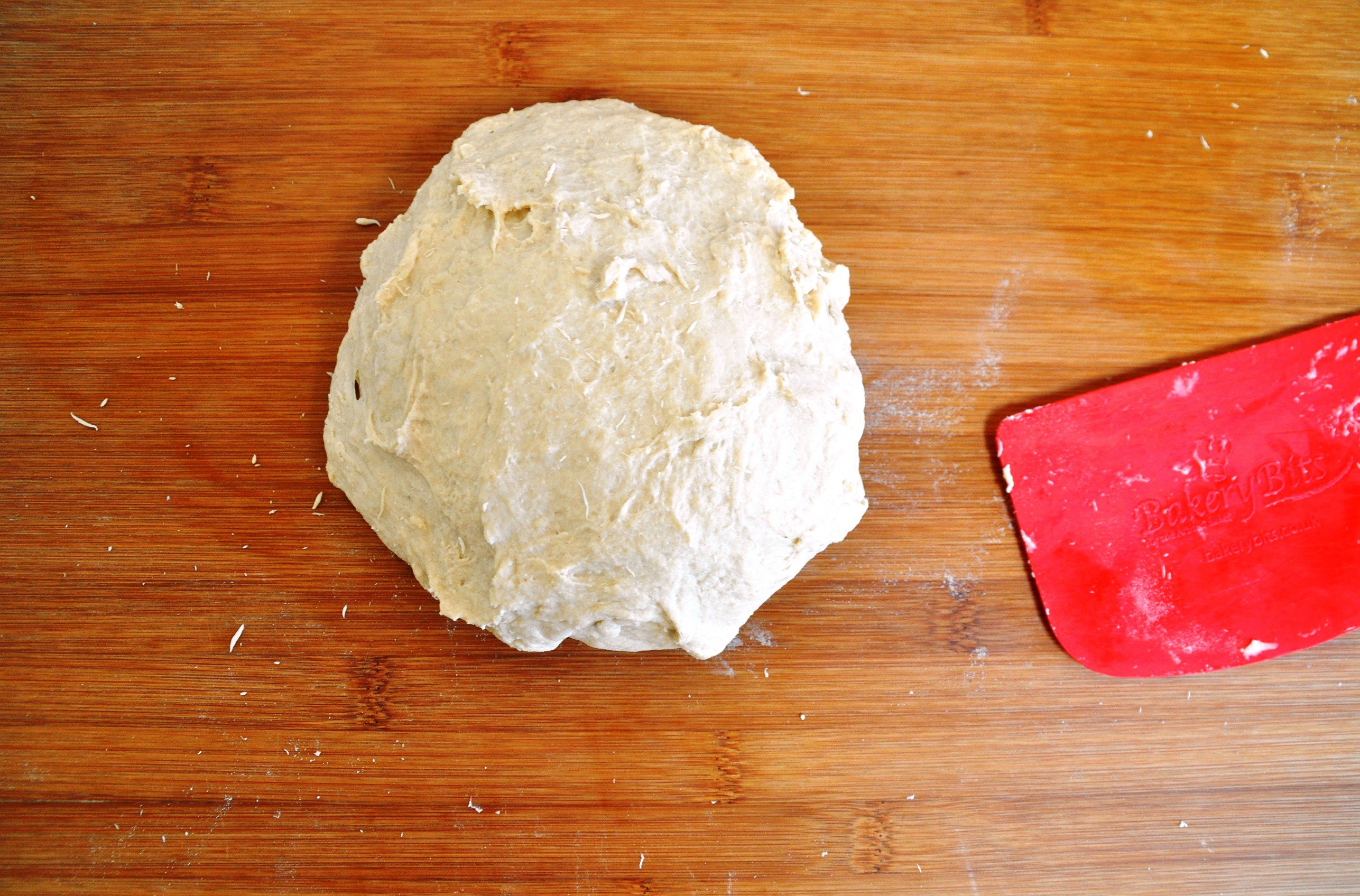
Kubaneh shaggy doughKubaneh - kneading doughKubaneh - smooth dough
4. Turn out the shaggy mixture onto a lightly oiled work surface and knead. I used the Dan Lepard technique of not kneading too much, then returning the dough to the bowl, cleaned and oiled, leaving for 10 minutes, then kneading briefly again. Repeat this twice more, then return to the cleaned, lightly oiled bowl.
5. Cover with plastic or a clean, damp tea towel and leave to prove for a couple of hours, or until doubled in size. The time will depend on the ambient temperature. It’s about 20C in my kitchen on a mild English summer’s day, and it took about two and a half hours.

Kubaneh dough - proved
6. While it’s proving, liberally grease the cake tin with butter, and grease the underside of the foil lid too. If you have a lidded pot, grease that similarly.

Kubaneh dough - slapped around
7. Sarit describes the next step as “the strange bit” – you moisten your hands then “flip the dough about in the bowl to knock it back”. Do it three times, keeping your hands moist.

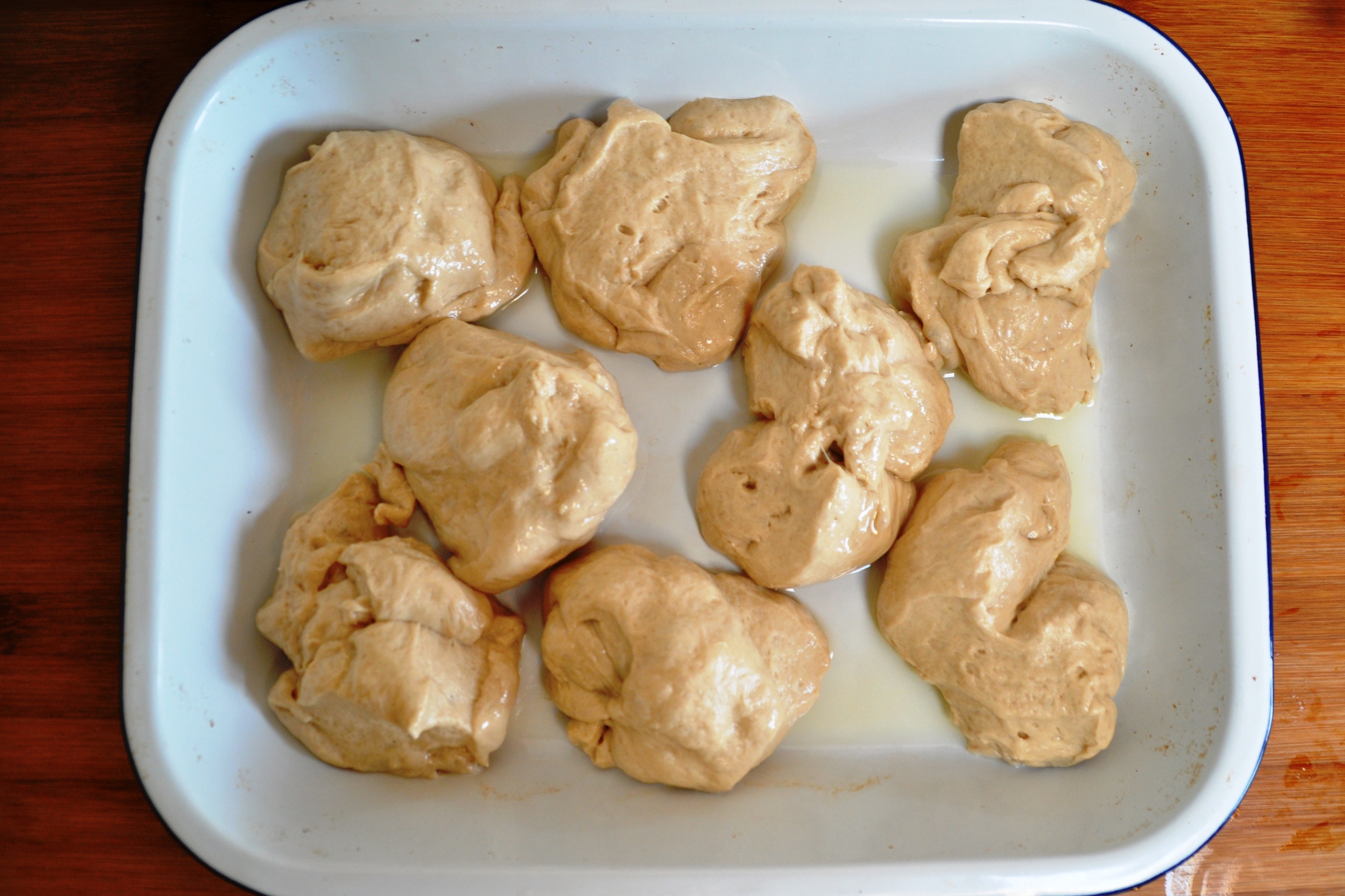
Kubaneh dough - pieces
8. Oil a tray, then divide the dough up into eight pieces and place them on the tray. The dough weighs 900g, so eight pieces at around 112g.
9. Oil your hands a bit then take each piece, stretch it slightly, and put a blob of butter in the middle. I used pieces at about 10g, half a walnut size.
10. Smear the butter a bit then wrap the dough around it to form rough balls.

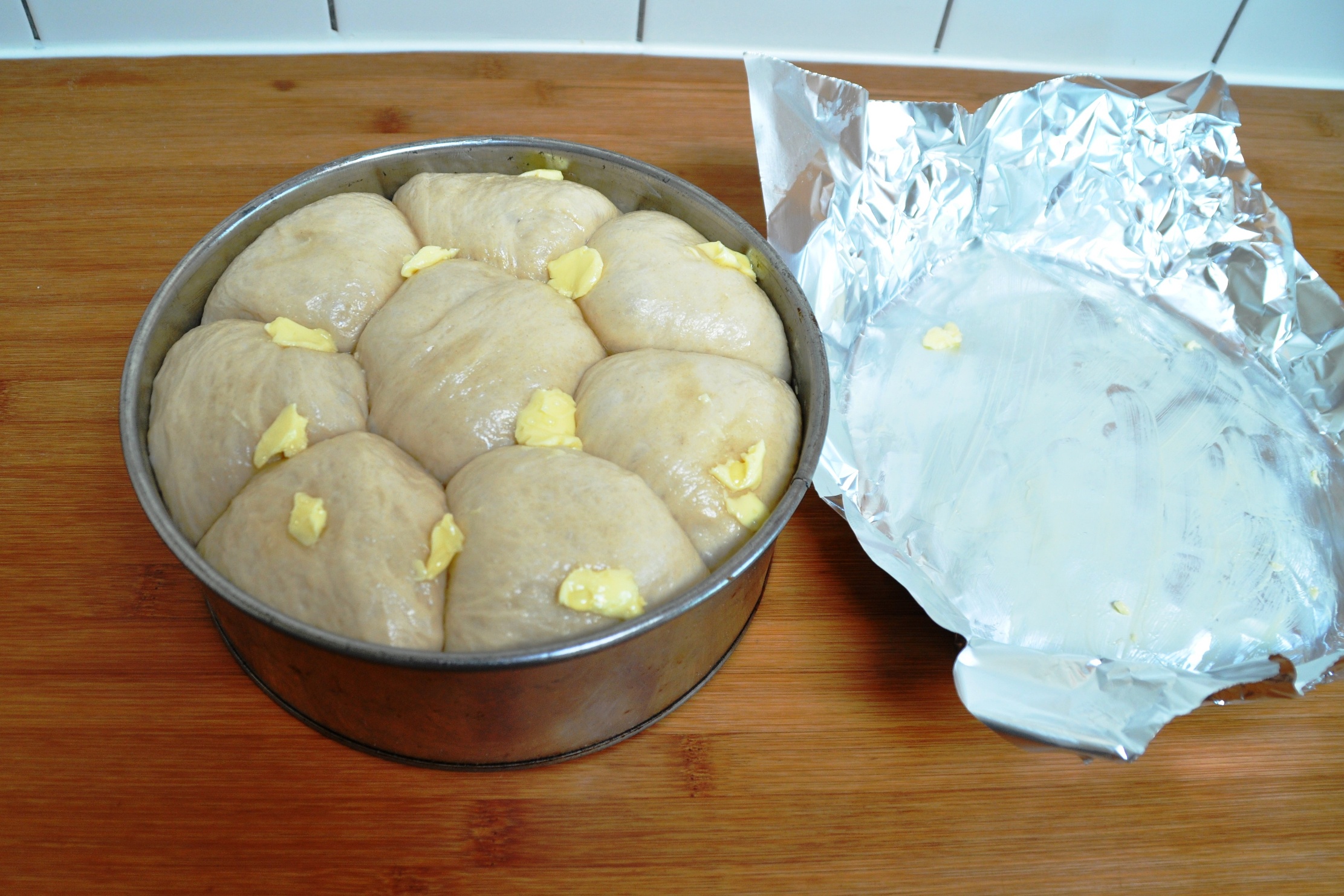
Kubaneh dough pieces in tin
11. Put the balls in the prepared tin, one in the middle, the rest equally spaced around it.
12. Put some more flecks of butter on top, drizzle with honey then cover and prove again until the dough “almost reaches the top” – too high and it’ll “overflow when baked.” I drizzled a bit more honey and added a bit more butter before baking.

Kubaneh dough ready for baking
13. Preheat the oven to 220C.
14. Put the tin, with its lid, in the oven and bake for half an hour.
15. Reduce the heat to 200C and continue baking for another half an hour.
16. Reduce the heat again to 180C and continue baking for another half an hour.
17. Turn the oven off and leave in the oven “for at least an hour”.
18. It’s best served warm, so if you’re an insomniac and have been doing this all night, or proved it overnight in the fridge and baked it early, enjoy it thus.

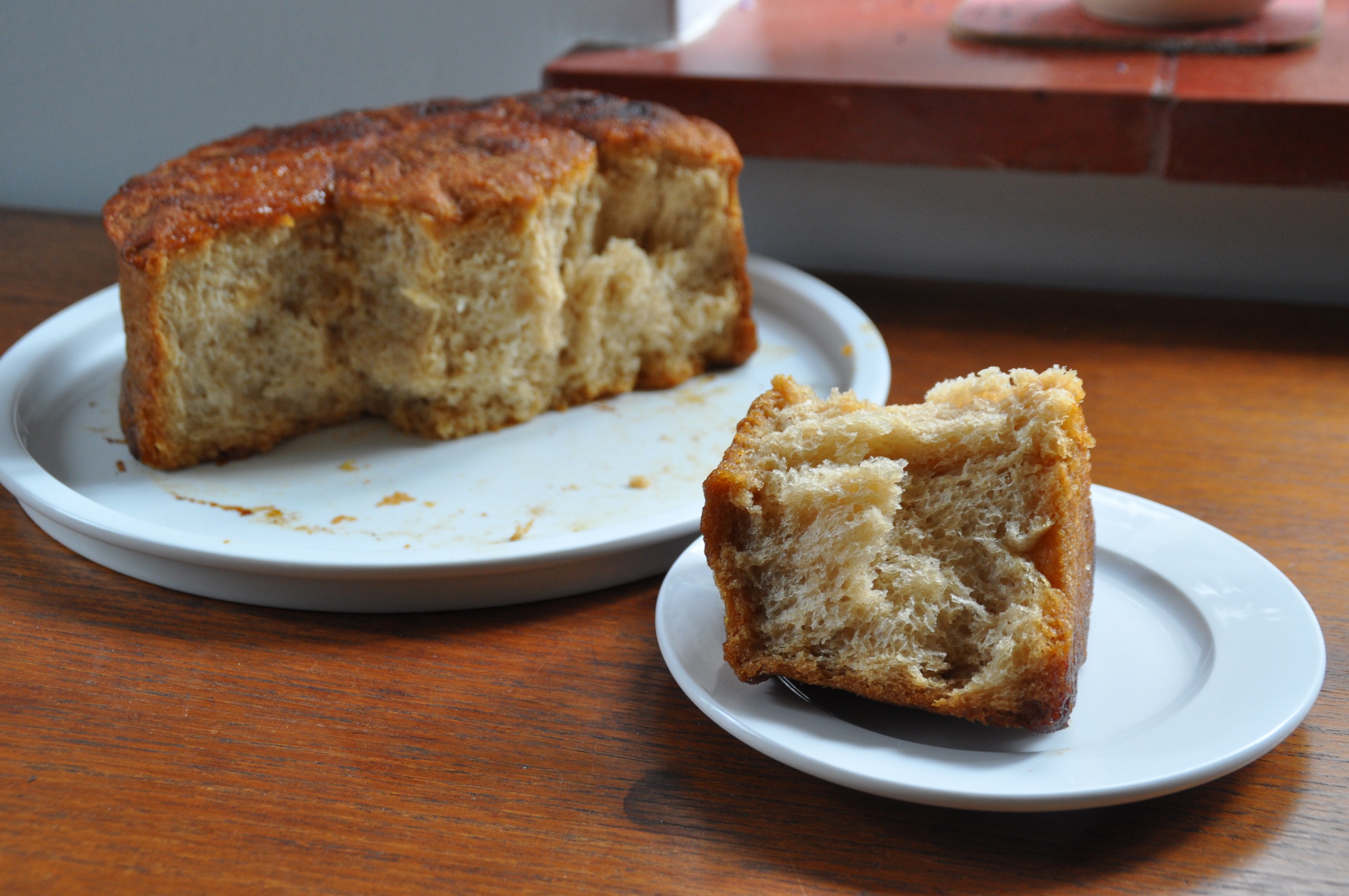
It’s surprisingly soft and chewy, and if you’re lucky, you’ll get nice caramelised bits. I won’t be doing it every week, but it’s a great addition to my enriched breads & breakfast bakes armoury. It’s also reminiscent of English lardy cakes, particularly the fruit-free versions from my part of the country, Hampshire and Sussex. Though obviously the fats used are a bit different for that gentile bake.

It’s also got me thinking about that most indulgent of fatty-sugary-doughy caramelised concoctions, the Breton kouign amann, which is more a pastry than a bread. Still, I might have to revisit that soon.

* Aka zhug, zehug; the Honey & Co The Baking Book also has a recipe for this, to accompany their lahooh, Yemeni pancakes.

5 Comments

Filed under Baking, Breads, Cakes (yeasted), Recipes

Triple ginger cake

Triple ginger cake

Last week, I made a batch of khobz for my friend Alex, who has started up a market stall. His operation (Kabak, named after a place he loves in Turkey) specialises in Eastern Mediterranean, Middle Eastern and North Africa inspired foods and very fine they are too. In you’re in Lewes, look out for him Friday mornings at the market.

Coming home from helping Alex break-down the stall, I got to thinking about sweets inspired by similar cuisine. The classics are baklava and suchlike pastries, as well as cakes like the syrupy basbousa/revani. But I wanted to try something new, so reached for the cookbooks.

Arabesque* by Melbourne-based Greg and Lucy Malouf is subtitled “Modern Middle Eastern Food”, which is a good way of saying it’s not trying to be slavishly traditional or authentic. I’m not sure if his sticky ginger cake relates to any specific sweet the Middle East at all, but it’s a pleasing concoction that uses both powdered and fresh ginger. I like crystallised/candied ginger, so I added some of that too, hence the name.

Golden syrup

Golden age
It also uses golden syrup, arguably a quintessentially British ingredient and one I love, from a childhood of ginger biscuits and steamed syrup puddings.

It was invented in the late 19th century as a by-product of sugar refining. In Britain, we still mostly use the Lyle’s brand in the green and gold tin. The tin still bears an image of a (dead) lion and a swarm of bees, with the Biblical slogan “Out of the strong came forth sweetness”, as it did when it was first marketed in 1885. (See Judges 14 for the full peculiar, gruesome yarn.)

Lyle’s golden syrup became a popular product in early 20th century Britain. This is in large part, I suspect, as with two world wars and food shortages it was a cheaper, more available alternative to refined sugar and a sweeter, less bitter alternative to molasses and black treacle.

So golden syrup isn’t a terribly Middle Eastern ingredient, but I suspect Greg Malouf uses it as a way of emulating or echoing the stickiness many more traditional sweets from that area achieve with a syrup poured on after baking.

220g golden syrup
170g sour cream, or yogurt (I used a half-half mix of double cream and yogurt)
2 eggs
100g soft brown sugar
About 50mm of fresh ginger, finely grated
80g crystallised ginger, roughly chopped
Zest of one lemon
280g unsalted butter
130g plain (all-purpose) flour
130g self-raising flour
1 tsp baking powder
1/2 tsp fine sea salt
2 tsp powdered ginger

1. Grease and base line a 20cm tin, ideally spring-form.
2. Preheat the oven to 180C.
3. Warm together the butter and golden syrup until the former is melted then beat this with the cream or yogurt, sugar, eggs, grated ginger, crystallised ginger and lemon zest.
4. Sieve together the flours, baking powder and powdered ginger then sieve again, into the mix, and fold to combine. Try to mix in any lumps of flour but don’t beat it.
5. Pour the mixture into the prepared tin and bake for about minutes. Test to see if it’s baked with a skewer – does it come out clean? If not, return to the oven for a bit longer. If it’s starting to get too brown on top, cover with foil.
6. Remove from the oven and allow to cool in the tin, then turn onto a rack to continue cooling.

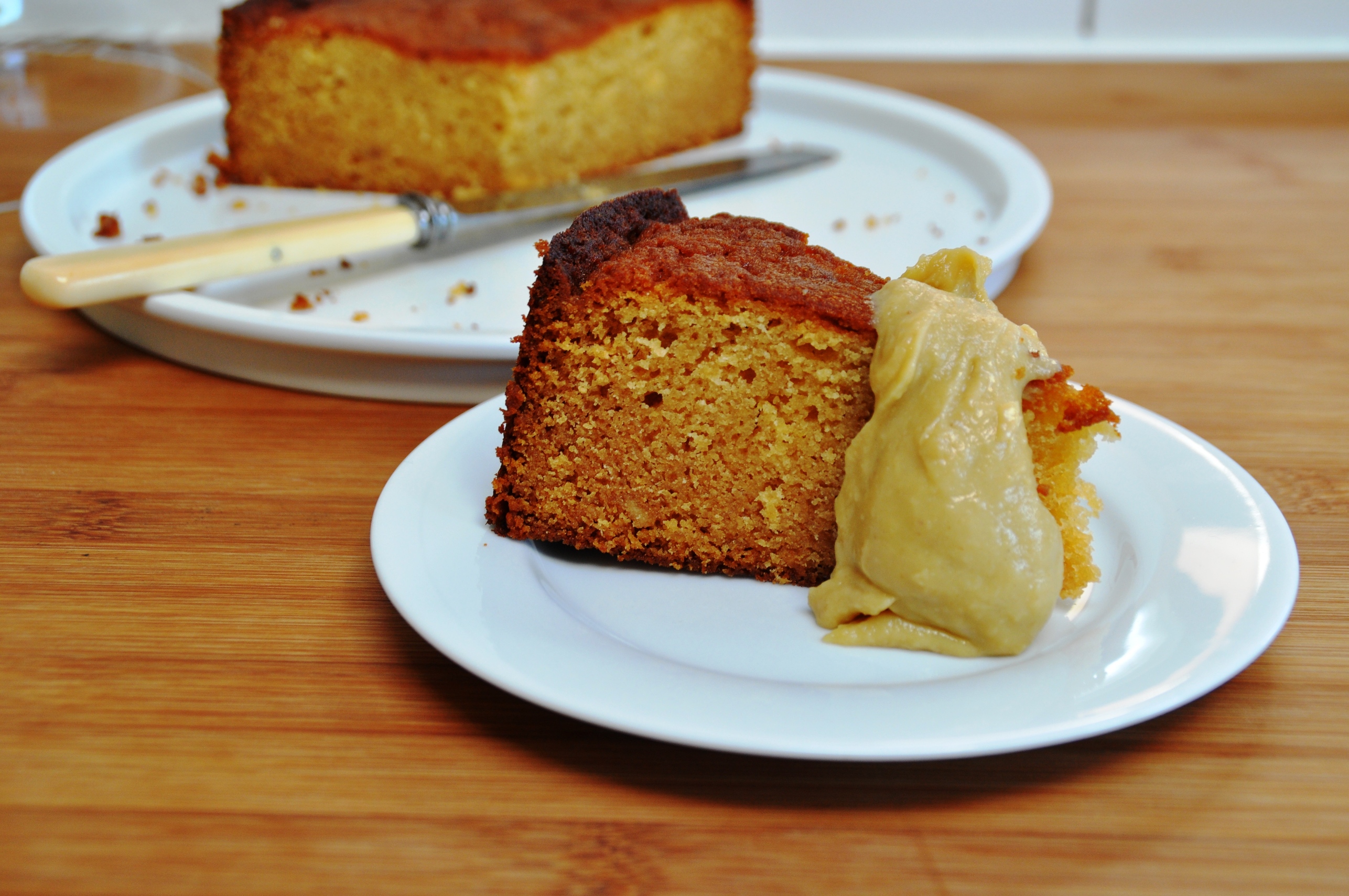
Arabesque suggests serving it with what they call ginger cream – which is really a ginger custard. It doesn’t look that appetizing in the pic, but – it’s custard! With ginger!

About 30mm section of fresh ginger, finely grated
150g double cream
1/2 tsp powdered ginger
40g soft brown sugar
2 egg yolks

1. Whisk together the egg yolks and brown sugar.
2. Warm up the cream and gingers in a saucepan, and heat to scald – ie just as bubbles appear, but don’t boil.
3. Pour the cream over the egg and sugar mix, whisking.
4. Put the mixture back in the pan and continue whisking, over a low heat, until it thickens.
5. Put in a clean bowl and allow to cool.
6. When ready to serve, whisk (or indeed whip) to increase the volume a bit.

Serve with the custard. It’s also very nice with clotted cream. But then everything is.

Anyway, this was good, but when it comes to Middle Eastern and Middle Eastern-inspired baking and sweets, what I really need on my bookshelf is the new The Baking Book from Honey and Co. Hopefully it will be there soon.


* Not to be confused with Claudia Roden’s book with the same title and similar theme.

7 Comments

Filed under Baking, Cakes

Galettes aux vin blanc with Tom Hunt’s strawberry ice cream

Galettes aux vin blanc with strawberry ice cream

Me and Fran got married at this time of year, six years ago. June is the height of strawberry season in England, and three days before our wedding we got nicely sun-burned at a pick-your-own. It was 26C and beautiful. Three days later it was 8C and raining. And our skins matched the strawberries in the huge bowls of Eton mess made by my mother, Helen.*

This June is shaping up pretty similarly. Summer one day, winter the next. But the strawberries are still good. I got a big tray at reduced price the other day. That same week, the Guardian’s Saturday Cook section featured recipes from Tom Hunt. Tom, who I met at Rachel’s book launch last week, is the chef, founder of Poco restaurant in Bristol and author of Guardian The Natural Cook. His ethos is one of combating waste and encouraging sustainability and seasonality. Hence the strawberries recipes right now.

There was a fruit and veg stall in the precinct the other day and their strawberries were imported from Holland. Why? Are there none from Sussex or the southeast of England? Does it really economic sense to ship them across the channel? Possibly with our skewy economics, but it doesn’t seem to make environmental sense.

Fellow Brits – enjoy British strawberries why you can! The more local the better. Then enjoy them again next year, when they’ll taste even better for being a seasonal treat.

Or make big batches of ice cream and preserves to spin out the pleasure.

Tom’s ice cream recipe is wonderfully simple: strawberries, macerated and quickly boiled with some sugar, whipped cream, some mascarpone. Best of all, it doesn’t call for an ice cream maker. I know you can make most ice creams by hand-churning, without a machine, but it always puts me off when the recipe stipulates a machine, one piece of kitchen kit I don’t have.

I served it with a puree made from some of the other strawberries, which I macerated in some blackberry gin made by our friend Becky in 2010, and with galettes aux vin blanc. These could be called “white wine biscuits” and are another recipe from the 2011 edition of The Art of French Baking by Ginette Mathiot, which I talked about in the previous post.

The galettes are not unlike a type of shortbread, -ish, and as strawberries and shortbread are a classic combo, it seemed to make sense. (In all honesty they’re not as delicates and short as shortbread; they’ve got more body.) I also had some white plonk that needed using up.

200g plain (all-purpose) flour
100g caster sugar
100g unsalted butter, softened
Pinch of fine sea salt
45g white wine (3 tbsp)
1 egg yolk, beaten

1. Preheat oven to 200C and grease a couple of baking sheets.
2. Put the flour in a roomy bowl.
3. Stir in the sugar and salt, pour in the wine then add the butter, cut into small pieces.
4. Get your hands in there and squidge it all together to form a dough.
5. Lightly flour the work surface and turn out the dough. Knead lightly to homogenize but don’t over-work it.
6. Roll out the dough to 5mm thick.

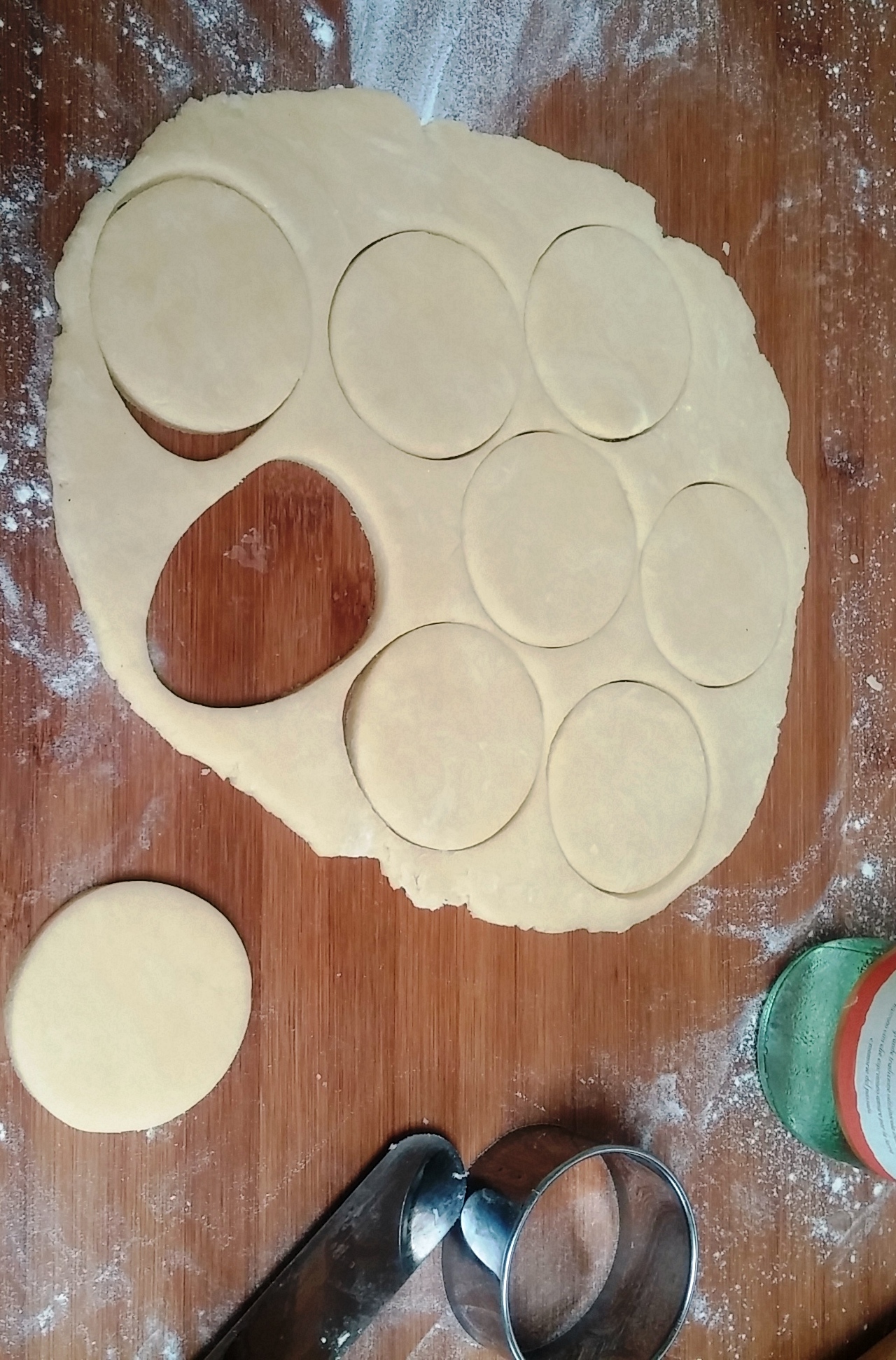
Cutting galettes aux vin blanc
7. Cut circles with a round pastry cutter. One with a diameter of about 5cm (2″) is good.
8. Put on the baking sheets, brush with beaten egg yolk to glaze and bake for about 15 minutes until nicely golden.
9. Allow to cool.

Galettes aux vin blanc with strawberry ice cream

Serve with strawberry ice cream. I’m not sure this is how the French would eat galettes aux vin blanc. They would probably add some actual wine consumption to the mix – quite possibly a dessert wine. French-speaking Francophile Fran can give me no further information on this issue. Any French who read this, please do let me know.


* We were a little burned, but not really strawberry coloured. That was a joke. I’m lucky as I’m fairly dark skinned for an Anglo-Saxon-British mongrel, Fran not so much. Kids – don’t forget that sun-block, especially if you’re fair-skinned.

8 Comments

Filed under Baking, Recipes

Reminiscences and butter biscuits

Petits beurres biscuits

I’ve just spent a great long weekend with Rachel Roddy, helping out with the food for the party celebrating the launch of her book, Five Quarters, catching up with Rome friends and meeting lots of interesting new people.

Given the theme of Rachel’s book and the fact that we met there, inevitably Rome was a big topic of conversation at the party. There’s a lot I’m missing about Rome. We know why we moved back in December 2013 – to try and adopt. But that doesn’t mean I’m not pining for certain things, especially food-related things: a six-days-a-week food (etc) market on the next block; a great gelateria two blocks away on our street; restaurants and cafés where you can get good food and drink for a sensible price (a fairly elusive concept in much of England); checking out the latest birra artigianale; going to the Città dell altra Economia in Testaccio to meet friends and buy huge, affordable chunks of local cheese on a Sunday. I could go on, but I won’t.

As I said in my post about Rachel’s book, I have to avoid the rose-coloured specs. But it’s hard, especially now while we’re at a difficult stage in the adoption process. We’ve been approved, but there don’t seem to be any children that are a suitable match for us. It’s a form of limbo – and as such all too conducive to drifting memories, reminiscing.

So much in our life now re-connects us to Rome. Even all the recipes I’m currently trying from The Art of French Baking by Ginette Mathiot. My sister – another Rachel – gave me this book just as we moved to Rome in August 2011 and in my mind’s eye I can still see it sitting on the shelf in our kitchen there, alongside a few I’d brought with me – Lepard’s The Handmade Loaf, Bertinet’s Dough – and some we acquired there – The Food of Rome and Lazio by Oretta Zanini de Vita, La Cucina di Roma e del Lazio (ie the same title) by di Marco and Ferré, Cucina Romana by Sara Manuelli, er, Cooking Apicius by Sally Grainger etc.

The Mathiot was a newly published Phaidon edition of the 1938 book Je sais faire la pâtisserie (“I know how to make patisserie”), translated and adapted by Clotilde Dusoulier. The book provides, in Dusoulier’s words, “the elemental components of French baking”: pastries, biscuits, cakes and puddings.

I used it a bit, but in all honestly I didn’t embrace it at the time. Why? Well – because Rome was all around us and I was somewhat distracted by all the pasticcerie (patisseries), biscotterie (biscuit bakeries), forni and panifici (bread or general bakeries) had to offer. I ate, I found favourites, I learned to make them at home. I got a bit obsessed with Italian baked goods. We have French-style patisseries in England, but Italian ones are considerably less common, so there was a lot to learn. (And still is1.)

I’m enjoying the Mathiot a lot now. I used it during my puff pastry experiments back in January, and I’ve been trying a lot of the biscuit and galette2; recipes, and musing over the brioche recipes. All eight of them. Eight. Rachel’s been talking about brioche too – they’re a common product in Sicily and Naples – so I plan to test them all, as well as the others in my cookbook collection. In the meantime, however, some biscuits.

Twice the fat, twice the pleasure
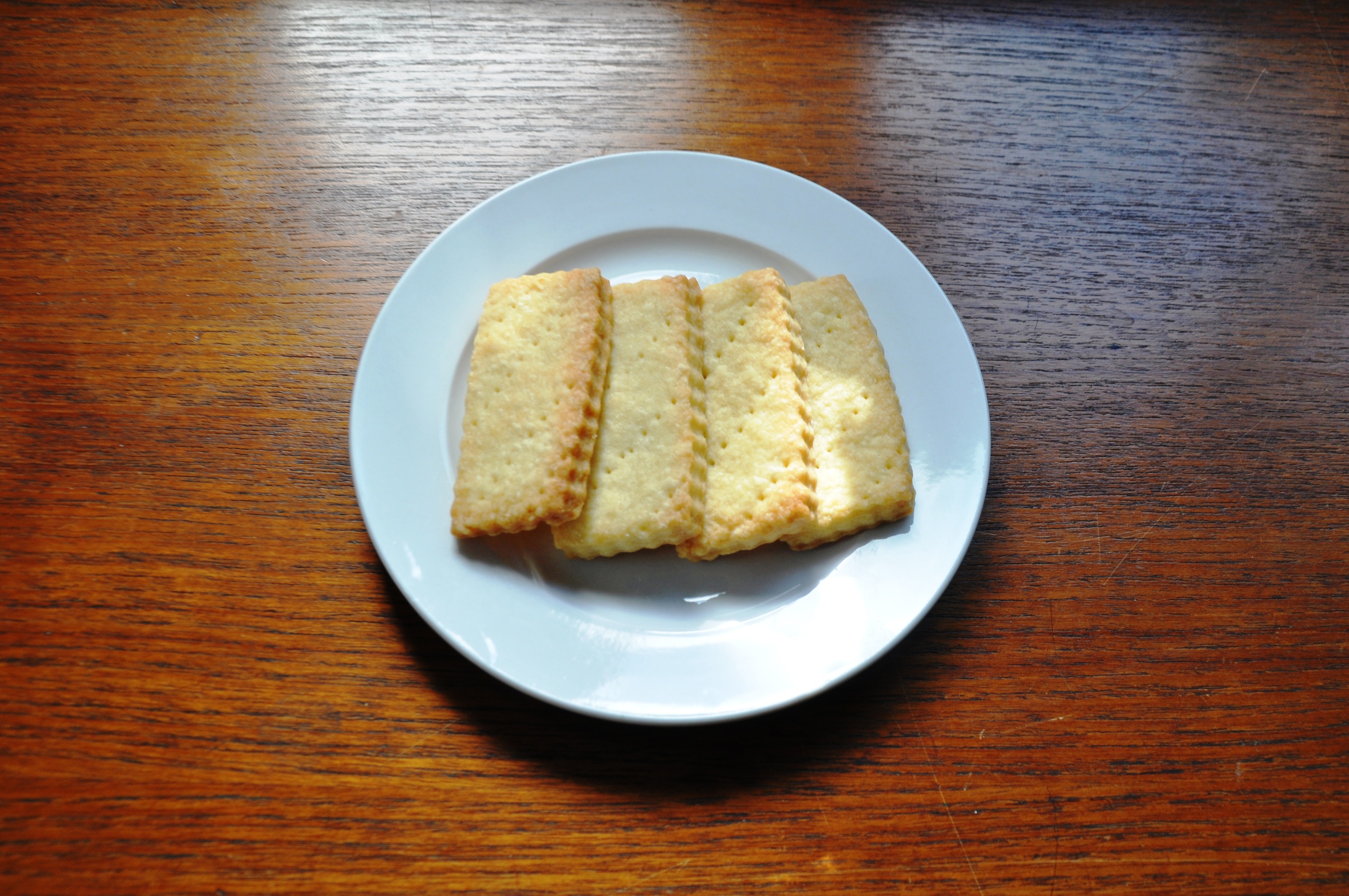
If Italian food is synonymous with olive oil3, French food is synonymous with butter. Petits beurres4 – for those who don’t have spectacular school French like mine – simply means “little butters”, or little butter biscuits. But not only do they have a good proportion of butter, they have the same proportion of double cream too. The result is a rich, light, crumbly biscuit. I make mine with a small, rectangular cutter that’s 40x75mm, so each one is a perfect size for a couple of bites.

I love this cutter. The result is not unlike the famous French industrial biscuit the “Petit Beurre LU” or “Véritable Petit Beurre” from Lefèvre-Utile. There isn’t much about it online in English, but French Wikipedia gives the story. It says the 1886 recipe by Louis Lefèvre-Utile was originally inspirant des productions anglaises de l’époque. “It was inspired by English products of the era”. That’s not something you hear the French admit very often. It’s also officially 65x54mm so slightly different proportions to mine.

These petits beurre are – unsurprisingly – considerably richer than the LU factory version, which doesn’t have half as much butter and no cream, instead being made with milk powder. Bugger that. Butter + cream = pleasure. As many chefs will tell you: “fat is flavour”. It’s something I heard often from Chris Behr, chef at the American Academy in Rome, when I did an internship there.

100g unsalted butter, chilled and diced
250g plain (all-purpose) flour
50g caster sugar
Pinch salt
100g double cream

1. Put the flour in a bowl and rub in the butter until the mixture resembles breadcrumbs.
2. Add the sugar and salt and combine.

Petits beurres - add the creamPetits beurres - form a dough

4. Pour in the cream then combine to form a dough, working it by hand. Work it enough to clear and form a smooth dough. Don’t overwork it. It’s basically a rich, sweet pastry paste, without raising agents, and overworking it can toughen it up.
5. Form a ball, squash it into a disk, wrap it in plastic and put it in the fridge to rest for least half an hour.
6. Preheat the oven to 180C and grease your baking sheets.
7. Dust the work surface with flour then roll out the dough to about 5mm.

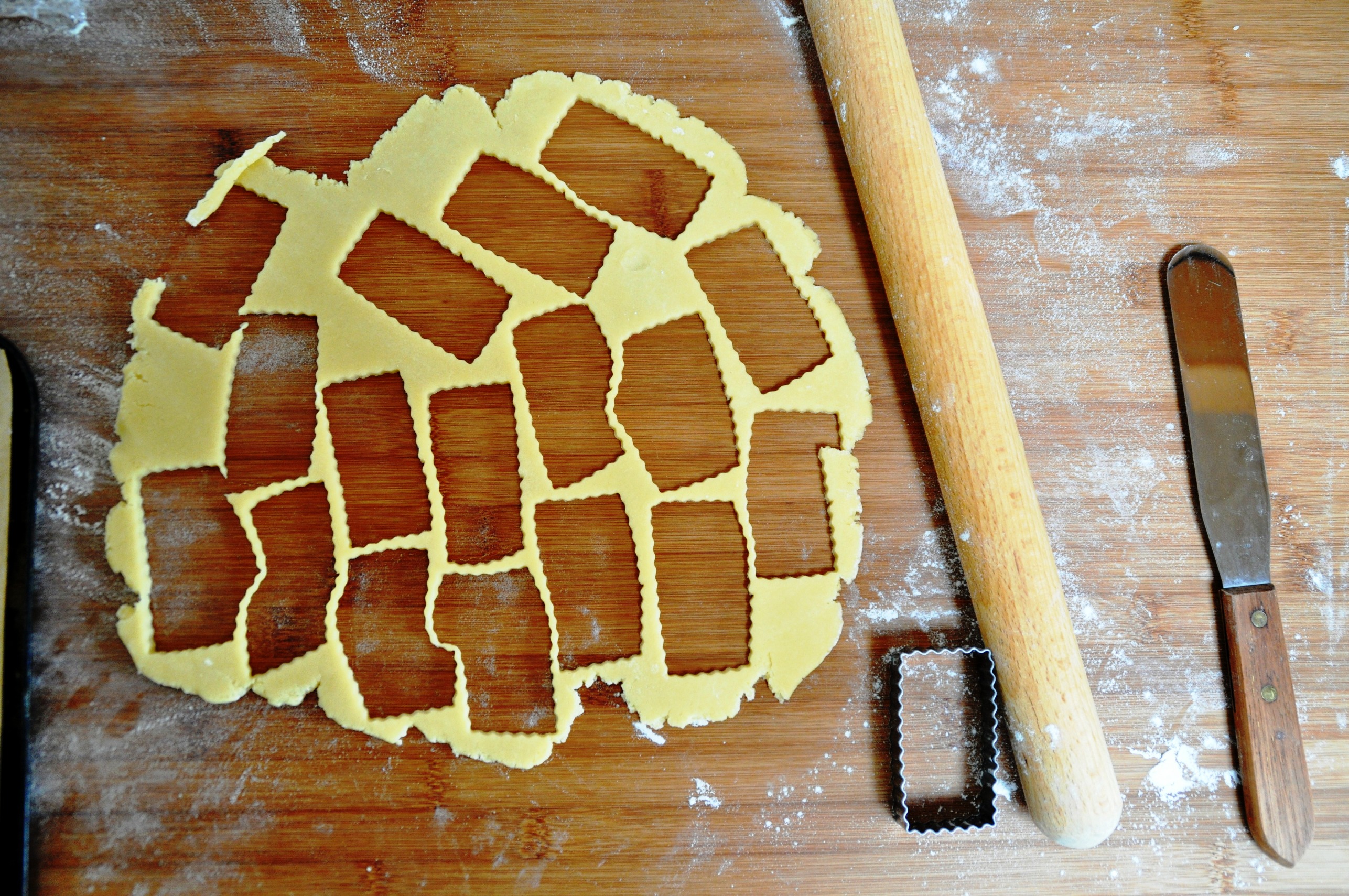
Petits beurres - cutting out

8. Cut out rectangles. If you don’t have a rectangular cutter you’ll have to do it by hand.
9. Place the biscuits on the sheets and prick them in diagonal pattern with a fork.
10. Bake for 15-20 minutes until starting to turn golden.
11. Transfer to a wire rack and allow to cool. I got 24 from this batch, but it depends on how big you cut them.

Enjoy. With a cup of tea or even alongside a nice strawberry dessert – as they’re in season here in England now. You should always seize British produce seasons as they’re not half so long as those in Italy. Damn it, there’s me reminiscing again!

Petits beurres

Notes
1 Italy, as you probably know, is a country of regions with strong local, cultural and culinary identities. Each region has dozens of food specialities, even when it comes to baked goods, breads and pastries etc. My two years in Italy were just a start really. It would be a lifelong project to learn them all.
2 Galette is a French word that doesn’t have an immediate equivalent in English. Sometimes it refers to something we’d translate as a pancake (eg Breton buckwheat pancakes), other times things we’d call a pastry, and others it’s more like a cookie. I looked at the etymology over in my post about galette des rois.
3 Despite that being a more historically southern Italian thing, with strutto – lard – arguably a more common fat in the mountains and the north.
4 Should they be called petits beurres or petits-beurre? They can’t seem to agree on the agreement. The English is just petit beurre biscuits.

15 Comments

Filed under Baking, Recipes

Burger buns and khobz variations


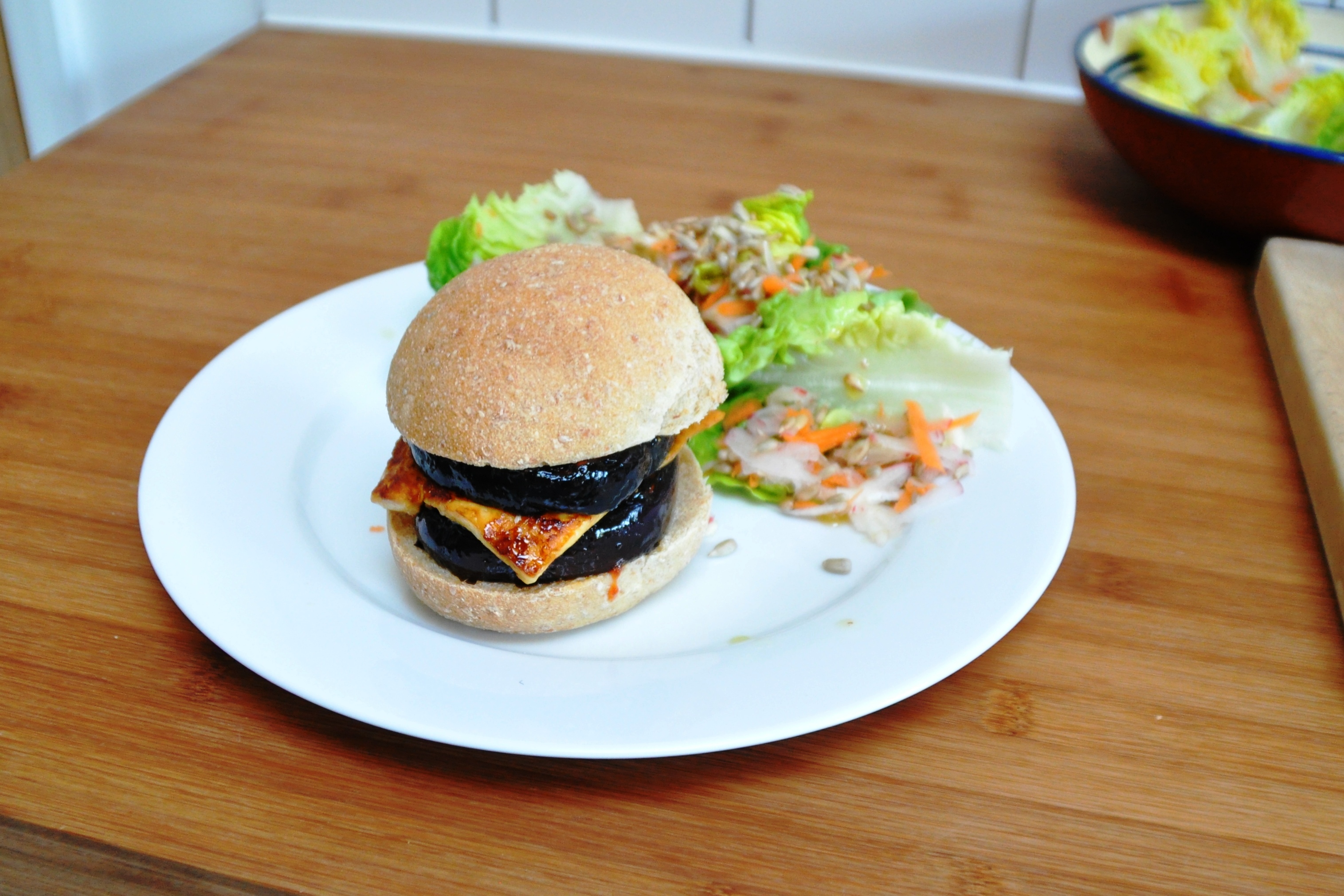
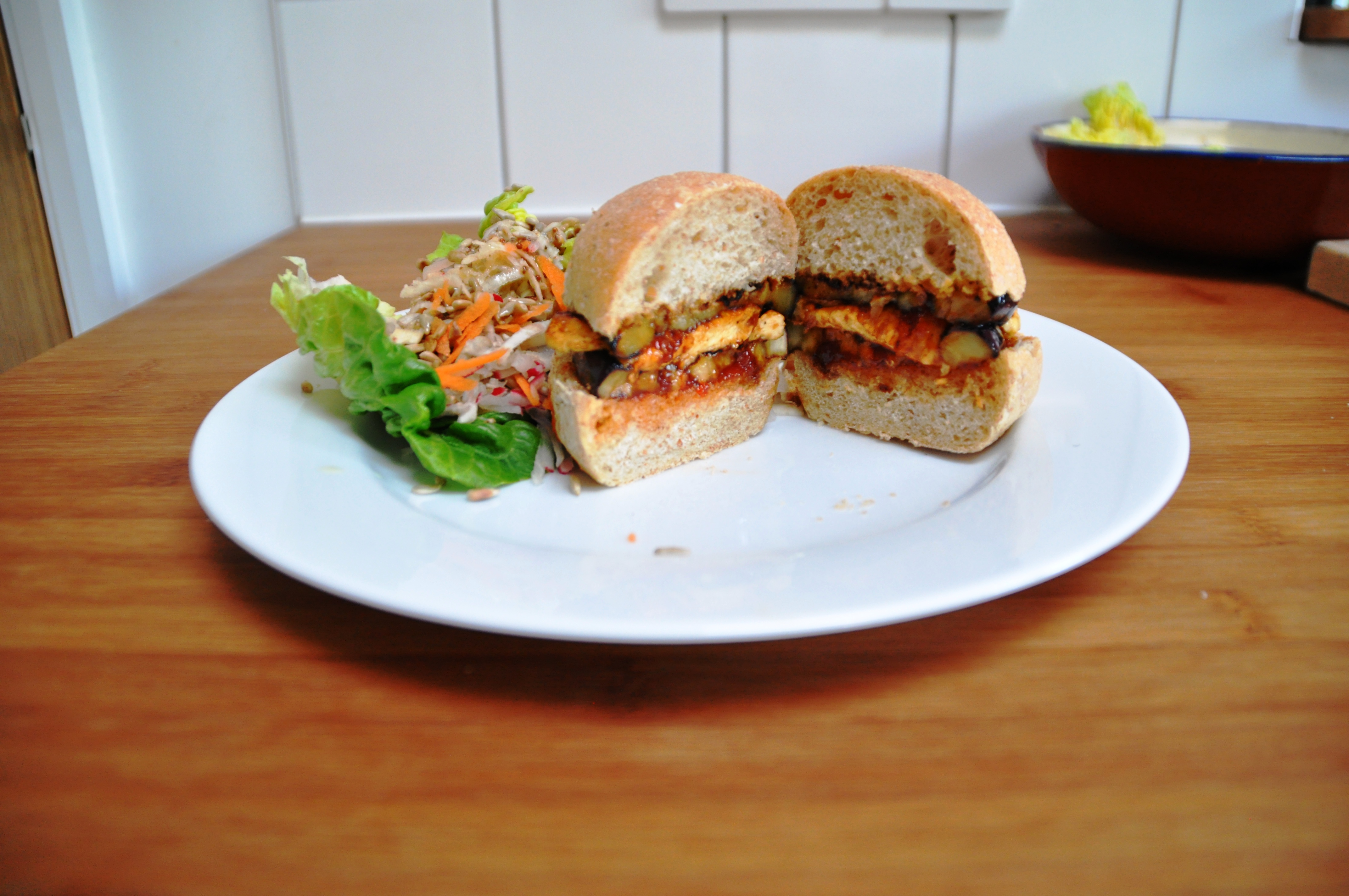
Aubergine and halloumi burger with khobz bun

Back in the old days, I’m sure we always ate burgers with a sesame bun. It wasn’t exactly the greatest bread, but at least it was savoury. These days, all the hip and wannabe burger joints sell theirs in brioche buns. I do not get this at all. Brioche is a sweet breakfast bread.* I don’t want a sweet burger bun, it’s just plain weird.

I was a vegetarian or pescatarian for about 20 years and although I’m more omnivorous these days I still don’t eat much red meat; in fact, I reckon I’ve only eaten beef about three times in the last 30 years, in part as I’m not a huge fan, in part as, in much mainstream modern industrial farming, beef can be reared in grim and environmentally unsustainable ways*. So meat burgers aren’t really my thing. But I do love the format, so when I saw this veggie option on Hermione’s Pantry for burgers with aubergine (eggplant, melanza) and halloumi – one of my desert island foodstuffs – I had to try it.

Khobz bun with aubergine halloumi 2

A month or so ago, I did a version of the khobz, an Arabic bread made with semolina and wholemeal wheat flour. I’ve been enjoying playing around with the recipe. I thought why not try the same dough for burger buns. I divided the same quantity of dough from my khobz recipe into eight and rather than making flatter, disc-shaped loaves, made balls for burger buns. I then used them for this aubergine and halloumi burger. I tweaked Hermione’s marinade and left it much longer than she says, but the result was great, with a juiciness that’s often lacking from veggie burgers and the khobz dough making for a good, suitably savoury, bun.

The khobz recipe involves a very satisfying combination of flours, and has also proved itself suitable for large, tear-and-share breads. Rather than dividing the dough into six for small loaves, I divided it in two and made these for a meal with friends a few weeks ago:

Large khobz


* Just read up on concentrated animal feedlots (CAFOs), deeply messed-up arrangements involving cattle being crammed into fenced pens, with no grazing, and instead a diet of maize – something they’ve not evolved to eat. They stand around in their own excrement and get sick, necessitating intensive regimes of antibiotics. CAFOs, or at least similarly brutal intense operations, are creeping into Britain and, likely, will become increasingly common as countries like China become wealthier and more of the world’s seven billion start shifting to more heavily meat-based diets.

Although it’s a US-oriented book by California-based writer Michael Pollen, I’d recommend anyone, even in Britain, read The Omnivore’s Dilemma.  It not only looks at meat (and, by extension, cheese) production in the food supply chain, it even evaluates the virtues, or otherwise, or locavorism, something that’s close to my heart but also something I’m happy to question and be further educated about.

In the meantime, I prefer my bovine products to come from cattle like this. Except for the one beast that isn’t a cow, but instead seems to be a fallow deer that has adopted the herd!

Cattle on the South Downs, Southerham, 30 May 2015

* Except when it’s not. I’ve got a few recipes for savoury brioche, eg the cheesy brioche de gannat.

5 Comments

Filed under Baking, Recipes

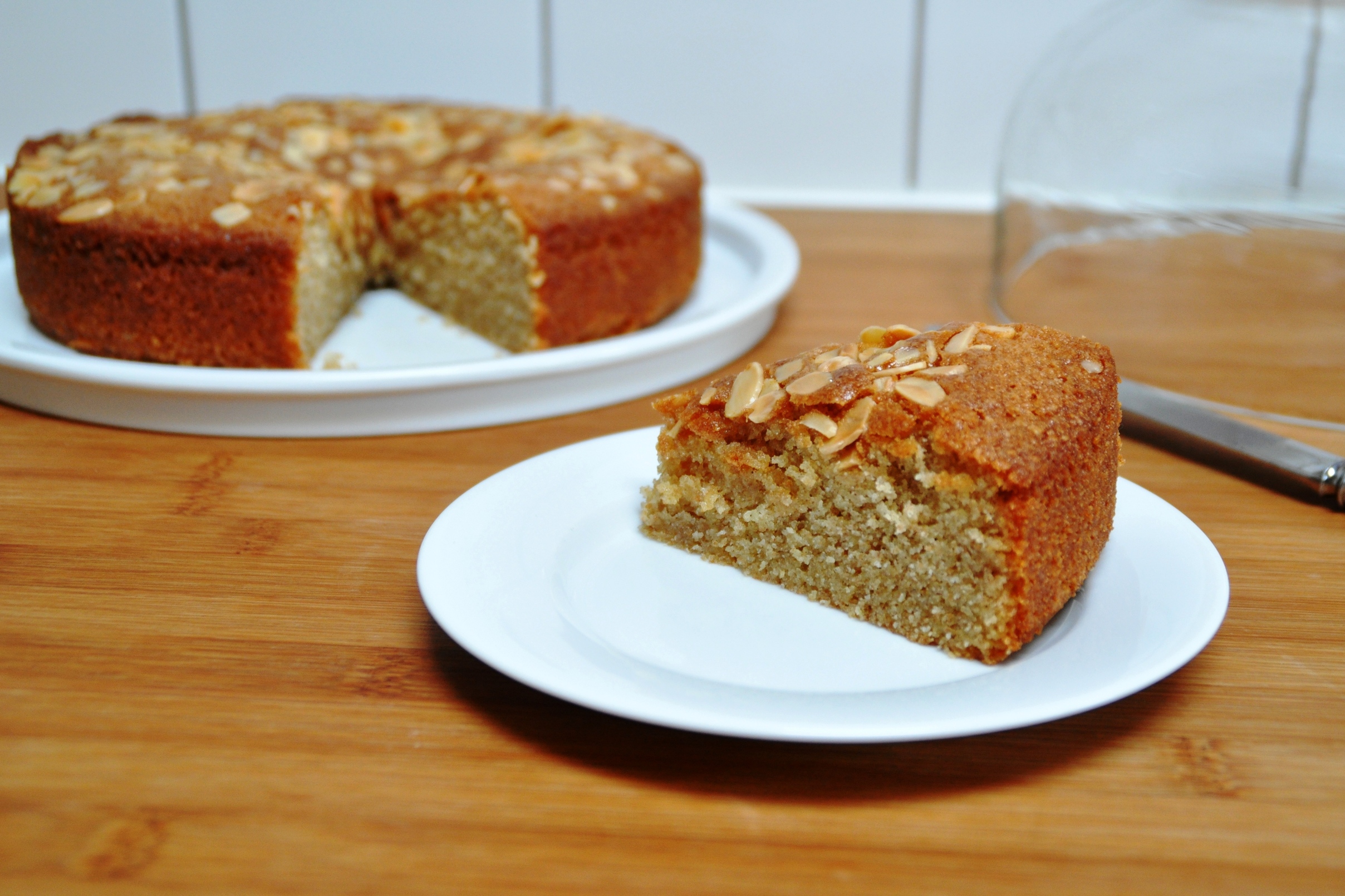
Wholemeal honey cake

Wholemeal honey cake

I love cakes made with ground almonds. And I love cakes with sweet syrups poured over them after baking. So this cake is a result – it has both.

It’s from a recipe by Gill Meller, now group head chef of Hugh Fearnley-Whittingstall’s River Cottage operation. As with my last syrupy cake, revani, it’s a recipe I got from the paper several years ago. It’s one I strongly associate with my parents’ place in northwest Devon, as the original newspaper cutting lives in a file there, along with some notes about what’s not quite right with it. Notably, the version as it appeared in the Guardian had too much butter in it, which seriously leaked out on baking. The version on the River Cottage site reduces the butter and increases the oven temperatures. For our family version, we reduce the butter even more.

The original also uses self-raising wholemeal flour – something that’s not especially common, so you can replace it with plain wholemeal flour and a bit more raising agent. But watch it with the baking powder. See notes below. More specifically I use a low protein (less than 10%) wholemeal flour, as opposed to a higher-protein bread-making wholemeal flour (12% plus). It would work with bread flour, but might be slightly heftier. As it is, it’s surprisingly soft for something so brown and branny.

Plain wholemeal flour

Not gluten free… but it could be
On the flour note, anyone who reads my blog will know I don’t generally have problems with modern common wheat (Triticum aestivum) and gluten. I prefer locally grown and/or stoneground where possible, and I find that as long as I don’t eat industrially made wheat products – specifically that paragon of bad modern food, white sliced – I’m fine.  For those of you who like, or have to, avoid modern wheat, I suspect this cake could work pretty well with either older wheat such as spelt (Triticum spelta), which has less starchy endorsperm and less gluten.

It may even work with alternatives to grass/cereal flours (wheat, rye, barley, oats etc), such as pseudocereal buckwheat (Fagopyrum esculentum). I’ve put the latter on my shopping list as it’s a foodstuff I enjoy for its own merits and want to try for this cake. Half-buckwheat, half-ground almonds sounds pretty good to me.

Wholemeal honey cake ingredients

250g unsalted butter, softened
250g caster sugar
4 eggs, lightly beaten
150g ground almonds
150g self-raising wholemeal flour*
2g baking powder [this is about a 1/3rd of tsp and has been a problematic aspect of this recipe, see below]
1 tsp powdered cinnamon
Pinch fine sea salt
40g flaked almonds
100g honey

1. Preheat the oven to 170C.
2. Grease a 23cm (9″) diameter springform cake tin and line the bottom with baking parchment.
3. Cream together the butter and sugar until light and fluffy.
4. Beat in the egg, a little at a time.
5. Beat in the ground almonds.

Bran

6. Sieve together the flour, baking powder and cinnamon, add a pinch of salt, then fold this in too. Sieving lightens and combines, but also removes the bran. The bran is good, rich in dietary fibre, protein, B vitamins and various minerals (including iron) – so chuck it into the mix too!
7. Put the mixture in the tin, scatter the 40g flaked almonds over the top. Place on a baking sheet (it may still leak some butter) then bake for about 1 hour, until a knife or skewer comes out clean. As long as the top’s not charring, it’s better to overbake this cake than underbake it. It’ll be more stable and the almonds and honey will keep it moist.
8. Warm the honey in a saucepan. I weigh mine straight into a pan, to avoid any sticky complications. Plus, if you only have set honey, heating it will make it runny, and if you’re using runny honey, it’ll make it runnier, so it’ll seep through the sponge better. While the cake’s hot, drizzle over the honey.
9. Place the tin on a wire rack to cool. Serve warm with cream, ideally clotted, for a pudding or at room temperature at teatime.

Wholemeal honey cake

Excuses excuses
I’m not going to deny I got some sinkage in the middle on the cake photographed here. It doesn’t affect the taste of course, but in terms of aesthetics, and perfectionism, it’s annoying. That said, if you look at F-W’s version on that Guardian page, it’s sunk in the middle too, so I’m in good company.

Potential causes of cakes sinking in the middle are:
1. Too much raising agent. It can cause cakes to over-rise then collapse.
2. Not baked quite long enough. However, if the cakes is pulling away from the edges of the tin and a skewer comes out clean, it generally means it’s done.
3. Overbeating the mixture.
4. Wholemeal flour is trickier than white flour. With all that (lovely, nutritious) bran and whatnot, it doesn’t lend itself to retaining a nice delicate structure.

I’m going with option 4, with a bit of option 1 on the side, for today’s excuses. I’ve made this cake again since this entry, and reduced the baking powder again and had much better results.


* Or 145g wholemeal flour with, total, 5g 0r 1 tsp baking powder.

6 Comments

Filed under Baking, Cakes, Recipes

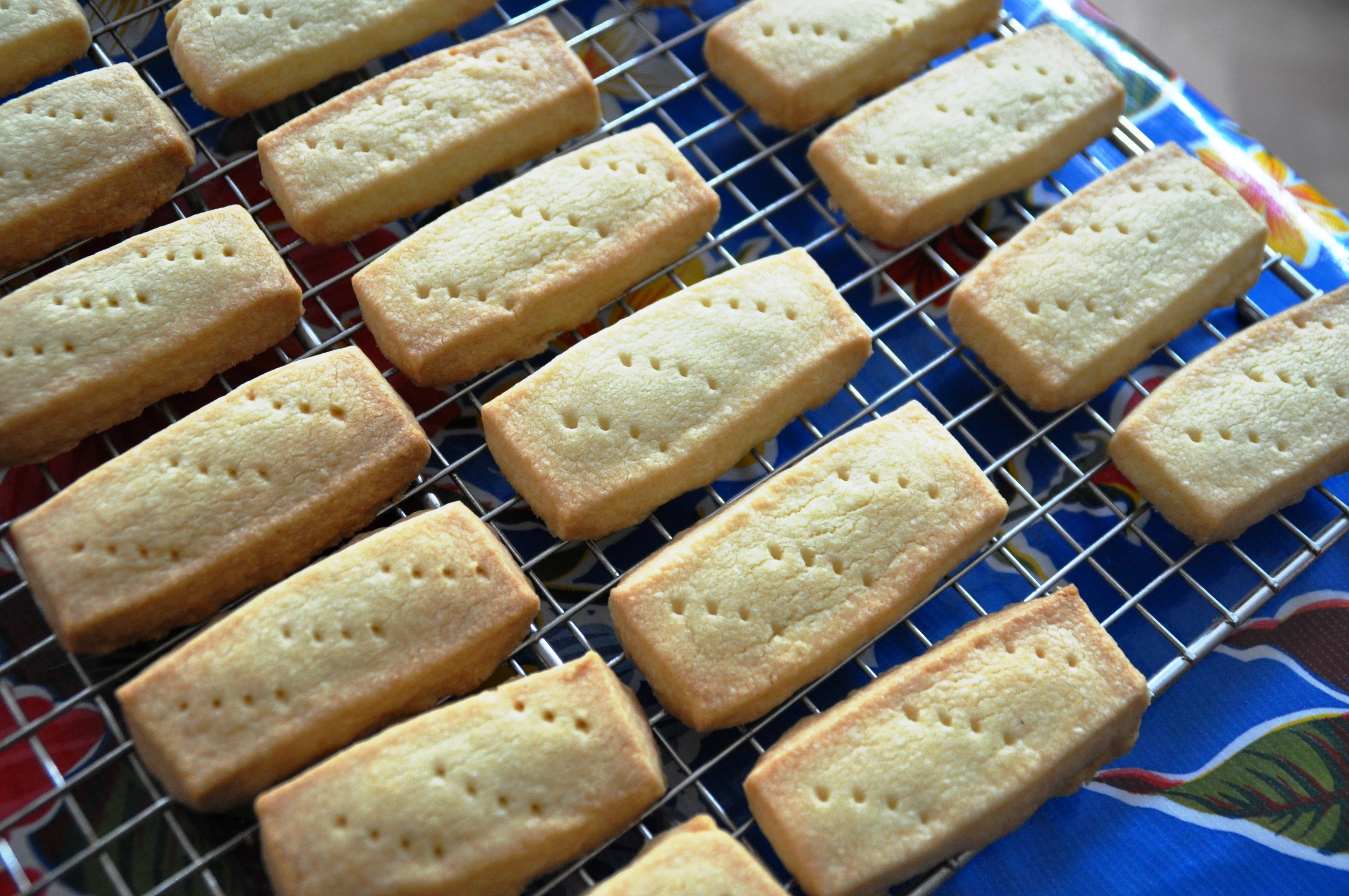
Delicate shortbread fingers

Shortbread fingers

Every family has its funny little games. One I play with my mother is “What’s the most past its best-before-date ingredient in the back of the cupboard?” These tend to be spices, but in this case, at my folks’ place I found a box of cornflour1 that was… well, let’s say that at least it was from this century.

Now, one of the many wasteful habits we have in the modern world, especially in the West, is throwing away perfectly good food. Love Food Hate Waste says that in the UK alone “We throw away 7 million tonnes2 of food and drink from our homes every year, the majority of which could have been eaten.” This may be a massive underestimate though. Other stats3 have it at 15 million tonnes. Think of that. That’s a mountain of food. A mountain of food that was produced with vast amounts of energy, that goes into landfills, when elsewhere people are starving – or indeed, relying on food banks here in the UK, the sixth biggest economy in the world.

So rather than giving it to the birds or the bin, I thought, why not try and use up the cornflour. Certainly, in its long career at the gloomy back of the cupboard, it’s not improved, but nor has it become inedible – it’s probably lost some of its power-to-thicken, but it hadn’t rotted or become toxic or bad for you. It just got stale.

Shortbread/shortcake
I’d been browsing Jane Grigson’s English Food and naturally, given my inclinations, I was in the Teatime chapter. Among the entries is one for Shortcakes. Though these are actually shortbreads, or shortbread biscuits. Grigson, writing in 1974, before the internet made everyone a expert and/or pedant, simply says, “Scottish shortbread is one of the many international variations on the shortcake theme”.

Shortbread is one of those recipes that utilises memorable proportions: 3 parts flour, 2 parts butter, 1 part sugar. For the flour, the Grigson recipe gave an option for either using ground rice or cornflour mixed with flour, so this seemed like a great way to use up the museum piece.

I’ve made shortbreads with ground rice and semolina before, which gives them a bit of crunch, but using cornflour takes them the other way – into a softer biscuit that almost dissolves in the mouth. The delicate texture can be further enhanced by using icing (powdered) sugar wholly or partially for that 1 part sugar.

A note on techniques
Shortbread can be made by either creaming the sugar and butter, then adding the flour, or by rubbing the butter into the flour, then adding the sugar. Grigson’s recipe did the latter, and gave the delightfully in-depth instructions of “Mix to a dough”.

Shortbread isn’t a million miles away from a shortcrust pastry, so the rubbing-in method seemed like a logical choice. As with a shortcrust pastry, try to avoid overworking the flour.

Now, I’ve made these twice in the past week: once with the, er, vintage cornflour, and once with some fresh stuff now I’m back home. Both worked well: the, er, well-aged cornflour resulted in a slightly softer, more powdery biscuit that was perfectly edible and palatable. Stale flour isn’t ideal, but it won’t kill you. So don’t bin it the moment it goes over its best-before date. Think of those 7 – or 15 –  million tonnes.

200g plain (all purpose) flour
100g cornflour (corn starch)
200g unsalted butter
50g caster sugar
50g icing sugar

1. Preheat the oven to 180C.
2. Line a couple of baking sheets with parchment or silicone mats.
3. Weigh out the flours and sieve them together into a large bowl. Or just combine and whisk a bit with a fork if you can’t be bothered with the sieve.
3. Cut the butter into small cubes, add it to the flour and rub it in until the mixture is crumb-like.
4. Add the sugars to the mixture and squeeze to all together to form a dough. It will be crumbly. You want it crumbly – crumbly = short.

Shortbread fingers - cutting the paste

5. Roll out the paste on a lightly floured worktop, to a thickness of about 12mm. I made mine into fingers, cutting pieces about 70 x 25mm.

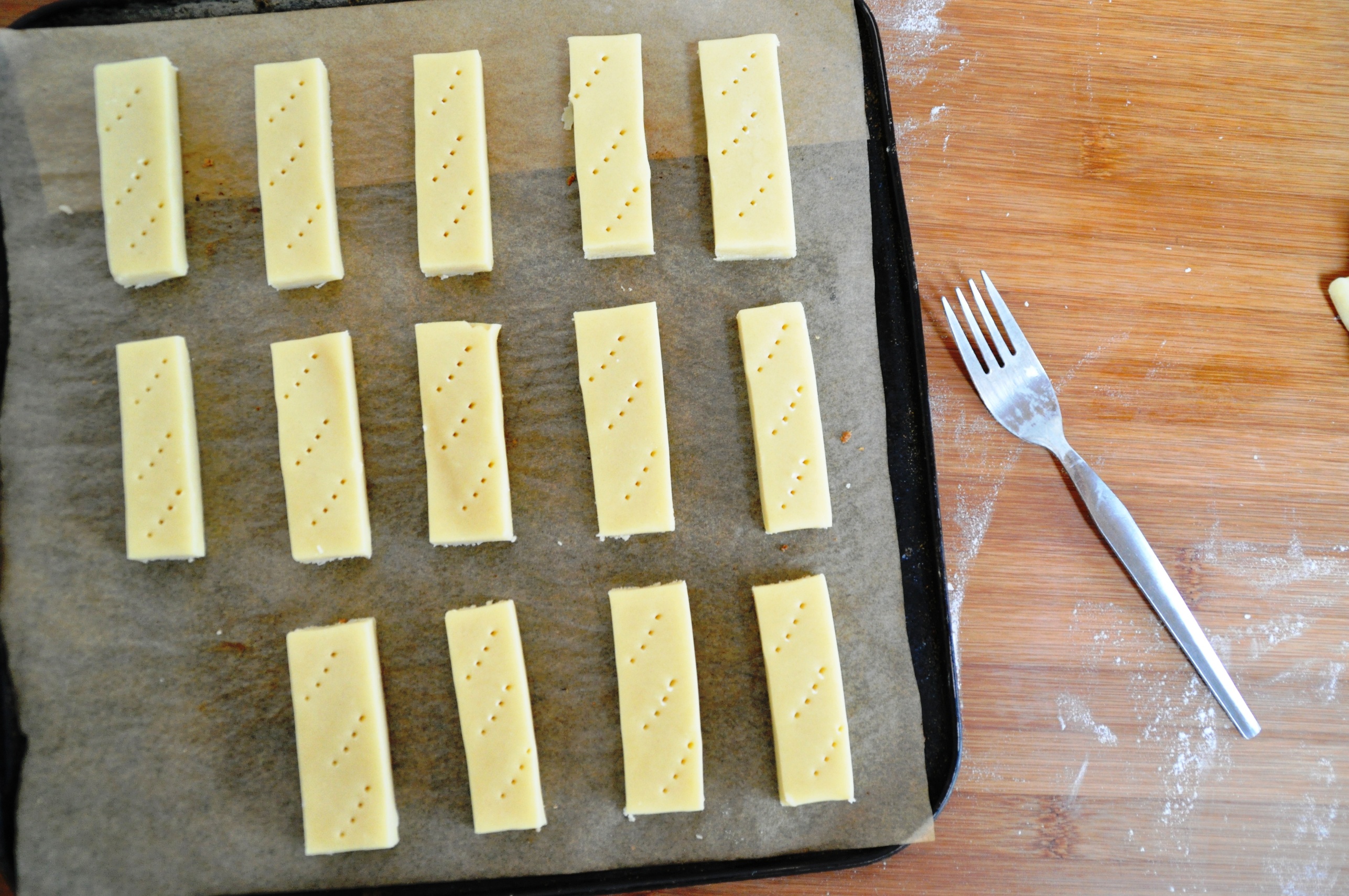
Shortbread fingers - prick with a fork
6. Put the piece on the baking sheets and prick them with a fork.
7. Put them in the oven and bake for about 15 minutes. The classic shortbread is baked to the point where it’s still pale, but I like mine just starting to colour. Your choice – add or subtract a few minutes from the baking time to suit your tastes.


1. What Americans call corn starch and Italians amido di mais. Whatever you call it, it’s a starch extracted from the endosperm – the carby bit – of kernels of Zea mais, maize, or corn in US English.
2. 7 million metric tonnes is 7.72 million short/US tons or 6.9 long/imperial tons. By any measure, a lot.
3. This article in The Guardian is about a new law in France to stop supermarkets wasting so much food. It has stats from Eurostat, with the UK at the top of an EU league table of food wasters.

7 Comments

Filed under Baking, Biscuits, cookies, Recipes

Syrupy almond-semolina cake – revani or basbousa

Revani cake

Some time in the late-1990s, I cut this recipe out of a newspaper. The writer was definitely Andy Harris, the paper was possibly The Independent. I went through a phase of making it loads then, I don’t know, it just seemed to get forgotten. I’ve no idea why, as it’s great. Just my sort of thing – quite dense and textured thanks to its use of almonds and semolina and moist thanks to a flavoursome syrup poured over after baking.

The name Harris used was revani (alternatively ravani), and he wrote about it as a Greek cake. Actually, similar and related cakes made with almonds, semolina and citrus syurp are common through much of the Eastern Mediterranean, Levant, Maghreb and Middle East. These are known as basbousa (rendered into English in various spellings), hareesa/harisa, namoura and kalbelouz. Some versions also feature coconut. I don’t fancy this as syrup is spiced up with cinnamon, cloves and orange and in tandem with the flavour of almonds, I think the coconut would be a bit much.

I’ve added a little orange blossom water to the original recipe. In part to boost that orangey-ness, but also as I find it’s the sort of ingredient that gets pushed to back of the cupboard and forgotten until it’s a decade over its best-before date. So I want to keep using it. Harris’s recipe featured brandy, but I don’t have any, I’m not sure what it would add, and I’m pretty certain that when this cake it made in Muslim nations it wouldn’t contain any booze.

Fitting in with my interest in feast day foods too, it may also eaten by Coptic Christians in Egypt and beyond for their Great Lent and Christmas celebrations. Though this info seems to be lurking on Wikipedia, unverified, and repeated elsewhere by lazy bloggers. Oh, oops. I’m struggling to confirm it, and don’t know any Copts.

Syrup
350g granulated sugar
700g water
1 cinnamon stick
6 whole cloves
Zest and juice of 1 orange
1 tbsp orange blossom water (optional)

Cake
200g granulated sugar
225 g unsalted butter
6 medium eggs (about 300g beaten egg)
110 g plain flour
175 g semolina
1 tbsp baking powder
110 g blanched almonds [or ground almonds, see below]
1/2 tsp vanilla essence
1/2 tsp almond essence
Extra blanched almonds to decorate

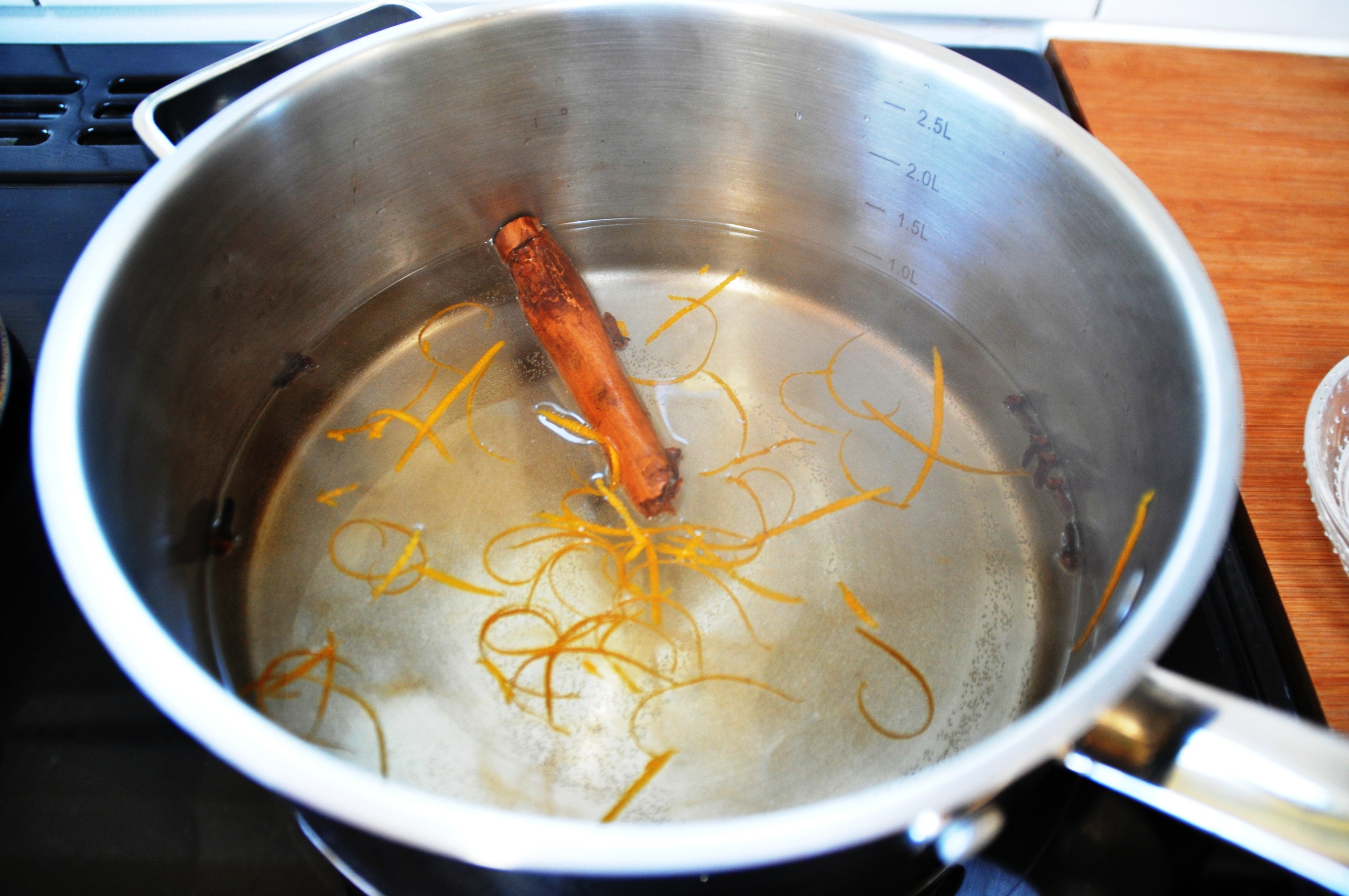
1. To make the syrup, dissolve the 350g sugar in the 700g water in saucepan over a low heat.
Revani cake syrup
2. Add the cinnamon stick, cloves and orange zest and juice and simmer for 15 minutes.
3. Take the syrup off the heat and allow to cool. Stir in the orange blossom water, if using.

Revani cake ingredients

4. In a large bowl, or with a food mixer, beat the butter and sugar together until creamy and light.
5. Beat the eggs with the vanilla and almond essences, then gradually add the egg to the creamed mixture, incorporating well.
6. If using blanched almonds, chop them finely – either by hand or in a food processor. Alternatively use ground almonds – you won’t have quite such an interesting texture but it’s easier. I used a mix this time round – 40g ground almonds and 70g blanched almonds, chopped.
7. Sieve together the flour, semolina and baking powder. Add the chopped almonds/ground almonds.
7. Add the flour mix to the creamed mix and blend well.
8. Preheat the oven to 180C.
9. Grease a rectangular tin, about 32x20cm.

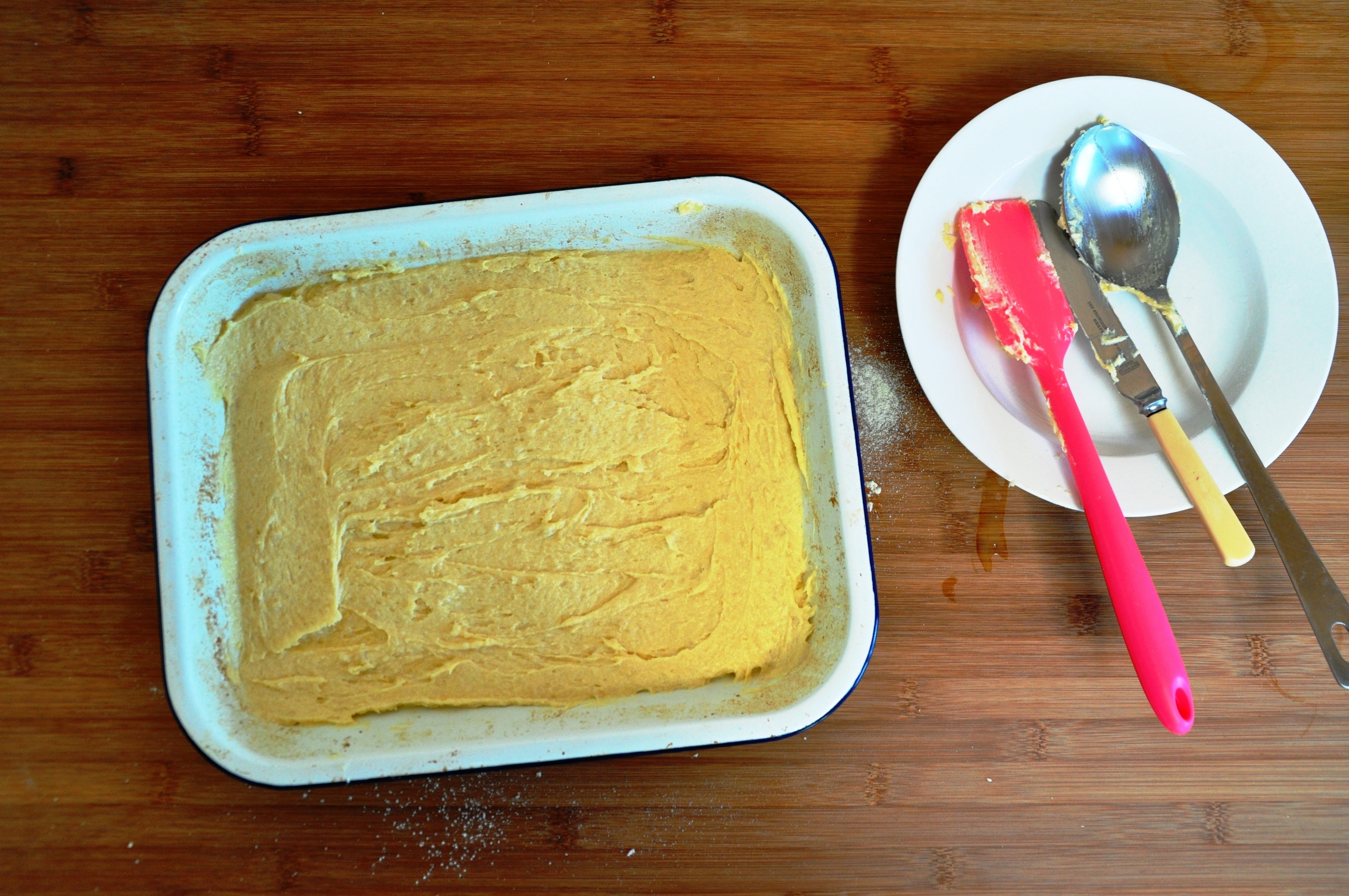
Revani cake batter

10. Spoon the batter into the tin, smooth it, and put in the oven for about 30-40 minutes, until firm and browned.

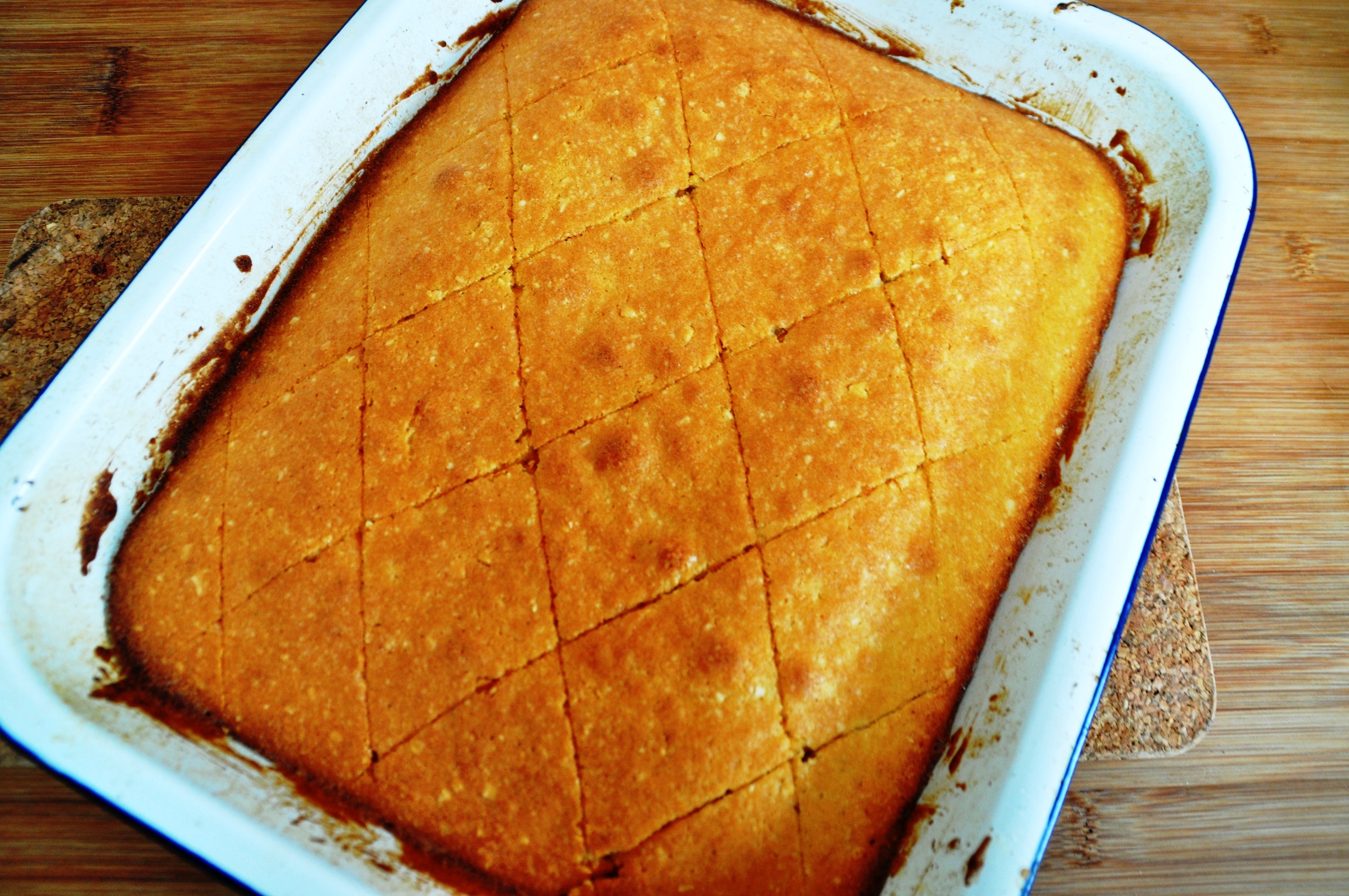
Revani cake - score a diamond pattern

11. Remove from the oven and score a diamond pattern in the top with a sharp knife.

Revani - pour syrup over, straining out the spices

12. Pour the syrup onto the warm cake – through a sieve or strainer to catch the spices and zest.

Revani - decorate with blanched almonds
13. Decorate the diamonds with a blanched almonds.
14. Allow to cool and serve at room temperature for tea or as a dessert. The latter can be souped up by being served with honey-sweetened Greek yogurt or poached fruit.

Revani, basbousa

A note on photography
When I thought I’d broken Fran’s camera last week, actually I’d just broken the lens thread. Phew. So we got a new (well, second-hand) lens. It’s an 18-200mm F/3.5-6.3, so Fran could use it more for landscapes and stuff.

I’m not a photographer, and struggled enough to learn how to use the kit lens effectively, but now I’m struggling again. I can’t quite get in close enough, suspect I won’t be able to rely on the autofocus as much, and doubly suspect I probably could do with a faster 35mm or 50mm prime lens or something with a better macro. Gawd knows. It’s all changed so much since I got my photography O-level in 1986….

Leave a comment

Filed under Baking, Cakes

Many ways to bake

Stone and casserole

If my blog is isn’t getting updated quite so regularly these days, it’s because Fran and I are at a pretty intensive stage of a journey we’ve been on the past decade. It’s a journey that’s much shorter for most people: that of starting a family.

The old-fashioned way failed us, so we tried medical intervention. Quackery also failed us, so the past year or so we’ve been involved in the adoption process.

As anyone who’s had similar experiences will tell you, it’s a roller-coaster. The adoption process in the UK is predicated on extending the protection of children in care who may well have had tragic, sad or painful starts to life. So as the prospective adoptive parent, you’re scrutinised to within an inch of your life, every corner of your life checked, considered, evaluated.

You spend months filling in forms, being interviewed. The sheer weight of bureaucracy can make you buckle with its Kafkaesque convolutions as you struggle to prove you can be a good parent – without ever having had the experience of being a parent, thanks to the fickle vagaries of nature. It’s tough, but the end goal is clear – giving a child a good home.

Baking as palliative
When times are tough, baking is gives me solace. Bread-making especially is unique and special: it’s about making a basic food stuff, but it’s so tactile. Plus it’s all about fertility too, in its modest way. You’re reliant on the life incarnate in microorganisms: yeast, and, for sourdoughs, yeast and lactobacilli (bacteria). You need to nurture them, feed them, encourage them to reproduce. Reproduce as fervently as possibly. Unlike us, they shouldn’t need any intervention.

So I’ve been baking a lot recently. I’ve been baking most of my life, and making bread for at least 20 years, though it’s only been the past eight years or so I’ve made pretty much all the bread we eat at home. Although I’ve got a baking diploma, I’m not a professional. The thing professionals have over home bakers is a mastery of skills acquired through repetition. For long baking shifts, often through the night, professional bakers will make their doughs, prove them, shape the loaves, bake them, perfecting the processes.

So although I have a reasonable knowledge of all these things, I haven’t the mastery: it’s a lot harder to achieve when making one or two loaves a week. Especially if, like me, you have an enquiring mind and want to keep experimenting. There are so many variations on basic techniques, so many kinds of flour, so many permutations. So I keep on playing around.

I was a pretty good artist when I was young, but art, like bread-making, like any skill, is something that needs constant practise. Creativity needs nurturing. I carried a notepad and sketched all the time until my mid-twenties, but then it just tailed off. I don’t really know why. Anyway, my creative urges these days mostly go into food, into baking. Talking to my friend Rachel, who knows all about our trying-to-start-a-family saga,  she suggested the baking obsession is also an expression of my creativity, my nurturing instincts. (I’m not a stereotypical macho male, obviously.)

If fate, and the powers that be, allow us to adopt and, finally, start a family, I don’t intend to stop baking. But I suspect I’ll have less time for free-form experimentation as the focus of the nurturing will be very different.

Bread experiments in the oven
Another thing Rachel’s said to me is: make your blog more personal. But I’ve not really known how to approach this. This attempting-to-start-a-family thing is mine and Fran’s big personal project. Fran’s sort of tried to put me off talking about it, but we process things differently.

The way I see it, with a pregnancy, you get to a point where you can’t not talk about it – it becomes publically obvious. I feel we’ve been involved with the adoption process for long it’s reaching an equivalent to that publically obvious stage. Just without the bump. Without the literal bun in the oven. Instead, there are my bread experiments in the oven.

This is my latest haphazard experiment. I wanted to see how the same dough behaved when baked in two different ways.

Lively sponge

I made a dough using a kilo of flour, a mixture of white wheat flour, wholemeal spelt flour and rivet flour. I combined 400g of this with 650g of water and 15g of yeast to make a sponge pre-ferment.

Full of wheatberries

I let that ferment for a few hours at about 17C, then made up a dough with 15g fine sea salt and about 200g of cooked wheatberries (wheat grains) I had.

Well risen

Then gave all that a prove for about five hours, giving it some turns and folds.

I then managed to break Fran’s camera. We’d had two days of howling winds, 40-50mph (64-80kph), and that frays your nerves somewhat. Clearly it made me clumser than usual. I’d just said to myself, better watch out, the concrete floor would destroy this camera if dropped – then I dropped it while climbing a small stepladder to take an overhead photo. So now my pics are taken with my inferior phone camera. And I need to take a trip to the camera shop.

Divided up

After breaking the camera, both pieces of dough were scaled at the same weight, both were moulded the same way, and both were given their final prove in round bannetons.

Final prove

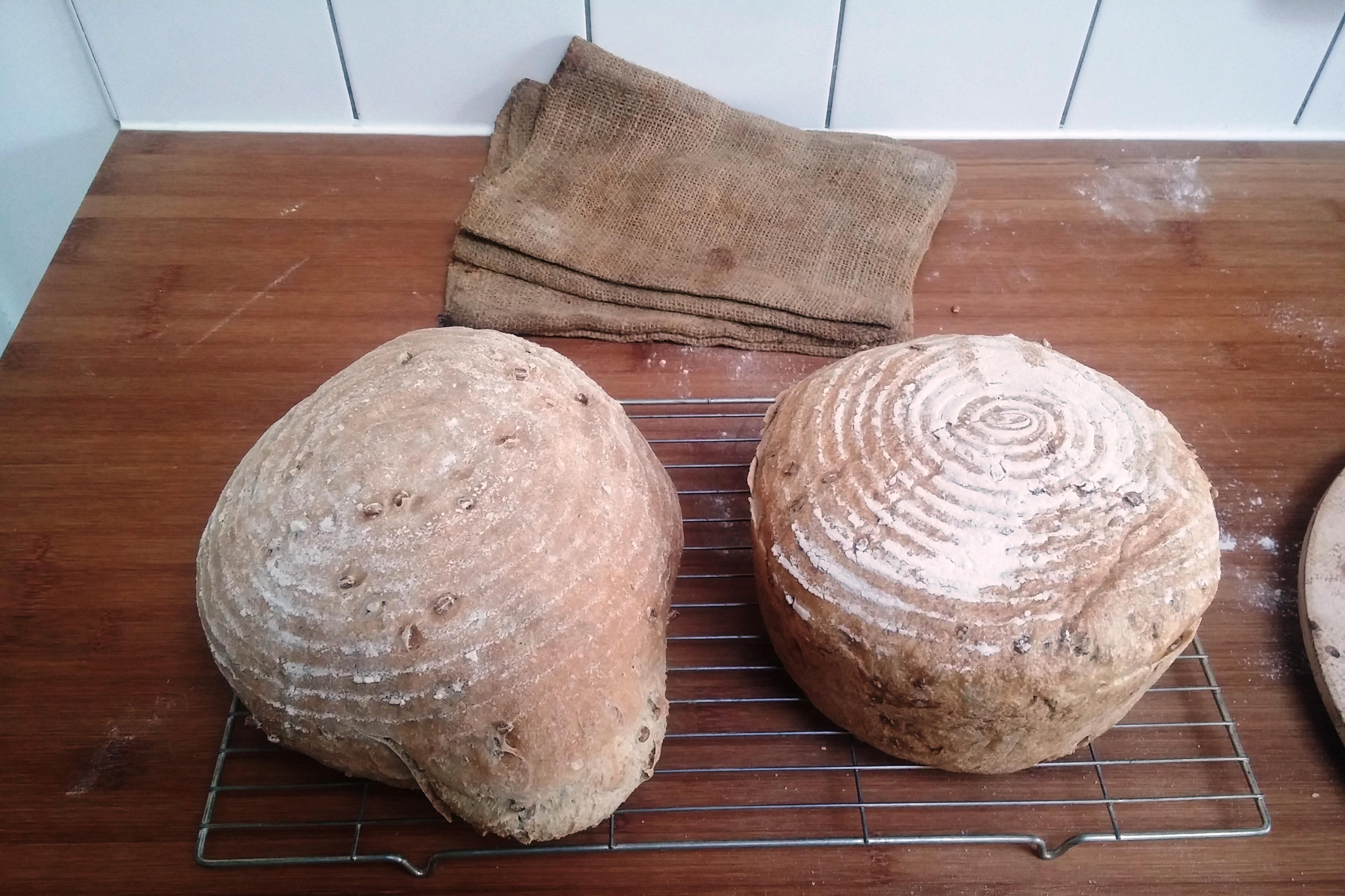
After the final prove, I put one in a Le Creuset casserole dish, pre-heated in the oven at 220C. Some call this the Dutch oven technique. I used a peel to slide the other onto a baking stone (or, more specifically, my pizza stone). Both were then baked at 220C for 20 minutes, then 30 minutes more at 180C.

Baked

Now, as you’ll see from the photos, despite all these years of baking, I’m still making some errors. Firstly, the two kilos of dough I had was too much for the size of Le Creuset I was using. Oops. Secondly, the one I baked on the stone, not being constrained by a container, did a funny oven spring and opened out sideways. This is frustrating for several reasons as I know the factors full well:
1. I probably didn’t leave it long enough in the final prove.
2. It may have opened up better if I’d give the top some slashes.
3. I quite possibly didn’t get the dough tight enough in the moulding stage.

The latter is one a baking skill I really struggle with. Sometimes I nail it, sometimes I fail miserably. I’ve managed 80% hydration ciabatta, then made a 70% hydration ball that’s turned out a discus.

Cut

Anyway, the real thing I was wondering about with this experiment was whether the crust and the crumb of the bread would be markedly different when baked with the different techniques. I was expecting they would be. They weren’t. Both are lovely loaves, soft, wholesome, good for sandwiches or, when they’ve staled a bit, toast.

For this experiment, I probably should have divided the dough in three, and baked a third on a steel baking sheet. Not sure my oven’s big enough though. Still, it was a fun experiment, a nice distraction from the anxiety and emotional intensity of the adoption. And, heck, one day I hope it’s the sort of bread my kids will like for their school lunches.

25 Comments

Filed under Baking, Discussion, Misc