Category Archives: Discussion

A week in Rome: Etruscan necropolis, Etrusca beer

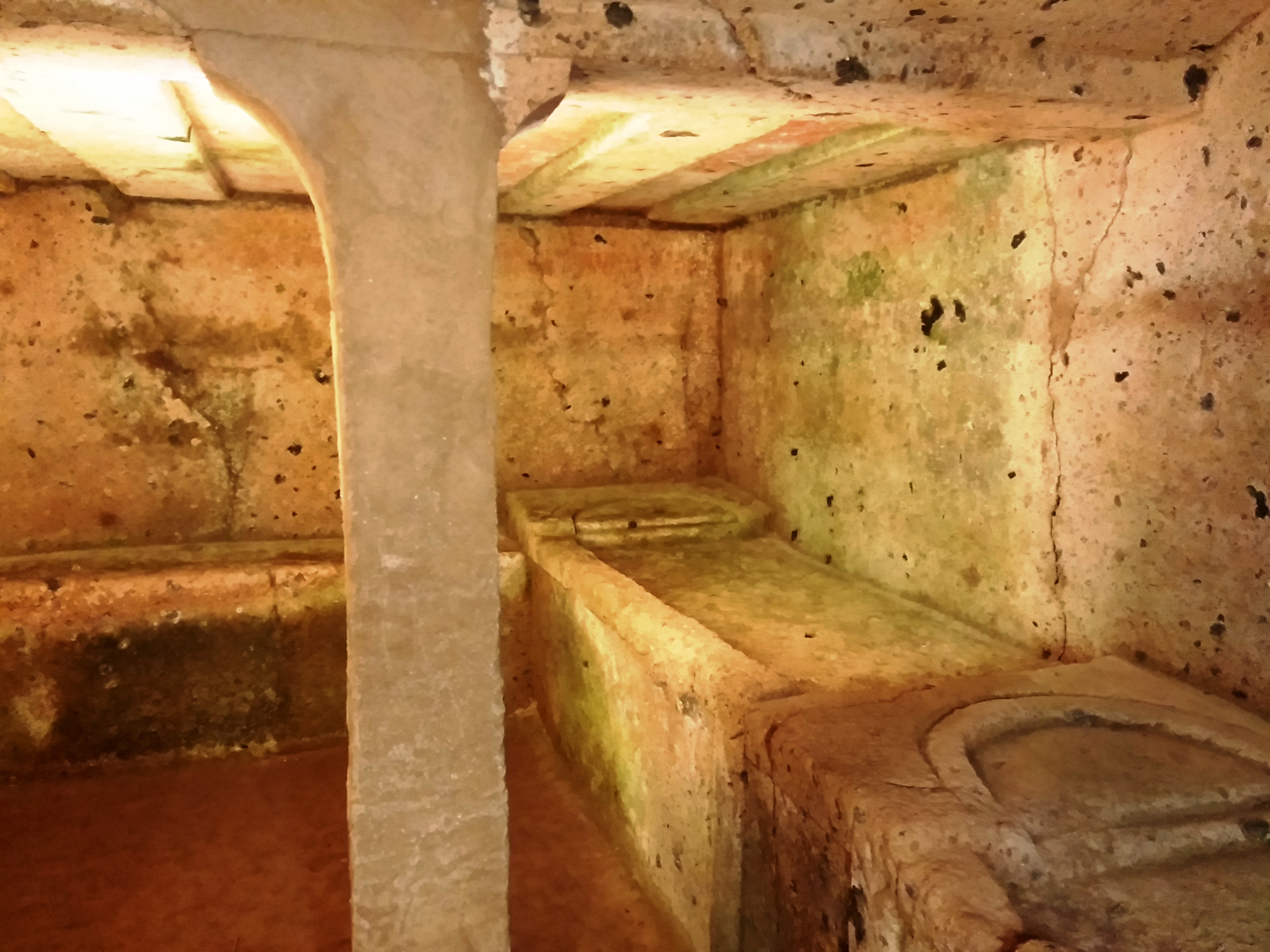
Stone beds at Banditaccia necropolis, Cerveteri

We didn’t spend out entire holiday just eating and drinking. I made a point of doing a few day trips. One was to the Etruscan necropolis – city of the dead – of Banditaccia, a train ride, a bus ride and a surprisingly pleasant walk from Cerveteri, a town near the coast to the nortwest of Rome.

Banditaccia is such an evocative name. It makes me think of bandits and other unsavoury rural types using the old underground chambers (hypogea) to hide away in the middle ages. It’s quite likely they did too, though I can’t report that as fact.

The necropolis was established at the beginning of the 7th century BC, at least. I love this – you wander round Rome going “Wow, Colosseum…” but that particular monument only dates from the 1st century AD. Etruscan civilisation, which gave its name to Tuscany, was already remarkably sophisticated when Romulus and Remus were still just dirty wolf-boys shouting at each other, mythically, from huts on the adjacent hilltops of the Palatine and Aventine.

Etruscan pot, Cerveteri museum

Cerveteri, called Caere by the Etruscans and located a mile from Banditaccia, has a museum in the castle that dominates the centre of town. Even after all the best finds from excavations were filched by the Vatican, it’s still full of amazing finds, mostly ceramics. They show how closely the Etruscans traded through the Med, notably with the Greeks, as the art style is similar, as are the gods and mythological characters featured.

Multimedia hypogea
Visiting the tombs themselves, and imagining how they would have looked decorated with these urns and other funerary furnishings, is an amazing experience. The place was pretty much deserted when we visited, so a staff member was able to turn on multimedia installations for us in three of the hypogea. I have mixed feelings about all the holes in the tuff volcanic rock drilled so they could install projectors and speakers, but the systems work surprisingly well, lighting up the tombs and giving a sense of how these spaces were used.

What struck me, even centuries later, with the tombs mostly denuded of their decorations, is how homely they are. And this is just the point. The Etruscans created the necropolises as mirror images of the cities of the living. Each hypogeum was a home for several generations of family. The dead were initially body wrapped in cloth, then buried, or burned and put in urns. The hypogea consist of rooms with stone beds, and some even feature incredible decorations. The most famous example is Banditaccia’s Tomb of the Reliefs – amazing 3D designs of tools and utensils, for war and domestic work: those two most important activities of the living.

Tomb of the Reliefs, Banditaccia, Cerveteri (Photo: Fran Hortop)

As Fran pointed out, the notion of the tombs being the mirror image of homes is also expressed by the fact that these spaces, firstly large, rounded tumuli, then later in rows much like terraced housing, were carved out of the tuff. It was a process of creating a living space for the dead by hollowing out spaces in the ground. This contrasts with building a home above ground, creating space by erecting walls and roofs.
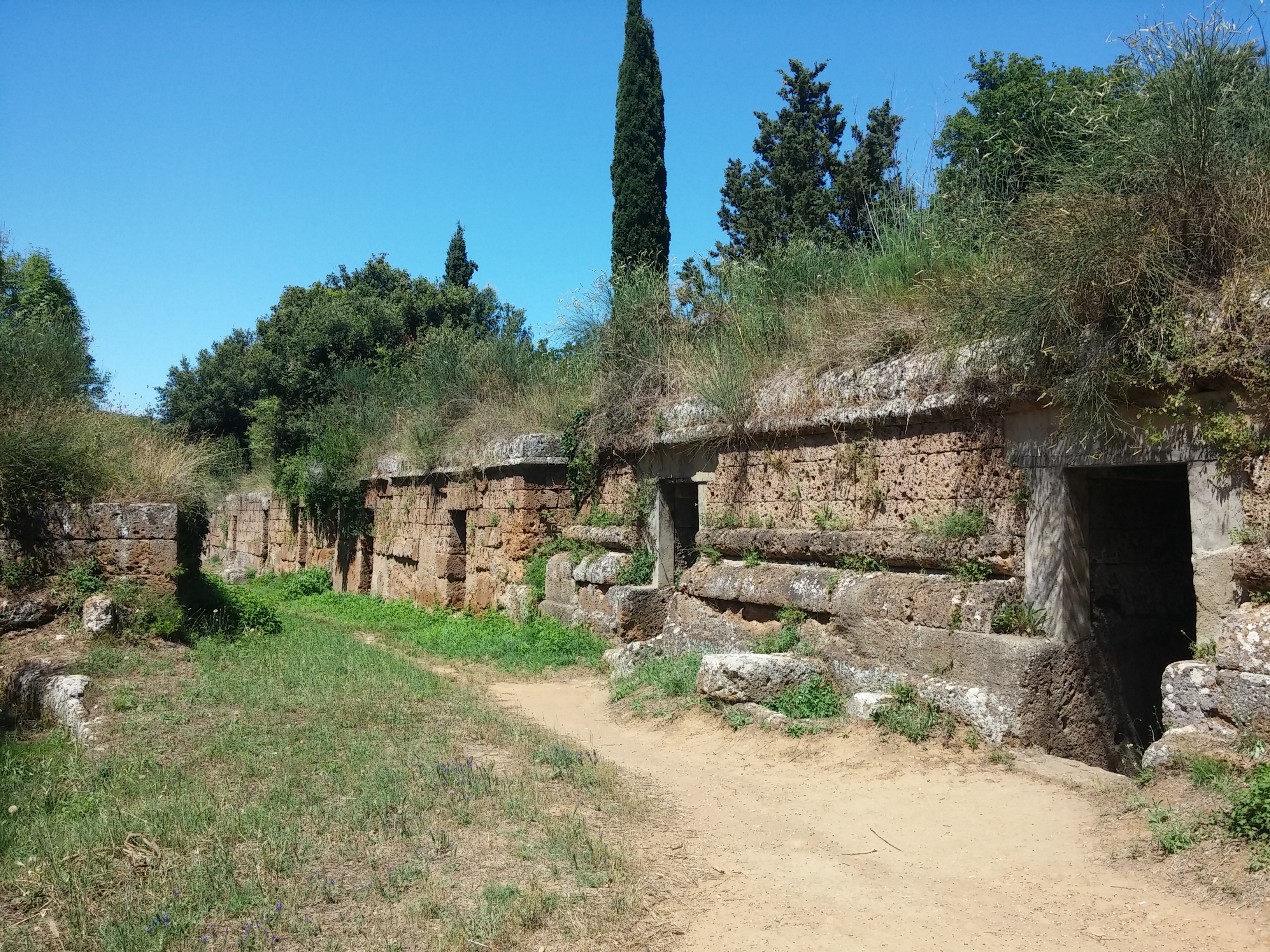
Terraced tombs, Banditaccia, Cerveteri

It’s interesting too that although the Roman Republic eventually subsumed Etruria, the final three kings of the Roman Kingdom were an Etruscan dynasty (in the 7th-6th centuries BC, though this period isn’t well documented). And as they had so much common culture, the guide we spoke to said the Romans respected the Etruscan funerary arrangements enough to leave the necropolises alone, even after they had effectively quashed their civilisation. Indeed, there were still new tombs being carved in the 3rd century AD. It was only later they were semi-forgotten, becoming overgrown. Although some did provide strange cave-like spaces for shepherds – and bandits? – over the centuries, most were lost and the area resembled a series of lumps and small hills in the 19th century, before Raniero Mengarelli started his systematic excavations in 1909.
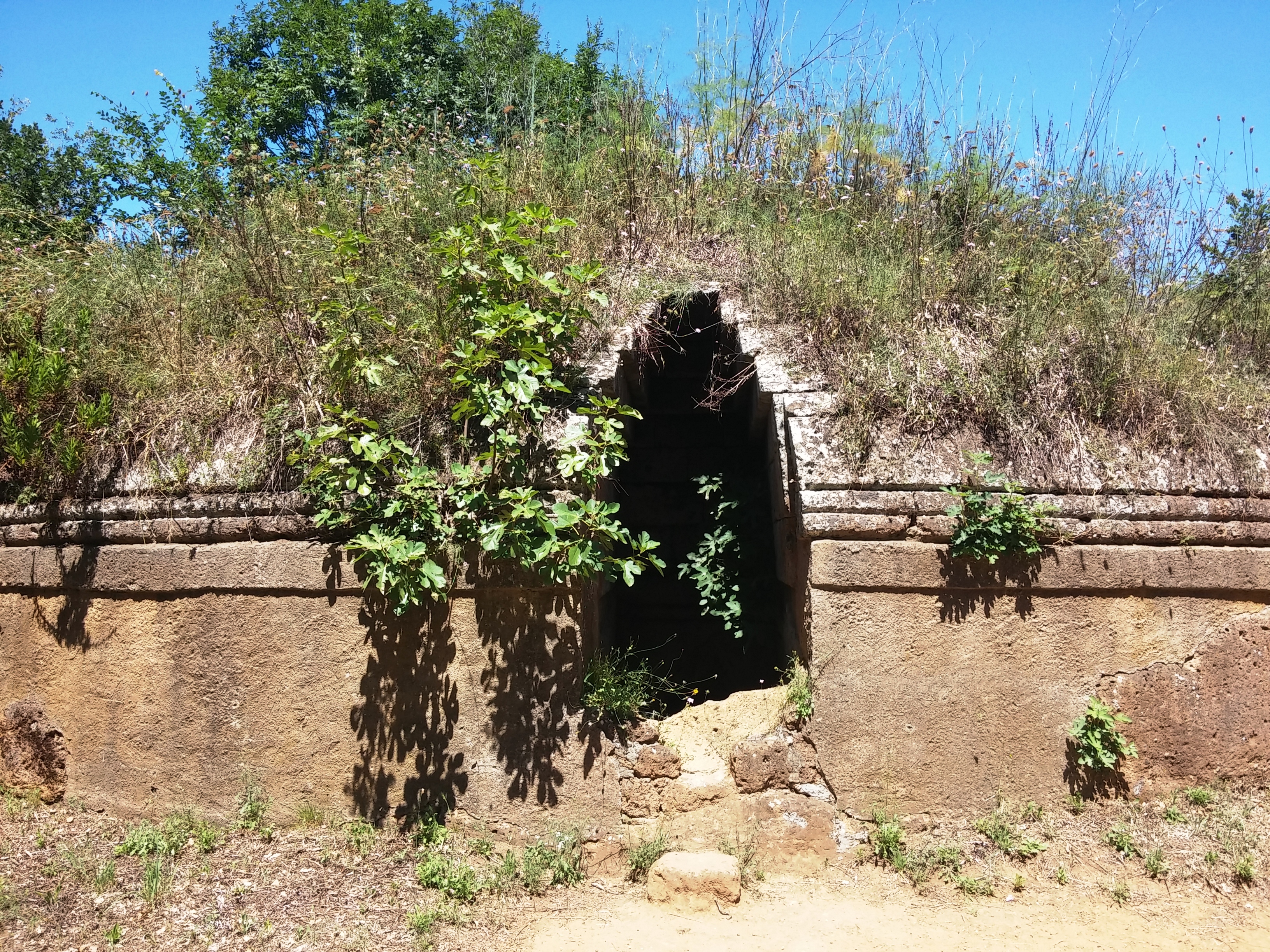
Tumulus Etruscan tomb, Banditaccia, Cerveteri

It’s a wonderful place, right up there with Ostia Antica for my favourite ancient sites in Italy: partly because these two are just undersubscribed compared to the better-known Pompey and Herculaneum, but also partly because Banditaccia has a reminded me of its fellow UNESCO site Angkor Wat in Cambodia. Banditaccia – or at least what’s been excavated – is a lot smaller but both have a similar substantialness and sense of mystery. Angkor Wat is a lot more recent (dating from the 11th-15th centuries AD) but I love these places where ancient stones have trees growing through the weathered old stonework, itself carved with sheer manpower.

Etruscan beer
After visiting Banditaccia we went beer shopping and it seemed only right to get a bottle of Birra del Borgo’s Etrusca “archeo birra”.
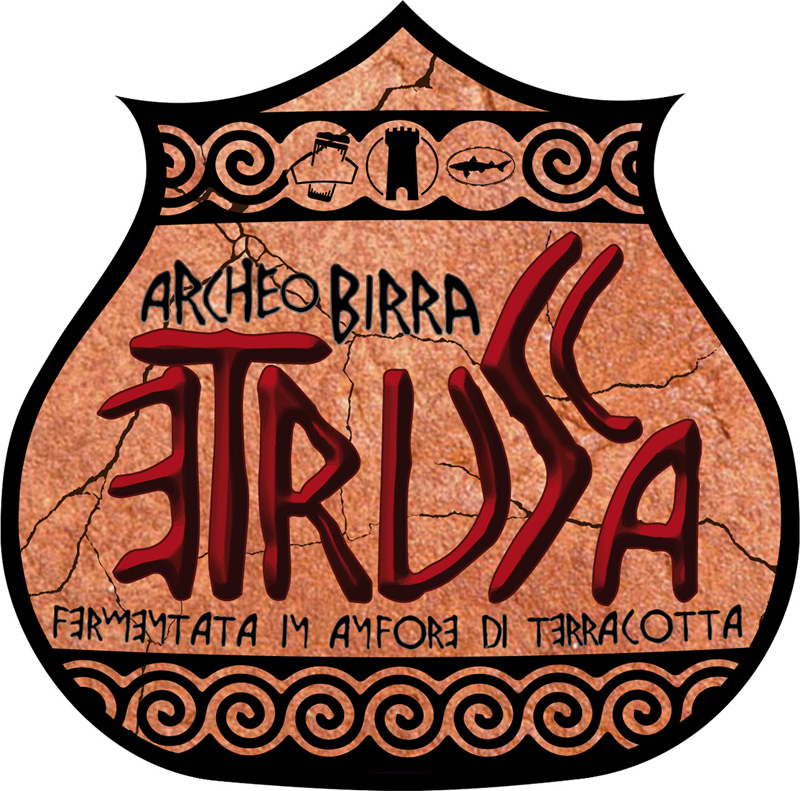
Borgo Etrusca label

Etrusca is actually the name of three beers, first made during a fascinating project in 2012 by Birra del Borgo (in Lazio, east of Rome), Baladin brewery (in Piedmont, NW Italy) and Dogfish Head (in Delaware, US). The brewmasters of all three worked with Dr Patrick McGovern, an archaeology professor and director of the Biomolecular Archaeology Project for Cuisine, Fermented Beverages, and Health at the University of Pennsylvania Museum, who had worked on various other ancient ale projects previously with Dogfish Head.

Together they established a list of ingredients that were consumed by the Etruscans. The Baladin site says, “Under Dr Pat’s supervision, ingredients have been selected on the basis of the findings made at several Italian archaeological sites.” According to a post on the Dogfish Head site, meanwhile, “the team clearly found that the Etruscans had a taste for ale.”

I know the ancient Romans drank beer, so it’s not a stretch to imagine the Etruscans did too true. Although grain-based beer is more associated with northern Europe, grain was of course grown in ancient Italy too, and the Dogfish site continues “The backbone of Birra Etrusca comes from two-row malted barley and an heirloom Italian wheat.” This wheat is ‘Senatore Cappelli’, which I saw in several Italian craft beers on this recent visit.

Italian society never underwent the seismic changes experienced in Britain during our comprehensive industrial revolution. Nor did it embrace as fully as Britain or the US the post-war approaches to agriculture based on rejecting ancient practices in favour of plying farmland with tonnes and tonnes and endless tonnes of petrochemical industry derived fertilisers, pesticides and herbicides. Plus, pockets of mountainous Italy remain isolated to this day. Unlike Britain, where we rejected our heritage grains in favour of modern varieties bred by agri-corporations to thrive with said chemicals, Italy still grows some of the same varieties of grain it has grown for centuries. Cappelli, however, arguably isn’t such a grain: it was selectively bred from Tunisian ‘Jenah Rhetifah’ durum wheat at the start of the 20th century. It’s conjecture, but ‘Jenah Rhetifah’ may have ancient heritage, and may indeed have been related to grain traded or cultivated by the Etruscans. I don’t know; I need to consult an expert more. Or find some funding to bloody well do a PhD!

Weird and wonderful
The beer also contains various other weird and wonderful ingredients, based on, according to the Baladin site, “research carried out on Etruscan habits, as they would [have] spiced fermented drinks with hazelnut flour, pomegranate and pomegranate juice, honeys, sultanas, natural resin and gentian root”. The “natural resin” in question is probably what the Dogfish site refers to as “the sarsaparilla-like Ethiopian myrrh resin.” The myrrh and gentian are the bittering agents, though the recipe does also include a “handful of whole-flower hops”.

Recording cultivation of hops in Europe didn’t come until centuries later, though as Humulus lupulus is native to Eurasia and north Africa there’s the chance it was utilised by the Etruscans. Wondering about this, I sent an email to Dr McGovern, the “Indiana Jones of ancient ales, wines, and extreme beverages”. Though busy on a lecture tour in Australia he kindly replied and said, “There is some evidence of hops being found in association with beverages at Etruscan sites, but not much.” I’ve just ordered his most recent book, ‘Uncorking the Past: The Quest for Wine, Beer, and Other Alcoholic Beverages’ (Berkeley: University of California, 2009) so perhaps that will tell me more. Check out the article ‘The Brewing of Etrusca Beer’ via Dr Pat’s site here (a PDF download) as it gives more detail of the procedure, while a second article on the same page, ‘Ancient Italic Beer The archaeological finds at Pombia (NO), discusses the evidence of hop usage in this era, though it refers to finds from a “proto-Celtic” population in Piedmont/Piemonte, nortern Italy, that is north of ancient Etruria.

Birra del Borgo's Etrusca

So what does it taste like?
Evaluating the experience of drinking a beer like this is tricky as the story of its genesis is so fascinating it’s potentially distracting. Not only was the recipe created with Dr Pat’s expert input, but the three breweries used different materials for the ferment. Dogfish used some bronze plates in in the vats, Baladin used wooden barrels, and Borgo used specially made terracotta jars. This is appropriate given the importance of terracotta for storing liquids in ancient Italy. We were staying in Testaccio, and drank our bottle of Etrusca there, a mere 100m or so from Monte Testaccio, which is also known as Monte dei cocci – which could be translated as “Hill of the earthenware shards”. Yes, the hill is a massive mound of broken ancient Roman amphorae.

Suitably enough, given our day trip, Fran said the beer, which is a pale, cloudy golden colour, “smells like an old cave somewhere”, with all that nuttiness, fruit and fermentation giving a certain mustiness.

Dammit can't read the label

Fran got more earthy smells from it – mushrooms, humus (leaf litter not chickpea). I got a more sharp, sauerkraut smell, with honey. The taste was sour, honey, balsamic, metallic. Fran thought it tasted like fermented tomato juice: not that she’s ever drunk that, as far as I know, but it did have a certain minerally, Bloody Mary quality.

It’s not a beer to spend a relaxing evening with, perhaps, but it’s unique. I wish I could try the Dogfish Head version, but I’ve never seen any of their ales for sale in Italy or the UK, sadly. The comparison would be interesting, and Dr Pat says that he finds the “pomegranate and myrrh are more pronounced and better integrated” with the Dogfish version.

Either way, I love these historical experiments, like Harveys’ Priory Ale from earlier this year, commemorating a slightly more recent bit of history, the Battle of Lewes 750 years ago. Dogfish Head has produced a series of these experimental brews, with their most recent collaboration with Dr McGovern a prehistoric-style Nordic ale they’re called Kvasir. There’s more about their working process, and why we lost our inclination to make such diverse brews, in an article on The Atlantic’s site here.

So anyway, Etruscan remains, Etrusca archaeological ale recreations: what a great day. And far too long a post. I was planning to mention a few other beers I tried on the trip but that will have to wait.

5 Comments

Filed under Ale, beer, Breweries, Discussion, Italian beer, Misc, Rome

The Eighteenth South Downs Beer & Cider Festival, Lewes, 20-21 June 2014

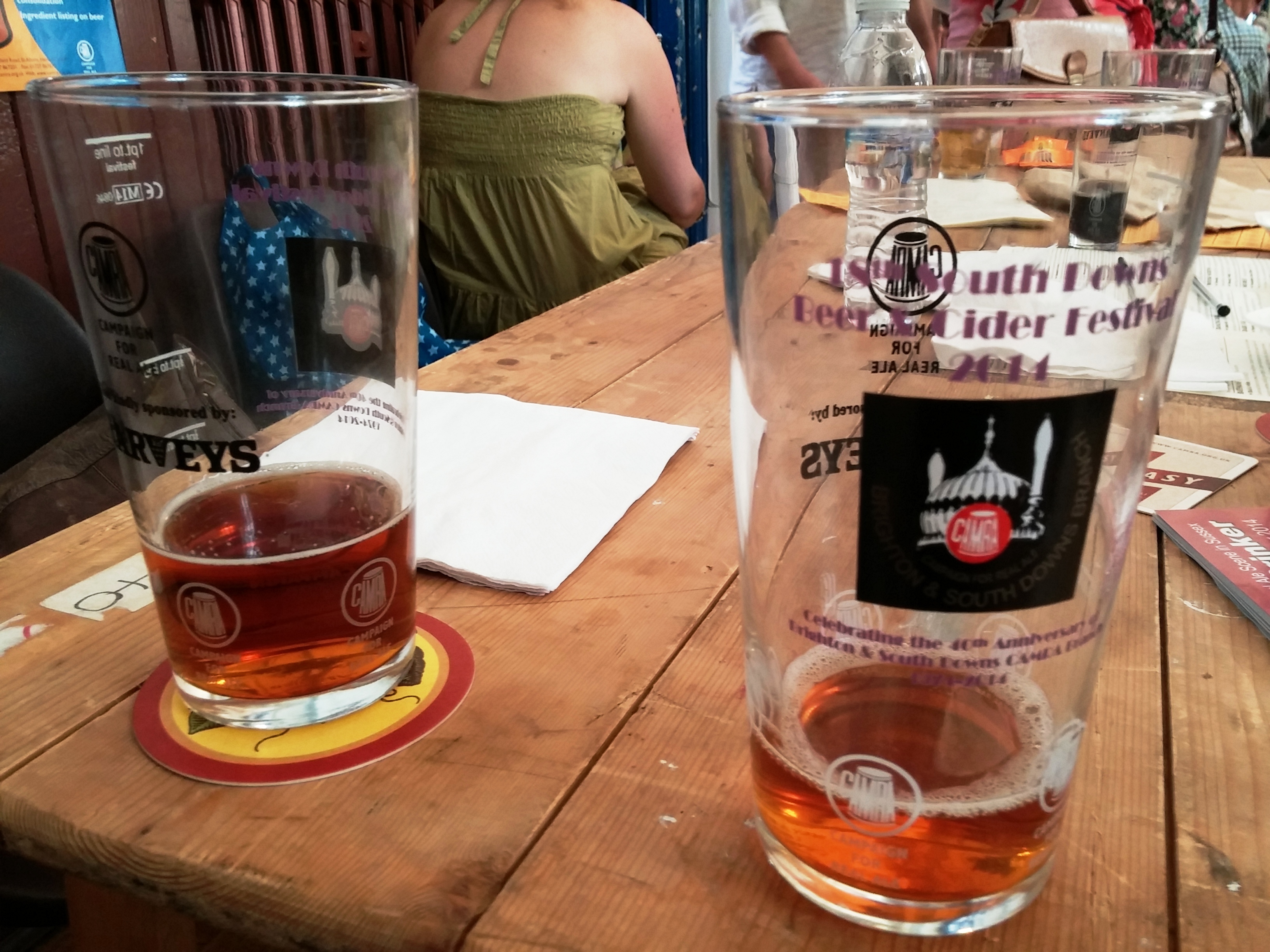
18th South Downs Beer Festival in Lewes town hall. With many empty casks.

The poster for the 18th South Downs Beer and Cider Festival nicely riffs on the cover design of Neil Young’s 1972 classic album ‘Harvest’. As I’m a fan of both real beer and that album, it got me excited about the event when I first spotted it. As Fran was interested in going, and couldn’t do the first day, a Friday, due to work commitments, I got tickets for the 11am to 5pm Saturday session.
South Downs Beer Festival 2014 PosterHarvest album cover

A week or so before the event, I went to the CAMRA site and printed off the list of breweries represented, going through it to highlight all the local ones. This festival, being held in the handsome Lewes Town Hall, marked forty years of the Brighton and South Downs Branch of CAMRA, so promised to be special.

So it was a kick in the teeth when we arrived at about 1pm on the Saturday to find pretty much all the local beers had run out, bar those from Harveys. Now I love Harveys, but I drink it most days, so I was most keen on trying other stuff from around Sussex. So it was disappointing to see crosses through the signs for both the beers from 360 Degree brewery at Sheffield Park, just north of Lewes; through those of Bedlam in Aldbourne, West Sussex; through both the beers from Burning Sky at nearby Firle; ditto Downlands, at Small Dole, West Sussex; ditto both beers from Goldstone, from nearby Ditchling; ditto Kissingate of Lower Beeding, West Sussex; ditto Brighton’s Laine; ditto Pin-Up Brewery of Southwick, East Sussex; ditto the intriguing Rectory of Streat, East Sussex, brewed by a priest.

Guttering and empty casks. Sorry, bad photo.
The few local beers I tried were: Lammas Ale from 1648 Brewing Co in East Hoathly, East Sussex. This had bubblegum-ish aroma, from malted wheat, and low carbonation, medium body. Then a Wolseley Best from The Stanley in Portslade, also East Sussex (though currently brewed at Downlands). This had nice hints of liquorice, charcoal and nuts, but frankly, I drink Harveys Best all the time and I wasn’t here for the best bitters. Cavedweller from Caveman Brewery, over in Kent, was a bit more interesting, a porter nicely combined blackcurranty flavours with more piney, resiny hints from UK Bramling Cross hops. I wouldn’t call porter a summer beer though. Another more interesting one was Regaler from Franklins, in Bexhill-on-Sea, East Sussex. The notes called it a “cold-fermented lager-style ale”. I assume it was a Kölsch-style beer, top-fermented like an ale and more full-bodied and less carbonated than most lagers.

Festival beer list

All of which was fun, but not what I was hoping for. Interestingly, a lot of what had run out was the more hoppy American craft beer-style stuff: not what you typically associate with CAMRA, which can he thanked for keeping British cask ale, notably bitters, alive through the 1970s and 1980s when dreadful industrial lagers took over British pubs. Although Britons still drink mostly industrial lager by proportion now, we’re coming back round to real beer – in part thanks to CAMRA, but also in part thanks to the vitality of the highly influential US craft beer movement and the exciting flavours and aromas offered by US hops.

My favourite beers these days are those that take our incredible British brewing heritage but aren’t afraid to be inspired by US beers and US hop flavours. That’s what I was hoping to try more at the festival, things like Burning Sky’s ‘Arise’ “Session strength IPA”, here available in cask. But it had run out.

Drinking out third-pints at the 18th South Downs Beer Festival

Now, I’m aware that things do – and have to – run out at these beer festivals, but considering the event was running from 11am on the Friday to the evening of the Saturday, when everything was finished, a total of about 20 hours of sessions, it seemed pretty poor that so much was gone already when we arrived – at roughly just after the mid-point. I realise part of the buzz of a beer festival is the first rush to try the latest products of interesting breweries on the first day, but well, it just seemed like poor event management that so many punters like us who didn’t arrive till the second day were deprived of the so many of the beers, in particular those local brews.

Now if I was writing about the event in a journalistic capacity, I would contact the Brighton CAMRA branch and the festival organiser, Ruth Anderson, but instead I’m just blogging about it as a disappointed punter and don’t feel like chasing around after them for quotes. Plus, I suspect they’d just reiterate the line about how it’s normal for casks to run dry after the initial evening throng has been at them. I really didn’t want to be writing a moany post about the event I’d been so looking forward to but, well, here we are.

Lewes Corn Exchange, with surprisingly mixed crowd at the beer festival

Still, while pretty much all the stuff I’d marked on my print-off had run out, at least it meant we’d only drunk a few third-pint samples each and were subsequently able to cycle down to the Kingston village fete, along a lovely traffic-free path. The festival was held in the Lewes Town Hall and corn exchange, a great venue where I usually just go to give blood, but as it was a gorgeous hot, sunny day, being outside appealed greatly.

Pints at the Kingston village fete

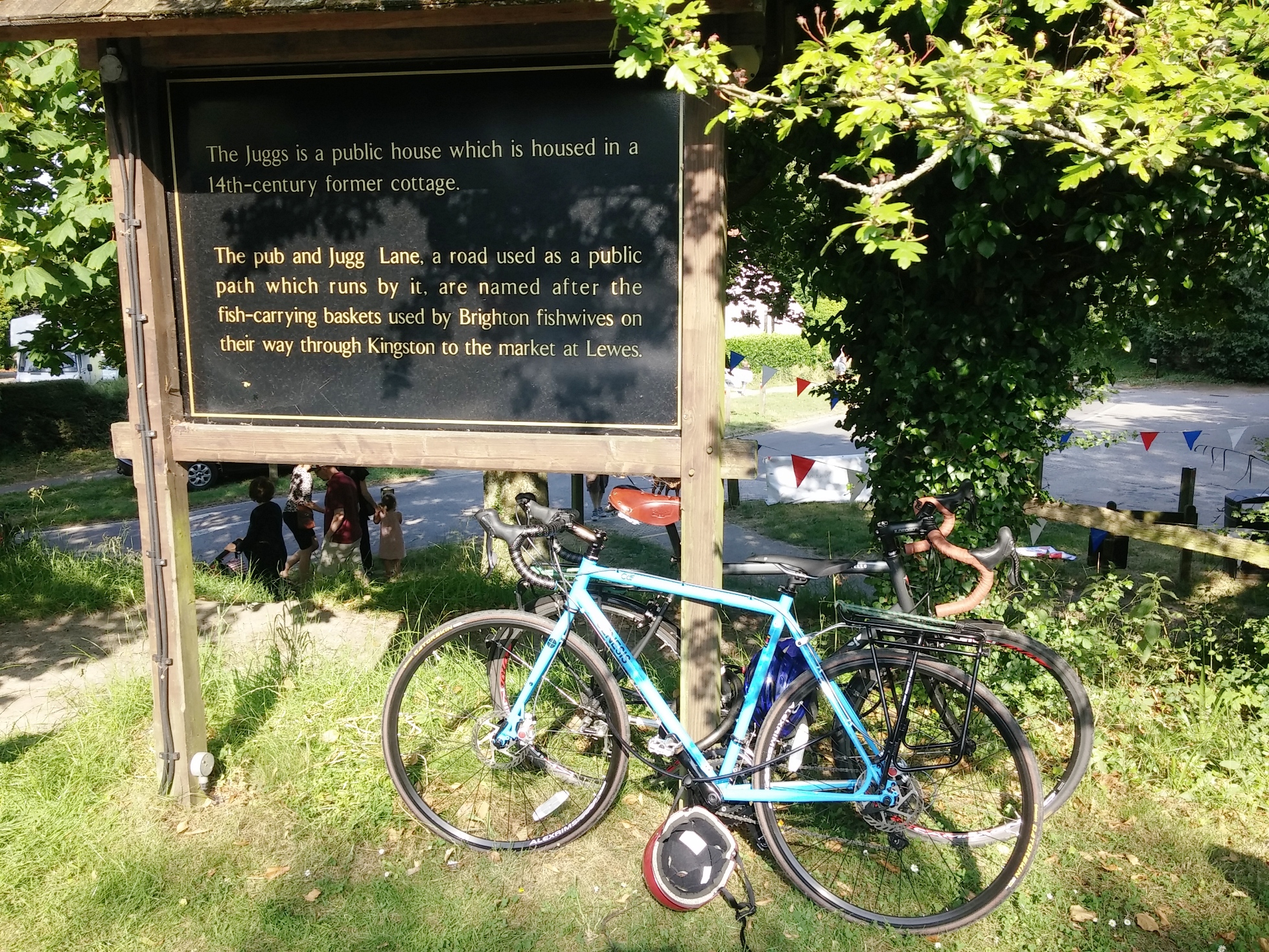
At the fete, we met some friends. And visited the beer tent – which not only had a cask of Burning Sky’s delicious Plateau pale ale, but the guy serving the drinks even gave us a free glass from Long Man, another nearby brewery. We went home via The Swan in Southover, where we had a Harveys Olympia golden summer ale in the lovely garden, so the day turned out well in the end.

Bikes outside fete, nr pub

2 Comments

Filed under Ale, beer, Breweries, British beer, Discussion, Events

Real Bread Maker Week, 10-16 May 2014

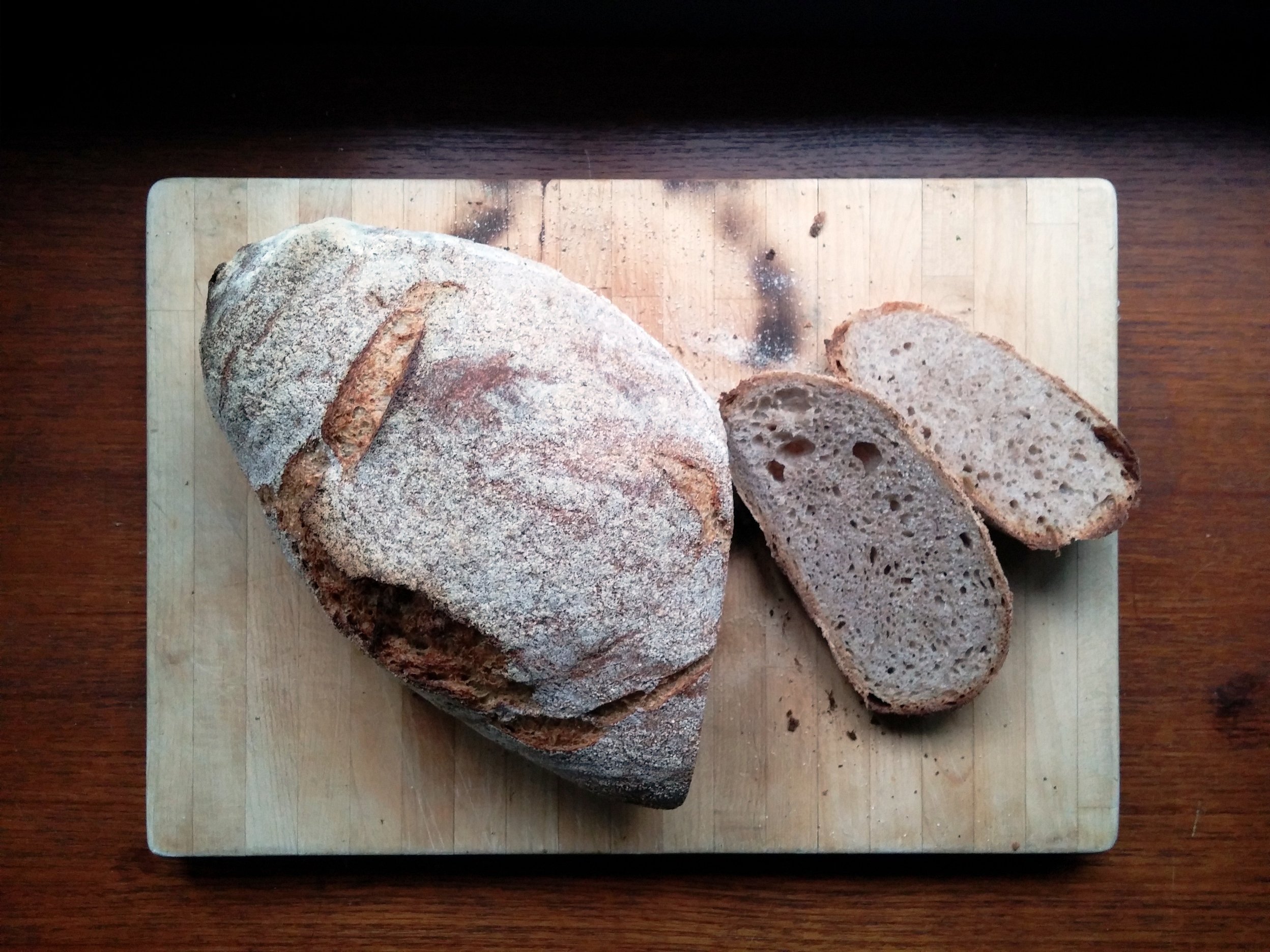
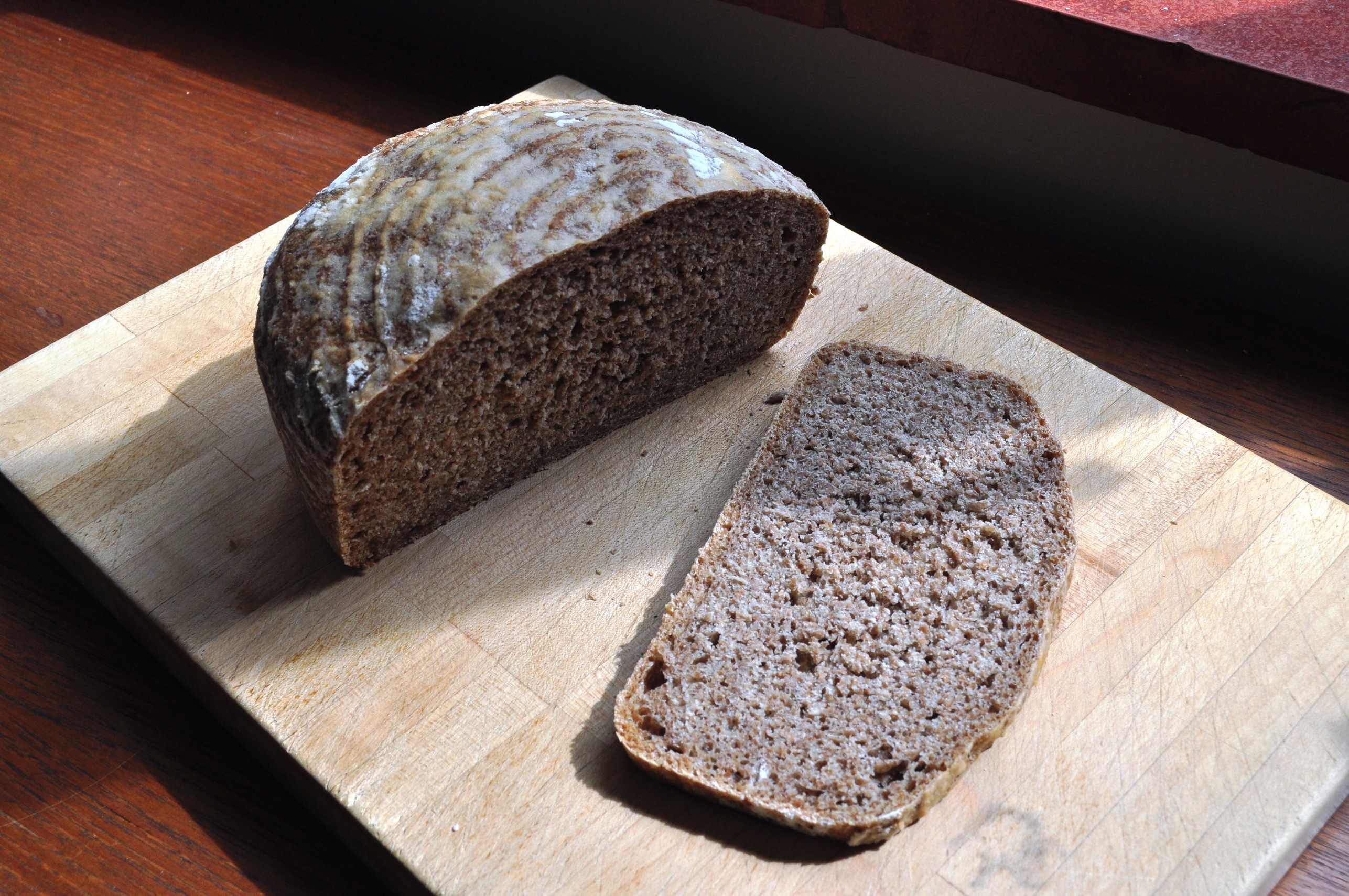
Sliced overhead
Earlier this week I had a fantastic bike ride up from Lewes to Wapsbourne Manor (44km there and back along verdant Sussex country lanes; route here), home of the renowned campsite also known as Wowo. There, I met owner Paul Cragg along with Andy Forbes of the Brockwell Bake, who is working to restore British heritage wheats and has a crop at Wapsbourne.

Our conversations were informative and wide-ranging and I’m still trying to work out how to write a blog about it all. This is partly because the Brockwell Bake is involved in a fascinating range of activities, all interconnected around questions of grain and bread, cultivating and baking, but each with its own detail and complexities. Among the activities are educational projects, encouraging a wider understanding of what goes into bread and how it’s made. And when I say bread, I mean real bread, not that wheat-based garbage wrapped in plastic you find on supermarket shelves.

Real Bread Campaign
In this respect, the Brockwell Bake’s work overlaps with that of the Real Bread Campaign. The campaign is part of the charity Sustain – the alliance for better food and farming. Their primary remit involves education about what constitutes real bread – a healthy item that’s been a part of the human diet for millennia but has been tarnished by the grotesque compromises of the mid-20th century industrialisation of food production. And how you can make it. Or where you can buy it. Or indeed, how you can set up your own business making and selling it. You can find out more about what the campaign here.

Anyway, tomorrow, 10 May, marks the start of the campaign’s Real Bread Maker Week: “The annual celebration of Real Bread and its makers: on your high street, in the back of your kitchen cupboard and at the ends of your sleeves.” Furthermore, according to the site, “The main aim of the week is to encourage people to get baking Real Bread or buying it from local, independent bakeries.” Various events are taking place around the country. Find out more here.

RealBread_MakerWeek_small

Red casserole bread
In the meantime, here’s the latest real bread I’ve made. I’m really loving using an old red casserole dish I acquired from my mother, who inherited it from her mother. It’s a heavy Danish cast-iron piece of kit that lends itself really well to the technique of pre-heating it as hot as your oven will go, then adding the bread, putting the lid on and baking.

Rye and wheat casserole bread

This is sourdough made with the sponge-and-dough technique. This involves making a pre-ferment – the sponge – with some of the flour and the liquid, letting that ferment, then adding the rest of the flour and salt and forming your dough.

Sponge:
100g rye leaven/sourdough starter (at 100% hydration)
320g water (filtered)
270g flour (I used 170g local wholegrain wheat, 100g slightly less local strong white)

1. Whisk together the water and leaven.
2. Add the flour and mix well.
3. Cover with a cloth and leave to ferment for 9-16 hours. Say while you’re at work.

Dough:
11g salt
270g flour (again, I used a mixture of wholegrain wheat and strong white).

Sliced, angle

4. Combine the salt and flour.
5. Add to the sponge and bring together with a spatula or wooden spoon or you can even get your hands in there if you want.
6. Bring to a dough with a quick knead, to make sure everything is well combined.
7. Form a ball and return to the bowl (cleaned and oiled slightly). Cover again and leave for few hours.
8. Take out the ball of dough, stretch it and give it a fold – that is, folding up one then, then the other down to form a kind of enveloped. Return to the bowl, then repeat this process again a few more times every 15 minutes.
9. Cover the bowl with cling film or put it in a plastic bag, then put it in the fridge for about 8-10 hours – I did it overnight.
10. Take out the dough, and allow it to come back to room temperature.
11. Gently form the dough into a ball, then rest it for 15 minutes.
12. Form the ball into a baton – but gently as you don’t want to de-gas it too much. (I really must do a series of photos or some videos of shaping dough.)
13. Give the dough one final prove (or proof) in a basket lined with floured cloth, with the seam of the baton upwards. I did this for about an hour in the airing cupboard, which is 24C.
14. Preheat the oven – I did mine as hot as it’ll get, 250C.
15. Put the casserole in the oven to get to the same temperature – I left mine for 30 minutes.
16. Take the casserole out and quickly and carefully invert the dough into it, so the seam goes to the bottom.
17. Put the lid back on, and bake for 30 minutes.
18. Take the lid off and bake for another 15 minutes, or until the top is nicely coloured – I like nice “high bake”, a dark colour.
19. Take out the loaf and allow to cool completely on a wire rack.

Oh, and while you’re baking, what better item to wear than a snazzy Real Bread Campaign apron? You can get a limited edition “I [loaf] Real Bread’ apron from Balcony Shirts here, with £3 from every sale going to the campaign.

Real Bread Campaign apron


1 Comment

Filed under Baking, Breads, Discussion, Flour & grain, Misc

Holey-er than thou

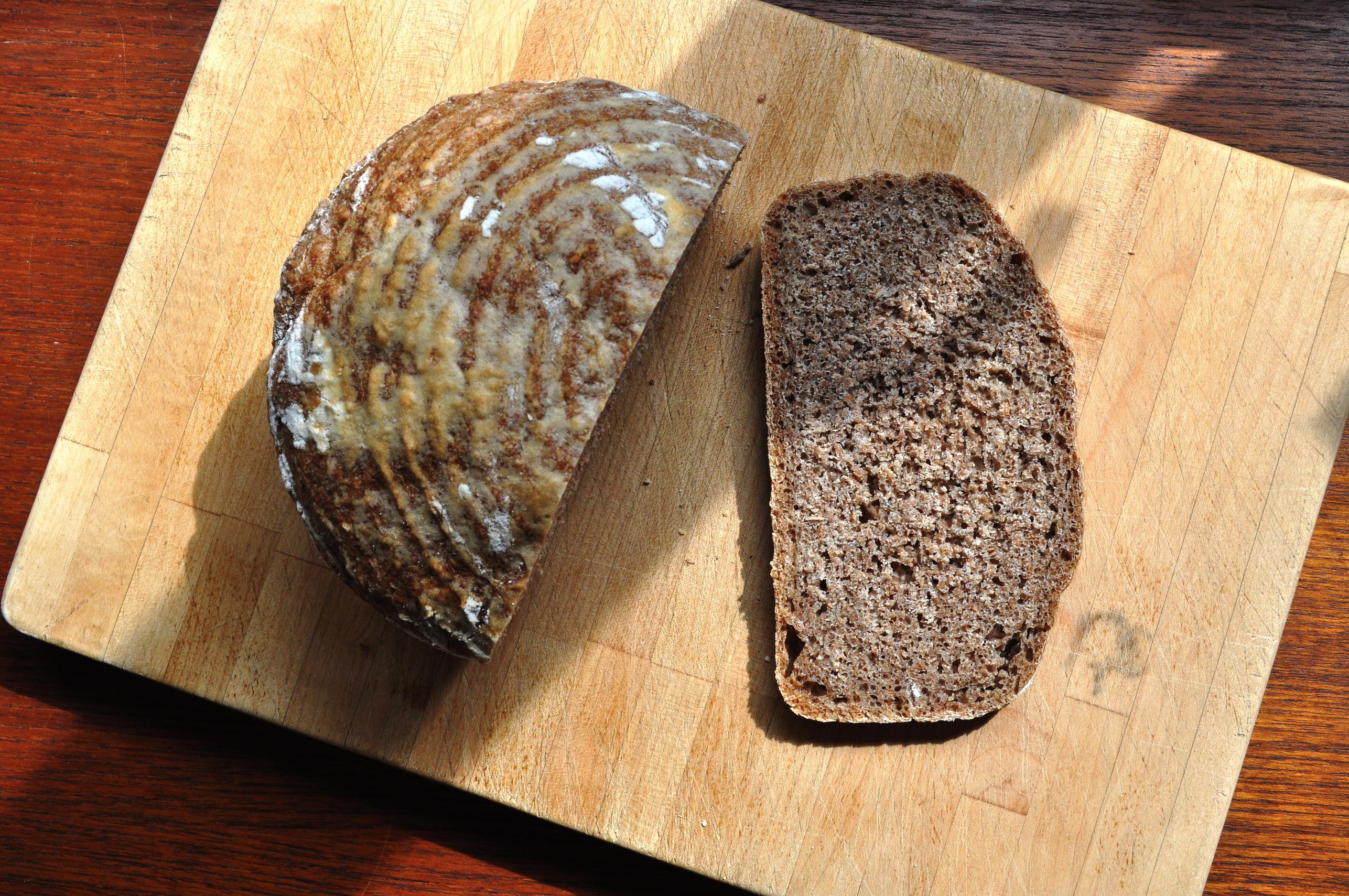
Holey bread 1

A lot of my recent bread has been fairly dense, with a close crumb. I like bread like this, especially with wholegrain breads like the 100% wholegrain wheat and spelt I’ve been making recently. They’ve tasted great and when fresh aren’t bad for open sandwiches and when a bit old they’re perfect for toast. But the favoured style of “artisan” bread these days is all about the open crumb. A nice crisp crust and an open, irregular crumb with a variety of big holes.

I know I’ve made holey bread like that in the past, but, I dunno, through all my experiments the past few years with seriously rustic flours, bought from farmers’ markets in Rome and here in Sussex, I seem to have lost the knack slightly. Learning to bake is one of those life-long challenges, especially if you’re a home baker and aren’t churning out massive batches. But it’s funny to feel you’ve learned something then forgotten it again.

High extraction challenge
It does seem that holey breads are a particular challenge if you’re using flour with a high extraction rate. The extraction rate is the amount of the grain that remains in the milled flour. So a genuinely wholegrain flour in principle should be 100% extraction. Modern, industrial, nominally brown flours, however, may only be about 80-85% extraction, whereas white flours, which have been sieved or bolted1 may be closer to 70% extraction – with the bran and germ (ie, the healthiest bits) removed and just the starches and proteins remaining. 

I’m sure the masters of the contemporary bread scene, especially those who work with ancient and heritage grains (like Chad Robertson of Tartine and the bakers producing the great looking results of the Brockwell Bake) could get a nice open, irregular holey crumb from 100% extraction flours, but not me. The wholegrain flours I’ve been buying lately have been very branny, stoneground, and I suspect probably close to 100% extraction. They taste great, but I need to get at it to open that crumb out.

I did go back to a classic Dan Lepard 100% white sourdough recipe the other day, and did get a holey crumb. Bit it’s wholly too holey. Holey-er than though. With giant crazy giant holes. So I’ve gone from one extreme to the other.

I reckon the next few weeks, I’m going to try and make breads that are 50/50 white and wholegrain and try the so-called “no knead” method. This seems to be very popular among US bakers and does seem to give holey crumb loaves. It involves mixing up the dough, resting it, and giving it a few stretch-and-folds over time. This does seem very similar to Dan L’s method of mixing, doing a short knead, resting it, and doing another short knead, then repeating, as those kneads basically just involve folding over the dough. I generally use Dan L’s method, with a few stretch-and-folds anyway. And there’s arguably a fine line between “kneading” and “folding”.

In the meantime, here are some pics of my comically holey bread. The flour was nothing fancy2, but the loaves still tasted pretty good. Even if they weren’t idea for making sarnies.

Holey bread 2


1 Etymology geek chums, bolting generally means sieving – or indeed sifting – through cloth. The word comes from 12th century Middle English bulten, from the old French bulter, which is probably from the Old High German būtil, meaning bag.)

2 Strong white from Waitrose supermarket. Although Waitrose/John Lewis does has its own farm,  the Leckford Estate in Hampshire, my home county, and to the west of Sussex in the south of England, they don’t seem to grow wheat that produces a strong white bread flour. The Waitrose own brand strong white is “produce of more than one country” – they, and even the likes of Dove’s Farm and Shipton Mill, Britain’s two big organic flour brands, don’t seem to be forthcoming about which countries. Presumably Canada, Kazakhstan, India, etc. I’ve now ordered some strong white flour from Stoate & Sons now instead. I believe they do manage to locally source and mill  a strong, high protein variety of wheat  in Dorset, the next country along from Hampshire.)

5 Comments

Filed under Baking, Breads, Discussion, Flour & grain

Hundred per cent local spelt loaf

Spelt loaf 1

The collection of different flours in my cupboard is getting a bit silly (again). I just can’t resist it when I see a new type I’ve not tried before. In this case, it was some spelt flour, grown and milled by Toos Jeuken, who I buy a lot of my veg from at the weekly Lewes market.

There’s a full profile of the Dutch-born Toos here on The Guardian site, from 2004, and a more recent profile on the market site here. They say she arrived in England on a bike in 1978 and has been farming in Sussex, specifically at Cuckfield, 16 miles from Lewes, since.

I hadn’t really registered that she sold grains as she always has such a wonderful selection of veg at her stall, even now, in the hungry gap. (Spring might be verdant, but traditionally March and April were the time of year when, as Paul Waddington puts it in Seasonal Food, “winter stores ran low and new produce had yet to mature.” Sure, there is still a selection of local produce – last week the farmers’ market had its first asparagus – but it’s a long way from late summer.)

Anyway, at her Laines Organic Farm, alongside all the veg, Toos grows several grains, including oats, barley and spelt. Last week I bought some of her rolled oats (hand-rolled!) and wholegrain spelt flour.

Too many chromasomes
Spelt (Triticum spelta) is an older variety of wheat, less manipulated1 than modern strains of bread wheat (Triticum aestivum). Though they are closely related, with spelt alternatively classified as a subspecies: Triticum aestivum subsp. Spelta. Both are what is called hexaploid plant species – that is, they have six sets of chromasomes. By comparison, more ancient wheats have few sets of chromasomes: einkorn (Triticum monococcum) is diploid, with two sets. Emmer (Triticum diococcum) is tetrapolid, with four sets, as is Durum wheat (Triciticum durum, or Triticum turgidum subsp. Durum) – the wheat most commonly used for pasta, which was domesticated from emmer.

In the issue 19 of ‘True Loaf’, the magazine of the Real Bread Campaign, Penny Williams of the Artisan Bakery School, highlights the importance of long fermentation of proper bread, but also looks at the issue of wheat varieties and how they may affect digestibility. She quotes a 2011 Indian study2 and concern about a potential “impending epidemic” of coeliac and other wheat protein related issues as India transitions from older diploid and tetraploid wheats to hexaploid wheats, notably modern strains of Triticum aestivum. She goes on to quote a 2010 study3 that looks at a broad selection of wheat varieties, with an eye to their “antigenic gliadins” – that is, the gluten proteins that may be responsible for “triggering autoimmune response in people with coeliac disease.”

“The findings suggest,” she writes, “that modern wheat breeding practices may have led to an incresed exposure to these coeliac ‘trigger’ proteins. While they also identified a few modern wheat varieties that had relatively low levels of antigenic proteins… I question whether tinkering with modern wheat is really the right direction to be going in.”

Less tinkered with
I would have to agree with that. Although I can’t really entirely avoid using modern wheat as I like to made cakes and enriched breads that rely on white flours too much, and these are hard4 to replace with older wheats.

I do at least try to use older wheat varieties in my wholesome bread experiments. And while spelt may be hexaploid, it’s a lot less tinkered with than modern, industrially cultivated and processed bread wheat. Especially as I’ve been lucky enough to find an experienced organic grower so close to home in the form of Toos. Next time I see her I’ll have to ask if she’s growing any emmer or einkorn.

So anyway. This was my 100% (or 99.5%) spelt loaf.

Spelt loaf 2

500g wholegrain spelt flour, nice and branny
340g water
10g fresh yeast
10g salt
50g wheat leaven, 100% hydration

This wasn’t a proper recipe. I just made a sponge, or pre-ferment, with 250g of the spelt flour, the 340g of water and the 10g of yeast in the evening and left it overnight. I wasn’t planning to use any sourdough leaven, but was playing around with it in the morning, so just chucked a bit into the sponge. I then added the rest of the flour and the salt and formed a dough. Did the on-and-off easy knead thing, let it prove up, formed a ball, gave it a final prove, then baked it the hot Le Creuset (like this bread), spraying some water onto the top crust before putting the lid on, resulting in a shiny floury glaze.

It wasn’t my best loaf in terms of the crumb – it’s crumbly and a bit underbaked – but boy did it taste good. The 100% wholegrain spelt flour just had a nuttiness and depth of flavour that’s more pronounced than the breads I’ve been making recently with the Sussex Red wholegrain flour (from Barlow, a modern wheat variety). As I do long fermentations, and avoid foul industrial wheat-based products (white sliced “bread” etc), I don’t suffer from negative reactions to “antigenic gliadians” etc, but I suspect even if I did, this spelt bread would be perfectly digestible.


Footnotes
1. By which I mean selective cultivation, over many centuries, but especially accelerated since the so-called Green Revolution of the 1960s when new strains of various crops with higher yields were developed. Higher yields but, we know now, potentially higher environmental repurcussions, due to their heavy reliance on chemical fertilisers, pesticides etc. So not really very “green” in the modern, sustainability sense.

1. ‘Celiac disease: can we avert the impending epidemic in India?’

2. ‘Presence of celiac disease epitopes in modern and old hexaploid wheat varieties: wheat breeding may have contributed to increased prevalence of celiac disease.’

3. Hard, but not necessarily impossible. It’ll just be a lifelong challenge to revise favourite recipes etc so they work with these more earnest, properly old-school wheat varieties.

6 Comments

Filed under Baking, Breads, Discussion, Misc

Our friend yeast

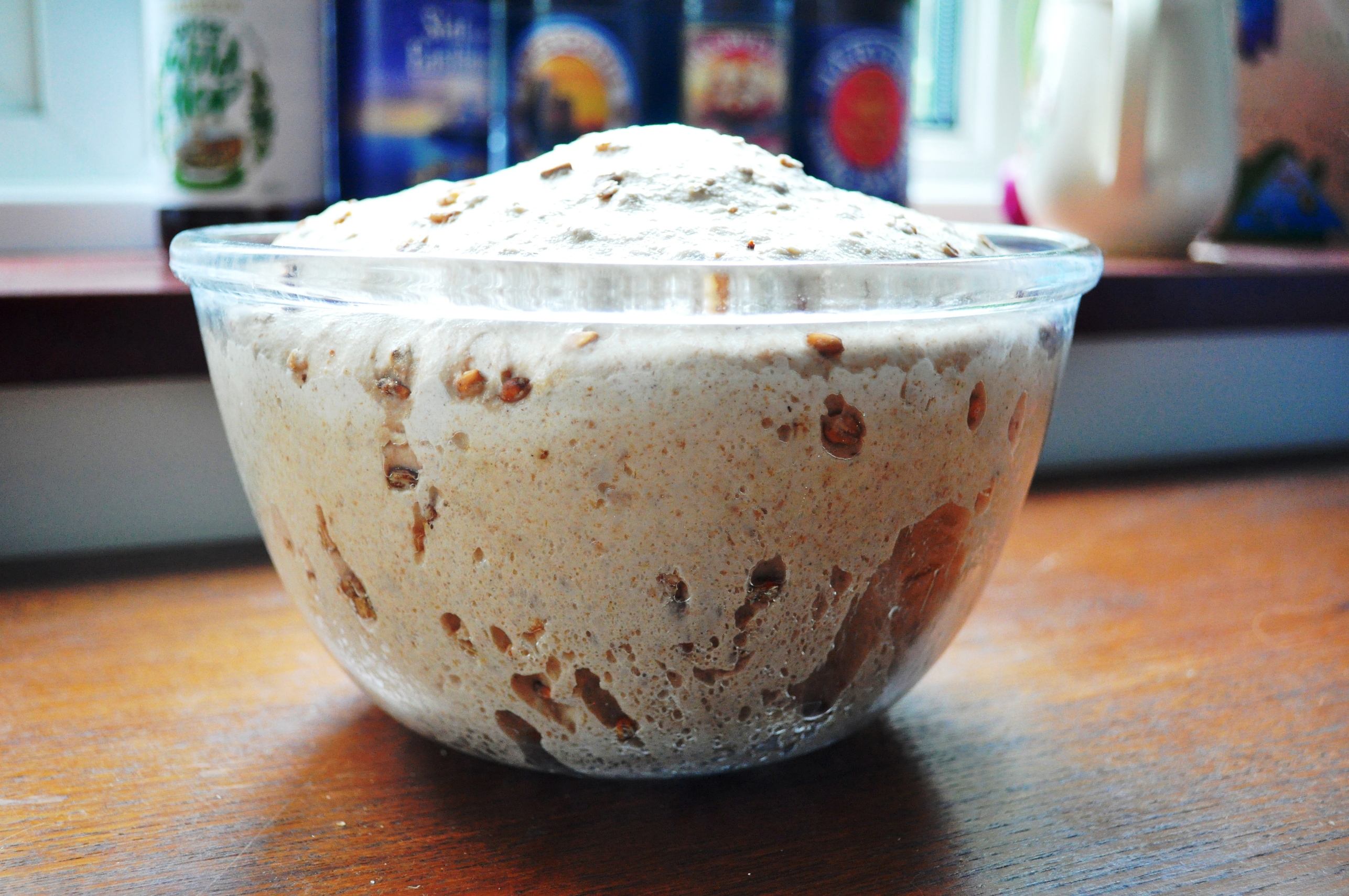
Unproved bread dough

Proved bread dough

It doesn’t matter how many times I make bread, I always find the rising, the leavening, of dough enormously pleasing. The quiet industry of yeast is nothing short of a wonder, and our relationship with it remarkable.

Yeast is a microscopic type of fungus. Of course, “yeast” in the baking and brewing senses refers to a variety of different species of yeast. Predominantly, however, bakers’ yeast is a strain of Saccharomyces cerevisiae. The main yeast used in brewing is also a strain of Saccharomyces cerevisiae. It’s also a key player in winemaking.

Some etymology
Myco is the Greek for fungus (with mycology the discipline of studying fungus). Saccharo, like saccharine, is also from the Greek, for sugar. So Saccharomyces means sugar-fungus.

Cerevisiae is generally translated as meaning “of beer”, but to go a little deeper, it’s presumably related to Ceres, the Roman goddess of grain, agriculture, and fertility, and the origin of our word “cereal”. (Ceres is also the name of a yucky strong Danish lager much loved by undiscerning Italians, but we won’t go into that.)

Cerevisia / cervisia means “beer” in Latin, and is the origin of the Spanish cerveza and even the obscure Italian word cervogia. Indeed, struggling through an Italian etymological dictionary, the vis is the Latin for “force” or “strength”, so the Latin name for beer seems to literally mean “the drink containing the strength of cereal”.

This is one of those many occasions when I wished I’d studied Latin. I went to a flippin’ Catholic school for crying out loud, but we didn’t do Latin!

Anyway, for most of humanity’s long history of bread-making and brewing, we were oblivious not just to the specific strains of yeast, but even to the whole concept of microorganisms. And yet there they were, helping us access the nutritional qualities of grain through the millennia. Yeast was first observed in 1680, but not recognised as a living thing. Louis Pasteur identified yeast as the cause of alcoholic fermentation in 1857 and the cause of dough inflating a few years later.

Even today, there’s plenty of disagreement about certain aspects of the nature of yeast: according to various figures, in a single gram of yeast, for baking or brewing, there are between 8 and 20 billion cells.

Oh, and after all that Latin and Greek, the word yeast itself is from the Old English gist/gyst, with very similar words in other northern European languages and, it seems, a Sanskrit root – yásati, meaning “(to) boil” or “to bubble”

Fungus fun for all the family
So thanks yeast. Or yeasts, as it’s not just S. cerevisiae. Other Saccharomyces are used in the production of food and drink, such as S. pastorianus (the hybrid strain used for bottom-fermenting lagers and pilsners; formerly known as S. carlsbergensis), S. bayanus and S. uvarum.

Then there’s the whole Brettanomyces genus. This name means “British yeast” and was so-named during investigations into English ales at the Danish Carlsberg brewery in the early 20th century. B. bruxellensis is an essential element in the production of Belgian Lambics and related sour beers.

Then there are other genera like Kazachstania, with K. exigua, found in sourdough cultures and olive brine. Heck, even the Candida genus comes into play. Yes, C. humilis, a yeast from the genus responsible for a lot of fungal infection, and even wine spoilage, is considered the “dominant species” for the production of some sourdoughs.

I like dogs, but with their invaluable services in the production of staple food and drink, to leavening bread doughs and fermenting alcohols, perhaps these yeasts have a better claim to being man’s* best friend(s).

* Sorry, inherently sexist language. Can’t really sidestep this by putting mankind’s or humanity’s either.

Leave a comment

Filed under Discussion, Misc

Go west, middle-aged man!

Done so much, seen so much, eaten so much, drunk so much since last post, hard to know where to start.

How about some of the amazing wildlife we’ve seen?

So, in vaguely chronological order: mule deer and a bald eagle, from the window of the California Zephyr, the train that took us on an amazing 25 hour journey from Denver, through the snowy Rockies and mud deserts of Utah, to Truckee; en route I enjoyed Pale Ale from Sierra Nevada Brewing Company, the Californian operation that’s one of the US’s biggest craft brewers.

image

A red-tailed hawk skimming low over our heads in a frosty meadow in south Tahoe; we saw bear prints in the woods nearby, before arriving back at our friend Cameron’s street to see a black bear and her cub just over the street. In Tahoe, I drank Moose Drool from Montana.
image

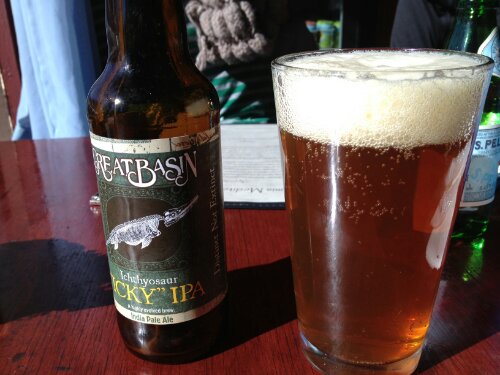
Then Great Basin’s Icky IPA, named after Nevada’s official state fossil the ichthyosaur (delicious, but served too cold as usual, so I had to warm it in the sun); “Distinct not extinct”.
image

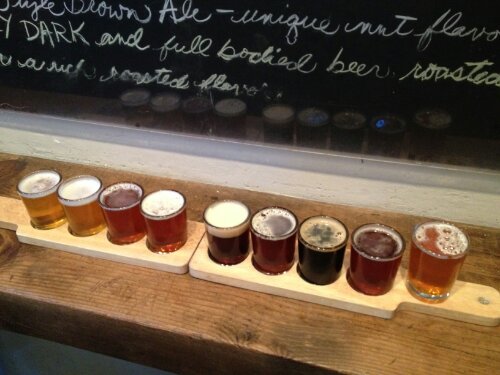
We also visited The Brewery at Lake Tahoe brewpub and sampling all nine of their delicious wares.
image

I also ate a serious cinnamon bun from Sugar Pine Bakery to give me a sugary-carb hit before we went and lost money on the blackjack (aka 21) tables in a casino over the Nevada state line and got our money’s worth from a House of the Dead III machine.

Lake to sea
After a few fabulous days in Tahoe, we continued our westward journey, towards the California coast. As Cameron drove us towards her hometown of Carmel, we saw our first coyotes. I know these are pretty common in the western US, and considered a nuisance by many, but Brits like me get excited about such large fauna as we killed off such impressive animals as bears, wolves and lynx centuries ago. Plus, well, I love foxes, and coyotes are their big canine cousins: real survivors.

In Carmel we saw hundreds of cormorants and pelicans (again, common there but pretty exotic for us), as well as my first ever (sea) otters, all during a walk on the glorious Point Lobos. The latter were especially engaging – six or so, all snoozing in the kelp beds, floating on their backs and holding hands.

image

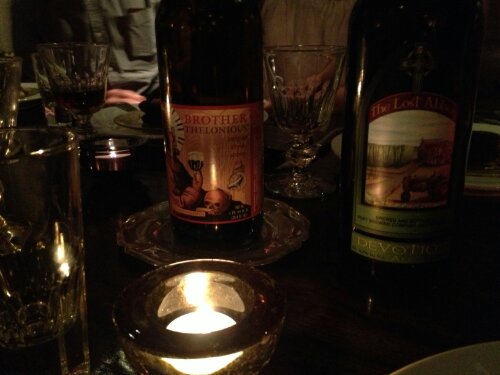
In Carmel, I drank sundry beers, including Laguinitas Little Sumpin’ Wild Ale, which was strong (8.8%) and pleasingly, crisply bitter; Brother Thelonius from North Coast Brewing, a strong (9.4%) dark ale, reminiscent of slightly charred toffee apples; and Devotion Ale from The Lost Abbey, a sweet blonde; amongst others.
image

We also tried to visit Post No Bills in Sand City, but were too early. Phooey, thwarted!

Big Surring
Somewhere we did visit, however, was Big Sur. This is a really special area that reminded me a bit of one of my fave places: the north of New Zealand’s South Island. Both have a rugged beauty, partially shaped by humanity but mostly defined by ocean and forest. On a hike in Andrew Molera State Park we saw more red-tailed hawks as well as another iconic American raptor, the turkey vulture.

image

Beforehand, I’d fuelled up with the biggest, most amorphous almond croissant ever, from Big Sur Bakery. It was mighty good with a filling that was more crunchy than the usual almond paste.

Afterwards we had lunch at Nepenthe, a restaurant in a location once fleetingly owned by Orson Welles and Rita Hayworth that has incredible views but food that needs a bit of an injection of energy.

image

They had some great beers though, including the wonderfully named Eye of the Hawk from Mendocino brewing, another strong (8%) ale, this time coppery and warmly malty.

image

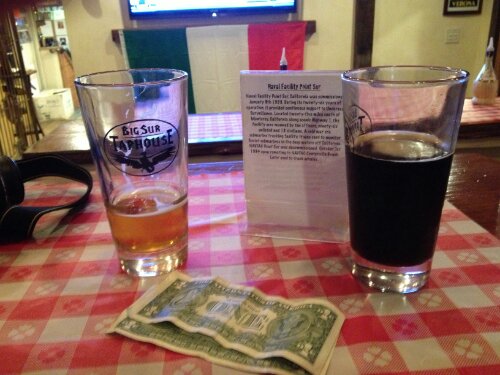
Later on, we even fitted in a quick visit to Big Sur Taphouse, in the same stretch as the bakery.
image

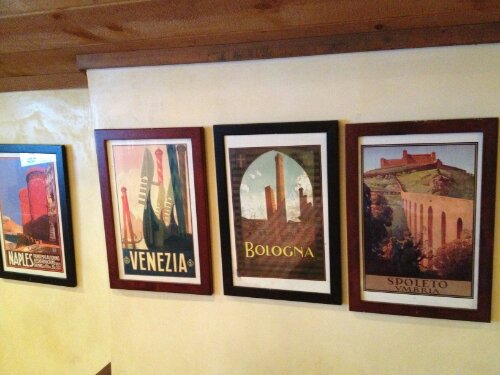
Pictures on the walls and a flag were Italian, but we drank local beers before buying some bottles from the amazing selection in the general store next door. Jeez, I wish British corner shops had such enthusiasm with their beer stock.

Oh, and I know I’m straying even further from my remit, but an honorable mention to Lula’s Chocolates for their Dark California Toffee: toffee, coated in dark choc, sprinkled with almonds. Best chocolate we had, and we we’ve been sampling a lot.

A bigger city
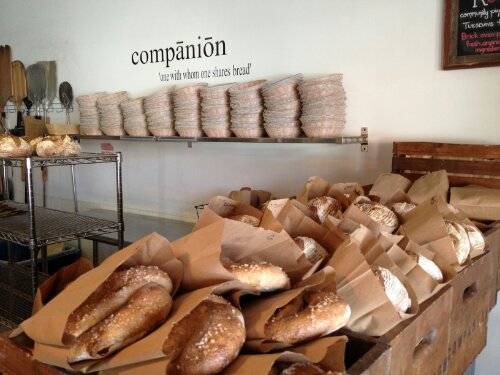
We’re now back in the big city, San Francisco, having said goodbye to Cameron, our ever-generous California host, on Wednesday night. We drove up via Santa Cruz, having a quick stop at the likeable Companion Bakeshop (handsome piles of breads, cookie far too earnest and 1980s-Cranks, tomato and onion tartlet underseasoned and soggy bottomed).

image

As Cameron and I met at the kitchens of the American Academy in Rome, it was fitting that our final dinner together was at Chez Panisse, the restaurant founded by Alice Waters, who also set up the Rome Sustainable Food Project at the Academy.

I must admit the food couldn’t quite live up to the hype (things rarely do), but I did have an excellent beer as an aperitivo: Proportional Response from The Rare Barrel. This brewery – also in Berkeley, like the restaurant – specialises in oak-aged sour beers. I usually loathe oakiness in wine, but this stuff was great – smoothly sharp, acidly mellow.

Having seen a few photos recently in which my 40-something-not-getting-enough-exercise-belly is coming along nicely (tall skinny man with a beergut – never a good look), I managed to go a day with our bread, cakes or ale yesterday (almost – had a cookie), but we did have a great walk around the city.

I’m loving California, but I do struggle with a car-oriented lifestyle; I just love to walk around and SF is a perfect place to do that. Cameron’s mum had kindly given us tickets for the de Young Museum’s David Hockney: A Bigger Exhibition. The show was largely about Hockney returning to his native Yorkshire after 25 years living in California and as such provided a perfect connection between dear, soggy, verdant old England and this magnificent state.

http://hockney.famsf.org/sites/default/files/styles/big_preview/public/preview/08A01_cropped.jpg?itok=cfHMSYWU

We’ve got a few more days in SF now, before heading to NZ. I meant to get up early this morning and go to the much-praised Tartine, but I suspect we’re too late now as I’ve been doing this blog, having the usual fight juggling three devices and trying to sort all the pics and links.

We’ll see what the next few days hold. Sadly, I was way too late to get on a tour at Anchor Steam Brewery (thwarted again). Shame really, as I’m really keen to ask a US craft brewer about the whole issue of serving their brews at fridge temperature (4C, or 39F) compared to “cellar temperature” (8-10C, 46-50F).

6 Comments

Filed under Ale, beer, American beer, Bakeries, Bars, pubs etc, Discussion, Misc, Restaurants etc, Travelling

Departures, rip-offs, cocoa beans and kernels

We finally left Rome on Wednesday. The flat was scoured, the kitchen was re-cluttered with the piles of stuff belonging to our landlady that we’d stashed in the basement, and, well, the place didn’t really look very different. It was sad to leave Rome, but it wasn’t exactly sad to leave that flat, where we always felt besieged by the other denizens of the palazzo: mad, sad or just pretty unfriendly to know. And all of them shouters, barkers and door-slammers.

One final, expensive international-house-move hiccough happened when we tried to check in our bags at the airport. We’re not naive, and understand perfectly that budget airlines make their money by hitting you from all sides with extra ways, many unexpected, to help you part with your cash, but EasyJet’s luggage policy is especially dubious. We didn’t think to question that spending money to carry extra luggage meant you were spending money to carry extra weight. That’s a logical assumption. You’re paying for the extra weight, right? Um, no – you’re paying simply to have the option to spread your luggage between more bags. So one hold bag: 20kg. Two hold bags: 20kg. Eh?

We’re both pretty web literate, but this info isn’t exactly front and centre on the site when you’re booking; it’s stashed, to help encourage punters to make this costly mistake. Being told we had to pay several hundred euro extra there and then before our clobber would be added to the flight was a shocker.

Oddly, carry-on has “No weight restriction applies as long as you can place and retrieve the cabin bag safely in the overhead lockers without assistance.” I’ve always treated carry-on as a means of transporting my passport and my reading matter, not being one of those people who blocks up boarding and disembarking. So yeah, I suppose I am naive. And the bank account is somewhat lighter too. Ouch.

Still, at least our arrival in Blighty was fairly painless; if British railways’ gulp-inducing prices could ever be considered painless. (No they can’t – they’re a national disgrace, each year leaping ahead of the rate of inflation with undisguised exploitative neoliberal glee.) Struggling with our marginally hefty, now somewhat highly priced luggage, we went into London then out again to our old hood, Herne Hill, where we met the friend Becca, who, with husband Ceri and daughter Angharad, is looking after our cats, who survived their road trip from Rome.

A taxi took us to their house, and a reunion with the beasts in question, Lux and Pip. They’d settled in well. Further reunions followed when we headed further into deepest sarf London and Honor Oak. Some were of the human variety, with old friends Jo and Lawrence and their somewhat enlarged, considerably more articulate kids, and some were with beer.

This isn’t a blog about child development though, so I’ll stick to the latter.

Meantime at Donde

We went to a tapas place called Donde, where they had Meantime London Pale Ale and London Stout on tap. Founded in 2000, Meantime was on the first of the new generation of London breweries I drank their products a reasonable amount before we moved out of London in 2011, and always enjoyed them. Although I enjoyed my pint of London Pale Ale, it struck me as somewhat generic and decided over-carbonised; the latter is partly because it was keg not cask. The former is – I don’t know – perhaps it’s one of those cases where a traditional brewery has got so successful and grown so much that the product, while still good quality, has lost its distinction.

Sure they still exemplify a continuity in the great brewing traditions of London, but with a more industrial approach. They, for example, had a relationship with supermarket chain Sainsbury’s to make some of their own-branded beers. I’m really not sure about this. Surely something as avowedly authentic and artisanal as traditionally brewed beer shouldn’t really cosy up with something as antithetical to all things artisanal, local and traditional as a corporate supermarket.

I really can’t decide what I think about all this. Do success and scale implicitly go hand in hand with a compromise in quality?

It’s something I’ve thought about a lot through two years of enjoying Italian craft beers, especially given that a friend, Michele Sensidoni, is master brewer at one of Italy’s biggest craft breweries. A brewery with an output that some in Italy won’t even acknowledge as “artigianale” (100,000hl / 6,097 UK barrels / 8,547 US barrels – big for Italy, but tiny by US or multinational standards). I talked about Michele’s brewery here, then went on to discuss this question of what defines craft beer: for me, with fermented products like bread and beer, time is one of key factors. Not rushing. Michele doesn’t rush their beers: they’re bottle conditioned for long periods and remain unpasteurised and unfiltered. He also regularly brews up new tests beers, a very hands-on process.

One such beer was smuggled in the luggage I paid an arm and a leg to transport back to Britain. As such, it’s not only the first of its kind to reach these shores, it also had a pretty substantial relative value, thanks to EasyJet’s €14 per excess kilo. (Yes, €14 – about £12, or US$19. I still need a take a breath when I think about that).

Mastri Birra Umbri chocolate stout

The beer is a stout. As with many of Michele’s beers, it’s made with atypical ingredients. So while there’s nothing new about stout that tastes very chocolaty, this one is specifically made with cocoa/cacao beans. They give the beer a delicious smell of chocolate. The beer itself was pretty carbonised and had a similarly delicious taste of chocolate, well toasted malts, charcoal. I’d want perhaps a little less carbon and a bit more body ultimately though.

We drank the beer over dinner, with Ceri and Becca and the cats, then moved on to a bottle of The Kernel Breweryʼs Table Beer. This added a nice balance to the evening: I started drinking beer from one of the founders of London’s new generation of breweries, said farewell to Italian craft beer in the middle, then continued with one of the big success stories of more recent London craft breweries.

The Kernel was founded in 2009. Sadly, I didn’t even become aware of it until I left London in early 2011, but during my time in Rome its name came up a lot as being at the heart of London’s newly revitalised craft brewing scene. The brewery was part of the burgeoning real food scene in Maltby Street, in Bermondsey, southeast London. Like Meantime, they quickly established a reputation and moved to bigger premises in 2012. I’ve only tried a few of their beers so far, but both have been great.

The Table Beer features The Kernel’s neat, pleasing brown packing paper style labels, where, while completely failing to take a photo, I noticed it was just 3.3% ABV. This was an interesting surprise after so many strong beers in Italy. It’s also a delicious beer, very easy drinking with a floral scent and fresh, citrusy taste. Compared to the Meantime London Pale Ale, this is a thinner kind of pale ale, with less body, but it’s also perfectly carbonised, very drinkable and feels, well, uncomplicated but eager. It’s eager to sit on your table and be drunk along with food in lieu of a table wine.

Now  I’m sitting here at the kitchen table in my parents’ house in Winchester, the ancient capital of England. I grew up here, looking out over the hillfort that predated the Roman settlement whose street plan still dictates something of the nature of the contemporary city. Rome itself is about 850 miles or 1370km to my south. It was cold and blue and beautiful this morning, but now the rain is sheeting down and the cliché of English weather is asserting itself.

We’ve got a few days here in Blighty, enough time to do one of the best things this island has to offer: avoiding the rain by going to pubs. Then we’ll be off to New York City, and whatever bread, cakes and ale I encounter there. Just to add to the neatness of Wednesday’s beer consumption reflected my current trajectory, Ceri also opened a bottle of Brooklyn Breweryʼs Brooklyn Lager. In a week or so we’ll be able to try it again, mere miles from where it’s brewed.

Info
Donde Tapas
37–39 Honor Oak Park, Honor Oak, London SE23 1DZ
(+44) 20 8291 2822 | dondetapas.com | share@dondetapas.com

Meantime Brewery
Lawrence Trading Estate, Blackwall Lann, Greenwich, London SE10 0AR
(+44) 20 8293 1111 | meantimebrewing.com | sales@meantimebrewing.com

The Kernel Brewery
1 Spa Business Park, Spa Road, Bermondsey, London SE16 4QT
+44 (0)20 7231 4516 | thekernelbrewery.com | contact@thekernelbrewery.com

3 Comments

Filed under Ale, beer, Breweries, British beer, Discussion, Italian beer

Post number 100, a celebration of Italian craft beer, and getting ready to leave Rome

Italian craft beers

According to WordPress’s strange date conventions I started this blog with a post published 2012/11/07. For most of the world1, this would otherwise be known as 07/11/2012, 7 November 2012.

It was started so I had a place to write about my baking experiments, my interest in the baked goods I encountered while living in Rome, where we moved in August 2011, and my burgeoning enthusiasm for Italian birre artigianali (artisan beers, craft beer).

Some Baladin beers

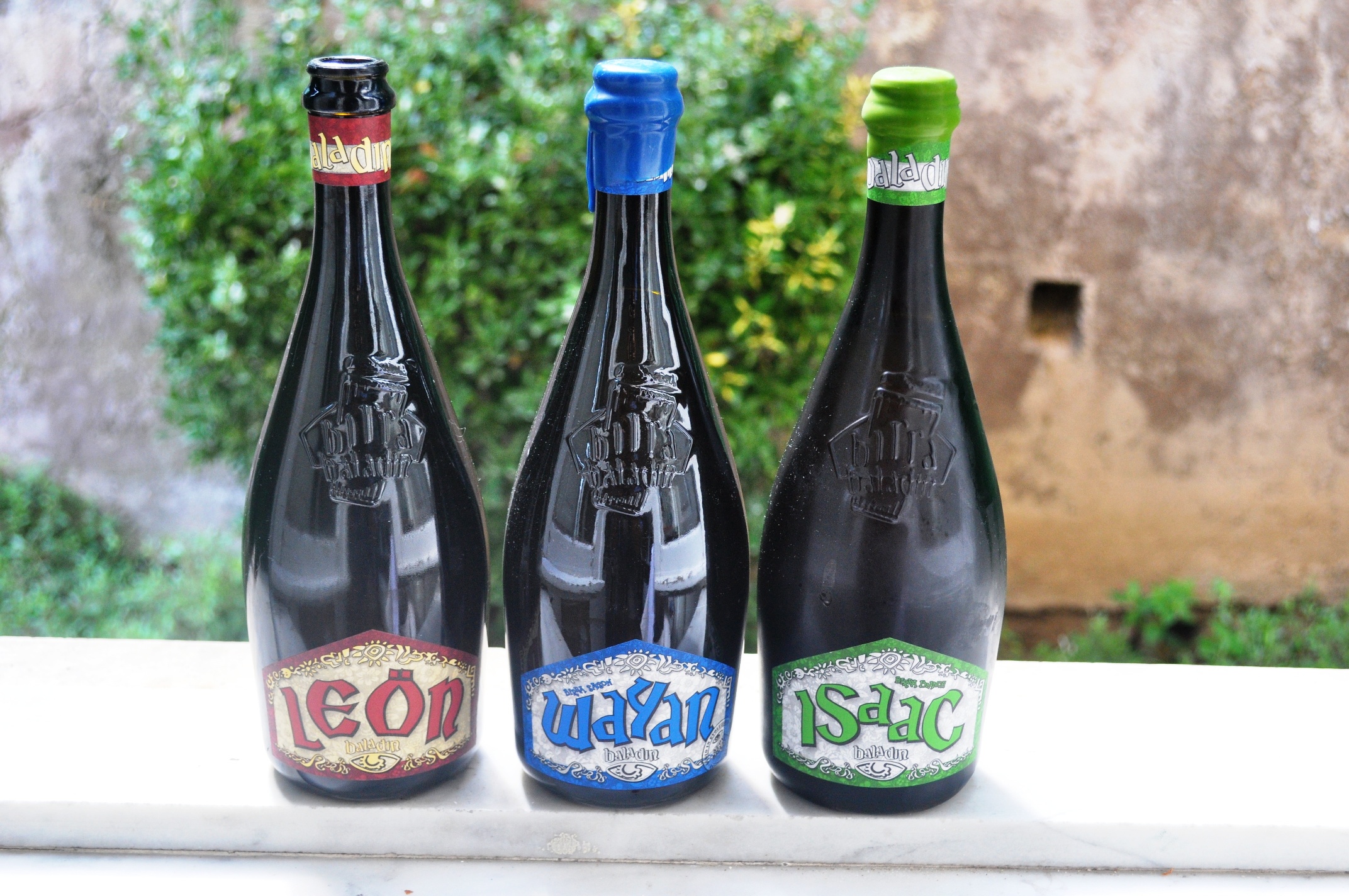
Leon, Wayan and Isaac from Baladin, the brewery that really kicked it all off in Italy and still produces many of the best, most intereting beers here.

Now, almost 11 months later, I’ve arrived at my 100th post…. just as we’re preparing to leave Rome after two roller-coaster years. These included:
difficult work (Fran);
unpaid work/unemployment (me; including one [dubious] SF-fantasy novel, an internship on the American Academy’s Sustainable Food Project, and this educating-myself-about beer and waffling on about baking project);
faltering attempts to learn Italian;
lots of baking (some great; some heavy; some that went mushy);
lots of food (some amazing, a lot mediocre);
lots of beer (mostly interesting);
bewilderment at the Italian ways of doing things (or not doing things; like having to wait five months to get our internet connected, or the post office that doesn’t sell stamps);
still no kids (sadly);
neighbours from hell (WTF!? It’s 4am! Again! Che cazzo state facendo?! Stiamo provando di dormire. Mortacci tua!);
zanzare;
some great new friends;
witnessing Palme d’Or winner Nanni Moretti move in next door;
and, overall, an incredible immersion in this bonkers, intoxicating, dilapidated, exasperating, traffic-choked, caffeine-fuelled, history-sozzled city.

Draco beer

Draco, from Birrificio Montegioco. Made with bilberry (aka blueberry) syrup, no less.

When I wrote the 99th post, I thought, “Accidenti! I better do something interesting for the arbitrary landmark of number 100″. But that stymied me.

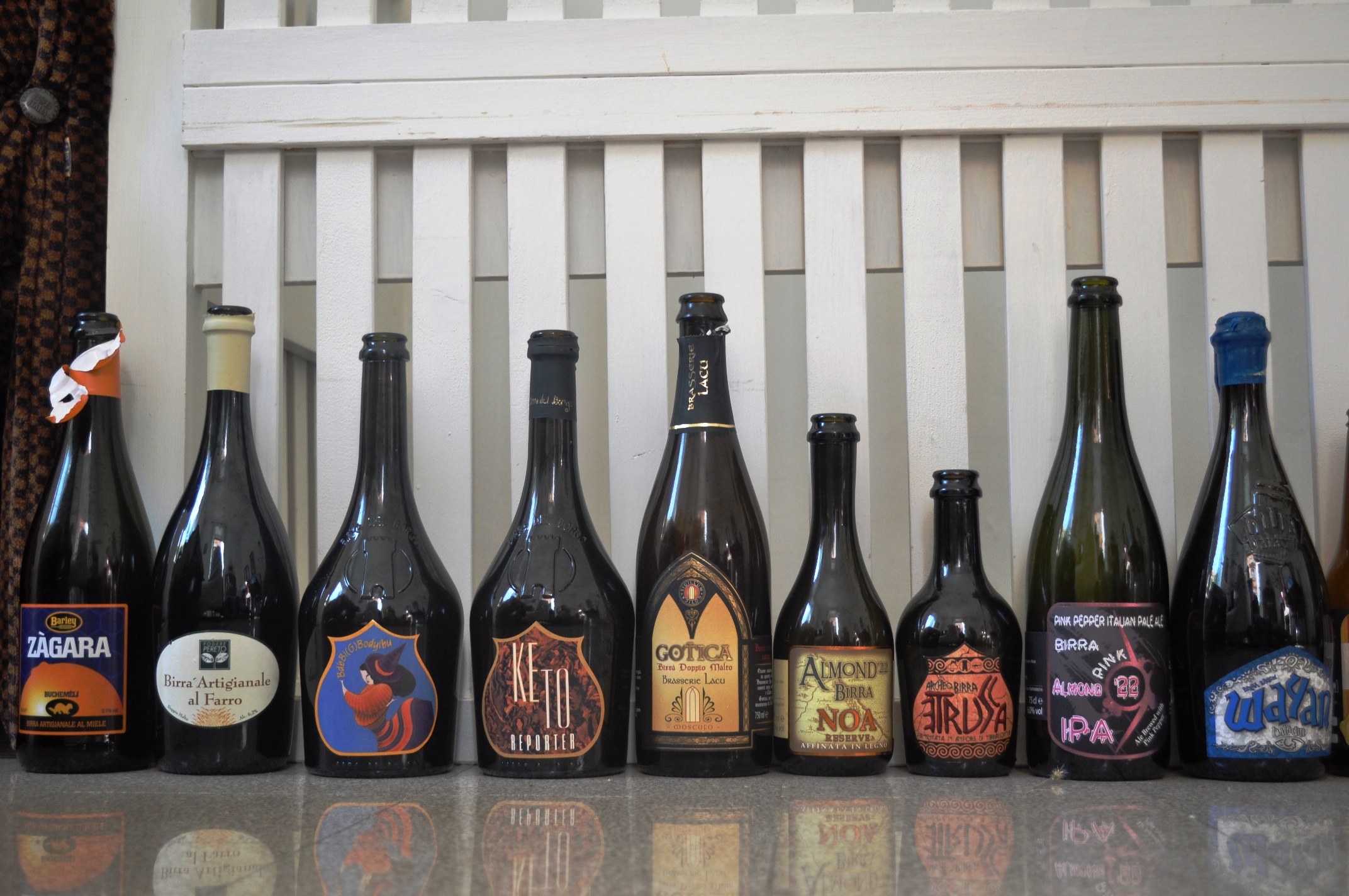
So instead, here are a load of pictures of beer. They’re mostly from a party we had at the weekend that doubled tripled up as a goodbye, a free jumble sale, and a celebration of Italian craft beer. Although we had a great selection of fascinating brews, they are only the tip of the iceberg of the 500 or so birra artigianale breweries currently operating in Italy. I wish I could stay here and keep on drinking my way through them, but we need to return to Britain.

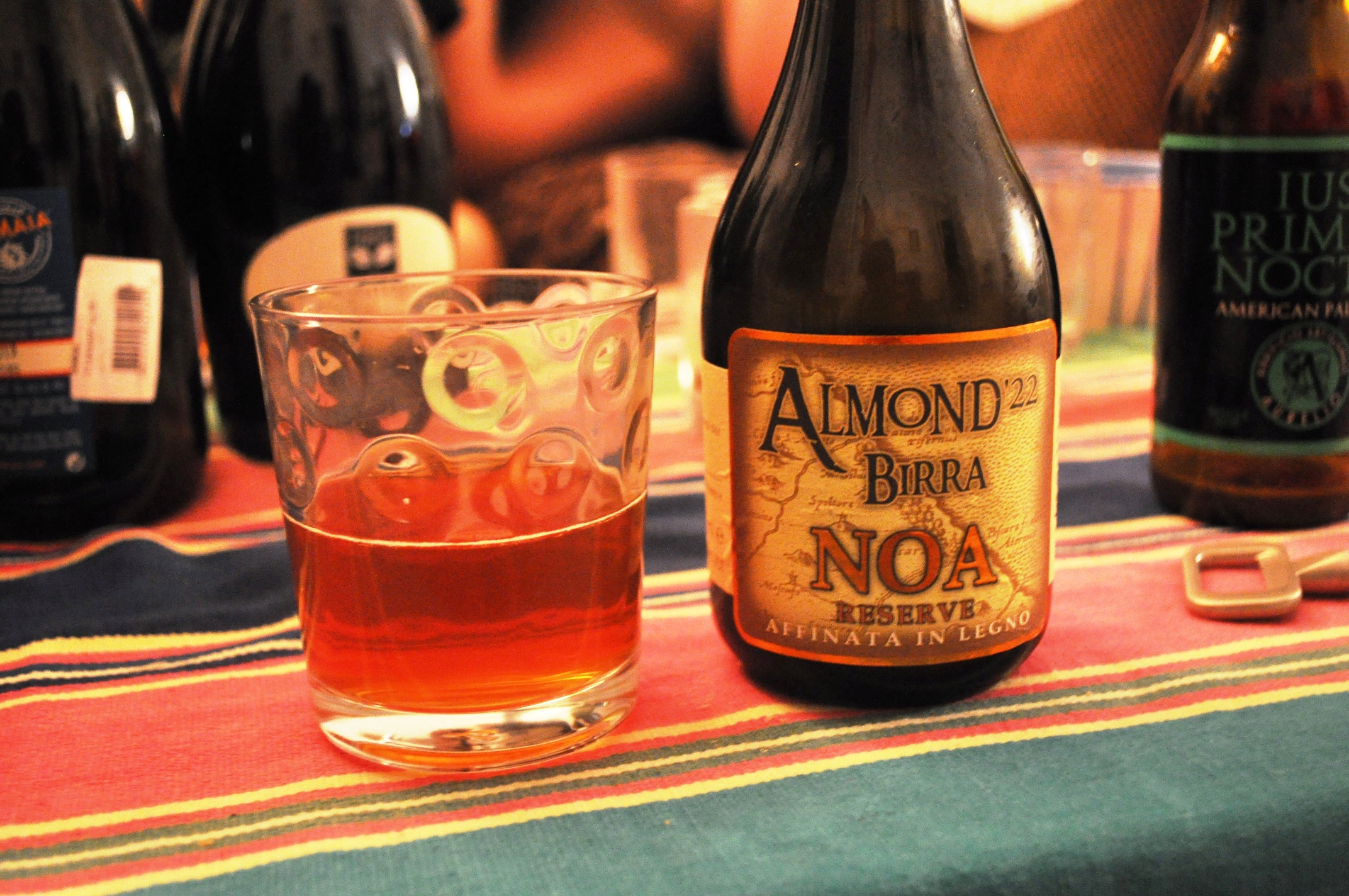
Noa Reserve

Noa Reserve – one of the strangest beers we had that evening. Aged in barrels, it basically tastes of whisky, brandy, or as our friend MM said, “a memory of foreign land you’ve never been too.”

I do hope any readers of this blog won’t be put off by the fact I won’t have the glamorous “I live in Rome” factor any more. For the next few months, we’ll be visiting friends and family in the US and NZ, before settling back home around Christmas. So the blog will change slightly – not its tone, but its context.

We’ll see how it goes.

I certainly have no intention of stopping baking and I’m really excited to get back to the real beer scene in the UK, which, like that of Italy, has grown exponentially the past few years, with 197 new breweries opening in the past year alone, while London alone has nearly 50, up from just two in 2006.

Ecco, more photos of beer:

Marche'l Re

Marchè’l Re from Loverbeer brewery. Possibly even stranger than Noa Reserve, me and chef Chris Behr concluded it was like “drinking fruit beer from an ashtray”.2

Gotica from Brasserie Lacu

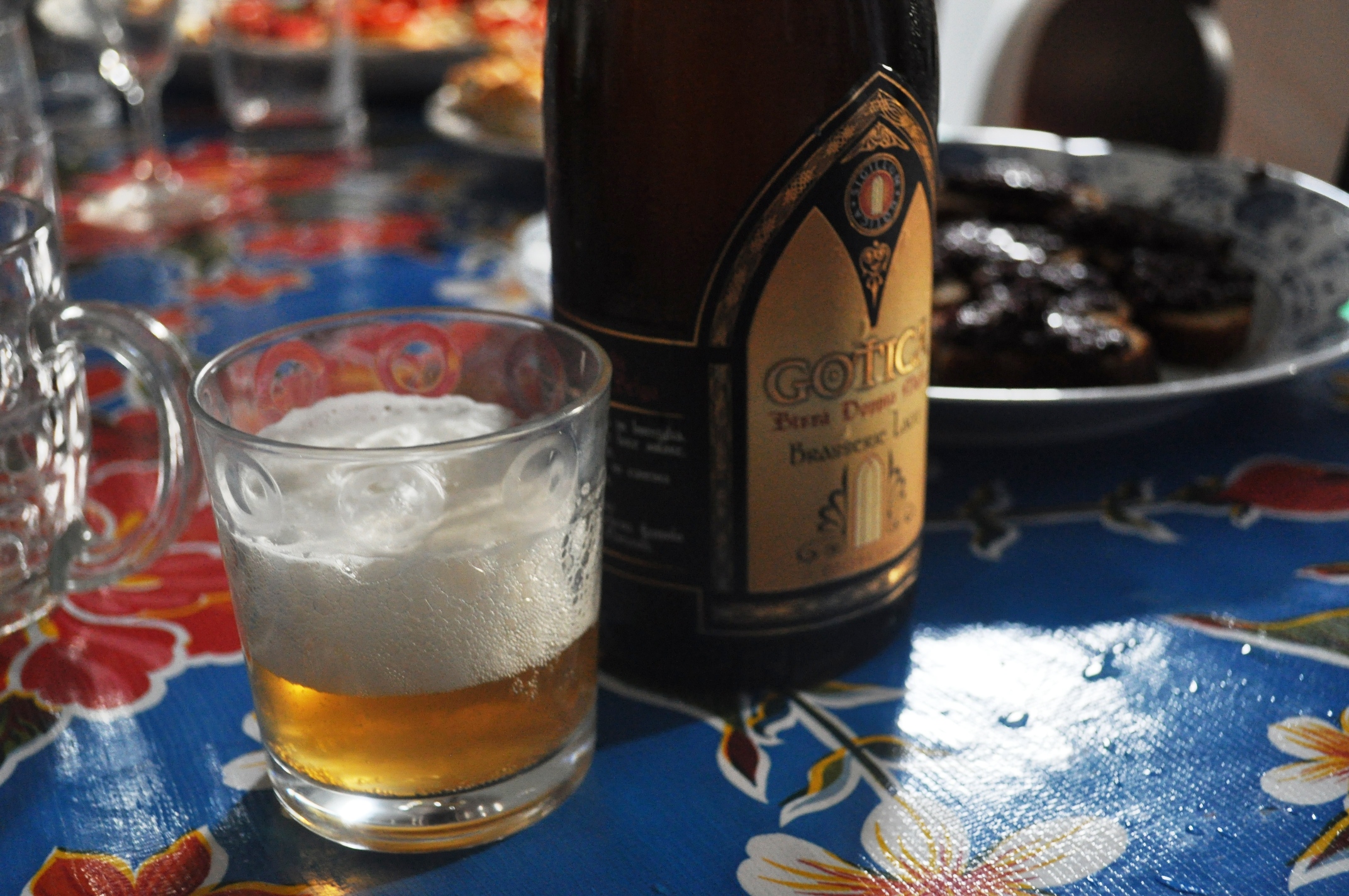
Gotica from Brasserie Lacu, a light double malted Belgian abbey ale – made in Belgium for the Italian market.

Rubbiu MRL

Can’t really find out much about this one, Rubbiu, but it was a great gift – as it came from a small brewery in a friend’s small home town outside Rome.

Zagara beer from Barley brewery

Zagara beer, an orange blossom honey ale from Barley brewery in Sardinia. So the first Sardinian beer I’ve ever had.

Line-up left

Line-up, centre

Line-up, right

And finally, a bit of nocturnal ambience. Thanks to anti-mosquito candles.

Isaac, anti-mozzie candles

1 Except you contrarians in the US, of course, who would insist on confusing the rest of us by using putting 11/07/2012 for 7 November 2012.

2 We didn’t necessarily mean this in a bad sense. I wish I’d written about Loverbeer more in my time here, but I’ve only really discovered them fairly recently. (I did write about their Madamin.) As they really are producing some of the most interesting beers in Italy. They seem intent on combining the traditions and tastes of wine and beer. So their D’uva beer  is made with 20% grape must and tastes much more like a sparkling wine than a beer, not unlike say Birra del Borgo’s Rubus.

I’m increasingly interested in this whole area of making beer that doesn’t really taste of hops or malt. It’s fascinating, and I’m very divided. The above mentioned Noa Reserve, from Almond ’22 brewery, is another example, as is the fascinating Etrusca (which can be seen in one of the above pics), a beer made by three different breweries (Baladin and Borgo in Italy, and Dogfish Head in the US) according to an ancient recipe; it tastes much more like wine or mead than beer. I very much enjoyed experiencing the weirder beers we had, but I think my favourite of the evening was Ius Primae Noctis (“right of the first night”, Latin for “droit du seigneur”), a hoppy, citrussy Italian APA from Birrificio Aurelio, which is in Ladispoli, not far from Rome. So yes, I’m clearly not leaving behind hoppy beers any time soon.

11 Comments

Filed under Ale, beer, Discussion, Italian beer

Pudding, boudin, budino and complex historical relationship between desserts and sausages

In my last post, I mentioned my attempt to make a boudin di ricotta (below). It either went wrong, or this retro cheesecake just wasn’t to my taste. Either way, one thing the dish got me thinking about was the word budino, which can be translated as “pudding”.

Budino di ricotta, baked

As anyone who’s interested in food, or eating, or sausages, or dessert, knows, the meaning of the word pudding can be little complicated. Likewise budino.

English has the word pudding, French boudin, and Italian budino. Surely these are all related? It’s agreed that the latter words come from the Latin for gut or intestine, botellus, which relates to the modern Italian word budella. English etymological dictionaries, on the other hand, suggest that the word pudding may comes from old English and German words for swellings and lumps (puducpuddek etc). Thankfully, other sources posit1 botellus as an alternative source too. The relationship seems too strong for the English word to not have the Latin root, surely?

Originally, pudding, budino and boudin all referred to much the same kind of product: sausages made with blood, meal, fat and animal bits (including ambergris, a sperm whale digestive byproduct), all stuffed into intestinal membrane and steamed or boiled.

Sanguinnacio

This sense of the word still exists in the things like the Scottish haggis, or the British black pudding, its French cousin boudin noir, and even an Italian cousin called sanguinaccio 2 (from the Latin sanguis, blood). Interestingly, though, the latter straddles both the older sense of the savoury pudding, and the modern usage, which more commonly refers to desserts. Italy has various versions of sanguinaccio, running the spectrum from full savoury sausage, to a chocolate pudding traditionally thickened and flavoured with fresh pigs’ blood at the time of slaughter to a basic chocolate pudding like a mousse, with nary a pig byproduct.

Pudding cloth boiled pudding

Although in British English, the word pudding has become almost synonymous with dessert, for me (I’m English), it more specifically refers to dishes that have been steamed or boiled.

Again, in the Middle Ages, food, specifically the food of the rich, would blend what we now consider very different flavours: the savoury with the sweet, meat with spices, salt and sugar. British mincemeat (as in Christmas mince pies) originally took this form, for example.

When one strain of the pudding evolved into savoury sausages, other strains evolved into desserts. The meat in the dish would have been reduced to fat in the form of suet or lard, while the grain, fruit, sugar and spices might have stayed. The animal membrane was replaced with a cloth, then latter a ceramic bowl, though the pudding was still cooked by boiling or steaming.

mason cash pudding basin

This path of evolution gives us things like British Christmas pudding, schoolboys’ favourite spotted dick, bread-and-fruit summer pudding and other dishes where even the fruit and spice has evolved out, such as one personal fave, treacle sponge pudding. Strangely, the word’s usage narrowed down even further in North American English, where, as I understand it, pudding just refers to mousse or custard-like deserts.

The abovementioned treacle sponge pudding is basically just a steamed cake mixture made with golden syrup (a gingery version of mine can be found here). If an equivalent type of mix is instead baked, then served as a dessert, it’s still a called a pudding (in BE). It may be long way from stuffed intestine but it’s still a descendant. We also still have savoury puddings in Britain, where a pastry crust is filled with meat and/or vegetables and steamed or boiled in a ceramic pudding basin (eg this one made with venison).

So any time Anglophones from North America and the British Isles find themselves arguing about the meaning of the word pudding – something we’ve done with a Canadian friend – bear this wonderful, convoluted history in mind!

Footnotes
1 From Etymonline: pudding (n.) c.1300, “a kind of sausage: the stomach or one of the entrails of a pig, sheep, etc., stuffed with minced meat, suet, seasoning, boiled and kept till needed,” perhaps from a West Germanic stem *pud– “to swell” (cf. Old English puduc “a wen,” Westphalian dialect puddek “lump, pudding,” Low German pudde-wurst “black pudding,” English dialectal pod “belly;” also cf. pudgy).

Other possibility is the traditional one that it is from Old French boudin “sausage,” from Vulgar Latin botellinus, from Latin botellus “sausage” (change of French b– to English p– presents difficulties, but cf. purse). The modern sense had emerged by 1670, from extension to other foods boiled or steamed in a bag or sack (16c.). German pudding, French pouding, Swedish pudding, Irish putog are from English.

2 You can find recipes for various versions of sanguinnaccio online. There’s a more savoury one here (and pictured above). And while this one is made using sausage casings, it’s more a dessert. While this one (in Italian) is decidedly a dessert, made with neither sausages casings or even blood: so basically a chocolate mousse.

2 Comments

Filed under Discussion, Misc, Other food, Puddings & desserts