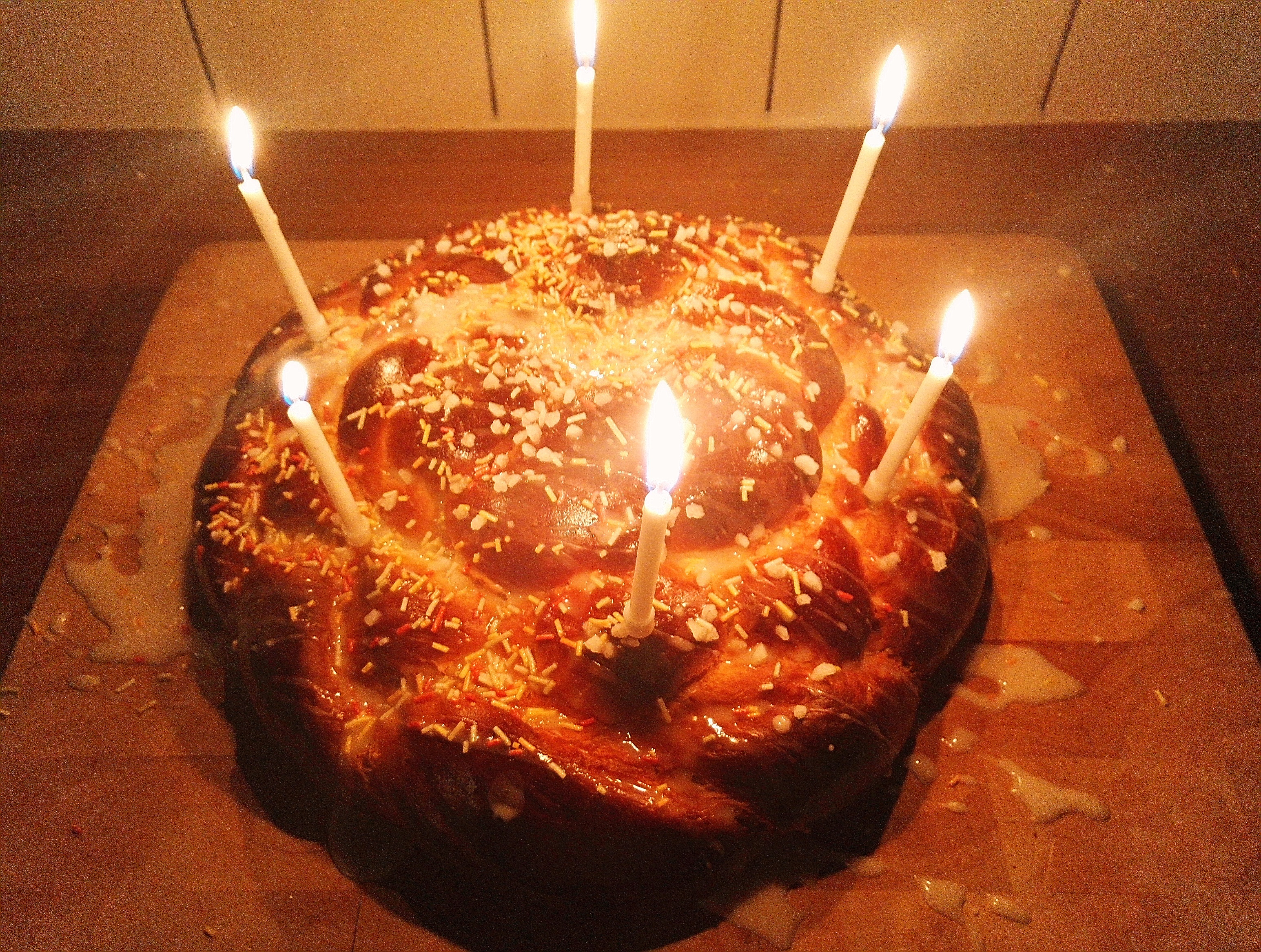
Santa Lucia crown

Santa Lucia crown

The feast day of Santa Lucia,  St Lucy, is celebrated on 13 December. Her name derives from the Latin lux, as in “Fiat lux!” – “Let there be light!”. We also have a cat called Lux. She’s not divine in any way, she’s a needy, bony scrag, but we still love her.

Lucia was supposedly born into a wealthy family in Syracuse, Sicily, in 283AD, a time when the Roman Empire was still officially devoted to Zeus, Apollo and co. Christianity only won out a century later. The Emperor Diocletian was old-school, and she was killed during his reign, in 304AD. Medieval accounts of her death are grim, and involve her eyes being gouged out before she was burned at the stake. She remains the patron saint of the blind. As well as salesmen, oddly.

The facts are, of course, uncertain, but her veneration spread to Rome by the 6th century, and had even reached Britain by the 8th century. Today, she’s mostly celebrated on her home island and in Sweden. Her namesake role as a bringer of light was particularly important in the mid-winter gloom and her feast day may previously have been celebrated on the solstice, the shortest day of the year: now 21 December and more bound up in Christmas itself.*.
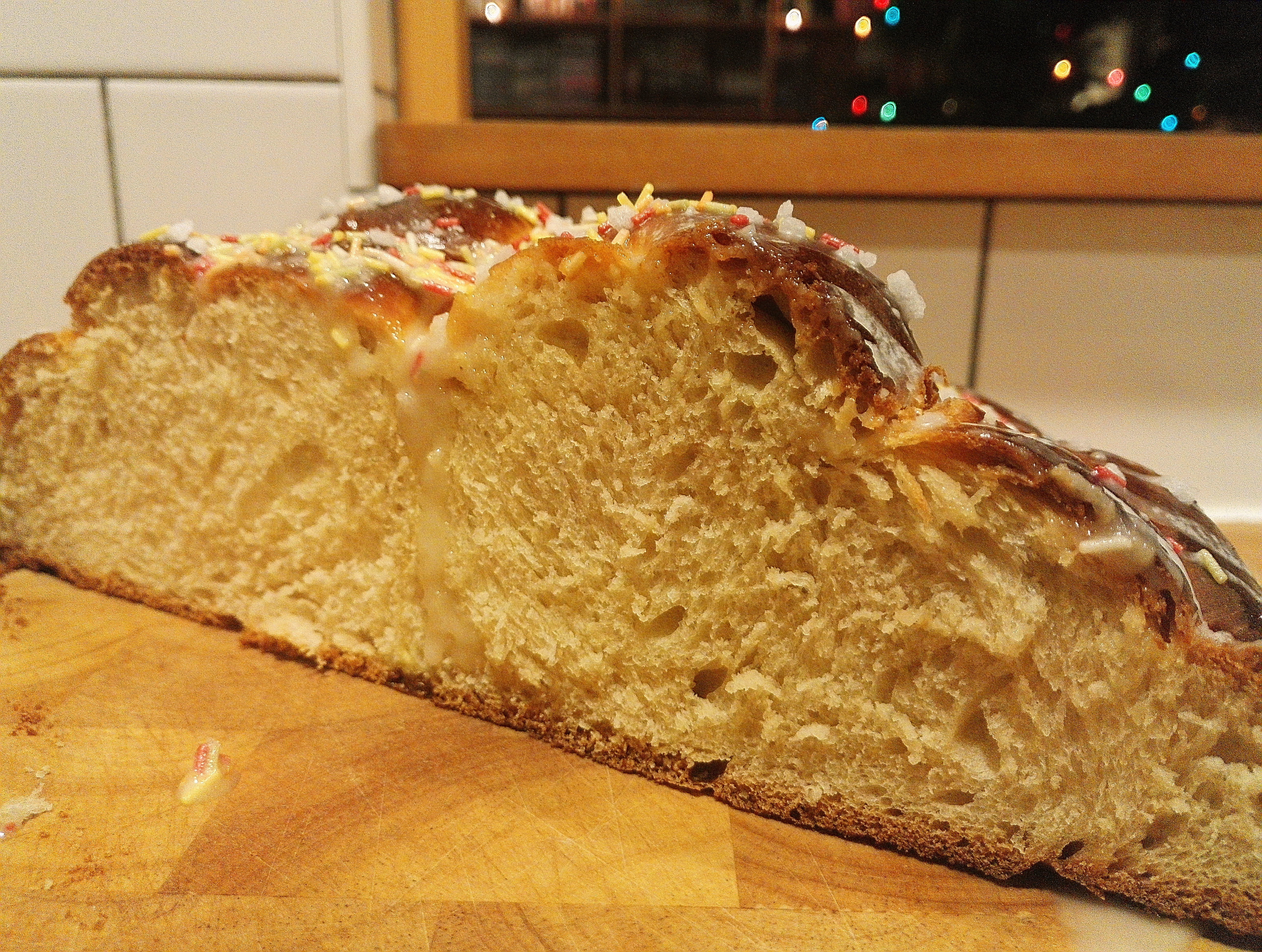
Santa Lucia crown cut in half

Anyway, this is based on another recipe from Cooking with the Saints by Ernst Schuegraf, “The Most Unique Catholic Cookbook Ever!”. It’s purportedly based on a traditional Swedish bake, but I can’t guarantee that. I’ve made Swedish inspired Santa Lucia buns before, which feature a similar enriched dough with saffron. And in the book Scandinavian Baking, Trine Hahnemann has a saffron bread recipe and recounts a Swedish legend about a man being woken by beautiful singing on the long, solstice night, 13 December 1764. It was St Lucia, bringing light, food and wine, and adding herself to the pantheon of Swedish annual traditions.

125g water
125g full-fat milk
A few sprigs of saffron
6g active dried yeast
250g plain (all-purpose) flour
250g strong white bread flour
2 eggs
120g caster sugar
50g butter, softened
3g salt

Plus
1 extra egg to glaze
100g icing sugar
30g milk, possibly more
3g vanilla essence
Candied fruit, lightly toasted flaked almonds, nibbed sugar or sprinkles to decorate

1. Combine the milk and water, warm slightly, add the saffron and leave to infuse for at least 20 minutes, even overnight.
2. Warm the liquid again then add the yeast and leave to froth up.
3. In a large bowl, combine the flours, sugar, salt, softened butter and two of the eggs.
4. Add the yeast mix and bring everything together to form a rough dough.
5. Turn out onto a lightly greased surface and knead to combine and create a smooth dough.
6. Form the dough into a ball and put in a clean, lightly oiled bowl.
7. Leave to prove until doubled in size. This will depend on the temperature. I don’t have a prover or warm cupboard, and our kitchen was about 19C; the doubling took a couple of hours.
8. The total dough should be about 1030g. Cut off a piece weighing about 350g, leaving the other at about 680g. Form these into balls, rest them for 10 minutes or so.
9. Stretch the balls slightly then slice each one into three equal sized pieces.
10. Roll the small pieces into snakes around 40cm long, and the larger ones into snakes about 80cm long.
11. Braid the three longer pieces, then form into a circle, pinching the ends together. Put this circle on a greased baking sheet.
12. Braid the three smaller pieces and go through the same process. Put this smaller circle on top of the larger circle.
13. Cover with a clean cloth then leave to prove again until doubled in size.
14. Preheat the oven to 190C.
15. Whisk the final egg, then brush over the dough to glaze.
16. Bake for about 15 minutes then turn down to 180C. Keep an eye on this bake as the glaze can brown then burn easily. If it does, cover with foil. Bake for another half hour or so.
17. Cool on a wire rack.
18. Sieve the icing sugar, then add the milk (adding more as necessary) to create a basic icing.
19. Drizzle the icing over the crown and decorate as you wish – you could use glace cherries, I suppose, but they’re the Devil’s work. The kids like sprinkles, so I’m using vermicelli and nibbed sugar.
20. Serve the crown with birthday candles for Lux, Lucy, Lucia, light.

Enjoy in the pre-Christmas mayhem of Advent, close to the solstice.
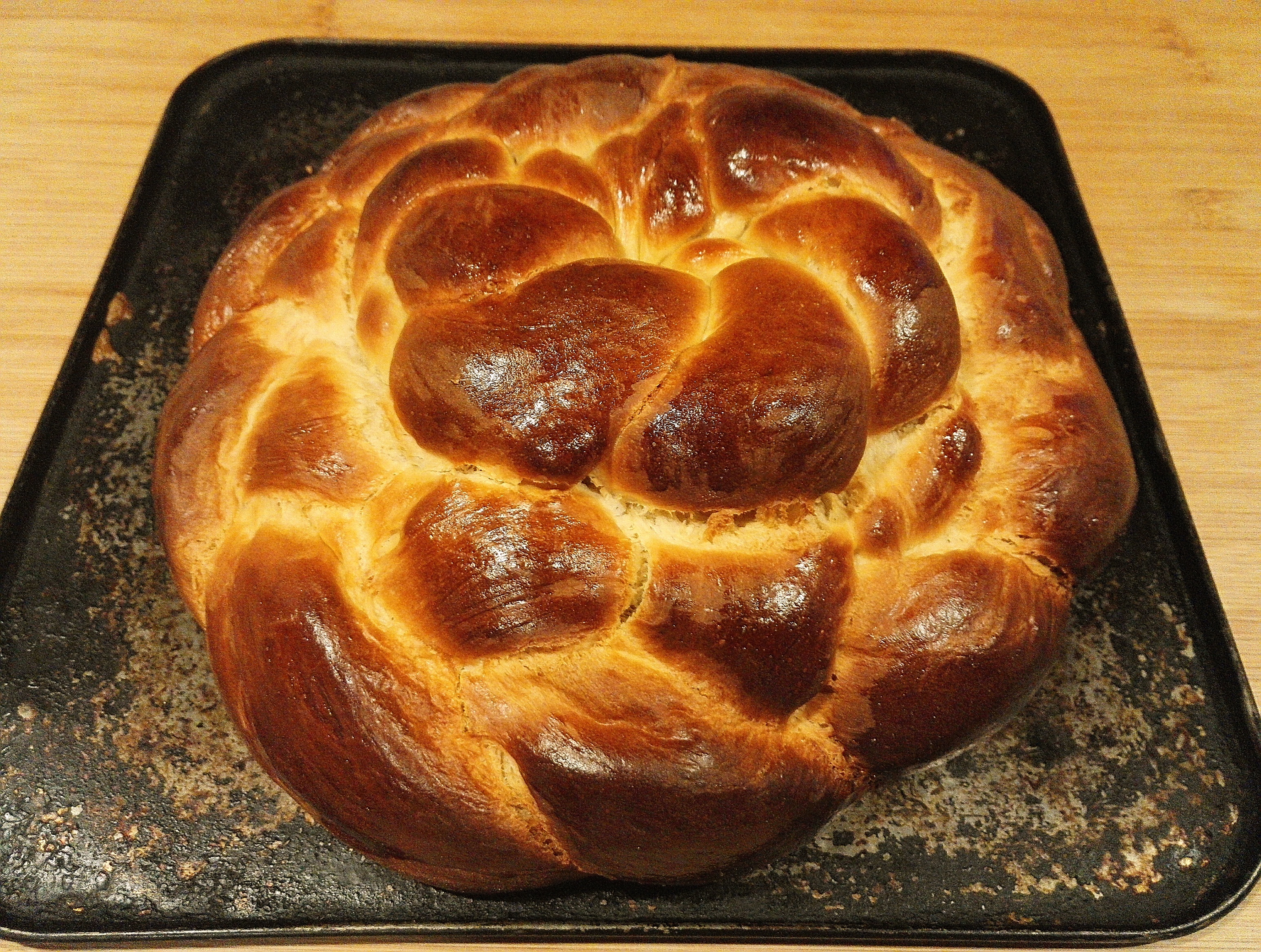
St Lucia crown baked

* I’m talking about the northern hemisphere of course. The shift from the old Julian calendar to the new Gregorian calendar involved removing between 10 and 13 days, depending on when the transition took place. Strongly Catholic countries like Italy, Spain, Portugal, France and Poland made the switch in 1582. Britain, Canada and most of the US didn’t until 1752.

5 Comments

Filed under Baking, Breads, Cakes (yeasted), Feasts, Recipes

Speculaas for St Nicholas’s day

Totoro speculaas

Our Dutch friend Annely told us about speculaas a few years ago. They are the spiced biscuits traditionally eaten in the Netherlands and Belgium for St Nicholas’s day, Sint Nicolaas, Sinterklaas, on 6 December. They’re also, apparently, eaten in Germany at Christmas itself.

When I say “spiced biscuit”, what I mean basically is gingerbread. They’re all related these spiced feast day biscuits. What made speculaas interesting for me wasn’t just the recipe or spice blend – predominantly ginger and cinnamon, and possibly some quantities of nutmeg, coriander, cardamom, anise and white pepper depending on your family’s or your local baker’s recipe. No, it was more the way they’re made.

Traditionally, the dough is rolled into a wooden mould, the excess cut away, then it’s tapped hard – to free the dough, which takes on the stamp from the mould. The stamps can be ornate figures of men and women, as well as animals, windmills, and, of course, clogs. Such moulds can be purchased online, here and here for example. Maybe we’ll invest in a few moulds for next year; this year, it’s miscellaneous cookie cutters and Totoro (and Chibi and Chu, too).

I’m even more excited about this because while I was doing this recipe, with Fran making a few batches, I had a child-free chance to visit my local library. I was researching a fabulous local building and its clock tower, but in a book called Memories of Old Sussex by Lillian Candlin I found a chapter called Fair Gingerbread. This was all about the spice biscuits historically sold across the county at fairs, when gifted called “fairings”. One blog I read about speculaas said the figures could be given during courtship. I can imagine this happening with Sussex fairings too.

Candlin says they were patterned or shaped as “effigies” – ie figures. “The wooden moulds that were used for stamping ginger-bread are now museum pieces.” I must see if any are still on display in Brighton museum, as they’re very similar to those used to make speculaas. She mentions moulds of the “Duke of Wellington on horseback, all complete with sword and pistol; a solemn looking cat and a grandfather clock.” And then there’s this one, from Horsham, which appears to show a cockerel sitting on some trousers.

Horsham gingerbread mould

If I ever see such things in antique shops, I’ll know what they are now. Such a shame their use is another tradition we’ve lost in England.

Anyway, here’s a recipe for speculaas (the plural; singular speculaasjes). Frankly, I’m happier with it than my earlier gingerbread, as it’s got a nice snap: so long as it’s rolled thinly (thanks Fran). About 3mm. Tweak the spice mix to taste.

225g butter
300g light brown sugar
5g fine salt
80g milk – QB
500g plain flour
12g baking powder
15g cinnamon
10g ginger
2g ground cloves
A few grates of nutmeg
A pinch of white pepper
Flaked almonds & pearl sugar for decoration

1. Cream butter and sugar.
2. Add the salt and milk and blend. Note, the milk quantity is QB, as the Italians say – as much as you need. You might want to add a dash more.
3. Sieve the flour, baking powder and spice mix in then bring to a dough.
4. Form a ball, then wrap and rest – ideally for at least 12 hours but the results are fine if you want to do it sooner. Total dough is about 1200g – quite a lot. So you could freeze half.
5. Preheat the oven to 150C.

Raver sprinkles and rolls

6. Roll out the dough to about 3mm and cut with cookie cutters of choice. (If you have moulds, flour them and push in the dough. Cut away excess. Bash the mould on works surface to release the shape.)
7. Place on baking sheets lined with paper or mats.
8. Decorate as you wish with flaked almonds or nibbed sugar.
9. Bake for 30 minutes.
10. Leave to cool on a wire rack.

Oh, and etymology geeks – the name may derive from the Latin speculum. This means mirrror (in modern Italian, specchio… ah, that reminds me of via degli Specchi, the address of an old favourite haunt in Rome, Open Baladin, with its 50 or so craft beers). It’s a neat suggestion, as the mould’s stamp is then mirrored in the biscuit.

Speculaas

Oh 2. I realise my daughter’s hair looks a bit disreputable in the pic. I did brush it this morning, but well, she’d just got up from an afternoon nap when she was “helping” Fran make the biscuits. What I was more impressed with was her technique for sprinkling flour and rolling the dough. Go Raver, aged 2!

1 Comment

Filed under Biscuits, cookies, Feasts, Recipes

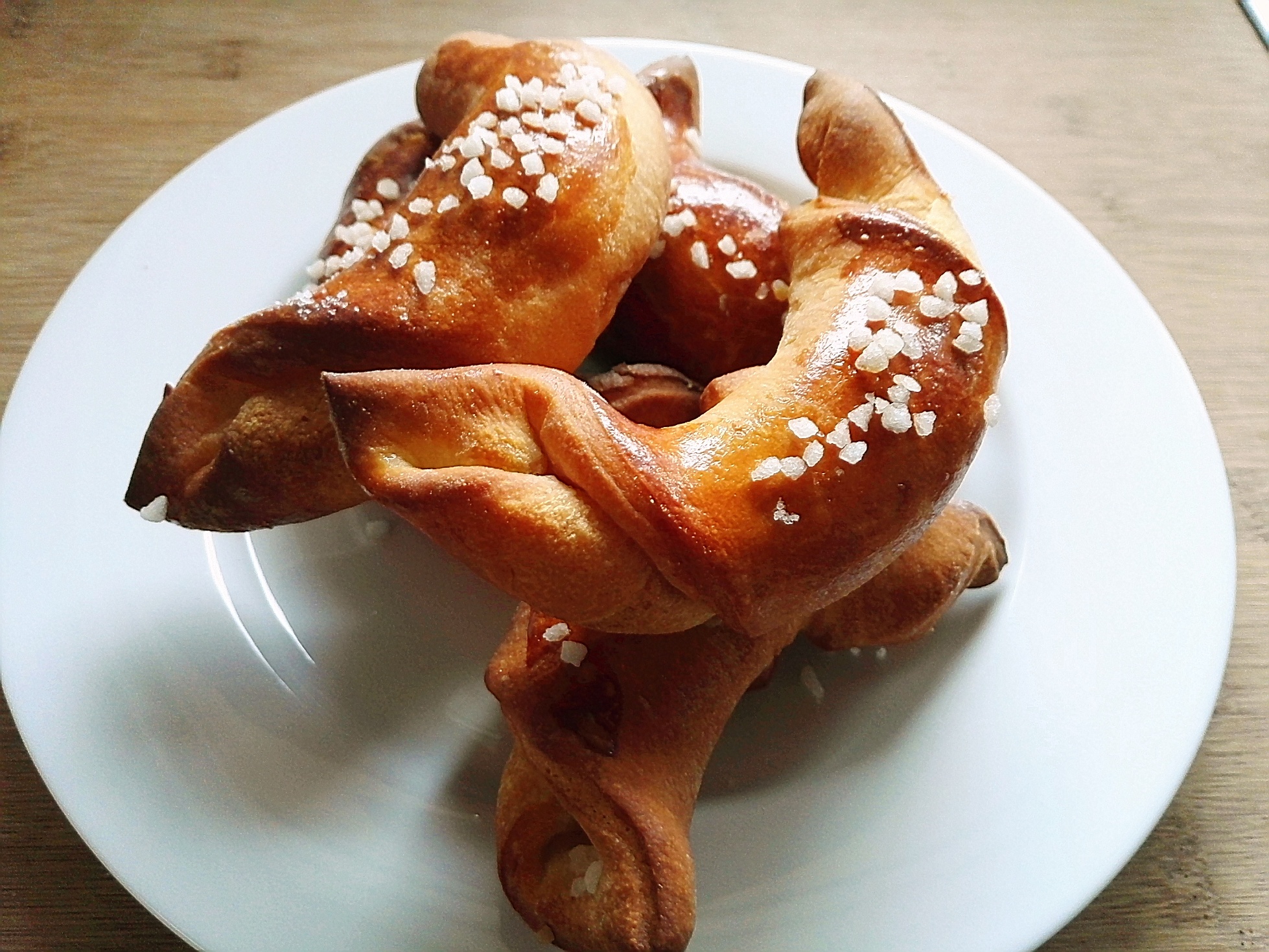
Martinshörnchen – St Martin’s day crescent rolls


Martinshornchen

When I started this blog – blimey, five-ish years ago – it was because I was loving the products that appeared in Roman bakeries during certain periods of the Catholic calendar, for feast days and whatnot, notably Carnevale. I miss Carnevale, that indulgent period after Christmas and before the fasts of Lent when I gorged myself on such things as frappe and castagnole.

Anyway, for a spell, I researched and made several Italian feast days bakes, then continued to try and do the same, with British and international products, when we moved back to England at the end of 2013.

Soon after that, we started the adoption process, and in early 2014, our two wonderful kids moved in with us. Since then, I’ve been doing a lot of childcare. Almost full-time childcare. Now, some people manage to have children, jobs and involved blogs. And acclaimed books. Not me. That’s effing superhuman. Hats off to them. I’ve struggled to keep my blog going, let alone research new feast day bakes.

Martinshornchen

But my diary keeps on reminding me. I noticed Martinmas – 11 November – was coming up, the feast day that celebrates the life of one-time soldier St Martin of Tours and is conflated in the UK with Remembrance Day.

OK, I won’t shirk. I need to get things moving around here. So I reached for my spreadsheet and pile of books. I’ve made a couple of other things for St Martin’s day. This time I nearly tried the Sicilian biscotti di San Martino, which are not biscuits, but rolls with a ricotta filling. But, well, it looked like it might break me when the kids rejected them for the aniseed flavour after the hard work. So I’m trying Martinshörnchen instead.

These are crescent-shaped rolls from Saxony in Germany, literally “Martin’s little horns” or “Martin’s little crescents” (thanks Pa). I hesitate to call them croissants, as they’re not laminated. Without lamination (layering the dough with fat multiple times) they’re a lot easier to make, but don’t have the wonderful flakiness of laminated doughs and pastries. They are, however, made with a dough enriched with milk, butter, sugar and eggs. I love anything made with an enriched dough – you know, brioche, panettone, challah, doughnuts, hot cross buns, currant buns, saffron cake, babka etc etc etc. Yum.

So here we go. This is adapted from a recipe in Cooking with the Saints by Ernst Schuegraf. The original recipe has a slightly counter-intuitive method where you’re supposed to try and make a dough with 200g of milk and 500g of flour, then add the enriching ingredients later. I’ve revised this to make it more logical and straightforward, and less likely to carbonise the results.

200g full-fat milk
3g active dried yeast or 6g fresh yeast
250g strong white flour
250g plain (all-purpose) flour
35g caster sugar
3g fine sea salt
3 eggs, that is around 155g beaten egg
100g butter, softened

Plus
100g butter, melted
2 egg yolks
100g-ish nibbed sugar

1. Warm the milk (to about 35C) stir in the sugar, then add the yeast. Leave it to froth up.
2. Put the flours and salt in a bowl, then add the yeast mix, beaten egg and softened butter.
3. Bring to a dough, then knead well. It’s soft and sticky, but that’s good.
4. Form a ball, using flour sparingly to help, then leave to rest in a clean, lightly oiled or greased bowl. Leave to prove until doubled in size. Note, fat (butter and egg yolks) can slow the fermentation. It’s at this point I wish we still had our old hot water cylinder in the cupboard, or an oven with a prover… Hi ho.

Dough

5. When it’s proved, melt the second 100g of butter and preheat the oven to 200C.

Rolled out

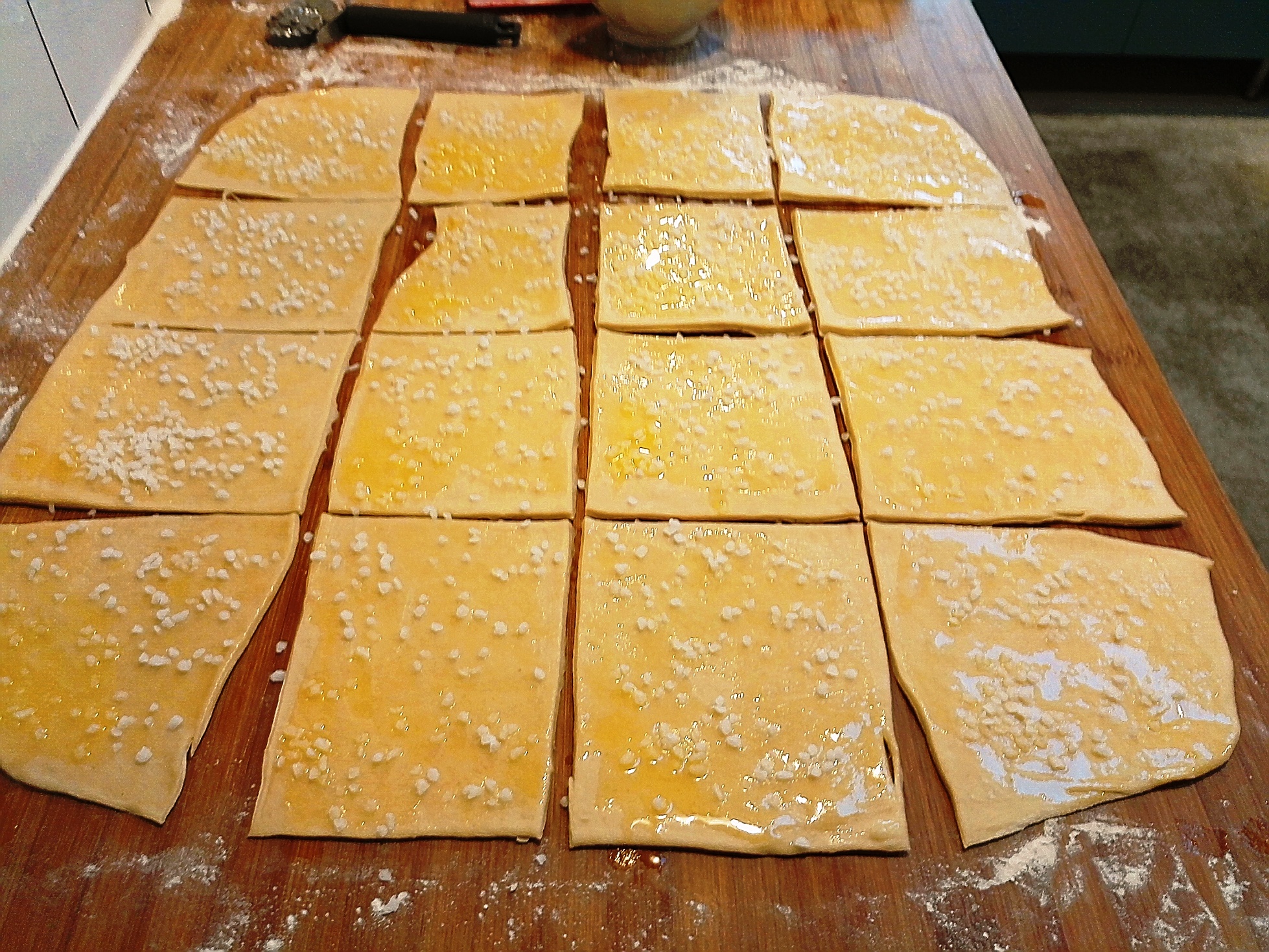
6. Roll out the dough to about 3mm thick. I made a sheet about 48cm square, then cut this into 16, ie pieces at 12x12cm. Approximately… This being dough, of course it stretches and shrinks.

Cut into squares

7. Brush with the melted butter and sprinkled with the nibbed sugar.

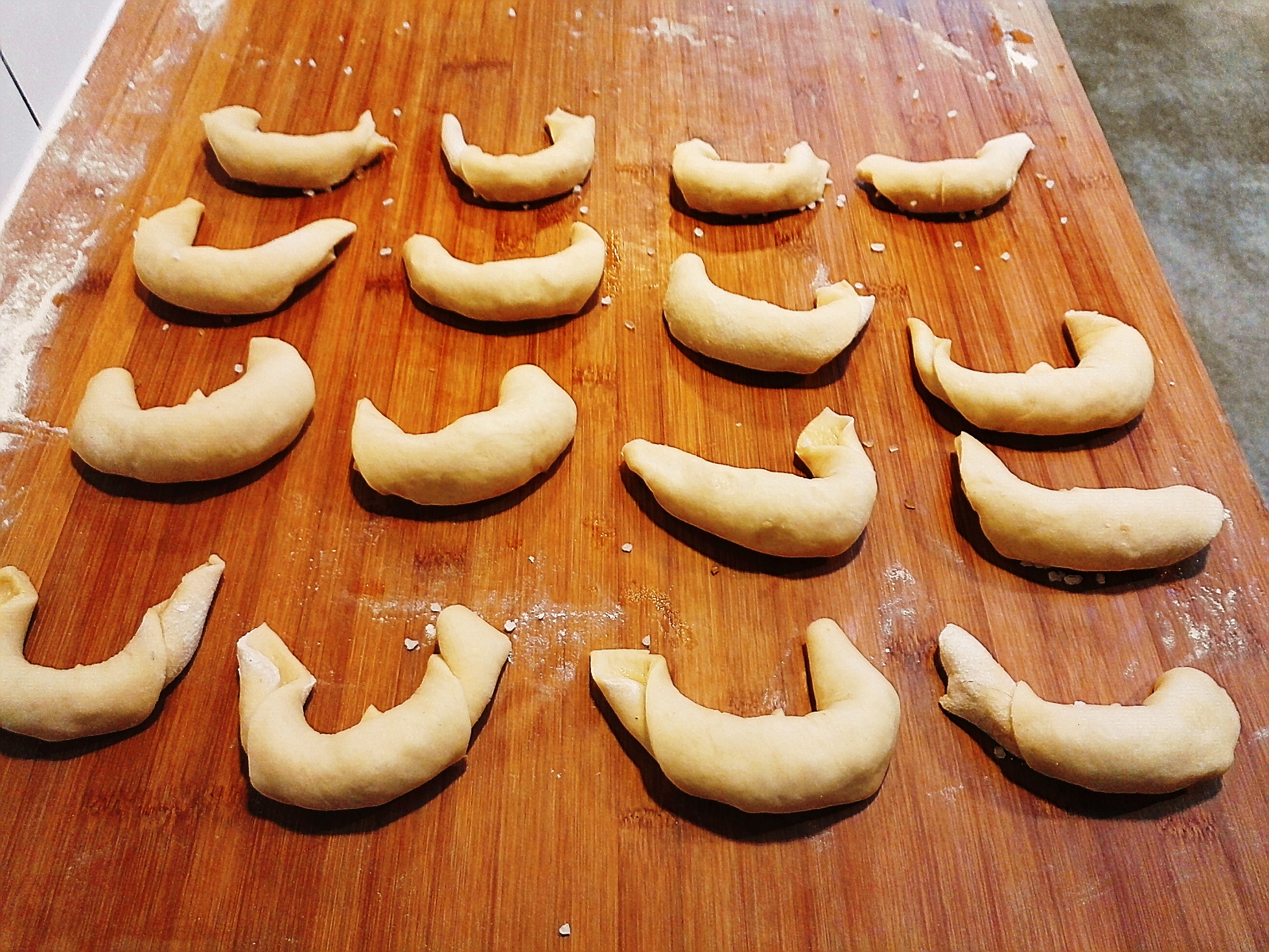
Form crescents

8. Roll up the squares, starting from a corner, then curl the ends in to make a crescent shape.
9. Transfer to baking sheets, lined with parchment or silicone mats.

Brush with egg yolk

10. Brush with beaten egg yolk and sprinkle with more sugar.
11. Put in the oven and bake for about 15-20 minutes. Keep an eye on them – if they start browning too much, turn the oven down to 180C and/or cover the Martinshörnchen.
12. Cool on a wire rack.
13. Feel free to eat them with butter and jam, though I’ve no idea if that’s traditional in Saxony. Happy St Martin’s day!

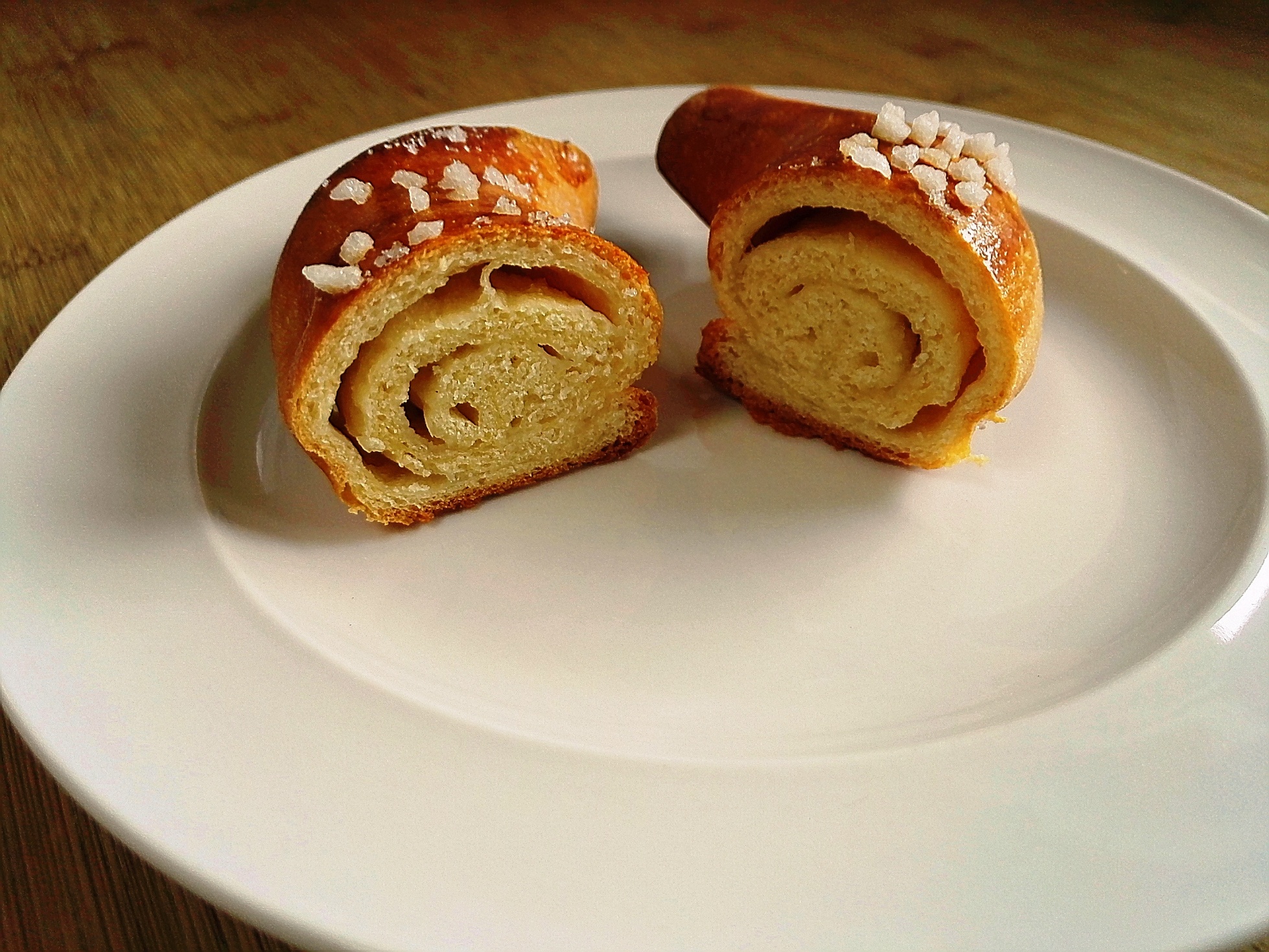
Martinshornchen spiral

4 Comments

Filed under Baking, Feasts, Recipes

Canterbury apple tart

Canterbury tart

My copy of the Roux Brothers on Patisserie is inscribed as a gift from my parents for Christmas 1995. They posted it out to me in New Zealand, where I enjoyed an antipodean summer Christmas. As summer gave way to Autumn, we began the Old Man Mountain apple harvest. In was in that orchard that I got, aged 24, my first ever bee sting. It descended liked a Stuka and stung me just below the eye.

I made a lot of French apple tart that Autumn. Mostly successfully, until the one time when I was helping my host, mentor and friend Nadia with a catering job. I made three or four in large trays, but failed miserably to get the liquid for the glaze to setting point. I’m still ashamed of that cock-up. Nadia wasn’t happy with me. I still love the Roux French apple tart, too. Though these days I’m possibly more keen on Canterbury tart.

We’ve lost so much of our culinary tradition in this country. I’ve said it before, but the combination of urbanisation, two world wars, the industrialisation of farming practices and the rise of the supermarket homogenised much of our food. Furthermore, we have a long history of food fashions and fads, such as royals employing French chefs. More recently, thanks to the work of food writers and immigrants, we’ve embraced Indian subcontinent and Italian-inspired food to the point where most families eat pasta more than they eat traditional British stodge, for example. We probably do. I’m not sure what I’d do without pasta to fill up T-rex most lunchtimes.

It shouldn’t need saying, but British food can often rival anything from our continental neighbours. We had our Dutch friend Annely visiting this weekend, and as she loves cheese treated ourselves to some pricy local fare. One was Lord of the Hundreds, a sheep’s milk cheese as good as any Sardinian or central Italian pecorino. Another was Lord London, a soft cows’ milk cheese as good as any French brie.

So when you discover a recipe like Canterbury tart, it’s worth noting that it’s as good as if not better than a classic French apple tart, and more straight-forward to make too. Now, I’m loathe to say Canterbury tart is an old, traditional Kent recipe as I can’t find much information about it. Several websites cut and past the same blurb saying the first recorded recipe was written by Geoffrey Chaucer in 1381 but I’m doubtful. Kent is certainly the heartland of apple growing, so let’s say it likely has some history. I got the recipe from my mum. Googling, it looks like one from Mary Berry. I wish Berry had told us where she got it from but her recipes are somewhat lacking in preamble.

Pastry
100g butter
225g plain flour
25g sifted icing sugar
1 egg, beaten

Filling
4 eggs
225g caster sugar
2 lemons, zest and juiced
100g melted butter
2 large cooking apples, peeled & cored, about 350g
3 dessert apples, peeled, cored & thinly sliced
25g Demerara sugar

A 25cm (or thereabouts) flan tin

1. First make the pastry. If making by hand, rub the butter into the flour and icing sugar until the mixture resembles breadcrumbs, then stir in the beaten egg and bring together to form a dough.
2. If making the pastry in a processor, combine the flour, butter and icing sugar in the bowl then add the egg and mix until the dough starts to form.
3. Form the pastry into a smooth ball, wrap in plastic and chill in the fridge for at least 30 minutes.
4. Roll out the pastry and line the flan tin, leaving an overhang. Chill the tin for a further 30 minutes (or longer if you need to).
5. To make the filling, beat the eggs, caster sugar, lemon rind and juice together in a mixing bowl. Stir in the warm melted butter, then coarsely grate the cooking apples directly into the mixture. Mix well.
6. Have the dessert apples ready sliced.
7. Preheat the oven to 200C, putting t a heavy baking tray in to heat up. (You don’t bake the pastry case blind, so this will help cook the bottom.)
8. Remove the pastry case from the fridge and spread the runny mixture in the bottom. Level the surface and arrange the dessert apple slices on top, neatly overlapping.
9. Sprinkle with Demerara sugar.
10. Put in the oven and bake for about 40-50 minutes, until the centre feels firm and the apples slices are slightly browned.

Serve warm, with cream or ice cream obviously. Though I would say I prefer it when it’s cooled and firmed up more. Even after a night in the fridge. Yum. The citrus/apple combination works so well.

By the way, I’m aware my pastry looks a bit messy. Although I can be somewhat perfectionist in some areas, I’m long reconciled with my shortcomings as a pastry chef. The important thing here is that it tasted good.

3 Comments

Filed under Baking, Pastry, Pies & tarts, Puddings & desserts, Recipes

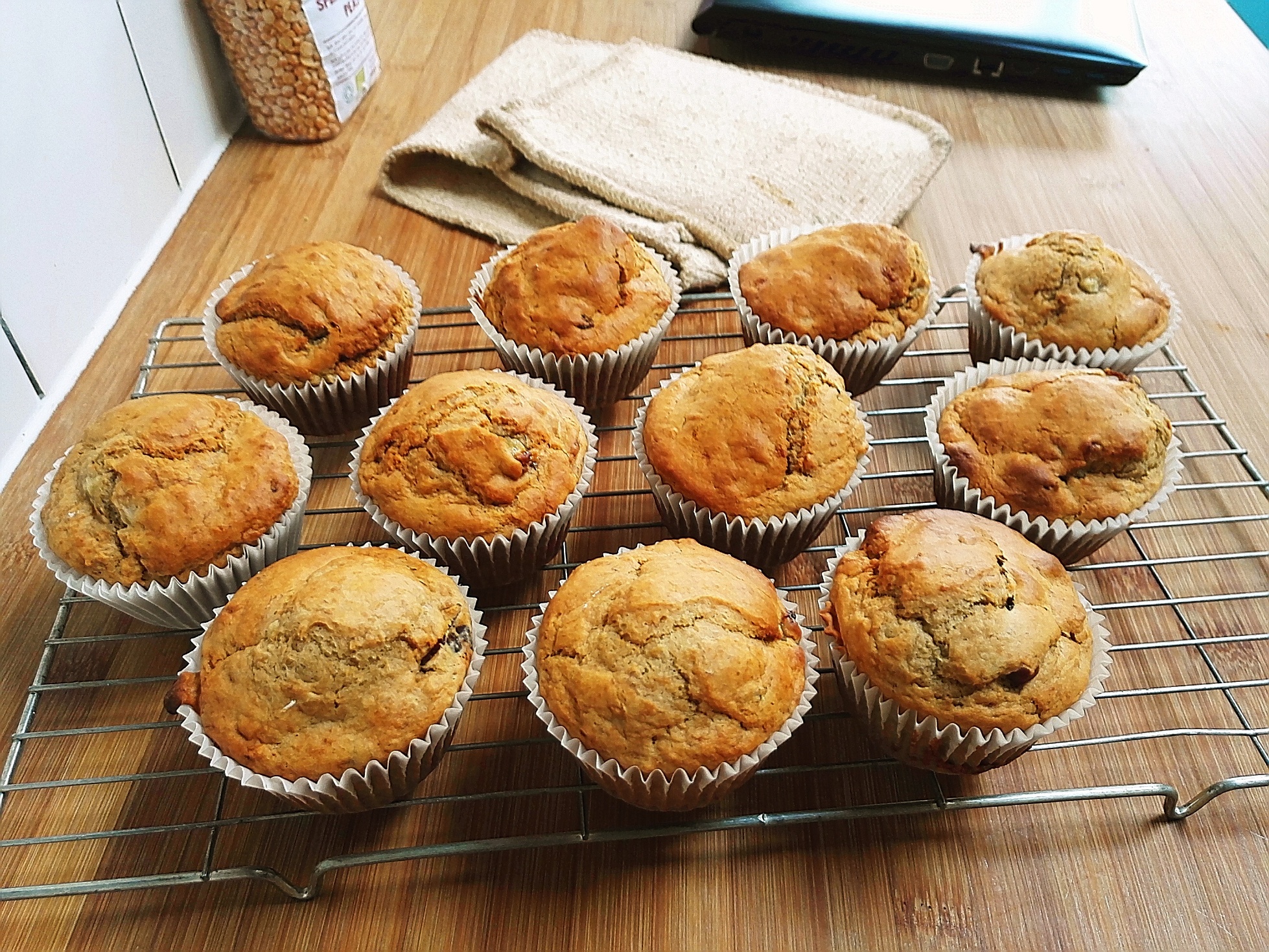
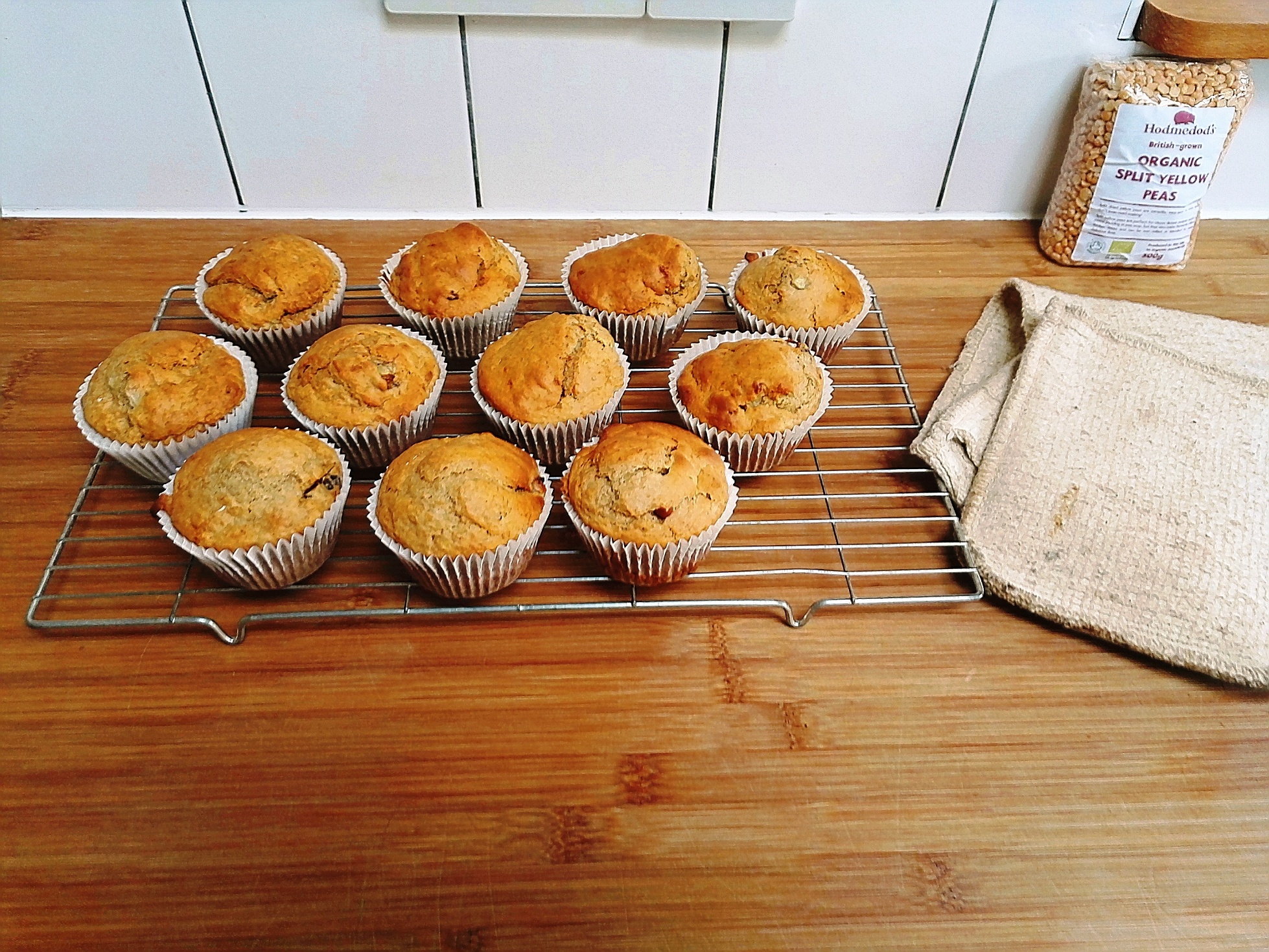
Banana and date muffins

You know something I dislike? The school summer holidays. I used to love them as a child. Unlike today, when we seem to get our best weather in May and June, before schools even break up, in the seventies and eights, summer seemed to really happen in August. It went on and on and was a delight. Thinking about my childhood now, it sounds like something from the thirties or fifties – long games of French cricket, roaming in the water meadows and Downs, chasing round the garden with brother trying to catch stag flying beetles (successfully) and bats (unsuccessfully) with a minnow net attached to our long bamboo laundry prop.

Obviously, my kids are a lot younger, but I can’t imagine them forming any particularly fond memories of this summer just passed. Aside from the summer weather seeming to end the moment school broke up, to be replaced by weeks of grey, the whole experience seemed very unsettling for my three-year-old son, T-rex.

After nearly a year at nursery, he was thriving. He’d made a lot of friends and by and large seemed settled and happy. He was sleeping well, making decent progress with his food fussiness, pretty much out of nappies, and getting excited about the prospect of “Big boys’ Lego” for his fourth birthday later in the year. Then suddenly all the routine disappeared and things regressed, became increasingly unsettled.

It’s hard to create a routine when you may be away for a spell, may be visited by family, may be able to grab a bit of sunshine, but then get wrong-footed by rain. As most organised summer holiday activities are for ages 5-6 plus, I had to try and create my own. But three-year-old boys aren’t the biggest fans of arts and crafts. Mine certainly isn’t. All he wants to do is watch The Lego Batman Movie.

I try to cook with them, and the Raver, now aged two, enjoys that – well, some “mix-mix” and the licking spoons at least. As T-rex has decided he doesn’t like “nana shake” – one of his long-time breakfast favourites – any more, I had to come up with other solutions for over-ripe bananas. Googling didn’t really satisfy, so I reached for my vintage copy of Fresh and Natural, a New Zealand hippy classic, published in 1980 and gifted to me by my old friend Nadia the final time I saw her at her home in the Malborough Sounds in October 2013, a year before her untimely death. It includes a nice flexible recipe for banana muffins, one I remember using when I lived with Nadia in 1994-95 and helped feed her large family in the Yellow House at Old Man Mountain in the Buller Gorge.

I tried to get T-rex interested in this project, but even before making or seeing the finished product he said “I won’t eat those.” It’s a protest and control tactic he’s using quite a lot currently. Refusing tea before I’ve even put it on the table, before I’ve even made it.

We hoped the return to nursery would settle him, but instead we underestimated the shock of how much his class would have changed. Loads of his friends have gone up to reception. I realise now he’s a boy who feels particularly settled when he slots into a social group of older boys, whose more alpha ways give him guidance and stability. The teachers had said the older kids often get into the role of being in charge, being the guides themselves. I hope T-rex does. I hope he likes these muffins.

This isn’t a parenting or adoption blog, so I want to keep things light, but T-rex is, in the technical term my wife taught me, dysregulated. England isn’t like France or Italy where people may take the whole of August off and hang out at the beach with family. Here, primary carers can face a long slog through the summer and sometimes children struggle. And it’s not like we need this Victorian institution of long summer holidays that freed up children to help with the harvest. The most my kids harvest is under-ripe tomatoes. So anyway, I also dearly hope that politicians move to adjust the length of the summer school holidays. Though if those in power are all wealthy, reactionary deadbeats who never even change their own kids’ nappies, I suspect it’s unlikely.

So yes, a slog – hence this blog has been a bit quiet lately. And even now I’m posting, it’s for something very undemanding. Not sure I’ll be able to muster any fancy stuff any time soon…

Here’s the recipe. Converted to new money, with added dates. The original uses nuts. You can use either or both, or neither.

50g butter, softened
50g golden syrup
1 egg (that is, about 50g without shell)
5g vanilla essence
2 mashed bananas (that is, about 200g)
105g milk
4g baking soda
300g plain flour, ideally stoneground or even wholegrain
5g baking powder
50g chopped dates

1. Preheat oven to 200C. Like a muffin tin with cases, or just grease it if you don’t have any.
2. Beat together the butter and golden syrup until creamy.
3. Add the egg and vanilla and beat well.
4. Dissolve the baking soda in the milk.
5. Mash the bananas.
6. Alternately add the milk and banana to the mixture.
7. Sieve together the flour and baking powder and add.
8. Add the dates.
9. Equally divide the batter into the muffin cases (or not).
10. Bake for about 20 minutes, until nicely browned.

Nice for breakfast, with some butter and maybe a drizzle of golden syrup or honey.

4 Comments

Filed under Baking, Recipes

Peanut butter buckwheat cookies

Peanut butter buckwheat cookies

Our kids are now three and two. The older one has a sweet tooth, the younger one isn’t too fussed. One thing they both do like is peanut butter. But not just any peanut butter, so I ended up in that situation where the shelf was littered with open jars of rejected spreads.

Now, nut butters are a great ingredient for cookies – eg here are some I made a few months ago. So that was the ideal solution for using up some of the extraneous stock. A quick browse of my cookbooks and good old Dan Lepard had a recipe for peanut butter cookies in Short and Sweet. His recipe uses wholemeal or spelt flour combined with rolled oats.  All ingredients I love, but I fancied making some buckwheat flour cookies, not because I’ve suddenly decided I can’t eat wheat or gluten, but just because buckwheat is yummy.

This is one of those great recipes that can handle tweaking. We did a batch that was half buckwheat, half plain flour, then I did another that was 100 per cent buckwheat. They worked very well. I reduced the sugar (as I always do) and used coconut sugar for one batch. Then in this one I used cocoa nibs and chocolate chips.

Peanut butter buckwheat cookies

200g peanut butter
125g unsalted butter, softened
125g caster sugar
140g soft brown sugar
8g vanilla essence
1 egg
250g buckwheat flour
6g baking soda
80g cocoa nibs
80g dark chocolate, chopped into rough chunks
(Or 160g of just chocolate chips if you haven’t got any nibs. Or add some nuts. Whatever you like really.)

1. Preheat the oven to 170C.
2. Prepare baking sheets by lining with parchment or silicone.
3. Put the peanut butter, butter and sugars in a large bowl and cream together until soft and light.
4. Beat in the egg and vanilla.
5. Sieve together the baking soda and flour then add to the bowl.
6. Add the nibs and chocolate and combine well.
7. Fall balls about the size of a walnut, around 30g each.
8. Place, spaced out, in the baking sheets.
9. Bake for about 15-20 minutes until nicely browned.
10. Allow to firm slightly on the sheets then move to a wire rack to finish cooling.

Enjoy. In our case, quite possibly in a playground or on a walk up the hill.

8 Comments

Filed under Baking, Biscuits, cookies

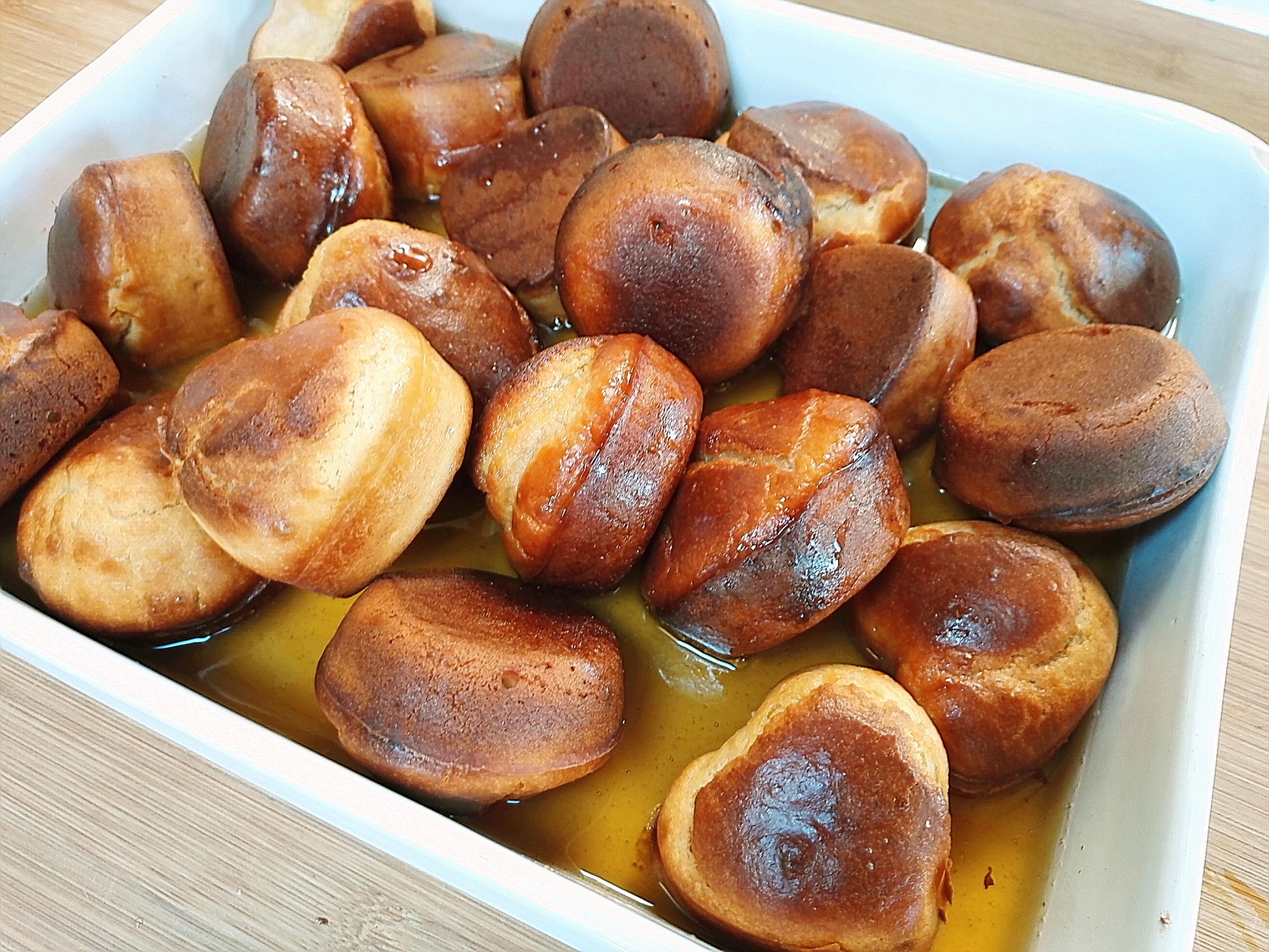
Orange honey buns

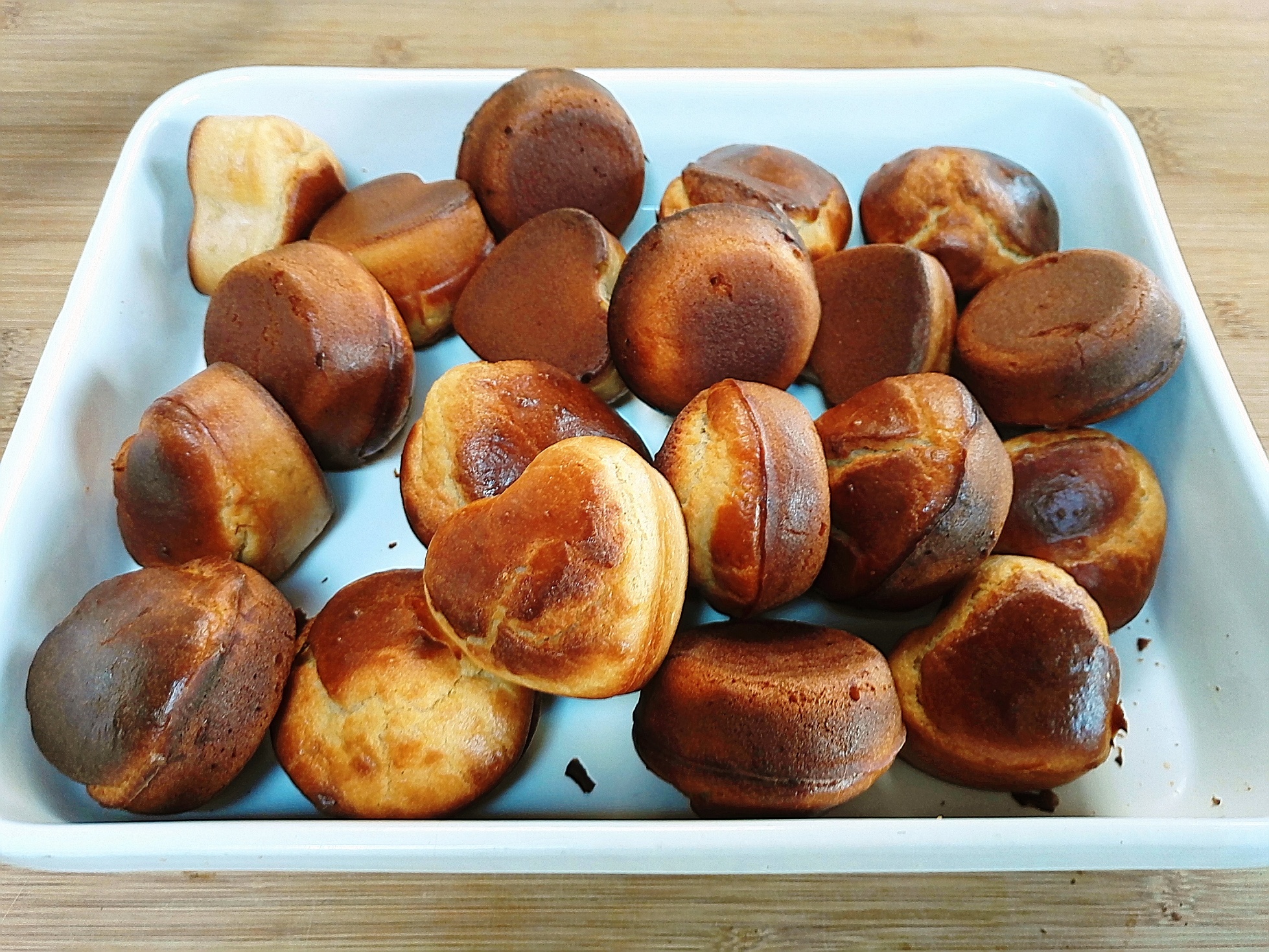
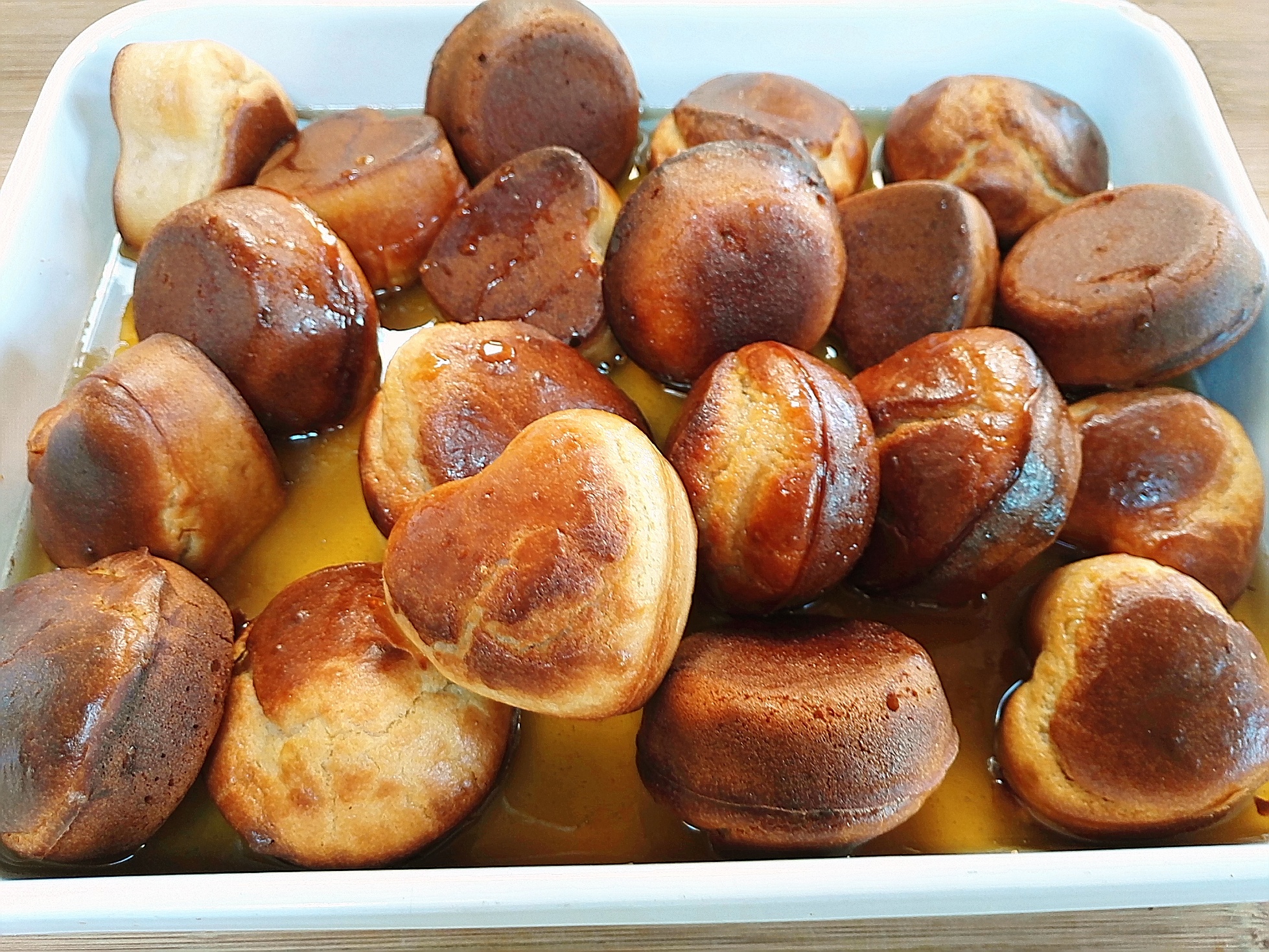
This is a slight adaptation of a recipe by Valentine Warner, from his book What to Eat Now, published in 2008. I believe I saw him making it on telly, and had a flurry of using the recipe back then. It was forgotten for a few years, but for some reason popped up in my memory. Possibly because, well, it’s for yeasted buns that are soaked in a citrus syrup, and I’m just loving citrus syrup soaked goodies (see also this).

The result is a bit like a rum baba; he recipe does include booze in his recipe, but I’ve left it out. Beacuse A) we don’t generally stock orange-flavoured liqueur and B) my bambini are the main recipients of these treats and I’m not sure they’re ready for the hard stuff.

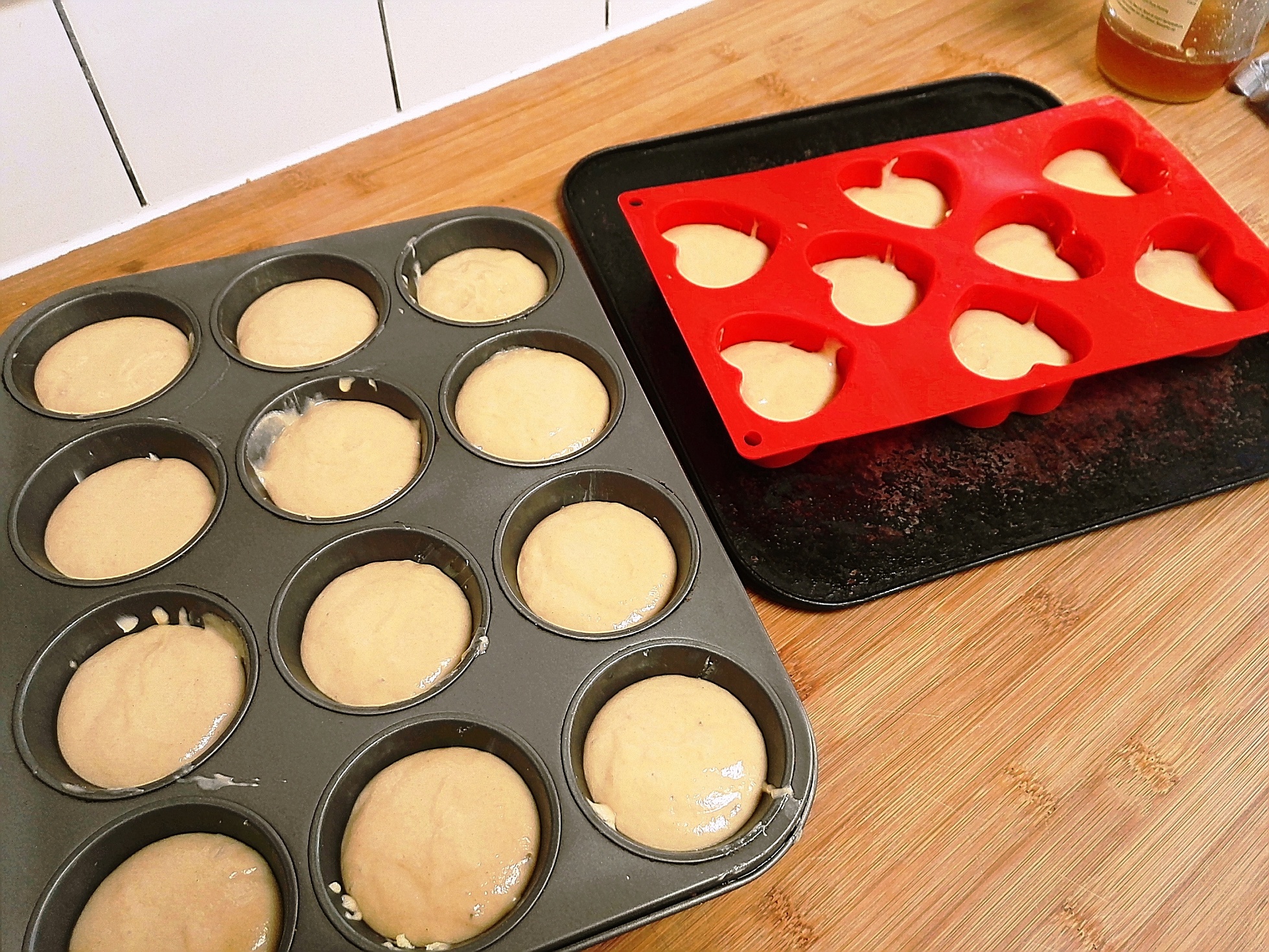
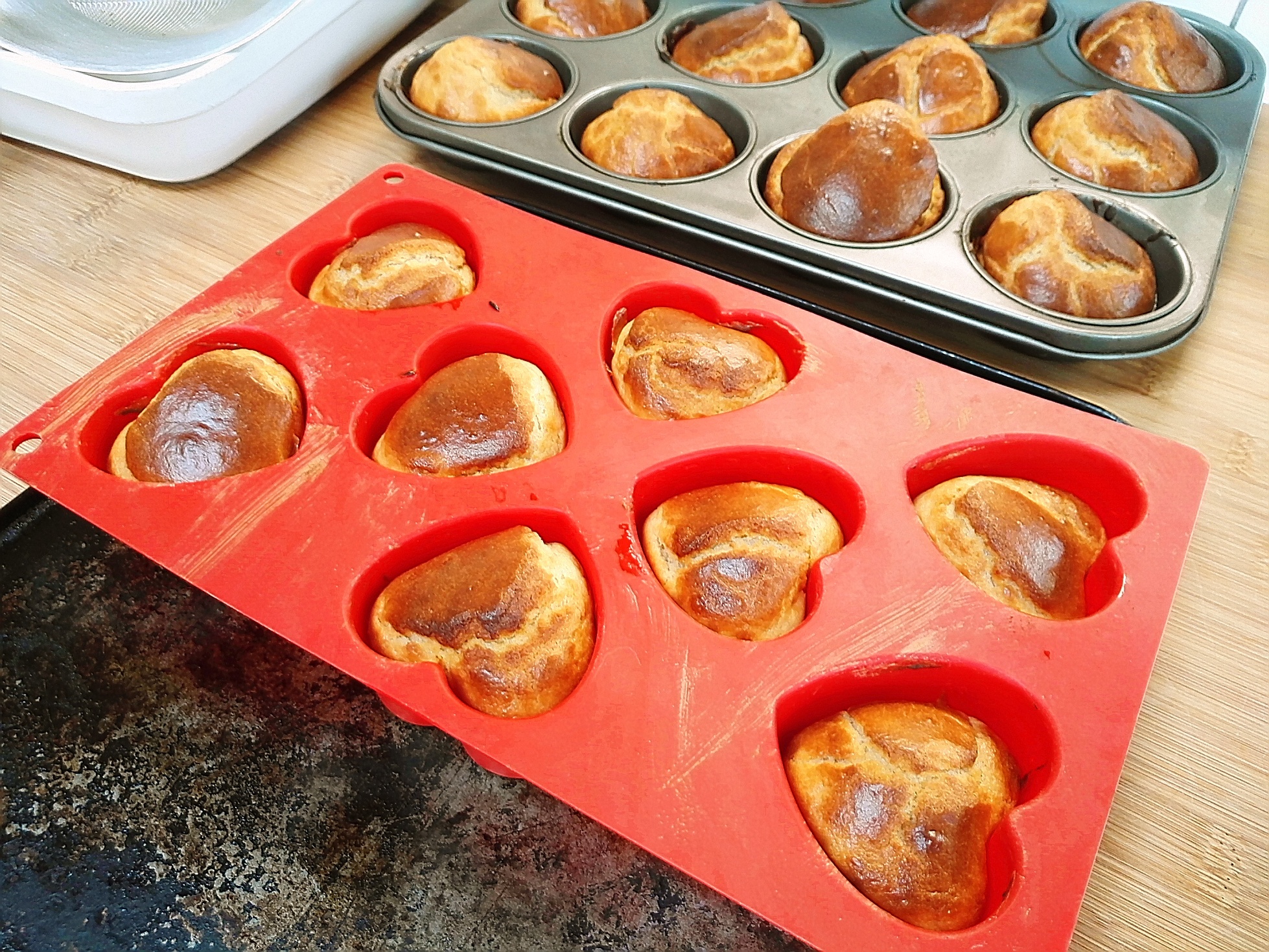
It’s a yeasted mix – though it’s more like a cake batter than a dough. You don’t need to worry about kneading it at all. The original recipe involves easy mix yeast, just thrown in and mixed up. I don’t really use easy mix yeast, so I’ve adapted it slightly to be made with active dried yeast or fresh yeast. I also doubled the quantities, making about 18 buns. It’s nice to make them in heart-shaped silicone moulds but if you don’t have such things, normal 12 hole muffin tins are fine too.

6g active dried yeast or 12g fresh yeast
30g caster sugar
60g warm water or milk
300g plain flour
4g fine sea salt
5 eggs, lightly beaten, about 250g
150g butter, melted and cooled a bit

For the syrup
500g sugar (caster or granulated or mix)
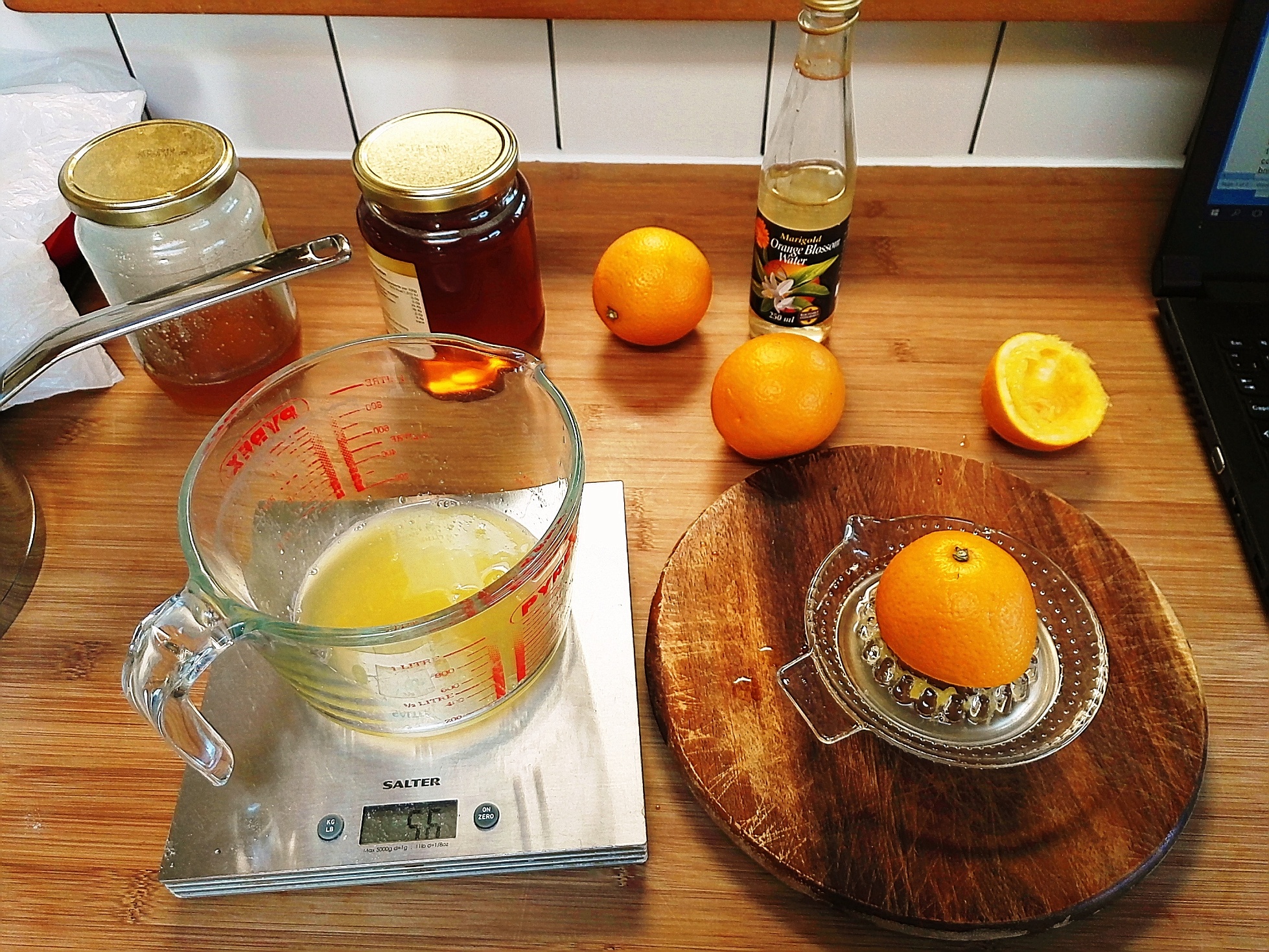
250g freshly squeezed orange juice
250g water
Zest of one orange, in long strips
100g honey
2g orange-flower water (optional, to taste)

1. Grease the wells of a couple of 12 hole muffin trays or similar.
2. Activate the yeast in the water (or milk) with the caster sugar then mix in a large bowl with the flour and salt.
3. Beat in the beaten egg and butter.
4. Mix until smooth then cover and rest for about 15 minutes.
5. Divide the dough into the muffin tins, filling about 1/3rd.
6. Cover and leave to prove unit double in size. In a warm place, this may take about an hour. In a cool place, longer.
7. Preheat the oven to 220C.
8. Bake the buns for 12-15 minutes, or until well risen and pale golden-brown.

9. Remove from the tin and set aside to cool on a wire rack.
10. While the buns are cooking make the syrup. Heat the sugar, juice, water and rind in a pan over a low heat, stirring well. When the sugar has dissolved, increase the heat and boil for five minutes or so, until it thickens and becomes slightly syrupy.
11. Reduce the heat and dissolve in the honey. Remove from the heat and add the orange-flower water, if using.
12. Set aside until cooled slightly.

13. Put the buns in a bowl or deep plate and pour over the syrup.
14. Enjoy. Lick sticky fingers. Wipe messy children.

Leave a comment

Filed under Baking, Cakes (yeasted), Recipes

Buttermilk chocolate cake

Buttermilk chocolate cake

If I’m craving a cake, chances are I’m craving chocolate cake. Were someone, well Fran probably, to ask me what kind of birthday cake I want, I’ll say chocolate. Yes, I like chocolate. I like cake. I like chocolate cake.

But strangely, despite decades of baking and consuming chocolate cakes, I’ve never found a go-to recipe. A recipe so easy, reliable and rewarding that I don’t even have to think about it. Discussing this with my mum the other day, she asked if she’d ever given me an old Katie Stewart recipe called Quick-mix chocolate cake. Not that I recalled.

I like Stewart’s recipes. She died in 2013, and was somewhat out of fashion. But if you’ve ever seen or owned one of her recipe books, chances are it’ll be well-thumbed. She was one of those British writers food writers of a certain age, along with Prue Leith and Delia Smith1, born in or just before the Second World War, who produced practical, no-nonsense recipes.

Sometimes I like my recipes with a little more context and colourful images, but often I just want to reach for the recipe, forgo any preamble, grab the ingredients from store cupboard and fridge and get on with it. Stewart wrote for The Times from 1966, a year before my parents married and four years before I was born. She continued to do so until 1978, and my mum assiduously collected the cuttings in a yellow ring binder and used them a lot during my childhood. She still has it, still uses it. So yes, I had to try this recipe. Stewart was a big part of my upbringing and food education.

What is buttermilk?
Buttermilk is readily available from supermarkets these days – or at least the cultured version, as opposed to the liquid left from churning cream to make butter. This is what I first learned was buttermilk, when making butter while living at Newton Livery then Old Man Mountain farms in New Zealand in the early-mid 1990s. This is called “traditional buttermilk” and is unlikely to be available to you unless you’re churning cream.

If you really can’t find cultured buttermilk, I suspect (though I’ve yet to try. Watch this space*) you could make this using yogurt. A little Googling suggests a ratio of three parts yogurt thinned with one part milk. As you’re using alkaline baking soda as a raising agent, it needs an acid to react with, to produce the carbon dioxide that gives lift. Both cultured buttermilk and yogurt are acids, though they’re fermented with different bacteria giving rise to their different qualities2.

Here’s the recipe. I’ve converted it to new money and reduced the sugar.

225g plain flour
55g cocoa powder
5g bicarbonate of soda
2g fine salt
250g caster sugar
112g butter, softened
140g buttermilk
2 large eggs (about 120g beaten egg)

1. Grease and line two 18 or 20cm. (Smaller will be taller, larger will be flatter.)
2. Preheat the oven to 180C.
3. Sift the flour, cooca and bicarb into a bowl.
4. Beat together the sugar and softened butter.
5. Add the buttermilk and beaten egg.
6. Add the sieved powder and stir in.
7. Beat to combine thoroughly, for about a minute.
8. Divide between the tins.
9. Bake for 25-30 minutes, until firm to the touch.
10. Cool in tins for 10 mins then turn out and cool on racks.
11. “Sandwich the layers with buttercream or chocolate frosting.”

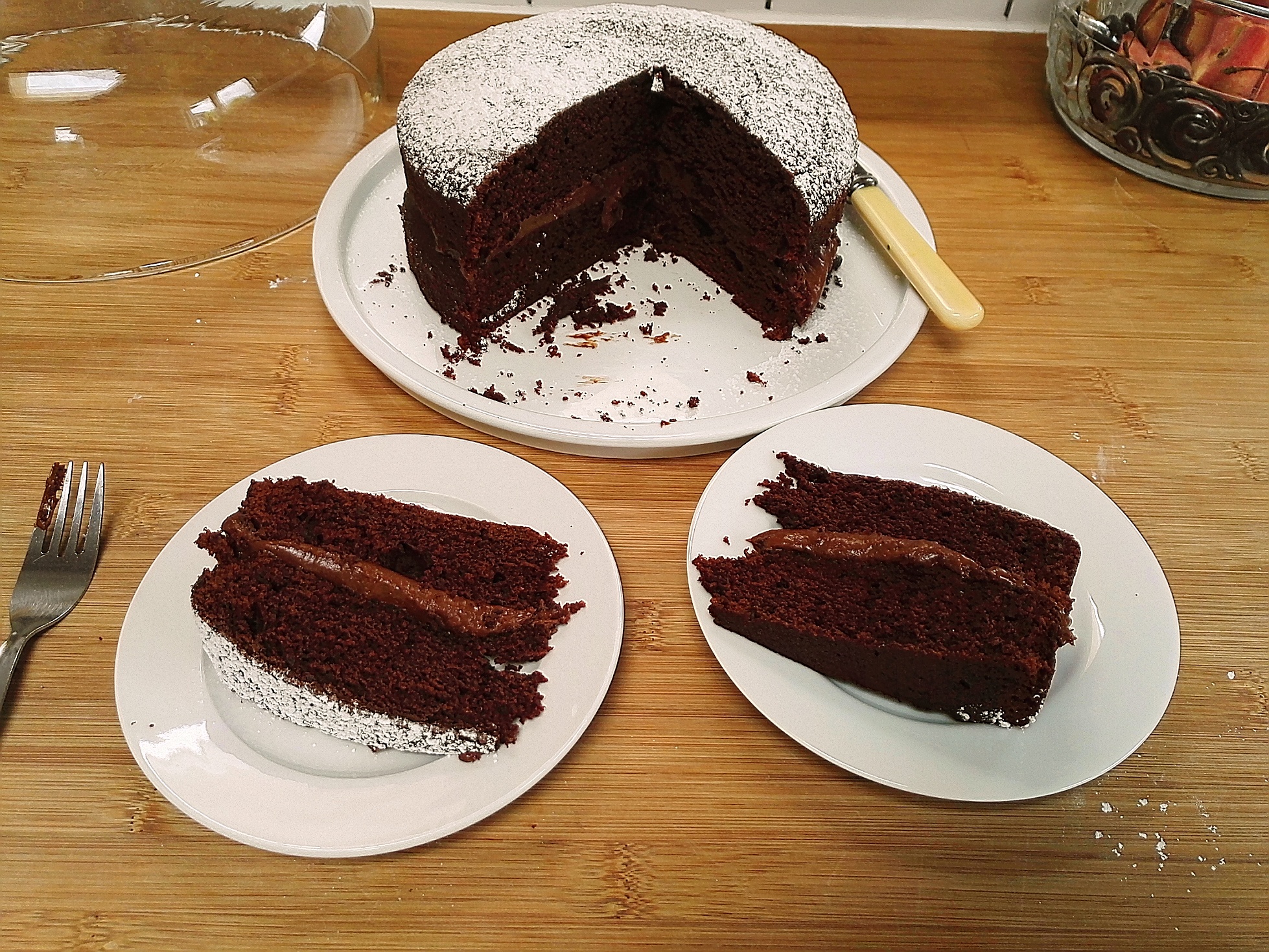
Slices of buttermilk chocolate cake

I had some chocolate frosting in the freezer. I can’t remember what recipe I’d used to make it. I also had some cream cheese frosting left over from the Raver’s birthday. Both needed using up. I mixed them and added a dash more cocoa. Twas delicious, and probably fairly unrepeatable. I love those using-up-leftovers accidents. Any good frosting or buttercream will do.

I’m not entirely sure this will become my go-to chocolate cake recipe. As Stewart said in the cutting, it’s a “light-textured cake”, and sometimes I want rich and fudgy, sometimes I just want the ground nuts goodness of a Sachertorte or torta caprese. But I will be using this again, as it is indeed easy and reliable. Good old Stewart.


Notes
1. Obviously not everything. The earlier stuff by Smith, notably The Complete Cookery Course (c1980) is essential. How to Cheat at Cooking (2008) not so much.
2. Lactococcus lactis or Lactobacillus bulgaricus for buttermilk, Lactobacillus delbrueckii subspecies bulgaricus and Streptococcus thermophilus and others for yogurt.

* I tried it. 105g yogurt mixed with 35g milk. It worked fine. Can’t quite put my finger on how different it was.

7 Comments

Filed under Baking, Cakes, Recipes

Citrus honey cake

Citrus polenta cake

Fran, my wife of these past eight years and partner of nine more before that, isn’t really much of a cake person. Or a pudding person. Or a chocolate person. We’re quite Jack and Mrs Sprat in our food inclinations. I was a vegetarian or pescetarian for 20 or so years, she’s pretty much always been a keen carnivore.

When we got together, our dietary habits met in the middle somewhere, but I still don’t have a great sense of what her favourite cake is. Personally, I’m all about the chocolate, so a rich chocolate cake is what I always hope for on my birthday. As her birthday approached last week, however, I wasn’t sure what do bake her. I hinted for some guidance, but it didn’t really manifest. So I looked through old recipes and took a punt.

This isn’t exactly what you’d call a celebration cake. It’s not slathered in icing or exactly suitable for candles. But it’s rich and yummy, and a bit different.

Special honey… or not
It’s originally from a recipe by Nigel Slater in The Observer. His piece was all about the honey, which is here used to make the citrusy syrup. I enjoy honey, and always like to have a jar of special honey in the house. A few years ago, some friends from New Zealand came for a visit, and brought a jar of Tutaki Manuka honey, produced by Trees and Bees, up the Mangles Valley, in the Buller Gorge, South Island. This was my stomping ground on and off in my youth, so a mere sniff of the jar is hugely evocative.

Just as that jar was reaching emptiness, my friend Alex “Kabak” Marcovitch gave me a jar of honey from the bees he’d kept on his allotment in the Coombe, just on the eastern side of Lewes, about half a mile from home.

The Coombe is a try chalk valley that cuts into Malling Down, which is a reserve managed by the Sussex Wildlife Trust. It’s farmed to preserve the ancient Downland ecology, an essential task as Britain has lost 97% of its wildflower meadows since the 1930s, when the Second World War food shortages meant vast amounts of grazing land was put under the plough for grain and potatoes.

It’s a special place, especially at this time of year when not only are the orchids (common spotted and pyramidal I believe) out, but the wild thyme and wild marjoram are starting to flower. Before moving to Lewes I didn’t even realise these herbs grew wild in Britain. I grew up on the Downs, but at the other end of this ridge of chalk hills, in Winchester, 80 miles to the west. I don’t remember seeing thyme and marjoram growing wild there. Perhaps Sussex is just that bit sunnier and dryer (it has some of the most sun and least precipitation in the UK).

Anyway, Alex’s Coombe honey evokes Malling Down with one sniff, the thyme, marjoram and innumerable other flowers the bees visited in their time there. Alex subsequently lost the allotment, so the Coombe honey is extra-special, as it was only produced for one year. The bees are now in his back garden, feeding off more domestic flower species, but apparently doing well.

I’ll admit I didn’t use special honey for Fran’s cake. Don’t tell her. I used cheap rubbish, which I buy for making granola. I know, I know, it’s probably made by bees who are fed sugar syrup, but… well, home economics. Plus, I just prefer to keep the good stuff to enjoy simply with a piece of bread or toast; I don’t want to lose its qualities in the melange of cooking.

So yes, I’d love to make this cake with special honey, but I defaulted to the cheap stuff. Don’t tell Fran.

220g butter
180g unrefined caster sugar
300g ground almonds
3 large eggs, beaten, approx 175g beaten egg
150g polenta
5g (1 tsp) baking powder
Finely grated zest and juice of a large orange
Zest of one lemon
12-20 green cardamom pods, to taste

For the syrup:
Juice of 2 lemons, juice of 2 oranges, approx 320g juice
100g honey

1. Grease and line the base of 20cm round, loose-bottomed cake tin.
2. Preheat oven 180C.
3. Beat the butter and sugar till light and fluffy.
4. Add the beaten eggs and combine.
5. Add the ground almonds.
6. Mix the polenta and baking powder, then fold into the mixture, together with the zest and juice.
7. Crush the cardamom pods and extract the black seeds. Grind them to a fine powder. Add the spice to the cake mixture and combine.
8. Put the cake mixture in the tin.
9. Bake for 30 minutes, turn down the heat to 160C for a further 25 -30 minutes or until the cake is firm.
10. To make the syrup, put the honey and juice sin a stainless steel saucepan, bring to the boil and dissolve in the honey. Keep the liquid simmering until it has formed a thin syrup, about 5-10 minutes.
11. Spike holes into the top of the cake (still warm and in its tin) with a skewer then spoon over the hot citrus syrup.
12. Leave to almost cool, then remove from the tin.

Serve with Greek or other thick yogurt, crème fraîche, or even thick cream. It’s up to you. It doesn’t really need the dairy blob though. With its dense, ground-almond texture and dowsing in syrup, it’s not unlike the Greek cake Greek revani or Claudia Roden’s Orange and almond cake, which Rachel Roddy talks about here, or is also available here (scroll down a bit).

Yum. T-Rex, three and a half, rejected it on the first bite. The Raver, almost two, went mad for it. Fran seemed content with it too.

3 Comments

Filed under Baking, Cakes

Crumbs Brewing and the bread-beer relationship

Crumbs Brewing Amber Lager

This blog was founded because of my dual love of bread and beer, two foodstuffs that are linked through their fundamental ingredients of grain and yeast. At some point after humanity settled and began growing crops, we discovered that grain, either whole or ground as flour, underwent a decisive process when mixed with liquid and left – fermentation. The first written record of all this is from ancient Sumeria (modern southern Iraq), the circa 1800BC Hymn to Ninkasi1 – the goddess of beer, or more broadly, the goddess of fermentation. Her followers may well have been responsible for beer and bread.

For centuries, fermentation remained a sort of quotidian mystery. Such was the significance of bread and ale as staples for the masses in Medieval Europe that the unknown ingredient had an almost spiritual nature and was called “Godisgoode”, “God is good” (possibly2). Early scientists thought the process was chemical not biological. The single cell fungi yeast and lactobacilli that fed on sugars and produced carbon dioxide – leavening bread and lending vigour to beer – wouldn’t be understood until the mid-19th century and the work of microbiologist Louis Pasteur.

Anyway. In Lewes, on the second Sunday of every month, there’s a street food market called Food Rocks. Not many people seem to be aware of it, so it needs a bit more promotion – as there’s some good stuff there. I was helping my friend Alex Marcovitch on his stall Kabak, selling delicious Eastern Meditteranean, North African and Middle Eastern-inspired foods. This time round, diagonally opposite us were Chalk Hills Bakery of Reigate, in the Surrey Hills, where I got myself ready for my shift with a delicious cinnamon bun, and Crumbs Brewing, where I met founder Morgan Arnell and “crumb spreader” Adria Tarrida.

Restoring an ancient connection
These two establishments have a noteworthy relationship. It’s one that reconfirms the ancient connection between baker and brewer. Historically, notably in Gaelic cultures, bakeries and breweries would have operated side-by-side, the barm – the frothy surplus yeast – from the brew being utilised by the baker to make a leaven for bread3.

Apparently, in some parts of Europe, the barm method existed alongside the sourdough method. Baker and food writer John Downes gives one Medieval example here: “In England noblemen’s bread, manchet, was always made with the barm method, whereas the commoners’ bread, maslin, was a sourdough.” He continues “Barm bread survived until World War Two and even later in the North of England largely as barm cakes.”

Anyway, as usual I’m getting distracted4. Crumbs Brewing aren’t doing this (yet). Instead,they’re using leftover bread from Chalk Hills Bakery as an ingredient. A few breweries are using the technique, such as Toast Ale, whose website gives the statistic that “44% of bread is wasted”. It’s pretty shocking. Any food waste is a crime. The amount of energy put into growing and transporting food, only for it to be thrown away is bad enough, but in landfills it contributes to the problem of methane, a potent greenhouse gas.

Morgan Arnell and Adria Tarrida of Crumbs Brewing

Hills to Isle
So the work of breweries like Crumbs is very important. Morgan, who founded Crumbs with his wife Elaine, says they collect any leftover bread, crumb it, and freeze it. When they have 150kg they take it to Goddards Brewery on the Isle of Wight. Morgan says Goddards were “one of the few brewers that was willing to test out our recipe and method, helped by the fact that I grew up on the Island so could twist their arm to help us!”

The longer term plan is to set up in the Surrey Hills too. Morgan writes more about the process of making the beer – their first batch was brewed in April – here on the Crumbs blog. The 150kg makes a 30 hectolitre5 brew, “c 6000 500ml bottles in our case” explains Morgan.

Breadbeerisgood
Suffice to say, the beer is delicious. I wouldn’t really be writing about it here if I didn’t actually like the stuff. It’s called an Amber Lager, and I can kind of see the logic of this naming to help it appeal to lager drinkers. It’s certainly light and refreshing. It’s bottled at Goddards and isn’t bottle conditioned, but its carbonation level is pleasant. To my mind it is more an ale than a lager, and it is indeed made with top-fermenting (ale) yeasts, not bottom-fermenting (lager) yeast.

There are so many craft ales around at the moment, notably dubbed APA and American IPA, which overuse the Chinook, Cascade, Citra, Mosaic hops etc to the point where they’re reminiscent of cleaning products, pine-scented detergent or whathaveyou. Thankfully the Crumbs Amber is more subtle proposition. Morgan says they use Progress hops, which the British Hops Association says, are “an excellent bittering and late aroma hop.” The overall flavour is more about the malt and bread. It doesn’t taste bready per se, but it has a warm sweetness and decent body, without heaviness. Morgan says “The slightly sweet, malty aftertaste is a result of the bread.” He adds that they plan to try brewing with different types of bread and it “Will be interesting to see how brewing with different loaves changes that character.”

It’s a great addition to the SE of England craft brewing scene so I’m very glad to have come across Crumbs at Food Rocks. Good luck to them, and I’m intrigued to try their next beers made with different breads: “dark rye stout or sourdough IPA anyone?”

Notes
1 The full text of the Hymn of Ninkasi can be found here. In English, not ancient Sumerian.
2 There’s some debate. This thread gives a few sources for the term, but it’s not entirely conclusive.
3 I’ve done a few barm bread experiments: here and here.
4 When one is actually paid to write journalistically, one mustn’t get distracted. There’s usually a tight editorial brief and even tighter wordcount. Not so on one’s own blog! Hah!
5 A hectolitre is 100 litres. 1hl is about 0.61 UK beer barrels, or So 30hl is around 18 UK beer barrels or 660 imperial gallons. For Americans, 30hl is 25.5 US beer barrels or 795 US liquid gallons. Good heavens I wish people would standardise things globally. Some might see it as heritage. I love a bit of history, but all these different weights and measures just make life even more flipping complicated. I sincerely hope “Brexit” doesn’t have us going back to shillings and scruples and chains.

3 Comments

Filed under Breweries, British beer, Discussion, Flour & grain