Monthly Archives: December 2012

Christmas kringle

Kringle cut

Most Christmases I like to try a different type of seasonal cake. Anything but a British Christmas cake. Yuck. So in the past I’ve done stollen, and a few years ago a panettone (scroll down a bit on this page). This year, despite being in Italy, I’ve made a kringle, from a recipe I found in an in-flight magazine.

The recipe is from Norwegian-raised, London-based Signe Johansen. She doesn’t give much pre-amble, but says “Kringle gets its name from the Old Norse for a ring, and is eaten across Scandinavia during the festive period.”

As with the Italian ciambella though, the name kringle seems to cover a broad variety of baked goods, ranging from things that resemble a pretzel, to various ring-shaped cakes, and even ring-shaped variants make with flaky pastry. It looks like something that’s doesn’t just vary throughout Scandinavia, but also varies extensively across the Scandinavian diaspora, notably in the US.

This version is an enriched yeasted dough and much more like stollen (especially as it also has a marzipan filling) or panettone than the strudel-like versions in the above link. It’s also made with white spelt flour (farina di farro bianco in Italian). As much as I like to eschew using too much modern wheat, I’m not sure about this and if I did it again, I might be tempted to use half-half plain and strong white flours.

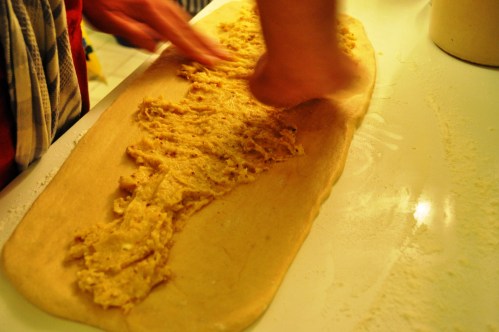
Spreading the filling

Anyway, I’ve no idea how authentic it is, whether it resembles a particular kringle from a particular nation or location, or whether it’s a total mongrel. It’s just a pleasing bit of seasonal baking, with a rich dough, plenty of almonds and a delightful touch of cardamon.

So, ingredients:

Dough
300g milk (whole, full-fat)
75g butter (unsalted)
525g refined spelt flour
100g caster sugar
1 tsp ground cardamom
3/4 tsp fine sea salt
15g fresh yeast (or 7g fast action dried yeast)
1 egg, beaten

Kringle rolling

Filling
100g raisins (soaked for 15-20 minutes then drained)
150g marzipan (she uses mandelmasse, which is another almond paste variable that. According to my Scandinavian baking consultant Tom Rönngård “marzipan has more added sugar”. So maybe just make some marzipan – which is v easy* – and reduce the sugar.)
75g almonds
50g butter (unsalted)
1 tsp vanilla extract
1 egg, beaten
1/4 tsp fine sea salt
caster sugar to taste

Glaze
1 egg, beaten
flaked almonds
Demerara or granulated sugar

Kringle round

Method:

1 Warm the milk and butter. Scald them, take off the heat and allow to cool.
2 Mix the flour, caster sugar, cardamom and salt together in a large bowl.
3 When the milk and butter have cooled to around 28C, crumble in the yeast.
4 Leave the milk and yeast for a few minutes, then add one beaten egg.
5 Pour the liquid into the flour and beat to combine. Beat until it starts to come together as a dough. You could use a food processor or mixer with a dough hook. She doesn’t seem to knead it at all.
6 Form the dough into a ball then leave to prove in a large, clean bowl, covered with cling film.
7 Turn around and ready your food processor.
8 To make the filling, blitz together the marzipan/mandelmasse, almonds, butter, vanilla, one more beaten egg, salt. You want a rough paste.
9 Add caster sugar to taste to the filling – 30-45g or so.
10 When the dough has doubled in size, take it out of the bowl and put on a lightly floured work surface.
11 Stretch and roll the dough out into a rectangle 60x15cm.
12 Spread the filling on the dough.
13 Starting from a long edge, roll the dough up.
14 Dampen the other long edge to seal the cylinder.
15 From the cylinder into a ring shape, pinching the ends together. (I’m not entirely sure how this works; it felt a bit bodgy to me.)
16 Preheat the oven to 200C.
17 Transfer the ring to a large baking sheet, lined with parchment.
18 Cover the dough and leave to prove again, until roughly doubled in size. She says “If it has proved enough, the indentation should stay after a gentle poke.” Which is nice.
19 When it is ready to bake, glaze with egg, and sprinkle with flaked almonds and Demerara sugar. I had some egg whites so used them. I also didn’t have any flaked almonds, so just sliced some blanched almonds. And I used granulated sugar instead or Demerara.
20 Bake for around 40 minutes, then cool on a rack.

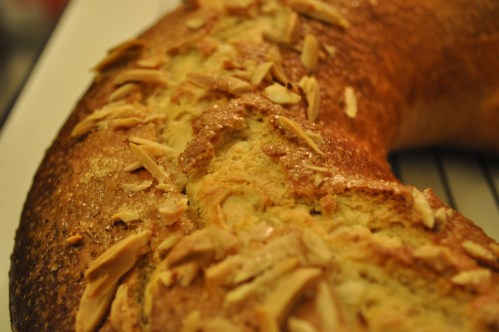
Kringle close-up

My blasted oven has fierce bottom heat, so despite triple-traying it, I still got a slightly burnt bottom. Otherwise, it was jolly good when we had it for breakfast this morning. The recipe says serve “on the day of baking”, but with a dough that’s so rich in fats and sugar I’m sure it’ll last happily for a several days.

* Marzipan tweaked a bit to become more like mandelmasse

30g golden caster sugar
60g icing sugar, sifted
120g ground almonds
1/2 tsp vanilla essence
1 egg, beaten
1/2 tsp lemon juice

Mix the sugars and almonds.
Add the egg, lemon and vanilla.
Blend with a knife then knead briefly.
Wrap with cling film and store in a cool place.
It’ll keep fine for a few days, if not more.

4 Comments

Filed under Breads, Cakes (yeasted), Recipes

Pane di Lariano I – preamble


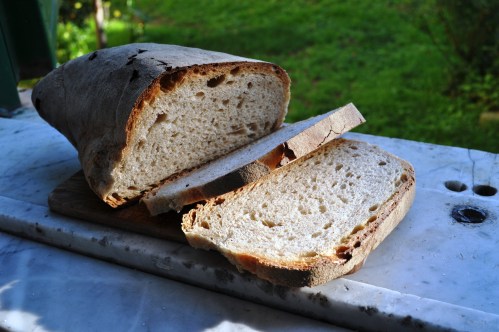
Pane di Lariano is bread from Lariano, a comune in Lazio about 25 miles southeast of Rome in the Alban Hills. As such, it’s a very common bread in Rome. I haven’t tried making it yet, but in the meantime here’s a bit of an introduction.

It’s a classic, simple bread, but one made with an ancient method. It’s made with wholewheat flour (farina integrale), 00 or 0 flour, salt, water, and a natural leaven (aka sourdough starter).

In some ways it’s not unlike a British wholewheat loaf, but it has a lovely irregular crumb, a pretty irregular baton form, and a serious crust. The one I’ve been eating the past few days is from Volpetti, a costly emporium of foodie delights beloved of Romans and tour groups (who can be frequently found blocking the pavement outside the shop in Testaccio). Volpetti seems to offer a wholewheat or a white version.

Most bakeries in Roma province will sell it. The renowned Roscioli says this on its own site: “One of the bakery’s specialities is Lariano Bread, a naturally risen, oven-baked bread, filled with raisins, nuts or olives.” Which all sound delicious, even if they’re – arguably – not entirely traditional. Shock horror.

The other traditional quality that most of us probably won’t be able to reproduce is not just baking the bread in a wood-fired oven, but in a wood-fired oven burning fascine (bundles, faggots) of small branches from chestnut trees.

Recipes I’ve been looking at suggest a long knead and a short proving time. I shall begin to investigate after I’ve tried a few more from different bakers. Hey, it’s Christmas. There’s only so much experimentation one man can do, and currently I’m busy making a Swedish Christmas bread.

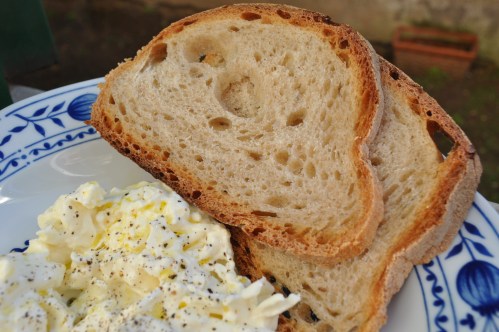
In the meantime, some gratuitous shots of how we’ve been eating the Lariano today.

We started out with a Lariano and pancetta sarnie. We’re Brits. We need bacon sarnies (other than during the 20 or so years of my life when I was vegan, vegetarian or pescetarian). This is our best experiment yet in trying to get that bacon sarnie hit with Italian ingredients. Pancetta is, of course, not bacon, it’s cured differently, and this one even had chili in the mix, but boy was it good.

At lunch, we had some pane di lariano with burrata. Burrata is, quite possibly, the most indulgent cheese in the world. I suspect it’s certainly up there with the fattiest. It is – quite literally – half mozzarella, half cream. Lawks, I’m going squiffy just thinking about it. Pity we finished it all off at lunchtime. I never ate it before coming to live in Italy, but thanks to Simon for the introduction. Apparently it became a “next big thing” in the UK in 2011, so by the time we move back (whenever that may be) hopefully it’ll be more readily available. It’s one of those things it’s hard to imagine living without once you’ve tried it.

Anyway, enough cheese fantasising. Some time in the new year I plan to start trying out recipes for pane di Lariano. Watch this space.

1 Comment

Filed under Breads

Brutti ma buoni

Brutti ma buoni

The easiest way to describe Brutti ma buoni (“ugly but good”) is as nut meringue cookies. All the ones I’ve encountered in Rome have been made with hazelnuts, and many of the recipes online seem to be also. But there’s also a variant made with almonds.

Italian Wikipedia says they’re also called Bruttibuoni, made with almonds and are from Prato in Tuscany. I suspect a lot of other Italians might take issue with that though, as they do seem to be a fairly widespread. Indeed, a bit more googling, and another source claims they’re from Varese, in Lombardy, north of Milan. Yet another calls them Brut ma bon (a more French-sounding dialect name) and gets even more specific about their origin: not just Varese, but Gavirate, a town in the vicinity of Varese.

Hazelnuts reading for roasting

Whatever the history, bottom line is that they’re a meringue-type cookie (ie made with egg whites, no fat and little or no flour) that are rich in chopped nuts. Heck, even us Brits have a traditional hazelnut meringue, so I’m really not sure it’s the sort of recipe anyone can really stake a claim to.

I decided to make some as we had some egg whites left in the fridge from making custard. The recipe I used is from Biscotti: Recipes From The Kitchen Of The American Academy In Rome. It’s the third recipe I’ve tried from there following the wonderful Honey and farro cookies, and the Pinolate (pine nut cookies). I need to try the latter again before I blog it as my first batch wasn’t quite right.

Chopping nuts

Anyway. While baking these this morning, I looked around to compare recipes, and – would you Adam and Eve it – my favourite baker Dan Lepard published his recipe a few weeks ago in The Guardian. It’s an indication that despite how basic these cookies may be, there are several approaches to the method. His doesn’t require the eat whites to be beaten, uses pre-skinned hazelnuts, and involves combining all the ingredients in a saucepan. I will have to try that for comparison. One day. Not today. Not when I’ve already got 30 biscuits cooling in the kitchen. Another recipe, from a Canadian cookbook, meanwhile, also involves cooking the sugar and egg whites together, then beating them. That approach is more like a classic Italian meringue, and certainly the results in the pics look more meringue and less cookie.

Sugar, beaten egg whites etc md

So. As usual, I’m tweaking as I go along. The original recipe made a lot of mixture, but as you turn off the oven at the end of baking and let the cookies cool inside – as you do with meringues – you either need a massive oven, or should do half quantities. So I’ve halved the original recipe. I’ve also added some almond essence – simply because it’s more explicitly nutty than just using vanilla essence. Ideally I’d use hazelnut essence but I don’t have any.

250g hazelnuts (with skin)
1 egg white
125g granulated sugar
1 teaspoon vanilla essence
1/2 teaspoon hazelnut or almond essence
5g plain flour
Zest of half a lemon

Heat the oven to 150C.

1. Put the nuts on a tray, then roast them for about 15 minutes.
2. Turn the oven up to 180C.
3. Take the nuts out of the oven and rub them with a tea towel. This removes some of the skin. Don’t agonise though. The inclusion of some skin adds a depth of flavour, IMHO. (I also prefer my peanut butter to be wholenut, skins and all.)
4. Put half the nuts in a mixer and give them a quick whizz. Just break them up. You don’t want to grind them.
5. Put the other half of the nuts on a chopping board and chop roughly. (The original recipe has you chopping them all by hand, but a) that’s labour intensive and b) I like the mixture of sizes and texture this method creates. Mades the results extra-brutti.)
6. Beat the egg whites to a soft peak.
7. Beat the sugar into the egg whites, to a firm peak, then add the essences.
8. Add the zest and flour to the nuts.
9. Gently fold the egg white mix into the nuts.
10. Put teaspoonfuls on a baking sheet lined with parchment, leaving about 4cm between (though they don’t spread much).
11. Bake for about 12 minutes, until only just starting to colour.
12. Turn off the oven, leaving the cookies inside to continue baking as it cools. Leave for about 10 minutes
13. Remove and cool on a wire rack.
14. Enjoy.

Baked and cooling

3 Comments

Filed under Biscuits, cookies, Recipes

English-Italian confusables and false friends / Falsi amici

Intro

Italian is a Romance language (or series of dialects) that predominantly evolved from Vulgar Latin. English (I’m British, so I’m talking about BE) is a mongrel language, evolved from a blending of Vulgar Latin, Anglo-Saxon Germanic dialects, Norman French (another Vulgar Latin derivative spoken by a group of northern French of Viking descent), and all the rest (notably words added to BE from the British international imperial and post-imperial experience, eg anorak, canoe, pyjamas, curry, etc etc).

So English shares a lot of language roots with Italian, but not all.

Quite often, if you’re an Anglophone learning Italian, you’ll encounter a word that looks and sounds like an English word and assume it has the same meaning. And quite often you’ll be right, the words will be cognates – with the same linguistic roots – and friends – with the same meaning.  But not always. They might have the same etymological Latin DNA, but it will have got twisted somewhere along the way.

So here’s my ongoing list of false friends and English-Italian linguistic confusables. Along with a bit of etymology, because that’s how I roll.

Word list, A-Z

accidenti! – this is a fun one. It sounds like ‘accident’, ‘accidents’, but actually can be translated in a number of ways, depending on your favoured English idiom. I like ‘crikey!’ ‘Bimey! ‘Flipping heck!’ It’s a cute, non-religious, old-fashioned way of saying ‘dammit’. So the more US English equivalents might be ‘dang it’, ‘gosh darn it’, etc. I suppose it’s also not unlike mamma mia! An accident in Italian is un incidente, which is also a cognate for incident. Phew.

affermazione – is a cognate of ‘affirmation’, but more in the sense of a statement that provides motiviation. The other English sesnse, of a statement that confirms a fact, is una conferma, from the verb confermare.

annoiato  – doesn’t mean ‘annoyed’. It means ‘bored’. But the word ‘annoyed’ is related to ‘ennui’, so there is an etymological connection in there somewhere. Noioso means ‘boring’.

attico – rather than being a direct equivalent for the English word ‘attic’, meaning a loft or roof space for storage, it more normally means a top floor flat or penthouse appartment. A loft storage space would instead be called a soffitto. Which is slightly confusing as the word for ceiling is soffitta. Other words for a loft (storage, not fancy urban living) or attic are solaio and sottotetto. The latter is nice as it literally just means “under-roof”. You have to watch it a little with tetto though, as I mentioned here. Both attico and ‘attic’ are from the Greek ‘attikos’, meaning from Attica, the region around Athens. The term(s) came to be used in architecture to refer to a certain type of pilaster used to decorate top storeys, so the migration to the related modern meanings in English and Italian becomes slightly clearer.

camera – the old classic. It doesn’t mean camera in the English sense, it means ‘room’, and relates to the English word ‘chamber’, which derives from the Latin word for room, camera, which is from the Greek kamara. A camera, ie a device for taking (primarily still) photographs, is a macchina fotografica or fotocamera in Italian. A video or film camera is a telecamera. The English name for a camera comes from camera obscura, an early set-up for capturing images that was original just darkened room with a hole in the wall. Camera obscura literally means dark room in Latin. The room became a box, the box became a device with film in it. And so it goes.

capitolo – doesn’t mean capital in the sense of capital city (that’s capitale), and doesn’t mean capital in the sense of upper case letters (that’s maiuscola). It doesn’t mean the capital of a column either (that’s capitello). Nor does it mean ‘capital!’ in the sense of a blustery Victorian gentleman praising the latest imperial victory from the confines of a leather armchair in the tabacco smoke atmosphere of his private members club (that would be eccelente! meraviglioso! stupendo! or even splendido!, all good friends). No, it means ‘chapter’, in the sense of a section of a book or a biker gang. All these cap– words are related to caput, the Latin for head, which lives in in capo, the Italian for boss, leader or even head (still).

casino – literally means ‘little house’. In modern English it’s become almost exclusively used for a gambling house, but in Italian it means a brothel. It’s also used figuratively in the sense of “what a shambles!” – “che casino!“. A place for gambling in Italian is a casinò, with the emphasis on the final o, or a casa da gioco – ‘a gaming house’.

confetti – during carnival (after Christmas and before Lent, so usually around February), confetti is thrown around all over the place to celebrate. Or at least it is here in Rome, where the streets are liberally sprinkled with the stuff. You’d assume that in Italian confetti was confetti, as it’s clearly a loanword. You’d be wrong. It’s actually called coriandoli. Coriandolo is the herb/spice coriander. So it’s plural coriander that’s thrown around. Confetto (singular of confetti) is actually a type of sweet, a sugared almond, or a pill (as in medicine).

confezione – I was buying a Christmas poinsettia yesterday, and the vendor offered me some confezione. It’s not unlike the English word ‘confection’, and even the word ‘confectionary’. In the sense the vendor was using, it’s more like the former: he was offering to decorate or gift-wrap the pot. So it means ‘packaging’, but it also means ‘tailoring’, ‘sewing’ or, more broadly, making. This latter is closer to the English sense. ‘To confect’ means ‘to prepare’, even if it’s most used in the sense of preparing something sweet, confectionary. Both the Italian and the English (via old French) have their roots in the Latin verb conficere, to make, which itself is derived from facere, to make. In modern Italian to make is fare but its conjugation has more overtly Latin forms such as faccio, I make.

confidente – we were talking about this one last night. A Sicilian friend said it’s not actually the Italian word for ‘confident’, in the sense of having confidence, being self-assured, though it has come to be used in that sense. For confident in that sense the Italian word is sicurezza. Confident in the sense of ‘in confidence’, it’s confidenza. For being ‘confindent in someone’, in the sense of having trust, it’s fiducia. Confidente can also be translated into the gender-variable English nouns ‘confidant’/’confidante’, ie someone you have entrusted a secret to.

conveniente –  although it can mean ‘convenient’, more normally it means means ‘suitable’, ‘appropriate’ or ‘favourable’, ‘advantageous’. So it’s a cognate – ie it has the same linguistic roots – but it’s distinguished by nuance and context. For ‘convenient’ in the sense of useful, easy for that particular moment or opportunity, a better Italian word is comodo, but that also means ‘comfortable’. And relates to the English word ‘commodious’ – which comes from the commodus, meaning ‘convenient’. Though ‘convenient’ and conveniente themselves, as well as ‘convene’, ‘convention’, etc come from the Latin convenire, that is con + venire, where venire is still the verb ‘to come’ in modern Italian (and pretty much the same in French and Spanish: venir): ‘to come together’.

deluso – You might assume this means ‘deluded’, but in fact it means ‘disappointed’. The verb deludere is ‘to disappoint’, ‘to betray’ or ‘to let down’. The verb ‘to delude’ on the other hand is illudere. They all have roots in the Latin ludere – ‘to play’. So the English ‘to delude’ is from the Latin deludere, ‘to play false’, but the meanings have evolved in slightly different directions over the centuries.

doloroso – is arguably both a cognate and a good friend of the English adjective ‘dolorous’, but I feel there’s some distinction. In English, we generally use in the sense of emotional pain, anguish, grief, and in Italian I believe it’s used more in the sense of physical pain, ie when an injury is painful, it is una ferita dolorosa. Both are from the Latin dolere, ‘to feel pain’.

etichetta – while this does translate as the English ‘etiquette’, meaning ‘code of conduct’ or ‘manners’, it also means ‘sticker’, ‘tag’, ‘label’, ‘docket’, ‘ticket’. Which at first seems odd. But with a bit of digging, the relationship becomes clear (ish). Apparently, it’s from Old French, and mid-18th century French, when rule of decorum were written or printed on small cards.  Which is all very well, but surely it would have been rude, in specific social situations, to keep having to say “Hold on a mo,” then flick through your deck of crib-cards? BTW, the verb etichettare does mean ‘to stick a label on’. You’d think the reflexive form etichettarsi would mean ‘to behave oneself’, but it doesn’t seem to exist.

eventualmente – no, this doesn’t mean ‘eventually’. It’s a classic false friend. It actually means ‘possibly’, ‘in case’. Thankfully possibilmente is a true friend. Eventuale means ‘possible’. Thankfully eventualità is a true friend – it means ‘eventuality’. Though ‘eventually’ itself can be translated as alla fine, infine, finalmente – more literally ways of saying ‘finally’, ‘at last’.

fattoria – means ‘farm’, not ‘factory’. A factory is a fabbrica, ie a place where things are fabbricated or manufactured.

fiasco –  it’s another one of those words where you get a clue by replacing the i with a l: it literally means a ‘flask’. From scouring all of two different dictionaries it seems to be the case that the feminine form, fiasca, does strictly mean ‘flask’, though the masculine form fiasco can be used figuratively in the same sense as we know it in English: a farce, a shambles. Though I’ve never heard this; more common terms are a casino (see above), macello (slaughterhouse – so literally the same as ‘shambles’), or even bordello (which we also have as a loan word in English, meaning ‘brothel’). “Che casino!”, “Che macello!”, “Che bordello!”

genitori – no, not ‘genitals’. It means ‘parents’. What are parents? They are people with children. How are children made? From matter originating in the genitals. It’s all from the same Latin root. The Latin genitalis means ‘relating to birth’, it’s from the past participle of gignere, meaning ‘to beget’. The Italian for genitals is a nice neat cognate actually: genitali, or organi genitali.

gentile – it can mean ‘gentle’, but the more typical translation is ‘kind’, or even ‘gracious’. The ‘gens’ part of these words all has the same Latin root meaning, gens, meaning ‘family’, ‘race’, ‘people’ (see genitori, genitals etc). Somehow, perversely, the idea of being of noble lineage got mixed up with the idea of being gentle and kind. The mind boggles.

ginnasio – does mean ‘gymnasium’ in the British sense, but more typically it’s used to mean a secondary school or high school. The word is apparently used in various countries in this sense. I’d never encountered it before as a Brit whose longest time overseas was living in New Zealand (where all the linguistic education I got was an accent, pronouncing “peg” as pig, “pen” as pin etc). In ancient Greece, the gynmasium was a place of exercise for body and mind. Naked (gymnos means naked). So it’s no surprise that in different countries it’s taken either one meaning or the other: place of physical exercise or place of education. For those who like to go to the gym and use environmentally costly electricity to run on the spot, , like so many giant hamsters, what you’re looking for in Italy is a palestra. Though today neither places involve requisite nudity.

macchina – this isn’t a false friend, but it can be a little confusing. It does literally mean ‘machine’, but for the most part it (at least in the Italian I’ve encountered, mostly in Rome) it means ‘car’. It’s the quintessential Italian metonym. Italians are so obsessed with cars it’s no wonder the car is their ultimate machine, the machine. (Rome has an obscene amount of internal combustion personal transportation, something that’s just not viable for a 21st century civilisation that needs to move beyond fossil fuel gluttony.) Other examples of where macchina is used in the non-car sense include: macchina da scrivere (“machine for writing”, ie typewriter); macchina da presa (“machine for gripping”, meaning movie film camera, gripping ye old celluloid); macchina fotografica (see camera); macchina da guerra (war machine), etc.

magazzino – nope, not a magazine. That’s a rivista (ie “re-viewed”, reviewed). A magazzino is a warehouse, storeroom or store. It’s not such a false friend really, though, as English still uses ‘magazine’ to refer to a store of explosives or ammunition, for example. Apparently, books and periodicals acquired the name ‘magazine’ in English, directly from the Italian word, in the mid-17th century; it was being used figuratively, as publications were stores of information. Oh, and this one isn’t from the Latin, it’s from the Arabic: makhazin, meaning storehouses. In Latin, a warehouse is an horreaum. No idea what the ancient Romans called a magazine, like ‘Ampitheatre Times’ or whatever.

mansione – doesn’t mean ‘mansion’. It means ‘task’, ‘job’, or ‘function’. A mansion – a grand house – can be translated with palazzo (which also means apartment building, or the more obviously related palace) or villa (which means a detached house or large country house or… villa). A manor house is a maniero. I can’t quite get my head around the etymology here. The English ‘mansion’ is related to the French maison (house), and both have the same root in the Latin manere (itself from the Greek, from the Persian), which means ‘to remain’ (in Italian rimanere); as such a house was a place to stay or remain. But quite how the modern Italian meaning of task emerged I can’t say. Especially as this (old) Italian etymological dictionary seems to say mansióne (with an acute on the o) does mean ‘staying place’, a definition I can’t find in any other (newer) Italian dictionaries like Wordreference & Collins here, or the offline ones we have at home.

occorrere – this verb’s primary meaning is ‘to be necessary’, ‘to be required’. It can mean ‘to occur’, but the most direct translation for this English verb is succedere. (see below)

pavimento – doesn’t mean ‘pavement’. It means ‘floor’. Pavement (or ‘sidewalk’ in North American English) is marciapiede, which is a lovely word that makes me think, semi-literally, of “marching feet”. Pavimento, like ‘paving’ etc, is derived from the Latin pavimentum, a hard floor, from the Latin verb pavire, ‘to beat hard’.

piano – isn’t the musical instrument. That’s called a pianoforte in Italian, and indeed that was the name originally used in English. Piano is one of those interesting words in Italian where, if you replace the I with an L (think piatto, ‘plate’; piazza, ‘plaza’), it gives you some idea of the translation. So think piano, ‘plane’, in the sense of an even, level surface. Also think piano, ‘plan’. It also means ‘smooth’, ‘gently’, ‘softly’, ‘easy’, ‘floor’ (in the sense of ‘storey’), etc. The instrument – pianoforte – means ‘softloud’, ie the instrument was capable of this range. Though in English we’re just really calling it a ‘soft’ now.

radice – looks and sounds (“radishay”) like the English word ‘radish’. But it ain’t. That’s ravenello or rapanello. What is a radish? It’s a root. Radice means root. It’s from the Latin radix, which is also the the root of such English words as ‘radical’ and ‘eradicate’.

reduce – related to the English word ‘reduce’, sure, but in Italian it has two meanings: il reduce is the veteran, or the survivor, while reduce da means returning from, back from.

rumore – doesn’t mean ‘rumour’, it means ‘noise’. Fare rumore means ‘to make noise’. For ‘rumour’, Italian uses voce (literally ‘voice’); pettegolezzo (which is closer to ‘gossip’), chiacchiera (which is closer to ‘chatter’). There’s also the Neopolitan dialect word inciucio, which has apparently become more widespread throughout Italy. Rumore and ‘rumour’ may or may not have the same roots. The English word comes from the Old French, and thence the Latin (rumor – common talk), but the roots may go deeper than that, to the Old Norse rymja, ‘to roar’, and even possibly to the Sanskrit raut, rauti, ravati, (he) cries.

simpatico – this is a classic semi-false-friend-that’s-really-quite-friendly. An Anglophone might well assume it means ‘sympathetic’ when more commonly it means ‘likeable’ or ‘pleasant’. Someone can be molto simpatico – very nice. Though if they’re that nice, they’re probably going to be sympathetic too, which is lucky as it helps clarify the shared etymology, which is from the Greek sympathetikos, via Latin sympatheticus, meaning ‘having fellow feeling, affected by similar feelings’. (With+pathetic, where pathetic is based on pathos, feeling, suffering.) Having said all that, simpatico – in the Italian sense – can be found in English dictionaries….

succedere – this verb’s primary translation is ‘to occur’, ‘to happe’n, not ‘to succeed’ in the sense of ‘to accomplish something’. A better verb for that is riuscire. Which I find confusing, as uscire means ‘to go out’, ‘to exit’, so literally riuscire also means ‘to re-exit’, ‘to go out again’. Succedere can mean ‘to succeed’ in the sense of to be successful, to be good at something.

vizioso – this is another one of those nuanced ones. It is related to the English word ‘vicious’, but is another example owhere the words in Italian and English have evolved in slightly different directions. So, by and large we use the word vicious increasingly to mean savage, ferocious, ‘a vicious dog’. Officially and literally though, it means ‘characterized by vice’, ie ‘depraved’. Which is closer to the Italian sense. For vicious in the sense of ‘ferocious’, there’s the nice feroce, un cane feroce. Confusingly, Italians do use the expression un circolo vizioso, but, like in English, it’s less to do with depravity and more to do with generic, unfortunate cause-and-effect.
2 Comments

Filed under Italy, Learning Italian

What is “farro”? Wheat names in English and Italian

100% spelt loaf, sliced

This is my latest loaf. It’s made with 100 per cent farro biano flour. Farro is the Italian word for spelt. Or is it? This is something that’s been nagging me for a while.

Farro is a big part of various Italian regional cuisines. So, for example, there’s the classic Tuscan zuppa di farro e fagioli – spelt grain and bean soup. When I first tried to make zuppa di farro e fagioli, back when my poor Italian was even worse, it inevitably involved trying to work out what specific grain to buy. As well as having to try and work out the difference between farro perlato and farro decorticato (more on which later). This also led me to double-checking the assumption that farro is literally translatable as “spelt”.

I knew spelt was an ancient strain of wheat, that is a member of the Triticum genus of the Poaceae (or Gramineae) family of grasses, but it’s also known as dinkel wheat, and its proper scientific name is Triticum spelta. Okay, “Spelt wheat”, check. But when I checked “farro” on Italian Wikipedia it informed me that Italian uses the word to describe three species of wheat.

These are:
1 farro piccolo or farro monococco
2 farro medio or farro dicocco
3 farro grande or farro spelta

Oh dear. How confusing.

Now, I’m not a scientist, but I am interested in taxonomy and how it aids clarity and accuracy when, for example, discussing the production of a type of bread. When I first encountered these Latin names, I was mildly exasperated that when I buy the packets of farro flour, the packaging blurb doesn’t include the specific species. Normally, I like to buy stoneground organic flours from renowned or local producers. I have, for example, been buying my flour from Mulino Marino (though, yes, they’re in Piedmont, so not exactly local to Roma. I must find a supply of Lazio grains milled in Lazio) and their packets just say Farro bianco etc. Today, however, I noticed the Coop supermarket’s organic farro flour is labelled with “Farro spelta”, so I think it would be fair to assume that is Triticum spelta.

A little more investigation, meanwhile, reveals that farro piccolo, aka small farro, aka farro monococco, aka Triticum monococcum is the ancient wheat species we know in English as einkorn. Though, to add to the confusion, in English Einkorn can also refer to its wild cousin, Triticum boeoticum.

Checking Triticum dicoccum, meanwhile, reveals that Farro medio, aka medium farro, aka farro dicocco, is what we know in English as emmer (the name is related to the Hebrew for “mother”). Oh, and according to the Slow Food book ‘Pane, pizze e focacce’, it’s also known as spelta, just to add to the confusion, while Triticum spelta is also known as spelta maggiore. It’s an awned wheat, that is with most bristles on the ear. Apparently, when Italians refer to farro, it’s most commonly used to mean this grain. So it’s likely that in the abovementioned soup, for example, the grain will be Triticum dicoccum, emmer.

Oh, and while I’m at it with the ancient wheat species, another flour I encounter in Italy is KAMUT. This is a trade name for Khorasan wheat, aka Triticum turanicum. Khorosan is the name of a region in northeast Iran, just to the east of the ancient Fertile Crescent where so many of today’s most common food crops were first cultivated, notably grains.

Just when I think I’m achieving some clarity with this issue though, I have to return to the question of perlato and decorticato. Perlato literally means “pearly” and as such relates to pearl barley, a traditional ingredient in British cuisine, such as the lamb knuckle stews I hated so much as a kid. Pearled grain has in fact not just been hulled, or husked (that is de-hulled, de-husked), it’s also been polished to remove the bran. Farro perlato cooks down to fairly mushy in about 20 minutes. According to the handy glossary in Zuppe, the soup book from the Rome Sustainable Food Project, farro perlato is emmer.

Decortico literally means husked too, and English does have an equivalent word, decorticated. But the difference here is that it’s not been polished, and when farro decorticato is cooked, it takes longer to soften, and indeed retains more bite even after about 45 minutes. In Britain, we’d make the distinction between pearl barley and hulled barley. The other English name for these hulled grains is groats.

Phew.

Meanwhile, as wheat is the third biggest stable crop in the world, after maize and rice, I just want to mention a few more species.

The most commonly cultivated wheat is Triticum aestivum, known, unsurprisingly, as bread wheat or common wheat. It was first cultivated in the prehistoric period, though it’s been bred rapidly since the 1960s to increase the amount of endosperm, the starchy part of the grain, for white flours. Another major wheat species is Triticum durum, durum wheat, a descendent of emmer that is used for dried pasta, semolina and couscous. You can buy both semolina and durum flour here; the latter is what’s known as farina di grano duro: hard grain (wheat) flour. The hard here is not used in the same sense as in English: when we describe a flour as hard, we mean it’s high protein, high in gluten.

Right. That’s quite enough of all that. I’m not even going to touch the question of hexaploid, tetraploid and duploid wheats, or the matter of seasonable wheats. I’ll save those subjects of another day. Plus, I’ll also save a discussion of why I’m making the transition away from modern baking with modern wheat varieties for another post.

At least now I’m fairly confident that when I buy farro flour, it is indeed spelt: Triticum spelta. Though when I buy farro perlato, it’s quite likely to be emmer: Triticum dicoccum. Maybe.

Just to reiterate:
1 farro piccolo or farro monococco = einkorn (Triticum monococcum)
2 farro medio or farro dicocco or spelta = emmer (Triticum dicoccum, or Triticum turgidum var dicoccon)
3 farro grande or granfarro or farro spelta or spelta maggiore = spelt (Triticum spelta or Triticum aestivum var spelta)

13 Comments

Filed under Breads, Discussion, Flour & grain

Requisite Bonci post

If you’re based in Rome, and have a blog, and that blog talks about food, there seems to be an unwritten rule that at some stage you have to talk about Gabriele Bonci and his pizza. Far be it from me to break that rule.

A couple of weeks ago, I did Bonci’s two-evening pizza course. The day after the first class, I wrote a somewhat fevered draft about the experience. It wasn’t very level-headed (the working title was “Making pizza and taking the pizz”. You get the picture). The day after the second class, I wrote another piece. It was more level-headed, but little more than notes. So this is my third attempt. Hopefully it’ll be an honest appraisal, and sufficiently level-headed. (That’s not always my forte.)

Anyway. The course was a birthday present. A somewhat generous one, as it was really flipping expensive.

For those who don’t know who Gabriele Bonci is, here’s a little background. He’s a pizzaiolo (pizza-maker). He’s an celebrity chef. He has an acclaimed hole-in-the-wall pizza a taglio (pizza by the slice) place behind the Vatican called Pizzarium. He also recently opened a bakery, Panificio Bonci, nearby. He’s a big bloke, like a rugby player who’s enjoying the clubhouse more than the pitch.

Bonci 1

I first met him, briefly, at Open Baladin, the wonderful beer bar run by Italy’s biggest microbrewery. It was last autumn, and I’d been experimenting with making bread with chestnut flour. When I chose a chestnut beer (Borgo’s Castagnale), I got chatting with a friend who works in the bar, and mentioned I’d made the bread. She called over Bonci, who looked at a photo on my phone, made some encouraging noises, then wandered off to resume his duties (his outfit provides the bar with its breads). My friend said he’d suggested I do one of his courses, which seemed like a good call – except my Italian was non-existent then. After a year or so, I thought it might be ok – after all, a course is not just about the spiel, it’s about the demonstrations. And what I really wanted to learn was about how to handle very wet doughs (his starts with about 750g water to 1kg flour – ie 75% – then he adds more to bring it up to about 85%).

It was a foolish assumption, however, as my Italian really wasn’t adequate. Never mind the fact that Bonci talks in a Romanesco growl. Though I did manage to get more of an understanding of what Bonci stands for. I’d already investigated him a little when I first heard of Pizzarium, but broadly his message is much along the lines of my feelings about food: a rejection of industrial production; a blend of knowledge and instinct; an emphasis on  seasonal and traditional ingredients (eg he uses a natural leaven and einkorn flour at Pizzarium; we used easyblend yeast in the classes, as it’s nominally easier); no fear of innovation.

Bonci’s greatest achievement, perhaps, is the latter. The Italian obsession with food involves: eating; talking enthusiastically about food; patronising foreigners by default with the assumption we don’t cook and know nothing about food; and telling everyone that there’s only one way to do something in the kitchen. That way is the way your mum, or grandma, did it. Broadly, Italian food culture is anti-innovation. And yet Bonci does innovate and he’s made a success of it. He’s not afraid to experiment with the toppings of a pizza. Or indeed to variants with filled or upside-down pizzas. On the second evening he started by making a load of meat-fests: a leg of lamb, some garlic and rosemary all wrapped in pizza dough; ditto with chicken legs; ditto with sausage meat and artichokes. All baked slowly. (Though this technique is actually steeped in traditional too. Apparently, it’s an old rustic way of cooking: in an era of communal village ovens, it masked the cooking smells of your meat so your neighbours wouldn’t come blagging.)

Bonci 3

Anyway, it’s a solid, encouraging message: experiment with pizza dough, toppings and fillings.

For a Brit, and someone who’s always experimented in the kitchen, this is no great revelation but the enthusiasts crammed into the Tricolore kitchens on Via Urbana for the course, this message was received like the Sermon on the Mount. Indeed, there’s a profound level of sycophancy around Bonci. US Vogue called him “the Michelangelo of pizza”, and it’s impossible to write about him without reiterating this. I’d just like to point out now, however, that this is clearly hyperbolic bollocks. Very, very few people could spend years lying on rickety scaffolding painting vast expanses of ceiling, or wrangling with hefty chunks of marble and making incredible works of art like The Deposition or the Pietà. But anyone can learn to make pizza. Indeed, Bonci’s message is just that – try it yourself! Practise! Experiment! Enjoy!

I wonder whether he’s embarrassed by the “Michelangelo of pizza” thing. He seems like a decent guy, though he probably can’t help getting caught up in  the whole rock-star thing. For example, his recipe book, The Game of Pizza, is modestly subtitled Le magnifiche ricette del re della pizza: “The magnificent recipes of the king of pizza”!

His message is great and his pizza is quality, but the course itself was somewhat farcical, especially considering the not inconsiderable cost. Sure, it included eating and taking away as much decent pizza as you could hope to eat, but it really falls down with the location, format and facilities.

The Tricolore kitchens are tiny, enough room realistically for about six or eight students. Yet a dozen are crammed in. We each had about a square foot of work space, but mine was at the back of the class, in a busy thoroughfare. Sure Italians like the huddle more than Brits (who have this strange concept of “personal space”), but paying hundreds of Euros to get in the way of the staff was a bit shit. I mentioned this inconvenience, and the manager moved me for the second evening, but then I was right in the way of one of the main ovens so had to keep moving again. Apparently, it’s hard to find a decent teaching space with enough ovens in Rome. Really? In the capital city of a country that prides itself on its cuisine, there’s no better teaching space? It’s hard to believe.

This has turned into more of a ramble than I planned, so I think I need to summarise.
Bonci and the Bonci pizza courses.
Pros
Great overall message (you can do it!).
Solid technique demonstrations (don’t be afraid of 85% hydration; I’m getting there…).
You make a lot of pizza, you eat a lot of pizza, you take home a lot of pizza.
Cons
Expensive for six hours of lessons.
Especially expensive considering the tiny, totally inadequate space.

5 Comments

Filed under Pizza, Rome

A Tale of Two Chestnuts

The second weekend of November, we visited the handsome Tuscan town of Lucca. Avoiding the storms then ravaging much of northern Italy, we dived into a restaurant. After several evenings drinking wine with my oenophile parents, I was pleased to see this place had some beer on the menu and, more specifically, some real, craft beers. I’ve got no time for the big name Italian lagers – ick – but the craft beer movement here is incredibly rich and dynamic.

La Petrognola beers, Lucca

In this case, the beers on offer were from a brewery in Lucca province: La Petrognola. A quick visit to their website gives some idea of what they’re about: “From the most ancient wheat known to man is born a new craft beer, with its own unique and unmistakable taste, like the land from where it was born.” Or words to that effect (Here’s the original if your Italian is better than mine: “Dal più antico frumento conosciuto dall’uomo nasce una nuova birra di produzione artigianale. Un gusto unico e inconfodibile proprio come la terra in cui nasce.”). It’s earthy. It’s steeped in history.

This got me thinking though. Can Italian beer be steeped in history? Surely the warm Med was always a wine region, whereas it was the cooler north of Europe that has a more solid history in beer and brewing. Well, yes and no. Beer, like most of Western culture, has its origins in the (warm) ancient Middle East. (I’m not going to comment on the irony of that region now being dominated by conventions that deny a healthy ongoing engagement with the culture of alcohol.) And like much of that ancient Middle Eastern culture, beer reached Europe, including Rome. In Rome, it was considered a “barbarian” drink. Now, it must be clarified that the word “barbarian” has its origins in a Latin, then Greek, then even Sanskrit word that alluded to stammering, or incomprehensible speech. So, for the ancient Romans, “barbarian” didn’t imply savage so much as foreign. Anyway, as the Roman empire was so massive it also naturally included territories where beer and mead were the everyday drinks though in Rome itself it was a peasant drink, cheaper than the cheapest wine.

So beer has been here in Italy for at least two millennia, though it’s not exactly been at the heart of culinary heritage. Today, many of new craft beers are tied into the more overt culinary heritage by the use of local, traditional ingredients. Of the Petragnola beers we drank in Lucca, one, for example uses 100% malted farro (that is, spelt; though specifically what strain of spelt I don’t know. Wheat taxonomy is a thorny, or perhaps beardy, subject I will tackle at some stage [EDIT: I have now done so, see this post]). Another uses sweet chestnuts. I’m really enjoying chestnut beers these days. Borgo brewery also does one. We ordered it in Oasi della Birra in Testaccio last night, but they didn’t have it – but what they did have instead was Petrognola one, Marron. It’s a smooth, sweet beer (not bitter) with wholesome body, a dark amber colour and a nice depth of flavour. It’s 6.5% ABV, so strong by UK standards, but not that strong by Italian standards.

La Petrognola, Marron

Between these two sessions quaffing sweet chestnut beer, I’d paid a visit to Blighty. My father-in-law had got some decent beers in and among them was this Conker King. A conker, of course, is a horse chestnut (Aesculus hippocastanum) and – I didn’t realise this till now – not even in the same taxonomical order as the sweet chestnut (Castanea sativa), despite the similarities in the seed and leaf forms. And indeed while the sweet chestnut is edible, the horse chestnut isn’t: it’s mildly toxic, though has traditionally had medical uses.

So while I enjoyed the superficial connection between all these chestnut beers, the Conker King does not contain chestnuts, sweet or horse. It’s named thus simply to evoke things Autumnal. The blurb on the Holsworthy Ales site says: “Conker King is an Autumnal Ale, the copper brown colour of falling leaves. Made using hops harvested in England, this brew is beautifully balanced and thirst quenching – just what you need after a hard day gathering conkers.” Like the Marron it has a lovely burnt amber colour, but it’s a more bitter beer, with a lower ABV: 3.9% ABV.

Conker King

I’m very much enjoying the emergence of Holsworthy ales, as my family has a house there, in northwest Devon, and I’ve been visiting the area for more than a decade. According to the publican in Holsworthy’s best beer pub, CAMRA champ the Old Market Inn, it was was set up by a chap (Dave Slocombe) escaping London and an office job, whose passion for home brewing has grown into something commercial (though still on a craft scale). My 2013 Guida alle birre d’Italia says something similar about La Petrognola, which was set up by one Roberto Giannarelli, who had been homebrewing in his garage before setting up the brewery. Gotta love the craft beer movement, nuts and all.

(Apologies for the quality of the photos – all taken on rubbish phone.)

5 Comments

Filed under Ale, beer