Category Archives: Discussion

Toxins in our bread

An email from the Soil Association arrived in my inbox yesterday. It’s a petition…. no, no, don’t stop reading! This is important, especially if you eat grain-based foods* and, you know, don’t want to completely kill the environment and poison the food chain. It involves bread, and poisons therein.

For those who don’t know, the Soil Association is a UK charity that campaigns to promote organic farming as well as providing certification to farmers. Now, I broadly support organic practises for the common sense reason that using chemicals designed to kill living things in farming cannot be healthy for consumers – we are, after all, living things ourselves.

But nor do I completely reject non-organic farming, for a few key reasons. Firstly, people may be farming in a more traditional way but not want the strict restrictions that accompany certified organic farming. Secondly, I’m dubious about large-scale certified organic farming: it doesn’t seem dissimilar to non-organic industrial farming in its heavy use of fossil fuels, food miles etc. Thirdly, strictly organic systems may not be viable for feeding a global population of seven, eight, nine, ten billion.

Weedkillers in food
I’m not getting into these arguments now though as they’re complex. Instead, I want to promote is an awareness of this current Soil Association campaign. The email I received had a title “Not in our bread” with a subtitle that says, “Government tests show nearly 1/3rd of UK’s bread can contain weedkiller”. This figure is credited to a 2013 Department for Environment, Food and Rural Affairs (Defra) Pesticide Residues in Food (PRiF) report. After the same report, a news story last year said “63% of the loaves analysed in 2013 contained traces of at least one pesticide and that contamination has run at these levels for at least a decade.”

That’s shocking by any reckoning. Shocking, though probably not surprising. Since the two world wars, those of us in industrialised countries, then since the so-called “Green Revolution” those in developing countries, have embraced industrial farming methods that rely heavily on chemical inputs. We’ve known for a long while that such things are toxic, and such toxics are having an effect on the environment – getting into the water table, changing (damaging) the ecology of waterways, effecting animal and insect populations**. But we’ve been complacent about the effects, as if increasing crop yields and pushing down food prices are the only things that matter. Well, sure they matter – but poisoning ourselves and our environment matters too. Just a bit.

Is cheap, plentiful food worth it at the cost of our health and that our the environment?

Damaging our genes
The problem being addressed by this petition relates to glyphosate, a weedkiller. The chemical was discovered in the 1950s then Monsanto recognised it as a weedkiller in 1970. (A great way to commemorate the year of my birth; thanks Monsanto.) It was considered to have a comparatively low toxicity to animals, and became the key ingredient of commercially available weedkillers, most notably in Monsanto’s proprietary weedkiller Roundup.

Now, I never eat shitty industrial faux-bread and wheat-based products and I try to buy organic flour for my bread, but when I’m skint, I do resort to cheaper flours. And these will almost certainly have come from wheat crops nuked with such toxins. It’s a worrying thought.

The Soil Association says, “Government figures show its [glyphosate’s] use in UK farming has increased by a shocking 400% in the last 20 years. Nearly a third of UK cereal crops (over 1 million hectares) were sprayed with glyphosate in 2013.” It’s used on crops too, as well as in parks and gardens.

The Soil Association email also says, “Farmers spray the weedkiller pre-harvest, in order to kill and dry the crop and reduce weeds for easier harvesting. But, The International Agency for Research on Cancer [IARC] – part of the World Health Organisation – has recently identified glyphosate as a probable carcinogen.”

Professor Christopher Portier of the IARC says, “Glyphosate is definitely genotoxic.” That is, it damages your DNA. Furthermore, proprietary weedkiller mixes may be even worse. Dr Robin Mesnage of the Department of Medical and Molecular Genetics at Kings College, London, said at a Westminster briefing, “We know Roundup… contains many other chemicals, which when mixed together are 1,000 times more toxic than glyphosate on its own.”

It sounds like most of us will already be consuming products containing these toxics, and it’s unlikely that’ll stop any time soon. Some nations have already moved to ban glyphosate products, though in the UK, the Soil Association is initially just trying to exert pressure to stop the pre-harvest spraying, which would be a step in the right direction. If you would prefer to reduce the amount of toxins and carcinogens in your food supply, sign the petition.


* Like any sane, non-coeliac, person should.
** Insects that are food for other animals and insects that are pollinators. Such side-effects of large-scale industrial farming are quiet catastrophes that are already proving to have consequences. Another group of toxic chemicals used in agriculture, neonicotinoid insecticides, has been connected with the severe decline of bees recently. No bees to pollinate = no crops such as fruits, brassicas (from broccoli and cabbage to mustard and oilseed rape), coffee, onion, sunflowers, various beans/peas/legumes etc etc etc etc. Check out a comprehensive list here.

Just as I wrote this, we had some (more) terrible anti-sustainability news here in the UK: the government has ignored scientific advice and softened rules on neonicotinoid use. They’ve granted a derogation, allowing farmers to spray it on oilseed rape crops. More info here. It’s a difficult one as farmers have got used to this chemical-industrial approach to cultivation, and struggle when they’re banned, but such toxins aren’t the answer. Surely with a combination of traditional knowledge garnered from millennia of farming and modern science we can find sustainable solutions?
1 Comment

Filed under Breads, Discussion, Misc

Sardinian holiday – dinners and despair

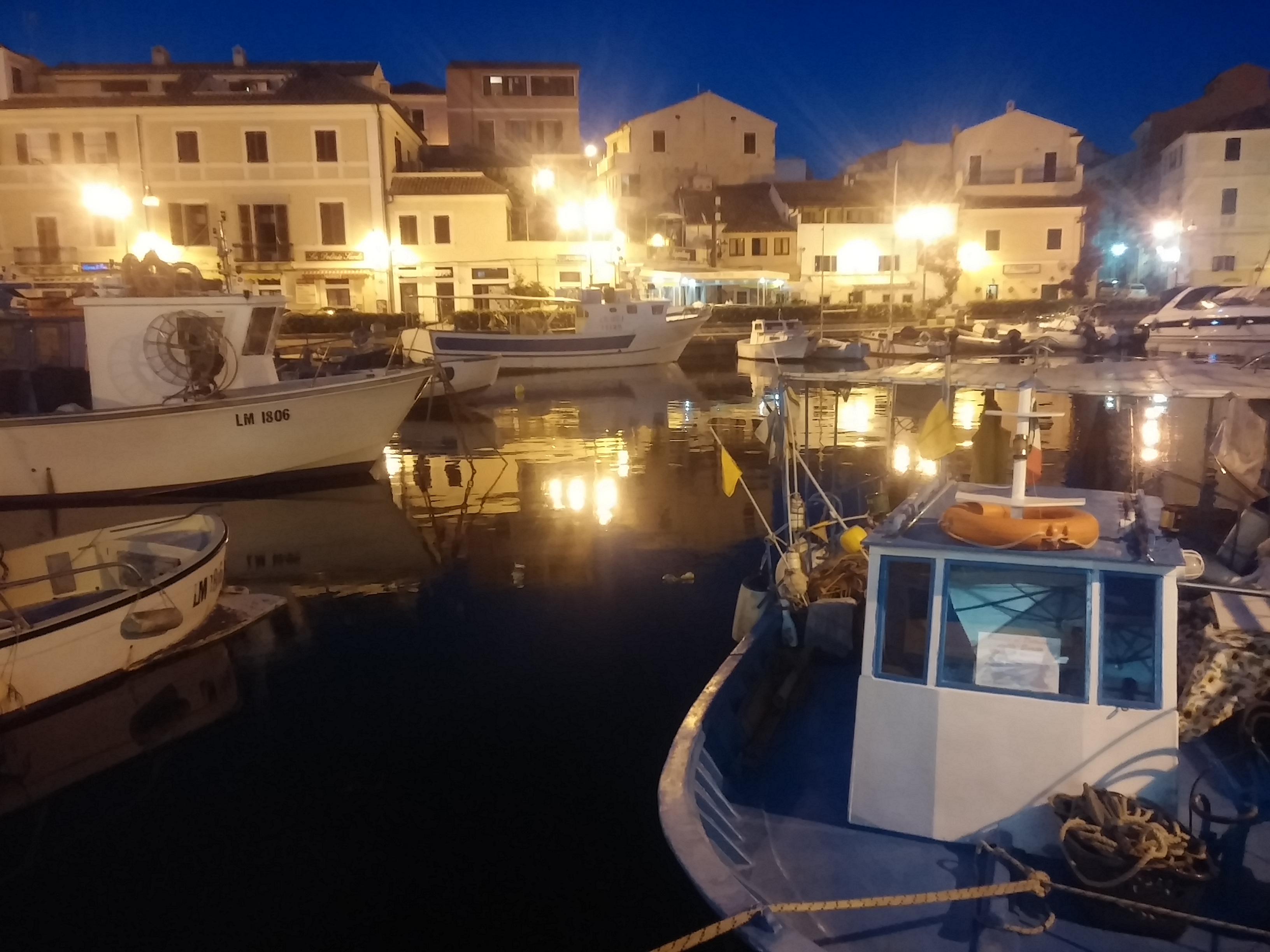
Fishing boats and Il Ghiottone (centre rear), La Maddalena

Talking about the evening meals we had on our holiday in La Maddalena, Sardinia, probably isn’t quite in the bread, cakes, ale purview, but it connects with something that troubles me deeply. And, well, we did eat bread. There’s always bread with Italian meals.

Whenever we go to Italy, I despair somewhat getting home and looking at our eating scene here in England. Now, I’m in small-town England, but it is a fairly affluent small town, not far from London – yet even here it’s hard to eat well at a reasonable price.

I’m not suggesting that Italy doesn’t have bad food. There are plenty of terrible restaurants in Rome, plenty of junk ready meals in the supermarket, plenty of engagement with the pervasive corporate-industrial food complex. But on our trip to Sardinia we were able to stay in a small town and still find places serving real food, made with fresh, local ingredients, at a reasonable price.

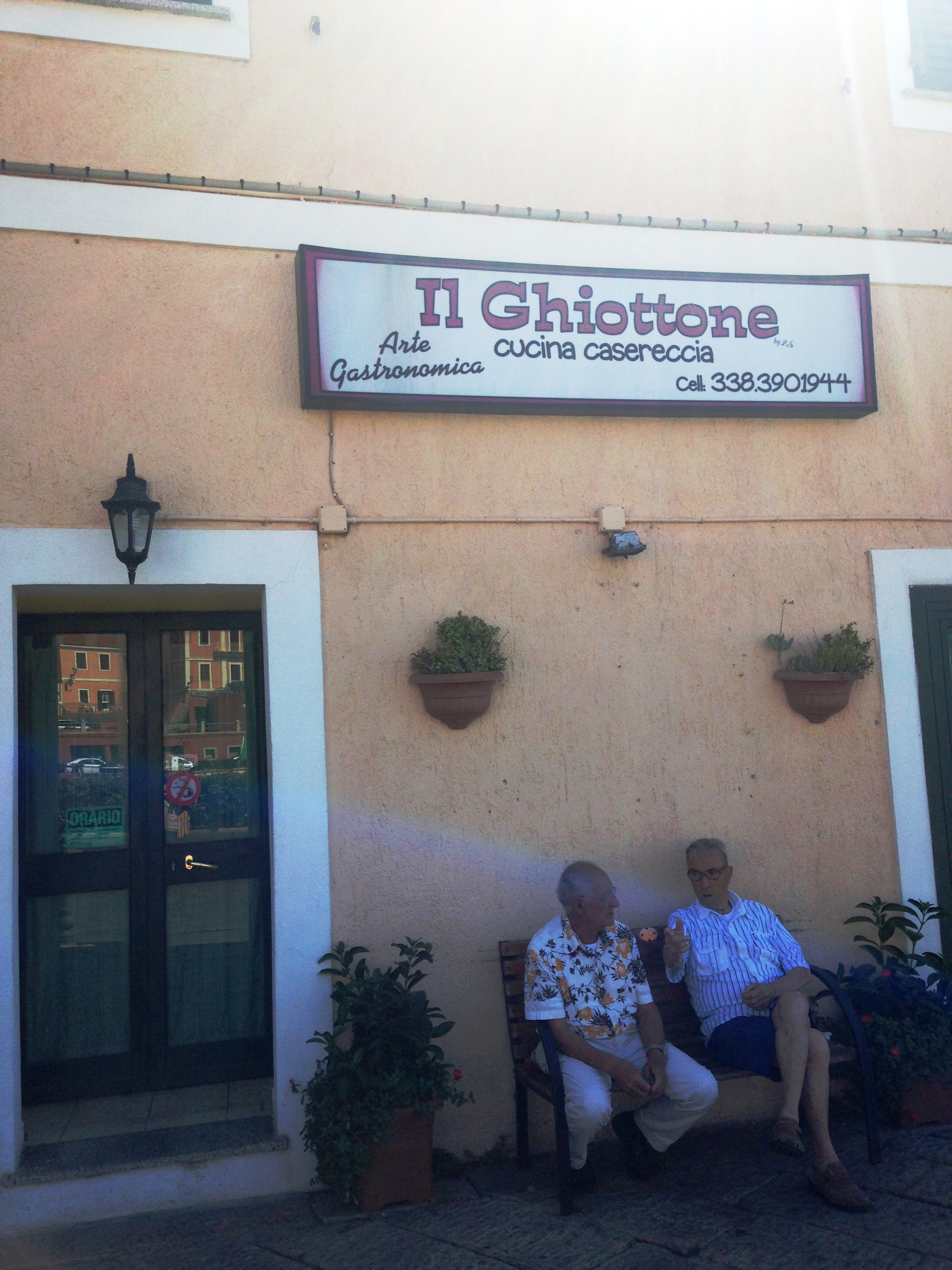
Geezers outside Il Ghiottone

The big gourmand
We had a few average meals in Sardinia, but we also had three excellent ones, two in the same place. This was Il Ghiottone, a tiny bunker of a restaurant with just 15 seats, on Via Guglielmo Oberdan, the quayside. You almost certainly have to book.

The name, I believe, means the “The big gourmand”, and it’s definitely a place for people who enjoy food – real food. The main emphasis, understandably, is on seafood. The restaurant faces the harbour, and Giorgio the co-owner with chef Paola, even offered to point out the fishing boat that supplied them, a small vessel moored about 10 metres away from where we were eating.

Giving thanks to the gods of food

The first time we stuck with antipasti (starters) and secondi (main, “meat”, courses), the second time we went for the primi (pasta or stodge courses – Italians generally don’t like their meat and potatoes on the same plate). We had a brilliant mixed seafood starter, the highlight of which was probably mussels served with a small amount of pickled or macerated red onion on top. Now, normally, we both dislike mussels, but these were great. I also had paranza – deep-friend whole small-medium fish. The sort of fish that in many places (eg here) would be by-catch, thrown back into the sea dead. It was great. The tails were the best bit.

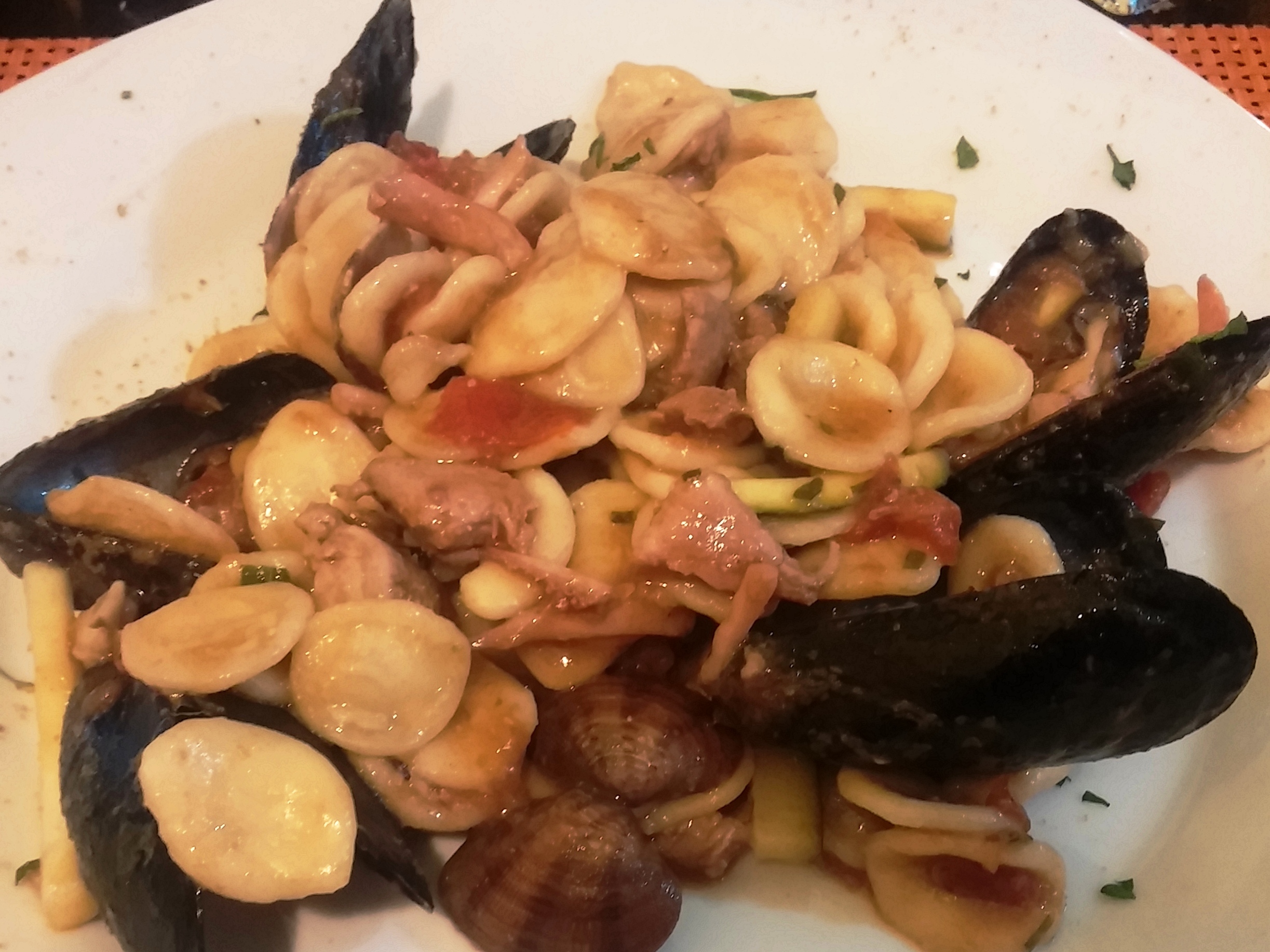
The second visit we had their pasta. They called it manccaroni, a word that’s presumably avariation on macaroni. To most Anglophones, this just refers to small tubular pasta shapes used for macaroni cheese (aka mac ’n’ cheese). I’m not going to go there with the etymology of the word (see Wikipedia if you’re interested), but historically it was used more generally for various pasta shapes. In the essential book on Italian food history Delizia, John Dickie says, “Maccheroni, spelled in a variety of ways, was the most popular medieval pasta term.” In this case the freah, pasta was in little ear shapes – orechiette. These were freshly made and served with mixed seafood. It was stupendous. I want more right now. I’m suffering as that’s not possible. The crappy phone photo doesn’t even come close to doing it justice.

Il Ghiottone pasta

We also tried our first seadas at Il Ghiottone. I’d not encountered this Sardinian dessert pastry fritter, or fried sweet pasta, before. It’s a palm-sized concoction, with a crimped edge, citrusy cheese filling and honey drizzle. It’s good. Not sure I could eat it every day, but I’d definitely eat it again. In fact, I did, a few days later at an otherwise very inferior meal in Olbia.

Looking up seadas now, many recipes use “pecorino” for the filling, but this is such a broad family of sheep milk cheeses – not just the salty parmesan equivalent you get here. I asked Giorgio about the cheese and he said “vaccina” – cow’s milk cheese, more specifically a young, unsalted curd type cheese. I had this corroborated later on an ingredients list on a packet in the surprisingly good airport shop – cagliata vaccina, cow’s milk curd cheese. I’ll have to scratch my head about sourcing that before I try making it at home.

Seadas

The pleasure of these meals was completed by being given a digestivo on both occasions – firstly mirto, then what Giorgio called “acqua sarda” – literally “Sardinian water”, but used in the same sense as eau de vie, the potent French “water of life”, or the Latin aqua vitae. Serious xenomorph blood, like grappa. Yowza.

Street barbeque
The other great meal we had was just round the corner. We’d walked past Da Ninì, Via Vittorio Emmanuele, several times and I’d been intrigued. I was particularly drawn by the brief whiff of a menu – a few scribblings on a board on the roadside, another on the frontage.

A small menu is generally a very good sign. A long, long menu can be the exact opposite – indicating no consideration, no variation and a dubious relationship with the industrialised food chain. With the implications of the latter a prioritising of cheap-as-possible over quality or seasonality.

Basically they were just serving fish, caught a few miles away, unloaded down the road, and cooked on barbeque set up on the road-side. The best seafood I’ve eaten in my life has had this sort of immediacy – mackerel we caught ourselves in Devon as kids; prawns in a Hong Kong night market that we alive moments before; the first tuna steak I ever ate in Bali; mussels straight from the rocks in New Zealand. OK, maybe not the latter. We weren’t experts and, well, see above.

Barbeque and Fran at Nini'

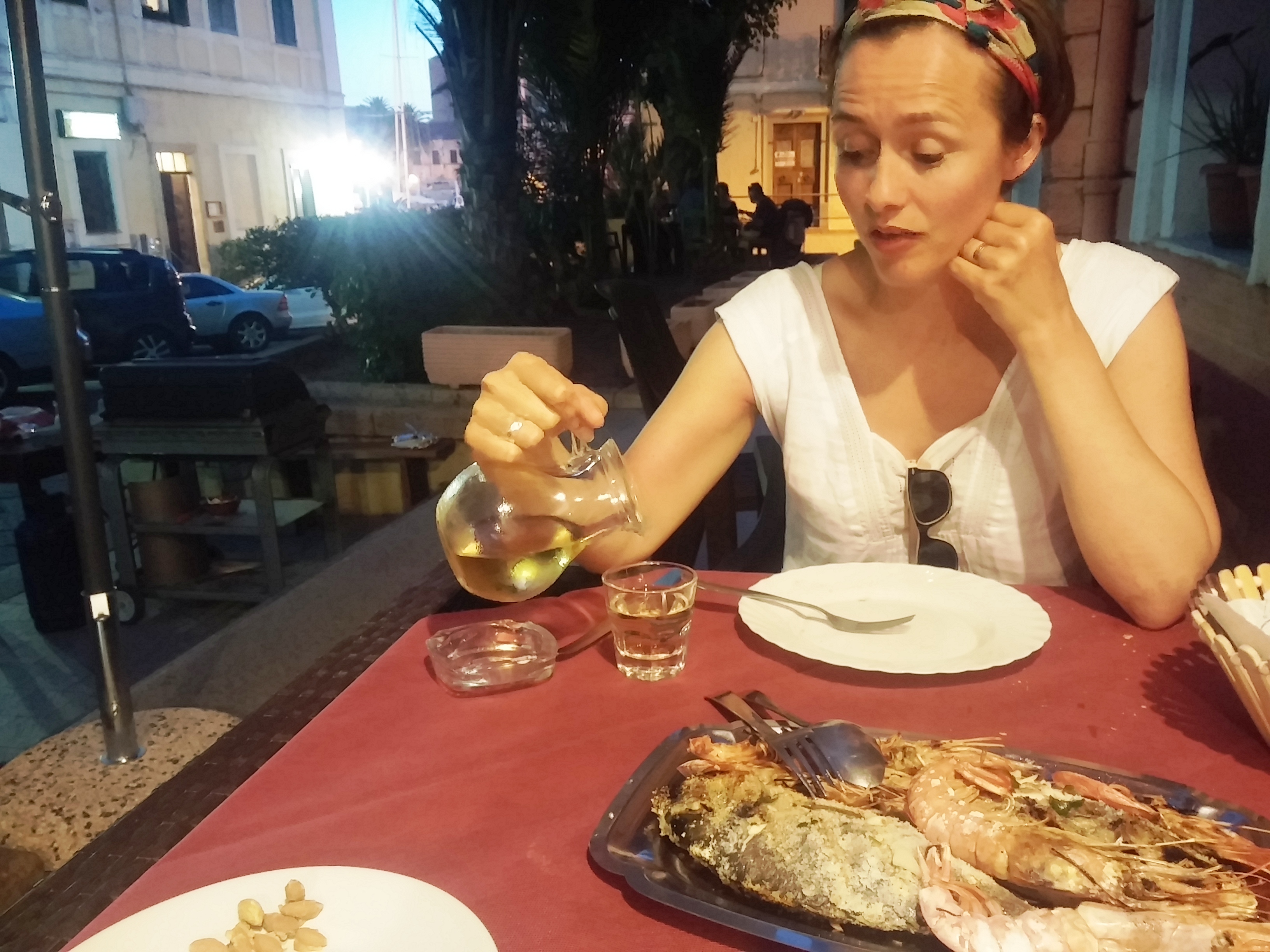
We had orata (bream; Sparus aurata) and spigola (seabass; Dicentrarchus labrax).* They had a salt crust and, well, that’s it. Fresh, simple, delicious. We also had some large prawns, which I doubt were local or sustainable. They’re among my fave foods, but I try not to eat prawns too much as they’re probably the most environmentally problematic seafood. Never mind the recent reports of slavery in the trade. I wish I’d asked, but it’s done now.**

These three meals were all excellent and frankly the ethical issue of a few prawns at Ninì is arguably minor in comparison to the ethical issues related to the large scale industrial food supply chain that most British restaurants and pubs engage with. I was about to rant about this issue more here, but I don’t want to sully my holiday memories, so I’ll save it for a later post.


(Check out my first two posts about this Sardinian experience: first and second.)


* If you’re on holiday in Italy and want to know what fish you’re eating, check out my list here.
** I won’t go into my attitudes to seafood here. I’ve done that before: here.

4 Comments

Filed under Discussion, Travelling

Yuval Noah Harari’s Sapiens and palaeo-romanticism

Sapiens by Yuval Noah Hariri is one of those grand, sweeping books that skips deftly between disciplines and gets you thinking in equal measure. Its title may recall Hawking’s Brief History of Time but a more salient comparison might be Jared Diamond’s Guns, Germs, Steel.

The book is subtitled ‘A Brief History of Humankind’, but it’s Part Two: The Agricultural Revolution that really interests me – not unsurprisingly given my interest in grain-based foods.

In my Anglo-centric education, the term “The Agricultural Revolution” was used to refer to the changes in British farming in the late 18th and 19th centuries. Harari is looking at a much bigger picture though: the Neolithic (new stone age) Agricultural Revolution. The period when Homo sapiens made the transition from hunter gatherers, foragers, to cultivators, agriculturalists.

The received wisdom is that learning to farm freed up humanity from the dirty primitivism of the forager lifestyle. Harari, thrillingly, turns this on its head. It wasn’t a liberation, he posits, but an enslavement. Most specifically an enslavement to Triticum, the wheat genus. This includes that dietary bogeyman modern wheat, as well durum and their forebears spelt, emmer and einkorn.

“Scholars once proclaimed that the agricultural revolution was a great leap forward for humanity,” he writes. “They told a tale of progress fuelled by human brain power. Evolution gradually produced even more intelligent people. Eventually, people were so smart that they were able to decipher nature’s secrets, enabling them to tame sheep and cultivate wheat. As soon as this happened, they cheerfully abandoned the gruelling, dangerous, and often spartan life of hunter-gatherers, settling down to enjoy the pleasant, satiated life of farmers.”

“That tale is a fantasy. There is no evidence that people became more intelligent with time… Rather than heralding a new era of easy living, the Agricultural Revolution left farmers with lives generally more difficult and less satisfying than those of foragers. … The Agricultural Revolution certainly enlarged the sum of food at the disposal of humankind, but the extra food did not translate into a better diet or more leisure. Rather, it translated into population explosions and pampered elites. The average farmer worked harder than the average forager, and got a worse diet in return. The Agricultural Revolution was history’s biggest fraud.”

Not being an accomplished archaeo-anthropologist, I can’t contest this. It’s certainly a compelling theory.

Feeding humanity
Humans – the whole Homo genus – had been hunter gatherers for about 2.5 million years. Then, around 12,000 years ago, it all changed: “The transition to agriculture began around 9500-8500 BC in the hill country of south-eastern Turkey, western Iran, and the Levant.” Wheat and goats came first, around 9000BC, then peas and lentils, then olive trees, horses and by around 3500BC, grapevines.

“Even today, with all our advanced technologies, more than 90 per cent of the calories that feed humanity [my italics] come from the handful of plants that our ancestors domesticated between 9500 and 3500BC – wheat, rice, maize, potatoes, millet and barley”. For all our culinary flamboyance and seeming diversity today, he writes that “If our minds are those of hunter-gatherers, our cuisine is that of ancient farmers.”

Unnatural selection
If you think of living things as repositories of DNA, which they are designed to simply pass on as much as possible, then Triticum, other food grains and farmed animals, have overcome the literal process of natural selection and been given huge, unnatural leg-ups by modern humans.

In a nice little exercise Hariri says, “Think for a moment about the Agricultural Revolution from the viewpoint of wheat. Ten thousand years ago wheat was just a wild grass, one of many, confined to a small range in the Middle East. Suddenly, within a few short millennia, it was growing all over the world. According to the basic evolutionary criteria… wheat has become one of the most successful plans in the history of the earth…. Worldwide, wheat covers about 2.25 million square kilometres of the globe’s surface, almost ten times the size of Britain. How did this grass turn from insignificant to ubiquitous?”

No turning back
How indeed? Well, by the aforementioned enslavement. “Wheat did it by manipulating Home sapiens to its advantage. This ape had been living a fairly comfortable life hunting and gathering… but then began to invest more and more effort into cultivating wheat. Within a couple of millennia, humans in many parts of the world were doing little from dawn till dusk.”

Homo sapiens shifted from a wandering lifestyle and an omnivorous diet to a hard-working settled lifestyle and a grain-based diet. “By 8500BC, the Middle East was peppered with permanent villages such as Jericho, whose inhabitants spent most of their time cultivating a few domesticated species,” he says. “The average person in Jericho of 8500BC lived a harder life than the average person in Jericho of 9500BC of 13,000 BC.”

We may have invented writing (in Sumeria and Egypt by around 2500BC, China by 1200BC, Central America 1000-500BC) and culture, but, he suggests, Homo sapiens has been trapped ever since, with the escalation of commitments of the early agriculturalists still echoed today in the habit of needing to work more to earn more to afford more.

It’s fascinating, but the theory does seem to have a certain inherent palaeo-romanticism. Indeed, many people who feel stressed or adrift or lost in the rush that is modern life, the idea of sitting around chatting with your tribe, spending a few hours foraging, then sitting around some more, before moving on to a new spot where you’ve previously had good fortune with the foodstuffs is potentially appealing. I certainly do, despite my love of grain-based foods.

Thing is, we’re somewhat committed now.

Palaeo-schmalaeo
Arguably people today do indeed try to act out palaeo-romantic fantasies, notably with the so-called “paleo diet”. It really bugs me. I’m sorry, but Stone Age man didn’t have a shopping bag filled with chia berries, and lemons, and avocado, and beef, quinoa and kaniwa, stevia powder and fresh tomatoes. All that stuff’s from different continents and different seasons and, indeed, mostly wasn’t even available as a foodstuff yet in the Stone Age. He would have had a load of starchy roots one day, stripped a tree of fruit another, ground up some wild grains another, then maybe had a pig-out on mammoth or giant elk or a giant flightless bird, depending on where he lived, the season, knowledge and luck.

Am I being too literal? Yes. But gah, food faddism drives me mad, especially so in the paleo case as it’s so much the product of a pampered, wealthy, western culture. Sure, I agree wholehearted that one should avoid industrially processed foods and artificial sweeteners and beef from drug-pumped cattle standing in their own faeces in concentrated feed lots. But really – what happens when all 7.3 billion (World population clock) of us want to live on beef and seafood and year-round avocado? A serious acceleration of the environment crisis, that’s what, as such diets are heavily predicated on an inefficient oil economy.

We could not feed humanity without staples: grains and legumes. There’s still a place for whole grains and legumes – the staples of the Agricultural Revolution – in a balanced, realistic, healthy, minimally industrial diet.

That said, if we do destroy our own civilisation with greed and overconsumption, maybe Homo sapiens will be able to go back to being hunter-gatherers after all (if if we survive at all). Something for your grand-children to look forward to perhaps?
10 Comments

Filed under Discussion

Rachel Roddy’s Five Quarters

Rachel Roddy's Five Quarters

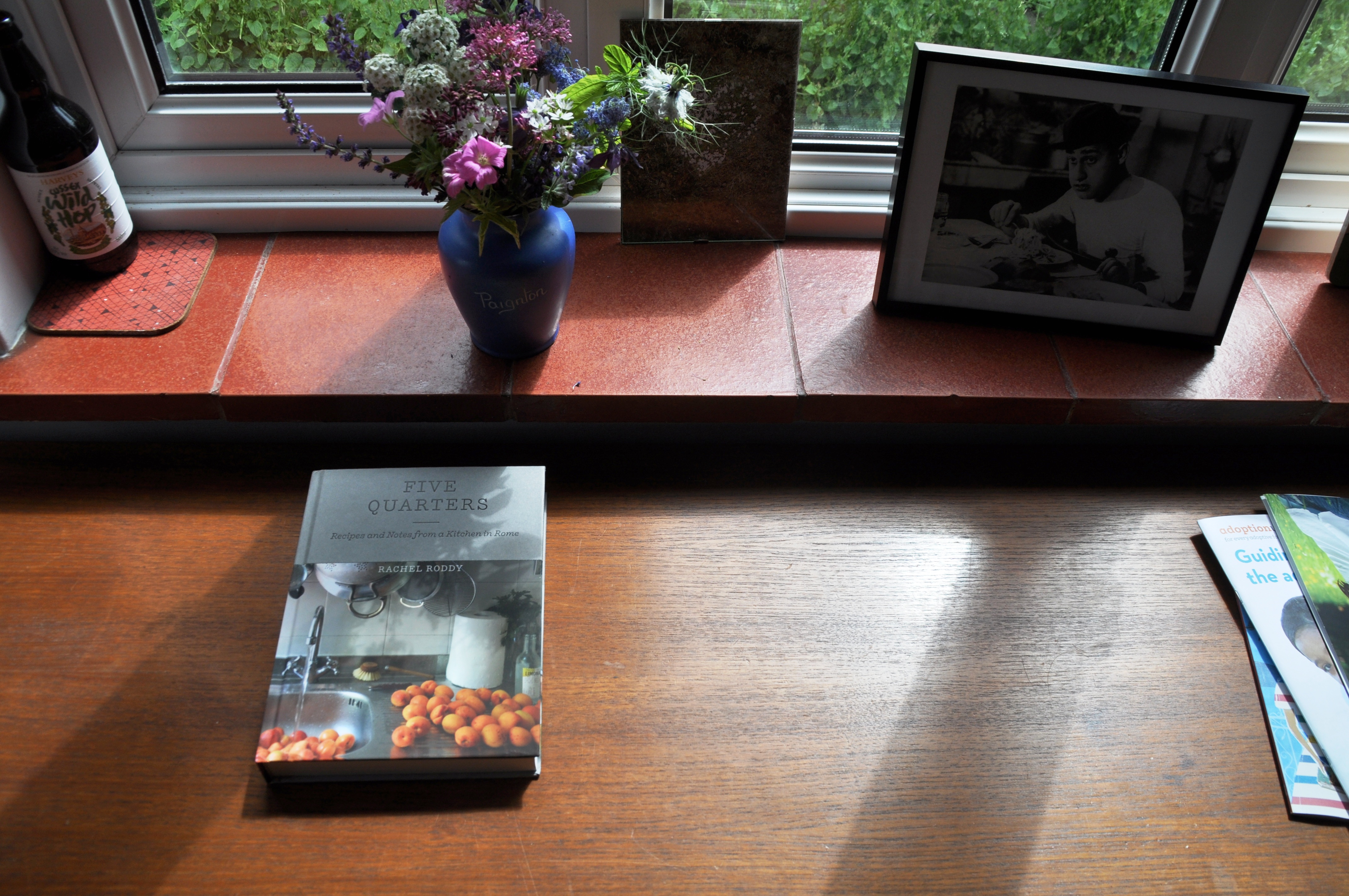
In the front porch this morning were a couple of bills, a wedding anniversary card and a large padded envelope. The card was nice, but it was latter that really got me excited. It contained a copy of Five Quarters: Recipes and Notes from a Kitchen in Rome by Rachel Roddy, a must-have food book published today by Saltyard Books.

Anyone who knows me or reads this blog will know Fran and I lived in Rome for a few years, moving there in August 2011. Recently, as we’ve struggled with the adoption process and a cold English spring, it’s been tempting to reminisce about Rome – the sunshine, the food,  friends, the fascinating city itself. But I have to keep reminding myself to not don the rose-coloured spectacles. Our first year in Rome was hard. Fran’s job was challenging, I was floundering around on various writing projects, I didn’t speak Italian, I missed my own house, I didn’t know what I was doing there, we felt a long way from friends and family. And it took five flippin’ months to connect the internet in the mausoleum-like Roman flat we were renting.

A marked improvement to our lives in Rome came one day in Autumn 2012, while me and Fran were walking through Testaccio. We had stopped to use an ATM when an English voice mentioned that it was dodgy, and recommended we use the other one across the piazza. We mumbled some very English thanks while a tall woman with a small child strapped to her chest strode away. Something passed between me and Fran along the lines of “she looked cool, let’s say hello.” Fran says we stalked her, I like to think we just overcame our English reserve.

This was Rachel Roddy. We became friends outside Volpetti on the corner of Via Alessandro Volta and Via Marmorata in what, we would learn, was the heart of Rachel’s turf. She was even living on Via Marmorata at the time, and took us to her local cafe, Barberini. It was a friendly and gracious gesture and the start of a new stage of our life in Rome.

We made other friends, but I particularly clicked with Rachel, which was such a relief after a fairly lonely year. We had things in common – we’d left London for difficult or sad reasons and ended up in Rome; we both had family from the north of England but had grown up in the south; both had a speedy way of conversing; and – of course – both had an obsession with food. I was blogging at the time, a bit about my baking, a bit about my general experiences of living in Rome, but it was Rachel, with her successful Rachel Eats blog, who encouraged me to start a new blog, focussed on the baking and beer. This blog in fact, which I launched in November 2012.

Over the months until we left Rome in October 2013, we saw a lot of Rachel, hanging out a lot at Tram Depot, just over the road from Volpetti and a perfect place to rendezvous on warm evenings, with Fran getting off the train home from work at nearby Ostiense station. Rachel became a great friend. She helped us get to know Rome, empathised as we slogged through our attempting-to-start-a-family saga. She encouraged me to try for the internship in the kitchens of the American Academy in Rome, I gave her the occasional baking lesson and raved at her about my latest favourite birra artigianale (“artisan beer”). We got to know her boyfriend Vincenzo, and watched the half-Roman Luca grow out of his baby-sling and start running around the piazze and mercato. And Rachel told us about her book deal, which we discussed enthusiastically as she poured energy into what would become Five Quarters.

Hand modelling

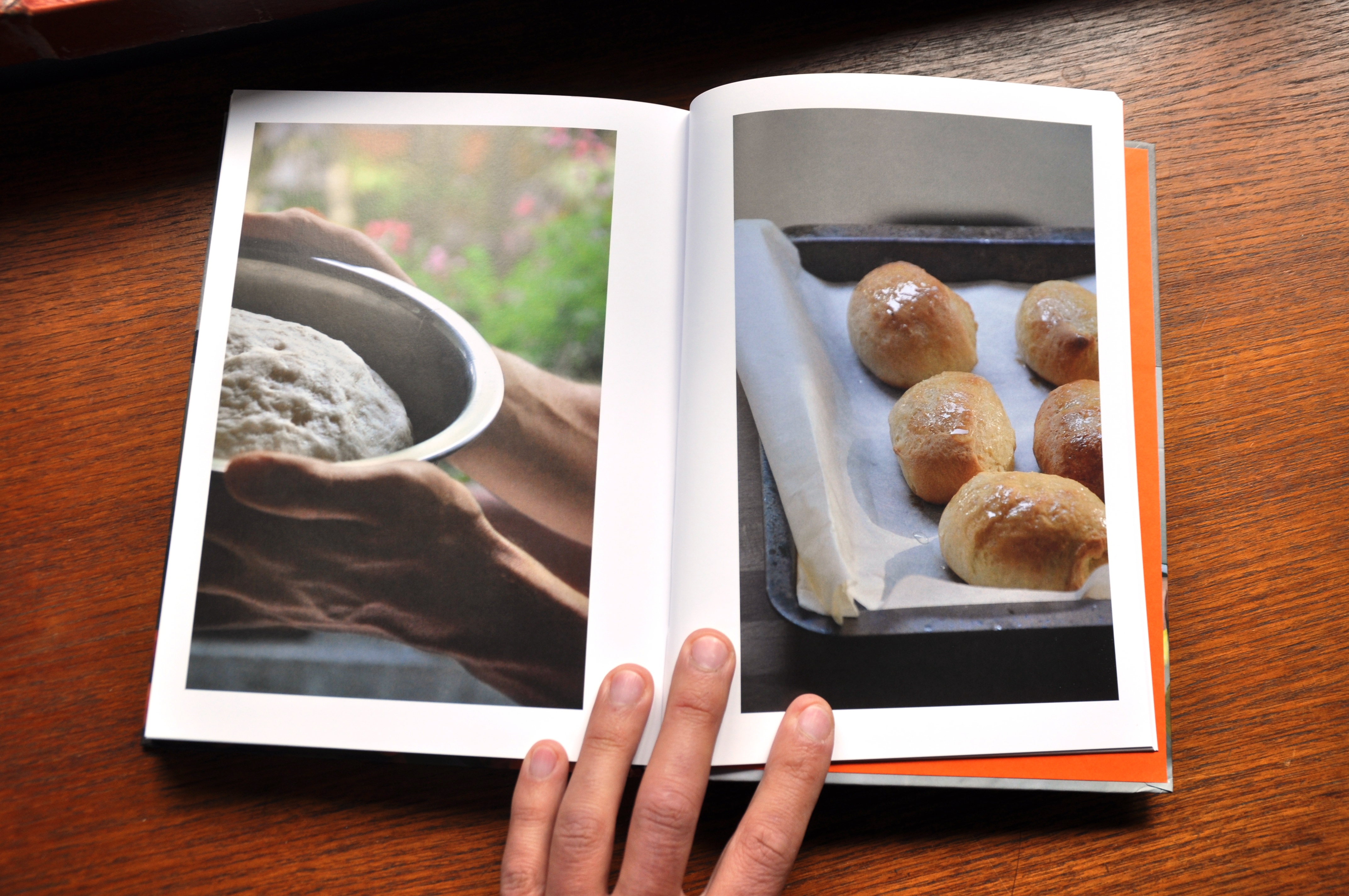
It’s been an exciting process, and I’ve been thrilled to be involved as a sounding board, occasional recipe tester and even, at one thrilling point in June 2014 (I believe), a hand model. Vincenzo’s hands appear fairly often in the book but those are mine on p358 holding a bowl of dough, and my wrist on p357, with a young Luca looking upwards with a mischievous sense of anticipation about the tray of proving maritozzi. These are Rome’s sweet breakfast rolls, which I blogged about here; Rachel includes a version of the recipe in Five Quarters. She also uses a version of my recipe for frappe, deep-fried sweet pasta treats eaten for Carnevale.

Although I read various bits and pieces of the book while Rachel was writing it, tried some of the recipes and talked about the progress, frequently via Skype, it’s a great to be holding the finished book. Blogs are all well and good, but a book, especially a handsomely bound book full of great photos and inviting text, is deeply pleasing.

I struggle with a lot of recipe books – they’re just recipes, and perhaps a photo of the dish, overly styled and not looking terribly like something you’d produce from your humble home kitchen. The recipes are often so lacking in context. Five Quarters, on the other hand, is a book all about context. It’s about the Testaccio quartiere, and Rachel connecting with that quarter. It’s about food, and Rachel learning about it, exploring it, interpreting it. It’s about real food, made in a real kitchen – and photographed in that kitchen. Rachel’s kitchen is nothing fancy, it’s small and modestly appointed; it’s not some fancy professional kitchen or cookery studio with disingenuous props. As such, it’s a built-in reassurance that you too can make these dishes, you too can learn about Roman food.

She covers a broad sweep of Roman food, so much of the things I crave now while living in small-town England. From the joys of the deep-fried antipasti, to the reassurance of the classic pulse-and-pasta dishes than span the gap between soup and stew, to vegetables and dolci (my area of obsession, obviously).

The book may also introduce readers to the food of Testaccio, which gives the book its name: the quinto quarto, “fifth quarter” – the meat and the offal dishes developed by the workers in the local slaughterhouse (used c1890-1975). Rachel doesn’t get too hardcore here, as such dishes are a far cry from the so-called Mediterranean diet people might expect of all Italian food (it’s an abiding misconception). But they do connect nicely not just with the nose-to-tail eating ethos, and also, as Rachel points out, with many traditional dishes of northern England. Rachel often makes these connections, or gives an anecdote – some context – for how she first encountered a dish.

As such Five Quarters is a book that’s a good read, a book that’s pleasure to learn about cooking from, a book that’s an aesthetically pleasing object, with Rachel’s own pictures of food production accompanied by pictures of Testaccio, the neighbourhood, its streets, shops, market, restaurants and denizens by Nick Seaton. I’m trying to keep on top of my sentiment, but it’s also a book that’s making me pine for Rome, and meeting Rachel to go for a grattachecca and an obessive rant about the latest recipe we’ve tried or foodstuff we’ve bought. *sigh*

In the meantime, I heartily recommend you buy Five Quarteres from your local independent bookshop. Failing that, here it is on Waterstones and Amazon.


26 Comments

Filed under Discussion, Misc, Rome

Many ways to bake

Stone and casserole

If my blog is isn’t getting updated quite so regularly these days, it’s because Fran and I are at a pretty intensive stage of a journey we’ve been on the past decade. It’s a journey that’s much shorter for most people: that of starting a family.

The old-fashioned way failed us, so we tried medical intervention. Quackery also failed us, so the past year or so we’ve been involved in the adoption process.

As anyone who’s had similar experiences will tell you, it’s a roller-coaster. The adoption process in the UK is predicated on extending the protection of children in care who may well have had tragic, sad or painful starts to life. So as the prospective adoptive parent, you’re scrutinised to within an inch of your life, every corner of your life checked, considered, evaluated.

You spend months filling in forms, being interviewed. The sheer weight of bureaucracy can make you buckle with its Kafkaesque convolutions as you struggle to prove you can be a good parent – without ever having had the experience of being a parent, thanks to the fickle vagaries of nature. It’s tough, but the end goal is clear – giving a child a good home.

Baking as palliative
When times are tough, baking is gives me solace. Bread-making especially is unique and special: it’s about making a basic food stuff, but it’s so tactile. Plus it’s all about fertility too, in its modest way. You’re reliant on the life incarnate in microorganisms: yeast, and, for sourdoughs, yeast and lactobacilli (bacteria). You need to nurture them, feed them, encourage them to reproduce. Reproduce as fervently as possibly. Unlike us, they shouldn’t need any intervention.

So I’ve been baking a lot recently. I’ve been baking most of my life, and making bread for at least 20 years, though it’s only been the past eight years or so I’ve made pretty much all the bread we eat at home. Although I’ve got a baking diploma, I’m not a professional. The thing professionals have over home bakers is a mastery of skills acquired through repetition. For long baking shifts, often through the night, professional bakers will make their doughs, prove them, shape the loaves, bake them, perfecting the processes.

So although I have a reasonable knowledge of all these things, I haven’t the mastery: it’s a lot harder to achieve when making one or two loaves a week. Especially if, like me, you have an enquiring mind and want to keep experimenting. There are so many variations on basic techniques, so many kinds of flour, so many permutations. So I keep on playing around.

I was a pretty good artist when I was young, but art, like bread-making, like any skill, is something that needs constant practise. Creativity needs nurturing. I carried a notepad and sketched all the time until my mid-twenties, but then it just tailed off. I don’t really know why. Anyway, my creative urges these days mostly go into food, into baking. Talking to my friend Rachel, who knows all about our trying-to-start-a-family saga,  she suggested the baking obsession is also an expression of my creativity, my nurturing instincts. (I’m not a stereotypical macho male, obviously.)

If fate, and the powers that be, allow us to adopt and, finally, start a family, I don’t intend to stop baking. But I suspect I’ll have less time for free-form experimentation as the focus of the nurturing will be very different.

Bread experiments in the oven
Another thing Rachel’s said to me is: make your blog more personal. But I’ve not really known how to approach this. This attempting-to-start-a-family thing is mine and Fran’s big personal project. Fran’s sort of tried to put me off talking about it, but we process things differently.

The way I see it, with a pregnancy, you get to a point where you can’t not talk about it – it becomes publically obvious. I feel we’ve been involved with the adoption process for long it’s reaching an equivalent to that publically obvious stage. Just without the bump. Without the literal bun in the oven. Instead, there are my bread experiments in the oven.

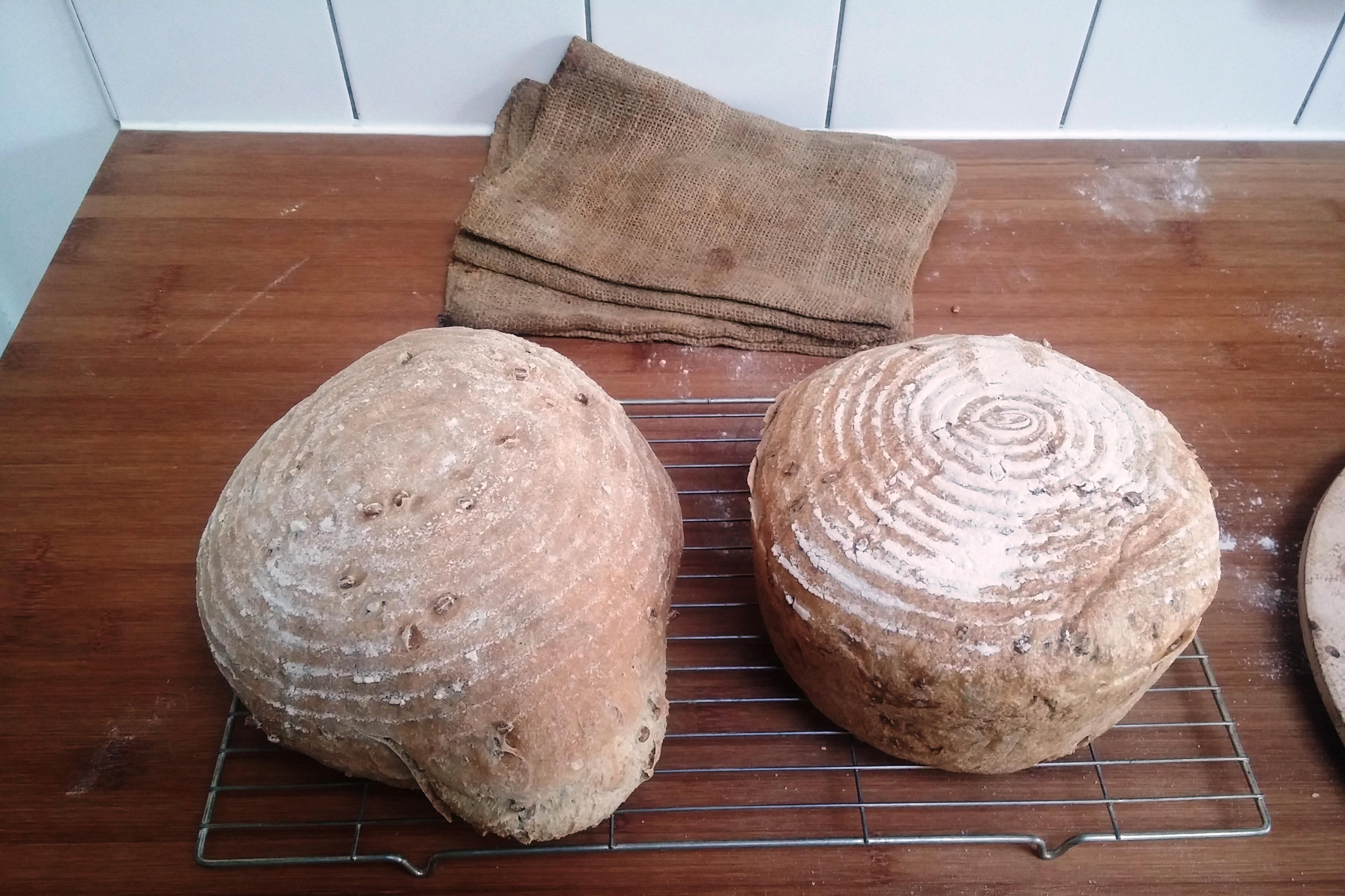
This is my latest haphazard experiment. I wanted to see how the same dough behaved when baked in two different ways.

Lively sponge

I made a dough using a kilo of flour, a mixture of white wheat flour, wholemeal spelt flour and rivet flour. I combined 400g of this with 650g of water and 15g of yeast to make a sponge pre-ferment.

Full of wheatberries

I let that ferment for a few hours at about 17C, then made up a dough with 15g fine sea salt and about 200g of cooked wheatberries (wheat grains) I had.

Well risen

Then gave all that a prove for about five hours, giving it some turns and folds.

I then managed to break Fran’s camera. We’d had two days of howling winds, 40-50mph (64-80kph), and that frays your nerves somewhat. Clearly it made me clumser than usual. I’d just said to myself, better watch out, the concrete floor would destroy this camera if dropped – then I dropped it while climbing a small stepladder to take an overhead photo. So now my pics are taken with my inferior phone camera. And I need to take a trip to the camera shop.

Divided up

After breaking the camera, both pieces of dough were scaled at the same weight, both were moulded the same way, and both were given their final prove in round bannetons.

Final prove

After the final prove, I put one in a Le Creuset casserole dish, pre-heated in the oven at 220C. Some call this the Dutch oven technique. I used a peel to slide the other onto a baking stone (or, more specifically, my pizza stone). Both were then baked at 220C for 20 minutes, then 30 minutes more at 180C.

Baked

Now, as you’ll see from the photos, despite all these years of baking, I’m still making some errors. Firstly, the two kilos of dough I had was too much for the size of Le Creuset I was using. Oops. Secondly, the one I baked on the stone, not being constrained by a container, did a funny oven spring and opened out sideways. This is frustrating for several reasons as I know the factors full well:
1. I probably didn’t leave it long enough in the final prove.
2. It may have opened up better if I’d give the top some slashes.
3. I quite possibly didn’t get the dough tight enough in the moulding stage.

The latter is one a baking skill I really struggle with. Sometimes I nail it, sometimes I fail miserably. I’ve managed 80% hydration ciabatta, then made a 70% hydration ball that’s turned out a discus.

Cut

Anyway, the real thing I was wondering about with this experiment was whether the crust and the crumb of the bread would be markedly different when baked with the different techniques. I was expecting they would be. They weren’t. Both are lovely loaves, soft, wholesome, good for sandwiches or, when they’ve staled a bit, toast.

For this experiment, I probably should have divided the dough in three, and baked a third on a steel baking sheet. Not sure my oven’s big enough though. Still, it was a fun experiment, a nice distraction from the anxiety and emotional intensity of the adoption. And, heck, one day I hope it’s the sort of bread my kids will like for their school lunches.

25 Comments

Filed under Baking, Discussion, Misc

How to handle a sticky bread dough

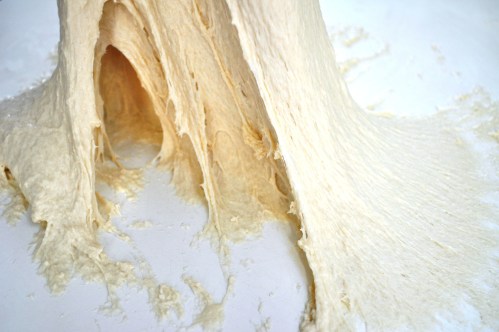
Stretching sticky dough

Tomorrow is Good Friday, the day when, traditionally, western Christians ended their Lenten fast. In Britain, this was marked by eating hot cross buns. So I’ve just made a batch, from my recipe. It’s a day early, but what the heck, the local supermarket has been pumping out its fake hot cross bun smell for at least two months already and most people probably aren’t even aware of the old traditions any more.

My recipe involves handling quite a sticky dough, so that got me thinking – perhaps I should have included some more advice about how to handle it. But it’s quite an important subject for making, so here’s a whole post on it.

When I talk about sticky doughs, this generally means doughs with a higher proportion of liquid to flour. These are called higher hydration doughs, and they often make for the best breads, especially with wheat. They can be softer, with a more open crumb and a better crust. If you’re doing an enriched dough – for a brioche, challah or any number of feast day bakes such as hot cross buns – the stickiness can also be further exacerbated by extra sugar, fats and egg.

A typical error inexperienced bakers make is to keep adding flour to such sticky doughs – putting lots on the work surface and adding more to the mix itself until it stops being sticky and feels easier to handle. This isn’t great, as it will make the crumb dense and dry. And if you add too much extra flour later on, it’ll miss out on the fermentation, being essentially raw – and indigestible.

Anyway, Ecco! Or voila, as we say in English: here are my tips for handling sticky doughs.

1. Get yourself a plastic dough scraper.
Seriously, after a bowl – and an oven of course – this is the most useful bit of kit for making bread dough. As a sticky dough adheres to your worktop, use the scraper to keep freeing it. You can also use it to make sure any bits of dough that go astray from the main lump are reincorporated. This the type I use. It’s a reasonable size and has a straight edge – good for the worktop – and a curved edge – good for freeing dough from bowls.

Scrapers

2. Get a metal dough cutter/scraper
Not quite as essential as the above, but it can be used a similar way. One option is called a Scotch scraper.

3. Oil the work surface
You can sprinkle your worktop with flour, but on the initial knead I prefer to oil the worktop. If you have a stainless steel or even marble surface, it’s not so relevant, but if your worktop is wood or bamboo (like mine), smear your work area with a few drops of oil. Generally I’ll just use sunflower seed oil, but if I’m doing an Italian or Middle Eastern bread, I may use a bit of olive oil. The oil stops the dough sticking… quite so much.

4. Clean and oil the bowl
After your first knead, and before you put the ball of dough back in the bowl, clean it. Dry it then add a dribble of oil and rub it around. Again, this’ll stop the dough sticking to the bowl, so it’ll come out more easily when you do your second knead. It’s not essential, but it’s helpful.

5. Knead with quick, confident movements
Watch a professional baker or an experienced home baker in action, and they don’t mess about with the dough. It’s handled with quick, confident movements. Indeed, even if you have a sticky dough, and are kneading it by hand, as you develop it, it will strengthen, become less sticky and start to form a ball. I would recommend getting hold of Richard Bertinet’s book Dough, as it comes with a DVD that shows this process. Someone has posted that video on YouTube, though I’m not sure how long it’ll stay up. He starts kneading from about 4 minutes in.

6. Flour your hands
Some people like to wet their hands, but I like to put a bit of flour on mine, not unlike weight-lifters dusting theirs with talcum powder.  It’s not something I do assiduously, but it can be a handy way of making things a bit easier without resorting to adding loads of extra flour to the dough. Also, towards the end of the knead I’ll clean my hands with some flour. OK, I’m not exactly cleaning them, but if you rub some flour between your hands as you would a bar of soap, it helps to get any dough off. My tactic is to do it directly above the sticky dough: the extra flour falls onto and around the dough, and I can then use the plastic scraper to tuck it under the lump, making it easier to form into a ball and put back into the bowl.

6 Comments

Filed under Baking, Breads, Discussion

Galette des rois and celebrating the end of Christmas with Epiphany

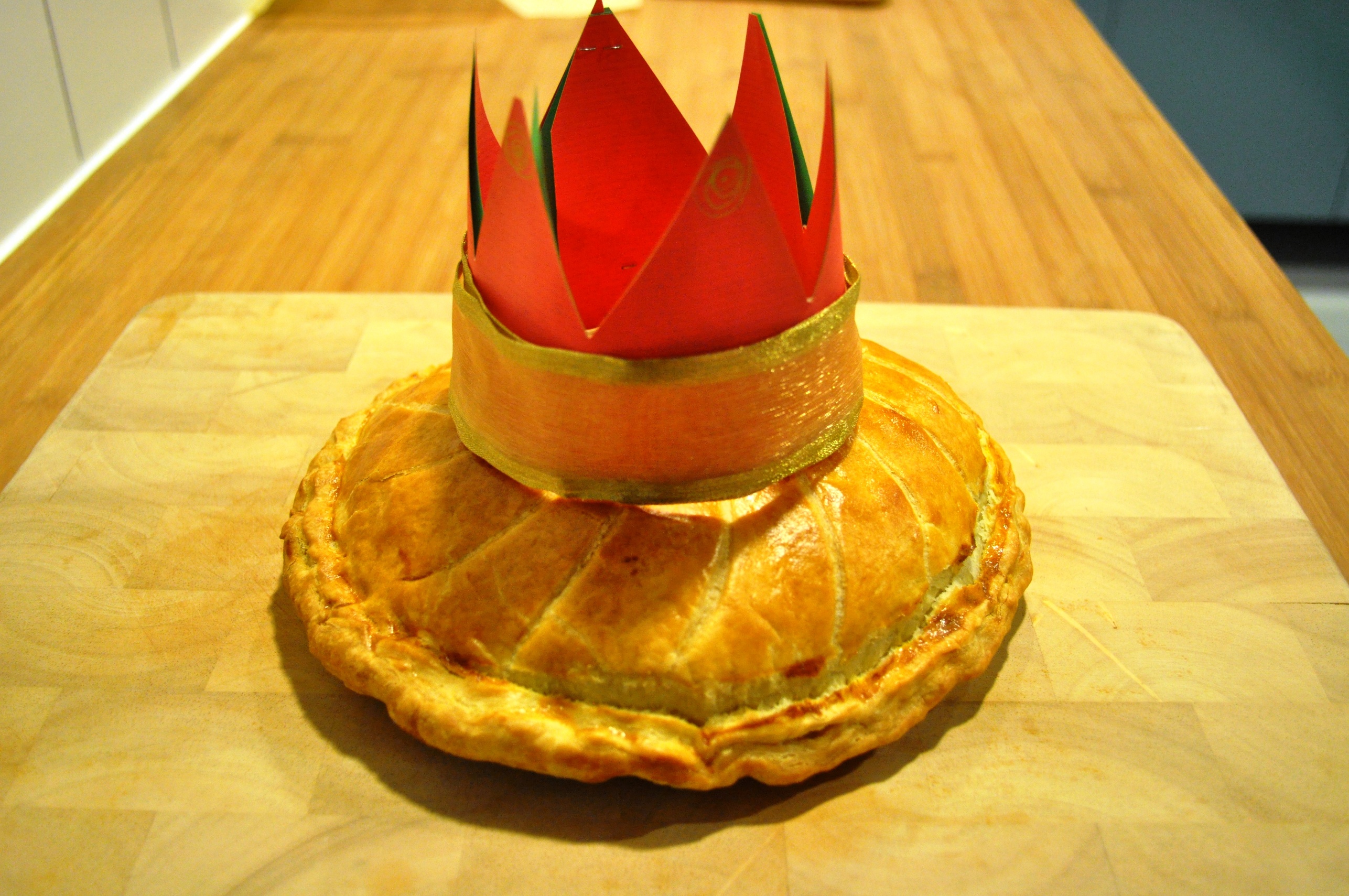
Crowned galette des rois

I love the Christmas season, but one thing I loathe about its modern British incarnation is how it begins in the middle of October. People start stressing, hurry to put up their trees at the start of December, then run out of steam by about Boxing Day, with some even taking down their decorations. Yet Boxing Day, the 26th, is only the Second Day of Christmas.1

We all know the song that starts “On the first day of Christmas my true love gave to me…” but miss the significance. Formerly, Christmas was celebrated from Christmas Eve and Christmas Day itself, when the feasting started and was sustained until Twelfth Night, 5 January, the eve of Epiphany. This ending of the season on 6 January is still celebrated in some cultures with king cakes, or kings cake. The kings in question? Why that would be the Three Kings, the Magi.
This is all perhaps a bit confusing for those who grew up with formalised Nativity plays and scenes that pack in the whole cast of characters – holy family, kings, shepherds, sheep, oxen, camels – for the actual birth of Christ. But alternative names for Epiphany are Three Kings Day, or simply the Day of the Kings, as it’s when they arrive at the famed Bethlehem farm outbuilding and give their gifts. Indeed, some cultures still do their main gift-giving on Epiphany. It’s an important Christian feast day, hence the feast foods: the king cakes.

The end of Christmas
Not only are variations on king cakes served on Epiphany, they can be served repeatedly through Carnival season right up until Lent, with the New Orleans version, for example, being essential for Mardi Gras, Fat Tuesday.

The northern French king cake – galette des rois – isn’t the richest concoction, but I still love how this tradition is one in the eye for all the hackneyed dogma that gets trotted out with the British New Year celebrations about how you have to stop indulging and embrace self-denial. Indeed, one of the things I loved during our two years living in Rome was how Carnevale brought with it uniquely indulgent seasonal sweets soon after New Year.

Before our time in Italy, the biggest connection to another European country and culture in our household came with Fran’s Francophilia. She’d made a connection with France when she was young, studied French, and spent several years living in Brittany and Paris when she was in her late teens and twenties. It was Fran who first told me about the galette des rois five years ago.

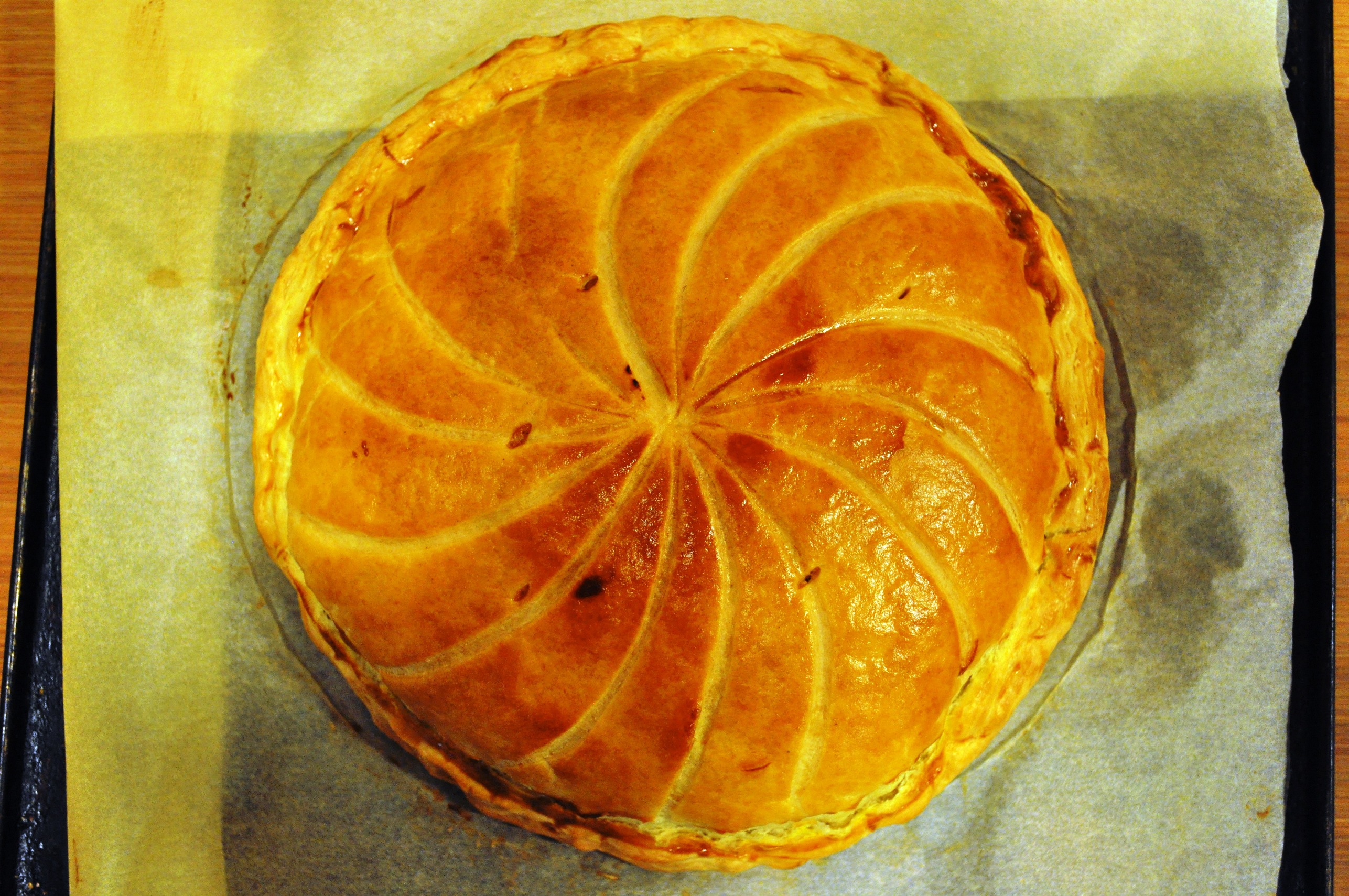
While southern French, parts of the US South and some Spanish and Latin cultures do a more cake-like king cake made with enriched dough, and decorated with coloured icings and candied fruits2, the northern French galette des rois is a more modest concoction. It’s a sweet pie, made with puff pastry (pâtes feuilletées) and filled with almond paste, frangipane; essentially a pithivier.

Slice

Cake, round and flat
What is a galette? Well, it’s defined as an “espèce de gâteau rond et plat” – “a type of cake, round and flat”. From what we can work out, it’s the diminutive of gale, again meaning a round, flat cake but also used to describe a small round stone, worn flat by water3. Alan Davidson says, “the word being derived from galet, a pebble perfect for skipping”. The word is perhaps best known from galettes brettonne, Breton galettes – pancakes made with buckwheat flour found in that region of northwest France. It also refers to certain types of biscuits and cookies, also round and flat.

Charming
Anyway, as well as being a modest treat, the fun thing about galette des rois is the inclusion of a fève – literally a dried bean (like the Italian word fava, broad bean). This is hidden in the frangipane mixture and bestows good luck on the person who finds it in their portion. This is not unlike the old British tradition of hiding a coin in Christmas pudding, and indeed lots of cultures have festive baked goods that include a charm of some form: it’s common to other king cakes, the Bulgarian banitsa contains a kusmeti charm, etc.

The modern form of the fève is a small ceramic or plastic figure of the baby Jesus. Last time I made one, I debated using a Monopoly piece but opted instead for a marble. This time, however, I decided to use something edible, so chose half a walnut. No danger of choking! The French tradition is for the youngest child of the gathering to sit under the table and call our names as the slices are served, for an added layer of chance. Whoever wins the fève gets to wear the paper crown you place on top of the galette des rois when you serve it and be the family king or queen for the rest of the day. Or nominate someone else if they’re not feeling the lure of such absolute authority.

The inclusion of a bean is likely a pre-Christian Roman tradition, when for one day in winter slaves and masters would eat together, and even the slave could be king of the feast, or at least the magister bibendum, “master of the drinks” or toastmaster. As Davidson points out, when the pagan Roman empire was Christianised, it made sense to declare 25 December Christ’s birthday, “co-opting these immensely popular holidays” and midwinter ceremonies, notably Saturnalia.

Recipe
This time round I also made my own puff pastry, using a recipe from the new 2011 translation of Ginette Mathiot’s The Art of French Baking (originally Je Sai Faire La Patisserie, “I Know How to Make Pastries”, 1932). It was okay, not great. Partly it didn’t puff well as I messed up the edge of the galette; that’s a tricky bit, as you need to seal it well to contain the frangipane, but not to the point of preventing any rising and puffing of the pastry. Anyway, most people will probably prefer to just use bought puff pastry – if so, make sure it’s all-butter as the richness and flavour is essential.

400-500g all butter puff pastry

Frangipane filling:
85g ground almonds
85g caster sugar
Pinch salt
85g unsalted butter, softened butter
2 medium eggs, beaten (that is, about 100g of beaten egg)
A dash of rum (optional)
One fève charm (optional)

Wash:
1 egg yolk
1 tsp milk

1. First make the frangipane. Combine the almonds, sugar and pinch of salt.

Add butter
2. Add the softened butter and squash it in, then cream it in fully. Keep creaming until the mixture becomes a paler colour.

Cream
3. Add the beaten egg, a little at a time, and the rum (if using) and beat to combine. Cover and put in the fridge while you prepare the pastry.

Beat till pale
4. Line a baking sheet with parchment.
5. Roll out the pastry then, using something round that fits your baking sheet, cut two discs. Mine were 230mm (9 inches) in diameter.

Cut out discs
6. Put both circles on the baking sheet with another piece of parchment in between, cover with plastic to stop them drying out and rest (them, not you) in the fridge.
7. Whisk together the egg yolk and milk for the wash.
8. Take the pastry and filling out of the fridge again and separate the discs.
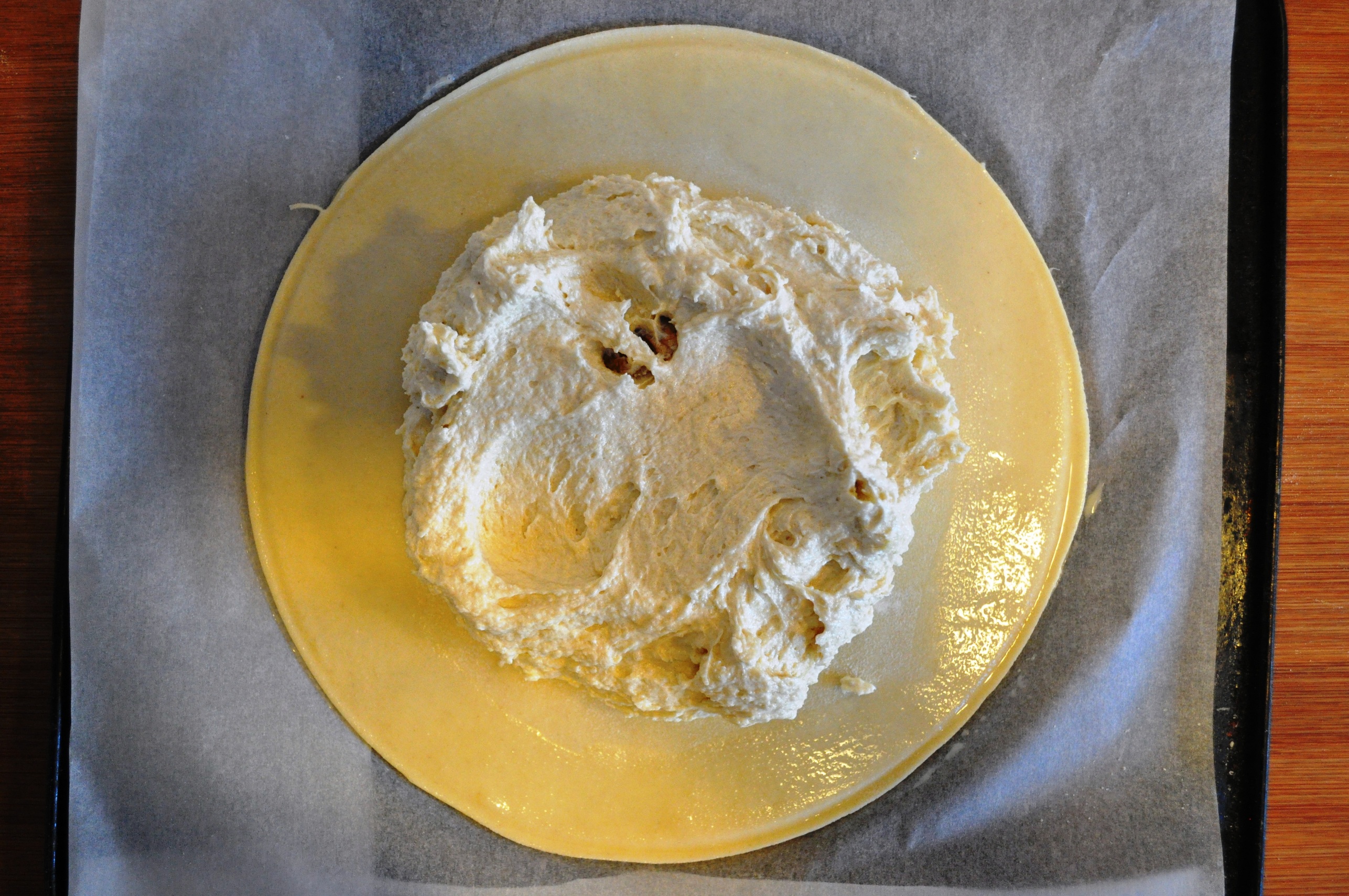
9. Put the almond filling in the middle of the bottom piece of pastry, leaving about 25mm all the way around the edge.

Add filling
10. Put a fève in the mix, making sure no one sees where it’s hidden.
11. Brush the exposed edge of pastry with water, put the other disc of pastry on the top then seal together tightly.
12. You can chill again now, leaving it until ready, even overnight. Again, cover or put in a plastic bag to stop it drying out.
13. Preheat the oven to 200C.
14. Brush the glaze all over the top.

Glaze and incise top
15. With a sharp paring knife, cut a pattern on the top. Traditionally, this involves diagonal lines or curving sunrays, but you can be as creative as you want. Stab a few holes too, to allow steam to escape. You can scallop or crimp the edge too, but see the above note.
16. Bake for about 30 minutes or until crisp and golden. (As soon as it’s out of the oven, you can also give it an extra glaze with sugar syrup.)

Baked 1
17. Serve warm or at room temperature, topped with the paper crown.

And forget about those silly New Year’s pronouncements to punish yourself for overeating over Christmas. Just moderate! So, for example, don’t eat an entire galette des rois on your own, greedily trying to win that crown. Fran got it – or half of it at least, a flaw in the plan of using a walnut – in her first slice.

Fran as the Epiphany galette des rois queen


1 Most count Christmas Day as the First Day of Christmas, though some start with 26th December, St Stephen’s Day, the British Boxing Day. If you follow the Julian calendar, you have to wait until 6 January to start the Twelve Days of Christmas. Thanks Alex and Nick for informing me of that with your Ukrainian Christmas celebrations on our Epiphany, yesterday.

2 Called variously gâteau des rois or royaume or reiaume, roscón de reyes or rosca de reyes, corona dels reis, tortell de reis and bolo de reis.

3 Fran also conjectures that the word relates to the Gaelic gall, which means “stranger”, but also “rock, stone” but it all gets a bit confusing when you learn the Breton language name for Breton galettes is Krampouezhenn gwinizh du.


Addendum

My folks visited at the weekend, and brought with them something given to them by some friends who live in Normandy, who bought it in their local patisserie – it’s a brioche des rois, another variation on the kings cake theme. None of us were sure what the red slices of candied fruit were – apple perhaps?

Brioche des rois


12 Comments

Filed under Baking, Discussion, Feasts, Pies & tarts, Recipes

Hops letterpress print

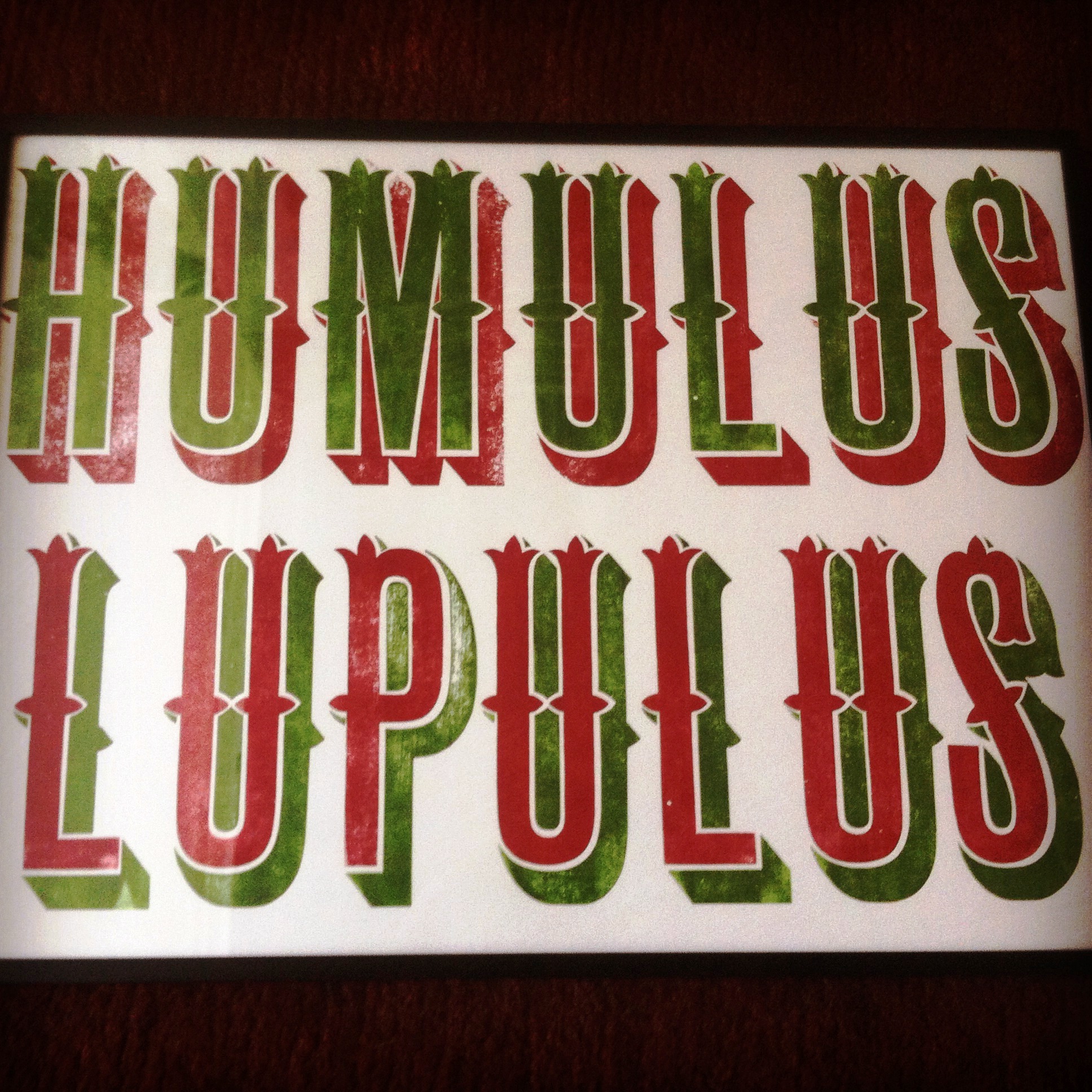
Humulus luplus letterpress, R Frost

Beer is mostly water. But through the magic of Saccharomyces cerevisiae consuming sugars provided by malted grains, that water becomes something wonderful. While the malt provides a lot of the body and the flavour of the beer, it’s with the addition of hops that beers become truly exciting in their varied characters.

The hop plant is Humulus lupulus, a native of Eurasia that’s quite possibly been associated with booze since the 6th century BCE (check out this PDF) but has been cultivated extensively, resulting in an incredible range of aromas and tastes.

What you can do with hops is really something to be celebrated, which is just what Russell Frost has done with this new print from his Hooksmith letterpress operation.

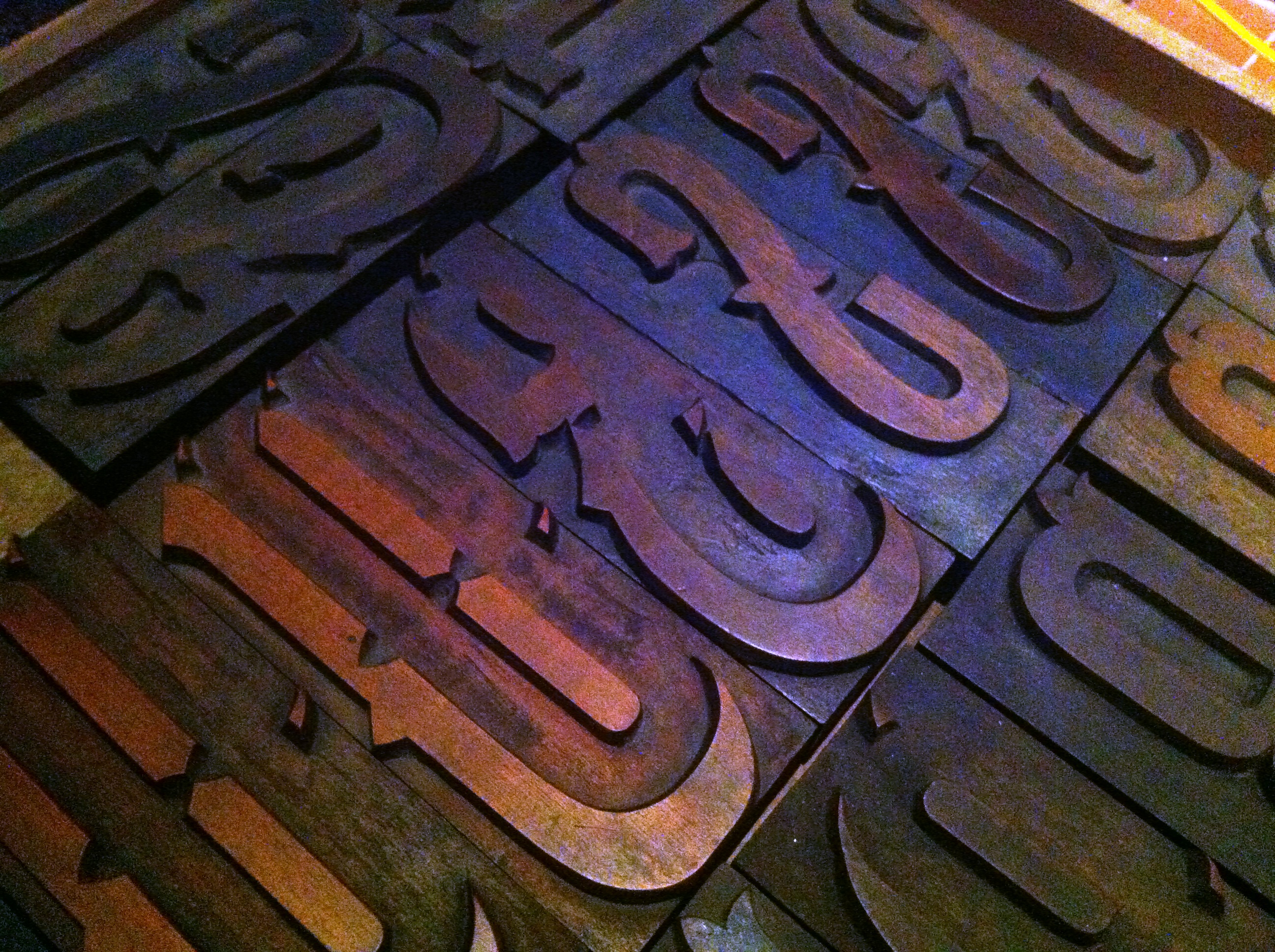
Russell, an old friend from New Zealand and a fellow fan of decent real beer, explains, “The type face is allegedly a hand-cut early Chromatic Victorian (meaning for two-colour printing)  known as an ‘ornamented grot'” Strangely, as “grot” is either short for grotto or grotty: these letters are neither.*

Russell has an extensive collection of vintage equipment as his operation in east London. For those who know their letterpress, his site says, “Presses include an Adana 8×5 platen and several proofing presses including a Farley, Stephenson Blake, Vandercook14 and a Vandercook SP15.”

Type. From Hooksmith

As for the ornamented grot used here, Russell says, “I came by it after a serious amount of hunting and it was sold to me by a collector who bought it off another collector in the 1980s.”

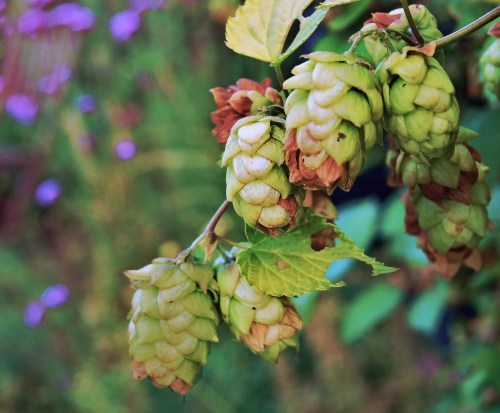
Great stuff. I particularly like how the decorative top tips of the letters reflect the pointed shape of the hop flower petals, as seen in this picture taken by a chap called Duncan Harris (thanks Duncan) and posted in his stream on Flickr:

Duncan Harris, Hops

Oh, and Russell, being an educated man and the son of a botanist, knows that it’s a no-no to capitalise scientific nomenclature (that is, put HUMULUS LUPULUS when it should always be Humulus lupulus or at a push H. lupulus), but it’s such a great font it’s justified by artistic license.


* Russell says “grot” is just short for “grotesque”, which makes sense. Grotesque doens’t just mean ugly or hideous, it originally referred to a decorative style that was inspired by ancient Roman decorative styles (re-) discovered during the Renaissance and featured bizarre, stylised animal and plant forms. Grotesque, grotto and grotty all have the same etymology – the Italian word grotta, cave, which comes from the Latin crypta (as in crypt) meaning underground passage or chamber. The 16th century artists who developed the grottesca / grotesque style had, for example, explored the buried rooms of places like Nero’s Golden Palace, which in the Middle Ages was largely lost and buried under the cumulative filth and silt of decades of neglect in Rome.


2 Comments

Filed under Discussion

Making bread in The Walking Dead

The Walking Dead 127, gardens at Alexandria Safe-Zone

Those who read this blog will know I like bread. You may not know, however, I’m also a lifelong comic book reader. One comic I’m following avidly is zombie apocalypse saga The Walking Dead, which has recently taken an interesting turn. They’re still fighting zombies of course, but they’re also growing more food too.

Although many people started reading The Walking Dead comics when the TV series (2010-) became a hit, I’ve been there since the beginning, 2003. I can’t remember how I started but it was possibly thanks to my friend Dr Jamie Russell, a screenwriter and author of Book of the Dead: The Complete History of Zombie Cinema. We’re both pretty into apocalyptic fiction. I grew up with stuff like John Christopher, John Wyndham and JG Ballard. My mother was partly responsible, as she likes it too: novels like these, but also TV like the BBC’s Survivors (1975-1977). My childhood was also the era of cinema classics like Mad Max and The Terminator or repeats of The Omega Man or Logan’s Run on TV.

I’m one of those apocalypse geeks who likes to discuss how things would change, what you’d do when human civilisation collapses. I like to fantasise about fortifying my parents’ place in the country, building up its traditional southwest of England hedge-banks into a proper defensive palisade to keep the zombie hordes at bay. Or whatever.

Reality check
It’s all daft, obviously, as the collapse isn’t coming in one neat cinematic fell swoop, it’s coming slowly, now, as we speak, from our excessive consumerism, our unquenchable thirst for fossil fuels, supported by “greenest government ever” pawns who support fracking when our focus should be on energy efficiency and renewables. Such backwards policy furthers climate change, which destabilises agricultural, which causes famine, which results in population movement and increased tension in an overpopulated world. But slowly. We’re living the slow apocalypse. Which just doesn’t make for such great fiction.

Still, while all this is happening, we lap up the sudden apocalypse fiction, the bombs, the plagues, the zombies: The Walking Dead TV series is huge how, and a new trailer for the long-awaited fourth Mad Max film has just emerged via the ComicCon event in San Diego, etc, etc, etc.

I’d got a bit behind with The Walking Dead comics, but now I’ve caught up again. Thankfully, with issue 126, creator Robert Kirkman ended the protracted ‘All Out War’ storyline, which IMHO revisited too much ground already covered by the Governor storylines. With issue 127, Kirkman and artist Charlie Adlard refresh the series with a neat ellipsis. The issue is called ‘A New Beginning’ and about two years have passed since the war. The community of survivors seems to be flourishing, focussing on their food security by cultivating food, not just relying on scavenging food from before the zombie plague.

Post-apocalyptic practicalities
As much as I love the action element of apocalyptic stories, I much prefer it when they look at the practicalities of living in a changed world. This is why the BBC’s 1975 Survivors is superior to the 2008 remake. The former got stuck into the important business of how to survive after a plague had wiped out most of the population and nature was taking over again. The 2008 version, meanwhile, mostly just had its survivors bickering like soap opera characters. When they did try to do something practical – eg build a chicken coop – it was pathetic and cursory, physically and dramatically. Compare that with the original TV series, where they look at things like medical treatment, how to make candles, and even how to maintain a watermill.

The latter is particularly significant as water and wind provided the (sustainable) energy for milling grain for centuries. And milling grain means bread, the historic staple food.

Today, most people go to a supermarket, buy something sliced and wrapped in plastic and eat that. That’s not bread. That’s a post-industrial filler, a culinary deception and dietary disaster. There’s no way western civilisation could have achieved all that it has achieved (for better or worse) if we’d had white sliced as our staple.

For a community to thrive it needs a decent staple, and real bread is just that. So it’s great to see the survivors in The Walking Dead during that two-year ellipsis are farming, have built a windmill and are baking their own bread in their home, Alexandria, Virginia, not far from Washington DC.

TWD 128 windmill

Burning issues
In issue 128, Eugene, the community’s resident dorky genius, says he just read a book about how to do it, but Rick, the increasingly physically maimed but mentally sharp leader, won’t hear it. He realises the importance of the mill and the bakehouse in his vision for rebuilding civilisation.

Although we don’t see the more extensive grain fields you’d need to feed the comic’s community of, I dunno, a hundred-ish, you do see gardens and a glimpse of orchards. Unfortunately, the way Charlie has presented the mill and bakehouse is a bit of a bodge. The artwork is as great as ever, but it’s not a credible layout. The bakehouse seems to be inside the windmill. I have never encountered such an arrangement, and suspect it rarely, if ever, happened historically. If a mill did have an associated bakehouse, it would have been a separate building due to the fire hazard of cranking a wood-fired oven near chaff, wooden structures and valuable grain and flour.

The Walking Dead 128, bread fresh from the oven

The bread itself is portrayed slightly strangely too. The baker, Olivia, is handling a peel with tin loaves on it – though they’re not in tins. I’ll give them the benefit of the doubt and say that she’s taken the loaves out of their tins then put them back in the oven to finish baking. Despite this quibbles, the scenes featuring the mill and bread are great: significant and moving.

Growing food. Grinding grain. Baking real bread. Now, perhaps The Walking Dead’s survivor’s can really thrive*.

* I doubt it though, as Kirkman generally seems to prefer his protagonists to suffer. Mistrust, human weakness and violence are the bread and butter of The Walking Dead. Not bread.

4 Comments

Filed under Breads, Discussion, Misc

Bad memories, skunkiness and the question of beer in cans

Beaverton Gamma

For many drinkers of real beer, the implications of cans are almost too terrible to contemplate. They certainly are for me. Cans remind me of buying cheapo industrial lager just to get drunk in the Winchester Cathedral Grounds as a teenager. As well as associating canned beer with vile industrial lagers, I always associated them with a metallic taste. I assumed this was not necessarily the vile industrial lager itself, but the packaging.

But all that’s changing. The challenge now is changing such preconceptions.

It is strange how abiding a prejudice can be, but if you learned to drink by consuming vile industrial lagers (or indeed snakebites), frequently from cans, and have memories of puking and hangovers, the psychology isn’t that complex. It’s just a kind of self-inflicted aversion. It worked too: I didn’t drink from the age of 18 to 24.

Times change
Anyway, the past few years, I’ve been increasingly encountering real beers, in cans. Initially I bridled when I was served  Angry Peaches from Garage Project in a can in a restaurant in Wellington, but this New Zealand take on an APA turned out to be delicious, and one of the best beers I had in NZ.

Angry Peaches meal md

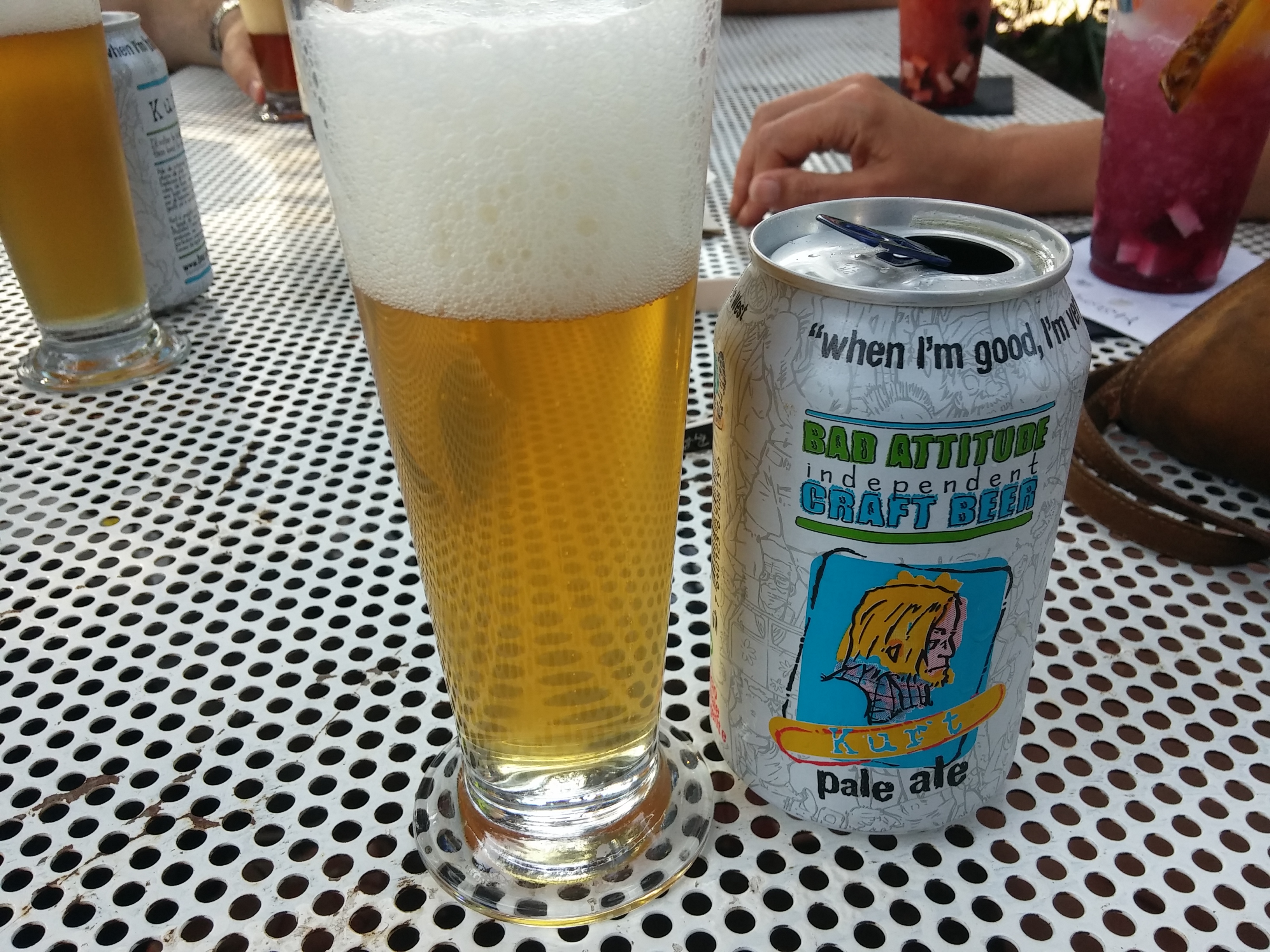
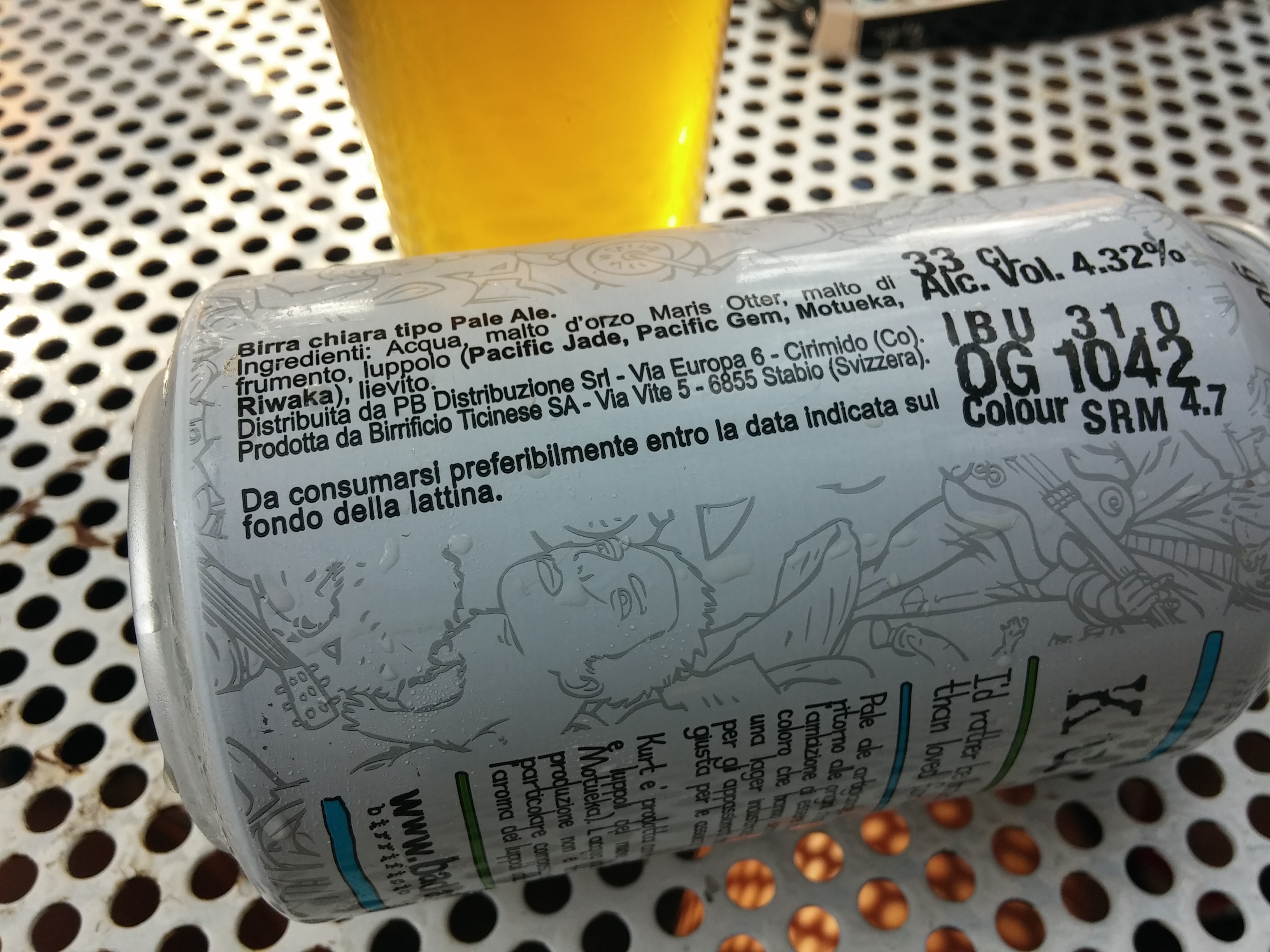
More recently I’ve encountered a couple of other interesting beers in cans. When we were in Rome a few weeks ago, hanging out at Tram Depot in Testaccio, I was drinking Steamer (7.6% ABV). But it wasn’t as good as I remembered: I appreciate its depth of flavour and body, but it’s not well-integrated and always seems to be over-carbonated. Its recipe needs some tweaking. So I wanted to try the other real beer they were offering, something not quite as strong (it had been a long day, a long hot day of boozing and eating). This turned out to be something called Kurt (4.32% ABV), and not Italian but Swiss. I didn’t even know Switzerland had a craft beer scene.

Kurt 1

It was nominally from a brewery called Bad Attitude. Aside from any irony inherent in this name, the Bad Attitude set-up is a bit confusing. It also seems to be Ticino Brewing Company (aka Birrificio Ticinese in Italian, as the Ticino is Switzerland’s predominantly Italian-speaking canton). Which also seems to be related to another brand, Birra San Martino. The latter’s site says they were founded in 2002, but have called themselves Birrificio Ticinese since 2010. They’re all at the same address in the town of Stabio, but I can’t work out why they exist as three brands.

As for the straw-coloured beer itself, it was a bit weird. Despite being made with two hops from one of my favourite parts of the world – Riwaka and Motueka, both places in the north of South Island NZ – and some great British Marris Otter malt, most of all I got a coconut flavour. It’s not that I dislike coconut especially, but I just didn’t like it in a pale ale flavour profile. I know some beers have coconut as an adjunct, but Kurt didn’t, so I’d guess it came from an ester, those chemical compounds that give beers so many diverse flavours and aromas.*

Kurt 2

Retro-futuristic
The most recent beer I’ve had in a can I drunk in the beautiful evening sun last night. This was Gamma Ray from Beavertown. This was the beer I’ve tried from this brewery, set up in London in 2011, and it was very enjoyable indeed.

I do love British APAs – they tend to have the decisive characteristics of the more aromatic US hops but balanced with our traditional love of beers defined more by their maltiness. In this case the hops were Amarillo, Columbus, Bravo and Magnum (“added in ever increasing amounts at the end of the boil and in the fermenter”), though the bitterness was surprisingly minimal, without any particularly dry mouthfeel. The beer was rounded out and sweetened with not one but three malts, Simpsons Best, Caragold and Caramalt. Excellent.

Gamma can 1

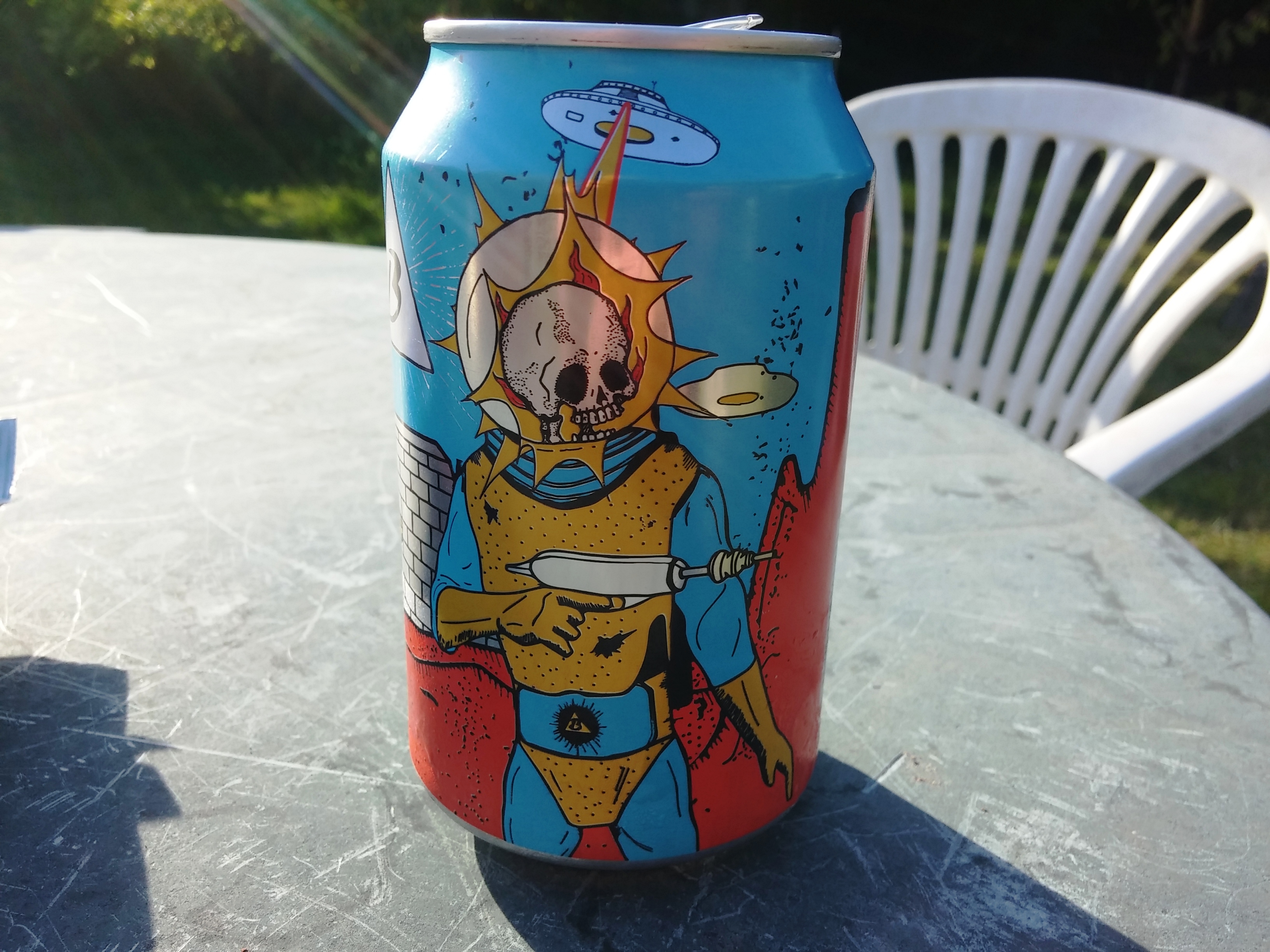
The experience was enhanced by the can’s awesome wraparound wide-screen design, a kind of retro-SF horror tableau of goldfish bowl-helmeted spacemen being zapped into skullfacedness by flying saucers. Love it. Indeed, on an aesthetic level, one of the great points about cans is how they design can go 360 like this, unlike with the traditional front and back labels of bottles.

Cans versus bottles
The main arguments for using cans, however, are more practical. Mostly made from aluminum, they’re simply a lighter weight material and as such involve much less energy when transported, compared to glass bottles. From both me lugging stuff home from Twenty One Wines in Brighton in a bag to massive trucks carrying it around on roads, or shipments moving internationally (something that’s arguably absurd given that beer is mostly water, but that’s another argument). Furthermore, a bottle, when used once, involves a lot more energy to manufacture and then recycle – assuming people bother to even recycle.

The other big argument for cans is that they protect the beer from light damage. The traditional brown glass bottle protects the beer from light damage to some extent, but for those companies that insist on packaging in green or clear glass, the beer will spoil, will get lightstruck when left in daylight. The UV causes a reaction resulting in what’s called “skunkiness” – that is, a chemical process creates a molecule that’s closely related to those in skunk spray.

As for the issue of the beer getting a metallic taste, so synonymous with cheapo bad lager, most cans used for beer these days have a thin inner lining so there’s no contact between beer and aluminium. Certainly all my recent experiences with “tinnies” have been entirely free of metallic hauntings and the ensuing teenage flashbacks.

So I’ll definitely be happy to drink real beer in cans now. Which is good, as it’s becoming increasingly common. This US NPR article quote says, “five years ago, just a few dozen craft brewers in the US were canning, while today there are more than 500.” So expect to see more here in the UK too.

Having said that though, probably 60 per cent of the beer I drink at home is from my local (800m away) brewery, Harveys. Their (brown) bottled beer is sold with a deposit, so I just take them back and they reuse them. But most people don’t have a local brewery with such an enlightened (nay, sensibly old-fashioned – we always did the same with milk in Britain when things were more localised) approach. So for the abovementioned reasons, there’s probably no reason to poo-poo cans any more. Even if you’re particularly hardcore about your real beer requirements. The Gamma Ray for example was in a can and unpasteurised and unfiltered.


* My friend Michele, a food scientist and brewer, suggests the coconut odour and taste may come from one of two chemicals: from the molecule d-Decalattone  (C10H18O2) or from an ethyl group of chemicals (–C2H5), which are derived from ethane (C2H6). Srangely, the latter can present with odours of coconut, or pear, or wine.

1 Comment

Filed under Ale, beer, Breweries, British beer, Discussion