Category Archives: Recipes

Burger buns with a twist

Beanburger with carrot and cumin bun

Over the past few years, the UK street food scene has improved markedly. Artisan producers, in part inspired by the US street food scene, have started producing real food from food trucks – a world away from the mechanically separated burgers, listeria buffets and industrial crap that has dominated here for so long.

The other day I was in Brighton and went to the Street Diner, a Friday street food market in Brighthelm Gardens, Queen Street, BN1. It started up exactly a year ago and is now operating Saturdays too I believe.

As well as various Asian and Middle Eastern-inspired food stalls, there was enough pulled pork, brisket and burgers to satisfy my carnaholic wife Fran and brother-in-law Al. No street food scene is complete without burgers of course. As much as I adore the form factor of a burger in a bun, I’m not a carnaholic, so went for something Middle Eastern. But the next day, back in Brighton to meet Fran, I thought she might be craving burger, so did some investigation into Brighton’s best.

Burgers in Brighton
This seems to be such an important subject, there’s even an entire blog dedicated to it (here). So yes, we couldn’t possibly hope to get to the bottom of the Brighton burger scene straight away, so just plumped for Troll’s Pantry. They’re one of the most established of Brighton’s burger outfits, emphasising a use of local ingredients and operating out of the Hobgoblin pub. Which is all well and good, but on a Saturday evening, the latter wasn’t exactly a joy. It felt just like some dodgy student pub from my uni years in the 1990s, stuck in grubby aspect. And even though they have half a dozen or so handpumps, most of them were off. Don’t they have any actually trained to change cask on their busiest night?

The burgers themselves were excellent though. They’re served, US-style, in a plastic basket and a brioche-style bun. Chips – or fries, if you must – extra. I had a veggie one, Gaea’s Bounty, that was tasty, and Fran said her beef job, the Imperial Swine, was excellent.

“All beef comes from Sussex conservation project, where the English Longhorn cattle lead a wholly natural lifestyle,” says the blurb on their site. “The beef is aged for 35 days before being ground into 100% steak patties.” So that at least compensated for the lame pub. Pity Troll’s Pantry can’t find a better place to ally with.

Brioche for breakfast not burgers
Anyway. The brioche thing. It’s had me scratching my head since I first encountered it in Rome, in a venue doing US-inspired burgers. I just can’t quite reconcile the use of brioche buns for burgers.

For me, brioche is quintessentially a breakfast bread. Enriched with egg, dairy and sugar, it lends itself to eating with jam, Nutella (god forbid), coffee and hot chocolate. I don’t get how it’s considered an appropriate partner for the salty, savoury experience that is burger patty and chips.

So when I wanted to make some bean burgers at home, I didn’t want to make brioche buns. I’ll save that for a weekend breakfast, thanks.

Good old Dan Lepard had a good option, a recipe in Short and Sweet, the book that collects his wonderful recipes from the Guardian. His burger bun involves carrot and cumin. And onion. And paprika. In the dough. Yes. Quite odd, perhaps, but it worked well.

In fact, the buns are, like brioche, made with dough enriched with milk, butter and egg. But rather than taking the dough into sweet, breakfast-appropriate territory, Dan takes it into savoury, burger-appropriate territory. With the addition of veg and spices.

If the addition of carrot sounds strange, just think how it helps make for delicious moist cakes. Dan, meanwhile, says, “The grated carrot and corn flour keeps these buns bouncy, soft and moist, helped by the hot oven and a short baking time.”

The original recipe can be found recipe here. The version in Short and Sweet is slightly differnt. Here’s my version,a tad tweaked.

100g milk
120g boiling water
15g fresh yeast
50g unsalted butter, melted
1 egg
100g carrot, finely grated
50g onion (ie a small-medium one), finely grated
500g strong white bread flour
50g cornflour (that’s cornstarch in American)
12g fine sea salt
1 t ground cumin
1 t paprika (I used smoked)
Water and sesame seeds to finish

Ingredients

1. Combine the boiling water and milk in a jug. You don’t want it too hot – if you have a thermometer, no more than body temp, or 37C.
2. Once it’s at a suitable temperature, crumble in the yeast.
3. Whisk the butter and egg into the liquid too.
4. Combine the flour, cornflour, salt and spices in a large bowl.
5. Add the liquid to the powders and bring to a dough.
6. Knead for a few minutes to clear (that is, bring it all together nicely), then leave, covered, for 10 minutes.
7. Give the dough another short knead, then leave for another 10 minutes and repeat. Do this once more.

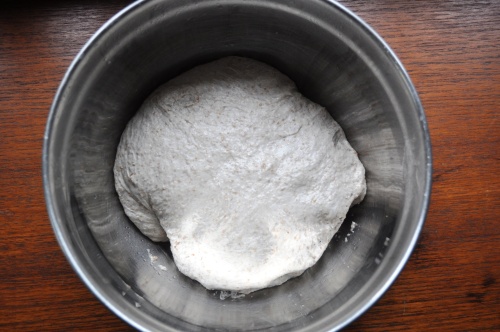
Dough before proving
8. Form a ball then leave to prove in a covered bowl in a draught-free spot.

Dough after proving
9. When the dough has doubled in size – how long this takes will depend on the temperature of where you leave it – take it out of the bowl.
10. Divide into six pieces. My dough weighed just over a kilo, so each ball weighed about 184g. You could make bigger or small balls depending on what you’re doing with the buns – are you making massive burgers or small ones?
11. Form the pieces into balls, put them on a baking sheet lined with parchment, and leave to prove up again.

Buns before baking
12. Preheat your oven to 220C (200C fan).
13. When the balls are plumped up – the original recipe says “until risen by half” – brush the tops with water and sprinkle with seeds.
14. Bake for about 25 minutes, until nicely browned.

Buns after baking
15. Leave to cool completely.

We had ours with some bean burgers. I like making bean burgers – you can basically just chuck beans and some stodge and whatever flavours and leftovers you have into a food processor. I used butterbeans, some soffritoed onion and garlic, some bread, a bit of mashed potato, some of the wild garlic and nettle pesto I made a massive batch of after a foraging walk on Sunday.

I’m not going to get into veggie vs meat argument here, as obviously a bean burger is a very different proposition to a real meat burger, lacking that juicy, bloody fattiness. But, like a meat patty, bean burgers can exploit the same satisfying format of condiments (in this case mustardy mayo) and additons (cheese, gerkins) all combined inside a bun. The chips here were actually just made from roasting raw potatoes.
3 Comments

Filed under Baking, Breads, Recipes

Frappe, chiacchiere, cenci, angel wings – sweet deep-fried pasta treats

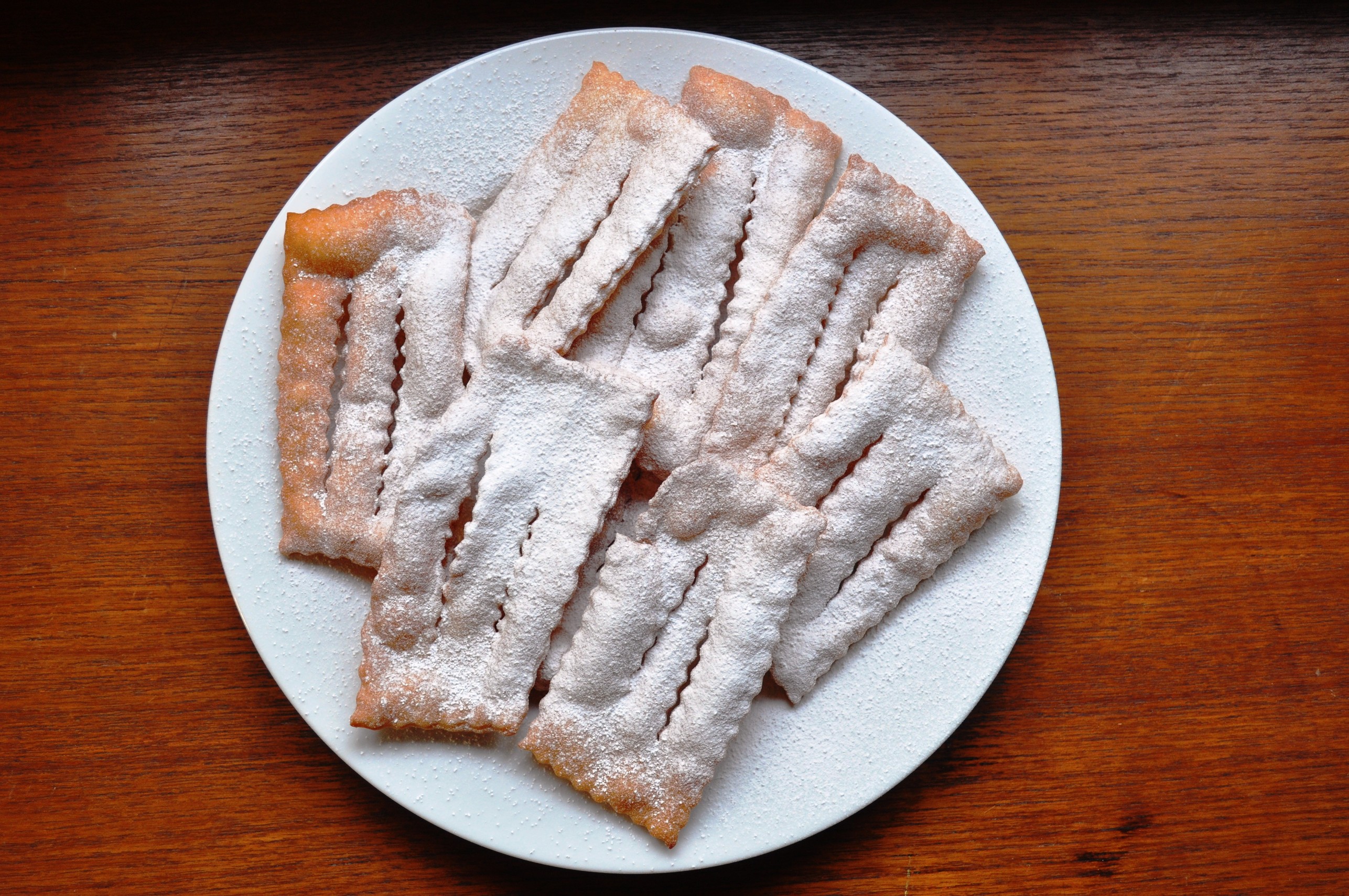
Plateful of frappe

One of the many things I’m missing about Rome is the pasticcerie – pastry bakeries, patisseries. Our old neighbourhood alone had four within about a hundred metres of each other, all independent, selling wonderful selections of handmade pastries. And what made these places a particular joy – for a baked goods geek like me – was watching their wares change over the seasons.

Particularly fun was the period of Carnevale, equivalent to our word carnival, and from the Latin to “take the meat away”. That is, stop eating meat for Lent, the period of Christian abstinence before Easter. In the Roman pasticcerie, Carnevale seemed to start pretty much immediately after Christmas and was heralded by the appearance of frappe and castagnole. For the two Carnevales we were in Rome, we indulged in these goodies extensively (check out here, here and here).

Plateful 2

Angelic chit-chat
I never tried making them though – there was little incentive when they were easily available. But now I’m home in Blighty, where proper handmade pastries aren’t quite so readily available. Plus, I was browsing Diana Henry’s book Roast Figs Sugar Snow and found her recipe for bugne ­– which are pretty much identical to frappe but from Lyon, France and take their name from the word beignet, another kind of sweet, dough fritter variable.

Bugne and frappe are simply deep-fried pieces of enriched, sweetened pastry or pasta dough* served dusted with icing sugar. Indeed, good ol’ Wikipedia – the dream of the internet incarnate – lumps bugne and frappe and may other similar international treats under the entry for “Angel wings”, which is presumably the US American English term, as I’ve not heard it in British English.

For me they’ll always be frappe as that was the name used in Rome, but even Italian has several other names for them, including cenci (“rags”) and chiacchiere (“chit-chat”).

So anyway, it’s technically Lent now, so I should have done this recipe a few weeks ago. But, well, I’m not religious and I just felt like some. Apologies to any devout Catholics who treat their seasonal gluttony proper seriously.

Frappe recipe

250g plain flour
1/2 t baking powder
30g caster sugar
Pinch of salt
Zest of half a lemon
25g butter, melted and cooled
2 eggs
1/2 t vanilla essence
1/2 T of liquor – grappa, brandy, rum, or whatever depending on your inclinations and what’s in your cabinet. We didn’t really have anything so I added a dash of vodka.
Oil for deep-frying (sunflower or similar)
Icing sugar for dusting

1. Sieve the flour and baking powder together into a bowl.
2. Add the pinch of salt.
3. Add the sugar and lemon zest.

Eggs
4. Lightly beat together the eggs, add the vanilla essence and liquor.
5. I could say “make a well in the centre….” but I’m not convinced you really need to worry about that unless you’re working directly on a work surface so simply add the egg mix into the flour mix.

Added together
6. Likewise add the melted butter.
Mixing

7. Bring together a dough. (You could do all this in a food processor, like making short-crust pastry, or in a mixer.)

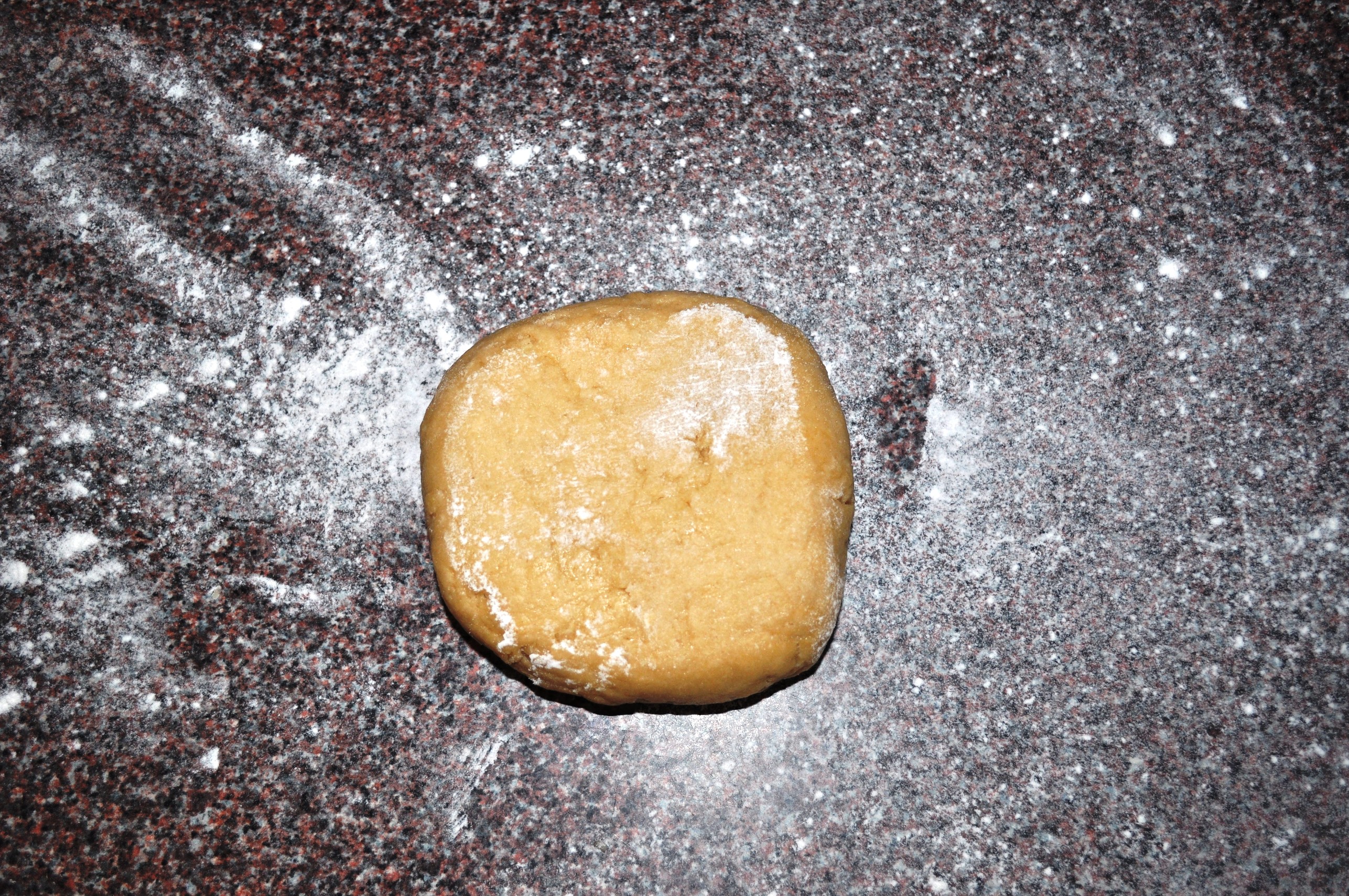
Ready to roll
8. Turn out the dough onto a lightly floured surface and knead for a few minutes until smooth and well integrated.
9. Wrap in plastic and leave to rest for at least half an hour in a cool, draught-free place.
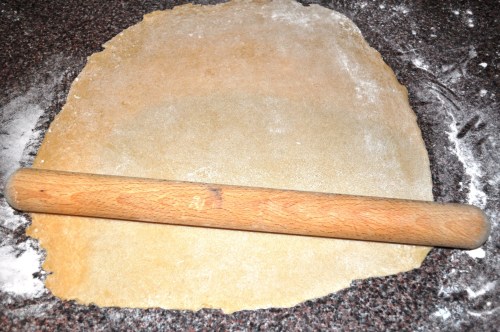
Rolled
10. Pin out the dough to about 1mm thick, maximum 2mm. You want them thin so they cook through and crisp up evenly. Ideally, roll it out with a pasta machine. We don’t have one.

Cut CU
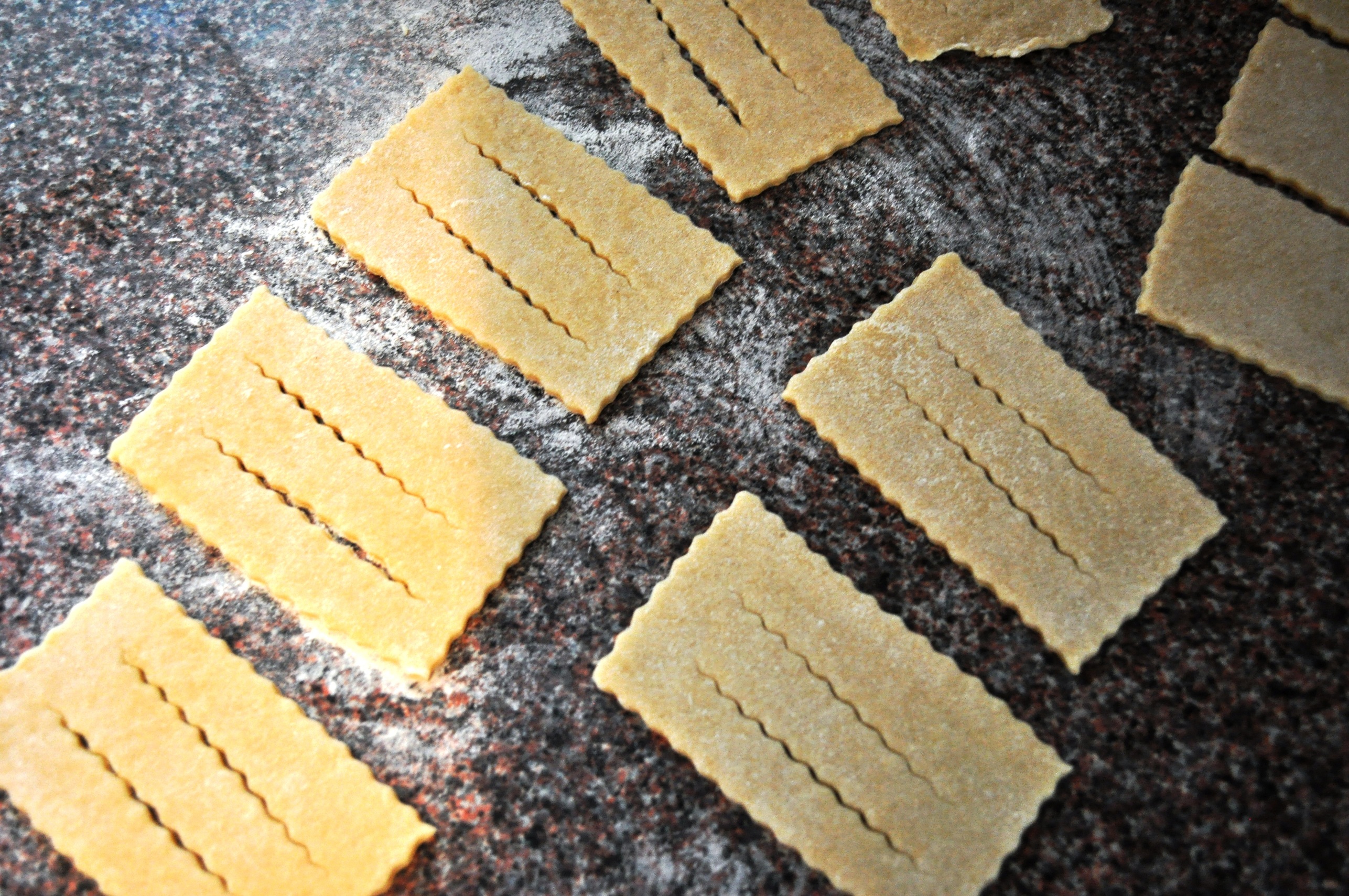
11. Cut rectangles about 5 x 10cm. If you have one of those little pastry wheels that gives a crimpedety** cut, perfect.

Cuts
12. Cut two slices within the rectangle. The difference between frappe and bugne is in the cut, nominally. With the bugne, you cut one slice and fold the piece of dough in on itself.

Frying
13. Heat the oil (to about 170C) then deep-fry the dough pieces a few at a time, until golden.

Cooling
14. Take out and put on some kitchen paper to absorb some of the fat.
15. When cool, arrange on a plate and dust liberally with icing sugar.

With hot choc
16. Enjoy, perhaps with a nice rich cup of quality hot chocolate.

After our record winter rains, we had a warm, sunny, dry March, very much spring. But now it’s turned cool and wet again, so I think we can do a bit more hot chocolate drinking before it gets too balmy to really enjoy that most delightful of hot drink. Current hot chocolate of choice is still Montezuma’s Dark, but local coffee-grinders Jaju also sell a very fine Columbia hot chocolate.

I found it very hard to stop eating these last night. So it’s probably better if I don’t make them too frequently.

* This dish really highlights the fine line between pastry and pasta.
** I am aware this is not a real word.

3 Comments

Filed under Other food, Recipes, Rome

Le Creuset-baked sourdough

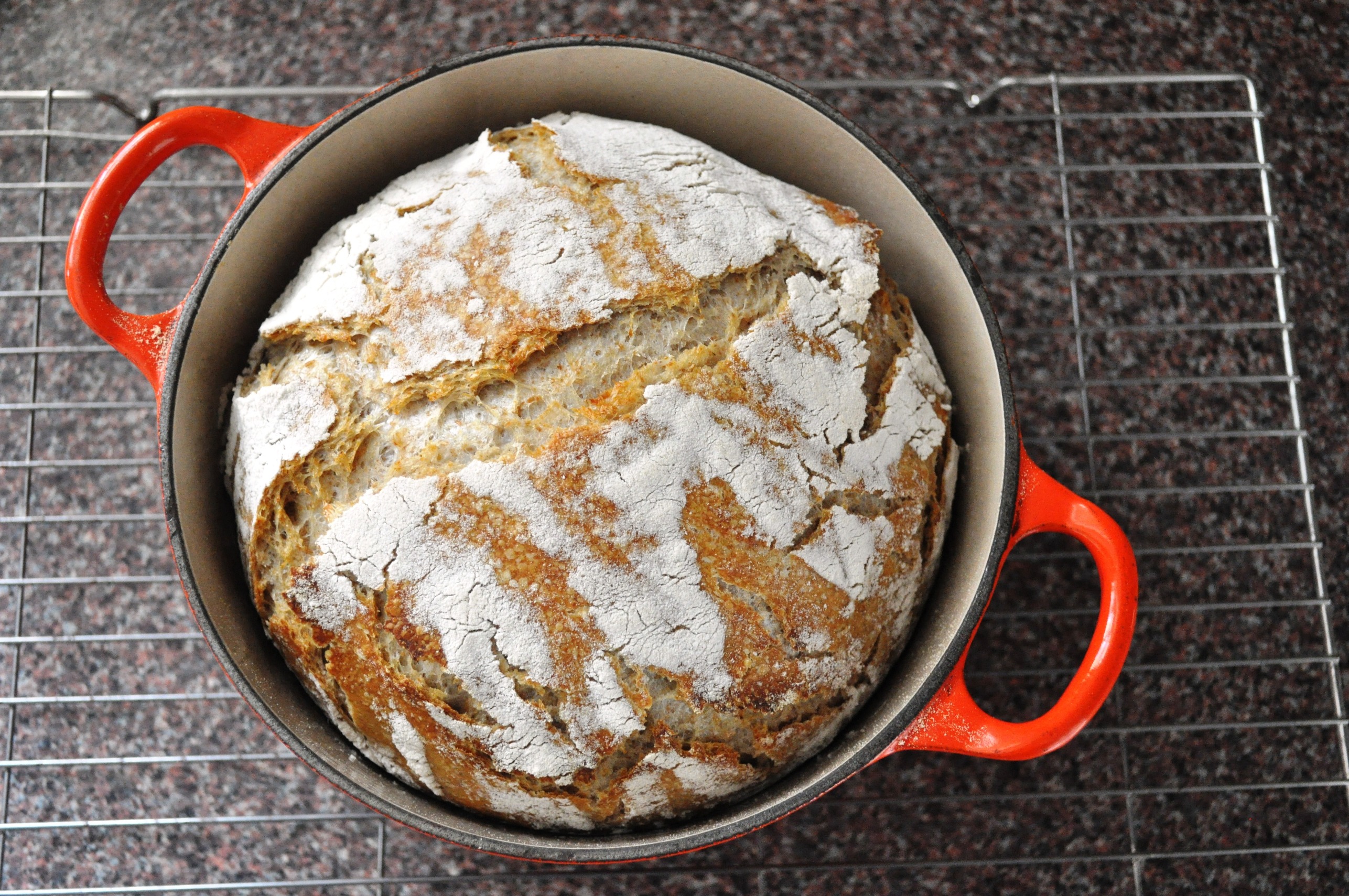
Sourdough baked in Le Creset, straight out of the oven

This is a technique I’ve been wanting to try for ages. Since last year, in fact, when still living in Rome. There, I encountered the blog of another ex-pat baking enthusiast, Krumkaker. She made several of her loaves in a casserole dish. It’s also a technique demonstrated by the ever-enthusiastic Vincent Talleu here.

I didn’t have my Le Creuset, or similar, with me while living in Rome, but now I’m home, I’ve found it. (Though we’ve lost a load of other baking kit in our double move. Particularly sad is the loss of an Eiffel Tower-shaped cake mould Fran bought in Paris with our dearly missed late friend Sara.)

Anyway. I’m not sure baking in a cast iron casserole, or Dutch oven, or Le Creuset, is a Scandinavian technique. It’s likely something that just evolved before Europeans had ovens, and would bake in pots, initially earthenware.

Cracks

On the road
The only other time I baked in a Dutch oven was in New Zealand, 1989, when I was on the road with my old friend Stephen McGrath, his Clydesdale horses and an elaborate caravan of wagons and carts. I made an enormous, heavy-duty loaf in a massive Dutch oven, baking it in the embers of our campfire.

Me driving wagon through Westport, New Zealand, 1989

The logic of baking in a casserole dish is that the cast iron is not only nice and hot – you preheat it – it also traps the moisture of the dough, effectively steaming the bread as it bakes.

Steam is how you get a crisp crust on bread, and can be difficult to create in a domestic oven. Professional baking ovens have steam injectors, but domestic techniques using misting sprays or trays of water are never quite as good. I can’t remember the qualities of my campfire loaf all those years ago (25!!!), but certainly this loaf has a lovely crust – though it wasn’t the crispest I’ve managed over the years in a domestic oven.

It also has a very satisfying shape, and the dish constrains any dough flow if I hadn’t moulded the ball well enough. (I hate it when I make a round free-form loaf, forming the dough into a ball, then it flows out into a discuss shape when it take it out of the proving basket; shaping nice tight balls can be surprisingly tricky.)

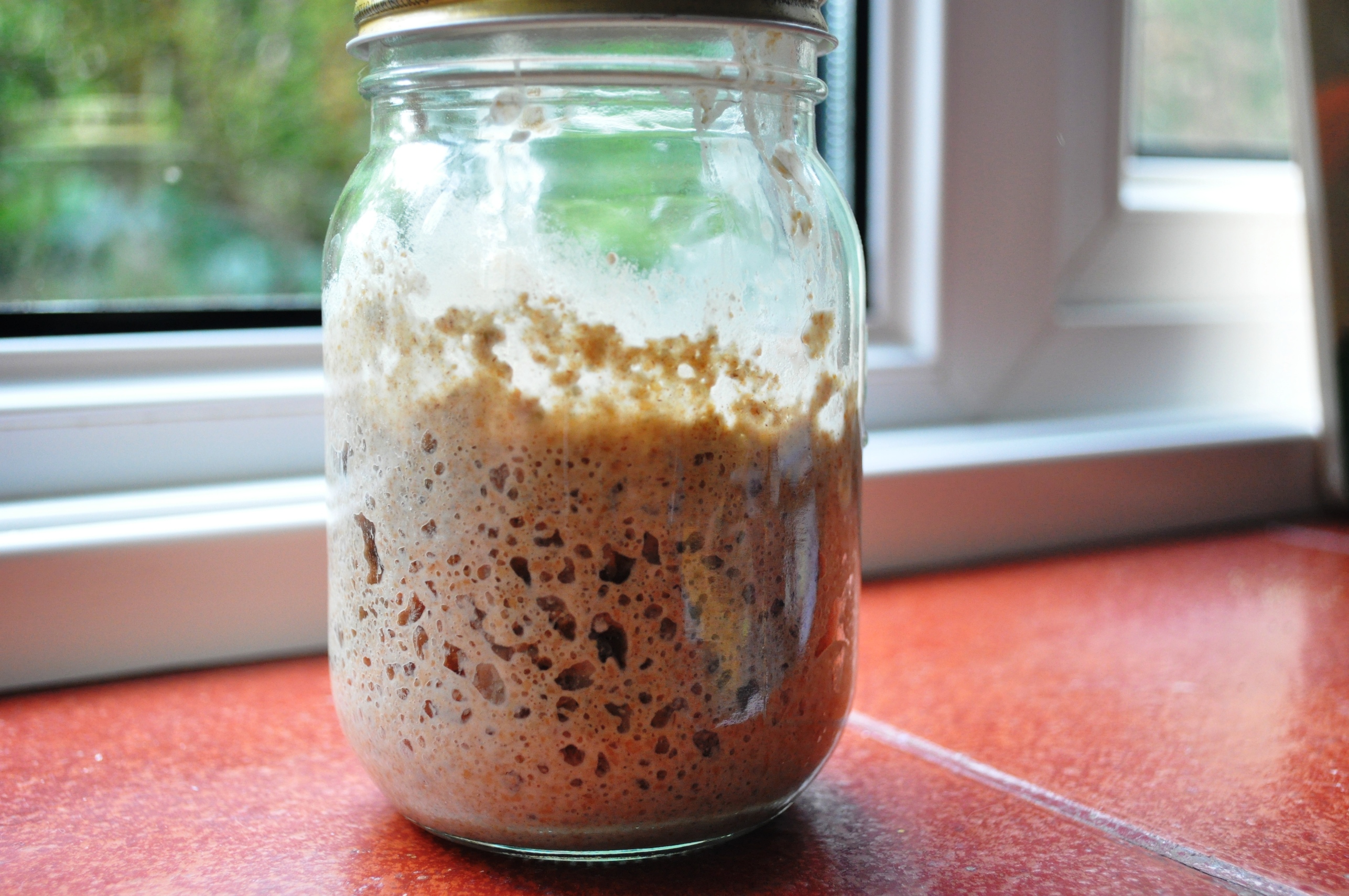
My leaven / sourdough starter, healthy again

Rude health
This loaf is also my first sourdough for a while. Although I’ve been making most of my own bread since we got back to England at Christmas, I’ve been neglecting my leaven somewhat.

Now about five years old, my leaven is well-travelled and much changed. It was born in London, then moved to Sussex, then it moved to Italy with us. There, it was fed on many and varied Italian flours – wheat, rye and various things referred to by the much misunderstood term farro.

Then it moved back to Britain. And I abandoned it for a few months. While we visited friends and family in the US and NZ, the sourdough lodged with my mother. Who’s a great cook, but not a bread-maker – she’s doesn’t make bread with easy yeast, let alone have any experience with sourdough.

So the past few months I’ve been nursing it back to health. I fed it rye, and local stoneground wheat flour, and filtered water. Finally I introduced some other leaven, from third generation baker Michael Hanson of The Hearth in Lewes. This could be seen as cheating, but I see it more like a kind of marriage. The yeasts and bacteria in my (puny) leaven mixing with those in Michael’s leaven. And after weeks of TLC, it’s finally back in rude health.

Mad science
As with much of my bread-making, this is kinda experimental, not a recipe as such.

I made a sponge with:
300g water
80g wholewheat leaven (at 100% hydration)
200g strong white bread flour
All mixed together, and left, covered with a shower cap – another technique I learned from Krumkaker.

I left it all day, for about seven hours, while I went off and worked in The Hearth.

In the evening, I made up a dough, with a further:
100g white bread flour
150g wholemeal wheat flour
10g salt.

I gave it a short knead, formed a ball, then let it rest for about 10 minutes. I then gave it another short knead, another 10 minute rest, and repeated this a few more times. I then left it an hour, at room temp (about 18C). I then gave it a fold then put it back in the bowl, covered it, and left it in the fridge overnight (4C).

Dough

In the morning, I gave it another fold, resting it at room temp for another hour, then formed a ball, rested it 10 minutes, tightened up the ball, then put it in a basked and gave it a final prove in the airing cupboard (about 24C).

Final prove

I then preheated the oven to 250C, with the Le Creuset inside. After about 20 minutes, with the oven at heat, I turned the well-floured dough out of the proving basket and dropped it into the hot dish – taking care not to roast my knuckles. I didn’t slash the top –  because I wanted to see how it cracked. Or because I forgot.

Before baking

The lid went back on and I baked it for about 25 minutes at 220C. I then took off the lid, dropped the temperature again to 200C, and baked for another 20 minutes or so.

Cut

The results were good. The crust is more chewy than crisp, the crumb soft and moist. We had some for dinner, when I did wood pigeon breasts with a pancetta, thyme and juniper berry red wine sauce. We didn’t eat all the meat, so Fran used the leftovers for a sandwich for work, with a smear of wild garlic sauce. I bet no one else had that posh flavour combo sarnie* for their work lunch today.

Sandwich


* Any US readers, “sarnie” is British English – possibly even English English – slang for sandwich.


27 Comments

Filed under Baking, Breads, Flour & grain, Recipes

Brazil nut, maple and white chocolate blondies

White chocolate maple Brazil nut blondies

If you’re a baking obsessive and have a bit of a sweet tooth, you’ll know that feeling when you just have to have something sweet and homemade in the house. Call it a sugar addiction, but I prefer to think of it as enthusiasm. (I’m not allowed to say I’m passionate about it though, as that’s Fran’s linguistic bugbear du jour.)

The other day, I was heading home, thinking, Damn, we’ve eaten all the last batch of cookies. I fancied something chocolately, and while some chocolate cookies are quick to knock out and conventional brownies are  easy to make (I normally use a no-nonsense Stephanie Alexander recipe I’ll post here one of these days), I thought I’d veer towards blondies instead.

For those who haven’t encountered them before, blondies are like brownies – a gooey, sweet, tray-bake – but are light in colour and flavoured more by the sugar (something rich like Demerara), and not by cocoa and dark chocolate.

White chocolate maple Brazil nut blondies

Here’s what I came up with.

75g unsalted butter
100g Demerara sugar
80g maple syrup
75g plain flour
1 t baking powder
2 eggs
1 t vanilla essence
100g brazil nuts
100g white chocolate

1. Preheat the oven 180C (160F fan).
2. Grease and line a square or rectangular baking tin. I used a 22cm square.
3. Melt together the butter and sugar, until the latter is starting to dissolve.
4. Add the maple syrup to the butter and sugar and remove from heat.
5. Sieve together the flour and baking powder.
6. Beat the sugar-butter mixture into the flour.
7. Beat the eggs and vanilla into the mixture.
8. Coarsely chop the nuts and white chocolate and stir into the mixture.
9. Pour the mixture into the baking tin and smooth.
10. Bake for about 20 minutes. As with brownies, you don’t want to over-bake blondies, you want them to retain some moisture and squidge. Exact cooking time will depend on your oven.


2 Comments

Filed under Baking, Cakes, Recipes

A pond pudding – Sussex or otherwise

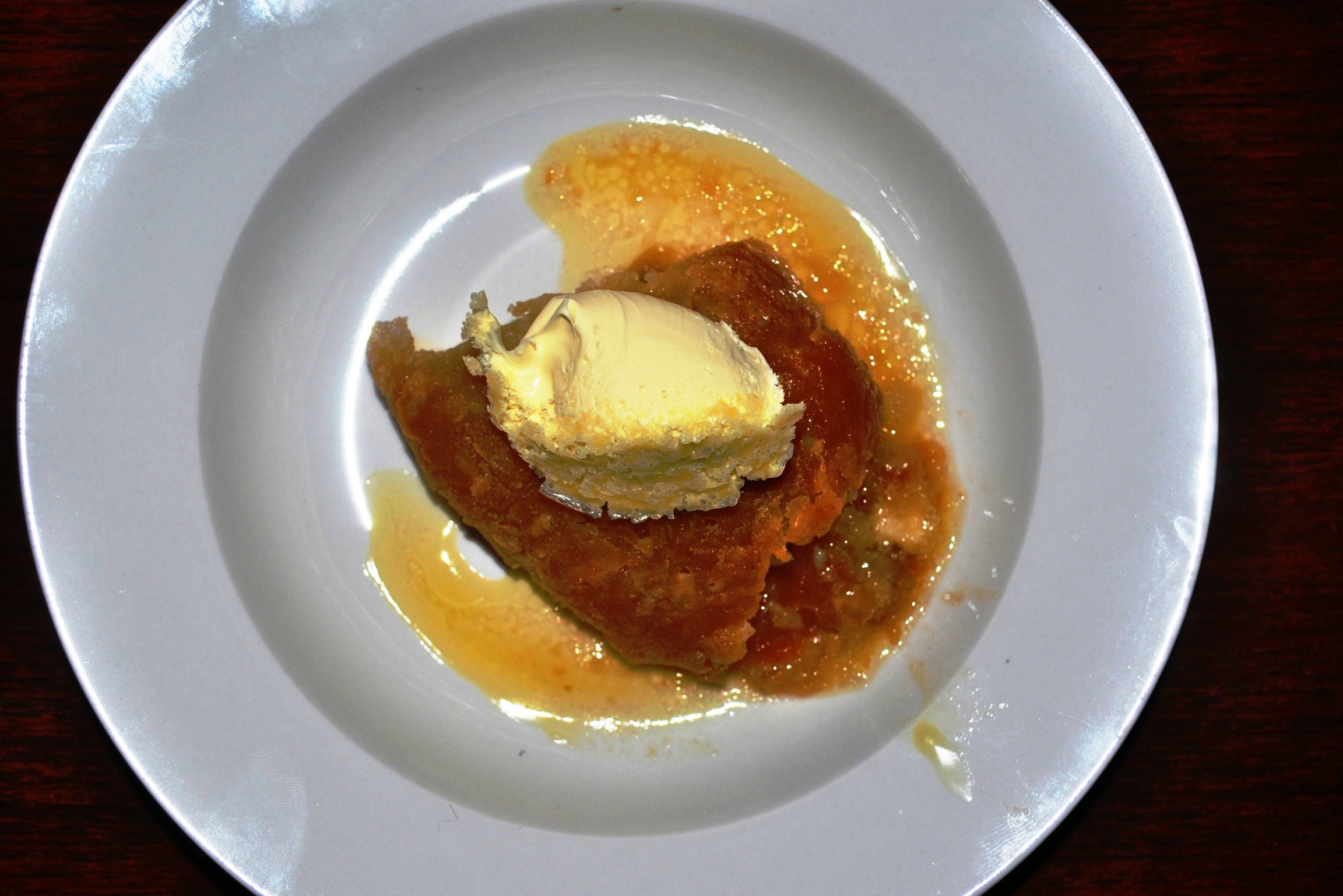
Sussex pond pudding with clotted cream

This was the first nominally, specifically Sussex-in-origin recipe I tried, years ago, when I first bought the ‘The Pudding Club Cookbook’* by Keith and Jean Turner.

In their intro to the recipe (I do like a bit of blurb), the Turners say “Some brisk correspondence exists in the archives over this pudding. Purists declare the edition of a lemon to be the ‘twentieth-century whim of a seriously misguided cook,’ and furthermore ‘the pudding dating from the seventeenth century is served with roast Southdown lamb, and the pudding crust dotted with currants, the centre oozing with butter and sugar’.”

Further variables are recorded. The version in Hannah Woolley’s ‘The Queen-Like Closet’ (1672) has it made with a whole apple inside instead. Certainly apples would have been easier to source, and afford, for many 17th century cooks.

MK Samuelson’s ‘The Sussex Recipe Book With a Few Excursions into Kent’ (originally published 1937, reprinted 2005) does corroborate that the recipe was made without lemon and with currants. Ditto Florence White’s ‘Good Things In England’ (originally 1932), which lists another recipe early 20th century version that involved currants and no lemon. Though the inclusion of currants was vehemently denied by a Wikipedia contributor who said this made it a Kentish pond pudding. (I’ve revised that Wikipedia page.) The lemon seemed to arrive in the recipe in the mid-20th century, with some crediting it to Jane Grigson’s ‘English Food’ (published 1974). “The genius of the pudding is the lemon,” which would be fairly immodest if it was her innovation.

Such is the nature of debate about historical recipes. And, as I’ve said before, surely any dish is going to be mutable depending on season, availability, what’s in your cupboard, what your family prefers, what your family can afford, how your granny did it, etc.

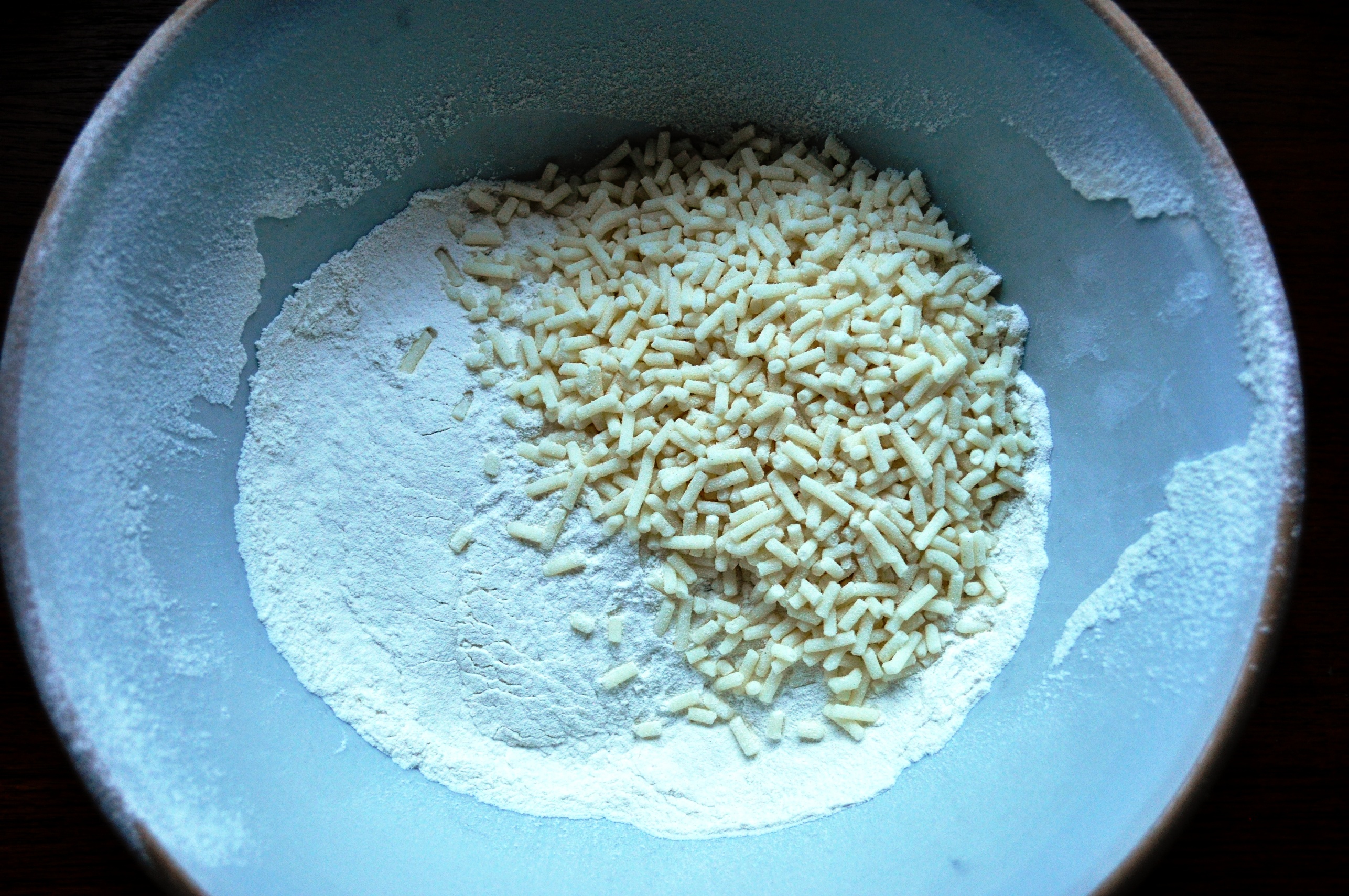
Pond pudding - flour and suet

A pond of sugar and butter
Suffice to say, the word “pudding” traditionally referred to boiled items that, in Medieval cooking, could feature dried fruits, meats, spices, sugar and spices. This hybrid of flavours isn’t common in English cooking these days though I discussed the whole relationship between pudding and sausages, etc, over here.

Retaining the legacy of meat products in puddings, the fat used for the pastry or dough of  English puddings of a say 19th century and later traditional, when they had evolved into something sweet, was likely suet. Suet is raw animal fat from around the kidneys of cow or, less commonly, sheep.

These days a pond pudding is most likely to be sweet. I would say that what defines a pond pudding is an oozing of buttery sugary sauce, which gestates inside the crust while the dish is steaming and streams out when the pudding is upturned and cut for serving. The Samuelson recipe calls for 1/2 lb (225g) to 1/2 lb of Demerara sugar. I’ve used a little less.

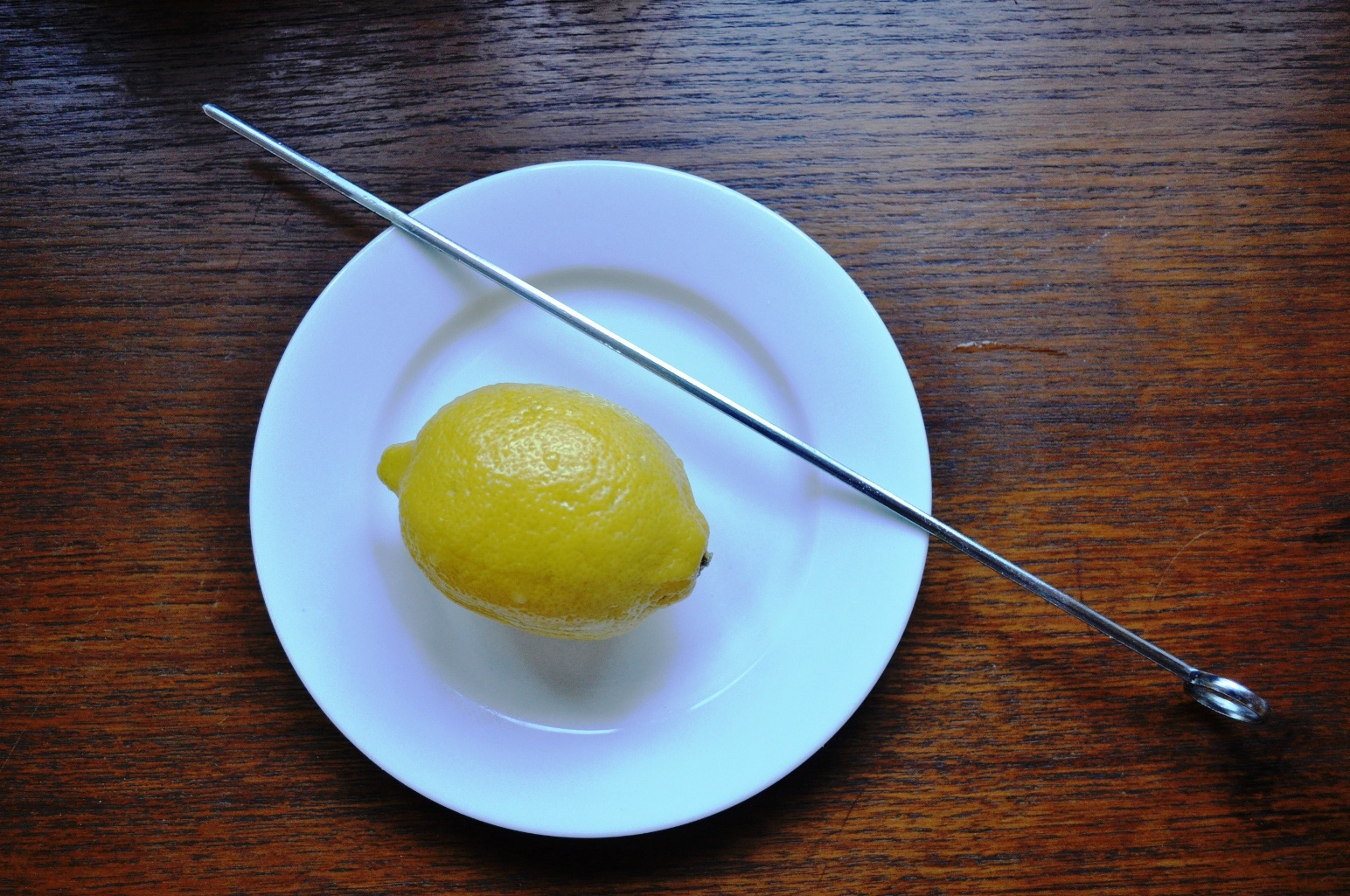
Sussex pond pudding lemon and skewer

Recipe
250g self-raising flour
Pinch of salt
120g shredded suet**
140ml milk and water, mixed. Don’t worry too much about the proportions.
120g butter
120g Demerara sugar
1 lemon

1. Grease a 1 litre (2 pint) pudding basin. The original recipe called for a 2 1/2-3 pint basin, but I found this too big.
2. Sieve the flour and add the pinch of salt.
3. Add the suet to the flour, then bring to a dough, using a knife, by slowly adding the milk and water mix. Don’t add too much, as you don’t want a sticky dough.
4. Turn out the dough and work to bring together into a ball.
5. Roll out the dough to about 6-8mm thick, in a roughly circular shape.
6. Cut a quarter out of the dough, and form this back into another small ball.
7. Line the basin with the 3/4 portion of dough, bringing the edges together and sealing them using a little more of the milk and water mix, or just water.

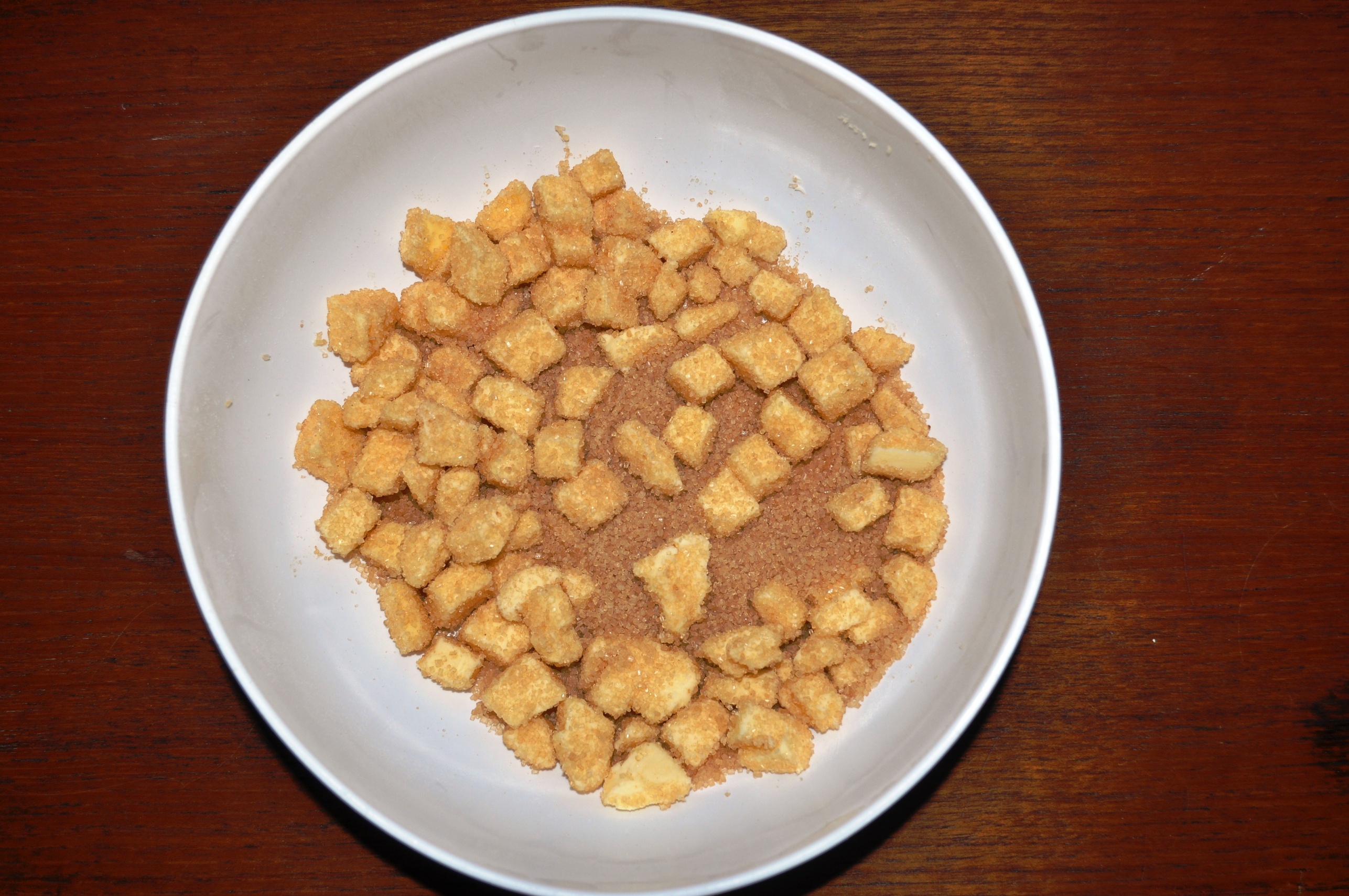
Sussex pond pudding, butter and sugar
8. Cut the butter into small cubes, and mix with the Demerara.
9. Put half the butter and sugar mix in the basin.
10. Prick the lemon all over with a large skewer then put this in the basin.
11. Cover the lemon with the rest of the butter and sugar mix.

Sussex pond pudding
12. Roll out the final portion of dough and use it to create a lid, closing up the sides, again, dampened with some milk and water or water.
13. Cover the dish tightly. I generally do this with foil, with a pleat in it, though you can use baking parchment, and tie it off.
14. Steam the dish for about 3 hours. I do this in the top of a vegetable steamer, but you can also sit the dish directly in simmering water in a large saucepan. Make sure the saucepan doesn’t boil dry.
15. When cooked, remove the cover and turn the dish out onto a plate with enough of a rim to collect all the butter lemon sauce that flows out.
16. Serve with cream, ice cream or custard. We had clotted cream.

Pond pudding, before steamingPond pudding, after steaming

Apparently, Heston Blumenthal was inspired by this type of pond-pudding-with-a-lemon-inside to create a Christmas pudding with an orange inside. I don’t see any reason why you shouldn’t do this recipe with an orange inside either. Or indeed add currants to the crust paste. As long as it gushes butter and sugar, you’ll have your own bespoke pond pudding.

Sussex pond pudding

* The Pudding Club, “‌est. 1985”. Their recipe book was revised in 2012 and is now published as Great British Puddings. Strangely there’s a maternity-wear brand that’s nicked the same name, muddling the British desert curator’s Google viability. Ma dai! Come on! Give over!

** I do eat some meat, but only good quality local, free range products. So here I used vegetable fat suet as I’m struggling to find good quality, non-industrial versions of both suet, and lard, as used in my previous recipe. It’s funny, as the real food movement, and all us (middle-class) consumers, have made sure good quality, free range and/or organic meats are commonplace these days, but lard or suet from well-husbanded animals is less available. Strange really, as you’d think if a farm was rearing free range pigs, it’d have some free range lard. Ditto farms with well husbanded cows – what happens to all that kidney fat? Of course using vegetable fat suet is also ethically problematic as it likely contains some portion of palm oil, and palm oil is notorious for being grown on plantations created in cleared and burned tropical rainforest, one of planet earth’s most important types of ecosystem.

1 Comment

Filed under Recipes

Sussex plum heavies

Sussex heavies, plum heavies

Seeing some Eccles cakes in Lewes got me thinking. Lewes, SE England, is a long way from the Eccles cake’s origins: Eccles, in Greater Manchester (and formerly Lancashire), NW England.

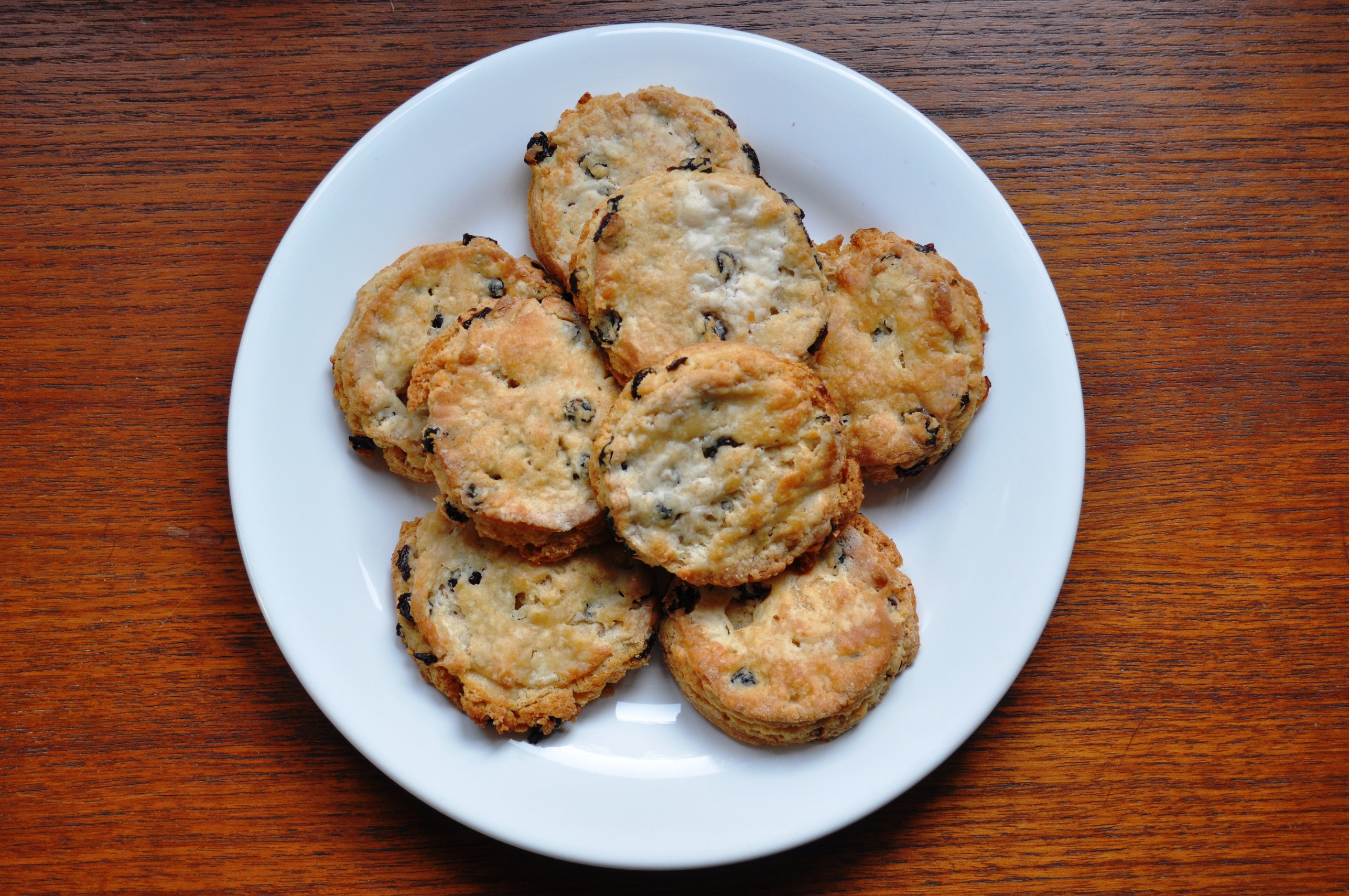
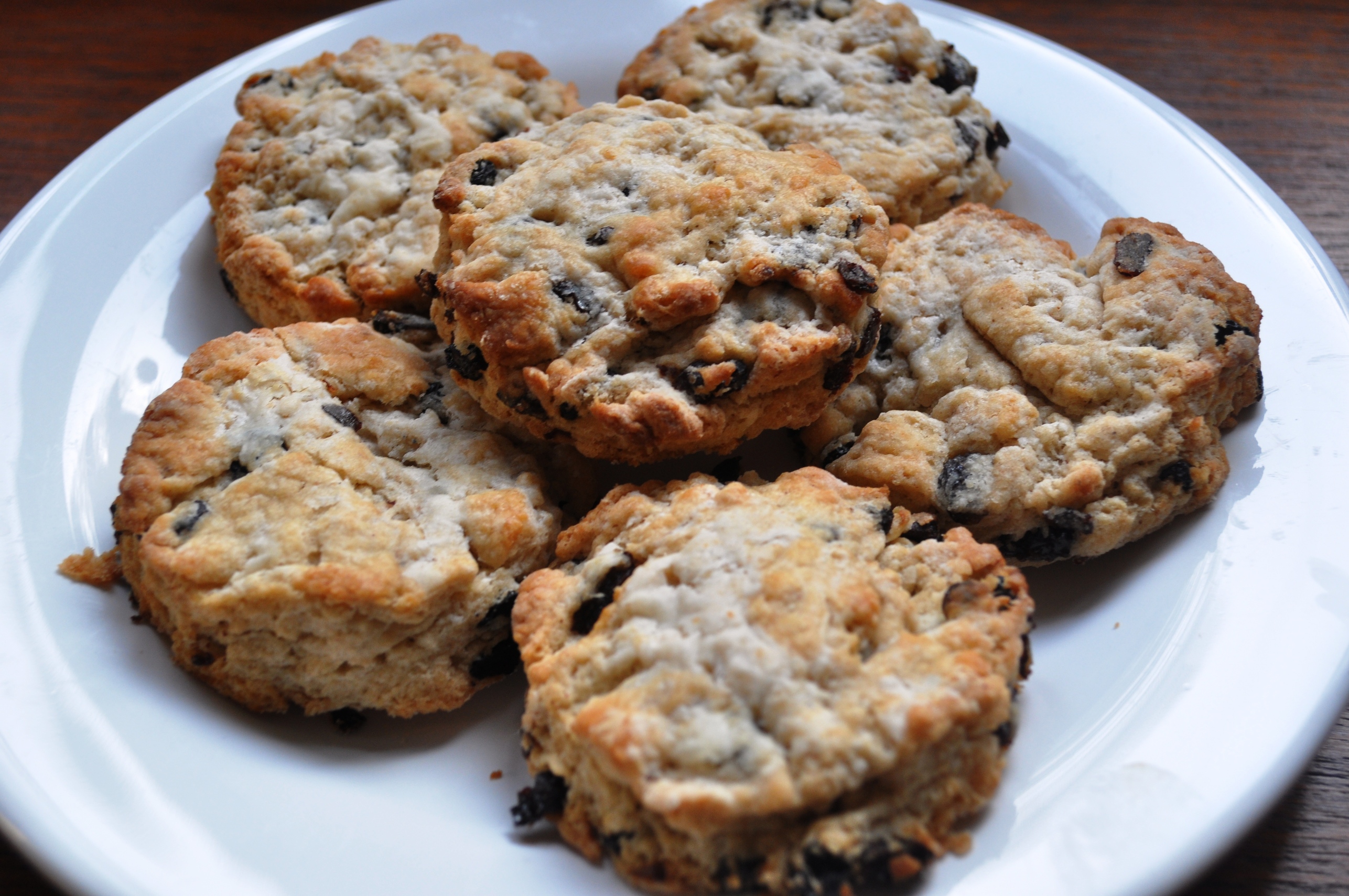
Why have these small cakes, made with flaky pastry and a currant filling, become commonplace in England when so many other traditional, regional products are virtually forgotten? After all, there’s nothing terribly unique about a product made with flour, sugar, fat and dried fruit. Indeed, other variables not unlike the Eccles cake include the Banbury cake* (Oxfordshire), the Chorley cake (Lancashire) and even the Cornish heavy, which has a distinctive criss-cross pattern on top. Furthermore, surely there’s a Sussex equivalent?

A quick Google lead me to Sussex heavies, aka (as I understand it) plum heavies. Which may once have been made with dried plums (prunes) but seem to have evolved into yet another variation the small curranty pastry-cake.

I’ve never seen these in a bakery, in Sussex or elsewhere. Maybe some places still make them, but I doubt it – a Google image search for “plum heavies” brought up one image when I wrote this, but that site has subsequently died. If they were more of them out there, I’m sure today’s baking enthusiast foodie bloggers would have posted more about them.

Fat and flour

Pastry archaeology
So investigating them is a form of archaeology. Reading about them and planning a recipe is like an archaeologist looking at bones and fabric scraps and trying to envisage what the person must have looked like. You can’t ever be sure, and any idea that what I’m doing here is “authentic” is a bit silly.

It’s particularly tricky in this case as there seem to be various different interpretations. Such diversity is not unusual with any traditional recipe of course, but quite often, as with Eccles cakes, the simple fact of their popularity, and their larger-scale production, means they have become more standardised.

Flour, fat, currants, sugar

Elizabeth David’s ‘English Bread and Yeast Cookery’ put me on to another book called  ‘Sussex Recipe Book, with a Few Excursions into Kent’ by MK Samuelson. Although originally published in 1937, I’ve acquired a 2005 reprint. It contains two different recipes, acquired from a pair of 1930s Sussex ladies, one for “Sussex plum heavies” and one for “Plum heavies”. The former is simply “dough”, lard, currants and brown sugar worked together and formed into buns. The latter is much more like a scone, with lard and butter rubbed into flour, with sugar and raisins added, and a dough formed with milk. They’re rolled, cut into rounds, brushed with milk and baked.

“You have got plum-heavies for tea”

Other information suggests heavies were snacks for outdoor workers like famers and shepherds, as well as for children. Recipewise says “they were also commonly given out at Halloween to trick or treaters”, but I’m dubious. Trick or treating wasn’t a widespread English activity before recent commercial cash-ins on the US tradition (though arguably that had its origins in Celtic culture).

Recipewise does quote another nice source though, an 1875 Lewes publication with the wonderfully Victorian title of ‘A dictionary of the Sussex dialect and collection of provincialisms in use in the county of Sussex’ by Rev.WD Parish, vicar of Selmeston, Sussex. The full text includes this definition of the plum heavy: “A small round cake made of pie-crust, with raisins or currants in it.” It also includes this anecdote: “Dr JC Sanger, of Seaford [Sussex], when Government Surgeon at the Cape of Good Hope, was sent for to see an English settler. Reaching the house at tea-time, he joined the family at their meal, and on sitting down to the table he said, ‘You come from Sussex.’ ‘ Yes,’ was the answer, ‘from Horse-mouncies (Hurstmonceux), but how did you know that?’ ‘Because you have got plum-heavies for tea,’ said the doctor, ‘which I never saw but when I have been visiting in Sussex.'” (p88).

Sussex heavies, plum heavies

Anyway, all sources online agree they were called heavies as they were dense concoctions made with plain flour, quite possibly in the form of leftover scraps of pastry. In some modern recipes they’re more like a scone, in others more like an Eccles cake, with the paste given extra flakiness by the use of lard ­– a key cooking fat in traditional English baked goods, despite how out of fashion it may be now. I found a few recipes that even involved some basic lamination. So that’s what I’ve based mine on. And I’ve used self-raising flour, to make them slightly less heavy heavies.

Recipe

225g self-raising flour
1/4 t salt
85g lard
85g butter [170g fat, total]
100g currants
50g soft brown sugar
100g milk, QB
Beaten egg to glaze

Method
1. Sift together the flour and salt.
2. Cut the fats into small pieces, or even grate it coarsely.
3. Rub 50g of the fat into the flour.
4. Add the currants and sugar and, using a palette knife, bring together with milk. Don’t pour all the milk in at once – use just enough to combine. What Italian recipes call QB, quanto basta, “how much is enough”.
5. Turn out the dough onto a lightly floured surface and knead lightly. Like with pastry, if you overwork the dough, it’ll toughen up.
6. Form a rough slab and roll it out to form a rectangle about 30 by 12 cm.

Rolling out
7. Flake one-third of the remaining fat (40g) over the bottom two-thirds of the dough.

Adding fat
8. Fold the un-fatty top third down onto the fatty middle third, then fold the fatty bottom third up.

First fold
9. Rotate 90 degrees then roll out again to about the same size and repeat the process with another 40g of fat.

Second fold
10. Give it one final fold in the same way with the last 40g of fat.
11. Wrap the dough in plastic and leave to rest in the fridge of about 45 minutes. More won’t hurt.
12. Preheat the oven to 200C (180C fan).
13. Roll out the dough about 6mm thick
14. Cut out 6.5cm rounds. (Or whatever size round cutter you have. This is all I could find. Lost loads of kitchen stuff in our double house move, including a large portion of Fran’s cookie cutter collection. *weep*.)

Cutting rounds
15. Place on baking sheets (greased or lined with parchment) and brush with beaten egg. Or milk, which is easier.

Before baking
16. Gather the scraps and roll out again. Cut more rounds, until you’ve used all the dough.
17. Bake for about 15 minutes, or until a nice golden brown.

Baked
18. Cool on a wire rack.

This recipe, with a 6.5cm cutter, produced about 14 rounds, then another 8 or so from the scraps. The ones made from the scraps rerolled have a slightly different consistency. The first rolling retains the lamination, but recombining then re-rolling the scraps mean it will be shredded. These ones, however, are probably more like the historical Victorian Sussex heavies, simply made with pastry scraps, some fruit and a sprinkle of sugar. Both are yummy, short, flaky and not too sweet.

Sussex heavies

A very enjoyable bit of food archaeology. Now I just wish some 90-year-old Sussex native would see this and reply with a description of the real things they ate as kids.


* The April 2014 issue of ‘Great British Food’ magazine has this intriguing story: “It’s possible that the recipe for Banbury cakes was brought to England by crusaders in the 12th century – a similar type of cake is known to have existed in Syria at the time, and the soldiers would have been able to acquire dried fruit and spices at a reasonable prices.” It’s a credible theory, as Midle Eastern delights like baklava and ma’amoul are in the same broad family of sweet-pastries-filled-with-dried-fruits-and-nuts. As are fig rolls, an industrialised incarnations of an (ancient) Egyptian pastry.

14 Comments

Filed under Cakes, Recipes

Buckwheat pancakes with rhubarb maple compote

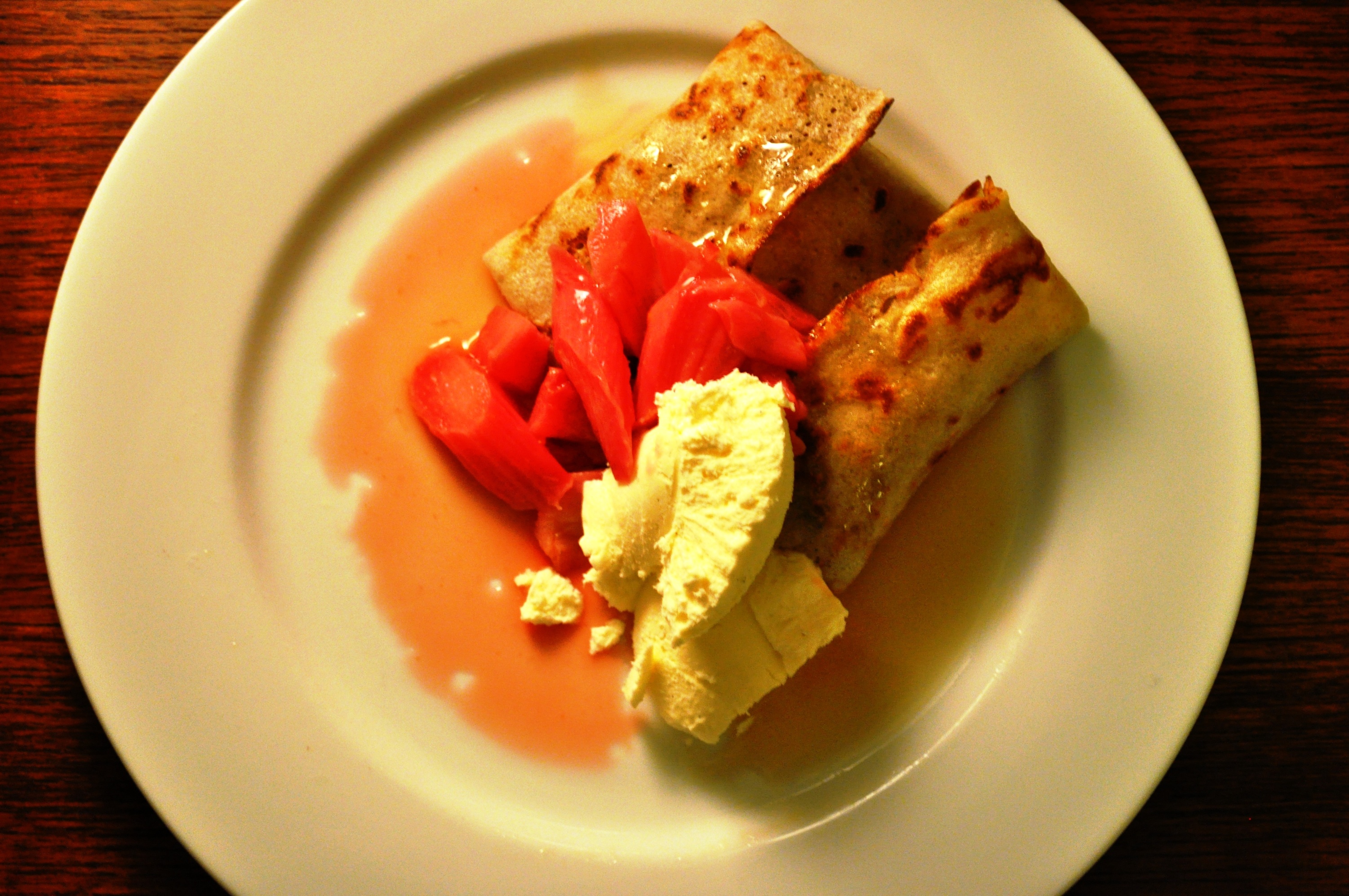
Buckwheat pancakes with rhubarb compote

This is one of those dishes that’s pleasing on a number of levels: it tastes good, it’s a take on a feast day speciality, it features seasonal produce, and the two principle components are even botanically related.

In fact, it was delicious, the compote featuring a variety of sharp and sweet flavours, which I tempered with some vanilla ice cream (though clotted cream, or crème fraîche, or mascarpone, or even custard, wouldn’t have been bad either), while the pancakes were satisfying and simple. The buckwheat flour I used from Dove’s farm was surprisingly pale and the pancake batter was not unlike one made with a plain white wheat flour.

Pancakes

Pancake Day
So yes, it was Pancake Day (aka Shrove Tuesday, Mardi Gras, Martedi Grasso etc, the start of Lent). Fran wanted buckwheat pancakes, and her usual filling of ham and gruyere. I wanted something meat-free, so did a kind of celeriac and cauliflower cheese (as both veg are in season).

The past few springs, I occasionally saw rhubarb on the market in Rome, where it was an expensive imported delicacy. Being back in Blighty, I fancied some for dessert pancakes – and it’s in in season at the moment. Sort of. It’s forced rhubarb that’s available, with the growers in Yorkshire enticing the pink stalks out of the nutritious soils of their dark sheds. Heated sheds, so it’s not like it’s the most eco of crops, but traditionally it was important as a means of providing some “fruit” in British markets in an otherwise lean period. It’s certainly wonderful stuff, with its pink palette and sharp flavours. And forced has the edge on outdoor grown rhubarb, which comes into season in April and lacks the delicacy, with its tougher, weathered hide.

Rhubarb isn’t a fruit of course, it’s the stems of the plant Rheum rhabarbarum (its italian name is rabarbaro), a member of the polygonaceae family. Buckwheat (Fagopyrum esculentum) is another member of this family; its starchy seeds being so grain-like they’re treated very similarly – though it lacks gluten, so presents challenges for those who want to use it for bread-making. It’s much more commonly used for noodles (such as Japanese soba, or even north Italy’s delicious but heavy duty pizzoccheri) and pancakes. The latter exist in various national cuisines, most famously Russia’s blinis and France’s galettes. These are a speciality of Brittany, where Fran lived for a while in her youth – hence her passion for them.

Anyway, some recipes. You need to make the pancake batter ahead of time, and ditto the compote can be made in advance.

Buckwheat pancakes

Buckwheat pancakes
Makes about 6 large (22cm ) pancakes. Double or triple the quantities if you’re hungry or have a large family.

100g buckwheat flour
Pinch salt
1 egg
300g milk
50g butter
Oil or butter for frying

1. Whisk together the egg and milk.
3. Put the flour and salt in a bowl, and pour in the liquid, whisking constantly.
4. Leave the batter to rest in the fridge for at least an hour.
[Now make your compote, below]
5. When you’re ready to make the pancakes, melt the 50g butter and whisk this into the batter. (I also added 1 extra egg white, just cos I had one hanging around.)
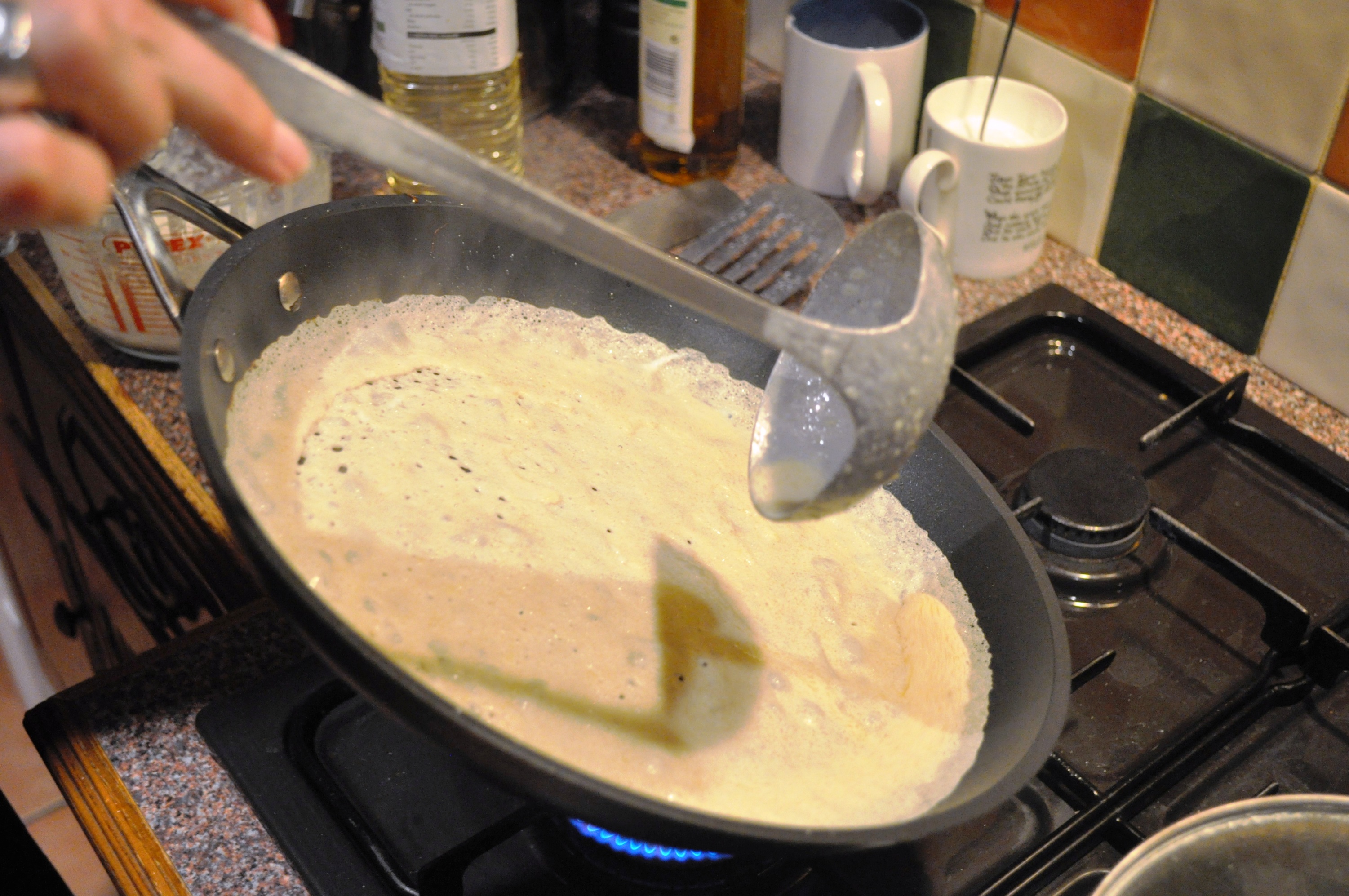
6. Heat oil or butter in frying pan and when it’s hot, add ladlefuls of the mixture (about 80ml each).

Buckwheat pancakes
7. Fry until browning nicely then flip over.
8. Keep warm on a plate in a low oven.

Rhubarb maple compote

800g rhubarb
2cm fresh ginger, finely grated
1 orange, juice and fine zest
50g soft brown sugar
50g maple syrup
1 t cinnamon
1 vanilla pod

Compote

1. Chop the rhubarb into pieces about 2cm long. (Cut skinnier stalks slightly longer and fatter stalks slightly shorter, so they’re all about the same size and cook evenly).
2. Put in a large bowl with all the other ingredients and toss or stir to combine and coat. (We tend to keep our ginger root in the freezer, then just grate it on a Microplane/fine grater. Easy.)
3. Put the mixture in a roasting tray and cook for about 30-40 minutes at a low temperature, 150C (130C fan).
4. When the rhubarb pieces are tender remove from oven.
5. Strain, keeping the juices.
6. Boil the juices to thicken it. Don’t boil it all away though!

Assembly

To assemble the pancakes, keep your frying pan warm after making them, then put one back in the pan, add a good dollop of rhubarb in the centre, and fold over the sides, like an envelope. Cook a little and flip over, to seal slightly. Or don’t bother. You could roll the pancakes with the filling if you prefer that form.

Put on a plate, with another dollop of compote, some of the juices and a good drizzle of maple syrup.  I was wondering if I’d overdone it with too many flavours here – orange, maple, ginger, cinnamon and vanilla – but they all actually slot together nicely. Serve with your indulgent dairy product of choice.

We had salad with our savoury pancakes for our main course and that contained some common sorrel (Rumex acetosa) – which is another member of the polygonaceae family. So our Pancake Day dinner was a real polygonaceae feast. Truly a versatile element of the plant kingdom.

Buckwheat pancakes with rhubarb compote

5 Comments

Filed under Other food, Recipes

Brutti ma buoni, mark II

On plate 3

Considering brutti ma buoni – Italian “ugly but good” – cookies are basically just made of nuts, egg white and sugar, methods of making them are surprisingly varied. How much albumen? How much sugar? Grind the nuts? All of them? How fine? Leave some whole? Whisk the egg whites? Cook the mixture in a pan? Include some cocoa? Never mind the question of using almonds.

The first recipe I tried was from the American Academy in Rome’s Biscotti book. They were good, but I wasn’t entirely satisfied. It’s taken me this long to get round to trying a different recipe. I thought I’d better try an actual Italian one, direct from an Italian source.

One of the biggest, perhaps the biggest, Italian recipe site is Giallo Zafferano (“Yellow Saffron”). When googling Italian recipes you may well get prompted to visit there first. Although I’m gathering other recipes, I thought why not start here? So here’s a tweaked, reduced translation of their recipe. The original makes “about 70” cookies, which seems excessive for domestic consumption – unless you’ve got a very big family that loves hazelnut meringuey things.

Even if you don’t speak Italian, it’s worth checking out the site for the pics of the procedure.

Makes about a dozen.

200g whole, skin-on hazelnuts
20g water
25g caster sugar
1/2 t honey
35g egg white (ie the white of one egg, more or less)
90g icing sugar

On tray

1. Gently roast the hazelnuts, at about 150C, until they’re starting to brown. Remnove but keep the oven on.
2. Rub the hazelnuts in a tea towel (which I believe you US lot call a “dish towel”) or cloth to remove the skins. Don’t agonise if a little bit stays stuck.
3. Divide the nuts in two, and coarsely grind half of them in a food processor.
4. In a pan, warm the water and caster sugar until the latter dissolves, then stir in the honey and allow to cool slightly.
5. In a clean bowl, whisk the egg white to peaks.
6. Slowly pour in the syrup, whisking constantly.
7. Keep whisking for another few minutes or so (the original recipe says 10, but this seems excessive), then sieve in the icing sugar.
8. Keep whisking for another few minutes. You’ve basically got a meringue mix.
9. Add the ground nuts, then the remaining, whole, nuts and fold to combine.
10. Line a baking sheet (or two) with parchment, then dollop dessertspoonfuls onto it, leaving space between for the cookies to flow and expand a bit while baking.
11. Bake at 150C for about 12 minutes, until they’ve coloured slightly or as the original puts it, until they’ve achieved “un colore leggermente dorato” (“a lightly golden colour”). Which seems a bit misleading, as egg while plus hazelnut doesn’t really equal golden. It’s more a pale brown.
12. Cool. I actually left mine to cool in the oven, turned off, as you would meringues.

The result is very nice, note unlike some hazelnut meringues I remember my mother making on occasion when I was a nipper. I still don’t think this is quite the perfect brutti ma buoni recipe though, so I’ll try another soon, specifically one that uses the technique where the mixture is cooked first before baking, drying it out more. Onwards, bakers!

2 Comments

Filed under Biscuits, cookies, Recipes

Wholesome, wholegrain Magister and einkorn bread

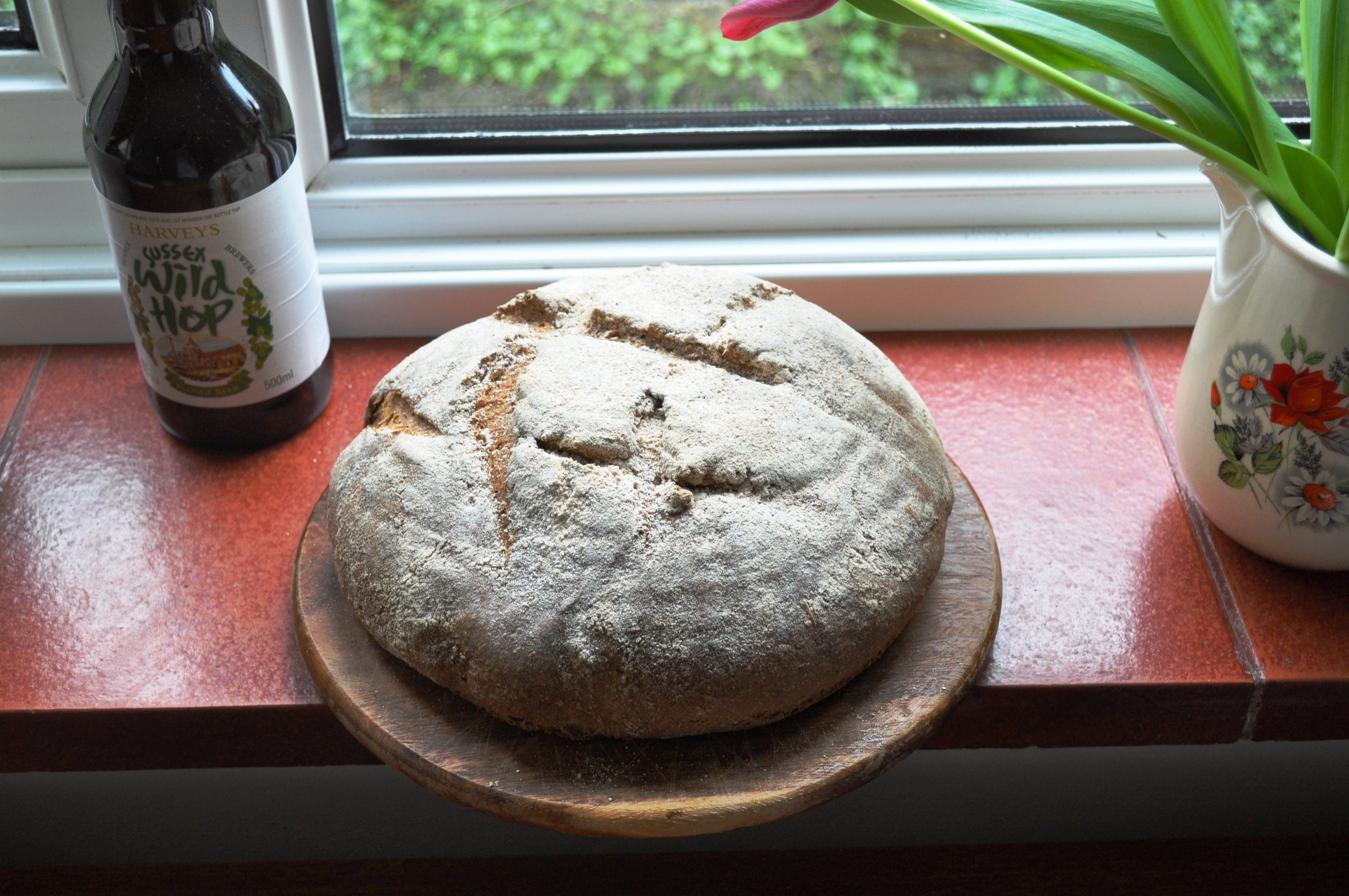
With Sussex Hops

One of the things I enjoyed in my bread-making experiments in Italy was trying different flours, many of them traditional or what’s called “heritage grains”. This is a slightly vague term, muddled up with food fads, but basically it just means grains that are older strains. In the case of wheat*, they can either be alternative varieties to common/bread wheat (Triticum aestivum), or local variables, cultivated over generations to suit a particular terroir.

When I was trying to get my head around the Italian names for grains and flours – particularly the vexed question of what’s meant by “farro” – I wrote a few posts (here and here), where I started learning about some of the different strains and varieties of wheat.

Key heritage wheats that have survived the 20th century’s industrialisation and intensification of agriculture are einkorn, emmer and spelt, or to use their scientific names: Triticum monococcum, Triticum dicoccum and Triticum spelta. As with a lot of taxonomy, things are constantly being revised or bickered about; spelt is interesting, as it’s either Triticum spelta, or classified as Triticum aestivum var spelta, ie a variety of common wheat.

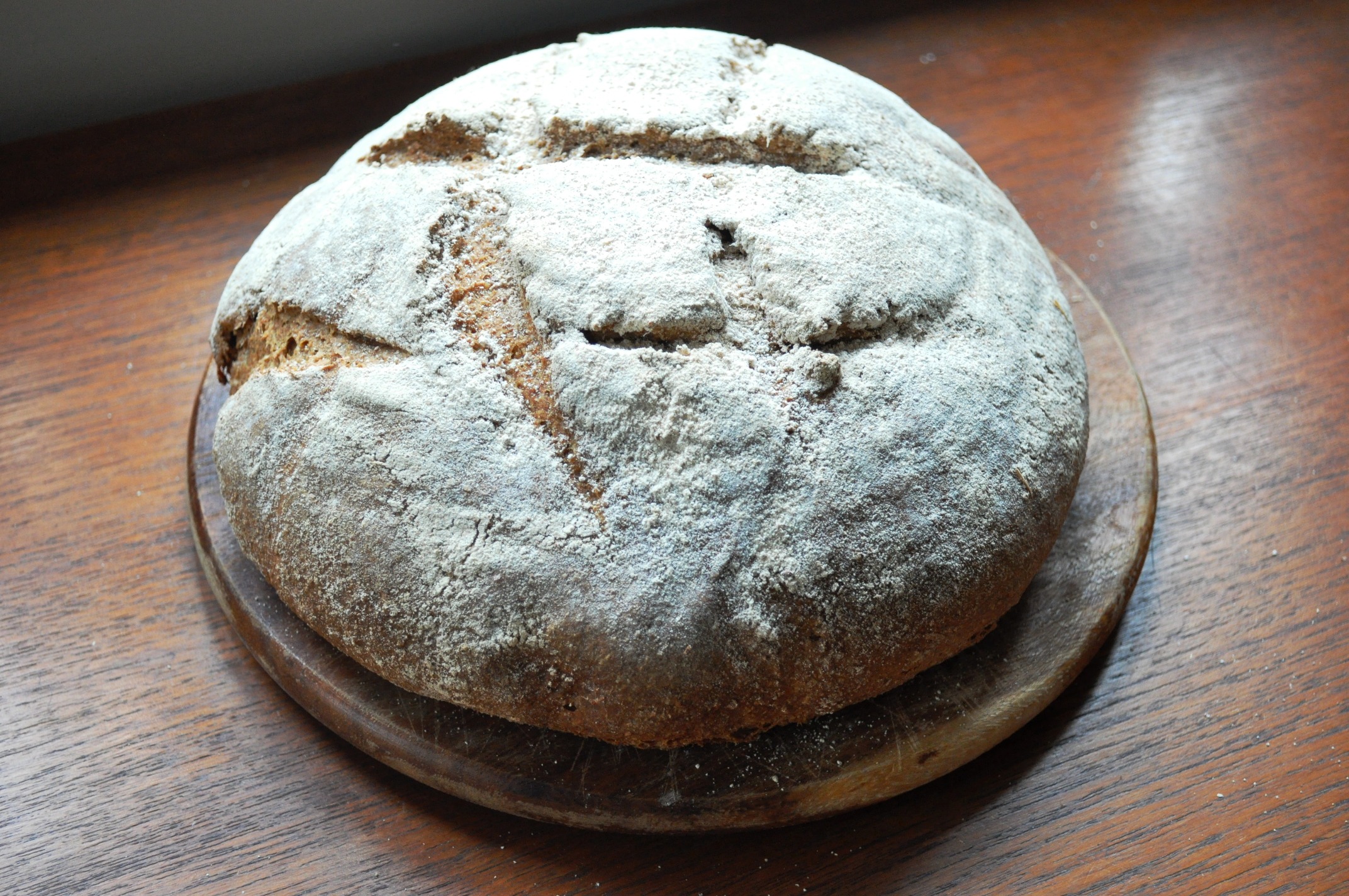
Whole loaf

Olde English
Since coming home to England at Christmas, after our two years in Italy and two months travelling in the US and NZ, it’s taken me a while to get back into the bread-making.

This is partly as we have a rubbish oven, partly as I forgot to pick up my leaven from my mother, who had been looking after it, and partly because Lewes now has a couple of great places to buy real bread these days: Flint Owl and The Hearth, which also has the town’s only proper pizza, made by master baker Michael Hanson and pizzaiolo and in his wood-fired oven.

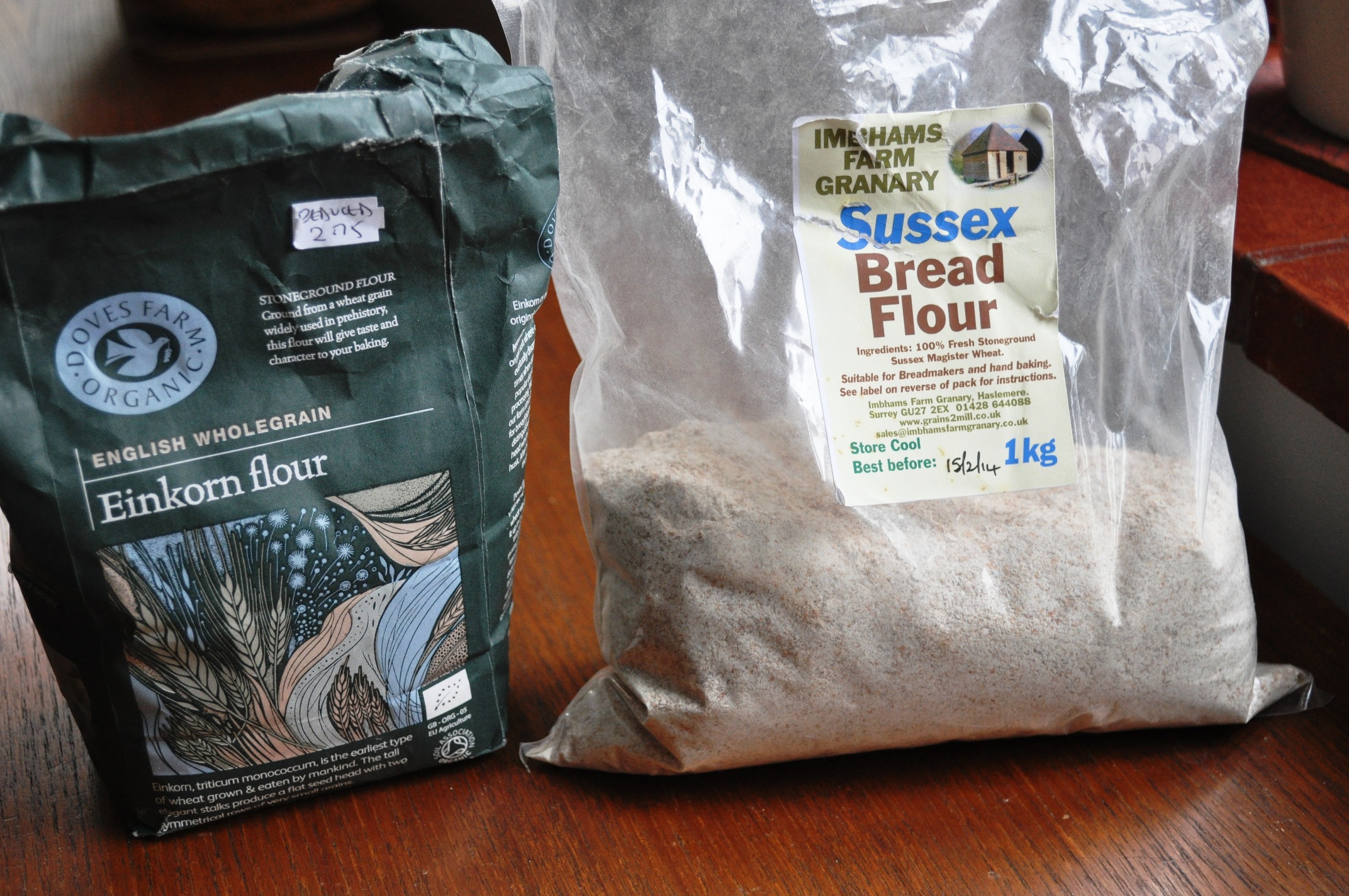
Yesterday, however, I dived back in to the bread-making. I’ve been buying flours, and some of it needed using – particularly the Dove’s Farm wholegrain einkorn I bought that had a “Best before” date of July 2013. Ooops. Best before dates are, as sane people know, just a guideline, but flour does get a bit stale and loses its verve.

Still, at least it’s flour with form. The packet says Dove’s, one of Britain’s bigger organic flour brands, has been growing it on their farm on the Wiltshire/Berkshire border since 2008, and that the einkorn itself “was the original wheat, developed over 20,000 years ago”, and that it’s “the earliest type of wheat grown & eaten by mankind.” As such it can be seen as the crop that symbolises the human transition from wandering hunter-gatherers to settled farmers. You could say it’s the foodstuff that represents the founding of human civilisation, in Eurasia at least.

Einkorn, Sussex

So that had to go in. As did some lovely Sussex Bread Flour from Inbhams Farm Granary. These guys are a small operation, based in Surrey, the county to the north of Sussex. They sell a range of British grains and flours, as well as home milling equipment. Their emphasise the importance of freshness in grain products. Ironic considering the potentially state of the einkorn flour I had.

Still, the Sussex Bread Flour is not only relatively fresh, and thoroughly local, it was also a nice variety – Magister wheat, which Imbhams describe as “an older two row** variety” that “is a strong (high protein) grain”. It’s a winter wheat, and a variety of Triticum aestivum. I asked about the flour, and James Halfhide of Inbham’s explained that “Magister is a modern 21st century grain introduced from Germany and a ‘2 row’ variety – so an ‘older style’ of grain not unlike spelt or naked barley. So you could say it will carry some older characteristics – one we liked was the flavour. More modern breeding has lead to the ‘4 row’ varieties so they look ‘square’ and usually shorter straw stems.”

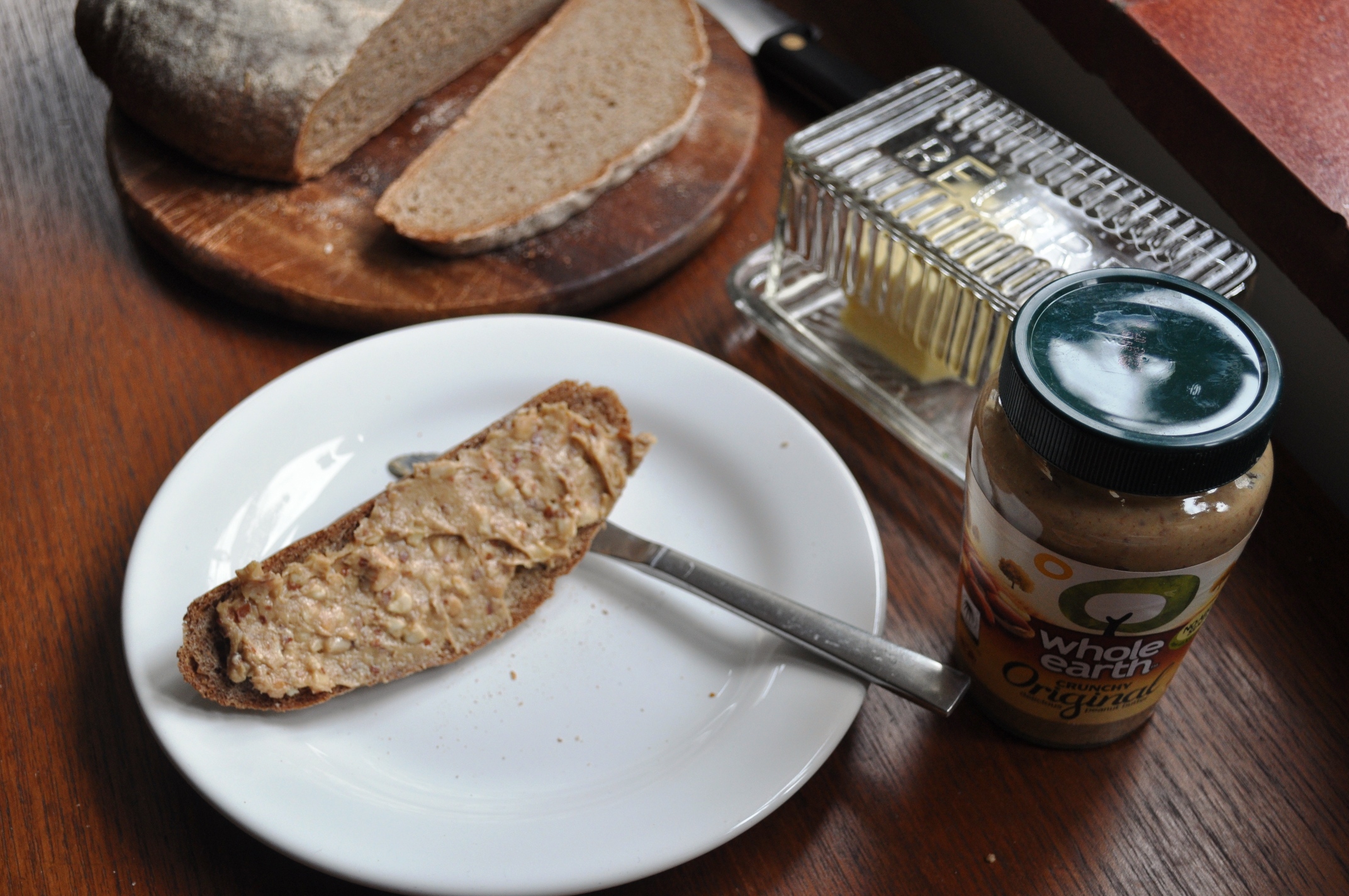
Between the two flours, both wholemeal, it made for a seriously wholesome dough, with only minimal elasticity. The einkorn has a protein level of 10.6% and while the Magister might be higher protein (around 12.5%), it’s stoneground and very branny. The resulting loaf has a close, slightly crumbly crumb. Very tasty though. And great with my favourite peanut butter brand.

Being back home in southern England, with its ongoing wind-wracked soggy apocalypse, might be miserable in some senses compared to poncing around the NZ summer or living in Roma, but at least I can get my Whole Earth Crunchy Original – a delicious type of peanut butter made with the peanut skin left on and one of the few foodstuffs I was transporting back to Italy after trips to England.

Sorry, it’s just better than any of those US Peanut Butter & Co varieties I’ve tried, despite that brand’s success (and hip excursions into film and TV; I first spotted it on screen a year or so ago in Girls) and even better than Pic’s Really Good, which I enjoyed a lot in NZ, as it’s from Nelson, a town I’ve got a lot of affection for. Those skins in tandem with butter – yes, butter, I like animal fat with my peanut fat – and this wholesome bread made for a cracking elevenses snack on this filthy morning.

Whole Earth

Not really a recipe

For one medium loaf I used:
500g wholegrain einkorn flour
250g Sussex Bread Flour
525g water
12g fine salt
10g fresh yeast

I’m using these same flours to feed up my leaven, but that’s not really ready for baking yet, so fresh yeast it was.

I also used water from our Brita filter. The tap water here in Lewes is pretty hard, and full of god knows what chemicals. I’m not sure the Brita existing makes it as pleasing as water bubbling from the ground in a mountain meadow in spring time, but hey, it’s got to be slightly better.

I just crumbed the yeast into half flour, then added the water and made a sponge. Then I added the salt and the rest of the flour.

I gave the dough a few short kneads over about an hour, then formed a ball.

Then I left in a cold place (about 10C; cold crappy 1950s construction house, basically) for about eight hours.

I gave it a quick shape into a ball, then a final prove in a warm place (about 20C; old-school airing cupboard) for a couple of hours, until it had doubled in size.

Baked at 230C for 20 minutes, then another half an hour at 200C.

Wholesome, historic and local.

Magister einkorn cut

* “Wheat” isn’t just one member of the grass family (Poaceae or Gramineae), it’s several, including many strains that have had ooh, ten-plus millennia of crossing and selective breeding.
** As I understand it, when talking about grains as 2-row, 4-row, 6-row, it’s a reference to the number of rows of kernels on the ear.

7 Comments

Filed under Baking, Breads, Recipes

Red wine and chocolate ring cookies, or Ciambelline al vino rosso e cioccolato

Red wine and chocolate ciambelline, Ciambelline al vino rosso e cioccolato

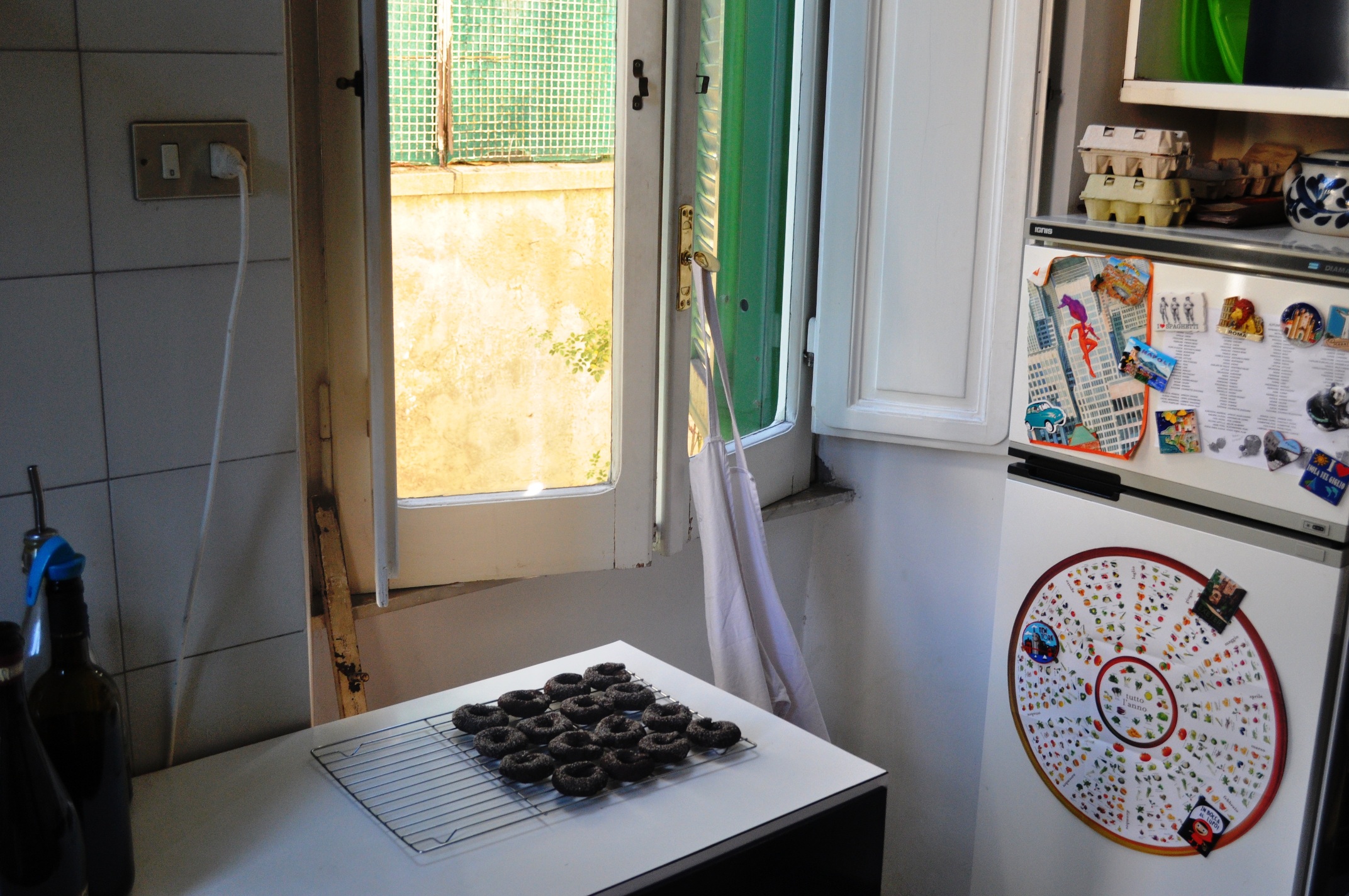
These are a long way from authentic ciambelline al vino – ring cookies that are normally made plain or flavoured with fennel or anise seeds. But hey, I love chocolate. Chocolate doesn’t seem to play a big role in Italian biscotti etc, but as we’re moving house soon, and I have a large pot of cocoa in the cupboard that needs using up, I thought I’d try chocolate ciambelline.

Plus, we had a bottle of red wine that also needed using up. This cost us the princely sum of €1.50 so was clearly seriously and definitely hardcore cooking wine; or very desperate-at-the-end-of-an-evening-wine; or Withnail wine (“This is a far superior drink to meths!”).

We also had a bar of chocolate and did chop it up and add it to the mix, but it caused problems with the rolling: the chips kept severing the dough. So if you do it, I’d recommend either chopping the chocolate up into small pieces (I’m talking chips of a just a few mm) or leaving it out completely. Ditto, some slithers of almond would be nice, but they’d have to be small or they’ll compromise the structural integrity. You don’t want a hull breach. (Sorry, going a bit Star Trek.)

Kitchen

Anyway, ciambelline are classic Italian cookies that are often served with a digestivo after a meal. They’re related to taralli, which are almost like hard-baked bagels (and, indeed, they’re boiled in water before baking), and tarallini, which are smaller versions thereof. I’ve generally encountered savoury taralli and tarallini, but in one seafood restaurant we like in central Rome, they serve you a Vin Santo desert wine with a few small, fennel-seed flavoured sweet ring biscuits that they call tarallucci.

So, as with so many Italian nouns relating to food, usage is fairly mutable! (Depending on region, slang, dialect, inclination, family etc.)

So anyway. Here’s my recipe. Bear in mind, these sorts of recipes are traditionally made with the whole qb approach: quanto basta, “how much is enough”. I always prefer to use grams but if you do make these, and you feel your dough isn’t quite right, just follow your instincts and adjust the amount of liquid or flour.

360g flour
50g cocoa
150g sugar
160g extra virgin olive oil
160g red wine
(Optional: 50g dark choc, cut in small pieces, or some small slithers of nut)

Red wine and chocolate ring cookies, or Ciambelline al vino con il cioccolato mix

1. Combine the wine, oil and sugar.
2. Sieve in the flour and cocoa, stirring.

Red wine and chocolate ciambelline, Ciambelline al vino rosso e cioccolato
3. Form a dough. Add more flour if it’s too wet, more oil or wine if it’s too dry.
4. Rest the dough, for about half an hour, to let it relax.

Red wine and chocolate ciambelline, Ciambelline al vino rosso e cioccolato
5. Preheat the oven to 180C.
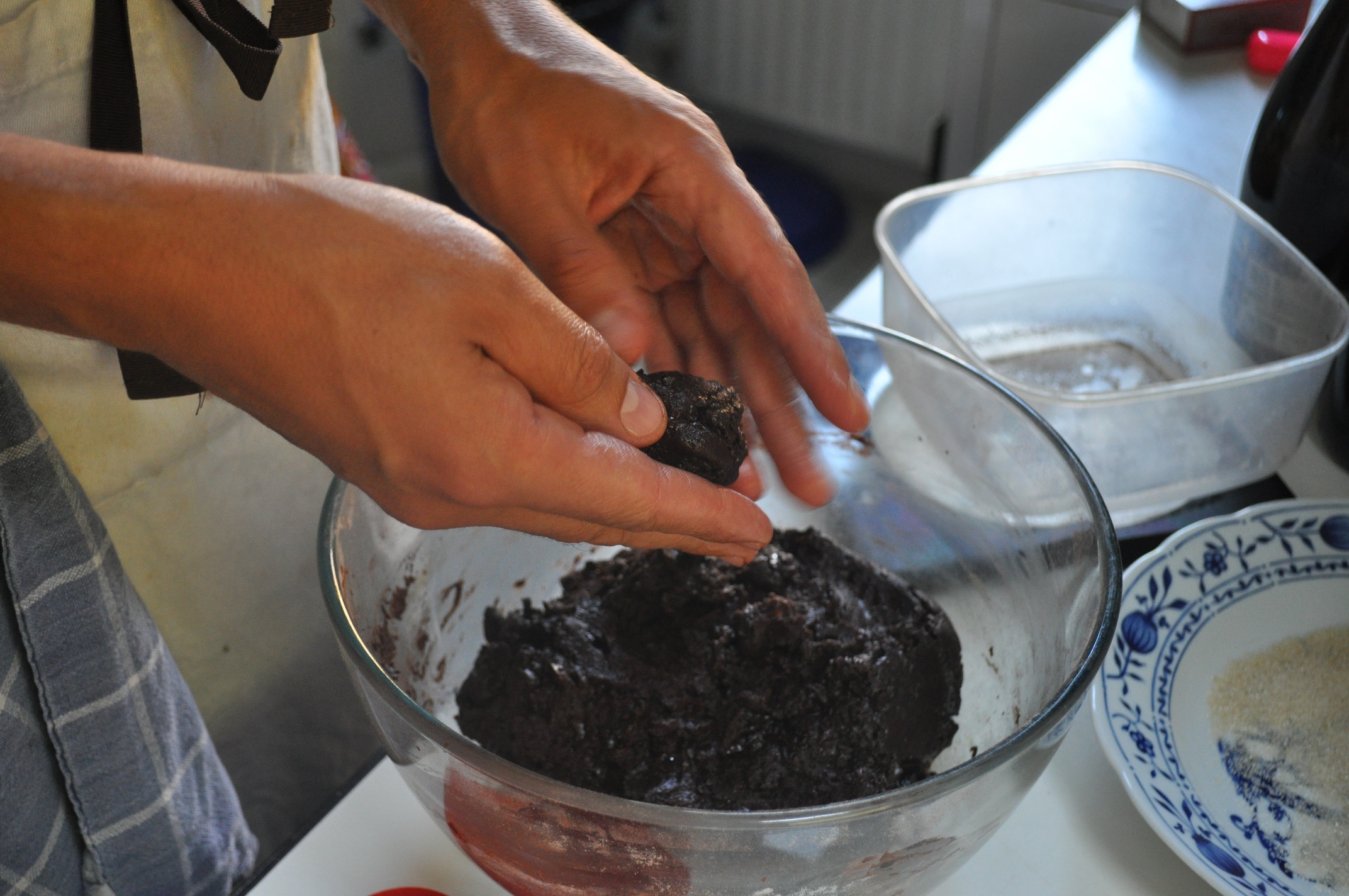
6. Form balls, about the size of a walnut. I went for a scaling weight of 30g, but ciambelline are often bigger, so you could go for 60-80g. Whatever you prefer.

Red wine and chocolate ciambelline, Ciambelline al vino rosso e cioccolato
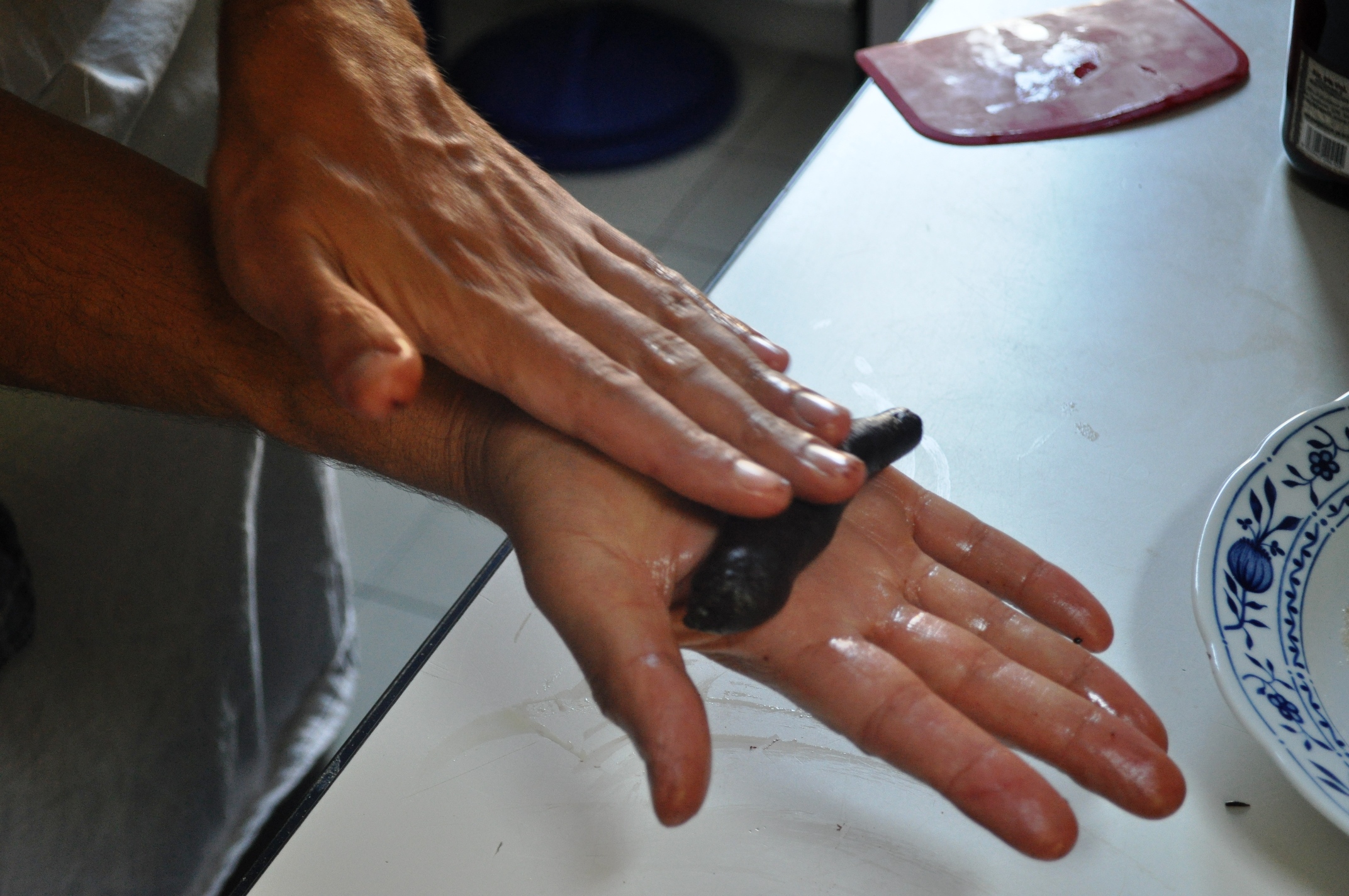
7. Roll the balls into sausages.
8. Form the sausages into rings, pinching together the ends.
9. Dip the top in granulated sugar.

Red wine and chocolate ciambelline, Ciambelline al vino rosso e cioccolato
10. Place on a baking sheet, lined with parchment.
11. Bake for about 20 minutes, depending on your oven.

Red wine and chocolate ciambelline, Ciambelline al vino rosso e cioccolato
12. You can crisp / harden them more by leaving them in the oven, switched off, while it cools. Though these harder ones may need stronger teeth / liquids for dipping and dunking.

Now of course, there’s something else about these ciambelline that’s so far going unsaid. It’s the elephant in the room of this recipe. If you don’t have appreciate scatological humour, browse away now! If you’re not easily fazed, scroll down and highlight the black.

Oh dear. Oh dear oh dear oh dear.
So yes, they look like poo. Especially when I was making them. All that cocoa and glistening olive oil – poo, or at least joke-shop plastic turds. And when I rolled them in the sugar, I couldn’t help thinking of the saying “You can’t polish a turd… but you can roll it in glitter.” But then, thought I, worry not: what could be more perfect in Rome, a city that’s totally and utterly and liberally decorated with dog mess, than a ciambelline of that resembles these pavement obstacles? (Our v borghese neighbourhood is especially bad – worse than Paris in the 1980s, and that’s saying something.)
Sorry.

1 Comment

Filed under Biscuits, cookies, Recipes