Category Archives: Recipes

Pizza di San Martino for Martinmas

Pizza di San Martino

November 11 is Martinmas, the feast day of St Martin, or San Martino as he’s known in Italian. I talked about St Martin and his feast day here, and one of the related food products I mentioned was pizza di San Martino. This is a kind of enriched bread – as in Italy, “pizza” doesn’t necessarily imply a thing topped with tomato sauce and cheese. There are many variations on the theme.

Do a Google image search, and pizza di San Martino comes in several forms but they’re all basically yeasted cakes. It probably originates from the small Italian region of Molise, which reaches from the east coast into the Apennines, or possibly from the region to its north, Abruzzo. This area of central Italy, along with Umbria, has suffered recently from a series of earthquakes and aftershocks this year, so making this is one way of saying I’m thinking of friends living there, and anyone who’s lost their homes and livelihoods.

The patron saint of protection against earthquakes is actually Emygdius or Emidio, but he’s pretty obscure and I’m not aware of any baked goods associated with his feast day (5 and 18 August). I’ve adapted this pizza recipe from one found in Cooking with the Saints by Ernst Schuegraf; he doesn’t mention St Emygdius.

As I wrote in my previous piece about St Martin, a traditional pizza di San Martino would contain trinkets, favours, much like the inclusion of a silver coin in traditional British Christmas pudding or ceramic baby Jesus in galette de rois. This recipe doesn’t include any. There’s nothing to stop you adding trinkets though, for luck to whoever receives them.

1. Dissolve the yeast in the warm water.

Make the sponge, preferment

2. Add about 150g of the strong flour, and blend to form a sponge or pre-ferment.

Bubbly sponge

3. Allow the sponge to develop until it’s nice and bubbly – an hour or two, depending on warmth.

Combine the ingredients
4. Put the rest of the flour and the salt in a large bowl, then pour in the sponge, milk, beaten egg and melted butter and add the sugar, raisins and zest. I used orange and lemon zest.

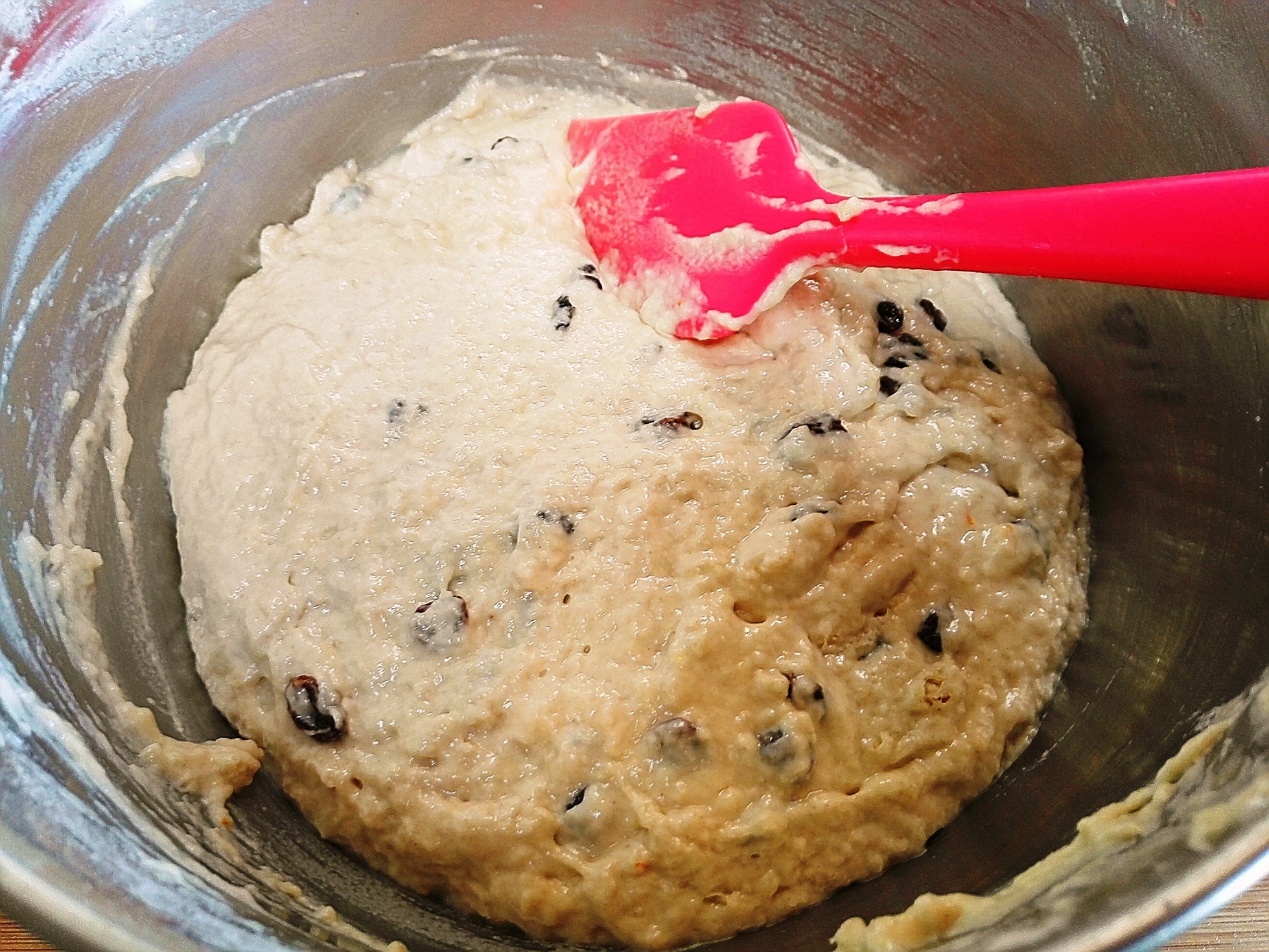
Bring together - almost more a batter than a dough.

5. Mix to combine. It’ll be a fairly sticky dough. With just the water and milk, it’s about 67% hydration, but factor in the eggs and melted better too and that’s a fairly high proportion of liquid to flour.

Sticky dough

6. Turn out onto an oiled worktop and bring to a dough. For tips on how to handle sticky doughs, read my notes here.
7. Return to the bowl, cleaned and oiled, then cover and leave to prove until doubled in size.
8. Butter a round cake cake tin, ideally 26cm,  or even larger. (If you don’t have one, you could bake the pizza freeform, shaped like a disc, on a baking sheet.)
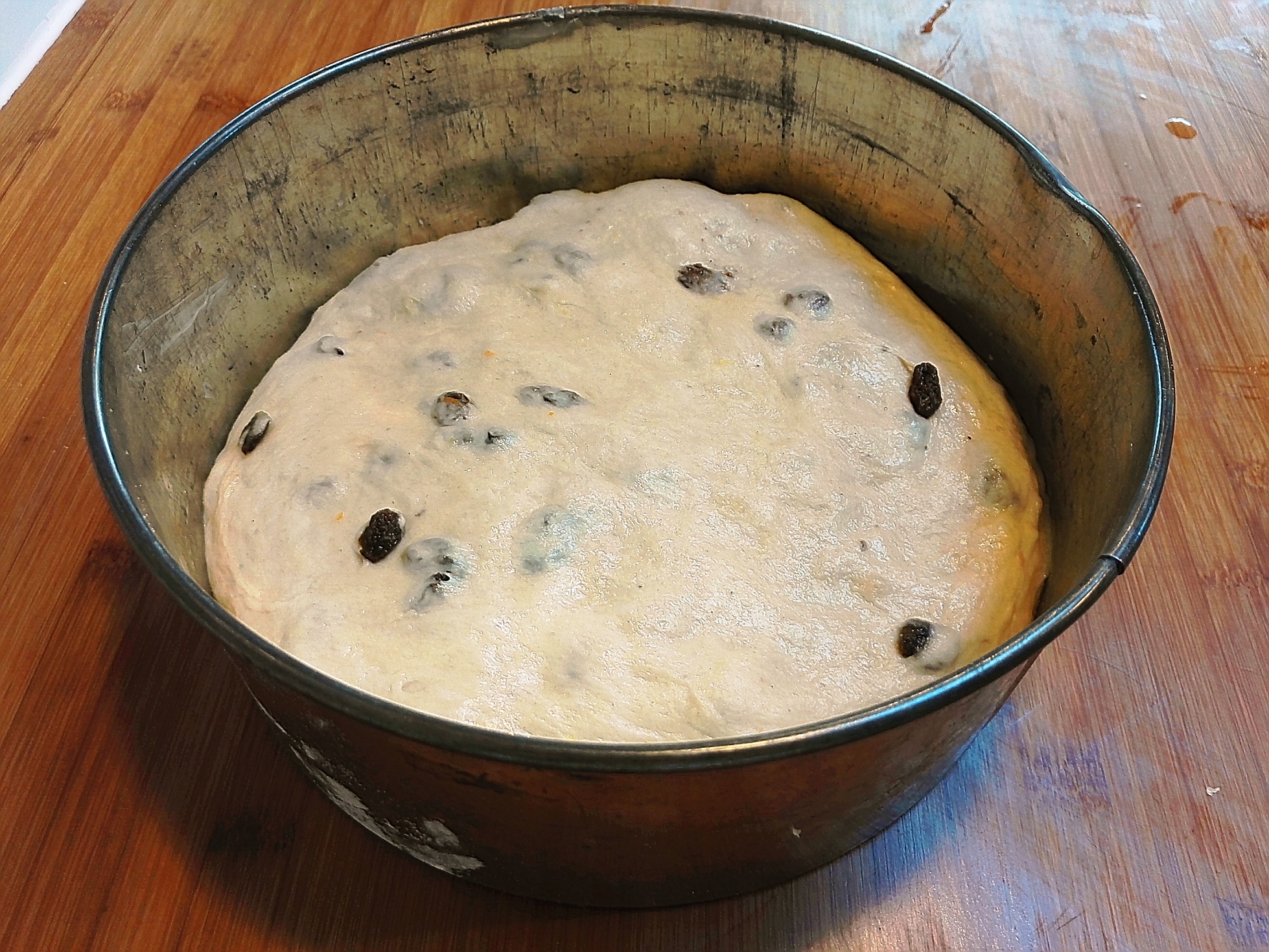
9. Turn out the dough and form into a ball. Push the ball down into the cake tin, then cover and leave to prove again.
10. Preheat the oven to 200C.

Put in round cake tin

11. When the dough is nicely risen, put it in the oven.
12. Bake for about 40 minutes. If it’s browning too much, cover with foil or turn down the oven.

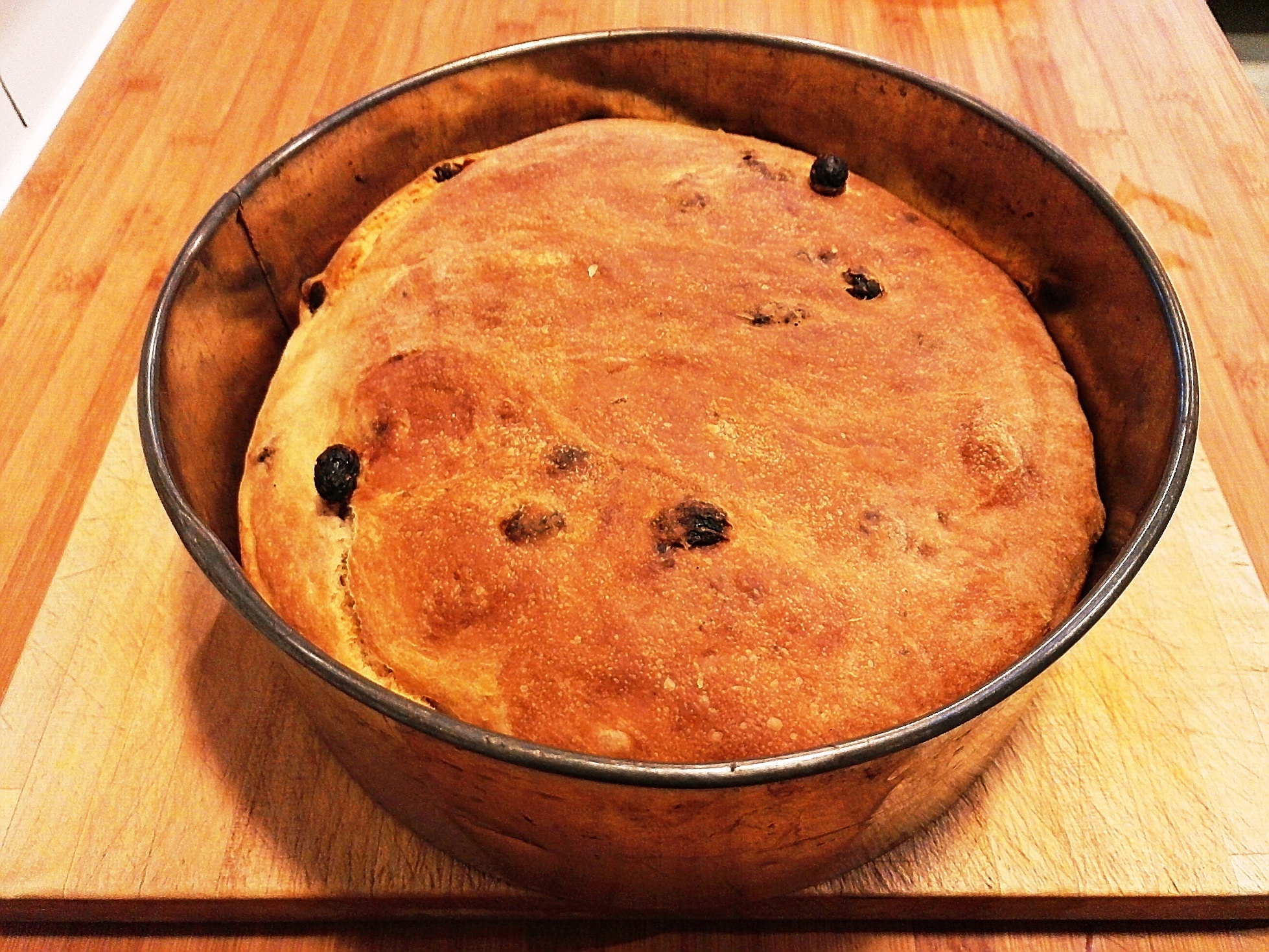
Freshly baked pizza di San Martino

13. Take out, turn out and cool on a rack.

It’s not unlike a kind of brioche, so eat for breakfast, or morning coffee, or with tea. If I’m honest, I’ve no idea how an Italian family would eat it. During my time in Italy I never really managed to inveigle myself into households to watch people eating Easter Colomba or Christmas panettone or other enriched feast day breads like this. So any central Italians reading, please do let me know.

4 Comments

Filed under Baking, Feasts, Recipes

Exmoor in and out pudding

Exmoor in and out pudding

A few years ago, before kids, Fran and I rode our bikes across Devon, her home county, in southwest England. It was lovely as we embarked from Tiverton Parkway in the east of the county, but as soon as we reached Exmoor, having climbed steeply from the village of Dulverton, the wind and rain set in.

Although this pudding is named after the moor, it’s hard to imagine it’s a place where many apples are grown. Sure there are some orchards within the confines of Exmoor National Park, but by and large the moor itself is, along with other West Country moors Dartmoor and Bodmin moor, is about as close to wilderness as you can experience in southern Britain. We certainly didn’t pass any orchards as we fought a fierce headwind.

Another county
I made this pudding with apples from my parents’ tree, in Winchester, Hampshire. It would have been hard to find Exmoor apples. Indeed, for crying out loud, it’s hard enough to find English apples in the supermarkets at the moment, despite it being apple season. I live in the southeast of England, in East Sussex. The adjacent county, Kent, is the historical heartland of apple cultivation – and yet our local supermarkets are filled with apples from France, Chile, South Africa and even New Zealand. This madness makes me want to scream. I suspect I’ve ranted about it here before.

Talking of madness: Brexit*. Will it mean fewer food imports as costs increase? Will it encourage domestic food production? Who knows. No one seems to know what’s going to happen, apart from an abiding smugness from aging little Englanders as we metaphorically unmoor ourselves and drift away into deepening obscurity.

Fall from grace
Anyway, back to the apples. My folks have a magnificent Bramley tree. While picking, I managed to fall off the ladder, knocking over not just my toddler, T-rex, but also my seventy-something dad. Sorry guys! Still, it’s great fruit. We should be celebrating home-grown Bramleys more than ever now following the news this summer that the original Bramley tree in Nottinghamshire is dying of a fungal infection, having been sown in 1809.

This is a lovely variation on the theme of apple pudding involving a cake-like mixture. The mixture has the distinction of by being made with rich, caramelly demerara sugar. It also contains some ground almonds, one of my favourite ingredients. Some Exmoor in and out puddings also contain suet. This recipe, based on one found in the National Trust’s Complete Traditional Recipe Book by Sarah Edington, doesn’t.

500g Bramleys, or other cooking apples
50g demerara sugar
5g cinnamon
60g apple juice, or water

110g unsalted butter, softened
110g demerara sugar
2 eggs
1/2 tsp almond essence
110g self-raising flour (or 105g plain flour and 5g baking powder)
50g ground almonds
Flaked almonds

1. Heat the oven to 180C.
2. Peel and slice the apples.
3. Combine the apple slices, cinnamon, demerara and apple juice or water then put into an overproof dish. Cover with a damp cloth so the apple doesn’t brown while you prepare the topping.

Exmoor in and out pudding

4. Cream together the butter and other portion of demerara sugar.

Exmoor in and out pudding mixture
. Lightly beat the eggs, with the almond essence, and slowly beat into the mixture. If it starts to curdle, add some of the ground almonds.
6. Add the ground almonds and sieve in the flour. Fold to combine.

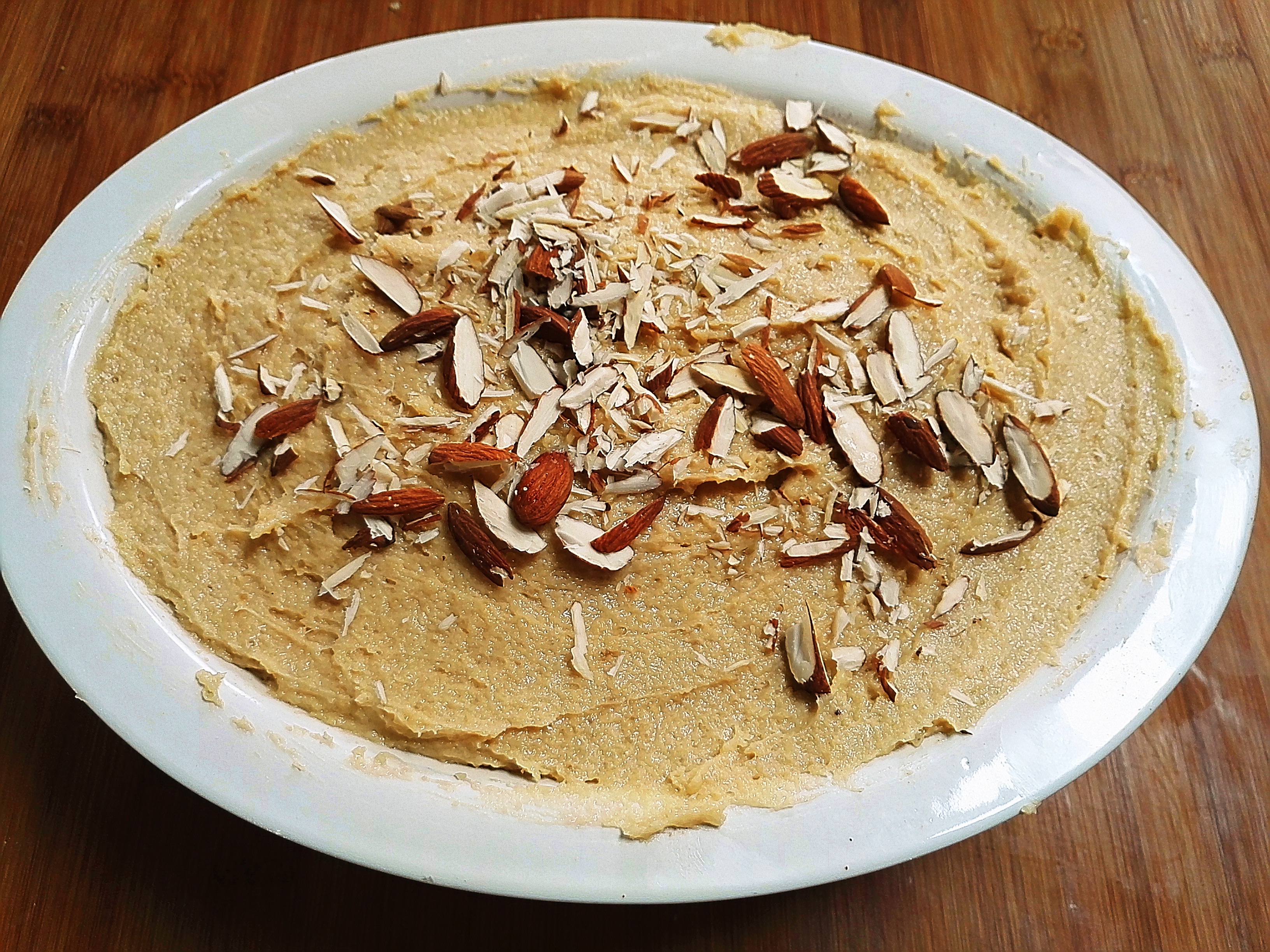
Exmoor in and out pudding, cover apples with mixture

7. Put the topping on the apple mix.

Exmoor in and out pudding, ready to bake

8. Sprinkle with ground almonds.

Exmoor in and out pudding, baked

9. Bake until the top is nicely browned and the cake is firm to the touch, about 40 minutes.
10. Serve warm with cream, ice cream or even custard.


* As well as the actual process of the UK leaving the EU upsetting me, I detest the ugly neologism “Brexit”. But I can’t come up with a better, succinct alternative, so we’re stuck with it.

6 Comments

Filed under Baking, Puddings & desserts, Recipes

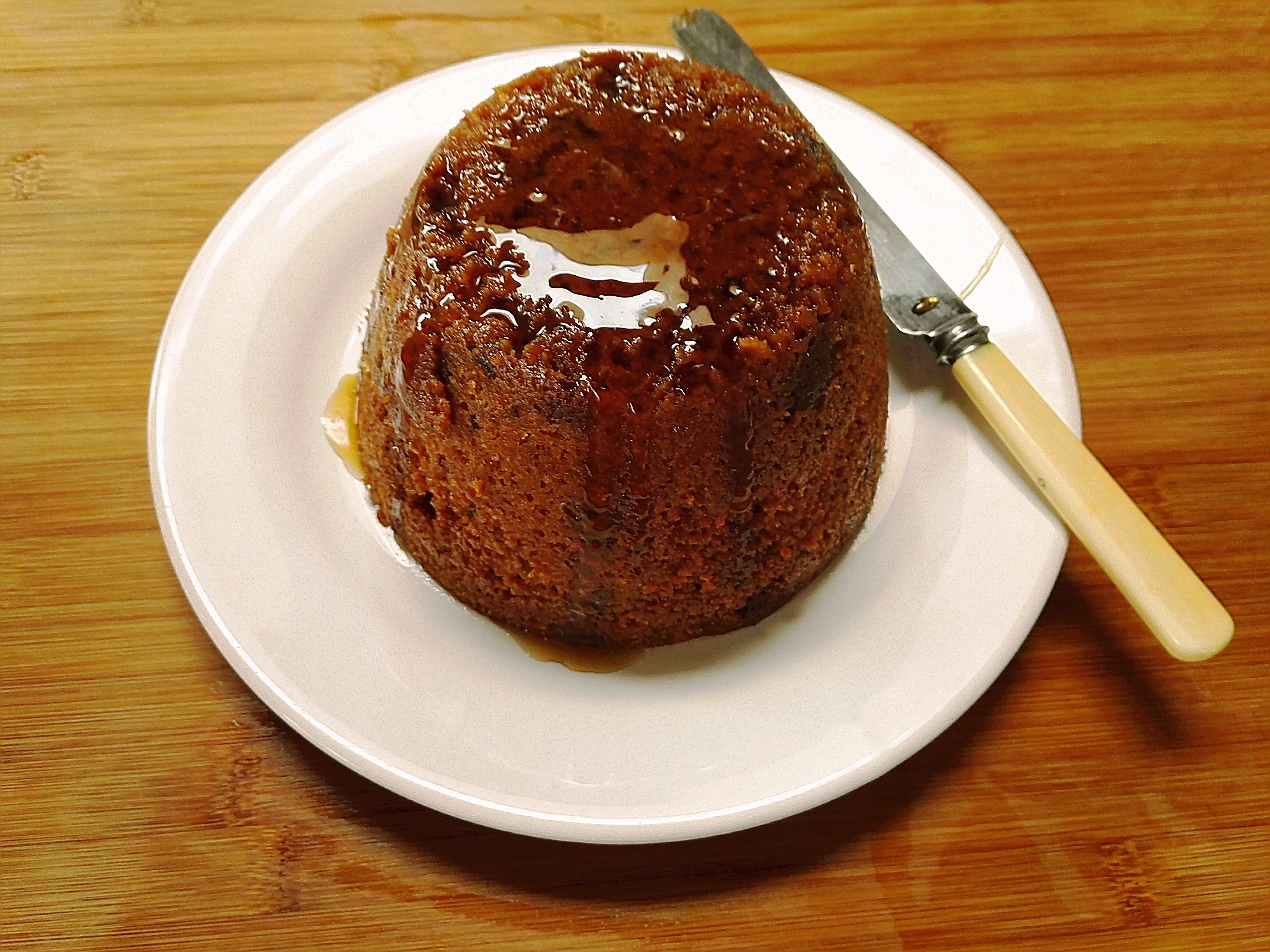
Date and maple syrup steamed pudding

Date and maple syrup steamed pudding

We had a pretty good summer in southern England this year, with very little rain and a reasonable amount of sunshine July to October. But now it’s definitely Autumn, with winter round the corner and that means one thing: steamed puddings!

OK, maybe not just one thing, but I do crave serious stodgy English puddings in the winter. Growing up, a favourite was treacle sponge – actually a steamed pud made with golden syrup. It’s a recipe I revisit regularly, and frequently use as the basis for variations on a theme, adding things like stem ginger, other fruits and spices.

Since the end of last winter, my kitchen whiteboard has featured an increasingly faint scribble saying “date and maple syrup steamed pudding”. This weekend we had a lovely visit from our friend Mary Margaret, who Fran worked with in Rome. She’s Canadian. So of course that’s a good excuse to reach for the maple syrup. MM said she hadn’t had a traditional Canadian Thanksgiving this year (10 October), so our Sunday roast stood in for it. She was very satisfied with my entirely non-traditional date and maple syrup pudding.

The dates were chopped and soaked in boiling water with half a teaspoon of baking soda. This is a technique used when making sticky toffee pudding, another classic stodgy English pudding. Which probably had its origins in a Canadian recipe.

I do include a bit of golden syrup here as it’s thicker than maple syrup and I felt it’d help with the texture but if you live somewhere that it’s not available (the US, I believe), just use all maple syrup. It’s a pretty forgiving recipe.

Date and maple syrup steamed pudding, sliced

100g dates, roughly chopped
2g baking soda
Boiling water
70g maple syrup
20g golden syrup
190g butter, softened
150g soft brown sugar, or light muscovado
3 eggs, lightly beaten that is about 170g
190g self-raising flour
4g baking powder
2g cinnamon
2g allspice
Pinch of salt

1. Put the dates in a bowl, add the baking soda and cover with boiling water. Leave to soften.
2. Grease a 1.2 litre pudding basin with butter.
3. Put the syrups in the bottom of the basin.
4. Beat together the softened butter and sugar until light and creamy.
5. Add the beaten egg a little at a time, continuing to beat. If it starts to curdle, add a little flour.
6. Sieve together the flour, baking powder and spices, then sieve this into the beaten mixture, along with a pinch of salt.
7. Strain the dates and add to the mixture.
8. Fold to combine. If it seems a bit firm, add some of the date liquid or a splash of milk.
9. Put the mixture in the pudding basin.
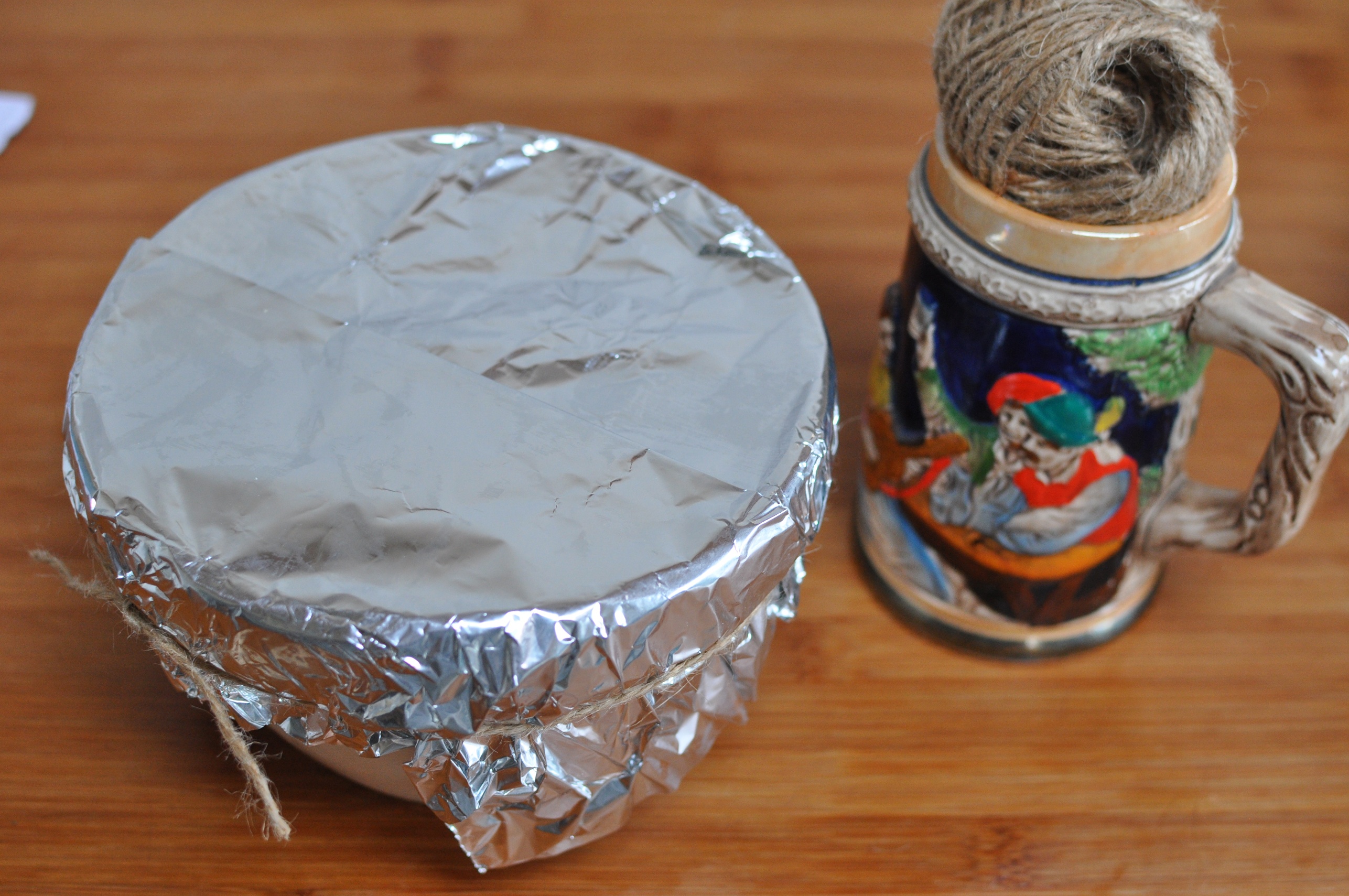
10. Cover the basin with a piece of foil, with a pleat in it. You can tie the foil on, but I’ve given up these days.
11. Put the basin in a large saucepan with some boiling water, or in a steamer over a saucepan, and steam for about 2 hours.
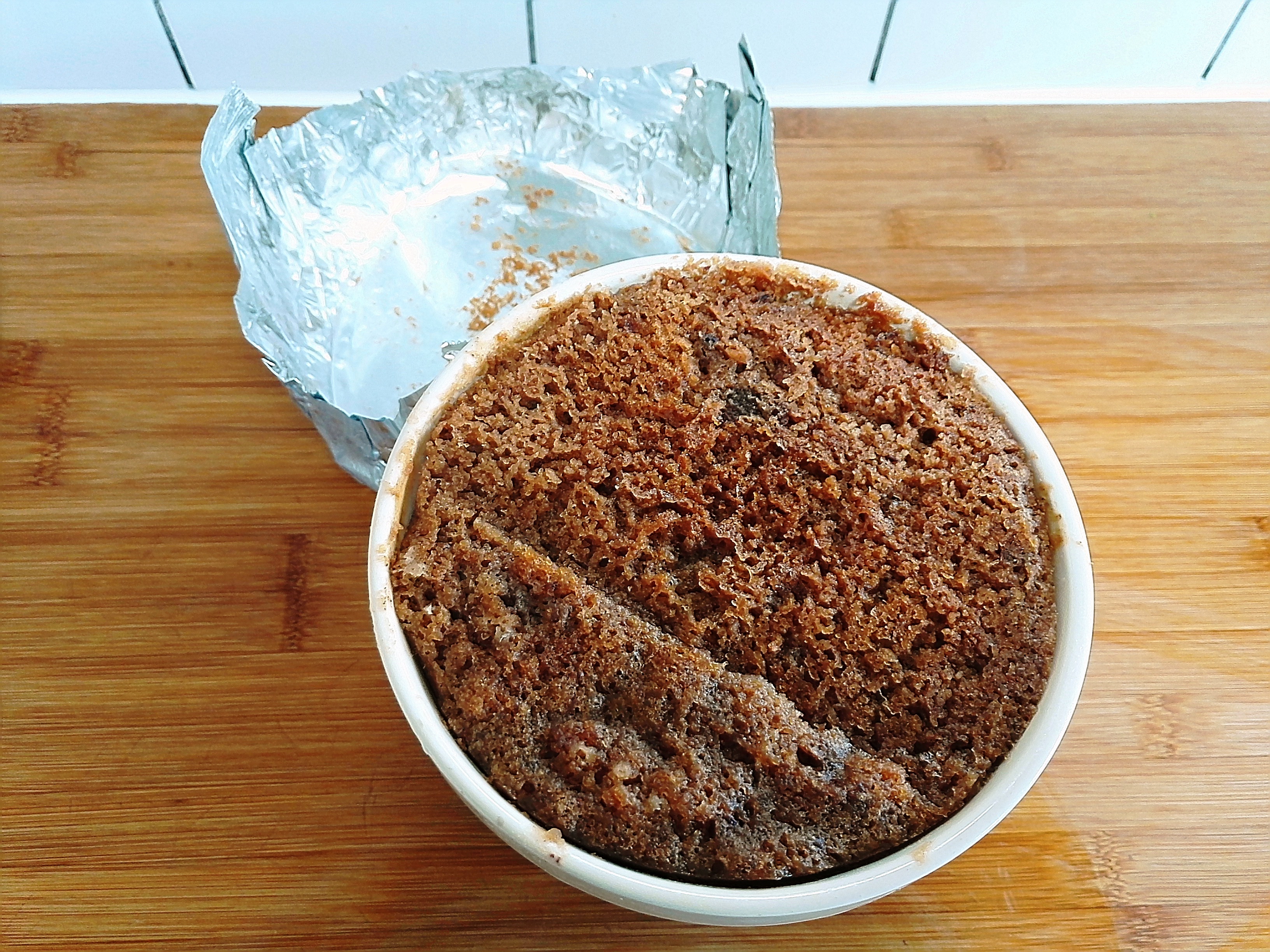
12. Remove from the saucepan and lift the foil. The top should be fairly firm and cakey.

Date and maple syrup steamed pudding, foil

13. Turn out onto a plate.
14. Drizzle with more maple syrup and serve warm with cream or ice cream for extra indulgence. Preferably on a cold, rainy day. If you feel the need, go for a good energetic walk – before or after – to justify it to yourself…

Date and maple syrup steamed pudding, with cream

6 Comments

Filed under Puddings & desserts, Recipes

The sheer indulgent excess that is monkey bread

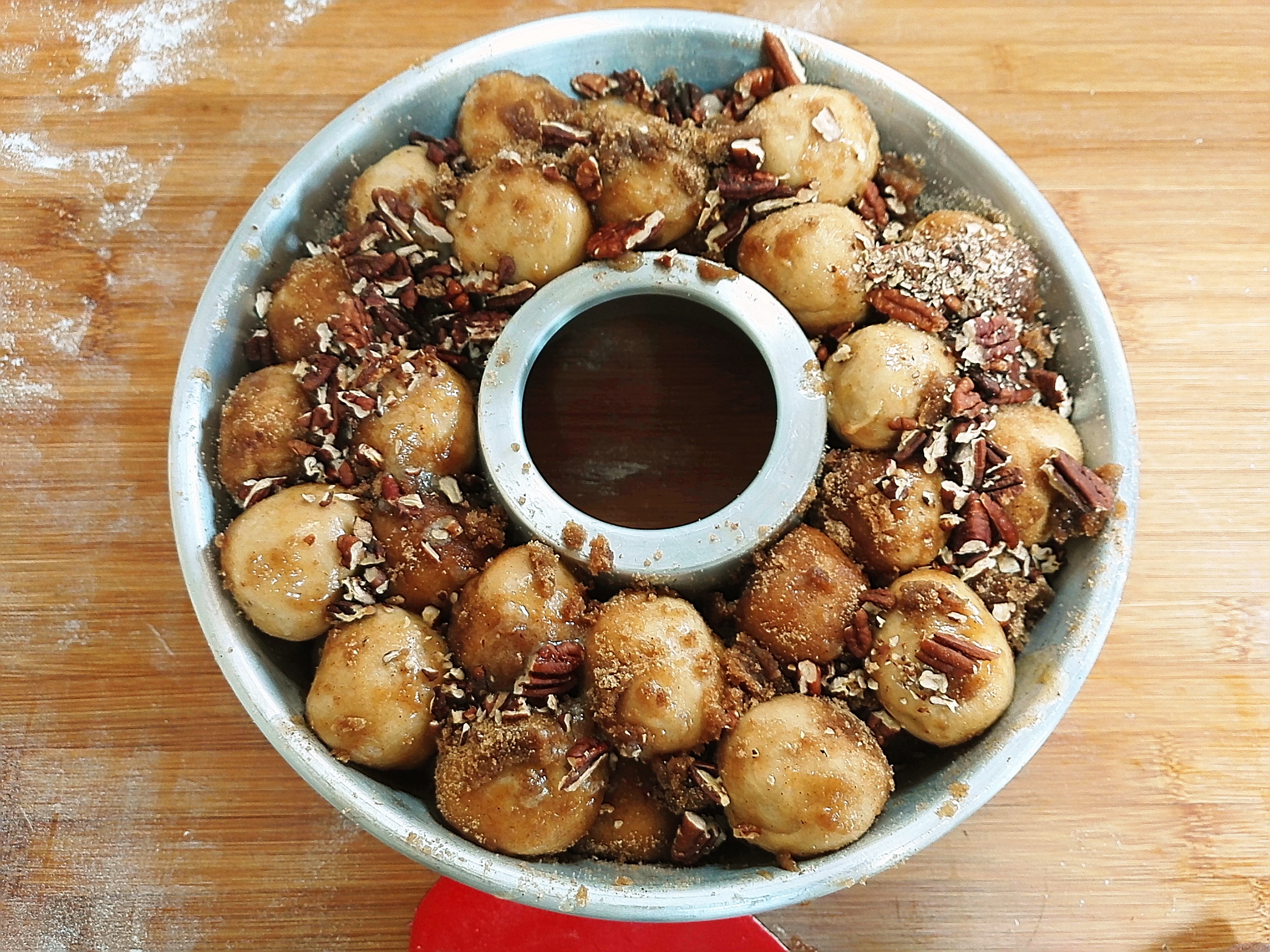
Monkey bread

In my time as a baker and sugar addict, I’ve made or consumed a vast number of rich concoctions and enriched doughs, from multinational doughnut variations to chocolate babkas. But nothing was quite as indulgent as monkey bread, something I’d not heard of until a few weeks back when a recipe by Jane Hornby popped up in a BBC Good Food newsletter.

Monkey bread is basically made with an enriched dough, with balls or chunks dipped in more butter, sugar and spices, and arranged in a ring shaped tin for baking. It is a kind of sticky, cinnamony, buttery, pull-apart, tear-and-share bread that clearly has its origins in traditional sweet, spiced buns and breads of Germany, Scandinavia, the Netherlands, and even Britain (eg the Chelsea bun). Those traditions crossed the Atlantic with migrants who settled in America, where they changed, evolved – and had gallons of butter and tons of sugar thrown at them.

The oldest print version of monkey bread is from 1945, and by ZaSu Pitts1, an American actress with a career that spanned the silent and early sound eras. While much of Europe was suffering from rationing, American was producing monkey bread. Goshy.

No one knows where it gets its name, but it’s either because it supposedly resembles the monkey puzzle tree, or because it’s like something monkeys would get in a frenzy over pulling apart. The latter seems more likely to me, as we – four adults, four little monkeys (aged 1 to 11) – ate it together, falling on it with simian fervour.

There are savoury versions or versions with dried fruit, but this one is based on Hornby’s – cinnamon, sugar, butter, some roasted pecans – and it seems closer to the classic US type. My bundt tin wasn’t quite big enough, the whole thing was absurd, and I can’t really imagine being able to justify making it too often, but it’s a pretty awesome thing to have in one’s repertoire.

Recipe

Dough
220g full-fat milk
85g unsalted butter
12g active dried yeast (or 20g fresh yeast)
50g caster sugar
2 eggs (that is, about 110g of egg), beaten
550g strong white flour
6g fine sea salt

Assembly
125g unsalted butter
12g cinnamon
4g powdered ginger
2g grated nutmeg
225g light muscovado or light soft brown sugar2
140g pecans, toasted and roughly chopped

Icing
100g icing sugar
3g vanilla essence
15g milk
5g cinnamon
30g unsalted butter, melted

Method
1. You need a bundt pan or similar ring-shaped tin, ideally 30cm in diameter.
2. To make the dough, first melt the butter and warm the milk slightly. I did this in a microwave. Stir in the caster sugar, scatter in the yeast, and leave it a few minutes to get going.
3. Put the flour and salt in a large bowl, then pour in the yeast mix and add the eggs. Of course, you can do this in a mixer. If you have a mixer, combine and mix and skip to 8.
4. Working by hand, combine everything.
5. Bring together as well as you can.
6. Turn out and knead a bit more to homogenise. more
7. Form a ball, then leave to rest again, covered, for another ten minutes.
8. Give it another knead, then cover and rest again. Repeat this once or twice more until you have a nice smooth dough.
9. In a clean, lightly oiled bowl, cover and leave to rest again, until the dough has doubled in size.
10. Prepare the bundt tin by melting the 125g of butter then using some of it to brush the inside of the tin.
11. Mix the sugar and spices, then sprinkle some of this into the buttered tin. Add a handful of the roasted, chopped pecans.
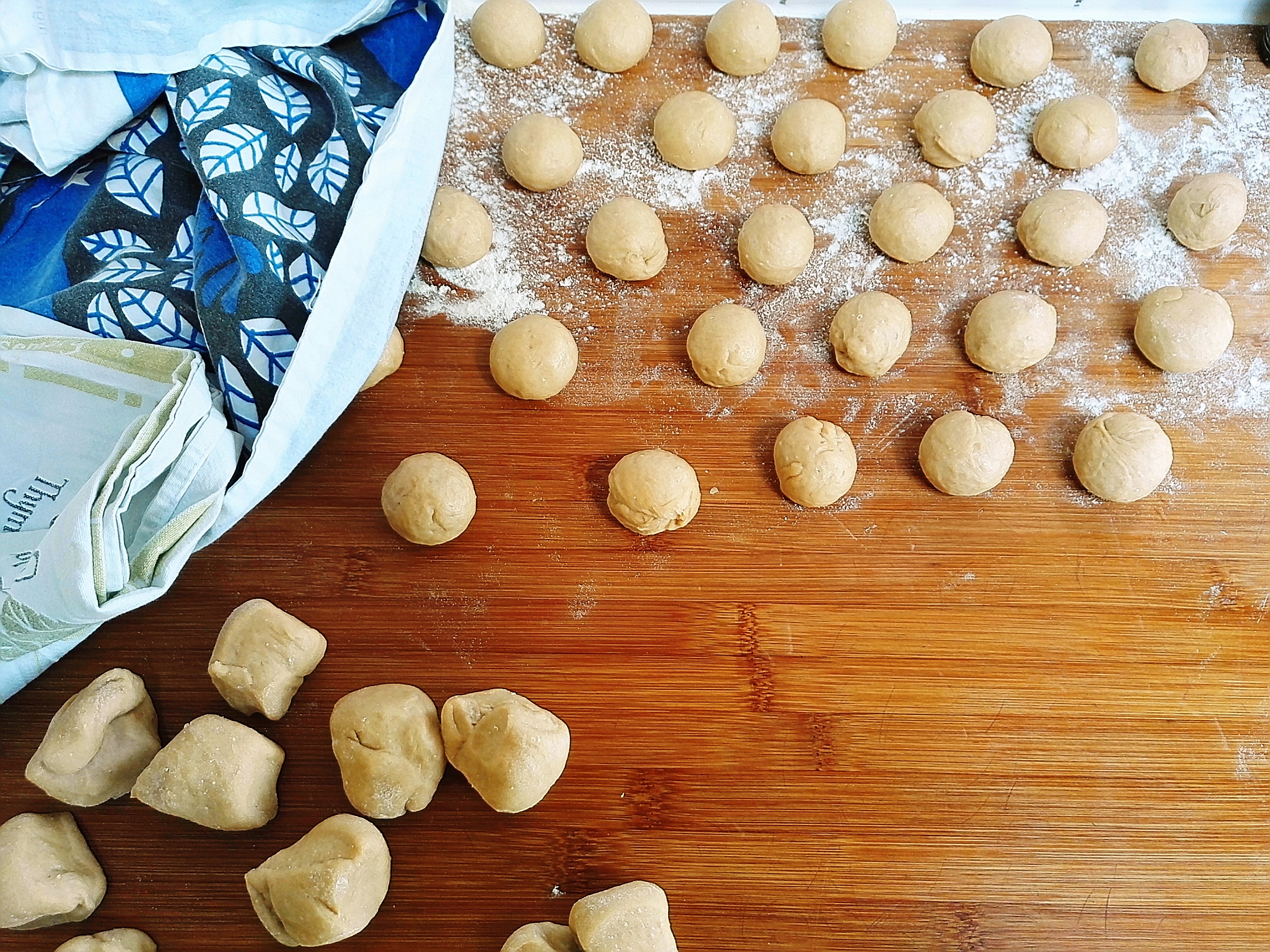
12. When the dough has proved, you need to divide it into pieces. Hornby’s recipe said 65, I went for 50 as that seemed a tad excessive. The total dough weighed about 1080g, so I divided it into pieces each weighing about 21g.

Balls of dough for monkey bread

13. Roll these into balls. You don’t really need to, but I fancied it, just cos, to maintain the technique, which involves cupping your hand over them, and rolling them on a lightly oiled worktop. If you get proficient, you can do one in each hand. Ta da.
14. Leave the balls under a cloth as you work so they don’t dry out.
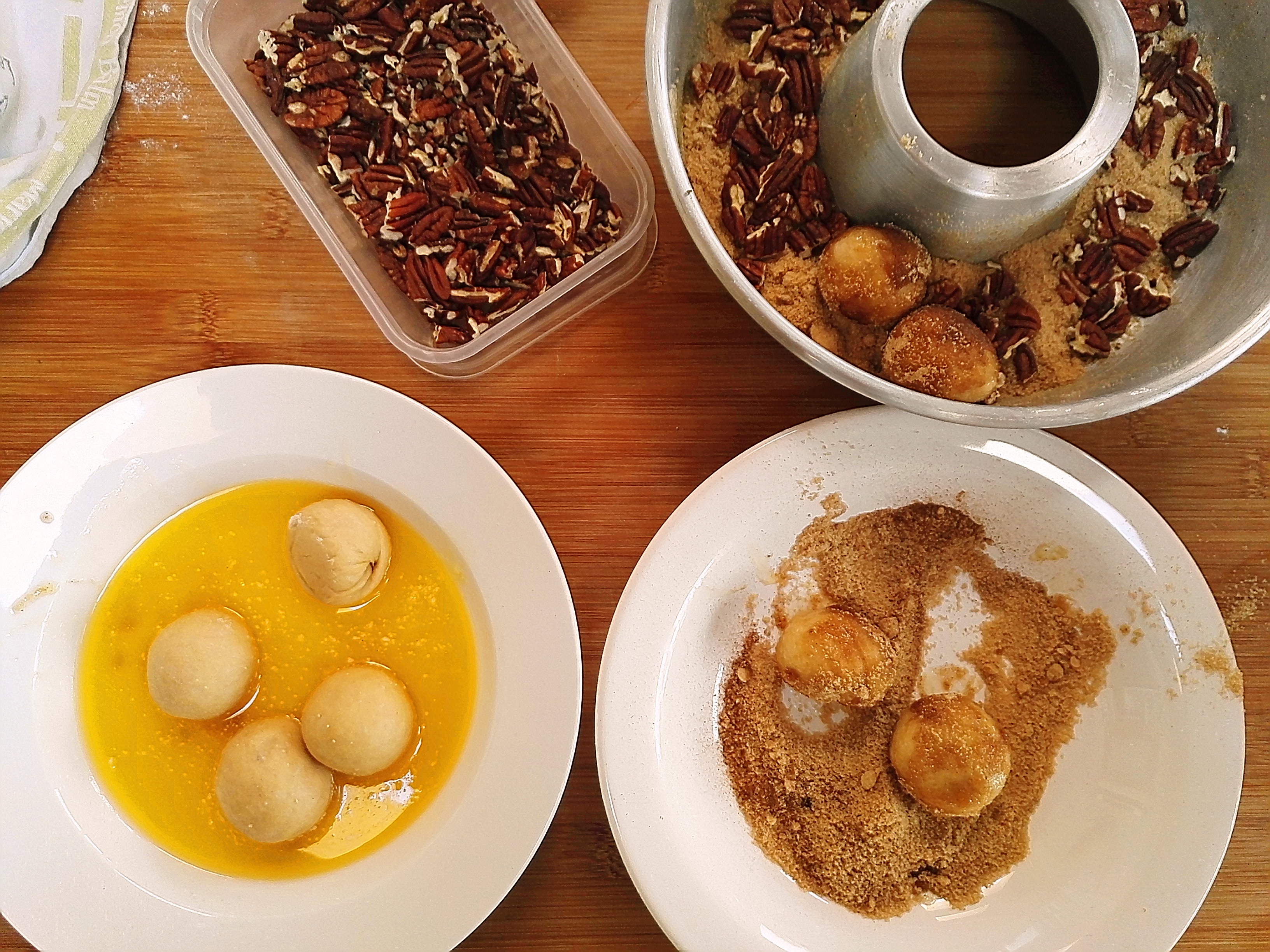
15. Put the rest of the melted butter in a flat-bottomed bowl or container, and the rest of the sugar and spice mix in another.

Assembling monkey bread

16. Roll the balls, in batches, in the butter, shake off any excess, then roll them in the sugar and spice mix. Place them in the tin.
17. Form a layer, sprinkle with more pecans, and keep going until the tin is full and balls all used up.

Monkey bread, before final prove

18. Cover again, then leave to prove one last time, until bulging and springy to the touch. Push a finger in and the dough should slowly re-expand.

Monkey bread, after final prove

19. Heat the oven to 180C, then bake the bread for about 40 minutes. Turn the oven down a bit, or cover with foil, if it’s over-browning before this time.

Monkey bread, baked
20. Leave to cool in the tin, then turn out when still warm but not hot.
21. Whisk together the ingredients for the icing then drizzle over.
22. Eat with for breakfast, with a morning coffee, as afternoon tea, or even as a dessert – which is what we did.

Good. Excessive. Indulgent. But good.

Monkey bread

Footnotes
1. More about her here. Her recipe, and more about monkey bread, can be found here.
2. I find these sugars behave pretty similarly in baking, though muscovado sugars were originally those of lower quality, and have higher molasses content.

13 Comments

Filed under Baking, Breads, Cakes (yeasted), Recipes

The gingerbread boy

Gingerbread men

Our toddler has been obsessing over the story of The Gingerbread Man recently. So it seemed only right that we started making actual gingerbread men together.

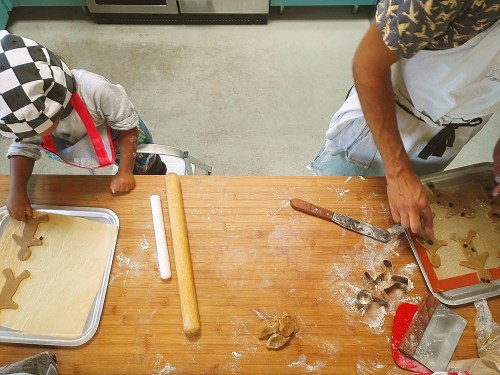
Now, every time he grabs the book for me to read, he points at the gingerbread man on the cover and says, “We make some buttons!” Handling the mixture, rolling out a soft-ish dough, doing the cutting and transferring the pieces to a baking sheet aren’t exactly jobs for a two-year-old (see previous post), but he’s very happy to be given the task of sticking currants in to make eyes and buttons. Nothing fancy. No icing decorations. It isn’t Bake Off, it’s just father-son “do making”, making something he then ardently scoffs whenever we allow.

Cake and biscuit
Gingerbread is a fairly generic name that covers both soft cakes and a cookies, but I’m talking about those distinguished in the UK and US traditions from other ginger cookies by being cut into the shape of a man. One source on Wikipedia says they were first recorded as being made in England for the court of Elizabeth I, who reigned 1558-1603. Though ‘breads’ sweetened with honey and spices are quintessential foods for feast days and celebrations and have probably been made in Europe since the Middle Ages, if not longer.

Various ginger-spiced biscuits and cakes can be found in the traditional feast day foods of much of Europe still, but notably in Britain, Germany (eg lebkuchen), Scandinavia, the Netherlands, Poland etc: that is, more northerly countries. It’s easy to imagine Medieval folks huddling round fires in the winter and very much appreciating feast day treats containing ginger, cloves etc, as such spices have a warming effect.

Dough and cutter

Sentient food
Now, before I get to a recipe, I must talk a little about the story The Gingerbread Man. I love folk stories, fairytales, Märchen. I’ve read a lot, and I look forward to the kids being old enough for me to introduce more to them. I know full well they can be illogical, macabre and confounding to the modern mind, but The Gingerbread Man is downright weird.

Here’s the gist, if you don’t know it, or need reminding. A childless couple (which obviously resonates) decide the way to overcome their sadness isn’t to, you know, visit an orphanage, but instead to bring forth life through the medium of baking. Indulging in some kind of dough-based witchcraft. I suppose it’s not unlike Gepetto carving a son out of a piece of wood in Pinocchio.

The old lady makes a gingerbread man. But rather than being a dutiful son, he leaps out of the oven, out the door, and runs off. The old woman and her husband give chase. Various other people and animals see him and join the chase. The couple want their “son” back, the others want to eat him – despite him being ambulatory and self-aware, as evinced by his taunting song: “Run, run, as fast as you can, you can’t catch me I’m the gingerbread man!”

When he reaches a river, a fox appears and offers to carry the gingerbread man across. The sentient – but none-too-bright – biscuit agrees. But the fox tricks him and in three tosses of his head, he eats him all up. Snap! Snap! Snap! And that’s the end of the gingerbread man.

The moral of the story? Who knows. Maybe it doesn’t have one. It’s suggested that folk stories teach children about life, but it’s not always clear what the lesson is. The lesson here is not to be gullible or trusting of strangers, I suppose. Or alternatively to beware hubris. Certainly, the gingerbread man is a proud fool. Arguably the hero of the story is, instead, the fox. He’s cunning, and gets the snack. Cunning is quality in many cultures (eg the Italian concept of furbismo, which kept Berlusconi in power for so long), and is often exemplified by the fox, an archetypical trickster, in folk stories.

There are other folk stories about runaway food in British, German and Easter European folklore – balls of dough, pancakes, bannocks – but the gingerbread man story appears to be a variation that evolved with migrants who settled in America.

Cutting out

Melt or rub
Whatever the origins or moral of the story, the boy loves it. Finding a recipe we could easily make together has been a minor challenge. Pre-children, I probably would have tried half a dozen recipes, but today, with two under-threes, I tried just three recipes. One from Dan Lepard’s Short and Sweet, one from Leith’s Book of Baking by Prue Leith and Caroline Waldegrave and one from Geraldene Holt’s Cake Stall (a hand-me-down from my mum with a wonderful dated 1980s cover, where Holt looks like an Edwardian).

The two main approaches for making gingerbread men involve melting together butter and sugar, then combining with flour etc, or rubbing the butter into the flour, and adding the sugar etc. The latter is easier, but frankly, the best one of the three I tried was Leith one, which involved melting. The dough was trickiest to handle, but the resulting cookies had a proper snap – suitably enough considering the gingerbread man’s fate in the jaws of the fox.

Making the dough (or paste), then cooling it in the fridge to firm it up and relax the proteins isn’t exactly ideal if you have a small child chomping at the bit to “do making” right now! I tried to lull young T-rex by putting The Jungle Book on (it was a rainy day) but it still wasn’t ideal. So I suggest making a batch of the dough in advance, then freezing some or leaving it in the fridge until the optimal “do making” moment in your day.
Decorating

Recipe
This is based on the Leith version, but tweaked somewhat.

If you’re doing this with a small child, make the dough in advance to give it time to cool, so you can do the rolling, cutting and baking in one hit.

225g unsalted butter
200g caster sugar
160g soft dark brown sugar
350g plain flour
6g baking powder
3g fine sea salt
3g ground cloves
12g ground ginger
2 eggs, beaten (that is, about 110g beaten egg)

1. Melt together the butter and both sugars, stirring and cooking until the sugar has all dissolved.
2. Take off the heat, allow to cool slightly, then beat in the egg.
3. Sieve together the flour, baking powder, spices and salt.
4. Put the sieved mixture into a bowl then gradually add the butter, sugar and egg mix, combining to form a homogenous mixture.
5. It’s a very soft dough, so put the bowl in the fridge to cool it completely. Then you can divide the mixture into slabs, and keep one in the fridge for a day or so until you want to do the baking. You can also freeze it.
6. When you’re ready to roll, heat the oven to 180C and line baking sheets with parchment or silicone.
7. This dough warms up easily and gets soft, so to cut out the gingerbread men, do it in portions. Roll to about 4-5mm thick and cut out your men. We have a cutter about 13cm tall by 8cm armspan. Decorate with currants for eyes and buttons if you like.
8. Place on baking sheets lined with parchment or silicone, with enough room for some spread, and put in the oven. Note, this dough will spread slightly, especially if you’re oven isn’t quite hot enough. (What the knobs says and the actual temperature inside are very likely to not be the same if you have a domestic oven, so I recommend an oven thermometer.)
9. Bake for about 10-12 minutes until nicely brown. Leave to firm up on the tray for a few minutes then transfer to cooling racks and allow to cool completely. They should crisp up as they cool.
10. Satisfy the obsession of toddler. Briefly.

This is, obviously, a tricky area. I love to bake; he loves sugar; I try to be a responsible parent and not allow him too much. I want to nurture a sane relationship with food, where sweets are treats. This is a challenge as refined sugar is so addictive small children rapidly get crazy for it, something that’s exploited by the food industry and insufficiently regulated. Just look at breakfast cereals, some are a third sugar or more. But that’s another story, another rant. Run, run as fast as you can, I’m a two-year-old on a sugar rush….

4 Comments

Filed under Baking, Biscuits, cookies, Discussion, Parenting, Recipes

Brioche: not just a buttery French breakfast

Sicilian brioche

One of the projects I set myself last year was to perfect brioche. Specifically, I wanted a recipe where I could give a final prove overnight then bake in the morning to have for breakfast. I haven’t achieved that yet as the research is proving seemingly endless.

In many ways, brioche is the classic enriched dough. An enriched dough is a standard bread dough – yeast, water, flour, salt, time – that’s been made into something more indulgent by the addition of sugar, eggs, butter etc. Indeed, I always thought butter was pretty essential. But when I started looking at recipes, I realised there was enormous variation.

I already knew it was a bread that came in many forms – personally I’ve done tin braids, freeform braids (like challah), rings, and the classic Brioche à tête or parisienne, with the smaller ball on top of a large ball, usually baked in fluted tins. The variation, however, goes beyond the shape. I’ve got a list of 20-plus recipes, with the first eight alone coming from the 2011 Phaidon English version of Ginette Mathiot’s The Art of French baking, first published in the 1930s in France as Je sais faire le pâtisserie (“I know how to make patisserie”). There’s classic brioche, rich brioche (lots of eggs and butter), poor man’s brioche (very little butter and egg), brioche with no butter but crème fraîche instead, a brioche leavened with baking powder not yeast (and therefore more cake than bread) and even a Norwegian brioche (no eggs; peel and dried fruit).

The recipe I’m doing here, however, is another variation, from Sicily. Naples and Sicily have historical connections to France – not only did Normans invate Sicily around they same time they conquered England (what an incredible logistic achievement), but there was a 15th century invasion and claim to the throne, and a Napoleonic Kingdom in the 19th century – which in part explains a French influence in their baking traditions. Notably in the presence of brioche. I don’t know these parts of Italy, but I’m aware of the stupendous idea of eating small brioche as a kind of gelato sandwich, or with granita.

Interestingly, this brioche, based on the version in La cuccina Siciliana by Maria Teresa di Marco and Marie Cécile Ferré, doesn’t even contain butter. It’s instead made with lard, strutto. It’s called “Brioche con il tuppo di Nonna Adele”. So many Italian recipes seem to originate with someone’s nonna (grandmother).

A tuppo is a chignon, though it may also be related to tappo – plug, cork, stopper. Di Marco and Ferr also give the dialect variation tuppitieddu, which may be Catanese – from the port of Catania. Which is all getting a bit much for me with my basic linguistic skills.

250g strong white flour
250g plain flour
200g milk, tepid
80g caster sugar
75g lard, softened (or butter, see below)
2 eggs, about 110g beaten egg
15g fresh yeast (or about 8g active dried yeast)
3g fine sea salt
5g vanilla essence, or to taste
1 more egg, lightly beaten, for the glaze

1. Combine the flour, sugar and salt in a bowl.
2. Dissolve the yeast in the milk, then add this to the flour.
3. Add the vanilla and the salt and blend.
4. Add the softened lard and keep blending.
5. Keep working to achieve an elastic dough.
6. Rest the dough in the fridge, covered in plastic, for at least 6 hours, up to about 10.
7. Take the dough out of the fridge. The total dough weight should be about 1kg. Divide into 10 pieces, each scaled at about 100g.

Form bigger and smaller balls

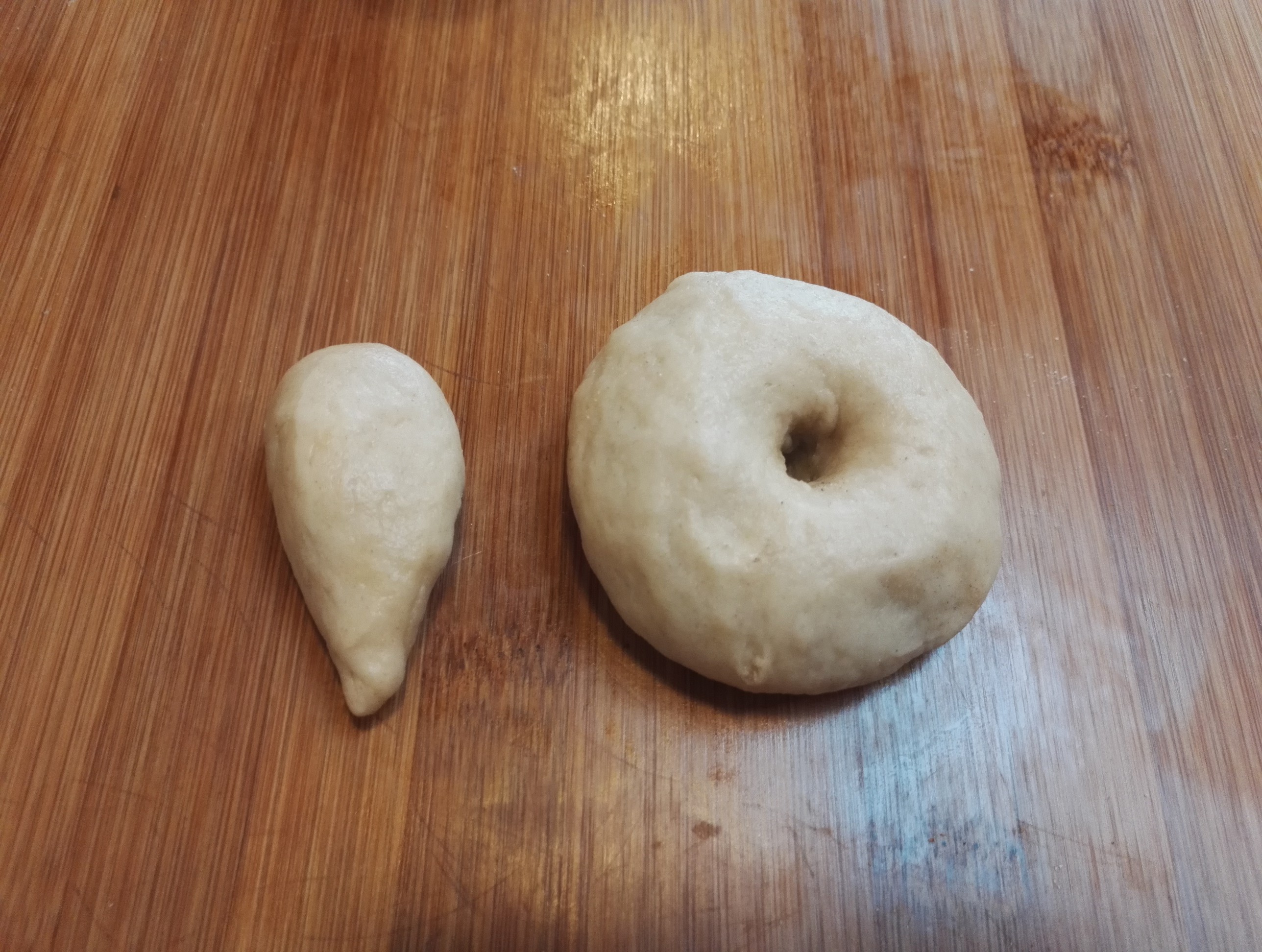
8. Take pieces, about 20g, off each ball to form “u tuppitieddu”. Form small balls.

9. Tighten up the balls. Then roll the smaller ones into a teardrop shape.

Form teardop shape and poke a hole in larger ball

10. Form a hole in the top of each of the bigger balls with your finger then insert the teardrops, pointy bit first. Make sure they’re well attached or they can fall off.
11. Put on baking sheets, cover with a cloth and leave to rise until doubled in volume, around an hour, hour and a half in a warm-ish kitchen.
12. Preheat oven to 180C.

Prove up and brush with beaten egg

13. Brush the buns with beaten egg then bake for about 15 minutes.

Now, I must say, I like these little brioche, the shape is fun, and I can imagine they’d work well with gelato or granita. As a breakfast bun, however, the lard quality isn’t half so nice as buttery brioche. It just feels like something’s missing.

Historically, poorer people may have had a pig, and therefore pig fat, as they can be kept in small spaces and eat almost anything. Dairy fats, on the other hand, require grazing – and land ownership was the preserve of the wealthier. So I can see how a lardy brioche might have evolved among Nonna Adele’s ancestors and their demographic peers. But these days, when we can easily buy butter, frankly, I’d use that instead. Unless you particularly like lard.

Oh, and apologies if my blog updating is a little haphazard these days. Not only did my computer just die an unfortunate death, forcing me to try and cope with Fran’s aged, badly maintained old laptop, but we’re also in the process of expanding our family. Big changes afoot.

13 Comments

Filed under Baking, Breads, Recipes

Sabbiosa, a cake from Lombarby

Sabbiosa cake

It’s taken me a long time to make this cake from Lombardy in northern Italy, whose name roughly means “sandy” – perhaps a reference to both its colour and its texture. I first saved a page out of the Independent newspaper back in 1999, with a recipe from Simon Hopkinson. He explained how he’d first eaten sabbiosa in 1984 but when he’d first tried to make it there had been some confusion about the type of flour used.

Via an erroneous translation, he laboured under the impression that the flour was corn starch, or what we know in British English as cornflour. Instead, however, it’s a potato flour. In Italian this is fecola di patate, which is translated on Wordreference as both “potato starch” and “cornstarch”. Given that patate is potato, it’s clearly not corn (ie maize) starch – which in Italian is amido di mais.

Adding to the confusion, Hopkinson gives his ingredient as “potato flour” – which some sources, such as this site, say is an entirely different ingredient to potato starch. There’s some logic to this, but Italian sources tend to just refer use fecola as a synonym for farina di patate, potato flour. Italian Wikipedia saysLa fecola di patate is a flour obtained from the dehydration and subsequent grinding of potato.”

Potato or wheat?
Furthermore, a lot of the Italian recipes I’ve seen for sabbiosa are simply made with wheat flour. I’ve had Hopkinson’s version filed for 17 years, so I wanted to stick with potato. I’m not going gluten-free or anything, heaven forefend, gluten is such a marvellous, useful protein* when treated right. But during a visit to Roma last week, I saw some fecola di patate in the shop at the Città dell’Altra Economia, which forms part of the Ex-Mattatoio, the handsome, sadly neglected 19th century former slaughterhouse, so I had to get it. In UK health food shops, the equivalent does seem to be called simply potato starch.

The other distinctive Italian ingredient I’ve used here is Lievito Pane degli Angeli (“Bread of the Angels leaven”!). This is just a brand of baking powder – a chemical blend of difosfato disodico (disodium diphosphate) and carbonato acido di sodio (sodium bicarbonate), much the same as my UK baking powder. Though the degli Angeli brand has a punch of aromi – flavourings. Rachel, who we saw last week, loves this stuff, and was enthusing about its miraculous qualities, but I find the aromi a bit pungently vanilla, and I’m suspicious whether it’s even real vanilla or some synthetic flavouring. Either way, if you’re using non-flavoured raising agent, you can add say a teaspoon or two (to taste) of real vanilla extract if you like.

The cake recipe also contains booze, which is similarly optional. Also optional is a mascarpone crema, made with raw eggs, much like that used in many tiramisu recipes. If you’re scared of raw egg, serve with cream, custard or even crème fraîche. Or nothing, for a weary nod towards tedious New Year dietary abstention.

The recipe

Ingredients for sabbiosa

400g unsalted butter, softened
400g caster sugar
400g potato starch, aka potato flour, aka fecola di patate
10g baking powder
Pinch salt
4 large eggs, beaten, about 225g
35g brandy (optional)

1. Preheat the oven to 180C.
2. Grease and line the base of a 25cm tin.
3. Beat together the butter and sugar until light and very fluffy.
4. Combine the beaten egg with the brandy (if using).
5. Beat the egg into the creamed mixture, adding a little of the potato starch if it starts to curdle.
6. When the egg is all combined with the creamed mixture, sieve in the potato starch and baking powder, and add the pinch of salt.

Making sabbiosa with potato starch
7. Fold the fecola through the batter until well combined.
8. Pour the mixture into the prepared tin.
9. Put in the oven and bake for about 45 minutes then, carefully, check the cake to see if the top is browning. If it is, cover with foil, then return to the oven.
10. Continue baking for until a skewer comes out clean, for another half hour or thereabouts.

Sabbiosa - leave to cool in the tin
11. Leave to cool in the tin then turn out onto a rack and cool completely.
12. Prepare the accompanying cream.

Mascarpone cream (crema di mascarpone):

2 eggs
250g mascarpone
70g caster sugar
20g rum or brandy, to taste (optional. Either leave our use some other booze. I used some bourbon as it smelled like it’d be nice… and it was!)

1. Separate the eggs.
2. Beat the yolks with the sugar until pale and creamy.
3. Beat in the mascarpone and booze (if using)
4. In another bowl, whisk the egg whites to stiff peaks.
5. Fold in the egg whites until you have a smooth mixture.

Dust the cake with icing sugar and serve slices with a good pour of the crema. Muse about the potatoes. Ignore new year diets.

Sabbiosa with mascarpone crema


* Or more accurately, combination of proteins: gliadin and glutenin.

13 Comments

Filed under Baking, Cakes, Recipes

Papassini biscuits – and lard

Papassini biscuits

Let’s be honest: lard isn’t a popular ingredient. It’s not fashionable, even in this era of nose-to-tail eating. Even when the media, from Britain’s Daily Bile Mail to the US Huffington Post, is running articles on lard’s virtues. It’s still got an image problem.

And yet, it’s a fat we cooked with for centuries, especially here in northern Europe, where we can’t grow olive groves and peasants may have had a pig but were less likely to have had dairy. Look at any collection of older – say pre-WW2 – British recipes and lard is ubiquitous. Not just as a fat for frying, but also as the main fat for making pastries and baked goods. The only legacy of this tradition most Brits are aware of these days is lardy cake. I talked about this subject back in April 2014, when making lardy johns, an ostensibly old Sussex recipe that’s a cousin to the scone.

Back then, I couldn’t get my hands on any decent lard. As Marwood Yeatman says in The Last Food of England, “A modern porker has little fat and therefore little lard, so most of it is imported”. The only stuff I could get hold of was from Ireland. Last week on a Sunday market here in Lewes, I was pleased to see Beal’s Farm, our favourite supplier of locally produced charcuterie and salumi, whose pancetta was a joyful discovery when we moved home from Rome, has started selling their own lard. Indeed, I wasn’t just pleased, I was excited! Quality lard! I’d been making a lot of game pies with a hot water crust, and this pastry is best made with lard.

Yes, even in the Mediterranean diet
It’s not just northern European foods that are traditionally made with lard though. The past month or so I’ve been researching and developing products for my Italian-oriented biscuit stall. I wanted to focus on Christmas and festive products last week, and one product I made was papassini.

Also called pabassini, pabassinas, pabassinos and papassinos in various Sardinian dialects, these are biscuits made for not just Christmas but also Ognissanti (All Saints, 1 November) and that other principal Christian festival, Easter. Pretty much all the Italian (nay Sardinian) recipes I read used strutto – lard. Only a few used butter.

I made my first batch with Beal’s lard, and they were great. The mix is pretty much a pastry, enriched with fat, sugar, spices and some fruit – sultanas or raisins. The name papassino, according to Italian Wikipedia, comes from papassa or pabassa, Sardinian for uva sultanina, a type of grape, that is dried to become sultanas1 . The lard gave them a nice fairly delicate crumb. I also made them using Trex, hardened vegetable oil. Where vegetable means palm.

This is the sort of ethical conundrum we face in modern life – eat a meat byproduct from local, well-husbanded pigs or eat a veggie alternative made from an ingredient that’s most likely grown in a corporate plantation that required the destruction of rainforest. The results weren’t as good either.

So I experimented with butter versions too, notably for the market, where I didn’t want to have to worry about repeatedly explaining why certain products weren’t vegetarian. Which seems faintly daft, but we live in complex times for food. In many ways, industrialisation and intensification have thoroughly messed up our relationship with food, resulting in innumerable dietary inclinations, phobias, rampant orthorexia nervosa, intolerances, allergies and imagined allergies. A whole slew of first world worries.

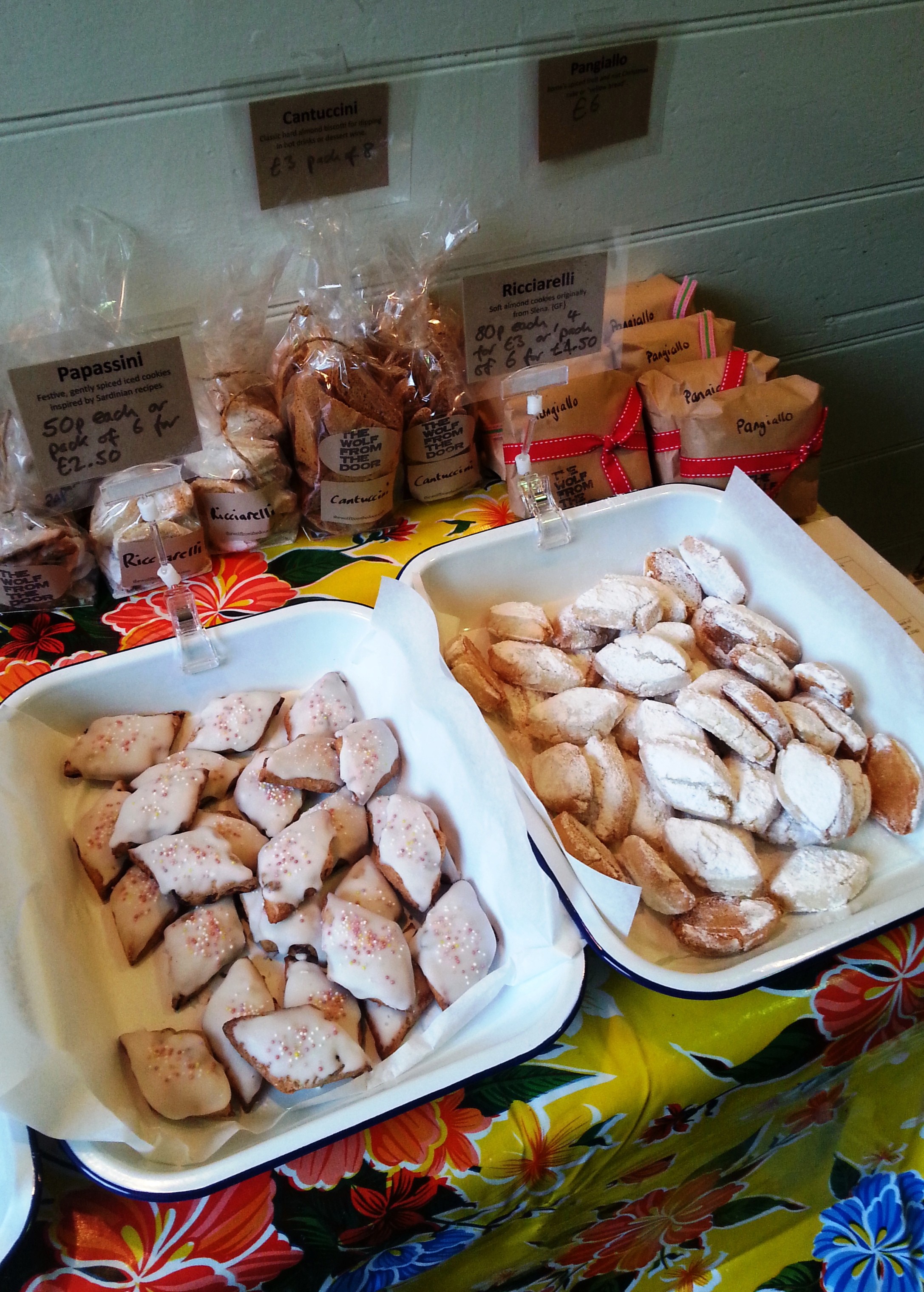
Papassini on my market stall, along with riciarelli, pangiallo and others

Anyway, butter was pretty good too. I mean, I love butter. I would say the result was similarly crumbly, slightly sweeter. But then all the biscuits were sweet once I’d iced them. I just iced them with a basic water or glacé icing – that is, icing sugar2 and water, or lemon juice. More “authentic” recipes would be topped with an Italian meringue glaze, but that wasn’t entirely practical for me.

Another note on “authenticity” – the grapiness of these biscuits would also have been enhanced with sapa/saba. This is a kind of grape syrup, also known as vino cotto (“cooked wine”) and mosto cotto (“cooked grape must“). It’s an ingredient that has been made for millennia. Imagine a grape cordial, or a kind of sweet cousin to balsamic vinegar. You can produce a semblance by simmering grape juice to thicken it, but frankly almost none of the papassini recipes I researched used it so I didn’t bother.

So yes, these are in no way authentic, but I’m not Sardinian. That said, as with any Italian recipe, every family or baker or pasticcere would have differences of opinion and ingredients, so I would like to think mine are just another variation on a theme. Ideally made with quality Sussex lard.

250g plain flour
6g baking powder
80g ground almonds
100g caster sugar
120g lard or butter
50g walnuts, chopped fairly finely
80g sultanas or raisins
Zest of half a lemon
Zest of half an orange
2 eggs, lightly beaten, QB3 (about 120g)
4g cinnamon
4g fennel seeds

Icing
Icing sugar, sieved
Water or lemon juice
Hundreds-and-thousands, sprinkles

1. Soak the sultanas or raisins in hot water for about 10 minutes then drain and squeeze out any excess water.
2. Sieve together the flour and BP.
3. Dice the fat and rub it into the flour, or blitz in a food processor, until the mixture is crumb-like.

Papassini mixture
4. Add the ground almonds, sugar, walnuts, sultanas and zest.
5. Add the egg and bring the mixture a dough. If it’s too dry, add a little more egg or some milk.
6. Form into a disc or slab then wrap in plastic and leave to rest for at least half an hour.
7. Preheat the oven to 180C.

Cutting papassini dough into diamonds
8. Roll out the dough to about 10mm thick.
9. Cut diamond shapes.
10. Reform the offcuts and keep cutting more diamonds.
11. Bake for about 10-12 minutes.
12. Cool on a rack, then ice. If you’re doing the easy option like me, just sieve icing sugar and add a little water or icing sugar to form a smooth mixture, not too runny. Dip each biscuit in the icing, then sprinkle with hundreds and thousands.


Notes
1. I think; I never really got my head around English-Italian translations for sultana, raisin, etc. I believe a raisin is uva passa – literally “past” or “spent” grape. I’m more confused by uva sultanina, which may be both the grape and the sultana. I’m not sure, and I can’t go to an Italian dry goods store or supermarket or market to check very easily from here in Lewes. Hope to get back to Roma after Christmas, so I’ll have to try and remember to see if I can work it out then. Heck, all this confuses me, even in English. Until embarrassingly recently, I though currants were dried black- or red-currants, when they’re actually also dried grapes too. I suspect the Italian words are often fairly generic – so uvetta (literally “little grape”) can be used for currant or raisin, or people use different words in different regions.
2. Powdered sugar, confectioner’s sugar, zucchero a velo.
3. Quanto basta, “how much is enough”. Ie you may not need all of it, just enough to achieve the desired consistency.

8 Comments

Filed under Baking, Biscuits, cookies, Feasts, Recipes

St Nicholas pudding

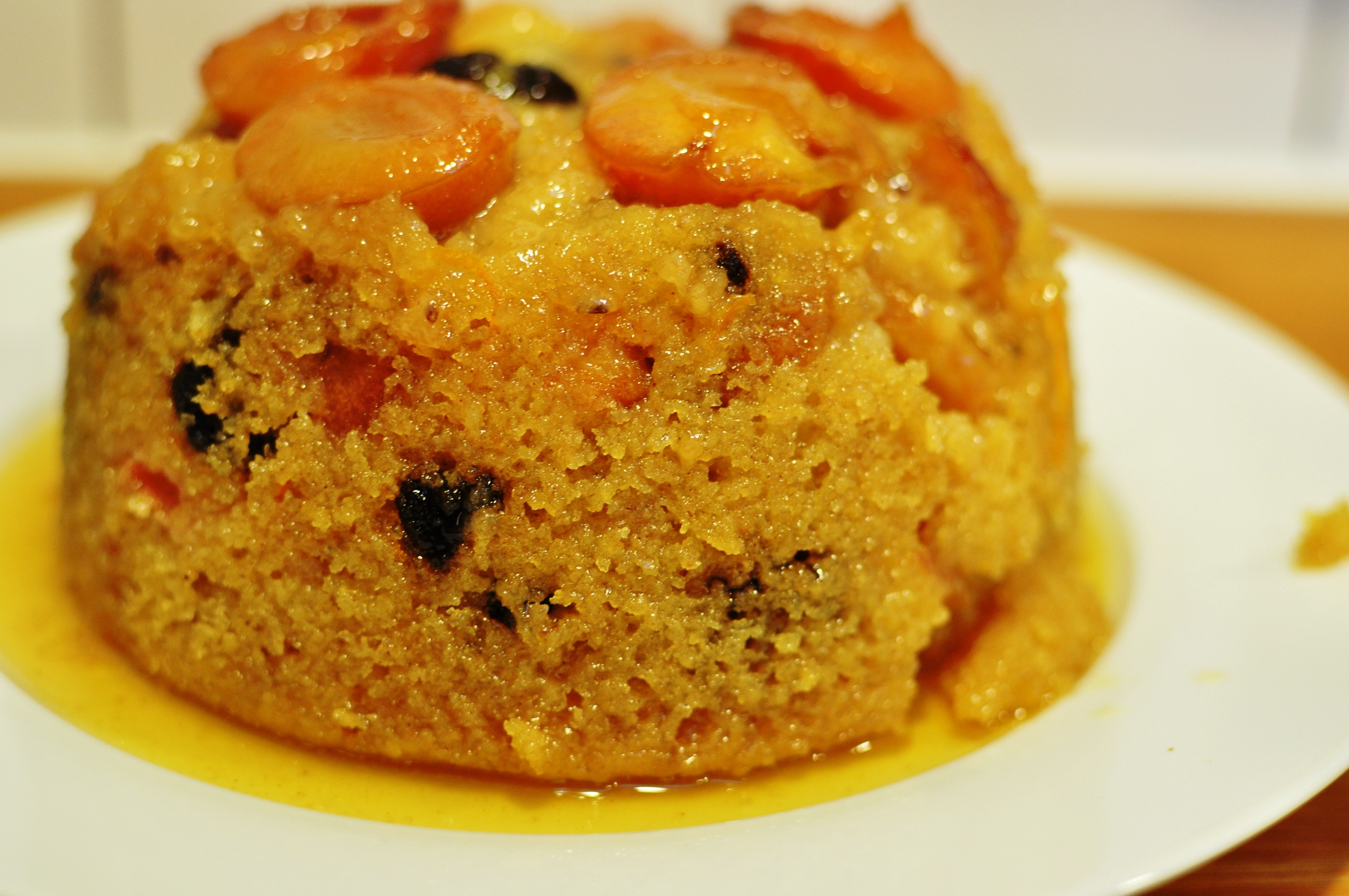
St Nicholas' pudding

Christmas is looming. Father Christmas, or Santa Claus, is waiting to do the impossible and deliver gifts to millions of kids on Christmas Eve. Santa is a slightly baffling modern evolution of St Nicholas, who was in fact born to a Greek family, in what is now part of Turkey but was then part of the Roman Empire, in the late 3rd century.

St Nicholas’ feast day is actually 6 December (in Western Christianity; 19 December in Eastern Christianity) and in many cultures that date is still a big deal, with celebrations and special baked products: speculoos biscuits in the Netherlands; ciastka miodowe, honey cakes, in Poland; and vanilkove rohlicky, vanilla crescent biscuits, in the Czech Republic, among others. Even here in England there was apparently1 a traditional pudding – though I can’t imagine many people still make it for 6 December. Which is a shame, as it’s rather good, and could even make a good alternative to the traditional British Christmas pudding – a heavy, alcohol-infused concoction I’ve never liked.

Traditional British Christmas pudding is often called “plum pudding” – though its main fruit component is raisins, not plums. It gets the name as in older English “plum” was used to mean raisin, or dried fruits in general. St Nicholas pudding, on the other hand, is a genuine plum pudding.

I’m slightly confused by this as the plums on our Victoria tree were all ripe in August, and while there are later varieties, any fresh plums in early December would surely have been imports – but importing fruit was a less commonplace activity in Olde England than it is now in our industrial, seasonality-quashing modern world. More likely, it used prunes – dried plums. This recipe uses both. Luckily I had 3kg of our plums stoned and frozen from August.

Prunes and plums

Like Christmas pudding, this is a steamed pudding2 so it’ll need a good 2 hours cooking time. Plan ahead!

125g butter
125g caster sugar
1 orange, zested and juiced
2 eggs, lightly beaten
90g plain flour
8g ground cinnamon
4g ground cloves
4g baking powder
50g breadcrumbs
200g plums, stoned
60g prunes, stoned and chopped
80g golden syrup
About 6 more plums or prunes, stone and halved

Sauce
750g plums
240g caster sugar

1. Cream together the butter and sugar.
2. Add the zest of the orange.
3. Add the egg a little at a time.
4. Sieve together flour, baking powder and spices, and add to the mixture, along with the breadcrumbs.
5. Fold to combine.
6. Add the orange juice, plums and prunes and mix gently until well-combined.
7. Grease a pudding basin, then put the 80g (two generous tablespoons) of golden syrup in the bottom.
8. Arrange the halved 6 plums or prunes in the syrup.
9. Spoon the batter onto the top.
10. Seal with foil and tie.

Seal the pudding basin with foil and string

11. Steam for approx 2 hours.
12. Make the sauce by slicing plums into saucepan, with a little water. Simmer until well softened then puree by putting through a mouli, or blending and putting through a strainer.

Caramelise the sugar
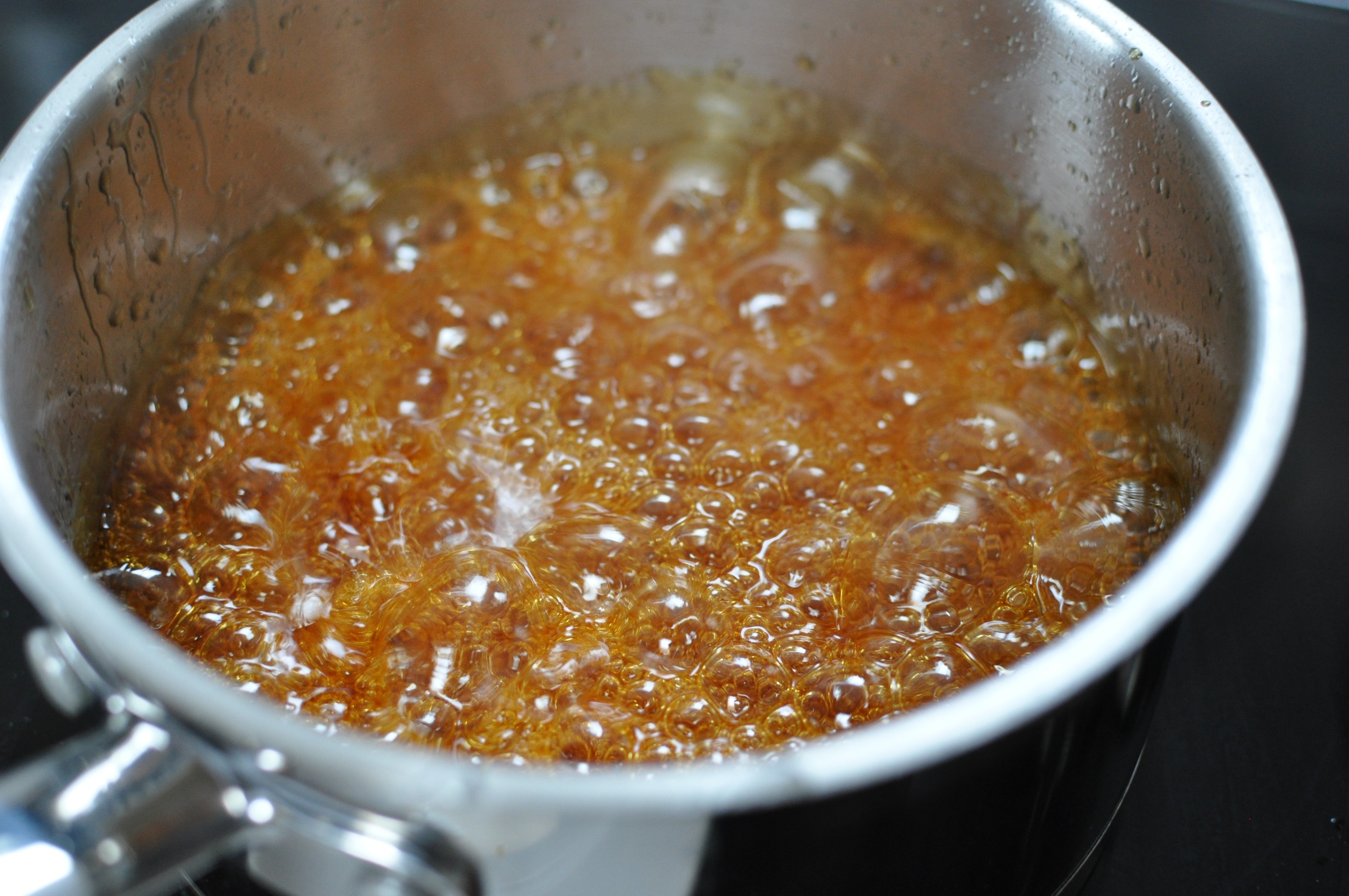
13. Dissolve the sugar with about 60-80g water. When it’s dissolved, turn up the heat and boil to caramelise slightly. Remove from the heat, stir in about 60-80g more water – carefully, as it’ll spit.
14. Add the plum puree to the syrup, and stir well to combine. You can add some booze if you like – port, Kirsch, a dash of brandy.
14. Check if the pudding is cooked by lifting the foil and sticking in a skewer; it’s basically a moist cake, so the skewer won’t come out clean – but nor should it come out with bits that still resemble batter. If it’s still battery, keep steaming.
15. When the pudding is cooked, turn it out onto a plate and serve with the sauce.

You could even serve with some cream or vanilla ice cream, if you’re feeling really indulgent. It’s a lovely pud, with the orange, and possibly the caramelised sugar, tempering the sweetness of the sugar and syrup and adding some bitterness.

Portion of St Nicholas' pudding

1 I say apparently as although a recipe appears in my 1997 copy The Pudding Club Cookbook, and that one is essentially copied in Cooking With the Saints (Ignatius Press, 2001), I can’t find any mentions of the pudding in my books of older traditional British recipes.
2 OK, some Christmas puddings are boiled still. See this post for more discussion of just what is meant by “pudding” and its history.

8 Comments

Filed under Feasts, Puddings & desserts, Recipes

Parkin for Bonfire Night 2015

Parkin

Parkin is one of those quintessential historic British cakes. Specifically northern English, as it’s most associated with Yorkshire and Lancashire. It’s related to ginger cake, in that it usually contains some ground ginger and cinnamon, popular but expensive spices for much of British history, often reserved for Autumn and winter cakes made for feast days. Parkin is also associated with Bonfire Night, Guy Fawkes, 5 November.

Yes, I realise Halloween has come and gone and I didn’t post anything, but on that count I would say that firstly, when I was a kid, Bonfire was always a much bigger event in England, and it still is here in Lewes, “Bonfire Capital of the World”, and, secondly, I did make a lot of stuff over Halloween weekend, but none of it was exactly suitable for publication. I had my first go an Mexican pan de muerto (“bread of the dead”) and while it all looked relatively OK going into the oven, when it came out the skull and crossbones decorations had slipped and it looked more like pan de tortuga, er, tortoise bread. So I’ll be practising that more for next Halloween.

Anyway, back to parkin and Bonfire Night. Unlike classic ginger cakes, parkin is made with oatmeal, or a mix of oatmeal and wheat flour. For centuries in Britain, oats and barley were staples of the poor, over the more expensive wheat, and this cake is a record of that legacy.

This is another one of those recipes where I can’t remember the source, beyond it being something I wrote down in a notepad while living at Old Man Mountain in New Zealand, this time during a 1997 visit. It’s pretty similar to other recipes you may encounter, such as this one from Dan Lepard in the Guardian, which he reports dates from 1907, this one on the BBC site, and this one at Deliaonline. I’d ignore this one on the Beeb though, as there’s no sign of oats – very inauthentic!

Talking of authenticity, older recipes would also have been made with lard instead of butter, though lard isn’t that popular these days, so it’s up to you really. Reading the moaning and trolling on the BBC site, some find eggs contentious too, but hey, there’s only so far you’ll want to go to recreate that 18th century peasant experience right? Oh, and if you’re in a part of the world where you can’t get golden syrup or treacle, you could try substituting honey for the former and the latter is just a type of molasses.

Black treacle and golden syrup

Ideally, this is made at least a day in advance. Parkin has a pretty dry crumb but becomes moister over time.

Happy Bonfire! I’ll be enjoying this with some Harveys Bonfire Boy ale.

225g plain flour
1/2 tsp bicarb soda
1/2 tsp salt
1 tsp cinnnamon
1 tsp mixed spice
1 tsp ground ginger
200g medium oatmeal
140g lard or butter
110g soft brown sugar
110g golden syrup
110g black treacle
1 egg
140g milk

1. Grease and line a square tin, 20 or 23cm square (8-9 inch) or similar.
2. Heat oven to 160C.

Parkin, sieve flour and spices

3. Sift together the flour and spices into a bowl and toss in the oatmeal.

Combine dry and wet

4. Melt together the fat, sugar, syrup and treacle.
5. Add buttery mix to dry mix then beat in egg and milk.

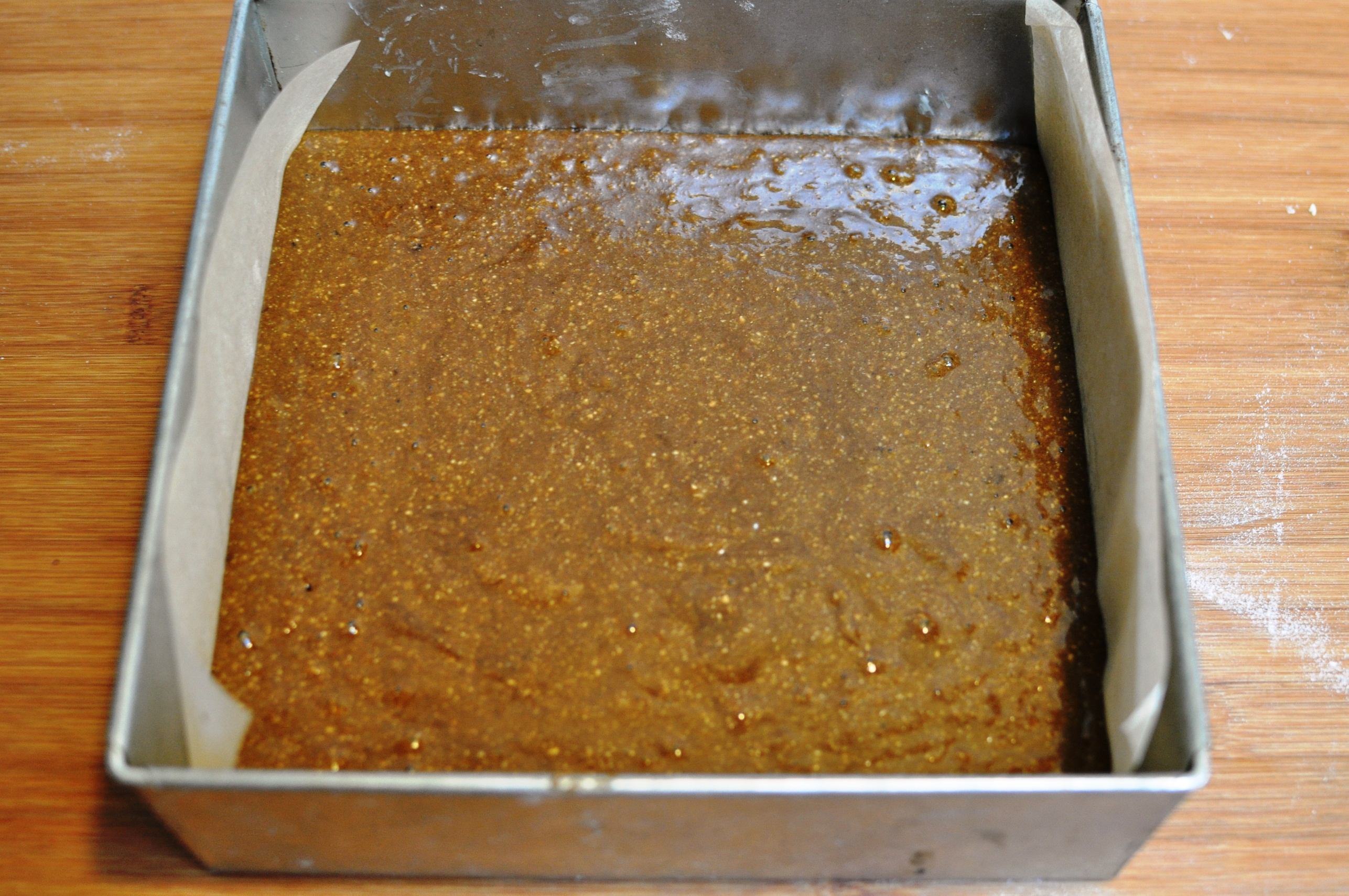
Pour into tinBaked
6. Pour the batter into the tin and bake for about an hour or more, until firm and a skewer comes out clean. Cover with foil if top browning too much.
7. Leave to cool.
8. Store in an airtight container for 1 day before cutting and serving.


5 Comments

Filed under Baking, Cakes, Recipes